
A complete issue · 16 pages · 1885
Judge — May 23, 1885
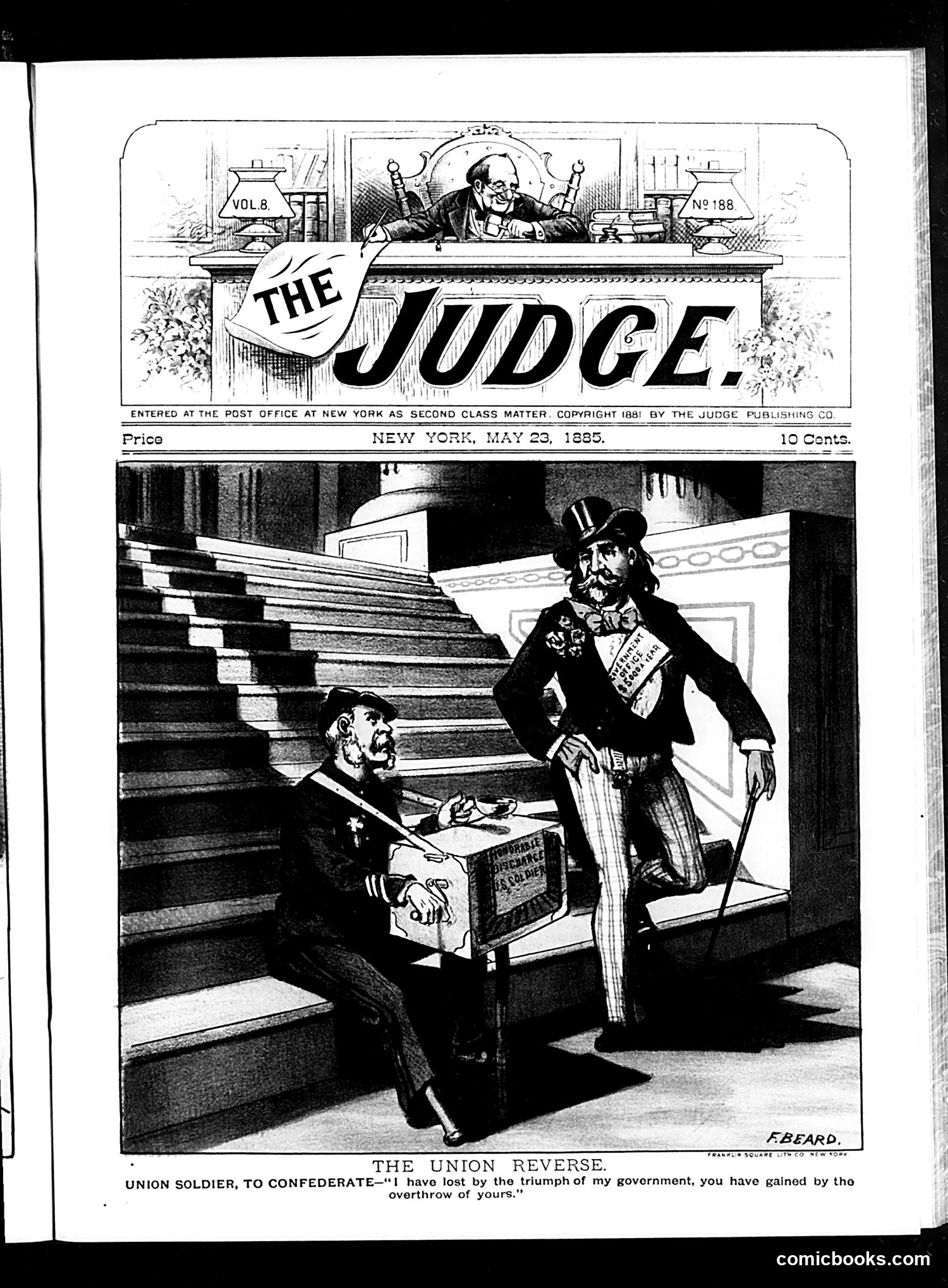
This page contains a single political cartoon titled "The Union Reverse," drawn by F. Beard. It depicts two military figures on grand stairs: a Union soldier (seated, appearing dejected) and a Confederate officer (standing, in formal dress). The caption quotes the Union soldier telling the Confederate: "I have lost by the triumph of my government, you have gained by the overthrow of yours." The cartoon sarcastically critiques Reconstruction-era politics, suggesting that despite the Union's military victory in the Civil War, former Confederate leaders gained political power or influence in the post-war period—while Union soldiers faced hardship. This reflects late-1880s frustration that Southern Democrats had regained control despite Northern victory.
This page from *Judge* (a Republican satirical weekly) contains editorial pieces criticizing President Cleveland's Democratic administration (1885-1889). **"Why We Wave"** attacks Cleveland for favoring ex-Confederate officials over Union veterans and their families. Judge argues Cleveland appointed ex-Confederate soldiers to positions while excluding Union officers, and even removed a Union widow from her position. The piece frames this as betrayal—the Union cause deserves equal honor and protection, not discrimination. **"The Unspeakable Policeman"** satirizes New York City's corrupt police force, citing documented scandals: police conspiring with gambling houses and brothels for profit, a police inspector's son witnessing misconduct without consequences, and Officer Conroy receiving lenient punishment for murder. Judge questions how such lawbreakers can be entrusted with administering justice and protecting citizens. Both pieces deploy moral outrage as political ammunition against Democratic governance.
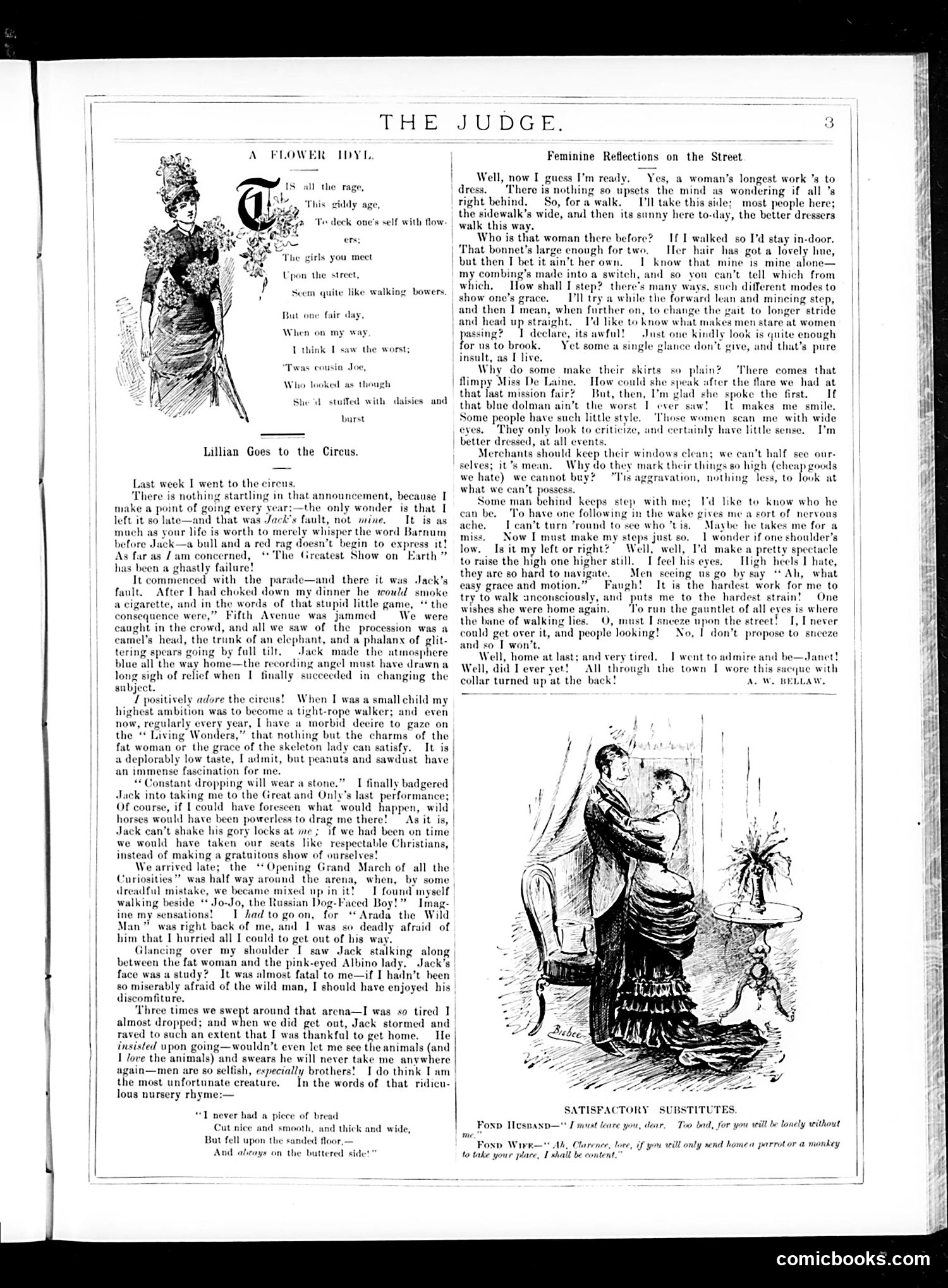
This page contains two separate satirical pieces about women's social behavior: **"A Flower Idyl"** (left) mocks women's obsessive floral ornamentation—likely poking fun at the Victorian fashion trend of adorning clothing and hats with elaborate flowers and botanical elements. **"Lillian Goes to the Circus"** (center) depicts a woman's frustrating circus outing with her reluctant husband "Jack." The satire targets both female persistence in dragging husbands to entertainments they dislike, and Jack's sullen behavior afterward. The piece humorously captures domestic tension. **"Feminine Reflections on the Street"** (right) satirizes women's anxieties while walking in public: preoccupation with others' appearances and fashion choices, self-consciousness about being watched, concerns about their own appearance, and obsessive social comparison. **"Satisfactory Substitutes"** (bottom) shows a brief joke about a husband offering a monkey instead of romantic attention—mocking marital disappointment. The overall theme critiques women's vanity, social obsession, and relationship friction in late-19th-century urban life.
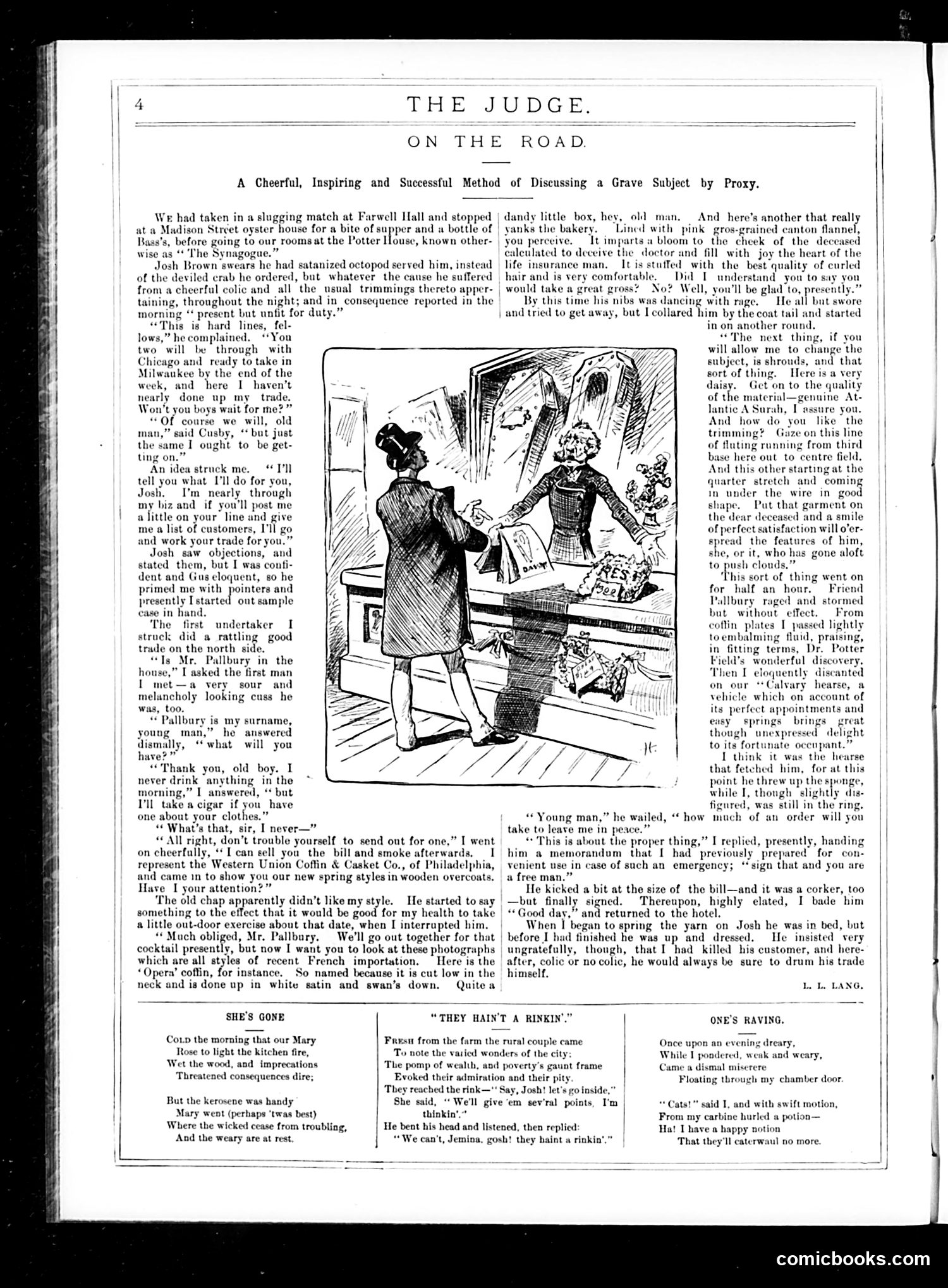
This is a humorous short story with an embedded illustration about a traveling salesman's misadventure. The narrative describes how Josh Brown becomes ill after eating oysters and can't travel, so the narrator volunteers to take over his undertaking/coffin sales route to Milwaukee. The central joke involves the narrator's aggressively unconventional sales pitch to an undertaker named Pallbury. The salesman uses absurdly casual language—comparing coffins to "wooden overcoats," baseball diamond measurements, and other crude analogies—to describe what should be somber funeral merchandise. His deliberately inappropriate tone and forced friendliness ("I never drink anything in the morning") are meant to be comedic. The illustration shows the salesman demonstrating casket designs to the bewildered undertaker, who appears deeply uncomfortable with this irreverent approach to his business. The satire targets aggressive 1890s-era salesmanship and the American tendency to commercialize everything—even death—with forced cheerfulness and dubious marketing tactics. The humor relies on the incongruity between the grave subject matter and the pushy, flippant sales approach.
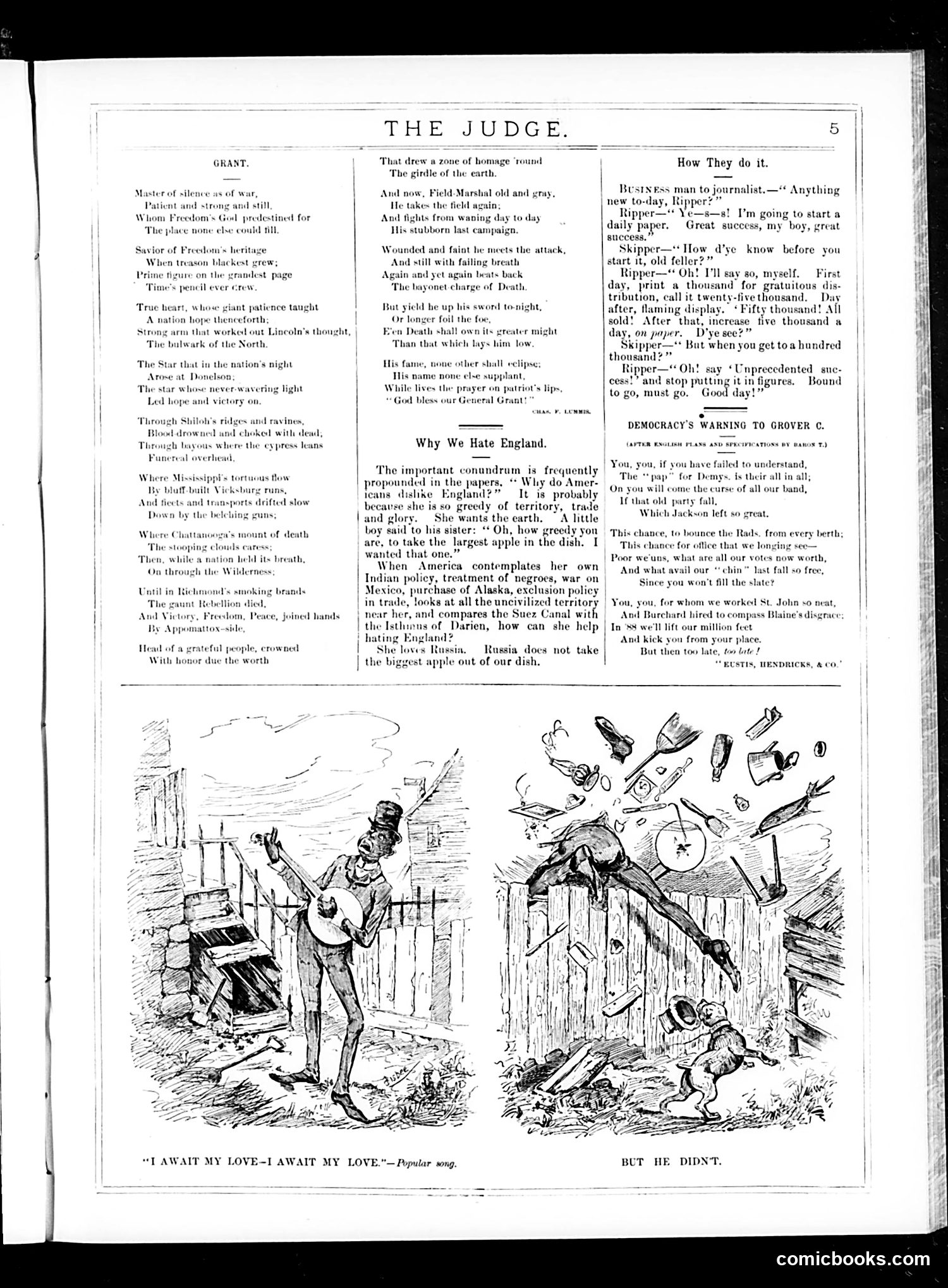
This page from *Judge* magazine contains political satire from the Gilded Age, likely 1880s-90s. **"Grant"** (left column): A reverential poem honoring General Ulysses S. Grant, emphasizing his Civil War leadership and moral character—reflecting nostalgia for his presidency. **"Why We Hate England"** (center): Satirizes American hypocrisy. The piece argues Americans criticize Britain's imperial greed while ignoring their own territorial expansion (Alaska, Mexico, treatment of Native Americans). The joke: America accuses England of taking "the biggest apple" while doing the same. **"How They Do It"** (right): A humorous dialogue between a "Business man" and "Skipper" about launching a newspaper through deceptive circulation claims—printing inflated numbers then sensationalizing success. **"Democracy's Warning to Grover C."** (bottom right): Political verse attacking President Grover Cleveland, referencing supporters like St. John and Burchard, warning of electoral defeat. **Bottom cartoons**: Appear satirical but are difficult to interpret without clearer context—one shows a man with a guitar, the other depicts chaos.
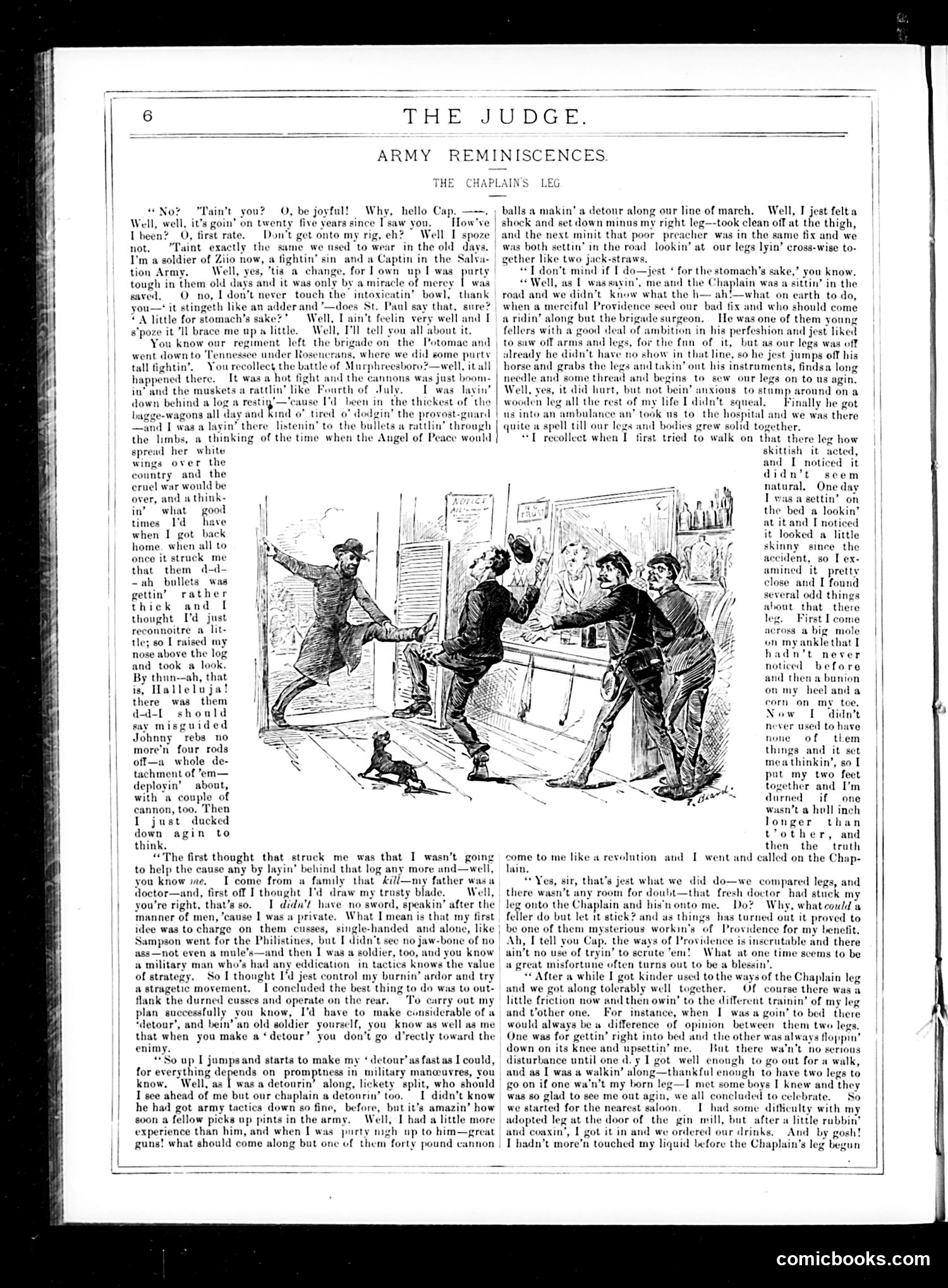
This is a comic monologue illustrated by a sketch showing soldiers in conversation. A Union Army veteran—now a Salvation Army captain—recounts a Civil War battle story to an old acquaintance. The humor centers on the narrator's exaggerated military posturing. During combat near the Potomac (likely referencing the American Civil War), he spots Confederate forces and decides to execute a strategic "detour" to outflank them. The joke: his "detour" is actually a panicked retreat. Even funnier, the chaplain simultaneously performs the identical "retreat," and both lose their right legs when a cannon shell strikes during this tactical withdrawal. The satire mocks soldiers who rationalize cowardice as military strategy, and the irony that both the worldly narrator and the pious chaplain prove equally self-interested when danger arrives. The narrator's conversion to the Salvation Army is played as equally theatrical—replacing military pretense with religious posturing.
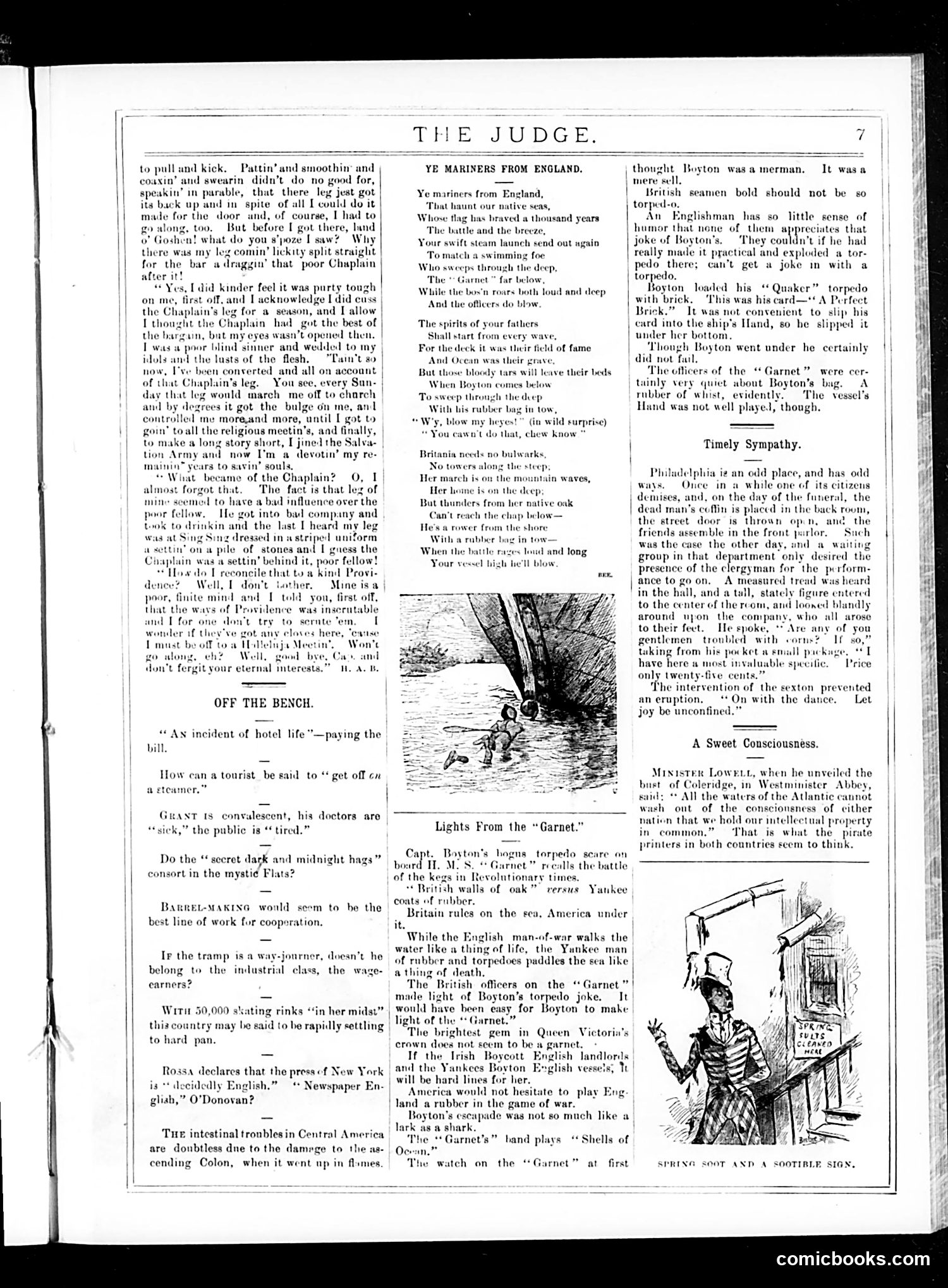
This page satirizes a contemporary stunt by an American performer named **Boyton**, who apparently attempted to navigate underwater or in treacherous waters (likely a torpedo or "Garnet" vessel context suggests naval competition). The poem parodies patriotic British naval verses, mocking British confidence in maritime superiority. The satire suggests that while Britain boasts of naval prowess and "needs no bulwarks," an American performer like Boyton has demonstrated capability in waters where British sailors supposedly excel—undercutting their claimed dominance. The accompanying illustrations show Boyton in action. The text notes British officers made "light of Boyton's torpedo joke," yet would have been embarrassed if he'd succeeded, revealing the satirical point: American innovation and daring challenge British naval supremacy assumptions. The joke targets both British overconfidence and the sensation-seeking nature of contemporary performance stunts.
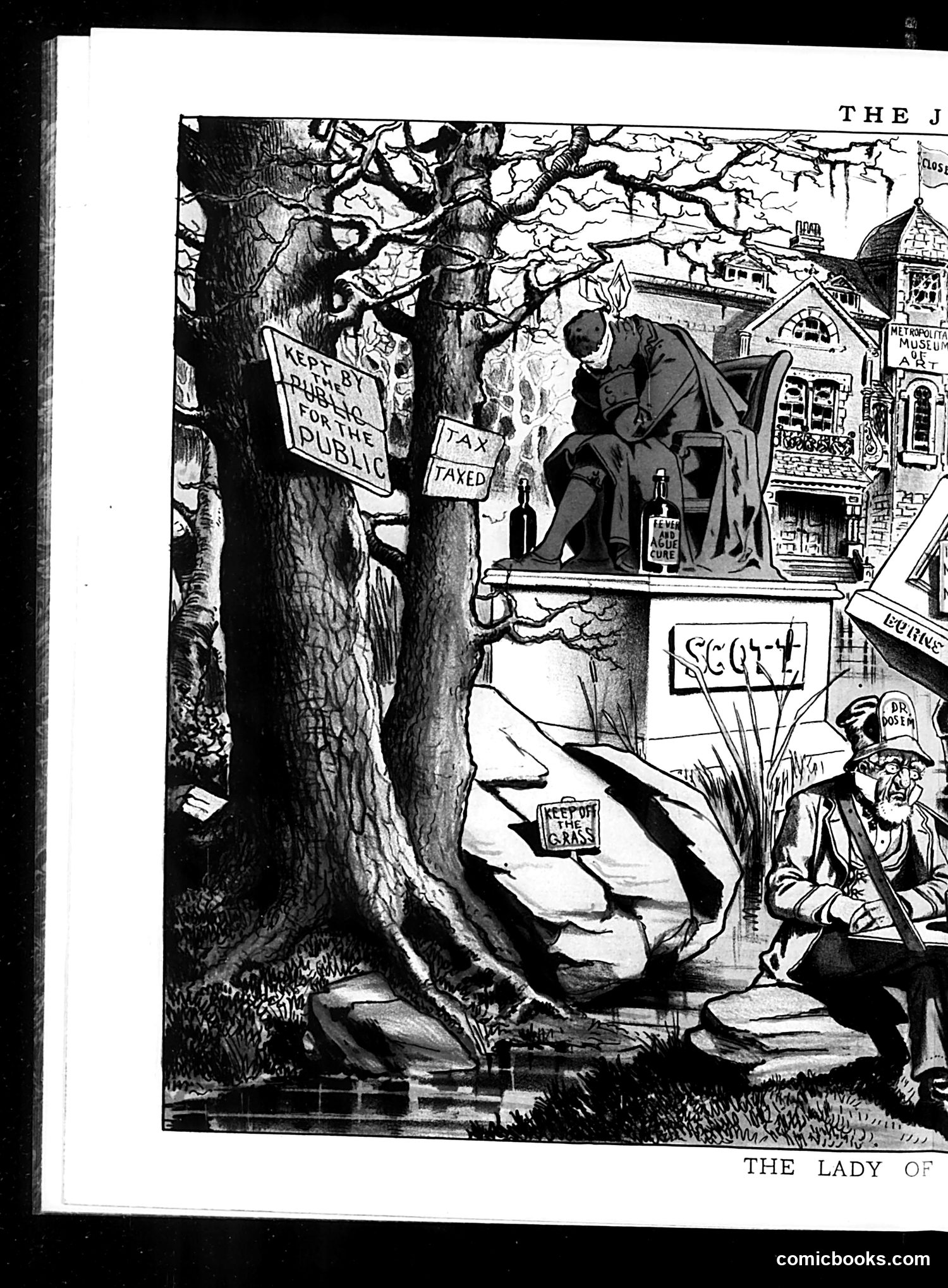
This appears to be a Judge magazine satirical cartoon depicting tax burden and public services. The central figure is a dejected man sitting on a platform labeled "SCOTT," surrounded by signs reading "KEPT BY PUBLIC," "TAX TAXED," and "KEEP OFF THE GRASS." The cartoon critiques how citizens are burdened by taxation and regulation. The large tree with signs suggesting public ownership, combined with the exhausted taxpayer figure, suggests commentary on excessive public control or taxation. A bottle visible near the figure may reference alcohol or other regulated commodities. The onlookers in the lower right appear to be observing this predicament. The title begins "THE LADY OF..." but is cut off. The satire targets the tension between public ownership/control and individual burden.
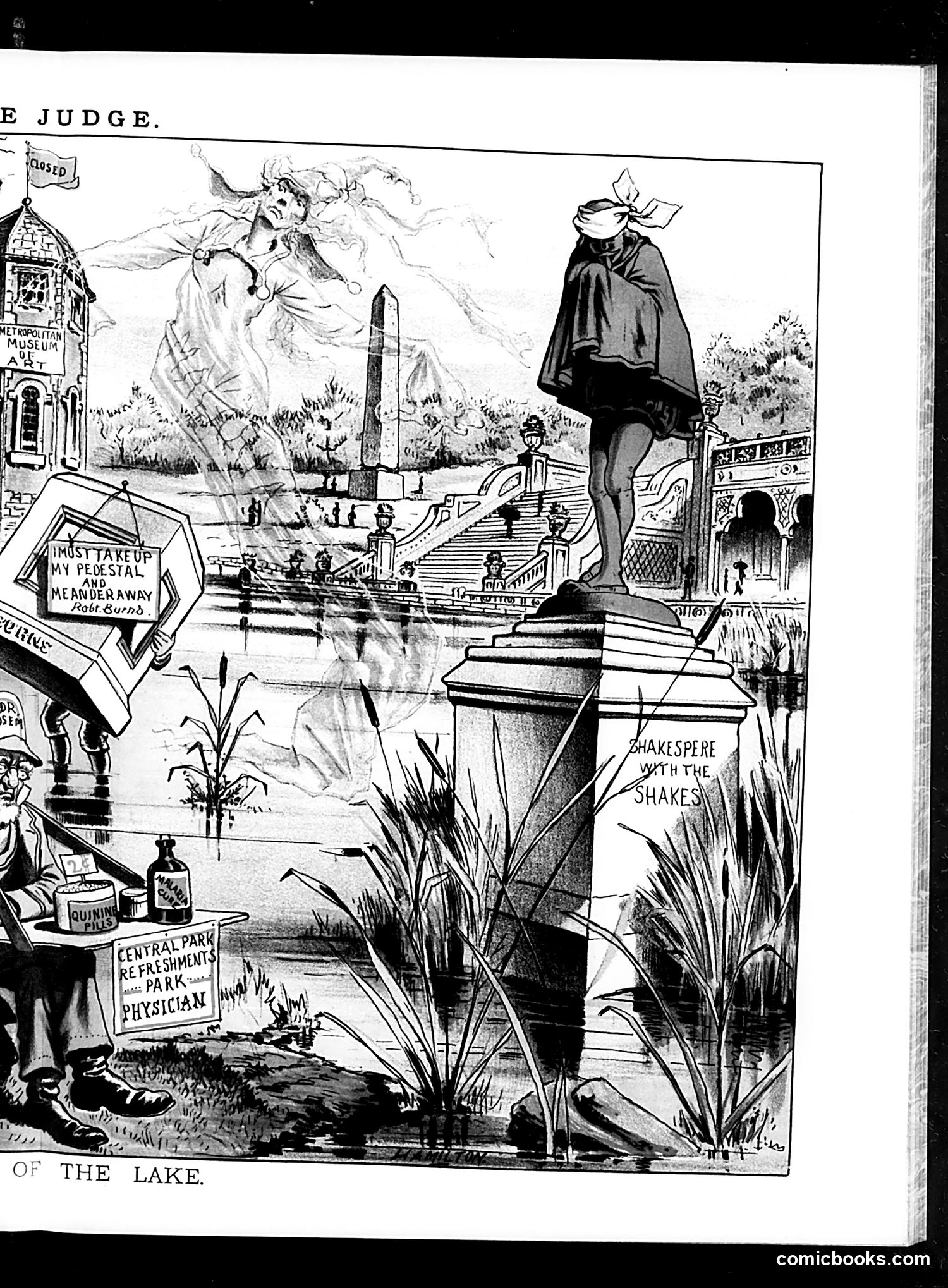
This satirical cartoon depicts a colossal female statue dominating a lakeside park landscape. The statue appears to represent Lady Justice or a similar allegorical figure, overshadowing the scene below. Visible text references include: - A museum marked "closed" - A sign stating "I must take up my pedestal and meander away" attributed to Robert Burns (Scottish poet) - "Shakespeare with the shakes" - Signs for "Central Park refreshments" and "Park Physician" The satire appears to critique how monumental public statuary and high cultural institutions dominate American public spaces, while practical concerns (refreshments, medical care) serve visitors. The exaggerated scale suggests commentary on misplaced civic priorities—emphasizing grand monuments over functional public amenities.
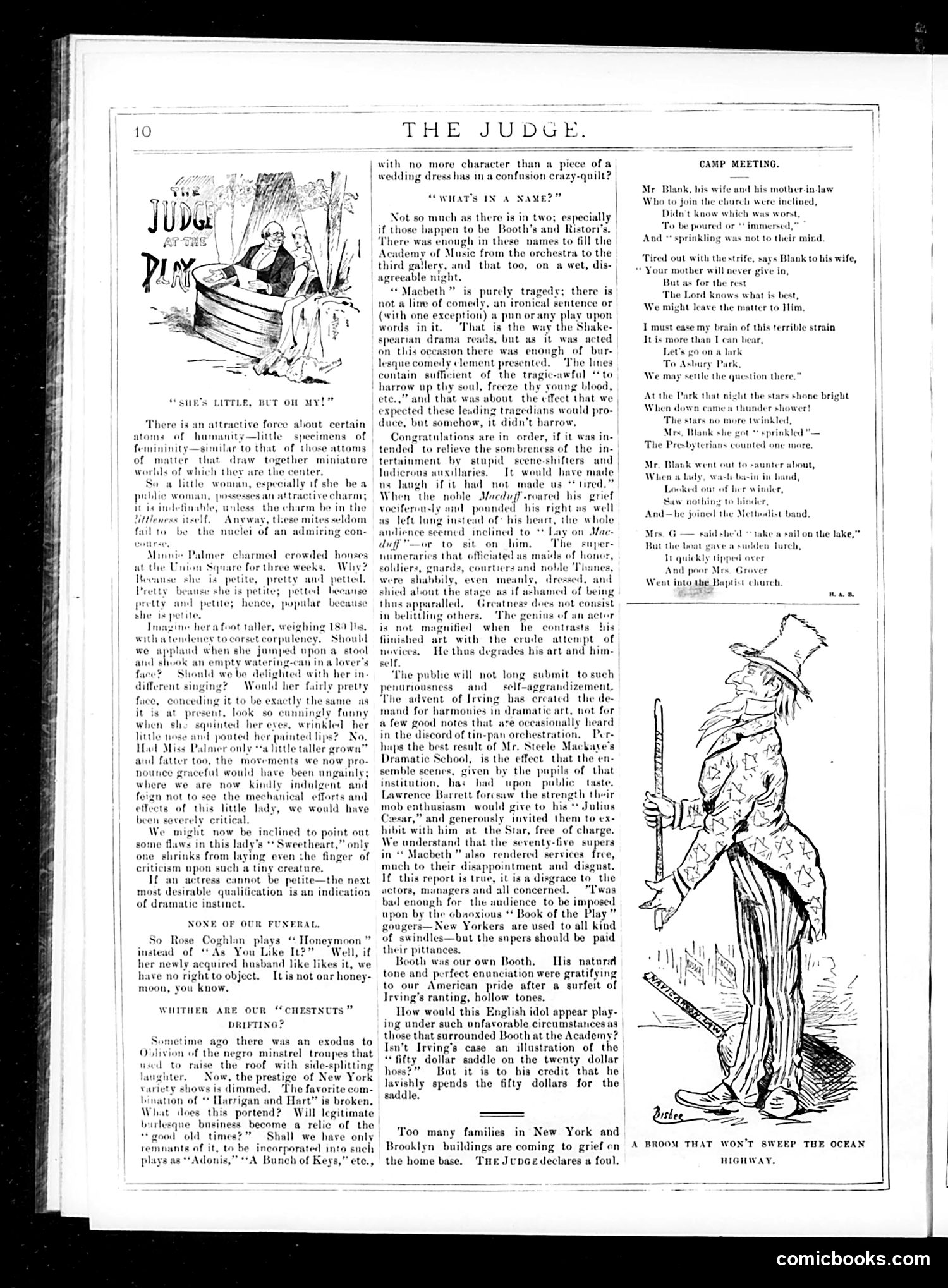
This page contains theater criticism and social commentary typical of 1880s-90s satirical journalism. **Main Cartoon**: "She's Little, But Oh My!" mocks the tendency of audiences and critics to overlook theatrical mediocrity when an actress is physically small and petite. The piece argues that if the performer were taller and less conventionally attractive, her mechanical, ungraceful movements would be criticized harshly—but her diminutive size excuses poor technique. **Theater Reviews**: - **"What's in a Name?"** criticizes a production of *Macbeth* starring famous actors Booth and Ristori. Despite the tragedy's serious content, the performance included slapstick comedy from incompetent stagehands and extras, undermining the drama. The critic notes Macbeth's emotional outbursts (pounding his lung instead of his heart) were laughable rather than moving. - Commentary on Rose [actress's name unclear], and nostalgia for departed entertainment forms—Negro minstrel troupes and the "Harrigan and Hart" comedy team—expressing concern that variety theater is declining into mediocrity. The satire targets both performers relying on appearance over skill and audiences' complicit lowering of standards.
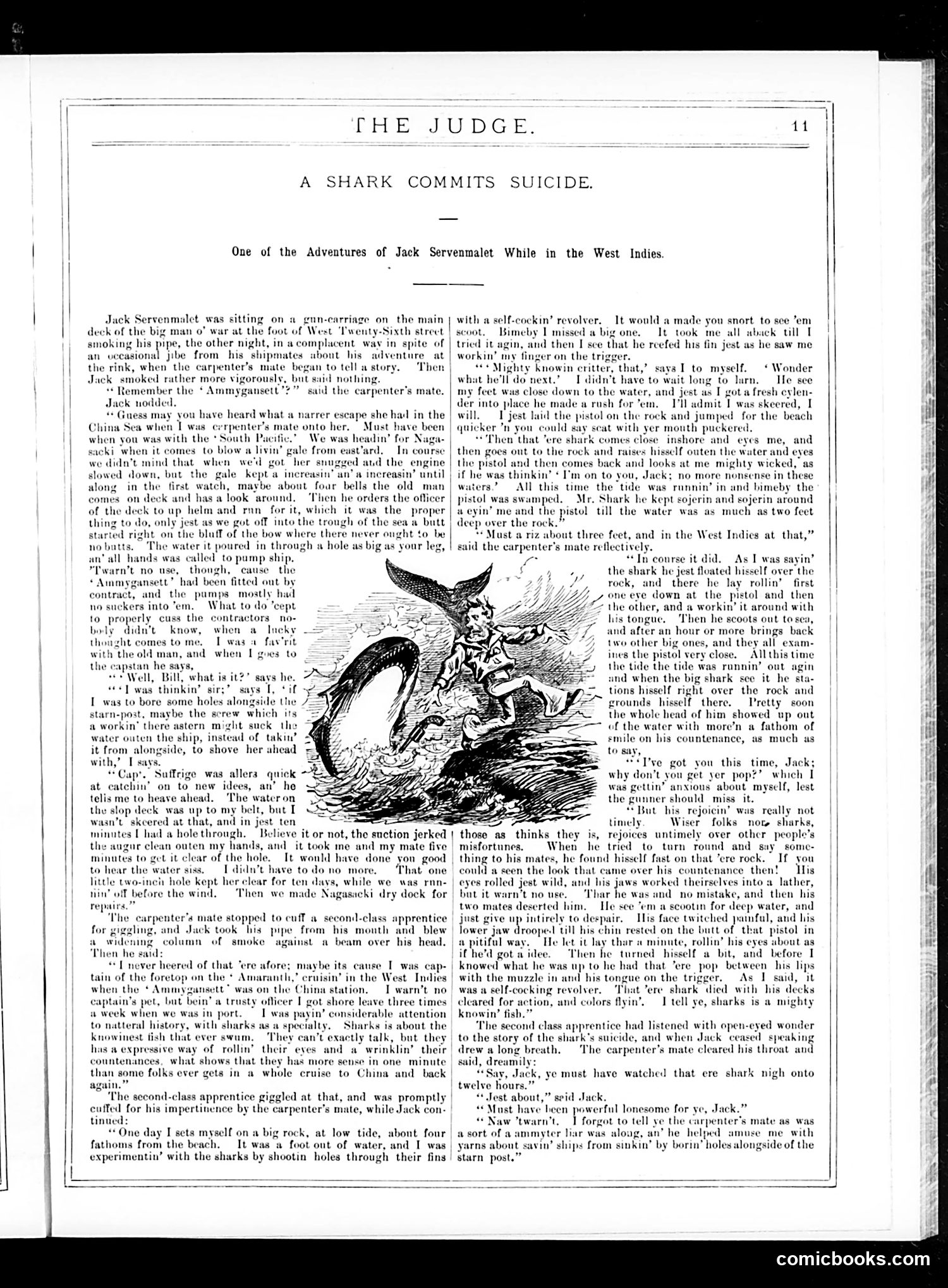
This page from *Judge* magazine presents a tall tale by Jack Servenmalet about an encounter with a shark in the West Indies. The narrative—told by a carpenter's mate to amused shipmates—describes how a shark becomes fascinated with Servenmalet's self-cocking revolver after he loses it on a rock during a confrontation. The satire appears to target the genre of exaggerated maritime adventure stories popular in the era. The shark's increasingly anthropomorphic behavior—examining the pistol with one eye, returning with companions to inspect it, finally positioning itself to be shot—transforms the animal into a darkly comic character committing suicide out of curiosity or resignation. The humor lies in the absurdist escalation: a shark that understands human weapons well enough to recognize defeat and deliberately facilitate its own death. This parodies both the implausibility of tall tales and the romanticized, melodramatic narratives common in adventure fiction, where animals allegedly possess near-human reasoning. The wood engraving shows the shark mid-action, supporting the narrative's visual entertainment value.
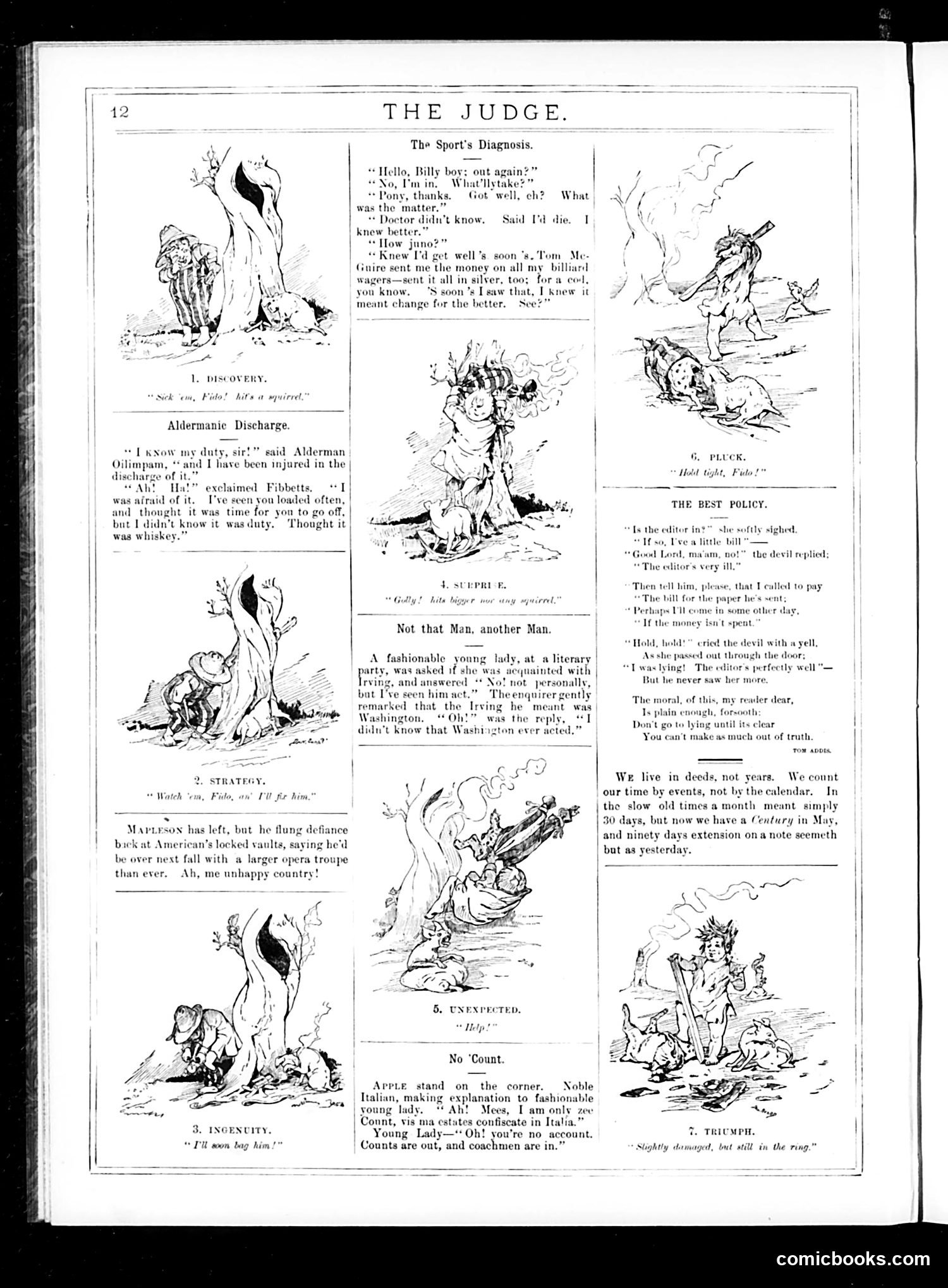
This page collects seven brief satirical sketches, each using exaggerated characters and situations to mock contemporary social types and behaviors: **"Discovery"** and **"Aldermanic Discharge"** ridicule incompetent or corrupt city officials (aldermen), with one admitting he thought whiskey was his civic duty. **"Not that Man, another Man"** mocks pretentious society ladies ignorant of American culture—a fashionable woman doesn't know George Washington was an actor, confusing him with the English actor Washington Irving. **"No 'Count"** satirizes European nobility fallen on hard times: a destitute Italian count tries impressing a lady by claiming his estates are "confiscated in Italia," only to be dismissed as worthless ("no account"). **"The Best Policy"** is a moral tale where a bill collector lies to the devil about an editor's health to avoid payment; the devil calls out the lie, showing dishonesty fails even in Hell. **"Unexpectedly"** and **"Pluck"** are visual gags about mishaps. **"Triumph"** celebrates persistence despite damage—likely referencing boxing or sports recovery. The overall tone criticizes pretension, corruption, and social affectation.
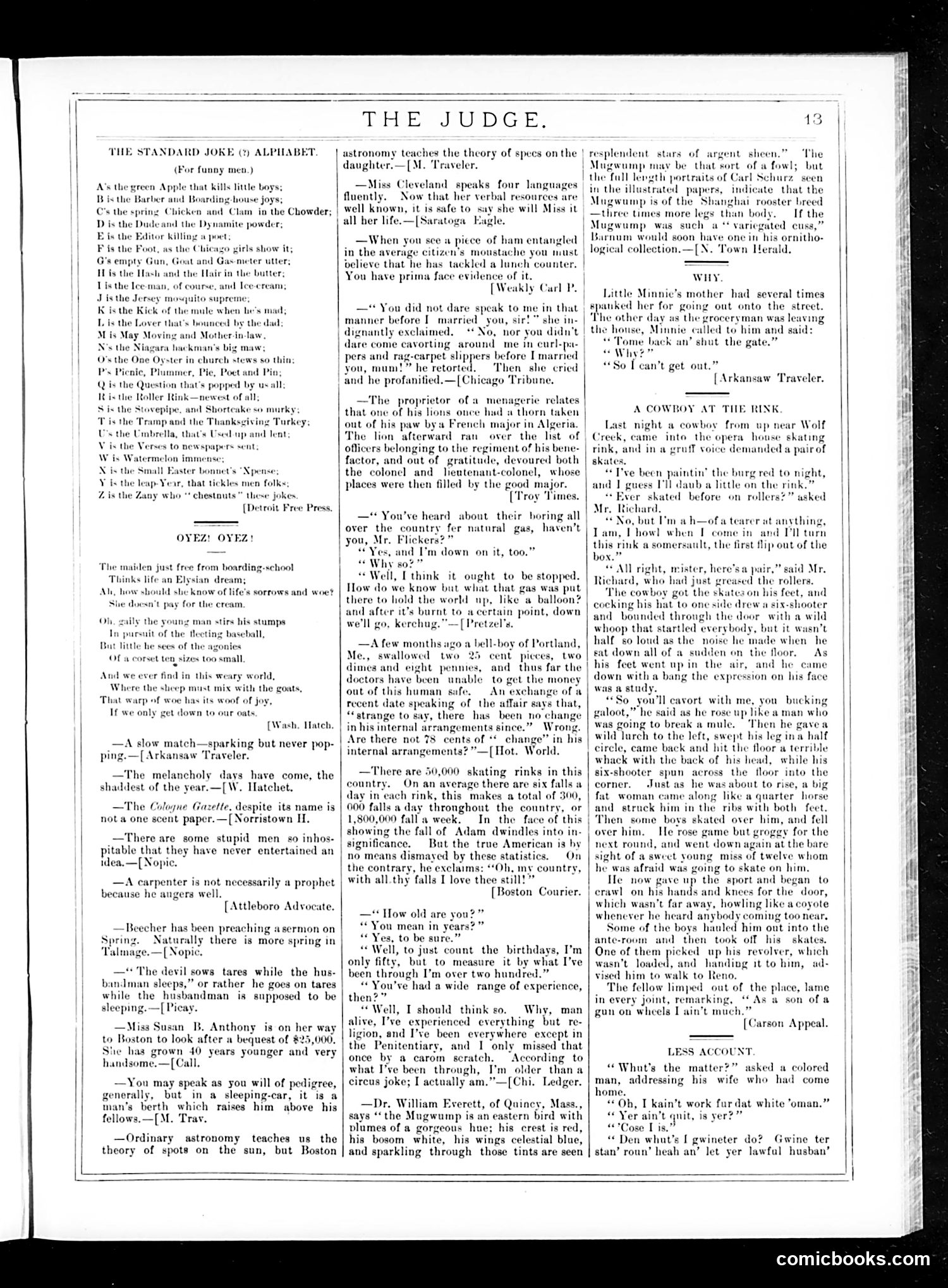
This page from Judge is primarily a **collection of humor pieces and jokes** rather than political cartoons. The content includes: 1. **"The Standard Joke Alphabet"** — a meta-joke mocking formulaic humor in newspapers. It catalogs tired comedic tropes (barbers, boarding-house mishaps, mother-in-law jokes) to satirize how repetitive and predictable newspaper humor had become. 2. **Various short jokes and quips** from different contributors, covering domestic situations (newlyweds bickering), social commentary (Susan B. Anthony's appearance), and wordplay. 3. **References to contemporary figures**: Miss Cleveland (likely President Grover Cleveland's sister, known for her public role), Susan B. Anthony (women's suffrage activist). The overall satirical point is **self-aware criticism of journalism and humor itself** — Judge is gently mocking the clichéd jokes that filled newspapers of the era. This reflects the magazine's sophistication: rather than simply providing jokes, it's commenting on joke-writing as an art form.
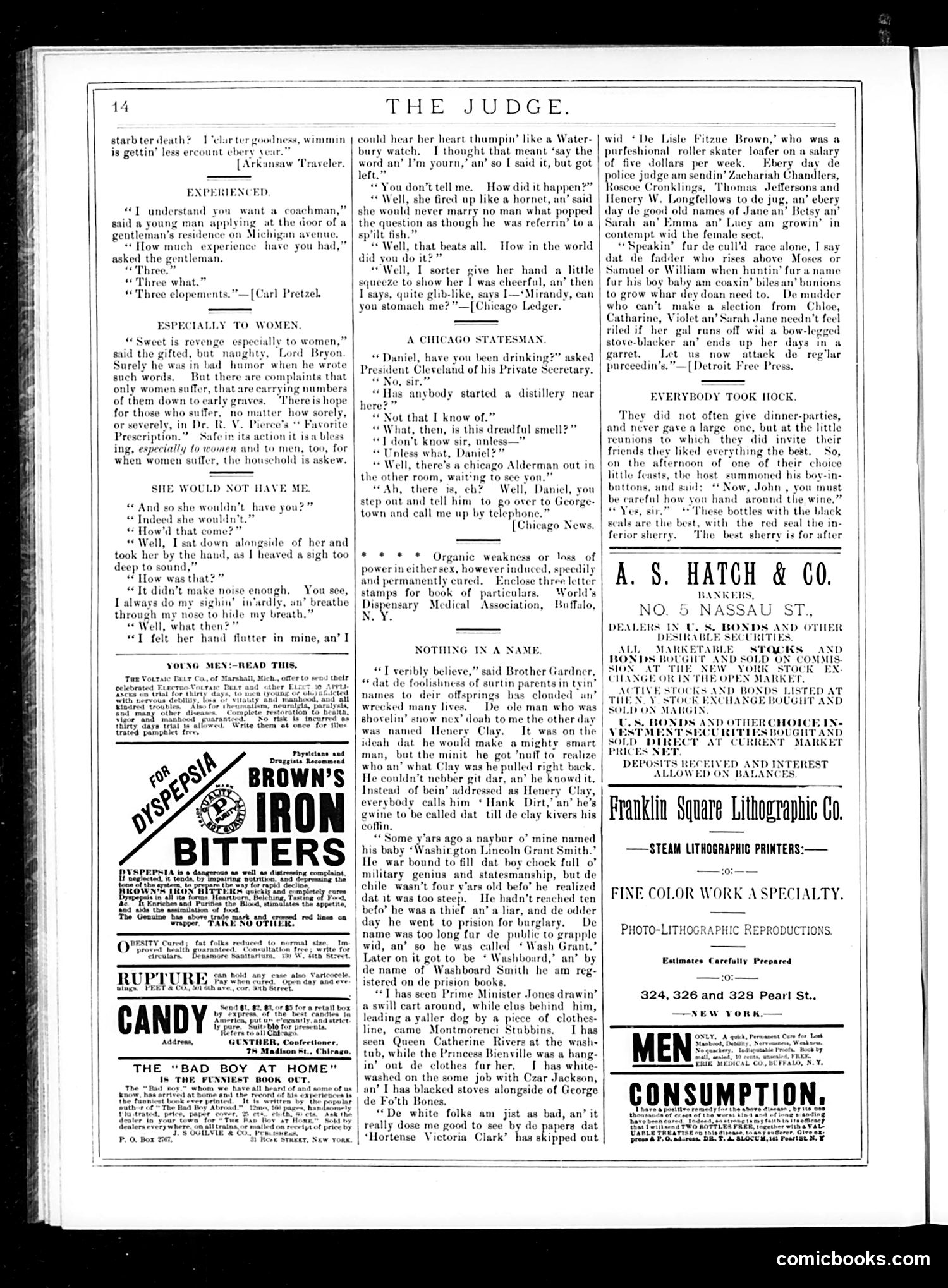
This page from *Judge* magazine contains primarily **humorous anecdotes and advertisements** rather than political cartoons. The humor pieces satirize **late 19th-century social conventions**: one mocks romantic miscommunication ("I thought that meant 'say the word'"), another jokes about a coachman's inadequate experience, and several target **gender relations** and courtship. Lord Byron's quote about revenge being "sweet to women" frames commentary on romantic disputes. One piece titled "A Chicago Statesman" appears to mock a **political figure** (referenced as "Daniel," possibly a local politician) for his drinking and connections to corrupt Aldermen—typical *Judge* criticism of urban machine politics. The section "Nothing in a Name" satirizes the **pretentious naming of African American children** with white historical figures' names (Henry Clay, Washington Lincoln Grant Smith), suggesting ironic commentary on Reconstruction-era race relations. **Advertisements** dominate the lower portion, promoting patent medicines, lithography services, and remedies—standard period advertising. The page reflects *Judge's* focus on **social satire, romantic comedy, and political mockery** of machine politics and racial attitudes.
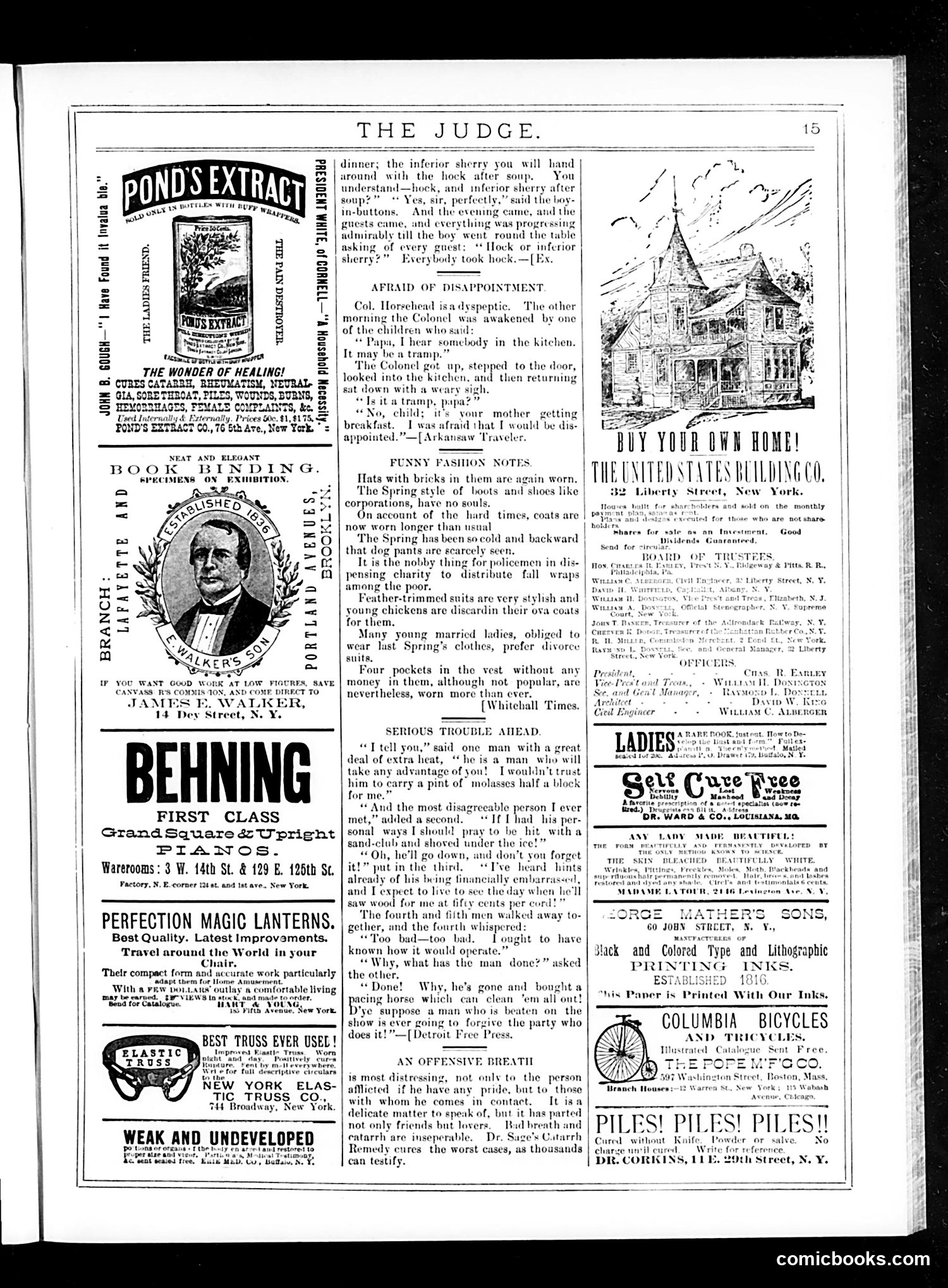
This page contains mostly advertising with some short satirical sections from Judge magazine. The visible humor pieces include brief anecdotes mocking common situations: a story about a "dyspeptic" colonel who mistakes his family for a tramp during a kitchen visit; criticism of men's questionable character and finances; and commentary on spring fashion, including a joke that divorces are preferable to wearing last year's clothes. The "Serious Trouble Ahead" and "An Offensive Breath" sections are gossip-like moral observations typical of the era's satirical magazines—warning about unreliable men and social embarrassments. These pieces use understated humor common to late 19th-century American satire. However, the page is dominated by period advertisements for pianos, book binding, trusses, and medical remedies, reflecting Judge's revenue model. Without clear political cartoons or identifiable figures visible, this appears to be a standard interior page mixing modest social satire with commercial content.
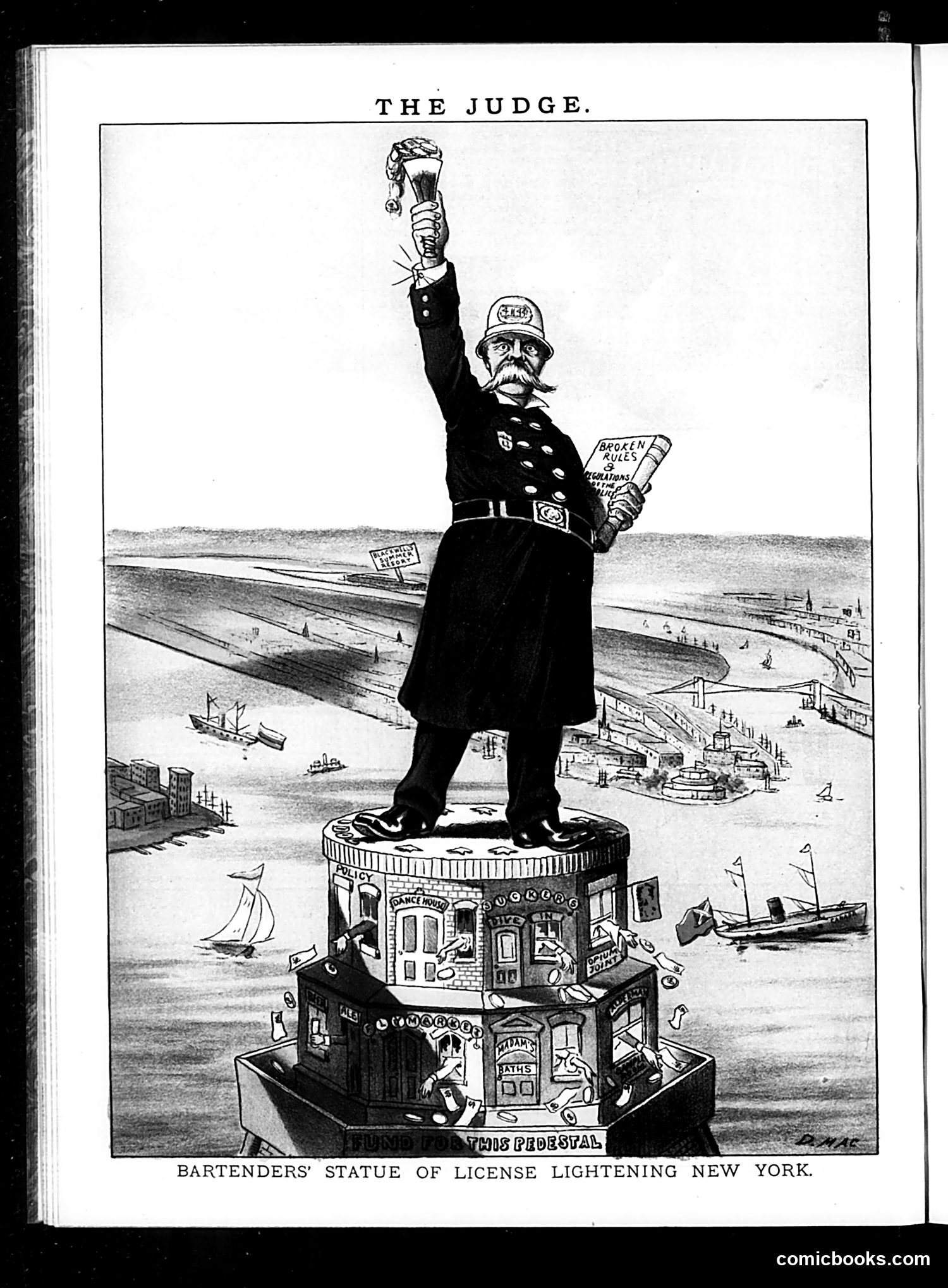
This satirical cartoon depicts a massive, authoritarian military figure (resembling a judge or ruler) standing atop a pedestal labeled "his pedestal." The figure holds scales of justice aloft while clutching documents marked "Berlin Rules" and other regulations. The pedestal itself is constructed as a multi-story building containing various establishments—bars, dance halls, and other venues—suggesting the commercialization of urban entertainment. The caption references a "Bartenders' Statue of License Lightening New York," indicating this critiques how liquor licensing regulations were being weaponized or manipulated by authorities. The cartoon satirizes how licensing laws ostensibly meant for public welfare actually became tools of control by an overbearing judicial/governmental apparatus. The irony: a "license" supposedly granting freedom instead represents oppressive regulation.