
A complete issue · 17 pages · 1885
Judge — April 11, 1885
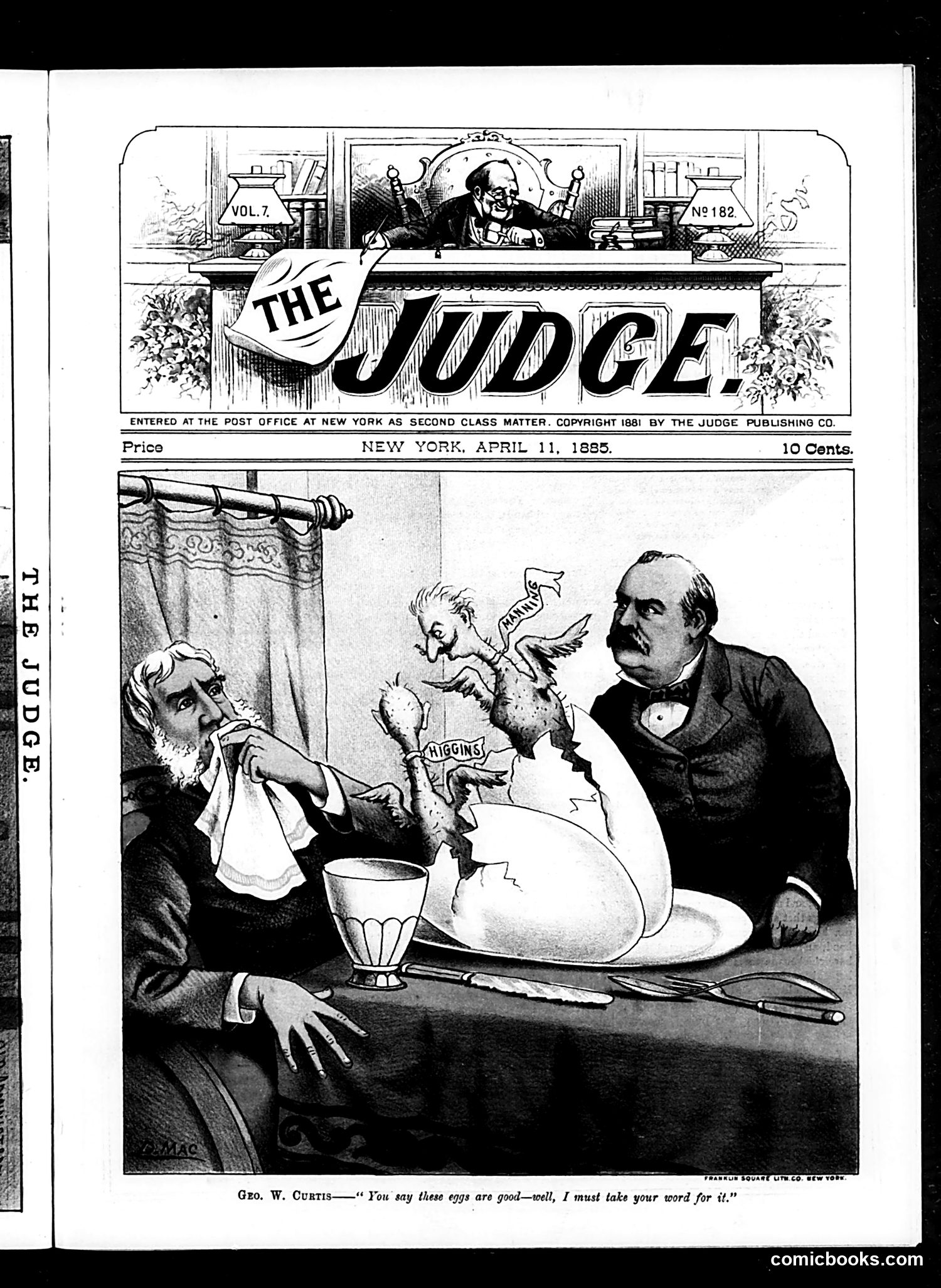
This cartoon depicts **Geo. W. Curtis** (identified in the caption), a prominent 19th-century editor and social critic, examining eggs with two other men. The caption reads: "You say these eggs are good—well, I must take your word for it." The satire appears to target Curtis's credibility or judgment. The eggs likely represent some public issue or claim Curtis had endorsed or promoted. The cartoon suggests skepticism about Curtis's ability to properly evaluate quality or truth—he must simply accept others' assertions rather than verify them himself. Curtis was known for his editorial work at *Harper's Weekly* and his reform advocacy, making him a recognizable public figure for Judge's readership. The exact issue being satirized remains unclear without additional historical context.
This is primarily **editorial content**, not a cartoon page. The main article, "Only Waiting," argues that President Cleveland should distribute government positions through party machinery rather than attempting "personal administration" above partisan politics. **Key political argument**: The author criticizes Cleveland for trying to govern independently of party structures. The piece contends that: - Organized political parties, despite their flaws, are preferable to one-man rule - Individual reform-minded politicians cannot resist systemic pressures - Party discipline ensures voter interests are represented better than personal monopolies **The satire targets**: Cleveland's reformist pretensions and those who advised him to rise "above party." The author mockingly notes the "Evening Post" expressed surprise at Cleveland's conventional appointments, despite his clear party affiliations. **Context**: This reflects 1880s-90s debates about civil service reform versus traditional patronage politics—Cleveland attempted both, alienating reformers and party regulars alike. The page also contains subscription information and contributor guidelines typical of period magazines.
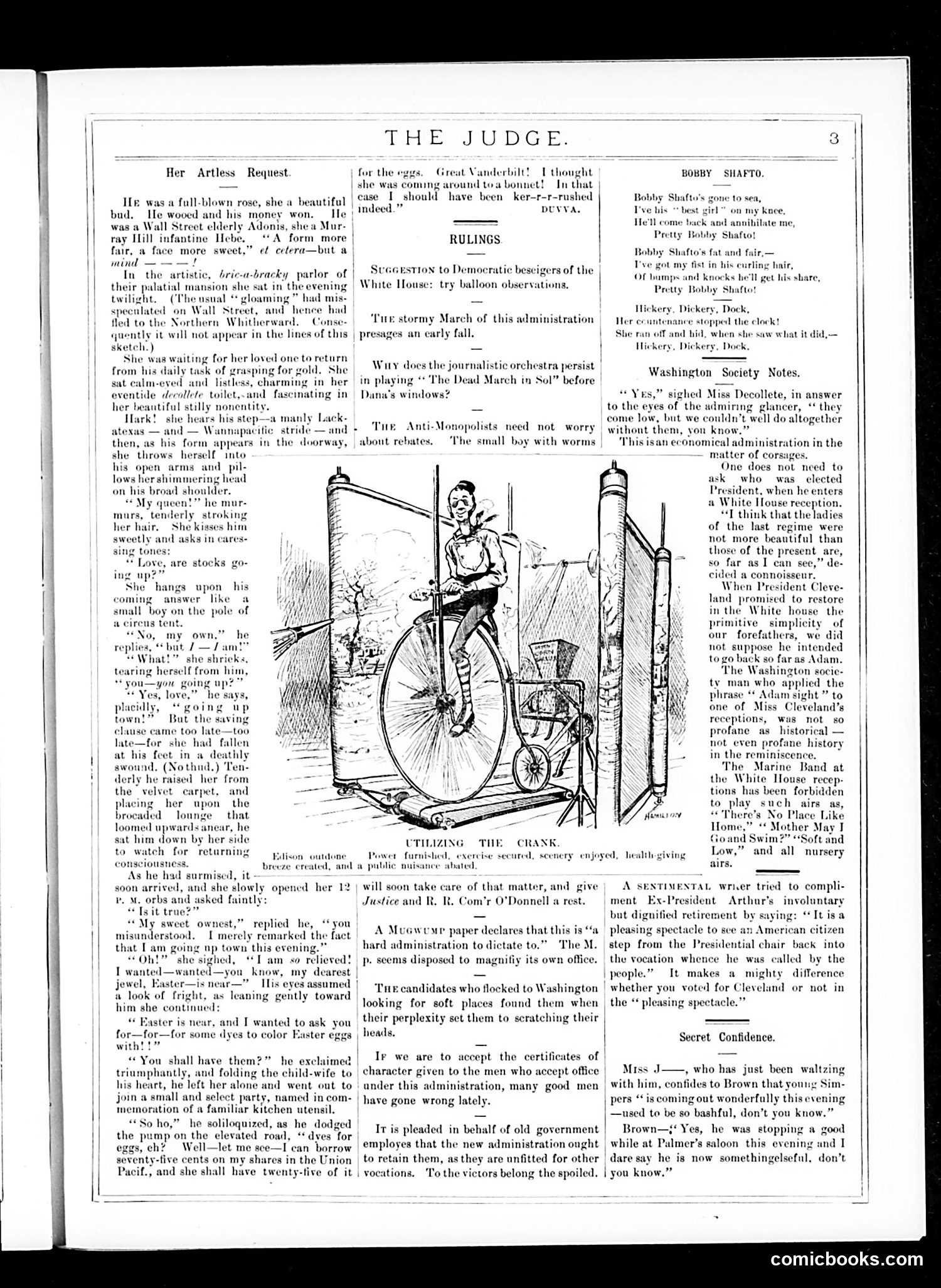
This page from Judge (a 19th-century American satirical weekly) contains a serialized romantic story titled "Her Artless Request" alongside political commentary sections labeled "RULINGS." **The Main Story:** A wealthy Wall Street man returns home to his society wife, who tearfully asks if he's "going up town." She faints thinking he means permanently, but he clarifies he's merely going out for the evening. Her relief reveals her actual concern: she wanted him home to help color Easter eggs. The satire mocks both the frivolous wealthy wife and the hen-pecked husband. **Political Rulings:** Brief satirical quips attack the current administration (appears to be Cleveland-era based on references to "Dana's windows" and discussion of government employees). Topics include: criticism of Democratic criticisms of the White House, questioning newspaper coverage, mocking anti-monopoly efforts, and sarcastically praising the administration's supposed incompetence. **The Illustration:** Shows a woman on a bicycle, captioned about "utilizing the crank"—likely a visual pun playing on "crank" (both bicycle part and slang for eccentric person).
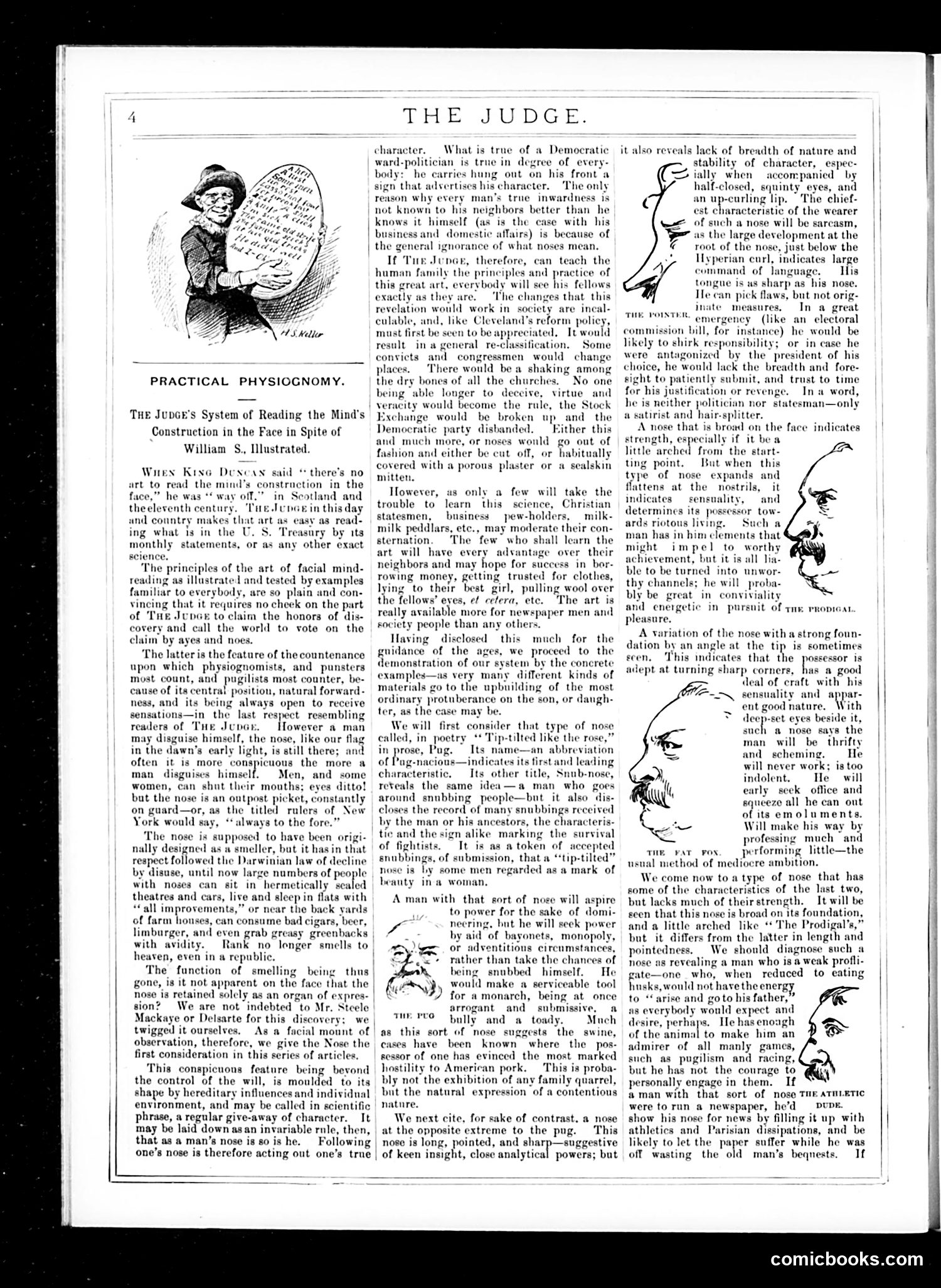
This article satirizes phrenology and physiognomy—pseudo-scientific practices claiming to read character from facial features, particularly the nose. **The Satire's Target:** Judge ridicules these popular "sciences" by claiming the nose is an infallible character indicator. The illustrations show various nose types supposedly revealing personality. **The Political Joke:** The text mentions "Democratic ward-politician" and references to "congressmen" who would need "reclassification" if true character were readable on faces—implying politicians are naturally deceptive and would be exposed by such a system. This reflects 1880s-90s skepticism toward both pseudoscience and political corruption. **The Broader Context:** The piece mocks contemporary faith in pseudo-scientific character assessment while using it as a vehicle to criticize dishonesty in politics and society. References to "Cleveland's reform policy" suggest a specific historical moment, likely the Gilded Age when such theories remained popular despite growing scientific opposition. The humor relies on readers recognizing these "sciences" as nonsense.
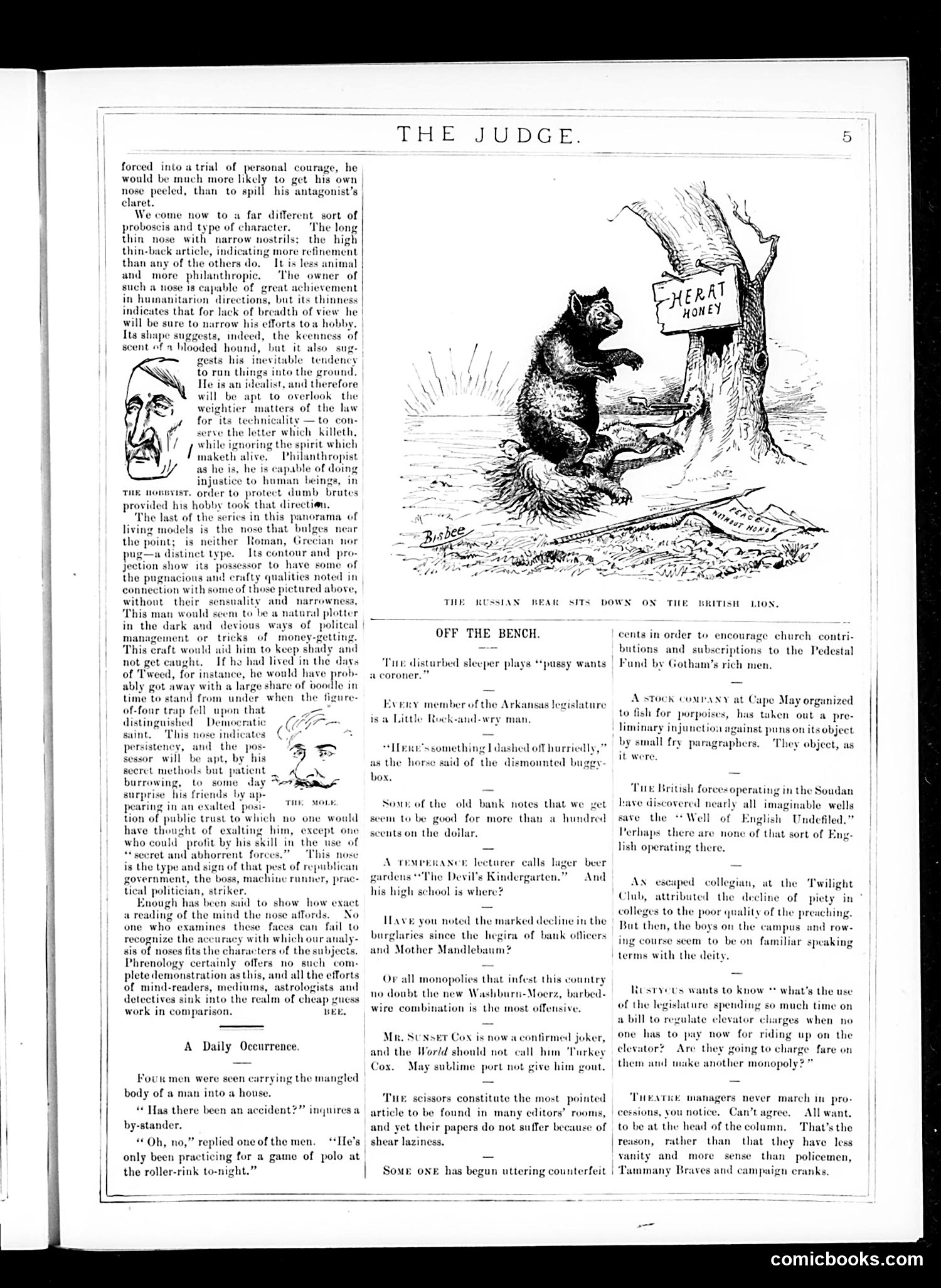
This page contains **character physiognomy satire** — using nose shapes to mock personality types — and several brief political jokes. **Main Cartoon:** "The Russian Bear Sits Down on the British Lion" depicts Russia (as a bear) dominating Britain (as a lion), likely referencing 19th-century imperial tensions over colonial/geopolitical interests, particularly in Central Asia. **"The Hobbyist" and "The Mole"** caricatures analyze noses as personality indicators: the thin-nosed philanthropist narrows his vision to hobby horses; the bulging-nosed figure represents the corrupt political operative or "boss" — a veiled reference to **Boss Tweed**, the infamous Tammany Hall politician. **Brief jokes** mock Arkansas legislators as "little Re[publicans]," lampoon beer gardens as "Devil's Kindergarten," and reference declining bank robberies and old currency. The page blends pseudo-scientific character analysis with topical political commentary typical of Judge's satirical approach during the Gilded Age.
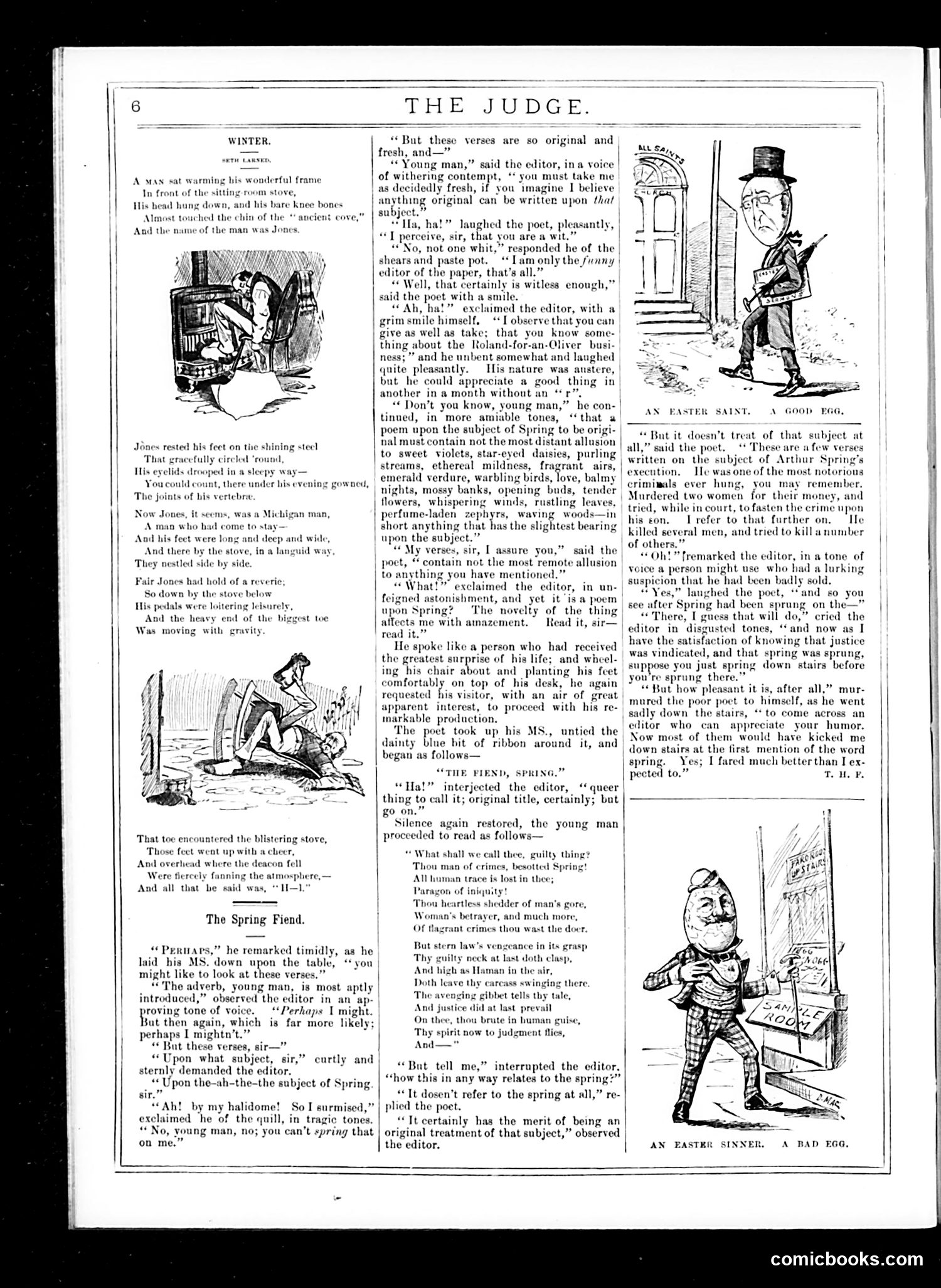
This page satirizes literary pretension and editorial gatekeeping in the publishing world. A young poet visits a dismissive editor who demands that spring poetry avoid all conventional imagery—violets, daisies, birdsong, etc.—to be considered "original." The poet then reveals his verses aren't about spring at all, but rather Arthur Spring's execution (a notorious criminal case). The satire works on multiple levels: it mocks editors who impose arbitrary rules about originality while dismissing genuinely fresh approaches; it ridicules the poet's obliviousness in misunderstanding the assignment; and it uses the macabre twist (spring/Spring) as dark comedy. The accompanying cartoon illustrations of "An Easter Saint," "A Good Egg," and "An Easter Sinner: A Bad Egg" appear to extend the spring/Easter theme with moral commentary. The piece critiques both pretentious literary standards and incompetent writers.
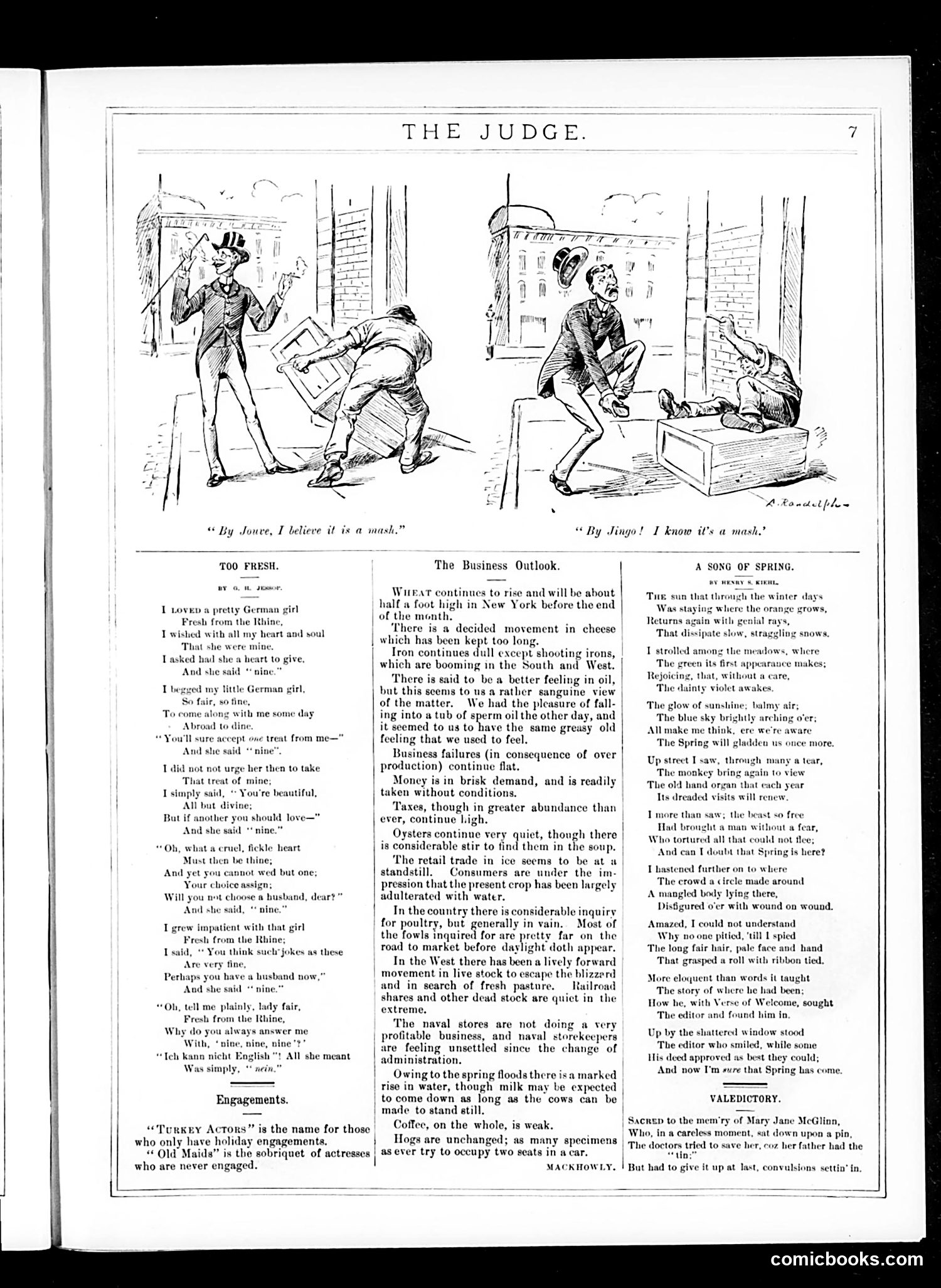
The two cartoons at top satirize romantic miscommunication. Both depict men courting women through misunderstandings—likely playing on period gender dynamics and the confusion between formal courtship and genuine affection. The captions "By Jouve, I believe it is a mash" and "By Jingo! I know it's a mash" (slang for romantic infatuation) suggest the men are deluded about their prospects. Below, "The Business Outlook" is satirical economic commentary. It mocks current market conditions through absurdist observations—wheat growing "half a foot high" in New York, cheese "kept too long," and milk adulterated with water. The final jab at hogs occupying two train seats likely references actual crowding complaints. The section "Engagements" contains brief wordplay: "Turkey Actors" only work holidays, while "Old Maids" are "never engaged"—a pun on theatrical versus marital engagement. The poetry celebrates spring's return after winter. Overall, this page blends light romantic humor, economic satire, and seasonal verse typical of Judge's variety format.
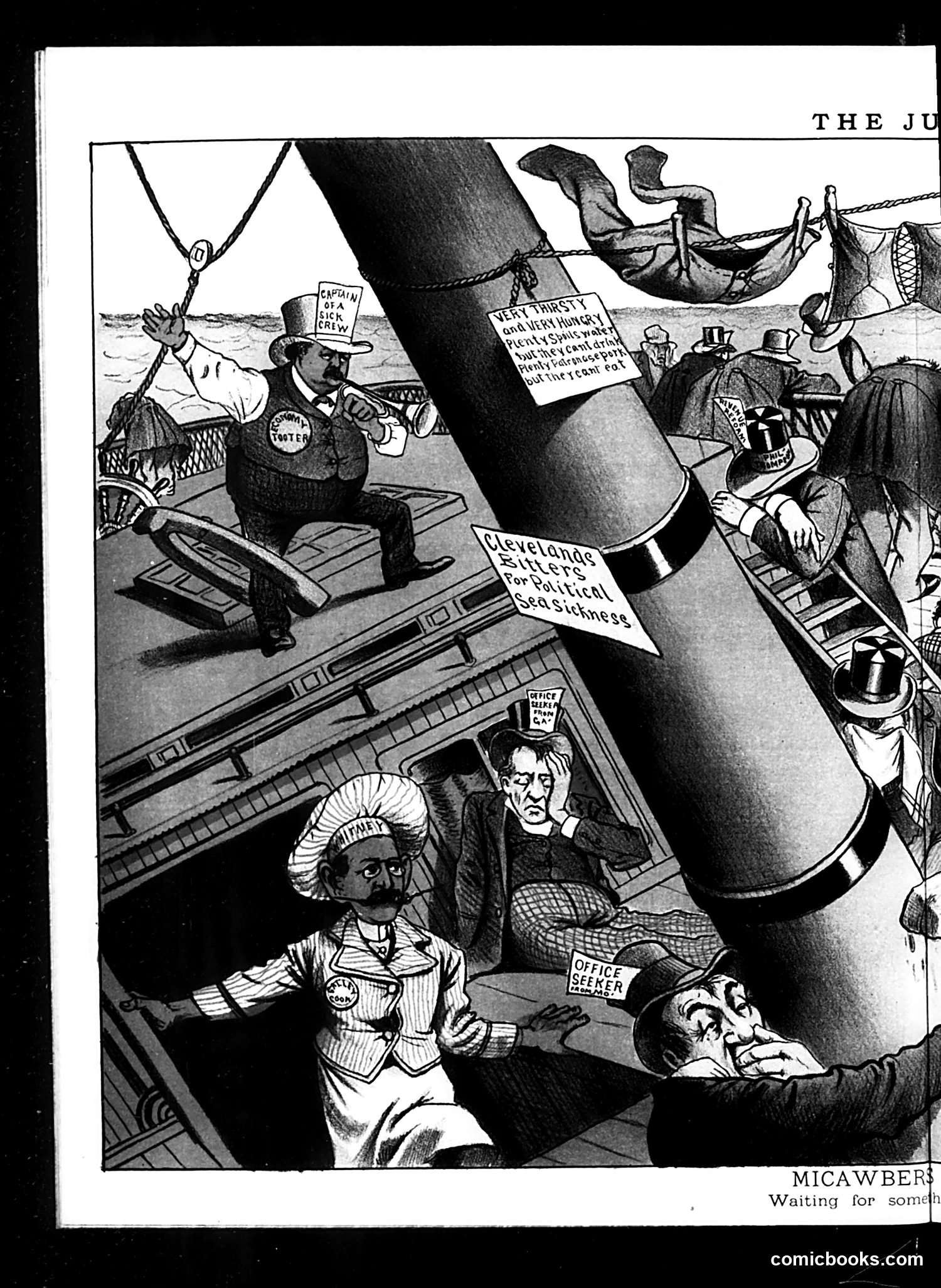
This appears to be a political cartoon satirizing Cleveland's political leadership and governance. The prominent giant telescope or cannon dominating the image suggests scrutiny or oversight of city affairs. Labels visible include "Cleveland's Rifle for Political Goodness" and references to "Office Seeker," indicating commentary on patronage and political appointments. The scene depicts various figures—appearing to be politicians and office-seekers—gathered around maritime/nautical elements, suggesting corruption or turbulent political waters. The "Waiting for some[thing]" caption (partially cut off) implies anticipation, likely mockingly commenting on citizens' hopes for reform or honest governance. Without the publication date visible, the exact political crisis referenced remains unclear, though the cartoon critiques Cleveland-era municipal corruption and the spoils system.
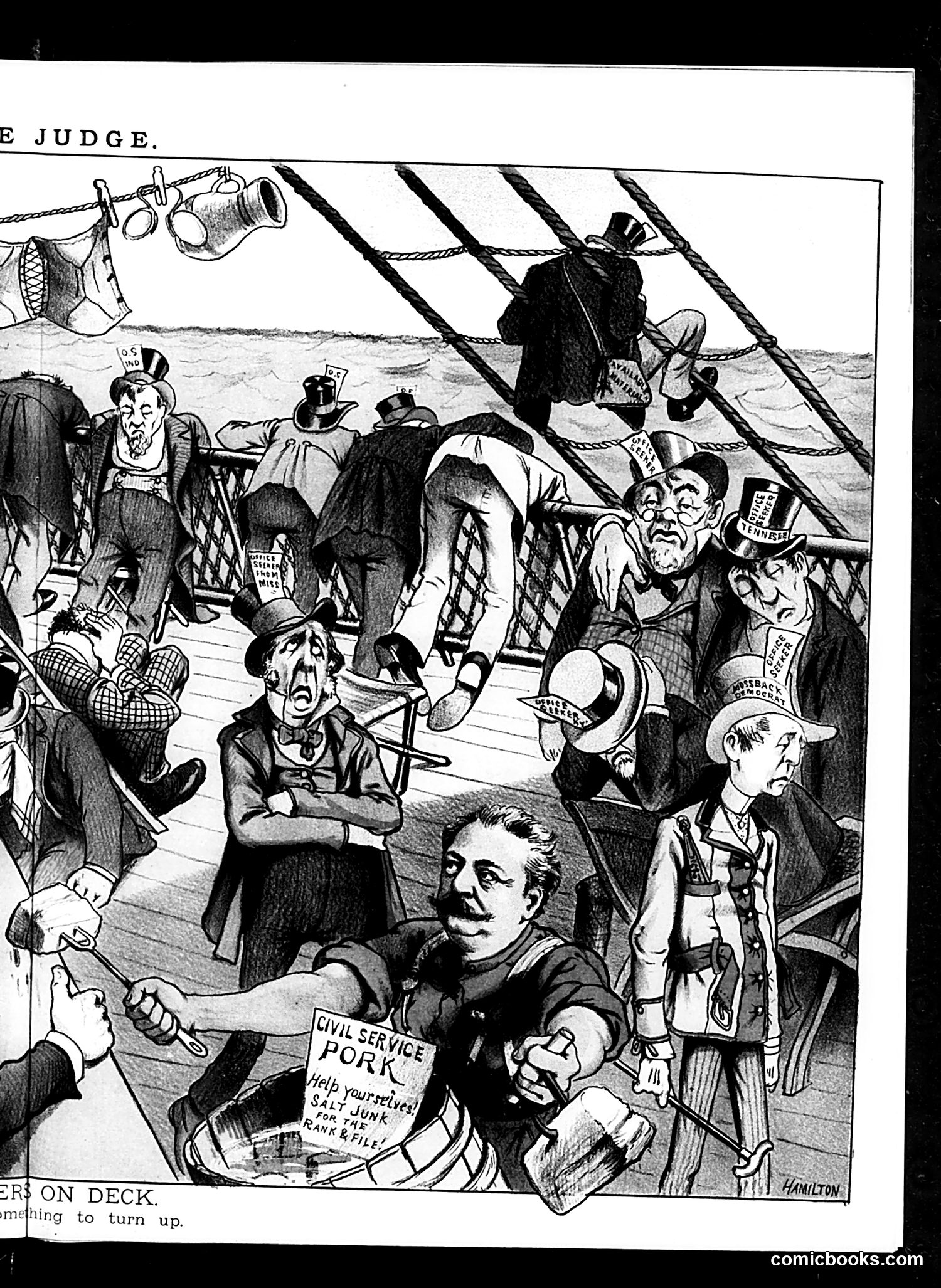
This political cartoon satirizes civil service corruption. The ship's deck is crowded with politicians and bureaucrats labeled with references to "Civil Service Pork," "Salary Junk," and "Rank and File"—mocking how government jobs were distributed as political patronage rather than merit. The caricatured figures appear to represent various political factions or parties competing for cushy government positions. The maritime setting suggests they're all in the same boat, dependent on this corrupt system. The cartoon criticizes the spoils system: appointing unqualified people to government jobs as political favors. The title "Something to Turn Up" suggests anticipation of future scandals or revelations about these practices. The artist is credited as Hamilton (visible at bottom).
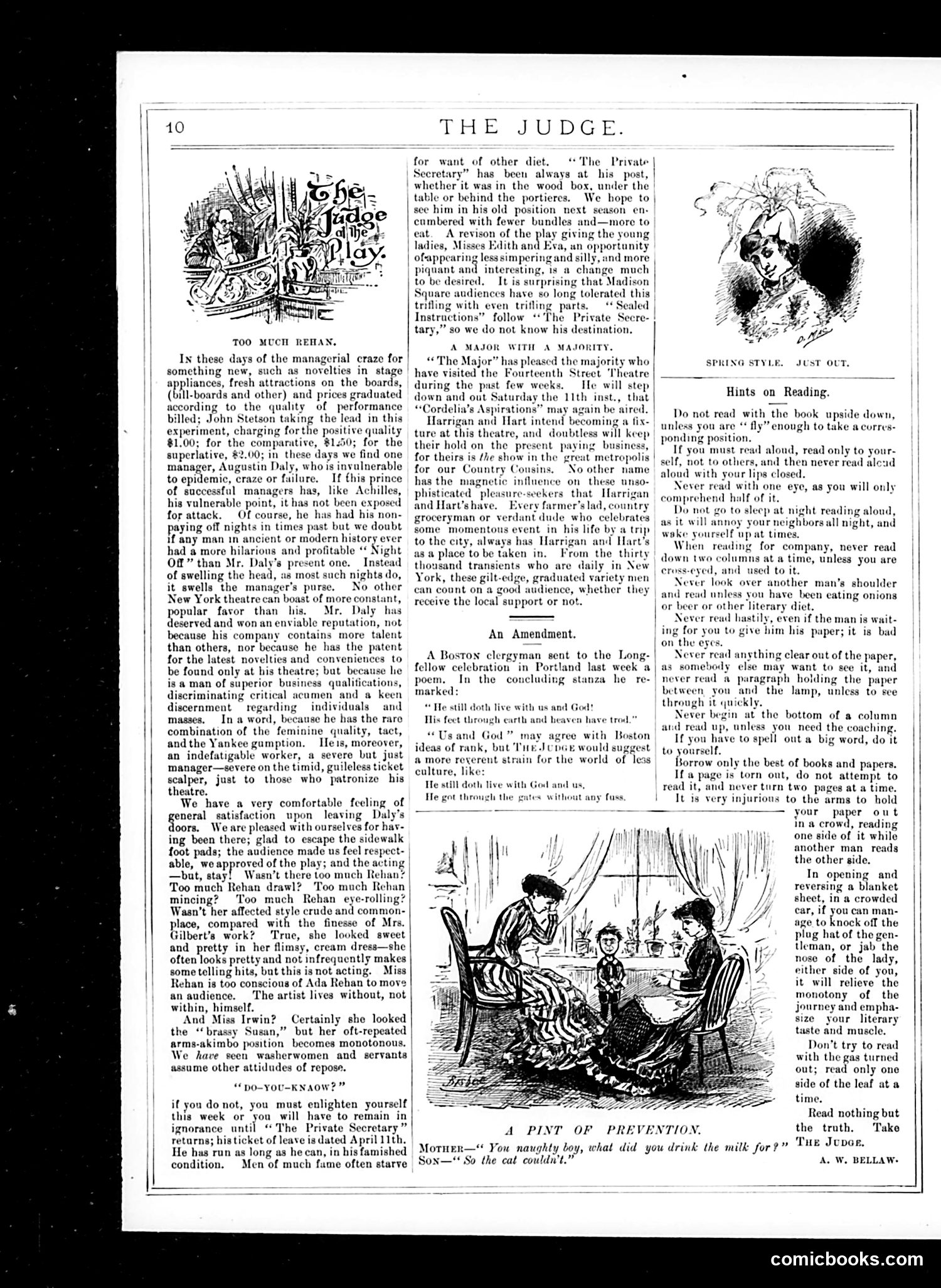
This page from *Judge* contains theatrical criticism and satirical social commentary typical of 1880s American magazines. **Main Content:** The large article "Too Much Rehan" critiques actress Ada Rehan's performance style in "The Private Secretary" at Daly's Theatre, calling her acting "too much" in various ways—too conscious of the audience, too affected, overly theatrical. The reviewer suggests a revised script with younger actresses would improve the play. **"A Major with a Majority"** reviews "The Major" at the Fourteenth Street Theatre, praising manager Augustin Daly's consistent success and noting the play's appeal to working-class audiences ("transients," country folk celebrating in the city). **Side Content:** "Hints on Reading" offers humorous etiquette advice about proper book-reading posture and behavior—don't read upside-down, don't monopolize others' shoulders, don't fall asleep while reading aloud. The small illustrations accompany these pieces but lack clear captions identifying specific figures. **Overall:** Theater criticism mixed with comic advice pieces for genteel readers.
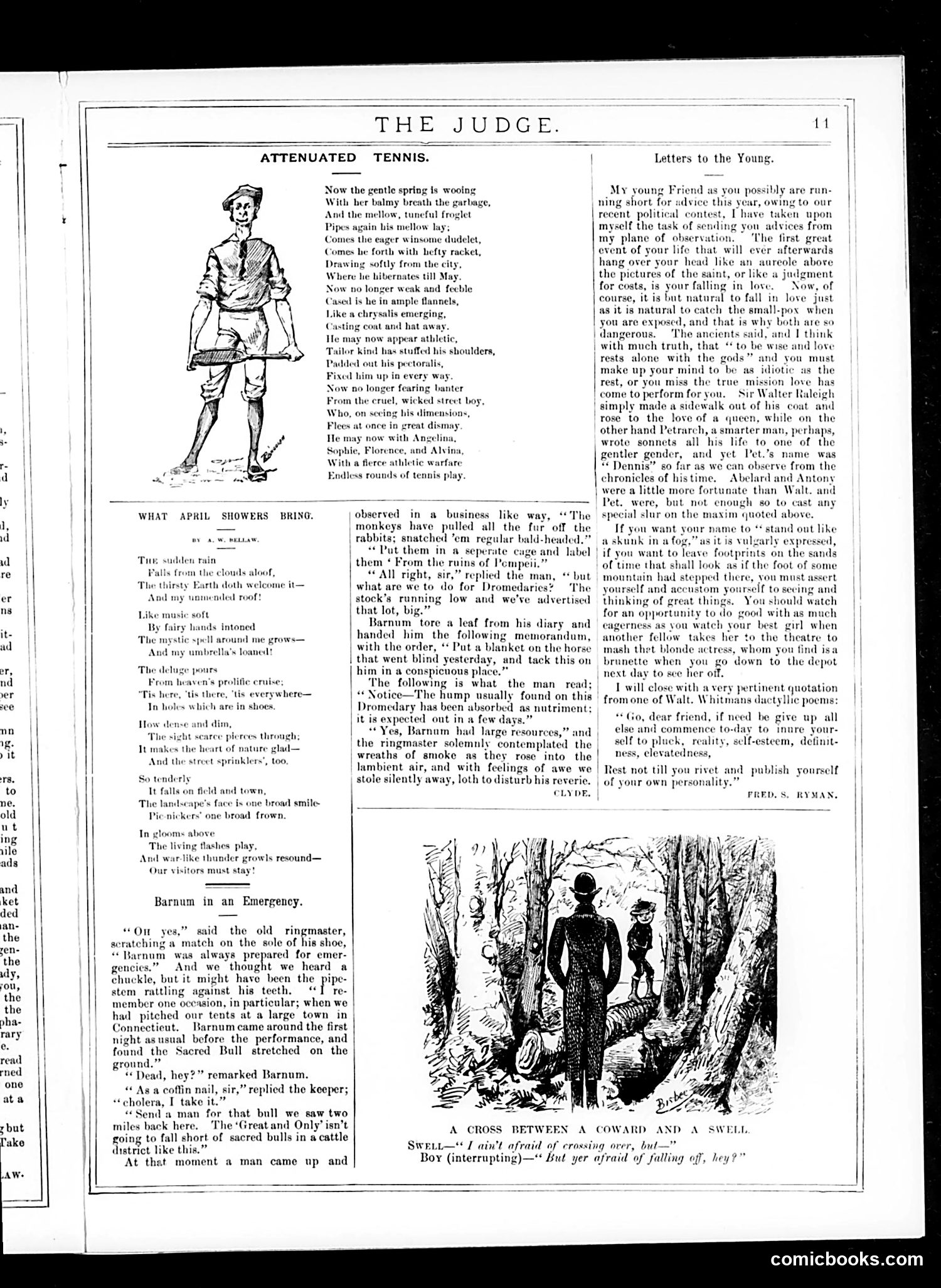
This page contains several distinct pieces of turn-of-the-century American humor: **"Attenuated Tennis"** mocks the seasonal ritual of spring tennis, depicting a scrawny, underfed player emerging from winter hibernation. The satire targets the absurdity of wealthy urbanites adopting athletic pursuits as fashion—the "dudelet" padding his shoulders to appear muscular. **"What April Showers Bring"** is a humorous poem about spring rain's dual nature: nourishing for nature but disastrous for people's clothes, shoes, and outdoor plans—a relatable domestic complaint. **"Barnum in an Emergency"** celebrates P.T. Barnum's legendary resourcefulness. When his prized red bull dies (from cholera), Barnum simply substitutes another animal, even disguising it with memoranda about "Pompeii" and "Dromadaries." The joke celebrates American showman ingenuity—Barnum's refusal to let facts impede spectacle. The final illustration shows two figures in woods labeled "A Cross Between a Coward and a Swell," likely satirizing social pretension among aristocratic types.
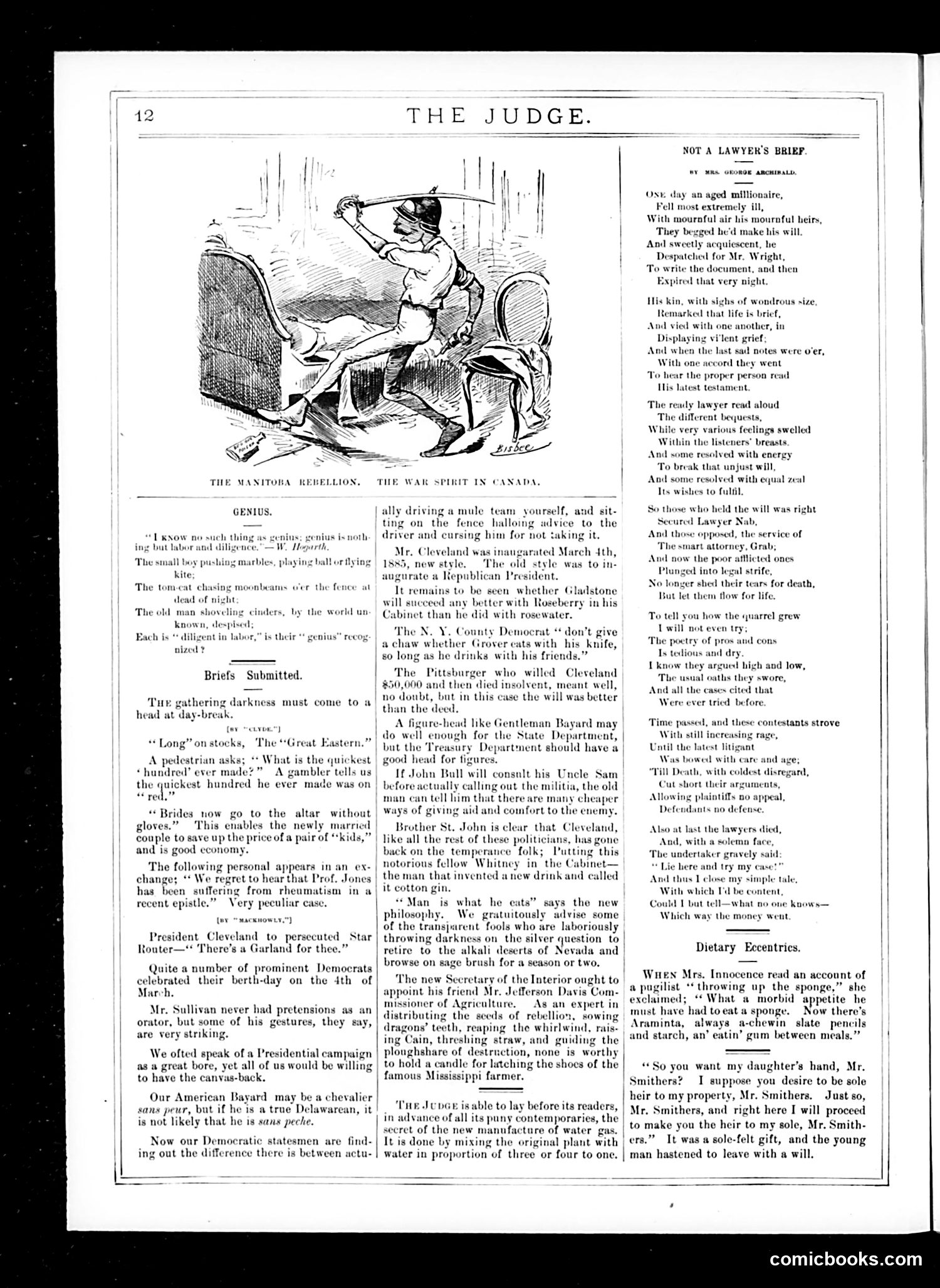
This page from Judge satirizes the Cleveland administration (March 1885) through multiple brief commentaries and a cartoon titled "The Manitoba Rebellion. The War Spirit in Canada." **The Main Cartoon** depicts a violent figure wielding a weapon, likely referencing Canadian tensions during the 1885 Northwest Rebellion (led by Louis Riel). The satire appears to mock American/Canadian relations and frontier violence. **The Commentary Targets:** - **President Cleveland**: newly inaugurated (March 4th), the first Democratic president after Republican rule - **Treasury Secretary**: criticized for lacking financial acumen (needing a "good head for figures") - **Secretary of Interior**: satirized for appointing Jefferson Davis (former Confederate general) as Agriculture Commissioner—a jab at putting a "rebellion" expert in charge - **British politics**: comparing Gladstone's ministry unfavorably to Cleveland's **The Tone** is typical Judge humor: political mockery through puns, absurdist comparisons, and mock-biographical items. The page ridicules Democratic incompetence while celebrating American superiority over British governance.
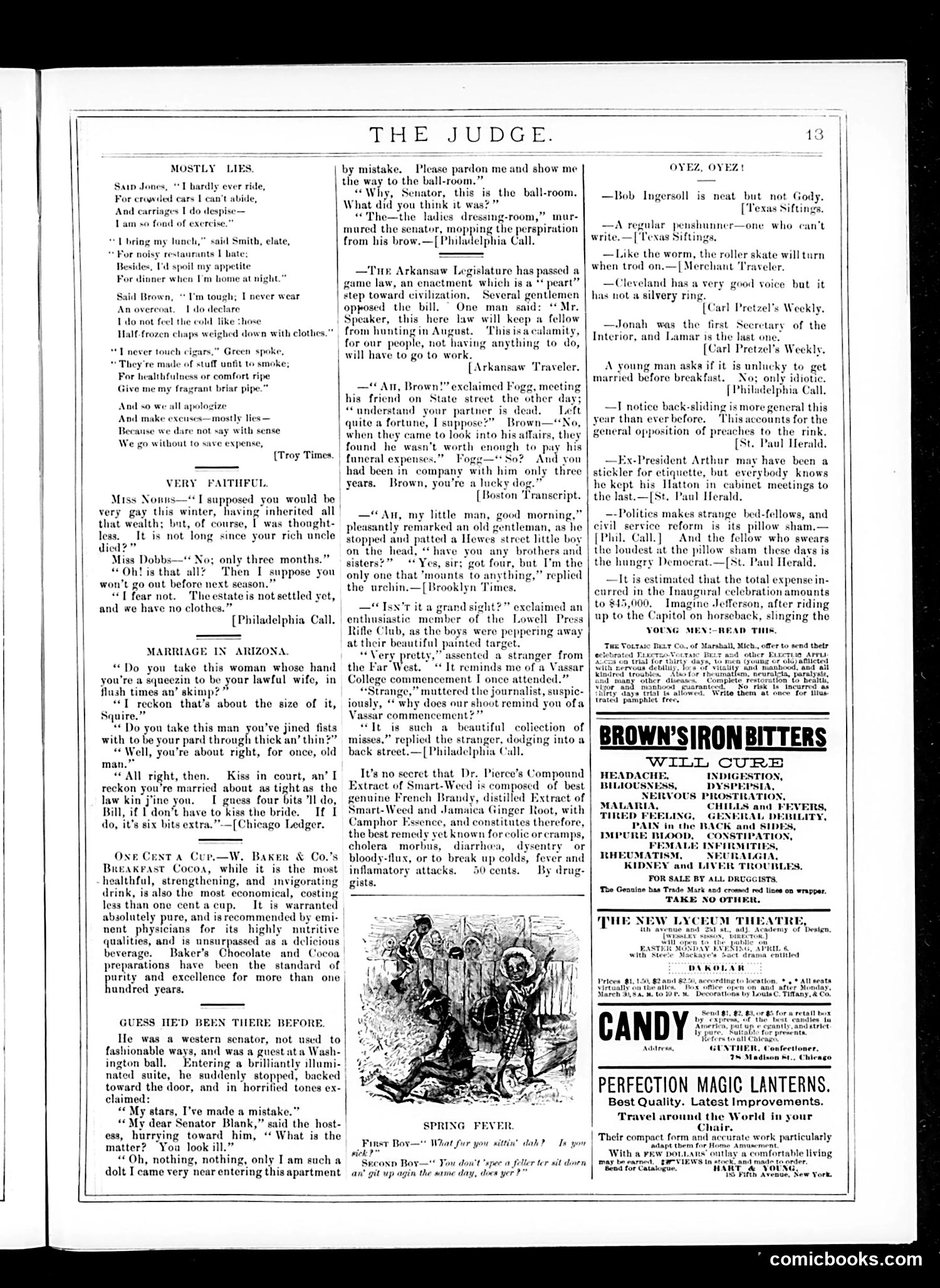
This page contains several short humorous sketches typical of Judge's satirical format. **"Mostly Lies"** satirizes urban gentlemen making excuses for their unhealthy habits—one avoids crowded streetcars, another claims he doesn't feel the cold, a third refuses to smoke cheap tobacco—all while admitting they're really just being cheap or lazy. The joke is their self-deception masquerading as principle. **"Marriage in Arizona"** mocks frontier justice and informal western customs, depicting a judge casually performing a wedding ceremony and charging fees for extra services like kissing the bride. **"Guess He'd Been There Before"** plays on a senator's embarrassment at nearly entering what he assumes is a ladies' dressing room at a Washington ball—suggesting his confusion about proper high-society protocol. The remaining sketches use similar structures: brief dialogues exposing human hypocrisy, pretension, or social awkwardness. The page also includes advertisements for consumer products (cocoa, bitters, candy, lanterns) typical of the era.
This page is primarily **advertising** rather than editorial content. The satirical/humorous elements are limited and minor. The only significant cartoon-related text appears in the center, under "THE JUDGE" heading—a series of brief anecdotes in the magazine's signature witty style. These include: 1. A joke about a politician viewing a bill for $45,000 in expenses with "simplicity" (satirizing political profligacy) 2. A dialogue between a gentleman and woman about why pedestrians behave dangerously around trains (absurdist humor about irrational human behavior) 3. A children's dialogue about a balloon, using "gas is—is—is melted wind" as a punchline (wordplay satire) 4. A story mocking Miss Mabel Hearne, who sued a venue manager for dress-code discrimination, wanting reparation while actually blaming her own appearance—satirizing female vanity and frivolous lawsuits. The remainder consists of period product advertisements (banking, medical services, printing inks, custard powder, beer pumps, building companies).
This is primarily an **advertising page** (page 15) from Judge magazine, dominated by patent medicine and product promotions rather than editorial cartoons. The small editorial content includes brief humorous anecdotes: 1. **A joke about a judge** drawing "the fine of demarcation" between women—apparently commenting on the difficulty of distinguishing between female appearance or behavior. 2. **An Abraham/real estate joke** playing on "Lot in Sodom" as a literal property reference. 3. **A children's story** about a girl named Rilla mishearing criticism of her handwriting as comparing her to a hen. The page's **main content** is aggressive advertising for **Duffy's Pure Malt Whiskey**, claiming medical benefits for sore throat, consumption, cholera, and hemorrhoids. It includes pseudo-scientific testimonials from doctors and chemists—typical of late-19th-century patent medicine marketing. These claims are completely unsupported and would be illegal today. Other ads promote Pond's Extract, skin-bleaching products, pianos, bicycles, and truss devices, reflecting era-specific consumer concerns.
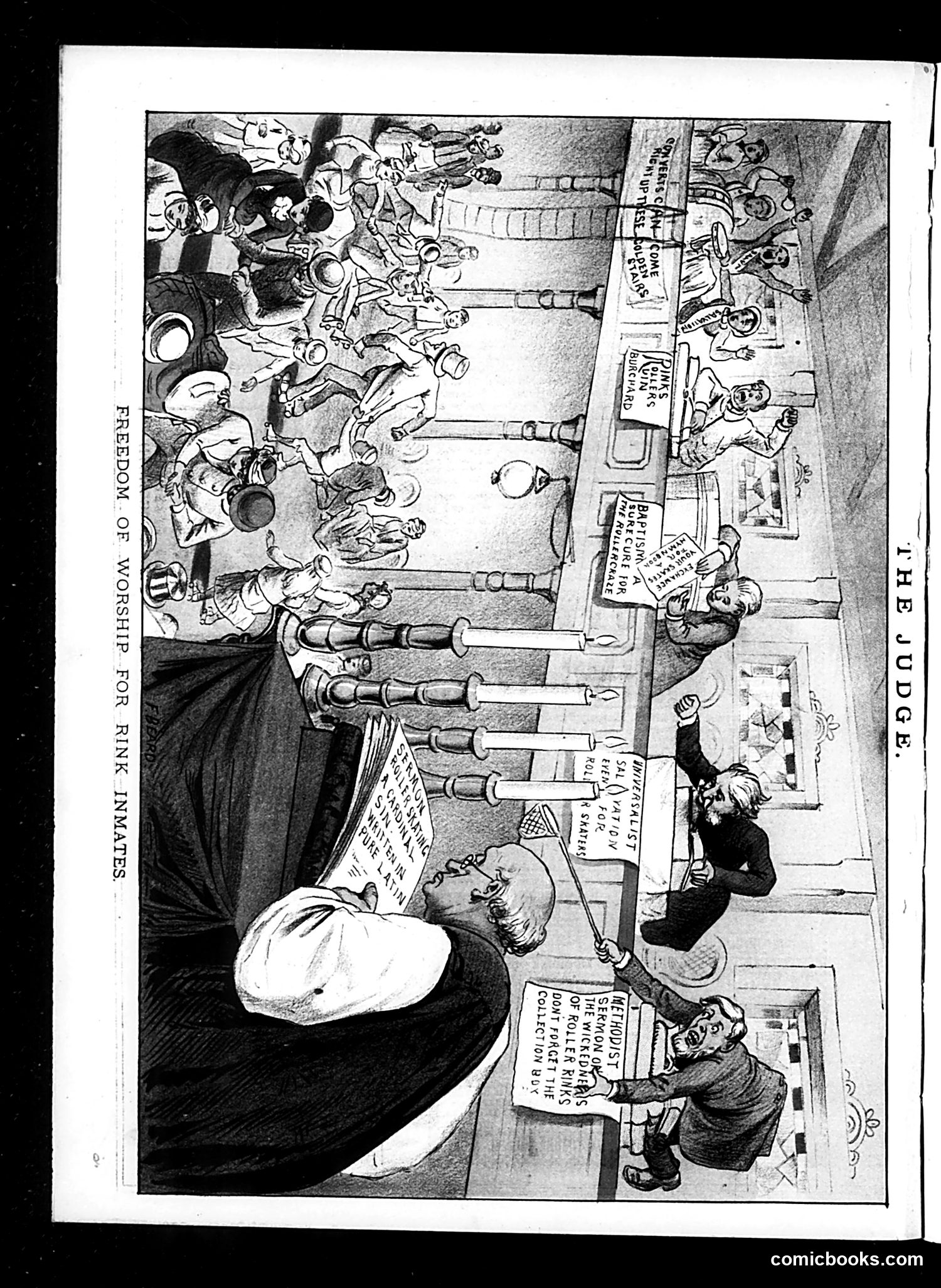
This satirical cartoon critiques religious hypocrisy regarding leisure activities. The image shows various religious denominations (Methodist, Salvation Army, and others visible in signage) gathered around what appears to be a roller rink—a popular entertainment venue that religious conservatives opposed as sinful. The cartoon's central joke: these churches preach "Freedom of Worship" while simultaneously condemning roller rinks as dens of wickedness. The figures holding collection plates suggest clergy exploiting moral panic about the rink to solicit donations from parishioners. This reflects early 20th-century tensions between traditional religious institutions and modern commercial entertainment. Judge magazine used this to mock religious establishments for selective morality—defending their own freedom while restricting others' innocent pleasures. The satire targets clerical sanctimoniousness and institutional greed masked as moral guardianship.
I can see this is a page from *Judge* magazine (visible in the left margin), but the image shows essentially a blank or nearly blank white page with only minimal text visible along the spine. There is no discernible cartoon, illustration, or substantive written content that I can analyze. The OCR text appears to be corrupted or represents only page artifacts rather than actual article/cartoon content. Without visible editorial content, caricatures, or satirical illustrations on this particular page, I cannot identify the political or social references, figures, or the satire's point. This may be a blank page, a title page, or an advertising page from the magazine.