
Judge, 1885-04-11 · page 2 of 17
Judge — April 11, 1885 — page 2: what you’re looking at
What you’re looking at
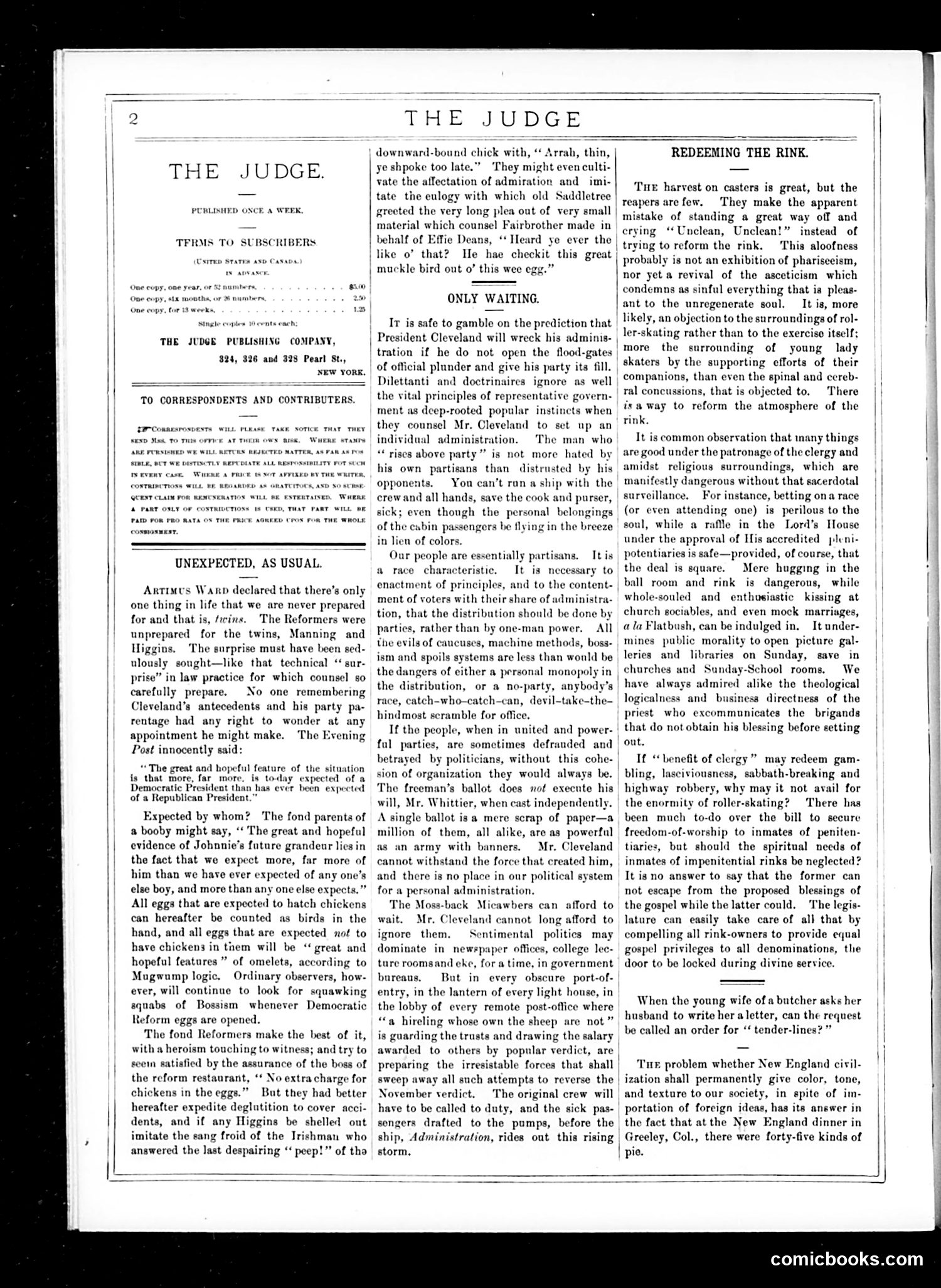
This is primarily **editorial content**, not a cartoon page. The main article, "Only Waiting," argues that President Cleveland should distribute government positions through party machinery rather than attempting "personal administration" above partisan politics. **Key political argument**: The author criticizes Cleveland for trying to govern independently of party structures. The piece contends that: - Organized political parties, despite their flaws, are preferable to one-man rule - Individual reform-minded politicians cannot resist systemic pressures - Party discipline ensures voter interests are represented better than personal monopolies **The satire targets**: Cleveland's reformist pretensions and those who advised him to rise "above party." The author mockingly notes the "Evening Post" expressed surprise at Cleveland's conventional appointments, despite his clear party affiliations. **Context**: This reflects 1880s-90s debates about civil service reform versus traditional patronage politics—Cleveland attempted both, alienating reformers and party regulars alike. The page also contains subscription information and contributor guidelines typical of period magazines.
📄 Transcribed text from this page (OCR, searchable)
Machine-transcribed from the original scan — historical spelling and the odd misread are preserved.
THE JUDGE downward-bound chick with, ‘ Arrah, thin, ye shpoke too late.” They might even culti- vate the affectation of admiration and imi- tate the eulogy with which old greeted the very long plea out of very small material which counsel Fairbrother made in TFRMS TO SUBSCRIBERS | behalf of Effie Deans, | like o’ that? He hae checkit this great muckle bird out 0’ this wee egg.” THE JUDGE. PUBLISHED ONCE a WEEK, Usrrep Starrs asp Casana ONLY WAITING. THE JUDGE PUBLISHING COMPANY, 824, 326 and 328 Pearl St., Ir is safe to gamble on the prediction that tration if he do not open the flood-gates of official plunder and give his party its fill. NEW YORK. ge ——= Dilettanti and doctrinaires ignore as well TO CORRESPONDENTS AND CONTRIBUTERS. _ the vital principles of representative govern- ment as deep-rooted popular instincts when aw-Conassrosvesre. wrt rake sor! rwxy they counsel Mr. Cleveland to set up an EXD Jisk To TIES OPTIC AT THEE OWN Risk, WHERE individual administration. The man who ARE PORSIAHED WH WILL RETURS REJECTED MATTER, 48 FAN AS «rises above party” is not more hated by eee eee nnae crane wert urarostemt cme, , bis own partisans than distrusted by his br REDARDED as oRaTCroCaaND soatme Opponents, You can’t ran a ship with the wu mx eereeraiven, Woene crewand all hands, save the cook and purser, + con, Tar raRT HL ME Sick: even though the personal belongings maoueny Cros ron eme wHX of the cabin passengers be flying in the breeze it Jie of colors. 3. 7 Our people are essentially partisans. It is | UNEXPECTED, AS USUAL. a race characteristic. It is necessary to enactment of principles, and to the content- ment of voters with their share of administra- tion, that the distribution should be done by parties, rather than by one-man power. All the evils of caucuses, machine methods, boss- ism and spoils systems are less than would be the dangers of either a personal monopoly in the distribution, or a no-party, anybody’s race, catch-who-catch-can, devil-take-the- hindmost scramble for office, If the people, when in united and power- ful parties, are sometimes defrauded and betrayed by politicians, without this cohe- sion of organization they would always be. The freeman’s ballot does not execute his will, Mr. Whittier, when cast independently. A single ballot is a mere scrap of paper—a million of them, all alike, are as powerful as an army with banners. Mr. Cleveland cannot withstand the force that created him, and there is no place in our political system for a personal administration. The Moss-back Micawbers can afford to wait. Mr. Cleve nnot long afford to ignore them. Sentimental politics may dominate in newspaper offices, college lec- ture roomsand eke, for a time, in government bureaus, But in every obscure port-of- ‘y, in the lantern of every light house, in the lobby of every remote post-office where “a hireling whose own the sheep are not” is guarding the trusts and drawing the salary Antiavs Warp declared that there’s only | one thing in life that we are never prepared | for and that is, /icins. The Reformers were unprepared for the twins, Manning and Higgins. ‘The surprise must have been sed- ulously sought—like that technical “ sur- prise” in law practice for which counsel so carefully prepare. No one remembering Cleveland’s antecedents and his party pa- rentage had any right to wonder at any appointment he might make. The Evening Post innocently said: “The great and hopeful feature of the situation is that more, far more, Democratic President than of a Republican President.” Expected by whom? ‘The fond parents of a booby might say, “The great and hopeful evidence of Johnnie's future grandeur lies in the fact that we expect more, far more of him than we have ever expected of any one’s else boy, and more than any one else expects.” All eggs that are expected to hatch chickens can hereafter be counted as birds in the hand, and all eggs that are expected not to have chickens in them will be ‘great and hopeful features ” of omelets, according to Mugwump logic. Ordinary observers, how- ever, will continue to look for squawking aquabs of Bossism whenever Democratic Reform eggs are opened. The fond Reformers make the best of it, with a heroism touching to witness; and try to seein satisfied by the assurance of the boss of the reform restaurant, ‘* No extracharge for chickens in the eggs.” But they had better hereafter expedite deglutition to cover acci- dents, and if any Higgins be shelled ont imitate the sang froid of the Irishman who answered the last despairing ‘‘ peep!” of tha preparing the irresistable forces that shall sweep away all such attempts to reverse the November verdict. The original crew will have to be called to duty, and the sick pas- sengers drafted to the pumps, before the ship, storm. awarded to others by popular verdict, are | Saddletree | “Heard yo ever the | | | | President Cleveland will wreck his adminis- | Administration, rides out this rising | REDEEMING ' “THE RINK. | | ‘Tue harvest on casters is great, but the | reapers are few. They make the apparent mistake of standing a great way off and ing ‘Unclean, Unclean!” instead of ng to reform the rink. ‘This aloofness probably is not an exhibition of phariseeism, nor yet a revival of the asceticism which | condemns as sinful everything that is pleas- ant to the unregenerate soul. — It is, more likely, an objection to the surroundings of rol- ler-skating rather than to the exercise itself; more the surrounding of young lady skaters by the supporting efforts of their companions, than even the spinal and cereb- ral concussions, that is objected to. There isaway to reform the atmosphere of the | rink. It is common observation that inany things are good under the patronage of the clergy and amidst religious surroundings, which are, manifestly dangerous without that sacerdotal | | surveillance. For instance, betting ona race (or even attending one) is perilous to the soul, while a raffle in the Lord’s House under the approval of His accredited pleni- potentiaries is safe—provided, of course, that the deal is square. Mere hugging in the ball room and rink is dangerous, while whole-souled and enthusiastic kissing at church sociables, and even mock marringes, ala Flatbush, can be indulged in. Itunder- | mines public morality to open picture gal- | leries and libraries on Sunday, save in | churches and Sunday-School rooms. We have always admired alike the theological logicalness and business directness of the priest. who excommunicates the brigands that do not obtain his blessing before setting out. If “benefit of clergy” may redeem gam- bling, lasciviousness, sabbath-breaking and highway robbery, why may it not avail for the enormity of roller-skating? ‘There has been much to-do over the bill to secure freedom-of-worship to inmates of peniten- tiaries, but should the spiritual needs of inmates of impenitential rinks be neglected? It is no answer to say that the former can not escape from the proposed blessings of the gospel while the latter could. The legis- lature can easily take care of all that by compelling all rink-owners to provide equal gospel privileges to all denominations, the door to be locked during divine service. When the young wife ofabutcher asks her | husband to write her aletter, can the request | be called an order for ‘‘ tender-lines Tur problem whether New England civi ization shall permanently give color, tone, and texture to our society, in spite of im- portation of foreign ideas, has its answer in the fact that atthe New England dinner in | Greeley, Col., there were forty-five kinds of || comicbooks.com