
A complete issue · 16 pages · 1884
Judge — November 8, 1884
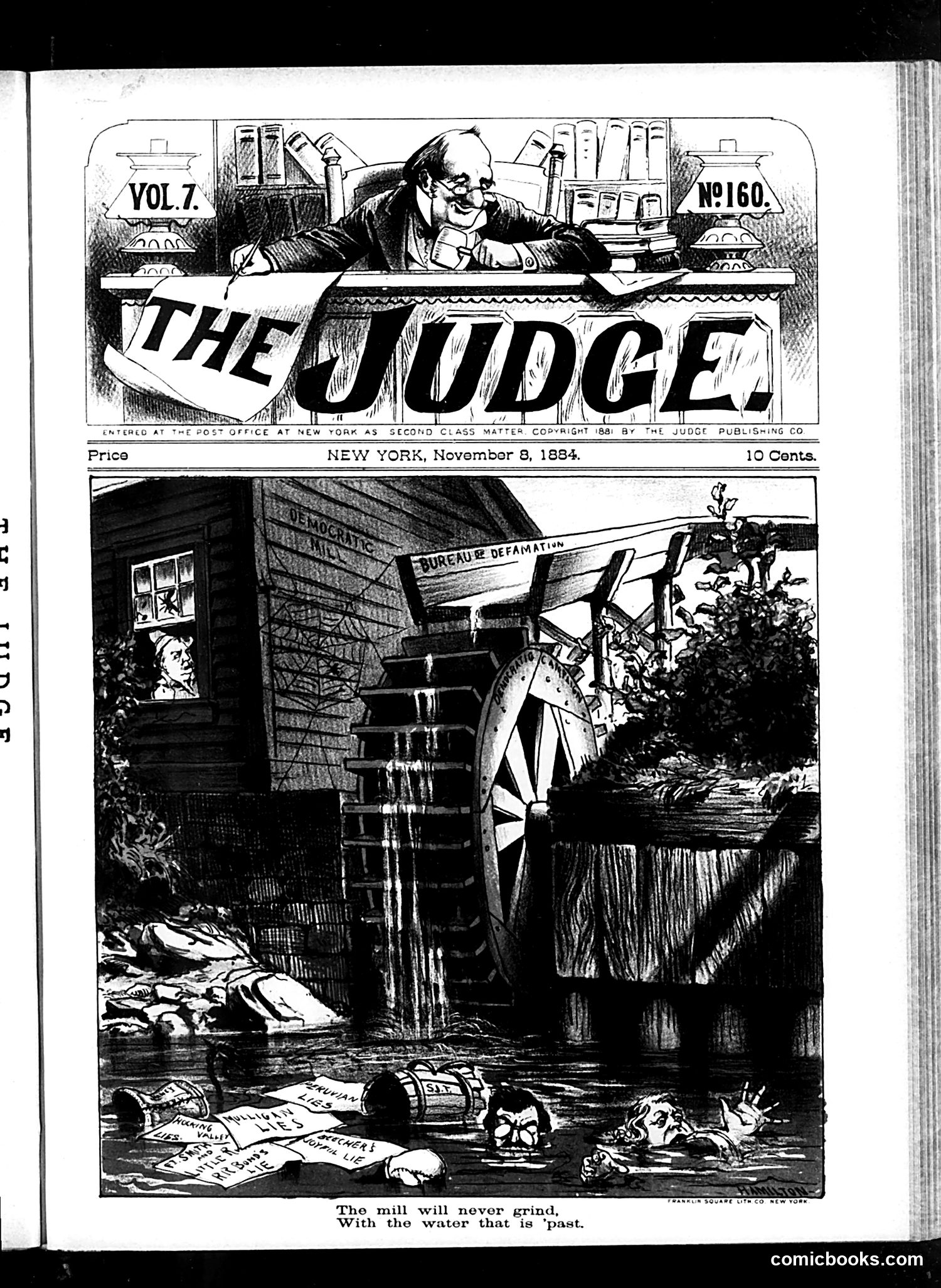
This political cartoon depicts a broken water mill with debris scattered below, labeled with text including "BUREAU OF DEFAMATION." The caption reads: "The mill will never grind, with the water that is past." **What it means:** This appears to be commentary on a defunct or discredited government bureau—likely referencing a scandal or failed initiative from the 1884 election period. The mill metaphor suggests something that once functioned productively can no longer operate. The scattered debris and "Bureau of Defamation" label suggest institutional corruption or misuse of power for character assassination. The cartoon likely critiques either a political opponent's administration or a specific government agency's malfeasance, using the mill as metaphor for institutions that have lost their purpose or legitimacy.
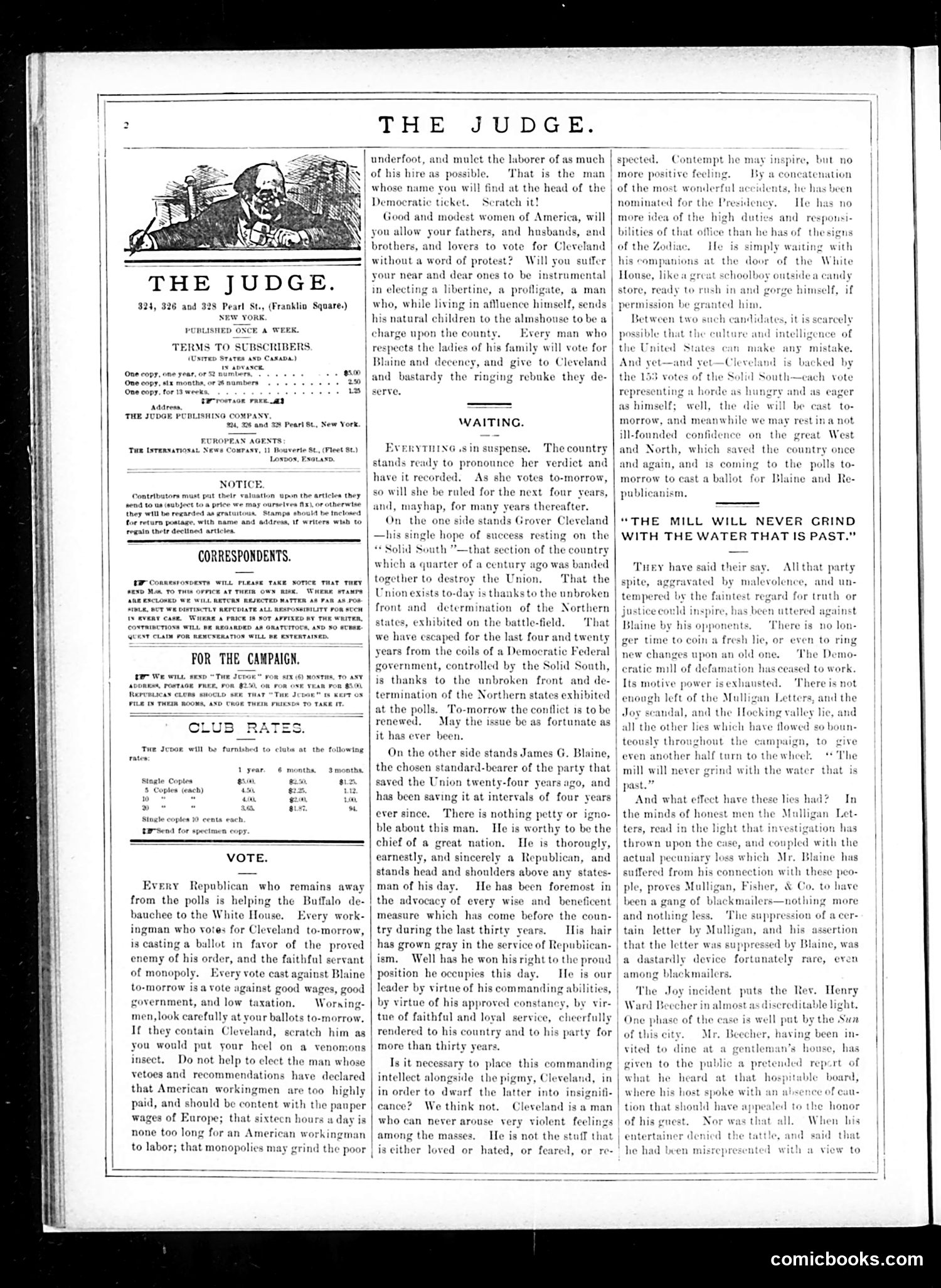
This page attacks **Grover Cleveland**, the Democratic presidential nominee, using the rhetoric of the 1884 campaign. The cartoon (top left) depicts Cleveland as a disreputable figure, while accompanying text targets him on moral grounds—specifically alleging he fathered illegitimate children and placed them in almshouses rather than supporting them. The editorial contrasts Cleveland with **James G. Blaine**, the Republican standard-bearer, praising Blaine's service and advocating for Republican votes. It warns women voters to reject Cleveland on grounds of decency and morality. The "WAITING" section expresses anxiety about election results, acknowledging Cleveland's strength in the "Solid South" (formerly Confederate states voting Democratic) while hoping Northern and Western states will reject him. The quote "The mill will never grind / With the water that is past" suggests Democrats cannot escape their Civil War-era legacy of disunion. Judge was openly partisan Republican. This represents period political journalism's aggressive personal attacks on candidates' character and private conduct.
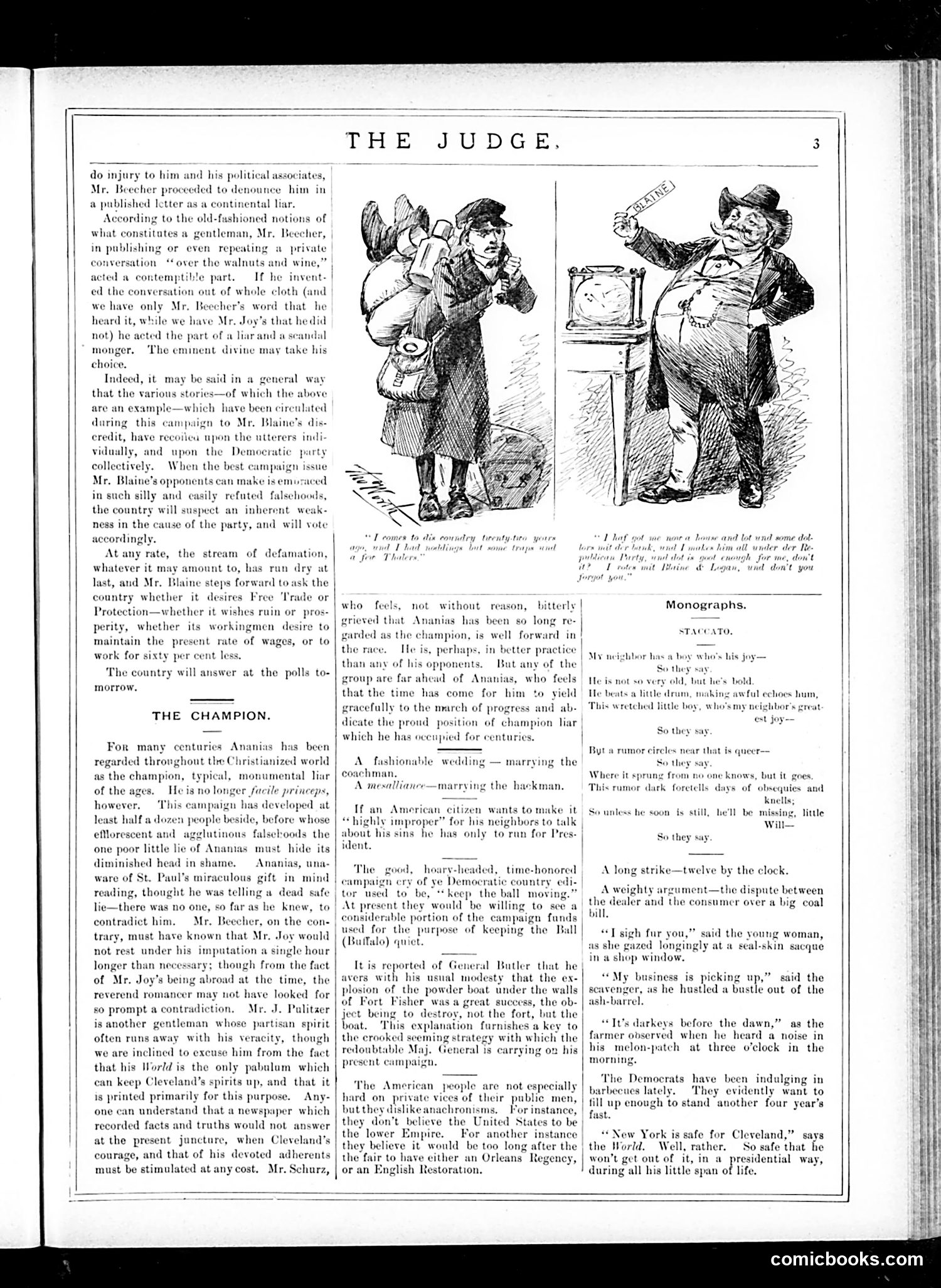
This *Judge* magazine page satirizes the 1884 presidential campaign, attacking Henry Ward Beecher (a prominent minister) and supporters of Democratic candidate James G. Blaine for spreading false accusations. **The Main Cartoon:** Shows a man (Beecher) carrying a sack labeled "SCANDAL" while another figure (likely representing a Democratic operative) greedily receives it—mocking how anti-Blaine forces spread unsubstantiated stories that backfired. **The Political Context:** The article argues that Beecher's published letter making unproven claims about Blaine damaged the Democratic cause, not Blaine's reputation. *Judge*, a Republican publication, contends that cheap personal attacks betray weakness in substantive policy arguments. **The Satire's Point:** By comparing Beecher to Ananias (biblical liar) and criticizing newspapers like Pulitzer's *World* for promoting falsehoods, the piece defends Republican Blaine against Democratic character assassination while questioning whether voters care more about Free Trade policy than scandal-mongering.
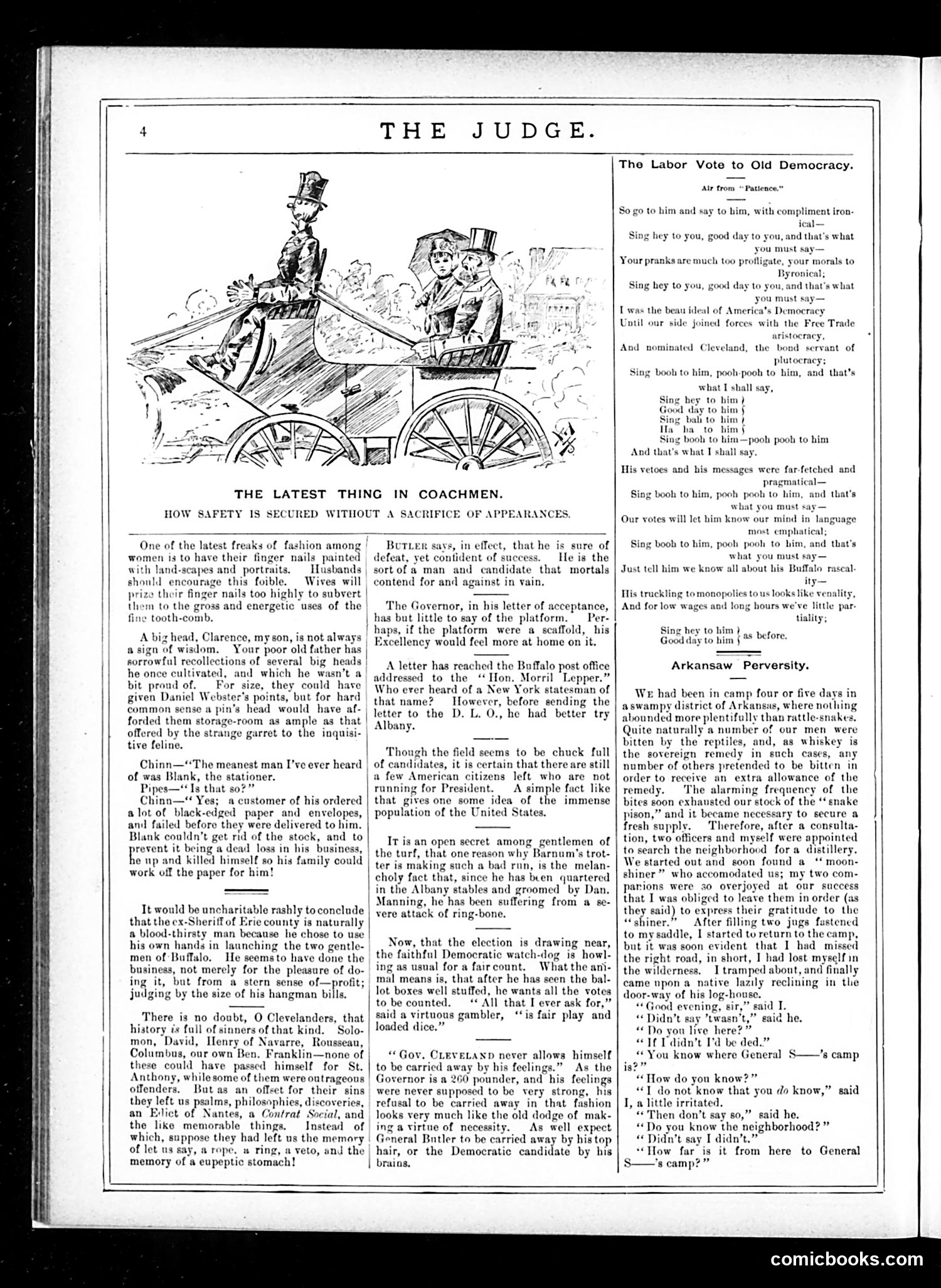
This cartoon satirizes safety innovations in horse-drawn carriages by depicting an elaborate mechanical contraption with a driver elevated high above passengers in a carriage. The title mocks the idea of achieving "safety without sacrifice of appearances"—suggesting wealthy clients wanted protective innovations that didn't visibly compromise the elegant appearance of their coaches. The accompanying text contains unrelated political humor typical of Judge magazine, including jibes at Cleveland (likely Governor Grover Cleveland), references to executions in Buffalo, and mockery of candidates and politicians. The "Arkansas Perversity" section humorously recounts an encounter with locals in Arkansas. The overall page exemplifies Judge's satirical approach: visual cartoons mocking fashionable absurdities paired with gossipy, pointed political commentary about late 19th-century American public figures.
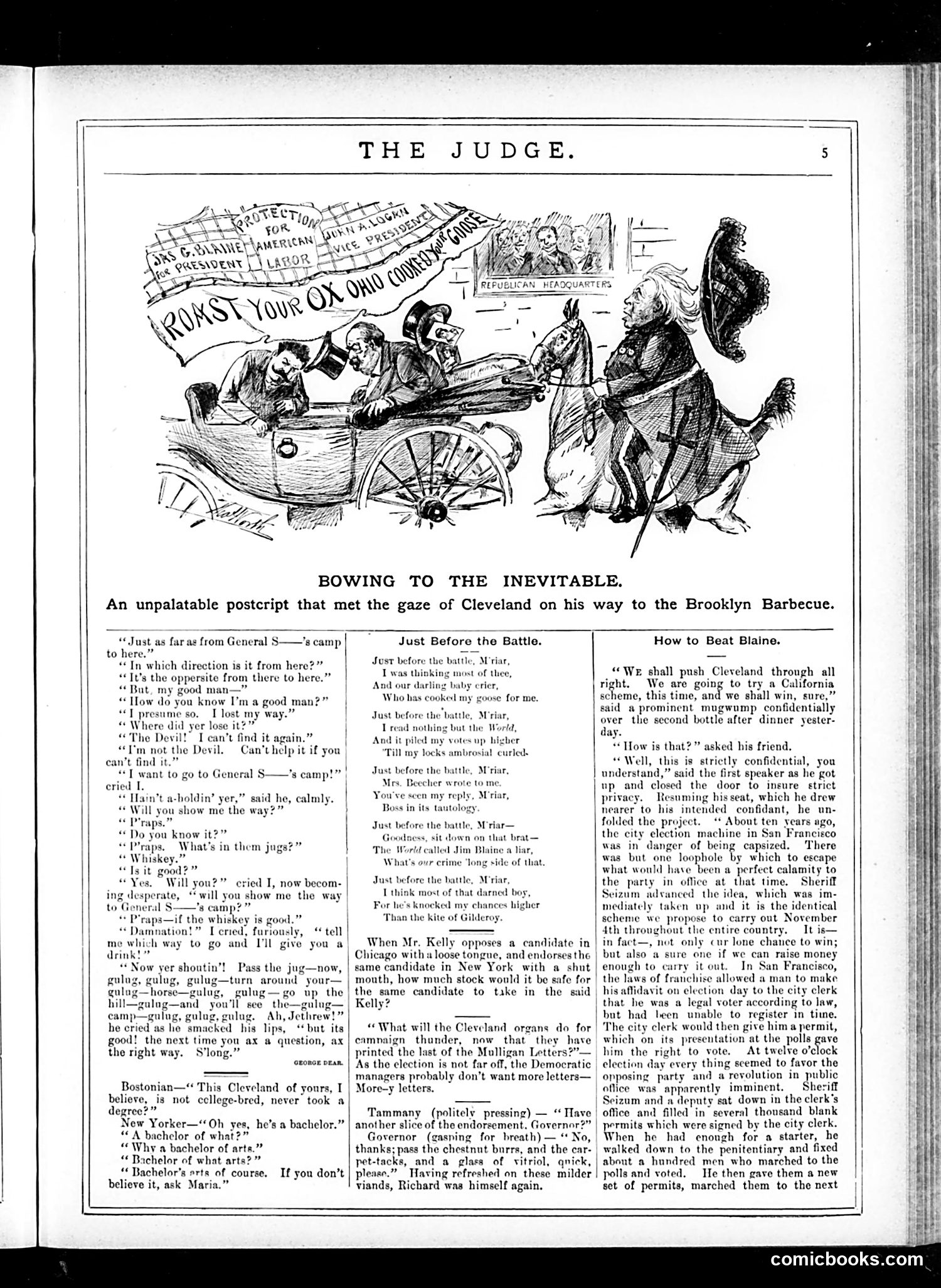
This 1884 page satirizes President **Grover Cleveland** en route to a Brooklyn event. The main cartoon depicts Cleveland in a carriage being pulled by a donkey labeled with competing Democratic factions and platforms—mocking the party's internal chaos and contradictions. The three accompanying comic dialogues ridicule Cleveland's perceived weaknesses: his crude manners (the "bachelor of arts" joke), his flip-flopping positions (the Kelly/Chicago-New York contradiction), and Democratic strategy against Republican **James G. Blaine**. The "Mulligan Letters" reference points to actual 1884 correspondence damaging to Blaine; Democrats exploited these while Judge implies they're running out of ammunition. The satire suggests Cleveland, despite Democratic claims of inevitability, is fundamentally unfit—more hapless than commanding—making him an unlikely victor against Blaine.
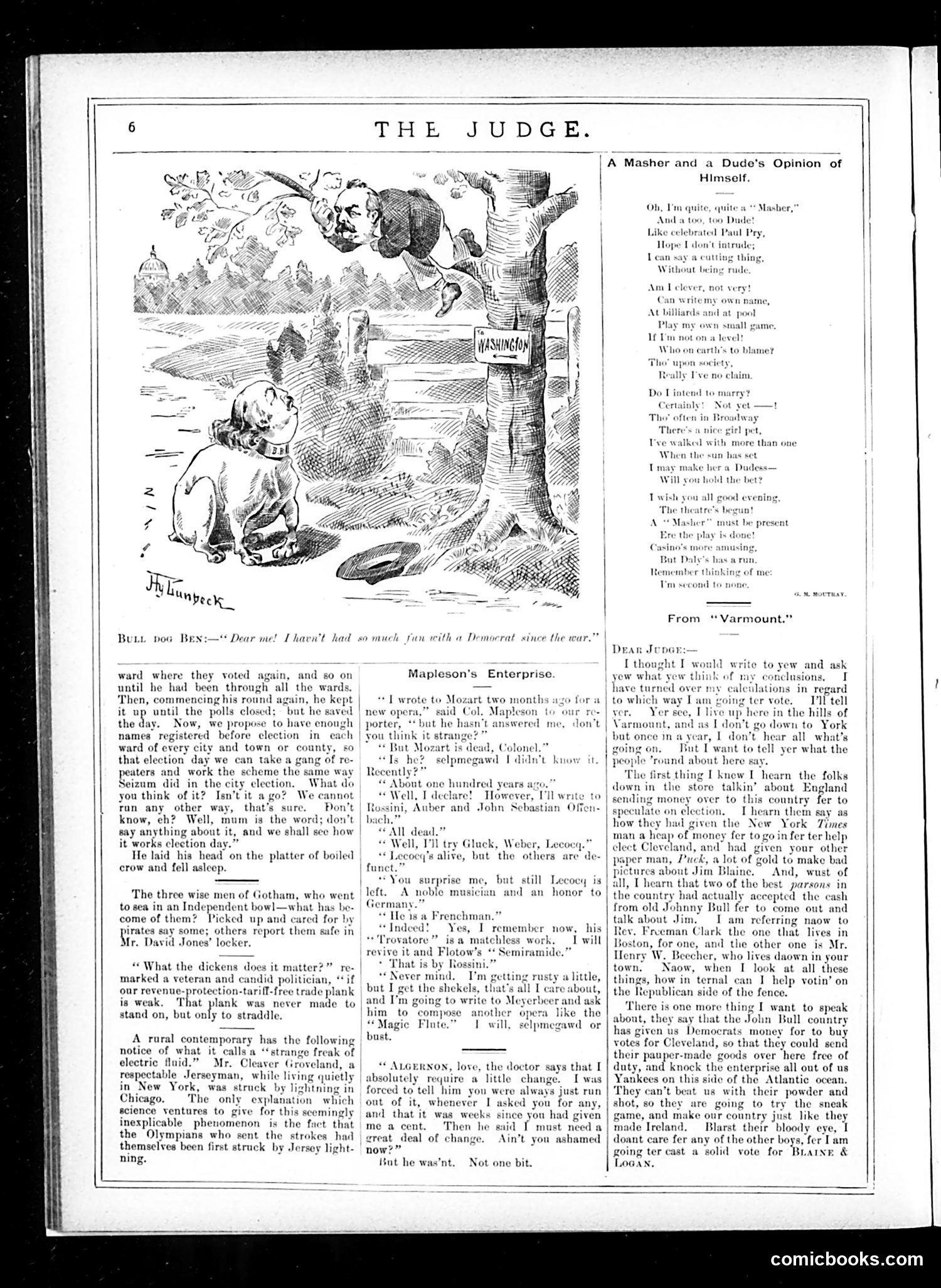
This page from *Judge* magazine contains political satire targeting the 1884 presidential election. The main cartoon shows a figure labeled "Bull Dog Ben" (likely referencing Democratic candidate Benjamin Butler or a similar figure) with an anthropomorphic bulldog, captioned about lack of fun with a Democrat—mocking Democratic campaign efforts or candidates. The "Mapleson's Enterprise" section satirizes operatic impresario Colonel Mapleson's business schemes, using musical references as metaphor for political maneuvering. The longer letter from "Dear Judge" (signed as from Vermont) is the page's central political commentary. A rural voter describes being lobbied by British interests allegedly funding Democratic candidate Cleveland's campaign, claiming British money supports anti-tariff policies to flood America with cheap goods. The writer resolves to vote Republican (Blaine & Logan ticket) to protect American industry and jobs. This reflects the *Judge* magazine's Republican-leaning editorial position during the protectionist tariff debates of the 1880s, framing Democratic free-trade policies as foreign-backed threats to American workers.
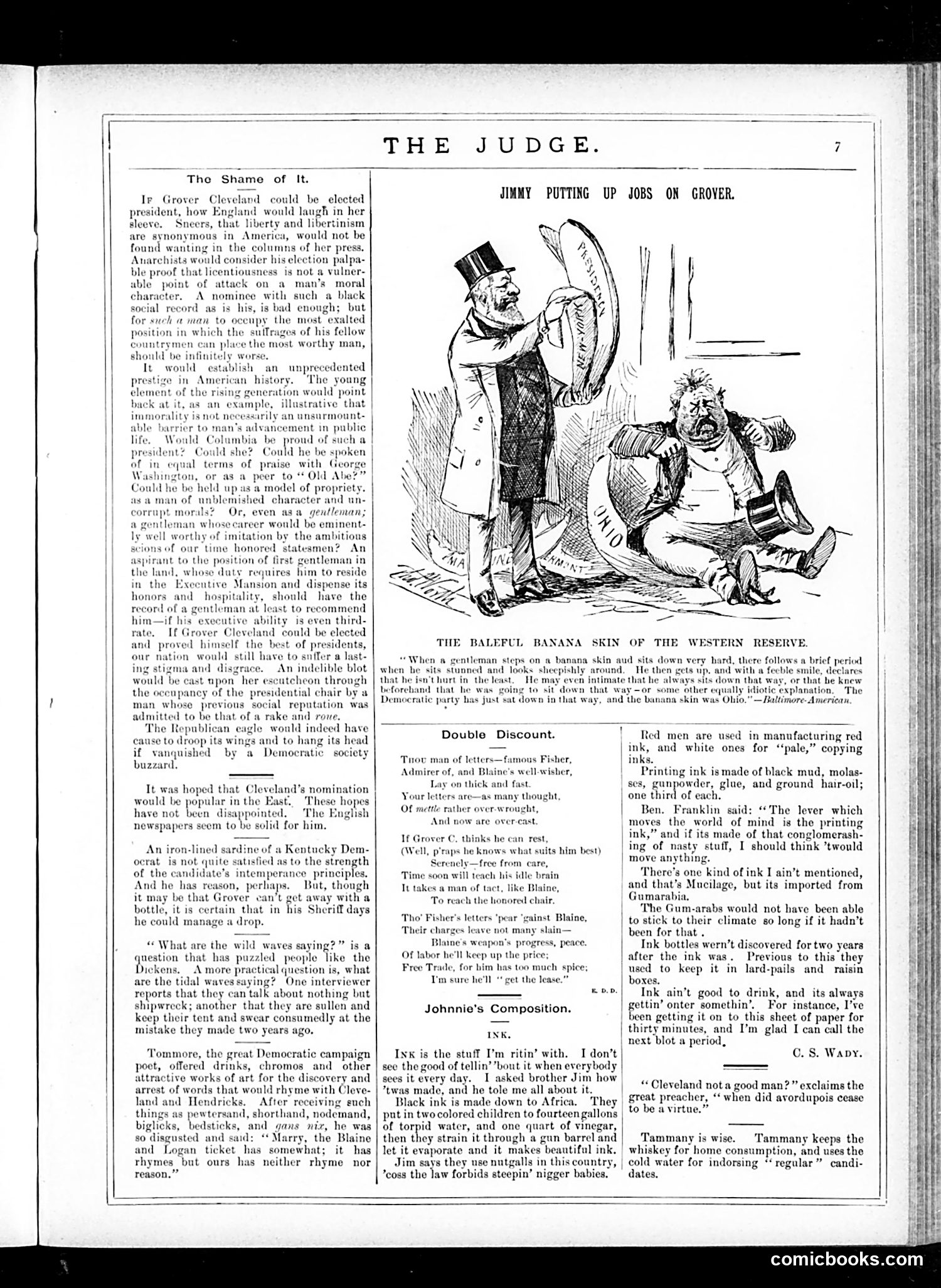
## Main Cartoon: "Jimmy Putting Up Jobs on Grover" The large cartoon depicts a well-dressed man (likely representing the Republican Party or establishment) placing a small figure labeled as representing Democratic candidate Grover Cleveland onto a banana peel—a classic slapstick setup. The satire references Cleveland's personal scandal: he had fathered a child out of wedlock, making him vulnerable to moral attacks despite his political competence. ## Context The accompanying editorial "The Shame of It" explicitly criticizes Cleveland's nomination, arguing that his moral failings disqualify him from the presidency regardless of executive ability. The cartoon reinforces this message: Republicans are "setting traps" (the banana peel) to exploit Cleveland's personal history as a political weapon. The page also contains lighter satirical pieces about campaign poetry and ink-making, typical of Judge's mixed content format. **Time period**: Appears to be 1884 presidential campaign coverage.
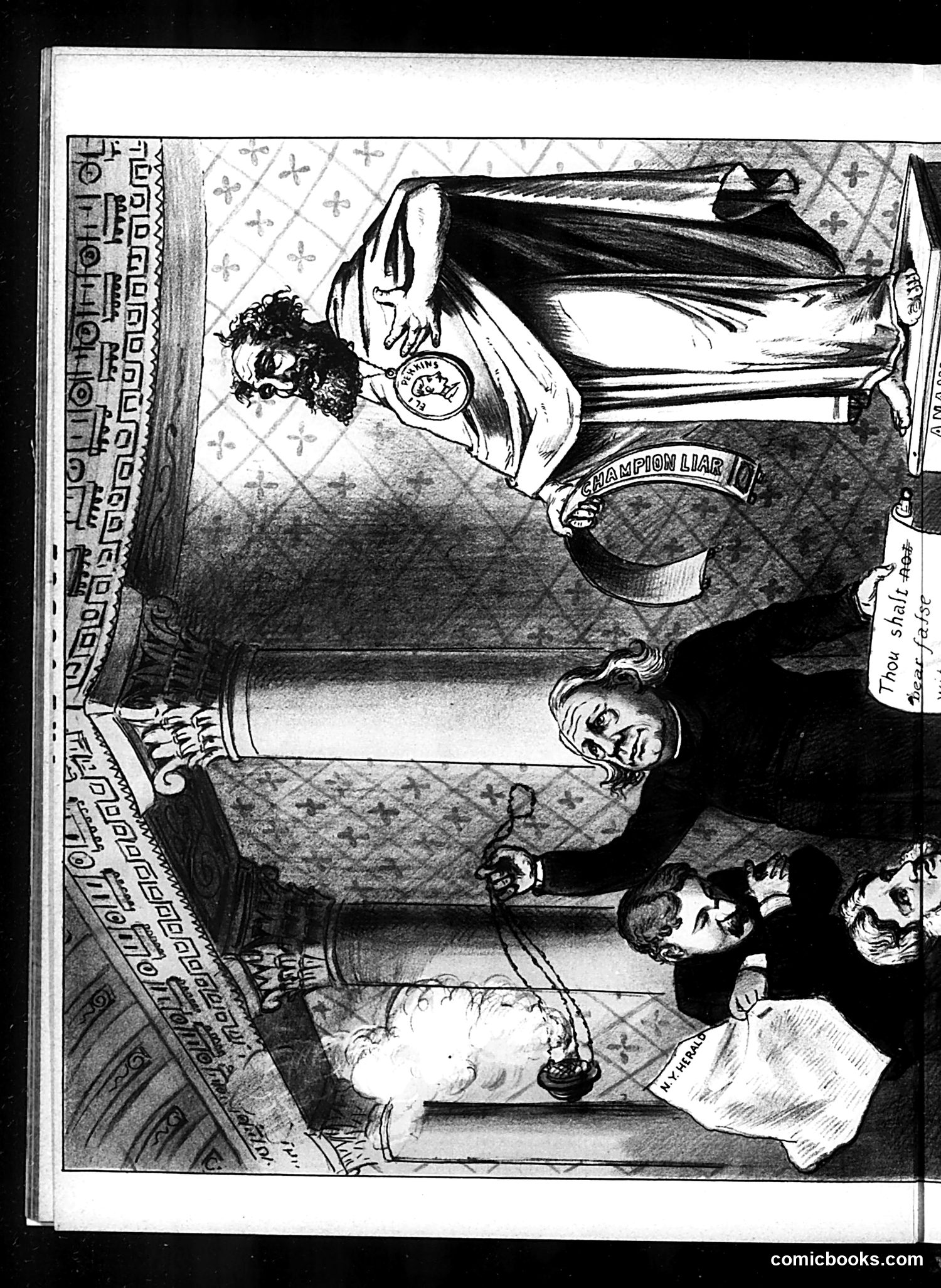
This appears to be a Judge magazine page featuring a satirical cartoon titled "Champion Liar." The image shows multiple figures in what appears to be a formal or official setting, viewed from an unusual rotated angle. The cartoon seems to present a social or political commentary about dishonesty or false claims, given the "Champion Liar" label visible on a banner or ribbon in the illustration. However, without being able to clearly identify the specific individuals depicted or read all the text clearly in this rotated reproduction, I cannot definitively state which political figures or events this references. The satirical style is typical of Judge magazine's approach to contemporary politics and society, but the specific historical context—the date, the particular scandal or claim being mocked—is unclear from this image alone.
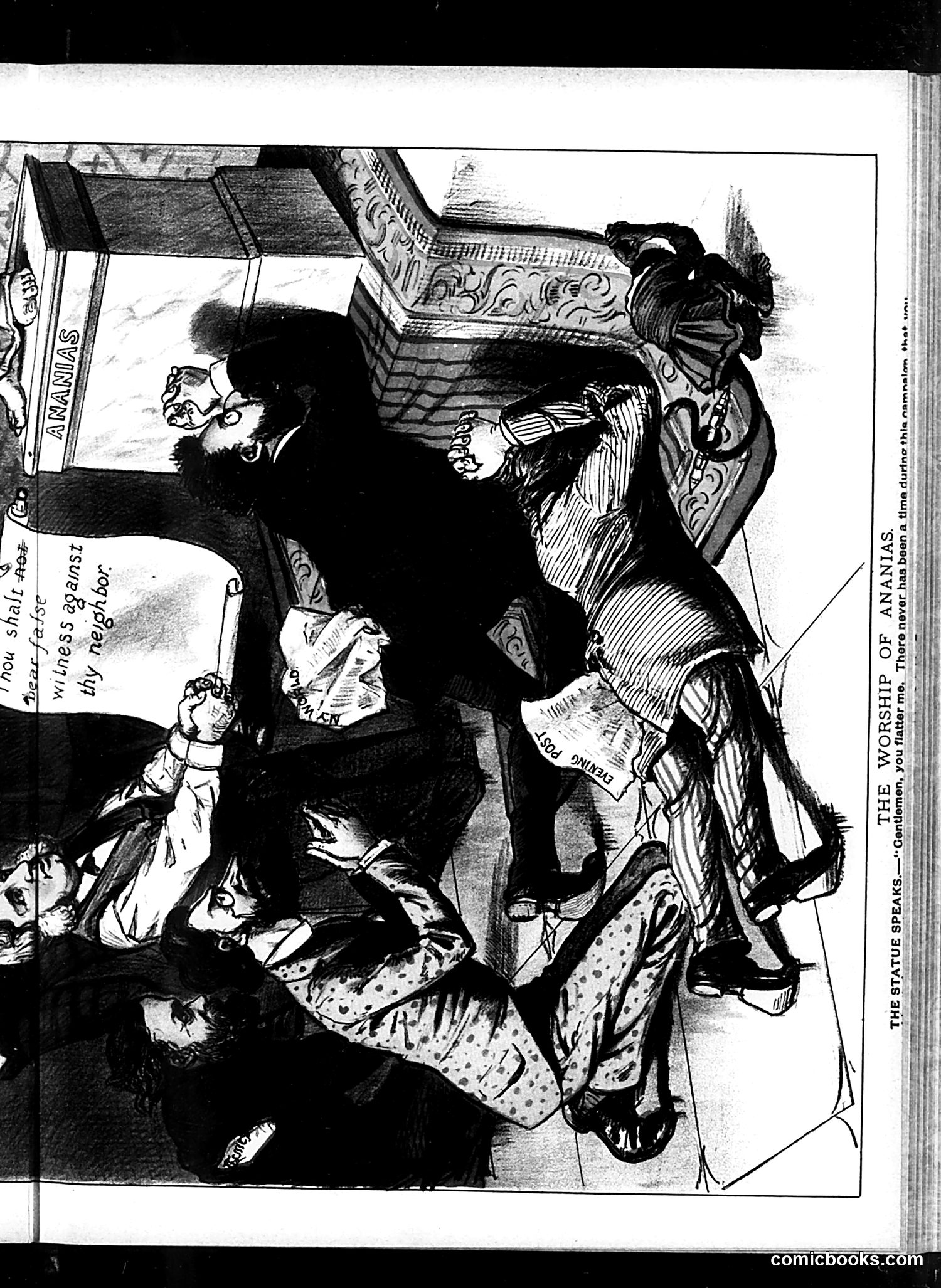
I cannot reliably interpret this cartoon due to OCR corruption that has rendered the text essentially illegible. The image shows what appears to be a satirical scene with multiple figures in period dress (appearing to be 19th century based on the artistic style) engaged in some kind of confrontation or dramatic interaction, with what looks like decorative architectural elements in the background. The title visible on the right reads "THE WORSHIP OF NANIAS" (or similar—also unclear). Without readable text identifying the specific figures, events, or political references being satirized, I cannot accurately explain what this Judge magazine cartoon means to a modern reader. To properly analyze this, a clearer text source or additional contextual information would be needed.
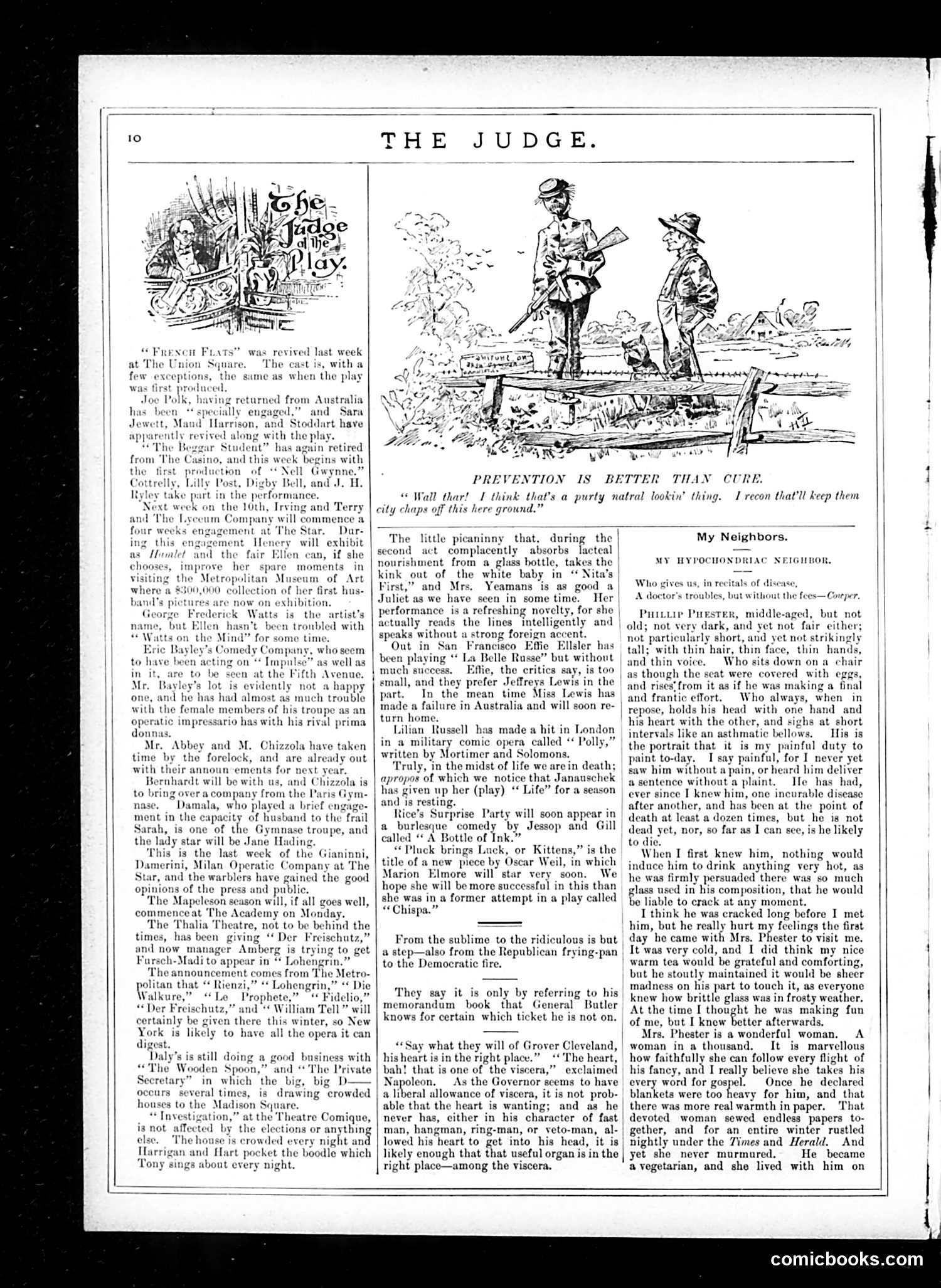
The main cartoon depicts two soldiers or military figures on what appears to be a fortified position, discussing prevention of disease or infection—likely a reference to contemporary public health concerns. The page is primarily theater criticism and gossip from Judge magazine. Text discusses the revival of "French Flats" at The Union Square Theatre, casting changes, and various theatrical performances and performers of the era (including mentions of Sarah Bernhardt, Lillian Russell, and other period actors). Near the bottom, there's a brief political reference: a joke about General Butler's inconsistency regarding party affiliation, suggesting he refers to a memorandum book to remember which ticket he's "not on"—satirizing his perceived political opportunism. The page reflects late 19th-century theatrical and political gossip typical of Judge's satirical coverage.
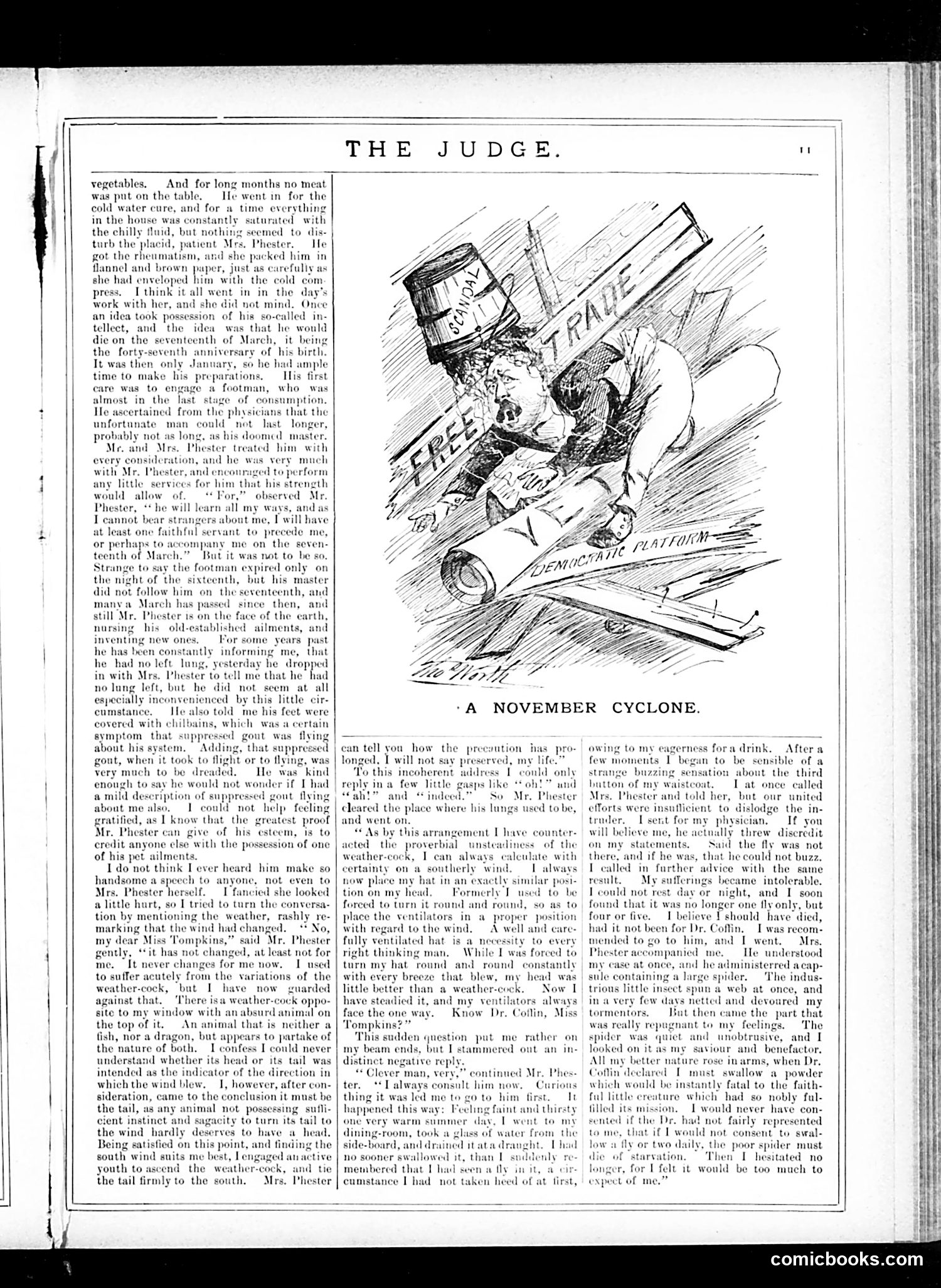
This page from *Judge* contains a satirical illustration titled "A November Cyclone" showing a figure (appears to be a political or public figure) caught in a violent wind, tumbling helplessly among papers labeled "FRAUD," "CORRUPT," and "DEMOCRATIC PLATFORM." The cartoon likely satirizes political chaos or scandal—the cyclone metaphor suggests a whirlwind of controversy engulfing a politician. The scattered documents suggest corruption allegations or broken campaign promises. The accompanying text (a humorous narrative about Mr. Phester, a hypochondriac) appears unrelated to the cartoon itself—typical of *Judge's* magazine format mixing editorial cartoons with satirical fiction. **Without clearer identification of the specific figure or visible date context, the precise political event referenced is unclear**, though the cyclone imagery and "Democratic Platform" label suggest criticism of Democratic Party politics during the late 19th or early 20th century.
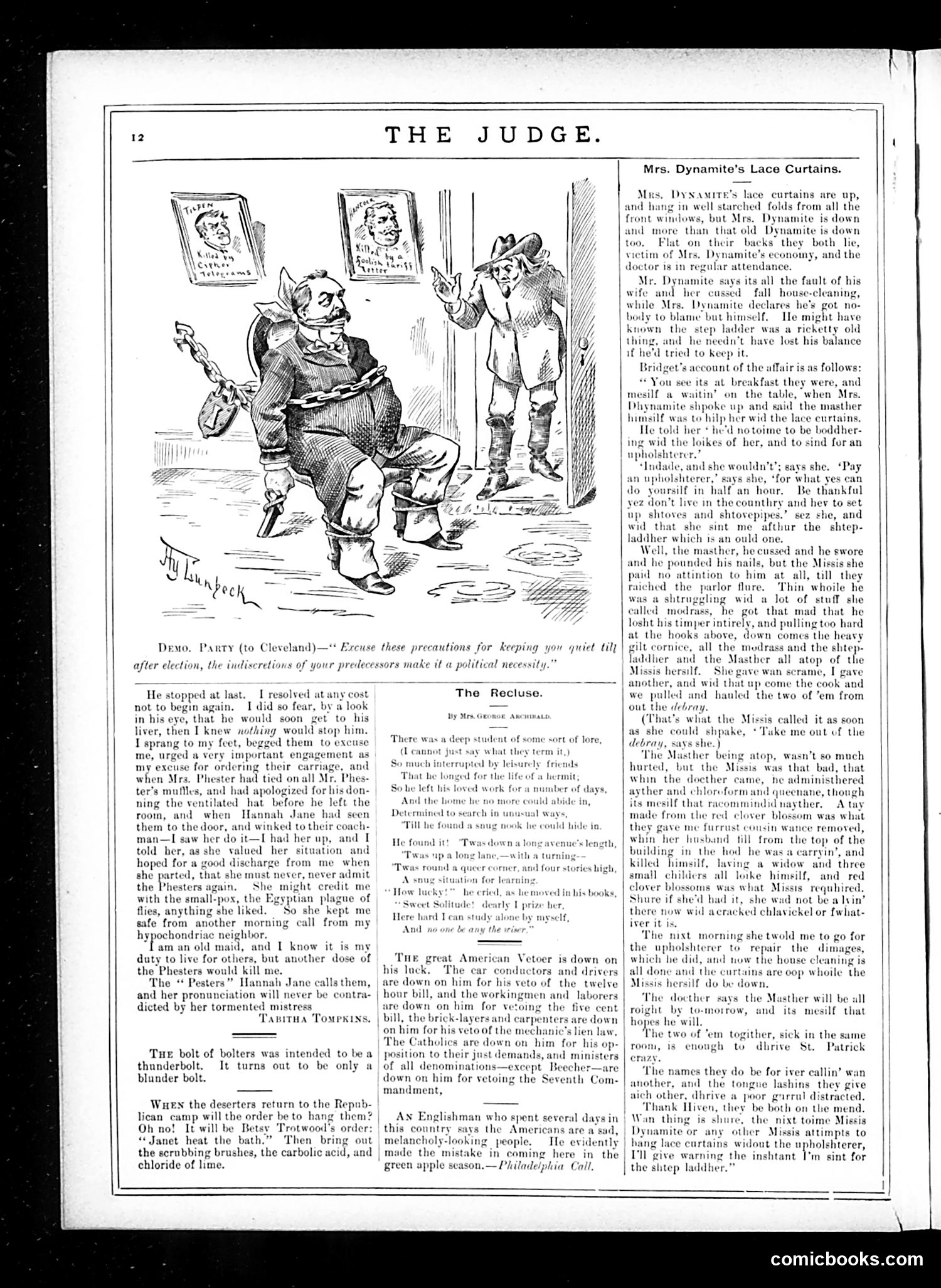
This page contains three satirical pieces targeting American politics and domestic life. **Main Cartoon ("Demo. Party to Cleveland"):** Depicts a Democratic operative warning President Cleveland to stay quiet before the election, suggesting Democratic Party leadership feared his uncontrolled behavior or statements could damage their campaign. **"The Recluse":** A poem satirizing scholarly isolation, mocking an intellectual who withdraws from society. **"Mrs. Dynamite's Lace Curtains":** A humorous domestic sketch where Mrs. Dynamite's obsessive cleaning (hanging starched lace curtains) causes her husband to fall and injure himself. The piece satirizes excessive housekeeping obsession and includes Irish-accented servant dialogue for comedic effect—reflecting period stereotypes about working-class Irish immigrants. **"The Great American Veto":** References a president (appears to be Cleveland) whose vetoes antagonized multiple constituencies: railroad workers, laborers, Catholics, and clergy—suggesting his rigid policies isolated him politically. The page reflects 1880s concerns about Cleveland's presidency, domestic tensions, and working-class representation.
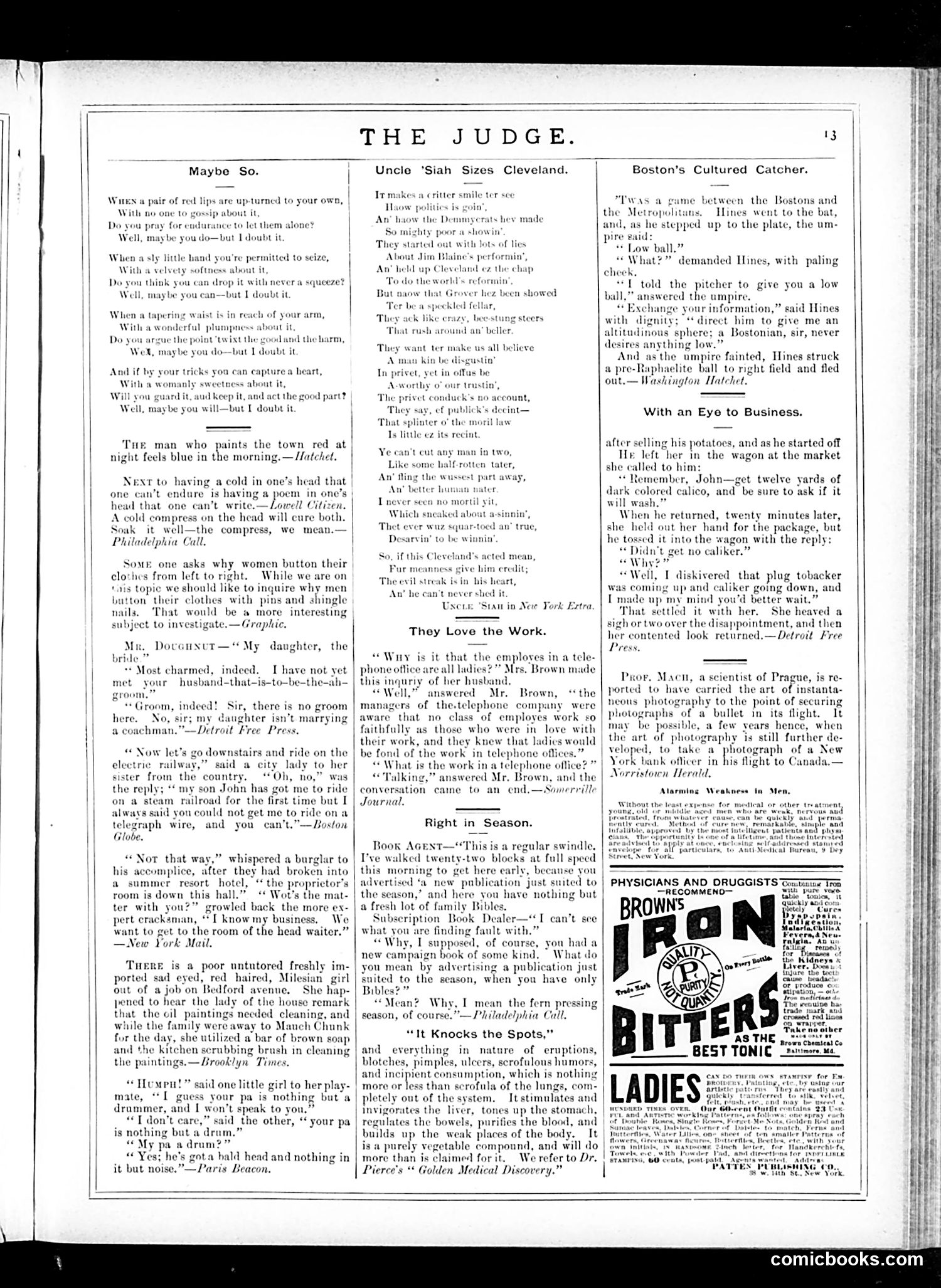
This page is primarily **humorous short pieces and verse** rather than political cartoons. The main items include: **"Uncle 'Siah Sizes Cleveland"**: A dialect poem where a rural character analyzes President Grover Cleveland's character. The satire contrasts Cleveland's public image (honest, trustworthy) with James G. Blaine's campaign accusations. The point: Cleveland's integrity is genuine—you can't separate his public and private virtue like "cutting a tater" and discarding the bad part. **Miscellaneous humor pieces**: Short jokes about romantic encounters, a country woman refusing to ride an "electric railway" (trolley) because she won't ride a "telegraph wire," an Irish maid scrubbing oil paintings with soap, and workplace anecdotes. **"They Love the Work"**: A brief dialogue suggesting telephone operators enjoy their jobs because they work with ladies they know are honest. The ads at bottom promote **Brown's Iron Bitters** as a tonic and other patent medicines—typical of the era's medical advertising. The page reflects late-19th-century American concerns: electoral politics, new technology (electric railways, telephones), and immigration (the "Milesian girl").
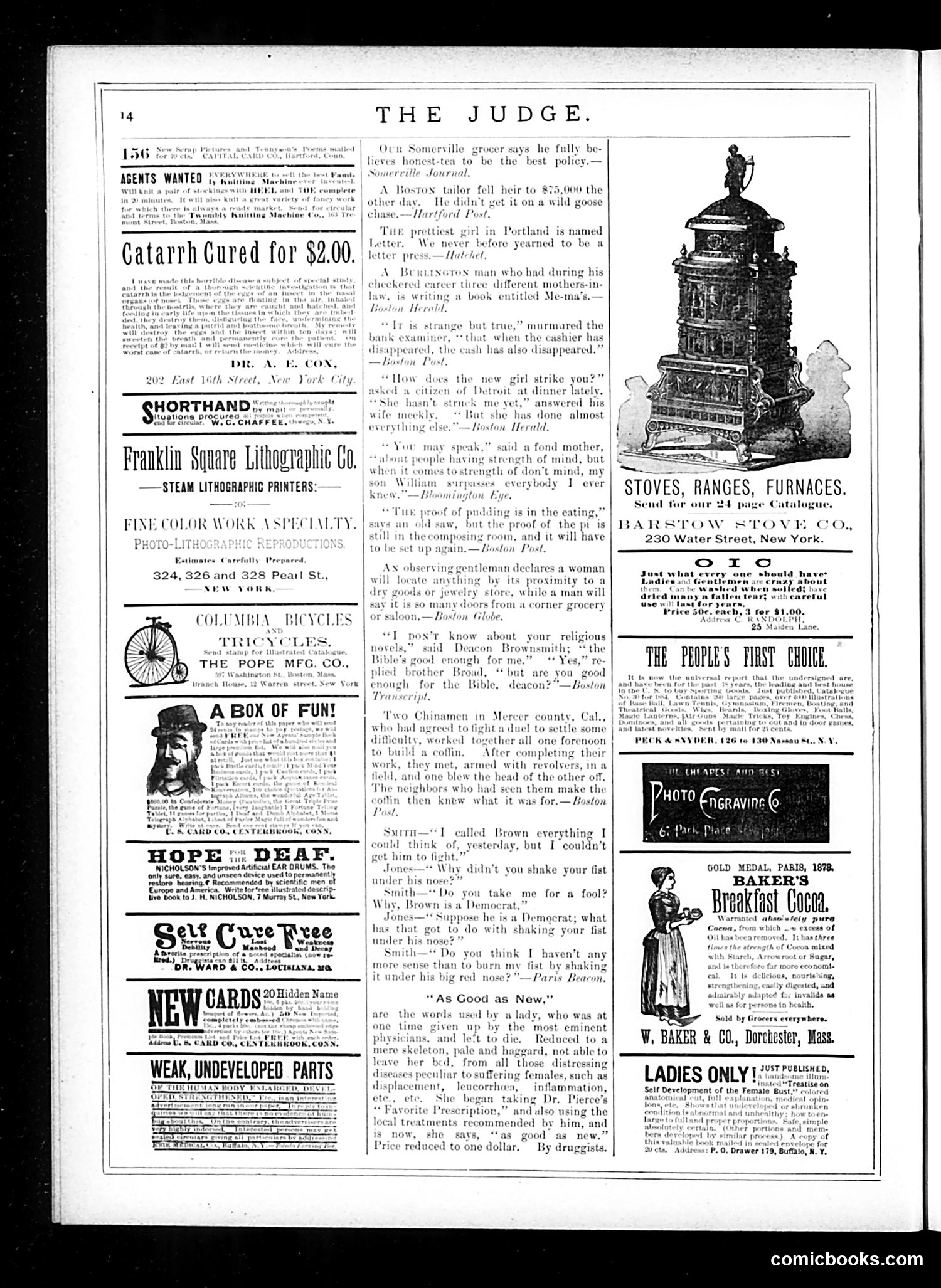
This page is primarily **advertising**, typical of 19th-century magazines. The left and center columns contain numerous commercial ads for medical remedies, business services, and consumer products—many of dubious efficacy (artificial ear drums, catarrh cures, "weak undeveloped parts" treatments). The right side contains brief **humorous anecdotes** rather than political cartoons: - A Boston tailor inheriting $75,000 but not getting it on a "wild goose chase" - A Portland girl named "Letter" - A man writing about three mothers-in-law - Various domestic humor about husbands and wives - A California duel story These are gentle, observational jokes about everyday life—society gossip and domestic comedy—rather than political satire. The page reflects Judge's satirical style through mockery of human folly and social pretension rather than partisan politics. The elaborate decorative ads (stoves, bicycles, cocoa) represent the magazine's primary revenue source.
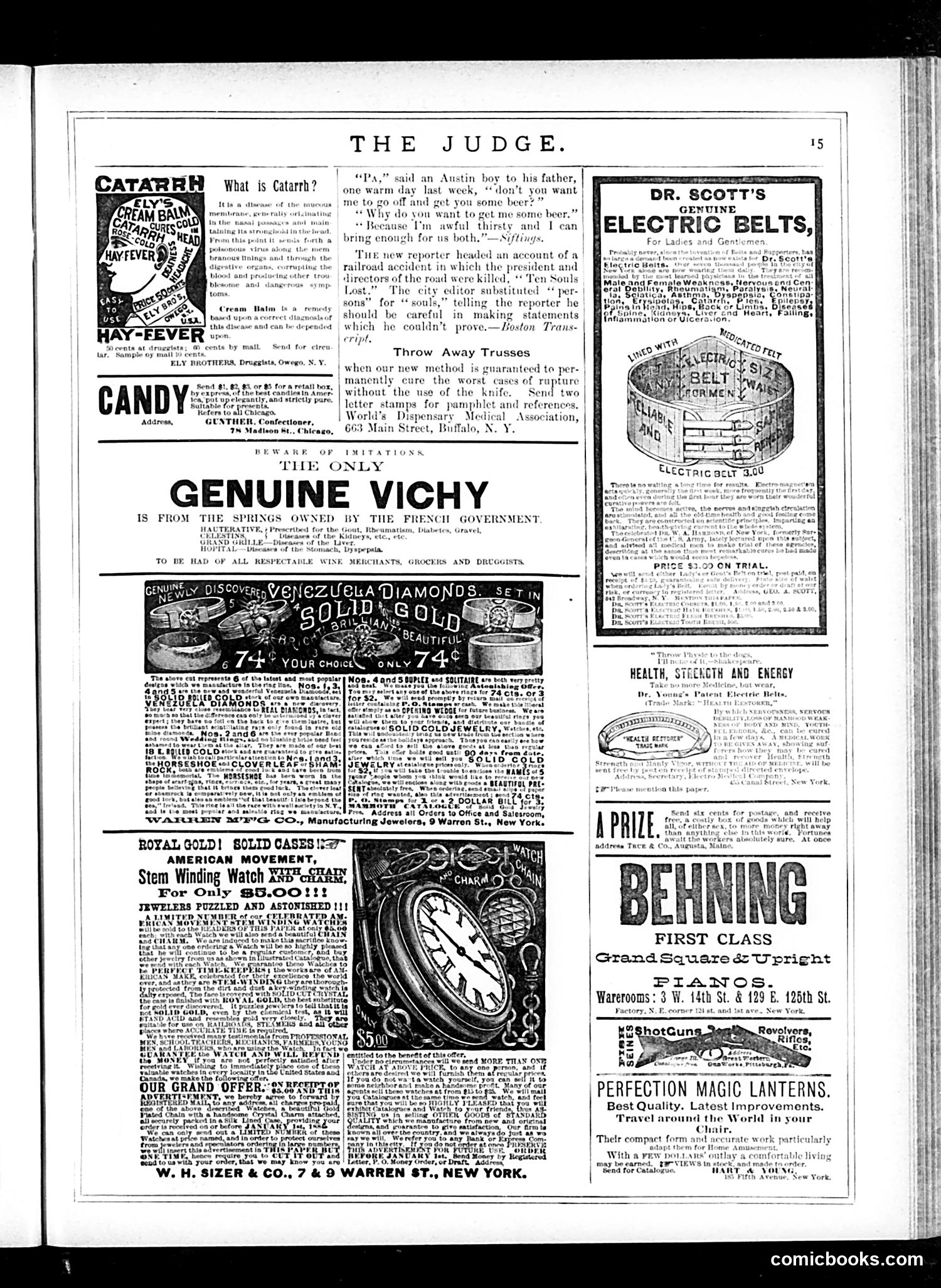
This page is primarily **advertisements** with minimal editorial content. The few jokes present are brief, inconsequential anecdotes: 1. **"Catarrh" joke**: A boy asks his father for beer, claiming thirst; the father assumes he wants to share. Light domestic humor. 2. **Reporter joke**: A new reporter writes that railroad accident victims were "lost" instead of "killed." The editor corrects him for making unverifiable claims—satirizing journalistic carelessness. The page consists almost entirely of **patent medicine and consumer product ads** typical of 1890s publications: Dr. Scott's Electric Belts, Vichy water, jewelry, watches, pianos, magic lanterns, and trusses. These ads often made dubious medical claims. **No political satire or caricatures are present**—this is a standard advertising-heavy page from an era when magazines relied heavily on such revenue. The modest editorial jokes serve mainly as filler between advertisements.
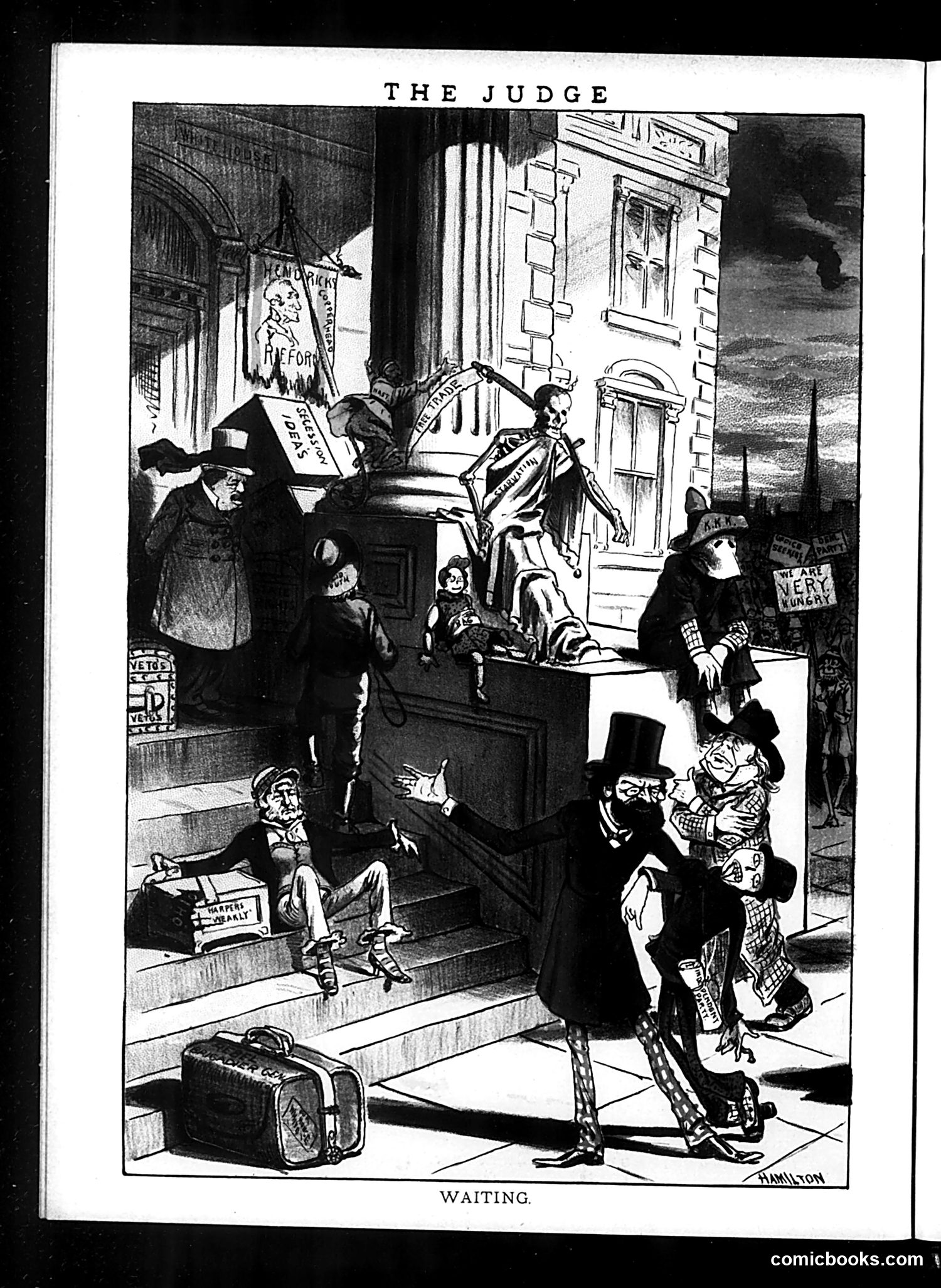
This political cartoon depicts a courthouse scene where various figures wait outside a judge's chambers. The artwork is signed by Hamilton (likely Grant Hamilton, Judge's prominent cartoonist). The scene shows well-dressed men in top hats and business attire standing alongside children and what appear to be working-class figures, all waiting in a formal architectural setting. While the specific historical context isn't entirely clear from the image alone, the title "Waiting" suggests commentary on judicial delays or a pending legal decision affecting multiple classes of society. The mixing of wealthy businessmen with common people implies social commentary, possibly critiquing how the legal system treats different classes or how justice postpones decisions affecting various populations. Without additional date context, the precise case or issue referenced remains unclear.