
Judge, 1884-11-08 · page 4 of 16
Judge — November 8, 1884 — page 4: what you’re looking at
What you’re looking at
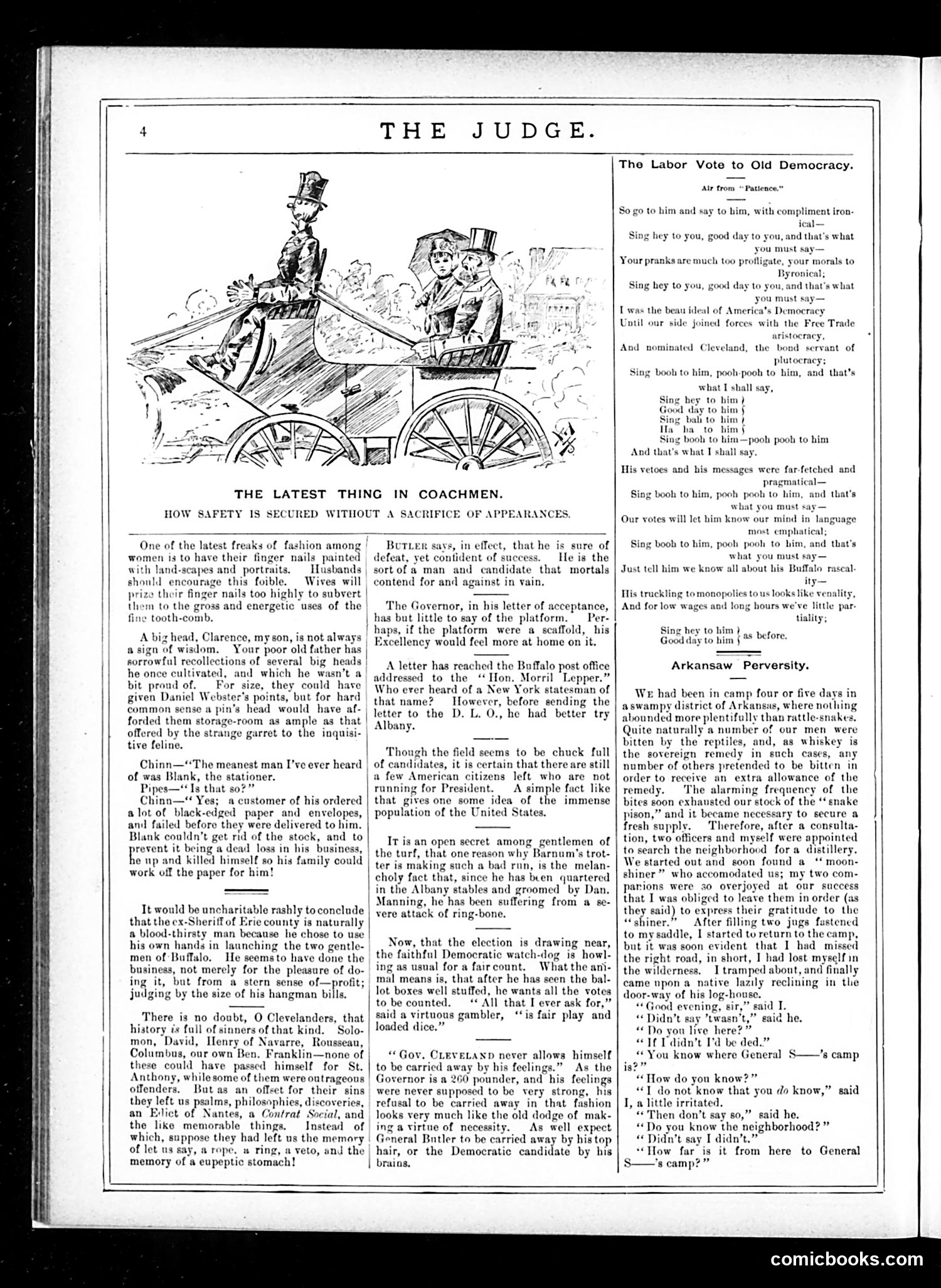
This cartoon satirizes safety innovations in horse-drawn carriages by depicting an elaborate mechanical contraption with a driver elevated high above passengers in a carriage. The title mocks the idea of achieving "safety without sacrifice of appearances"—suggesting wealthy clients wanted protective innovations that didn't visibly compromise the elegant appearance of their coaches. The accompanying text contains unrelated political humor typical of Judge magazine, including jibes at Cleveland (likely Governor Grover Cleveland), references to executions in Buffalo, and mockery of candidates and politicians. The "Arkansas Perversity" section humorously recounts an encounter with locals in Arkansas. The overall page exemplifies Judge's satirical approach: visual cartoons mocking fashionable absurdities paired with gossipy, pointed political commentary about late 19th-century American public figures.
📄 Transcribed text from this page (OCR, searchable)
Machine-transcribed from the original scan — historical spelling and the odd misread are preserved.
THE JUDGE. THE LATEST THING HOW SAFETY IS SECURED WITHOUT A SACRIFICE OF APPEARANC: IN COACHMEN. One of the latest freaks of fashion among | women is to have their finger with land and portraits, Husbands should encourage this foible. Wives will prize their finger nails too highly to subvert them to the gross and energetic uses of the ¢ tooth-comb, ails painte A biz head, Clarence, my son, is not always asign of wisdom. Your poor old father has sorrowful recollections of several big he: he once cultivated, and which he wasn’t a bit proud of. For size, they could have given Daniel Wet 's points, but for hard common sense a pin’s head would have af- forded them storage-room as ample as th offered by the strange gurret to the inquisi- tive feline. Chinn—‘The meanest man I’ve ever heard of was Blank, the stationer. Pipes—* Is that so?” Chinn—* Y a customer of his ordered alot of black-edged paper and envelopes, and failed before they were delivered to him. Blank couldn't get rid of the stock, and to prevent it being a dead loss in his business, he up and killed himself so his family could work off the paper for him! It would be uncharitable rashly toconclude that the ex-Sheriff of Erie county is naturall. a blood-thirsty man because he chose to u his own hands in launching the two gentle- men of Buffalo, He seemsto have done the business, not merely for the pleasure of do- ing it, but from a stern sense of—profit; judging by the size of his hangman bills, There is no doubt, O Clevelanders, that history és full of sinners of that kind. Solo- mon, David, Henry of Navarre, Rousseau, Columbus, our own Ben. Franklin—none of these could have passed himself for St. Anthony, while some of them were outrageous offenders. Butas an offset for their sins they left us psalms, philosophies, discoveries, an Evict of Nantes, a Contrat Social, and the like memorable things. Inst of which, suppose they had left us the memory of let us a rope. w ring, a veto, and the memory of a eupeptic stomach! Betcer says, in effect, that he i defeat, yet contident of success. sortofa man and candidat contend for and a; sure of He is the that mortals inst in vain. The Governor, in his letter of acceptance, has but little to say of the platform. — Per- haps, if the platform were a scaffold, his cellency would feel more at home on it. A letter has reached the Buffalo post office addressed to the ‘Ion. Morril Lepper.” Who ever heard of a New York statesman of that name? However, before sending the letter to the D. L. O., he had better try Albany. Though the field seems to be chuck full of candidates, it is certain that there are still a few American citizens left. who are not running for President. A simple fact like that gives one some idea of the immense population of the United States. Ir is an open secret among gentlemen of the turf, that one reason why Barnum’s trot- ter is making such a bad run, is the melan- choly fact that, since he has been quartered in the Albany stables and groomed by Dan. Manning, he has been suffering from a se- vere attack of ring-bone. Now, that the election is drawing near, the faithful Democratic watch-dog is howl- is usual for a faircount. What the ani- mal means is, that after he has seen the bal- lot boxes well stuffed, he wants all the votes to be counted. ‘* All that I ever ask for,” said a virtuous gambler, ‘‘is fair play and loaded dice.” “Gov, CLEVELAND never allows himself to be carried away by his feelings.” As the Governor is a 260 pounder, and his feclings were never supposed to be very strong, his refusal to be car: ay in that fashion looks very much like the old dodge of mak- ing a virine of neces As well expect General Butler to be carried away by his top hair, or the Democratic candidate by his brains, The Labor Vote to Old Democracy. Alr from "Patience." So go to him and say to him, with compliment iron- Sing hey t nd that's what st say — you, good day to you, you Your pranks are much too pro! our morals to Byronical; Sing hey to you, good day to you, and that’s what T was the beau ideal of America's Democrac Until our side joined forces with the Free Trade aristocrac And nominated Cleveland, the bond servant of plutoc Sing boob to him, pooh-pooh to him, what I shall say, g hey to him } him § ah to him ha to him§ Sing boob to him—pooh poob to him And that’s what I shall say, His vetoes and his messages were far-fetched and pr Sing booh to him, pooh pooh to smatical— im, and that's what you must Our votes will let him know r mind in language most emph Sing boob to him, pooh pooh to him, what you must about his Buff i His truckling to monopolies tous looks like venality, And for low wages and lo cal; that's Just tell him we know a hours we've little par- tiality; Sing hey to him } , Good day to him § ® before. Arkansaw Perversity. We had been in camp four or five days in aswampy district of Arkansus, where nothing abounded more plentifully than rattle-snakes. Quite naturally a number of our men were bitten by the reptiles, and, as whiskey is the sovereign remedy in such cases, ‘any number of others pretended to be bitten in order to receive an extra allowance of the remedy. The alarming frequency of the bites soon exhausted our stock of the ‘snake pison,” and it became necessary to secure a fresh supply. ‘Therefore, after a consulta- tion, two officers and myself were appointed to search the neighborhood fora distillery. We started out and soon found a ‘‘ moon- shiner” who accomodated us; my two com- parions were 30 overjoyed at our success that I was obliged to leave them in order (as they said) to express their gratitude to the hiner.” After filling two jugs fastened to my saddle, I started to return to the camp, but it was soon evident that I had missed the right road, in short, I had lost myself in the wilderness. I tramped about, and finally came upon a native lazily reclining in the door-way of his log-house. “Good evening, sir,” said I. “Didn't say ’twasn’t,” said he. «Do you live here?” “If Tdidn’t I'd be ded.” “You know where General S—'s camp ig?” “Tow do you know?” “T do not know that you do know,” said I, a little irritated. “Then don’t say 80,” said he. “Do you know the neighborhood? ” “ Didn't say I didn’t.” ‘How far is it from here to General ——'s camp?” comicbooks.com