
A complete issue · 16 pages · 1884
Judge — October 18, 1884
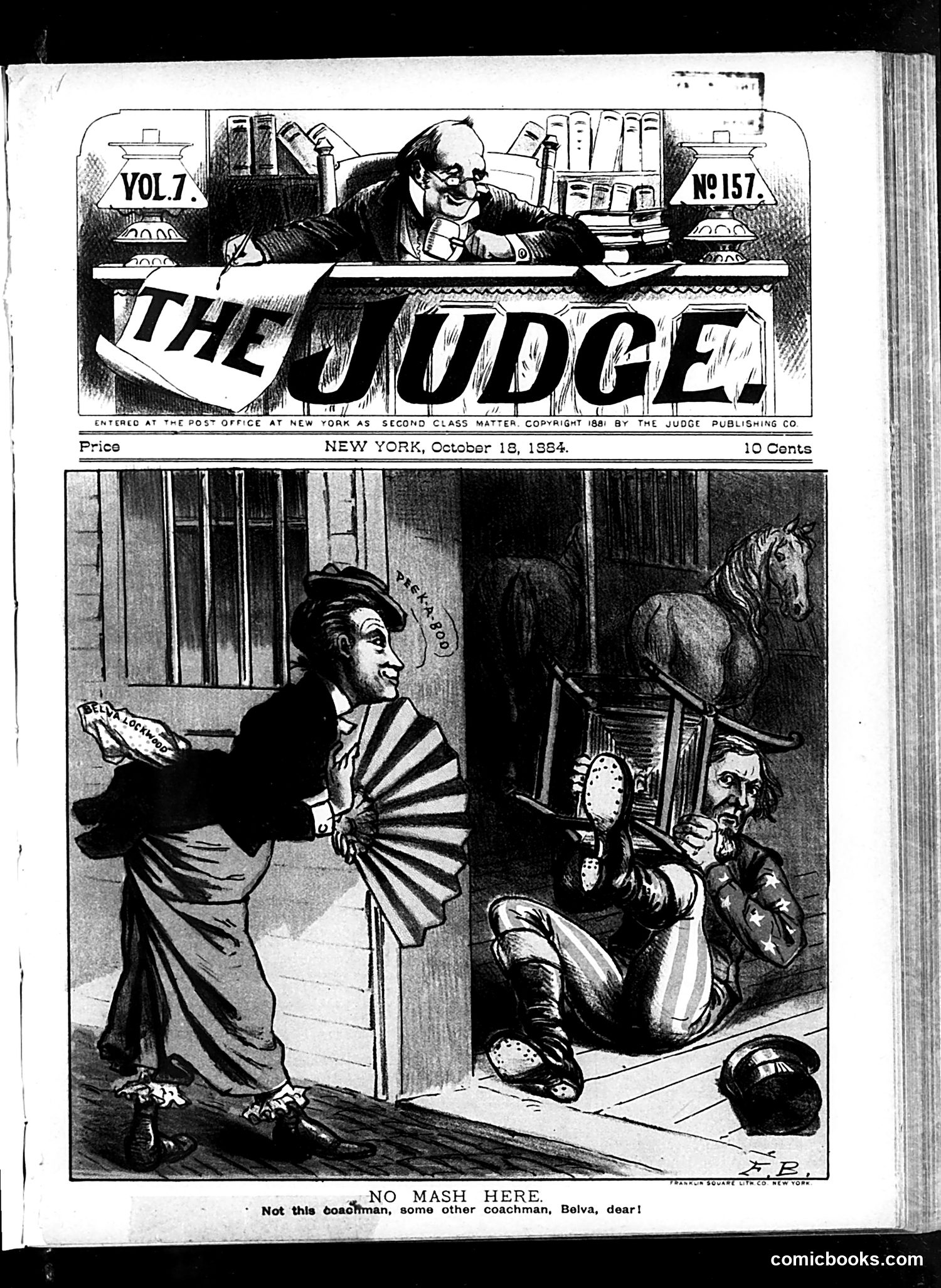
This cartoon satirizes a scandal involving a coachman. The main illustration shows a man at a stable door denying involvement with "mash" (slang for flirtation or seduction), claiming "some other coachman, Belva, dear!" The caption references someone named Belva. This likely references the Belva Lockwood scandal of 1884. Lockwood was a prominent women's rights advocate and presidential candidate that year. The cartoon appears to mock her or associates in her circle through this domestic/romantic entanglement involving servants. The satire targets progressive reformers by using a servant's indiscretion to undermine their moral authority—a common tactic in period political humor. The caricatured faces employ exaggerated features typical of 1880s satirical illustration.
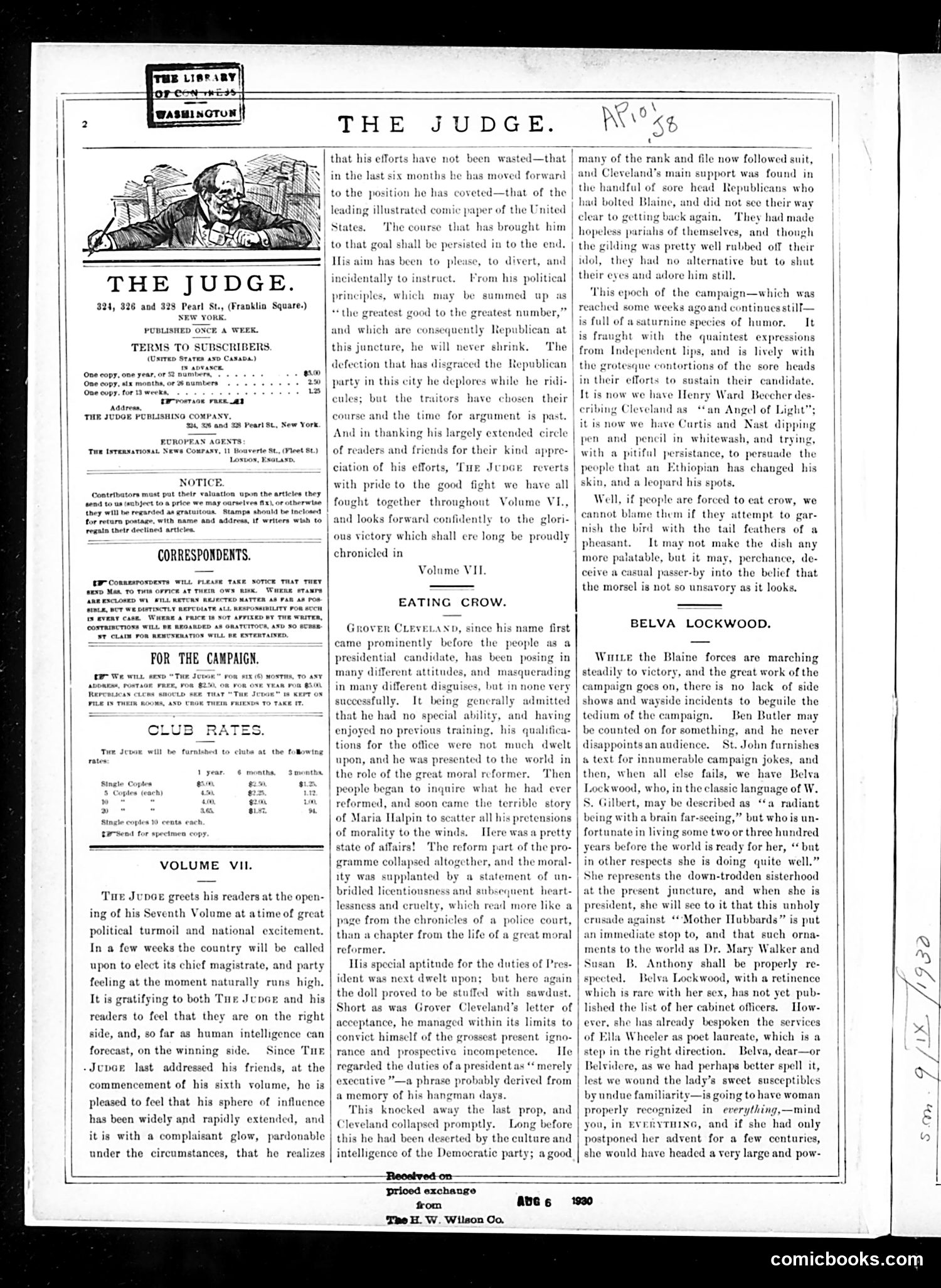
**Main Cartoon: "Eating Crow"** This article satirizes **Grover Cleveland**, the Democratic presidential candidate, attacking his credibility as a "moral reformer." The satire hinges on a major scandal: Cleveland had fathered a child out of wedlock with Maria Halpin, a fact that became public during the 1884 campaign. The "eating crow" metaphor suggests Cleveland must now face the humiliating consequences of his hypocrisy—he positioned himself as a moral leader while his personal conduct contradicted this image entirely. The piece mocks his various "disguises" and political posturing, arguing he lacks genuine ability or qualifications for office. **Context**: This is Republican-leaning *Judge* magazine defending the GOP against Democratic candidate Cleveland. The Maria Halpin affair was a genuine campaign scandal that Republicans weaponized heavily during the 1884 election. **Secondary Content**: The editorial celebrates *Judge*'s Volume VII launch, praising Republican orthodoxy and attacking "traitors" (likely referring to Republican defectors called "Mugwumps" who supported Cleveland).
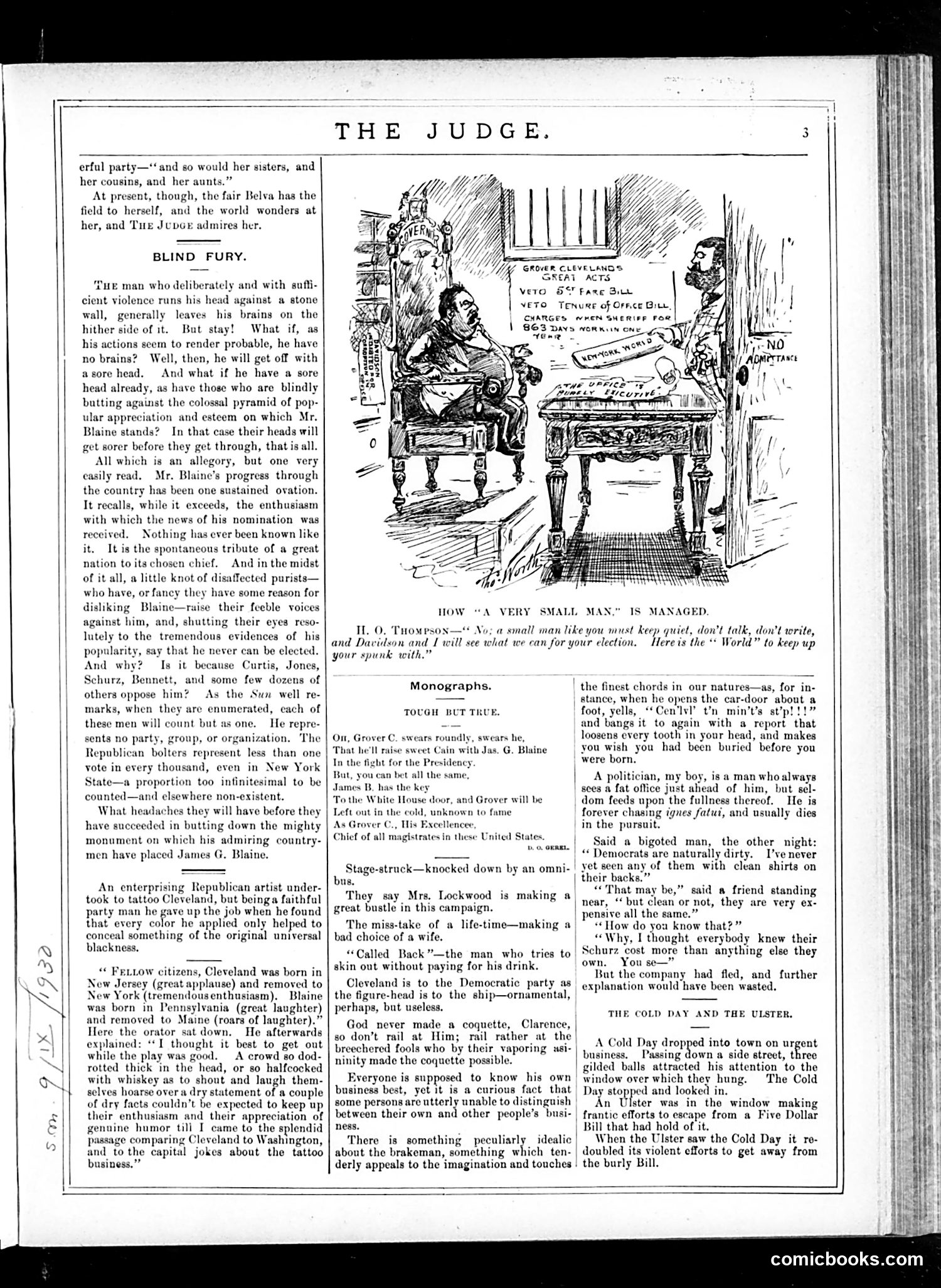
This page satirizes the 1884 presidential race between Republican James G. Blaine and Democrat Grover Cleveland. **"Blind Fury"** section mocks Republican critics of Blaine (likely "Mugwumps"—reform Republicans including Curtis, Schurz, and Bennett) who oppose him despite his overwhelming popular support. The metaphor compares dissenters to men banging their heads against a wall—futile and foolish. **The main cartoon** depicts H.O. Thompson silencing a small man (possibly a minor political figure or office-seeker), telling him to stay quiet during Cleveland's election campaign. The desk shows Cleveland's record as sheriff, suggesting attacks on his administrative history. **"Monographs"** contain brief political jabs: Cleveland swearing to compete with Blaine despite being unknown; a joke about Mrs. Lockwood (the National Woman's Party candidate); and a tattoo anecdote mocking Cleveland's character as inherently "black" (morally corrupt). The overall tone dismisses anti-Blaine Republicans as insignificant while defending Blaine's candidacy and attacking Cleveland's record.
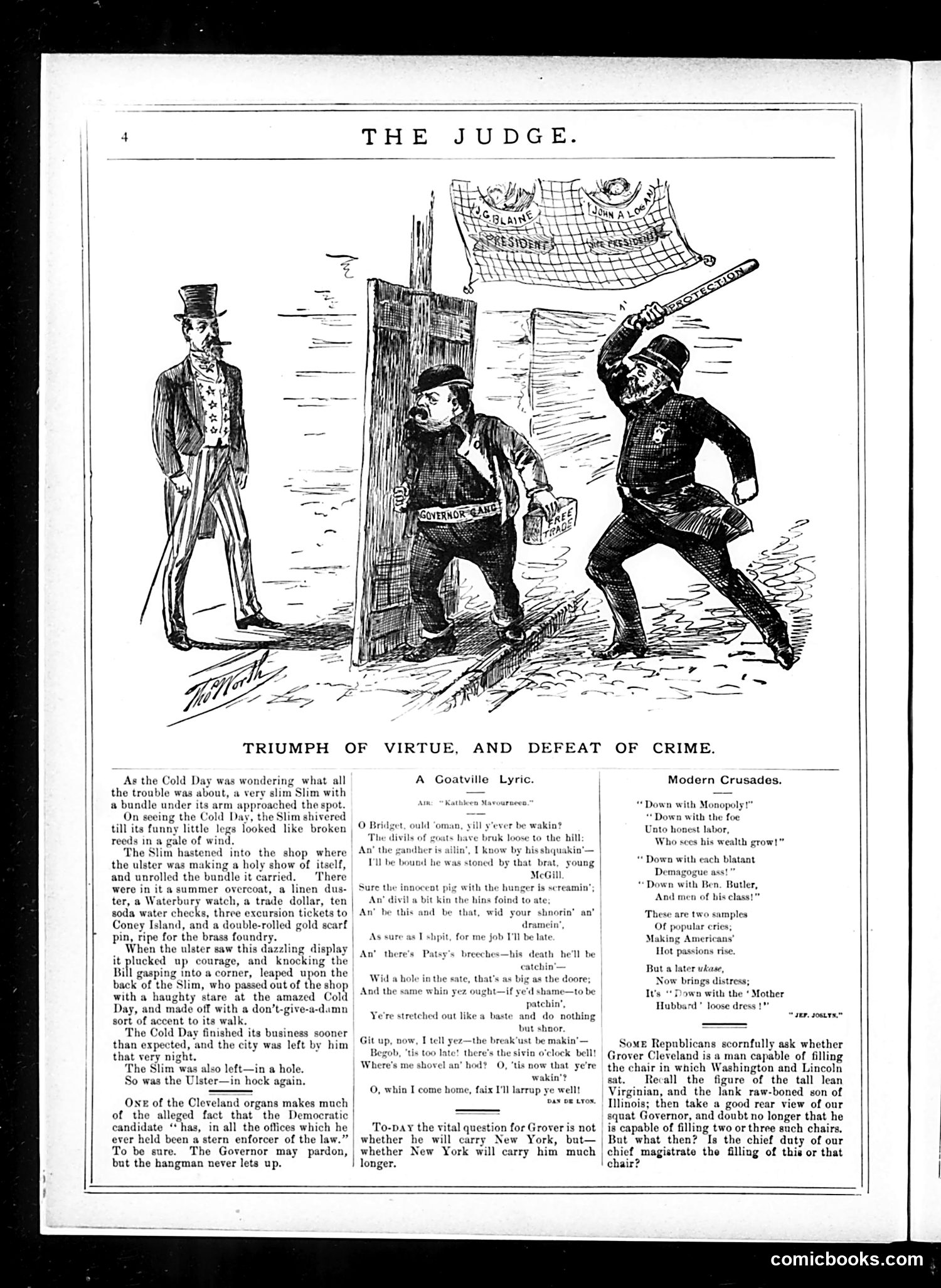
This Judge page satirizes the 1884 presidential race, likely targeting Democratic candidate Grover Cleveland. The main cartoon uses an extended metaphor: a "Cold Day," "Slim," and "Ulster" (coat) as allegorical characters representing political forces. The "Slim" defeats the "Ulster," suggesting virtue triumphing over corruption or vice. The accompanying text mocks Cleveland's reputation as a "stern enforcer of the law," implying his virtue is exaggerated. The final section ridicules Republicans praising Cleveland's physical build (comparing him to Washington and Lincoln), sarcastically questioning whether a president's chair-filling ability matters. The "Modern Crusades" poem satirizes popular reform movements, suggesting public outrage is selective and sometimes trivial. Overall, Judge expresses skepticism about Cleveland's fitness for office despite his law-and-order reputation.
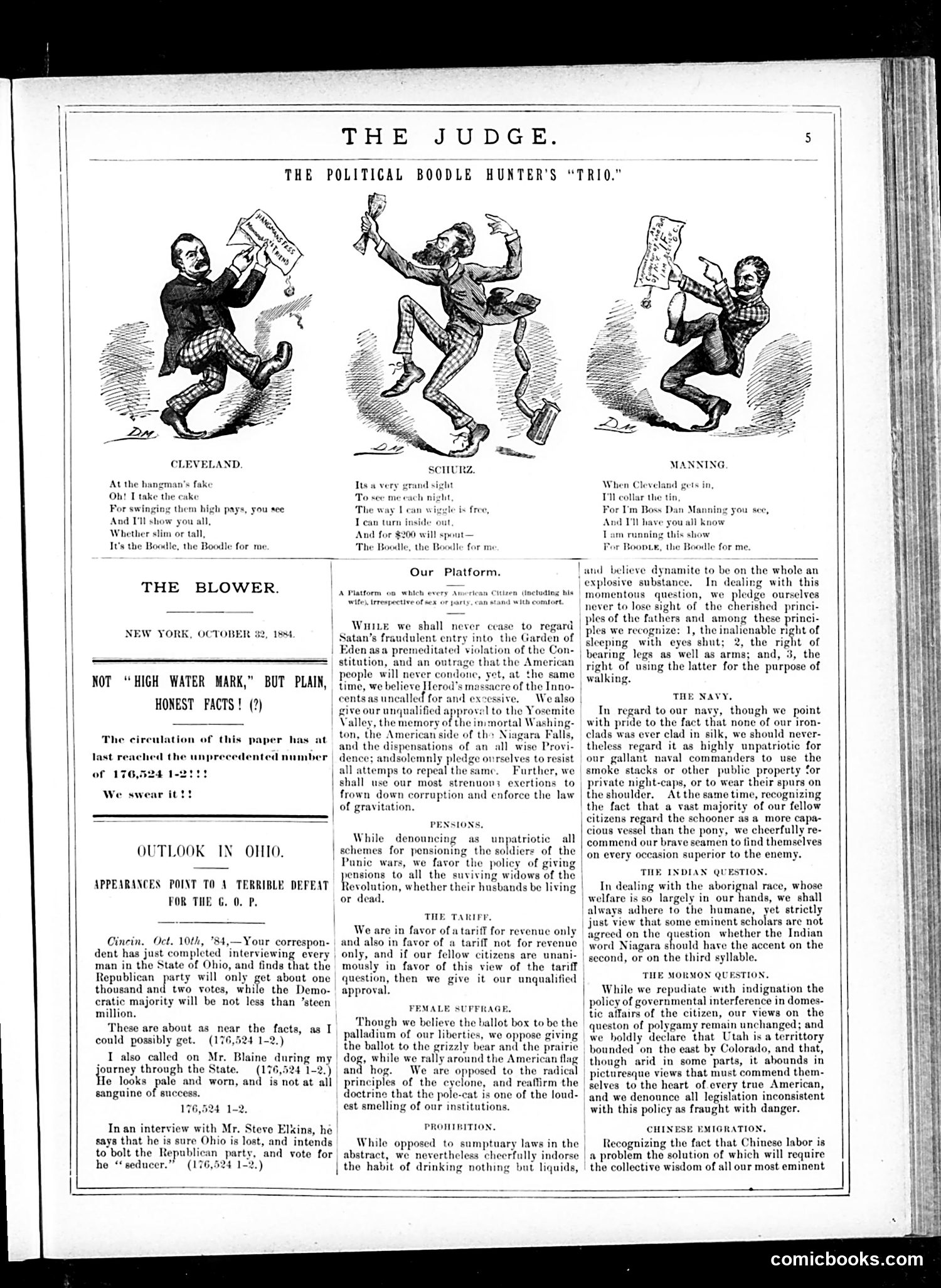
This 1884 Judge cartoon satirizes three prominent Republican politicians as corrupt "boodle hunters" (those seeking bribes/graft). The three figures are identified as **Cleveland**, **Schurz**, and **Manning**, each dancing while clutching money or documents labeled "Boodle." The accompanying verses mock each figure's willingness to abandon principles for financial gain. The cartoon appears during the 1884 presidential campaign, likely criticizing Republican candidates or defectors. Below, Judge's satirical "Platform" mocks the vagueness and contradictions of campaign platforms—endorsing incompatible positions simultaneously (tariff "for revenue only" and "not for revenue only"), praising absurd principles (the "law of gravitation"), and taking ridiculous stances (opposing voting rights for grizzly bears). The satire suggests that politicians prioritize money over genuine policy, and that their public platforms are deliberately meaningless rhetoric designed to offend no one while committing to nothing substantive.
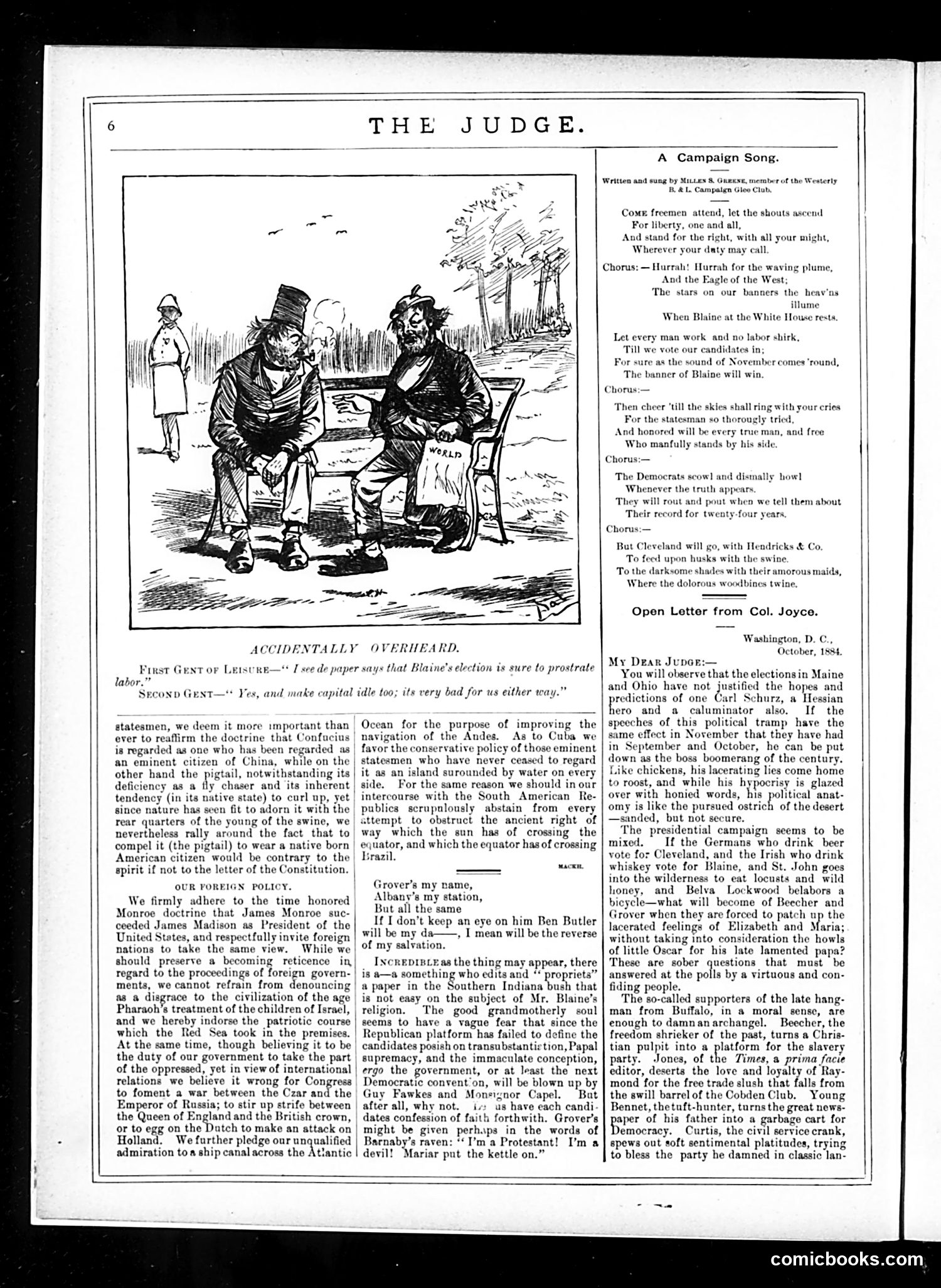
## The Main Cartoon: "Accidentally Overheard" The two gentlemen depicted are discussing James G. Blaine's presidential candidacy. One worries that Blaine's election will "prostrate labor" and make capital idle—bad economically "either way." This satirizes contradictory campaign anxieties: businessmen feared Blaine would harm commerce, while laborers feared economic disruption. ## The Satire Judge mocks these conflicting concerns as absurd. The accompanying "Our Foreign Policy" section amplifies the mockery, presenting deliberately nonsensical political positions (like praising the Red Sea for helping Moses, or preserving the sun's "ancient right" to cross the equator) to ridicule political double-talk and evasiveness. ## Context This appears from the 1884 presidential campaign. The magazine's satirical stance suggests skepticism toward Blaine's candidacy and the incoherent political rhetoric surrounding it. The campaign song promotes Republican support for Blaine's White House bid.
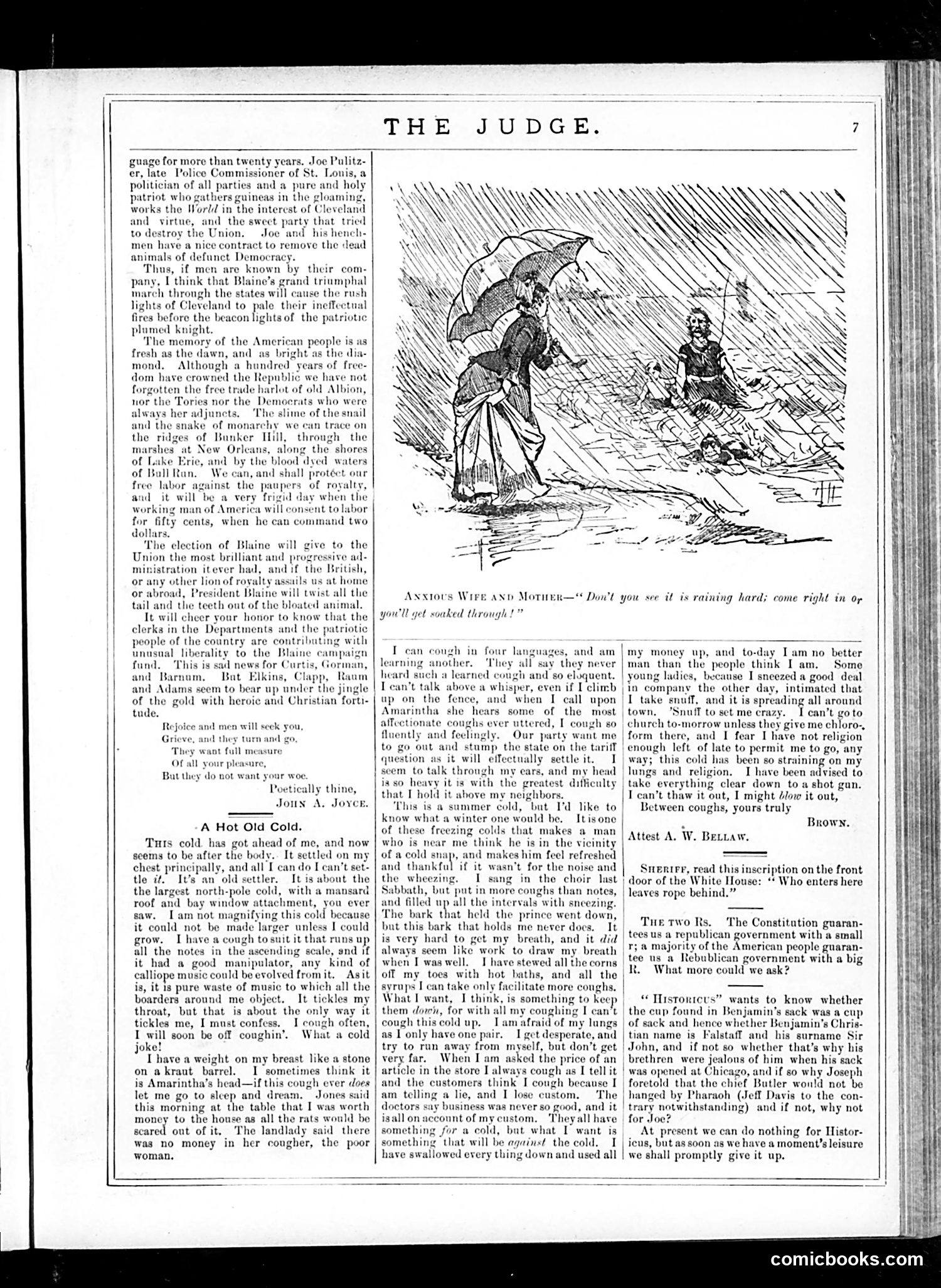
This page contains political commentary on the 1884 presidential campaign, primarily attacking James G. Blaine (the Republican candidate) and praising Grover Cleveland. **The main cartoon** depicts Blaine's wife and mother in a rainstorm—likely satirizing the family's wealth or vulnerability despite their pretensions. The caption "Don't you see it is raining hard; come right in or you'll get soaked through!" suggests ironic commentary on the Blaines. **The text attacks Joe Pulitzer**, publisher of the *World* newspaper, accusing him of hypocrisy—claiming he worked for Cleveland while pretending moral authority. It defends Blaine as a patriotic leader who will protect American workers from British trade competition (a Republican protectionist position). The remainder consists of humorous personal essays, including "A Hot Old Cold"—a comedic complaint about an illness—which appears unrelated to political content. The overall thrust: Republican defense of Blaine against Democratic-leaning press criticism.
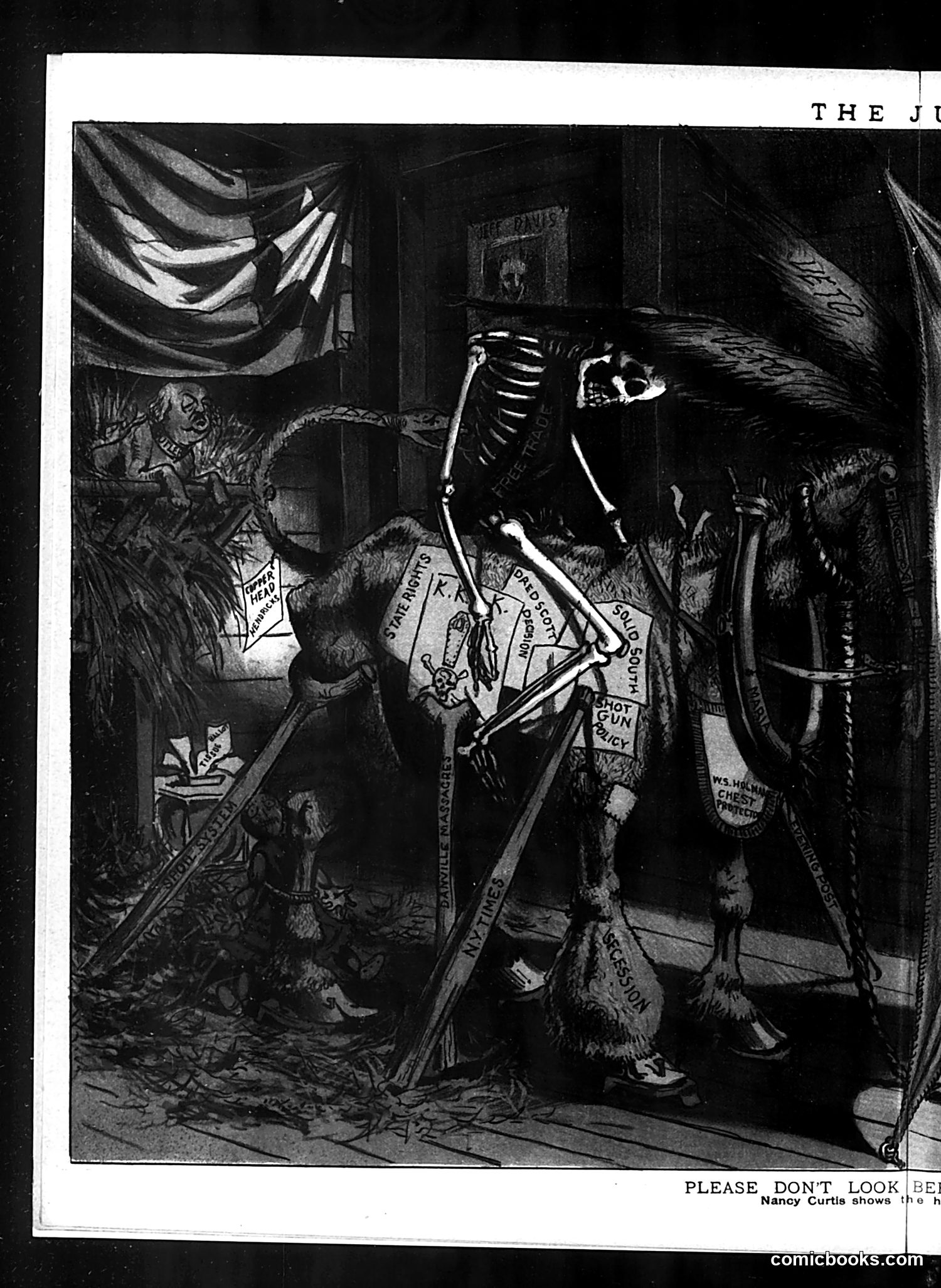
This appears to be a satirical illustration from *Judge* magazine depicting skeletal or death-like figures labeled with various policy positions and political concepts. The central skeleton figure is prominently positioned, surrounded by other animated skeletal forms in what appears to be a dungeon or dark interior setting. The visible text fragments reference "policy" and other governmental terms written on the figures' bodies, suggesting this cartoon critiques specific political policies or their consequences through macabre imagery. The "Please Don't Look" caption implies the cartoon presents an uncomfortable or disturbing truth about these policies. The artist (likely Nancy Curtis, per the caption) uses the memento mori tradition—skeletons symbolizing death—to satirize what the cartoonist views as deadly or destructive political positions. However, without the complete text and clearer date context, the specific policies or political figures targeted remain unclear.
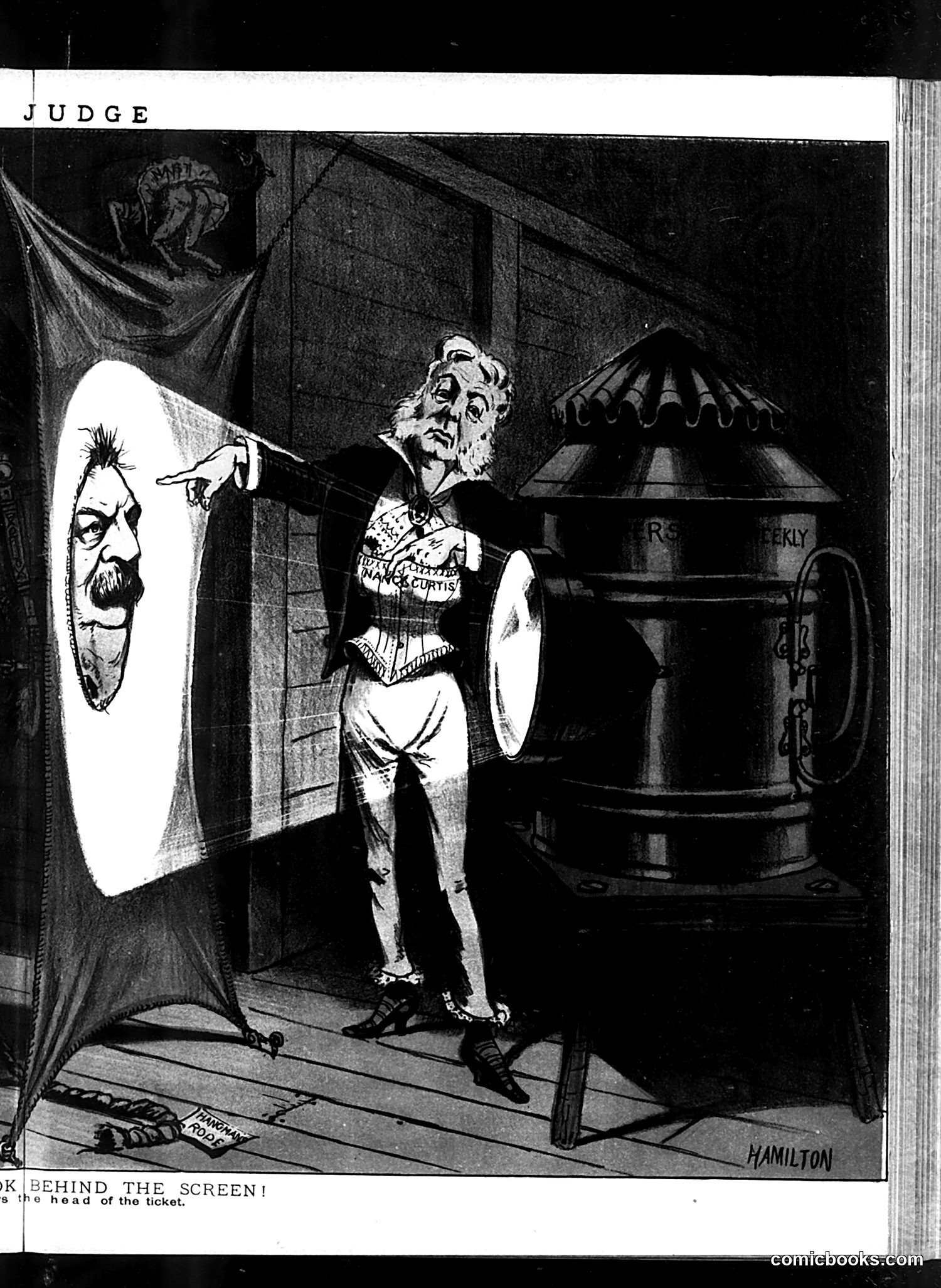
This cartoon, signed by Hamilton, depicts a figure in classical/military dress painting or unveiling a portrait of another bearded man's head. The caption reads "BEHIND THE SCREEN! the head of the ticket." The satire appears to criticize political image-making or manipulation—suggesting that a candidate's public persona ("the head of the ticket") is artificially constructed or painted over the true figure. The classical setting and theatrical props (canvas, brush, ornate costume) emphasize the artificiality of political presentation. Without seeing the date clearly, the specific political figures remain unclear, but the cartoon mocks how political campaigns manufacture candidate images for public consumption, contrasting hidden reality with carefully curated public appearance.
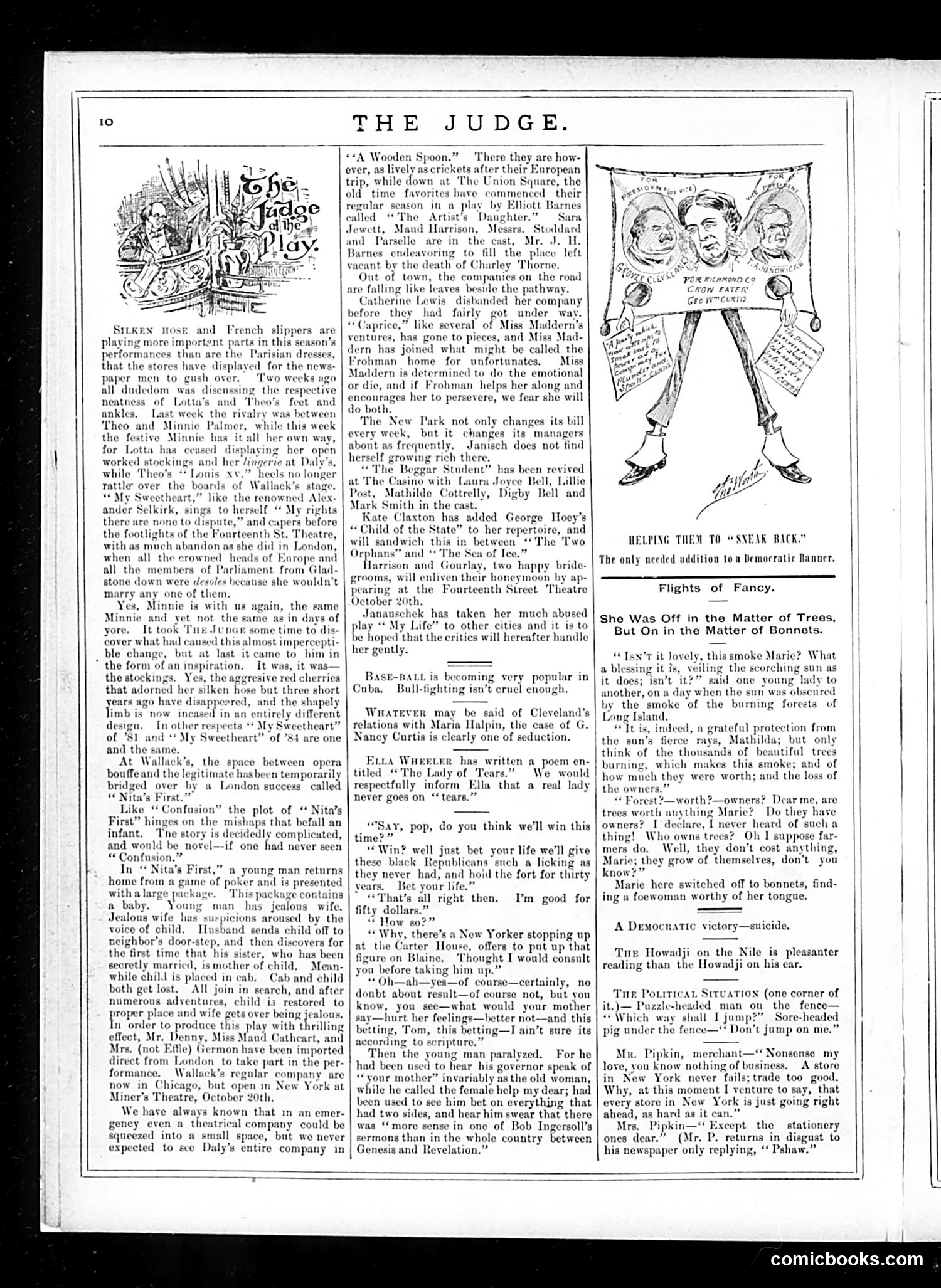
This page from *Judge* magazine contains theater criticism and gossip rather than political cartoons. The main illustration (right side) depicts a banner reading "HELPING THEM TO 'SWEAR BACK'" with caricatured figures, though its specific reference is unclear from context. The text focuses on Broadway theatrical news: actresses' fashions (particularly their stockings and shoes), new play productions, and company reorganizations. Notable references include Minnie Palmer (a celebrated actress), various theatrical venues (Wallack's, the Fourteenth Street Theatre), and plays like "Nita's First" and "The Beggar Student." The satire is light—criticizing derivative plots ("Confusion" versus "Nita's First"), mocking theatrical logistics, and gossiping about performers' personal lives and career moves. The tone is typical of entertainment journalism that treats Broadway as high society entertainment for educated urban audiences. This reflects the 1880s context when theater was a major American cultural institution.
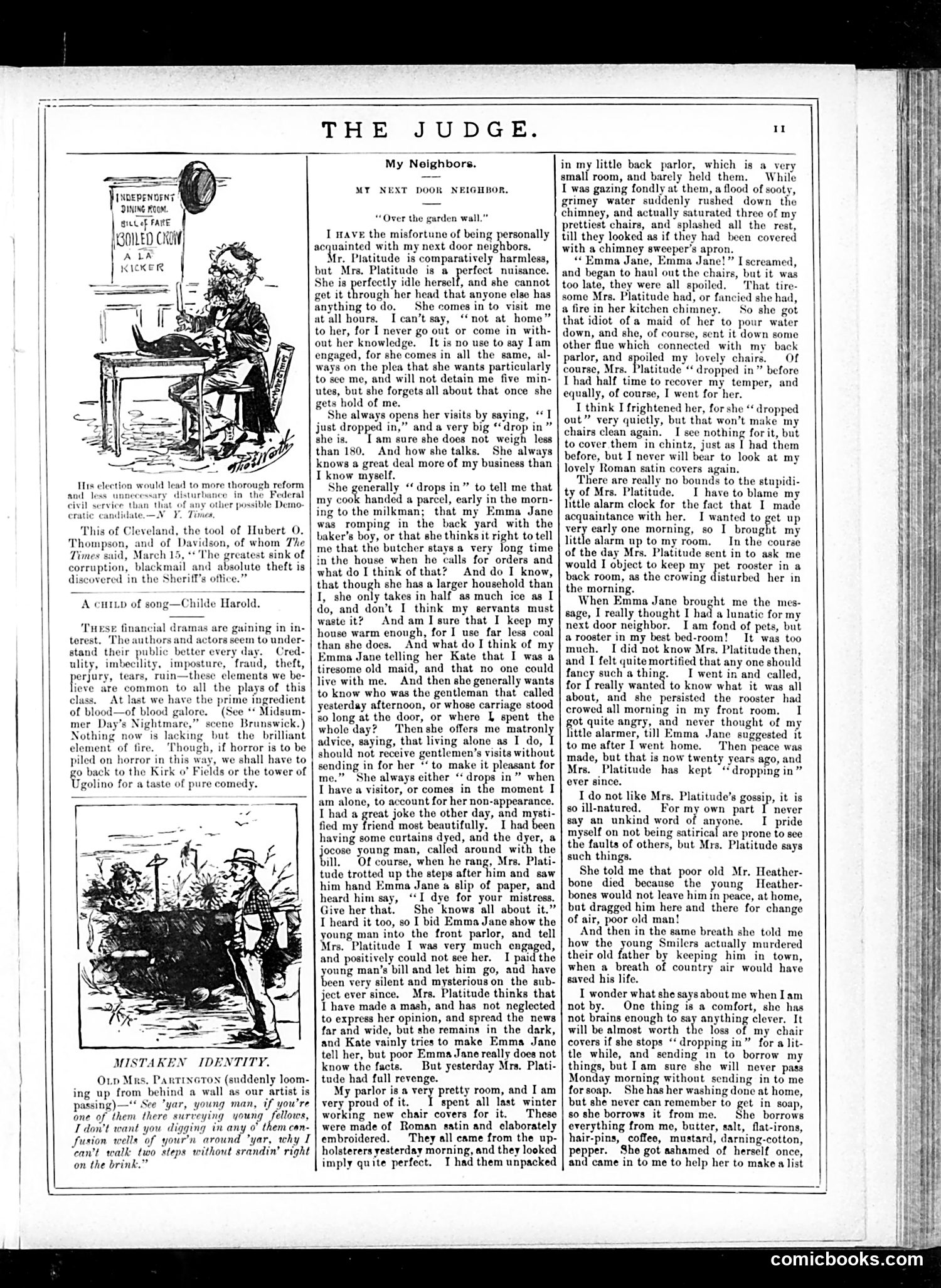
This page satirizes intrusive neighbors, particularly the garrulous Mrs. Platitude. The author complains that Mrs. Platitude constantly "drops in" unannounced, claims knowledge of the narrator's household affairs (servants, visitors, deliveries), and offers unsolicited advice—all while being idle herself and talking excessively. The satire targets a common Victorian social problem: neighbors who violate privacy boundaries under the guise of friendliness. Mrs. Platitude's behavior—monitoring comings and goings, commenting on household management, insisting on chaperoning gentleman callers—reflects period anxieties about female propriety and social surveillance. The accompanying illustrations show a woman disrupting domestic life and a man confused about a woman's identity, reinforcing the theme of social awkwardness and misunderstanding. The piece mocks both Mrs. Platitude's nosiness and societal expectations that permit such intrusion.
This page contains several humorous anecdotes rather than political cartoons. The main pieces satirize everyday domestic frustrations and social awkwardness: **"Forgot The Main Feature"** depicts a man approaching Major Dodridge claiming to be a former Civil War acquaintance from the Eighth Arkansas regiment. The humor lies in the man's indignation that the Major doesn't recognize him—he removes his hat to show his face, but we learn he's apparently forgettable or unimportant despite his assumed shared history. **Other pieces mock:** - A borrowing neighbor ("Platitude Tompkins") who constantly loans items and complains when they break, annoying her host - An evangelist in Texas who mistakes poker chips for coins in the collection plate - Various domestic annoyances and social pretensions The satire targets common irritations: mooching neighbors, pretentious amateur writers, and social awkwardness—universal themes rather than specific political commentary. The humor relies on exaggeration and relatable frustration with difficult acquaintances.
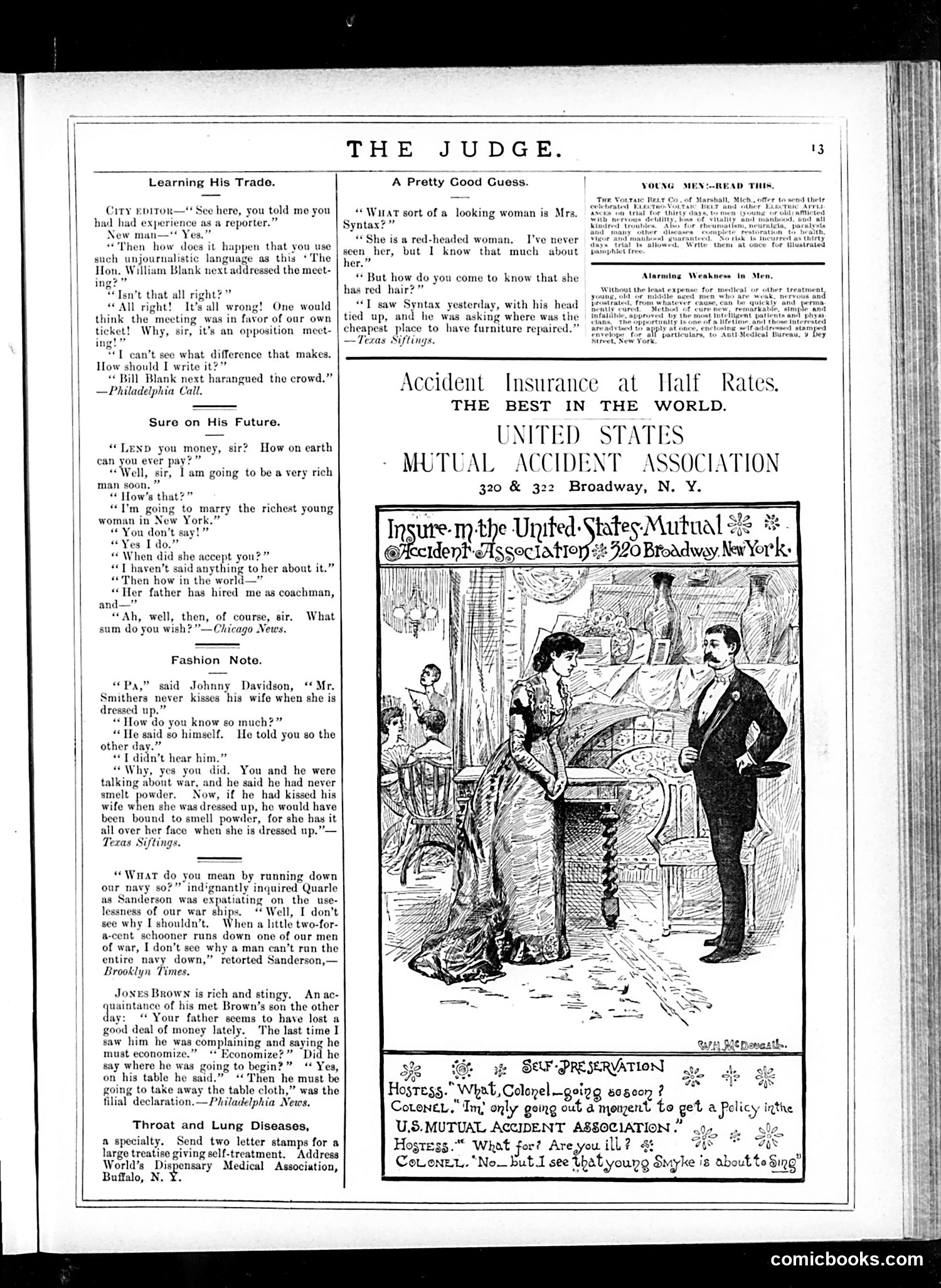
This page from the satirical magazine *Judge* contains several short humorous anecdotes and advertisements, circa late 19th century. **The cartoons/jokes target:** 1. **"Learning His Trade"** – Mocks a newspaper reporter's poor style, using dignified language ("The Hon. William Blank") that makes an opposition political meeting sound favorable to their own ticket. 2. **"Sure on His Future"** – A man seeks a loan claiming he'll marry a rich woman, though he hasn't even proposed. The joke is his confidence despite having no actual basis. 3. **"Fashion Note"** – A child innocently insults a woman by repeating that a man said he never smells "powder" (face powder) when kissing his wife because she wears too much makeup. 4. **The central illustration** advertises the U.S. Mutual Accident Association; the caption joke shows a colonel buying accident insurance because a young man (Smyke) is about to sing—implying the singing is dangerous enough to warrant insurance. All reflect period humor: journalism standards, romantic pursuit, social pretension, and the absurdity of accident insurance marketing.
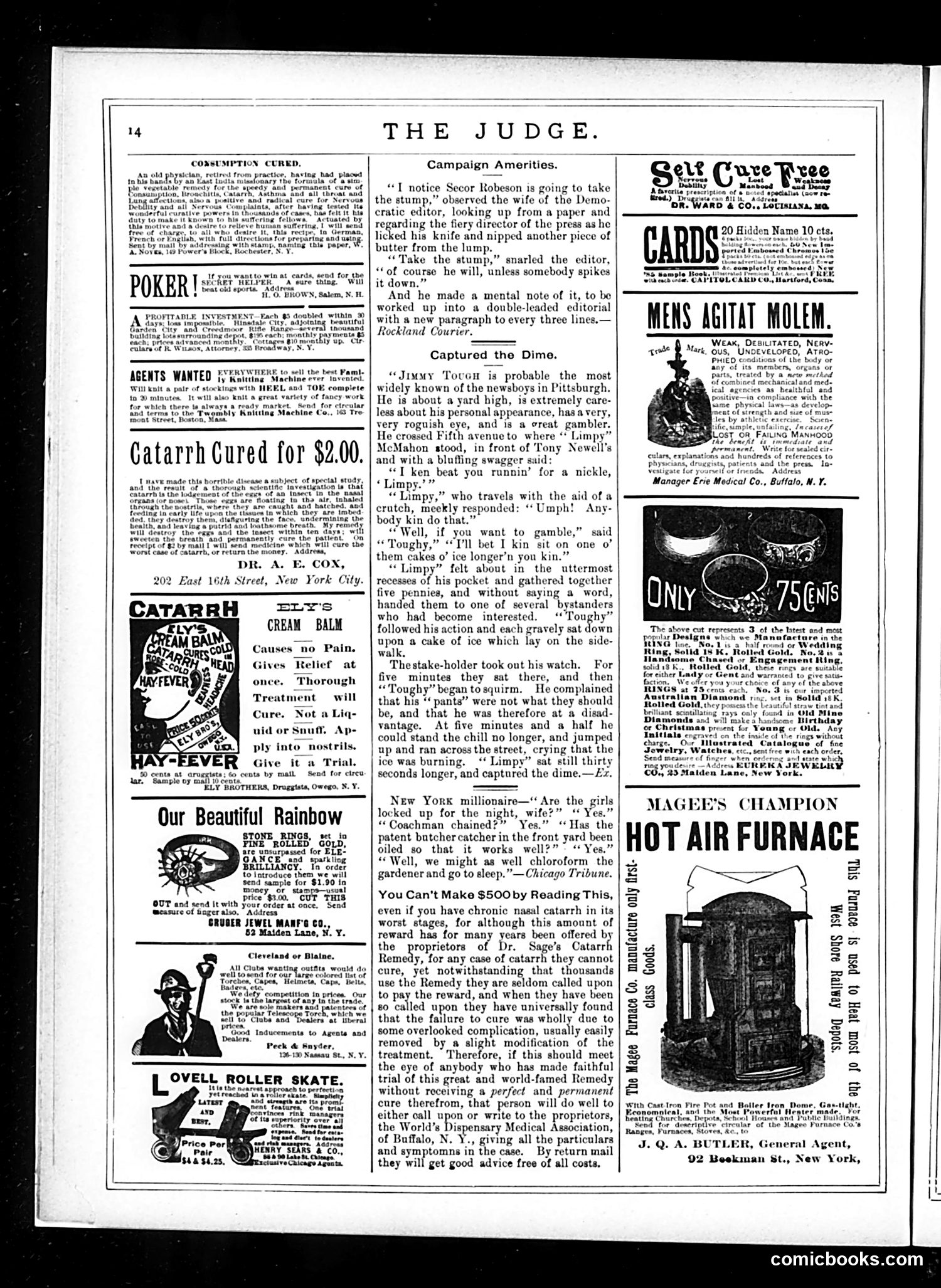
This page is primarily **advertisements and humorous anecdotal pieces**, not political cartoons. The main content includes two brief satirical stories: 1. **"Campaign Amenities"**: A joke mocking Democratic editor Secor Robeson's plan to campaign ("take the stump"). The Democratic editor's wife suggests supporting him, but he sarcastically responds that someone should "spike it down"—implying his political opponent should sabotage him. The editor then plans to editorialize about this, showing how partisan press figures weaponize minor comments. 2. **"Captured the Dime"**: A humorous anecdote about Pittsburgh street newsboys ("Jimmy Toven," "Limpy," and "Toughy") gambling over who can sit longest on ice cakes. It's local color humor about working-class youth, with no apparent political meaning. The page is dominated by patent-medicine ads (catarrhcures, furnaces, roller skates, jewelry) typical of Judge's era. No significant political or social satire appears here.
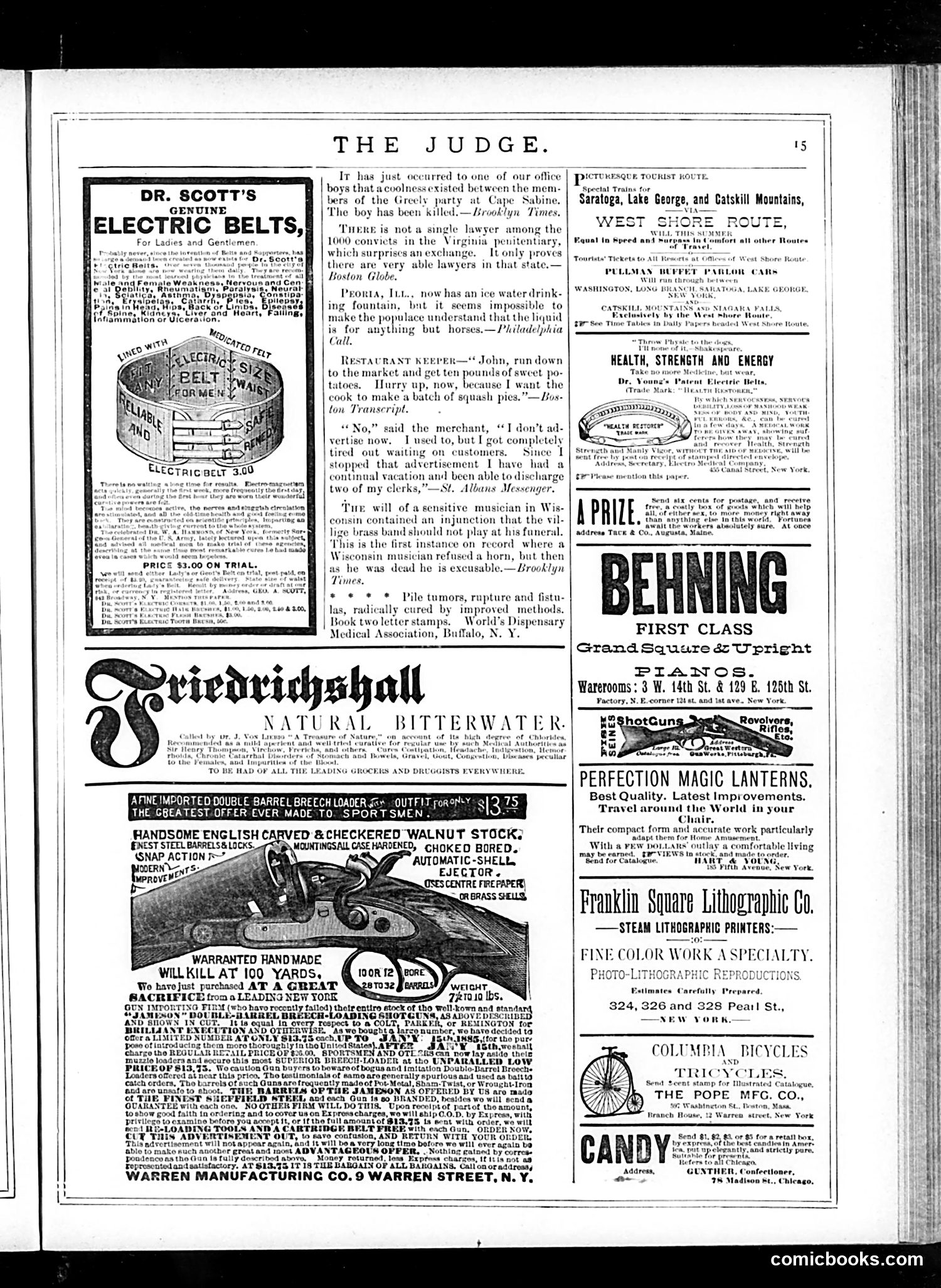
This page is primarily **advertisements** with brief satirical snippets interspersed. The main content includes: **Dr. Scott's Electric Belts** - A pseudo-medical device marketed for various ailments (weakness, nervousness, rheumatism). These were common fraudulent products of the era, exploiting public fascination with electricity. **Short humor items** mock contemporary issues: - The Greely Arctic Expedition (a famous 1881-84 disaster) - Virginia's legal system - A new ice-water fountain in Peoria being mistaken for a horse trough - A merchant who stopped advertising and claims it improved business **Friedrichshall Natural Bitterwater** - A patent medicine advertisement **Warren Manufacturing shotguns** - A lengthy sporting goods ad emphasizing quality and value The page reflects **1880s consumer culture**: patent medicines, sporting equipment, and printing services dominate. The humor targets public gullibility and absurd news items—typical of *Judge* magazine's satirical approach to American life.
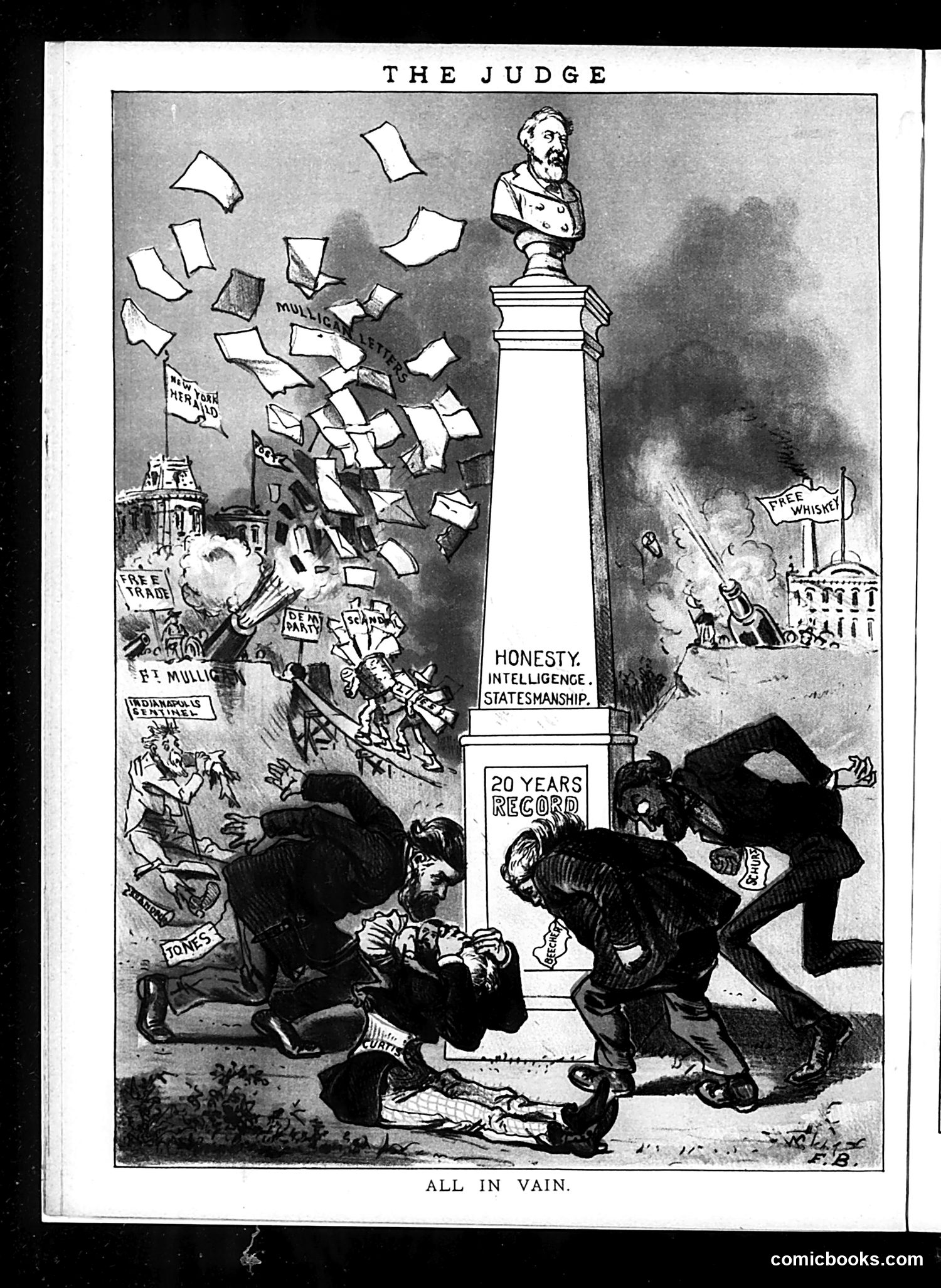
This satirical cartoon depicts a statue labeled "The Judge" with a pedestal inscribed "Honesty. Intelligence. Statesmanship. 20 Years Record." Below, various political figures and corrupt interests—identifiable by labels like "Free Whiskey," "Free Trade," "Monopolies," and scattered papers representing petitions or legislation—swarm around the monument's base in apparent chaos. The cartoon critiques the futility of judicial integrity against entrenched political corruption. Despite the judge's 20-year record of ethical conduct, the surrounding chaos of special interests, bribery attempts, and lobbying efforts overwhelm noble principles. The title "All in Vain" suggests that honesty and statesmanship cannot withstand the corruption surrounding American politics. The burning buildings on either side may represent societal damage from unchecked corruption.