
A complete issue · 16 pages · 1884
Judge — August 16, 1884
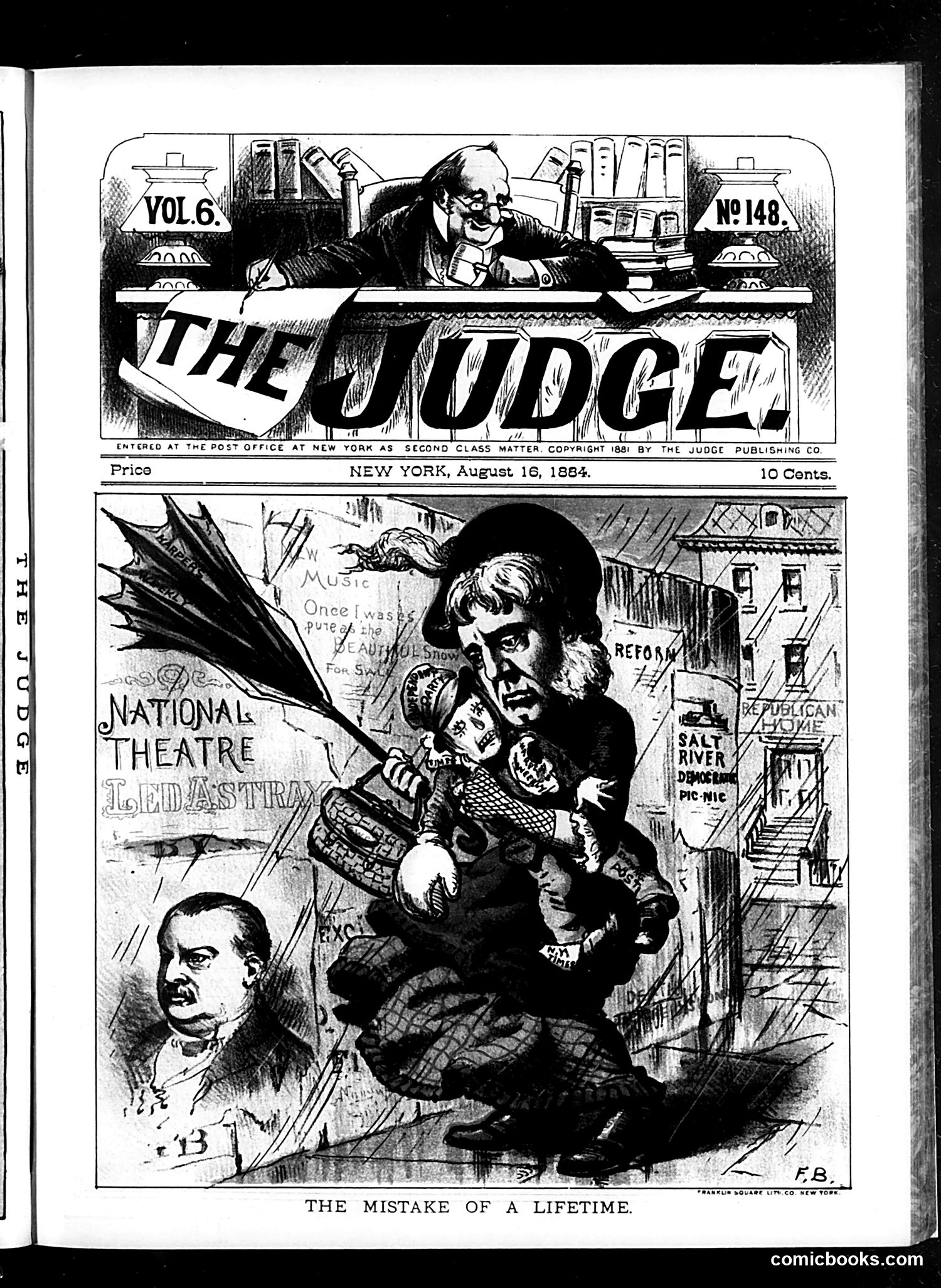
This satirical cartoon critiques what appears to be a political or theatrical scandal. The main figure—a man holding two children—is depicted near signage for "National Theatre," "Reform," and "Republican" establishments, suggesting involvement in both theatrical and political circles. The title "The Mistake of a Lifetime" indicates the central figure made a catastrophic error, likely related to abandoning or mishandling his responsibilities (represented by the children). The smaller portrait on the left observes the scene, possibly indicating a witness or related party. The satire appears directed at hypocrisy: someone claiming reform or Republican values while neglecting family duties. Without identifying the specific historical figure, the cartoon uses theatrical and domestic imagery to mock political moral failures common to 1880s American satirical commentary.
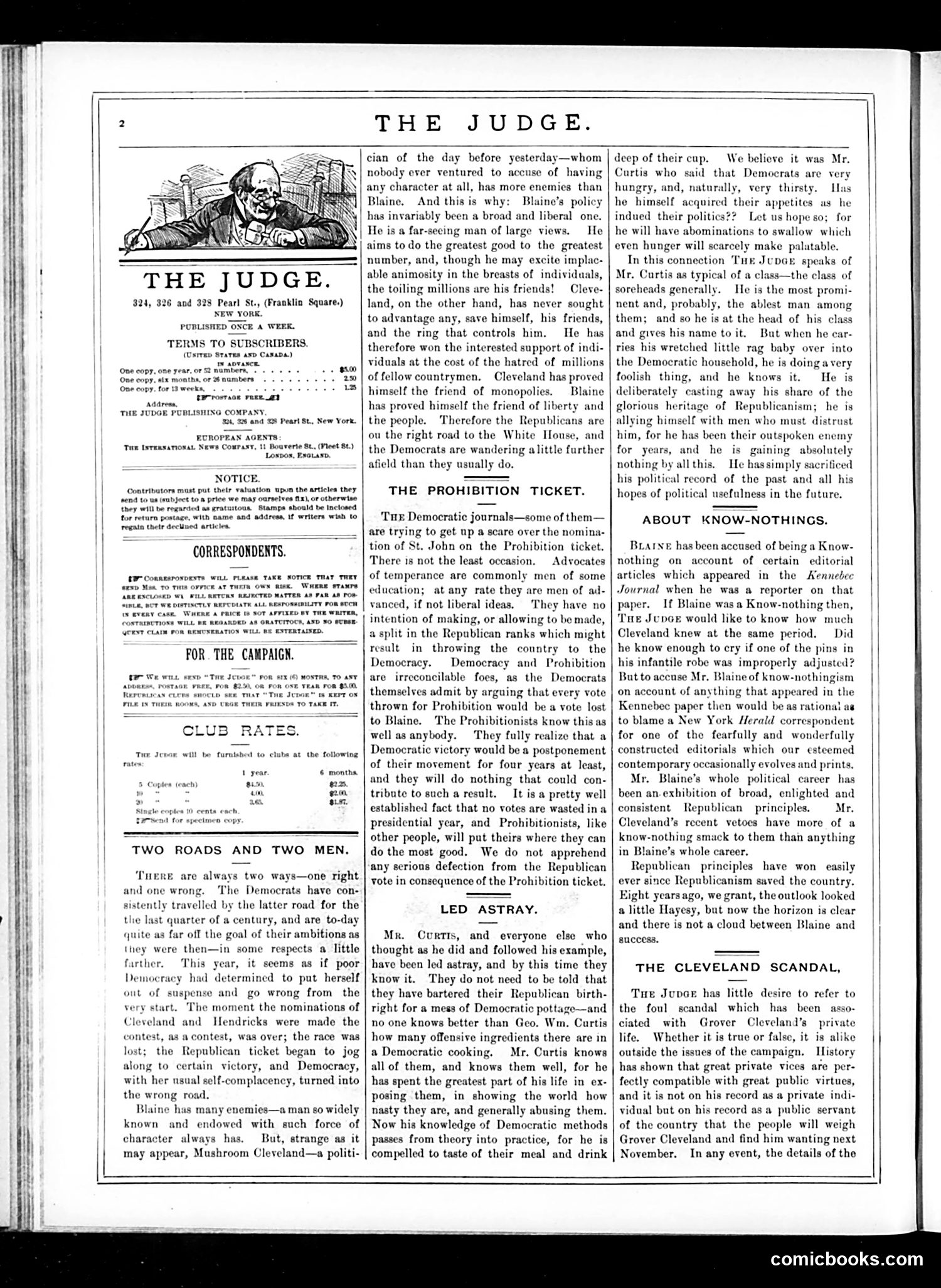
This page from Judge magazine appears to be from the 1884 presidential campaign. The main editorial cartoon (top left) depicts a caricatured figure, likely **James G. Blaine**, the Republican candidate, portrayed as crafty or scheming—typical satirical treatment. The articles defend Blaine against Democratic attacks and criticize **Grover Cleveland**, the Democratic nominee, as a "Mushroom Cleveland" lacking character or vision. The Judge argues Blaine is a man of broad principles serving "the greatest number," while Cleveland served only monopolies and corrupt political machines. The piece also defends the **Prohibition Party ticket** (St. John) against Democratic scaremongering, arguing Prohibitionists are educated, principled people who won't split the Republican vote. This reflects Judge's **Republican editorial stance** during the 1884 election, using satire and invective to support Blaine while attacking Cleveland's record of machine politics.
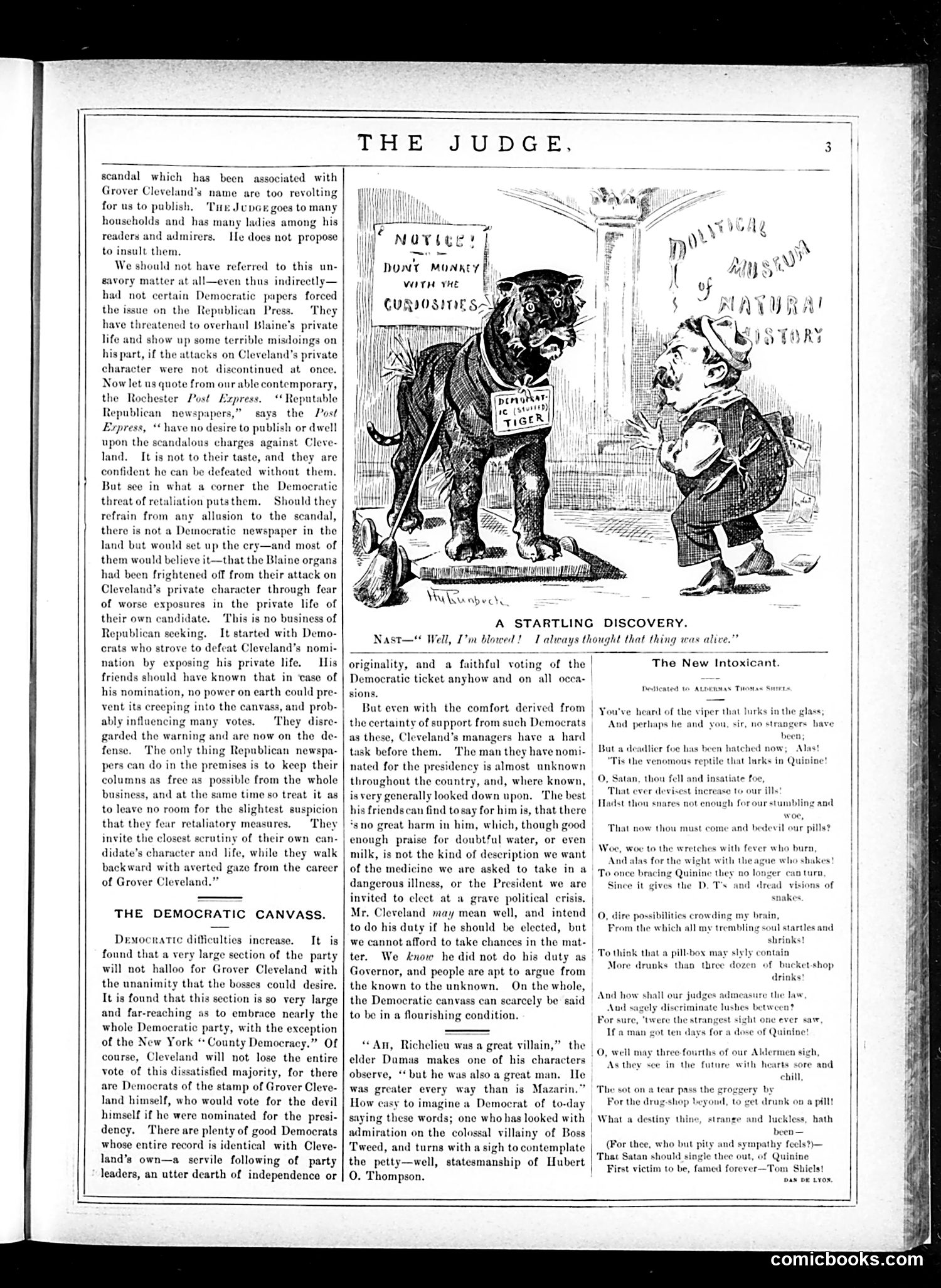
This 1884 political cartoon mocks the Democratic Party's nominee **Grover Cleveland** during the presidential campaign. The cartoon depicts a figure (labeled "Nast," likely referencing political cartoonist Thomas Nast) examining what appears to be a stuffed or lifeless animal—a commentary on Cleveland's perceived lack of vitality or presence as a candidate. The surrounding text reveals the context: Cleveland's campaign faced serious obstacles, including: 1. **Scandalous personal allegations** that Democrats feared Republicans would exploit 2. **Lack of party enthusiasm**—even many Democrats were reluctant supporters 3. **Unknown/unpopular status**—the text notes he was "almost unknown throughout the country, and, where known, is very generally looked down upon" The joke is that upon close inspection, Cleveland appears to have no real substance—he's essentially "not alive" as a political force. Judge sarcastically suggests the best his supporters can claim is that "there is no great harm in him," which the magazine ridicules as insufficient praise for a presidential candidate.
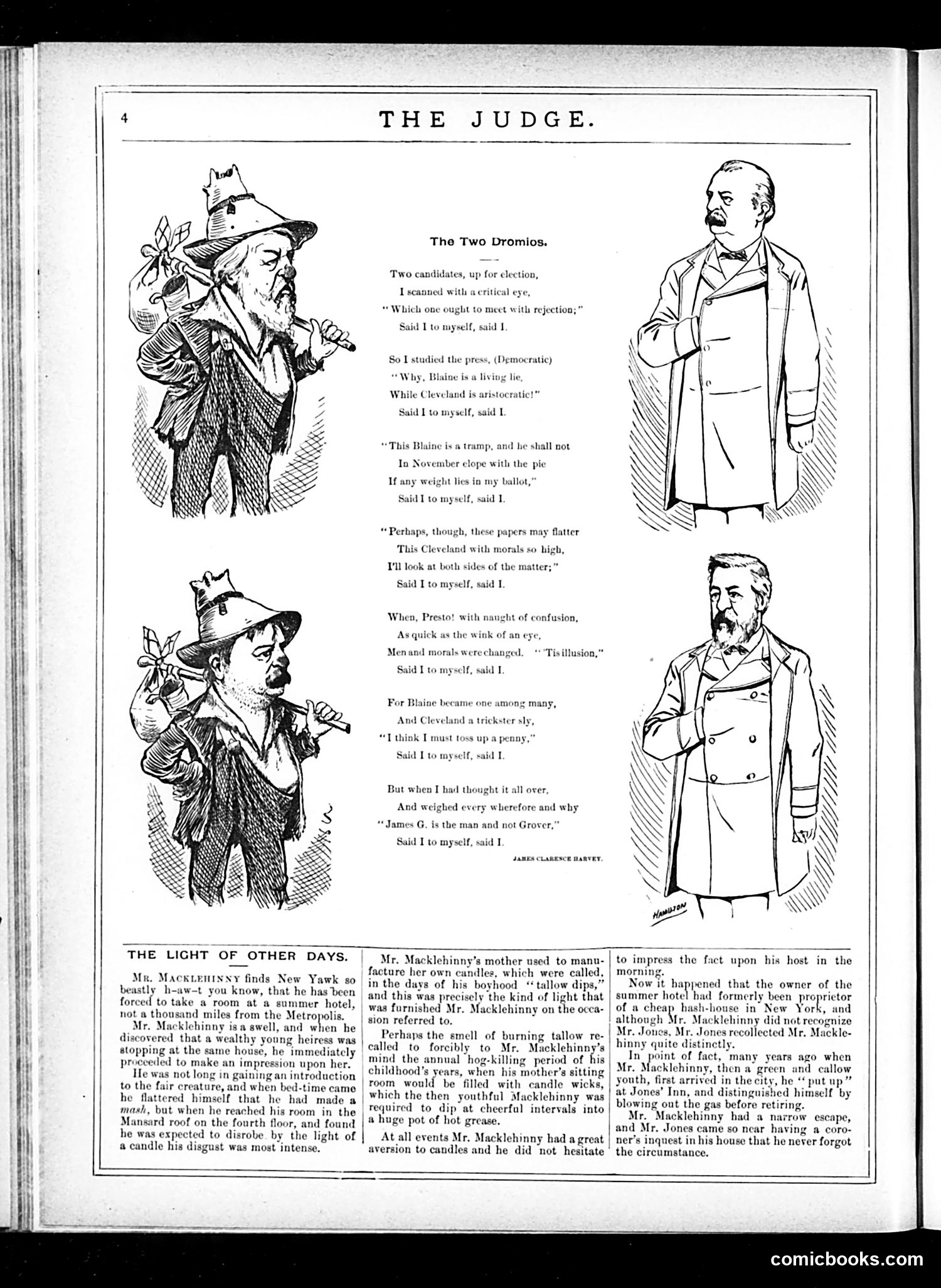
This 1884 Judge cartoon satirizes voter indecision during the presidential election between **James G. Blaine** (Republican) and **Grover Cleveland** (Democrat). The poem depicts a voter's tortured deliberation: he reads Democratic press attacking Blaine as "a living lie" and praising Cleveland's morals, then reverses after reconsidering both candidates. The voter ultimately settles on Blaine, though the constant flip-flopping suggests the absurdity of relying on partisan media for electoral judgment. The title "The Two Dromios" (referencing Shakespeare's *Comedy of Errors*) implies the candidates are interchangeable twins—both confusingly similar when examined critically. The satire targets not specific policies but rather the voter's gullibility to contradictory press coverage, suggesting that careful political analysis yields only confusion rather than clarity. The accompanying "Light of Other Days" prose piece is unrelated domestic humor.
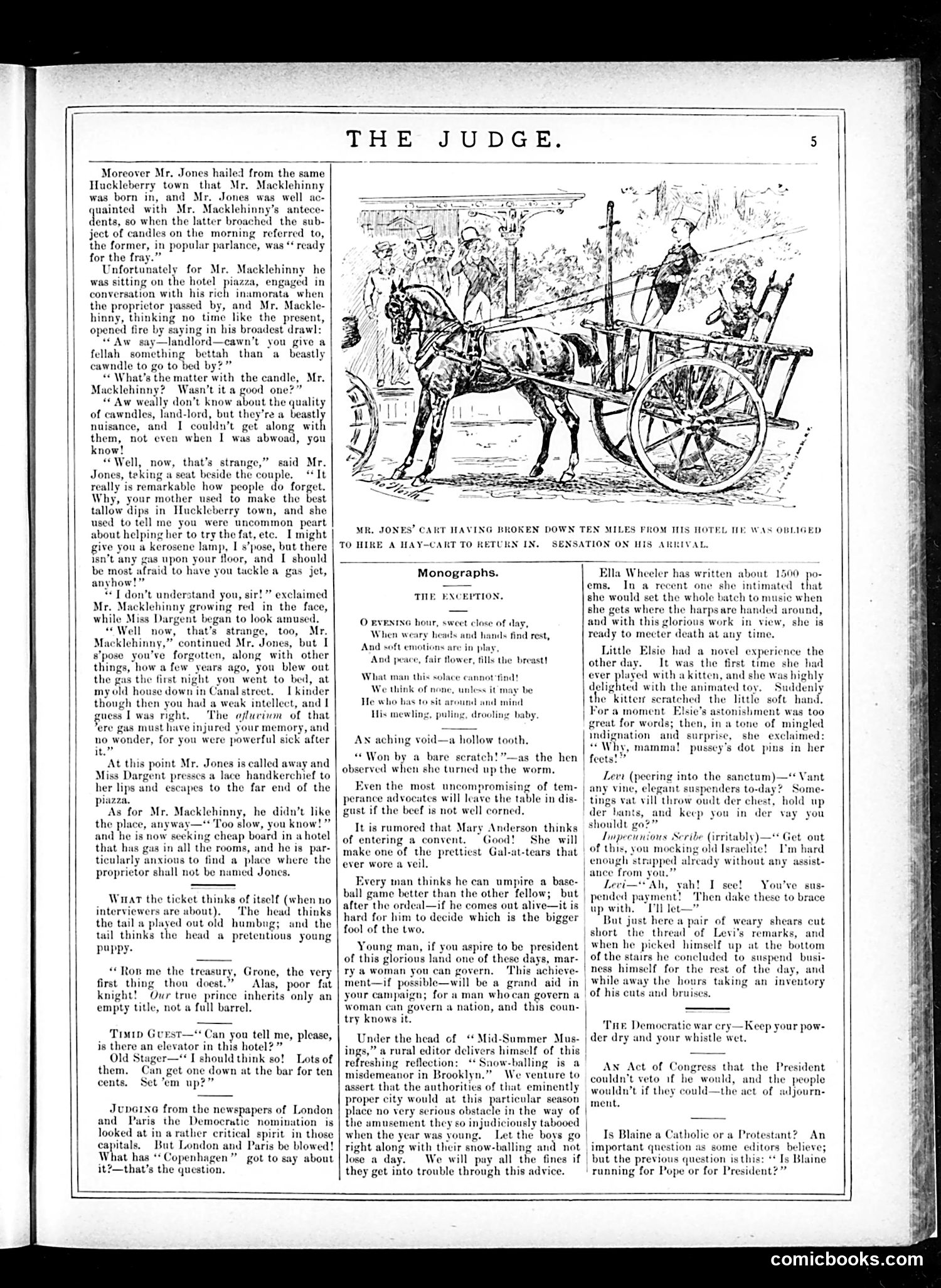
This cartoon illustrates a humbling social encounter set at a hotel. A man named Macklehinny complains to the landlord about poor candles, unaware that the proprietor (Mr. Jones) is from his hometown and knows his family history—specifically, that Macklehinny's mother made candles and that young Macklehinny once nearly poisoned himself by blowing out gas. Jones seizes the opportunity to publicly embarrass Macklehinny in front of his wealthy female companion (Miss Dargent), recounting these embarrassing incidents. The satire mocks Macklehinny's pretensions and social climbing: he complains about "beastly" candles using affected speech while his past reveals humble origins and questionable intelligence. The joke's punch line appears in the caption: Macklehinny's cart broke down miles away, forcing him to hire a hay-cart—a humiliation that compounds his social mortification. The cartoon satirizes pretension and the impossibility of escaping one's past.
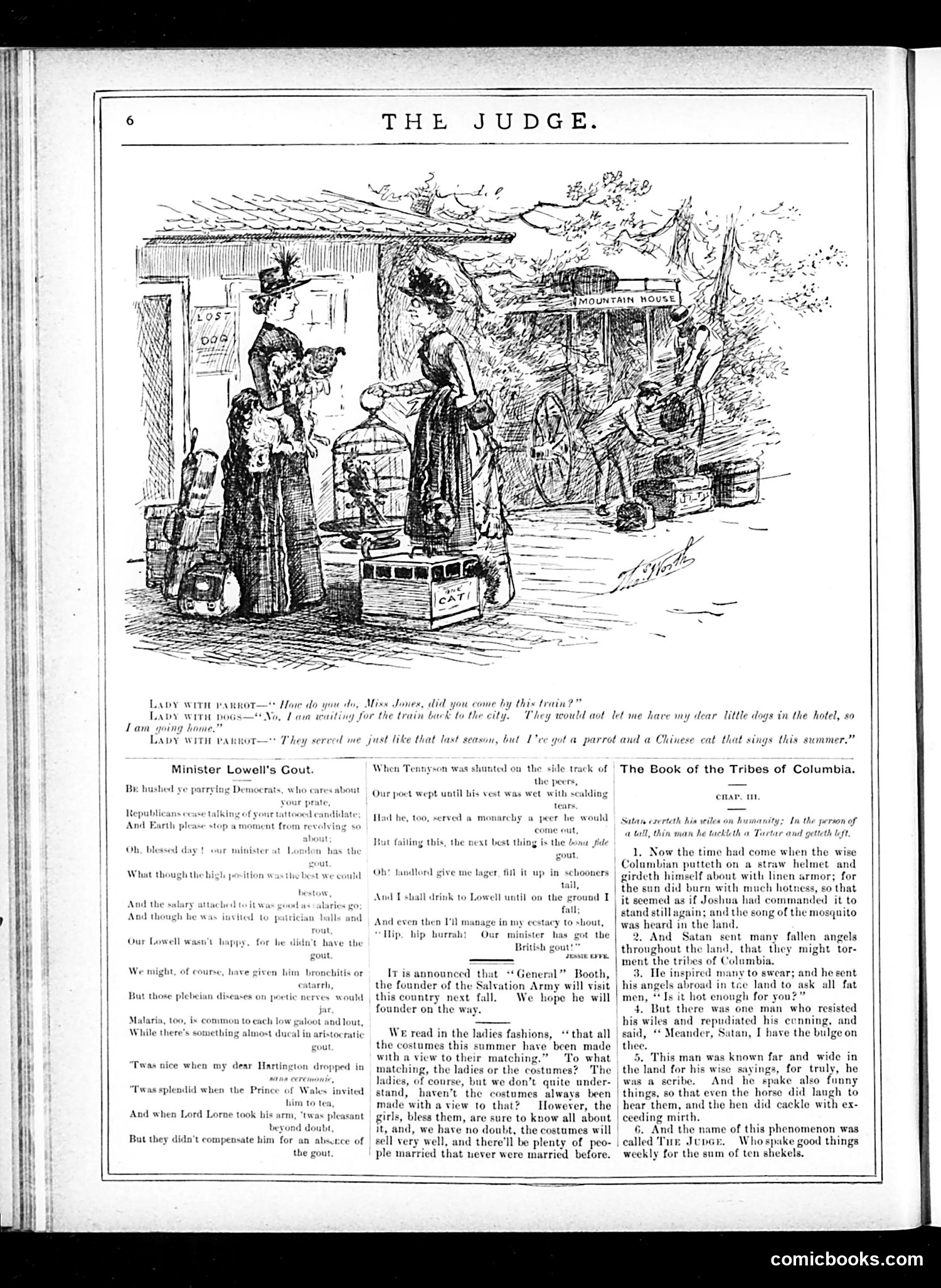
**Main Cartoon:** The top illustration depicts a social scene at what appears to be a mountain resort, with well-dressed ladies discussing travel. The caption's joke concerns a lady's complaints about hotel pet policies—she couldn't bring her dogs but now has a "Chinese cat that sings," a humorous non-sequitur suggesting absurd substitutes. **Political Content:** The text below satirizes **Minister Lowell's gout**—James Russell Lowell, American minister to Britain. The satire mocks Democratic politicians' schadenfreude over his affliction, suggesting gout is somehow a more "aristocratic" ailment befitting his diplomatic status. The poem jokingly celebrates his suffering as compensation for his elite position. **Additional Items:** - A jab at **General Booth** of the Salvation Army, wishing he'd "founder" (shipwreck) on his upcoming American visit - Mockery of women's fashion coordination - A mock-biblical section ("Book of the Tribes of Columbia") satirizing summer heat complaints, establishing "The Judge" (apparently the magazine itself personified) as the wit offering relief The page exemplifies *Judge* magazine's blend of political commentary, social satire, and topical humor.
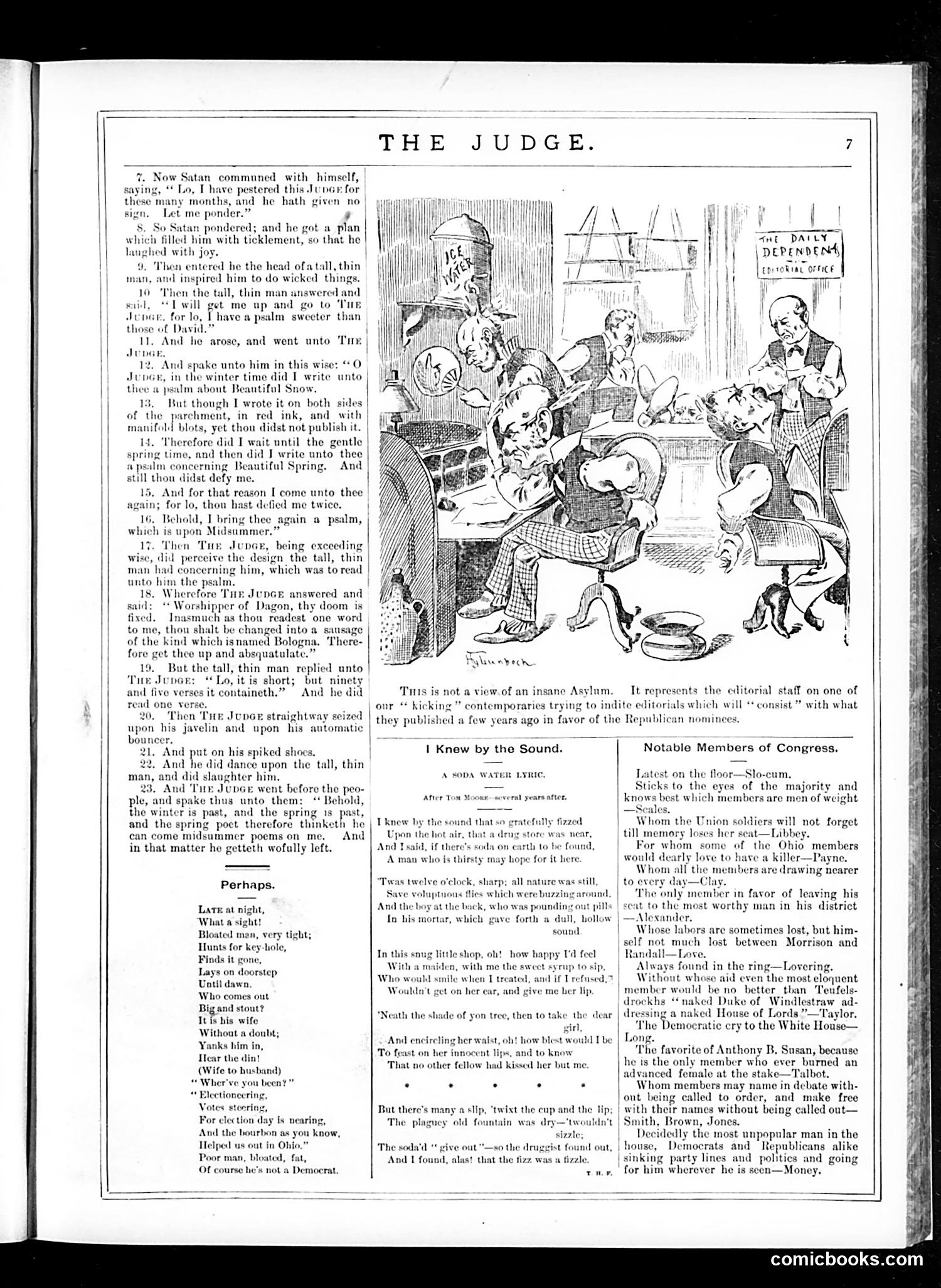
## Main Cartoon The large illustration depicts editorial staff at a competing newspaper (labeled "The Daily Dependent") arguing over content. The caption explains this represents contemporaries attempting to write editorials that "consist" with Republican positions they'd previously opposed—mocking editorial inconsistency and flip-flopping on political matters. ## Text Sections The biblical parody ("The Judge") satirizes a persistent poet submitting unsolicited "Beautiful Snow," "Beautiful Spring," and "Beautiful Midsummer" poems to Judge's editor. The editor (The Judge) threatens transformation into bologna sausage and violence if the poet reads even one word. This mocks nuisance contributors and editorial rejection. Below are lighter pieces: "Perhaps" (miscellaneous witticisms), "I Knew by the Sound" (soda fountain verse), and "Notable Members of Congress" (brief jabs at contemporary congressmen's perceived laziness, inconsistency, or ineffectiveness—names like Slocum, Libbe, Payne, Alexander referenced as representative of political failings). The satire targets editorial hypocrisy, persistent mediocre submissions, and congressional incompetence.
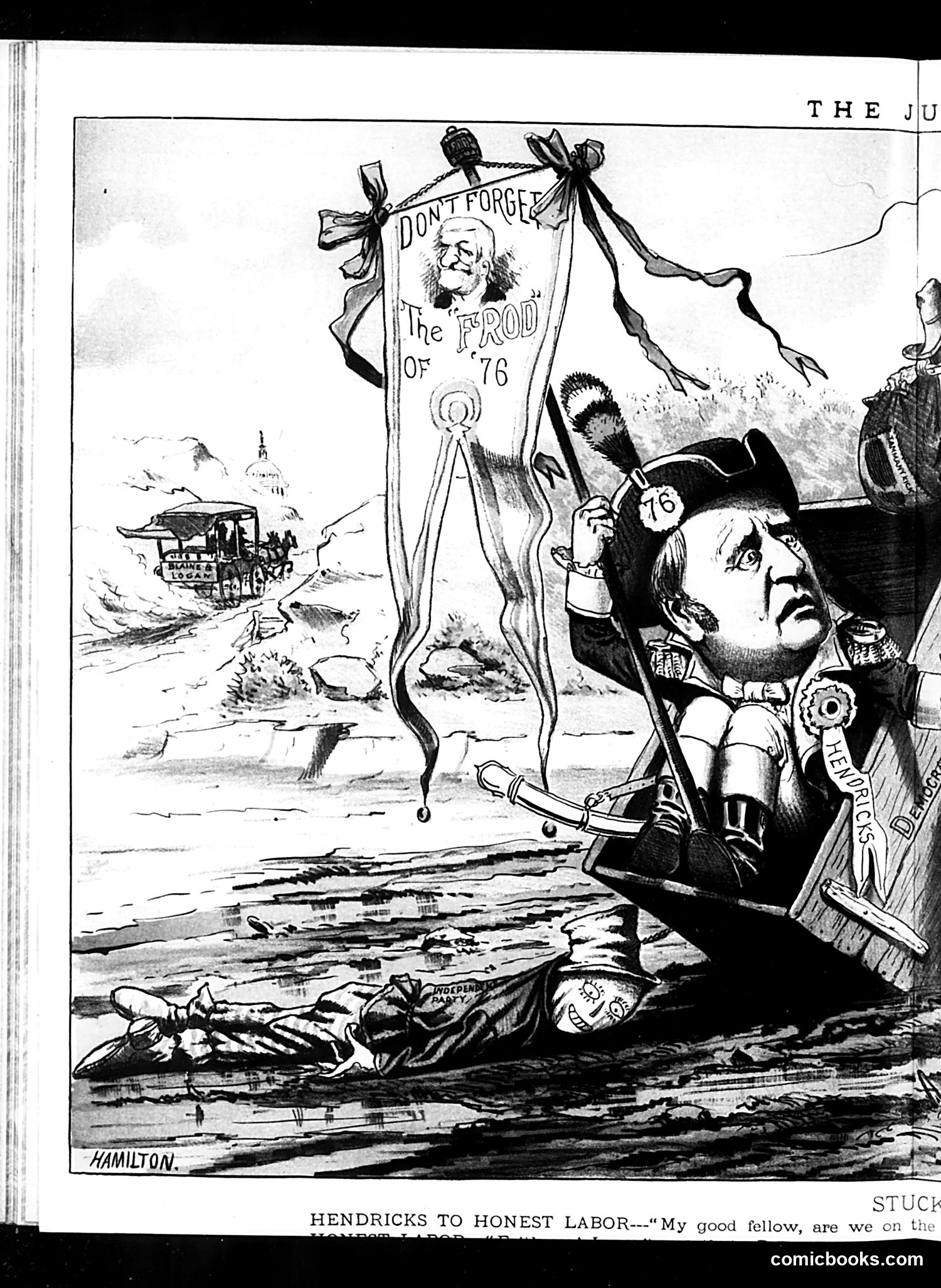
This 1876 Judge cartoon by Hamilton satirizes Vice President Thomas Hendricks. The image shows a uniformed military or political figure holding a banner reading "Don't Forget The Prod of '76"—referencing the Centennial celebration of American independence that year. The caption "Hendricks to Honest Labor" appears sarcastic, suggesting Hendricks is being "prodded" or reminded about labor issues. The figure lying on the ground likely represents either a political opponent or the working class. The elaborate military dress and theatrical setup mock what the cartoonist sees as Hendricks's pretensions or hypocrisy regarding labor support. The overall message appears critical of Hendricks's political positioning on labor matters during the 1876 election cycle.
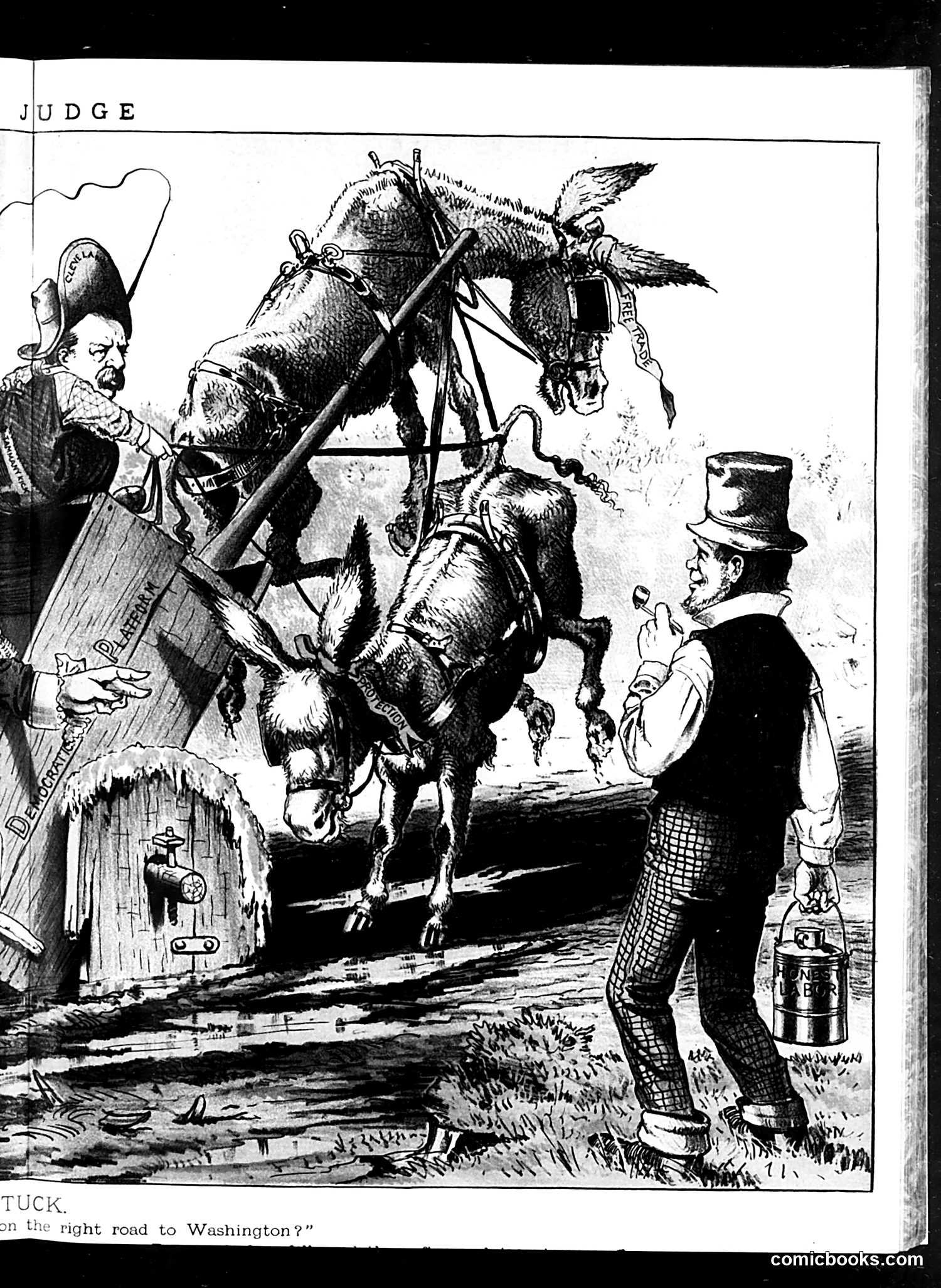
This is a Judge magazine satirical cartoon titled "On the Right Road to Washington?" The image depicts a figure in formal 19th-century dress (top hat, vest) standing beside a donkey that's being ridden by what appears to be a judge or authority figure. A small building (possibly representing a courthouse or government structure) sits nearby. The cartoon uses the donkey as a metaphor—likely representing either political stubbornness, the Democratic Party (which used the donkey symbol), or a foolish political direction. The question "on the right road to Washington?" suggests commentary on whether a particular political figure or policy is heading correctly toward the nation's capital. Without additional context or visible dates, the specific political reference remains unclear, but the satire critiques someone's political judgment or path.
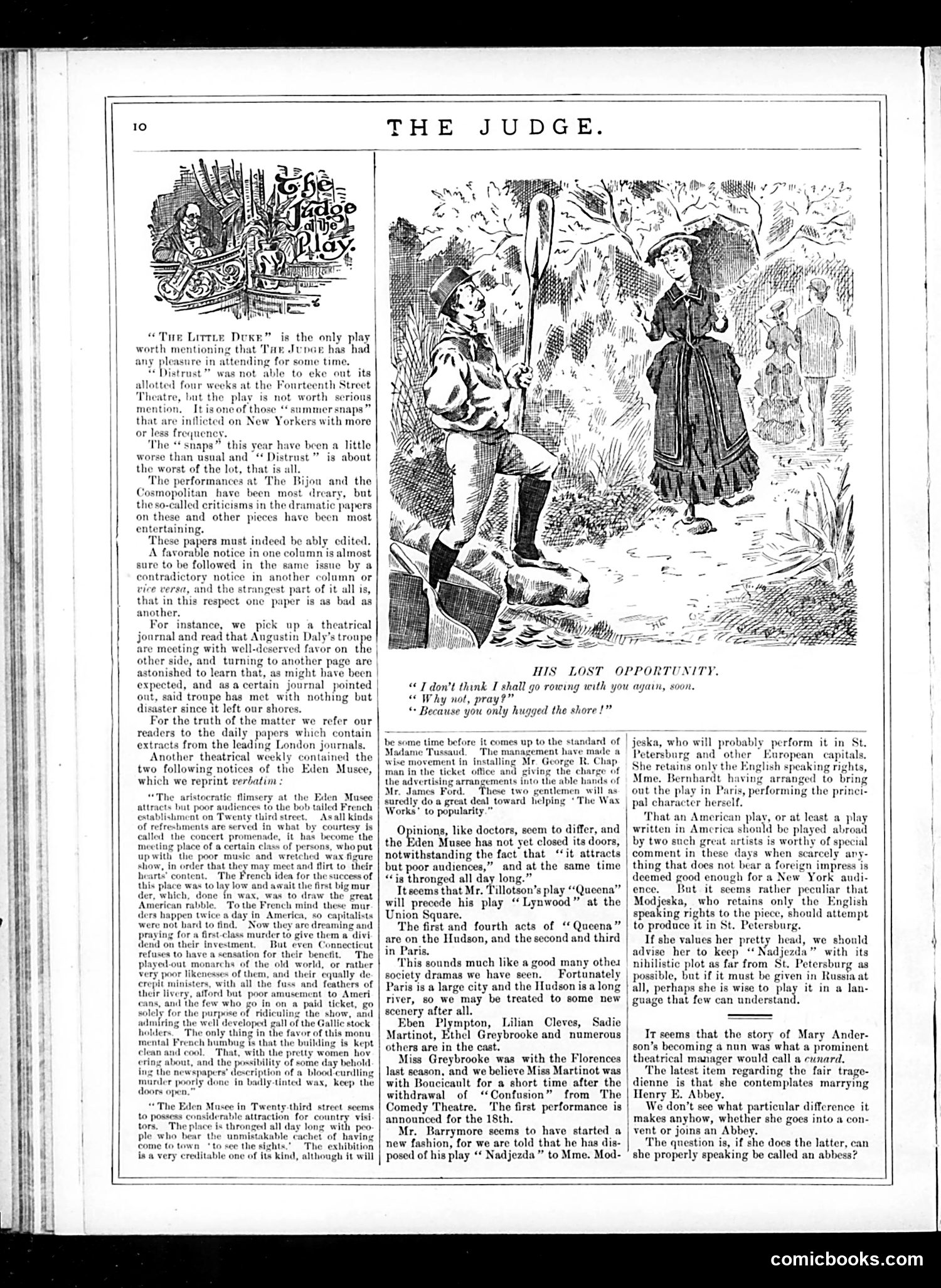
This single-panel cartoon depicts a man and woman in a natural outdoor setting. The man holds a rowing oar, and the woman appears to be rejecting his romantic advances. The caption reveals the joke: she refuses future rowing outings because "you only hugged the shore!" The satire is a play on the double meaning of "hug"—the man stayed close to shore (cautiously), but the woman expected him to literally embrace her during their outing. It's a commentary on timid courtship: the man missed his romantic opportunity through excessive caution. The accompanying theatrical reviews discuss various New York productions, including criticism of contradictory newspaper reviews and commentary on plays like "Distrust" and the Eden Musee attraction, providing context of 1880s-90s New York theater culture.
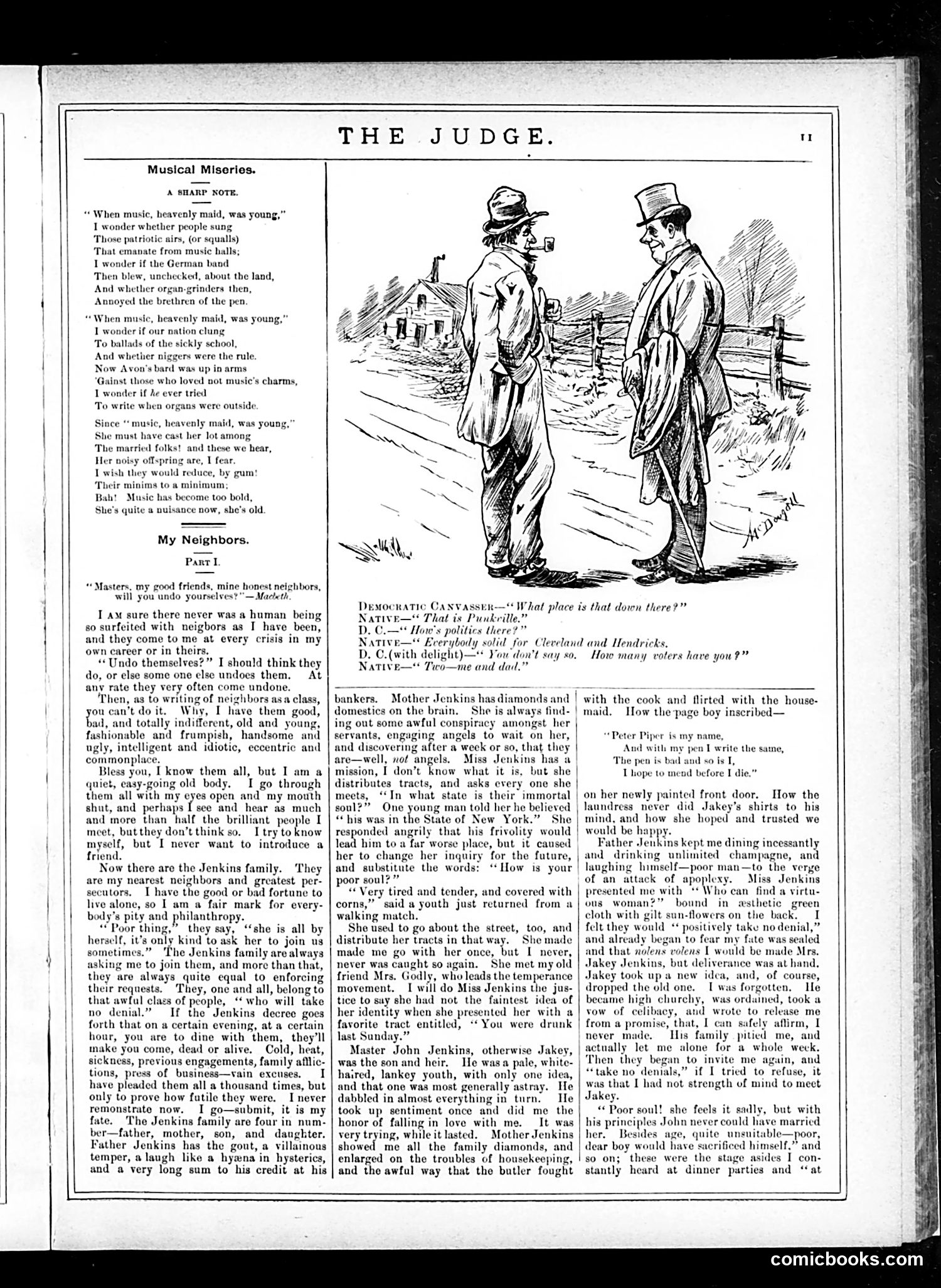
This page from Judge contains two main pieces of satirical content: **"Musical Miseries"** complains about how modern music has deteriorated. The poet laments that contemporary street musicians—German bands, organ-grinders, and music halls—have become an unbearable public nuisance, contrasting them unfavorably with music "when...was young." The satire targets urban noise pollution and the commercialization of music in late-19th-century America. **"My Neighbors, Part I"** begins a serialized essay mocking an intrusive neighbor family, the Jenkinses. The narrator, a solitary woman, is constantly pestered by these well-meaning but obnoxious neighbors who force social invitations upon her. The satire depicts period social pressures and class anxieties, particularly targeting Mother Jenkins's obsession with "diamonds and domestics" and her preachy religiosity. The small **"Democratic Canvasses"** cartoon satirizes rural political ignorance, showing a canvasser discovering that a supposedly solid Democratic district consists of only two voters: father and son.
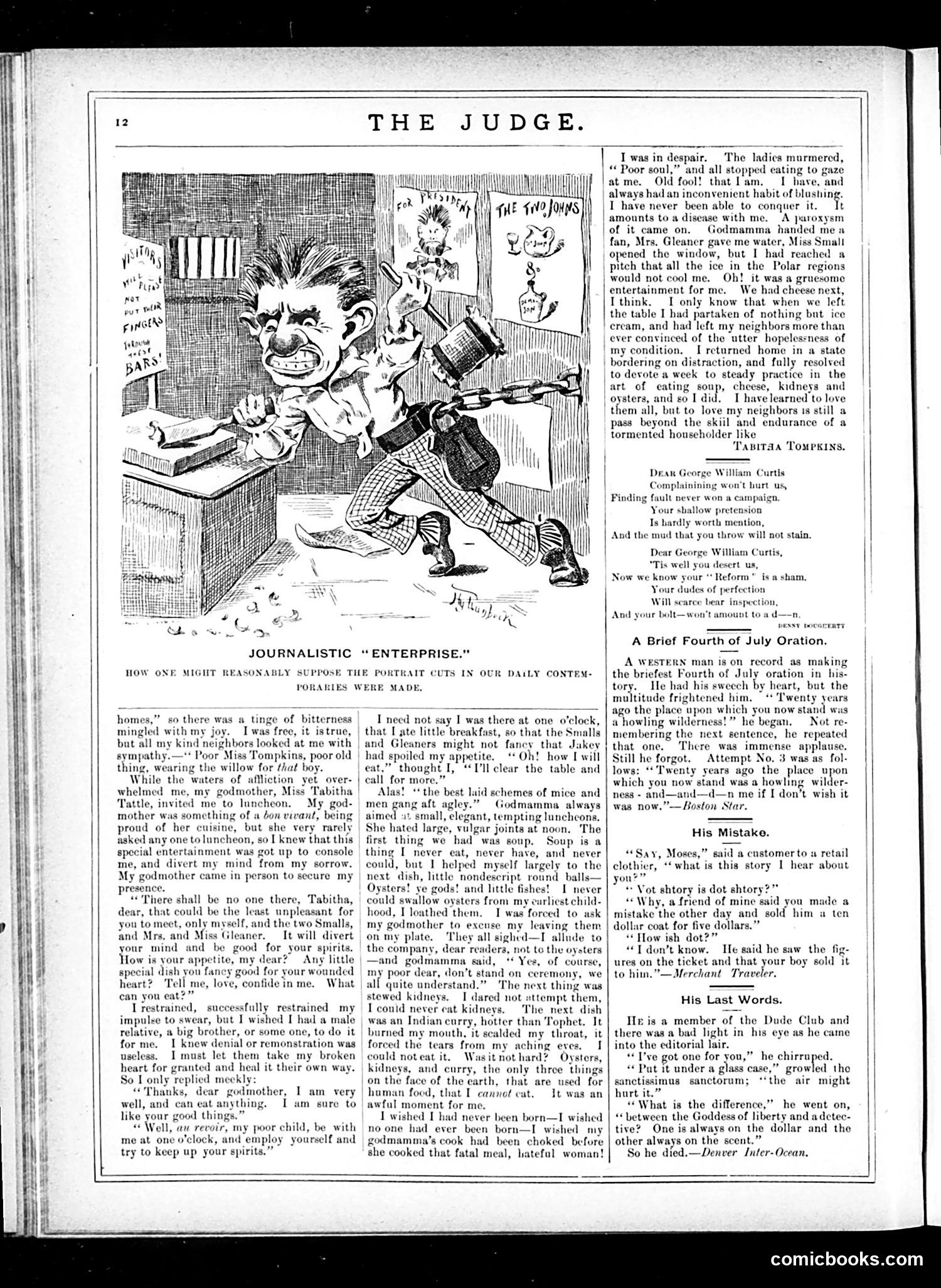
This cartoon satirizes how newspaper editors create portrait caricatures of public figures for daily publication. The wild, grotesque face being carved or manipulated on the left represents the distorted "cuts" (engravings) that appeared in contemporary newspapers like *Judge* itself. The satire targets the exaggeration inherent in political cartooning and portrait illustration: editors took recognizable subjects and deliberately warped their features for comedic or critical effect. The frenzied, demonic expression suggests the sensationalism and distortion involved in this "enterprise." The accompanying text story about a woman's social humiliation appears unrelated—likely filler content common in 19th-century magazines. The page demonstrates *Judge's* dual function: political satire through caricature while also poking fun at the medium itself and its methods.
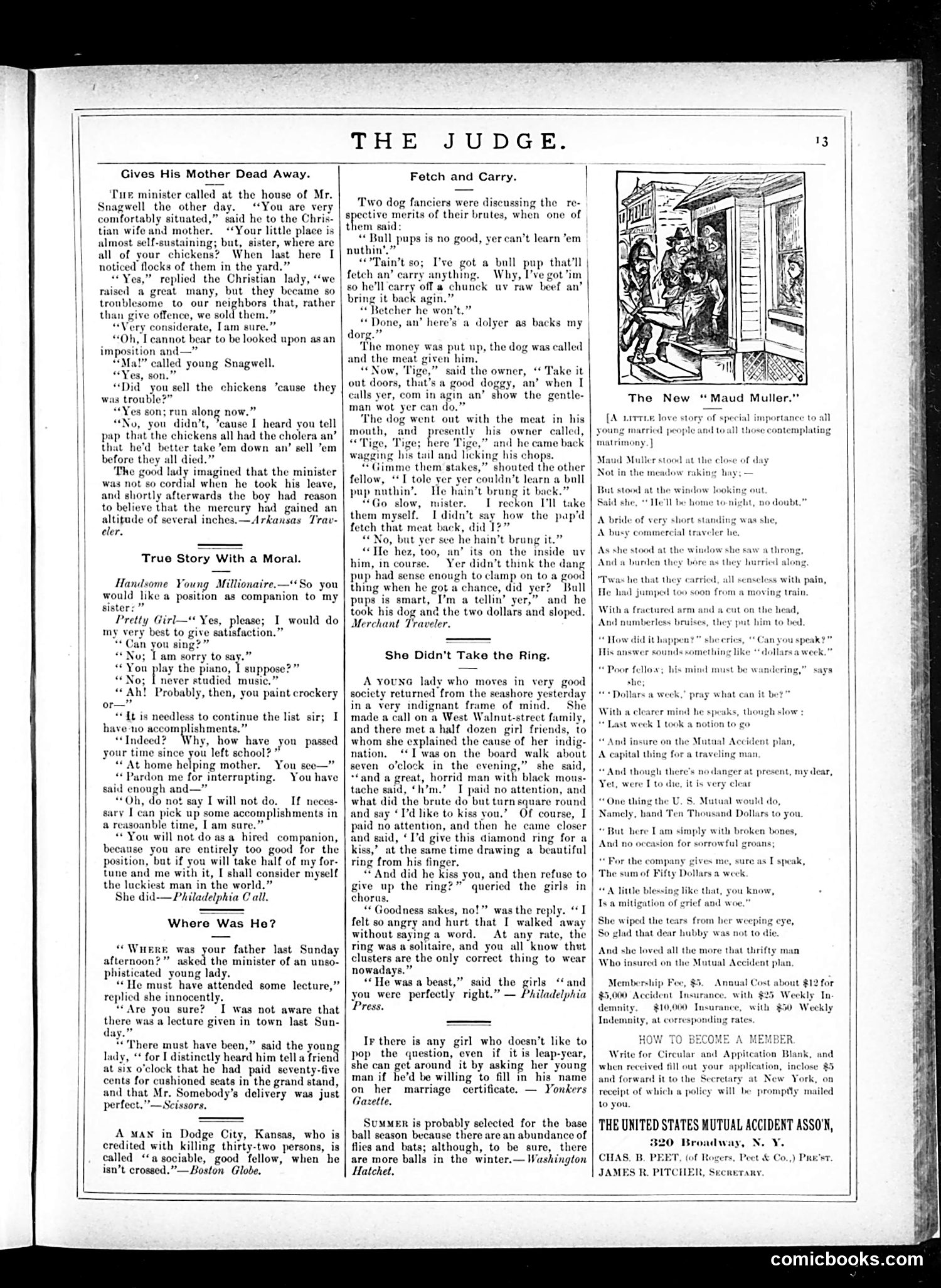
This page from the satirical magazine *Judge* contains several humorous anecdotes targeting hypocrisy and foolishness among ordinary Americans: **"Gives His Mother Dead Away"**: A Christian woman claims she sold her chickens to avoid bothering neighbors, but her son publicly reveals she actually sold them because they had cholera. The satire mocks sanctimonious pretense—the mother performs piety while lying to a minister. **"True Story With a Moral"**: A wealthy young man rejects a pretty companion applicant for lacking "accomplishments" (musical/artistic skills), then immediately proposes marriage, recognizing her genuine worth. The joke satirizes shallow status-consciousness among the wealthy. **"Where Was He?"**: A girl innocibly reveals her father attended something costing 75 cents with "cushioned seats," suggesting he went to a baseball game rather than a lecture as he claimed—mocking both parental dishonesty and children's innocent betrayals. The cartoon illustration (right) shows "The New 'Maud Muller'"—apparently depicting a young married woman contemplating matrimony, though specific context is unclear from the visible image.
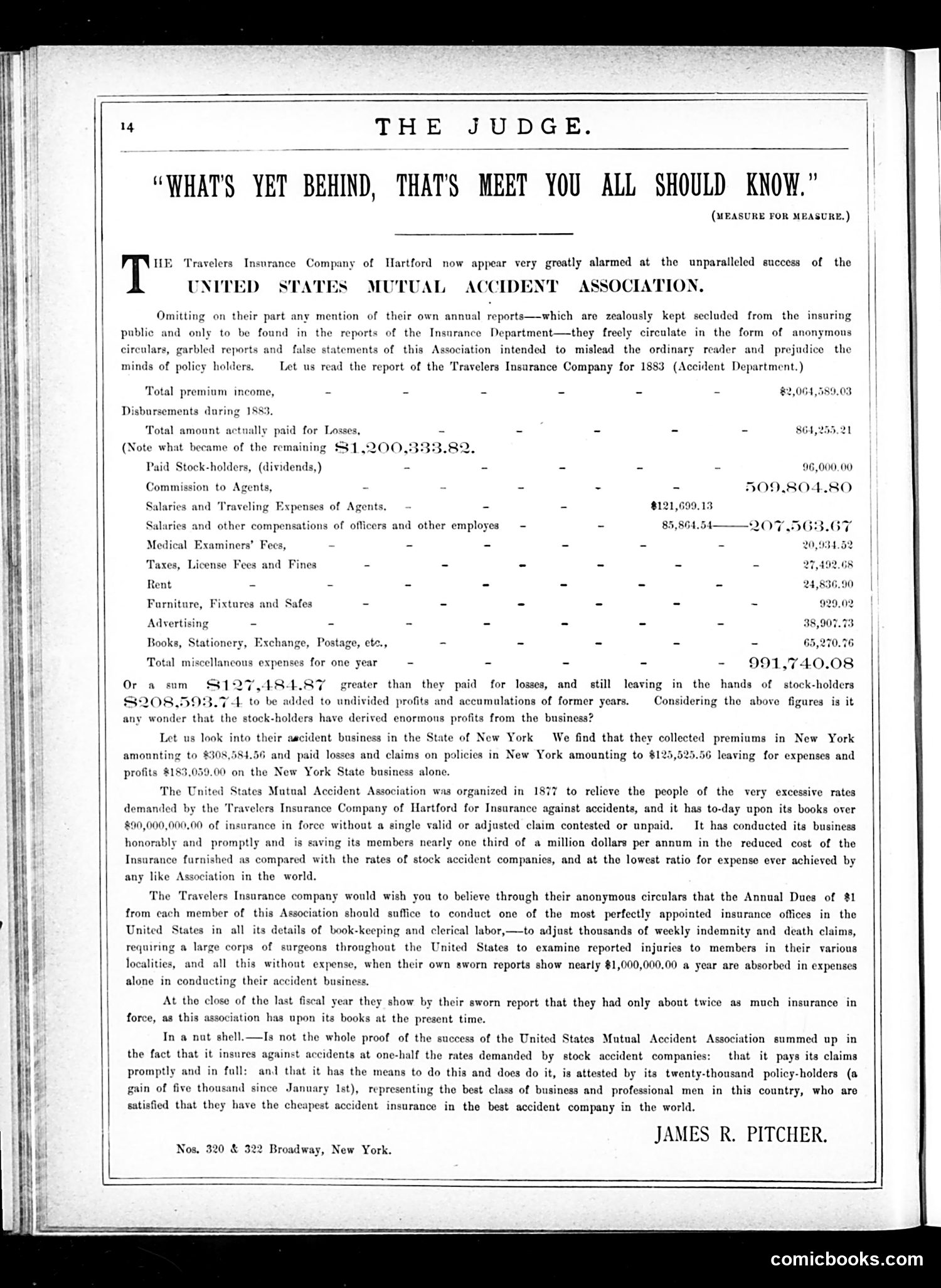
This page is **not a cartoon** but rather an **advocacy advertisement** disguised as editorial content in *Judge* magazine (circa 1883-84). **The Conflict:** The United States Mutual Accident Association is attacking the Travelers Insurance Company of Hartford for spreading negative rumors about it. **The Satire/Argument:** The piece uses financial data to expose what it claims is Travelers' hypocrisy—the company criticizes the smaller mutual association's efficiency while obscuring its own bloated expenses. The author (James R. Pitcher, apparently representing the mutual association) argues that Travelers spends far more on overhead than on actual claims payouts, yet somehow profits enormously, while the mutual association operates more efficiently and passes savings to members. **The Point:** This is a consumer-protection argument—essentially: "Don't believe the competitor's propaganda; look at the actual numbers showing who really serves policyholders better." It's an early example of comparative advertising rhetoric, though presented as editorial opinion rather than labeled advertising.
This page is primarily **advertisements** with brief satirical jokes scattered throughout. The content includes: **Main Features:** - Travel ads (Saratoga, West Shore Route) - Product advertisements (bicycles, pianos, magic lanterns, playing cards) - Short humorous anecdotes about everyday situations **The Satire:** The jokes target social conventions and absurdities: - A female physician refusing to treat an injured man because her hair isn't done up—mocking women's vanity and impracticality - Mismatched couples at a picnic with poor soda—playing on relationship dynamics - References to song titles ("When Jennie Meets Me at the Gate") used as comedic setup - A preacher whose congregation nods off—poking fun at boring sermons **Context:** These are gentle, domestic humor pieces typical of *Judge's* satirical style, relying on puns, situational irony, and stereotypes about gender roles, courtship, and social pretension rather than political commentary.
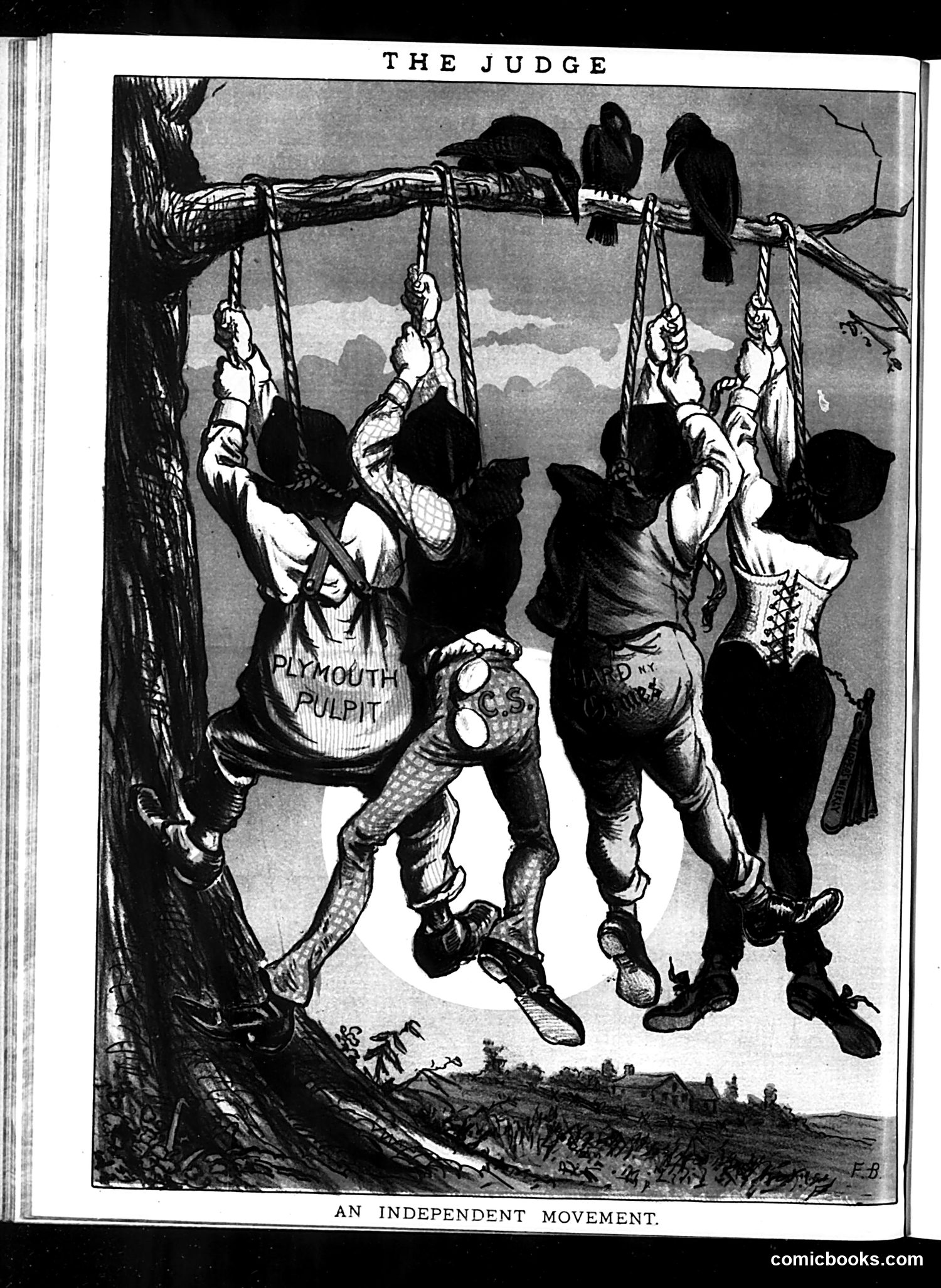
This Judge magazine cartoon satirizes political independence movements of the early 20th century. The image depicts four figures hanging from a tree branch, labeled "Plymouth Pulpit," "G.S." (unclear), and what appears to be "Hard" or similar. The figures are shown as hanged men, with crows perched above—a grim metaphor suggesting these "independent movements" are dead or doomed. The satire appears to mock ambitious political or religious movements claiming independence, suggesting they inevitably fail or end in disaster. The specific identities of all figures remain unclear without additional context, but the macabre visual clearly communicates the cartoonist's cynical message: independence movements are ultimately self-destructive ventures. The style is typical of Judge's sharp political commentary from this era.