
Judge, 1884-08-16 · page 10 of 16
Judge — August 16, 1884 — page 10: what you’re looking at
What you’re looking at
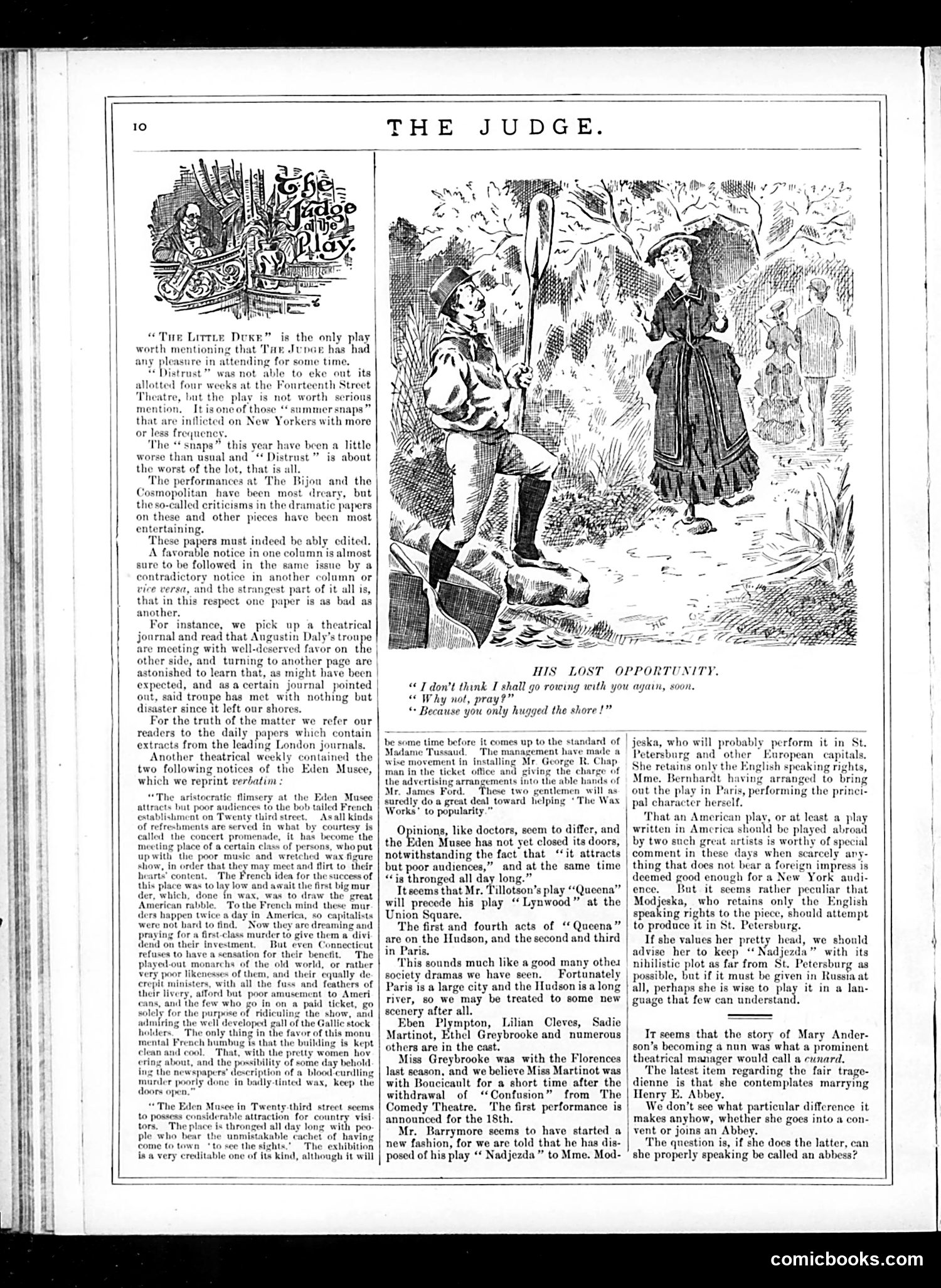
This single-panel cartoon depicts a man and woman in a natural outdoor setting. The man holds a rowing oar, and the woman appears to be rejecting his romantic advances. The caption reveals the joke: she refuses future rowing outings because "you only hugged the shore!" The satire is a play on the double meaning of "hug"—the man stayed close to shore (cautiously), but the woman expected him to literally embrace her during their outing. It's a commentary on timid courtship: the man missed his romantic opportunity through excessive caution. The accompanying theatrical reviews discuss various New York productions, including criticism of contradictory newspaper reviews and commentary on plays like "Distrust" and the Eden Musee attraction, providing context of 1880s-90s New York theater culture.
📄 Transcribed text from this page (OCR, searchable)
Machine-transcribed from the original scan — historical spelling and the odd misread are preserved.
«Tue Littie worth mentioni any pleasure in Fun as had | tending for some time. Distrust ” t able to eke out allotted four we “ourteenth St ‘Theatre, but the play is not worth serious mention. It is one of those ‘ summer snaps” that are inflicted on New Yorkers with more or less frequenc The “snaps” this year have been a little worse than usual and “ Distrust” is about the worst of the lot, that is all. The performances at The Bijou and the Cosmopolitan have been most dreary, but the so- criticisms in the dramatic papers ese and other pieces have been most ning. hese papers must indeed be ably edited. A favorable notice in one column is almost sure to be followed in the same issue by a dictory notice in another column or t, and the strangest part of it all is, that in this respect one paper is as bad as another. or instance, we pick up a the: journal and read that Augustin Daly’s troupe are meeting with well-deserved favor on the | other side, and turning to another page are ed to learn that, as might have been | d, and as acertain journal pointed aid troupe has met with nothing but disaster since it left our shores. ‘or the truth of the matter we refer our readers to the daily ers which contain ts from the leading London journals. Another theatrical weekly contained the two following notices of the Eden Musee, which we reprint verbatim : rical “The aristoc attracts but poc a at on Twenty third street. Asall kinds what by courtesy is ¢, it has become the sons, who put hed wax figure nd flirt to their for the success of up with the poor mu show, in order that they may mee hearts’ content. The French id this place was to lay lov t the first big mur der, which, done {n wax, was to draw the great American rabble. To the French mind these mur ders happen twice a day i ists were not bard to find, a ming and pray a first-class murder to give them a divi dend on their investment, But even Connecticut refuses to have a sensation for their benefit. The played-out monarchs of the old world, or rather very poor likenesses of them, and their equally de: crepit ministers, with all the fuss and feathers of their livery, afford but poor amusement to Ameri nil the few who go in on a pai for the purpose of he well developed gal only thing in the ach humbug is that the buildin; 1 h with peo of having HIS LOST OPPORTUNITY. « T don't think I shall go rowing with you again, soon. “Why not, pray?” “ Be se you only hugged the shore!” up to the standard of nagement h Mr. James Ford. These two gentlemen will as suredly do a great deal toward helping ‘The Wax Works" to popularity.” Opinions, like doctors, seem to differ, and the Eden Musee has not yet closed its doors, notwithstanding the fact that ‘‘it attracts but poor audiences,” and at the same time “is thronged all day long.” Itecems that Mr. Tillotson’s play “Queena” will precede his play “Lynwood” at the Union Square. The first and fourth acts of ‘“ Queena” | are on the Hudson, and the second and third | in Paris, ‘This sounds much like a good many othe society dramas we have seen. Fortunately Paris is a large city and the Hudson is along river, 80 we may be treated to some new scenery after all. Eben Plympton, Martinot, Ethel Greybrooke and numerous others are in the cast. Miss Greybrooke was with the Florences last season, and we believe Miss Martinot was | with Boucicault for a short time after the withdrawal of “Confusion” from ‘The Comedy Theatre. ‘The first performance is announced for the 18th. Mr. Barrymore seems to have started a new fashion; for we arc told that he has dis- posed of his play “ Nadjezda” to Mme. Mod- Lilian Cleves, Sadie | jeska, who will probably perform it in St. Petersburg and other European capitals. She retains only the English speaking rights, Mme. Bernhardt having arranged to bring out the play in Paris, performing the princi- pal character he ‘That an American play, or at least a play written in America should be played abs by two such great artists is worthy of special comment in these days when ly any- thing that does not bear a foreign impress is | deemed good enough for a New York audi- ence. But it seems rather peculiar that | Modjeska, who retains only the English speaking rights to the piece, should attempt to produce it in St. Petersburg. If she values her pretty head, we should adv her to keep ‘‘ Nadjezda” with its nihilistic plot as far from St. Petersburg as possible, but if it must be given in Russia at all, perhaps she is wise to play it in a lan- | guage that few can understand. elf. It seems that the story of Mary Ander- son’s becoming a nun was what a prominent theatrical manager would call a cunard. ‘The latest item regarding the fair trage- dienne is that she contemplates marrying Henry E. Abbey. We don’t see what particular difference it | makes anyhow, whether she goes into a con- vent or joins an Abbey. ‘The question is, if she does the latter, can she properly speaking be called an abbess? comicbooks.com