
A complete issue · 16 pages · 1884
Judge — July 5, 1884
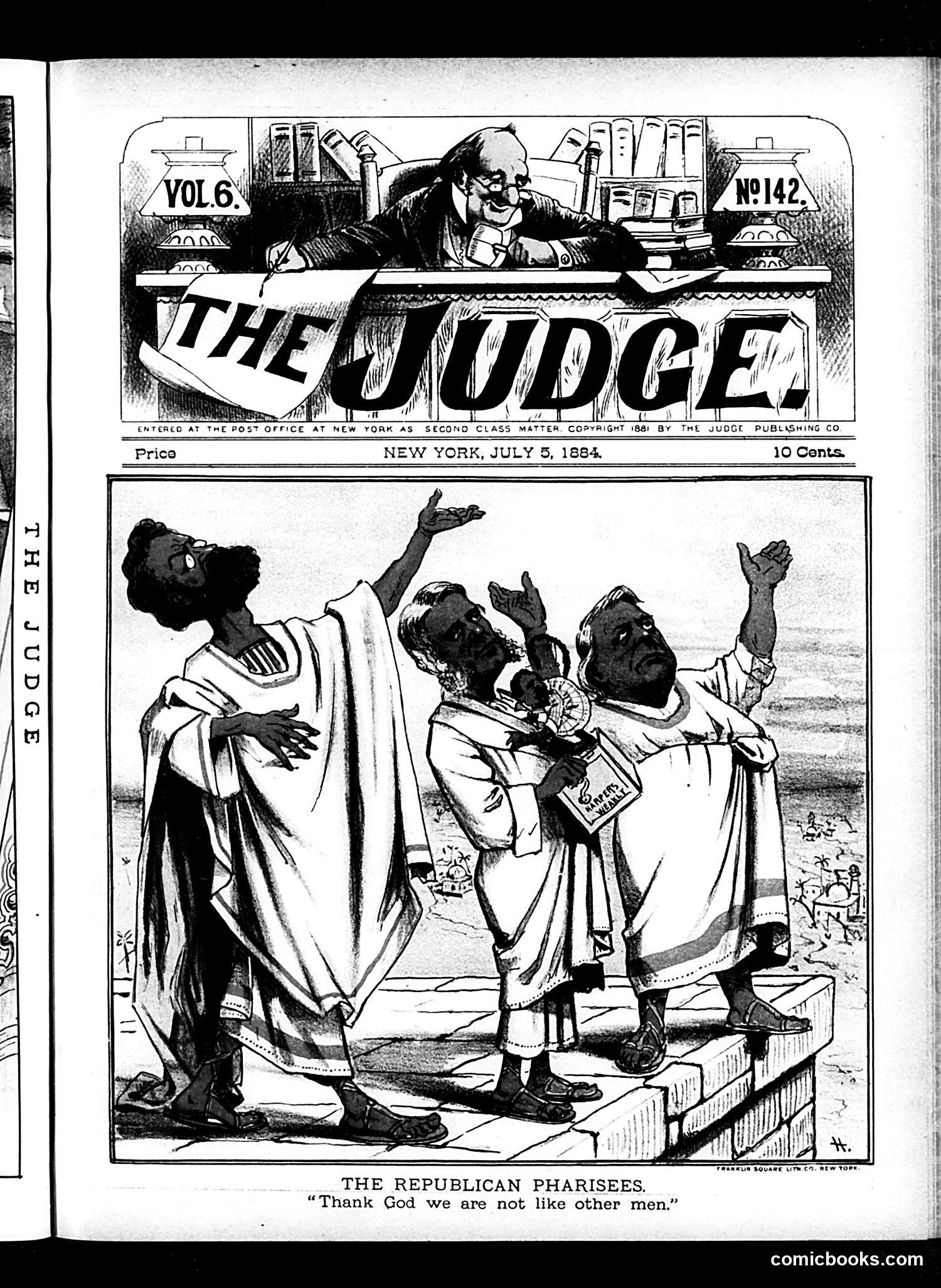
This cartoon satirizes Republican hypocrisy during the 1884 presidential election. The title references Biblical Pharisees—hypocrites who publicly performed virtue while lacking moral substance. The three figures in robes appear to represent Republican leaders or party members engaged in self-righteous posturing, with the caption "Thank God we are not like other men" (a direct Biblical quote from Luke 18:11, spoken by a boastful Pharisee). The satire suggests Republicans were publicly proclaiming moral superiority while, in the Judge's view, behaving hypocritically. This likely critiques Republican attacks on Democratic candidate James Blaine regarding personal scandals, while ignoring similar failings within their own party. The cartoon uses religious imagery to expose perceived moral pretense as the central political weapon of the moment.
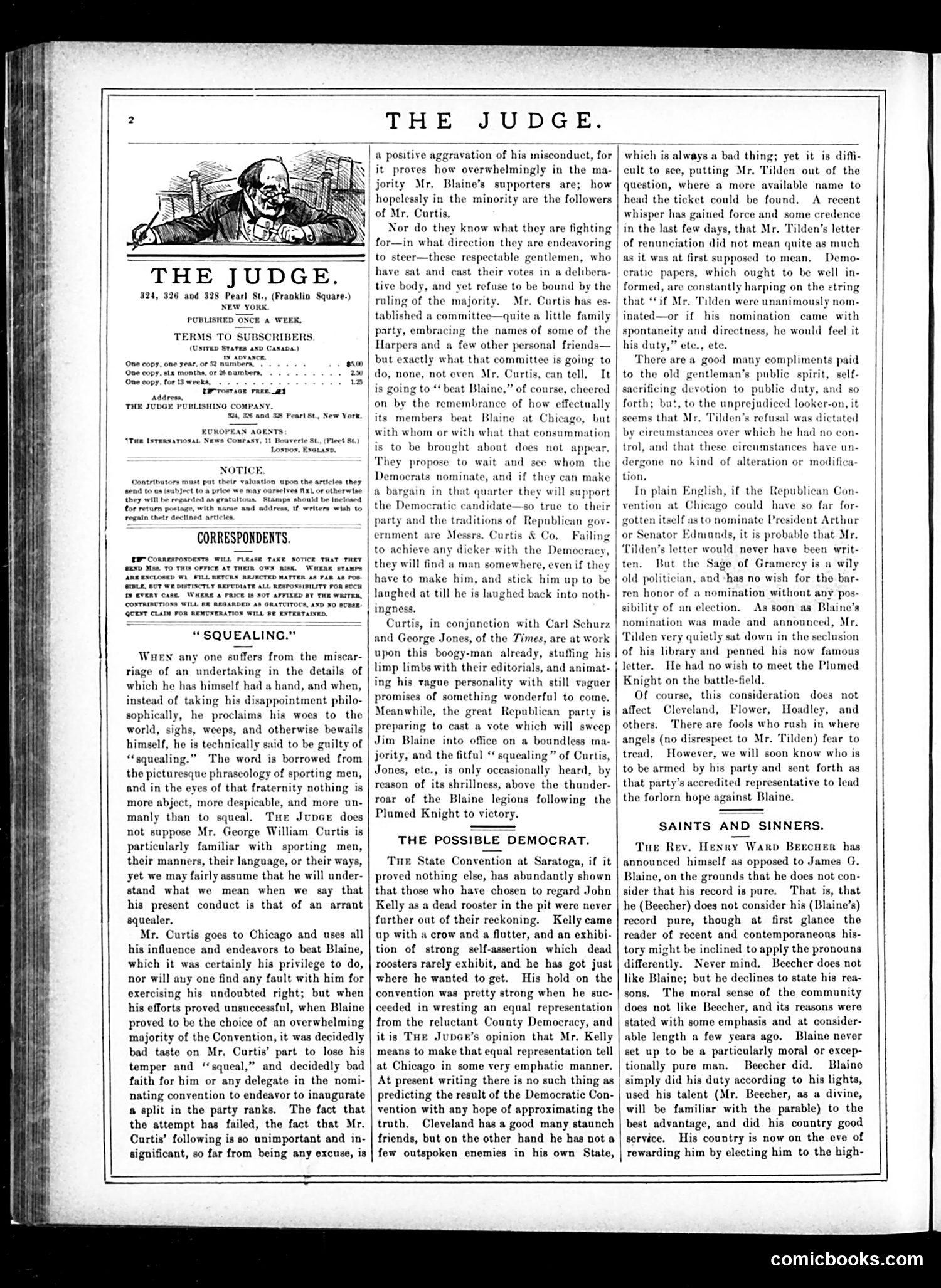
This page from Judge magazine (circa 1884) attacks **George William Curtis**, a prominent Republican editor and political reformer, for his conduct during the recent Republican National Convention in Chicago. The satire centers on Curtis's attempt to block **James G. Blaine's** presidential nomination. After failing, Curtis allegedly formed a splinter committee with Carl Schurz and others to either "beat Blaine" or potentially support the Democratic candidate instead—the exact plan remaining vague. Judge's **"Squealing"** editorial mocks Curtis for acting like a sore loser. In sporting slang of the era, "squealing" meant whining about defeat—considered deeply unmanly. The magazine argues Curtis demonstrated bad faith by refusing to accept majority rule at a party convention, then threatening to fracture Republican unity. The underlying point: Curtis is hypocritically abandoning Republican principles and loyalty simply because his preferred candidate lost. Judge frames this as petulant, arrogant behavior unworthy of a serious political figure.
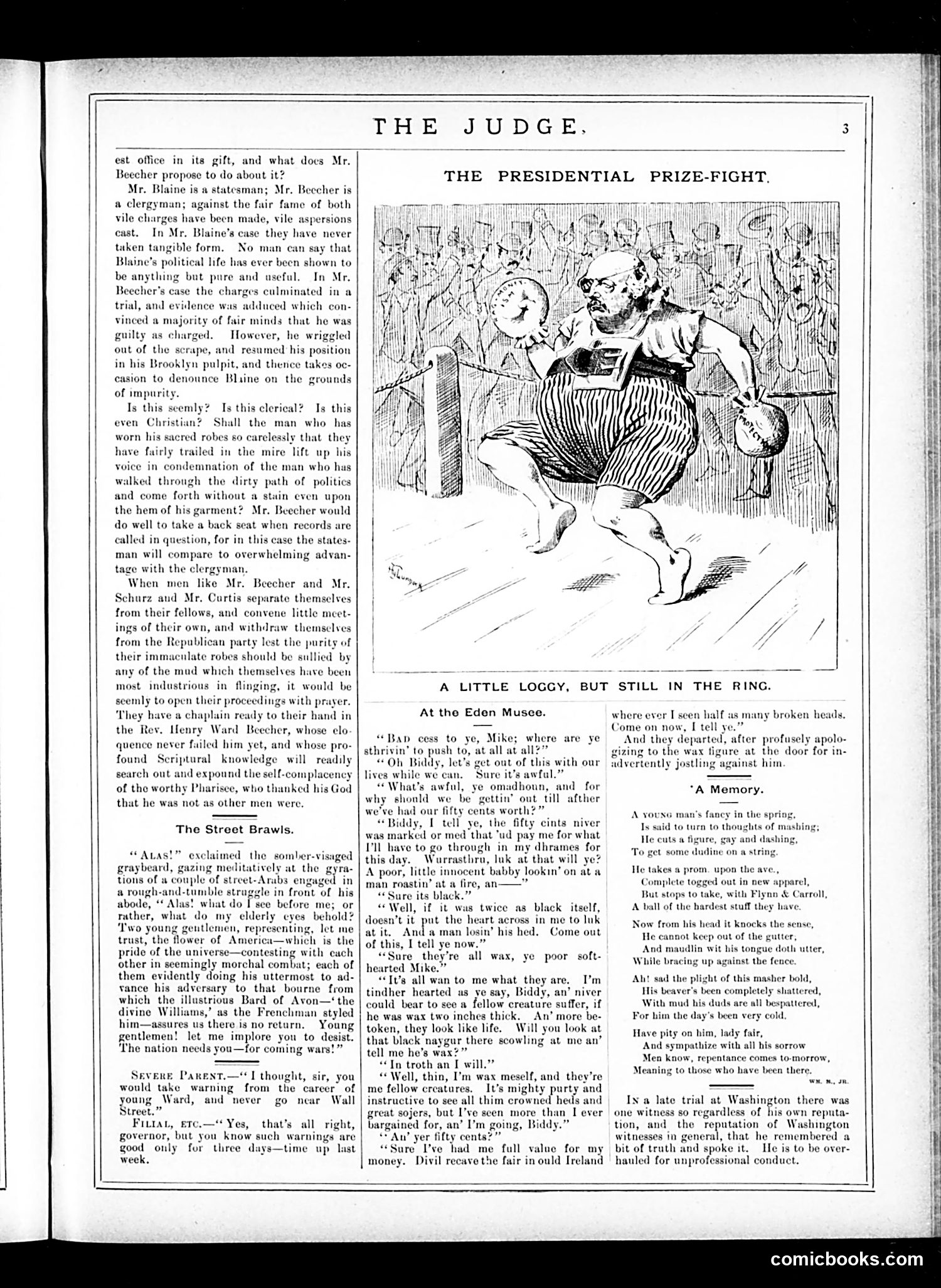
The main cartoon depicts a boxing match between **James G. Blaine** (Republican statesman and presidential candidate) and **Henry Ward Beecher** (prominent clergyman). The satirical article attacks Beecher's moral standing to criticize Blaine's fitness for office. The text argues that Beecher—who had faced adultery charges in a notorious 1875 trial—has no right to question Blaine's integrity from a political platform. Judge accuses Beecher and fellow Republicans (Schurz, Curtis) of self-righteous hypocrisy: they abandoned the party claiming purity while being "most industrious in flinging" mud themselves. The satire compares Beecher to a Pharisee, suggesting he's a sanctimonious fraud. Other content on the page includes street vignettes showing working-class Irish characters and a reflective poem about memory and loss—typical filler material for the era's satirical magazines.
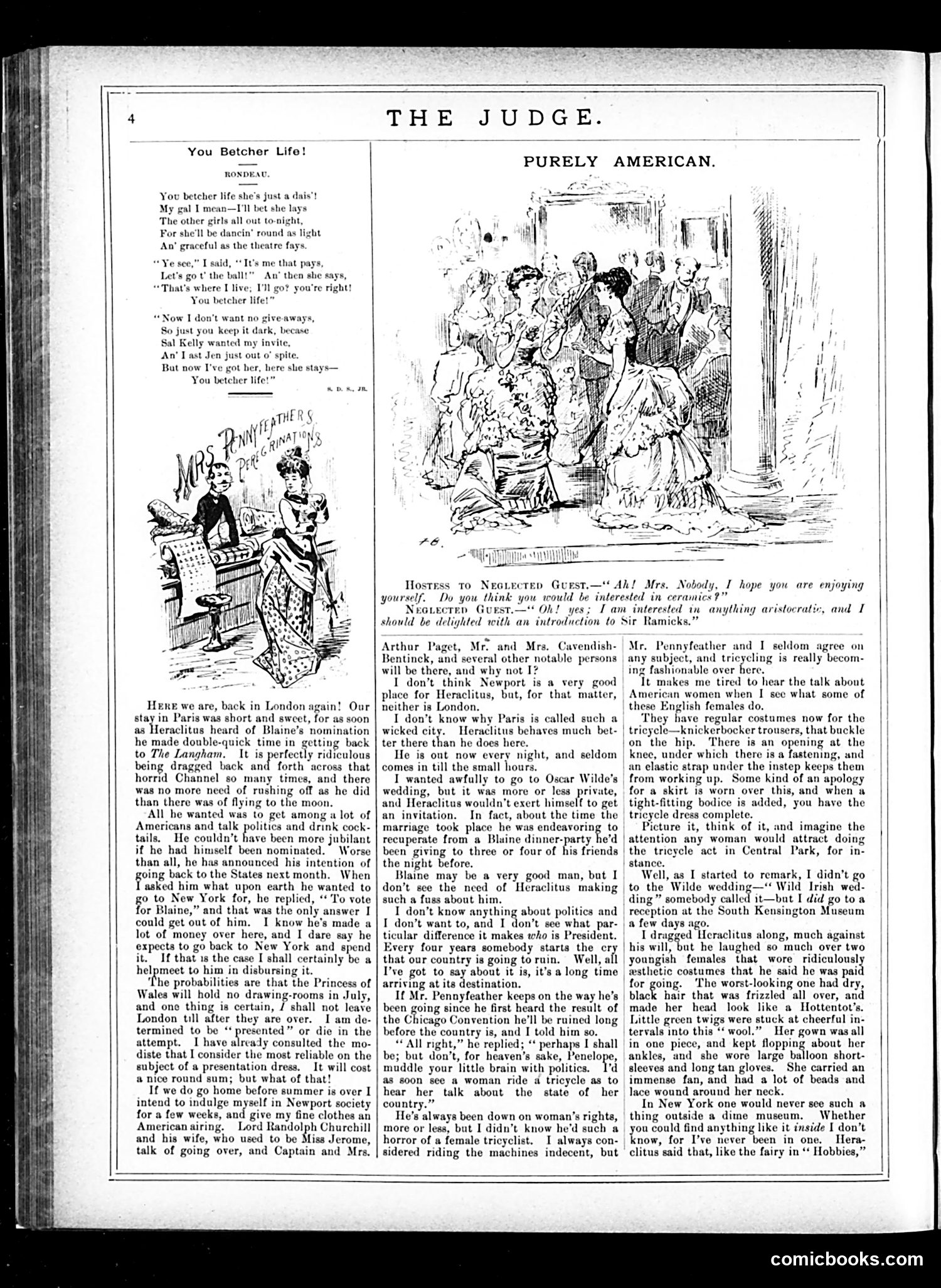
This page satirizes American social climbing and political obsession among the wealthy. The main cartoon depicts a crowded, chaotic social gathering where a snobbish hostess condescends to an "unselected guest," implying that without aristocratic connections (like "Sir Ramicks"), one lacks social worth. The accompanying text mocks Heraclitus, an American expatriate in London who becomes absurdly preoccupied with James G. Blaine's presidential nomination (likely 1884). The satire targets how Americans abroad adopt affected pretensions while remaining indifferent to actual politics. The narrator—a woman focused on presentation dresses and royal drawing-rooms—represents the shallow status-consciousness Judge associated with American society. The humor hinges on hypocrisy: Americans desperately seek European aristocratic validation while claiming disinterest in substantive matters. The reference to Oscar Wilde's wedding adds contemporary cultural context, positioning the satire within 1880s high-society circles.
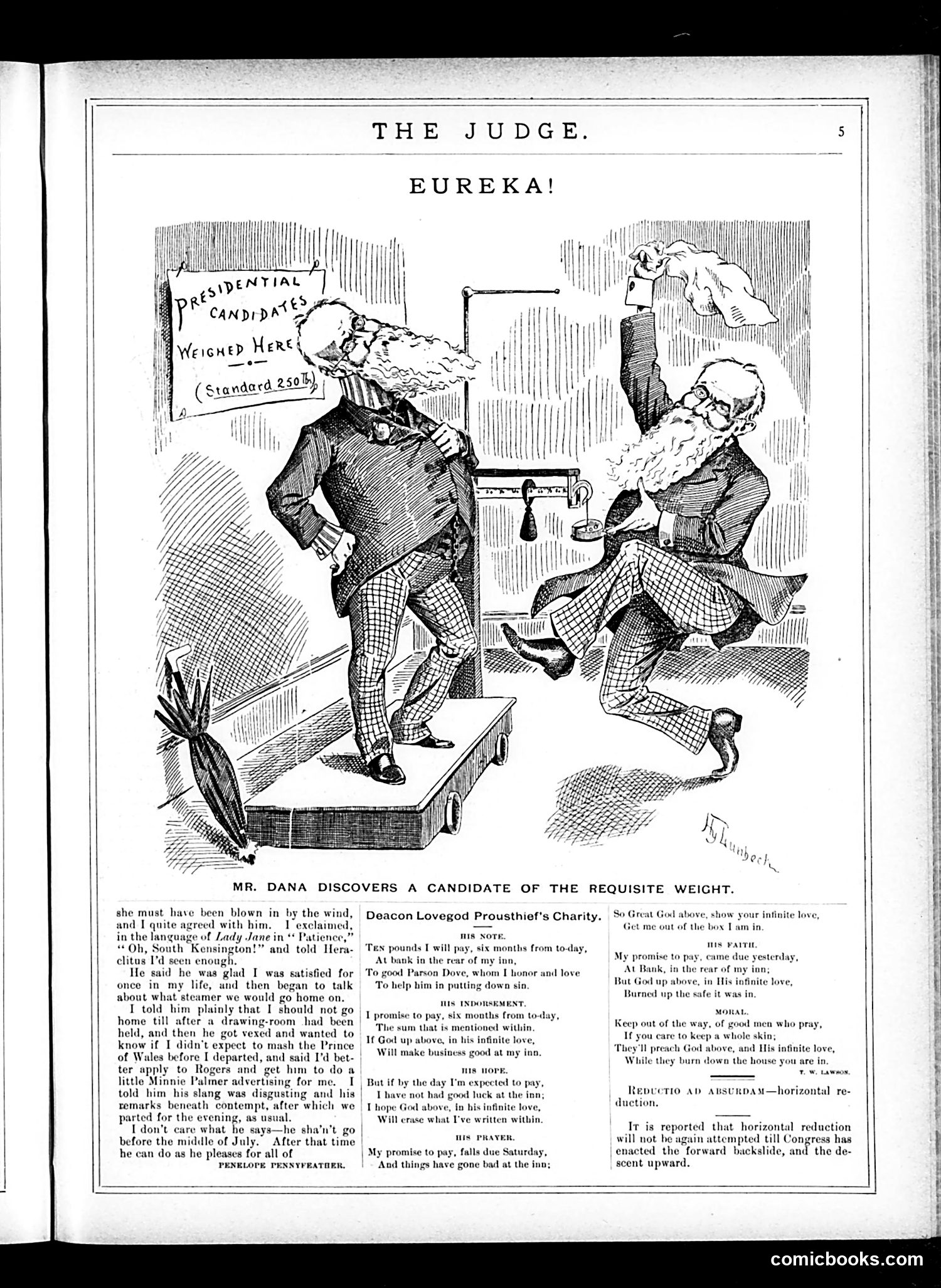
This political cartoon satirizes Charles Dana, editor of the New York Sun, who is apparently searching for a presidential candidate. The cartoon depicts Dana discovering a grotesquely overweight figure on a weighing scale labeled "Presidential Candidates Weighed Here (Standard 250 lb)." The joke plays on "requisite weight"—both literal physical heaviness and metaphorical political substance. Dana appears to have found someone who finally meets the minimum weight requirement for the position, suggesting that qualified candidates were scarce or that existing candidates lacked sufficient gravitas. The accompanying text includes mock financial "notes" and "endorsements," further satirizing the commercialization of politics and candidates' credibility. This likely reflects late-19th-century American skepticism about political leadership and the selection process for presidential nominees.
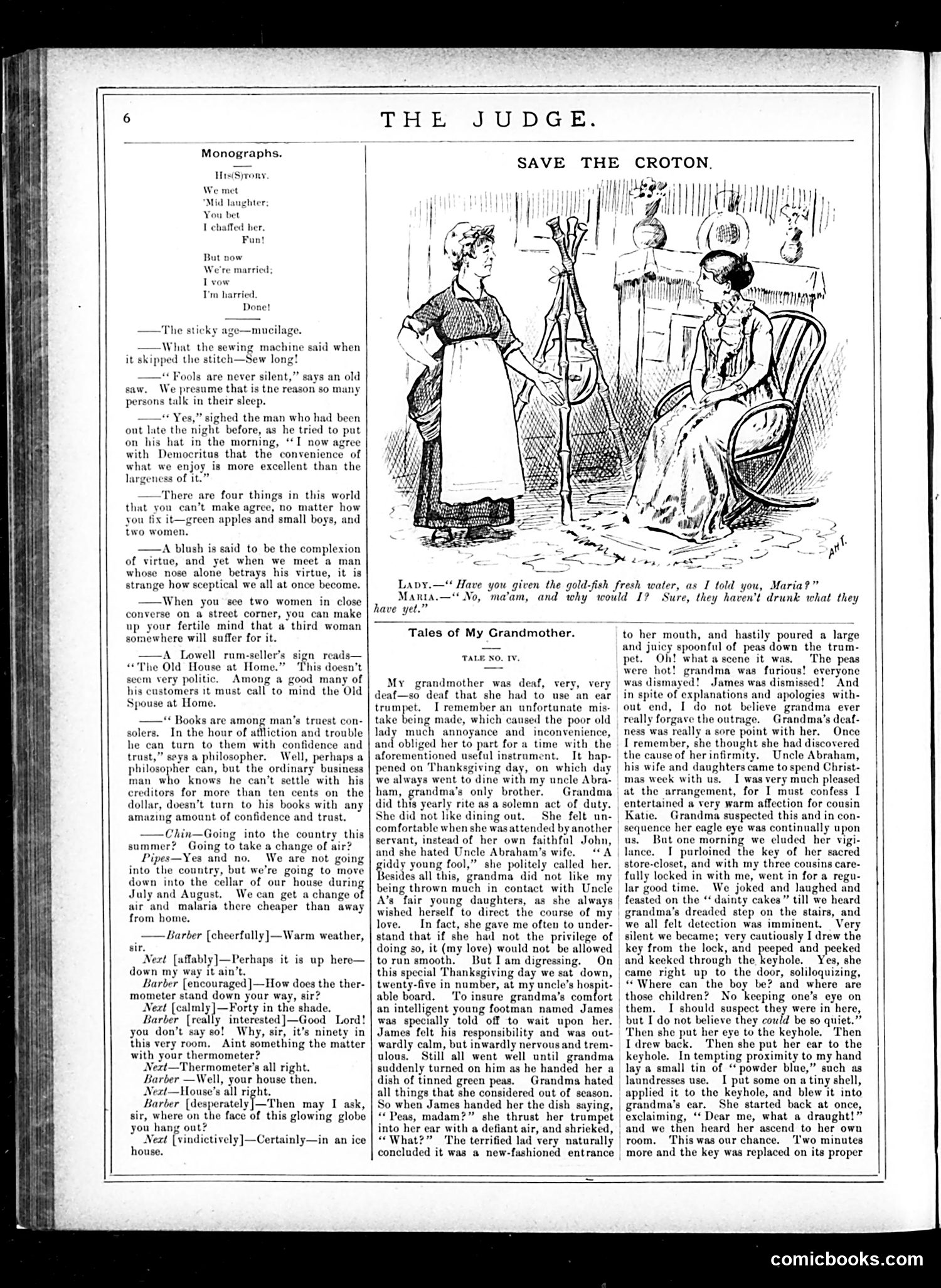
This cartoon satirizes water conservation during what appears to be a drought or water shortage (likely New York City's Croton water system). The scene shows two women discussing water waste: one stands with an umbrella catching water, while the other sits nearby. The caption indicates one woman is scolding the other about wastefully letting water run, asking "Have you given the water, as I told you, Maria?" and "No, ma'am, and why should I? No, they had what they have yet." The joke mocks the contradiction between public conservation appeals and domestic negligence—servants or householders ignore water-saving directives despite civic messaging. The umbrella detail emphasizes the absurdity of literally trying to catch wasted water. The satire targets both the ineffectiveness of conservation efforts and class tensions (between employer and servant) around household management during resource scarcity. The surrounding page contains humorous "monographs"—brief witticisms about social absurdities—typical of Judge magazine's comedy format.
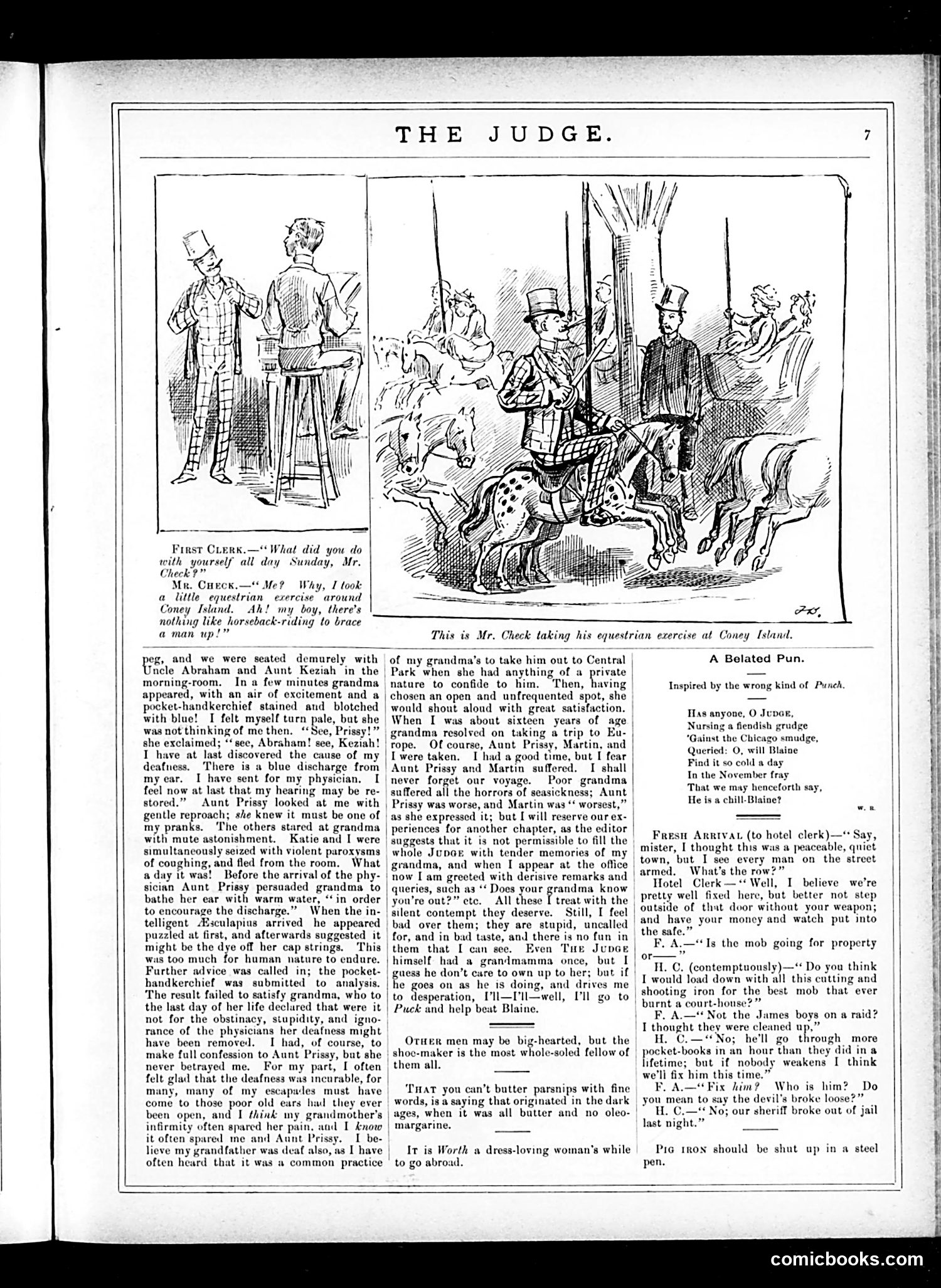
This page from Judge magazine contains two distinct items: **The main cartoon** (top right) depicts "Mr. Check taking his equestrian exercise at Coney Island"—a satirical visual joke showing a man riding a horse recklessly at the popular amusement destination, contradicting his claim to a coworker (left panel) that he spent Sunday doing "equestrian exercise" to "brace a man up." The humor lies in the chaotic, undignified reality versus his boastful description. **The text piece** is a lengthy, rambling anecdote about the author's mischievous pranks on his deaf grandmother, involving a blue-dyed handkerchief and fake medical concerns. It's lighthearted domestic humor typical of the era. The smaller items are brief jokes and puns, including a reference to James Blaine (likely the 1884 presidential candidate), suggesting contemporary political mockery. The page exemplifies Judge's blend of visual satire, personal humor, and topical commentary aimed at educated, urban readers.
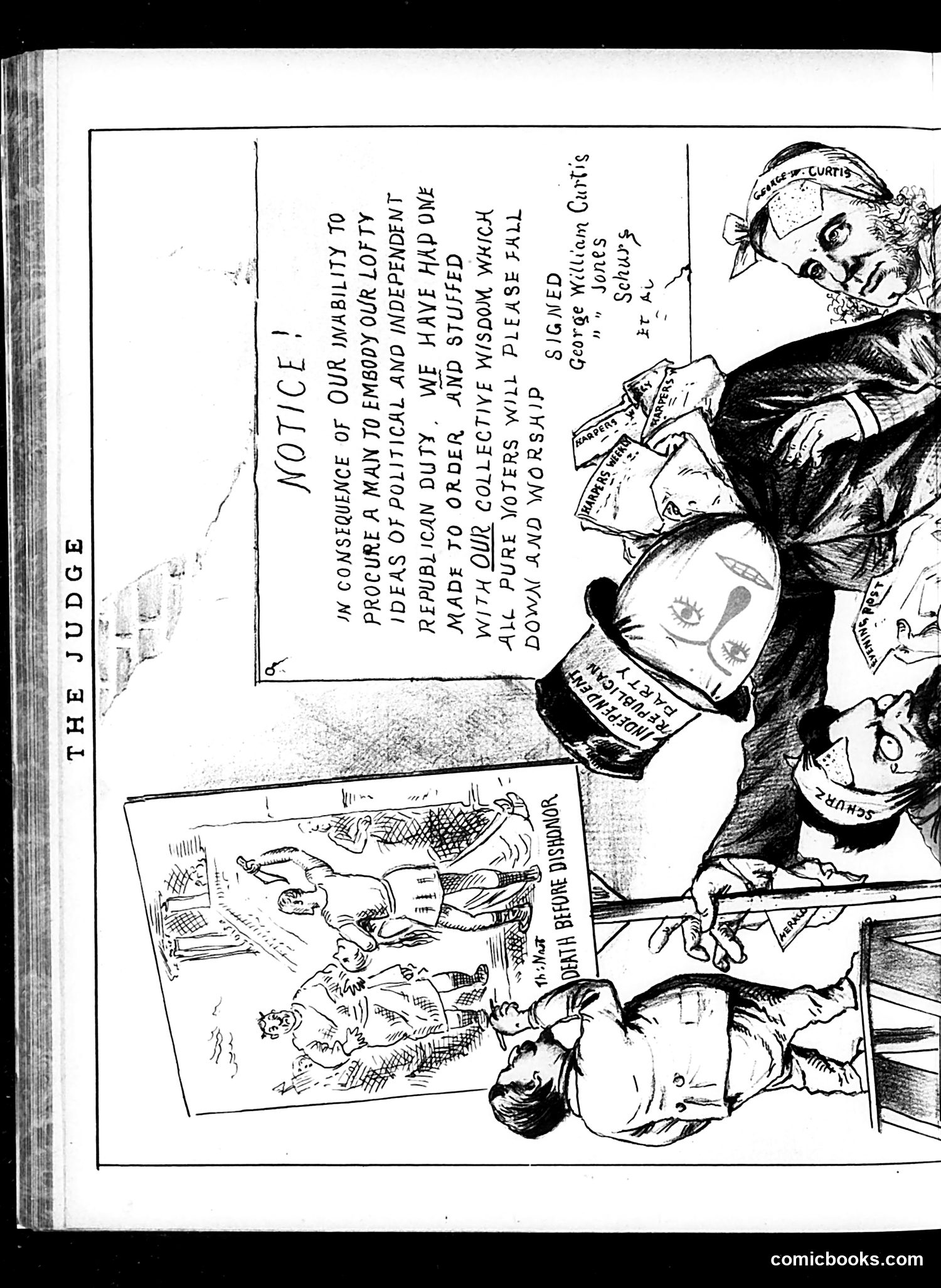
I cannot reliably read the OCR'd text on this page—it appears heavily corrupted or inverted. From the IMAGE alone, I can see this is a political cartoon page titled "THE JUDGE" featuring caricatured figures examining documents or papers. One figure appears to be a judge or authority figure (suggested by the "JUDGE" header), and there's what seems to be a notice or official document being scrutinized. The style and composition suggest commentary on legal proceedings, judicial authority, or bureaucratic process. **Without legible text, I cannot confidently identify the specific figures, historical event, or satirical point.** To properly explain this cartoon's meaning to modern readers, I would need either clearer OCR text or the original publication date to contextualize the reference.
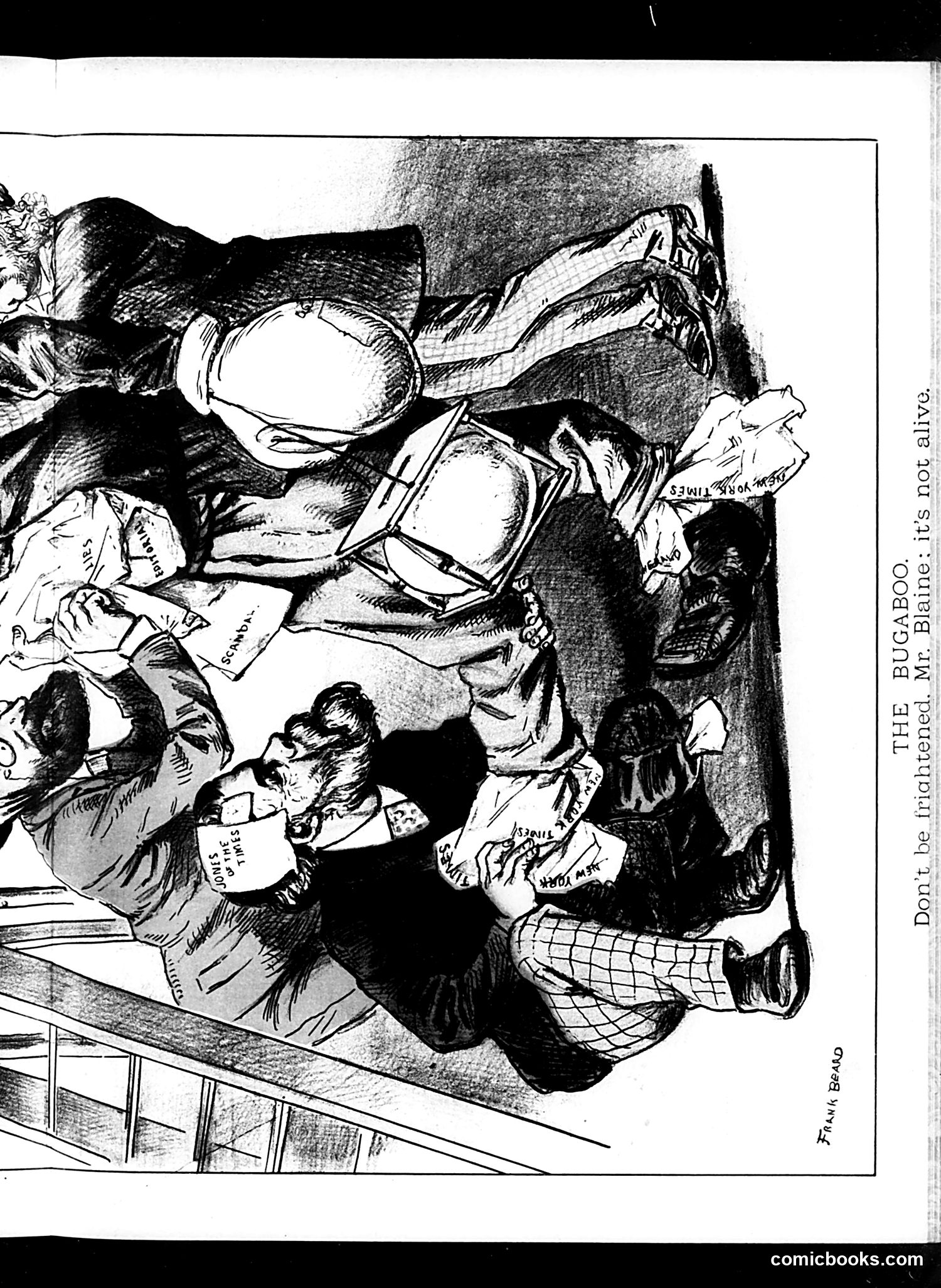
This is a political cartoon targeting **James G. Blaine**, likely from the 1880s (based on his prominence in that era). The cartoon depicts Blaine as a frightened figure confronted by what appears to be a large, menacing "bugaboo"—a creature representing some feared political threat or scandal. The caption "Don't be frightened. It's not alive" suggests the threat is imaginary or exaggerated. The satire likely mocks Blaine's political opponents or his own anxieties, implying he's reacting fearfully to something insubstantial. Without clearer visual labels identifying the specific "bugaboo," the exact political issue remains unclear—it could reference corruption allegations, electoral opponents, or policy disputes that contemporary readers would have immediately recognized but are obscure today.
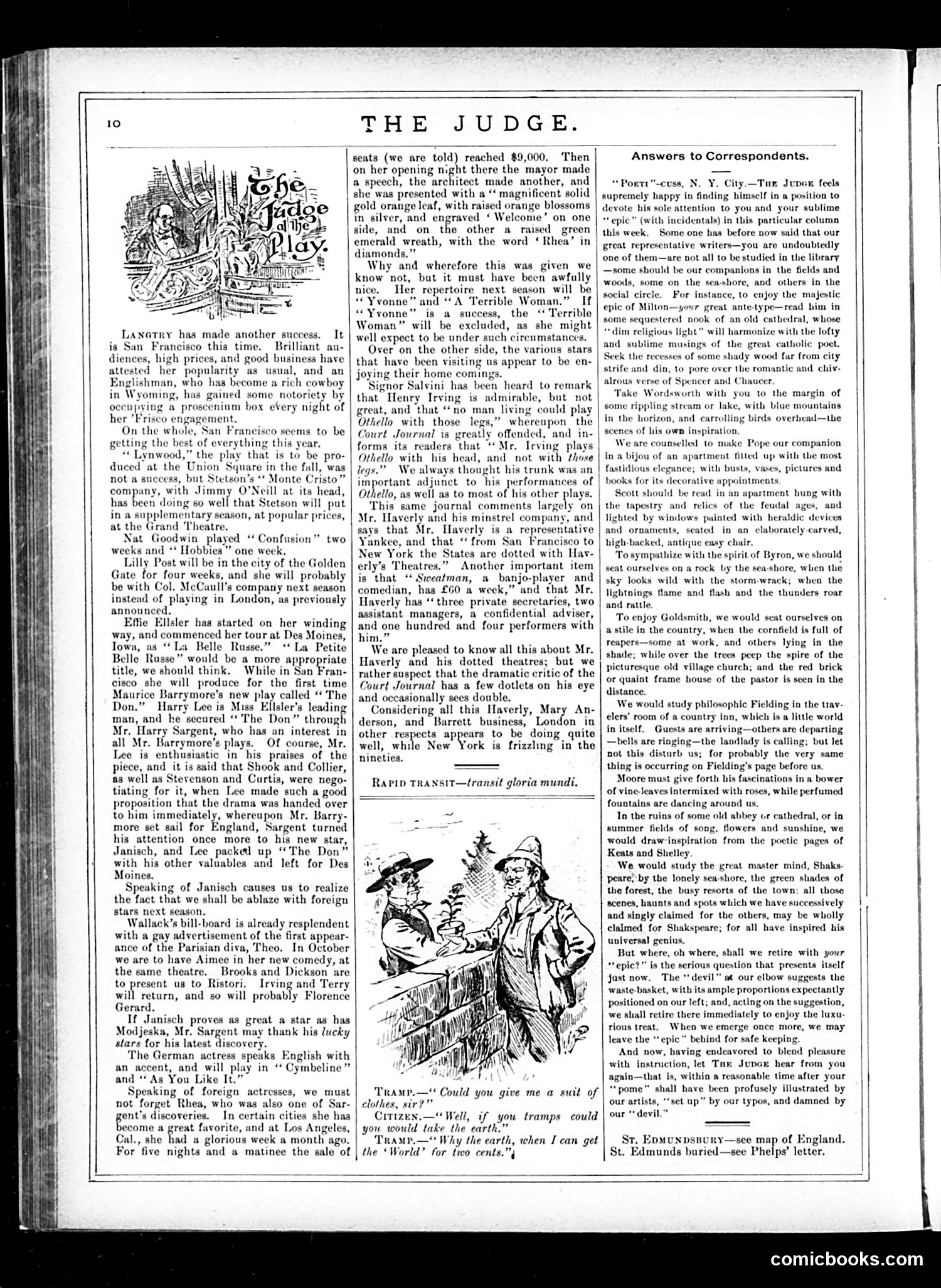
This page (from an undated but late-19th-century issue) is primarily **theater gossip and criticism**, not political satire. It discusses the touring successes of various actresses and actors across American cities—particularly San Francisco. The **cartoon** (bottom center) shows two figures in period dress exchanging dialogue about clothing—a *tramp* asking a well-dressed man for a suit of clothes. The tramp quips that with such clothes, "you would take the earth"—a mild joke playing on class differences and appearances. The **text** celebrates visiting performers like **Langtry** (likely Lillie Langtry, the famous British actress), **Effie Ellsler**, and foreign stars like **Janisch** and **Rhea**. It mocks overly-enthusiastic local receptions (such as Los Angeles's elaborate "gold orange leaf" gift to actress Rhea) while discussing theatrical business and upcoming seasons. This reflects Judge's role covering entertainment alongside its political humor—documenting the Gilded Age theatrical circuit and the celebrity culture surrounding touring stars.
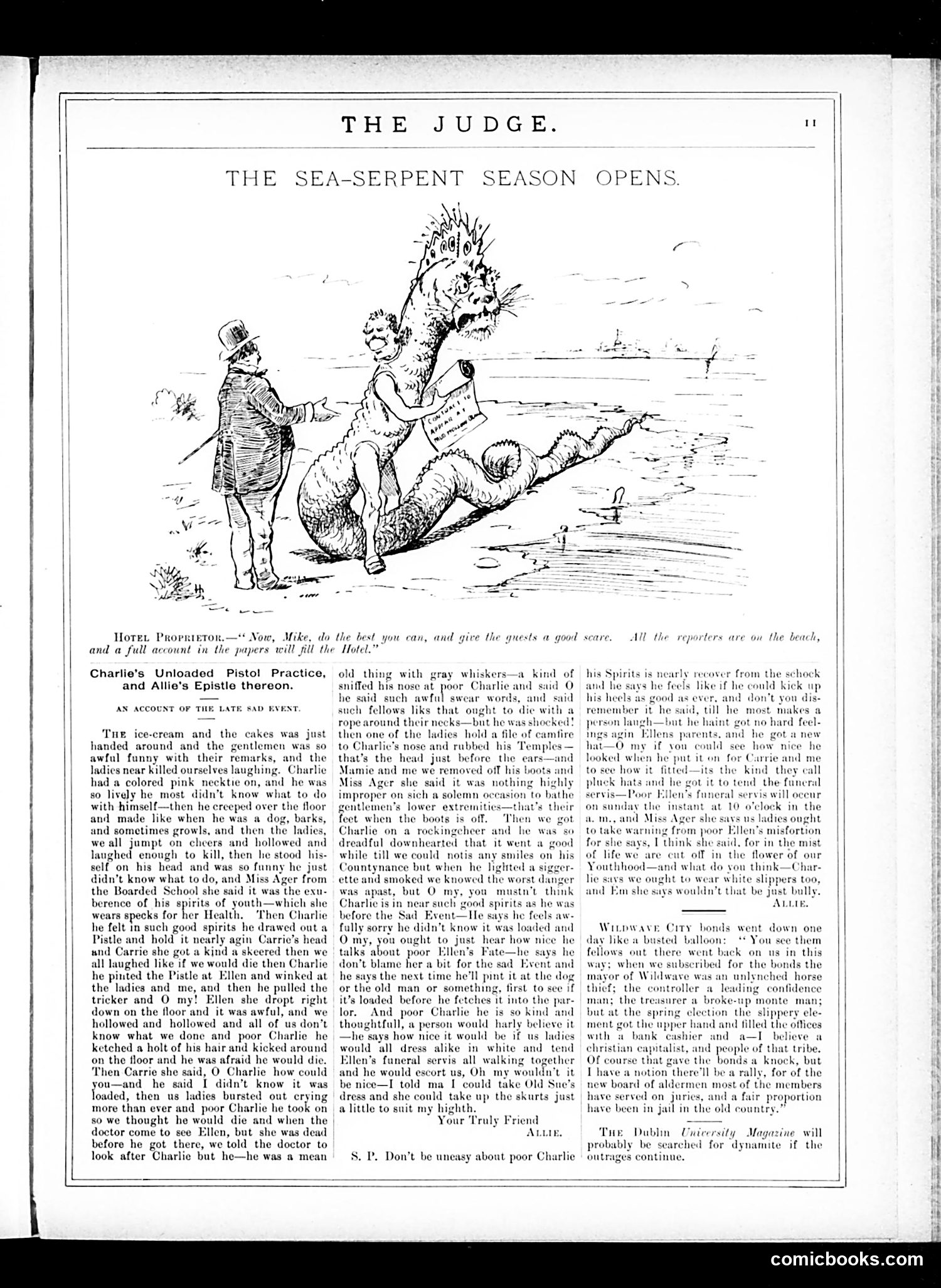
The top cartoon depicts a hotel proprietor instructing someone (Mike) to exaggerate the sea-serpent sightings in press accounts to attract guests—satirizing how resort hotels manufactured sensational stories for publicity. The lengthy text below is a humorous first-person account (signed "Allie") of a tragic accident: Charlie carelessly brandished what he believed was an unloaded pistol at a social gathering, accidentally shooting and killing a young woman named Ellen. The narrative captures the chaotic aftermath—Charlie's shock and subsequent emotional recovery, the ladies' hysterical responses, and Allie's gossipy, somewhat callous retelling of the event. The satire targets the casual recklessness of young men with firearms and social irresponsibility, while Allie's tone—mixing shock with romantic daydreaming about wearing Ellen's dress—satirizes shallow society attitudes toward tragedy. The piece appears designed as dark social commentary on carelessness, vanity, and how quickly society moves past even serious misfortunes.
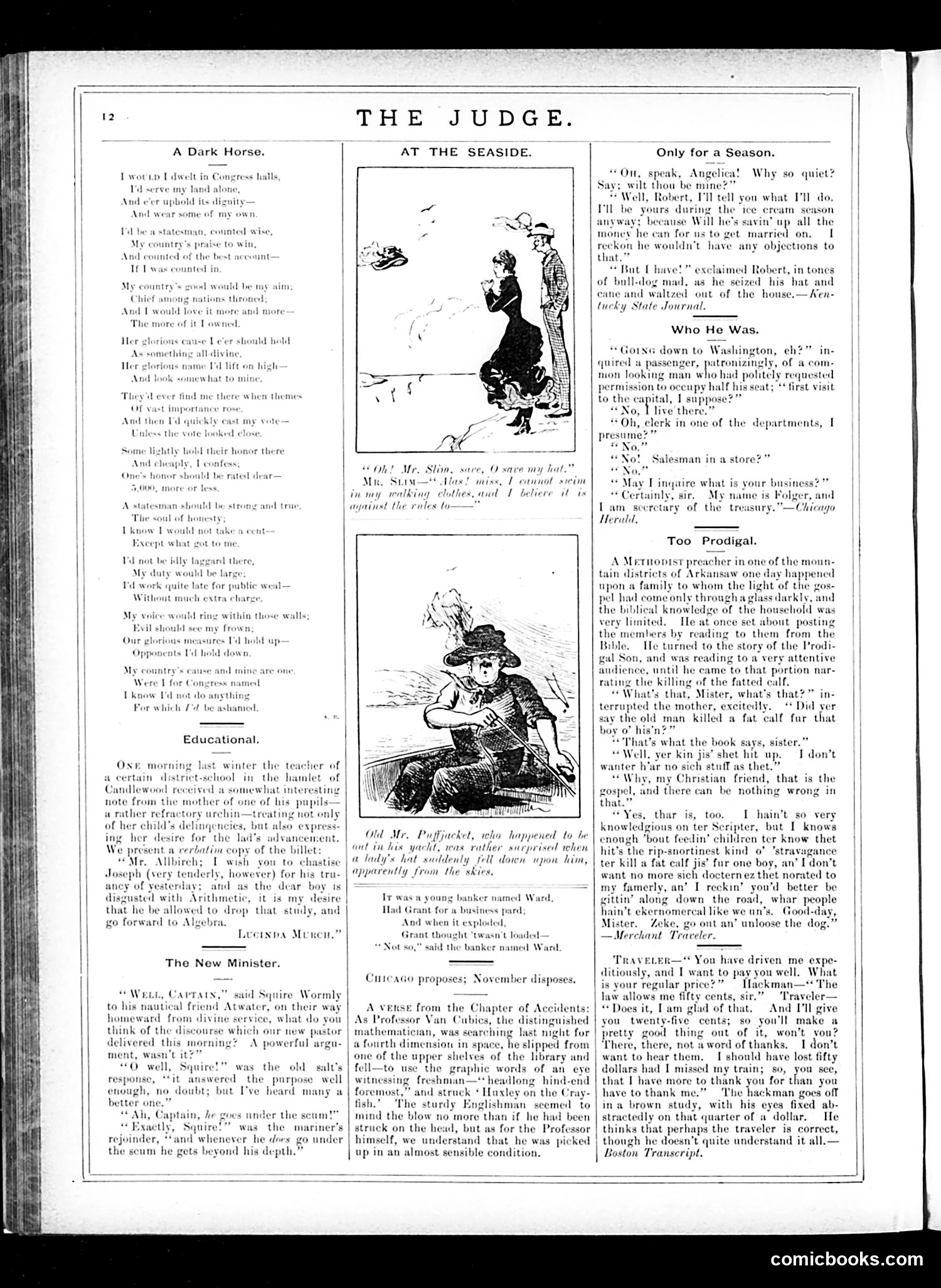
This page from Judge magazine contains several unrelated satirical sketches and humorous anecdotes typical of the publication's format. **"At the Seaside"** depicts a woman (Angelica) in a romantic entanglement—she agrees to date Robert only during ice cream season while another suitor (Zeke) waits. The humor mocks the frivolousness of seasonal romance and young women's bargaining tactics. **"Who He Was"** satirizes class assumptions: a passenger patronizes a "common looking man," assuming he's visiting Washington, when the man actually works as a clerk in the Treasury Department—reversing expected social hierarchy through understated revelation. **"Too Prodigal"** humorously depicts a Methodist preacher attempting to educate an Arkansas family about scripture, playing on rural/frontier Americans' limited biblical knowledge and the preacher's earnest but awkward missionary efforts. The page also includes a poem "A Dark Horse" about political ambition and shorter pieces on education and ministerial appointments—all employing light satire on American manners, class, and religion.
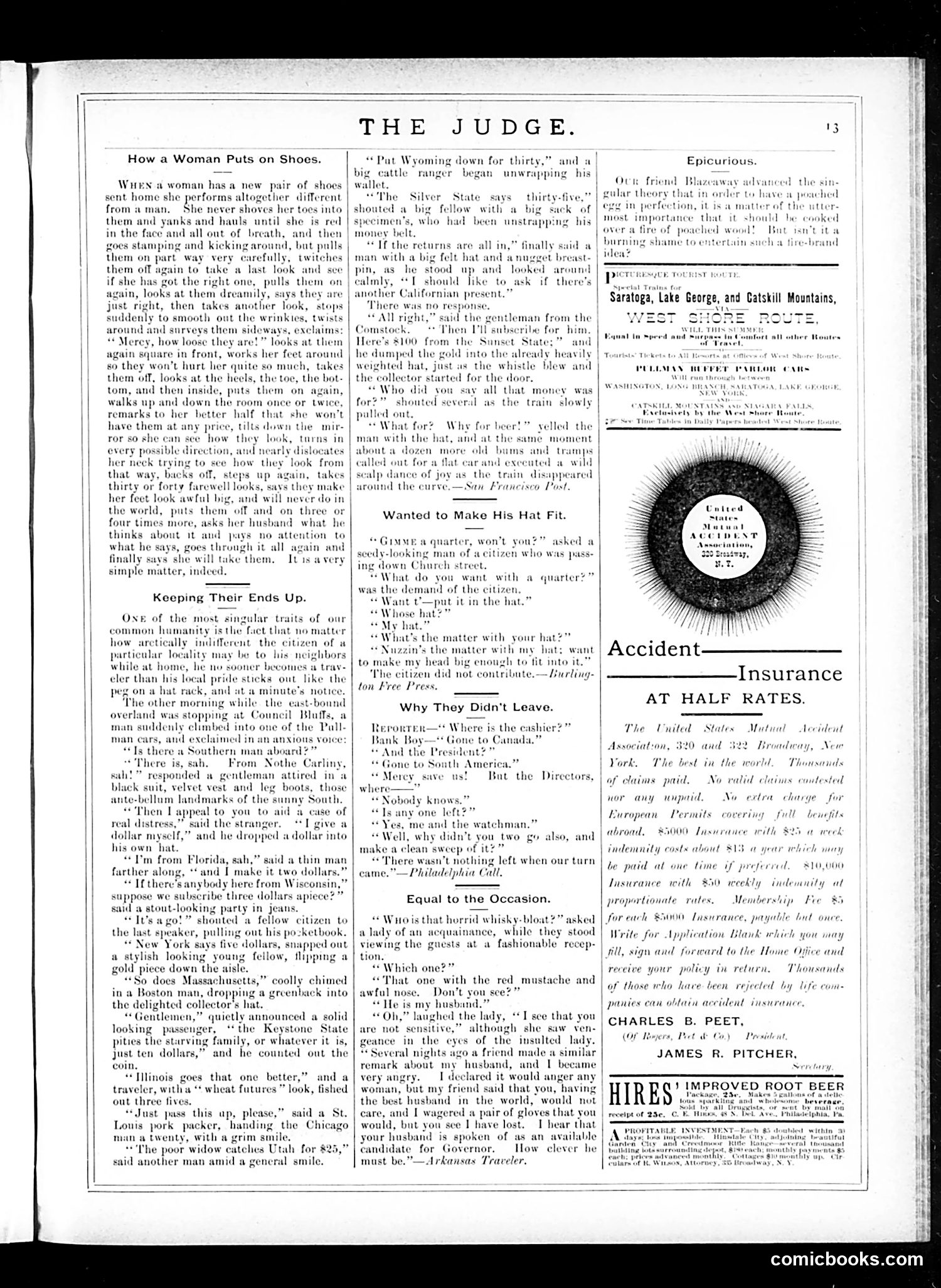
This page from the satirical magazine **Judge** contains humorous social commentary rather than political cartoons. The main articles mock middle-class American behavior: 1. **"How a Woman Puts on Shoes"** ridicules women's indecisiveness and vanity—the elaborate, time-consuming ritual of trying on shoes repeatedly, examining them from every angle, and constantly changing their minds. 2. **"Keeping Their Ends Up"** satirizes American regional pride and one-upmanship. When a traveler requests charitable donations for someone in distress, citizens from different states (Florida, Wisconsin, New York, Massachusetts, Illinois, Chicago) competitively contribute larger amounts to prove their state's generosity—prioritizing regional honor over actual charitable concern. 3. **"Wanted to Make His Hat Fit"** depicts a quarrel over a quarter, and **"Why They Didn't Leave"** presents a story about a hotel cashier's departure. The page also includes advertisements for accident insurance and other products. The satire targets Victorian-era American pretension and social vanity rather than specific political figures or events.
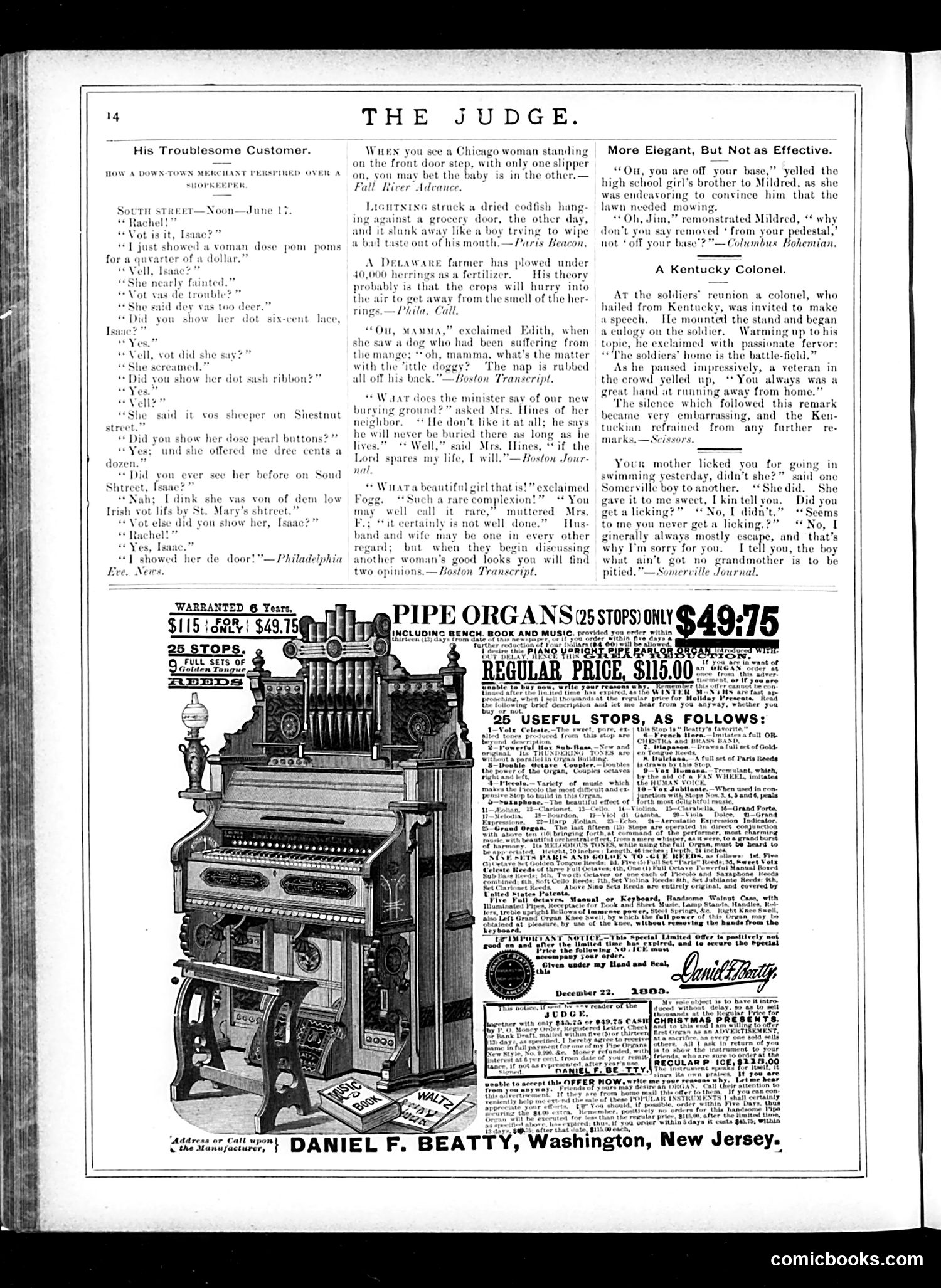
This page contains **humorous anecdotes and social commentary** rather than political cartoons. The content reflects turn-of-the-century American life: **"His Troublesome Customer"**: A downtown merchant recounts a frustrated exchange with a woman customer who returned a sash ribbon. The humor relies on the merchant's exasperated Yiddish-inflected speech ("Vot is it, Isane?"), a common ethnic stereotype in period humor. **"A Kentucky Colonel"**: A Southern military figure delivers patriotic rhetoric at a soldiers' reunion but is humorously interrupted by a heckler, deflating his grandiose speech. This gently mocks both military pomposity and regional stereotypes. **Other brief anecdotes** mock domestic disputes, rural misconceptions, and dating mishaps with light, conventional humor. The page is **primarily dominated by a large organ advertisement** from Daniel F. Beatty (Washington, New Jersey), offering a 25-stop pipe organ for $49.75—the commercial content far exceeding editorial space. The satirical content, while period-appropriate, contains dated ethnic stereotypes typical of 1903 American magazines.
This is primarily an **advertising page** from *Judge* magazine, not a satirical cartoon section. The page features commercial advertisements for pianos, breweries, bicycles, patent medicines, and other products typical of 1880s publications. However, scattered throughout are brief **satirical jokes and observations** in the margins—short humorous quips extracted from various newspapers. These include: - A joke about a Chicago woman suing two husbands simultaneously - Observations about Republican campaign songs and "Blaine" (likely James G. Blaine, a political figure) - Humor about urban life: children hulling strawberries, ice cream parlor encounters, and chorus girls The page demonstrates *Judge's* format: mixing commercial content with light satirical commentary on contemporary social and political topics. **Most of the satirical substance is lost** without understanding the specific 1880s references (the Blaine campaign, local scandals, etc.), making this primarily a document of period advertising rather than coherent political satire.
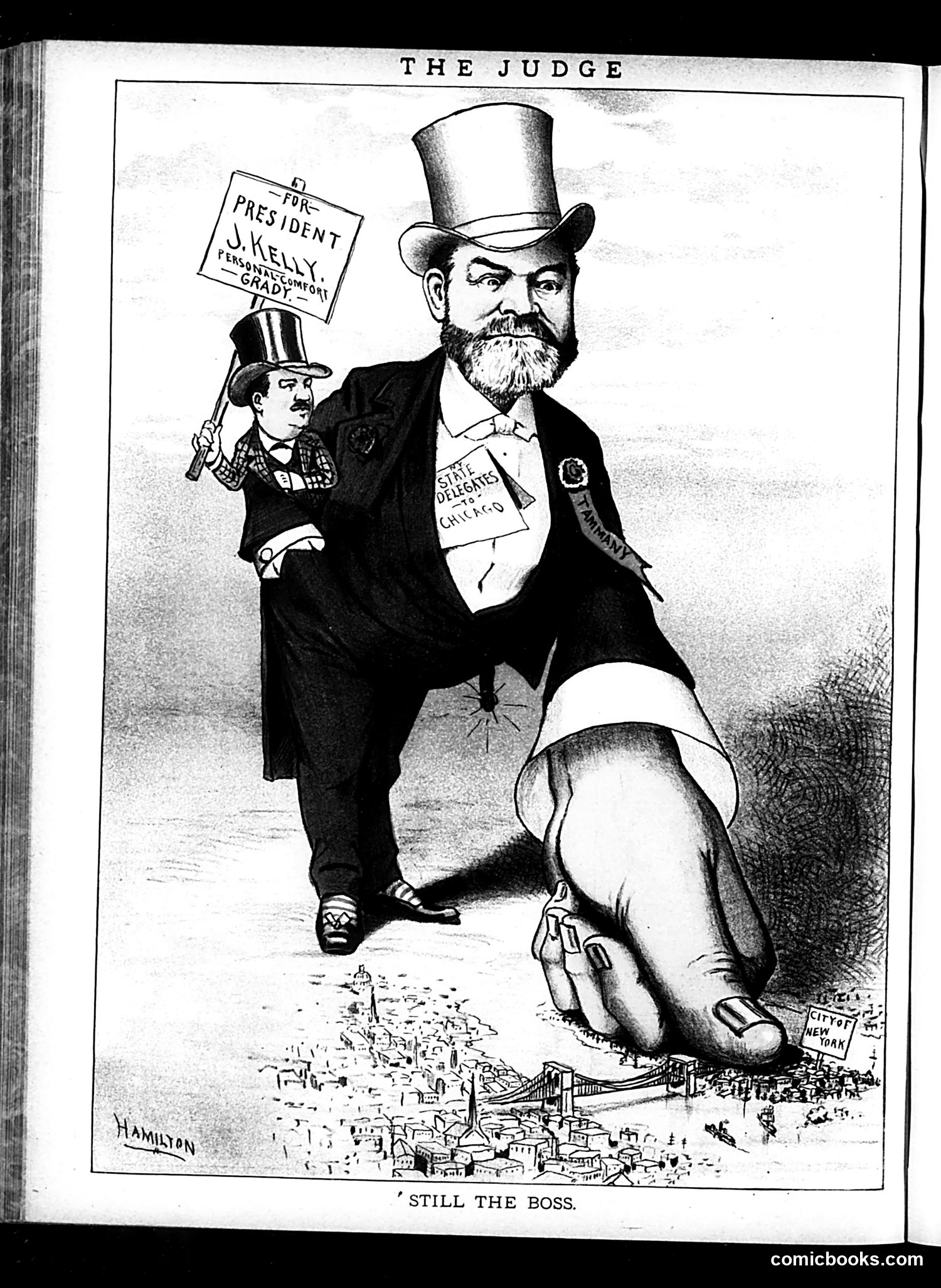
This Judge magazine cartoon satirizes Chicago political power, specifically **J.K. Kelly's presidential ambitions**. The large bearded figure represents a Chicago political boss—likely a Tammany Hall-style machine politician—who literally dominates the cityscape beneath his feet. A smaller man on his shoulder holds a sign reading "FOR PRESIDENT / J.K. KELLY / PERSONALT GRADY," suggesting Kelly's candidacy is being promoted by this political machine. The caption "Still the Boss" implies the real power lies with the larger figure controlling politics from behind the scenes, not with Kelly himself. The cartoon critiques machine politics and suggests Kelly's presidential aspirations are merely a puppet show orchestrated by entrenched Chicago political interests. The tiny cityscape underfoot emphasizes how thoroughly this boss controls the city.