
Judge, 1884-07-05 · page 2 of 16
Judge — July 5, 1884 — page 2: what you’re looking at
What you’re looking at
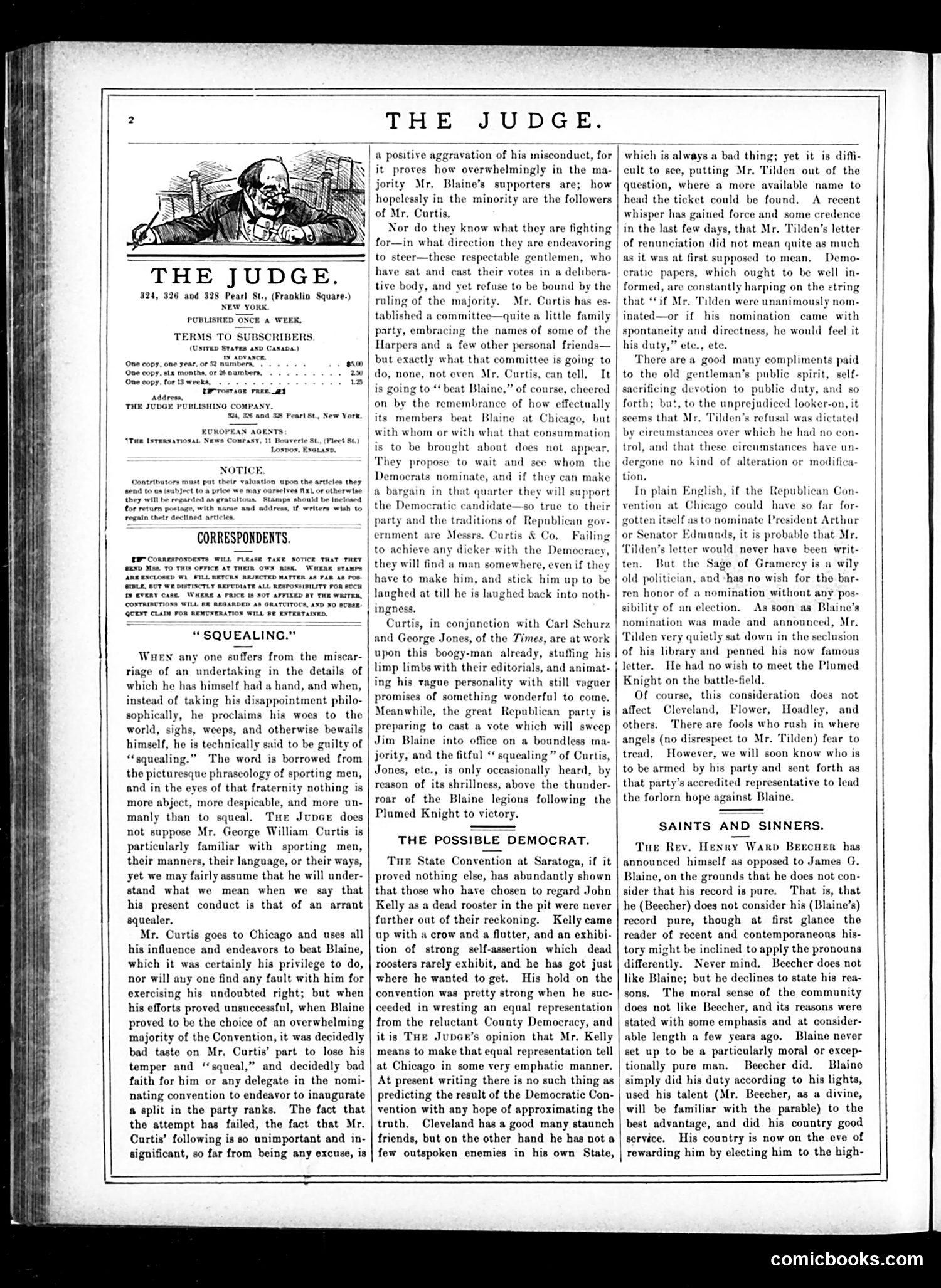
This page from Judge magazine (circa 1884) attacks **George William Curtis**, a prominent Republican editor and political reformer, for his conduct during the recent Republican National Convention in Chicago. The satire centers on Curtis's attempt to block **James G. Blaine's** presidential nomination. After failing, Curtis allegedly formed a splinter committee with Carl Schurz and others to either "beat Blaine" or potentially support the Democratic candidate instead—the exact plan remaining vague. Judge's **"Squealing"** editorial mocks Curtis for acting like a sore loser. In sporting slang of the era, "squealing" meant whining about defeat—considered deeply unmanly. The magazine argues Curtis demonstrated bad faith by refusing to accept majority rule at a party convention, then threatening to fracture Republican unity. The underlying point: Curtis is hypocritically abandoning Republican principles and loyalty simply because his preferred candidate lost. Judge frames this as petulant, arrogant behavior unworthy of a serious political figure.
📄 Transcribed text from this page (OCR, searchable)
Machine-transcribed from the original scan — historical spelling and the odd misread are preserved.
THE JUDGE. 324, 326 and 328 Pearl § PUBLISHED ONC TERMS TO SUBSCRIBERS. (Ustrep States axp Casapa.) Franklin Square.) weeks... : Tor rostso8 rae ad THE JUDGE PUBLISHING COMPANY. $04, E¥ and 2 Pearl St, New York, uation upon the articles they ay ourselves x erwise they will be reganted aa gratultous, Stamps for return postage, with name and address, if writers wish to regain thelr declined articles : CORRESPONDENTS. EW CORRESPONDENTS WILL PLEASE TAKE NOTICE THAT THEY asp Maa To THIS OFFICE AY THEI OWN RIK. WHERE STAMPe ARE ENCLOSED Wi TLL RETCRS REJECTED MATTER AS FAR AM POS. GUHLE, BOT WE DISTINCTLY REPUDIATE ALL REAPOSMIBILITY FOR #CCH AY EVERY Case WHERE 4 PRICE [8 SOT AFVITED BY THE WRITER, CONTRIBUTIONS WILL BE REGARDED AS ORATCITOCA, AND NO ACRRE QCEST CLAIM FOR REMUNERATION WILL RE ENTERTAINED, “ SQUEALING.” Wuen any one suffers from the miscar- riage of an undertaking in the details of which he has himself had a hand, and when, proclaims his woes to the world, sighs, weeps, and otherwise bewails himself, he is technically said to be guilty of “squealing.” The word is borrowed from the picturesque phraseology of sporting men, and in the eyes of that fraternity nothing is more abject, more despicable, and more un- manly than to squeal. Tue Jcpce does not suppose Mr. George William Curtis is particularly familiar with sporting men, their manners, their language, or their ways, yet we may fairly assume that he will under- stand what we mean when we say that his present conduct is that of an arrant squealer. Mr. Curtis goes to Chicago and uses all his influence and endeavors to beat Blaine, which it was certainly his privilege to do, nor will any one find any fault with him for exercising his undoubted right; but when his efforts proved unsuccessful, when Blaine proved to be the choice of an overwhelming majority of the Convention, it was decidedly bad taste on Mr. Curtis’ part to lose his temper and “squeal,” and decidedly bad faith for him or any delegate in the nomi- nating convention to endeavor to inaugurate a split in the party ranks. The fact that the attempt has failed, the fact that Mr. Curtis’ following is so unimportant and in- significant, so far from being any excuse, is it proves how overwhelmingly in the ma- | hopeles | tablished a committee—quite a little family its THE JUDGE. a positive aggravation of his im jority Mr. Blaine’s supporters are; how in the minority are the followers of Mr. Curtis, Nor do they know what they are fighting to steer—these respectable gentlemen, who have sat and cast their votes in a delibera- tive body, and yet refuse to be bound by the ruling of the majority. Mr. Curtis has e: party, embracing the names of some of the Harpers and a few other personal friends— but exactly what that committee is going to do, none, not even Mr, Curtis, can tell, It is going to “ beat Blaine,” of course, cheered | on by the remembrance of how effectually Blaine at Chi with whom or with what that consummation members beat . is to be brought about does not appear. They propose to wait and a Democrats nominate, and if they can make quarter they will support the Democratic candidate—so true to their party and the traditions of Republican ernment are Messrs. Curtis & Co, to achieve any dicker with the Democ they will find a man somewhere, even if the have to make him, and stick him up to be laughed at till he is laughed back into noth- ingness. whom the Curtis, in conjunction with Carl Schurz and George Jones, of the Times, are at work upon this boogy-man already, stutling his limp limbs with their edito: and animat- | ing his vague personality with still vaguer promises of something wonderful to come. Meanwhile, the great Republican party is preparing to cast a vote which will sweep Jim Blaine into office on a boundless 1 jority, and the fitful “ squealing ” of Curtis, Jones, etc., is only occasionally heard, by reason of its shrillness, above the thunder- roar of the Blaine legions following the Plumed Knight to victory. are THE POSSIBLE DEMOCRAT. Tue State Convention at Saratoga, if it proved nothing else, has abundantly shown that those who have chosen to regard John Kelly as a dead rooster in the pit were never further out of their reckoning. Kelly came up with a crow and a flutter, and an exhibi- tion of strong self-assertion which dead roosters rarely exhibit, and he has got just where he wanted to get. His hold on the convention was pretty strong when he suc- ceeded in wresting an equal representation from the reluctant County Democracy, and it is Tue Jupoe’s opinion that Mr. Kelly means to make that equal representation tell at Chicago in some very emphatic manner. At present writing there is no such thing as | predicting the result of the Democratic Con- | vention with any hope of approximating the truth. Cleveland has a good many staunch friends, but on the other hand he has not a few outspoken enemies in his own State, which is always a bad thing; yet it is diffi- cult to sce, putting Mr. Tilden out of the question, where a more available name to head the ticket could be found. A recent gained force and some whisper predence | in the last few days, that Mr. Tilden’s letter for—in what direction they are endeavoring | of renunciation did not mean quite as much as it was at first supposed to mean. Demo- eratic papers, which ought to be well in- formed, are constantly harping on the string that “if Mr. Tilden were unanimously nom- inated—or if nomination came with spontaneity and directness, he would feel it his duty,” e! his ete. ‘There are a good many compliments paid to the old gentleman’s public spirit, self- sacrificing devotion to public duty, and so forth; but, to the unprejudiced looker-on, it seems that M ilden’s refusal was dictated by circum over which he hi trol, and that these circ! dergone no kind of alteration or modifi tion. In plain English, if the Republican Con- vention at Chicago could have so far for- gotten itself as to nominate President Arthur enator Edmunds, it is probable that Mr. ‘TI letter would never have been writ- ten. But the Sage of Gramercy is « wily old politician, and -has no wish for the bar- ren honor of a nomination without any pos- sibility of an election, As soon as Blaine’s nomination was made and announced, Mr. ‘Tilden very quietly sat down in the seclusion of his library and penned his now famous letter. He had no wish to meet the Plumed Knight on the batt id. Of course, this consideration does not affect Cleveland, Flower, Hoadley, and others. There are fools who rush in where angels (no disrespect to Mr. ‘Tilden) fear to tread. However, we will soon know who is to be armed by his party and sent forth as that party’s accredited representative to lead the forlorn hope against Blaine. SAINTS AND SINNERS. Tue Rev. Wexry Warp Beecuer has announced himself as opposed to James G. Blaine, on the grounds that he does not con- sider that his record is pure. That is, that he (Beecher) does not consider his (Blaine’s) record pure, though at first glance the reader of recent and contemporaneons his- tory might be inclined to apply the pronouns differently. Never mind. Beecher does not like Blaine; but he declines to state his rea- sons. The moral sense of the community does not like Beecher, and its reasons were stated with some emphasis and at consider- able length a few years ago. Blaine never set up to be a particularly moral or excep- tionally pure man. Beecher did. Blaine simply did his duty according to his lights, used his talent (Mr. Beecher, as a divine, will be familiar with the parable) to the best advantage, and did his country good service. His country is now on the eve of rewarding him by electing him to the high- ee ees comicbooks.com