
Judge, 1884-07-05 · page 10 of 16
Judge — July 5, 1884 — page 10: what you’re looking at
What you’re looking at
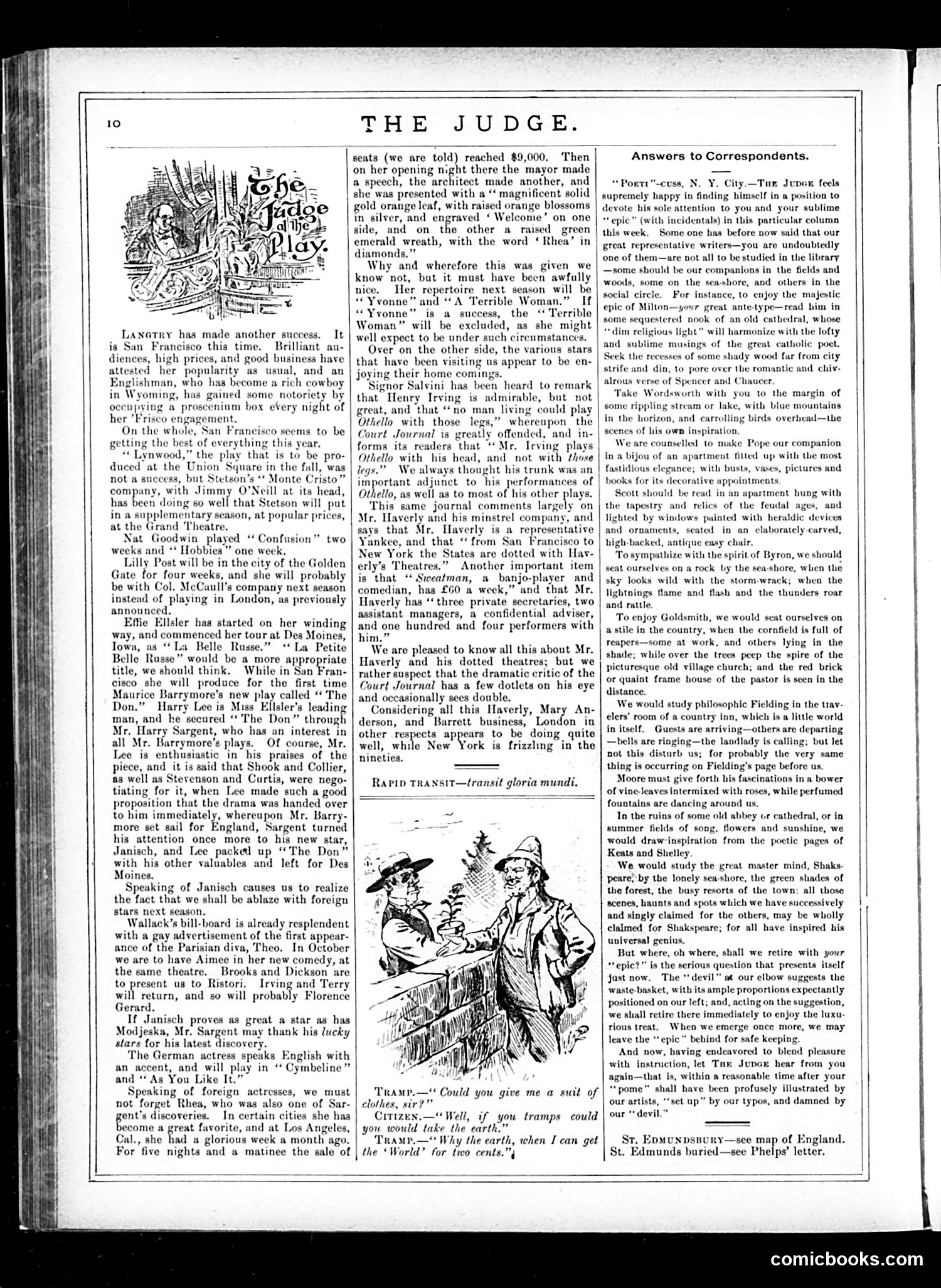
This page (from an undated but late-19th-century issue) is primarily **theater gossip and criticism**, not political satire. It discusses the touring successes of various actresses and actors across American cities—particularly San Francisco. The **cartoon** (bottom center) shows two figures in period dress exchanging dialogue about clothing—a *tramp* asking a well-dressed man for a suit of clothes. The tramp quips that with such clothes, "you would take the earth"—a mild joke playing on class differences and appearances. The **text** celebrates visiting performers like **Langtry** (likely Lillie Langtry, the famous British actress), **Effie Ellsler**, and foreign stars like **Janisch** and **Rhea**. It mocks overly-enthusiastic local receptions (such as Los Angeles's elaborate "gold orange leaf" gift to actress Rhea) while discussing theatrical business and upcoming seasons. This reflects Judge's role covering entertainment alongside its political humor—documenting the Gilded Age theatrical circuit and the celebrity culture surrounding touring stars.
📄 Transcribed text from this page (OCR, searchable)
Machine-transcribed from the original scan — historical spelling and the odd misread are preserved.
Lanatry has made another success. It is San Francisco this time. Brilliant au- diences, high prices, and good business ha attested her popularity as usual, and an Englishman, who has become a rich cowboy in Wyoming, has gained some notoriety oceupyi proscenium box every night of her 'Frisco engagement. On the whole, San Francisco se getting the best of everything th “Lynwood,” the play duced at the Union $ fall, was not a success, but Stetson Monte Cristo” company, with Jimmy O'Neill at its head, has Been doing so well that Stetson will put in a supplementary season, at popular prices, at the Grand Theatre. Nat weeks and ** Hobbies” one week. Lilly Post will be in the city of the Golden Gate for four weeks, and she will probably be with Col. McCaull’s company next season instead of playing in London, as previously announced, Effie Ellsler has started on her winding way, and commenced her tour at Des Moines, Towa, as ‘La Belle Russe.” *‘* La Petite Belle Russe” would be a more appropriate title, we should think. While in San Fran- cisco she will produce for the first time Maurice Barrymore’s new play called ‘ The Don.” Harry Lee is Miss Ellsler’s leading man, and he secured ‘The Don” through Mr. Harry Sargent, who has an interest in all Mr. Barrymore’e plays. Of course, Mr. Lee is enthusiastic in his praises of the piece, and it is said that Shook and Collier, as well as Stevenson and Curtis, were nego- tiating for it, when Lee made such a good proposition that the drama was handed over to him immediately, whereupon Mr. Barry- more set sail for England, Sargent turned his attention once more to his new star, Janisch, and Lee packed up ‘The Don” with his other valuables and left for Des Moines. Speaking of Janisch causes us to realize the fact that we shall be ablaze with foreign stars next season. Wallack’s bill-board is already resplendent with a gay advertisement of the first appear- ance of the Parisian diva, Theo. In October we are to have Aimee in her new comedy, at the same theatre. Brooks and Dickson are to present us to Ristori. Irving and Terry will return, and so will probably Florence Gerard. If Janisch proves as great a star as has Modjeska, Mr. Sargent may thank his lucky stars for his latest discove' ‘The German actress speaks English with an accent, and will play in “ Cymbeline” and “As You Like It.” Speaking of foreign actresses, we must not forget Rhea, who was also one of Sar- ent’s discoveries, In certain cities she has become a great favorite, and at Los Angeles, Cal., she had a glorious week a month ago. For five nights and a matinee the sale of ms to be odwin played Confusion” two | THE JUDGE. seats (we are told) reached $9,000. ‘Then on her opening night there the mayor made a speech, the architect made another, and she was presented with a “ magnificent solid | gold orange leaf, with raised orange blossoms in silver, and engraved ‘ Welcome’ on one side, and on the other a a green emerald wreath, with the word ‘Rhea’ in | diamonds.” Why and wherefore this was given we know not, but it must have been awfully nice. Her repertoire next season will be “Yvonne” and ‘‘A Terrible Woman.” If “Yvonne” is a success, the ‘‘ Terrible Woman” will be excluded, as she might well expect to be under such circumstance Over on the other side, the various stars that have been visiting us appear to be en- joying their home comings. Signor Salvini has been heard to remark that Henry Irving is admirable, but not | great, and that “no man living could play Othello with those legs,” whereupon the | Court Journal is greatly offended, and in- | forms its readers that ‘Mr. Irving plays Othello with his head, and not with those legs.” We always thought his trunk was an | important adjunct to his performances of Othello, as well as to most of his other plays. | This same journal comments largely on | Mr, Haverly and his minstrel company, and ys that Mr. Haverly is a representative Yankee, and that ‘‘ from San Francisco to New York the States are dotted with Ha erly’s Theatres.” Another important item is that ‘ Sweatman, a banjo-player and comedian, has £60 a week,” and that Mr. Haverly has “three private secretaries, two assistant managers, a confidential adviser, and one hundred and four performers with him.” We are pleased to know all this about Mr. Haverly and his dotted theatres; but we rather suspect that the dramatic critic of the Court Journal has a few dotlets on his eye and occasionally sees double. Considering all this Haverly, Mary An- derson, and Barrett business, London in other respects appears to be doing quite well, white New York is frizzling in the nineties. Raptp TRaANsIT—fransit gloria mundi. Trasr.— Could you give me a suit of clothes, sir?” Citiz you would tak Tramp. the ‘World’ for two cents.”4 “Well, if you tramps could the earth.” “Why the earth, when I can get | and sublime musings of the great cathe Answers to Correspondents. “Poett"-cuss, N. Y. City.—Tur Juper feels supremely happy in finding himself in a position to devote his sole attention to you and your sublime “epic” (with incidentals) in this particular column this week. Some one has before now said that our great representative writers—you are undoubtedly ‘one of them—are not all to be studied in the library —some should be our companions in the fields and woods, some on the seashore, and others in the social circle. For instance, to enjoy the majestic epic of Milton—your great ante-type—read him in some sequestered nook of an old cathedral, whose “dim religious light” will harmonize with the lofty ic poet. Seek the recesses of some shady wood fur from city strife and din, to pore over the romantic and chiv- alrous verse of Spencer and Chaucer Take Wordsworth with you to the margin of some rippling stream or lake, with blue mountains in the horizon carrolling birds overhead—the scenes of his own inspiration. We are counselled to make Pope our companion bijou of an apartment fitted up with the most fastidious elegance; with busts, vases, pictures and books for its decorative appointments Scott should be read partment hung with the tapestry and relics of the feudal ages, and lighted by windows painted with heraldic devices and ornaments, seated in an claborately-carved, high-backed, antique easy chuir, ‘To sympathize with the spirit of Byron, we should seat ourselves on a rock by the sea-shore, when the sky looks with the storm-wrack; when the lightnings flame and flash and the thunders roar and rattle. To enjoy Goldsmith, we would seat ourselves on a stile in the country, when the cornfield is full of reapers—some at work, and others lying in the shade; while over the trees peep the spire of the picturesque old village church; and the red. brick or quaint frame house of the pastor is seen in the distance. We would study philosophic Fielding in the trav- elers’ room of a country inn, which is a little world in itself. Guests are arriving—others are departing —bells are ringing—the landlady is calling; but let not this disturb us; for probably the very same thing is occurring on Fielding’s page before us. Moore must give forth his fascinations in a bower of vine-leaves intermixed with roses, while perfumed fountains are dancing around us. In the ruins of some old abbey or cathedral, or in summer fields of song, flowers and sunshine, we would draw-inspiration from the poetic pages of Keats and Shelley. We would study the great master mind, Shaks- peare?-by the lonely sea-shore, the green shades of the forest, the busy resorts of the town: all those ‘scenes, haunts and spots which we have successively and singly claimed for the others, may be wholly claimed for Shakspeare; for all have inspired his universal genius. But where, oh where, shall we retire with your “epic?” is the serious question that presents itself fast now, The ‘‘devil” at our elbow suggests the waste-basket, with its ample proportions expectantly positioned on our left; and, acting on the suggestion, we shall retire there immediately to enjoy the luxu- rious treat. When we emerge once more, we may leave the “epic” behind for safe keeping. And now, having endeavored to blend pleasure with instruction, let Tax Jupor hear from you again—that is, within a reasonable time after your “pome” shall have been profusely illustrated by our artists, “‘set up” by our typos, and damned by our “devil. in St. Eomunpspury—see map of England. St. Edmunds buried—see Phelps’ letter. comicbooks.com