
A complete issue · 16 pages · 1884
Judge — June 7, 1884
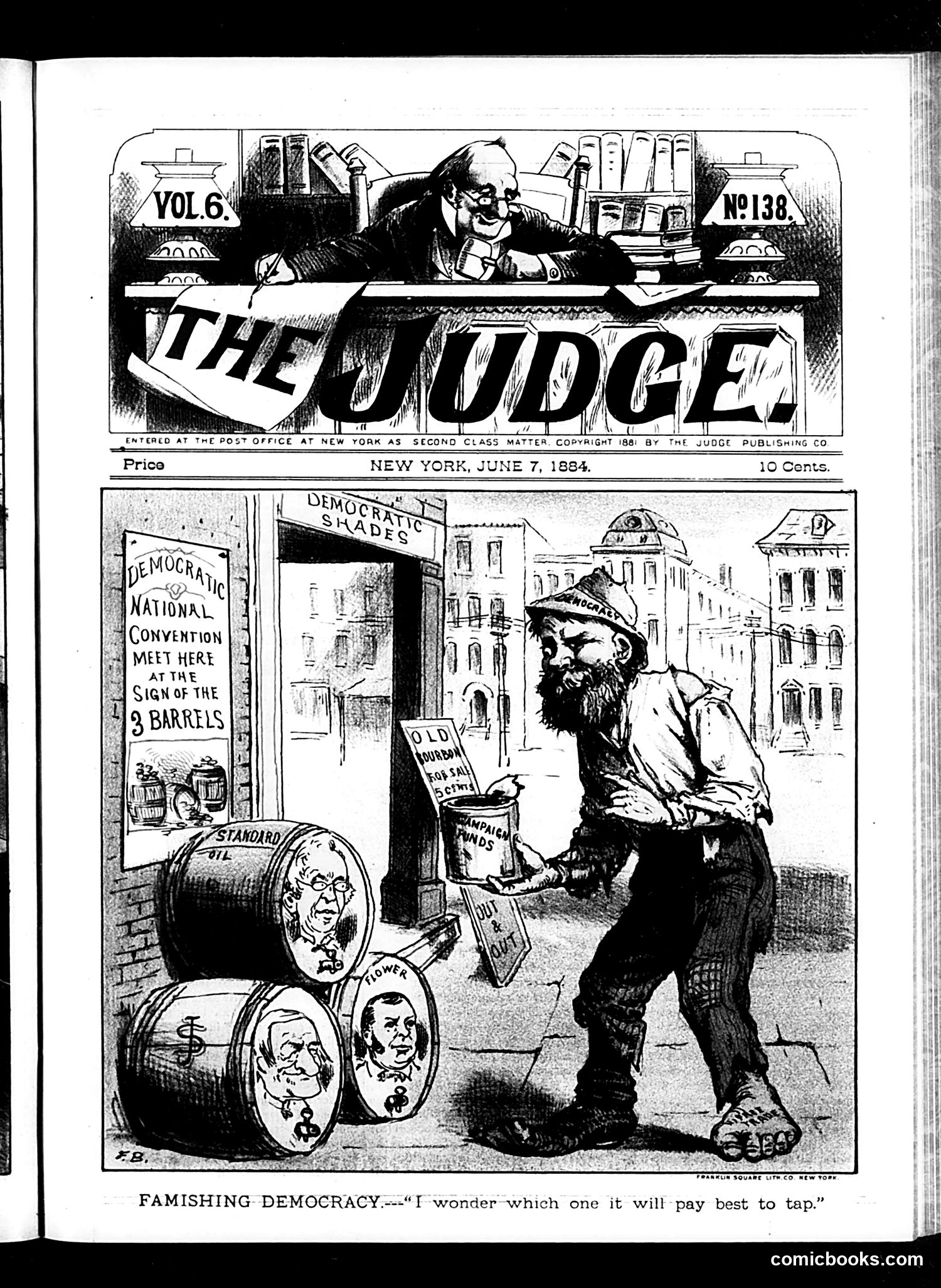
This **Judge** magazine cover (June 7, 1884) satirizes the Democratic Party's disarray before their national convention. The cartoon depicts a bearded man (representing the Democratic Party or a Democratic voter) examining barrels labeled with faces of party leaders—likely potential presidential candidates. A sign advertises the "Democratic National Convention Meet Here at the Sign of the 3 Barrels," suggesting the party leadership is divided into competing factions. The caption—"I wonder which one it will pay best to tap"—mocks Democrats' inability to unite behind a single candidate, portraying them as squabbling over which leader to support. The imagery of "famishing democracy" suggests the party's weakness and internal conflict threaten democratic governance itself. This reflects real 1884 convention tensions.
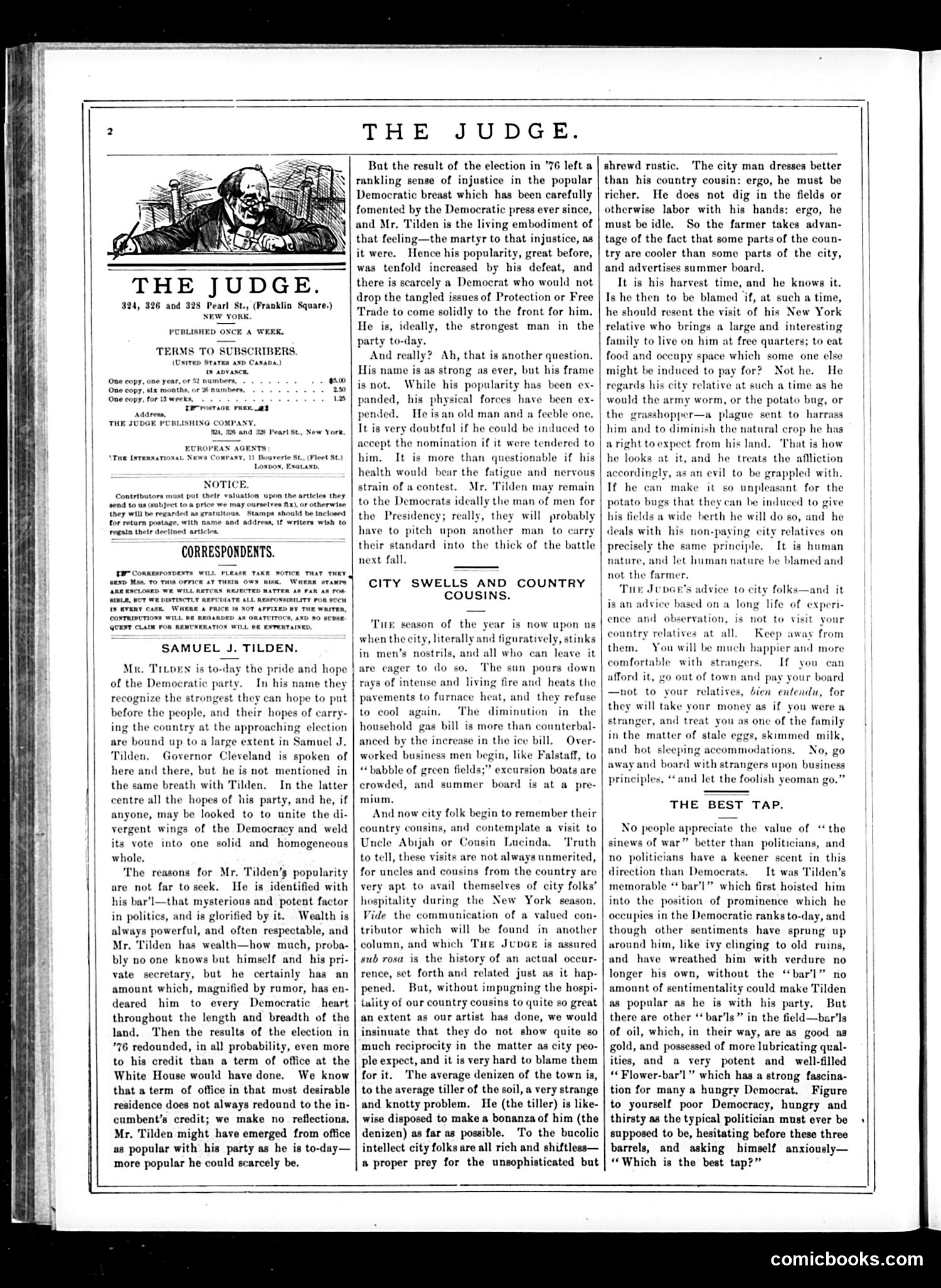
**Main Article: "SAMUEL J. TILDEN"** This piece discusses Democratic presidential prospects, focusing on Samuel J. Tilden, the party's 1876 nominee who lost to Rutherford B. Hayes in a disputed election. The article notes Tilden's popularity stems from two sources: his mysterious wealth ("his bar'l") and sympathy over the 1876 election loss—viewed by Democrats as an injustice. However, the satirist suggests Tilden's actual health and vigor have declined significantly. While ideally the Democrats' strongest candidate, his physical condition likely prevents him from accepting or enduring a presidential campaign. The magazine implies Tilden is more a symbolic martyr than viable candidate. **"City Swells and Country Cousins"** begins below, mocking wealthy urbanites' pretensions and their treatment of rural relatives visiting New York during summer season. The cartoonish masthead portrait likely depicts a contemporary political figure, though identification requires additional context.
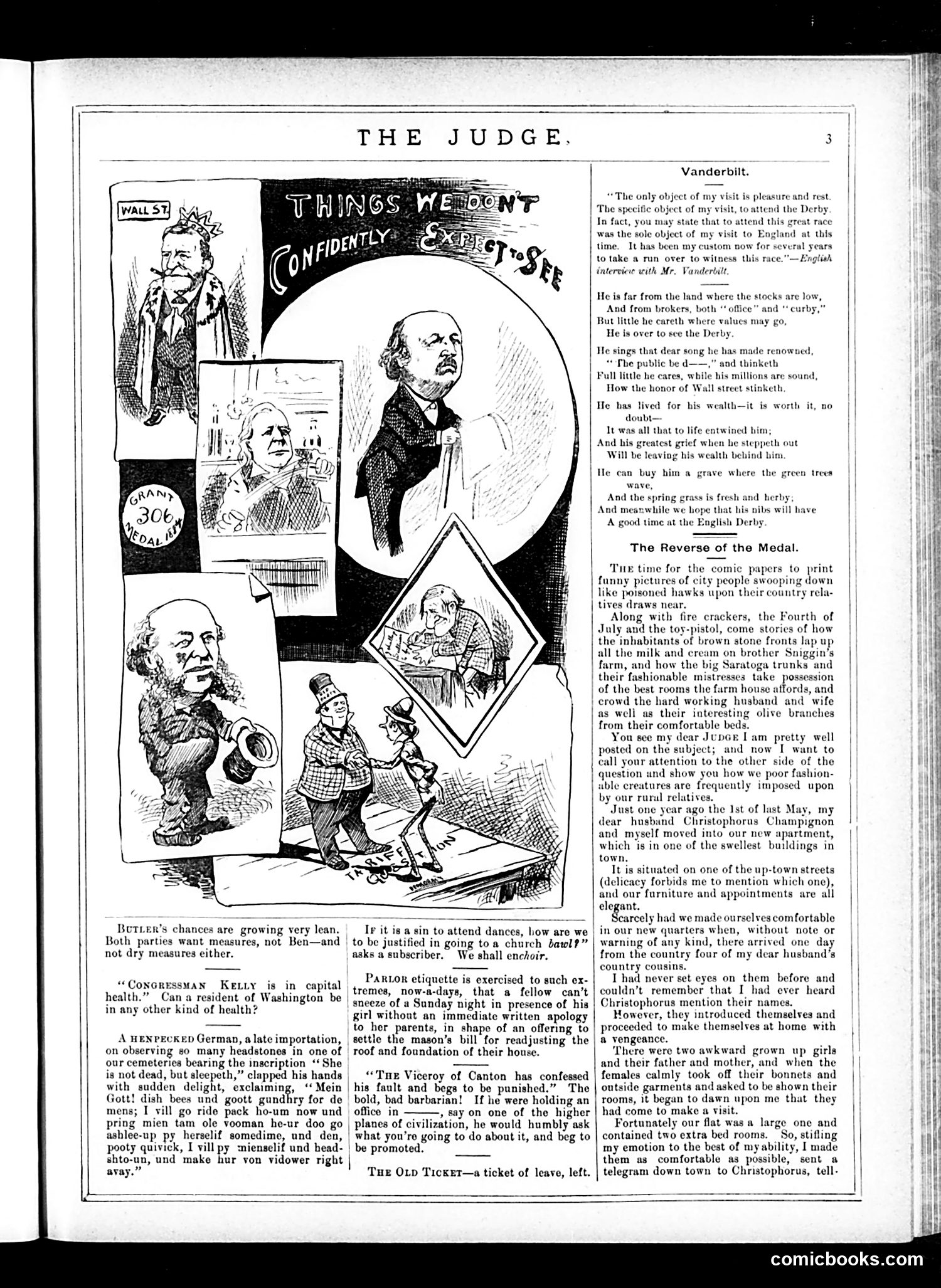
This page contains several short satirical pieces targeting contemporary figures and social customs. **"Things We Don't Confidently Expect to See"** (center): A collage mocking Wall Street financier Vanderbilt's trip to England to watch the Derby horse race. The satire suggests Vanderbilt cares only about wealth and will miss it most when he dies—contrasting his extravagant leisure travel with ordinary Americans' struggles. **Other items include**: - Mockery of "Congressman Kelly" regarding his health - A joke about German immigrants and cemetery inscriptions - Satire on excessive church etiquette and social formality - Commentary on a Chinese viceroy's willingness to accept punishment (implying Western officials wouldn't) **"The Reverse of the Medal"**: A letter-to-editor piece satirizing the stereotype of wealthy city people exploiting rural relatives during summer visits, by describing rural relatives' exploitation of city hosts instead. The overall tone targets wealth inequality, social pretension, and hypocrisy among the privileged classes.
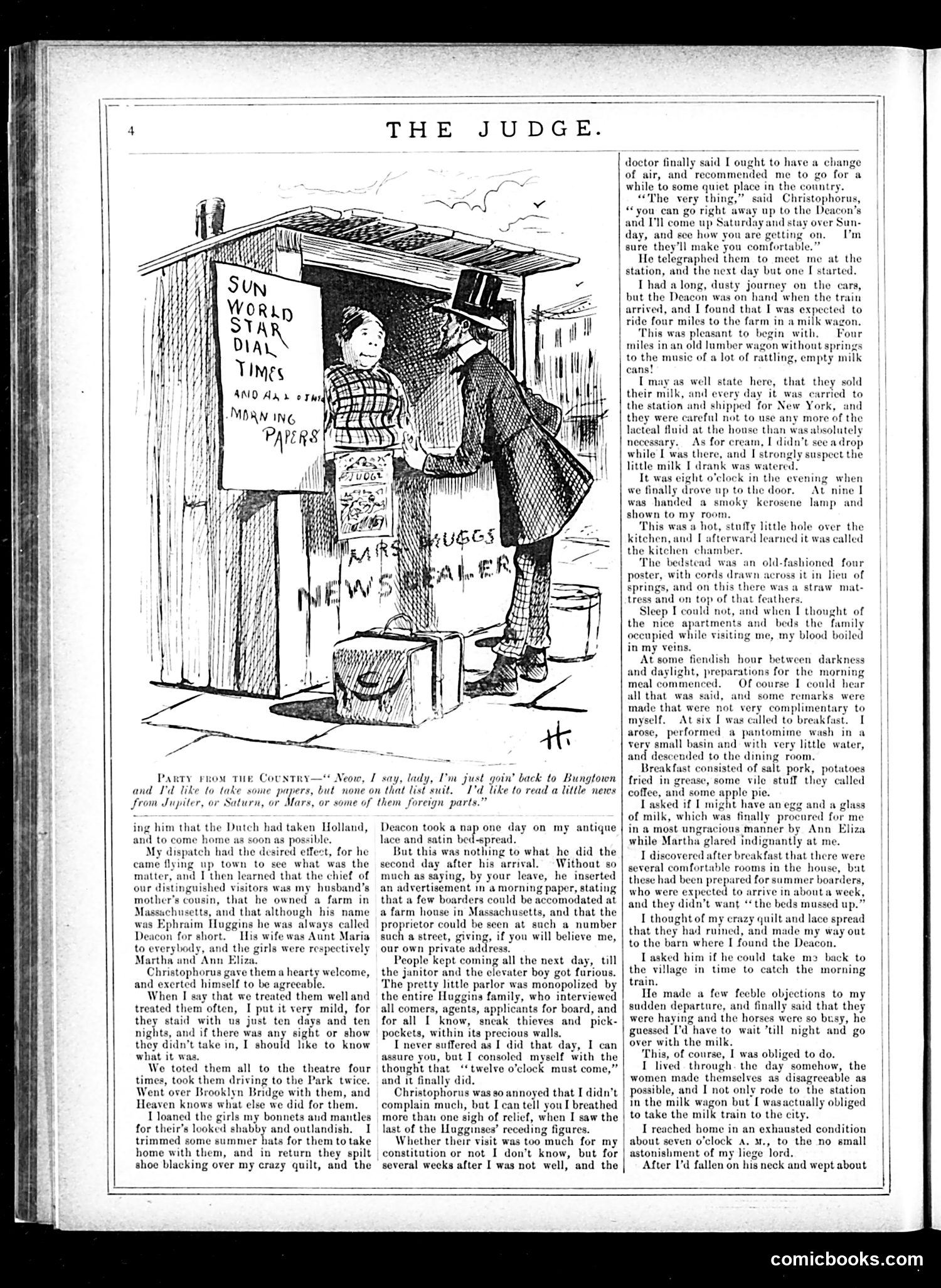
This page satirizes the burden of unwanted houseguests, specifically rural relatives. The central cartoon depicts a "Party from the Country"—a crude figure reading newspapers in a cramped space papered with advertisements, suggesting rustic unsophistication invading urban life. The accompanying text describes the narrator's ordeal hosting "Deacon" Huggins and his family from Massachusetts. The satire targets: 1. **Rural presumption**: Deacon audaciously places boarding-house advertisements using the narrator's private city address without permission 2. **Social disruption**: The family monopolizes the parlor, interviewing strangers and "sneak thieves" 3. **Property damage**: They spill shoe blacking on fine quilts and damage furniture 4. **Milking exploitation**: Upon visiting the Deacon's farm later, the narrator discovers they deliberately restricted milk use during her visit The joke exposes the hypocrisy and entitlement of country relatives—using urban hospitality while later stinting on basic amenities. It reflects Gilded Age class anxieties about rural-urban social navigation and the complications of extended family obligation.
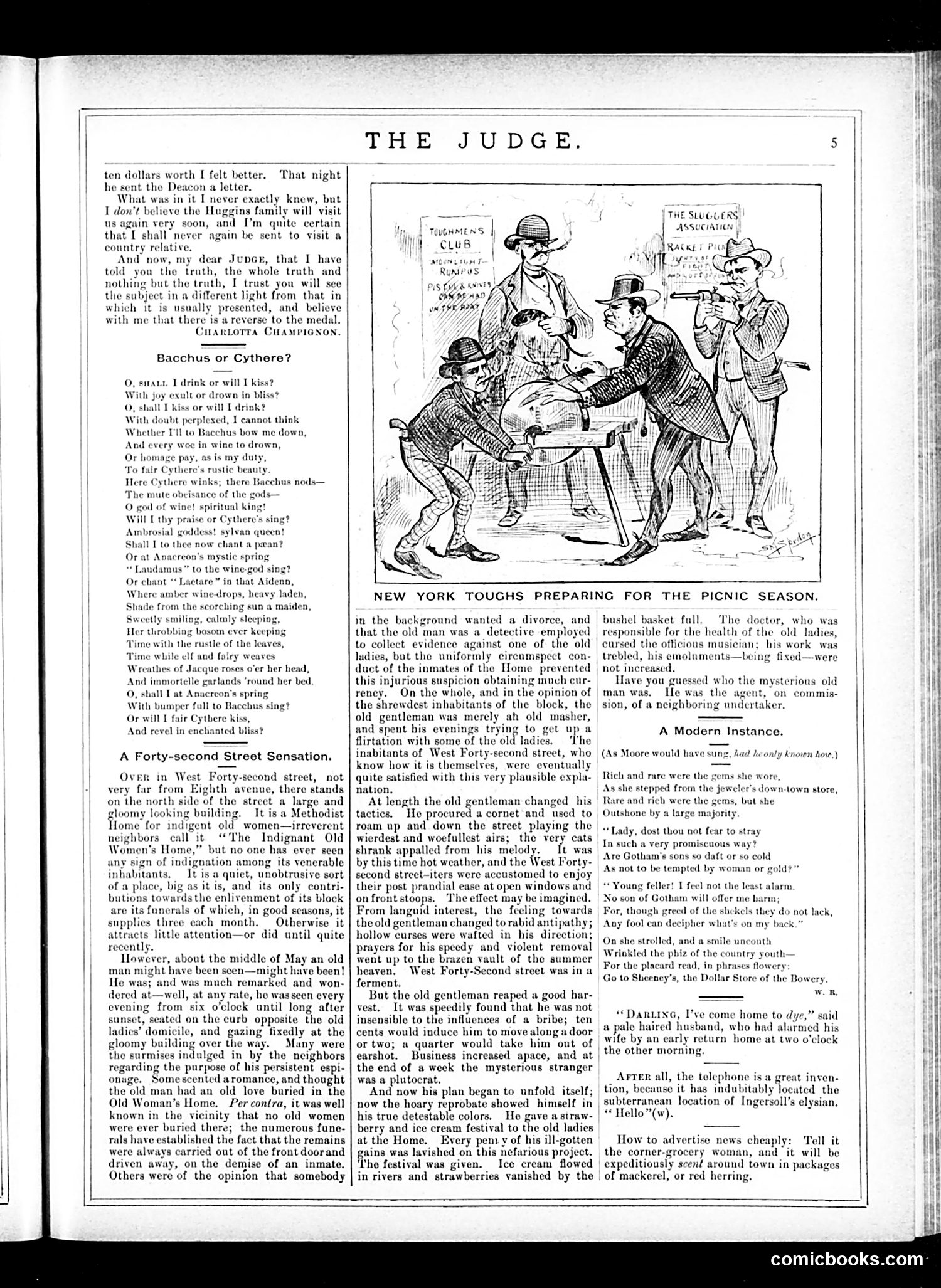
This page contains two distinct pieces of satirical content: **The Main Cartoon** ("New York Toughs Preparing for the Picnic Season") depicts members of the "Sluggers' Association" and "Toughmen's Club"—references to actual violent street gangs that plagued late 19th-century New York. The cartoon mocks organized gangs of young toughs who terrorized neighborhoods. The "picnic season" is satirical; these groups used warm weather as an excuse for increased violence and street brawling. The exaggerated dress and poses ridicule how these criminals posed as respectable citizens. **The Story Content** ("A Forty-Second Street Sensation") satirizes an old man mysteriously watching an Old Women's Home. The neighbors generate absurd theories about his motives—detective work, infidelity, or "masher" (sexual predator) behavior—when his actual purpose remains unclear. This mocks the gossiping, suspicious nature of urban tenement dwellers. The page generally satirizes street-level New York City crime, gang culture, and tenement-dwelling social dynamics of the Gilded Age.
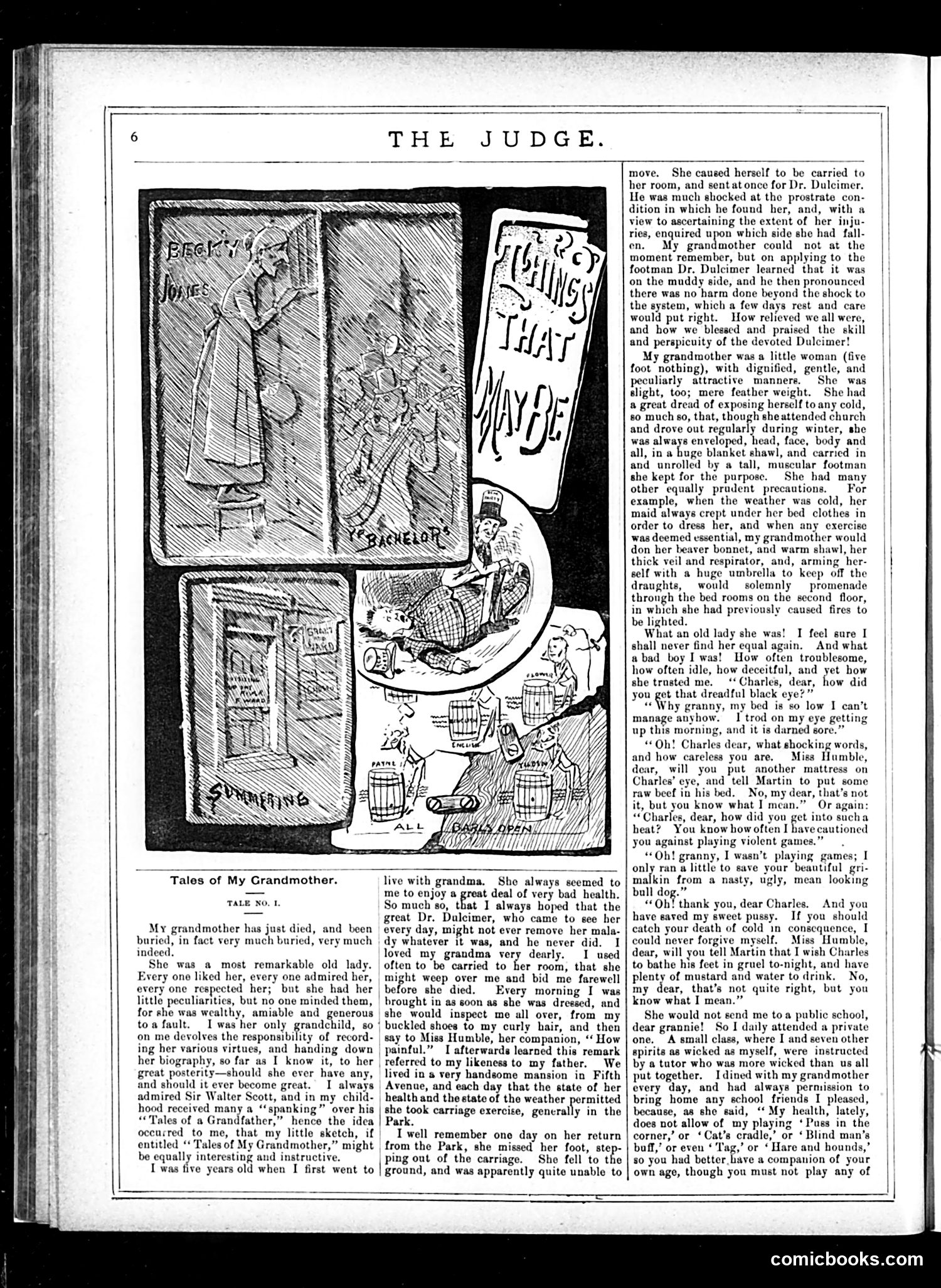
This is the opening installment of a serialized humorous memoir-style piece, not political satire. The cartoon illustrates the narrator's eccentric grandmother—a wealthy, hypochondriacal Fifth Avenue widow obsessed with protecting her health. The satire targets the Victorian upper class's excessive concern with illness and propriety. The grandmother's absurd precautions—requiring a maid to crawl under her bedclothes to dress her, walking only in heated bedroom corridors, wearing multiple protective layers even indoors—mock the era's wealthy's exaggerated health anxieties and mollycoddling. The reference to Sir Walter Scott's "Tales of a Grandfather" signals this mimics that work's narrative style for comic effect. The piece gently ridicules both the grandmother's hypochondria and the narrator's naive childhood devotion to her, capitalizing on Judge magazine's audience appreciation for satirizing genteel society's affectations and eccentricities.
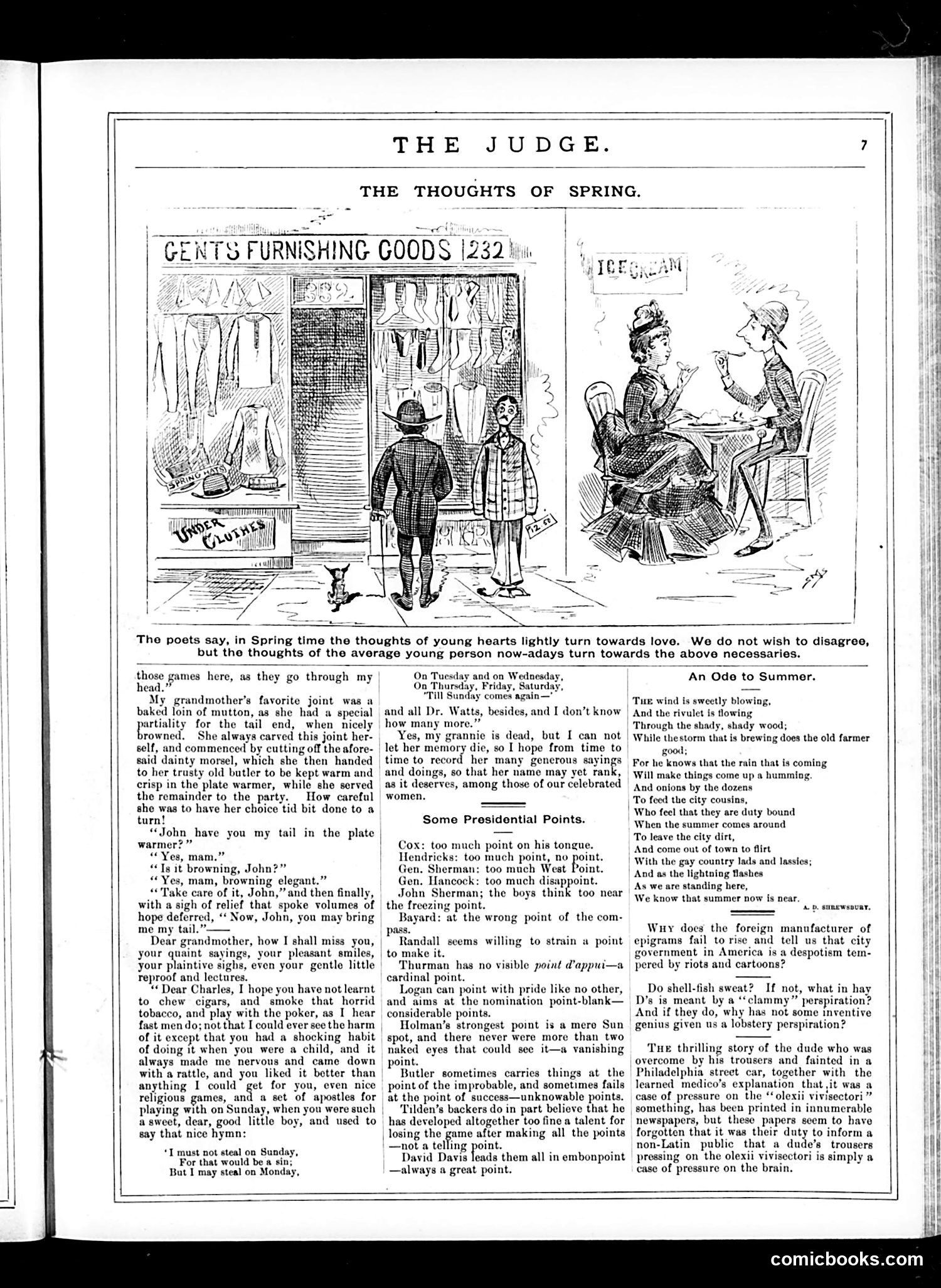
This satirical page contrasts romantic spring poetry with harsh economic reality. The main cartoon shows a couple window-shopping at a furnishing goods store, illustrating the caption: poets say spring turns young hearts toward *love*, but average people's thoughts turn toward *necessities*—clothing, household goods, basic survival. Below, "Some Presidential Points" mocks 1870s presidential candidates through wordplay. Each candidate is criticized via puns on "point": Cox has "too much point on his tongue" (speaks too much); Sherman "too much West Point" (military background); Hancock "too much disappoint"; Thurman "no visible point"; Butler carries things "at the point of the improbable." The satire suggests these candidates lack genuine merit or coherent positions. The page reflects working-class economic anxiety during this period—spring doesn't bring romance but urgent material concerns—while ridiculing political figures as insubstantial or hypocritical.
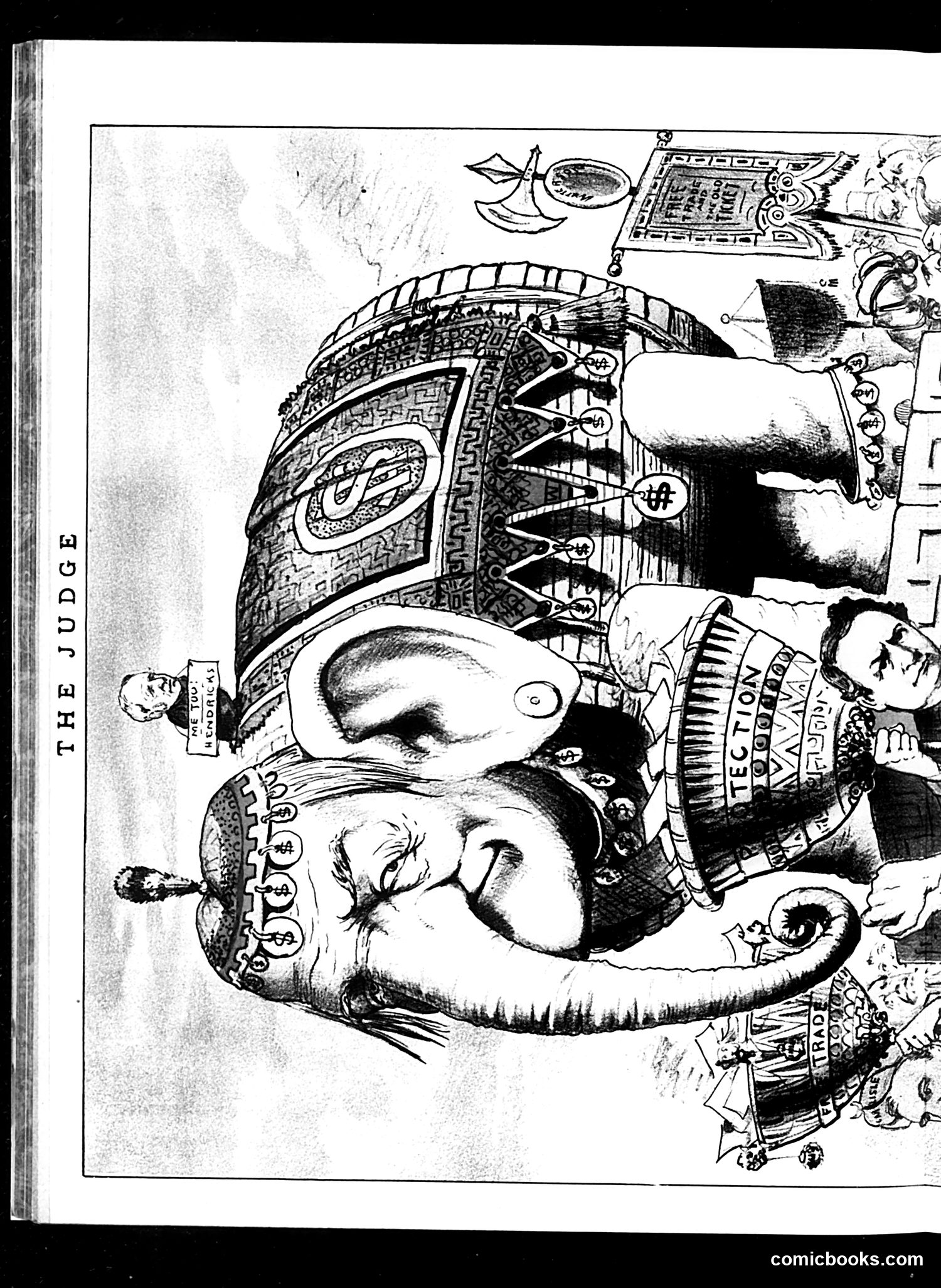
This appears to be a satirical cartoon from *Judge* magazine depicting a large figure labeled "THE JUDGE" in ornate, decorative clothing with elaborate patterns. The figure is surrounded by smaller characters and various symbolic objects at the top (scales of justice, architectural elements, decorative items). The satire likely critiques judicial authority or a specific judge's pomposity and ornamentation—suggesting pretension or excess in the legal system. The elaborate dress contrasts ironically with the figure's physical appearance, emphasizing vanity or self-importance. Without clearer text identifying specific historical figures or dates visible in this reproduction, I cannot definitively name which judge or legal controversy is being mocked, though the visual language of exaggerated formality strongly suggests commentary on judicial pretension during the Gilded Age or Progressive Era.
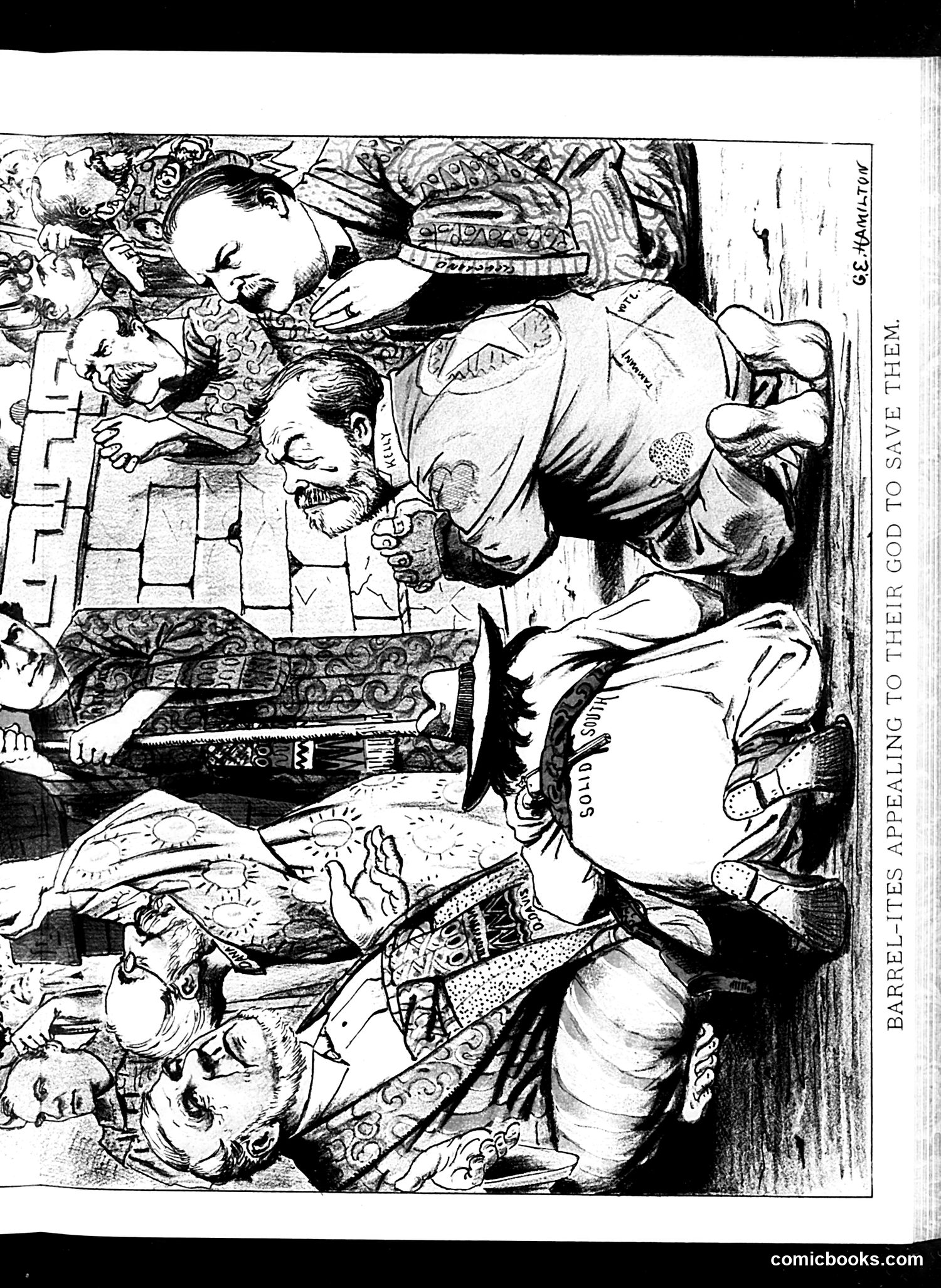
This appears to be a satirical Judge magazine cartoon, though the OCR text is too corrupted to read the caption clearly. The image shows what appears to be a wealthy or rotund figure (possibly a capitalist or politician) surrounded by barrels and goods, with other figures around him in attitudes of supplication or distress. The style and composition suggest commentary on economic inequality, hoarding, or exploitation during an era of American industrial capitalism—likely late 19th or early 20th century based on the artistic style. The caption fragment "GOD TO SAVE THEM" suggests the cartoon critiques how the wealthy or powerful invoke divine justification for their actions while common people suffer. Without clearer text, specific identifications remain unclear.
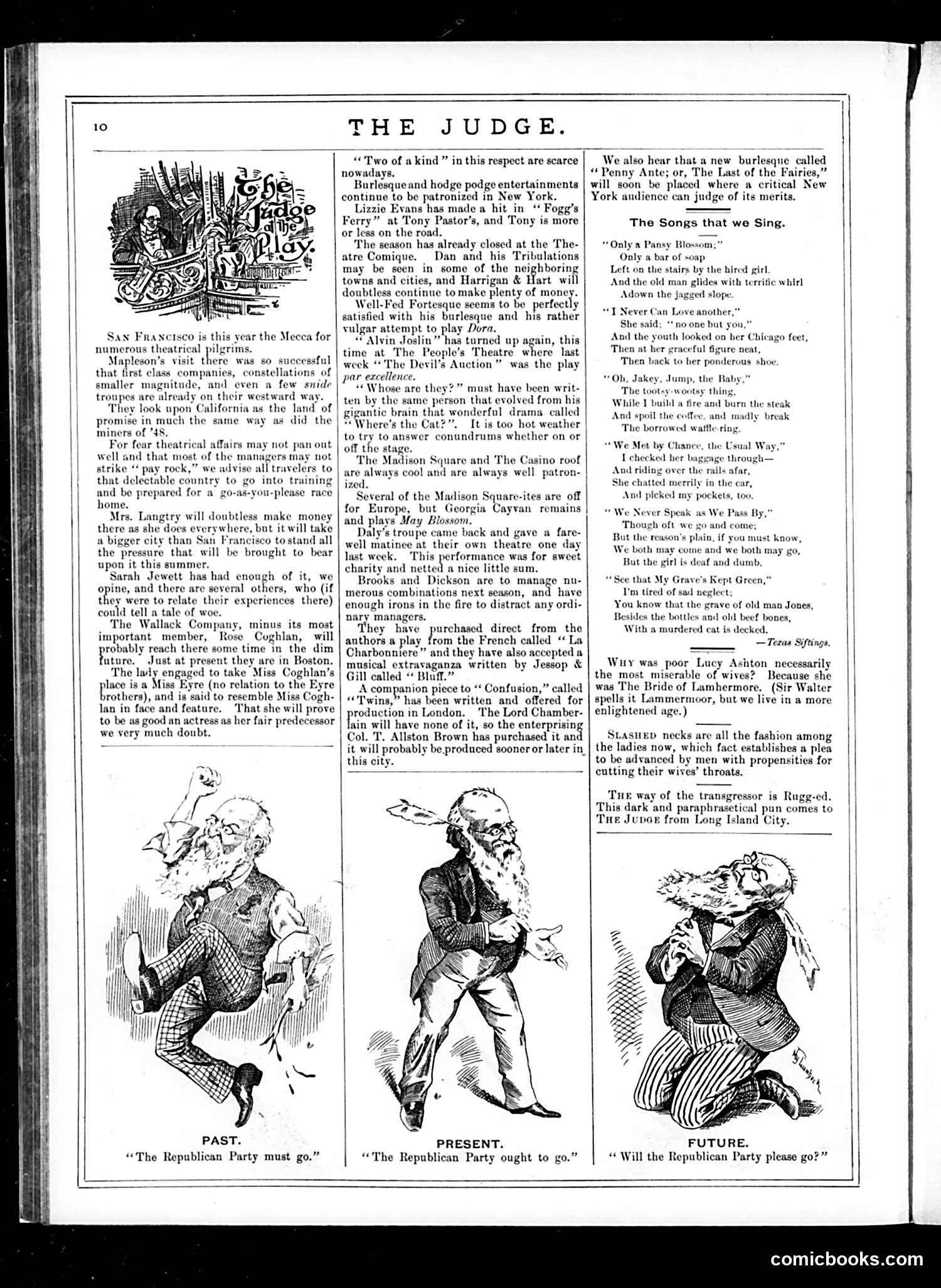
This page features three caricatured figures labeled "Past," "Present," and "Future," each with the Republican Party's status as their caption. The cartoons show a progression: a figure being ejected ("The Republican Party must go"), one gesturing defensively ("The Republican Party ought to go"), and one on his knees pleading ("Will the Republican Party please go?"). These appear to reference internal Republican Party turmoil, likely from the 1880s Gilded Age period when factions battled over patronage, tariffs, and reform. The imagery suggests escalating pressure for party dissolution or radical restructuring—moving from forceful rejection to reluctant acknowledgment to desperate supplication. The rest of the page contains theatrical reviews typical of *Judge* magazine's entertainment coverage, discussing New York theater companies and performances. The cartoons' satirical point: the Republican Party faces mounting existential crisis.
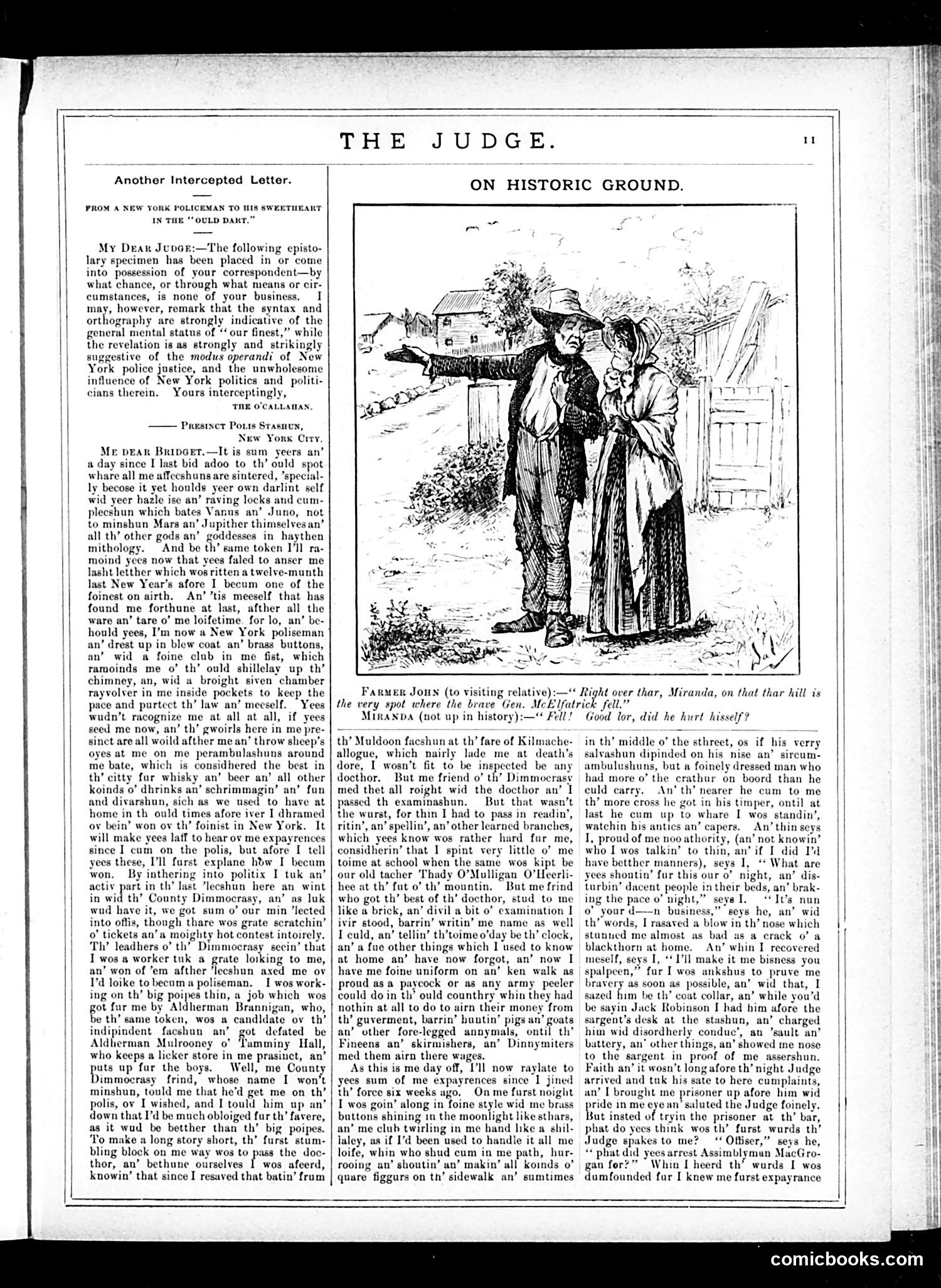
This page satirizes **New York police corruption and political patronage** in the Gilded Age. The main cartoon depicts "Farmer John" at a historic battlefield, apparently confused about Revolutionary War history—he confuses a general's death with a fall, mocking rural ignorance. The longer text is a faux letter from an Irish-American policeman to his sweetheart, written in exaggerated brogue. The satire targets how **police jobs were awarded through political connections** (the Tammany Hall machine) rather than merit. The officer admits he got hired through the Democratic Party after working on their campaign, not through legitimate qualification. The satirical point: New York's "finest" police were incompetent political appointees, not professional law enforcement. The heavy dialect and boastful tone underscore the critique—these were unfit men given badges and power through corruption. The mention of "County Dimmocrasy" (Democratic machine politics) directly indicts the political system enabling this abuse.
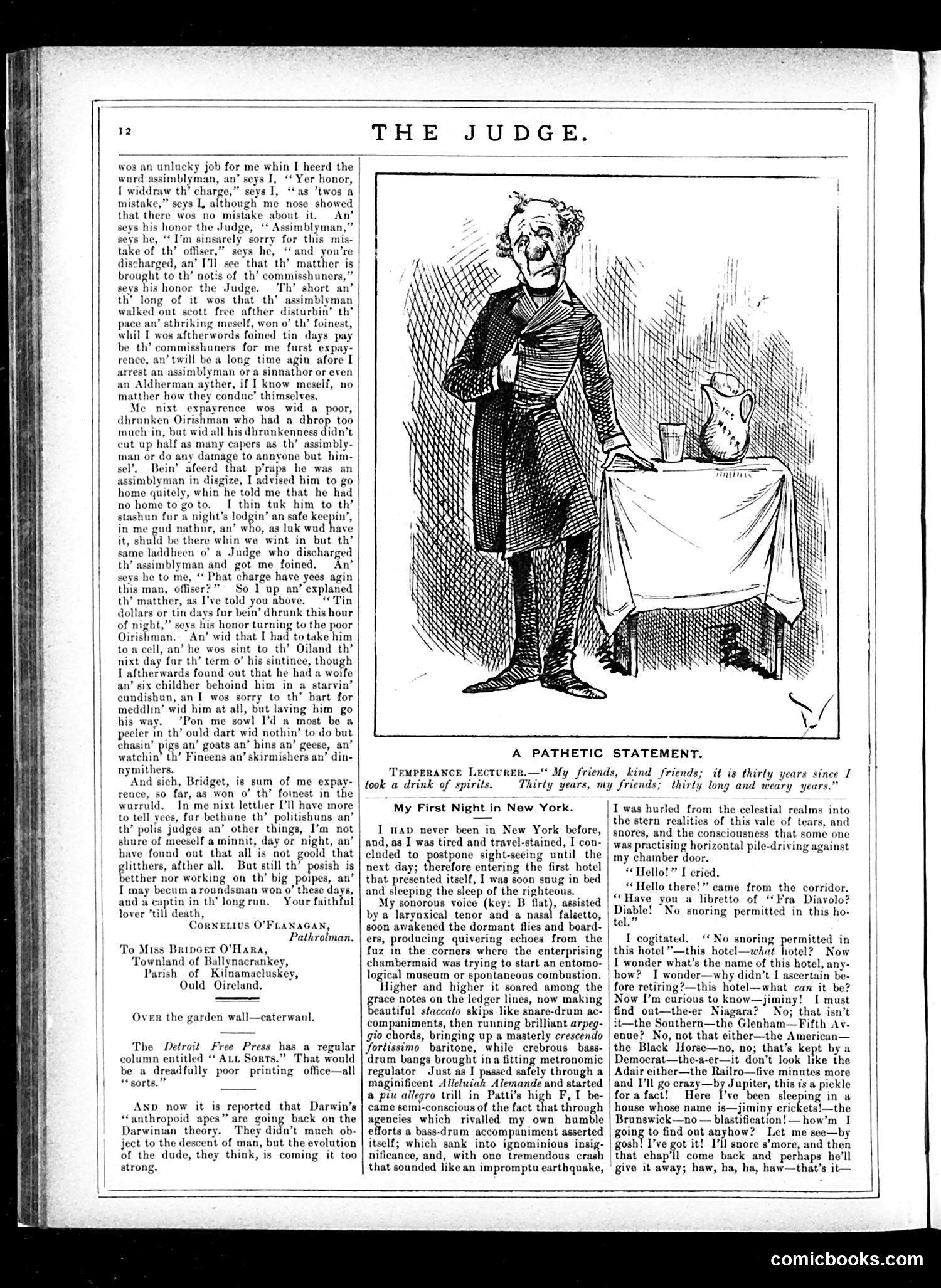
This page contains two pieces of social satire typical of 1880s-90s *Judge* magazine: **Main Cartoon ("A Pathetic Statement"):** A police officer (identified as Cornelius O'Flanagan in the accompanying letter) recounts his experiences enforcing the law unequally. The satire critiques judicial corruption: when he arrested a wealthy *assemblyman* (state legislator) for disorderly conduct, the judge discharged him with no consequences. Yet the same judge sentenced a poor, drunk Irishman to jail for a similar offense, separating him from his starving family. The cartoon's point: the justice system protects the politically connected while punishing the poor and powerless. O'Flanagan's Irish dialect and working-class perspective underscore the irony—he's a policeman prevented from doing his job fairly. **Secondary item:** A brief joke mocking Darwinian evolution, suggesting that while apes accept human descent, the evolution of the "dude" (a fashionable young man) is implausible—likely referencing contemporary anxieties about changing masculinity.
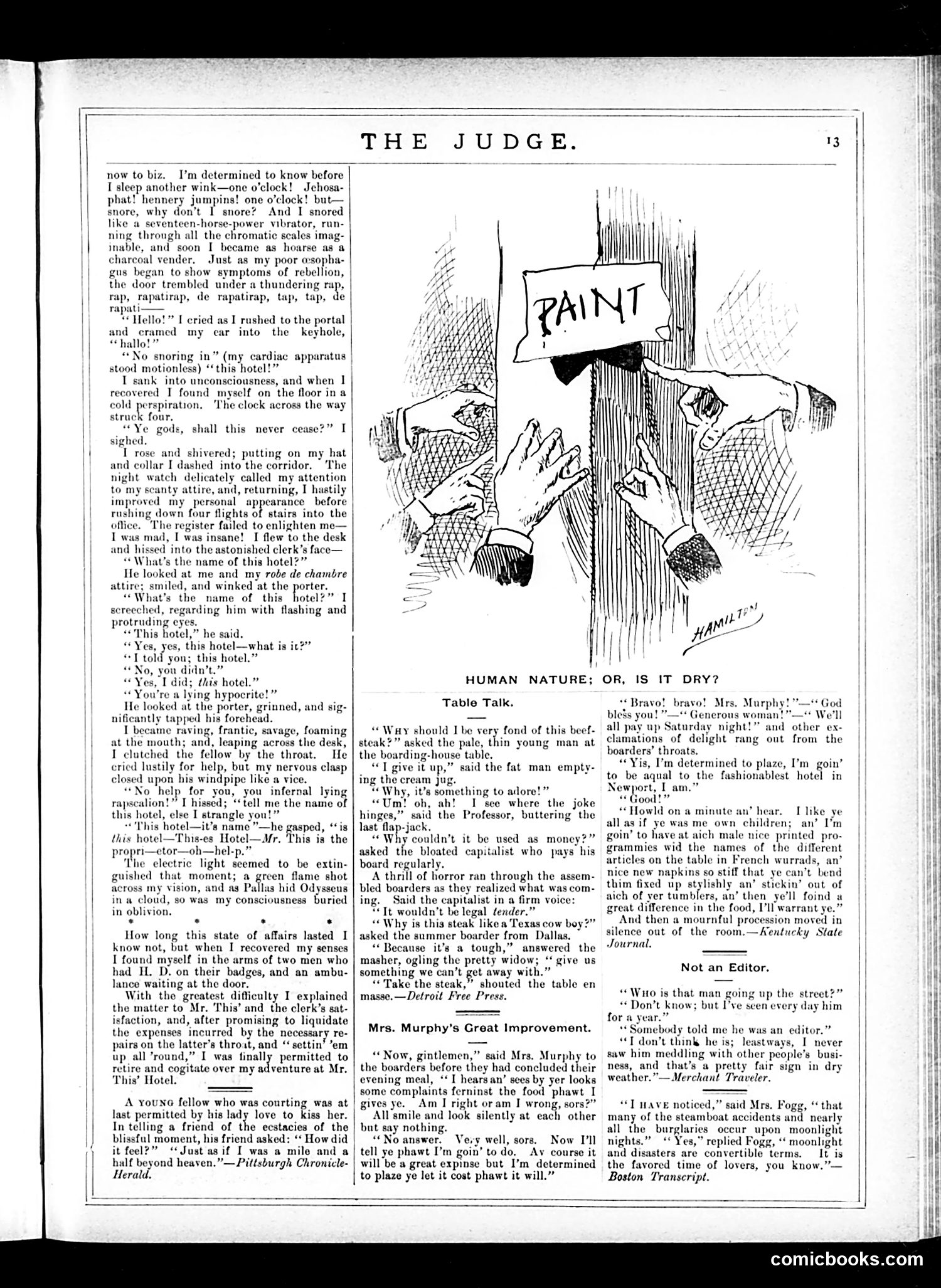
This page contains humorous short fiction and table talk rather than political cartoons. The main illustrated piece shows a frustrated hotel guest holding a paint can, apparently driven to absurdity by insomnia and a clerk's refusal to name the hotel. The "Table Talk" section satirizes boarding-house life through dialogue about a beefsteak. A thin young man's cryptic praise ("something to adore!") puzzles fellow boarders until a professor and capitalist debate whether the meat could serve as currency—a joke about the meat's quality or toughness, implying it's as valuable/durable as money. The satire targets everyday social pretension and the peculiar logic of boarding-house inhabitants. These are gentle domestic comedies rather than pointed political commentary, typical of Judge magazine's lighter content alongside its more overtly satirical pieces.
This page contains primarily **text-based satirical content** rather than visual cartoons. The main piece is "Brother Gardner on Politics," a dialect monologue satirizing American presidential campaigns. **The Satire's Target:** The piece attacks the corruption and hypocrisy of presidential elections. Brother Gardner (likely a Black character, given the dialect writing style common in 19th-century humor) outlines a cynical six-step program for securing a presidency: assembling a corrupt ring, buying newspapers to manufacture public opinion, bribing delegates, spreading lies about opponents, and celebrating the result as democracy in action. **The Point:** The satire exposes the gap between America's democratic ideals (freedom of press, ballot, republican government) and electoral reality—corruption, bribery, lying, and intimidation. Gardner's final exhortation to abandon religion and integrity to participate in campaigns underscores the moral bankruptcy Judge's editors saw in contemporary politics. The accompanying short jokes mock contemporary social absurdities (women, fashion, appearances) in Judge's typical satirical style.
This page from *Judge* magazine consists primarily of advertisements and humorous short jokes typical of late 19th-century American satirical publications. The jokes target various everyday annoyances: a suitor discovering his beloved has icy feet and snores; a caterer defending late suppers; debates over whether the original cow had horns (to explain Eve eating the apple without being gored). The humor relies on wordplay, logical absurdities, and domestic disputes. One joke mocks an old woman at the opera who, after hearing the full chorus sing together, complains the performers no longer care about quality since they've "got our money" and just rush through songs. Another features a doctor-patient exchange where a patient claims rubbing lotion cured his rheumatism—but on the wrong body part entirely—suggesting the "cure" was merely coincidental exercise. The page is dominated by period advertising for pianos, breweries, medical treatments, and lithographic services. The cartoon content is minimal; these are primarily joke-text pieces typical of *Judge*'s format, offering gentle social satire about manners, medicine, and domestic life rather than sharp political commentary.
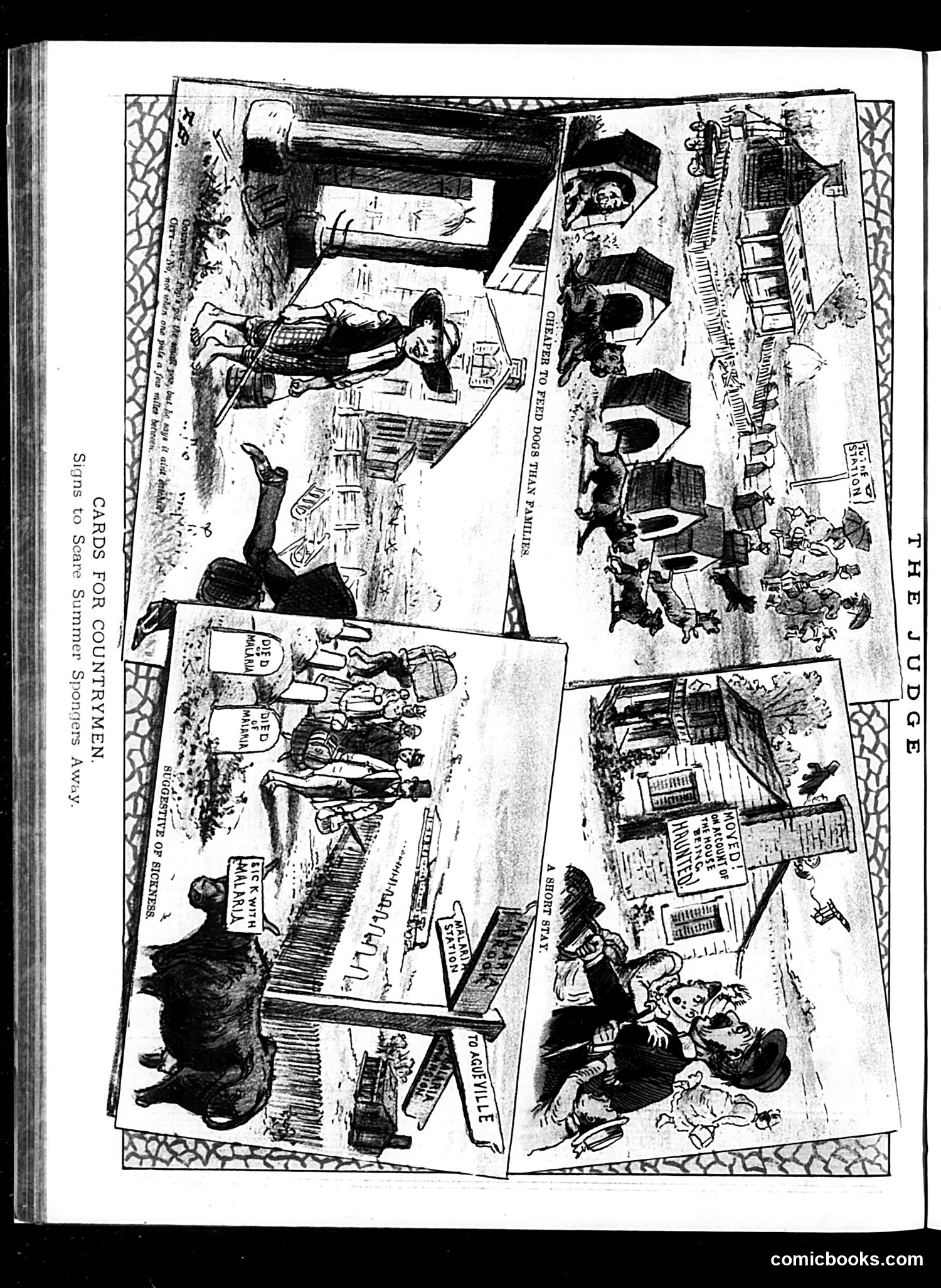
This *Judge* cartoon presents a satirical commentary on unwanted summer guests—"spongers" who impose themselves on country hosts. The page shows various warning signs and cards designed to discourage such visitors from staying. The humor targets a common social problem of the era: freeloading guests who overstayed their welcome during summer vacation season. The cartoon depicts exaggerated, off-putting signs and scenarios meant to repel these uninvited visitors—essentially humorous "keep out" notices for rural homeowners tired of hospitality abuse. The satire reflects class tensions and social anxieties about boundaries between host and guest, particularly among the middle and upper classes who maintained country estates. It's a lighthearted but pointed critique of poor manners and social freeloading—issues apparently common enough to warrant this extended comedic treatment in *Judge*.