
A complete issue · 16 pages · 1884
Judge — April 26, 1884
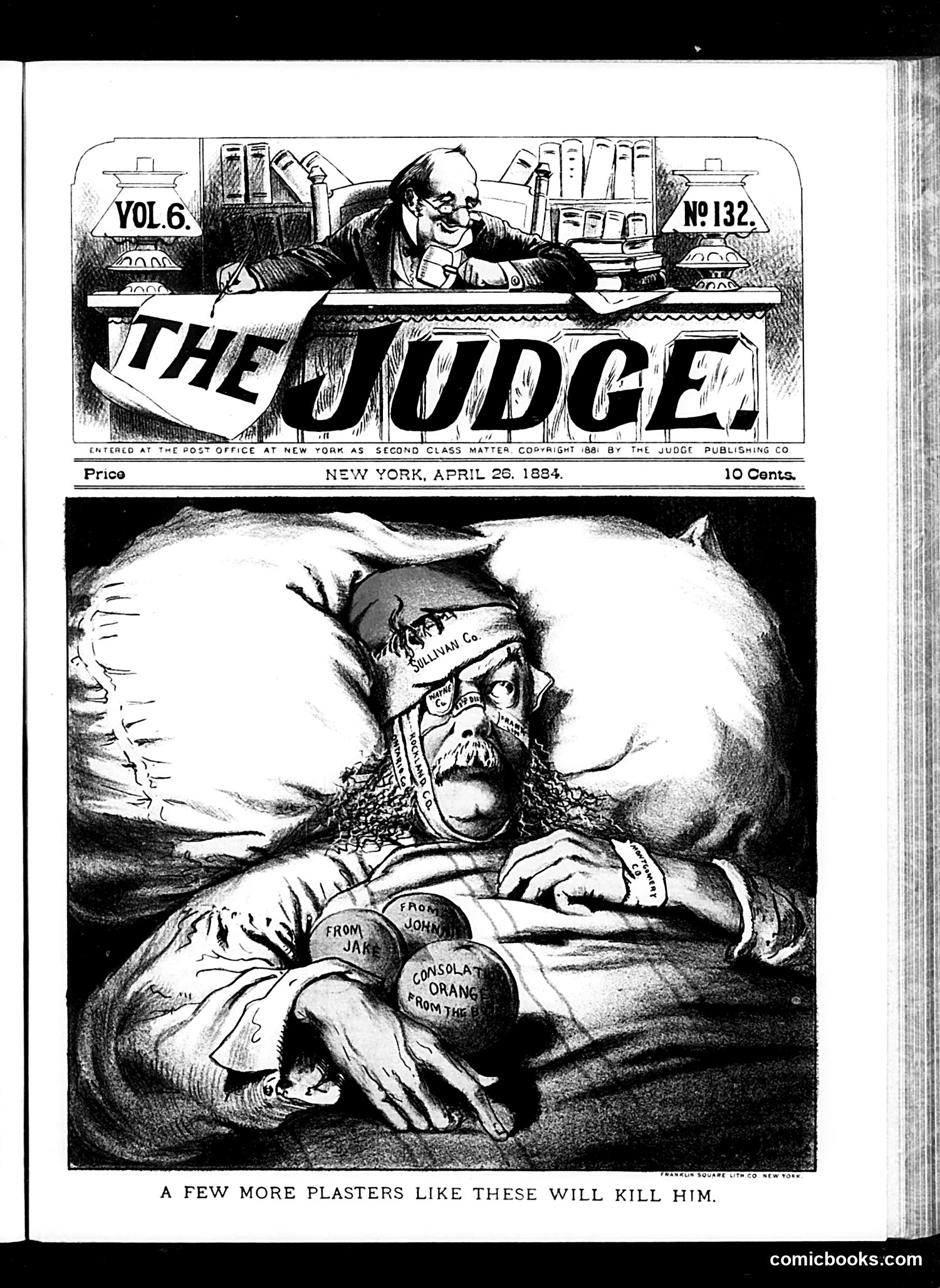
This political cartoon satirizes someone being treated with multiple medicinal plasters as a cure. The figure, wearing a "Sullivan Co." headband, lies prone and appears to be a caricatured Irishman with exaggerated facial features typical of 1890s ethnic stereotyping. The plasters are labeled from various sources including "John," "Orange," and "Consolata," suggesting different political factions or regions applying remedies. The caption states "A FEW MORE PLASTERS LIKE THESE WILL KILL HIM," implying that the cure—likely political intervention or compromise attempts—will prove fatal. Without additional context, the specific political situation remains unclear, though it appears to reference Irish-American politics or Anglo-Irish relations circa 1894.
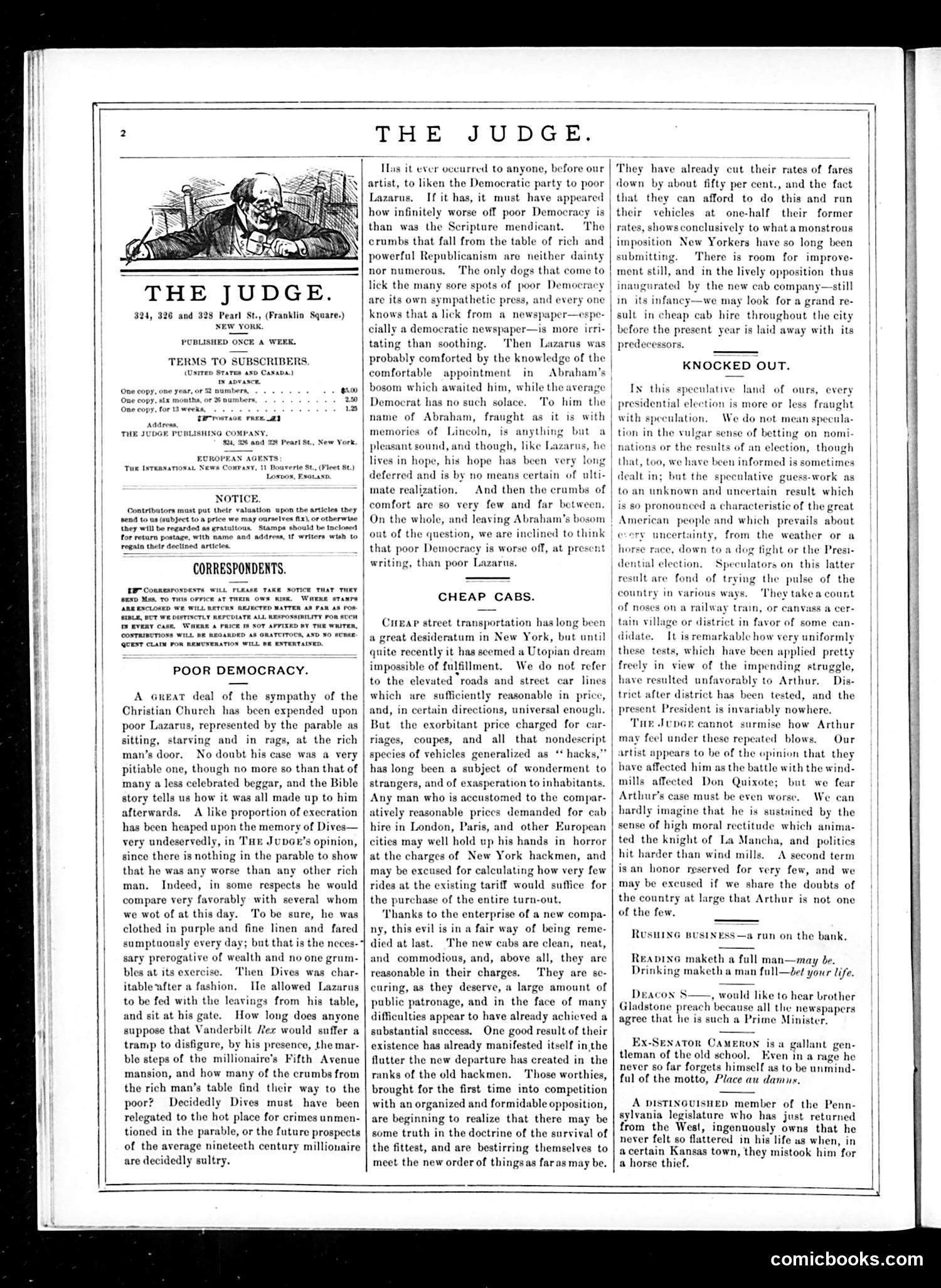
This editorial cartoon compares the Democratic Party to the biblical Lazarus—a beggar receiving scraps from a rich man's table. The artist argues that poor Democrats fare worse than the biblical beggar because: **The comparison:** Just as Lazarus received crumbs from the wealthy Dives, Democrats receive meager support from powerful Republicans, but without Lazarus's comfort (faith in Abraham's reward). **The critique:** Democratic newspapers offer harsh "licks" rather than genuine help. Democrats have "no such solace" as religious hope—they've lost faith in leaders like Lincoln (referenced mockingly). **The point:** Late-19th-century *Judge* magazine satirizes the Democratic Party's weakness and demoralization. They're worse off than a biblical pauper because they lack even spiritual consolation. The cartoon likely references contemporary political struggles, possibly related to industrial labor disputes or economic inequality, suggesting Democrats cannot effectively champion the poor against wealthy Republican interests.
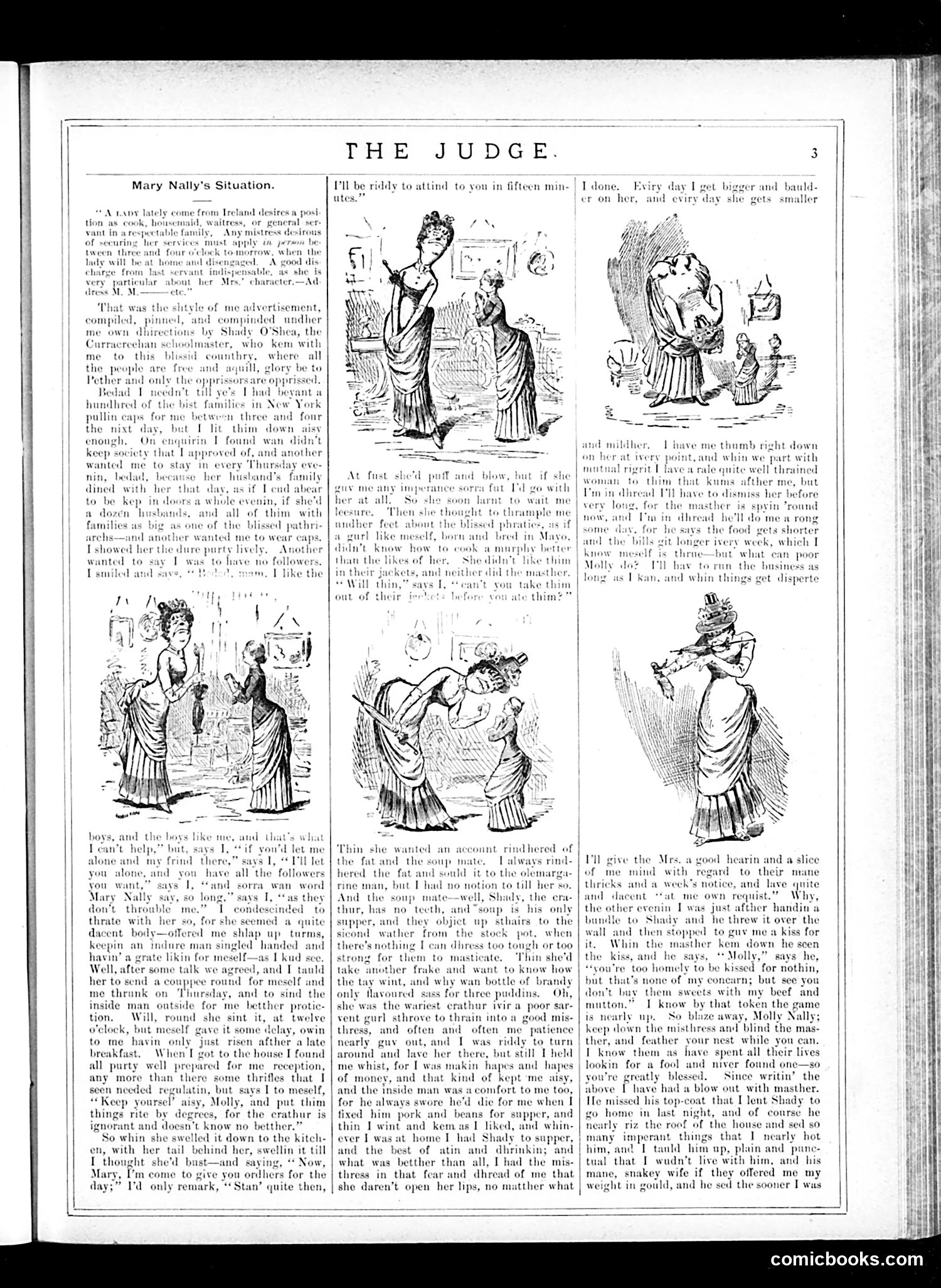
This page from *Judge* magazine presents "Mary Nally's Situation," a first-person narrative by an Irish domestic servant complaining about her employer's household. **The Social Commentary:** The piece satirizes the plight of live-in servants in late 19th-century America, particularly Irish immigrants. Mary details her grueling conditions: she's worked down to near-starvation ("Every day I get bigger and baulder on her, and every day she gets smaller"), endures constant physical demands, and receives minimal compensation and respect. **The Satire's Target:** Rather than mocking Mary, *Judge* exposes the hypocrisy of wealthy employers who claim to treat servants well while systematically exploiting them—denying them adequate food, personal time, and dignity. Mary's sardonic tone ("I can't help") underscores the powerlessness of working-class women trapped in servitude. **Visual Context:** The accompanying sketches show domestic scenes emphasizing the physical toll and social hierarchy between mistress and servant. This reflects *Judge's* occasional progressive stances on labor exploitation, though presented through ethnic dialect humor typical of the era.
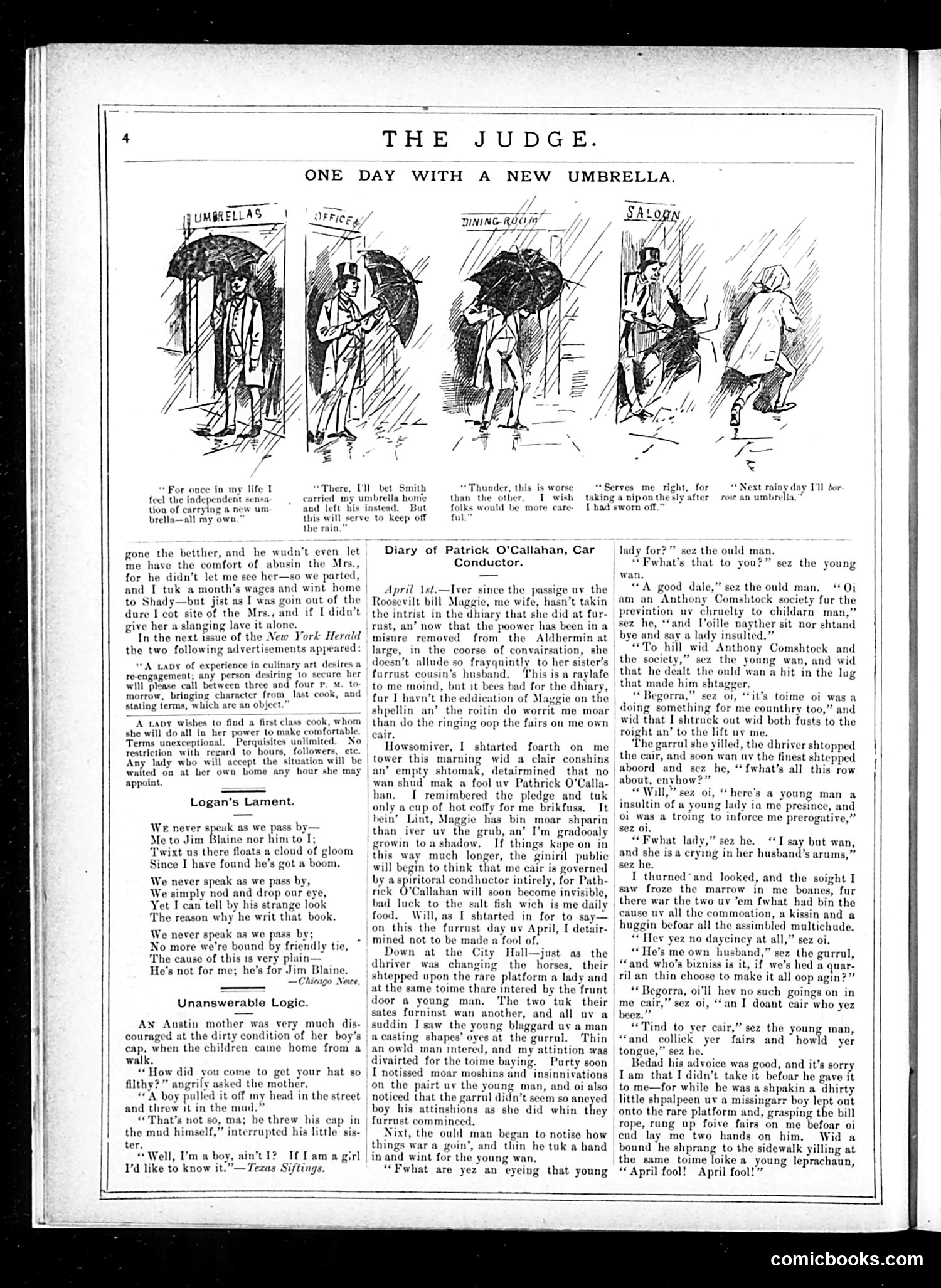
This is a five-panel comic strip showing a man's misadventures with a new umbrella during rainy weather. The humor derives from the umbrella's apparent uselessness—in each scene, despite carrying it, the man gets soaked while others around him stay dry or the umbrella fails him in comical ways (blowing away, blocking his view, etc.). The accompanying text includes humorous dialect pieces: Patrick O'Callahan's diary about being a streetcar conductor dealing with family life and poverty, and "Unanswerable Logic," a joke about a child's circular reasoning defending getting his cap muddy. The page also contains period advertisements about seeking household staff—typical Judge magazine content mixing satire with practical classifieds. The overall tone is lighthearted domestic humor rather than political commentary.
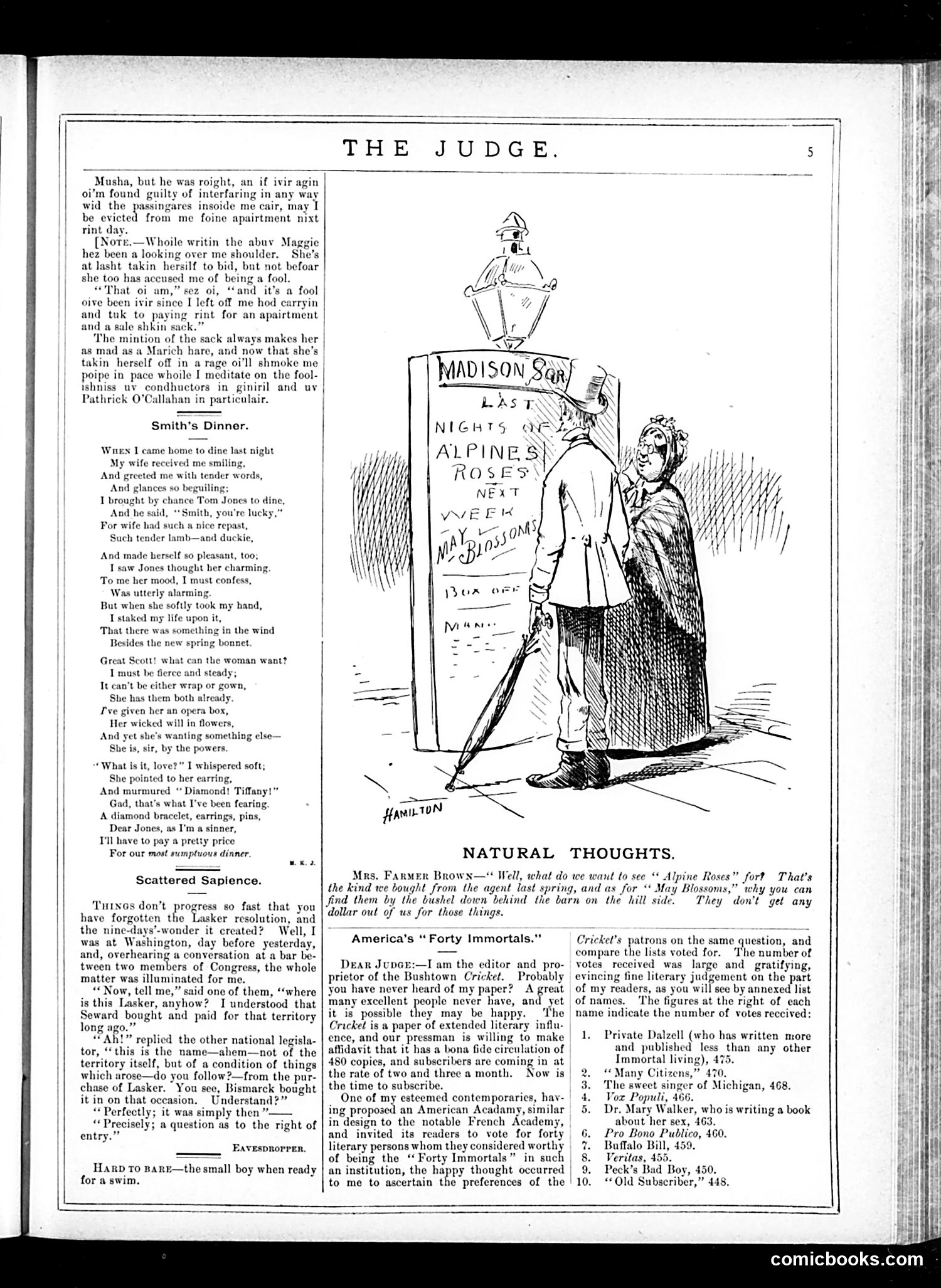
This page from the satirical magazine *Judge* contains several humorous pieces lampooning 1880s American life and politics. The main cartoon depicts a woman posting advertisements on a Madison Square pillar—likely promoting theatrical shows ("Alpine Roses," "May Blossoms"). The satire targets both commercial advertising clutter in public spaces and the gullibility of urban audiences. "Smith's Dinner" is a comic poem about a husband mystified by his wife's hints for expensive gifts (diamonds, opera boxes) after he's already provided luxuries. The joke: women's supposedly insatiable material desires. "Scattered Sapience" ridicules Congress through an absurd dialogue about the "Lasker resolution"—a real legislative matter apparently so obscure that lawmakers themselves don't understand it, satirizing congressional incompetence. "Natural Thoughts" mocks advertising through a farmer's wife rejecting expensive imported flowers when wild ones grow freely nearby—critiquing urban consumer culture as wasteful. The overall tone reflects *Judge's* middle-class perspective, mixing class commentary with domestic humor typical of Gilded Age satirical magazines.
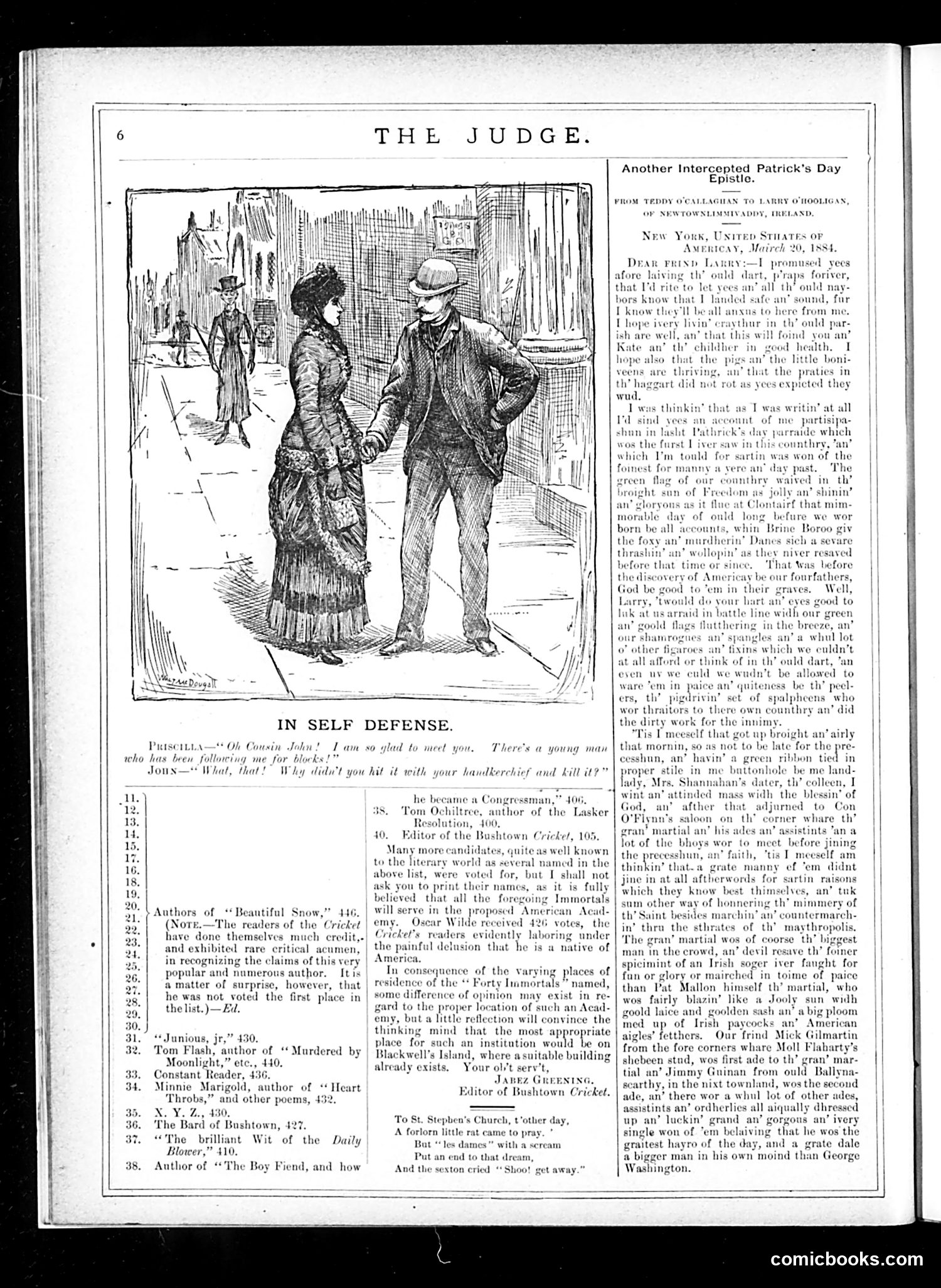
This *Judge* page contains two satirical pieces mocking Irish-American immigrants in 1884: **"In Self Defense" cartoon:** A brief visual joke about street harassment. A woman tells a man she's been "followed for blocks," and he responds she should have hit it with a handkerchief and "kill it"—treating the pursuer like a pest or animal. The satire targets both the woman's passivity and crude masculine "solutions." **"Another Intercepted Patrick's Day Epistle":** A longer piece mocking Irish immigrants through a fake letter from "Teddy O'Callaghan" in New York to his friend in Ireland. The humor relies on exaggerated Irish dialect and malapropisms (phonetic misspellings like "eraythur" for "creature"). The writer boasts about St. Patrick's Day celebrations and Irish pride, but the entire piece is constructed to make Irish speech and sentiments appear ridiculous to Anglo-American readers. Both pieces reflect the period's pervasive anti-Irish prejudice, using caricature and mockery to reinforce stereotypes that were common entertainment for *Judge*'s audience.
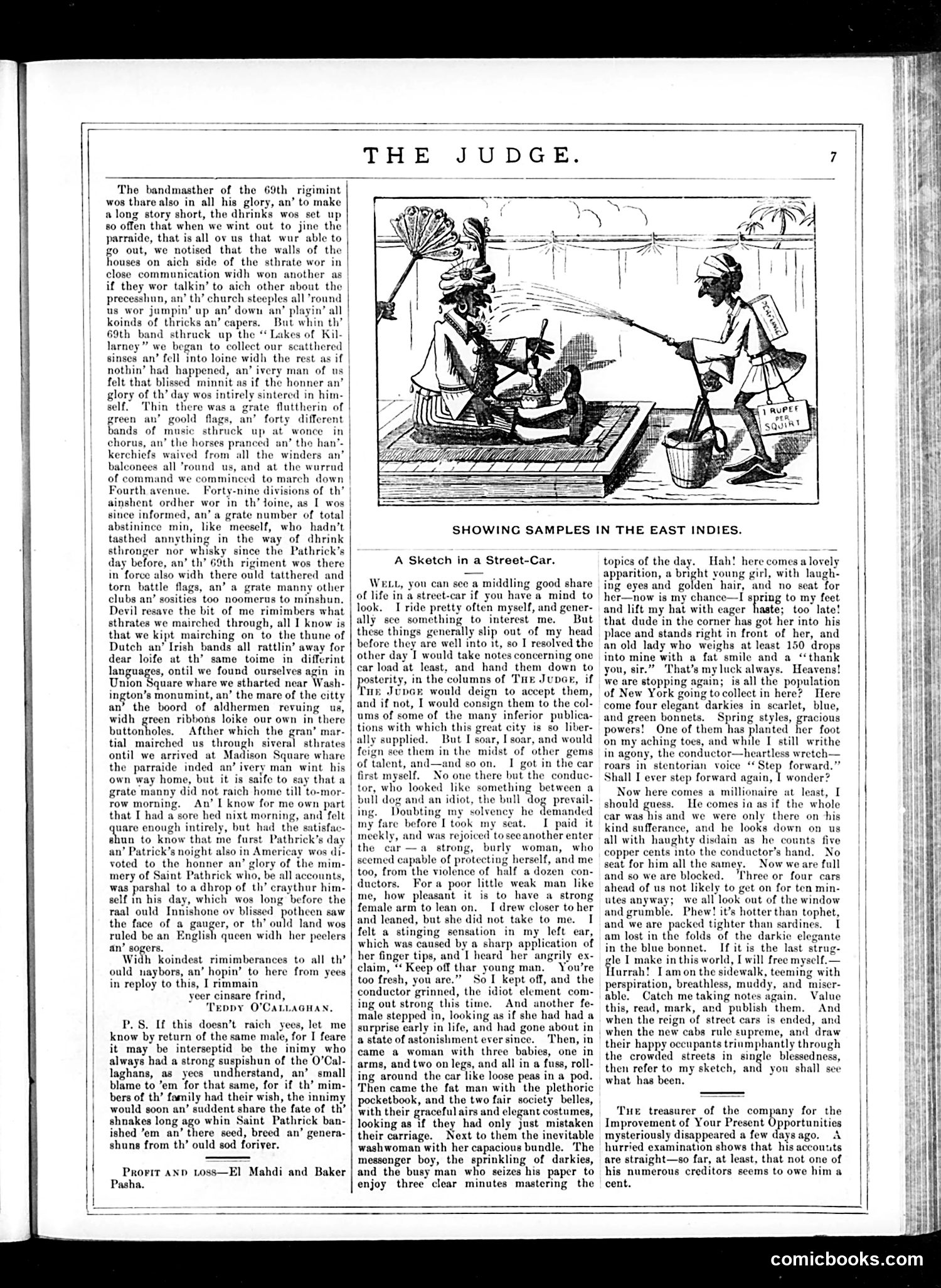
This page contains two distinct pieces of satirical content: **Main Story:** "Teppy O'Callaghan's" Irish-dialect account of a St. Patrick's Day parade (likely New York, given Union Square and Fourth Avenue references). The satire targets Irish-American drinking culture through exaggerated brogue and a narrator who claims abstinence while describing widespread intoxication during the 1880s celebration. The humor plays on stereotypes about Irish immigrants and alcohol. **Cartoon:** "Showing Samples in the East Indies" depicts a street-car encounter where a woman vendor displays fabric samples to a well-dressed male customer. The satire likely mocks either aggressive street commerce, uncomfortable social encounters in public transit, or the woman's boldness in accosting a gentleman—reflecting Victorian anxieties about proper public behavior and gender roles. Both pieces use exaggeration and stereotype for comedic effect typical of Judge magazine's approach to contemporary American social types and immigrant communities.
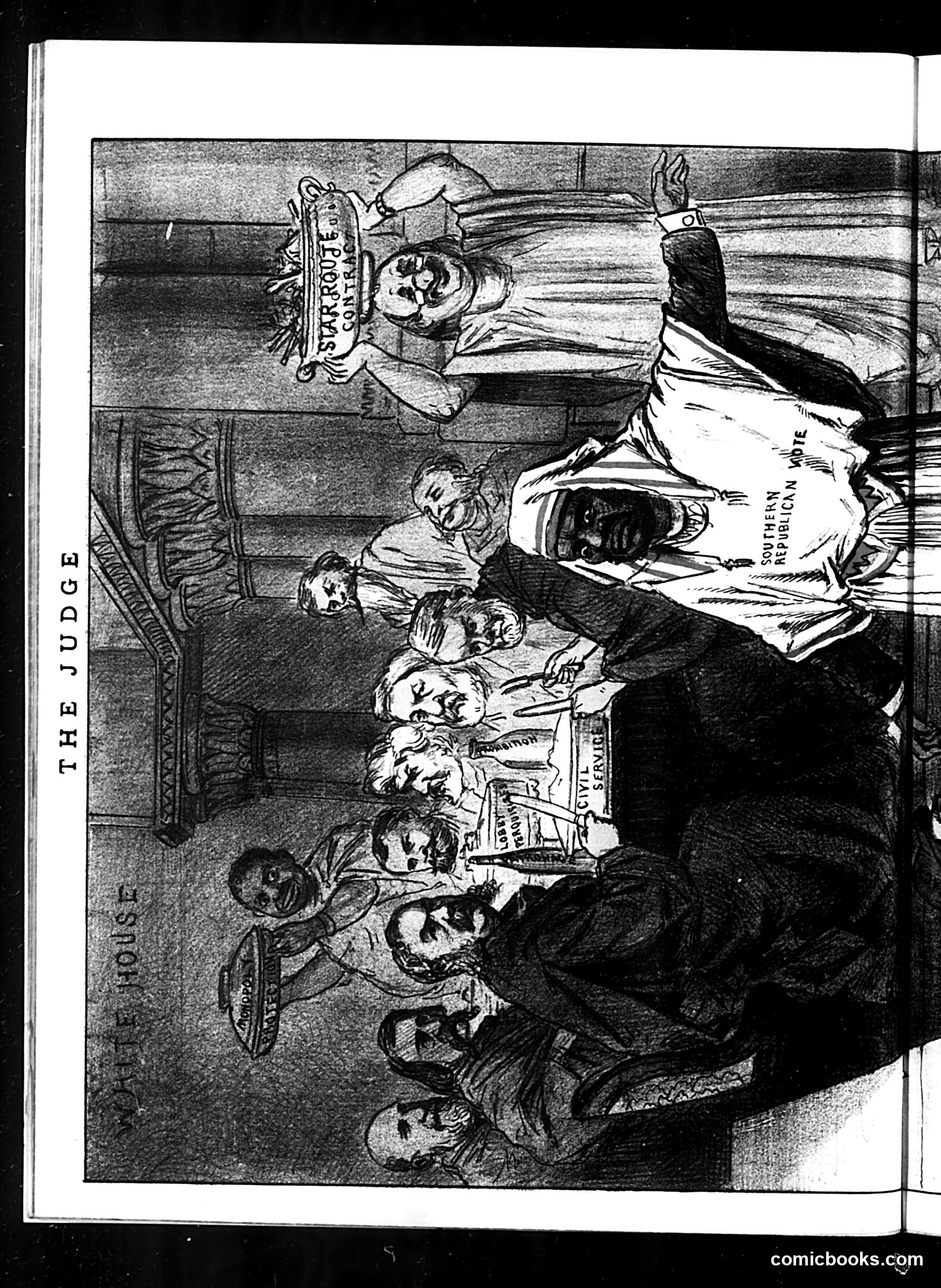
This page appears to be from Judge magazine's satirical comics section. The image shows a courtroom scene titled "THE JUDGE" (visible on the left margin). A rotund judicial figure presides over what appears to be a bench trial, with multiple defendants or parties seated before him. The caricatured style is typical of late 19th/early 20th-century American political satire. However, the OCR text is too garbled to identify specific figures, political references, or the particular case being satirized. Without legible text or clearer identifying markers, I cannot reliably determine which actual judge, legal case, or political controversy this cartoon lampoons. The artwork quality and composition suggest social commentary about the legal system, but specifics remain unclear from this image alone.
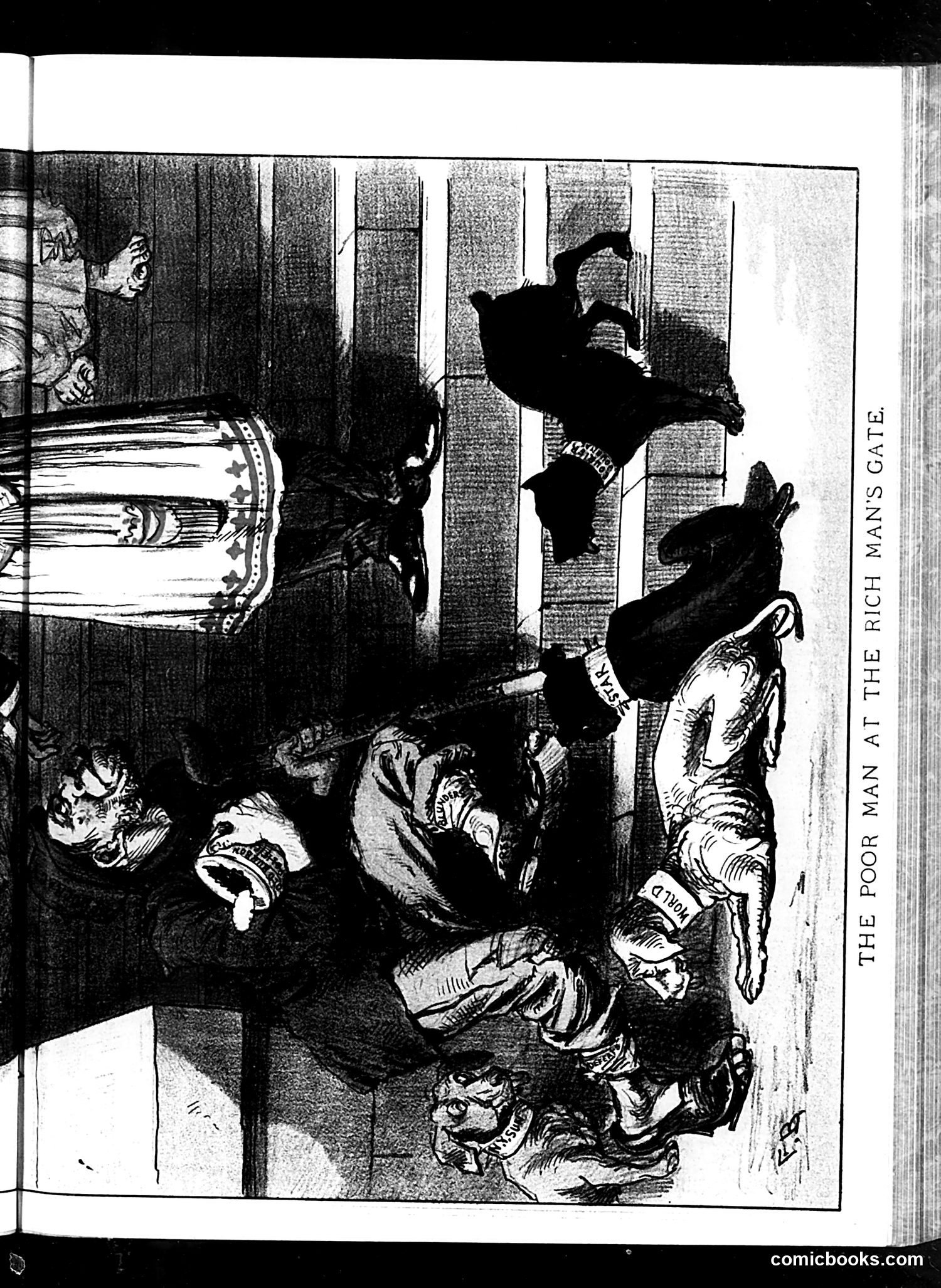
This appears to be a political cartoon critiquing wealth inequality and class barriers. The image shows poor, desperate figures outside an ornate gate or entrance (labeled "THE RICH MAN'S GATE"), seemingly locked out or denied access to wealth and resources represented by the elaborate architectural structure. The satire comments on economic disparity—the visual contrast between the elaborately decorated gate/building and the ragged, struggling poor outside it emphasizes the stark divisions between classes. The cartoon suggests the wealthy actively exclude the poor from opportunity and resources. Without clearer text or additional context, I cannot identify specific historical figures or events this references, but the message about systemic economic barriers and class separation is clear.
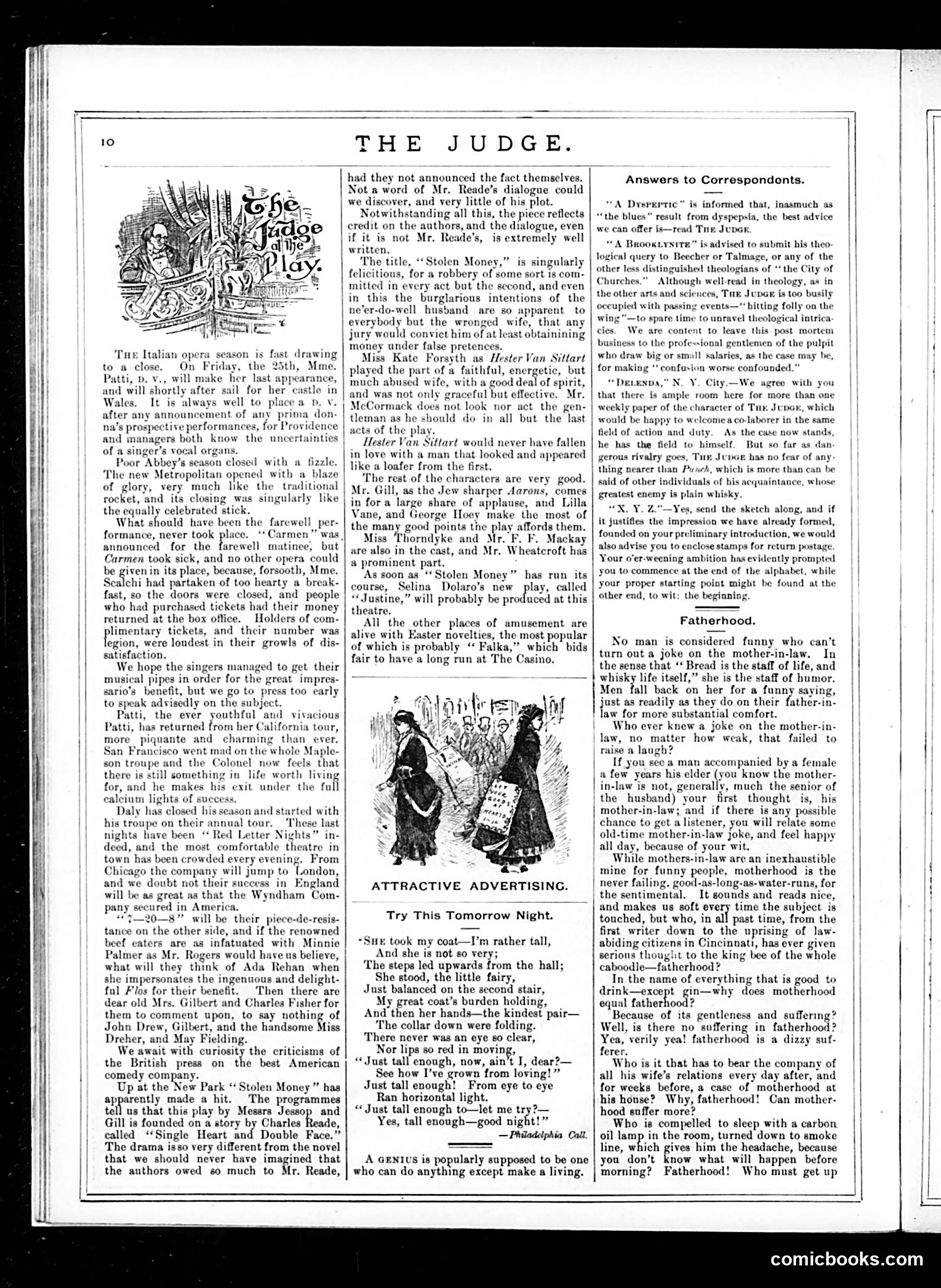
This page from Judge magazine (appears to be late 19th century) reviews the theatrical season, focusing on opera and drama performances. **Main Content:** The text discusses the closing Italian opera season, noting soprano Adelina Patti's final appearance. It mocks the uncertainty of opera singers' vocal reliability by noting "p.v." (presumably "perhaps") should follow any diva announcement. The piece satirizes Metropolitan Opera's opening as flashy but brief ("like the traditional rocket"), and criticizes a cancelled Carmen performance where singer Mme. Scalchi allegedly ate too hearty a breakfast, forcing refunds to paying customers while complimentary ticket holders complained loudest. **The Satire:** The humor targets opera's pretension and the absurdity of professional singers cancelling performances due to digestive issues, while lampooning the entitlement of free-ticket holders who still demanded compensation. **Illustrations:** Small theatrical vignettes appear but lack clear political significance—they seem decorative rather than satirical cartoons.
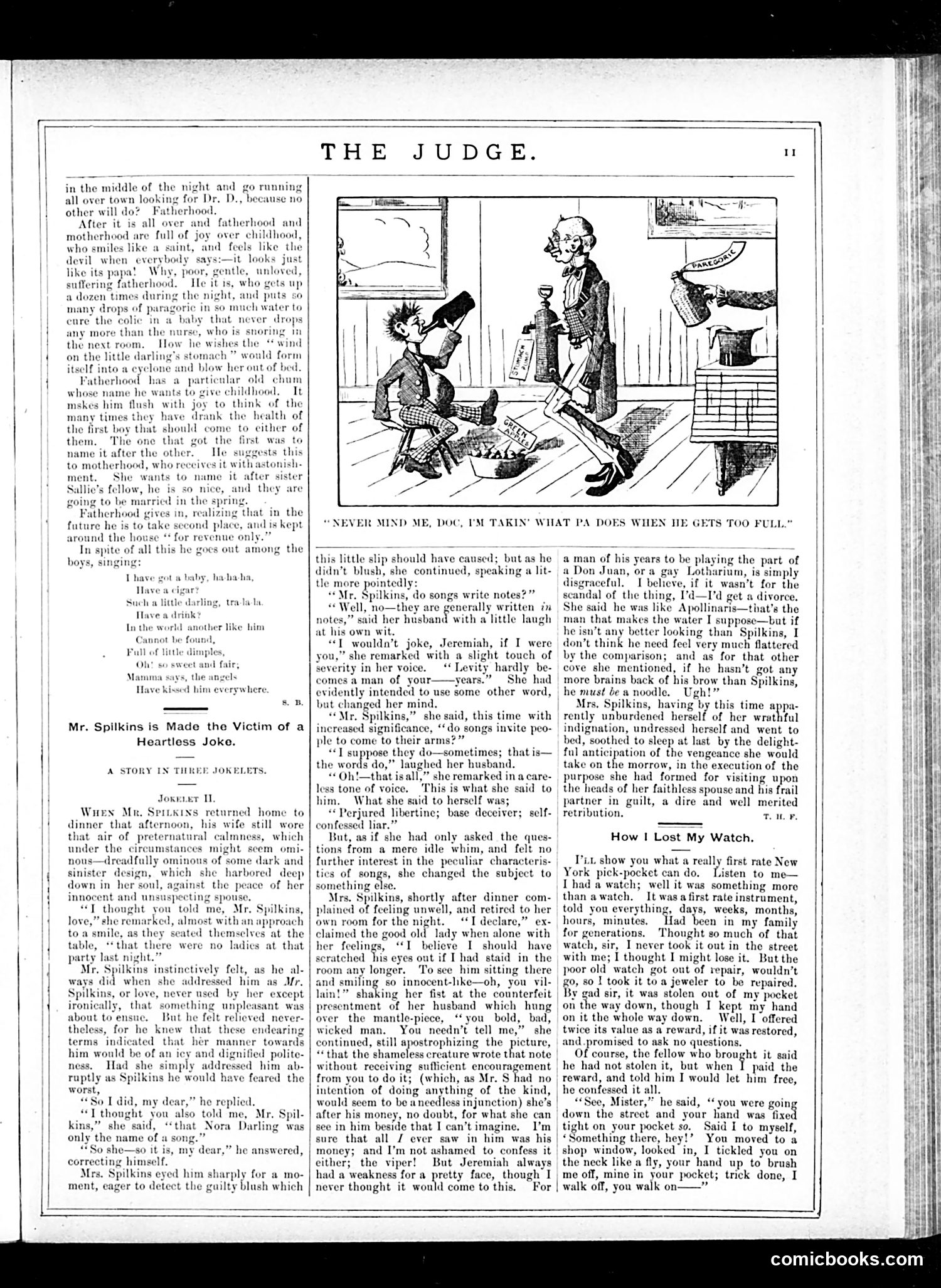
This page from *Judge* magazine contains two distinct pieces: **Top section**: A sentimental essay about fatherhood, illustrated with domestic scenes. It's sarcastic social commentary—describing fathers as suffering "devils" despite society's expectations, enduring sleepless nights and financial burden while pretending joy. The irony undercuts the era's romanticized view of parenthood. **Main story**: "Mr. Spilkins is Made the Victim of a Heartless Joke" depicts marital conflict. Mrs. Spilkins catches her husband, Jeremiah, in what appears to be a lie about attending a party with a woman named Nora Darling. She interrogates him pointedly about whether songs "invite people to their arms"—implying infidelity. The humor derives from his defensiveness and her barely concealed rage (she mentally calls him a "perjured libertine"). The satire targets Victorian marriage dynamics: wives' suspicion, husbands' evasiveness, and the gap between polite conversation and actual thoughts. The "heartless joke" likely refers to domestic manipulation or misunderstanding.
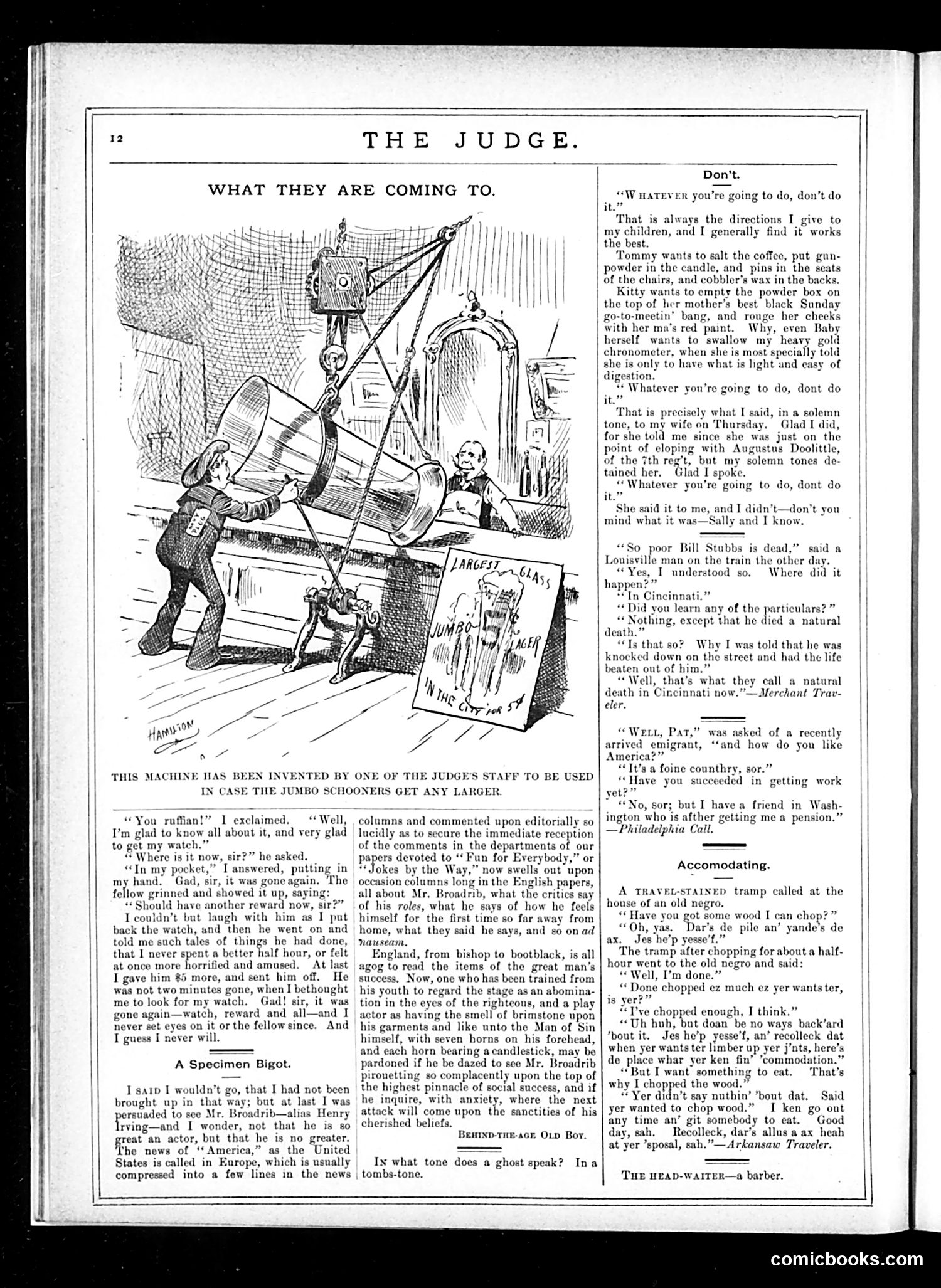
The main cartoon depicts a massive mechanical contraption—a grotesque machine labeled as "invented by one of the Judge's staff" to handle increasingly large "Jumbo Schooners" (beer steins). The joke satirizes the growing size of beer glasses and the excess of drinking culture. The small figure at the machine's base underscores the absurdity of this industrial-scale drinking apparatus. The surrounding text pieces include humorous anecdotes and observations typical of *Judge* magazine's satirical humor. One notable section mocks English fascination with American actor Henry Irving's (performing under the stage name "Broadrib") success, criticizing hypocritical attitudes toward theater among the supposedly pious. Another piece titled "Don't" offers ironic parenting advice, suggesting telling children not to misbehave produces comically opposite results. The overall page exemplifies *Judge*'s brand of social satire through visual caricature and witty commentary on contemporary American culture and behavior.
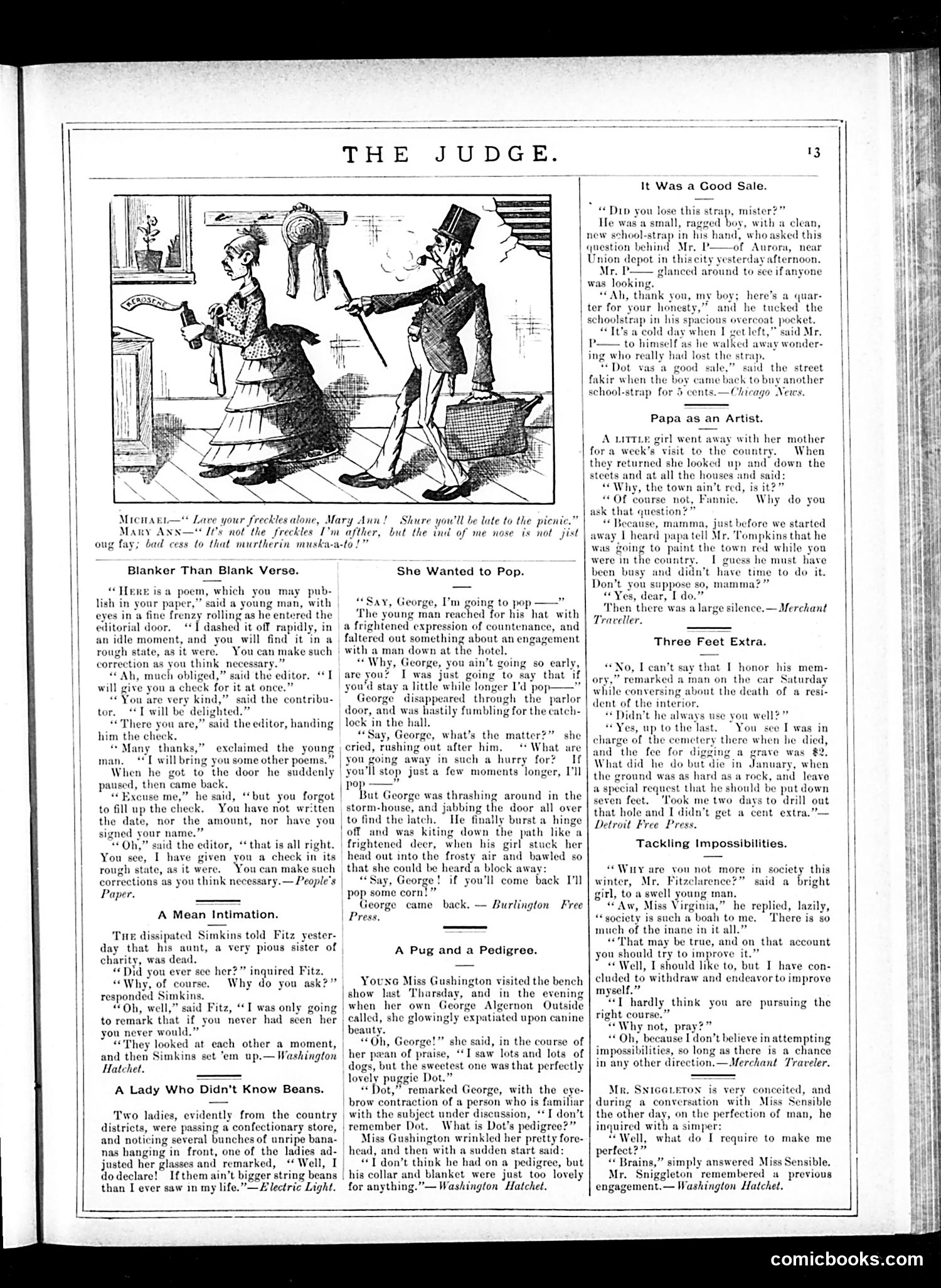
This page from *Judge* presents several brief humorous anecdotes typical of late-19th-century American satirical humor. **The main cartoon** (top) depicts a fashionable couple haggling over a school strap at what appears to be a Union depot. The Irish domestic servant ("Mary Ann") in the background speaks in thick dialect. The joke concerns negotiation—the man and woman are literally bargaining over price. **The text pieces below** are short comic stories exploiting wordplay and social misunderstandings: - "Blanker Than Blank Verse" mocks aspiring poets and editorial politeness - "She Wanted to Pop" plays on double meaning—the young woman repeatedly asks George to stay and "pop" corn, but he interprets this as a marriage proposal and flees - "A Pug and a Pedigree" ridicules a fashion-obsessed woman who confuses a dog's blanket with its pedigree - Other brief pieces satirize rural ignorance, pretentious contributors, and social awkwardness The humor relies on class distinctions, miscommunication, and mocking various American types—country folk, social climbers, and absurd urbanites.
This page consists primarily of **short humorous anecdotes and one-liners** rather than political cartoons. The content reflects late 19th-century American humor targeting working-class life and racial stereotypes. The main pieces mock: 1. **"Who Turn Dat Hog Loose"** - A white traveling salesman tricks a Black waiter (Jim) out of a promised tip. The humor relies on racial stereotyping of dialect and supposed gullibility. 2. **"He Wanted Soap"** - A traveler's request for soap is comically misunderstood as "soup" by a proprietor unfamiliar with hygiene standards at a cheap lodging house, ending absurdly with the traveler's death. The remaining items are brief satirical jabs at various subjects—Susan B. Anthony, marriage, and journalistic errors—typical of Judge's miscellaneous humor format. The advertisements below (Pennyroyal Pills, Baker's Blood Food) indicate this magazine targeted middle-class readers concerned with health remedies and patent medicines.
This is primarily an **advertising page** from Judge, a late 19th-century satirical magazine. The page contains numerous commercial advertisements (pianos, candy, medical treatments, carriages) interspersed with brief humorous editorial items typical of the publication. The humor relies on social observation rather than political satire: - A quip about London police jailing Irish suspects after an earthquake reflects anti-Irish prejudice common at the time - A joke about women wearing veils downtown and not being recognized pokes fun at female fashion and vanity - Commentary on whether the Earth can support its growing population reflects contemporary anxiety about overpopulation - A dialect piece stereotyping Arkansas speech patterns - Anecdotes about a Boston sunset, children's dinner table behavior, and a preacher who's an expert marksman **The cartoons** appear minimal on this page—primarily "The Sensitive Mermaid" advertisement dominates the lower left. Most content is text-based humor rather than visual satire. This was typical for Judge: a mix of ads and short jokes appealing to middle-class readers' everyday concerns and social prejudices.
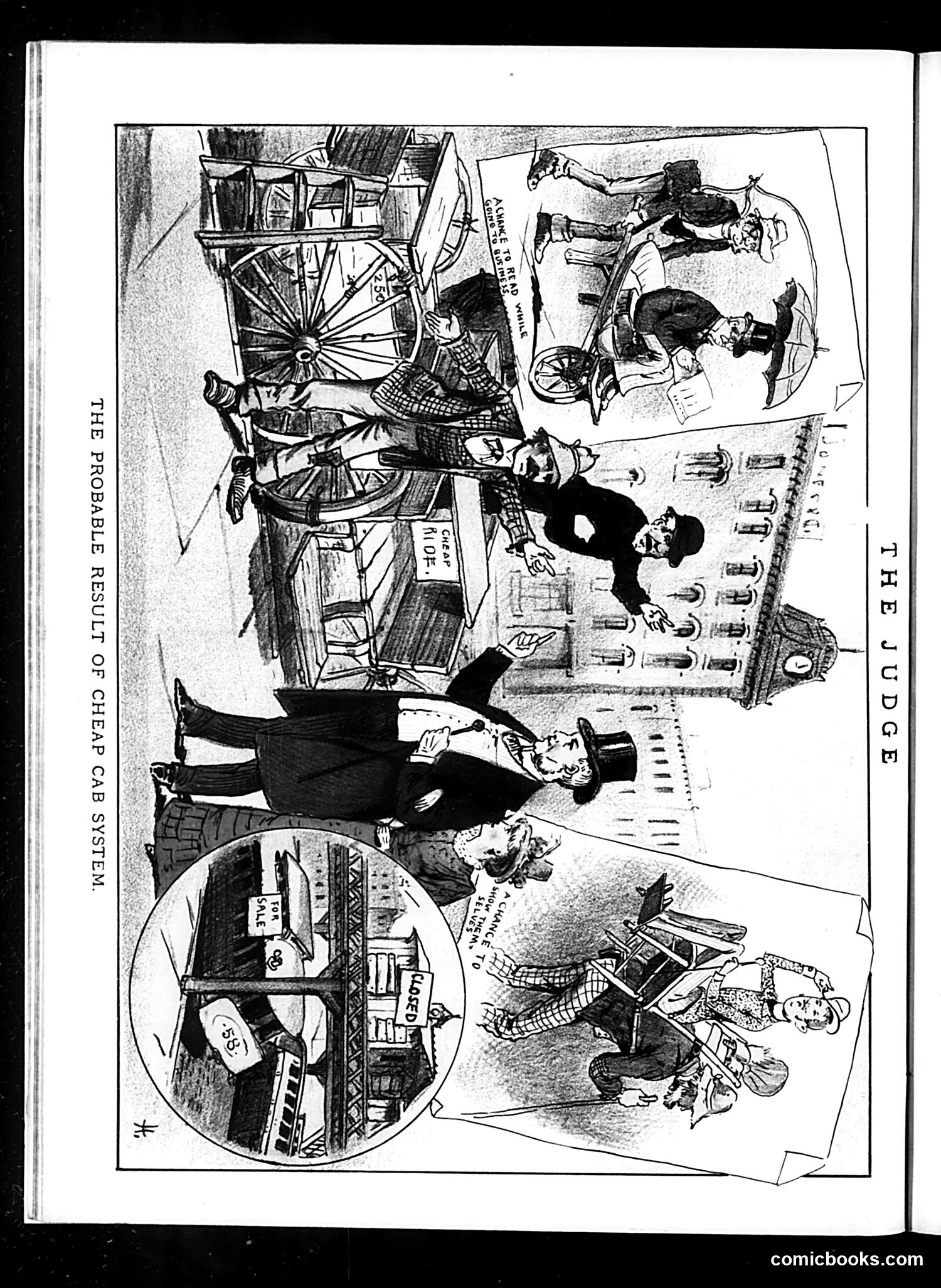
This satirical cartoon depicts the chaos of an inexpensive taxi service. The image shows multiple scenes of disorder: vehicles colliding, passengers in disarray, and general pandemonium on city streets. The central figure appears to be a well-dressed man (possibly representing a cab company operator or city official) observing the mayhem. The satire mocks the unintended consequences of introducing cheap cab fares—rather than improving urban transportation, the system creates dangerous, chaotic conditions with reckless driving and accidents. The cartoon criticizes what the artist sees as false economy: cutting costs on cab services produces worse public safety outcomes than maintaining higher standards. This reflects late 19th/early 20th-century anxieties about rapid urban motorization and competitive transportation markets.