
Judge, 1884-04-26 · page 10 of 16
Judge — April 26, 1884 — page 10: what you’re looking at
What you’re looking at
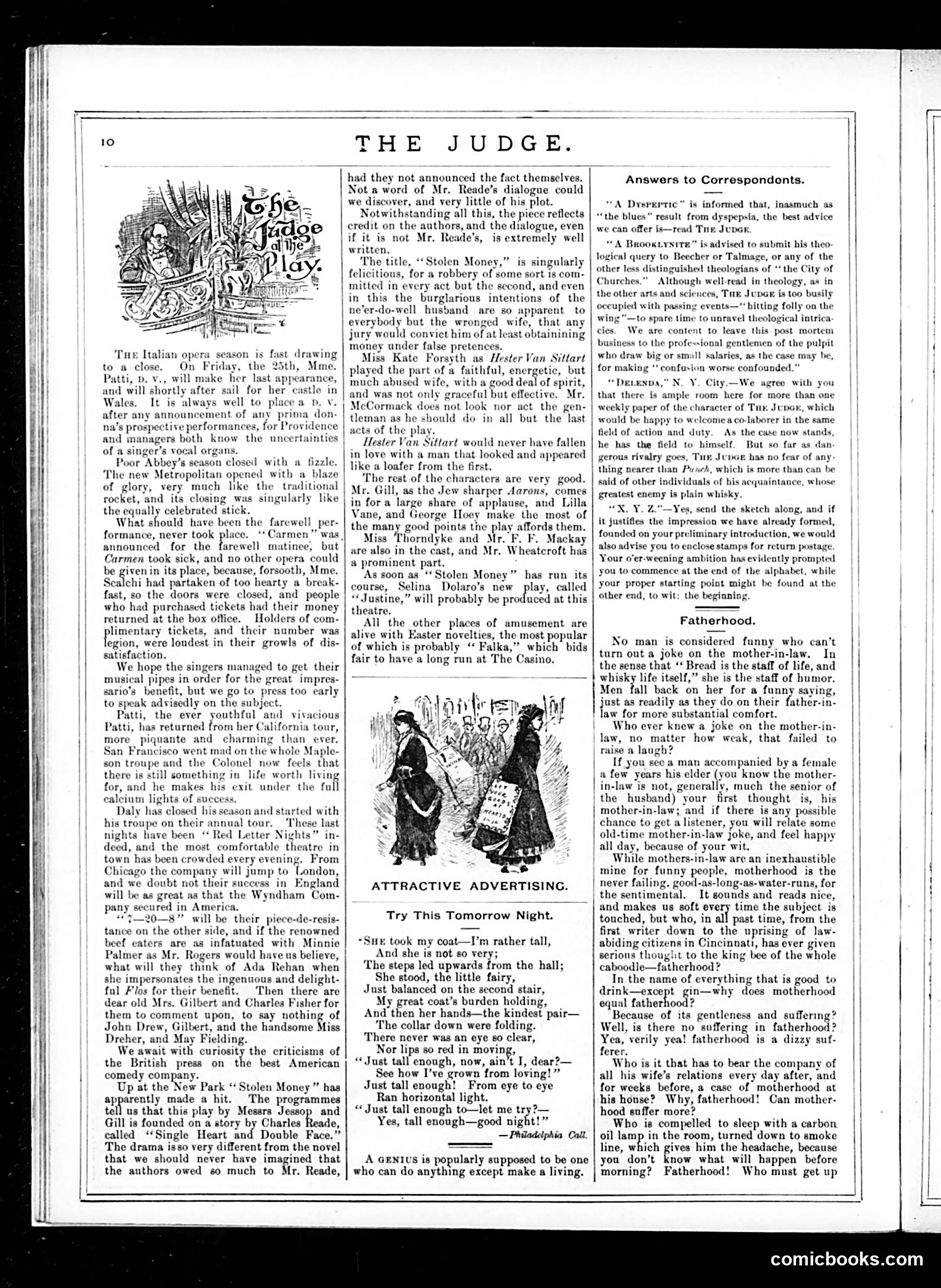
This page from Judge magazine (appears to be late 19th century) reviews the theatrical season, focusing on opera and drama performances. **Main Content:** The text discusses the closing Italian opera season, noting soprano Adelina Patti's final appearance. It mocks the uncertainty of opera singers' vocal reliability by noting "p.v." (presumably "perhaps") should follow any diva announcement. The piece satirizes Metropolitan Opera's opening as flashy but brief ("like the traditional rocket"), and criticizes a cancelled Carmen performance where singer Mme. Scalchi allegedly ate too hearty a breakfast, forcing refunds to paying customers while complimentary ticket holders complained loudest. **The Satire:** The humor targets opera's pretension and the absurdity of professional singers cancelling performances due to digestive issues, while lampooning the entitlement of free-ticket holders who still demanded compensation. **Illustrations:** Small theatrical vignettes appear but lack clear political significance—they seem decorative rather than satirical cartoons.
📄 Transcribed text from this page (OCR, searchable)
Machine-transcribed from the original scan — historical spelling and the odd misread are preserved.
‘Tue: Italian opera season is fast drawing On Friday, the 25th, Mme. Patti, p. v., will make her last appearance, and will shortly after sail for her tle in Wales. It is always well to placea p. v. after any announcement of any prima don- na’s prospective performance r Providence and managers both know the uncertainties of a singer's vocal organs. oor Abbey’s season closed with a fizzle. ‘The new Metropolitan opened with a blaze of glory, very much like the traditional rocket, and its closing was singularly like the equally celebrated stic What should have been th formance, never took place. announced for the Farewell matinee, but Carmen took sick, and no other opera could be given in its place, because, forsooth, Mme. Scalchi had partaken of too hearty a break- fast, s0 the doors were closed, and people who had purchased tickets had their mone: returned at the box office. Holders of com. plimentary tickets, and their number was legion, were loudest in their growls of dis- satisfaction. We hope the singers managed to get their musical pipes in order for the great impres- sario’s benefit, but we go to press too early to speak advisedly on the subject. Patti, the ever youthful and vivacious ti, has returned from her California tour, more piquante and charming than ever. San Francisco went mad on the whole Muple- son troupe and the Colonel now feels that there is still something in life worth living for, and he makes his exit under the tall calcium lights of succes Daly has closed his season and s his troupe on their annual tour. farewell per= rted with These last nights have been ‘‘ Red Letter Nights” in- deed, and the most comfortable theatre in town has been crowded every evening. From Chicago the company will jump to London, and we doubt not their success in England will be as great as that the Wyndham Com- pany secured in America. “7—20—8" will be their piece-de-resis- tance on the other side, and if the renowned beef eaters are as infatuated with Minnie Imer as Mr. Rogers would have us believe, what will they think of Ada Rehan when she impersonates the ingenuous and delight- fal Flos for their benefit. Then there are dear old Mrs. Gilbert and Charles Fisher for them to comment upon, to say nothing of John Drew, Gilbert, and the handsome Miss Dreher, and May Fielding. We await with curiosity the criticisms of the British press on the best American comedy company. Up at the New Park “Stolen Money” has apparently made a hit. The programmes tell us that this play by Messrs Jessop and Gill is founded on a story by Charles Reade, called “Single Heart and Double Face.” The drama isso very different from the novel that we should never have imagined that the authors owed eo much to Mr. Reade, ‘Carmen ” was | THE JUDGE. had they not announced the fact themselves. Not a word of Mr. Reade’s dialogue could we discover, and very little of his plot. Notwithstanding all this, the piece reflects credit on the authors, and the dialogue, even | written, The title, “Stolen Money,” is singularly felicitions, for a robbery of some sort is com- | mitted in every act but the second, and even jin this the burglarious intentions of the | ne’er-do-well husband are so upparent to | 1 | everybody but the wronged wife, that any jury would convict him of at least obtainining money under false pretences. Miss Kate Forsyth as Hester Van Sittart played the part of a faithful, energetic, but much abused wife, with a good deal of spirit, and was not only graceful but effecti Mr. McCorm: does not look nor act the gen- tleman as he should do in all but the last | acts of the play. Hester Van Sittart would never have fallen in love with a man that looked and appeared like a loafer from the first. ‘The rest of the characters are very good. | Mr. Gill, as the Jew sharper Aarons, comes in fora large share of applause, and Lilla Vane, and George Hoey make the most of the many good points the play affords them. Miss Thorndyke and Mr. F. F. ¥ are also in the cast, and Mr. Wheatcroft has a prominent part. As soon as “Stolen Money” has run its course, Seli Dolaro’s new pl called “Justine,” will probably be produced at this theatre. All the other places of amusement are alive with Easter novelties, the most popular of which is probably ‘ Falka,” which bids fair to have a long run at The Casino. ATTRACTIVE ADVERTISING. Try This Tomorrow Night. 3HE took my coat—I’m rather tall, | And she is not so very; ‘The steps led upwards from the hall; She stood, the little fairy, Just balanced on the second stair, My great coat’s burden holding, And then her hands—the kindest pair— The collar down were folding. (here never was an eye so clear, Nor lips so red in moving, “Just tall enough, now, ain't I, dear?— See how I’ve grown from loving!” Just tall enough! From eye to eye Ran horizontal light. “ Just tall enough to—let me try?— Yes, tall enough—good night!” —Philadelphia Call. A GENIUS is popularly supposed to be one who can do anything except make a living. if it is not Mr, Reade’s, is extremely well | Answers to Correspondonts. “A Dvsrertic” is informed that, inasmuch as “the blues” result from dyspepsia, the best advice we can offer is—read The JupGr. “A BrooxtysiTe” is advised to submit his theo- logical query to Beecher or Talmage, or any of the other less distinguished theologians of “the City of Churches." Although well-read in theology, as in the other arts and sc ‘Tie Juve is too busily occupied with passing events—“ hitting folly on th wi to spare time to unravel theological intrica. cies. We are content to leave this post mortem | business to the professional gentlemen of the pulpit who draw big or small for making , as the ca confusion worse confound: "N.Y. City.—We agree with you is ample room here for more than one weekly paper of the character of Tar, Jupae, which would be happy to welcome a co-laborer in the same field of action and duty. As the case now stands, he has the field to himself, But so far as dan gerous rivalry gocs, Tie Jupor has no fear of any- | thing nearer than Punch, which is more than can be said of other individuals of his acquaintance, whose greatest enemy is plain whisky “X.Y. Z."—Yeg, send the sketch along, and if it justifies the impression we have already formed, founded on your preliminary introduction, we would also advise you to enclose stamps for return postage. | Your o'er-weening ambition has evidently prompted you to commence at the end of the alphabet, while your proper starting point might be found at the other end, to wit: the beginning. Fatherhood. No man is considered funny who can’t turn out a joke on the mother-in-law, In the sense that ‘‘ Bread is the staff of life, and whisky life itself,” she is the staff of humor. Men att back on her for a funny saying, just as readily as they do on their father-in- law for more substan’ comfort. Who ever knew a joke on the mother-in- law, no matter how weak, that failed to raise a laugh? | Ifyou sec a man accompanied by a female a few years his elder (you know the mother- in-law is not, generally, much the senior of the husband) your first thought his mother-in-law; and if there is any possible | chance to get a listener, you will relate some | old-time mother-in-law joke, and feel happy all day, because of your wit. | While mothers-in-law are an inexhaustible mine for funny people, motherhood is the | never failing. good-as-long-as-water-runs, for | the sentimental. It sounds and reads nice, and makes us soft every time the subject is touched, but who, in al past time, from the first writer down to the uprising of law- abiding citizens in Cincinnati, has ever given serions thouglit to the king bee of the whole caboodle—fatherhood ? In the name of everything that is good to drink—except gin—why does motherhood equal fatherhood Because of its gentleness and suffering? Well, is there no suffering in fatherhood? Yea, verily yea! fatherhood is a dizzy suf- ferer. Who is it that has to bear the company of all his wife’s relations every day after, and for weeks before, a case of motherhood at his honse? Why, fatherhood! Can mother- hood suffer more? Who is compelled to sleep with a carbon oil lamp in the room, turned down to smoke line, which gives him the headache, because you don’t know what will happen before morning? Fatherhood! Who must get up comicbooks.com | {