
A complete issue · 17 pages · 1884
Judge — April 12, 1884
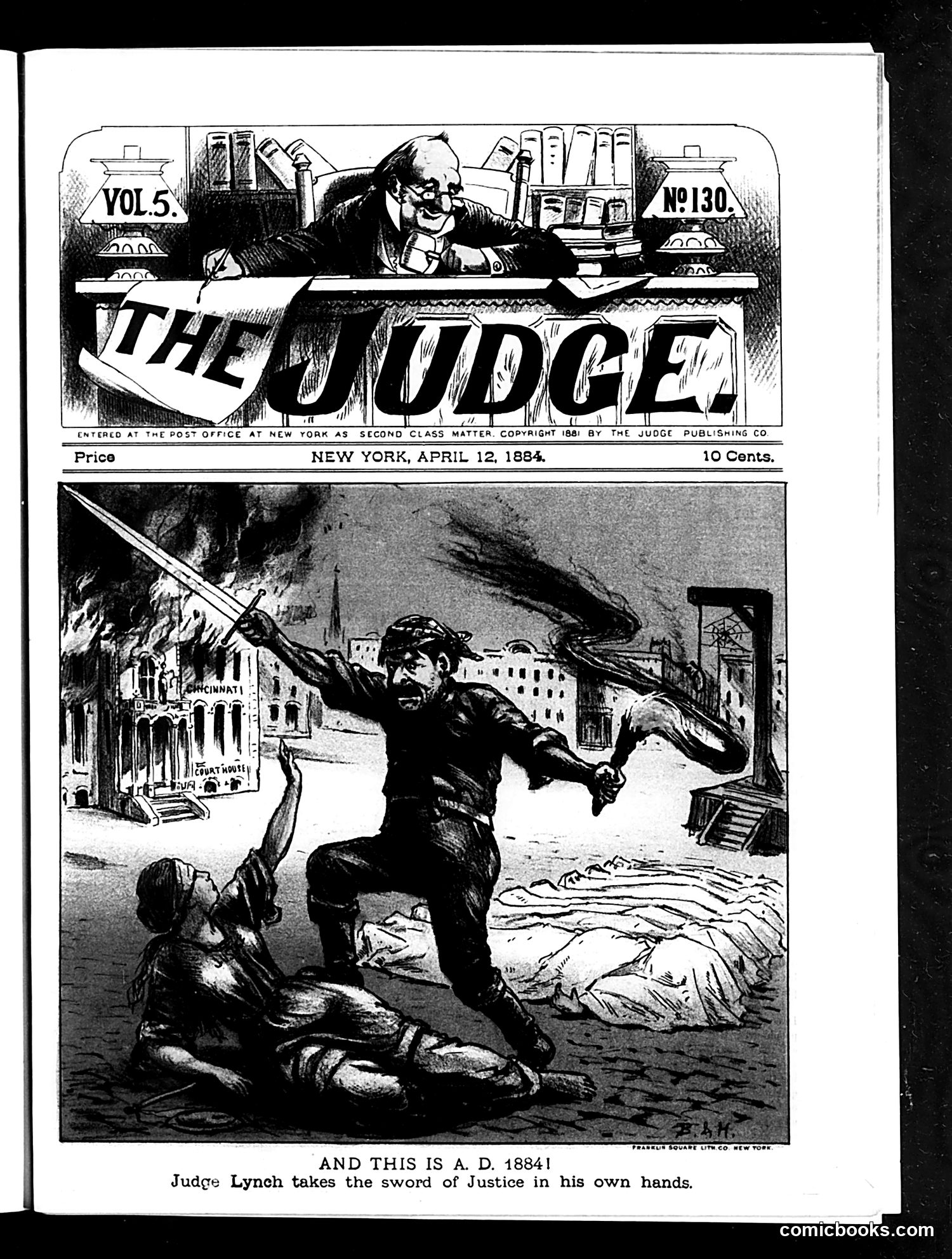
This cartoon critiques **vigilante justice in Cincinnati**. The caption "AND THIS IS A.D. 1884! Judge Lynch takes the sword of Justice in his own hands" refers to "Judge Lynch"—a contemporary euphemism for mob justice/lynching. The image depicts a violent scene where a bearded man wielding a sword attacks prone figures in an urban setting (Cincinnati is labeled). The contrast between the modern 1884 date and the primitive violence satirizes how American civilization has supposedly progressed, yet vigilantism persists. The cartoon likely references a specific lynching incident in Cincinnati around 1881-1884. The masthead shows a smug editor at his desk, suggesting Judge magazine's role in documenting or condemning such lawlessness. The satire implies American justice institutions have failed, forcing citizens into barbarism.
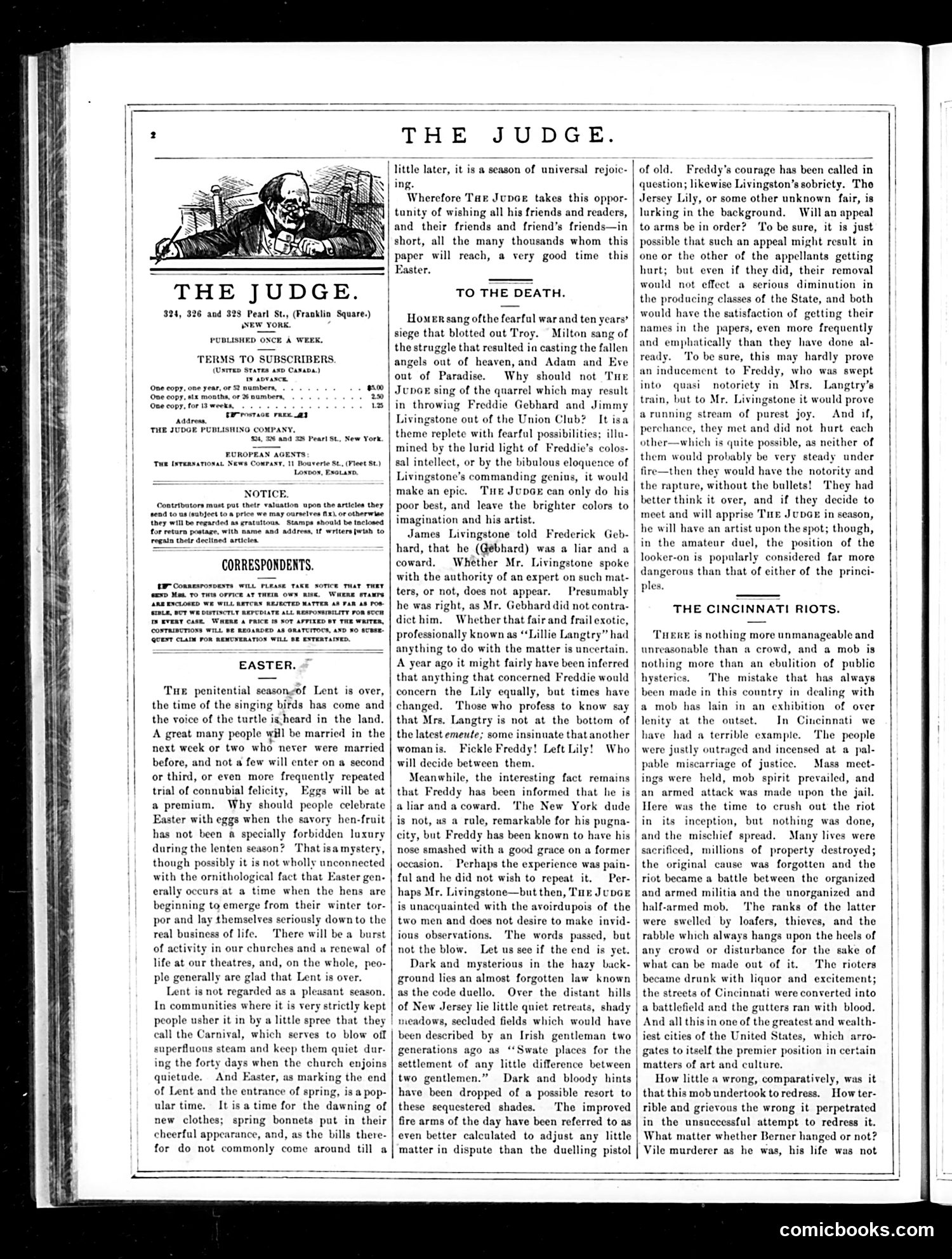
This page from Judge magazine contains two main pieces. The first is an Easter editorial wishing readers well during the spring holiday season—light, celebratory content about renewal and new clothes. The second, titled "To the Death," is satirical commentary on a quarrel between two wealthy New York society figures: **Freddie Gebhard and Jimmy Livingstone**, members of the exclusive Union Club. Livingstone allegedly called Gebhard a "liar and coward." The satire mocks this petty society dispute by comparing it grandiose to Homer's Trojan War and Milton's *Paradise Lost*—treating a gentlemen's club squabble as if it were epic literature. The piece ridicules both men's intellects (describing Livingstone's "bibulous eloquence" and Gebhard's "colossal intellect" mockingly) while questioning the seriousness and actual basis of Livingstone's insult. It's witty social satire targeting the pretensions of wealthy New York elites.
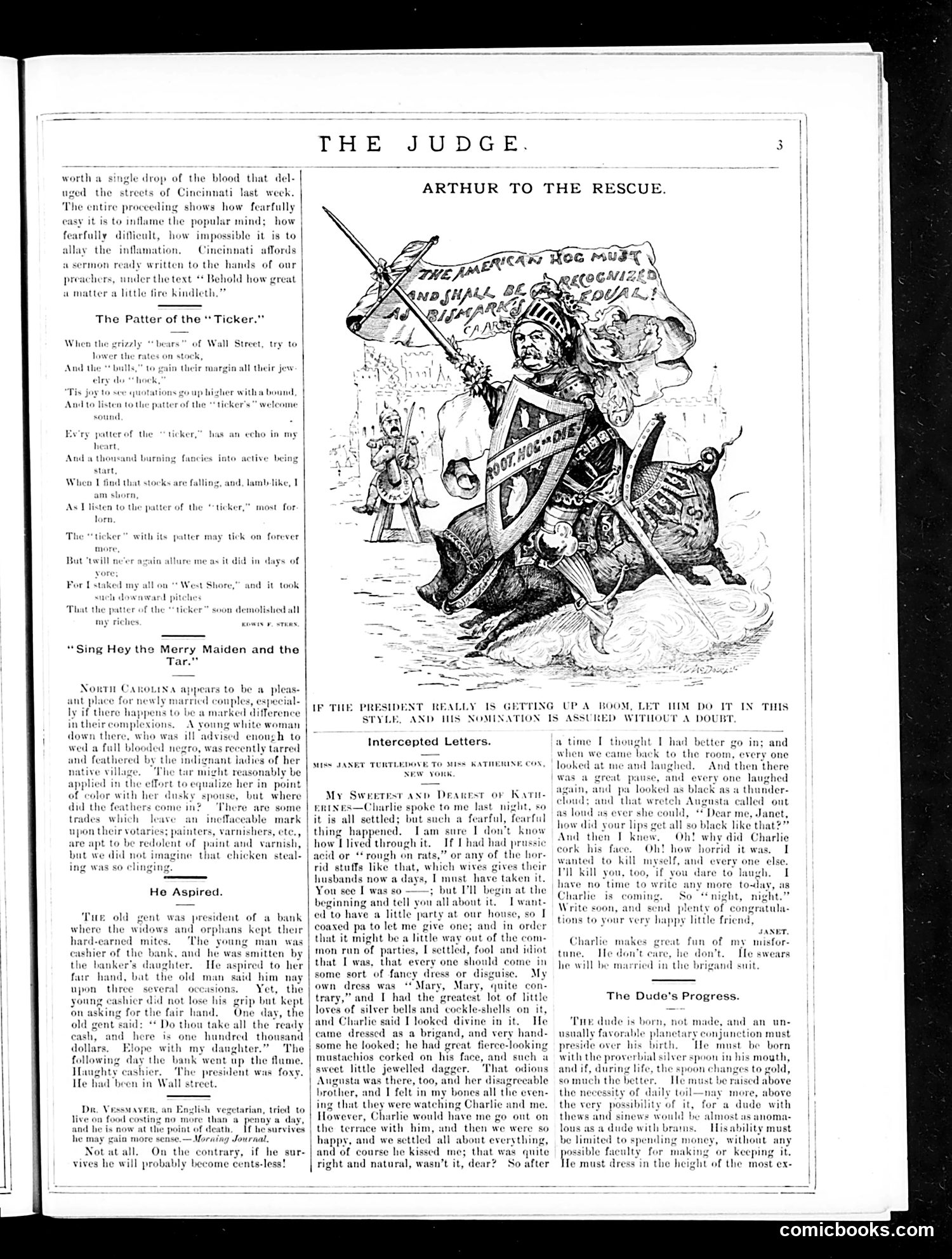
This political cartoon depicts **President Arthur** wielding a sword to defend American institutions (represented by the female figure labeled with references to "American" and various national symbols) from attack. The cartoon is likely from the early 1880s, during Chester Arthur's presidency. The satire appears to criticize Arthur's effectiveness as president. The caption sarcastically suggests that if Arthur is "really getting up a boom" for his nomination, he should do it "in this style"—implying that his actual political efforts are far less forceful or impressive than this heroic sword-wielding image suggests. The accompanying text discusses Cincinnati violence (likely the 1884 riots) and Wall Street financial matters, suggesting the cartoon addresses both civil unrest and economic concerns of the era—areas where Arthur's leadership was viewed skeptically by this satirical publication.
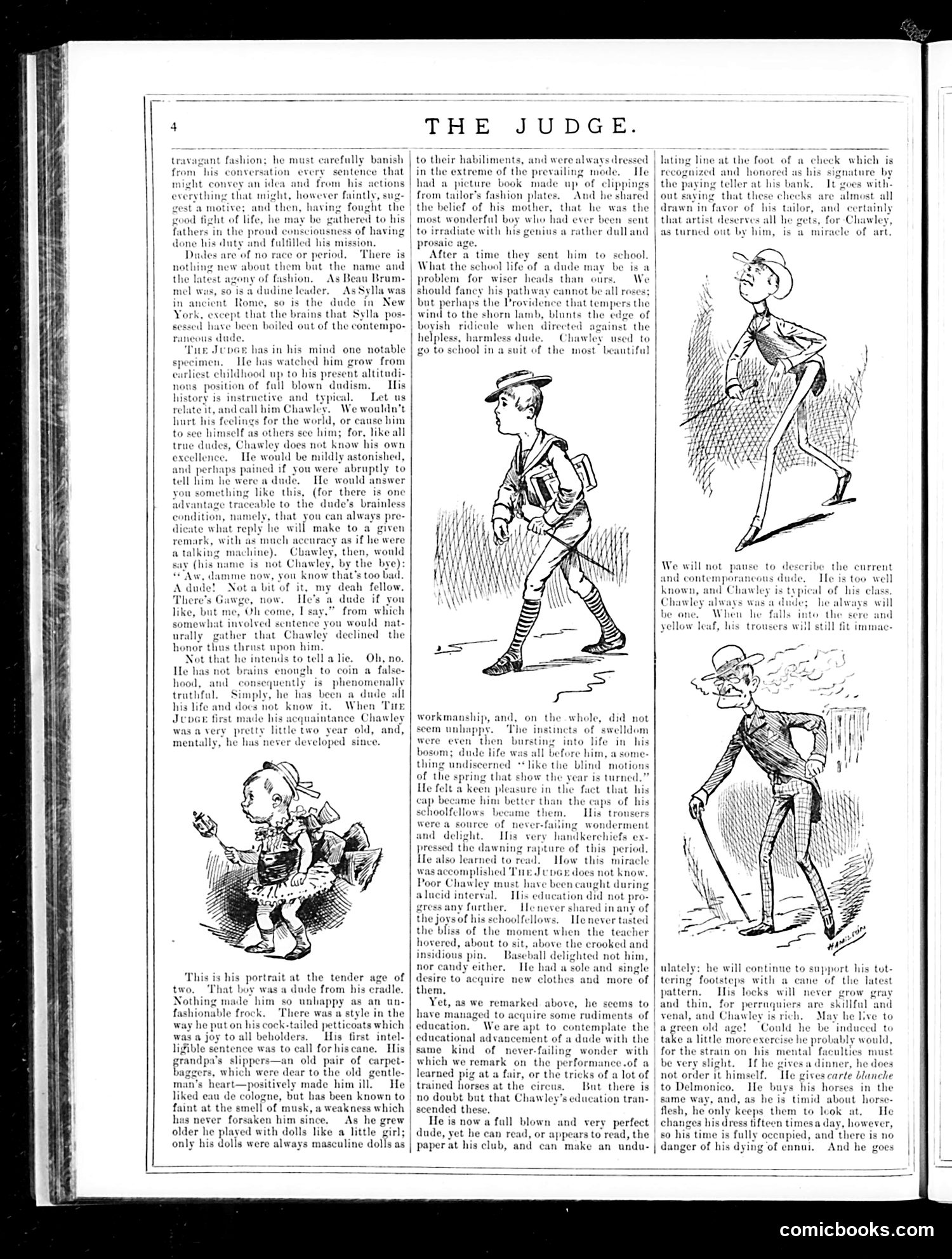
This piece satirizes the "dude"—a fashionable, style-obsessed young man who represents shallow materialism and arrested development. The character "Chawley" is the specimen under examination. The satire's targets include: **The figure**: An exaggerated dandy obsessed exclusively with clothing, grooming, and appearance from infancy onward. He faints at the smell of musk, demands eau de cologne, and judges himself by his wardrobe rather than character or intellect. **The joke**: Chawley has never mentally developed beyond age two, yet remains oblivious to his own ridiculousness. The text notes he "does not know it" when told he's a dude—his vanity prevents self-awareness. **Social commentary**: Judge mocks 1880s-1890s fashion culture and the leisure-class preoccupation with style over substance. The accompanying illustrations show exaggerated, spindly-legged figures in absurd outfits, emphasizing the dude's physical and moral weakness. The piece suggests that unchecked materialism and fashion-obsession represent a kind of permanent childishness—a failure to develop genuine character or accomplishment.
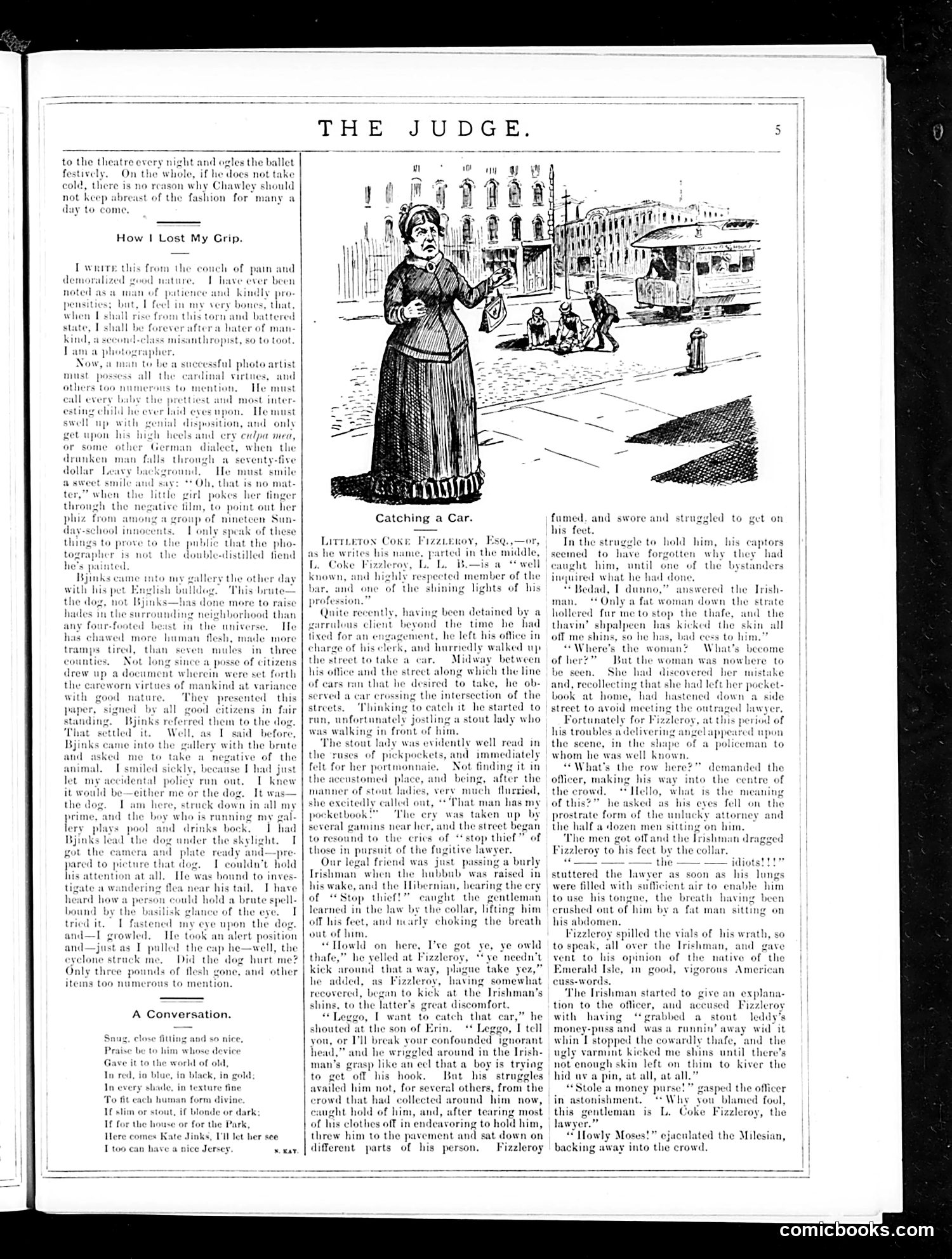
This page contains two stories. The main illustrated piece, "Catching a Car," satirizes urban chaos and mistaken identity in a large city (appears to be New York). **The Setup:** Littileton Coke Fizzleroy, a respectable lawyer, rushes to catch a streetcar. He accidentally jostles a stout woman, who cries "Stop thief!" thinking he's picked her pocket. The cry spreads through the crowd. **The Satire:** A burly Irishman grabs Fizzleroy by the collar, nearly choking him. Other bystanders pile on, wrestling and tearing his clothes. The irony: the woman's pocket-book was never stolen—she'd simply left it at home. By the time everyone realizes the mistake, Fizzleroy is bruised and humiliated. **The Point:** The cartoon mocks mob mentality, the ease with which false accusations spread in crowded cities, and the indignity suffered by respectable citizens caught in urban misunderstandings. It's social commentary on how quickly civility collapses in public spaces.
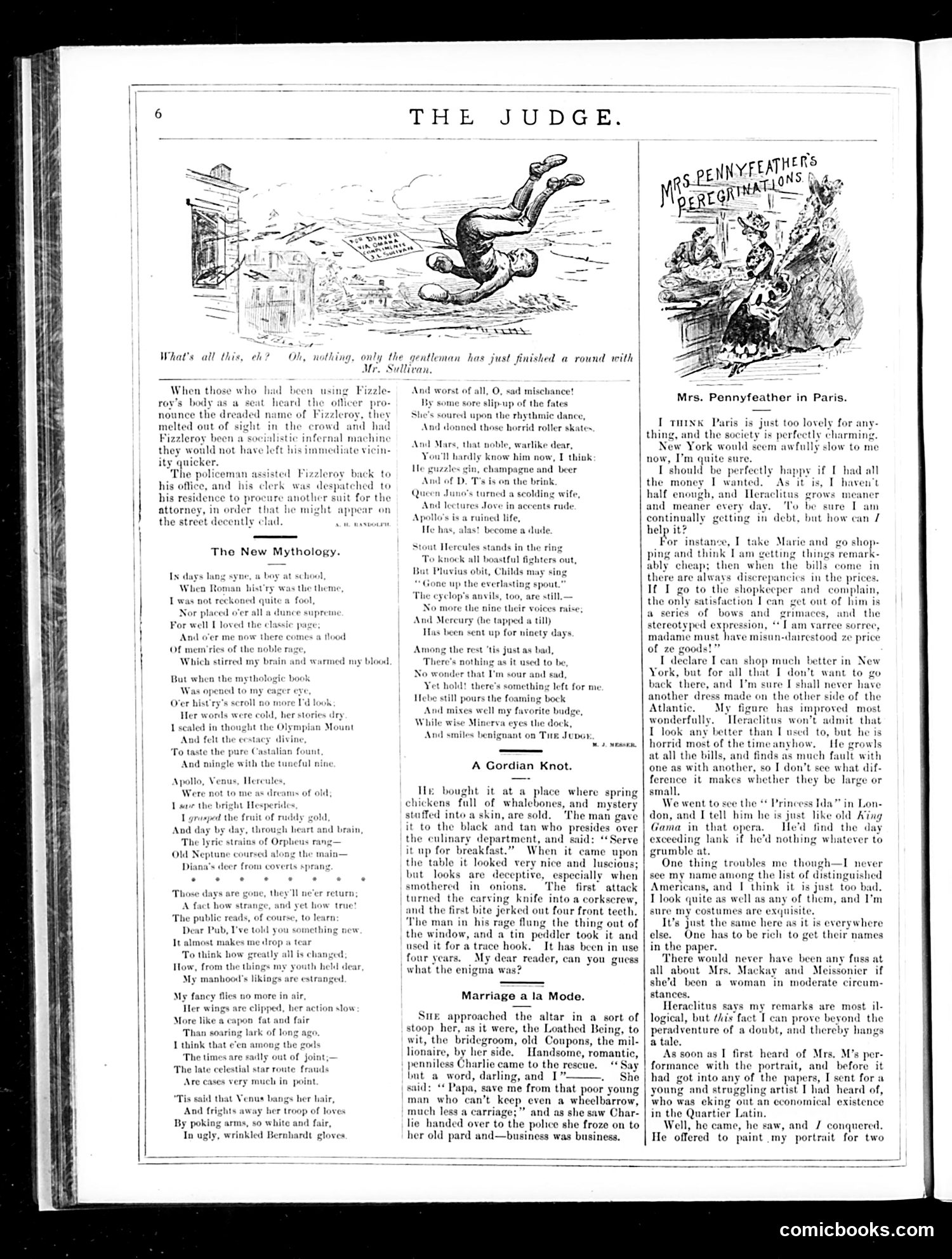
This page from the satirical magazine *Judge* contains three distinct pieces of social satire: **"The New Mythology"** (poem): A nostalgic lament that classical mythology has been replaced by modern concerns. The poet mourns that gods like Mars now box (likely referencing John L. Sullivan, a famous boxer), Mercury works as a till operator, and Hercules fights professionally—reducing noble classical ideals to vulgar contemporary pursuits like prizefighting and commerce. **"A Gordian Knot"** (short story): Dark humor about an indigestible mystery meat dish that destroys teeth and utensils, ultimately repurposed as a fishing hook—satirizing questionable restaurant food quality. **"Marriage à la Mode"** (story): Social commentary on mercenary marriage, where a poor but "romantic" suitor (Charlie) is rejected because he "can't keep even a wheelbarrow," while a wealthy but "loathed" millionaire (Coupons) wins the bride purely for financial security. The page satirizes the degradation of classical values, food safety, and romantic idealism in modern American society.
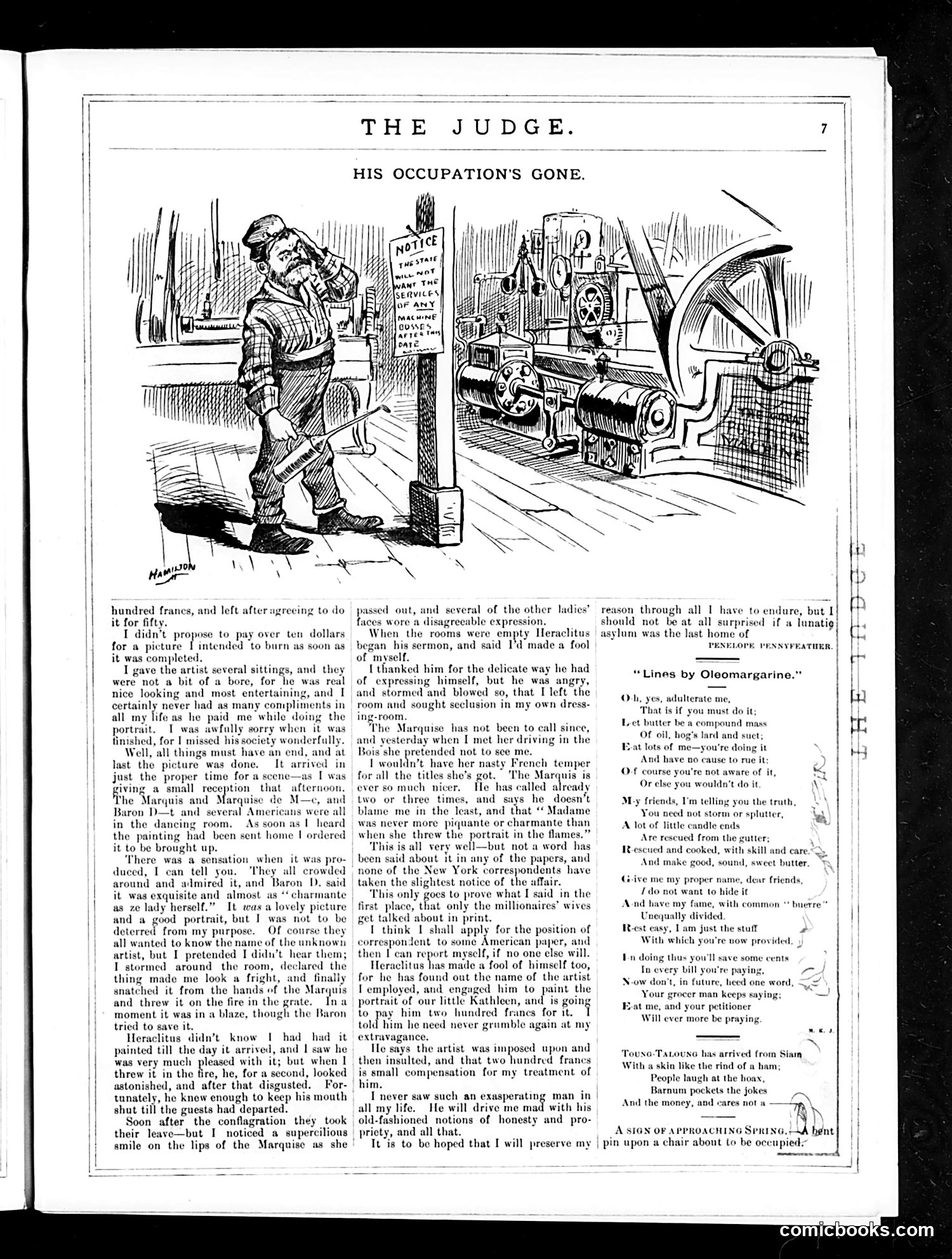
The cartoon depicts a judge standing idle beside industrial machinery, symbolizing that his traditional role has become obsolete. The title plays on the phrase "his occupation's gone"—suggesting the judge's authority or relevance has vanished. The satire likely critiques either the erosion of judicial power (possibly during a period of political turbulence or reform), or comments on how mechanization and industrialization were displacing established institutions and professional roles. The contrast between the stationary, contemplative judge and the active machinery suggests that progress and modernization have rendered him irrelevant. The accompanying text appears to be a serialized society story unrelated to the cartoon's political commentary. Without additional historical context about when this *Judge* issue was published, the specific target of this satire—whether it addresses a particular judge, judicial reform, or broader institutional anxiety—remains unclear.
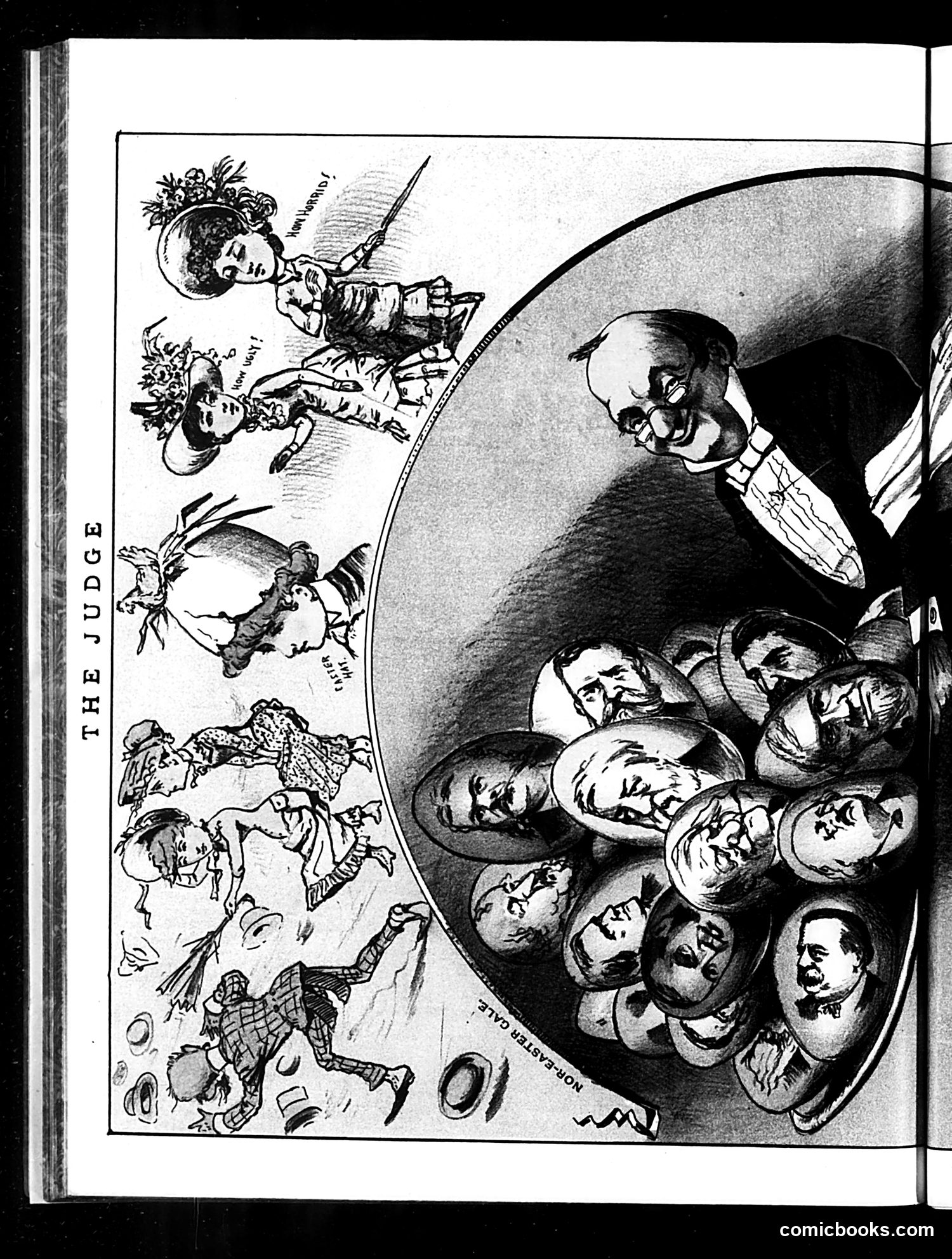
This page features "The Judge," a satirical cartoon with the heading "THE JUDGE" visible on the left side. The left panel shows multiple caricatured figures in various poses of apparent chaos or disorder. The right panel depicts a judge or authority figure looking down upon a crowd of distorted faces clustered together below. The satire appears to critique judicial or governmental authority, possibly commenting on how judges or the legal system regard common citizens or defendants. The exaggerated facial expressions and crowded composition suggest mockery of either incompetence, corruption, or the disconnect between authority figures and those subject to their judgment. However, without additional context about the publication date or specific historical events referenced, the precise political target remains unclear.
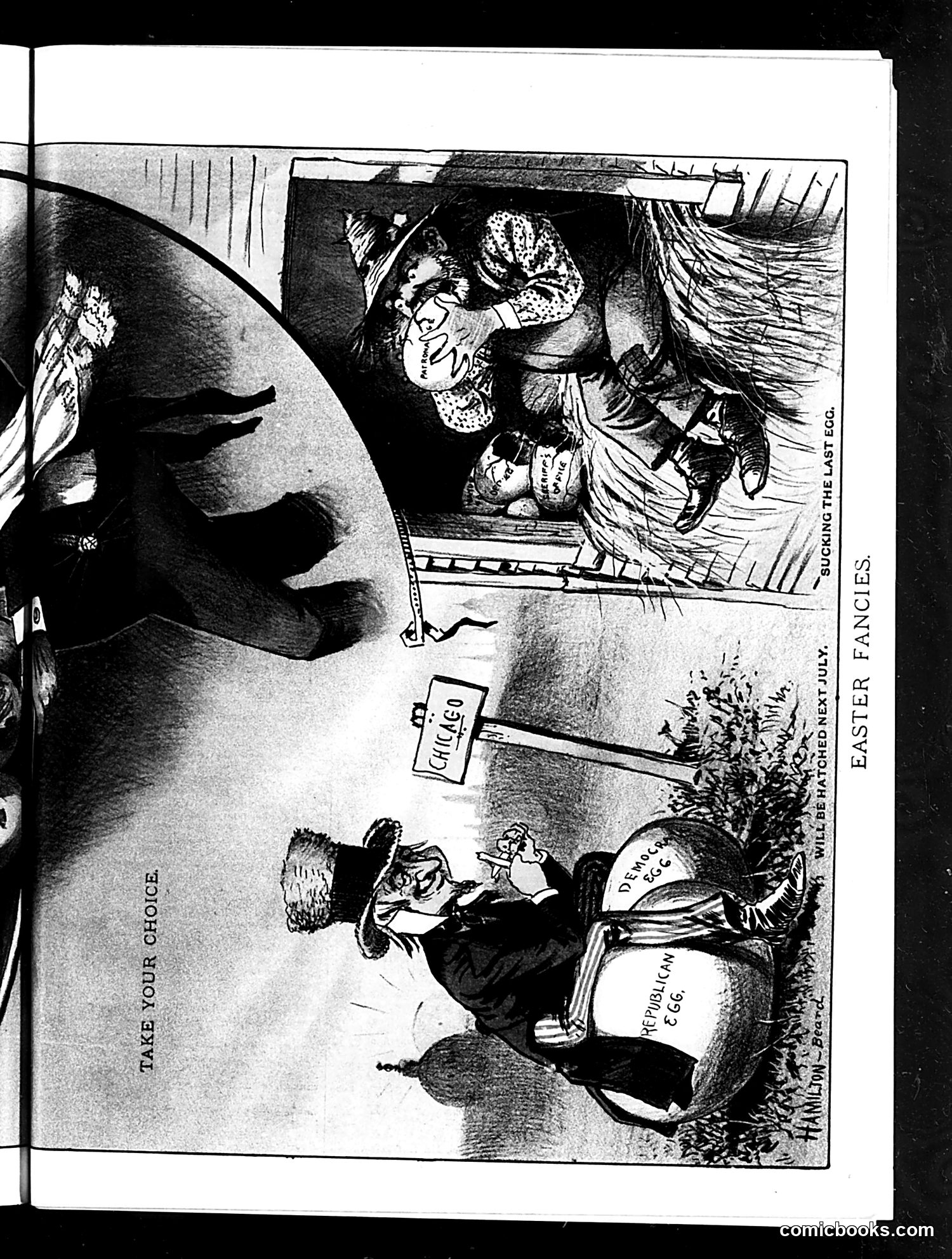
This appears to be a satirical cartoon from Judge magazine depicting a political scene. The text references "Taken Your Choice" and mentions "Wilberforce Easter Fancies" and what appears to be a "Prohibition" theme based on visible labels. The cartoon shows a figure looking into what appears to be a mirror or window, with caricatured faces visible inside. There's a bottle labeled with text that's partially legible, and vegetation on the right side. However, **I cannot confidently identify the specific political figures or events** referenced here due to image quality and incomplete OCR text. The satire appears to address prohibition-era politics and personal choice, but without clearer identification of the caricatured individuals or the specific date of publication, I cannot provide accurate details about which politicians or events are being mocked.
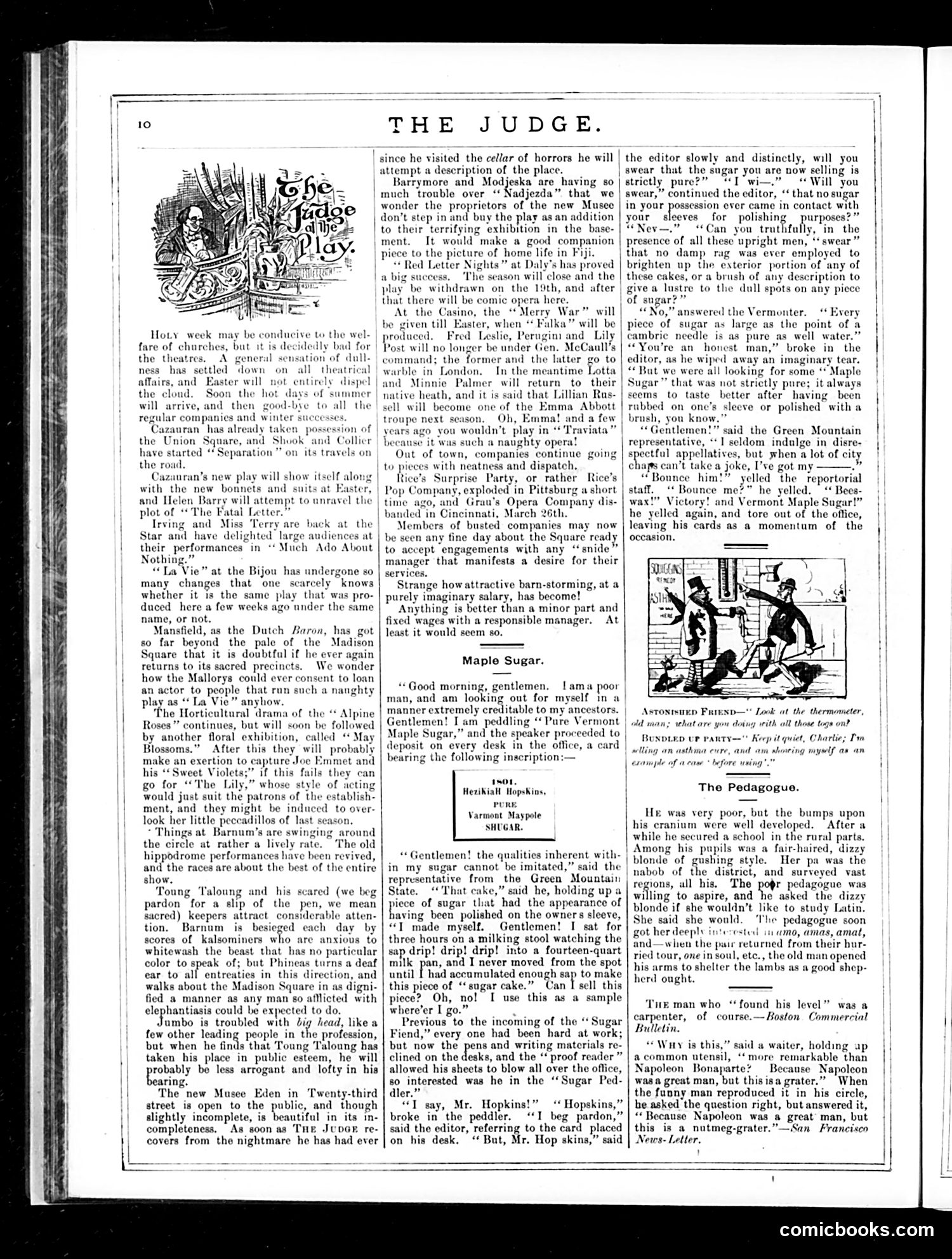
This is a theatrical gossip column reviewing New York stage productions (Easter 1884 era). The main illustrated content is "Maple Sugar," a humorous sketch where a poor man claims to be a Vermont maple sugar peddler, presenting himself to office workers as an honest rustic entrepreneur. The joke appears to be the contrast between his claimed humble origins and his polished sales pitch—he's clearly a con artist or imposter masquerading as authentic rural folk to sell fake "pure Vermont maple sugar" to gullible city dwellers. The accompanying caption jokes reference Napoleon and a nutmeg-grater, suggesting themes of deception and false claims of authenticity. The left column discusses various theatrical productions closing or relocating for spring/summer, including mentions of actors like Irving, Mansfield, and references to Barnum's circus attractions (notably the elephant "Jumbo"). It's essentially entertainment industry news with light satirical commentary on theatrical trends.
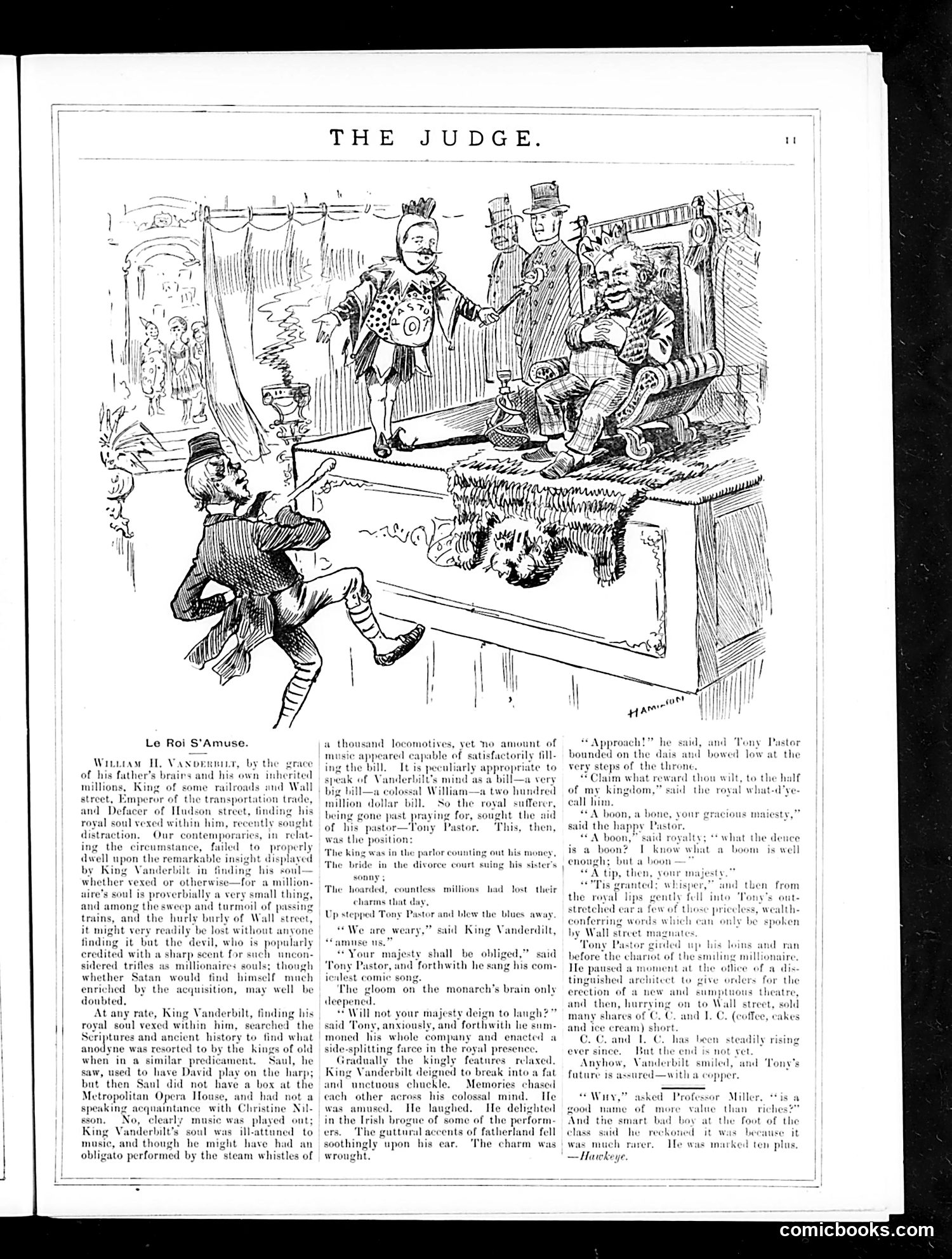
This satirical cartoon mocks **William H. Vanderbilt**, the wealthy railroad magnate and heir to a vast fortune. The piece parodies the biblical story of King Saul seeking David's harp music to ease his troubled mind. The joke: Vanderbilt, vexed despite his immense wealth, seeks entertainment from **Tony Pastor**, a popular vaudeville performer. After Pastor's comic song and performance fail to amuse him, Vanderbilt rewards him lavishly—promising to build him a theater and other gifts. Pastor then immediately goes to Wall Street and sells the stock tips Vanderbilt mentioned, profiting enormously. **The satire targets:** - Vanderbilt's inability to find happiness despite billions - The absurdity of rewarding entertainers extravagantly - The real money in Wall Street speculation versus honest labor - The Gilded Age excess and the power of insider trading The illustration shows the theatrical scene with Vanderbilt as a crowned, caricatured figure receiving Pastor's performance, highlighting the ridiculousness of a railroad tycoon playing "king."
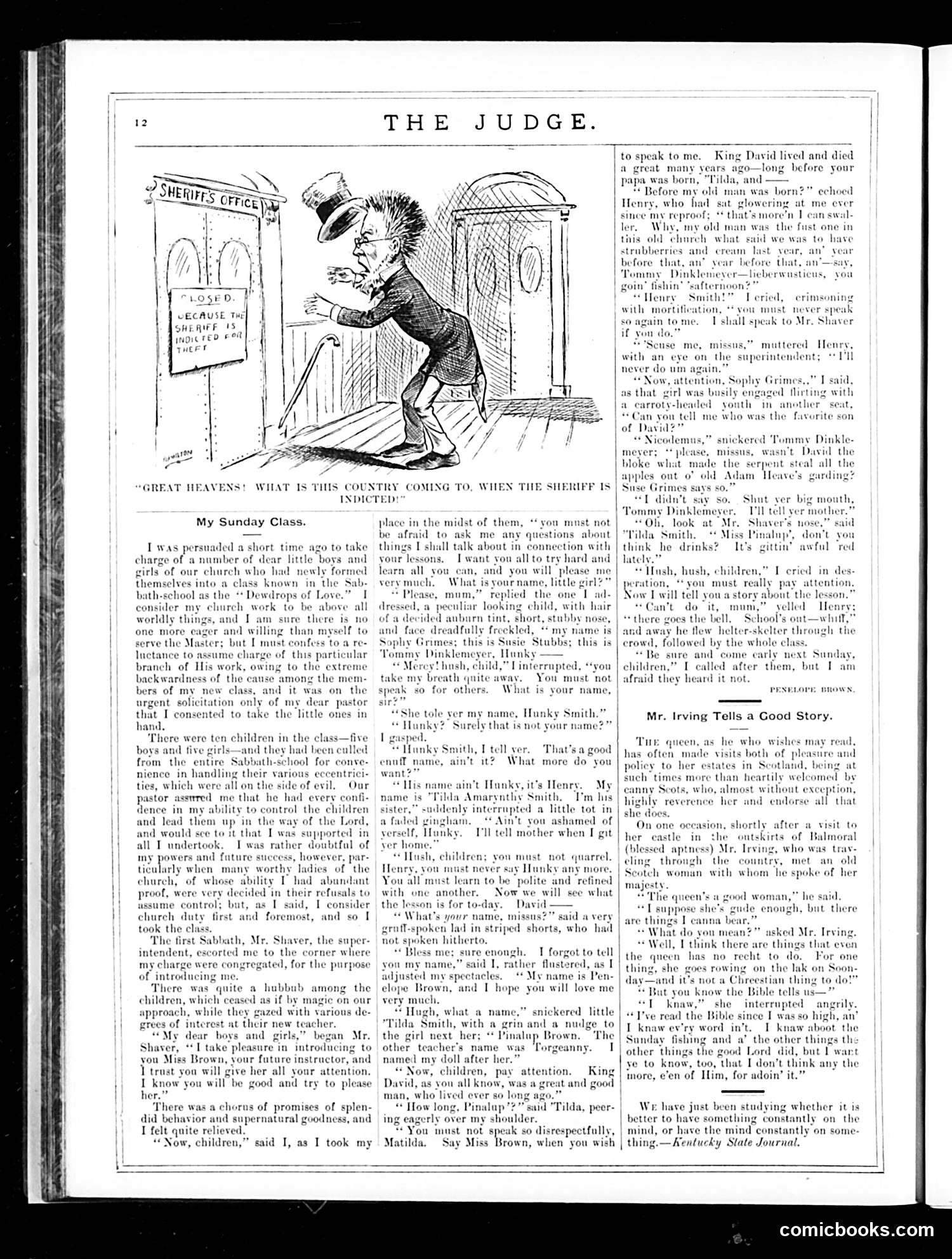
This page contains two distinct pieces from Judge magazine: **Main Cartoon (top):** Shows a man frantically pounding on a Sheriff's Office door marked "CLOSED BECAUSE THE SHERIFF IS INDICTED FOR BRIBERY." The caption "GREAT HEAVENS! WHAT IS THIS COUNTRY COMING TO, WHEN THE SHERIFF IS INDICTED!" satirizes corruption in law enforcement—apparently a timely scandal where a sheriff faced bribery charges. The joke targets the irony of the office meant to enforce law being compromised by its own leader. **Text Articles:** Two separate pieces: "My Sunday Class" (a humorous account of teaching unruly church children with colorful names like "Hunky Smith" and "Tilda Amarynthy") and "Mr. Irving Tells a Good Story" (about a Scottish woman's anecdote). The page reflects late-19th/early-20th-century concerns about governmental corruption while balancing lighter domestic humor. The satire assumes readers would recognize contemporary sheriff scandals as absurd enough to mock editorially.
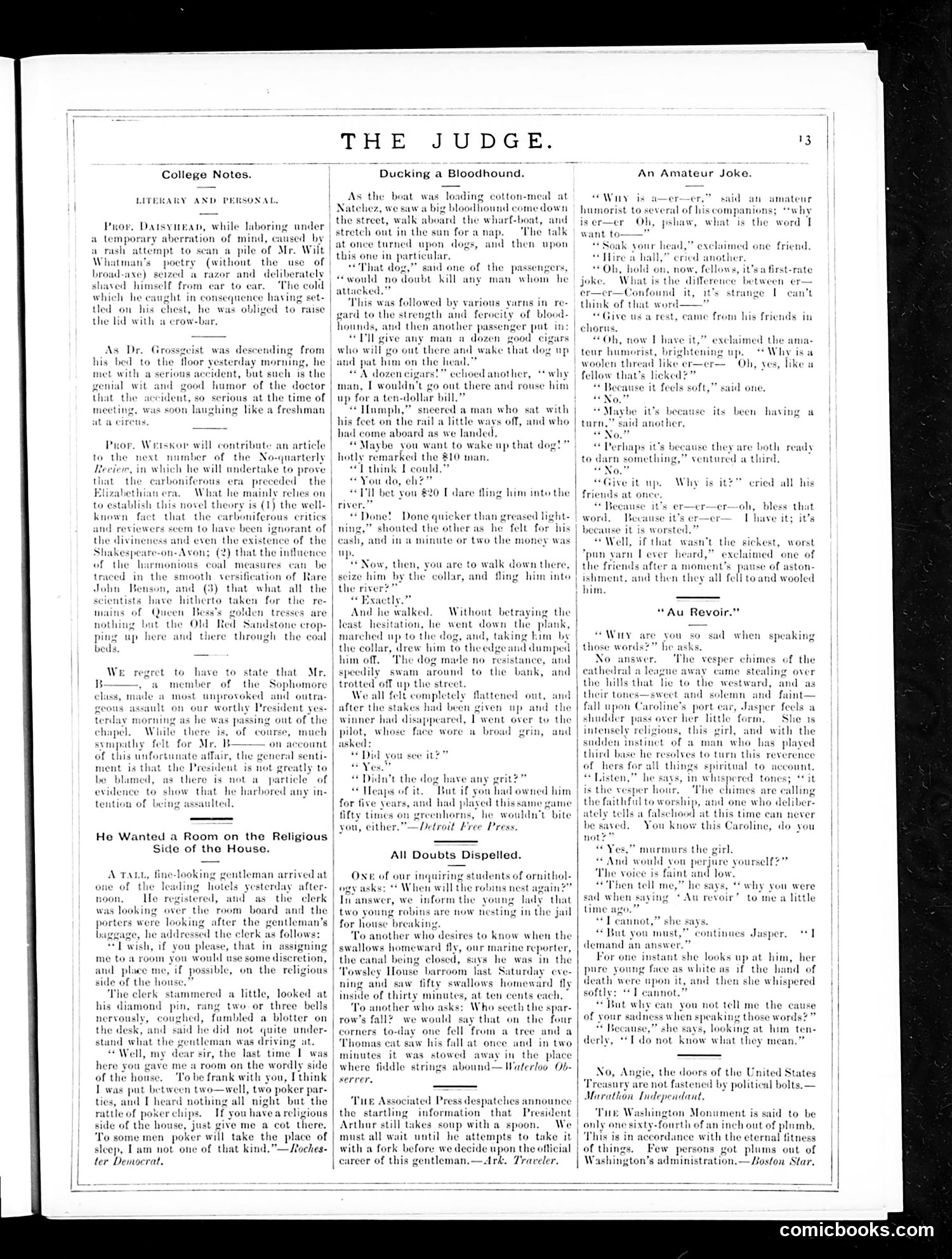
This page from Judge contains three humorous columns of anecdotes and jokes typical of the magazine's satirical style. **College Notes** mocks academia through absurd professor stories—including one about Prof. Daisyhead who supposedly attempts suicide after reading bad poetry, and another about a scholar trying to prove Shakespeare predated the Carboniferous era. **"He Wanted a Room on the Religious Side of the House"** satirizes hypocrisy and pretension. A gentleman checks into a hotel requesting a "religious side" room to avoid poker-playing guests, revealing the era's class anxieties about morality and social respectability. **"Ducking a Bloodhound"** is a tall tale about riverboat passengers on the Mississippi betting on who dares wake and handle a dangerous dog—a comedic narrative playing on masculine bravado and the boastfulness common to frontier folklore. The satire targets academic pomposity, social pretension, and exaggerated masculine behavior—themes recurring in Judge's critique of American life and character.
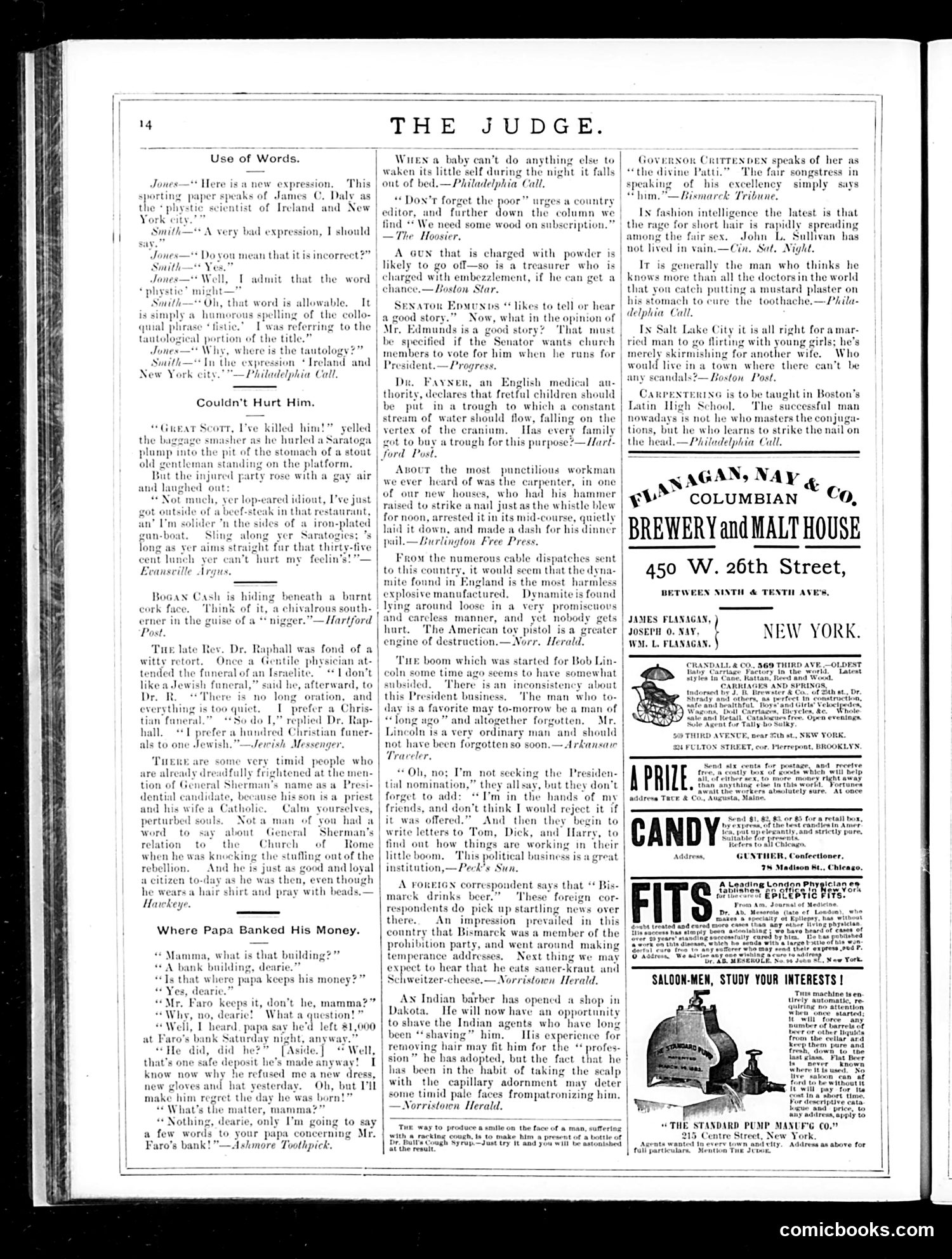
This page contains miscellaneous short humor pieces and advertisements typical of Judge magazine. The satirical content includes: **"Couldn't Hurt Him"** — A joke about a man whose stomach is so hardened by beef-steak that being hit with luggage causes no pain, satirizing working-class toughness. **"Where Papa Banked His Money"** — A domestic humor piece where a child innocently reveals her father gambles away money at "Faro's bank" rather than saving it legitimately, mocking paternal irresponsibility and gambling addiction. **Miscellaneous quips** on word usage, General Sherman's religious tolerability, dynamite safety versus toy pistols, and political hypocrisy about presidential ambitions. The page is primarily **advertising-heavy**, featuring prominent ads for Flanagan, Nay & Co. Brewery, candy, and other commercial products. The satire is light, domestic, and class-conscious rather than addressing major political events. Most jokes target personal vices (gambling, drinking) and social pretension rather than specific politicians or current affairs.
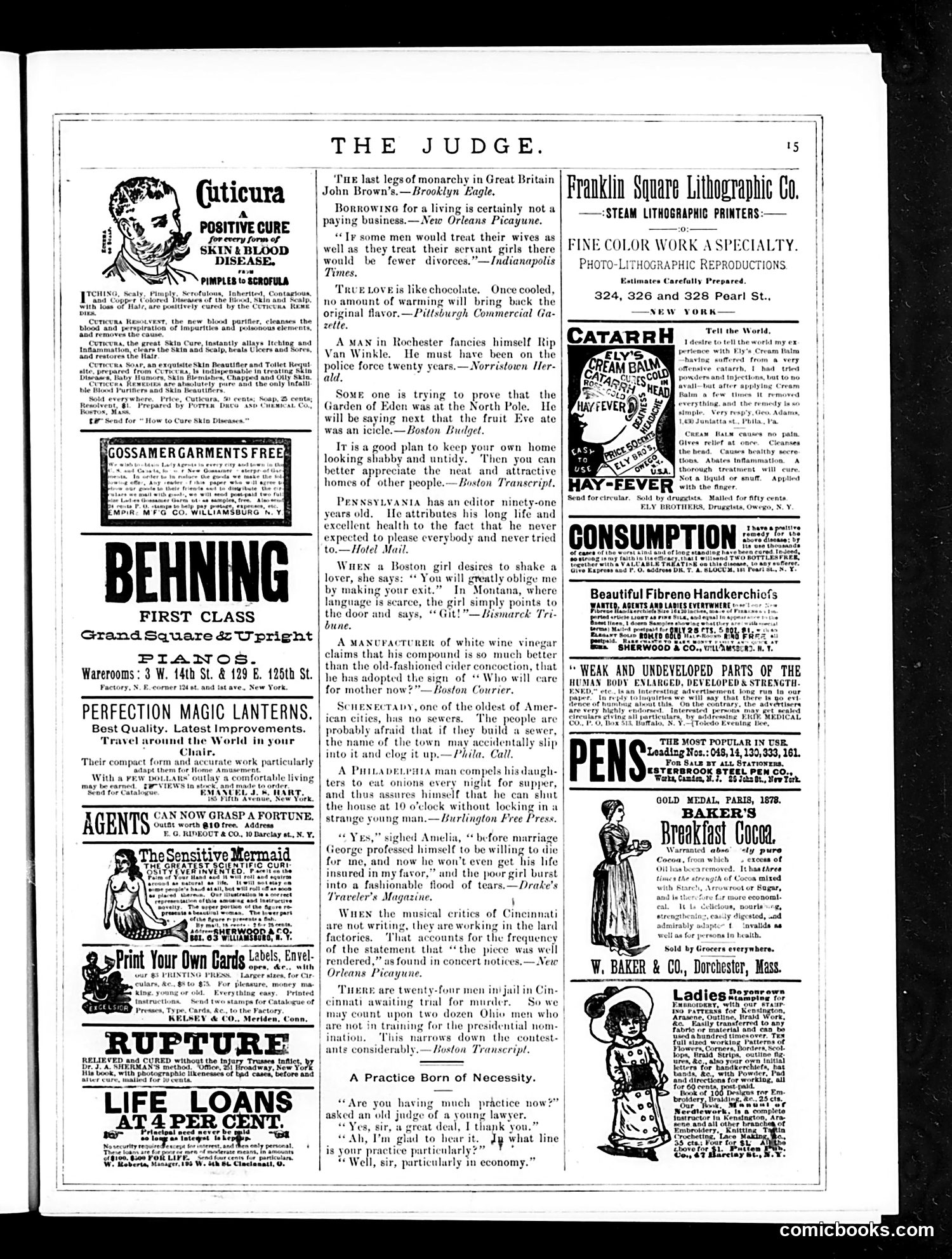
This page is primarily advertising with a sidebar of humorous quotations titled "The Judge" — a standard feature of this satirical magazine. The quotes mock contemporary social issues: marriage troubles, economic hardship ("borrowing for a living"), urban planning failures, and romantic disillusionment. One joke satirizes a Rochester man claiming to be Rip Van Winkle after 20 years on the police force — implying police work was so tedious it felt like enchanted sleep. Another mocks Philadelphia parenting: a father forces daughters to eat onions nightly so suitors won't visit after 10 p.m. The final anecdote concerns Cincinnati's musical critics who apparently also work in lard factories, explaining why they give uniformly positive concert reviews ("the piece was well rendered") — they lack discernment. These are lightweight social observations typical of Judge magazine's humor: poking fun at marriage, employment, urban incompetence, and provincial life. The surrounding page is dominated by product advertisements (pianos, skin treatments, magic lanterns), which was standard for 1880s magazines.
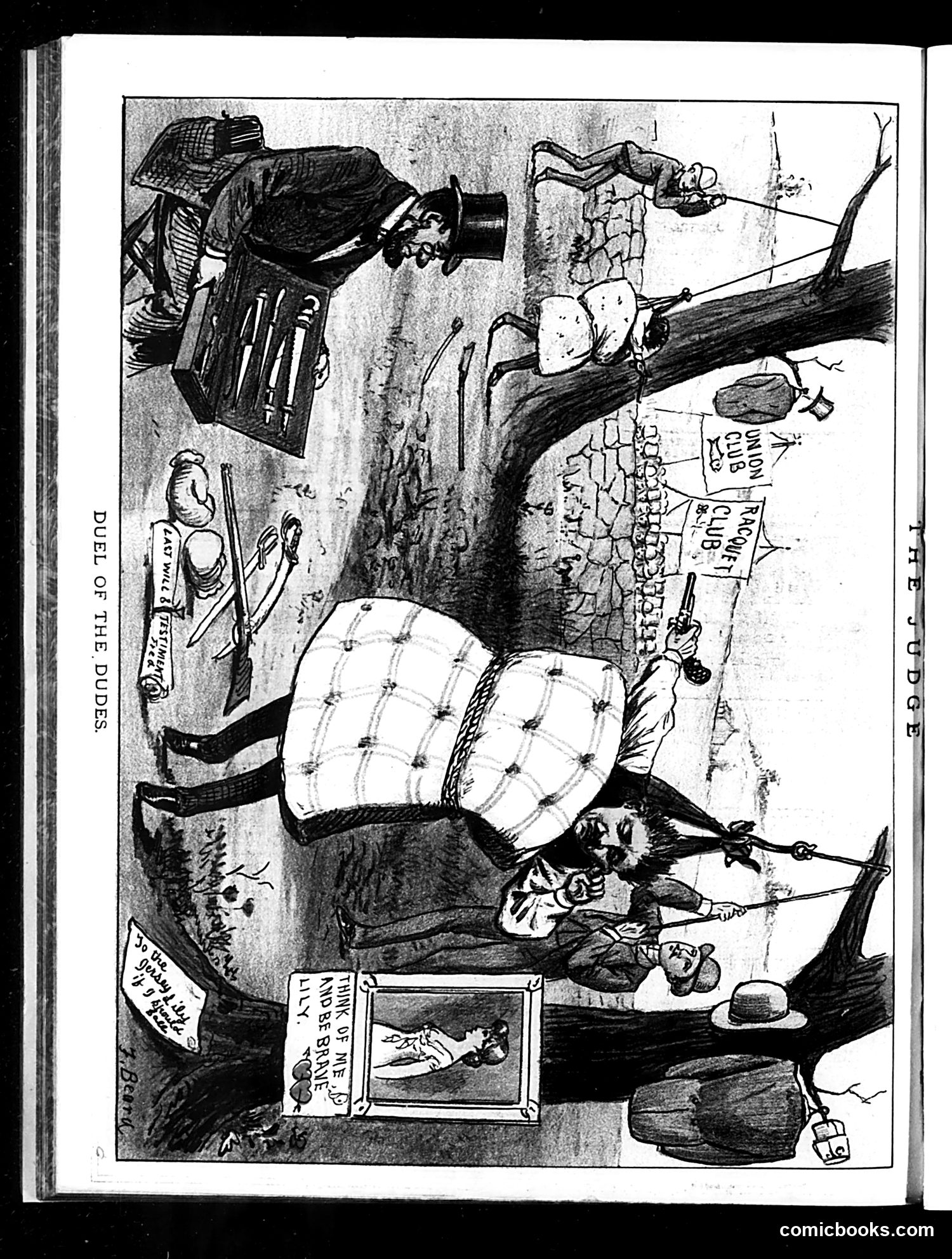
This satirical cartoon depicts two fashionably dressed men (caricatured as "dudes") in an exaggerated confrontation. The image mocks the affected mannerisms and excessive clothing styles associated with the "dude" subculture—likely referencing the 1880s-90s trend of wealthy, fashionable young men known for their pretentious behavior and flashy dress. The cartoon ridicules their vanity through exaggerated physical features and absurd posturing. Various objects and labels appear scattered throughout, though the OCR text is incomplete, making specific references unclear. The title "Duel of the Dudes" suggests these figures are engaged in some form of ridiculous conflict, playing on contemporary anxieties about idle wealth and masculine affectation that Judge magazine regularly lampooned for its upper-class readership.

I can see this is a page from *Judge* magazine with text that reads "THE JUDGE" vertically along the left spine, but the page itself appears to be blank or nearly blank—predominantly white space with no visible cartoon illustrations or readable body text content. Without visible cartoon imagery or legible text content to analyze, I cannot identify specific figures, political references, or satirical points. This appears to be either a blank page, a title page, or an advertising page from the magazine. To provide meaningful analysis of the satire, political commentary, or jokes intended, I would need a page with clearly visible cartoon artwork and readable text content.