
A complete issue · 16 pages · 1884
Judge — March 1, 1884
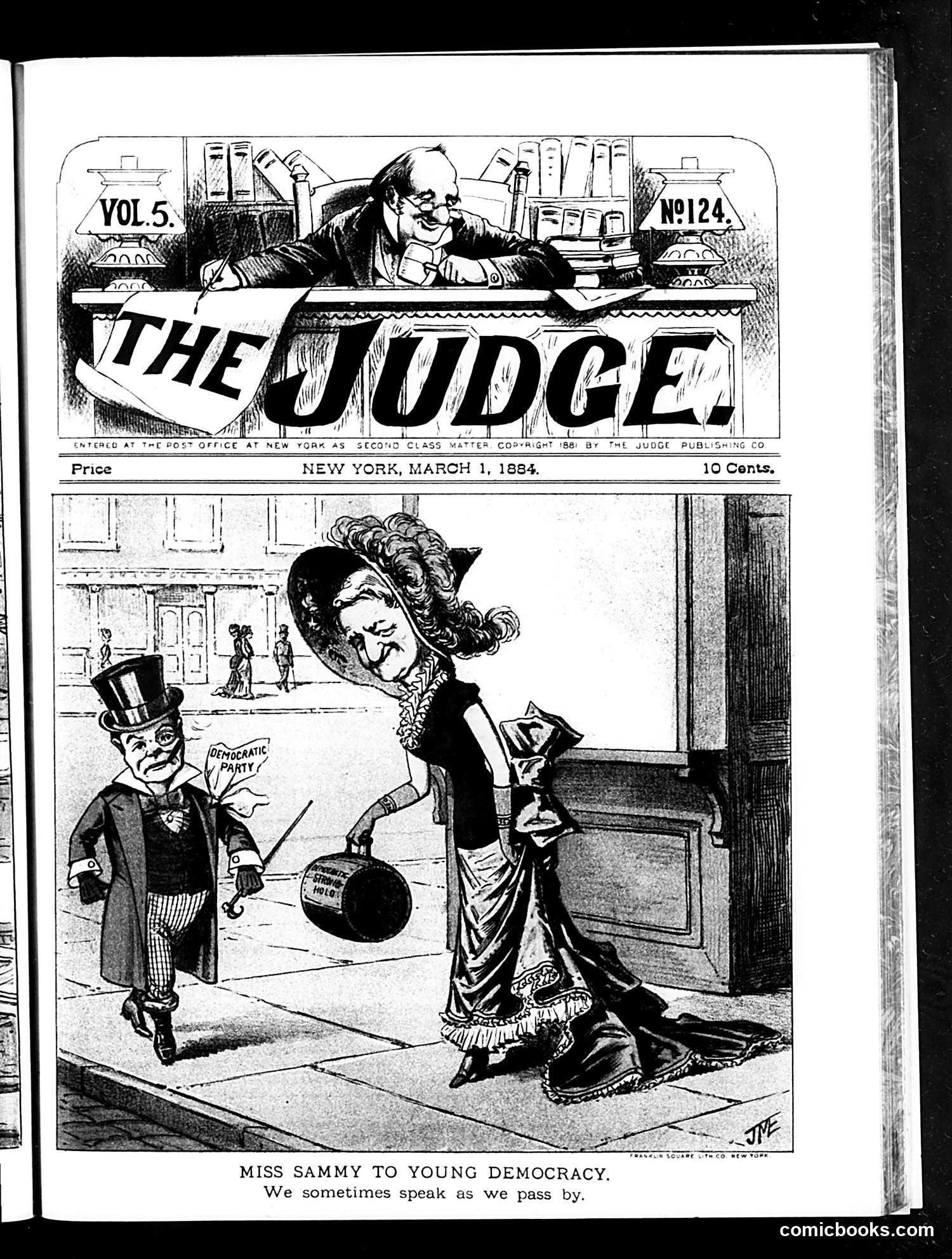
This satirical cartoon titled "Miss Sammy to Young Democracy" depicts a woman labeled "Miss Sammy" (likely representing Uncle Sam or America personified as female) addressing a small, poorly-dressed figure representing the Democratic Party, holding a document labeled "Democratic Platform." The satire appears to mock the Democratic Party's weakness or inadequacy as a political force. The caption "We sometimes speak as we pass by" suggests dismissive treatment—the implication being that democracy/the Democratic Party is so insignificant it barely warrants acknowledgment. The judge figure at the top observes the scene, indicating this is commentary on American politics during the 1884 election period. The cartoon uses gendered imagery and caricature typical of 19th-century political satire to criticize Democratic Party relevance or platform credibility.
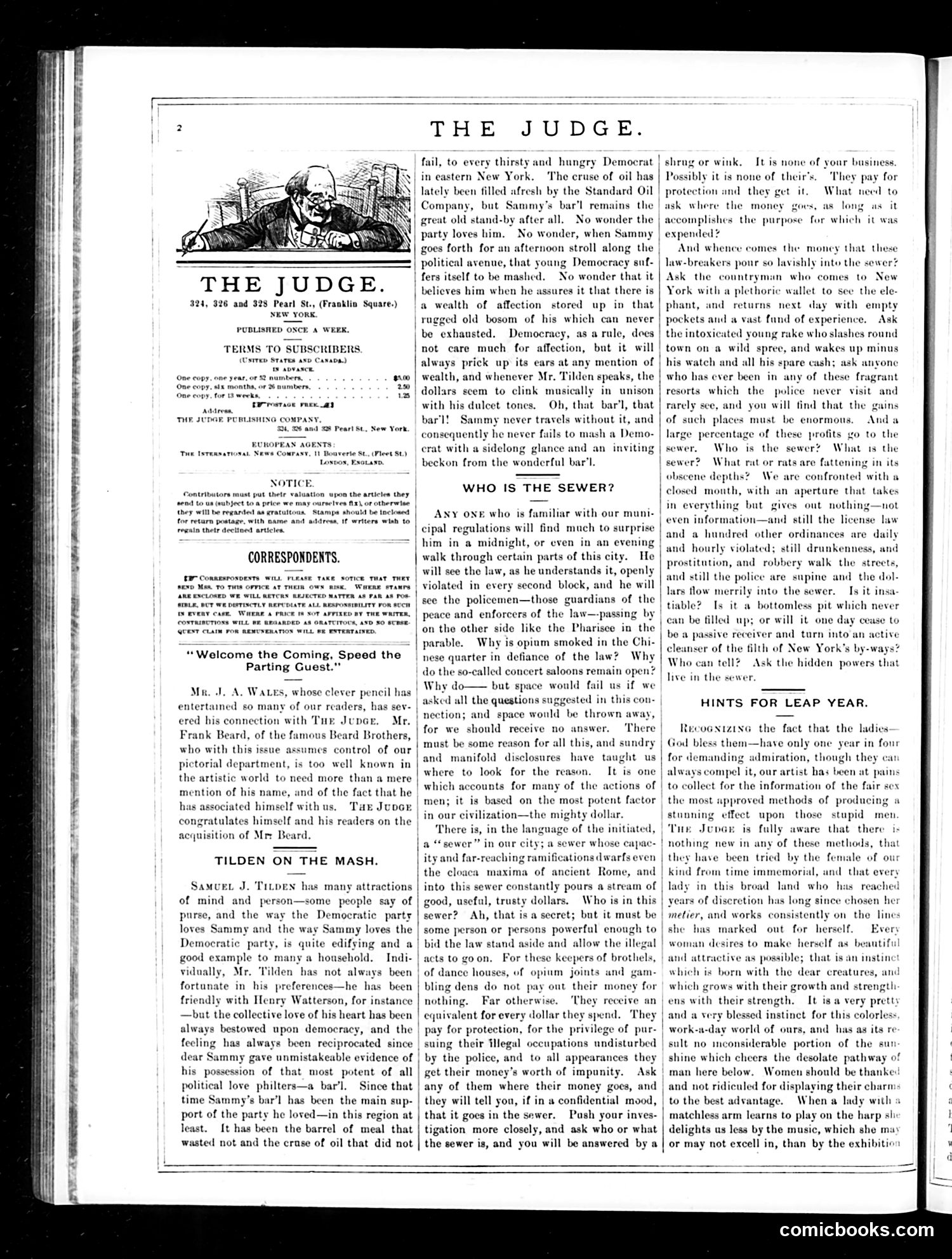
This 1870s satirical magazine page attacks Democratic political figures and practices through humor. **"Tilden on the Mash"** ridicules Samuel J. Tilden, a wealthy Democratic leader, suggesting his political influence derives entirely from bribing party members with money (the "barrel" of cash). The satire claims Democrats love Tilden only for his wealth, not his character—that he literally carries money to seduce ("mash") voters into supporting him. **"Who Is the Sewer?"** critiques municipal corruption in New York City. It documents how police openly ignore vice (prostitution, gambling, opium) occurring nightly in city neighborhoods. The Biblical reference to Pharisees suggests police hypocritically ignore lawbreaking while claiming to enforce order. Both articles mock Democratic governance: one targeting wealthy party bosses' corrupt influence, the other exposing police corruption and moral decay in Democratic-controlled New York. The tone is outraged moralism disguised as witty commentary—typical of Judge's Republican-leaning perspective.
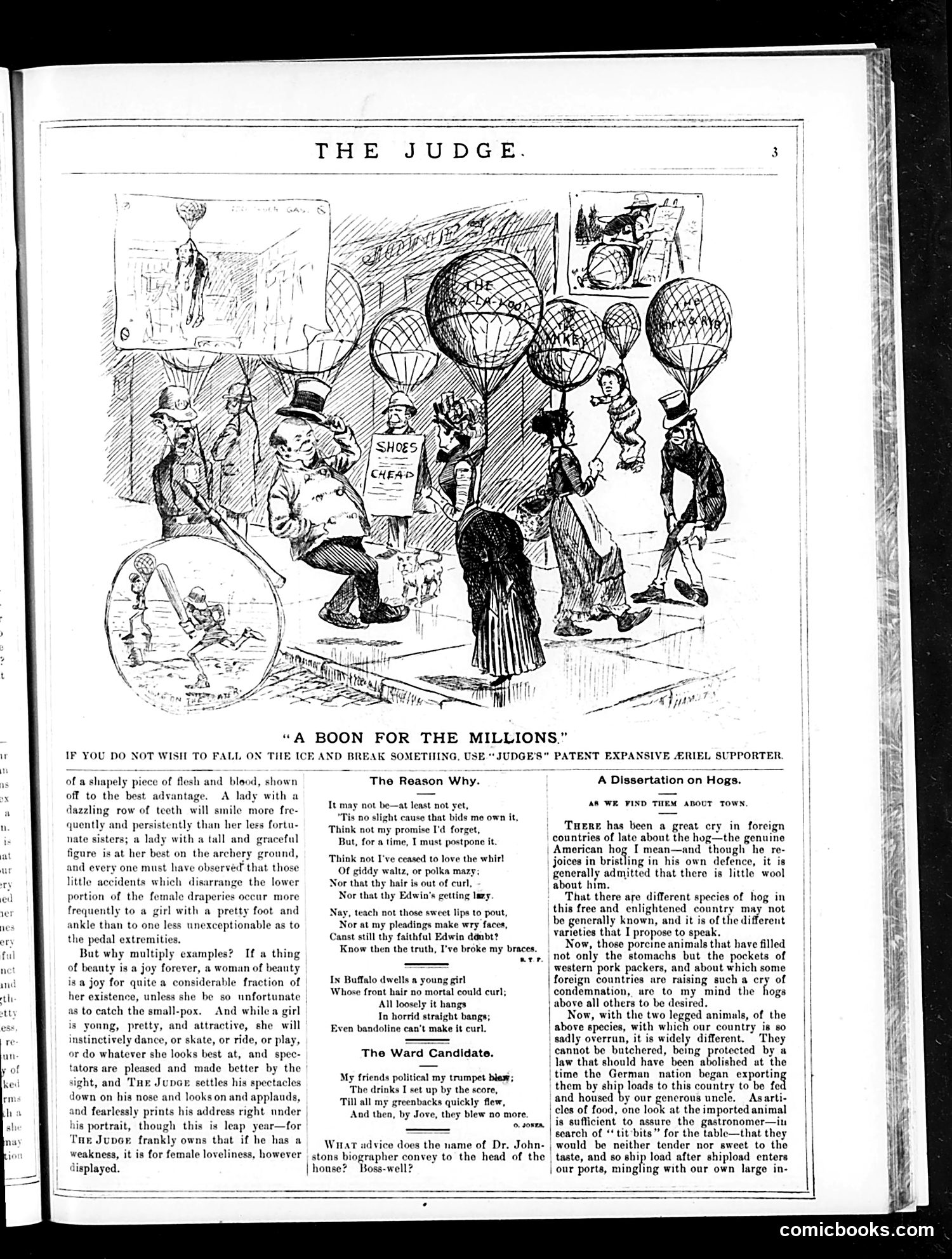
This page contains satirical commentary on American society and politics, circa late 19th century. **Main Cartoon ("A Boon for the Millions"):** The illustration depicts a chaotic street scene with people using absurd "expansive heel supporters" (exaggerated devices) to prevent falling on ice. This is mock-advertisement satire—Judge ridicules consumer products claiming to solve everyday problems. **"A Dissertation on Hogs":** The lengthy text uses hog-breeding as a metaphor for critiquing German immigrants flooding America. The piece complains that German hogs (literal animals) imported for breeding are inferior to American-raised pigs, then pivots to lamenting German human immigrants, calling them undesirable additions to American society. The satire equates imported livestock with unwanted foreign populations. **Minor Poems:** "The Reason Why," "The Ward Candidate," and others appear to be typical Judge filler—light satirical verse about romance, politics, and social foibles. The overarching theme reflects late-19th-century anti-immigration sentiment disguised as agricultural critique.
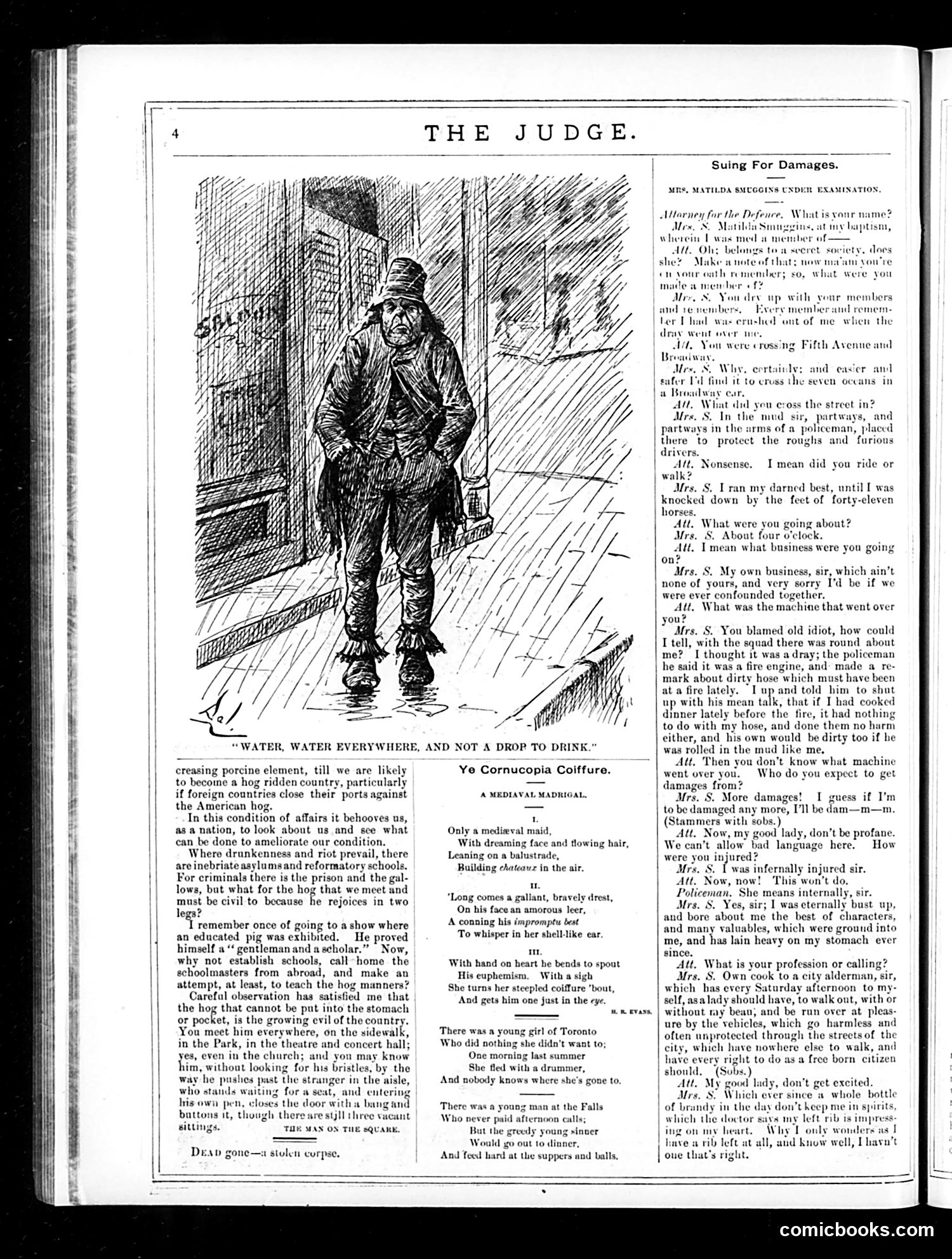
This page from *Judge* satirizes urban social decline through two main pieces: **Main Cartoon (left):** A poorly-dressed man stands in a flooded street. The accompanying text criticizes the prevalence of uncouth, aggressive men—metaphorically called "hogs"—infesting American cities. These are men who push past strangers in churches and theaters, lack manners despite education being available, and represent a growing national problem. The satire suggests society needs to reform these coarse individuals as it does criminals and drunkards. **"Suing for Damages" (right):** A comedic court transcript where Mrs. Matilda Smuggins describes being struck by a street vehicle (possibly a fire engine or dray). The humor derives from her evasive, aggressive testimony and malapropisms ("confounded together"), portraying working-class witnesses as combative and inarticulate. The lawyer's frustration highlights class-based courtroom friction. Both pieces mock urban chaos and social disorder of the era.
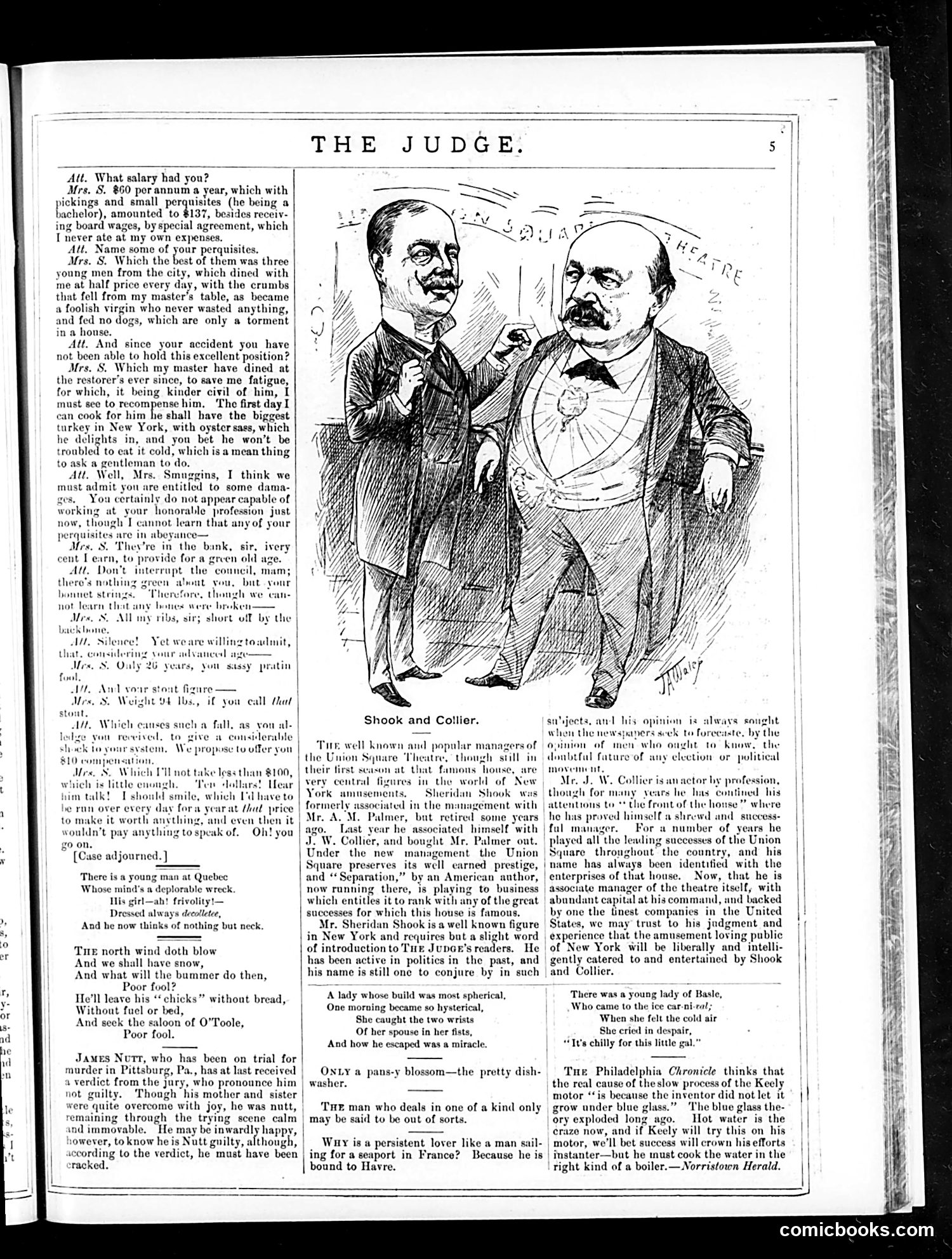
This page features a biographical sketch of two theater managers: **Sheridan Shook** and **A.M. Palmer** (later replaced by **W. Collier**), who ran the Union Square Theatre in New York. The accompanying caricature shows two well-dressed men in Victorian attire, likely the principals. The text praises them as "well known and popular managers" and notes their success with productions like "Separation," an American play. It mentions Shook's past involvement in politics and his continued influence in theatrical circles. The bulk of the page is devoted to a humorous legal deposition (titled "Alt." and "Mrs. S.") involving a domestic servant's injury claim—likely satirizing contemporary labor disputes and the absurdities of courtroom testimony, with the servant's malapropisms providing comedic relief. The page includes various light verses and jokes typical of Judge's satirical format, with no clear political agenda beyond general social humor.
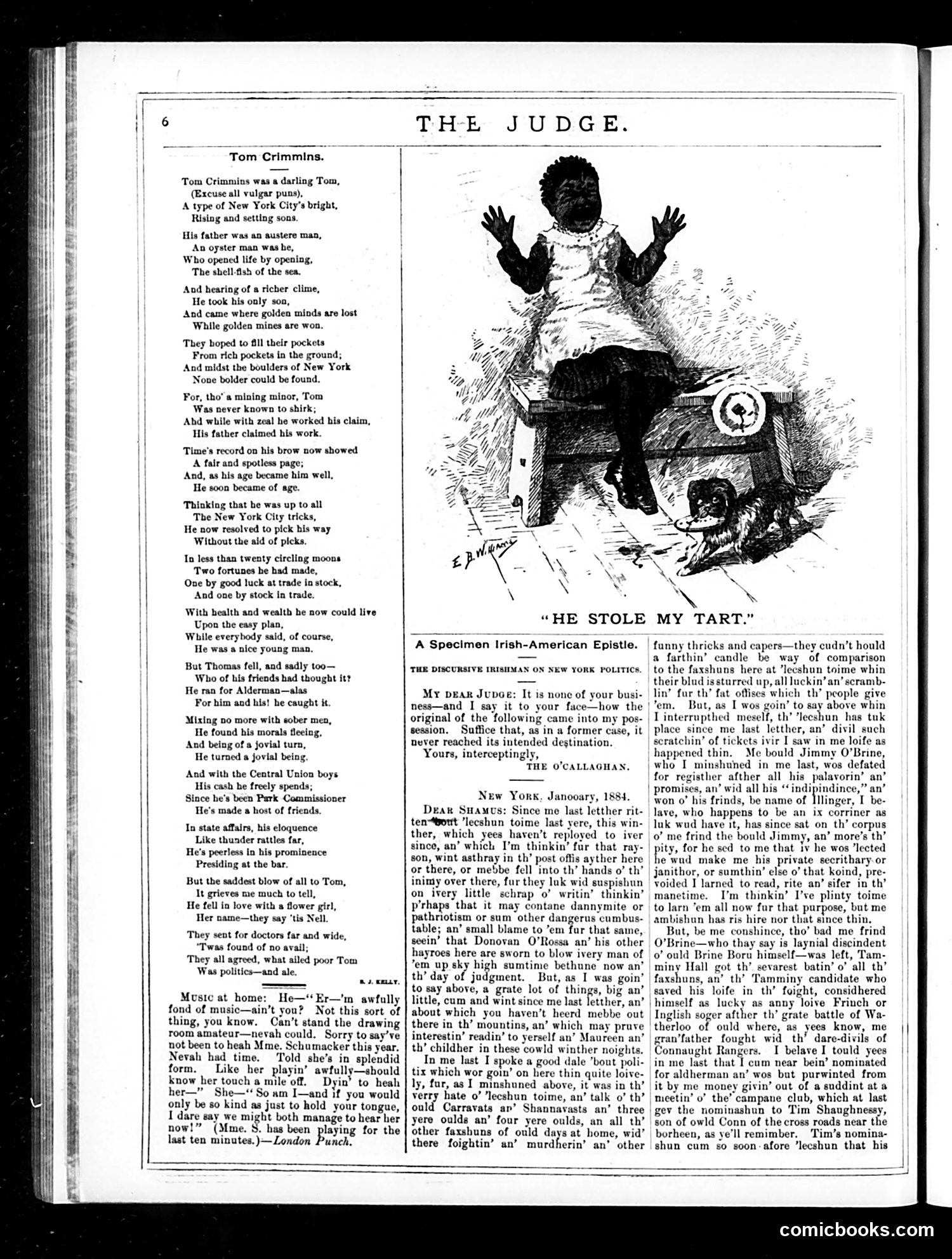
This page satirizes **Tom Crimmins**, a fictional New York politician who embodies corrupt urban machine politics of the 1880s. The poem traces his trajectory from honest mining work to moral decay after entering politics—specifically after becoming a Park Commissioner and running for Alderman. The satire's targets include: - **Political corruption**: Crimmins accumulates wealth through "good luck at trade in stock / And one by stock in trade" (insider trading), then solidifies power through the "Central Union boys" - **Machine politics**: His election to office marks his moral decline - **Urban vice**: He's corrupted by "politics—and ale" The accompanying illustration titled "HE STOLE MY TART" depicts an Irish-American character—likely representing working-class immigrant politics. The accompanying letter parodies Irish-American political discourse, suggesting Judge viewed immigrant political participation with condescension. Together, the content critiques both elite financial corruption and immigrant political machines that characterized Gilded Age New York.
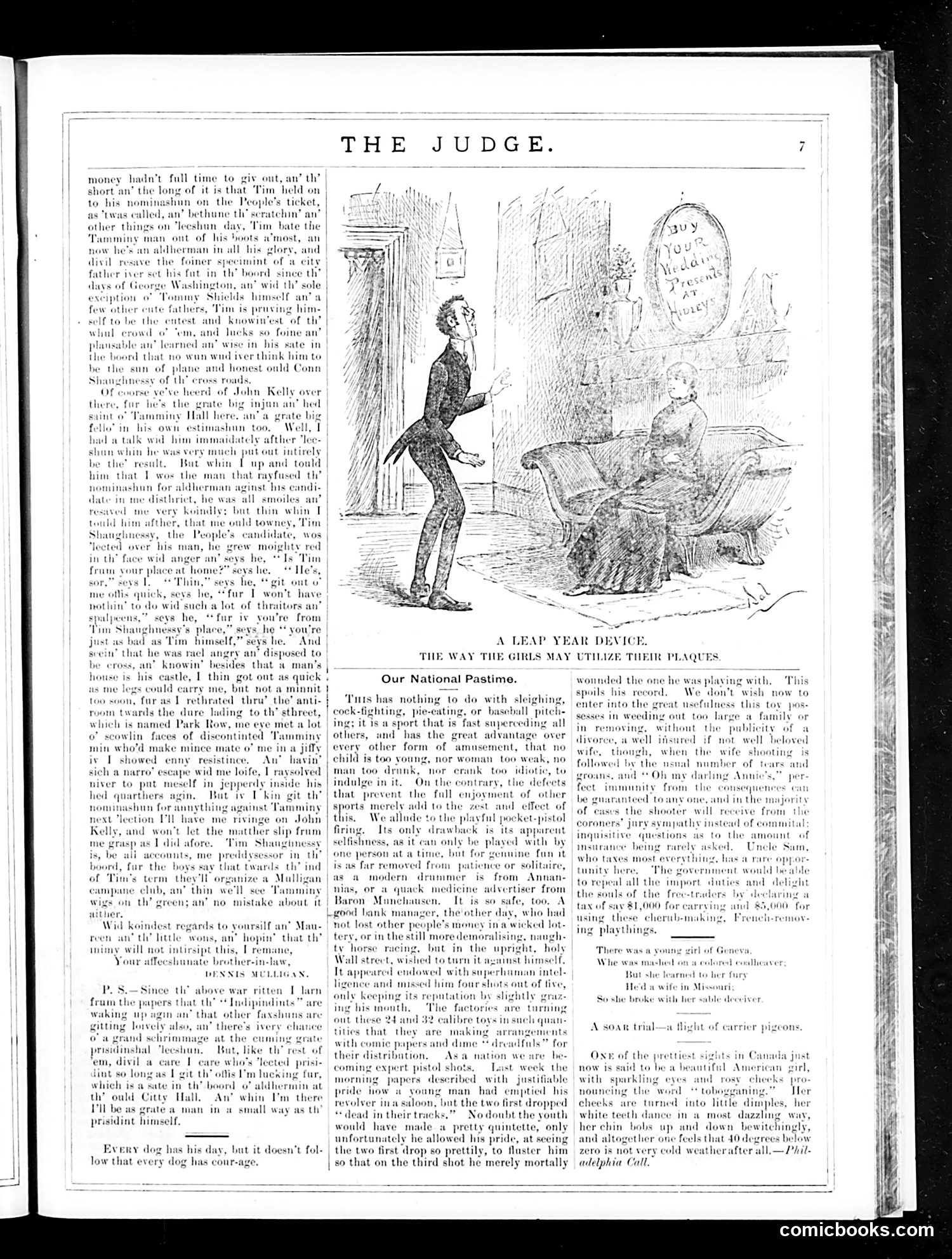
This page contains two distinct pieces of political/social satire typical of Judge magazine: **Left column: "Dennis Mulligan" piece** - A lengthy Irish-dialect monologue about Tammany Hall politics. The speaker discusses nomination politics and candidates (appears to reference actual 1880s NYC Democratic machine politics), expressing cynical views about political corruption and loyalty. The heavy Irish accent reflects Judge's typical ethnic stereotyping of immigrant political actors—a common satirical target for the magazine. **Right: "A Leap Year Device"** - The cartoon satirizes women's assertiveness during leap years (when tradition allowed women to propose to men). It shows a woman presenting a large ornamental plaque to a skeptical man, mocking the idea of female romantic initiative. The accompanying text jokes about "national pastime" toys and revolvers. Both pieces reflect late-19th-century Judge content: mocking Tammany corruption, immigrant voters, and contemporary social anxieties about changing gender roles.
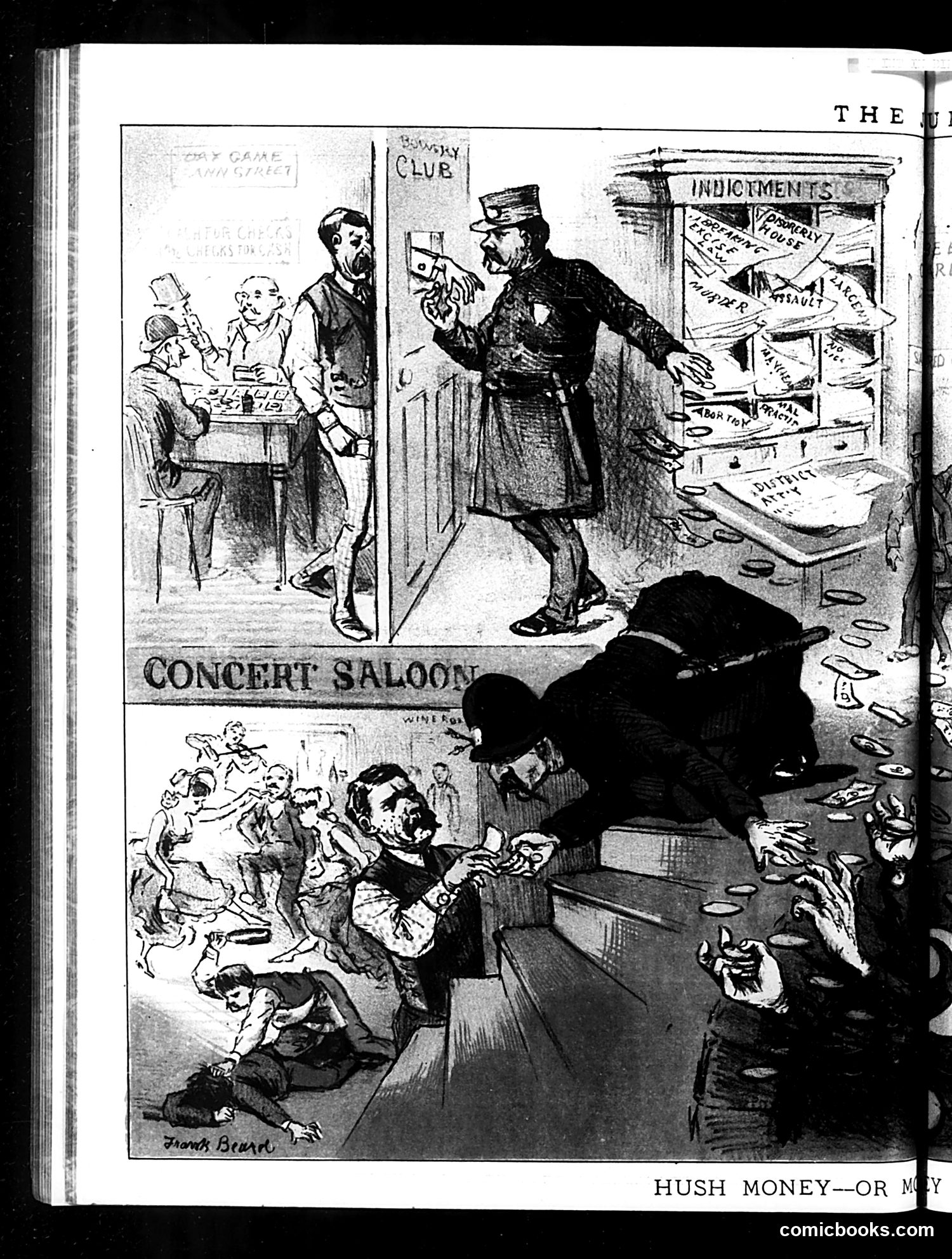
This appears to be a Judge magazine satirical cartoon titled "Hush Money—Or M[oney]" critiquing corruption and bribery in government or law enforcement. The top panel labeled "Concert Saloon" shows men in what appears to be a seedy establishment, suggesting illicit dealings. The right panel depicts a figure at a desk labeled "Indictments," with papers scattered about, indicating legal documents or charges being buried or filed away. The bottom panel shows a chaotic scene with figures appearing to engage in underhanded dealings, while money exchanges hands. The overall satire suggests that those with wealth or power use "hush money"—bribes—to suppress indictments and evade legal consequences. The cartoon criticizes how corruption allows the wealthy to escape justice through financial payoffs rather than facing proper legal proceedings.
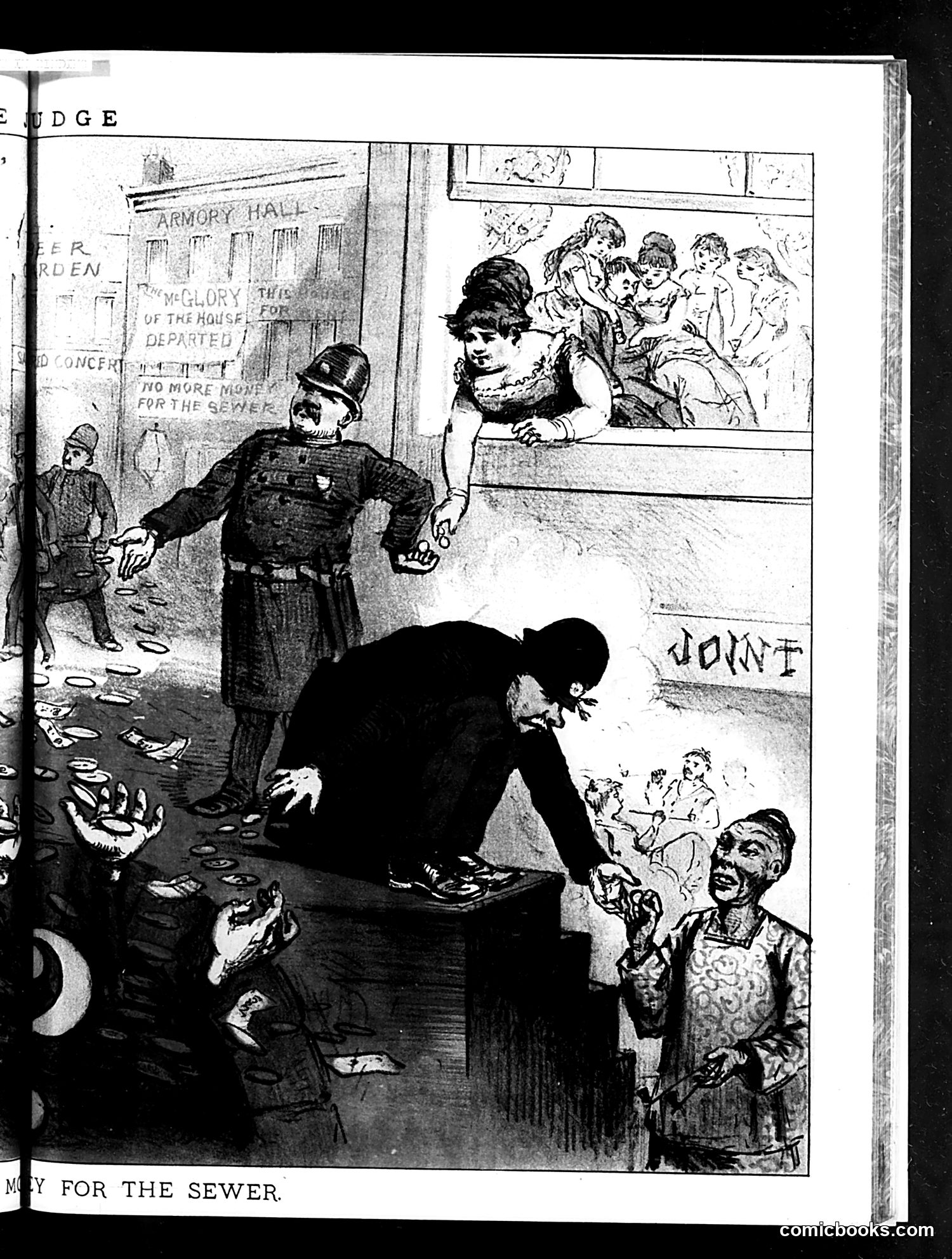
This appears to be a satirical cartoon about urban poverty and charity, likely from the late 19th or early 20th century. The scene depicts what seems to be a wealthy or middle-class figure (center, in dark coat and hat) distributing charity or alms to poor children and adults in a street setting. A sign visible reads "ARMORY HALL" and references "THE GLORY OF THE HOUSE DEPARTED" and "CONCERT...FOR THE SEWER." The satire likely critiques either: - Performative charity or charity events that benefited the wealthy more than the poor - The inadequacy of charitable relief for urban poverty - Class hypocrisy in addressing social welfare issues The contrast between well-dressed benefactors and ragged, desperate recipients underscores the social inequality being mocked. Without the magazine's publication date, specific event references remain unclear.
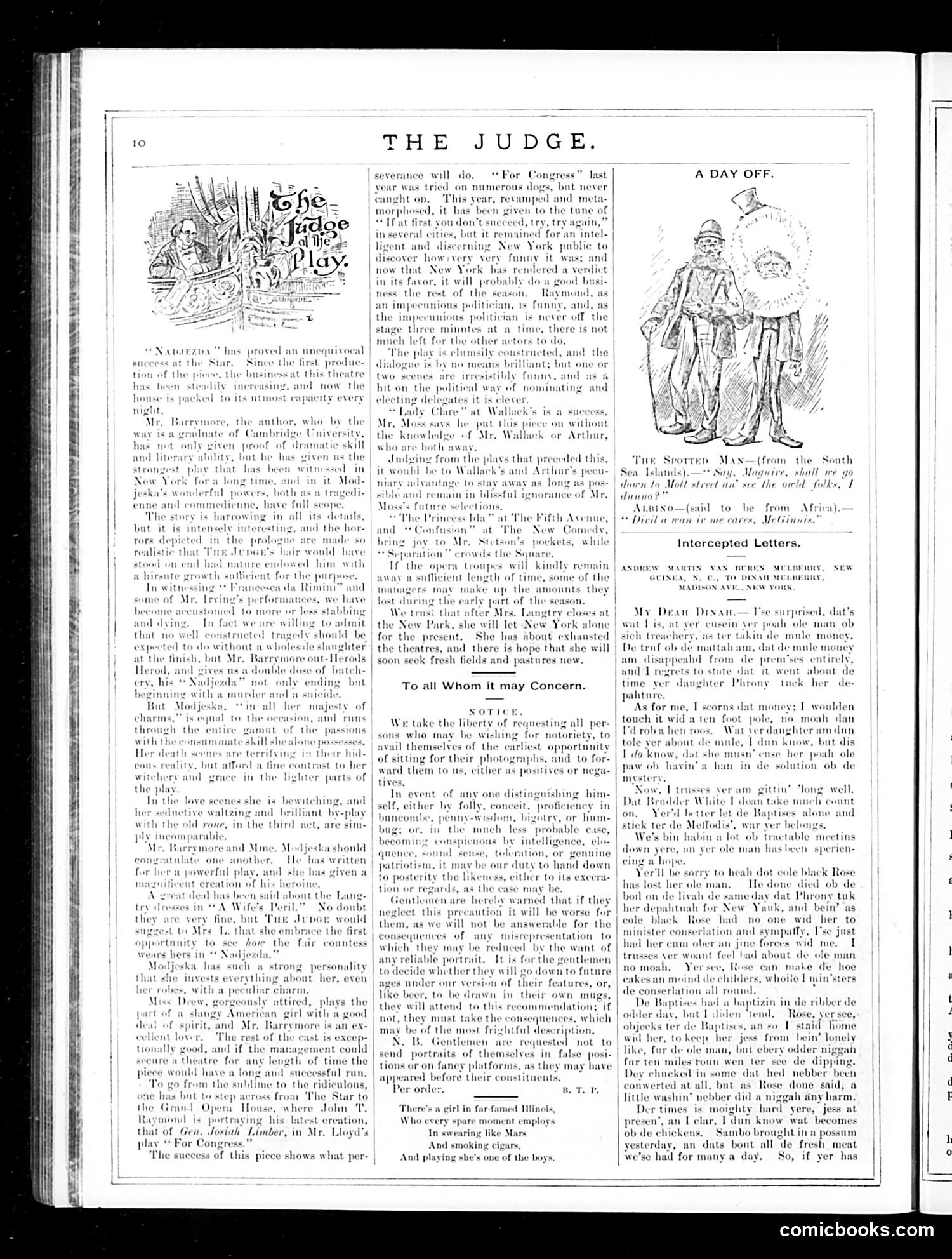
This page contains theater reviews and satirical content typical of Judge magazine's mix of entertainment criticism and social commentary. **Main Content:** The left column reviews "Nadjezda," a play praised for strong performances by actors Barrymore and others, though the political satire plot about an "impecunious politician" is criticized as formulaic. **"A Day Off" Cartoon (top right):** Shows a Southern man (labeled "The Spotted Man") with children, likely satirizing Reconstruction-era race relations and Northern assumptions about the South. **"Intercepted Letters" Section:** Humorous letters written in exaggerated dialect from an African American character ("Andrew Martin Van Buren Mulberry") to a friend, using crude phonetic spelling common to period racial stereotypes. The letters discuss family matters and church preferences in a manner that represents the magazine's ethnic humor conventions of the era. **"To All Whom It May Concern" Notice:** A mock warning to politicians not to submit false photographs or misrepresent themselves to the magazine. The page reflects Judge's typical blend of theater criticism, racial caricature, and political satire.
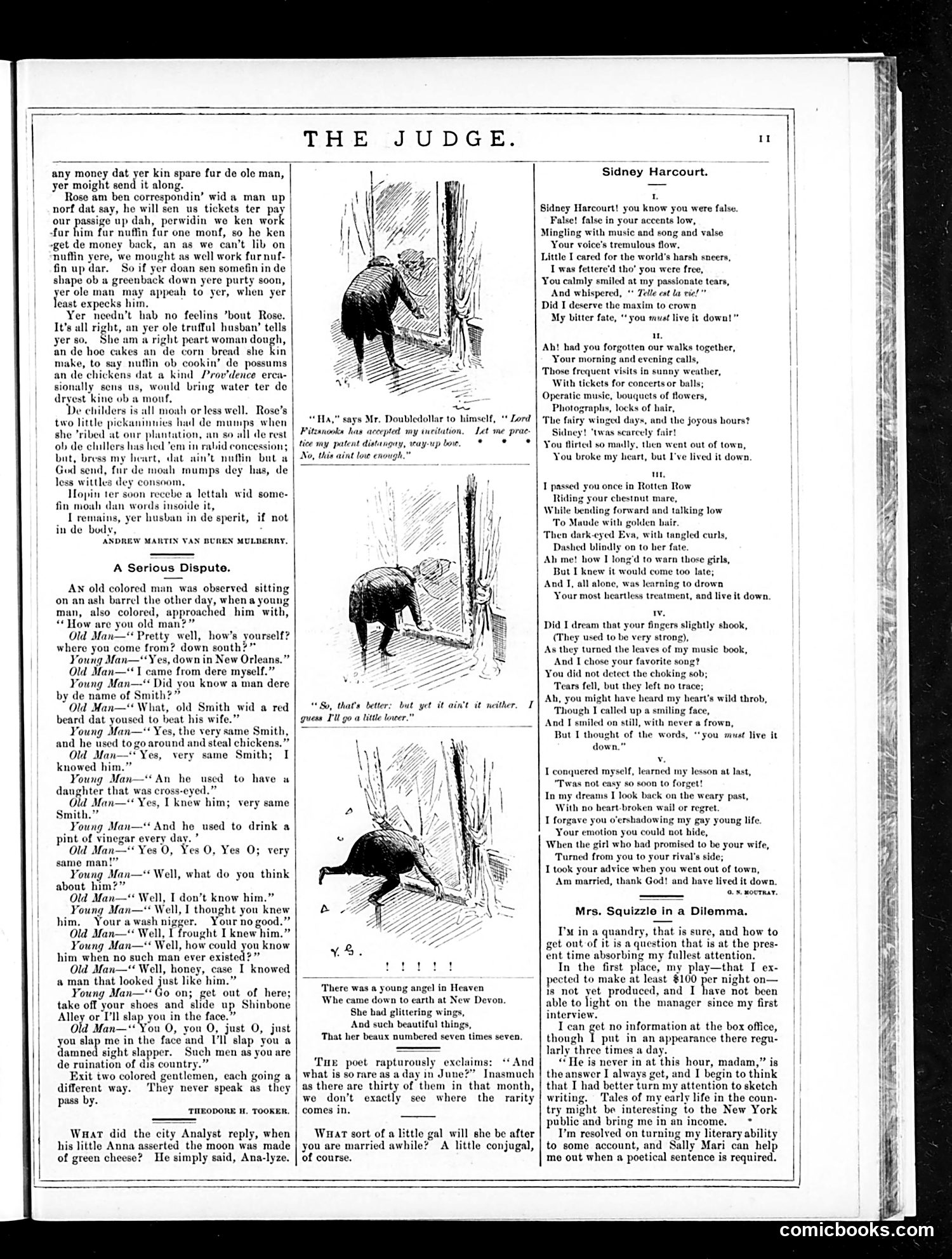
This page from the satirical magazine *Judge* contains three distinct pieces: 1. **"Rose's Letter"** (left column): A dialect piece written as correspondence from an enslaved or formerly enslaved man to a northern relative, asking for money. The heavy stereotypical dialect and references to "pickaninnies" and subsistence conditions reflect the crude racial humor typical of 1880s-90s American satire. 2. **"A Serious Dispute"** (center): A comedic dialogue between two Black men debating whether one knows another "old Smith." The joke relies on the older man's seeming confusion or dishonesty—claiming to know Smith while simultaneously denying knowledge. The racial epithet in the text signals this was intended as humor mocking Black speech patterns. 3. **"Sidney Harcourt"** (right): A romantic poem addressed to a woman, recounting past courtship and expressing forgiveness for her marriage to another. The cartoons show figures in domestic or street scenes. The overall page exemplifies *Judge's* mix of satirical commentary, ethnic humor (standard but offensive by modern standards), and sentimental poetry typical of late-19th-century American humor magazines.
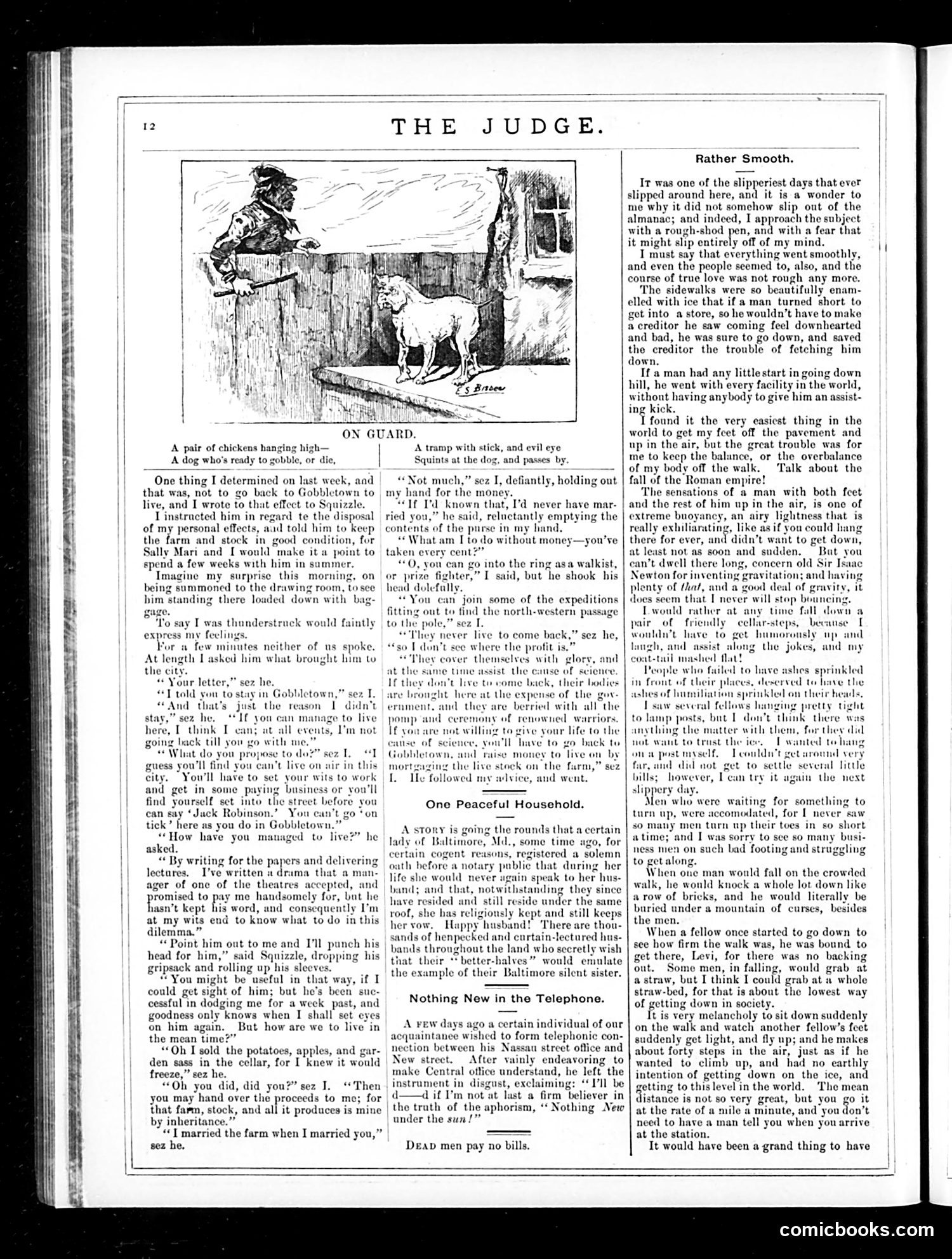
The cartoon depicts a dog guarding hanging chickens from a tramp—a visual joke about the desperation of poor urban life. The accompanying story mocks the genteel poverty of the educated middle class. A man from "Gobbletown" (rural simplicity) moves to the city seeking fortune. His friend Squizzle arrives with naive enthusiasm, only to learn harsh urban realities: the theatrical manager who promised payment disappeared, survival requires hustling or boxing, and Arctic expeditions are death traps for glory-seekers. The narrator sarcastically catalogs impossible "opportunities." The satire targets both rural naiveté about city life and the precarious circumstances of educated men who lack practical skills or capital. There's also gentle mockery of Squizzle's earnest offer to "punch" the theater manager—brute force cannot solve structural economic problems. The other brief items continue similar themes about urban struggle and the indignity of poverty-driven scrambling.
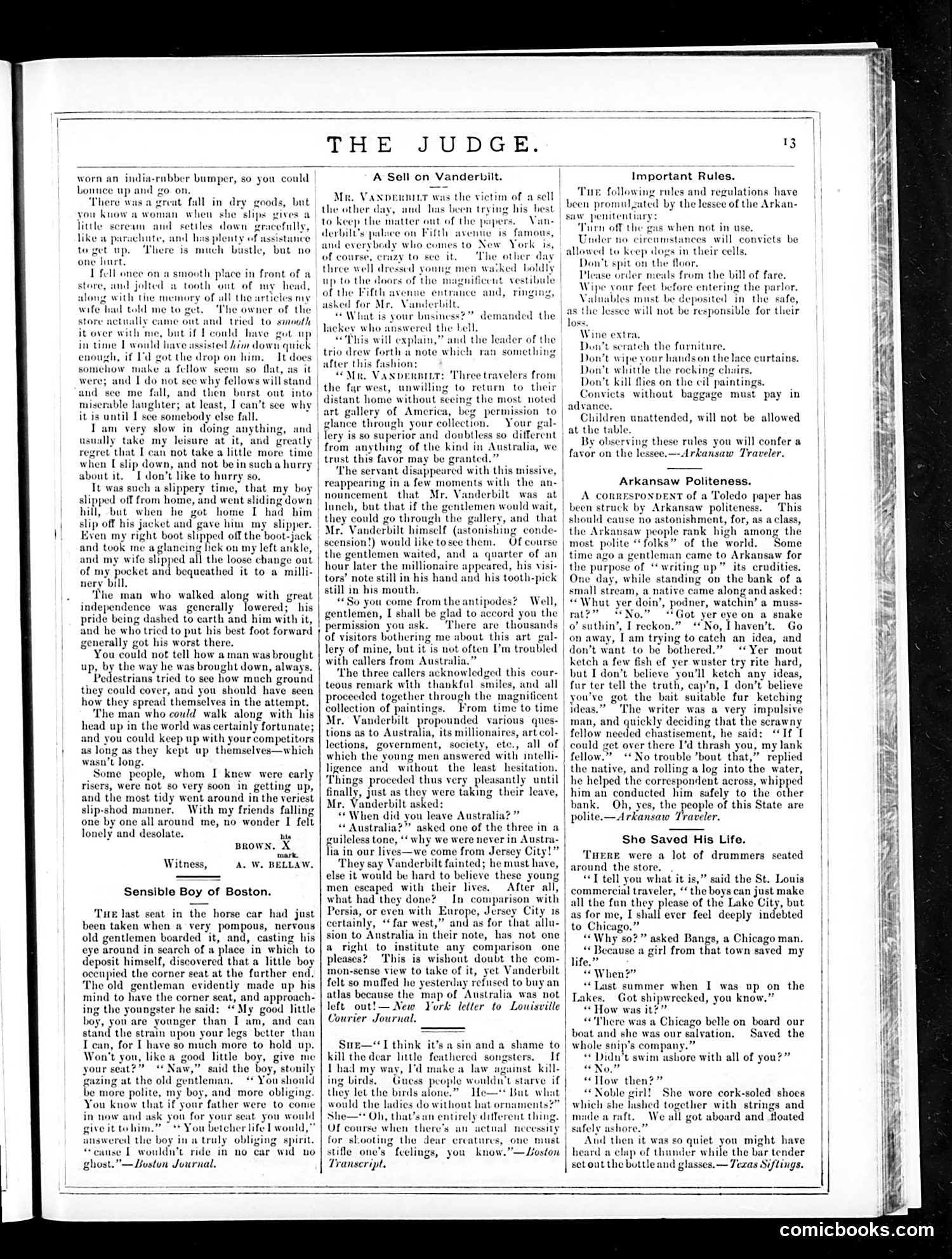
This page contains three separate humorous pieces typical of the satirical magazine's content: ## "A Sell on Vanderbilt" A con artist story where three well-dressed young men deceive Vanderbilt's servants at his famous Fifth Avenue mansion by presenting a forged note claiming to represent him. The humor relies on the audacity of the scheme targeting one of America's wealthiest industrialists—a common subject for satire given Vanderbilt's prominence and reputation for ostentatious wealth. ## "Sensible Boy of Boston" A working-class youth refuses to give up his streetcar seat to a pompous older gentleman, regardless of entreaties about age and infirmity. The boy's final quip—that he wouldn't ride in a car with a ghost—is absurdist humor, deflating the gentleman's self-importance. ## The main text article Appears to be a humorous essay about slipping on icy streets, establishing class commentary through observations about how different social types fall or maintain dignity. The overall theme: satirizing wealth, pretension, and social hierarchies—core concerns of Judge magazine's readership.
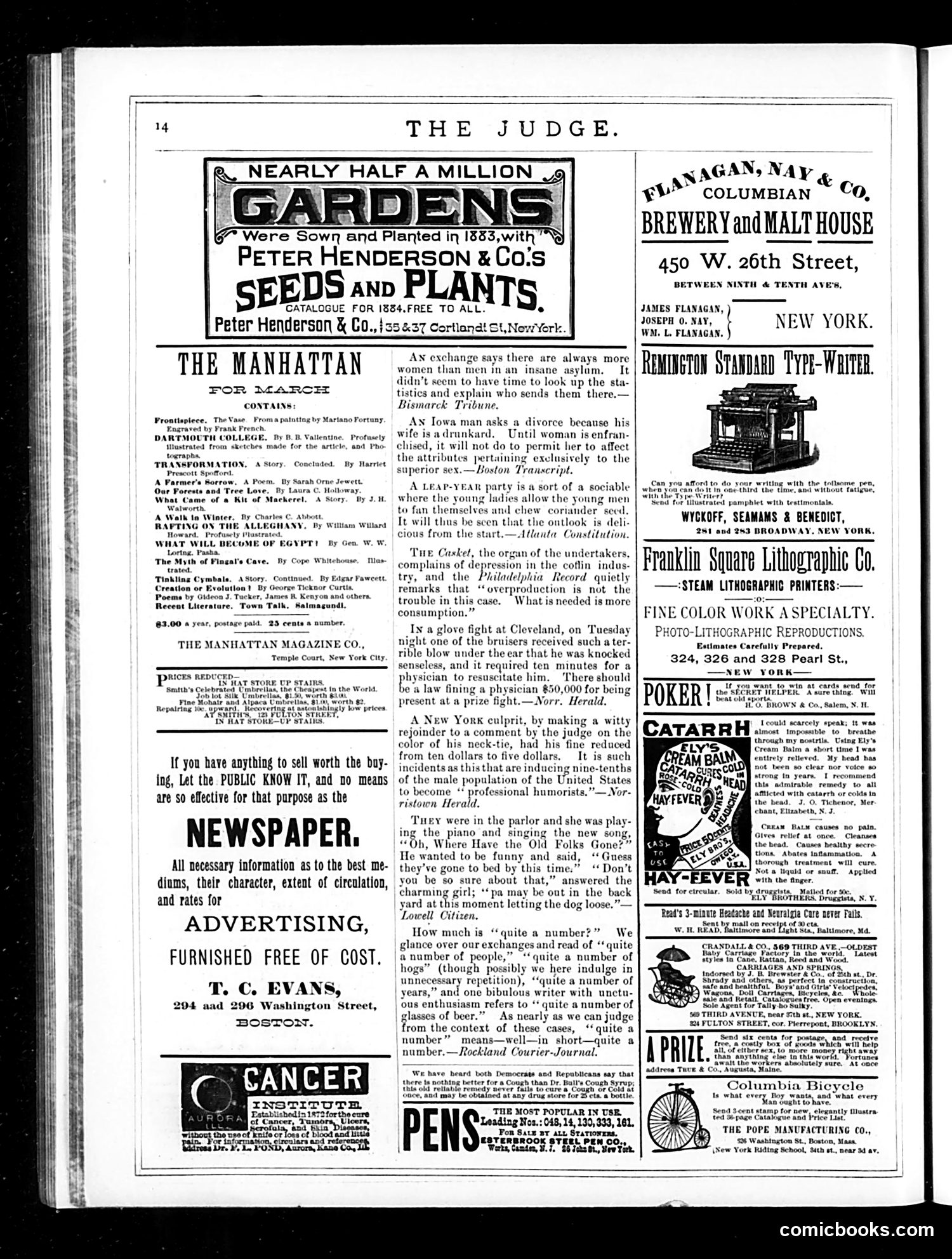
This page is primarily **advertising and miscellaneous content** rather than political cartoons. The page includes: **Notable Elements:** - Peter Henderson seed catalog advertisement (top) - "The Manhattan" magazine promotional content - Various short humorous anecdotes and observations on social topics - T.C. Evans advertising agency notice - Product advertisements (cancer institute, typewriter, brewery, lithographic company, etc.) **The Humor/Satire:** The scattered joke items mock contemporary social issues: women in asylums, divorce, Iowa social customs, prize fighting, judicial corruption, and courtship rituals. One anecdote satirizes a man's witty retort to a judge reducing his fine—mocking how Americans apparently value "professional humorists" over decorum. **Context for Modern Readers:** This reflects late-1880s American concerns: gender inequality, legal system flaws, boxing violence, and social propriety. The tone is lightweight satire typical of Judge magazine's approach to current events and human foibles. The page demonstrates Judge primarily functioned as a **vehicle for advertising revenue** alongside its satirical content.
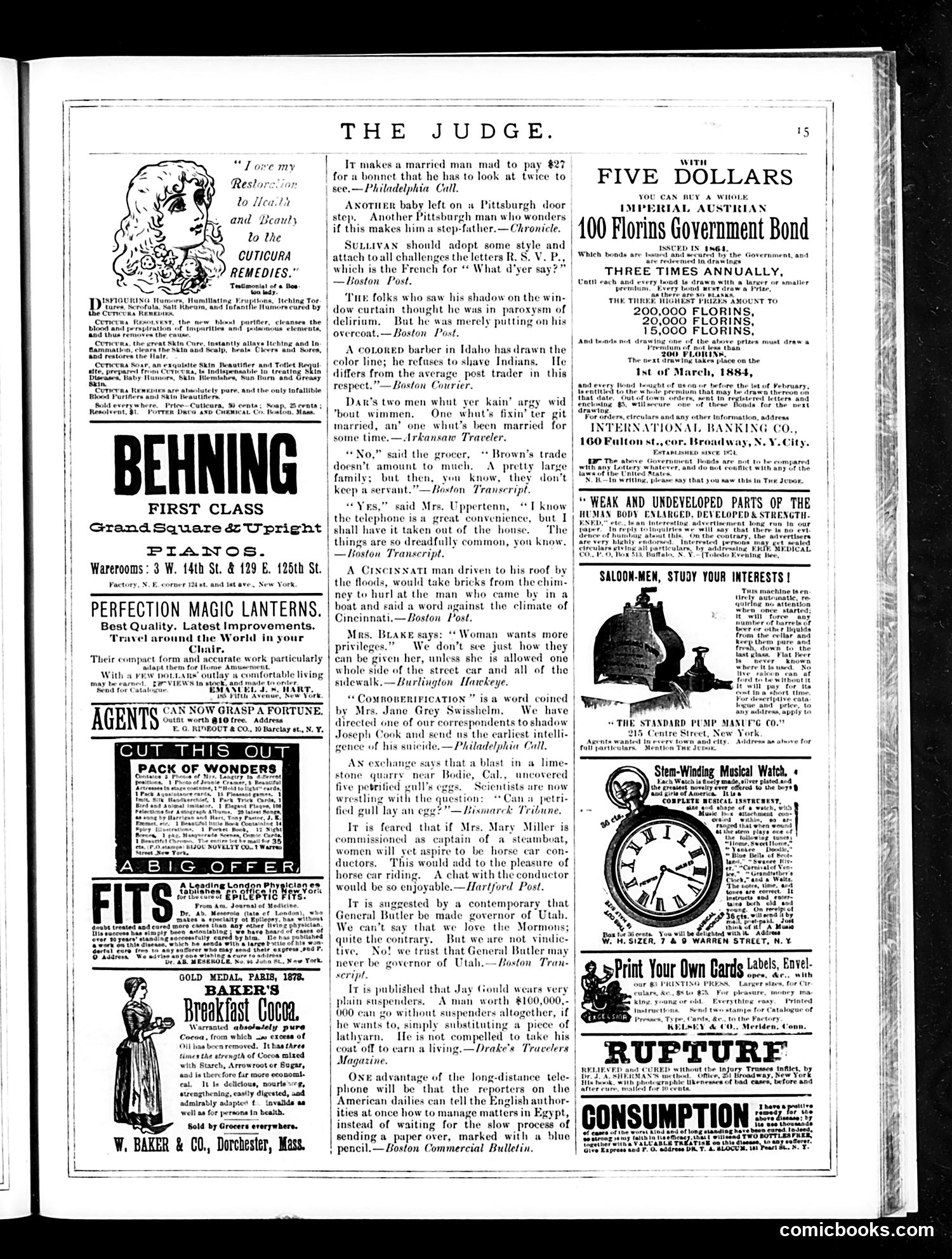
This page is primarily **advertisements and humorous short items**, not political cartoons. The content includes: **"The Judge" column**: A collection of brief satirical jokes on domestic life and social absurdities. Examples include complaints about expensive bonnets, a colored barber's race-conscious behavior, and commentary on women's expanding social roles (telephones, steamboat captains, horse car conductors). These reflect late-19th-century anxieties about women's increasing independence. **One notable reference**: A joke suggesting General Benjamin Butler (a prominent political figure) should become governor of Utah—a jab at both Butler and Mormon polygamy, which was a contentious national issue. **Content overall**: The page reflects period attitudes toward race, gender, and class through humor. Most jokes target women's ambitions, immigrant workers, and other groups. **Format**: Mostly **paid advertisements** for pianos, cocoa, patent medicines, and financial bonds interspersed with these brief comic observations—typical of Judge's revenue model.
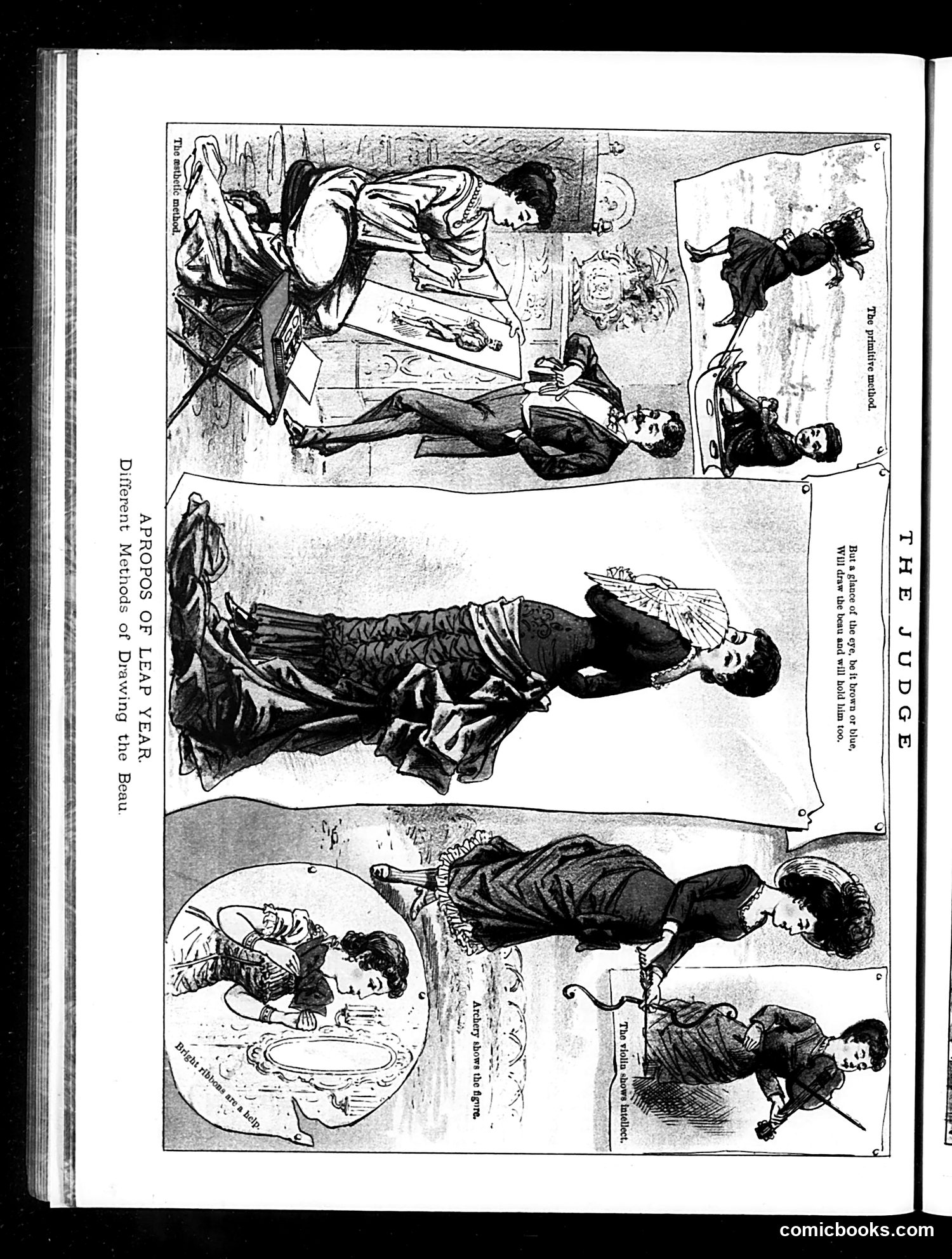
This page satirizes "Leap Year" traditions, when women were socially permitted to pursue men romantically—reversing normal gender roles. The title "Different Methods of Drawing the Beau" shows multiple panels depicting various approaches women might use to attract male suitors. The "esthetic method" appears to reference the Aesthetic Movement (a late 19th-century artistic trend emphasizing beauty and style). The verse suggests that a woman's gaze alone—"a glance of the eye, be it brown or blue"—can attract and hold a man's attention. The satirical point: the magazine mocks both the Aesthetic Movement's pretensions and the unusual social inversion of Leap Year, when conventional courtship rules temporarily flip. The cartoons likely show exaggerated, humorous depictions of women employing different tactics—artistic poses, direct appeals, or other methods—to secure romantic attention during this brief period when female initiative was socially sanctioned.