
Judge, 1884-03-01 · page 11 of 16
Judge — March 1, 1884 — page 11: what you’re looking at
What you’re looking at
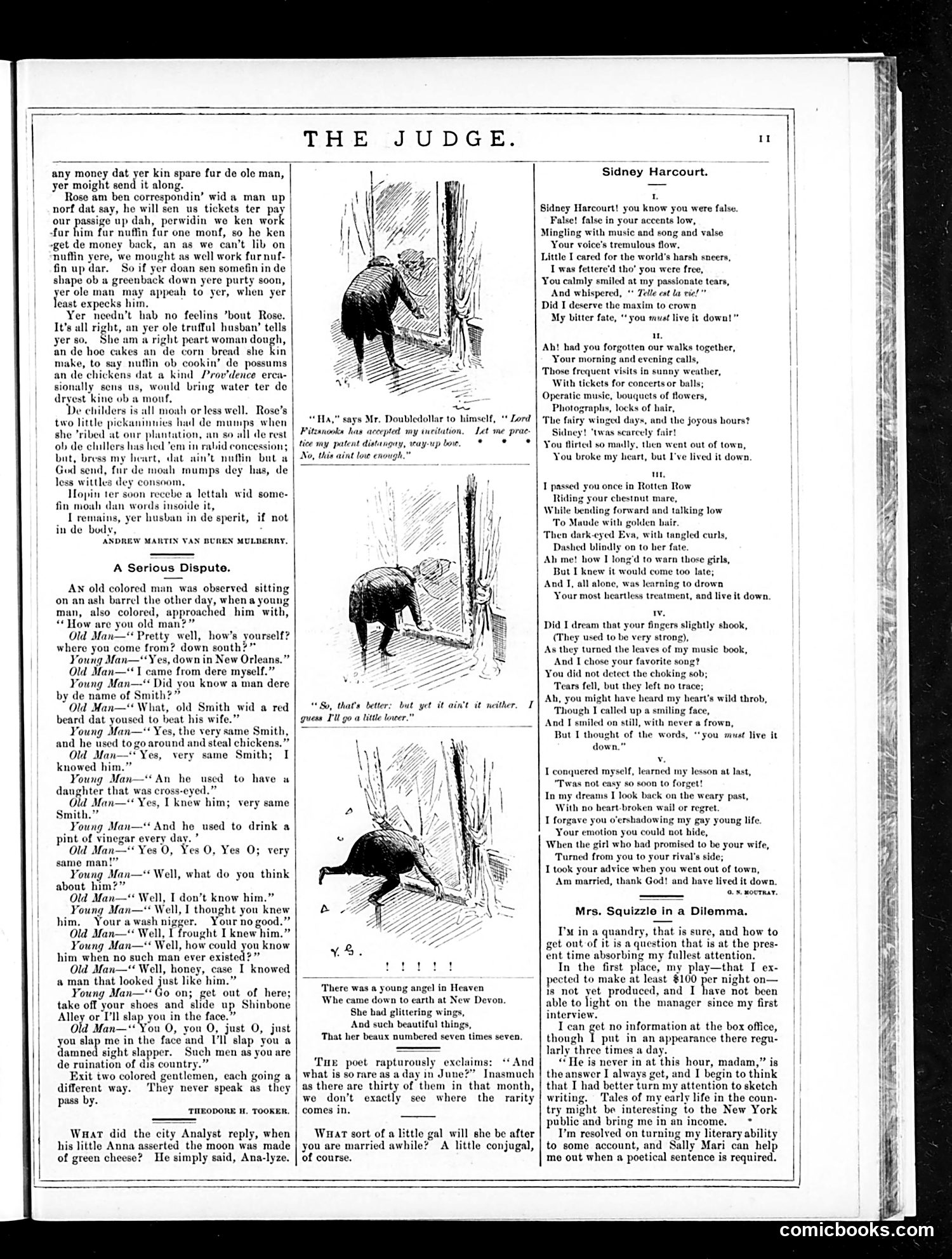
This page from the satirical magazine *Judge* contains three distinct pieces: 1. **"Rose's Letter"** (left column): A dialect piece written as correspondence from an enslaved or formerly enslaved man to a northern relative, asking for money. The heavy stereotypical dialect and references to "pickaninnies" and subsistence conditions reflect the crude racial humor typical of 1880s-90s American satire. 2. **"A Serious Dispute"** (center): A comedic dialogue between two Black men debating whether one knows another "old Smith." The joke relies on the older man's seeming confusion or dishonesty—claiming to know Smith while simultaneously denying knowledge. The racial epithet in the text signals this was intended as humor mocking Black speech patterns. 3. **"Sidney Harcourt"** (right): A romantic poem addressed to a woman, recounting past courtship and expressing forgiveness for her marriage to another. The cartoons show figures in domestic or street scenes. The overall page exemplifies *Judge's* mix of satirical commentary, ethnic humor (standard but offensive by modern standards), and sentimental poetry typical of late-19th-century American humor magazines.
📄 Transcribed text from this page (OCR, searchable)
Machine-transcribed from the original scan — historical spelling and the odd misread are preserved.
any money dat yer kin spare fur de ole man, yer moight send it along. Rose am ben correspondin’ wid a man up norf dat say, he will sen us tickets ter pay | our passige up dah, perwidin we ken work | fur him fur nuffin fur one monf, so he ken -get de money back, an as we can’t lib on nuffin yere, we monght as well work fur nuf- fin up dar. So if yer doan sen somefin in de shape ob a greenback down yere purty soon, ig ole man may appeah to yer, when yer east expecks him, Yer needn’t hab no feelins ’bout Rose. It’s ull right, an yer ole trafful husban’ tells yer so. She am a right peart woman dough, an de hoe cakes an de corn bread she kin make, to say nuflin ob cookin’ de possums an de chickens dat a kind Prov'dence erca- | sionally sens us, would bring water ter de t kine mouf, | ¢ childers is all moah or less well. Rose’s two litle pickaninnies had de mumps when she ’ribed at our plantation, an so all de rest | ob de clullers has hed ‘em in rabid concession; but, bress my heart, dat ain’t nuffin but a God send, fir de moh mumps dey has, de less wittles dey consoom, Hopin ter soon recebe a lettah wid some- fin moah dan words insoide it, I remains, yer husban in de sperit, if not in de body, ANDREW MARTIN VAN DURE A Serious Dispute. AN old colored man was observed sitting on anash barrel the other day, when a young man, also colored, ‘approached him with, “How are you old man?” Old Man—* Pretty well, how’s yourself? where you come from? down south?” Young Man—‘‘¥ es, down in New Orleans.” Old Man—‘‘1 came from dere myself.” Young Man—“ Did you know a man dere by de name of Smith?” Old Man—‘ What, old Smith wid a red beard dat yoused to beat his wife.” Young Man—*“ Yes, the very same Smith, and he used to go around and steal chicken: Old Man— Yes, very same Smith; I knowed him. Young Man—“‘ An he used daughter that was cross-eyed.” Old Man—* Yes, L knew him; very same Smith.” Young Man—* And he used to drink a pint of vinegar every day. ’ “Yes 0, Yes O, Yes 0; very to have w same man Young Man—* Well, what do you think about him?” Ola Man— Well, I don’t know him.” Young Man—* Well, I thought you knew him. Your awash nigger. Your no good.” Old Man— Well, I frought I knew him.” Young Man—* Well, how could you know him when no such man ever existed?” Old Man—* Well, honey, case I knowed a man that looked just like him.” Young Man—Go on; get out of here; take off your shoes and slide up Shinbone Alley or I'll slap you in the face.” Old Man—‘‘ You O, you O, just O, just you slap me in the face and I'll slap you a damned sight slapper. Such men as you are de ruination of dis country.” Exit two colored gentlemen, each going a different way. They never speak as they pass by. THEODORE H. TOOKER. Wnar did the city Analyst reply, when his little Anna asserted the moon was made THE JUDGE. Ia," says Mr, Doubledollar to himself, “ Lord tzanooks has accepted my incitation, Let me prac: tice my patent distangay, vay-up tow. © & * No, this aint low enough.” at's better: but yet it ain't it neither, T guess TUl go a little lower.” ‘There was a young angel in Heaven Whe came down to earth at New Devon. She had glittering wings, And such beautiful things, That her beaux numbered seven times seven, Tue poet rapturously exclaims: “And what is so rare as aday in June?” Inasmuch as there are thirty of them in that month, we don’t exactly see where the rarity comes in. Waar sort of a little gal will she be after you are married awhile? A little conjugal, of green cheese? He simply said, Ana-lyze. of course. Sidney Harcourt. 1: Sidney Harcourt! you know you were false, False! false in your accents low, Mingling with music and song and valse Your voice’s tremulous flow, Little I cared for the world’s harsh sneers, I was fettere'd tho’ you were free, You calmly smiled at my passionate tears, And whispered, ** Telle ext la rie!" Did I deserve the maxim to crown My bitter fate, “you must live it down!” ut. Ah! had you forgotten our walks together, Your morning and evening calls, requent visits in sunny we With tickets for concerts or balls; Operatic music, Louquets of flowers, Photographs, locks of hair, ‘The fairy winged days, and the joyous hours? “twas scarcely fair! You flirted so mally, then went out of town, You broke my heart, but I've lived it down ut, T passed you once in Rotten Row Riding your chestnut mare, While bending forward and talking low ‘To Maude with golden hair. Then dark-cyed Eva, with tangled curls, Dashed blindly on to her fate. Ah me! how I long’d to warn those girls, But I knew it would come too late; 41, all alone, was learning to drown Your most heartless treatment, and live it down. A Ww. ‘am that your fingers slightly shook, y used to be very strong), turned the leaves of my music book, etect the choking sob; Tears fell, but they left no trac Ah, you might have heard my heart Though I called up a smiling face, And I smiled on still, with never a frown, But I thought of the words, ‘you must live it down.” wild throb, v. I conquered myself, learned my lesson at last, “Twas not easy $0 soon to for; In my dreams I look back on the weary past, With no beart-broken wail or regret I forgave you o’ershadowing my gay young life Your emotion you could not hide, When the girl who had promised to be your wife, Turned from you to your rival's side; I took your advice when you went out of town, ‘Am married, thank God! and have lived it down. ©.» wooTRar, Mrs. Squizzle in a Dilemma. I's in a quandry, that is sure, and how to get ont of it is a question that is at the pres- ent time absorbing my fullest attention. In the first place, my play—that I ex- pected to make at least $100 per night on— 1s not yet produced, and I have not been able to light on the manager since my first interview. I can get no information at the box office, though i put in an appearance there regu- larly three times a day. “He is never in at this hour, madam,” is the answer I always get, and I begin to think T had better turn my attention to sketch ing. Tales of my early life in the coun- try might be interesting to the New York public and bring me in an income. * I’m resolved on turning my literary ability to some account, and Sally Mari can help me out when a poetical sentence is required. comicbooks.com