
A complete issue · 16 pages · 1884
Judge — February 23, 1884
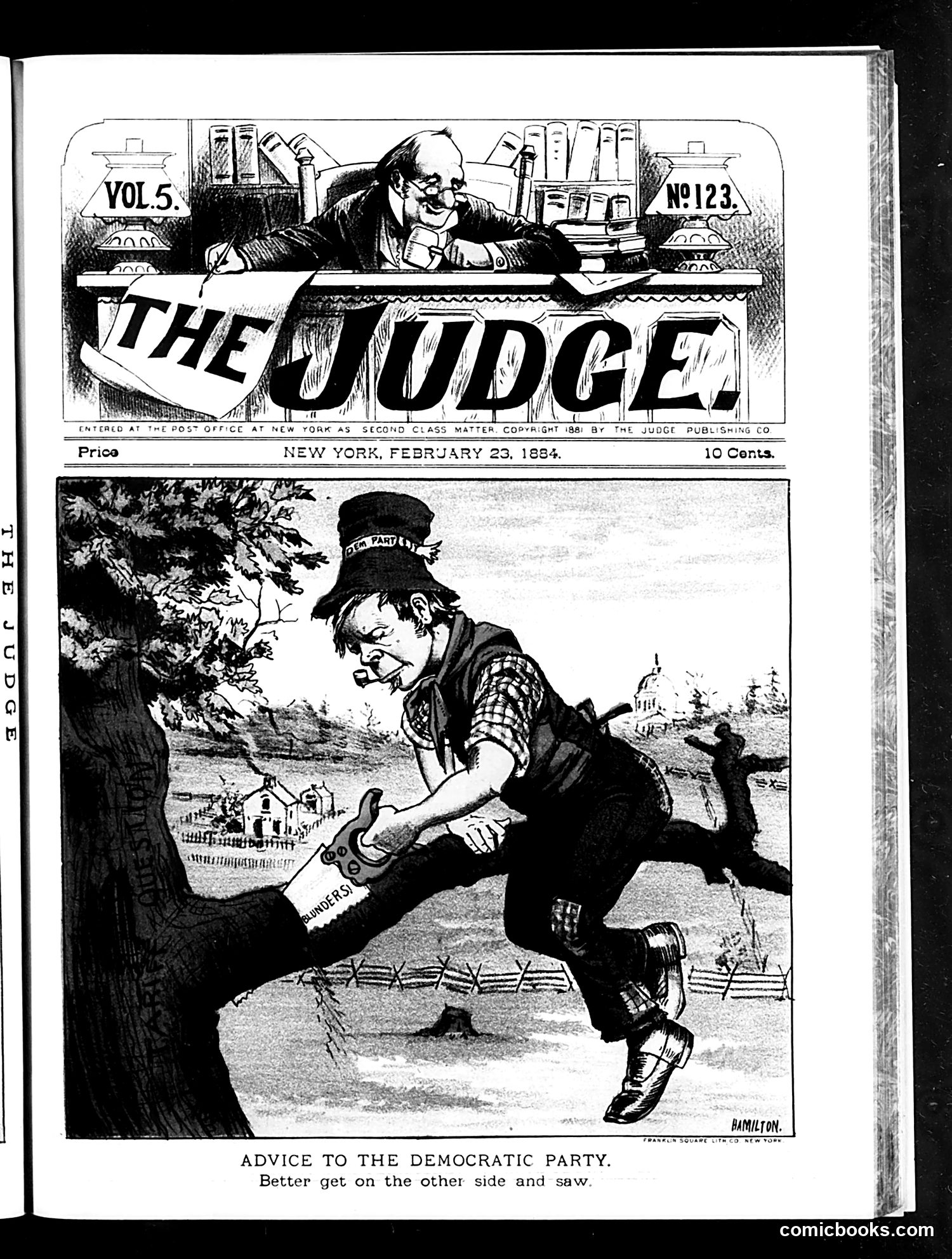
This cartoon, titled "Advice to the Democratic Party," depicts a man labeled "TARIFF" being sawed in half by a figure wearing a top hat marked "FREE TRADE." The man appears to be a caricatured politician or party representative being physically destroyed by free-trade ideology. The satire targets the Democratic Party's internal conflict over tariff policy in the 1884 election. The "saw" metaphor suggests free-trade advocates are literally dividing and weakening the party. The caption's ironic "advice" mocks the Democrats for allowing this divisive issue to splinter their unity. This reflects genuine 1880s political debate: protectionist Republicans supported tariffs, while many Democrats favored free trade, creating party tension during an election year.
This page contains editorial commentary on two major political issues circa the 1890s: **free trade vs. tariffs** and **rapid transit in New York City**. The **tariff debate** was the pivotal political question of that election year. Judge criticizes both parties for their awkward positions: Republicans championed high protective tariffs but risked appearing rigid; Democrats advocated free trade but feared the economic disruption. The satire suggests neither party genuinely wants to commit fully, preferring to avoid the issue that could "prove their ruin." The **rapid transit section** addresses Brooklyn's transportation crisis. Judge advocates for cross-town elevated railways to supplement existing north-south lines on Ninth, Sixth, and Third avenues. The critique targets the Rapid Transit Commission's slow progress and the competing interests of property owners resisting infrastructure development. The small **Judge masthead illustration** (upper left) shows a caricatured figure—likely representing political leadership or public sentiment—drowning in or struggling with these divisive issues. The page is primarily political commentary rather than humorous cartoons, reflecting Judge's satirical magazine format combining visual wit with substantive editorial argument.
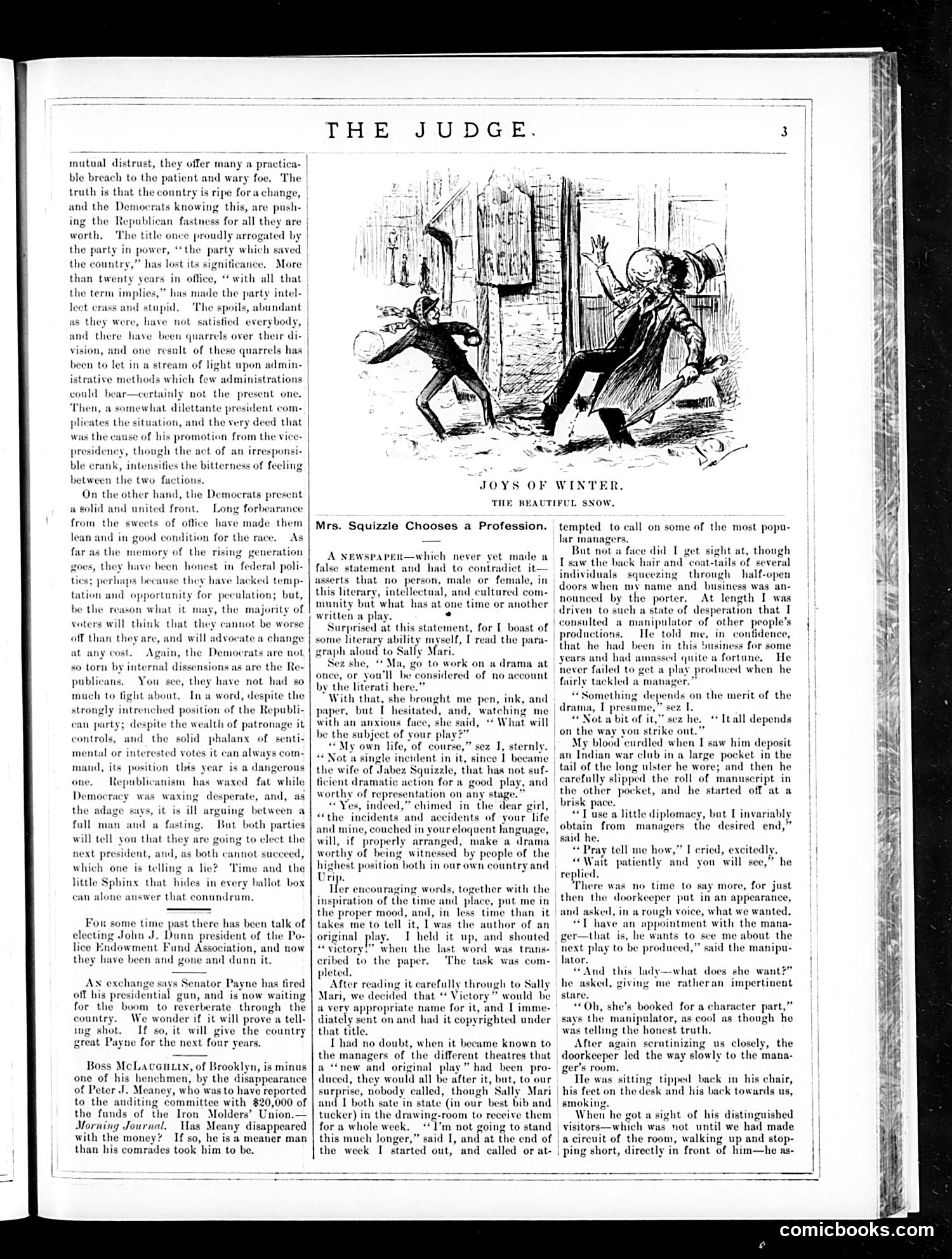
This *Judge* page contains two satirical pieces about American life. The main cartoon "Joys of Winter" depicts children playing in snow—a cheerful winter scene. Below it, the article "Mrs. Squizzle Chooses a Profession" satirizes the contemporary literary pretensions of middle-class Americans. A newspaper claims everyone in the cultured community has written a play. When Sally Mari reads this, she pressures her husband to write a drama or be considered "of no account by the literati." The satire targets both the absurd social anxiety created by fashion among the educated classes and the claim that playwriting is somehow an essential marker of respectability. The surrounding political commentary discusses Republican and Democratic factions, Republican complacency after twenty years in power, and Democratic revival chances—typical *Judge* partisan content from the Gilded Age.
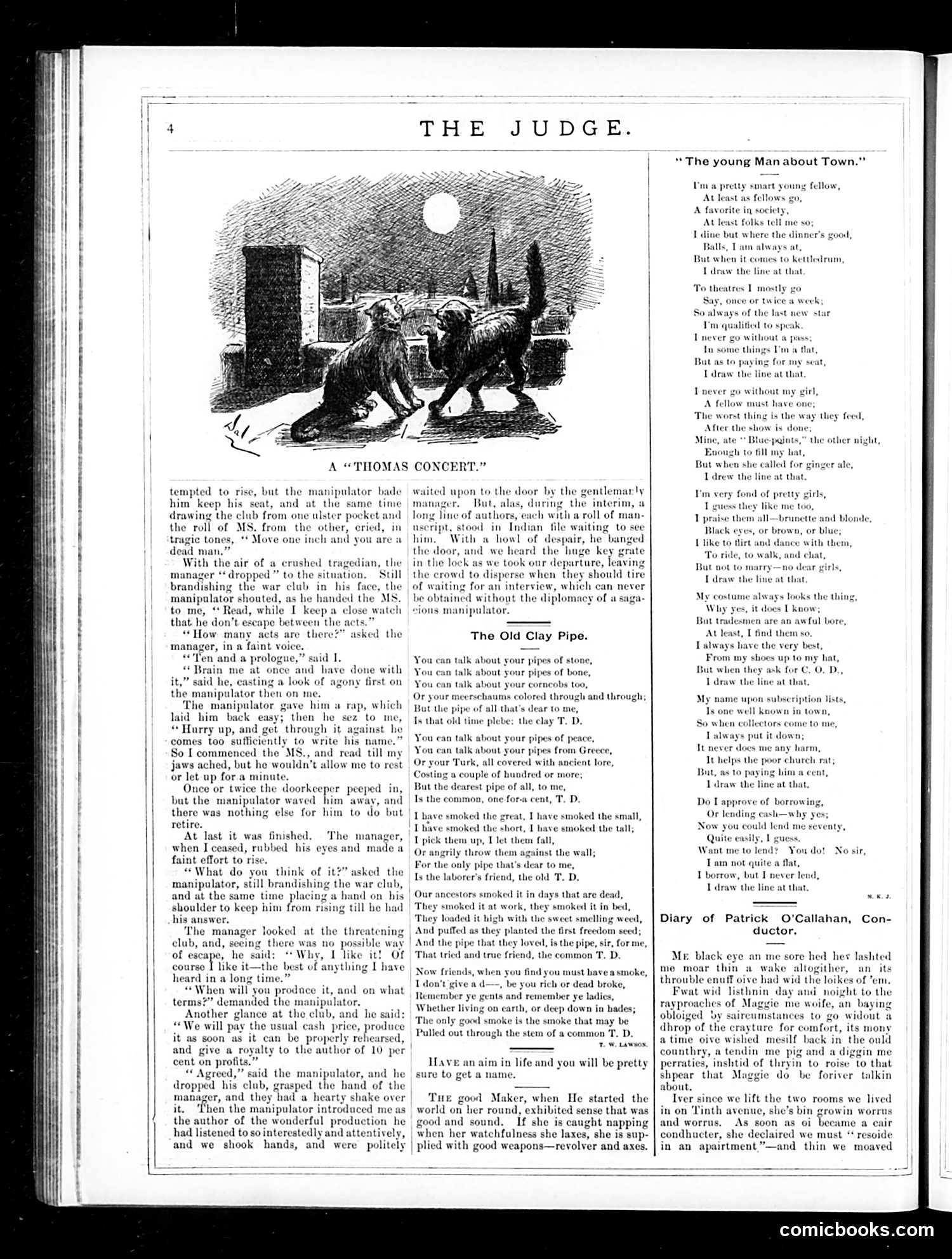
This cartoon satirizes theatrical management through a darkly comedic story. A "manipulator" (theatrical producer/manager) coerces a theater manager into accepting a play manuscript by threatening him with a war club, forcing him to listen to a ten-act play read aloud without interruption or rest. The satire targets the predatory practices of theater producers who used intimidation and manipulation to force managers into producing plays, often by lesser-known authors. The absurdist violence—using a weapon to literally hold a captive audience—exaggerates real industry power imbalances. The manipulator's subsequent success (the manager agrees to produce the play and pay royalties) darkly suggests that such coercive tactics actually worked in theatrical deal-making. The accompanying poem celebrates the humble clay pipe, likely a working-class commentary contrasting simple pleasures with theatrical pretension on the same page.
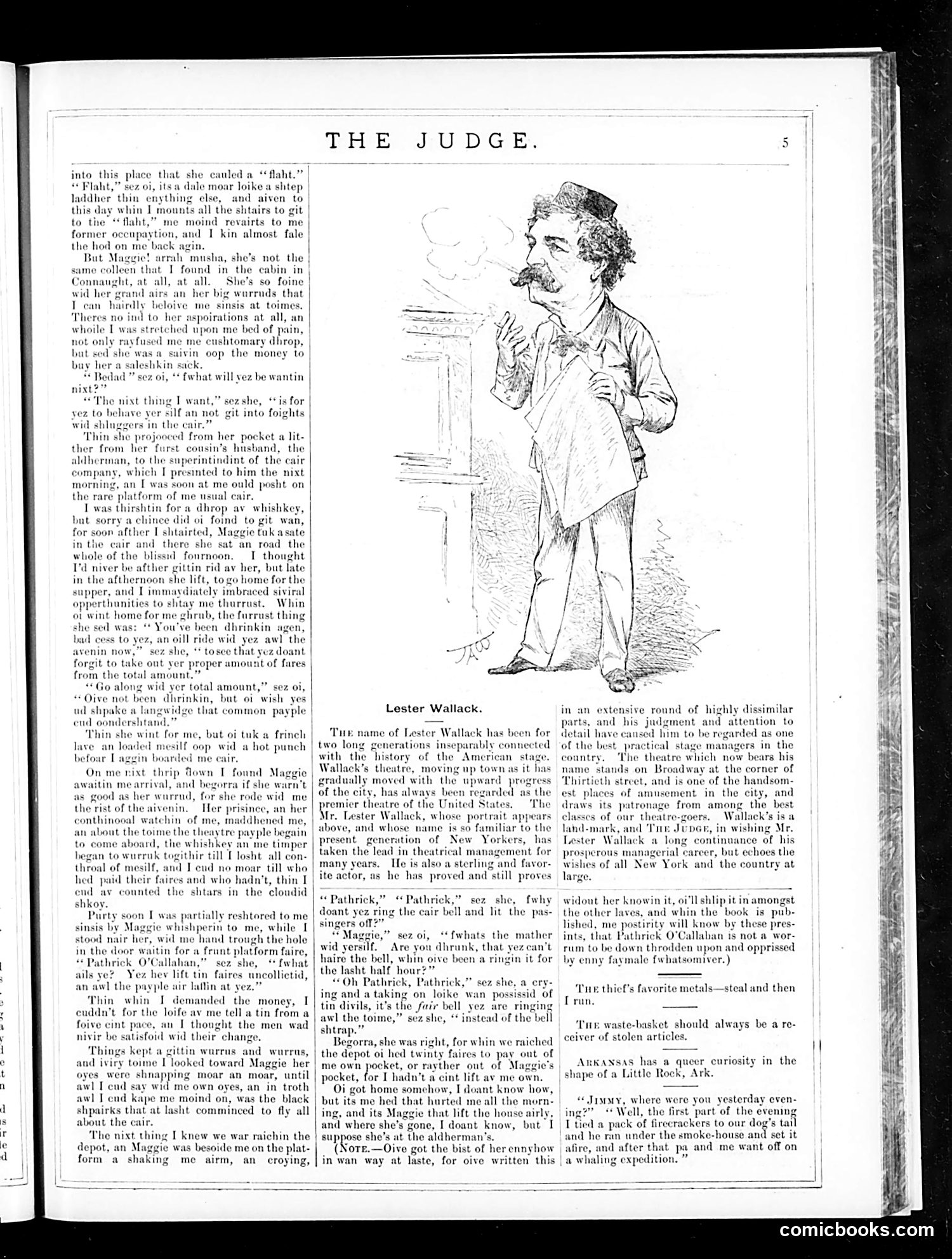
This page from *Judge* magazine contains two distinct elements: **Main Content:** A serialized Irish-immigrant story narrated in heavy dialect by a streetcar conductor named Patrick O'Callahan. The narrative depicts working-class Irish-American life and domestic friction—Patrick's wife Maggie demands he stop drinking and contribute to household savings for a fur coat. The story uses exaggerated phonetic dialect ("fwhat," "sez," "oyes") typical of late 19th-century ethnic humor, often considered derogatory today. **Portrait & Biography:** The page features a sketch of **Lester Wallack**, a prominent American theatrical manager and actor of the era. The accompanying text celebrates his long career managing New York's finest theaters and his status as a leading figure in American drama. The satire lies in the contrast: while Wallack represents refined theatrical culture, the Patrick story mocks working-class immigrant behavior through caricature and dialect—reflecting *Judge*'s audience of educated, prosperous readers who found such portrayals comedic.
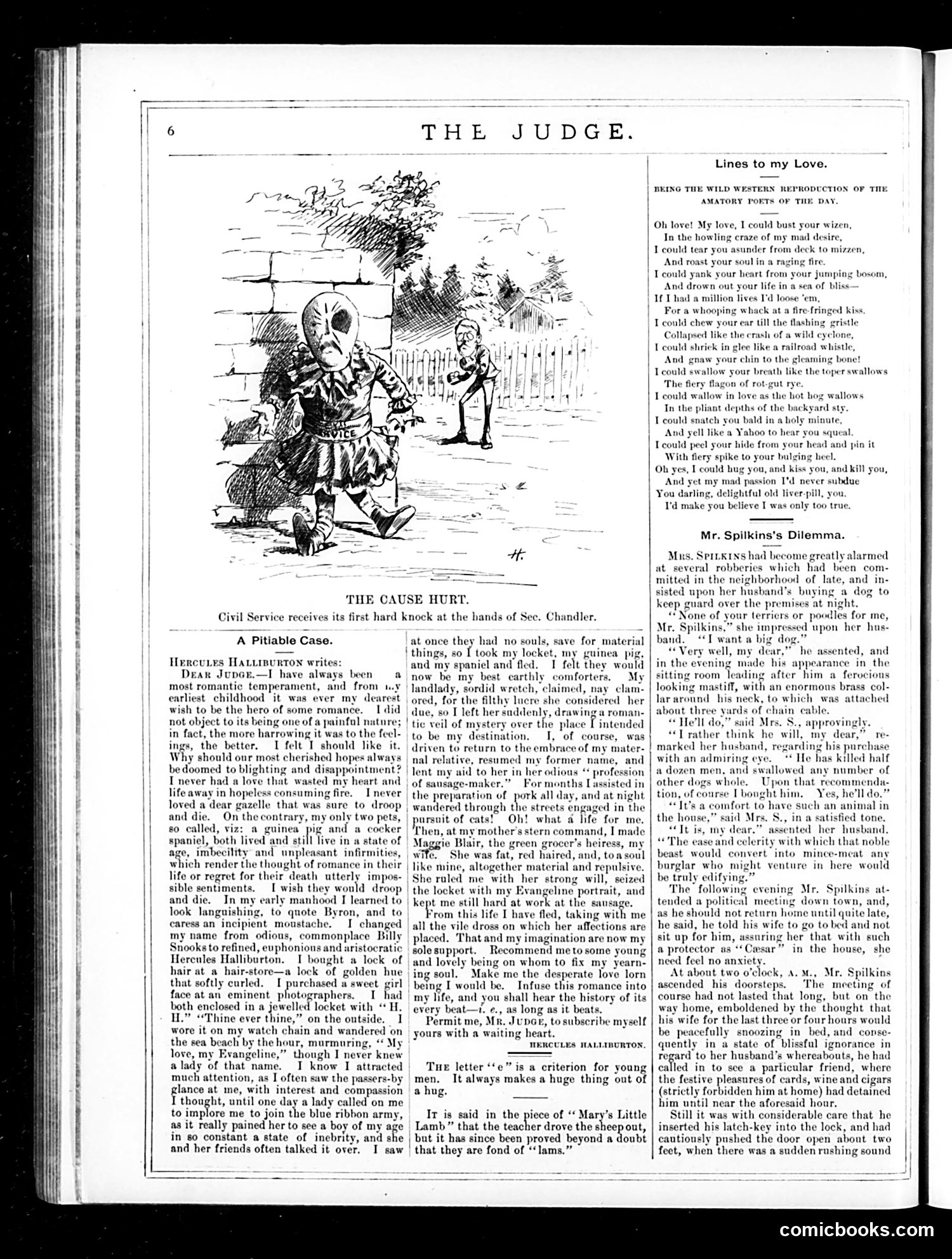
The main cartoon satirizes Secretary of the Interior **Samuel J. Chandler's** attack on Civil Service reform. The figure appears to be a bloated bureaucrat being struck down, with the caption indicating Chandler has dealt the first serious blow against Civil Service protections—likely referring to his dismissal of civil servants or interference with merit-based hiring. The "Pitiable Case" below is humorous social satire about a melodramatic young man (Hercules Halliburton/Billy Snooks) who romanticizes suffering but leads an absurdly mundane life: working in his mother's sausage factory, owning unromantic pets, and married to an unattractive woman. The joke mocks Victorian sentimentality and the gap between romantic fantasy and dreary reality. The final quip about the letter "e" is wordplay on "huge thing out of a hug."
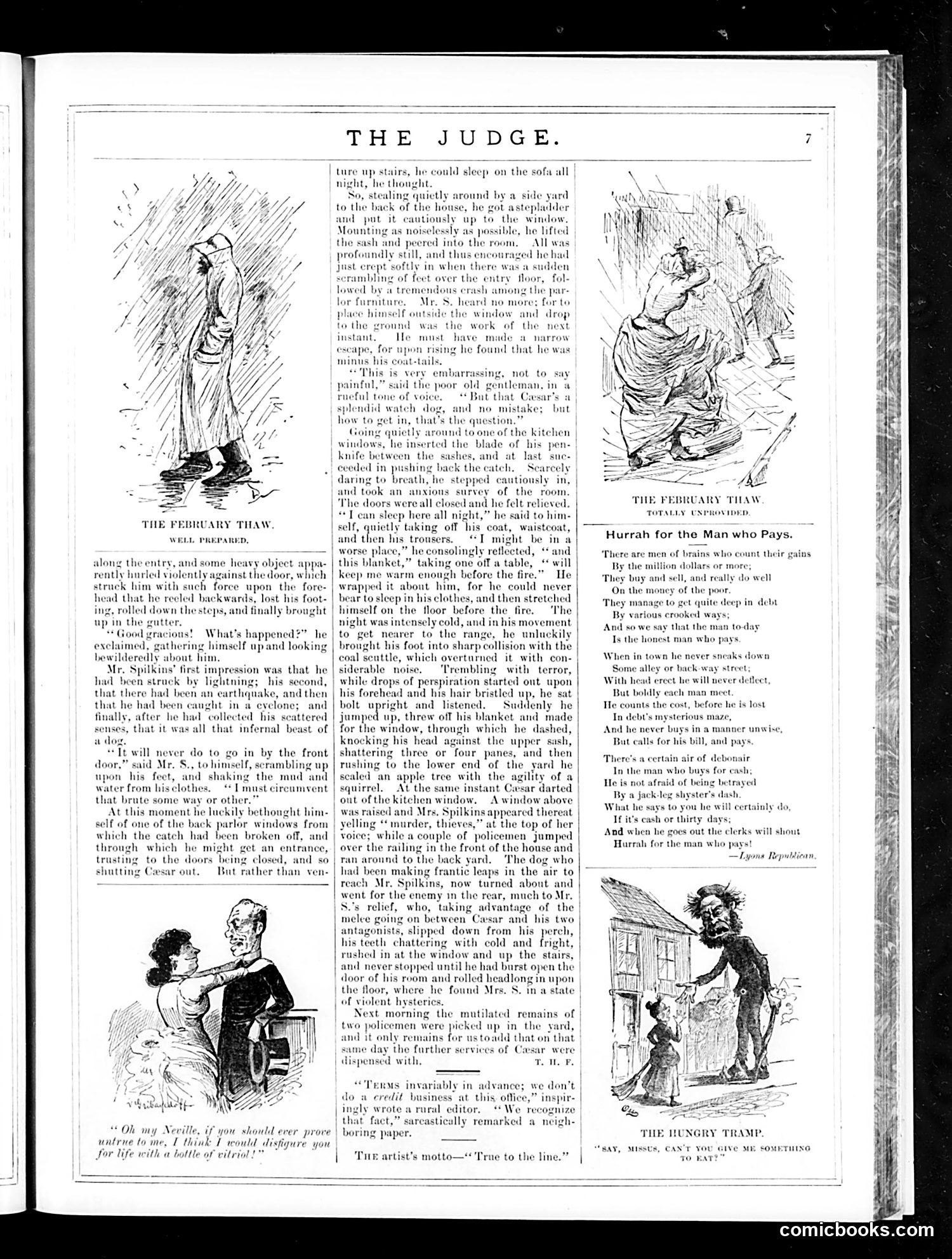
This humorous story-cartoon depicts a man (Mr. Spilkins) attempting to break into his own house after being locked out in winter. The satire mocks Victorian domestic melodrama: his anxious entry through a window, his nervous night hiding in the kitchen, and the absurd chaos that ensues when his wife Mrs. Spilkins mistakes him for a burglar. The humor escalates when their watchdog Caesar attacks two policemen who arrive to stop the supposed robbery. By morning, the "mutilated remains" of the policemen are found—an exaggerated punchline suggesting the dog's ferocity. The illustration titled "The Hungry Tramp" below depicts economic hardship, showing a beggar asking for food. This contrasts with Spilkins's domestic misadventure, reflecting Judge magazine's typical mix of class-based humor and social commentary on poverty during the Gilded Age.
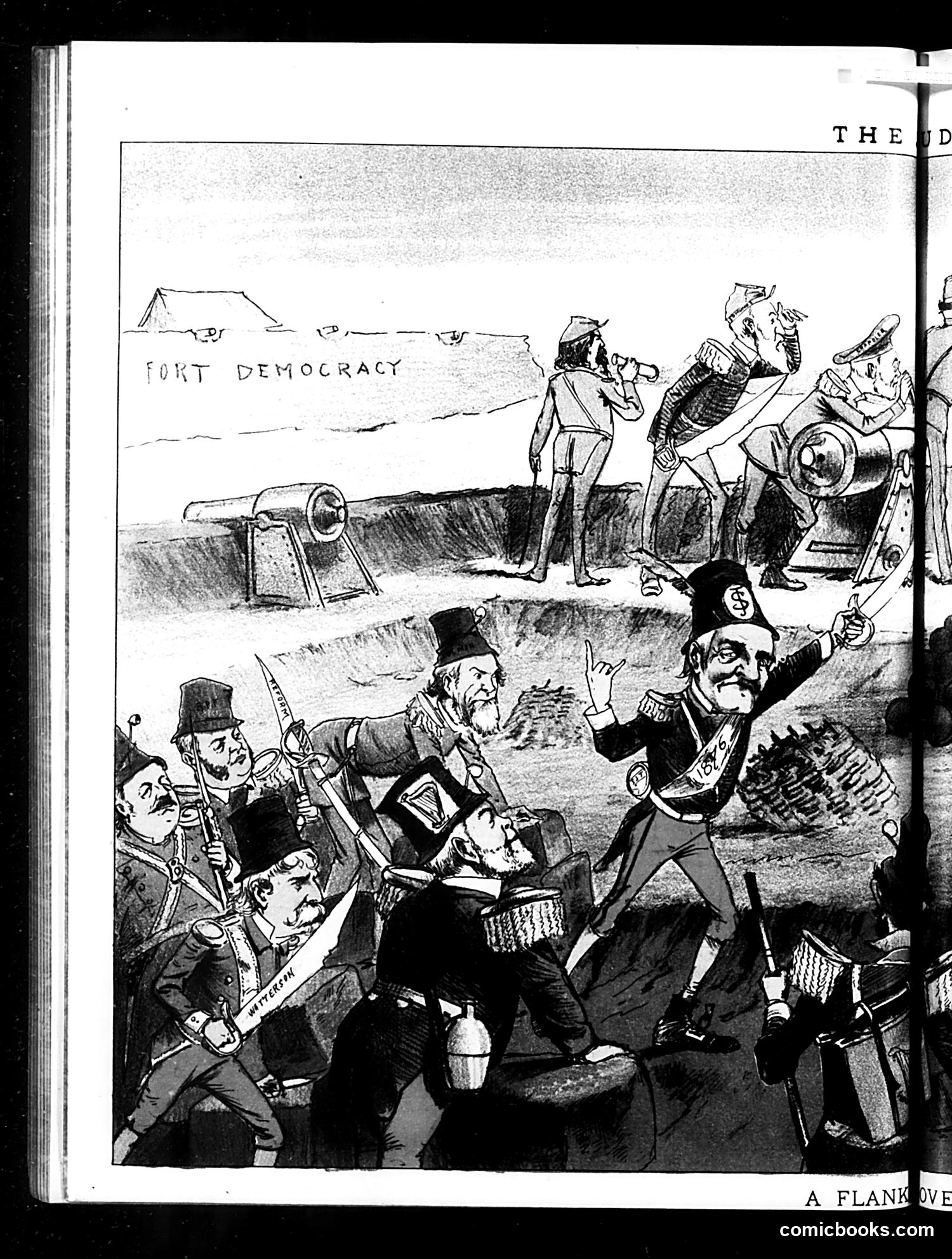
This satirical cartoon depicts "Fort Democracy" under siege by military figures wearing uniforms and insignia marked with dollar signs. The caricature on the right, prominently featuring a "$" symbol on his hat, appears to be a personification of capitalist or financial interests. Armed soldiers in the foreground—drawn with exaggerated, menacing features—seem to represent militaristic or authoritarian forces allied with wealth. The cartoon satirizes the perceived threat that unchecked military power combined with financial interests posed to democratic institutions. The fort itself symbolizes democracy under attack. This likely reflects early 20th-century American anxieties about militarism, corporate influence, and threats to democratic governance—common themes in *Judge* magazine's progressive satire during that era.
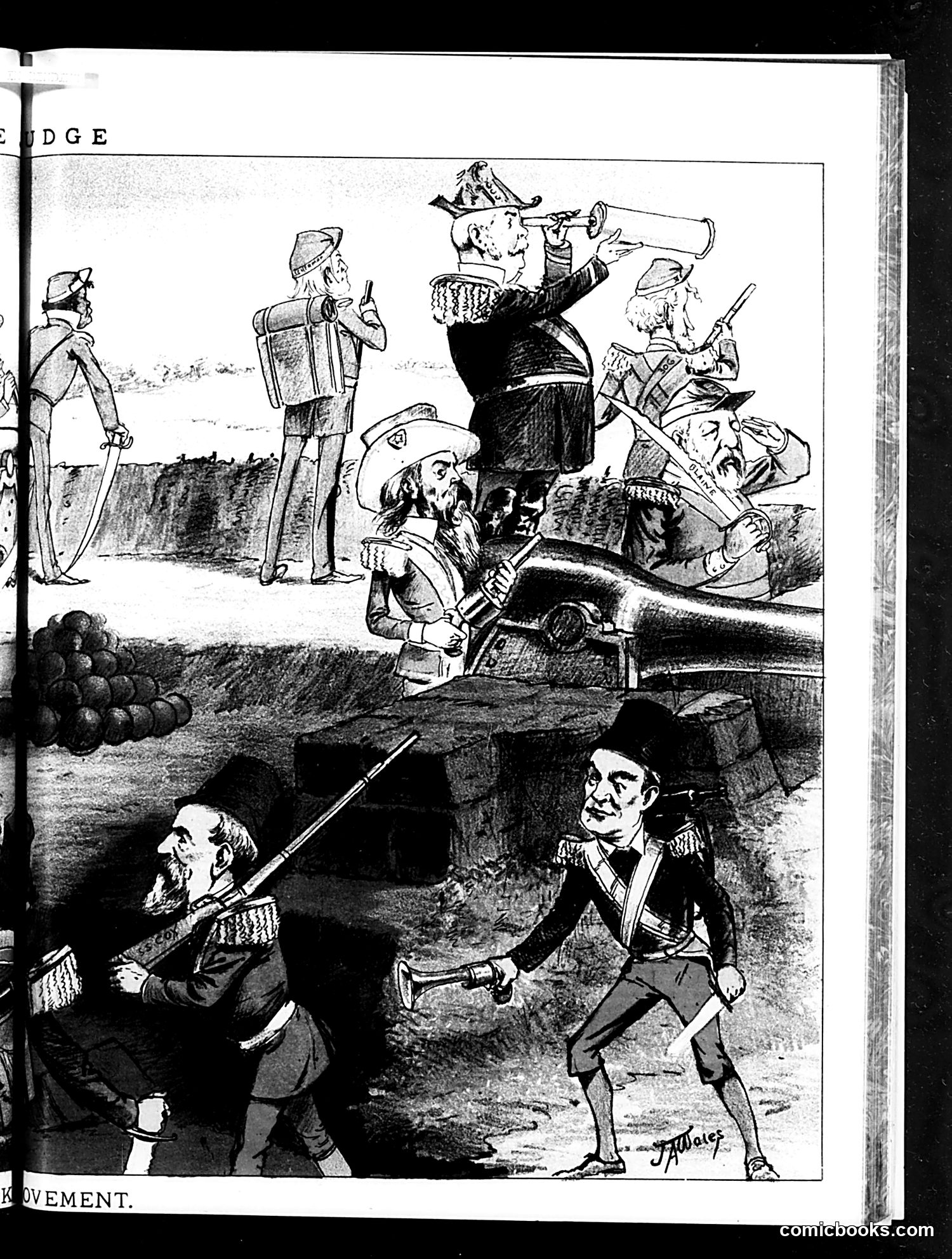
This appears to be a military satirical cartoon from Judge magazine showing officers in a fortified position. The central figure is a portly officer with a telescope, prominently positioned above the fortifications, while two bearded military men in the foreground appear to be in defensive positions below. The cartoon satirizes military leadership or strategy—likely depicting an incompetent or pompous commanding officer making tactical decisions while troops endure hardship. The exaggerated features and positioning suggest mockery of either specific military figures or general military bureaucracy and poor leadership. Without identifying text visible in the image, the exact historical reference remains unclear, though the military uniforms and fortification style suggest 19th or early 20th-century context. The satire appears to critique the disconnect between officers and enlisted soldiers.
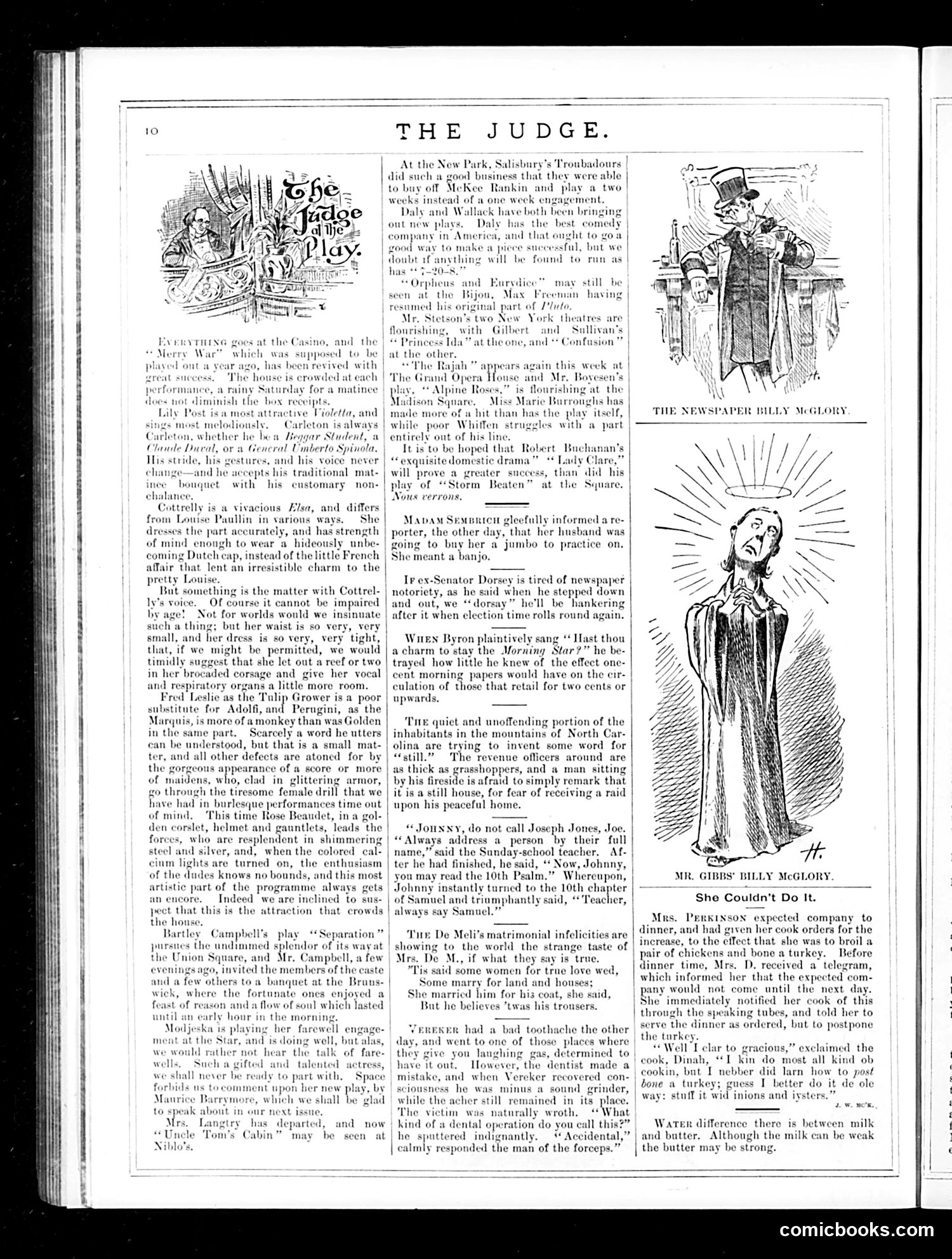
This page from Judge contains theatrical reviews and society gossip rather than explicit political cartoons. The three illustrations show caricatured figures labeled "The Newspaper Billy McGlory" and "Mr. Gibbs' Billy McGlory," along with a third unlabeled sketch—likely theatrical or society personalities of the era, though specific identities aren't confirmed by visible text. The written content satirizes Broadway productions, actors, and performers. It mocks actors like Carleton for traditional mannerisms, criticizes Cottrelli's tiny waist restricting her vocal performance, and ridicules various theatrical productions for their quality. References to "ex-Senator Dorsey" suggest mild political mockery regarding his attention-seeking. The humor relies on insider knowledge of 1880s-90s theater world personalities and productions now largely forgotten, making specific satirical points inaccessible without additional historical context about these performers and shows.
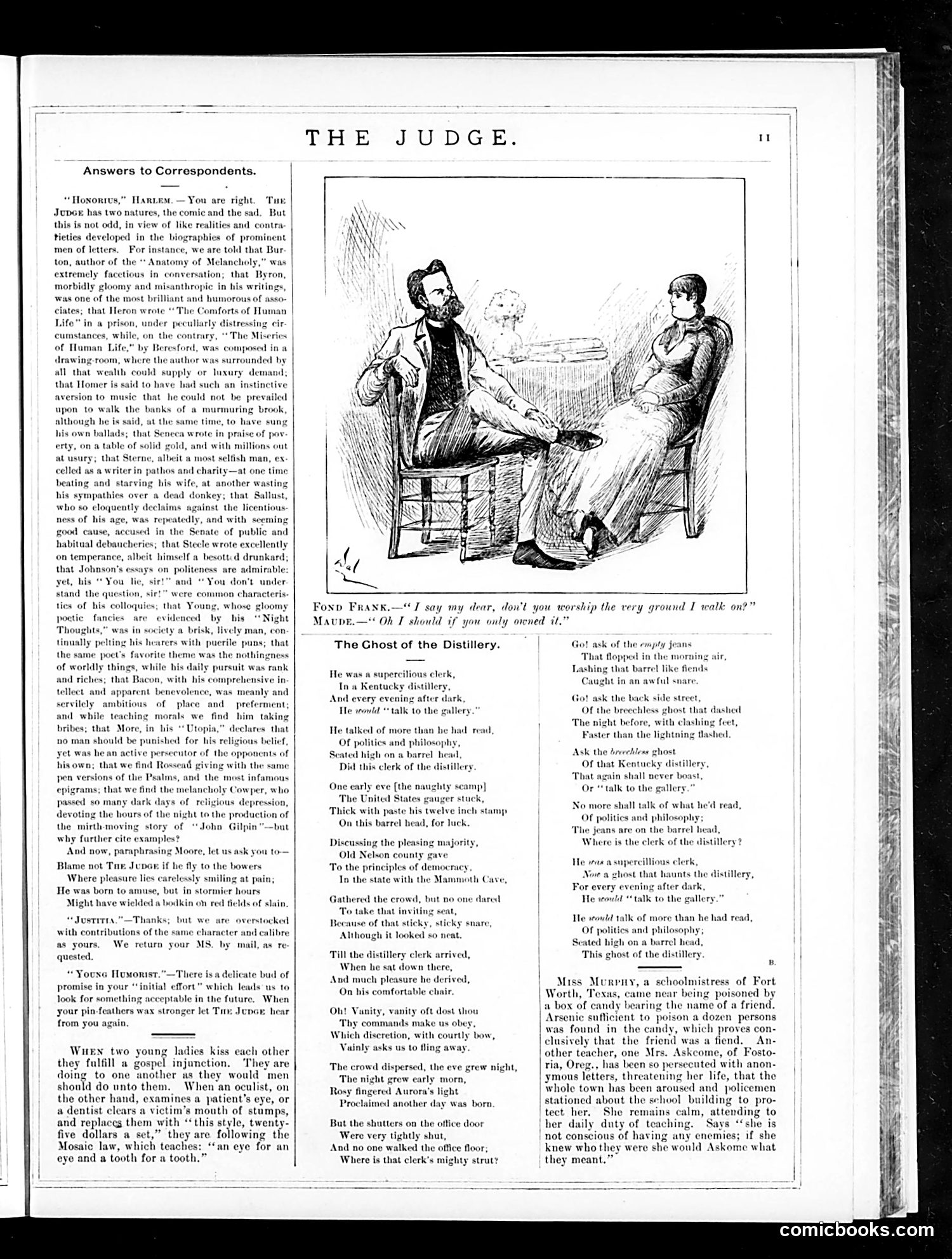
This page contains a humorous poem satirizing pretentiousness and vanity. The main illustration shows a pompous man sitting on what appears to be a barrel or chair, speaking to a younger listener—likely depicting the "supercilious clerk" of the poem's title. The poem's joke: A Kentucky distillery clerk, fond of spouting politics and philosophy he hasn't truly studied, sits down on a barrel marked with a U.S. tax stamp. The stamp is sticky ("sticky snare"), and he becomes stuck to it. The moral is transparent—his vanity and pretension literally trap him through his own foolishness. The satire targets self-important men who pontificate beyond their knowledge, a common Judge magazine target. The "ghost of the distillery" appears to be the consequences of such arrogance made literal and physical. The poem's final stanzas emphasize how vanity makes people foolish and vulnerable.
This cartoon satirizes the class dynamics and hypocrisy of wealthy "charity." A laborer saves a rich man from a train accident. The grateful gentleman offers increasingly large sums ($5,000, then $100 for a dress), but the working man grows visibly uncomfortable with each offer. The punchline reveals the satire's point: when finally given the chance to accept the "generosity," the laborer asks for merely a quarter—implying his actual need is minimal, and exposing the wealthy man's extravagant self-congratulation as performative condescension rather than genuine help. The title "Value of Human Life" is ironic. The rich man calculates human worth in dollars, while the laborer's modest request suggests the real "value" lies in dignity—which the patronizing wealthy man fails to recognize. It mocks affluent society's empty gestures of gratitude toward working-class people.
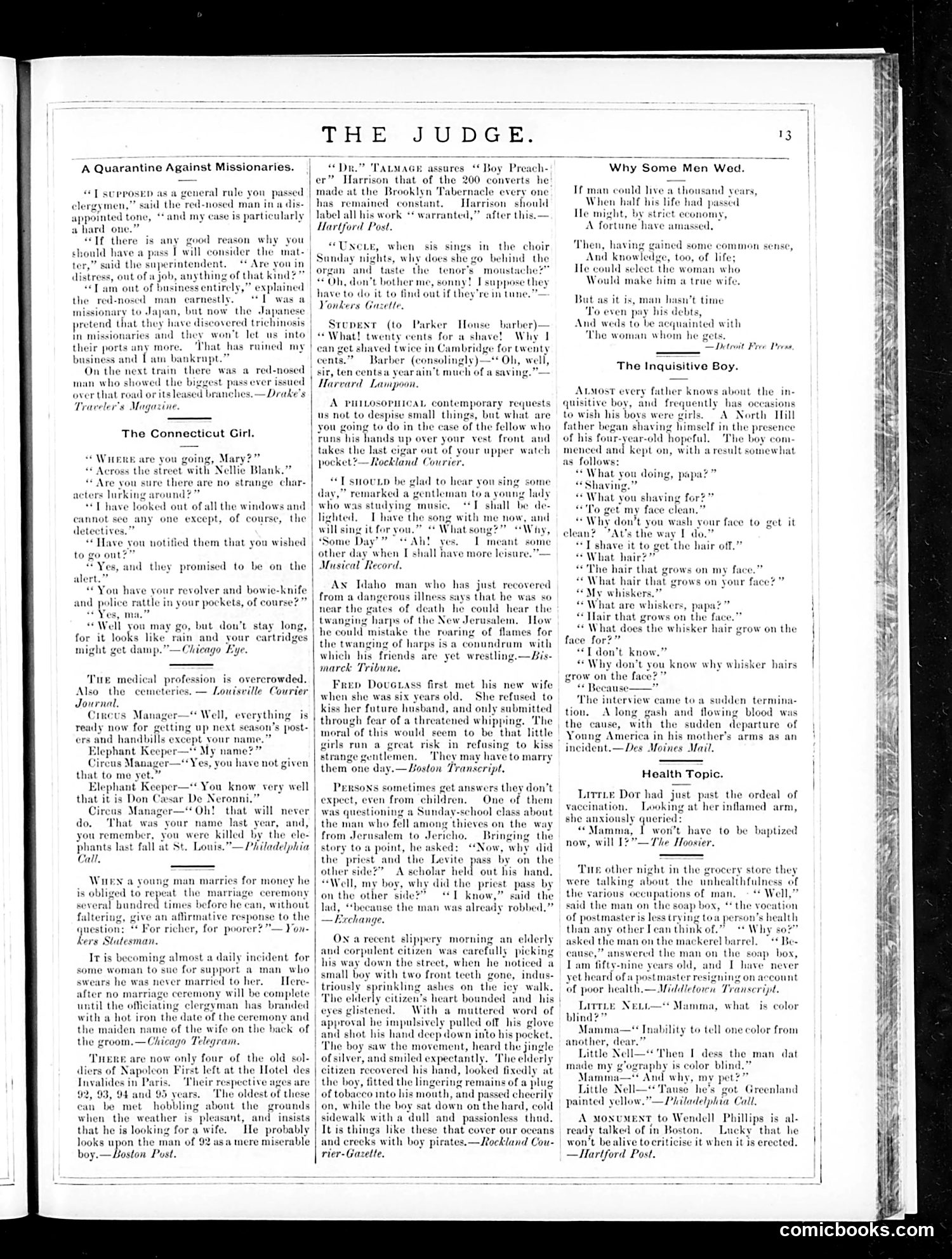
This page from the satirical magazine *Judge* contains multiple brief humorous anecdotes rather than political cartoons. The content satirizes American social life through short comedic scenarios: **"A Quarantine Against Missionaries"** mocks an unemployed missionary claiming Japan has quarantined American missionaries after discovering "trichinosis" among them—likely a jab at both missionary work and disease concerns. **"The Connecticut Girl"** jokes about an overly armed woman preparing to cross the street, suggesting paranoia about urban dangers while carrying weapons. Other brief items mock: Dr. Talmage's evangelism claims, church choir practices, barber pricing, a philosophical complaint about pickpockets, and a man who nearly died but heard harps instead of flames. The satire targets middle-class anxieties, religious pretension, urban paranoia, and small social absurdities. These aren't focused political commentary but rather the lighter "humor magazine" content typical of *Judge*'s miscellaneous joke sections from this era (likely late 1800s).
This page is primarily **advertising and miscellaneous content** rather than a coherent political cartoon. It features several short humorous items and satirical quips typical of Judge magazine's format. The notable content includes: **Humorous items** poking fun at: - A woman sitting in slush (mild social embarrassment humor) - Chinese laborers and their supposed lack of oath-taking customs - Young men's supposed physical weakness compared to older generations - The judicial system's delay tactics (prisoners feigning insanity to postpone execution) - Western Union's stock practices - A pastor preventing courting couples from meeting at night **The satire is lightweight and scattered**—mostly social observation and wordplay rather than pointed political commentary. References to General Butler and various regional incidents suggest typical 1880s magazine content. The page is dominated by **period advertisements** for breweries, lithography companies, rugs, carpets, typewriters, and bicycles, which was standard for Judge's business model.
This page is primarily **advertising**, not political satire. The masthead reads "THE JUDGE" (a major American humor magazine), but the bulk of the page consists of commercial advertisements interspersed with brief humorous quotes and anecdotes. The small illustrations and quoted jokes appear to mock various contemporary follies: - A doctor's claim that imaginary ailments plague wealthy patients - A merchant traveler's crude packing technique - A man with fourteen children blamed for political apathy - A doctor's dubious claim that candy causes various ailments - A railroad worker's delusion of land ownership These are generic social commentary rather than specific political cartoons. The page reflects late 19th-century magazine format: ads for pianos, fire extinguishers, medical devices, and "dubious remedies" (like the "Voltaic Belt") occupy most space, with scattered satirical snippets filling gaps. **No identifiable political figures or specific events are depicted.**
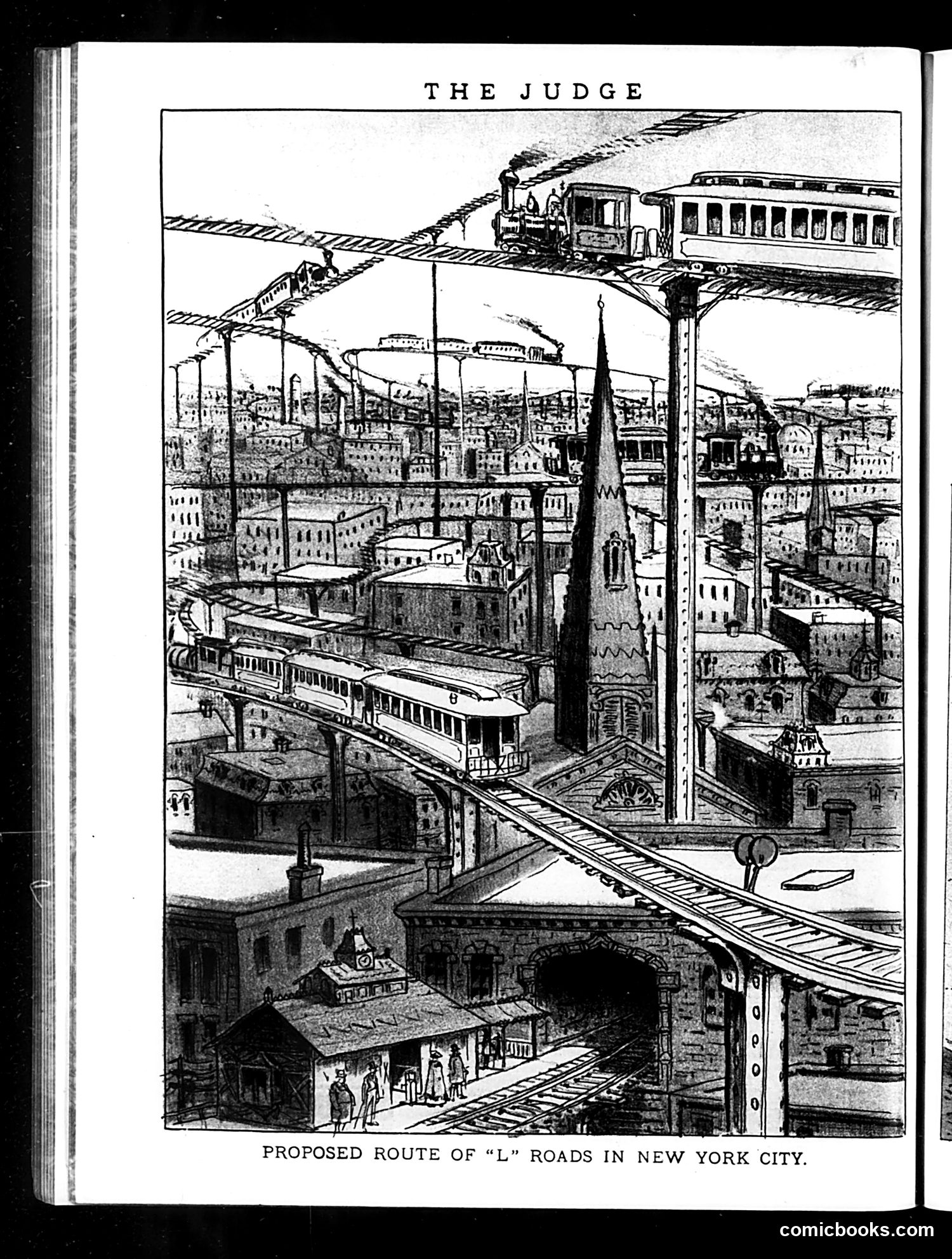
This is an illustration titled "Proposed Route of 'L' Roads in New York City," depicting elevated train infrastructure overlaid on an urban landscape. The "L" refers to the elevated rapid transit system that became iconic to New York City's infrastructure. The satire appears to critique ambitious urban planning proposals by showing an absurdly complex network of elevated tracks crisscrossing the cityscape at multiple levels, with trains operating at various heights above buildings, churches, and streets. This exaggerated visualization likely mocks either the impracticality of proposed transit expansion plans or the chaotic visual impact such infrastructure would create—satirizing both municipal planners' ambitions and public concerns about modernization transforming the urban environment. The dense architectural detail emphasizes the tension between existing city character and industrial-age "progress."