
Judge, 1884-02-23 · page 2 of 16
Judge — February 23, 1884 — page 2: what you’re looking at
What you’re looking at
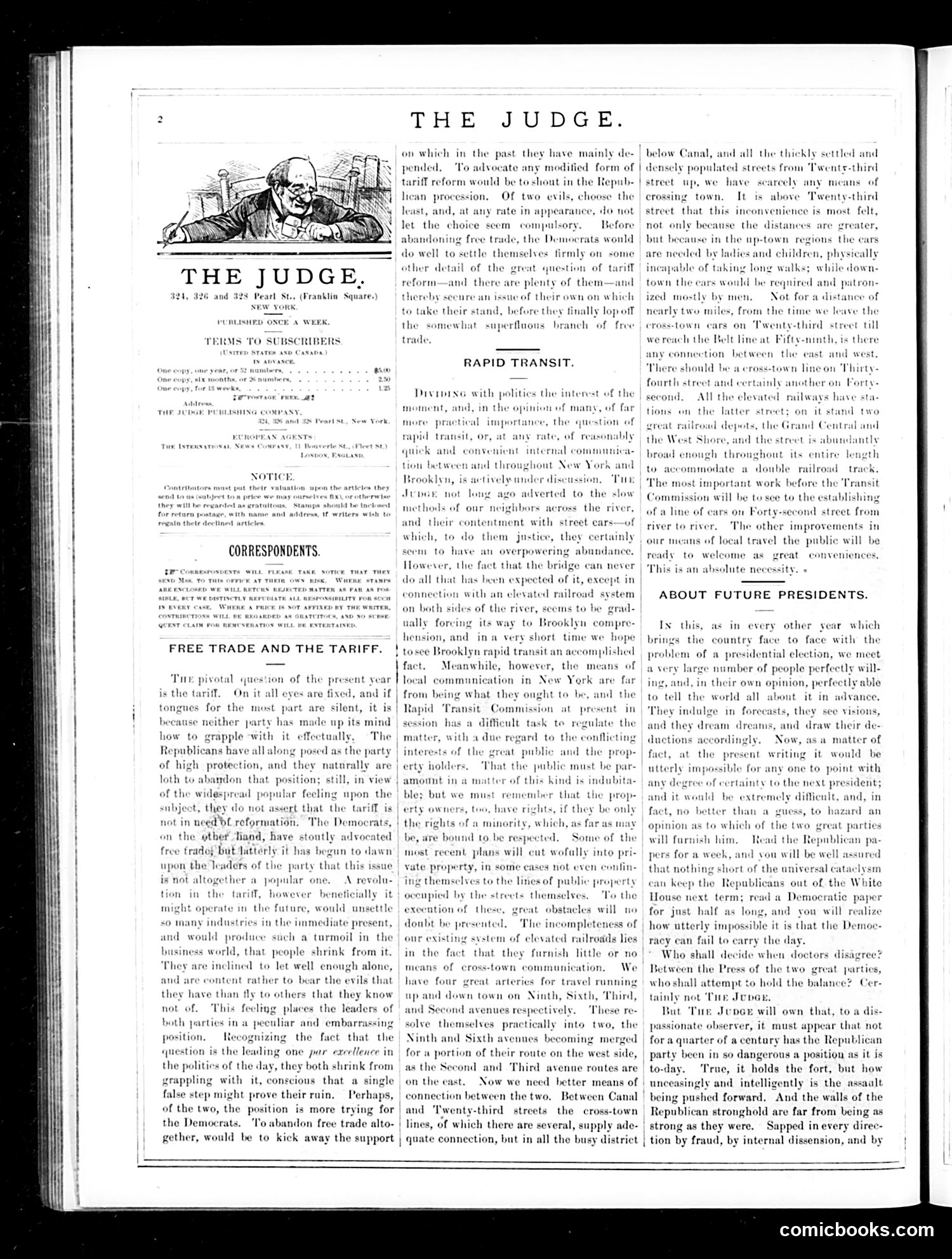
This page contains editorial commentary on two major political issues circa the 1890s: **free trade vs. tariffs** and **rapid transit in New York City**. The **tariff debate** was the pivotal political question of that election year. Judge criticizes both parties for their awkward positions: Republicans championed high protective tariffs but risked appearing rigid; Democrats advocated free trade but feared the economic disruption. The satire suggests neither party genuinely wants to commit fully, preferring to avoid the issue that could "prove their ruin." The **rapid transit section** addresses Brooklyn's transportation crisis. Judge advocates for cross-town elevated railways to supplement existing north-south lines on Ninth, Sixth, and Third avenues. The critique targets the Rapid Transit Commission's slow progress and the competing interests of property owners resisting infrastructure development. The small **Judge masthead illustration** (upper left) shows a caricatured figure—likely representing political leadership or public sentiment—drowning in or struggling with these divisive issues. The page is primarily political commentary rather than humorous cartoons, reflecting Judge's satirical magazine format combining visual wit with substantive editorial argument.
📄 Transcribed text from this page (OCR, searchable)
Machine-transcribed from the original scan — historical spelling and the odd misread are preserved.
TERMS TO SUBSCRIBERS. CORRESPONDENTS. ss WHE: & PRICK 18 SOT ANTIXED RY FREE TRADE AND THE TARIFF. Tue pivotal ques is the tariff. ion of the present year and if silent, it is On it all eyes are fixed tongues for the most part a either party has made up its mind apple -with it effectually, because how to Republicans have all along posed as the pi of hi loth protection, and they naturally are abarrdon that. pe widespread popul they eed OE reforn tion; still, in view fecling upon the rt that the tariff The Deme fe stoutly. advoe but tatterly it has be aders of the party the on the other diand, h free trade} upon th un to dawn this i A revolu- ficially it would is not altogether a popular o the tariff, the tion in however might operat future, nsett le ny indu ent, such a turmoil in the ries in the immediate pr ness world, that people shrink from it. They are inclined to let well enough alone, the evils that ly to others that the This feeling y and are content rather to bea they have than not of. know es the ers of rties ina peculiar and embarrassing the fact that the one par exrellence in ay, they both shrink from it, conscious that a single ght prove their ruin, s, the position is more trying for ts. ‘To aband free trade alto- gether, would be to kick away the support position. ognizin question is the leadi the polities of th y with Perh: of the tw the Demoe: THE JUDGE. on which in the they have mainly de- ‘To advocate m would be t ican procession. pende tariff refe > the » not Before would Of two evils, chor and, at any rate in appearance, compu the Democrat or; free trade, osettle themselves firmly on some il of the of tariff and there are plenty of them other de great question reform and thereby secure an to take their stand, bef the of their own on which e they finally lop off ewhat superfluous branch of free RAPID TRANSIT. Divipixe with polities the interest moment, ane of many rapid transit, or ite, of re quick and cor ternal communica- I throughout New York and tion between Brooklyn, is actively under dis Jepee uilverted to th the not long a methods of our ni tbors aer nent with s + th and their conte which, to do them justice eet seem to have an overpowering abundance. However, do all that the fact that the bridge can never wen expected of it, exc connection with an clevated railroad on both sides of the riv ually fo 1 ina very sl hope klyn rapid transit an accomplished Meanwhile, however, nication in New Y t they ou means of ork are far and the local comms from bei 0 ‘Transit Com sa difficult task to regu: sion at present in the th a due regard to the conflicting of the great public and the prop- erty holders. ‘That the public m of this hind i r that the t be par- amount in dubita- they be only rights, if ority, which, as fi bound to be respected. Some of the recent plans will cut wofally into pri- property erty owners, t the rights of a mi as may in some cases not even contin hemselves to the lities of public property elves. o the cles will upied by th th abt be presented. execntior ‘eat obst The incompleteness of existing system of elevated railroads lies in the t that they furnish little or no We running means of have four up and ¢ cross-town communication, great arteri r trave own town on Ninth, Sixth, Third, md avenue: and Se ‘These re- espectively. solve themselves practically into twe Ninth and Sixth avenues becoming mer for a portion of their route on the west sid us the Sec Third avenue routes are wwe need better means of nthe two, Between Canal and ‘Twenty-third streets the cross-town lines, of which there are several, supply ade- and on the east. connection betw | quate connection, but in all the busy district | tion by fraud, by internal ¢ iny moditied form of | densely popula pout in the Repub- | street up, we jow Canal, and all the thickly settled and «lst haves street that this inconvenie: ets from ‘Twenty-third ely any mcans of crossing town, above Twenty-third cis most felt, the distanc but because in the up-town re not only be se ater, vious the cars are led by ladies and children, physically incapable of taki walks; while down- town the cars would be required and patron- tly by Not for ad rom the tir ized me tance of » we leave the et ull two m son Twenty-third st Itline at F stown ci tw-ninth, is there t and west, eon ‘Thirty. 1 Forty. have sta- tions on the great ra the West She broad enon pmmodate a double railroad » most important work h the’ nmnission will be to see to the establishing of a line of car on Forty-second street from river to river. ‘The other impra travel the publ rents in our means of le will be ready to welcome conveniences, This is an absolute ne ABOUT FUTURE PRESIDENTS. In this, as in every other year which brings the country face to face with the ntial election, we meet a very large number of people perfectly will- ble it in advance. problem of a. pre 1 their own opinion, perfectly to tell the world all about They indul and they dream dreams in forecasts, they see visions, id draw their de- Now, as a matter of fact, at the git ductions accordin: would be utterly im any one to point with any degree of certainty to the next president; be tter than - and, in to hazard and it we fact, no or will furnish him extrem an ion as to which of t parties dlican pa pers for a week, and you will be we that nothing sh can keep the Republicans out of House next term; read a Dem for just half as lo how utterly imp of the universal cratic paper and you will realize De it is that the Democ- n fail to carry the day. 10 shall decide when doctors disagr ween the Press of the two great parties, all attempt to hold the balance? Cer- tainly not THe Jeu But Tur Jeper will own that, to a dis- passionate observer, it must appear that not fora quarter of a century has the Republican party been in so dangerous a position as it is ‘True, it holds the fort, but how gly and intelligently is the assaalt being pushed forward. And the walls of the Republican stronghold are far from being as strong as they were. Sapped in every direc- and by comicbooks.com