
Judge, 1884-02-23 · page 4 of 16
Judge — February 23, 1884 — page 4: what you’re looking at
What you’re looking at
This cartoon satirizes theatrical management through a darkly comedic story. A "manipulator" (theatrical producer/manager) coerces a theater manager into accepting a play manuscript by threatening him with a war club, forcing him to listen to a ten-act play read aloud without interruption or rest. The satire targets the predatory practices of theater producers who used intimidation and manipulation to force managers into producing plays, often by lesser-known authors. The absurdist violence—using a weapon to literally hold a captive audience—exaggerates real industry power imbalances. The manipulator's subsequent success (the manager agrees to produce the play and pay royalties) darkly suggests that such coercive tactics actually worked in theatrical deal-making. The accompanying poem celebrates the humble clay pipe, likely a working-class commentary contrasting simple pleasures with theatrical pretension on the same page.
📄 Transcribed text from this page (OCR, searchable)
Machine-transcribed from the original scan — historical spelling and the odd misread are preserved.
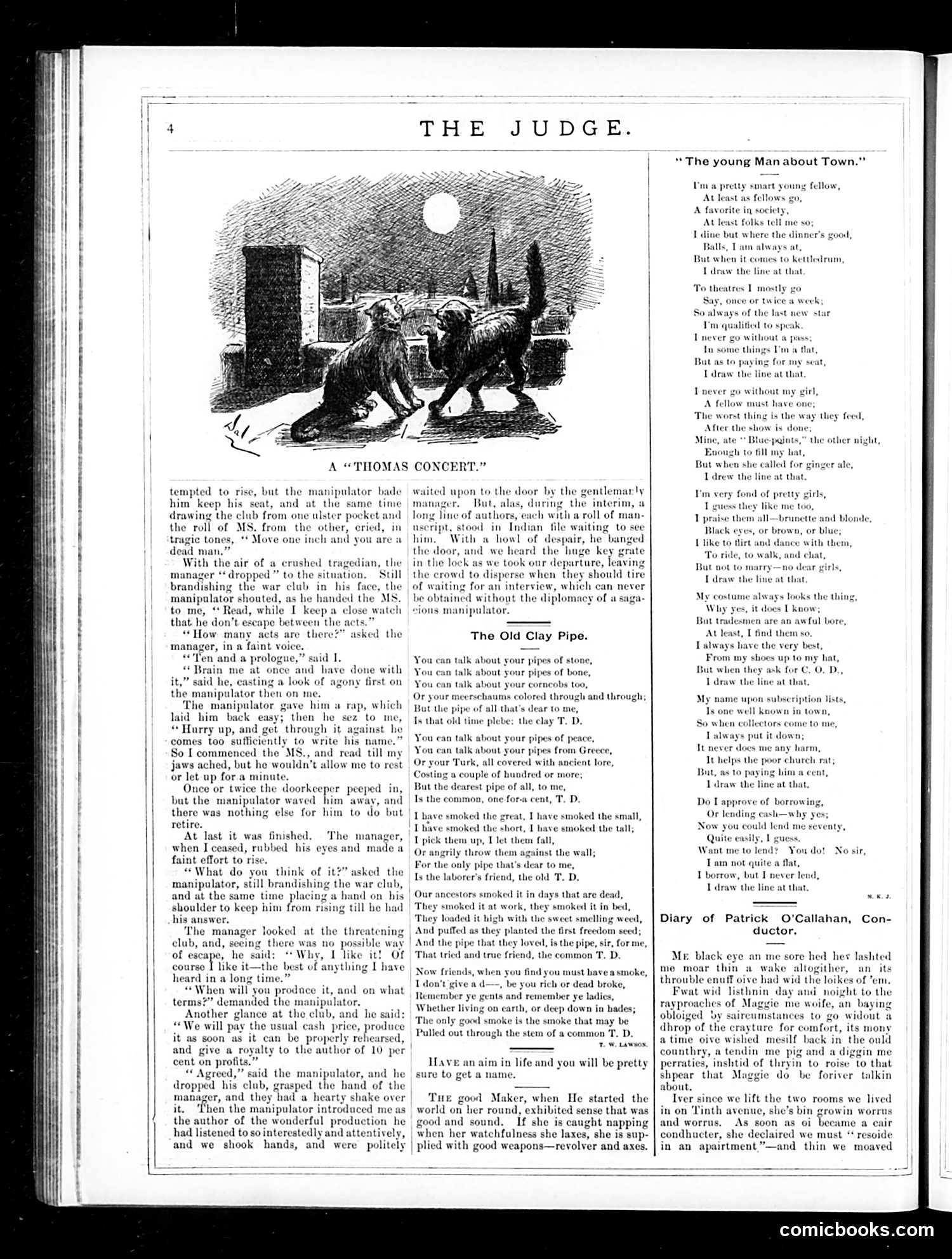
A “TILOMAS CONCERT.” tempted to rise, but the manipulator bade him keep his seat, and at the same time drawing the club from one ulster pocket and from the other, cried, in ‘Move one inch and you are a dead 1 man. With the air of a crushed tri jan, the ager “dropped ” to the situation, Still brandishing the war club in his face, the manipulator shouted, as he handed the M to me, ‘* Read, while I k a close watch that he don’t ape between the acts.” **How many acts are ther asked the manager, in a faint voic “Fen and a prologue “Brain me at on ne with yny first on the manipulator then on me, The manipulator gave him a rap, which laid him back easy; then vz to me, “Hurry up, and get through it inst comes too sufficiently to write his name So I commenced the MS., and read till n jaws ached, but he wouldn't allow me to rest or let up for a minute. Once or twice the doorkeeper peeped in, but the manipulator waved him away, and there was nothing else for him to do but retire At last it was finished. The when I ceased, rubbed his eyes : faint effort to ris “What do you think of it?” asked the manipulator, still brandishing the war club, and at the same time placing a hand on his shoulder to keep him from rising till be had his answer, manager, nd made a er looked at the thre g there was no pos of escape, he said: ** Why, I lik course I like it—the best of anythi heard in a long time.” “When will you produce it, and on what terms?” demanded the manipulator. Another glance at the club, and he said: “We will pay the usual cash price, produce it as soon as it can be properly rehed arsed, and give a royalty to the author of 10 per cent on profits.” “ Agreed,” said the manipulator, and he dropped his club, grasped the hand of the manager, and they ‘had a he: arty shake over it. ‘Then the manipulator introduced me the author of the wonderful production he had listened to so interestedly and attentively, and we shook hands, and were politely waited upon to the door by the gentlemarly manag But, alas, during the interim, a lor uthors, each with a roll of man- uscript, stood in Indian file waiting to him. With «a howl of despair, he bange the door, and we heard the huge key grate in the lock as we took our departure, leaving the crowd to disperse when they should tire of waiting for an interview, which can never be obtained without the diplomacy of as cious manipulator. The Old Clay Pipe. You can talk about your pipes of stone, You can talk about your pipes of bone, You can talk about your corne Or your mecrschaums colored thy But the pipe of all that's dear to me, Is that old time plebe: the clay T. D. You can talk about your pipes of pe You can talk about your pipes from Greece, 3 K ed with ancient lo red or more; But the dearest pipe of all, to me, Is the common, one for-a cent, T. D. moked the great, I have smoked the small, l the short, I have smoked the tall; I pick them up, I let them fall, angrily throw them against the wall; For the only pipe that’s dear to me, Is the laborer's friend, the old T. D, ~s sinokedl it in days that are dead, y smoked it at work, they smoke loaded it high with the sweet smell weed, And puted ted the first freedom seed; And the pipe that they loved, is the pipe, s ‘That tried and true friend, ¢ in bed, forme, e common T. D. Now friends, wh I don't give a d— Remember ye gents must havea smoke, \d remember ye ladies, Whether liv carth, or deep down in hades; The smoke is the smoke that may be Pulled out through the stem of a common T. D, 7. W. Lawsox: ILAve an aim in life and you will be pretty sure to a nam Tue good Maker, when He started the world on her round, exhibited sense that was good and sound. If she is caught napping when her watchfulness she laxes, she is sup- plied with good weapons—revolver and axes. “The young Man about Town.” I'm a pretty sma At least as fel A favorite in society, At least folks tell me so; I dine but where the dinny Balls, Tan But when T draw comes to kettledrum, ye Hine at that tres T mostly gc . once oF twic always of the last new star Fm qualitied to speak. Tm a th for my seat TL draw the line at that I never go without my A fellow must The worst thi Miter the M Blue-paints, 1 to fill my hat, But when she called + the way they f ww is done: the other ni, ner ale, T drew the line at that I'm very fond of pretty T guess they like me too, I praise them all—brunette and blonde Black e or brown, or blue; L like to flirt and To ride, to walk, But not to marry— T draw the lit ance with them, nd chat, » dear g 1 that irls, My costume always looks the thing, Why yes, it does I know; Butt nen are an awful bore At least, I find them so. I always have the very best, From my shoes up to my hat, t when they ask for C. 0. D., T draw the line at that, My nan Is one well know upon subscription lists, in town, So when collectors come to me, Lalw It never does me It helps the poor But, 5 Tdraw the li s put it down; hureh rat; as to payi Do I app Or lending Now you could l Quite easily, Want me to of borrowi cash—why Tain not quite a flat, I borrow, but I never lend, 1 draw the line at that, Diary of Patrick O'Callahan, ductor. Con- Me Dlack eye an me sore hed her lashted me moar thin a wake altogither, an its throuble enuff oive had wid the loikes of ’em. Fwat wid listhnin day and noight to the rayproaches of Maggic me woife, an baying obloiged tances to go widout a dhrop of the crayture for comfort, its mony atime oive wished mesilf back in the ould counthry, a tendin me and a diggin me perraties, inshtid of thryin to roise to that shpear that } be foriver talkin about. Iver since we lift the two rv in on ‘Tinth avenue, she’s bin and worrus. 8 condhucter, in an apairtment. oms we lived ‘owin Worrus on as oi became claired we must ‘ resoide nd thin we moaved comicbooks.com