
A complete issue · 16 pages · 1884
Judge — February 2, 1884
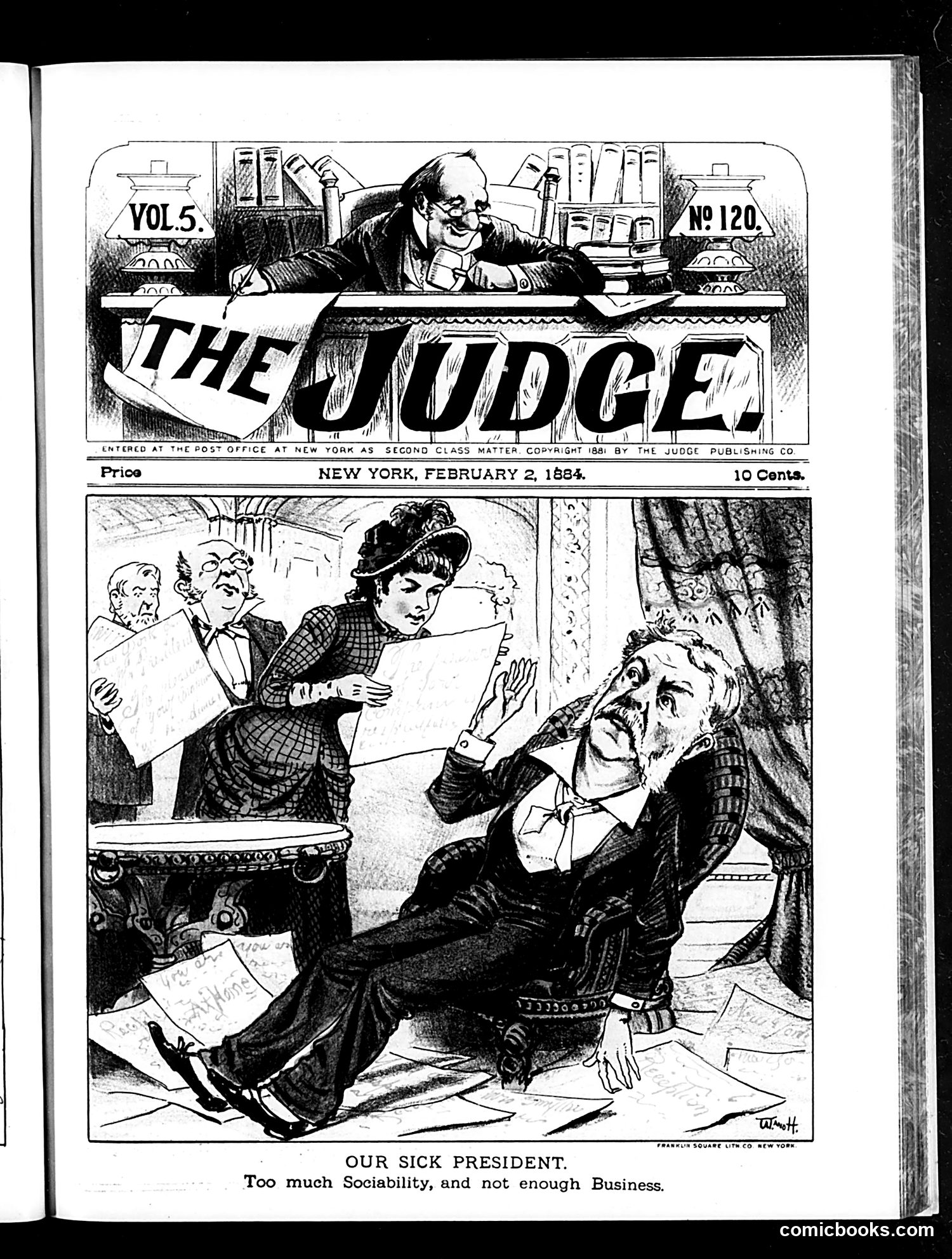
**Publication:** *The Judge*, Vol. 5, No. 120, February 2, 1884 **Subject:** The main cartoon critiques a sitting U.S. President (identity unclear from image alone, though 1884 dating suggests Chester Arthur or James Garfield era) for excessive "Sociability" at the expense of "Business." **Visual Satire:** A well-dressed man reclines exhausted among scattered papers, while a woman in fashionable dress presents documents to him. Other figures observe from behind. The "sick president" appears overwhelmed by social obligations rather than attending to governmental duties. **Point:** The cartoon satirizes what the artist views as misplaced presidential priorities—too much socializing, insufficient attention to executive responsibilities. This reflects contemporary debates about presidential effectiveness and proper conduct of office.
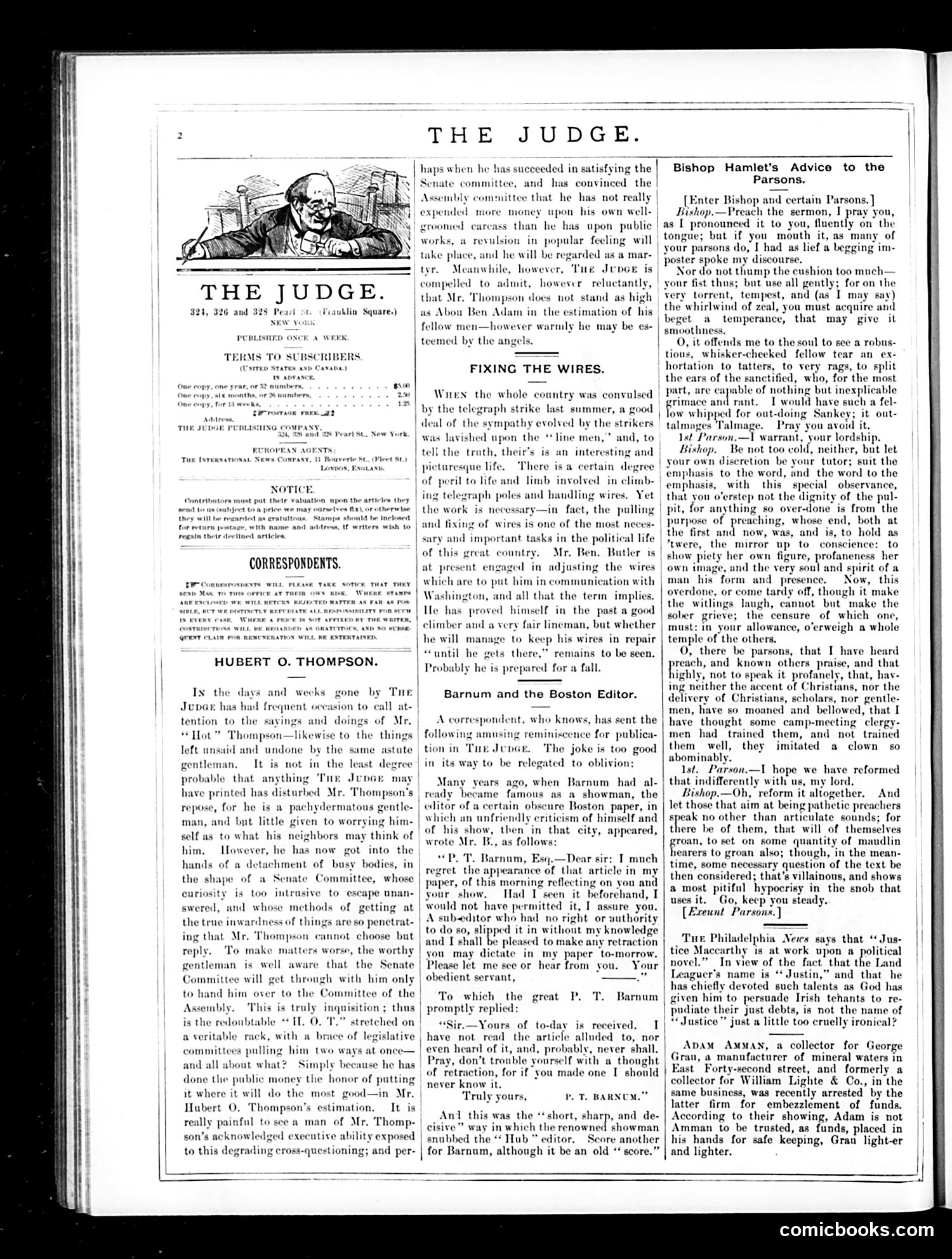
The main cartoon depicts **Hubert O. Thompson**, a political figure being investigated by a Senate Committee. The satire mocks Thompson as a wealthy, complacent man ("pachydermatous") facing aggressive legislative scrutiny. Judge suggests Thompson cares more about personal luxury than public works, yet maintains influence despite public disapproval—only the angels esteem him. A secondary piece satirizes **Benjamin Butler**, a general and politician attempting to "fix the wires" (maintain political connections) to advance his ambitions. The metaphor suggests his political maneuvering, though whether he'll successfully navigate to power remains uncertain. A brief anecdote describes **P.T. Barnum**'s witty response to a Boston newspaper editor's criticism—an early instance of celebrity managing negative press. The pieces collectively target corrupt or self-serving public figures and their political machinations during the Gilded Age.
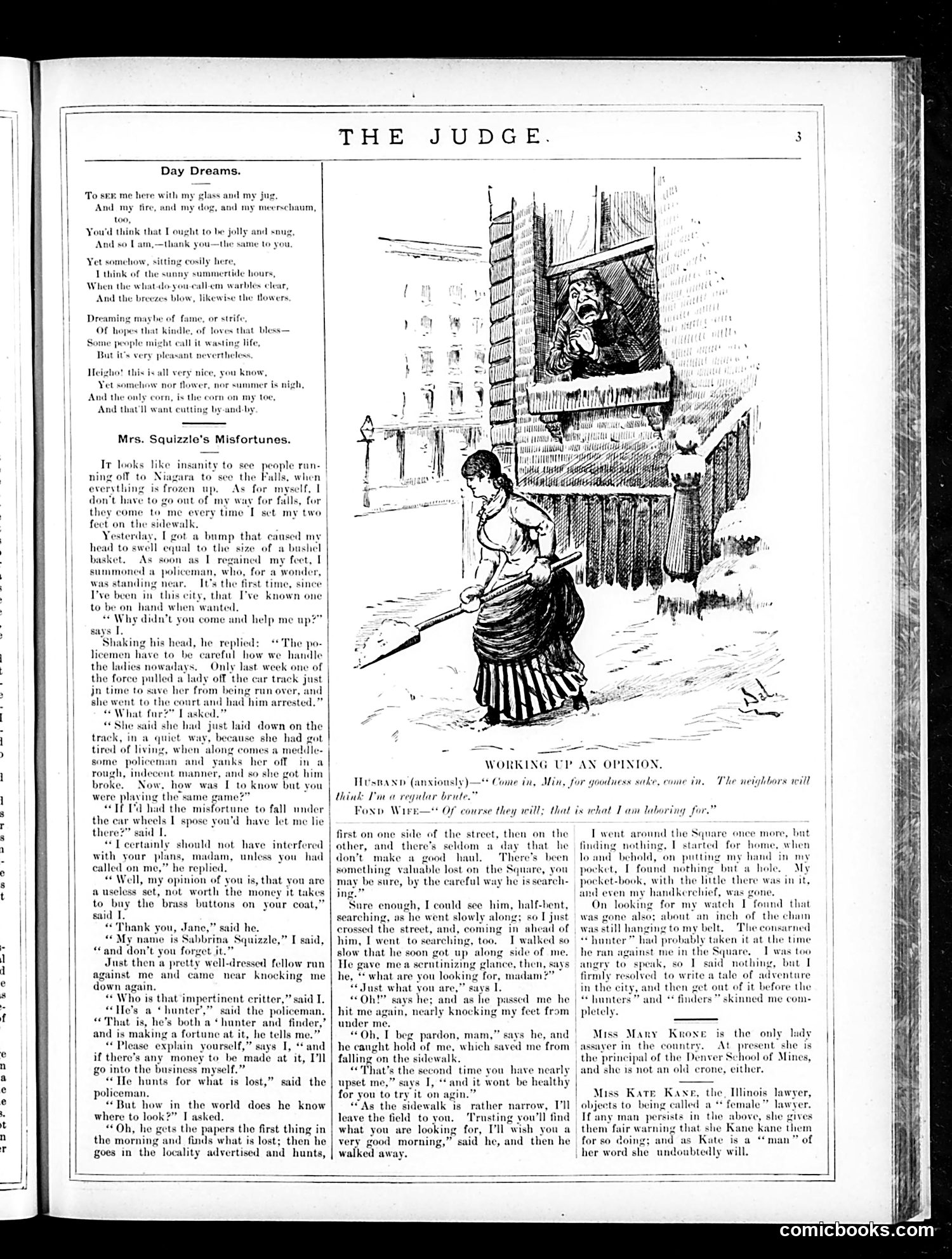
This page contains two satirical pieces typical of *Judge* magazine's social commentary: **"Day Dreams"** is a poem mocking idle leisure—suggesting that comfortable daydreaming about "fame, or strife" while lounging at home is escapist fantasy disconnected from harsh reality (winter, corn on the cob). **"Mrs. Squizzle's Misfortunes"** satirizes both urban hazards and incompetent policing. Mrs. Squizzle repeatedly falls on sidewalks, then encounters a "professional 'finder'" (a lost-and-found hunter who scours newspaper advertisements for lost items to locate and profit from returning them). The irony: he's so absorbed in searching for others' lost property that he keeps knocking her down. The broader joke appears to target either police negligence or the absurdity of city life where such parasitic professions exist. **"Working Up an Opinion"** (bottom illustration) shows a woman changing her view based on her husband's arguments, then reversing it again—mocking women's perceived fickleness or susceptibility to persuasion, a common sexist trope of the period. All three pieces reflect *Judge*'s satirical take on urban American life.
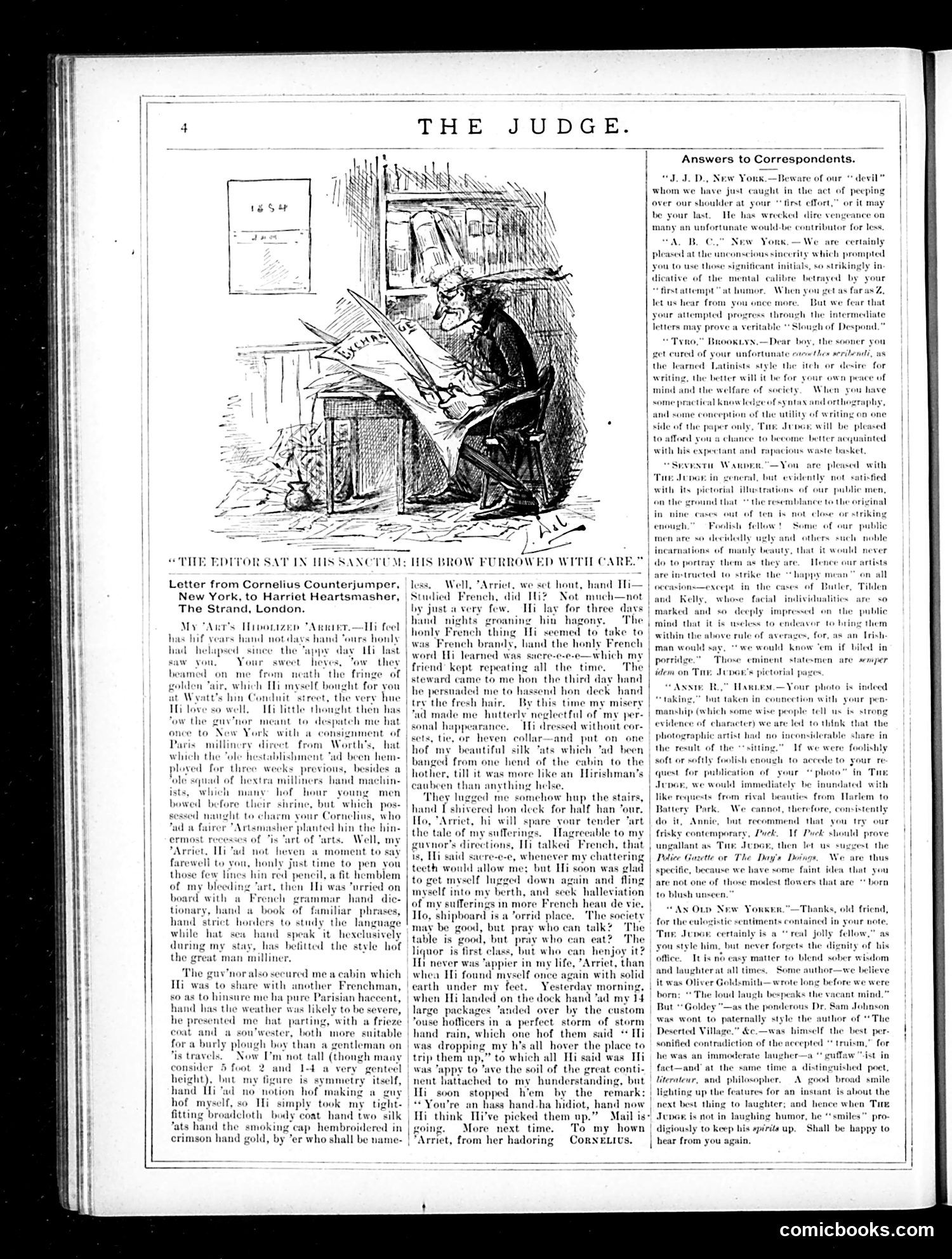
This page contains two distinct elements: a humorous illustration and an "Answers to Correspondents" advice column. **The Illustration** ("The Editor Sat in His Sanctum") depicts the editor of Judge at his desk, reviewing submissions—a self-referential joke about the magazine's editorial process. **The Advice Column** mocks aspiring writers and contributors. The responses are deliberately harsh and condescending, rejecting submissions for poor grammar, weak penmanship, and overall incompetence. The column satirizes both the pretentiousness of literary criticism and the flood of mediocre amateur writing the magazine received. **The Long Letter** from "Cornelius Counterjumper" to "Harriet Heartsmasher" appears to be a humorous fictional correspondence, likely parodying sentimental Victorian romance letters with exaggerated, overwrought descriptions of seasickness and romantic longing. The overall effect is satirical mockery of both aspiring amateur writers and the romantic literary conventions of the era.
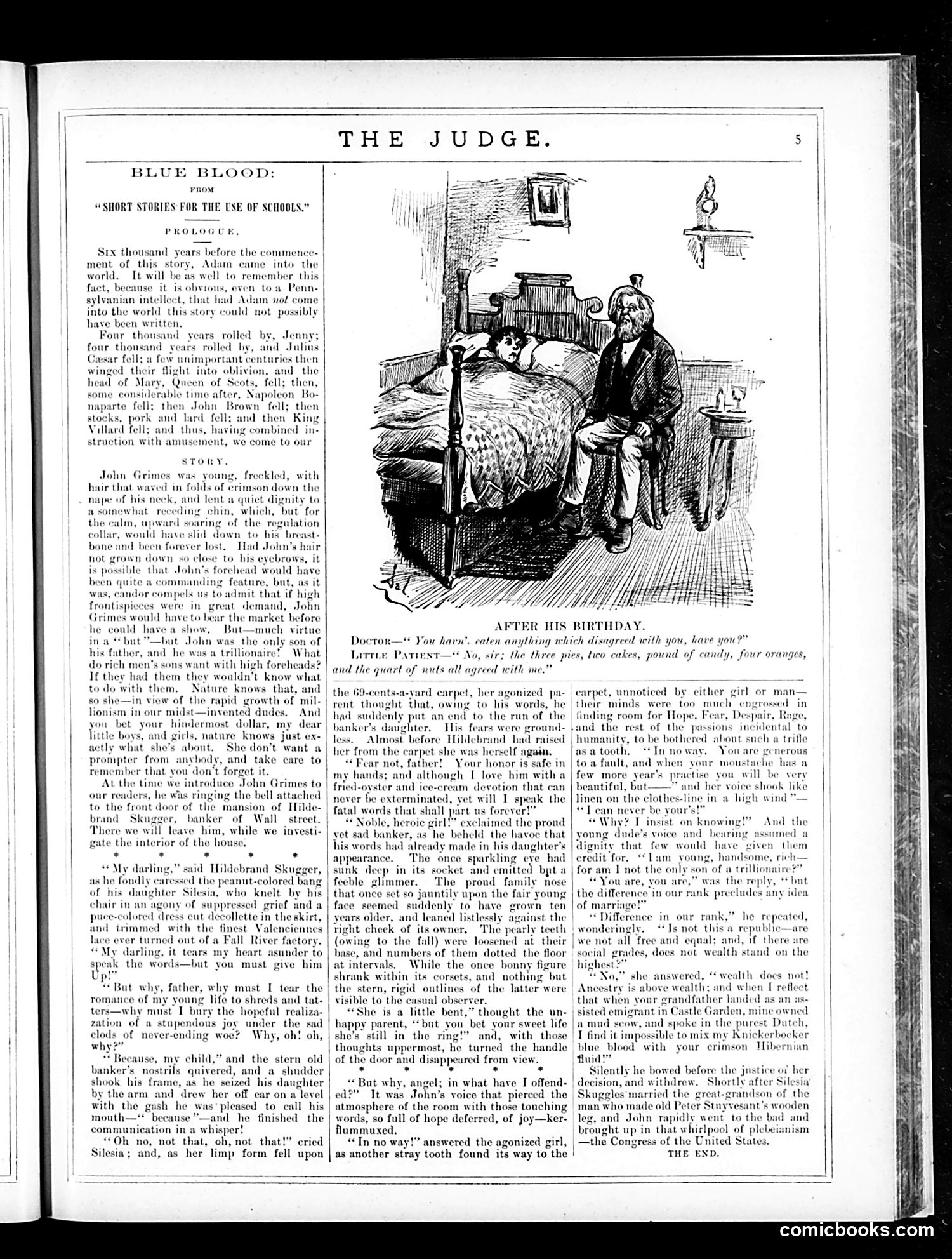
This page contains a serialized story satirizing American aristocratic pretensions. The narrative follows banker Hildebrand Skugger's daughter Silesia, whose father forbids her marriage to John Grimes (apparently of lower social status). The illustration depicts Silesia in bed, presumably ill from the emotional distress. The satire targets the "blue blood" obsession of wealthy Americans who claimed European aristocratic lineage. By naming the banker "Skugger" and setting him on "Wall Street," the author mocks nouveau-riche financiers who used social snobbery to justify class divisions. The overwrought, melodramatic prose—with references to "trillionaires" and elaborate social hierarchies—parodies Victorian sentimentality while critiquing rigid class barriers in Gilded Age America. The story was explicitly designed as educational material ("for the use of schools"), suggesting Judge aimed to teach readers about social hypocrisy through humor.
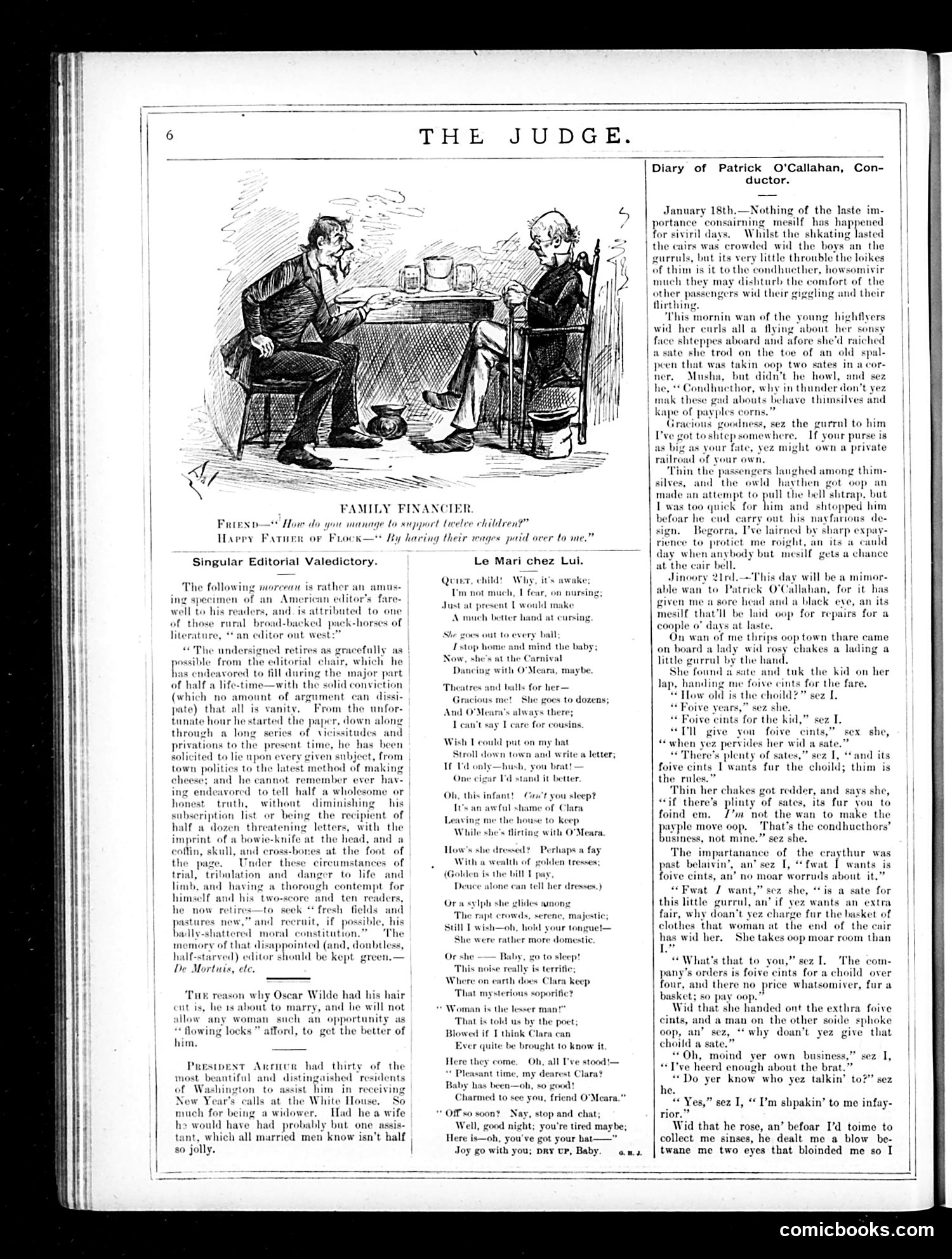
This page contains three separate satirical pieces: **"Family Financier"** (top): A cartoon mocking working-class financial struggles. A father and mother discuss managing expenses while supporting children, with the father's solution being simply having the children's wages paid directly to him—satirizing both parental authority and the economic desperation of families relying on child labor. **"Singular Editorial Valedictory"** (middle left): A mock farewell from a rural newspaper editor retiring after decades, expressing cynical vanity about journalism's futility. It's a humorous editorial convention piece poking fun at self-important editors. **"Le Mari chez Lui"** (right, in verse): A domestic comedy about a husband left home minding the baby while his wife Clara attends endless balls and theaters with someone named O'Meara, suggesting infidelity. The husband complains she's neglecting domestic duties for social life—satirizing changing gender roles and marital tensions of the era. The page reflects late 19th-century concerns: economic hardship, journalistic pretension, and anxiety about women's independence and changing family dynamics.
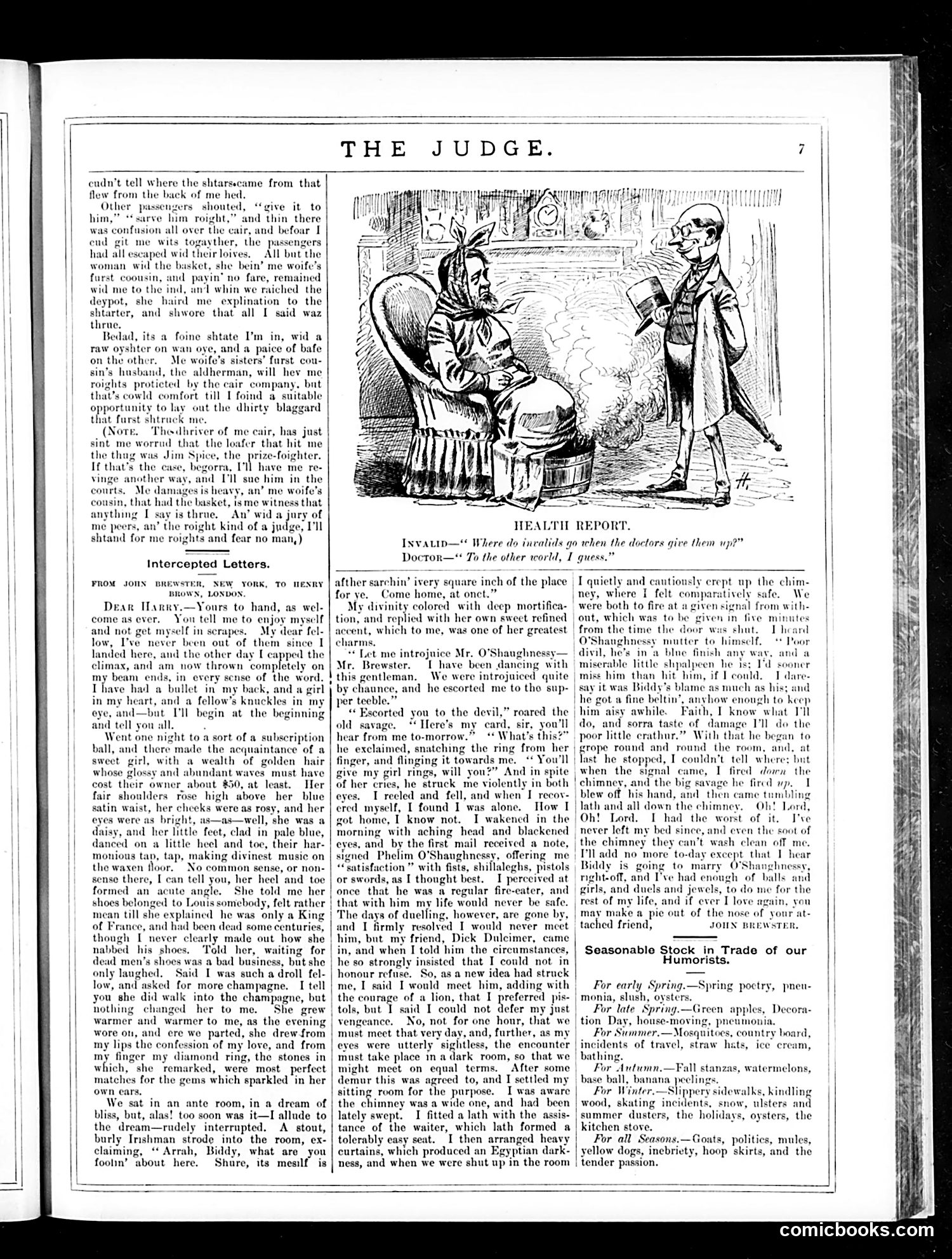
This page contains two satirical pieces typical of late 19th-century Judge magazine: **"Health Report" (cartoon):** A doctor tells an invalid patient that when physicians give up on a case, patients go "to the other world"—dark gallows humor about medical incompetence or hopelessness. **"Intercepted Letters":** A comedic narrative in Irish-brogue dialect about an Irish immigrant in New York who gets into various scrapes—a black eye, a bullet wound, romantic entanglement—after meeting a wealthy woman at a ball who seduces him. The humor trades on ethnic stereotyping: the thick Irish accent, the Irish protagonist's naiveté about European aristocracy (she claims her shoes belonged to "Louis somebody"), and his involvement in fisticuffs. The text's reference to "Jim Spice, the prize-fighter" suggests a real boxing personality readers would recognize. These pieces reflect Judge's typical formula: satirizing American life through working-class Irish characters and medical/romantic misadventures, relying heavily on ethnic dialect comedy that would be considered offensive today.
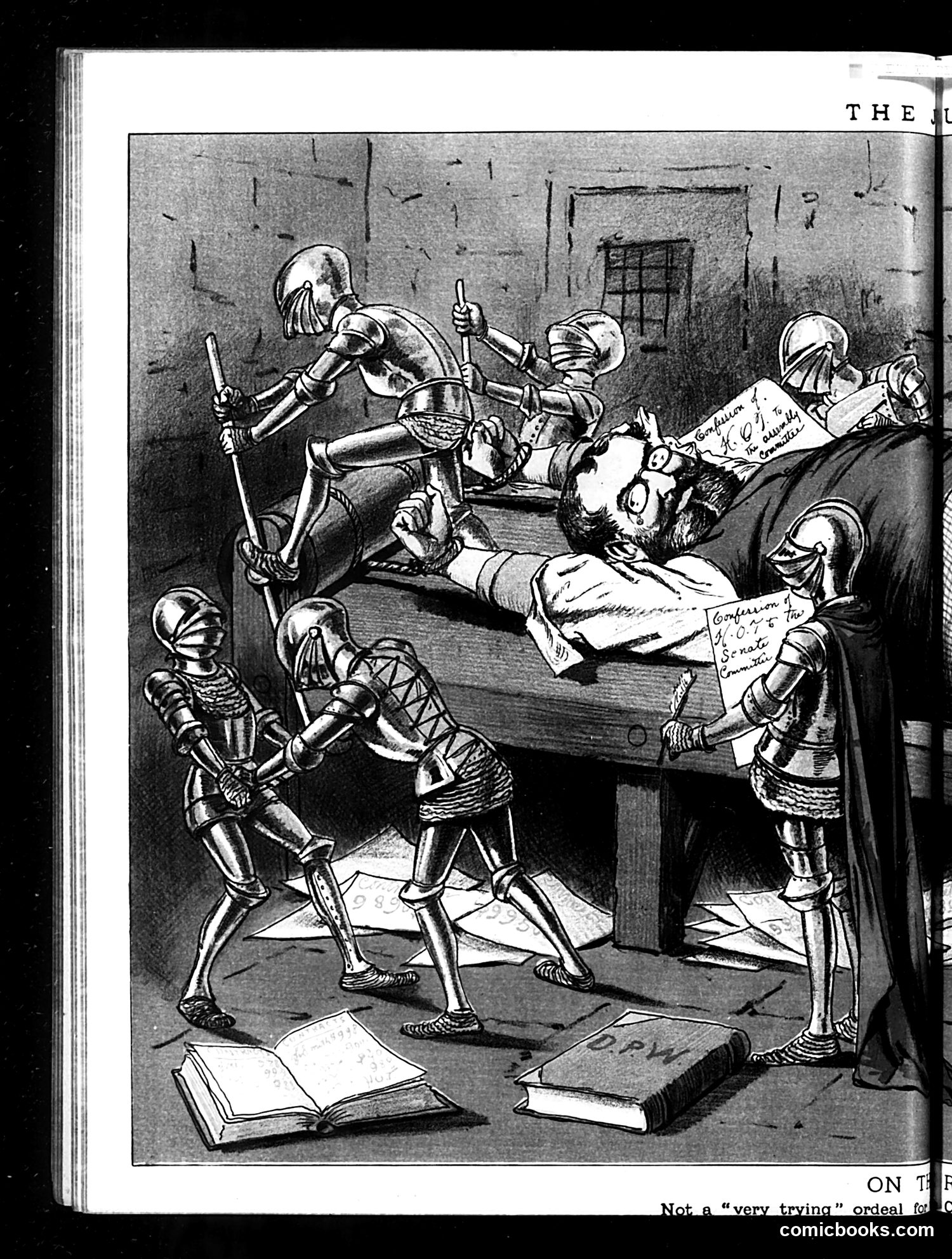
This appears to be a **medieval torture scene** serving as political satire. Armored figures wielding implements surround a prone victim on a table, with books scattered on the floor—likely representing **intellectual or legal persecution**. The labels visible on the victim's body appear to reference specific political targets or policies (text is partially illegible in the image). The medieval setting is a common satirical device in *Judge* magazine to depict contemporary political actions as barbaric or archaic. Without clearer OCR text identifying the specific figures and date, I cannot definitively name which politicians or events are being mocked. The cartoon likely criticizes some form of government coercion or unjust legal/legislative action against an individual or group, depicting it as primitive brutality.
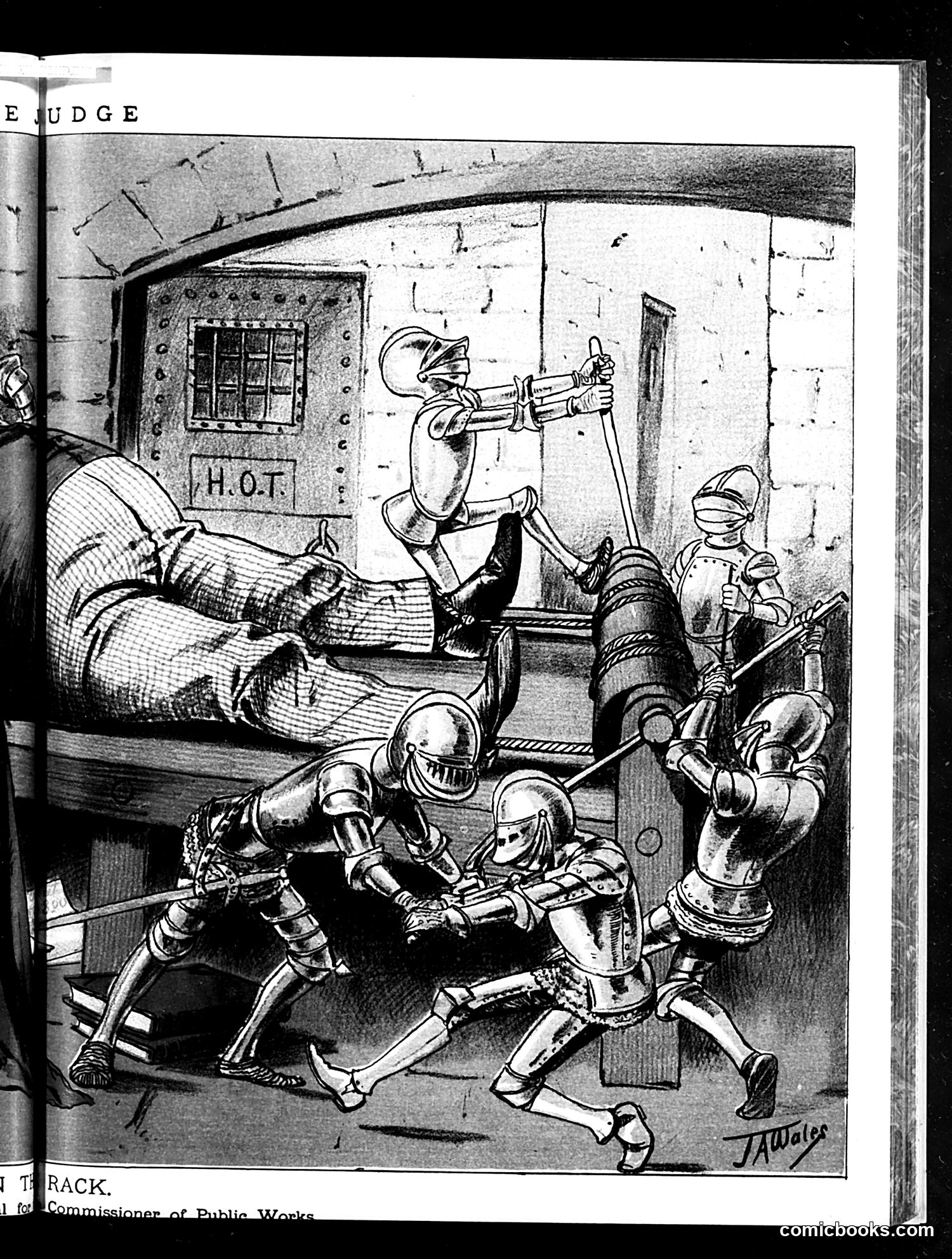
This **Judge** magazine cartoon depicts armored medieval knights besieging a fortified structure labeled "H.O.T." (likely "Heat" or a municipal office). The satirical image appears to criticize **government bureaucracy or municipal administration**—showing knights (representing either citizens, workers, or reform advocates) attacking or pressuring a fortified institution. The medieval armor and weaponry suggest the struggle is portrayed as archaic or absurd. The structure's small window and solid construction imply defensiveness or resistance to external pressure. Without visible dates or clearer text, the specific political target remains unclear—this could reference labor disputes, administrative reform efforts, or public works controversies common to early-to-mid 20th century American politics. The cartoonist's signature appears at bottom right.
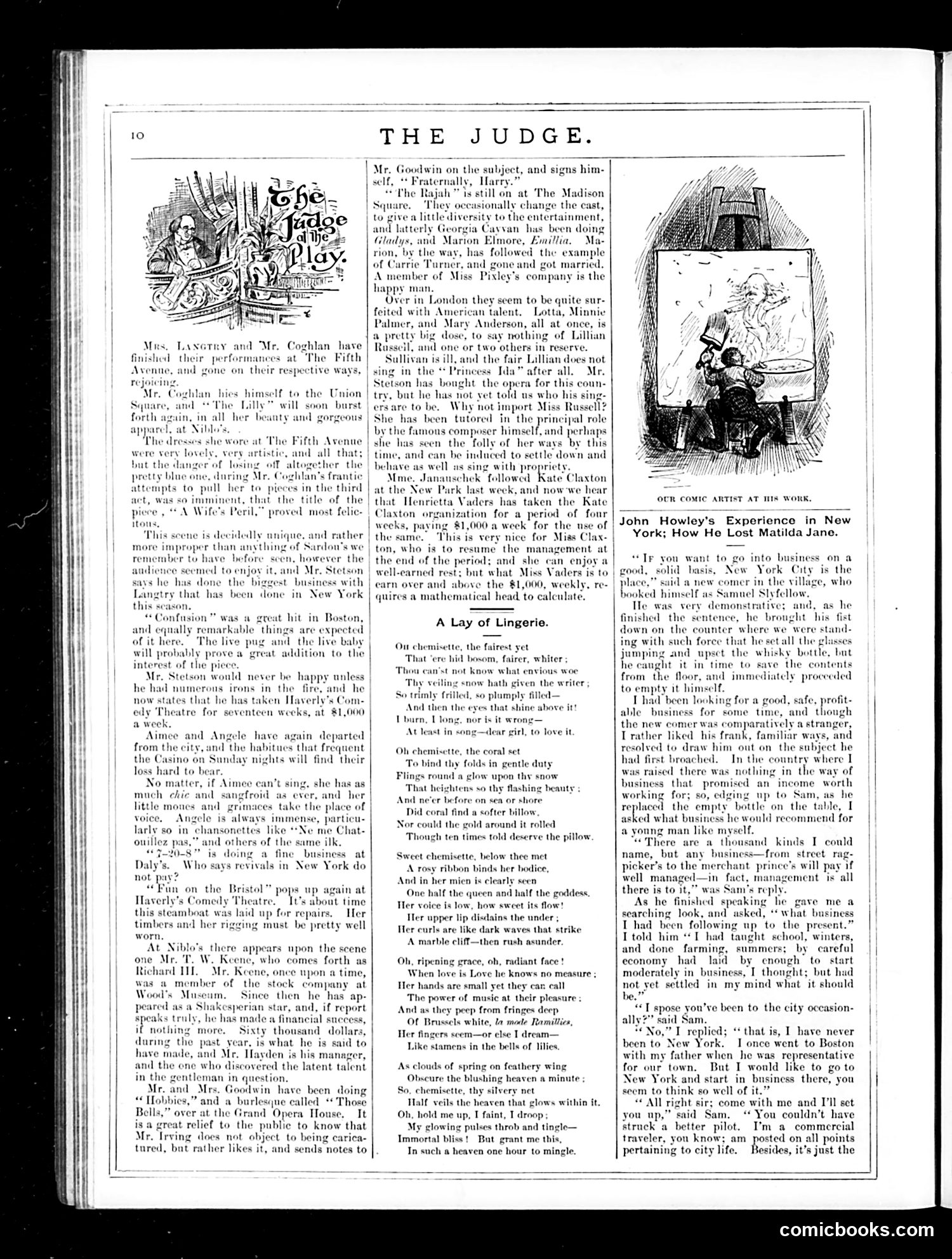
This page from Judge (a satirical weekly) covers theatrical gossip and reviews from New York's performance scene. The content includes: **Theater Gossip:** Brief updates on actors and productions—Mrs. Langtry and Mr. Coghlan finishing performances, Mr. Stetson managing multiple theatrical ventures, and various touring performers like Aimee and Angele. **The Satirical Elements:** The tone mocks the theatrical world's constant comings-and-goings, financial arrangements ($1,000-a-week contracts), and the focus on spectacle (live animals on stage) over genuine talent. There's gentle ribbing of performers' abilities and the industry's obsession with novelty. **"A Lay of Lingerie":** A sentimental poem about women's undergarments, typical of the era's genteel humor in publications aimed at educated audiences. **Right Column:** "John Howley's Experience in New York" describes a man's comedic misadventure in the city involving whisky and physical mishaps—lighthearted urban humor. The overall effect captures 1880s entertainment industry culture: celebrity-focused, performance-obsessed, and mixing theatrical criticism with broader social commentary.
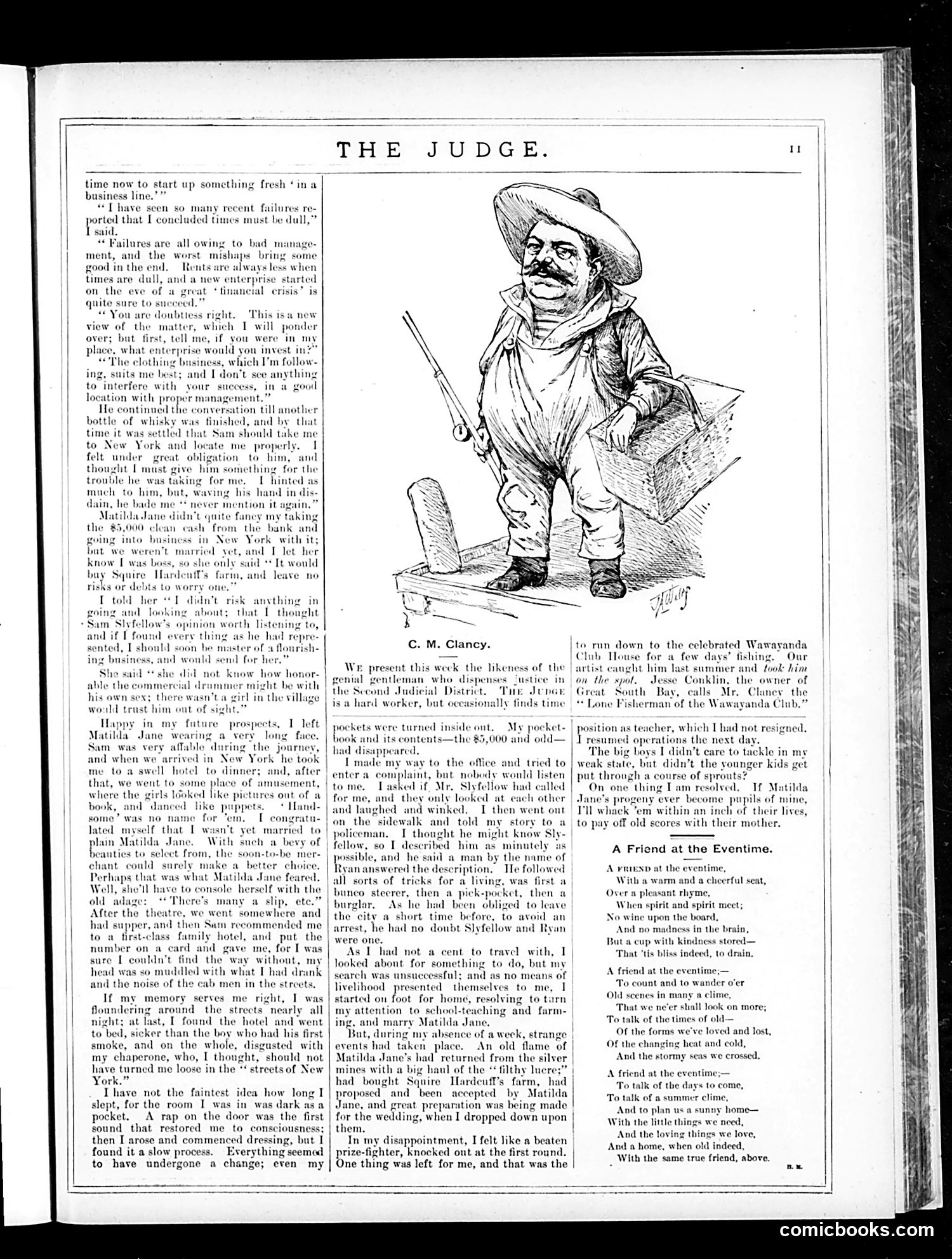
This page from *Judge* magazine presents a satirical story about a naive narrator who travels to New York City with a friend named Sam and his fiancée Matilda Jane. The accompanying caricature by C.M. Clancy depicts a stereotypical Irish or working-class figure—identifiable by the exaggerated facial features, pipe, and rustic clothing typical of period ethnic caricature. The satire targets gullible rural Americans victimized by city con artists. Sam's associate "Slyfellow" steals the narrator's money while the narrator is distracted by New York's temptations (theater, saloons, dancing girls). The story mocks both the con artist's cunning and the protagonist's foolishness—his inability to navigate urban sophistication, his susceptibility to vice, and his ultimate destitution. The title references a judge's wisdom, contrasting with the narrator's poor judgment. This reflects *Judge* magazine's frequent satirizing of American social types and urban-rural cultural clashes during the Gilded Age.
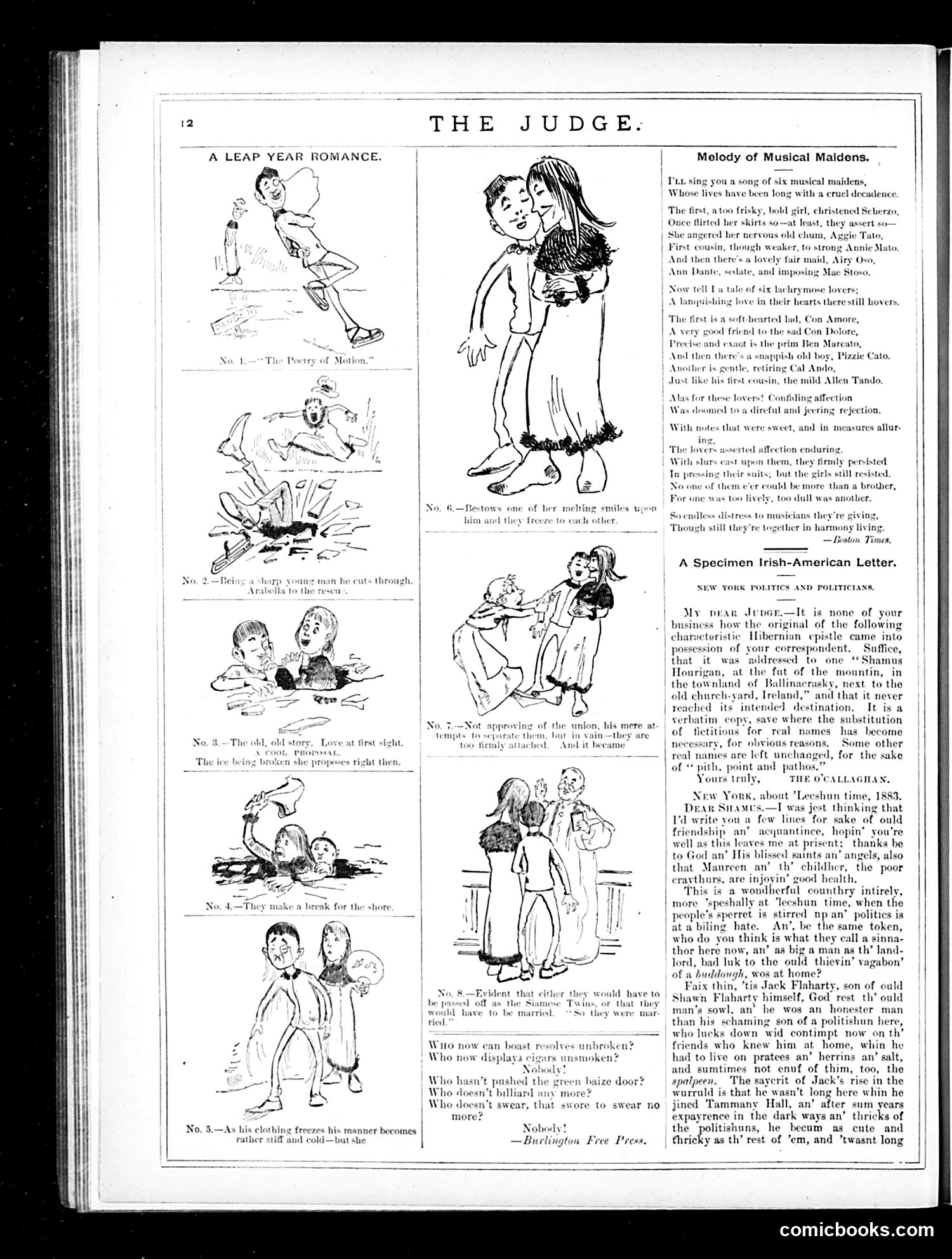
**Left side:** A humorous six-panel sequence depicting a "leap year romance"—referencing the tradition that women could propose to men in leap years. The cartoons show escalating physical comedy: a man being knocked over, couples slipping on ice, and increasingly awkward entanglements. The joke satirizes the chaos and role-reversal of women taking romantic initiative. **Right side:** Contains two unrelated pieces: (1) "Melody of Musical Maidens"—a whimsical poem about six female musicians and their male suitors, with Italian musical terms as names (Con Amore, Ben Marcato), playing on Victorian sentimentality about music and romance; (2) "A Specimen Irish-American Letter"—a satirical mock-letter written in exaggerated Irish brogue, portraying an Irish immigrant's astonishment at American politics and a fellow Irishman (Jack Flaherty) who has risen to prominence through Tammany Hall connections. The satire mocks both Irish immigrants and urban political corruption.
This page from **Judge** magazine (a 19th-century American satirical publication) contains three distinct pieces mocking urban Irish-American political participation and social pretension. The dominant content is a long monologue in exaggerated Irish dialect by a character named Shamus, criticizing Irish-American politicians who rise from poverty through corrupt politics, become morally compromised, and exploit poor Irish voters. He specifically attacks "Jimmy O'Brine" (likely a fictional representative of real corrupt NYC politicians) and the "Independent Party"—Irish politicians expelled from Tammany Hall who falsely claim reform credentials while remaining opportunistic. The satire targets: - **Political corruption**: How politicians exploit ethnic voters while enriching themselves - **Irish-American aspiration**: The contradiction between humble origins and moral compromise - **Tammany Hall politics**: The endemic corruption of NYC machine politics Two brief columns address "Business and the Weather" with unrelated anecdotes about commercial pragmatism and feminine sentimentality—typical filler content for the era. The ethnic stereotype dialect itself—while offensive to modern readers—was Judge's standard vehicle for political satire during this period.
This page is **primarily advertisements** with minimal original editorial content. The visible satirical material consists of brief humor items mocking social conventions of the era. The main cartoon/text piece, "The Deadly Plum Pudding," appears to use **racist caricature** (referred to as "a hungry little darkey") in a pseudo-folk-tale format about stealing dessert—standard degrading humor of this period that relied on dehumanizing depictions of Black Americans. The other editorial snippets mock contemporary social absurdities: women's marriage prospects, men's social pretensions, and gender roles. One item jokes about a Chicago man's three-year courtship of a woman he didn't realize was married—implying foolishness and satirizing social deception. The page's primary purpose is **commercial**: it features ads for grain/provisions, typewriters, throat lozenges, cocoa, and brewery products. The editorial content serves mainly as filler between advertisements, which was typical magazine economics of the period.
This page is primarily **advertising**, with some satirical commentary interspersed. The main content consists of period advertisements for pianos, patent medicines (Cuticura remedies), magic lanterns, and various services typical of late 19th-century America. The satirical items are brief, unsigned quips scattered throughout—typical of Judge's format. They mock contemporary absurdities: a woman's fear of wetting her bonnet, a Colorado suicide prevention law, sunsets blamed on "new standard time," and a judge presiding over the "Nutt case" (likely a real trial, now obscure). One joke mocks quack doctors advertising in country papers, another criticizes a man fined for kissing and immediately seeking another "kiss" to justify the price. The page reflects **late 19th-century concerns**: standardized time adoption, patent medicine proliferation, and social attitudes toward courtship and gender. The humor assumes reader familiarity with local news and social customs we've largely forgotten.
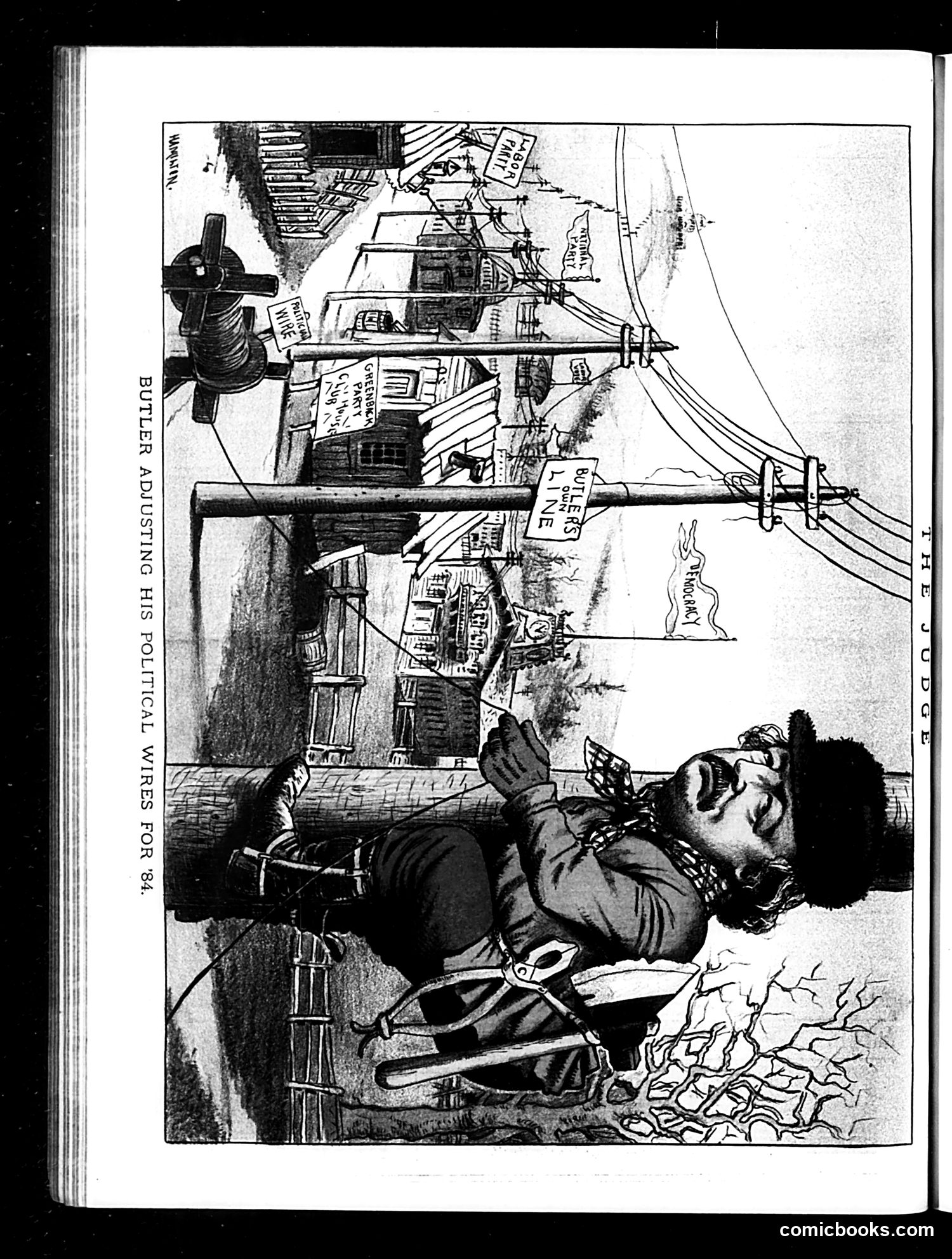
This political cartoon depicts a figure labeled as "Butler" manipulating political machinery in preparation for the 1884 election. The image shows Butler as a puppeteer-like operator controlling various political "wires" connected to buildings and structures representing political institutions and interests. The satire suggests Butler is orchestrating political machinations behind the scenes—pulling strings to advance his electoral ambitions. The cartoon likely references Benjamin Butler, a controversial political figure of the era known for shifting party affiliations and perceived opportunism. The "wires" metaphor represents hidden manipulation of the political system, portraying him as a schemer adjusting his strategies to gain advantage in the upcoming 1884 presidential race. The overall message criticizes what the cartoonist saw as Butler's calculating, puppet-master approach to politics.