
Judge, 1884-02-02 · page 2 of 16
Judge — February 2, 1884 — page 2: what you’re looking at
What you’re looking at
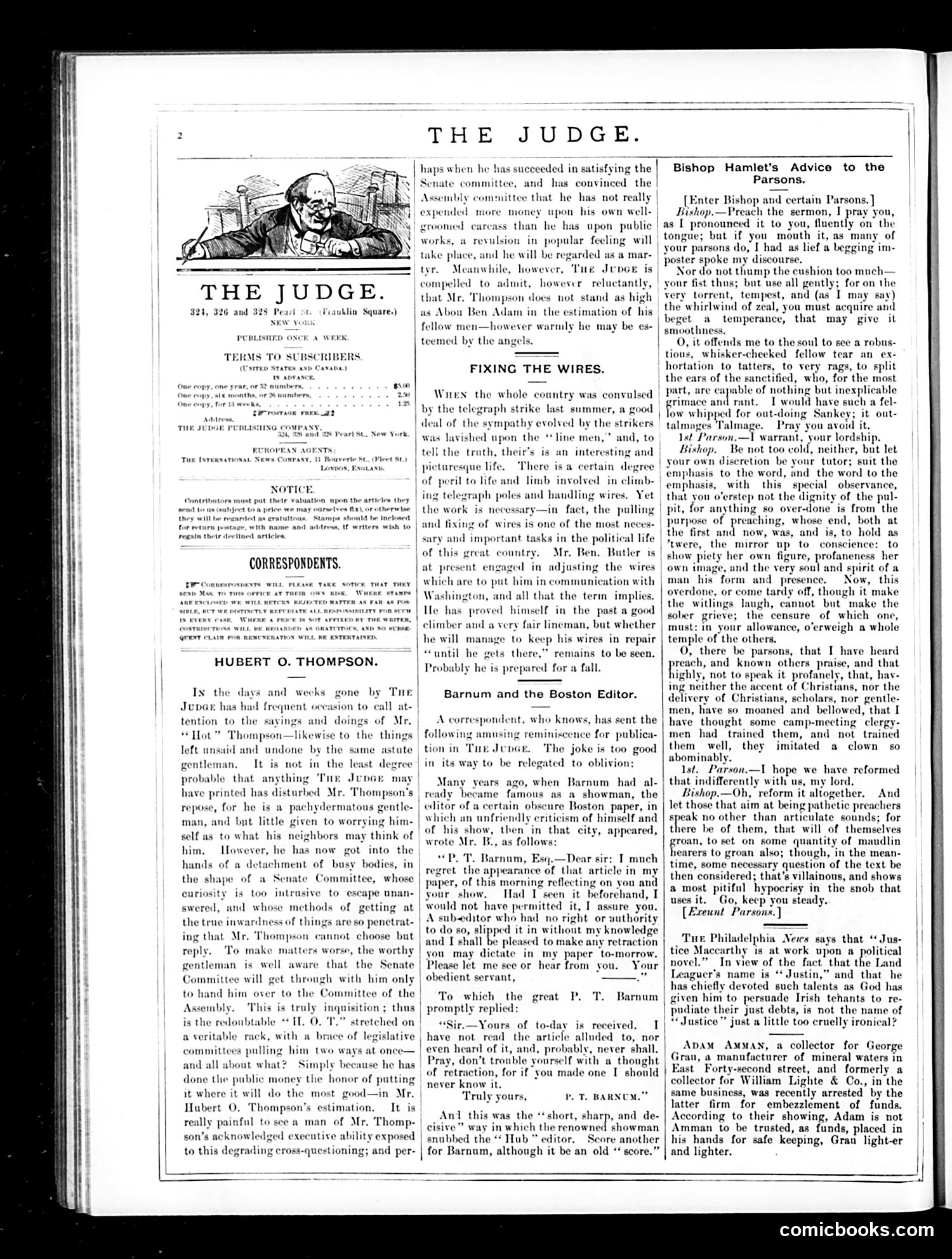
The main cartoon depicts **Hubert O. Thompson**, a political figure being investigated by a Senate Committee. The satire mocks Thompson as a wealthy, complacent man ("pachydermatous") facing aggressive legislative scrutiny. Judge suggests Thompson cares more about personal luxury than public works, yet maintains influence despite public disapproval—only the angels esteem him. A secondary piece satirizes **Benjamin Butler**, a general and politician attempting to "fix the wires" (maintain political connections) to advance his ambitions. The metaphor suggests his political maneuvering, though whether he'll successfully navigate to power remains uncertain. A brief anecdote describes **P.T. Barnum**'s witty response to a Boston newspaper editor's criticism—an early instance of celebrity managing negative press. The pieces collectively target corrupt or self-serving public figures and their political machinations during the Gilded Age.
📄 Transcribed text from this page (OCR, searchable)
Machine-transcribed from the original scan — historical spelling and the odd misread are preserved.
THE JUDGE. — 824, 326 and 328 Peas ot NEW Ys Viawklin Square.) PUBLISHED ONCK A WEEK TERMS TO SUBSCRIBERS. (Csiree Stare One copy py. a byt TH, JUDGE PUBLISHING COMPANY BUROVEAN AGENTS Tur terensaty on upon the articles they Ax) orotherwise will be ot aa eratltonn ye he m1 A be Inclosedt for ret we, with flame and addtrrsa, If writers wlah to. nctlnest articles CORRESPONDENTS. HUBERT O. THOMPSON. In the Juper has hu days and weeks THe frequent occasion to call at- tention to the and doings of Mr. “Ilot” Thompson—likewise to the th left unsaid and undone by the same astute gentleman. It is not in the least de probable that anything Tie June have printed has disturbed Mr. Thompson's sayi repose, for he is a pachydermatous man, and bnt little given to worrying him- self us to what his neighb may think of him. However, he has now got into the hands of a detachment of busy bod n the shape of a Scnate Committee, whose to escape unan- methods of getting at the true inwardness of thin: so penetrat- Mr. Thompson cannot choose but To make matters worse, the worth is well that the Senate will get through with him only over to the curiosity is too intrusive swered, and whose ing that ply. gentleman Committe re} aware to hand hin Assembly. is the redoubtable ** H. a veritable rack, with committees pullin; and all about what? done the public money the it where it will do the Hubert O. Thompson's estin really painful to s Committee of the ‘This is truly inquisition ; thus oO.'T. a bra him two ways at on Simply because he has honor of putting most good—in Mr, It is man of Mr. Thomp- son’s acknowledged executive ability exposed to this degrading cro: tion, | haps when he has succeeded in s | Washington, | regret the appearance of tl THE JUDGE. isfying the | has convinced the | he has not really more money upon his own well- | groomed carcass than he has upon public works, a revulsion in popular feeling will ake place, and he will be regarded as a mar- yr. Meanwhile, Tne Jvvee is compelled to admit, however reluctantly, that Mr. ‘Thompson does not stand as high as Abou Ben Adam in the estimation of his fellow men—however warmly he teemed by the angels. Senate committee, and Assembly committee that expended however, may be FIXING THE WIRES. Wires the whole country was convulsed by the telegraph strike last summer, a good deal of the sympathy evolved by the strikers | was lavished upon the “line men,” and, to tell the truth, their’s is an interesting and picturesque life, of peril to life aph pol the work is ne There isa certain degree nd limb involved in climb- and haudlit Yet in fact, the pulling nd fixing of wires is one of the most neces- sary and important tasks in the political life of this great country. Mr. Ben. Butler is at present din adjusting the wires which are to put him in¢ wires, sary: pmunication with nd all that the term implies. He has proved himself in the past a good climber and a very fair lineman, but whether he will manage to keep his wires in repair “until he gets there,” remains to be seen. Probably he is prepared for a fall. Barnum and the Boston Editor. A correspondent, who knows, sent the following amusing ence for publica- tion in Tue Jevor. in its way to be releg: ain The joke is too good ed to oblivion: years ago, when vy became famous itor of a certain obscure Boston paper, in which an unfriendly criticism of himself and of his show, then in that city, appeared, wrote Mr. B., as follows: Barnum had al- showman, the P. T. Barnum, Esq.—Dear sir: T much | it article in my aper, of this morning reflecting on you and your Had T seen it beforehand, I would not have permitted it, I assure you, A subeditor who had no right or authority to do so, slipped it in without my knowledge and I shall be pleased to make any retraction you may dictate in my paper to-morrow, show, | Please let me see or hear from | that indifferently obedient servant, To which the promptly replied: “Sir. ours of to-day have not read the artic! even heard of it, and, probably, never shall. Pray, don’t trouble yourself with a thought of retraction, for if you made one I should never know it, Truly yours, r great P. T. Barnum is received. [| IInded to, nor . T. BARNUM.” An1 this was the ¢ cisive ” way in whi snubbed the ‘ Hub hort, sharp, and de- he renowned showman litor. Seore another questioning; and per- | for Barnum, although it be an old * score.” Bishop Hamlet's Advice to the Parsons. [Enter Bishop and certain Parsons.] Bishop.—P. the sermon, I pray y as I pronounced it to you, fluently on the tongue; but if you mouth it, as many of your parsons do, I had as lief a begging im- poster spoke my discourse. Nor do not thump the cushion too much— your fist thus; but use all gently; for on the very torrent, tempest, and (as I may say) the whirlwind of zeal, you must acquire and beget a temperance, that may give it smoothness. O, it offends me to the soul to see a robus- tious, whisker-cheeked fellow tea n eX hortation to tatters, to very rag: split the ears of the sanctified, who, for the most part, are capable of nothing but inexplicable grimace and rant. I would have such a fel- | low whipped for out-doing Sankey; it out- talmopes ‘Talmage. Pray you avoid it. Ist Parson.—1 warrant, your lordship. Bishop. Be not too cold, neither, but let your own discretion be your tutor; suit the emphasis to the word, and the word to the emphasis, with this’ special observance, that you o’erstep not the dignity of the pul- pit, for anything so over-done’ is from the purpose of preaching, whose end, both at the first and now, , and is, to hold as ‘twere, the mirror up to conscience: to show piety her own figure, profaneness her own image, and the very soul and spirit of a man his form and presence. Now, this overdone, or come tardy off, though it make the witlings laugh, cannot but make the sober grieve; the censure of which one, must: in your allowance, o’erweigh a whole temple of the others. O, there be parsons, that I have heard pies ch, and known others praise, and that highly, not to speak it profanely, that, hav- ing neither the accent of Christians, nor the delivery of Christians, scholars, nor gentle- men, have so moaned and bellowed, that I have thought some camp-mecting clergy- men had trained them, and not trained them well, they imitated a clown so abominably. Ist. Parson.—I hope we have reformed with us, my lord. Bishop.—Oh, reform it altogether. And let those that aim at being pathetic preachers speak no other than articulate sounds; for there be of them, that will of themselves groan, to set on some quantity of maudlin hearers to groan also; though, in the mean- time, some necessary question of the text be then considered; that’s villainous, and shows a most pitiful hypocrisy in the snob that uses it. Go, keep you st [Ezeunt Parsons.] Tue Philadelphia News says that “Jus- tice Maccarthy is at work upon a political novel.” In view of the fact that the Land Leaguer’s name is ‘ Justin,” and that he has chiefly devoted such talents as God has en him to persuade Irish tehant: pudiat » their just debts, is not the ‘Justice’ just a little too cruelly ironical? ApamM AMMAN, a collector for George irau, a manufacturer of mineral waters in East Forty-second street, and formerly a collector for William Lighte & Co., inthe same business, was recently arrested by the latter firm for embezzlement of funds. According to their showing, Adam is not Amman to be trusted, as funds, placed in his hands for safe keeping, Grau light-er and lighter. comicbooks.com