
A complete issue · 16 pages · 1884
Judge — January 30, 1884
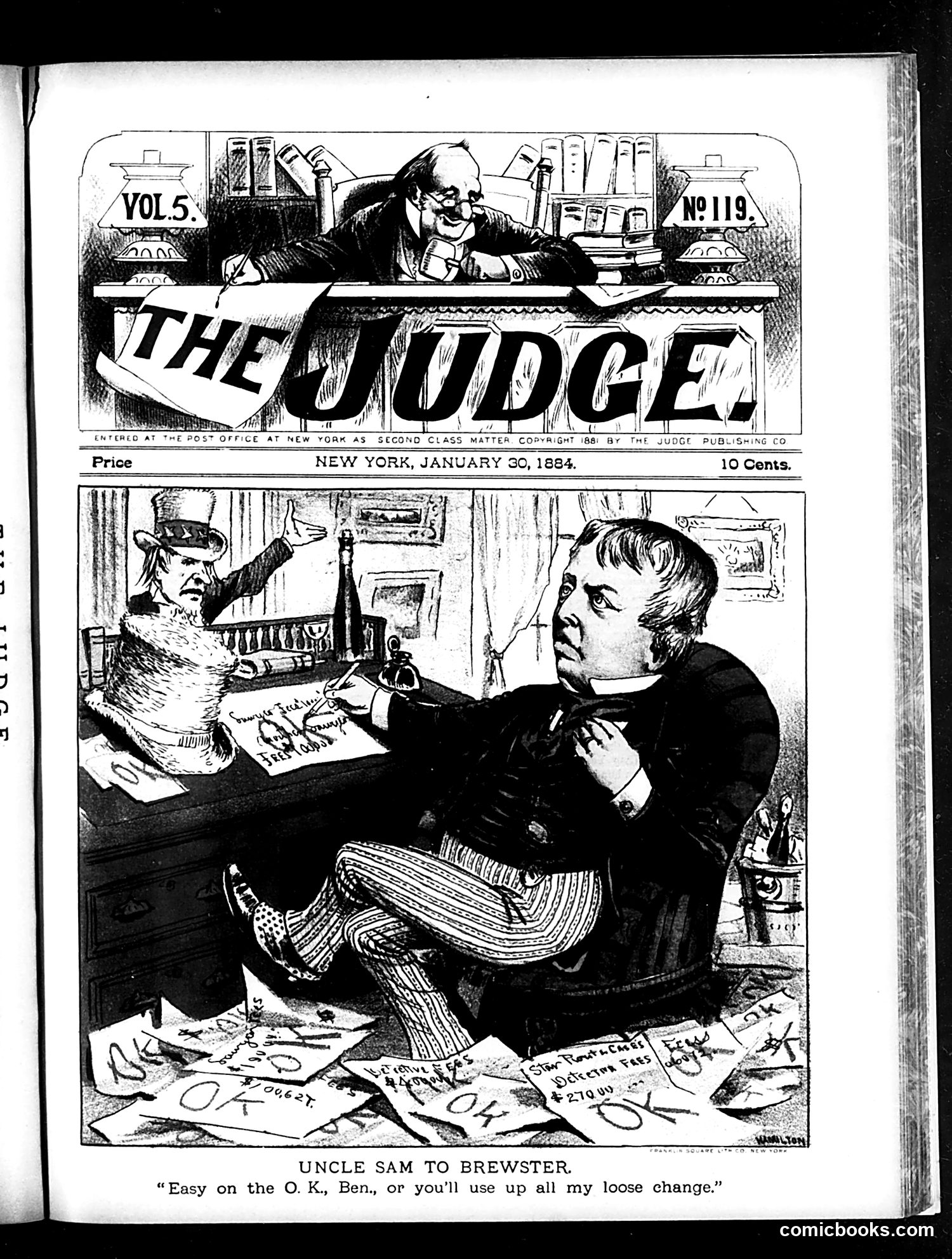
This cartoon from Judge (January 30, 1884) satirizes a financial dispute. The main figure "Brewster" sits at a desk surrounded by scattered bills and IOUs, looking distressed while holding a bottle. "Uncle Sam" (representing the federal government, shown in the mirror or reflection) warns him: "Easy on the O.K., Ben, or you'll use up all my loose change." The satire likely concerns Benjamin Brewster, U.S. Attorney General under President Chester Arthur, and alleged misuse of government funds or loose financial practices. The scattered papers with illegible notations suggest careless spending or accounting. The cartoon criticizes wasteful government expenditure, warning that reckless spending will exhaust public resources—a common satirical theme about federal mismanagement in the Gilded Age.
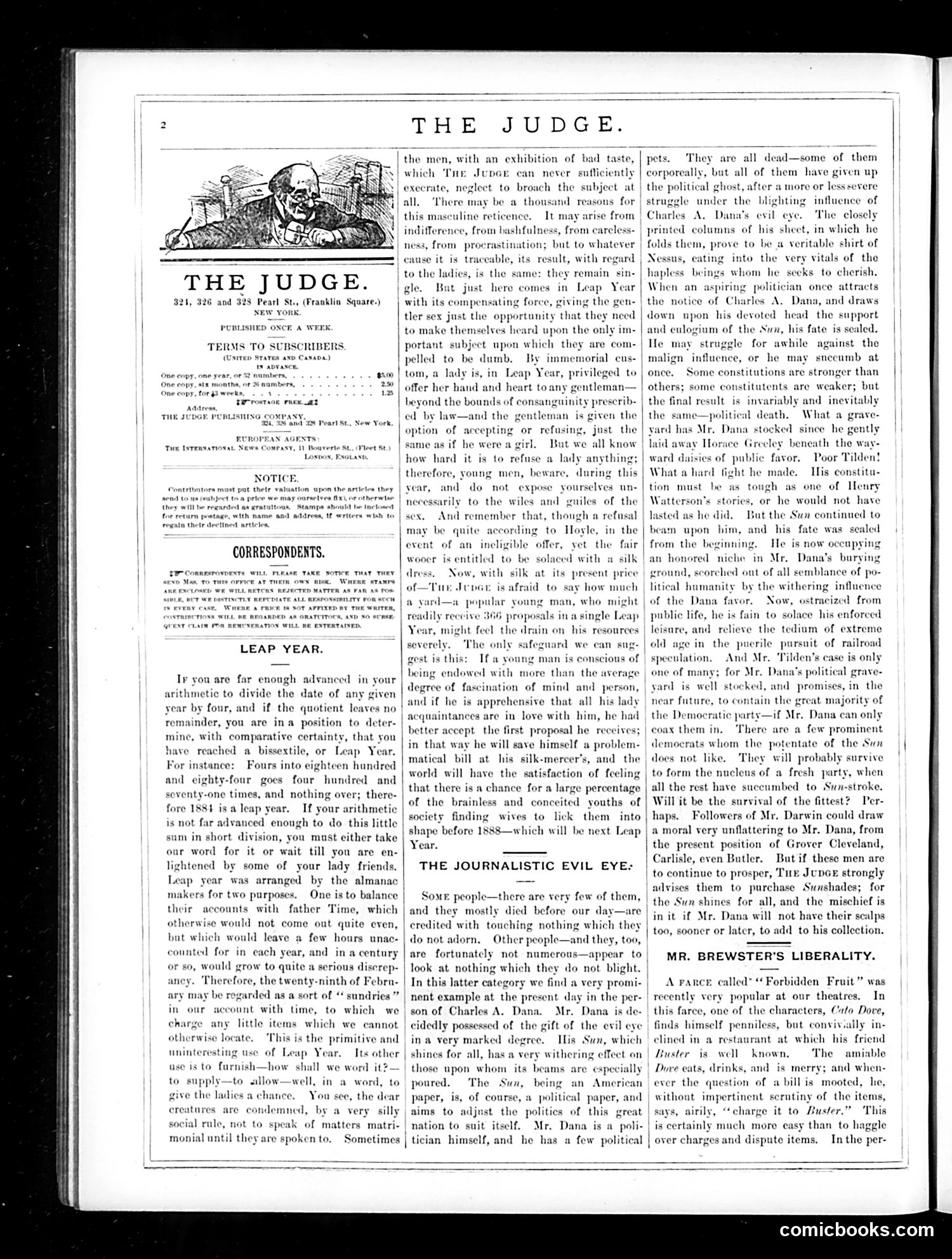
This page presents satirical commentary on **Leap Year marriage customs**, a Victorian-era social practice where women were permitted to propose to men. ## The Main Satire The article mocks the anxieties this creates for eligible bachelor men. Judge presents a tongue-in-cheek "warning": a desirable young man receiving 366 proposals during a Leap Year faces financial ruin from obligatory silk garters (consolation gifts for rejected suitors). The satire suggests that even refusing proposals costs money and social embarrassment. ## Social Context The piece ridicules **rigid Victorian gender norms**—specifically that women must normally remain passive in courtship. By inverting this expectation during Leap Years, the magazine highlights the absurdity of these restrictions. The satire implies that "society finding wires to lick [young men] into shape" reflects broader anxieties about unmarried men and women's limited romantic agency. The other columns address **Charles Dana** (editor of The Sun newspaper) and his political bias, representing typical Judge content criticizing public figures and institutions.
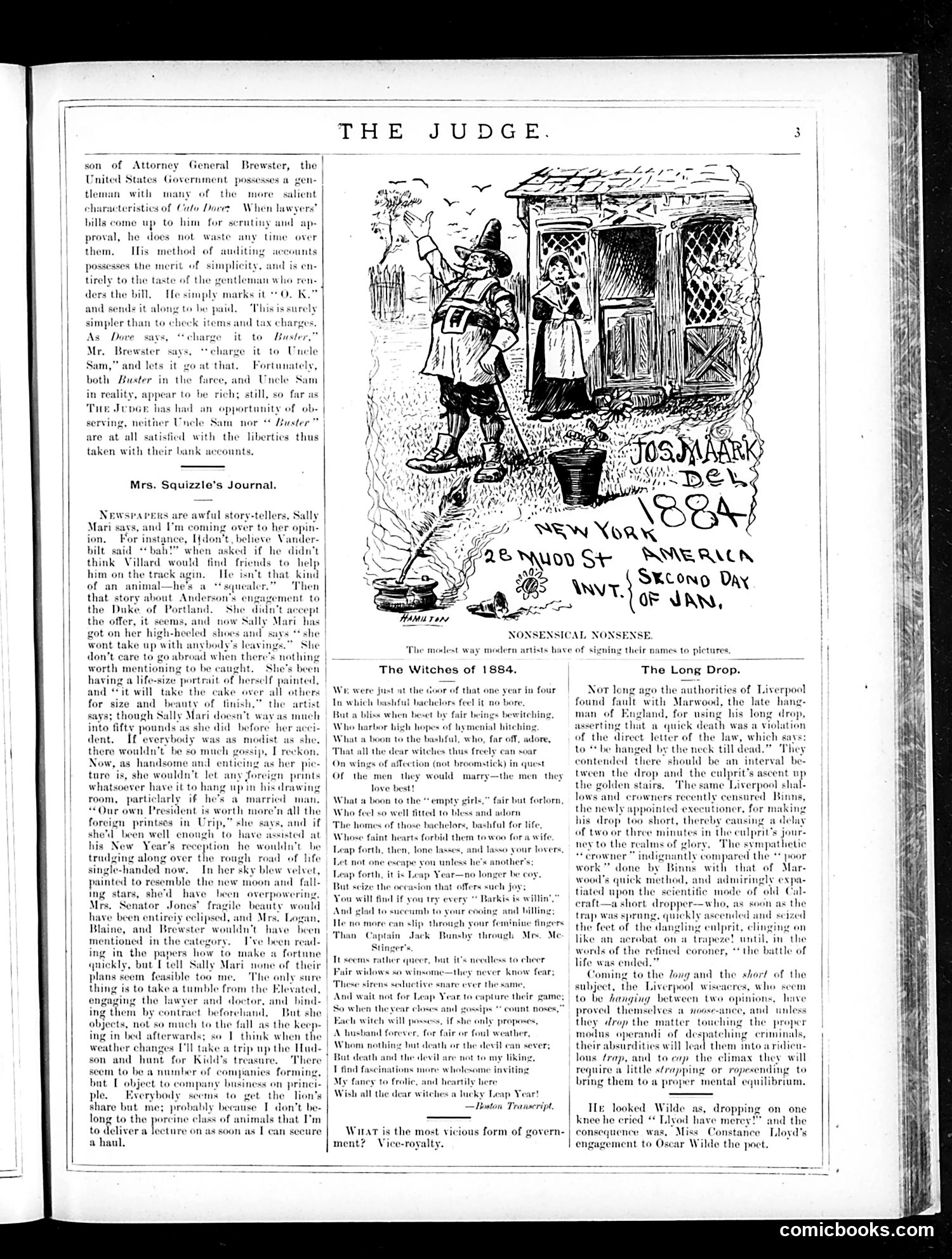
## Main Cartoon: "Nonsensical Nonsense" The illustrated cartoon depicts a figure in period dress at a cottage door, signed "Jos. Maark Del" with a New York address dated January 2, 1884. The satire appears to target modern artists' pretentious signature practices—the title mocks the "nonsensical" trend of artists dramatically signing their work on pictures themselves rather than simply inscribing signatures conventionally. ## Text Content The page includes several satirical pieces: - **"Mrs. Squizzle's Journal"**: Gossip-column satire mocking newspaper sensationalism and society women's vanity - **"The Witches of 1884"**: Humorous poem about unmarried women during Leap Year (when tradition allowed women to propose) - **"The Long Drop"**: Brief note about Liverpool hangman Marwood's execution methods The overall page exemplifies *Judge* magazine's satirical approach: targeting media excess, social pretension, and contemporary scandals through humor rather than direct political commentary.
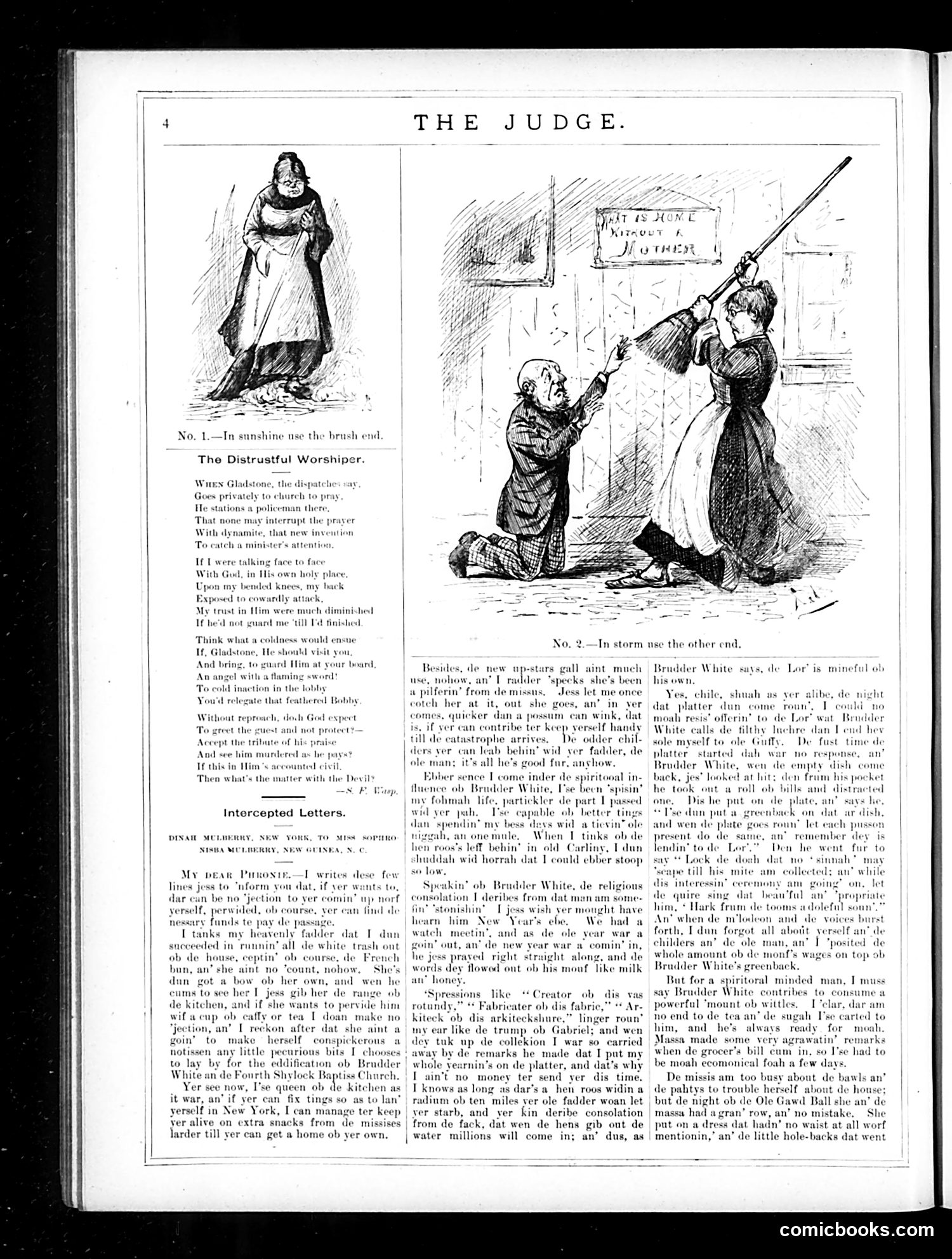
This page contains two satirical pieces targeting African American subjects through crude dialect humor typical of late-19th-century American magazines. **"The Distrustful Worshipper" (No. 1):** A poem mocking a Black worshipper who stations a policeman in church, fearing robbery during prayer. The satire suggests Black churchgoers are paranoid and lack genuine faith. **"Intercepted Letters" (Nos. 1-2):** Two humorous letters in exaggerated dialect between Southern Black women discussing domestic matters, servants, and church donations. The satire ridicules Black speech patterns, economic struggles, and religious fervor—particularly mocking a character "Brudder White," a preacher whose sermons manipulate congregants into donating money they cannot afford. **Context:** These pieces reflect late-19th-century racist stereotypes portraying African Americans as superstitious, financially irresponsible, and easily manipulated. The dialect spelling and caricatured voices were considered "humorous" by the magazine's white audience, while actually reinforcing dehumanizing racial prejudices common to the era.
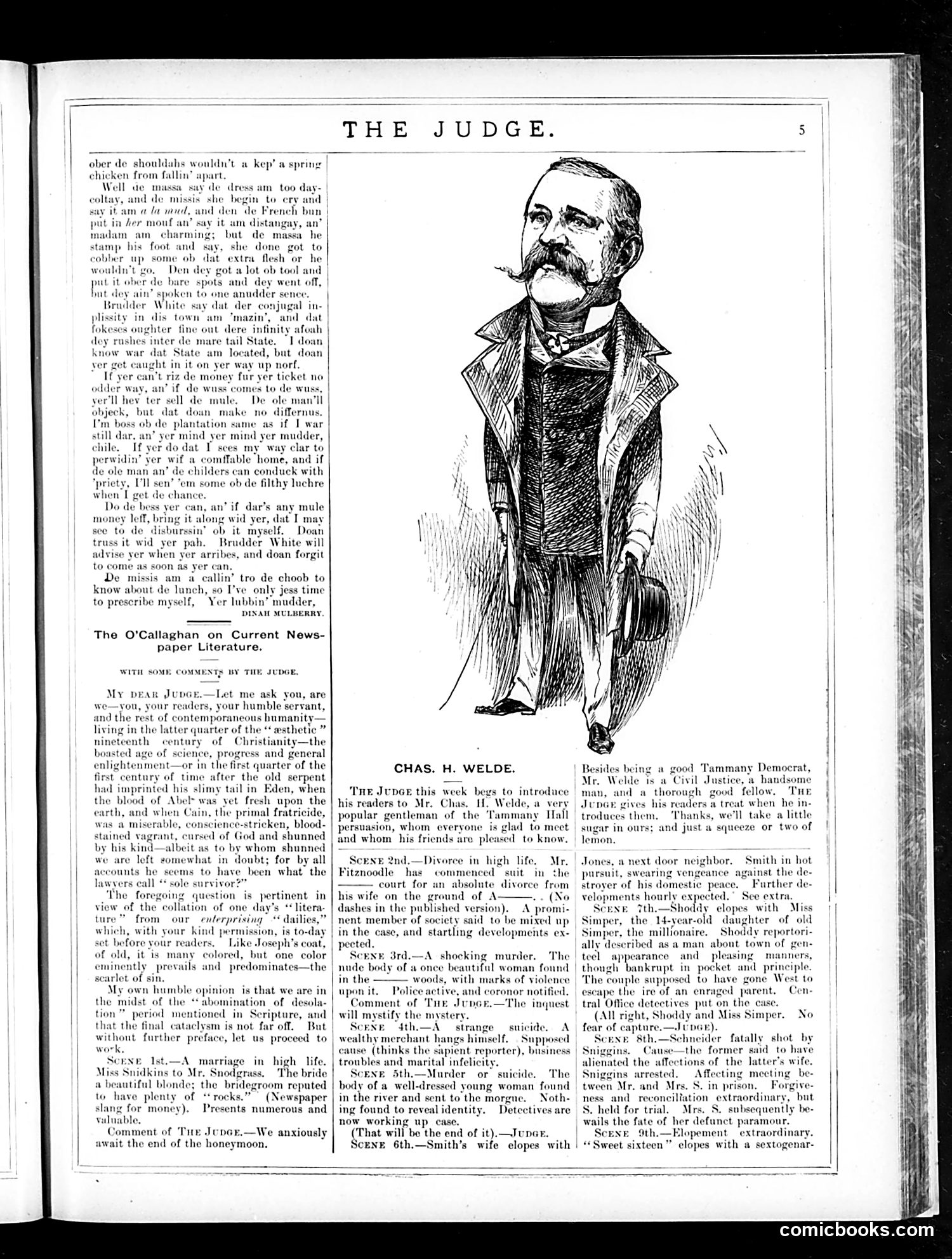
This page presents **Chas. H. Welde**, described as "a popular gentleman of the Tammany Hall persuasion"—referring to New York's Democratic political machine. The portrait and biographical note introduce him as a respectable figure to Judge magazine's readership. Below, **"The O'Callaghan on Current Newspaper Literature"** satirizes sensationalist newspaper reporting. The columnist lists six melodramatic news scenarios—divorce, murder, suicide, elopement—that appear constantly in papers, implying newspapers exploit scandal and tragedy. The Judge's comment ("That will be the end of it") suggests such stories receive no meaningful follow-up, mocking both papers' sensationalism and readers' short attention spans. The opening dialect passage (poorly OCR'd) appears to be a separate comedic piece using exaggerated African American vernacular—common in 19th-century humor magazines, though offensive by modern standards. The satire targets both yellow journalism and public appetite for lurid content.
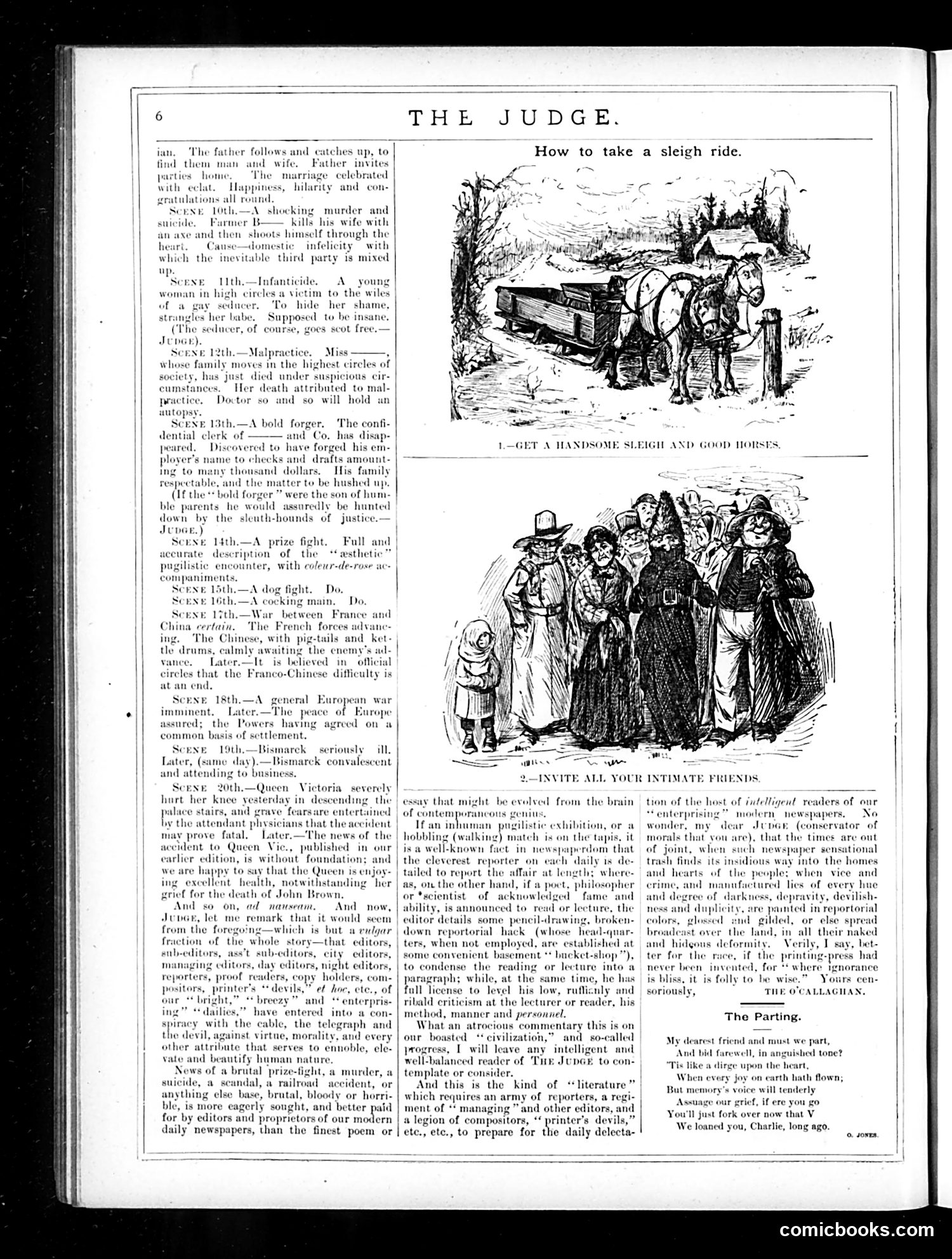
This page from *Judge* satirizes the sensationalism of contemporary newspapers. The left column presents a series of melodramatic scenarios—murders, suicides, infanticide, forgery, prize fights, and international conflicts—designed to show the lurid content editors prioritize. The accompanying illustrations depict genteel winter activities: "How to take a sleigh ride" (wholesome sleighing) and "Invite all your intimate friends" (social gathering). This visual contrast is deliberate irony. The editorial commentary argues that newspapers eagerly publish brutal, scandalous stories while ignoring refined literary or intellectual content. The author condemns editors and proprietors for choosing sensationalism over morality, suggesting their profit-driven coverage corrupts public taste and "insidious[ly]" poisons society's "hearts and homes." The satire criticizes Gilded Age journalism's commercialization—the gap between civilized social ideals (represented by the genteel illustrations) and the actual content newspapers promoted for profit.
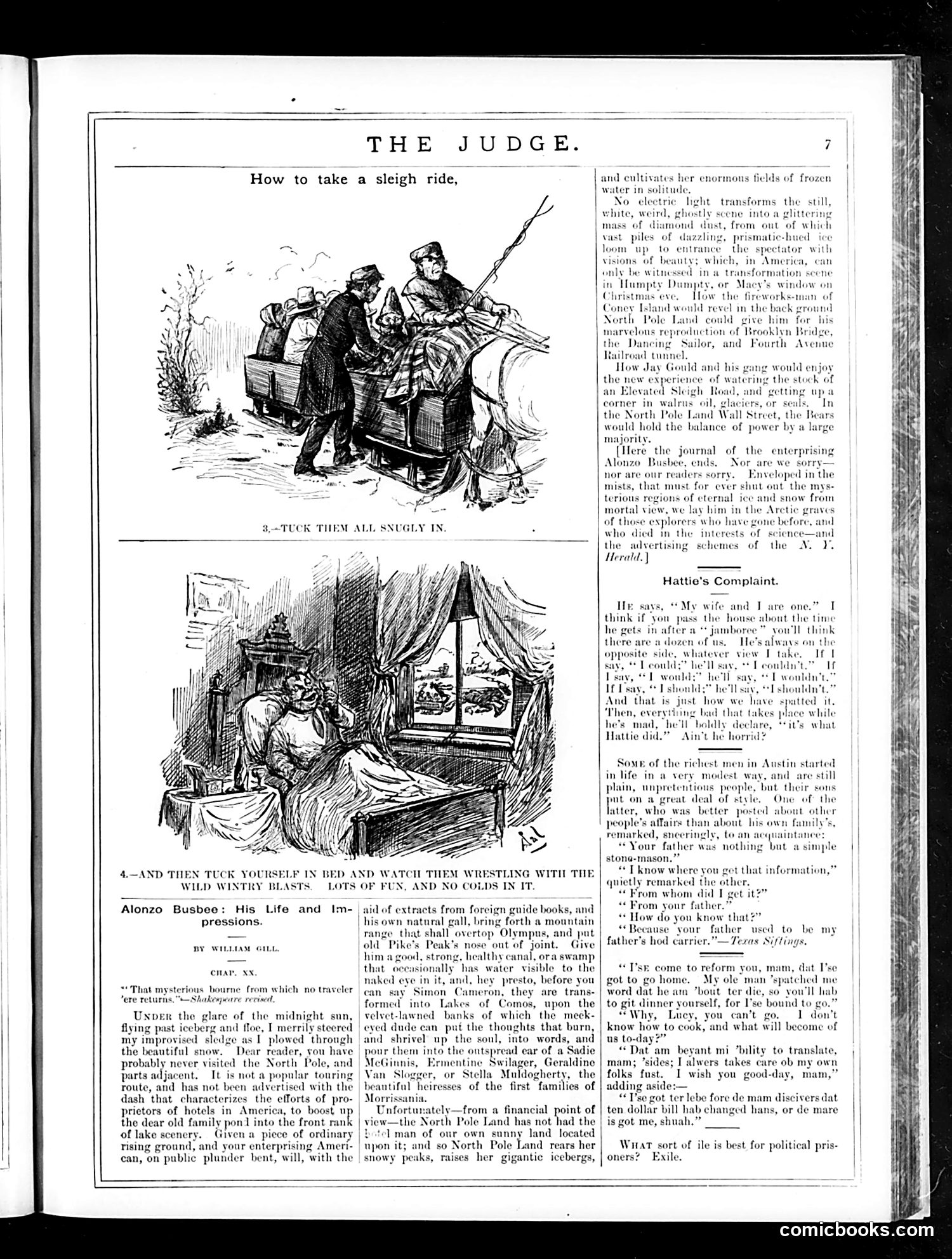
This page contains two distinct satirical pieces: **Top cartoon ("How to take a sleigh ride")**: A humorous instructional sketch showing people bundled in a sleigh, illustrating winter recreation for affluent readers. **Main article ("Alonzo Busbee: His Life and Impressions")**: A serialized fiction chapter mocking American entrepreneurship and tourism development. The narrator sarcastically criticizes how American businessmen ("on public plunder bent") transform ordinary landscapes—ponds into lakes, swamps into resorts—using fraudulent advertising to attract wealthy tourists and heiresses. The piece satirizes the North Pole Land development scheme, suggesting it could rival famous attractions like Coney Island or Broadway if properly marketed. The underlying critique targets American commercial exploitation and false advertising of natural features. **Secondary items**: Brief humorous anecdotes about marital complaints and social pretension among wealthy Austin residents, including a joke about a self-made man's son embarrassed by his father's humble origins as a stonemason. The satire targets American capitalism, tourism fraud, and nouveau-riche social climbing.
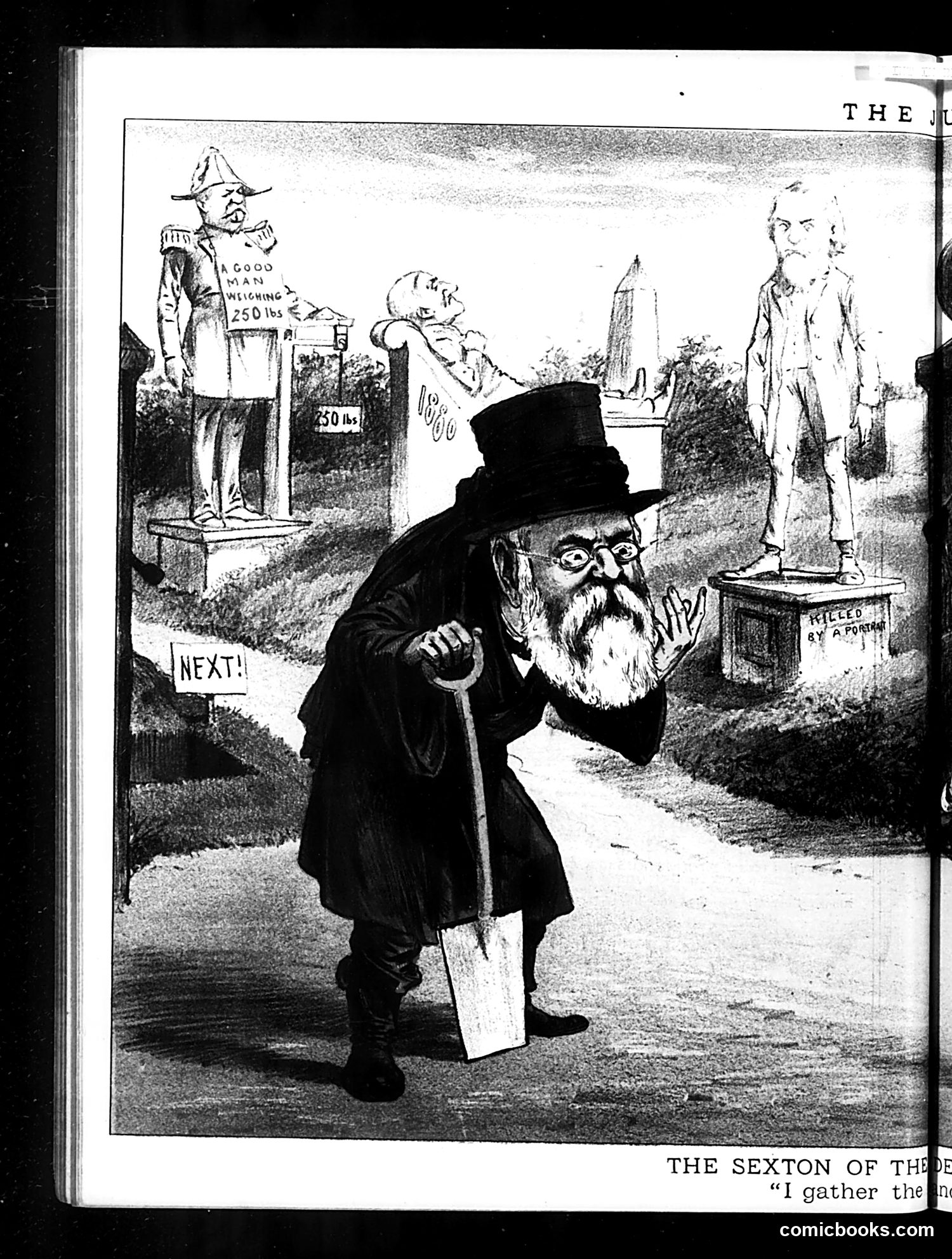
This appears to be a political cartoon from *Judge* magazine depicting a gravedigger (sexton) as an older man with a distinctive beard, wearing a top hat and formal coat—an unusual costume for someone doing manual labor, suggesting symbolic rather than literal meaning. In the background, three figures stand on pedestals labeled with weights ("250 lbs," "KILLED BY POISON"). The word "NEXT!!" indicates a sequence of deaths. The cartoon likely satirizes someone collecting casualties or deaths, possibly referencing political opponents, failed policies, or social victims. The formal dress combined with gravedigger's tools suggests Death personified, or a political figure presiding over multiple demises. Without the publication date or fuller caption, the specific political event or figures remain unclear.
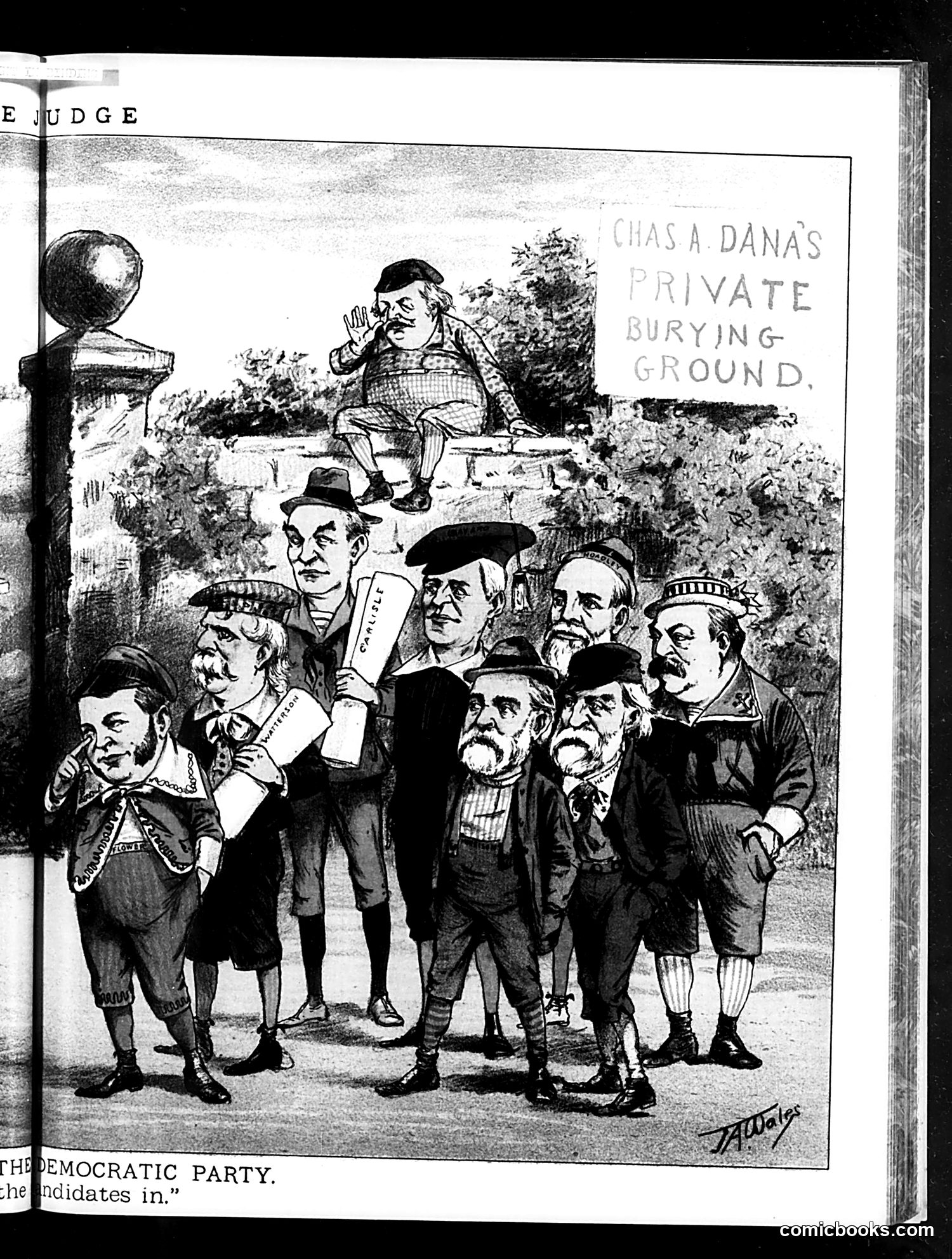
This is a satirical cartoon titled "The Democratic Party: The Candidates in," signed by what appears to be the artist's initials. The image depicts multiple caricatured male figures of varying sizes gathered at what looks like Charles Dana's private burying ground—a reference visible on the sign in the background. The cartoon mocks Democratic Party candidates through exaggerated physical caricatures typical of 19th-century political satire. The figures appear to be competing party politicians or hopefuls, portrayed as grotesquely as possible to ridicule them. The "burying ground" metaphor suggests the cartoonist views the Democratic candidates or party itself as dead or dying—a common satirical trope expressing contempt for the opposition party's viability or prospects.
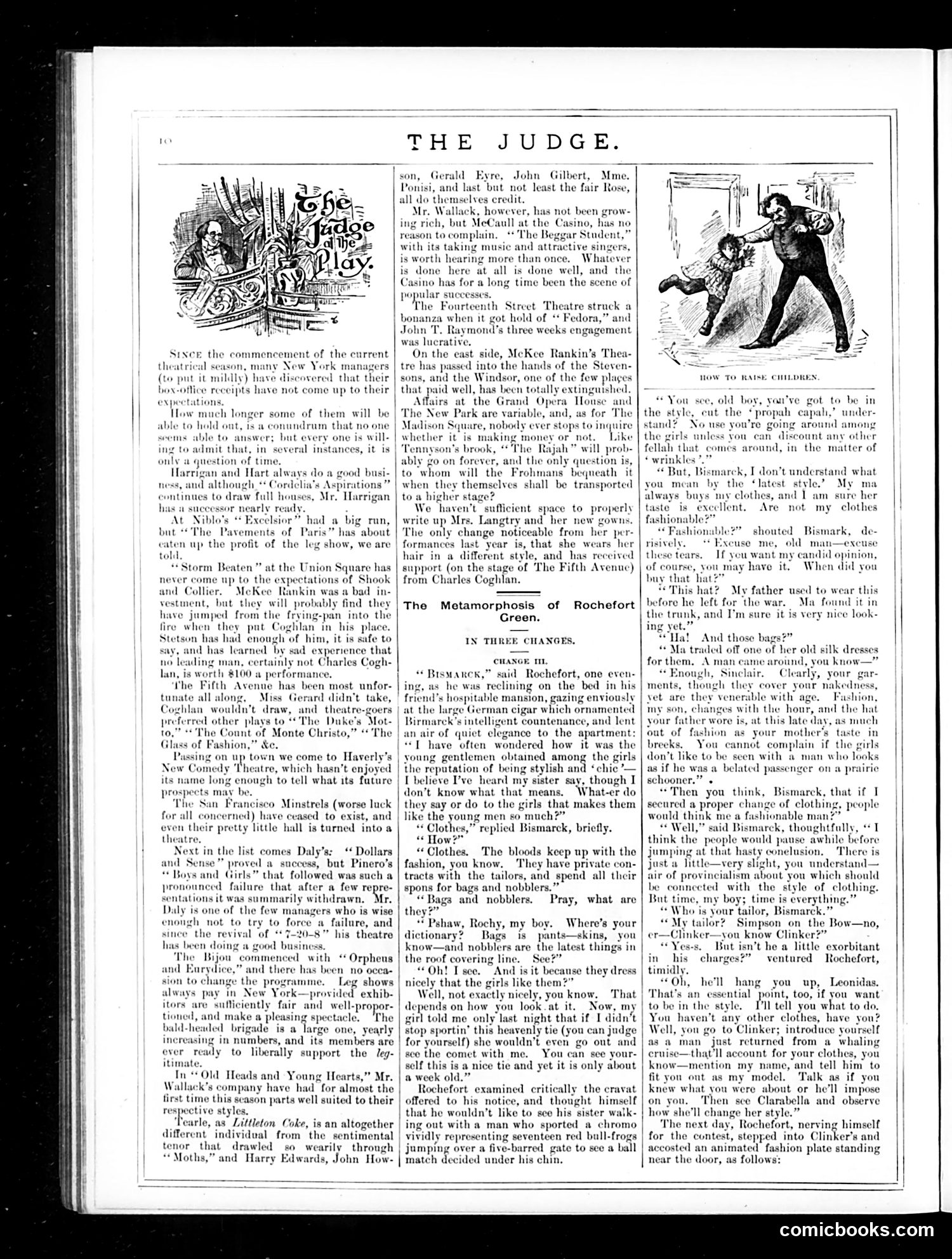
This is a **theatre industry report** from *Judge* magazine, not a political cartoon. The page discusses New York theatrical box-office struggles during the current season. The piece surveys various playhouses and their financial performance, naming theatrical figures like Charles Coghlan (an actor deemed not worth his $100 nightly fee), McKee Rankin, and Harrigan and Hart. Productions mentioned include *The Beggar Student*, *Fedora*, and *Excelsior*. The satire is **economic**: managers expected strong profits but are disappointed. The author notes that even prestigious venues like Madison Square Theatre succeed regardless of actual profitability—suggesting either fraud or audience loyalty transcending quality. The two illustrations appear to depict theatrical scenes: one shows "How to Raise Children," likely a comedic vignette unrelated to the main text, reflecting *Judge's* typical mix of commentary and entertainment. This reflects **Gilded Age theatre culture**—a competitive, speculation-driven industry where star power and novelty determined success more than artistic merit.
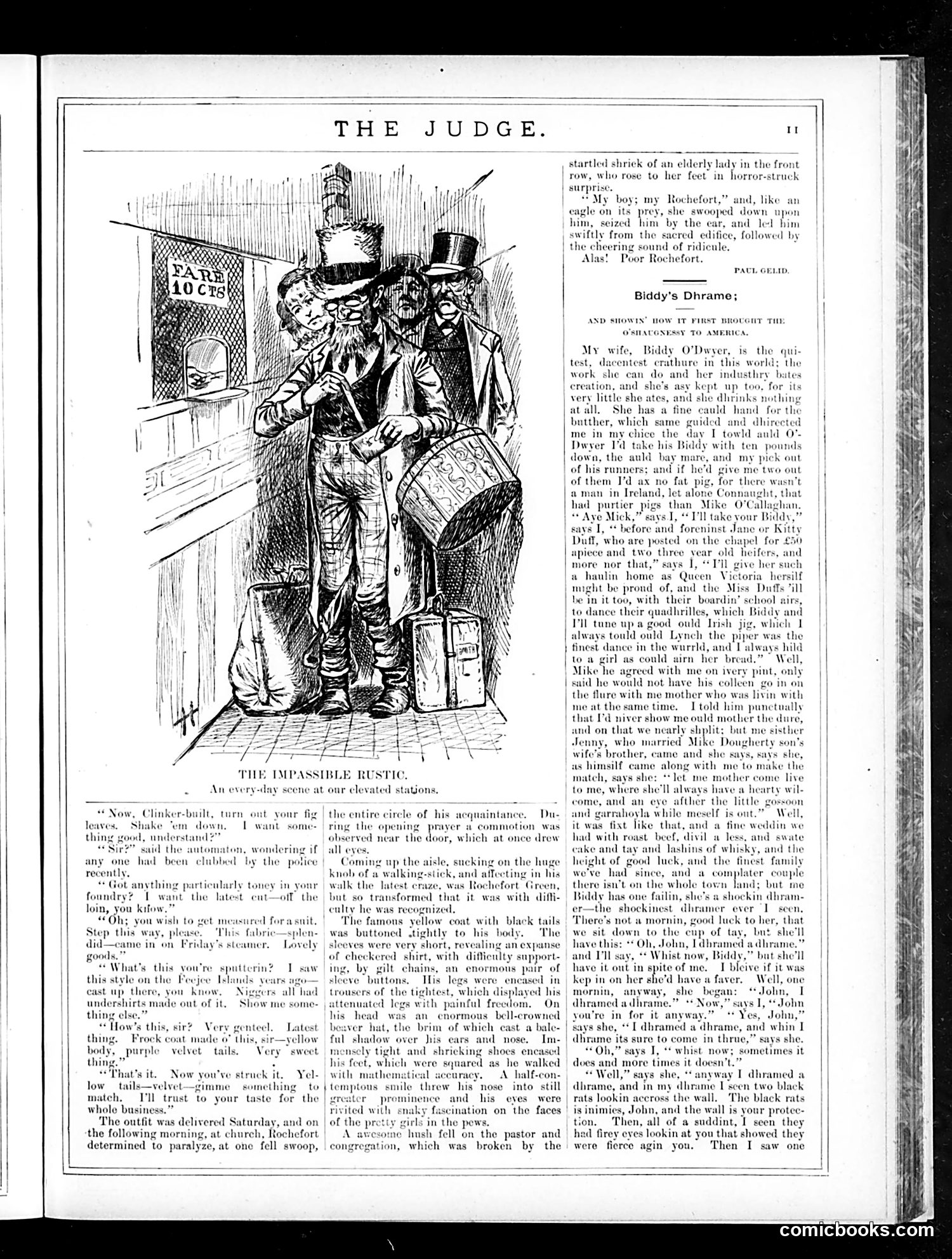
This page contains primarily **humorous fictional narratives** rather than political cartoons. The main content consists of Irish-dialect stories, likely representing common satirical material in Judge magazine. The largest piece, "Couldn't Remember Everything," is a first-person narrative in heavy Irish dialect about a man named John who emigrates to America after nearly being drawn into a revenge plot against a priest back home. The satire targets **Irish immigrant experiences**—depicting stereotypical Irish speech patterns, rural conflicts, poverty, and the common phenomenon of Irish emigration to America. The humor relies on **ethnic caricature**: exaggerated dialect, family drama, and the contrast between old-country problems and American opportunity. The story suggests that emigration, even when prompted by near-tragedy, leads to prosperity and family success. Several brief joke items appear in sidebars ("Mistaken Identity," "A Good Snip," etc.), using similar Irish stereotypes and working-class humor typical of Judge's satirical approach to contemporary American society.
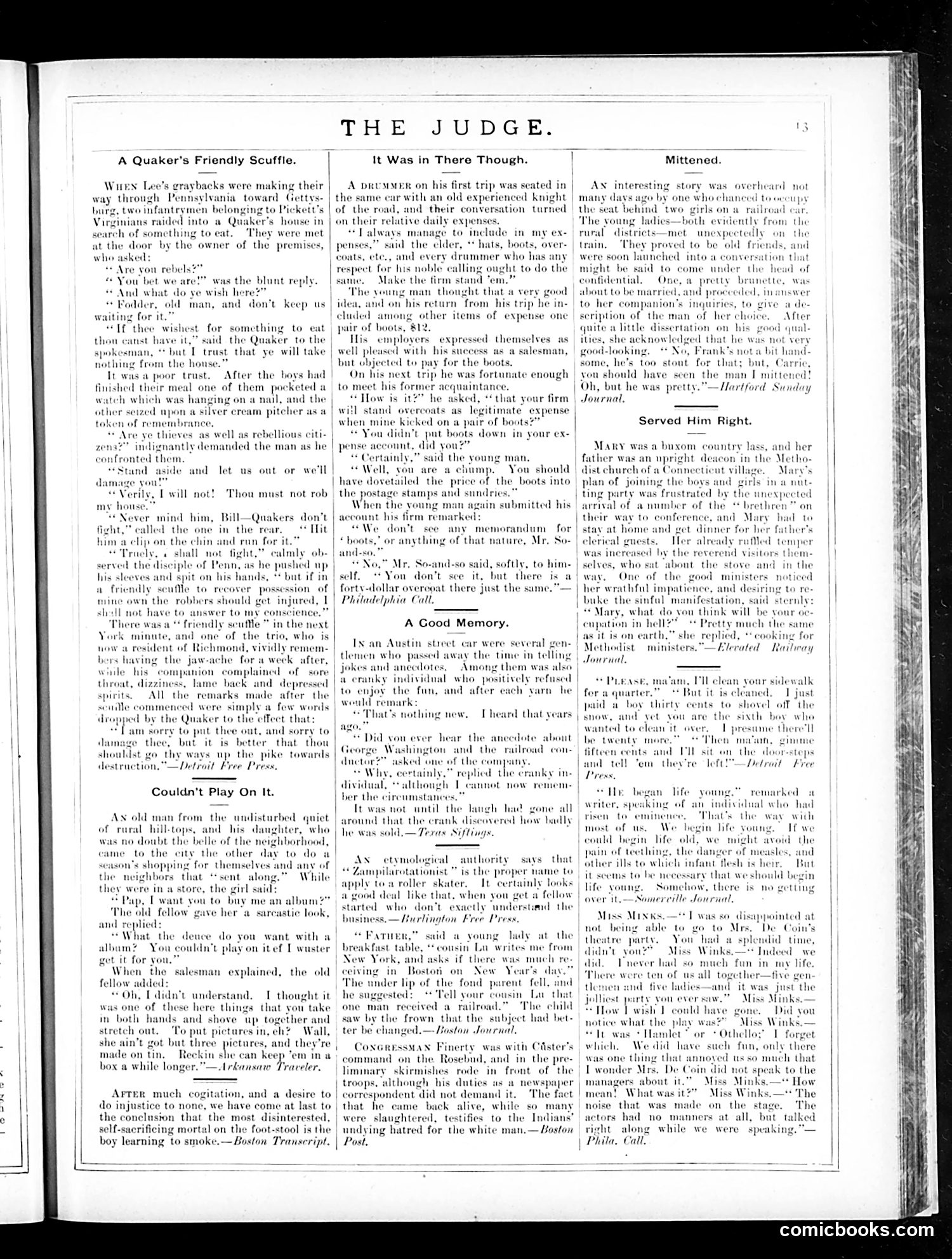
This page from Judge magazine contains several humorous short stories reflecting late-19th/early-20th-century American social satire: **"A Quaker's Friendly Scuffle"** depicts Union soldiers during the Civil War confronting a Pennsylvania Quaker (known for pacifism) to steal food. When the Quaker refuses and a soldier strikes him, the Quaker "friendly scuffles" back—the joke being that even pacifists have limits. It satirizes both wartime hardship and Quaker principles. **"It Was in There Though"** concerns a traveling salesman's expense reports, satirizing business dishonesty—he claims costs for items never purchased, a common corporate practice. **"Mittened"** features rural girls discussing a suitor the narrator "mittened" (rejected/dumped), poking fun at rural courtship customs and dialect. Other pieces ("Served Him Right," "A Good Memory," "Couldn't Play On It") continue in this vein of gentle social humor targeting various American character types: country folk, businessmen, and ordinary people in awkward situations.
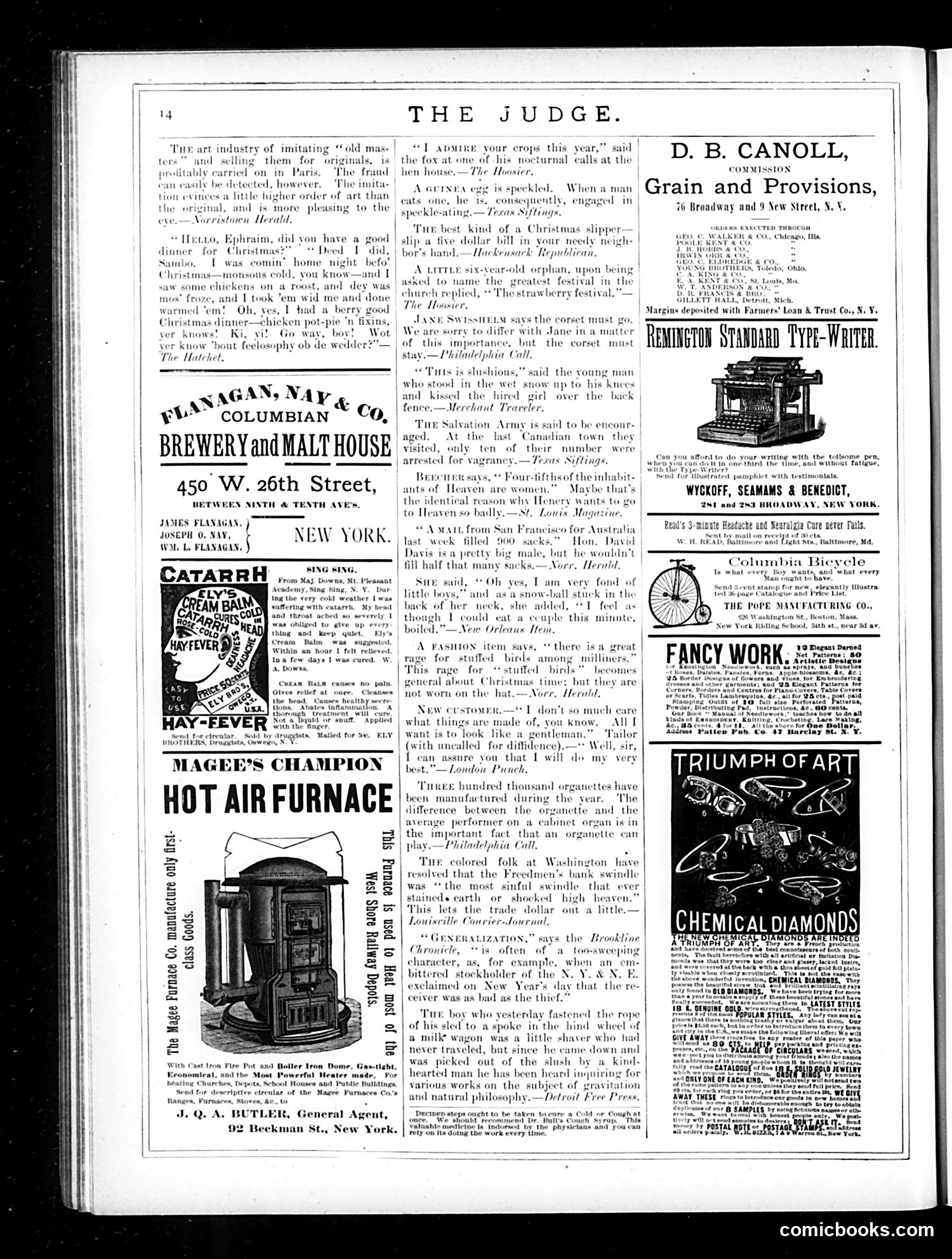
This is primarily an **advertising page** from Judge magazine, with scattered short humorous anecdotes rather than political cartoons. The advertisements dominate: a brewery, hot air furnace, typewriter, bicycle, and grain commission business. These reflect late 19th-century American commercial life. The small jokes sprinkled throughout are typical period humor—brief, pun-based observations on everyday life. Examples include exchanges between characters (appearing to use racial dialect in one anecdote about Christmas dinner), quips about fashion and romance, and observations about human nature. Notable is a reference to "the Salvation Army" being encouraged in a Canadian town, with only ten members arrested for vagrancy—a mild jab at the organization's effectiveness. The page contains **no identifiable political cartoons or caricatures of public figures**. It's essentially a commercial product page with filler humor typical of Judge's satirical magazine format, rather than the pointed political satire the publication was known for.
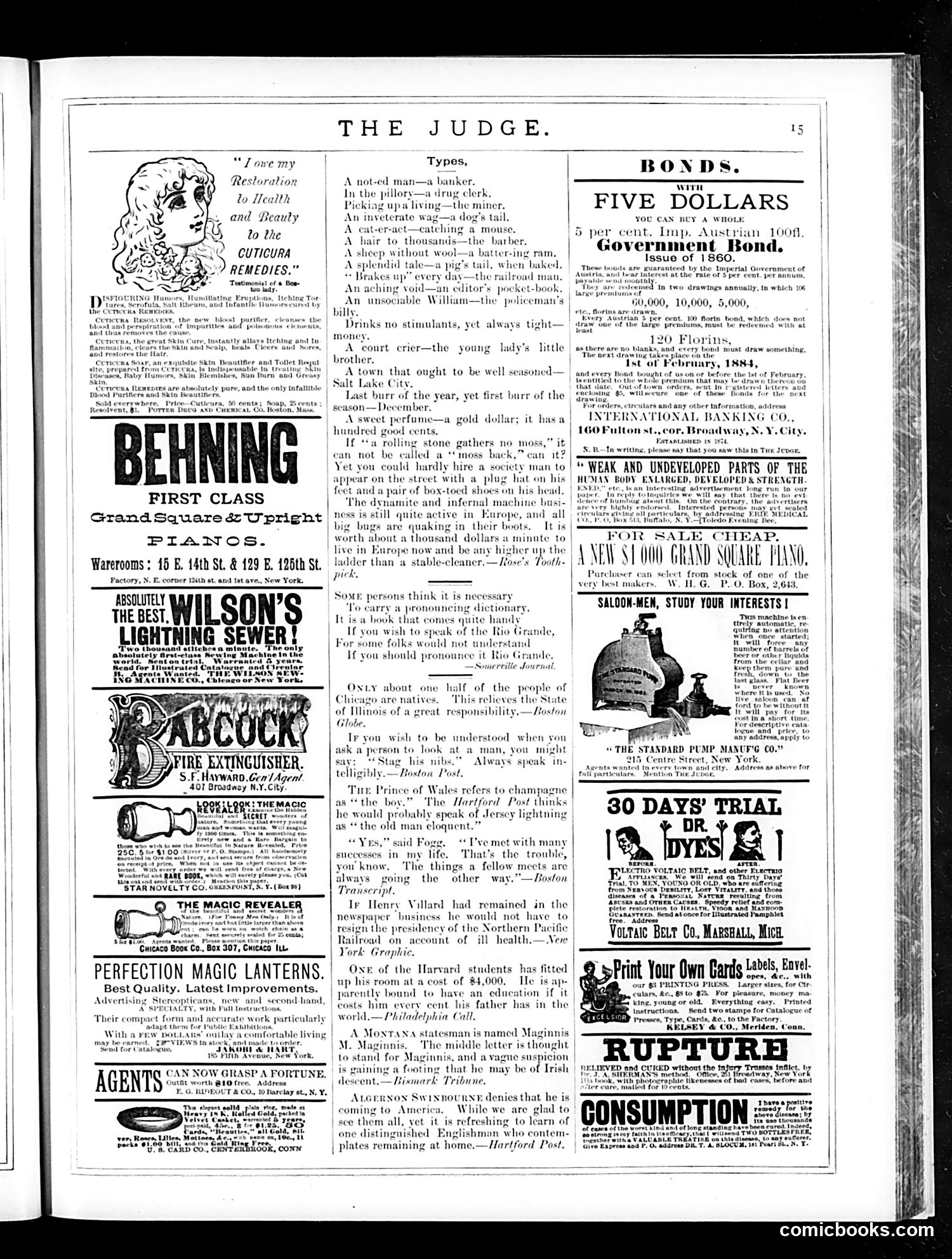
This page is primarily **advertisements and filler content**, not political cartoons. The main elements are: **Advertisements include:** - Behning pianos - Wilson lightning extinguishers - Cuticura remedies (skin care) - Magic lanterns - Austrian government bonds - Various patent medicines and printing presses **The "Types" column** contains light humor—brief, disconnected jokes about everyday characters (a banker, a barber, a policeman). These are gentle observational humor with no satirical bite. **Notable references:** - Henry Villard (railroad executive, mentioned as having resigned from Northern Pacific) - Harvard students (mocked for expensive room decorations) - Prince of Wales (champagne reference) - A "Montana statesman named Maginnis" (unclear significance) The page represents typical **19th-century magazine filler**—a mix of advertising revenue and mild, non-political humor. There are no sharp political cartoons or sustained satire visible here. It's essentially a commercial page with time-filling jokes.
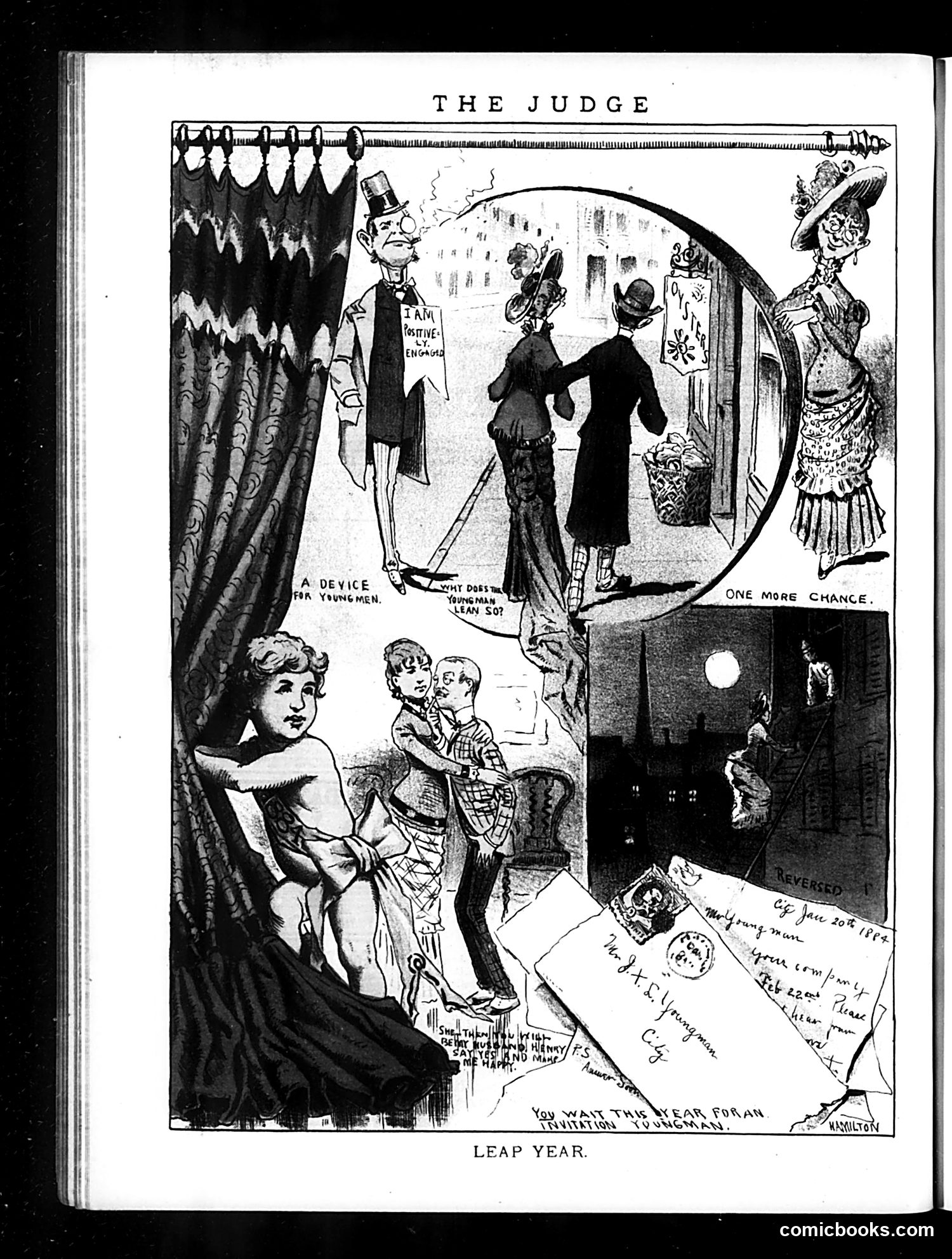
This is a satirical cartoon about "Leap Year" customs, specifically the tradition allowing women to propose to men (reversing normal gender roles). The main scene shows a well-dressed man labeled "A Device for Young Men" looking flustered as a woman and man approach him at a doorway, while an elegantly dressed woman on the right observes. The caption "One More Chance" suggests she's being offered another opportunity to propose. The lower left shows a cherub/cupid figure amid domestic chaos with children, while the bottom panel depicts a reversed scenario where a man must wait nervously for a woman's marriage proposal invitation. The cartoon mocks the social awkwardness and role-reversal anxiety created by leap-year proposal traditions, presenting it as comically destabilizing to conventional courtship norms. The satire targets male anxiety about female agency in romantic matters.