
Judge, 1884-01-30 · page 2 of 16
Judge — January 30, 1884 — page 2: what you’re looking at
What you’re looking at
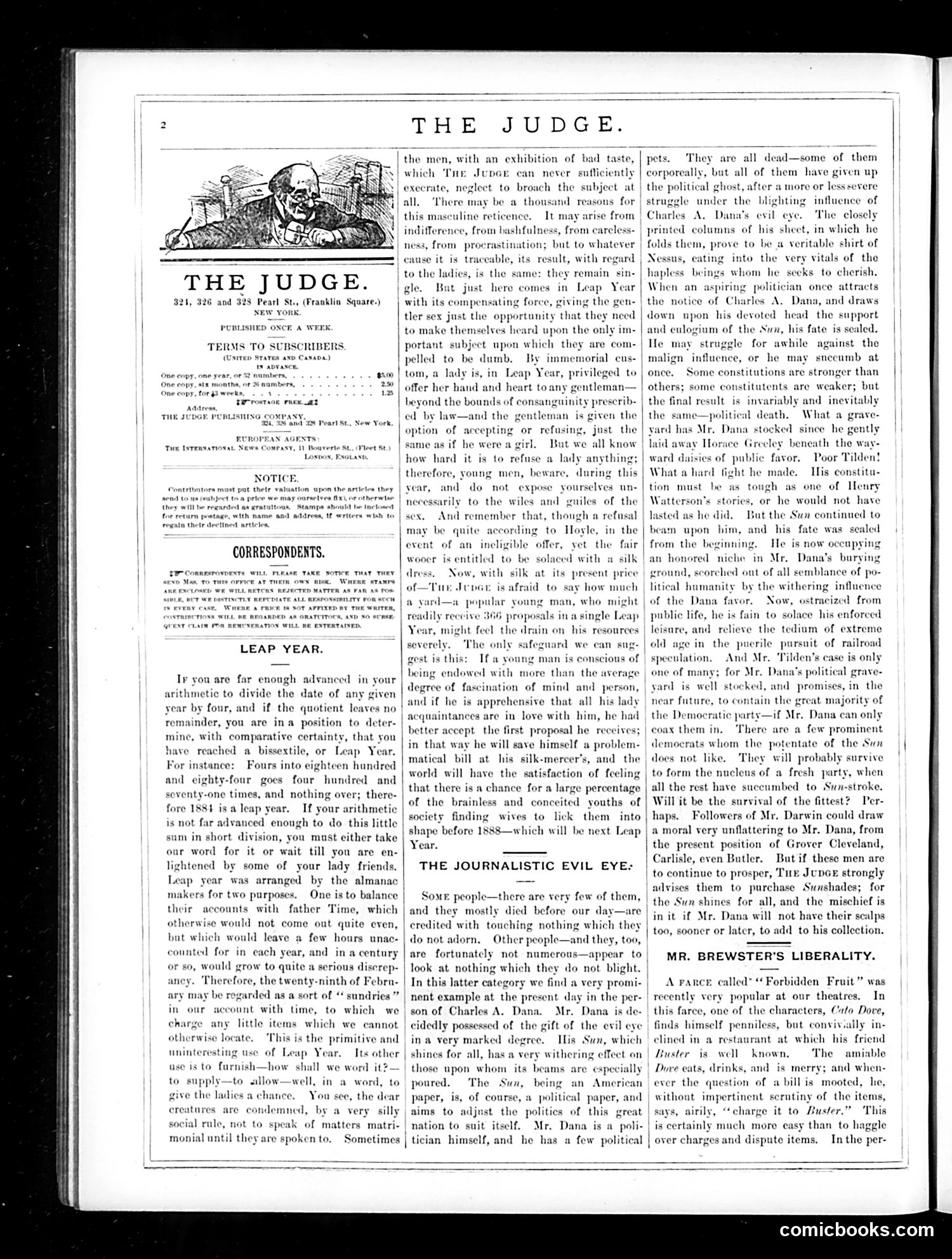
This page presents satirical commentary on **Leap Year marriage customs**, a Victorian-era social practice where women were permitted to propose to men. ## The Main Satire The article mocks the anxieties this creates for eligible bachelor men. Judge presents a tongue-in-cheek "warning": a desirable young man receiving 366 proposals during a Leap Year faces financial ruin from obligatory silk garters (consolation gifts for rejected suitors). The satire suggests that even refusing proposals costs money and social embarrassment. ## Social Context The piece ridicules **rigid Victorian gender norms**—specifically that women must normally remain passive in courtship. By inverting this expectation during Leap Years, the magazine highlights the absurdity of these restrictions. The satire implies that "society finding wires to lick [young men] into shape" reflects broader anxieties about unmarried men and women's limited romantic agency. The other columns address **Charles Dana** (editor of The Sun newspaper) and his political bias, representing typical Judge content criticizing public figures and institutions.
📄 Transcribed text from this page (OCR, searchable)
Machine-transcribed from the original scan — historical spelling and the odd misread are preserved.
THE JUDGE. and $28 Pearl St., (Franklin Square.) NEW YORK PUBLISHED ONCE. A WEEK. RMS TO SUBSCRIT (Ustren Sraves aso CaaDa) renbera Adte THE JUDGE. PUBLISTING © mi EU Tine Isrenearionat. News AN AGENTS “OMPASY, 11 Moaverle St. (Fleet St Lospos, Estas NOTICE | nece CORRESPONDENTS. 2 Comngsroxpents wits w LEAP YEAR. Ir you are far enough advanced arithmetic to divide the date of ar year by four, and if the qu remainder, you are in a po in your given t leaves ion to deter- ainty, that you | reached a or Leap Year. Fours into eighteen hundred and cighty-four goes four hundred and seventy-one times, and nothing over; there- fore 1884 is a leap year. If your arithmetic is not far advanced enough to do this little sum in short division, you must either take our word for it or wait till you are en- lightened by some of your lady friends. p year was arranged by the almanac makers for two purposes. One is to balance | their with father T which | otherwise would not come out quite even, but which would leave a few no mine, with com have For instance: accounts ime, hours unac- counted for in each year, and in a century or so, would grow to quite a ancy. serious diserep- | ‘Therefore, the twenty-ninth of Febrn- | ary may be regarded as a sort of “ sundric count with time, y in our to which we little items which we cannot This nd of Le other isto furnish—how 1 it? ly word, t » the ve charg otherw cate. the primitive ap Year. It shall we we uninteresting use u -to sllow—well, in You s by a » the ladies a chanc creatures are condemn silly social rule, not to of matters matri- monial until t Sometimes | | to make then | pelted | dres | shines for all, THE JUDGE. an oxhibition of bad ta Junee exer sleet I. ‘There may bi this m the men, with which ‘THe te, n an never sufticiently to broach the subject « us for line reticence. It may arise from indifference, from bashfulnes ne a thousand re: from careless- but to whatever ult, with regard they rem Leap with its compensating force, giving the tler sex just the opportunity that they need | , from procrastination; cause it is traceable to the lad its r is the s nm sine But just here comes in Year | ves heard upon the only im- | portant subject upon which they a to be dumb. om: 1 cus- tom, a lady is, in Leap Year, privileged to | offer her hand and heart toany gentleman— beyond the bounds of consan d by law—and the ninity preserib- entleman is given th option of accepting or refusi just the if he were a girl, But we all know hard a lady anything; | theref during this | year, it is to refusi , young men, be yourselves un- | and guiles of the thoi a refusal and do not exy arily to the wil And remember that, may be quite according to Hoyle, in the | of an ineligible offer, yet the fair wooer is entitled to be solaced with a silk with silk at sent price Jeper sex, event mw, its p Tur is afraid to say yard—a popular young man, who might readily receive y. severely. gest is this: of. how much 366 proposals ina single Leap r, might feel the drain on his resours The only Ifa your being endowed with more th degree of fascination of mind and person, nd if he is apprehensive that all his lady acquaintances are in love with him, he had better accept the first proposal he receives; in that way he will save himself matical bill at his silk-mercer’s, and the world will have the satisfaction of feeling that there is a chance for a Ia of the society sh Y wer: 4 problem- ge percentage | brainless and ited youths of | finding wives to lick them into | pe before 1888—which will be next Leap ar. THE JOURNALISTIC EVIL EYE: cone Some people—there are very few of them, and they mostly died before credited with touching nothin do not adorn. Other people—and thi are fortunately not numerous—appe: look at nothing which they do not blight. In this latter category we find a very promi- nent example at the present day in the per- son of Charles A. Dana. Mr. Dana is de- cidedly possessed of the gift of the evil eye ina very marked degree. Mis has a very witherin those upon whom its beams are poured. The our Sun, whieh specially being an Amer paper, is, of course, a political paper, a aims to adjnst the politics of this great nation to suit itself. Mr. Dana is a poli- tician himself, and he has a few political | Sun, an They all de of them corporeally, but all of them have given up the political ghost, struggle under the b Charles A. Dana's evil printed columns of his shee folds them, tol Nessus, eating into the pets. are —some or less severe influence of The y in which Ii a veritable shirt of very vitals of the or a more shting ove hapless beir When and the down 3 whom he seeks to cherish, 1 once attracts Dana, and draws head the support his fate is sealed. struggle for awhile against the influence, or he may snecumb at Some constitutions are stronger than some constitutents weaker; but jably and inevitably notic uy and eulo: He may malign once. others; the final result is inv the same—political death, What a grave- yard has Mr, Dana stocked since he gently laid away Horace y beneath the w ward daisies of public favor, Poor Tild What a hard fight he made. Ilis constitu. tion must as one of Henry Watterson’s storie would not have lasted as he did. Sun continued to him, n his devoted um of the Sun, are Greel ny be tough or he But the his fate . He is now oceupyir in Mr. Dana's. buryin ground, scorched out of all semblance of pi litical humanity by the withering influence of the Dana fa Now, ostracized from public life, he is fain to solace leisure, and relieve the beam upon and caled from the an honored was beginn niche his enforced tedium of extreme old age in the puerile pursuit of railroad And Mr. Tilden’s ease is only one of many; for Mr. Dana’s political grave- yard is well stocked, in the near future, f an only speculation. and promise ain the great majority the Democratic party—if Mr. Dana coax them in, ‘There are a few prominent crats whom the potentate of the Sun t like. They will probably survive to form the nucleus of a fresh party, when all the rest have succumbed to Sun-stroke. Il it be the survival of the fittest? Per- haps. ollowers of Mr. Darwin could draw a moral very unflattering to Mr. D: the present position of Grover Cleveland, Carlisle, even Butler. But if these men are to continue to prosper, Tuk JUDGE strongly advises them to purchase Sunshade the Sun shines for all, and the mischief is in it if Mr. Dana will not have their scalps too, sooner or later, to add to his collection. MR. BREWSTER'S LIBERALITY. e called’ ‘Forbidden Fruit” recently very popular at our theatres. A Far was In this farce, one of the characters, Cato Dove, finds himself penniless, but convivially in- clined in a restaurant at which his friend Buster well known, — The Dove eats, drinks, and is merr’ ever the question of a bill is mooted, without impert is amiable and when- he ent scrutiny of the items harge it to This is certainly much more easy than to haggle over charges and dispute items. In the per- Sit irily, “ uster.” comicbooks.com