
A complete issue · 16 pages · 1884
Judge — January 23, 1884
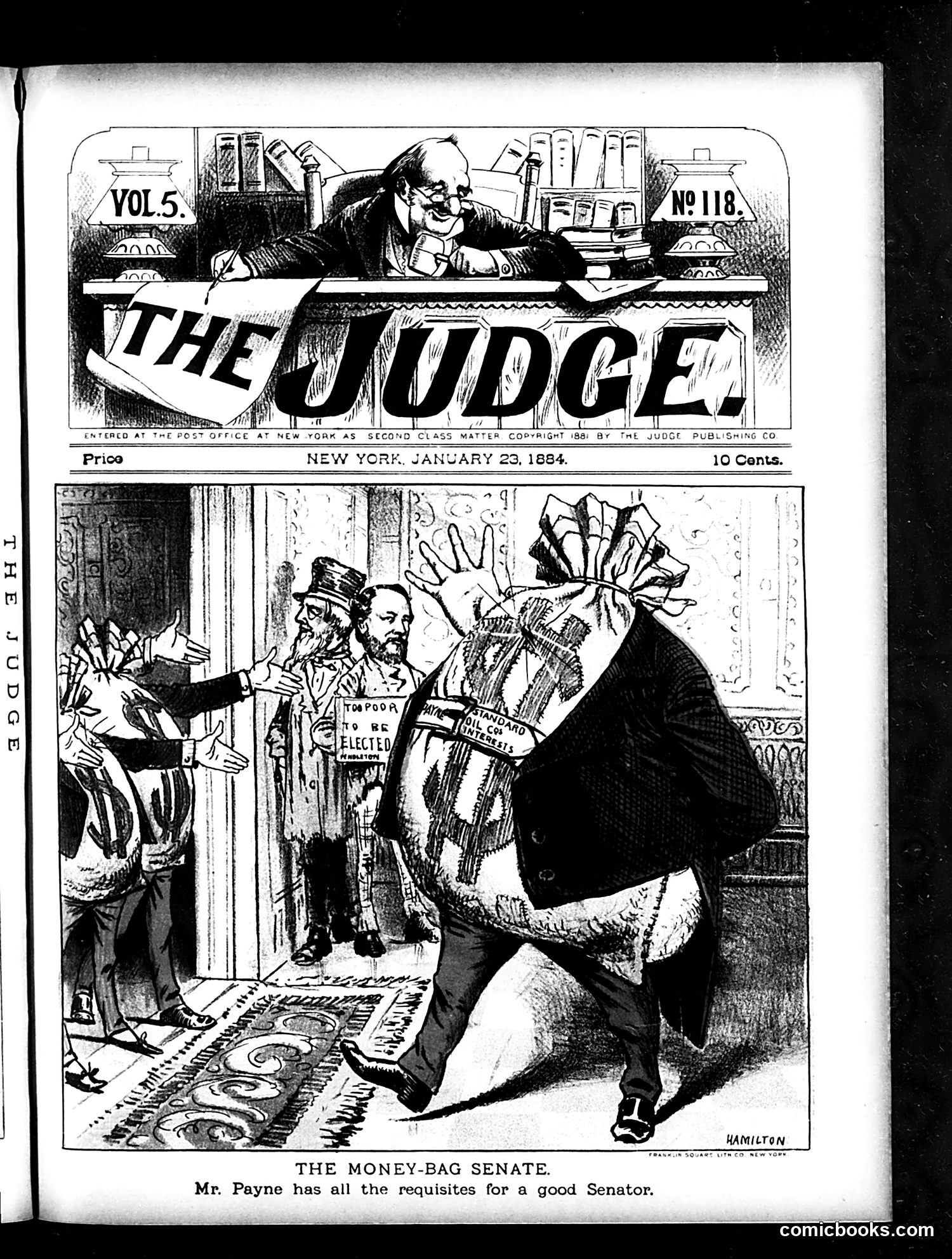
This 1884 *Judge* magazine cartoon satirizes the U.S. Senate as corrupt and purchasable. The caption states "Mr. Payne has all the requisites for a good Senator," suggesting that wealth—not character or merit—qualifies someone for the office. The central figure, a large man carrying an enormous money bag labeled with dollar signs, represents a wealthy industrialist or financier. He's being welcomed or escorted into the Senate chamber, where two gentlemen in formal dress greet him. The implication is clear: senators are bought by wealthy interests rather than elected by voters for public service. This reflects Gilded Age concerns about corruption and the influence of industrial magnates over government, a major reform issue of the 1880s.
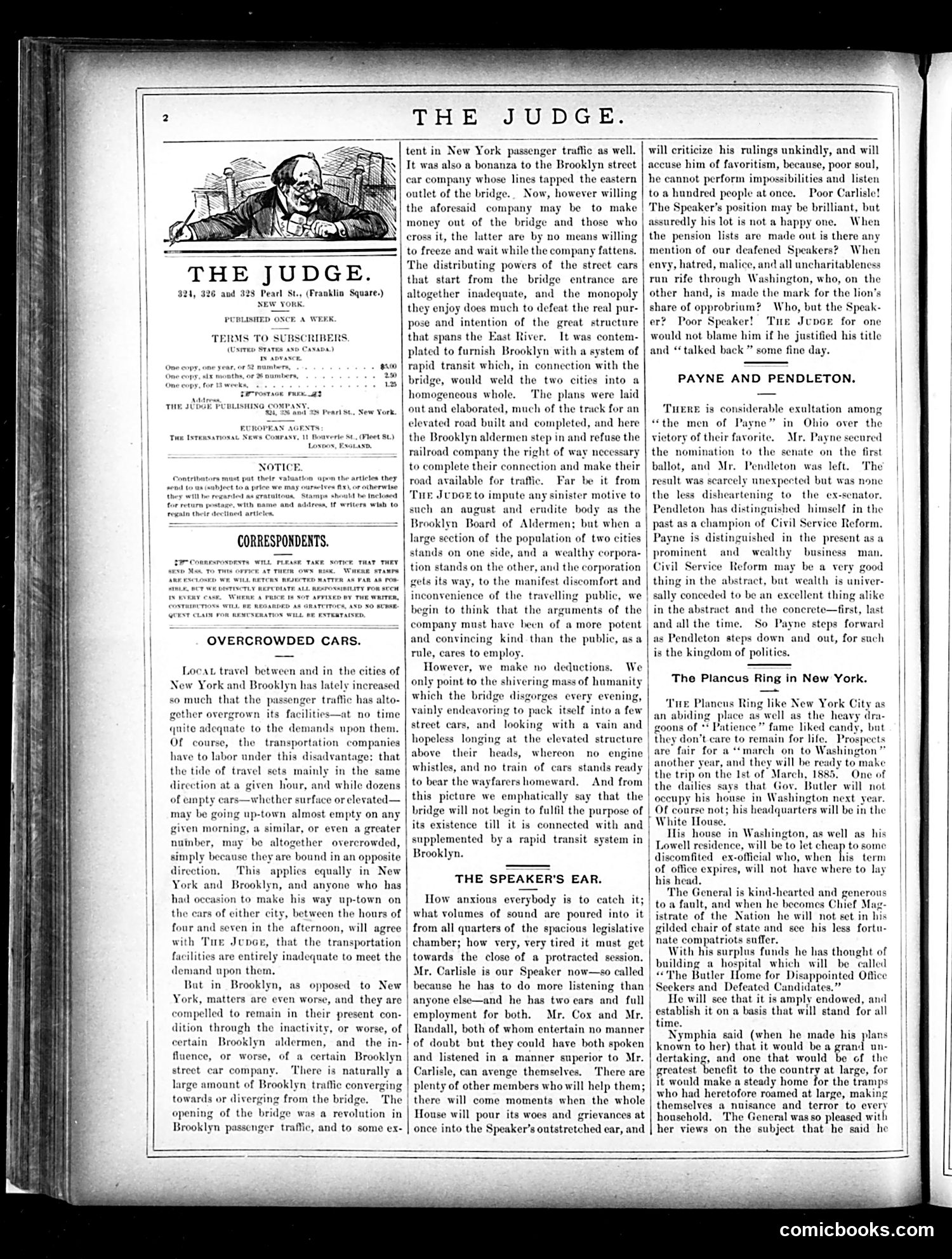
This page from *Judge* satirizes Brooklyn's transportation failures following the opening of the Brooklyn Bridge (1883). **The Main Cartoon:** The masthead features a caricatured judge observing overcrowded trolley cars—the visual metaphor for the publication's social criticism. **The Central Complaint:** The article critiques Brooklyn aldermen and a street car monopoly for blocking a rapid transit system that would complete the bridge's promise. Though an elevated railway was partially constructed, the Board of Aldermen refuses the railroad company right-of-way to finish it, leaving commuters freezing at bridge exits. **The Satire's Point:** *Judge* sardonically suggests the aldermen and corporation made corrupt backroom deals—the corporation's "arguments" being more persuasive than public interest. The magazine ironically claims not to "impute sinister motives" to this "august and erudite body" while obviously doing exactly that. **Context:** This reflects Gilded Age frustrations with municipal corruption, monopolies, and elected officials prioritizing corporate interests over public welfare.
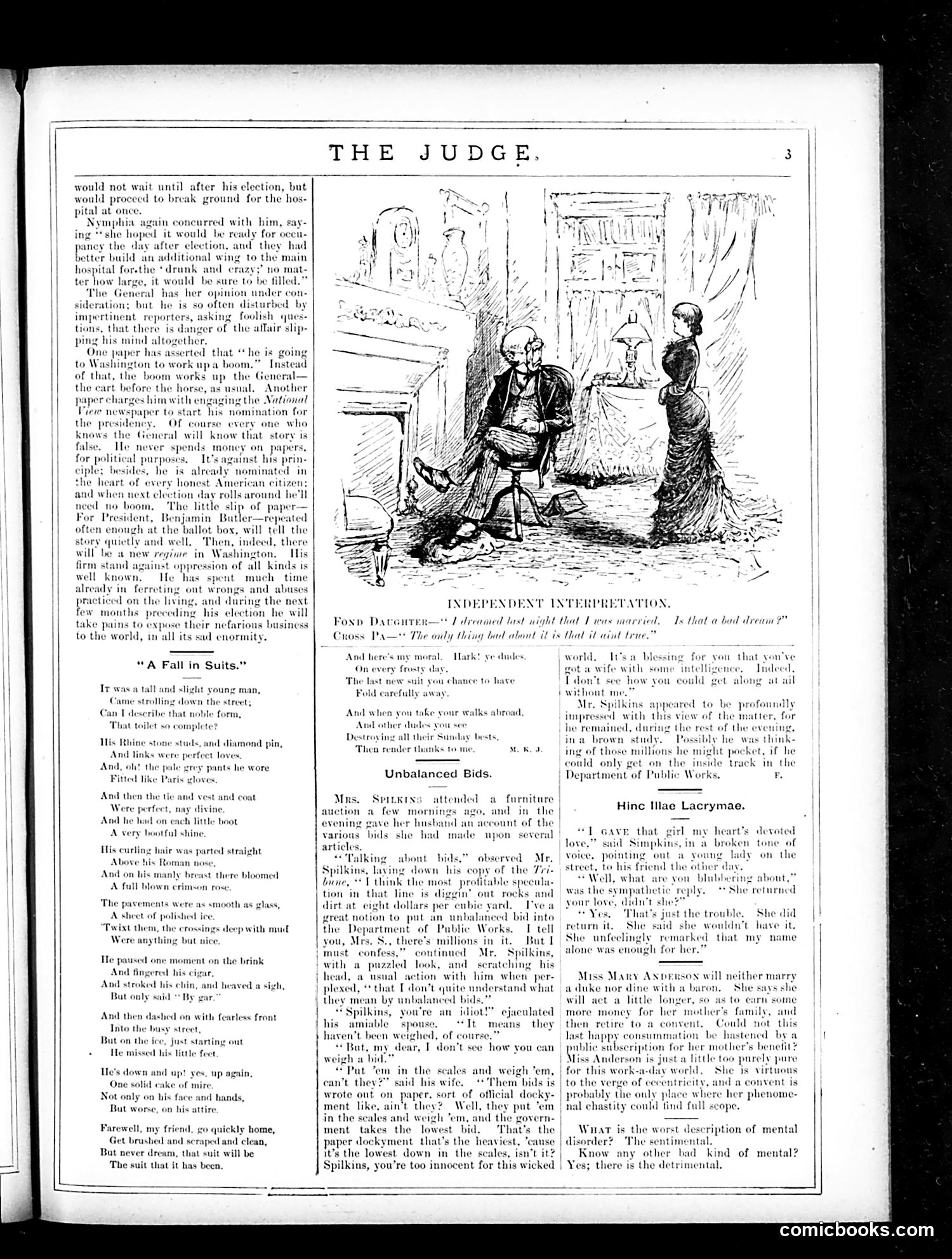
This page from *Judge* magazine contains three distinct satirical pieces: **1. "Independent Interpretation"** (top cartoon): Shows a conversation between "Fond Daughter" and "Cross Pa" about a dream of marriage. The satire mocks the father's cynical view that marriage is inherently miserable—a common Victorian-era domestic joke about matrimonial unhappiness. **2. "A Fall in Suits"** (poem): Ridicules a fashionable dandy whose elaborate toilet and expensive clothing are ruined when he slips on ice. The moral warns young men ("dudes") to protect their fancy suits during winter rather than risk them on frozen streets—satirizing vanity and impracticality. **3. "Unbalanced Bids"** (dialogue): Mr. Spilkins explains government contracting to his wife, who's confused about "unbalanced bids" in Public Works Department contracts. The satire exposes how lowest bidders win contracts regardless of merit—implying corruption or waste in government procurement. All three pieces employ gentle, humorous satire typical of *Judge's* social commentary on everyday American life and institutional folly.
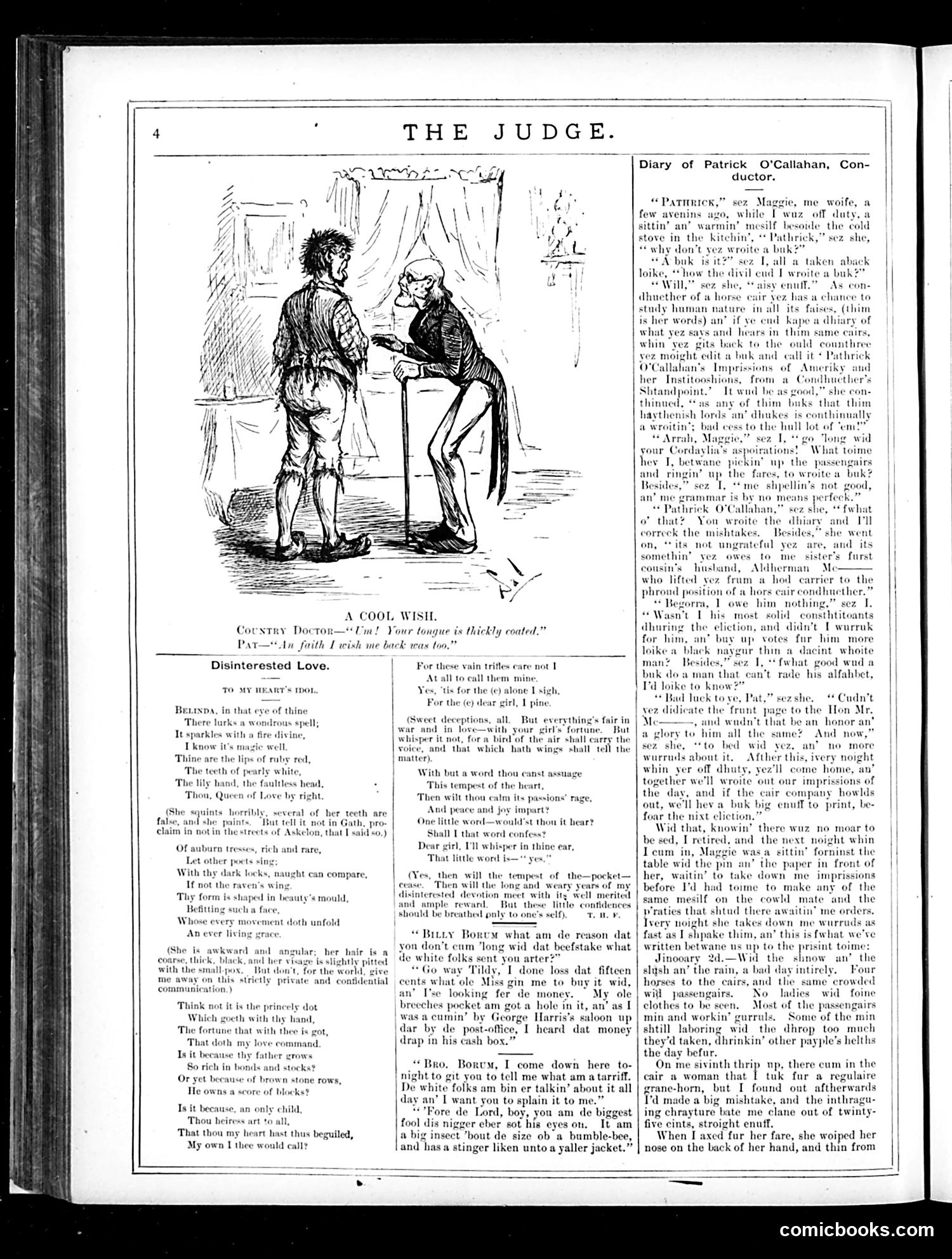
This page contains three satirical pieces mocking romantic and social pretense: **"A Cool Wish"** depicts a country doctor and patient in an awkward encounter—the doctor wishes his tongue were coated (suggesting he'd rather not speak), while the patient seeks sympathy. The satire targets false medical concerns and social discomfort. **"Disinterested Love"** is a lengthy poem parodying sentimental Victorian love poetry, which concludes with the reveal that the speaker's "disinterested" devotion is actually entirely interested—he's after the woman's money and inheritance ("the princely dot," "bonds and stocks"). This satirizes hypocritical courtship among the wealthy. **Remaining sketches** include dialect humor involving African American characters discussing tariffs (appearing to mock both the speakers and political confusion), and an Irish conductor's diary mocking his wife's suggestion he write about American institutions despite his poor spelling and grammar. The page reflects Judge's typical approach: satirizing romantic delusion, class hypocrisy, and ethnic/racial stereotyping common in 1880s American humor.
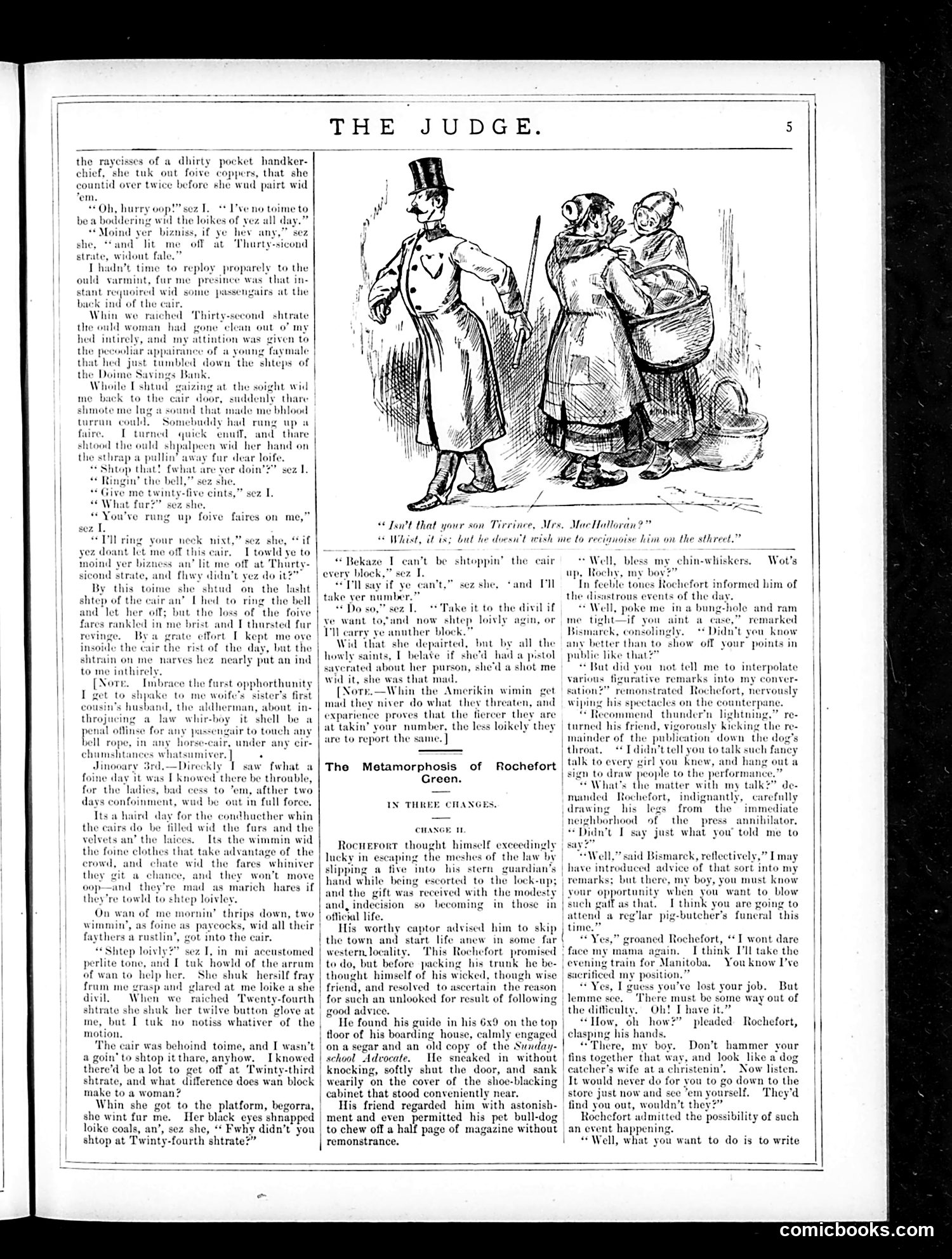
## Main Cartoon The illustrated scene depicts a streetcar conductor confronting an Irish immigrant woman passenger. The woman, depicted with exaggerated ethnic features typical of 1880s-90s American satirical magazines, has jumped on a moving car without paying and is clinging to the strap. The conductor demands payment while she insists he can't "stop the car" to let her off—implying she boarded illegally. ## The Satire The piece mocks Irish immigrants through dialect humor and portrays working-class Irish women as argumentative, cheap (counting pennies carefully), and dishonest about transit fares. The conductor's frustration serves as the sympathetic viewpoint, suggesting Irish passengers were troublemakers. ## Context This reflects late-19th-century American prejudice against Irish immigrants, who were stereotyped as poor, combative, and untrustworthy. The exaggerated brogue and comedic framing normalized anti-Irish discrimination during this period. The lower section appears to be unrelated satirical fiction about a character named Rochefort.
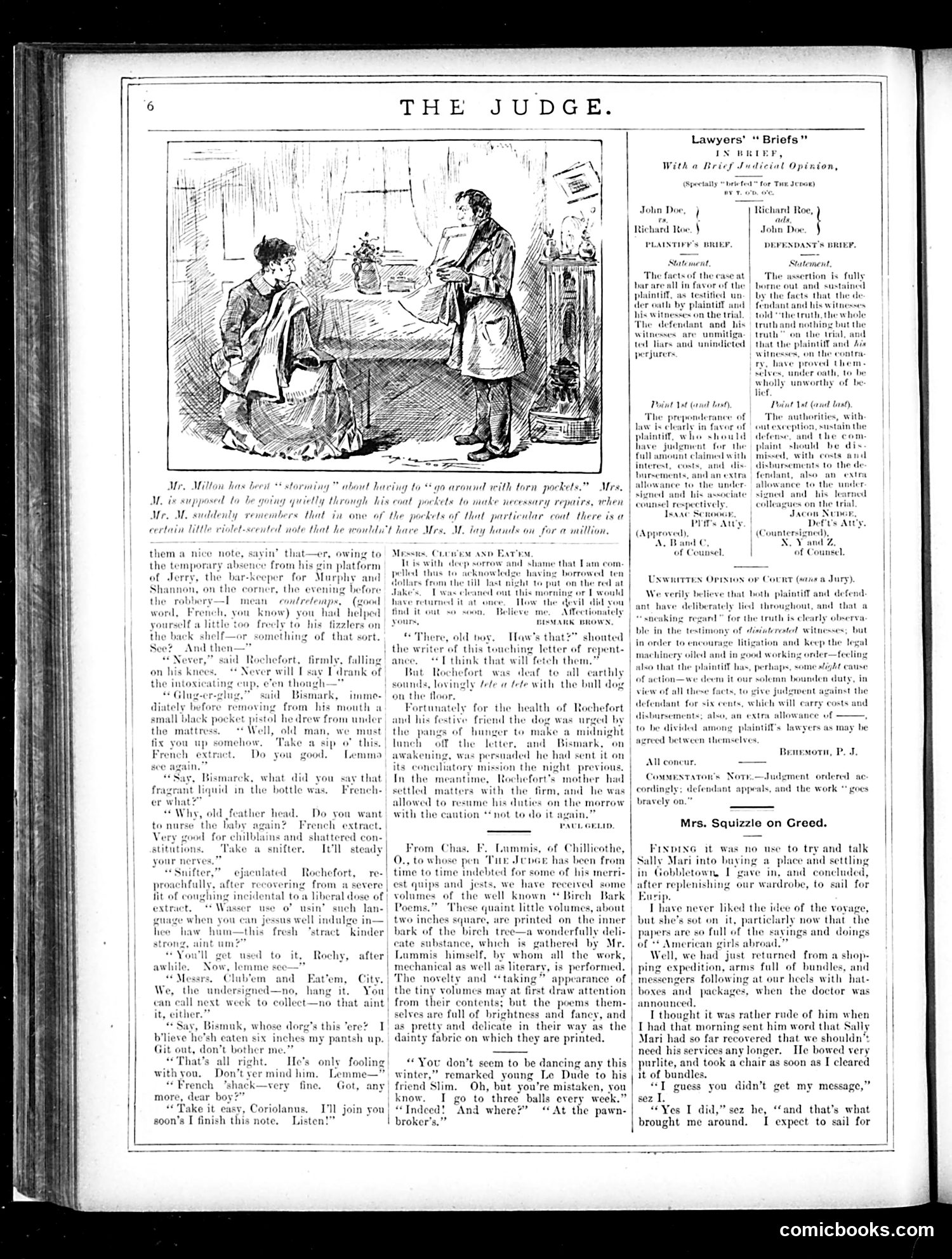
This page from *Judge* magazine contains two main pieces of satirical humor: **Main Cartoon**: "Mr. Milton has been 'showing' about having toga around with torn pockets" depicts domestic comedy. A husband frantically remembers he left an incriminating note in his coat pocket just as his wife prepares to mend it. The satire targets husbands' secrets and marital anxiety—the fear that wives will discover evidence of infidelity, drinking, or other misconduct while performing household repairs. **Legal Briefs Section**: The right column parodies courtroom proceedings with exaggerated legal language, satirizing the verbosity and pretension of lawyers' arguments. **"Mrs. Squizzo on Greed"**: A brief anecdote mocking a woman's avarice—she returns from shopping and immediately pressures her husband for more money, treating him as merely a financial resource. These pieces reflect late-19th-century middle-class anxieties: marital discord, secrets between spouses, and materialistic wives.
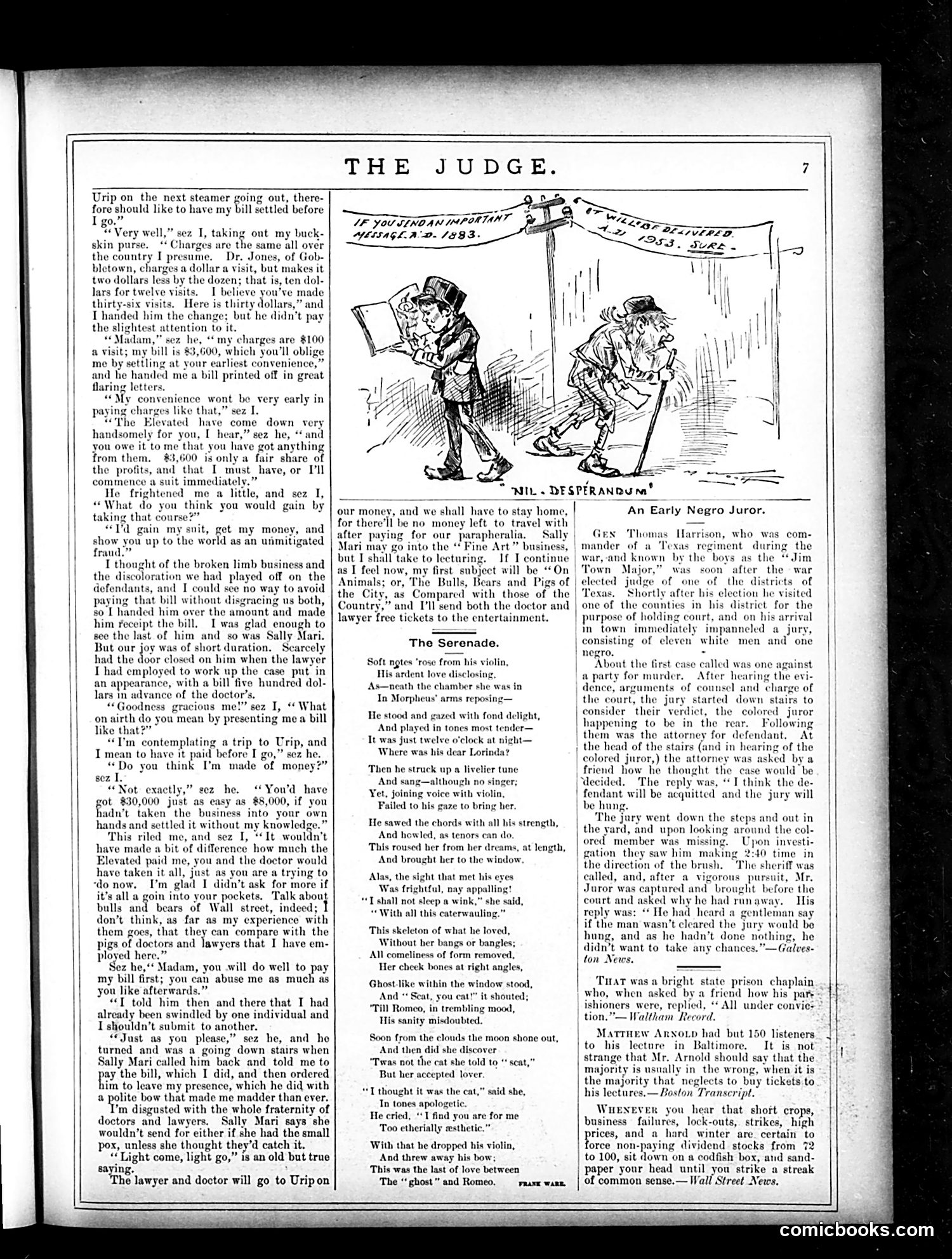
This page satirizes the predatory practices of doctors and lawyers in 1890s America. The main narrative describes a woman (Sally Mari) who hires both professionals to pursue a fraudulent injury claim against the Elevated Railway (a transit company). **The satire's point:** Though she wins $30,000 from the railway, the doctor demands $3,600 and the lawyer $500—professional fees that consume her winnings. The woman realizes she's been exploited by her own representatives as much as by defendants. **The political/social critique:** Judge attacks the legal and medical professions as greedy parasites who manipulate clients, often collaborating in fraud schemes. The final cartoon sketch (top right, "An Early Negro Juror") appears unrelated but reflects the magazine's broader satirical scope. **For modern readers:** This reflects genuine Progressive Era anxieties about litigation abuse and professional ethics before regulatory reforms and bar associations established standards.
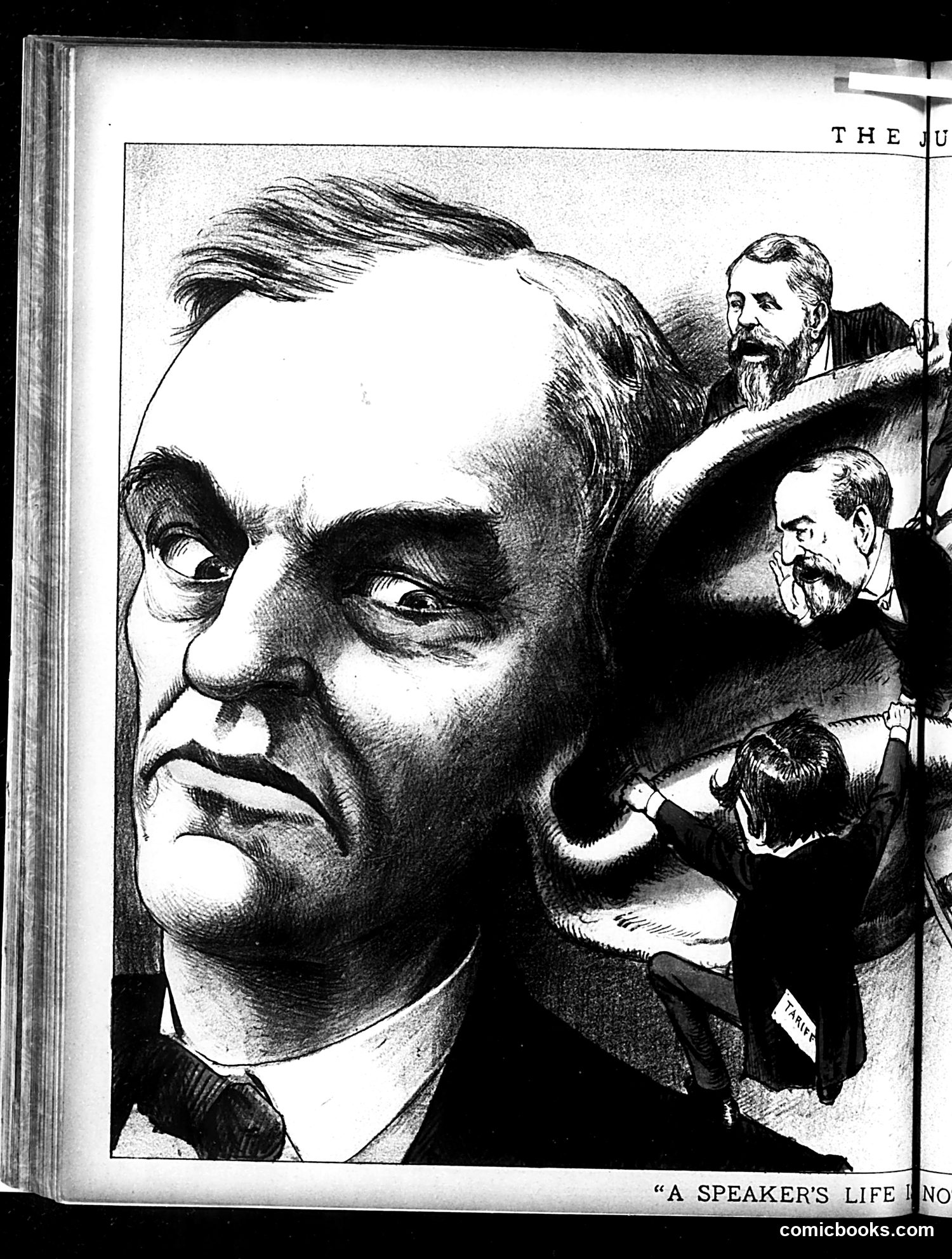
This page from *Judge* magazine features a political cartoon titled "A Speaker's Life" (visible at bottom). The image shows a large caricatured head of a man in the foreground, with three smaller figures emerging from or positioned on his head/shoulder area. The caption suggests this satirizes a political speaker—likely commenting on the pressures, influences, or competing interests that surround a public figure in leadership. The smaller figures represent people pulling the speaker in different directions or controlling his message. Without clearer OCR text or a visible date, I cannot identify the specific speaker or historical moment referenced. However, the composition is classic *Judge* political satire: depicting how powerful speakers are manipulated by various interests rather than acting independently. The exaggerated facial features were typical of the magazine's caricature style.
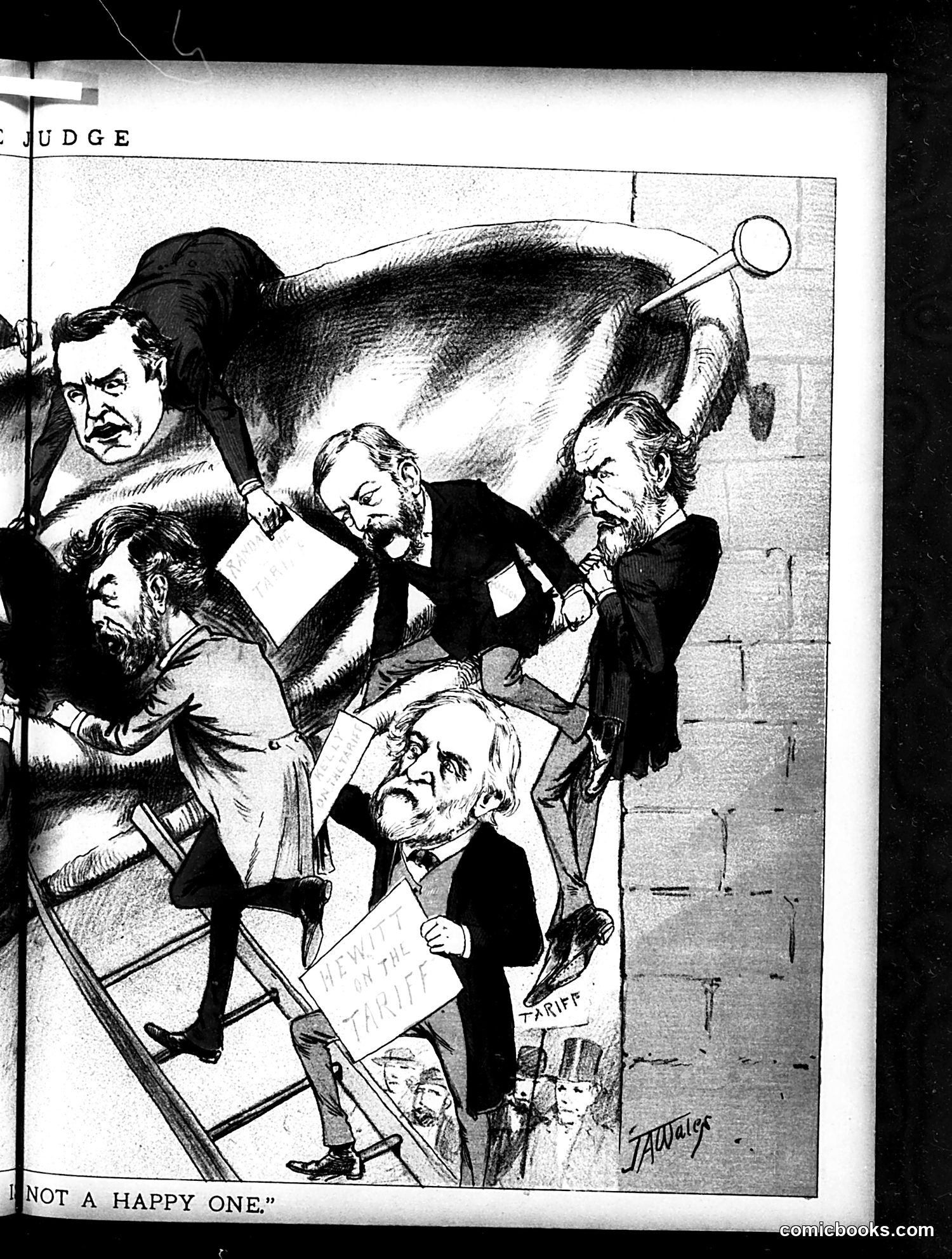
This Judge magazine cartoon, titled "Not a Happy One," depicts several bearded men in formal 19th-century dress climbing a ladder while carrying papers labeled "TARIFF." A large cow or similar animal sits atop the ladder, appearing to be the object they're struggling toward. The cartoon satirizes political figures' (likely congressmen or senators') efforts to pass tariff legislation. The ladder climb suggests the difficult, contentious process of tariff negotiations. The animal at the top likely represents either the tariff bill itself or the economic/commercial interests driving the debate. The men's strained expressions and crowded positioning emphasize the chaotic, competitive nature of the effort. Without clearer identification of specific individuals, the exact politicians targeted remain unclear, though this reflects broader late-19th-century trade-policy conflicts.
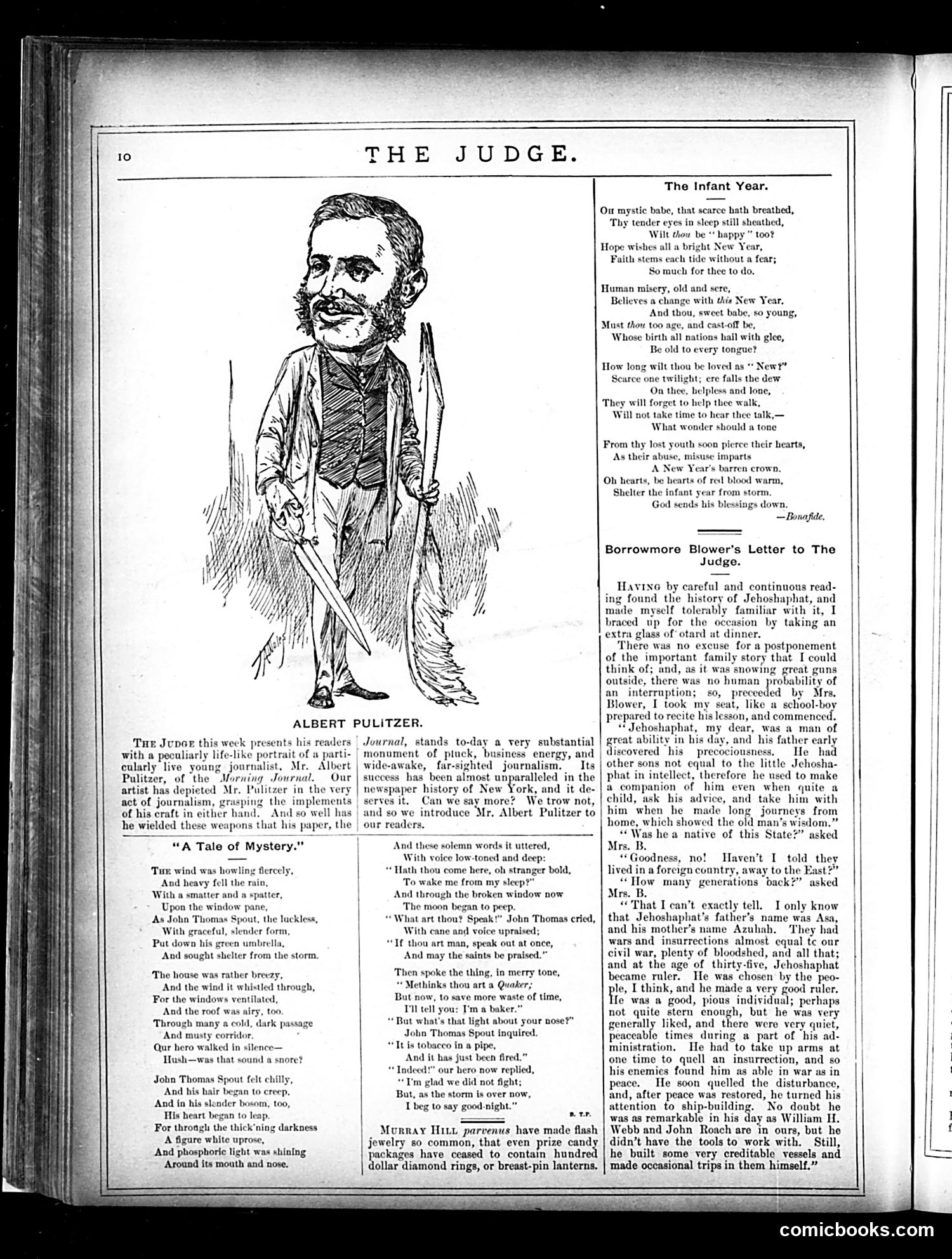
This page from *Judge* features **Albert Pulitzer**, a young journalist at the *Morning Journal* newspaper, depicted in a caricature portrait. The satire celebrates Pulitzer as an energetic, ambitious newspaper man—showing him wielding his "implements of his craft" (pen and cane). The text praises the *Morning Journal* for its remarkable success in New York journalism through "pluck, business energy, and wide-awake, far-sighted journalism." This is straightforward praise rather than sharp satire. Pulitzer appears to be Joseph Pulitzer's relative, and *Judge* is commending his journalistic ambitions and the paper's rapid rise to prominence. The accompanying poems and "Borrowmore Blower's Letter" are typical satirical filler content unrelated to the main portrait.
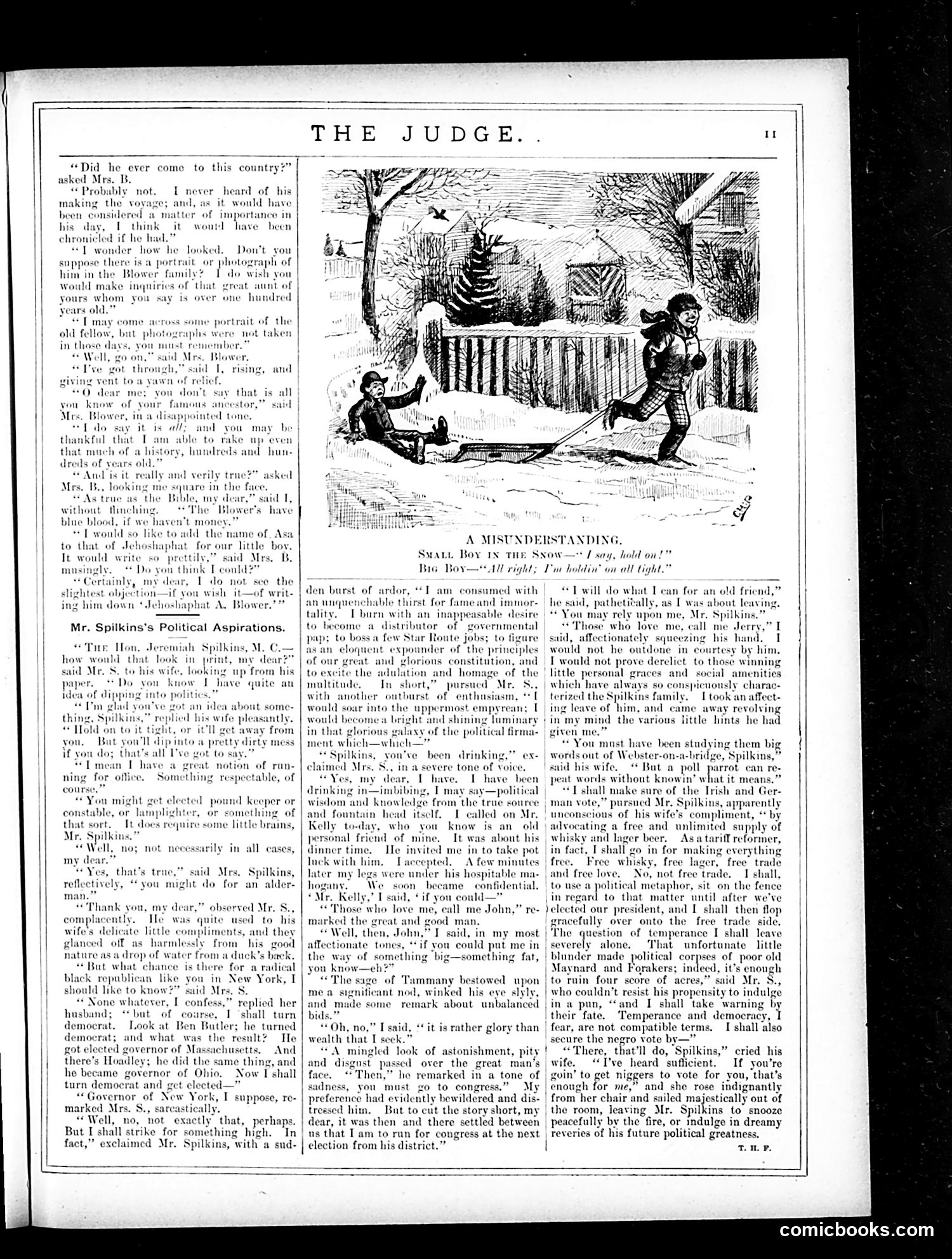
This page features a humorous domestic scene titled "A Misunderstanding," where a small boy in the snow misinterprets an adult's words. The boy believes the man said "I'm holdin' on all tight" when he actually said something else—the satire of miscommunication is the joke's core. The bulk of the page contains satirical dialogue about **Mr. Spilkins' political ambitions**. A seemingly unremarkable man with no particular qualifications aspires to become governor, then congressman. His strategy is brazenly transactional: he'll secure the "Irish and German vote" through unlimited whiskey distribution. The satire mocks corrupt political machines of the era—specifically how candidates bought votes through patronage and alcohol rather than merit or policy. Spilkins represents the archetypal opportunistic politician of Gilded Age America, willing to exploit ethnic voters shamelessly.
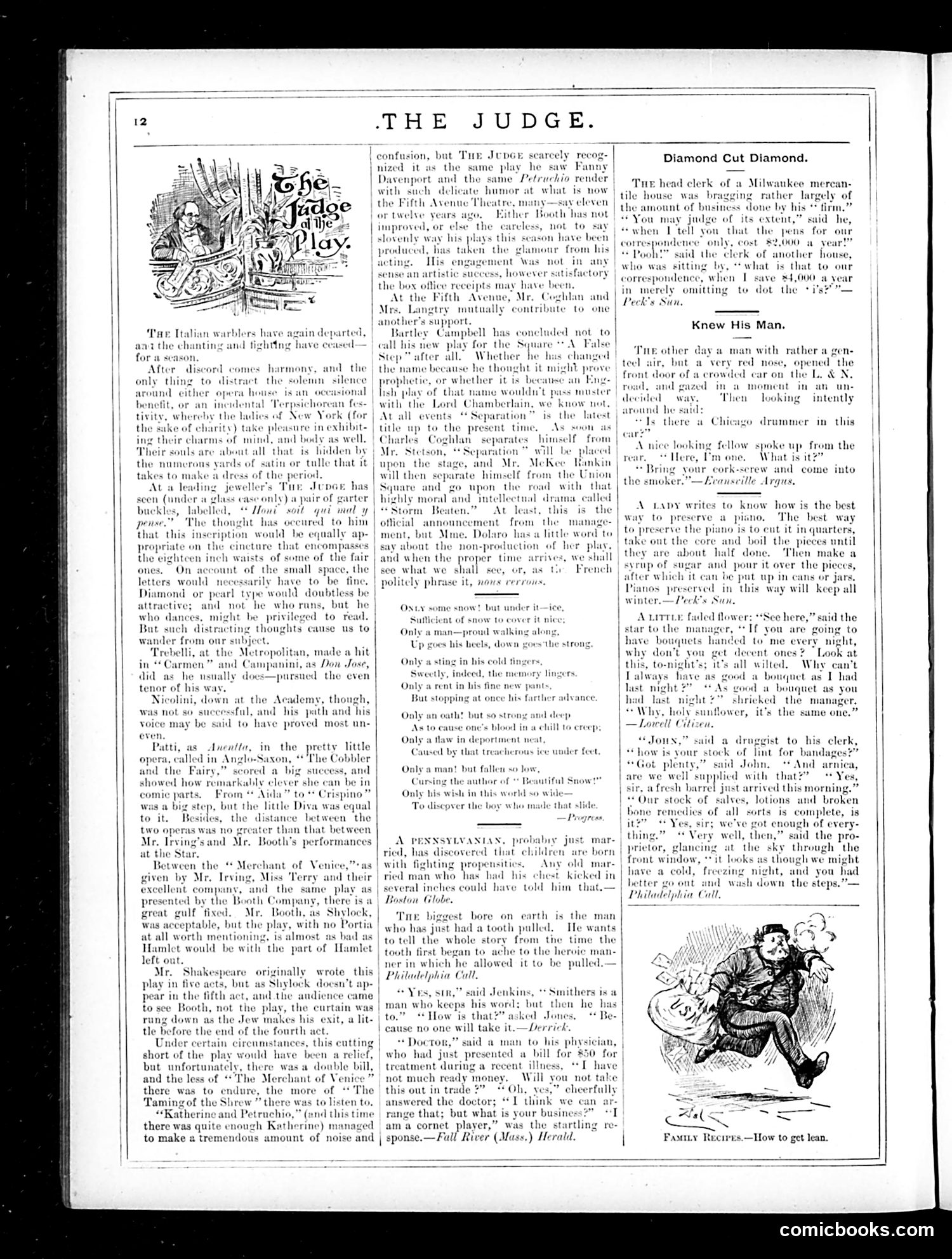
This page from *Judge* magazine contains multiple satirical pieces about theater and performances from the late 19th century. The main article discusses Italian opera singers performing in New York, particularly critiquing their performances at various theaters. The text sarcastically notes that audiences attend primarily for the singers' physical appearance rather than artistic merit, lamenting the "yards of satin or tulle" worn by performers. The piece also compares rival productions of Shakespeare plays—specifically *The Merchant of Venice* staged by both Henry Irving and Edwin Booth. The satire suggests that audiences came for the star actor rather than the play itself, with one production even cutting the curtain early during Booth's exit as Shylock, treating it as the play's climax rather than continuing to the actual ending. The bottom sections contain brief humorous anecdotes about everyday situations—a man with a tooth extraction story, and children fighting—typical of the magazine's miscellaneous humor content. The overall tone mocks theatrical pretension and audience priorities in Gilded Age entertainment.
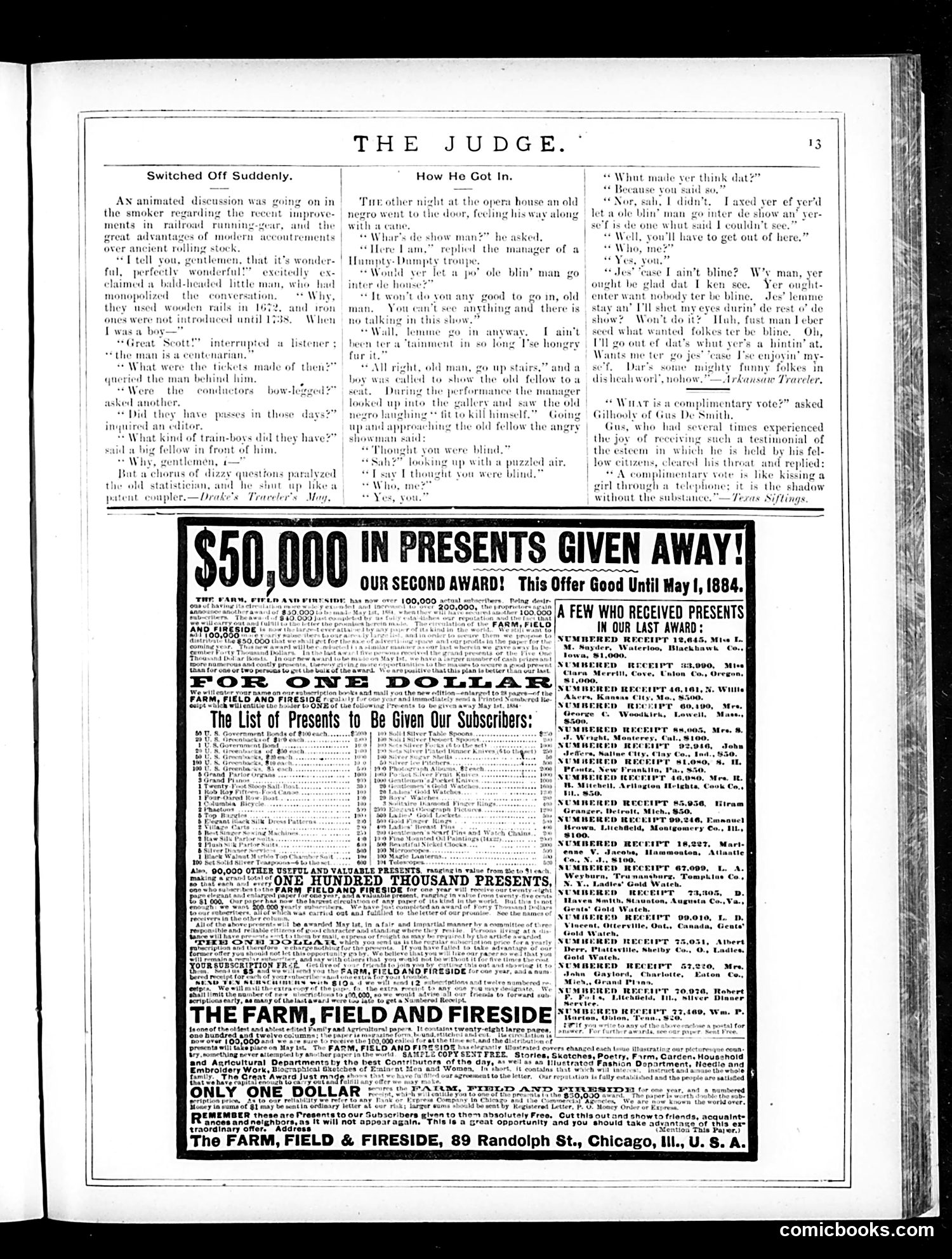
This page from Judge magazine contains three separate comedic pieces: **"Switched Off Suddenly"**: A railroad enthusiast monopolizes conversation bragging about the history of trains, claiming to remember wooden rails from 1672. A listener interrupts sarcastically: "the man is a centenarian"—mocking his implausible claims. **"How He Got In"**: A blind Black man gains entry to an opera house showing "Humpty Dumpty Troupe" by claiming blindness. During the performance, the angry showman confronts him in the gallery, saying "Thought you were blind." The man replies "Who, me? Yes, you"—revealing he faked blindness. The joke's punchline appears to mock the man's deception. **Bottom half**: A massive advertisement for *The Farm, Field and Fireside* magazine offering $50,000 in prizes and "one hundred thousand presents" to subscribers for one dollar—typical 19th-century promotional hyperbole. The cartoons reflect period racial stereotypes through dialect humor. The page is primarily advertising with satirical content secondary.
This page is primarily **advertisements and short humorous snippets** rather than political cartoons. The content consists of brief satirical observations clipped from various newspapers, interspersed with product ads. The humor targets contemporary social conventions: a woman joking she can't "fascinate" but can "fasten" (suggesting marriage as entrapment); observations about Sunday observance, ministerial hypocrisy, and the questionable value of manufactured goods versus natural products. One item references **"Jere Davis"** admitting relationship to a Cincinnati newspaper humorist—likely a topical reference to someone in journalism, though unclear without more context. The page includes ads for a brewery, hot air furnace, carpets, and other goods typical of 1880s-90s American commerce. The overall satirical tone mocks middle-class life, gender relations, and social pretension through brief, newspaper-sourced quips rather than visual cartoons. No major political figures or events appear identifiable on this particular page.
This page from *Judge* (a satirical weekly) is primarily **advertising with some satirical humor pieces**. ## Main Content: **"M'Carty's Pension Claim"** (top right) is a dialect humor piece mocking Irish immigrants exploiting the pension system. The joke: McCarty plans to get a government pension, then have his friend Tim swear falsely to help another friend do the same—a circular scheme of corruption disguised as helping fellow Irishmen. **Scattered throughout** are brief satirical quips on contemporary issues: women's reading habits, Southern honor/chivalry, Utah polygamy, and political corruption. These are light social jabs typical of *Judge's* style. ## Advertising: The bulk of the page advertises pianos (Behning), fire extinguishers, magic lanterns, fountain pens, and other consumer goods—standard late-19th-century commercial content. **Context for modern readers:** The ethnic dialect humor relies on anti-Irish stereotypes common in the 1880s. The pension corruption joke reflects real Gilded Age concerns about government fraud and immigrant participation in political machines.
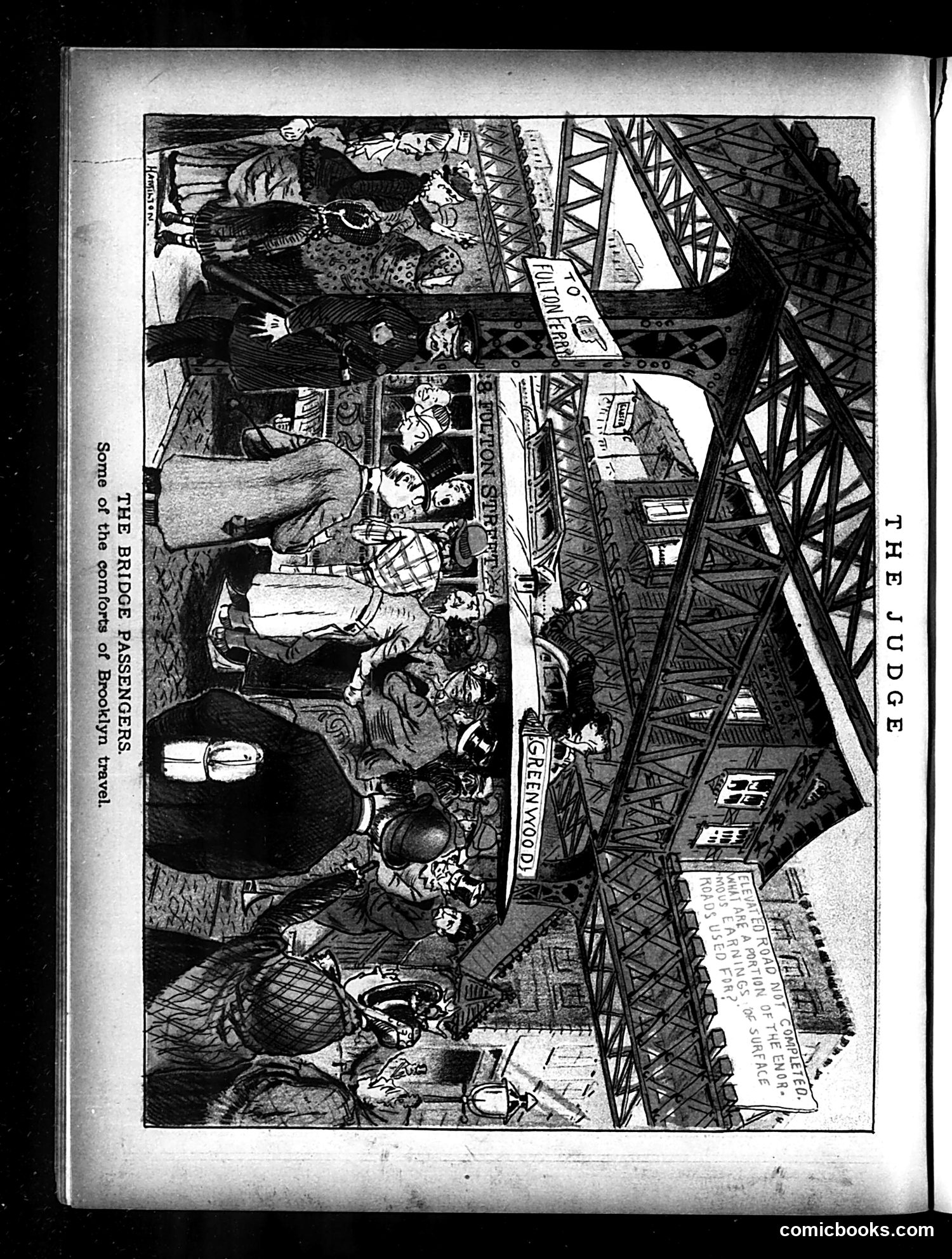
This cartoon satirizes conditions on the Brooklyn Bridge, likely from the late 1800s or early 1900s. The image depicts crowded, chaotic travel conditions with numerous passengers jammed together in what appears to be a streetcar or transit vehicle crossing the bridge's iron framework visible in the background. The caption "Some of the comforts of Brooklyn travel" is clearly sarcastic—there appear to be no comforts whatsoever. The packed conditions, disorganized arrangement of people, and cramped quarters mock the inadequate public transportation infrastructure serving Brooklyn residents at the time. This reflects contemporary complaints about urban transit systems being overwhelmed by growing populations, a common subject for *Judge* magazine's social satire.