
Judge, 1884-01-23 · page 2 of 16
Judge — January 23, 1884 — page 2: what you’re looking at
What you’re looking at
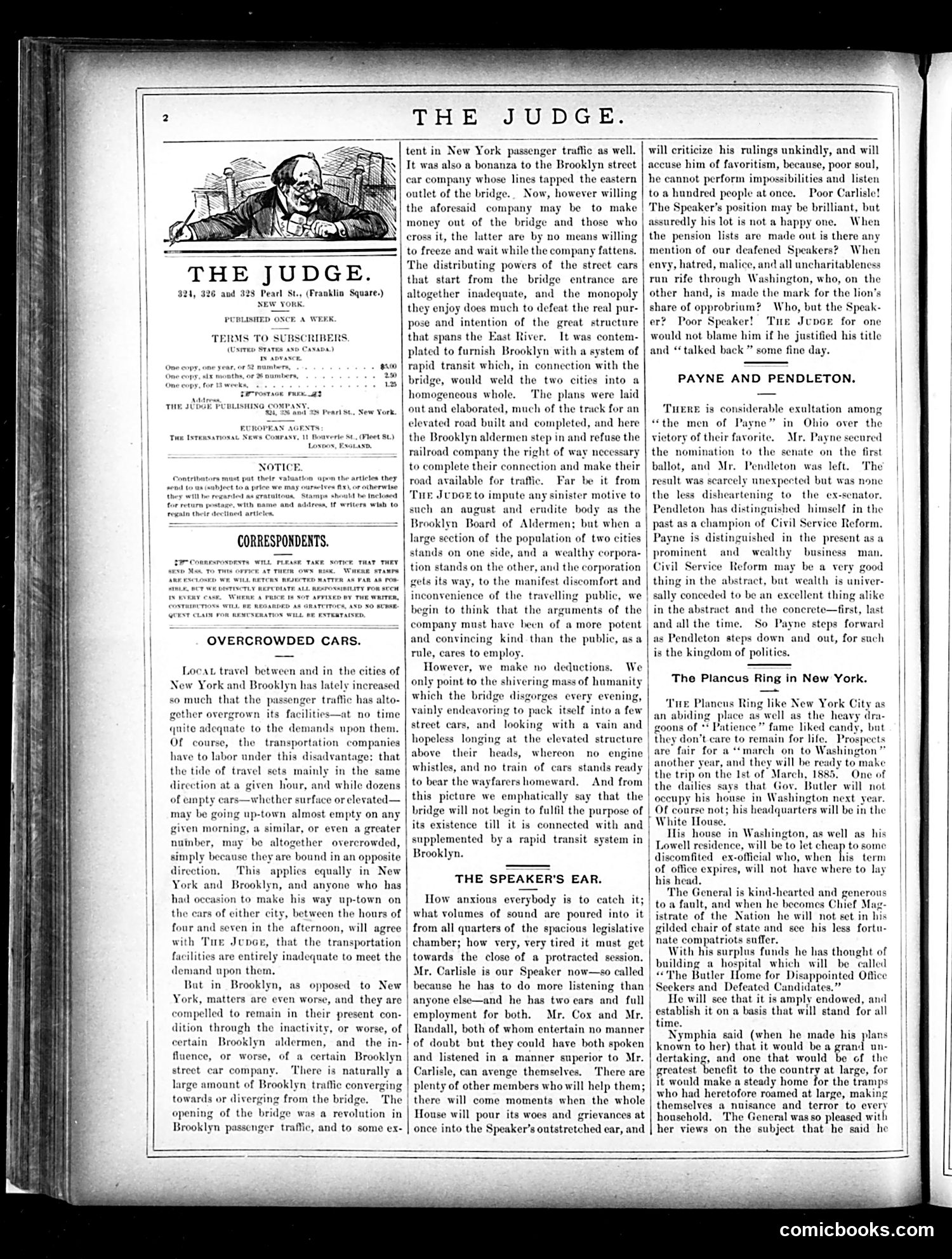
This page from *Judge* satirizes Brooklyn's transportation failures following the opening of the Brooklyn Bridge (1883). **The Main Cartoon:** The masthead features a caricatured judge observing overcrowded trolley cars—the visual metaphor for the publication's social criticism. **The Central Complaint:** The article critiques Brooklyn aldermen and a street car monopoly for blocking a rapid transit system that would complete the bridge's promise. Though an elevated railway was partially constructed, the Board of Aldermen refuses the railroad company right-of-way to finish it, leaving commuters freezing at bridge exits. **The Satire's Point:** *Judge* sardonically suggests the aldermen and corporation made corrupt backroom deals—the corporation's "arguments" being more persuasive than public interest. The magazine ironically claims not to "impute sinister motives" to this "august and erudite body" while obviously doing exactly that. **Context:** This reflects Gilded Age frustrations with municipal corruption, monopolies, and elected officials prioritizing corporate interests over public welfare.
📄 Transcribed text from this page (OCR, searchable)
Machine-transcribed from the original scan — historical spelling and the odd misread are preserved.
THE JUDGE. $26 and 323 Pearl By (Franklin Square.) PUBLISHED OSCE A WERK. TERMS TO SUBSCRIB (Wstrap Staves axo Canna py, for 18 weeks, Wrrostaae rank a3 HE PUBLISHING \ mr at OMPANY S bn 0 Pearl St. New York. EUROPEAN AGENTS Twe IsTexsaTionat News ComPasy, 11 Boaverte St, (leet St.) Loxpos, EaEAsD. NOTICE, uatt ticles they mas ourselee aherwh he Inclose with wat vere wlah to, A art CORRESPONDENTS. FPTCOMRESTONDENTS WILL PLEASE TAKE SOTICE THAT THEY Mat To THIS OFFICE AT THEM OWS Risk, WHERE Staats WR WILL RIETCRS RAJECTED MATTER 48 PAR AB FOR: <r M OR 14 NOT AYYIXED BY THE WRITER, OVERCROWDED CARS. Locat travel between and in the cities of gother overgrown. its quite adequate to the demands upon them. Of course, the transportation companies have to labor under this disadvantage: that the tide of travel sets mainly in the given hour, nd while dozens rs—whether surface or clevated— may be going up-town almost empty on any given morning, a similar, or even a greater nuinber, may be altogether overcrowded, simply because they are bound in an opposite direction, This applics equally in New York and Brooklyn, and anyone who has had oe nto make his way up-town on the ears of either city, between the hours of : | four and seven in the afternoon, will agree with Tne Jepoe, that the transportation facilities are entirely inadequate to meet the demand upon them, But in Brooklyn, as opposed to New York, matters are even worse, and they are compelled to remain in their present con- | dition through the inactivity, or worse, of certain Brooklyn aldermen, and the in- fluence, or worse, of a certain street car company. ‘There is naturally a large amount of Brooklyn traflic converging towards or diverging from the bridge. ‘The opening of the bridge was a revolution in Brooklyn passenger traffic, and to some ex- Brooklyn | | | supplemented by a rapid trans "| tent in New York passenger traffic as well. It was also a bonanza to the Brooklyn strect car company whose lines tapped the eastern outlet of the brid, Now, however willing the aforesaid company may be to make money out of the bridge and those who | cross it, the latter are by no means willing to freeze and wait while the company fattens. The distributing powers of the street cars that start from the bridge entrance are altogether inadequate, and the monopoly they enjoy does much to defeat the real pur- pose and intention of the great structure that spans the East River. It was contem- plated to furnish Brooklyn with a system of rapid transit which, in connection with the bridge, would weld the two cities into a homogeneous whole. ‘The plans were laid out and elaborated, much of the track for an elevated road built and completed, and here the Brooklyn aldermen step in and refuse the railroad company the right of way ne y to complete their connection and ma road available for traffic. Far be it from Tur JvDGE to impute any sinister motive to such an august and erudite body as the Brooklyn Board of Aldermen; but when a large section of the population of two cities stands on one side, and a wealthy corpora- | tion stands on the other, and the corporation gets its way, to the manifest discomfort and inconvenience of the travelling public, we begin to think that the arguments of the company must have becn of a more potent | and convincing kind than the public, as a rule, cares to employ. However, we make no deductions. We | only point to the shivering mass of humanity which the bridge disgorges every evening, vainly endeavoring to pack itself into a few street cars, and looking with a vain and hopeless lo the elevated structure | their heads, whereon no engine whistles, and no train of cars stands ready to bear the wayfarers homeward. And from this picture we emphatically say that the | bridge will not Legin to fulfil the purpose of | its existence till it is connected with and | em in e the above Brooklyn. THE SPEAKER'S EAR. How anxious everybody is to catch it; what volumes of sound are poured into it from all quarters of the spacious legislative | nber; how very, very tired it must get towards the close of a protracted session. Mr. Carlisle is our Speaker now—so called because he has to do more listening than | anyone else—and he has two ears and full | employment for both. Mr. Cox and Mr. | Randall, both of whom entertain no manner of doubt but they could have both spoken | and listened in a manner superior to Mr. Carlisle, can avenge themselves. ‘There are plenty of other members who will help them; there will come moments when the whole House will pour its woes and grievances at once into the Speaker’s outstretched ear, and | the dailies sa | “The Butler Home for Dis will criticize his rulings unkindly, and will accuse him of favoritism, because, poor soul, he cannot perform impossibilities and listen toa hundred people at once. Poor Carlisle! The Speaker's position may be brilliant, but suredly his lot is not a happy one. When the pension lists are made out is there any mention of our deafened Speakers? When envy, hatred, malice, and all uncharitableness run rife through Washington, who, on the is made the mark for the lion's Who, but the Speak- for one him if he justified his title some fine day. other hand, share of opprobrium? er? Poor Speaker! Tue Jeo would not blam and “talked back” PAYNE AND PENDLETON. Tuere is considerable exultation among “the men of Payne” in Ohio over the vietory of their favorite. Mr, Payne secured the nomination to the e ballot, and Mr. on the first Pendleton was left. The result was scarcely unexpected but w the less disheartening to the ex-senator. Pendleton has distinguished himself in the past as a champion of Civil Service Reform. Payne is distinguished in the pr prominent and wealthy Civil Service Reform m: thing in the abstr: $ none ent as a business y be a very man. good t, but wealth is univer- sally conceded to be an excellent thing alike in the abstract and the concrete—first, last and all the time. So Payne steps forward as Pendleton steps down and out, for such is the kingdom of polit The Plancus Ring in New York. ‘Te Plancus Ring like New York City as an abiding plice as well as the hes goons of ** Patience” fame liked th y don’t care to remain for life. Pre » fair for a ‘¢march on to Washington” acoier y the trip on the Ist of M i that Gov. Butler will in Washing’ . Of course not; his headquarters will be in the White House. Ilis house in Washington, as well as his | Lowell residence, will be to let cheap to some discomfited ex-official who, when his term of office expires, will not have where to lay his head. The General is kind-hearted and generous to a fault, and when he becomes Chief M istrate of the Nation he will not set in his gilded chair of state and see his less fortu- nate compatriots suffer. With his surplus funds he has thought of building a hospital which will be called ppointed Ofice Seekers and Defeated Candidates.” Ho will see that it is amply endowed, and | establish it on a basis that will stand for all | time. Nymphia said (when he made his plans known to her) that it would be a grand un- dertaking, and one that would be of the greatest benefit to the country at large, for it would make a steady home for the tramps who had heretofore roamed at large, making themselves a nuisance and terror to every household. The General was so pleased with her views on the subject that he said he comicbooks.com