
A complete issue · 16 pages · 1883
Judge — December 8, 1883
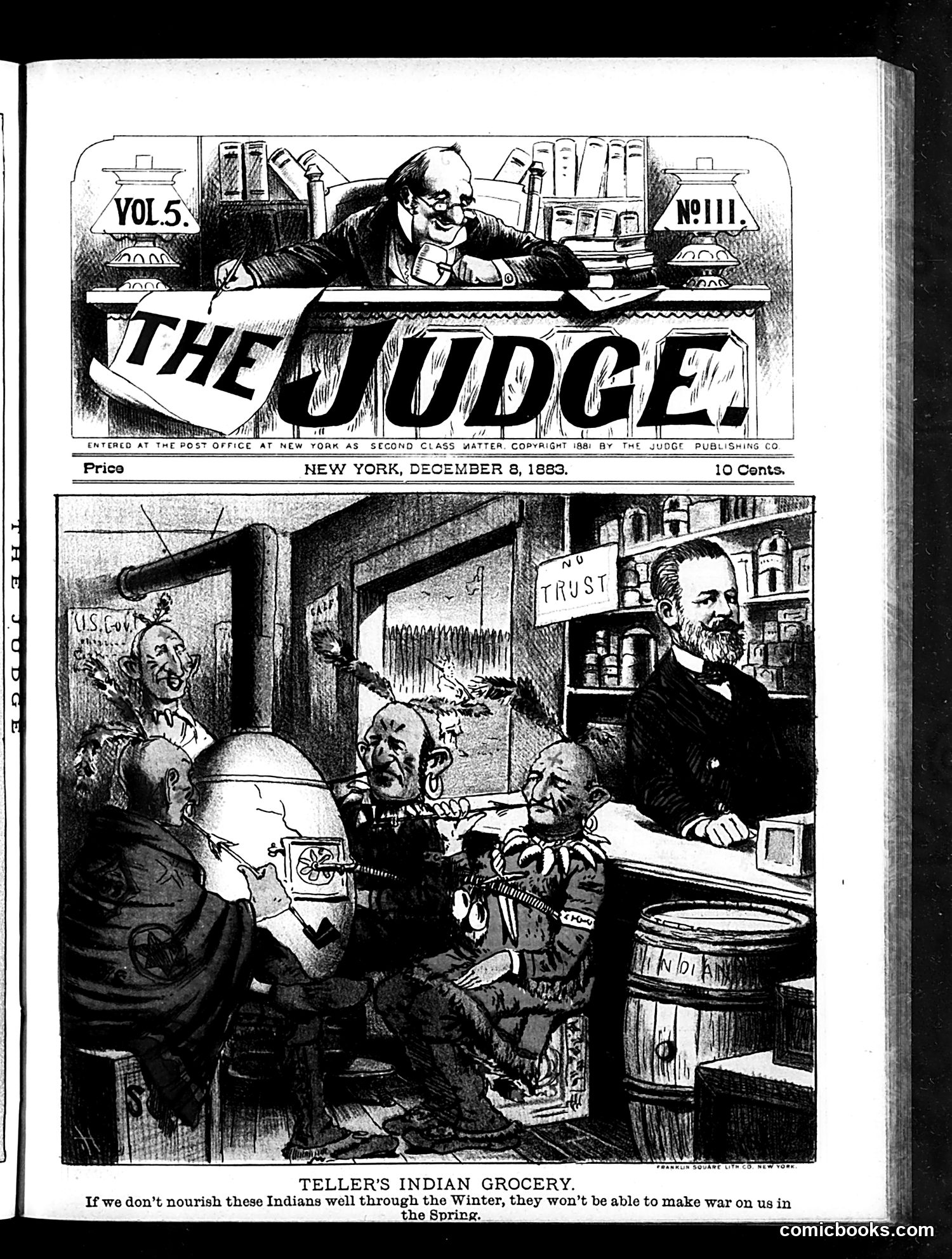
This page contains a political cartoon titled "Teller's Indian Grocery" satirizing Secretary of the Interior Henry M. Teller's Native American policy. The cartoon depicts a shop scene where various Native American figures (caricatured with exaggerated features) appear distressed or malnourished. A well-dressed merchant (likely representing Teller or the government) stands behind a counter marked "NO TRUST." The caption states: "If we don't nourish these Indians well through the Winter, they won't be able to make war on us in the Spring." The satire critiques the government's inadequate provision of food and resources to Native Americans, suggesting the motivation wasn't humanitarian concern but rather preventing armed resistance. The "grocery" framing implies the government was stingy or unreliable in meeting basic Indigenous needs during harsh winter conditions.
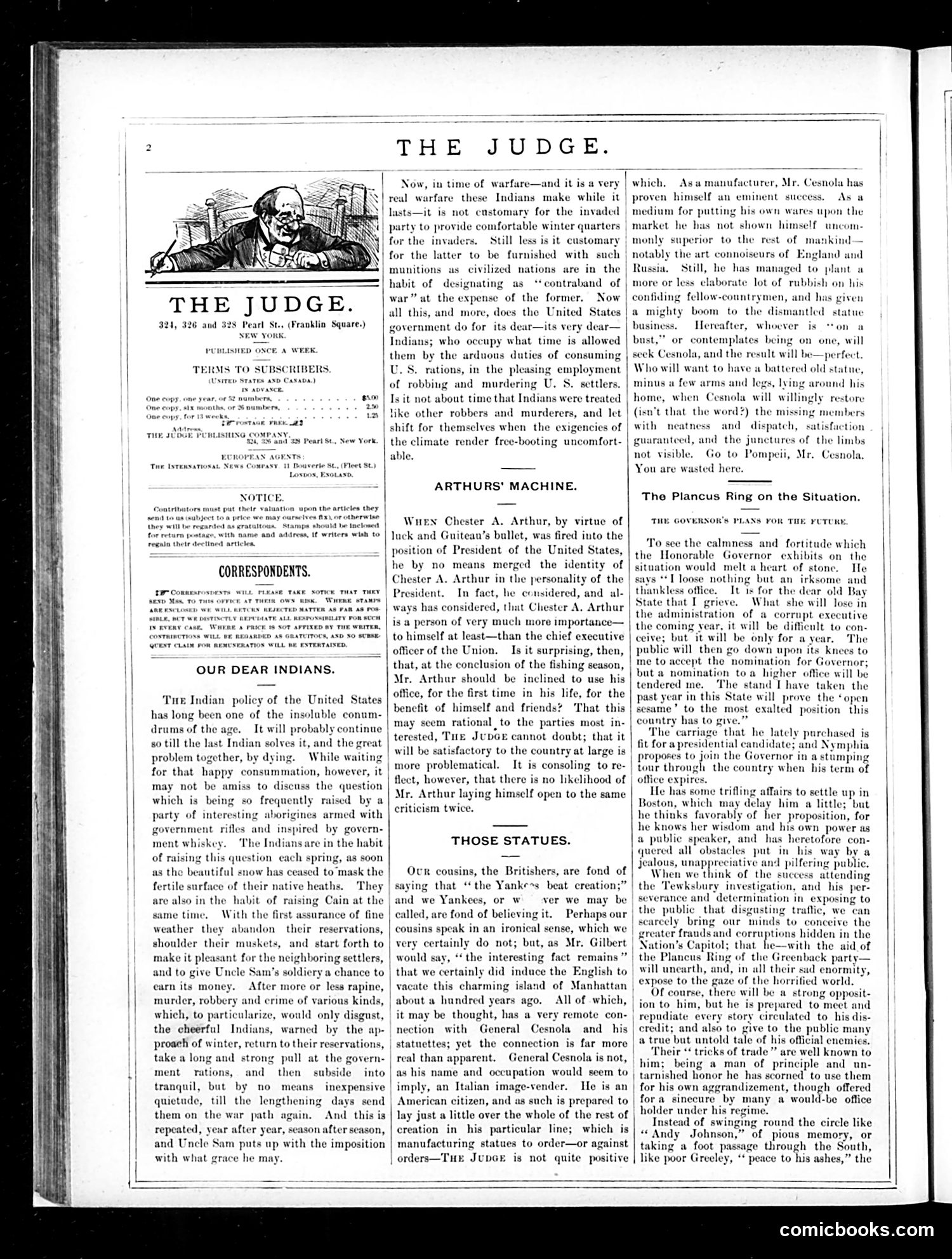
This page contains three satirical pieces from *Judge* magazine: **"Our Dear Indians"** (main article): The editorial sarcastically criticizes U.S. Indian policy, specifically the practice of providing winter quarters and weapons ("contraband of war") to Native Americans during peacetime. The author notes that Indians raid settlers each spring, then return to reservations for government rations each winter—a cycle the writer finds absurd and costly. The piece argues Indians should be treated like common criminals, not subsidized combatants. **"Arthurs' Machine"**: This attacks President Chester A. Arthur (who assumed office after Guiteau assassinated Garfield in 1881). The satire suggests Arthur views the presidency as a tool for personal enrichment and favoring friends, prioritizing his own interests over the office's dignity. **The cartoon** (top left) appears to show a figure at a desk, likely representing editorial commentary. The overall tone reflects late-19th-century attitudes: skepticism toward Native Americans and criticism of executive corruption.
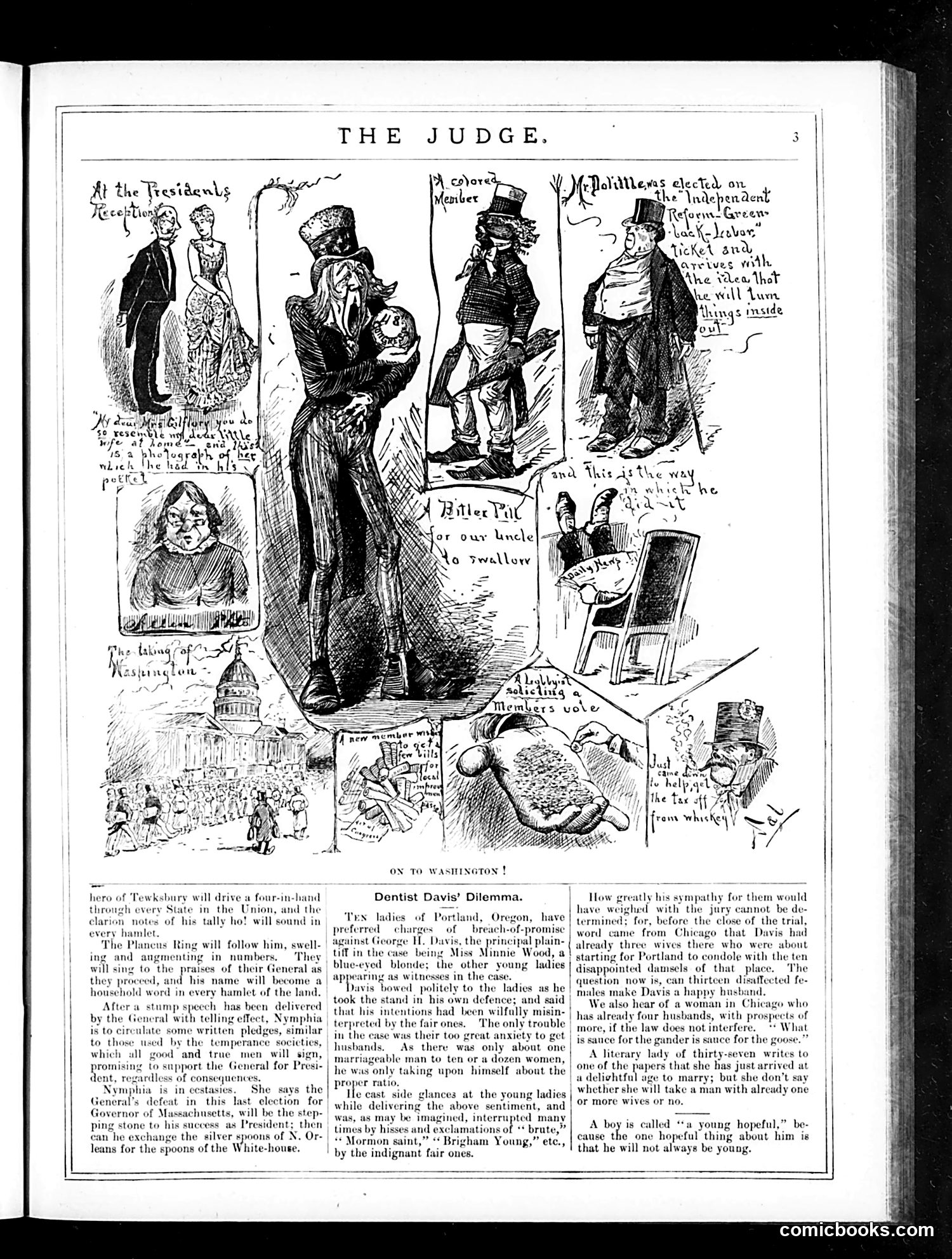
This page contains two satirical pieces mocking American political figures and social scandals of the era. **"On to Washington!"** mocks a political candidate (likely from Massachusetts, based on text) and his supporters' enthusiasm for his presidential ambitions. The satire suggests his campaign will sweep through states with grand promises, building a cult of personality that will eventually elevate him to the White House—implying his rise is based on spectacle rather than substance. **"Dentist Davis' Dilemma"** ridicules a Portland dentist named George H. Davis facing ten breach-of-promise lawsuits from women. The joke: Davis defends himself by claiming he was merely taking his "proper ratio" of one man per ten women—essentially a polygamy argument. The satire exposes the absurdity of his defense while also mocking the women's desperation to marry and a Chicago woman allegedly juggling four husbands. The final quip about "sauce for the gander" suggests gender hypocrisy in marriage expectations. Both pieces use exaggeration to critique social climbing, legal absurdity, and romantic desperation in Gilded Age America.
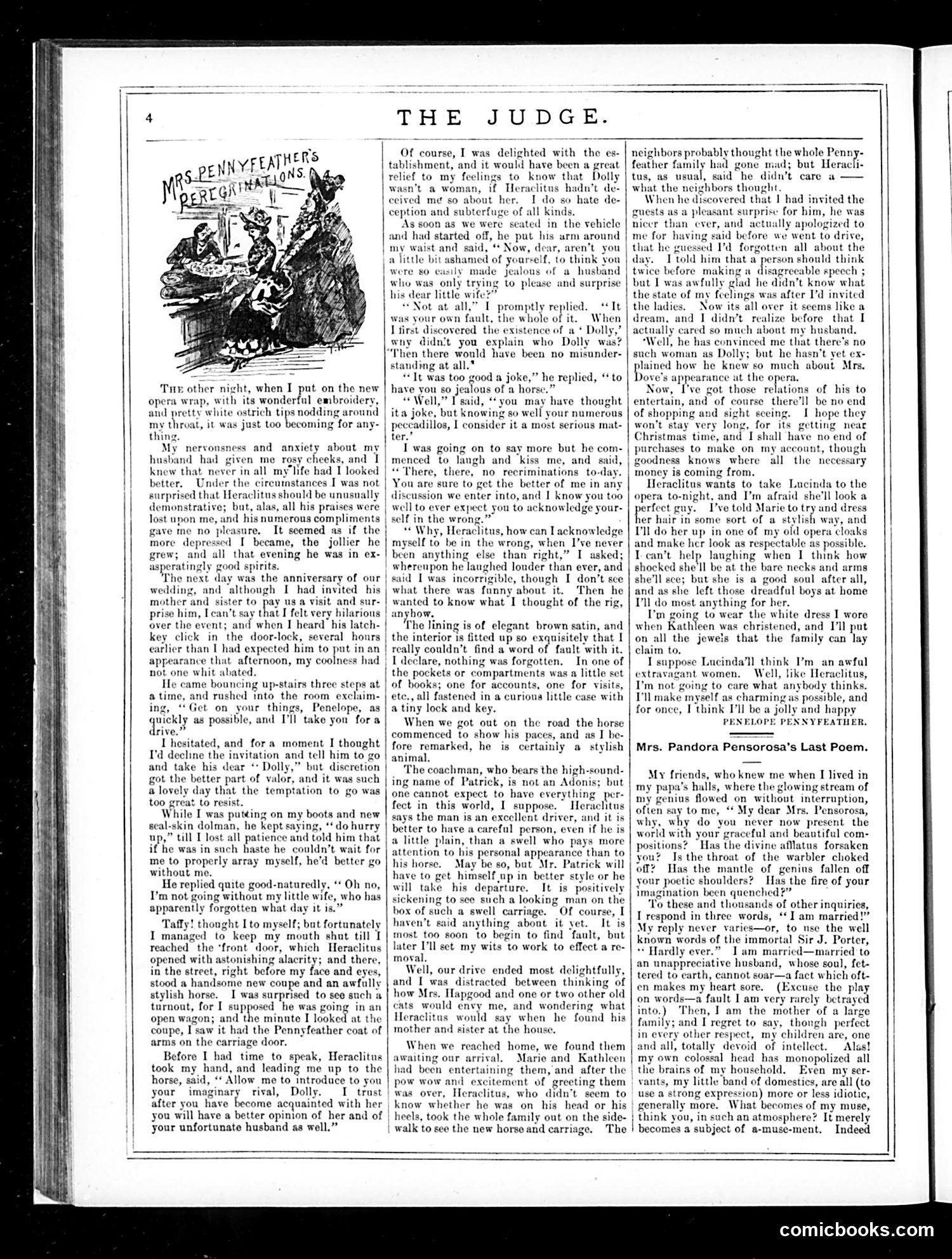
This is a domestic humor piece satirizing marital jealousy and miscommunication in Victorian-era relationships. **The Setup:** A wife (narrator) becomes irrationally jealous when her husband Heraclitus frequently mentions "Dolly," whom she assumes is a woman. Her anxiety intensifies when he buys a new carriage and keeps "Dolly" secret. **The Punchline:** "Dolly" is revealed to be a horse—a new carriage horse. The husband's repeated references and deliberate secrecy were meant as a surprise anniversary gift. **The Satire:** The piece mocks wives for unfounded jealousy while simultaneously criticizing husbands (like Heraclitus) for deliberately deceiving their spouses "as a joke." The wife's assumption isn't entirely unreasonable given her husband's admitted "peccadillos" (minor faults/indiscretions). **Social Context:** The piece reflects anxieties about marital trust and suggests that even in what appear to be happy relationships, deception (even playful) creates genuine harm. The wife's final statement—that she considers his deception "a most serious matter"—undercuts any suggestion the joke was harmless.
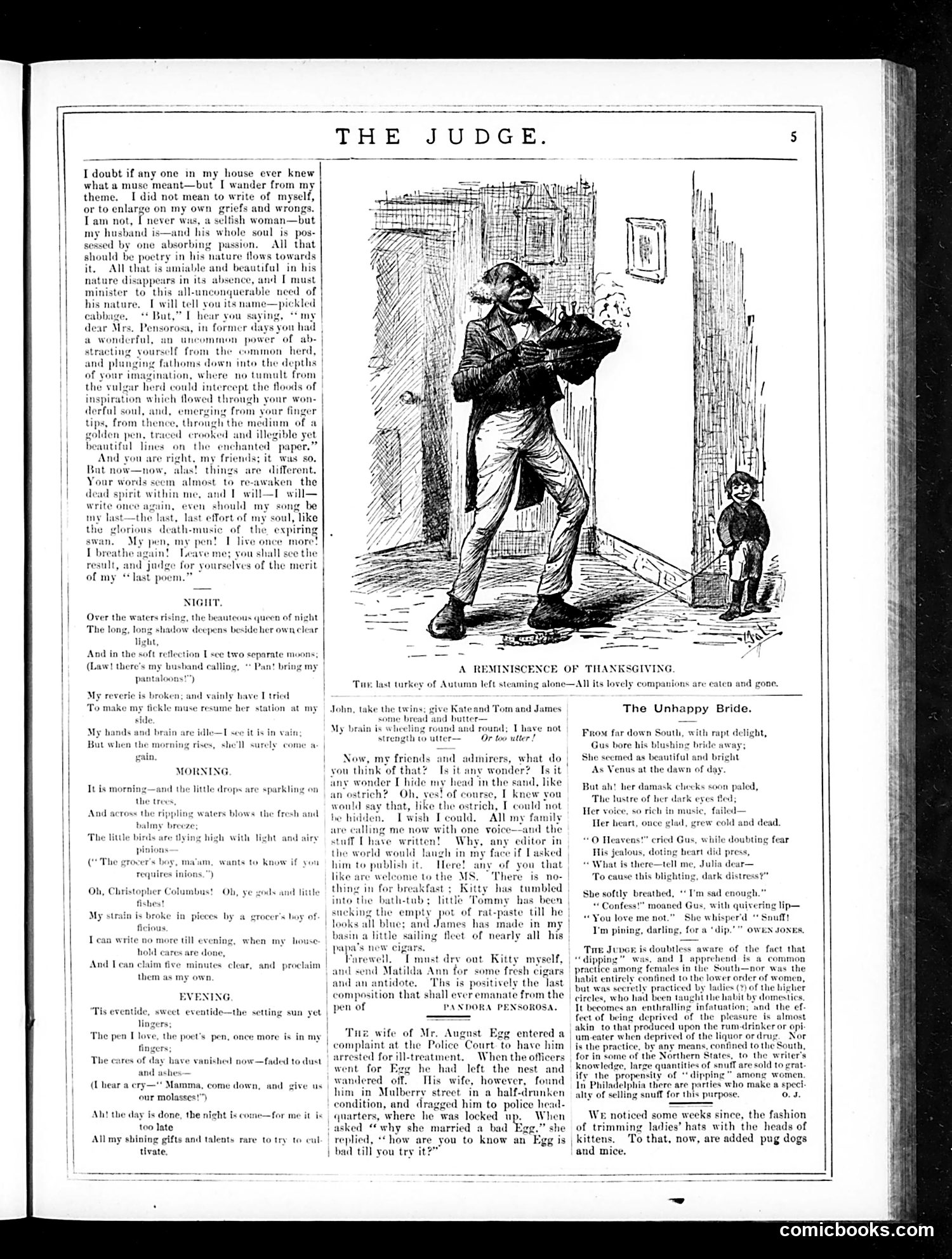
This page contains two distinct pieces: a sentimental short story and a satirical cartoon. **The Main Story ("The Judge")** presents a woman writer's lament about her inability to compose poetry. She romanticizes her past literary gifts but now finds her creative muse constantly interrupted by domestic duties—a husband demanding pickled cabbage, children making messes, and a grocer's boy asking about onions. The satire targets Victorian sentimentality and the "tragic poetess" trope, while also poking fun at women who blame external circumstances for their lack of accomplishment. **The Cartoon** (titled "A Reminiscence of Thanksgiving") depicts a man reading aloud to his wife while surrounded by domestic chaos—children visible in doorways, suggesting the very interruptions the story's narrator complains about. The implicit joke: pretensions to artistic sensitivity are ridiculous when faced with ordinary family life. Judge mocks both the melodramatic self-pity of aspiring writers and the reality that domestic responsibility is incompatible with romantic notions of inspiration.
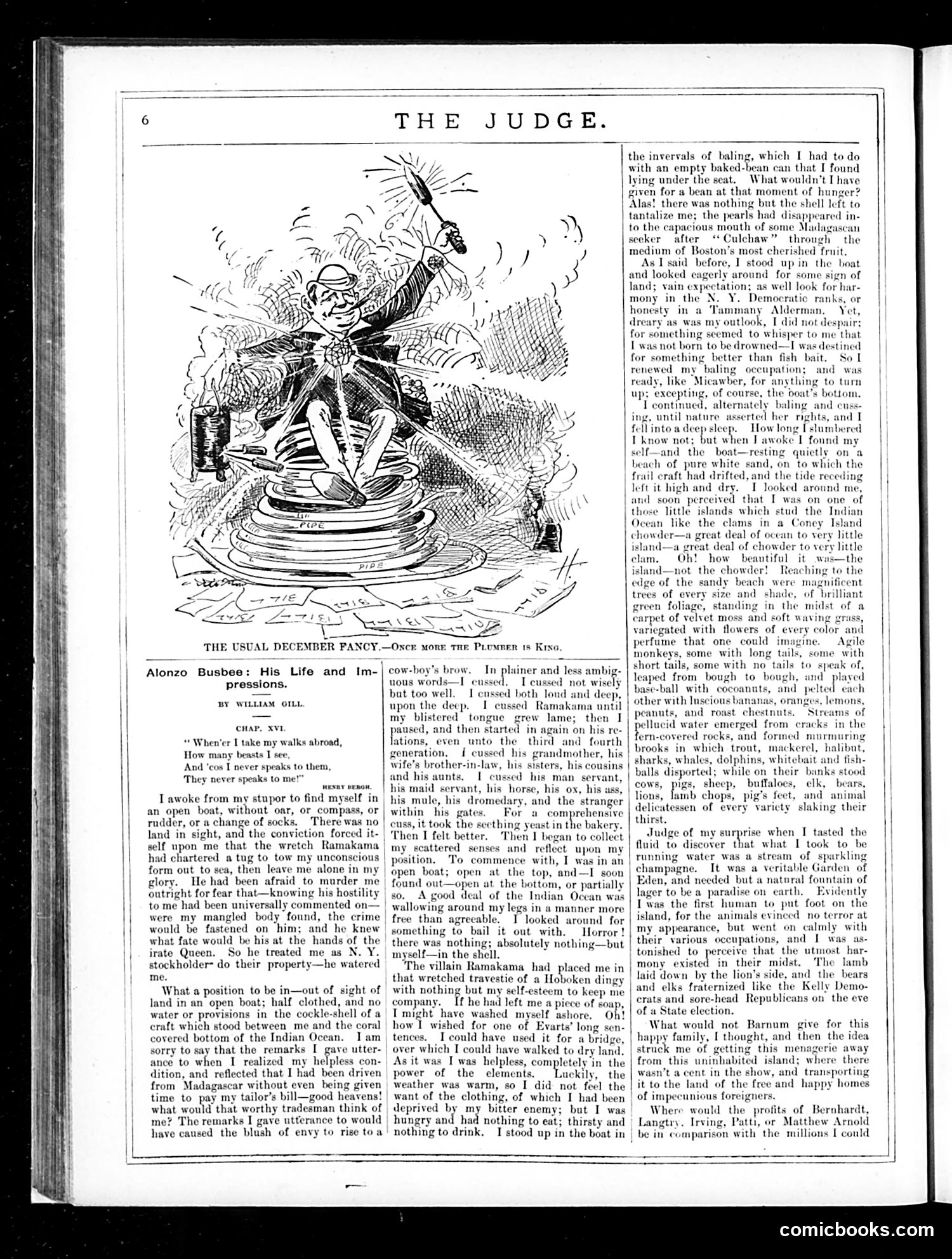
This page from *Judge* magazine contains a serialized story titled "Alonzo Busbee: His Life and Impressions" by William Gill. The accompanying cartoon shows a figure in distress—apparently the protagonist Busbee—struggling in water. The narrative describes Busbee abandoned in a leaking boat by a villain named Ramakama, left to die. Busbee's predicament is played for dark comedy: he's without provisions, frantically bailing water, and reduced to cursing elaborately. The text includes characteristic *Judge* satirical jabs: references to Senator Evarts's famously lengthy speeches (suggesting they'd make useful as bridges), criticism of "N.Y. Democratic ranks" for lacking harmony, and jabs at Tammany aldermen for dishonesty. The "December fancy" subtitle likely indicates this is seasonal satirical fiction, typical of *Judge*'s holiday content—combining adventure-story melodrama with biting social and political commentary aimed at contemporary readers.
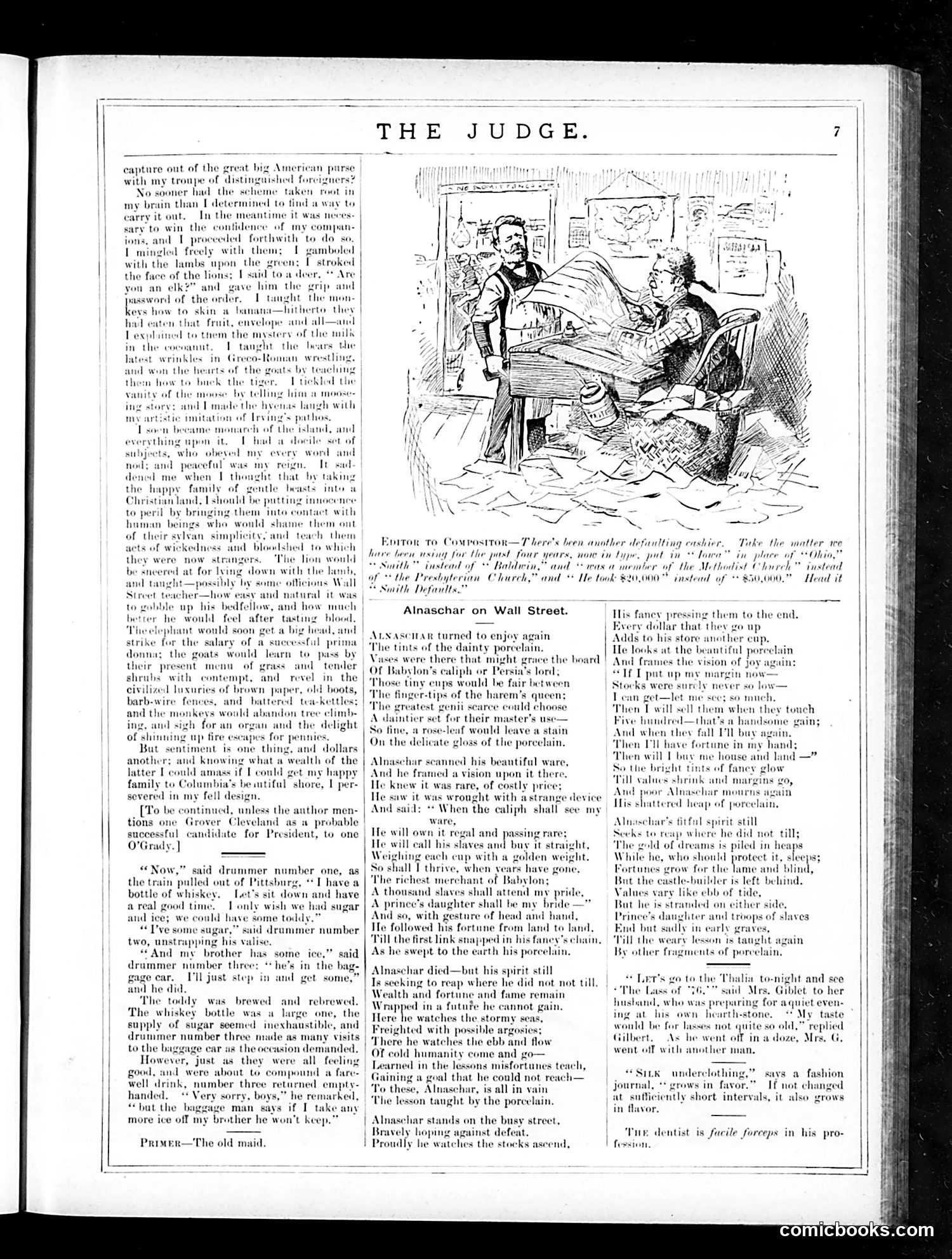
This page contains two distinct pieces. The main article (left column) is a lengthy narrative about capturing wild animals and bringing them to America—apparently a cautionary tale about unintended consequences of civilization. The cartoon (right side, with illustration) is titled "Alnaschar on Wall Street." It references the famous Arabian Nights character Alnaschar, a poor porter who dreams of wealth. Here, the satire applies that allegory to Wall Street speculators: a man gazes at a porcelain cup and fantasizes about becoming rich through trade, imagining princes' daughters and vast fortunes. But the moral is clear—like the original tale, his dreams collapse. The poem's repeated refrain warns that he "watches" future wealth he cannot actually grasp. **The satire's point**: Wall Street dreamers pursuing get-rich-quick schemes are delusional, building castles on air. Their imagined fortunes evaporate upon contact with reality, much like Alnaschar's broken porcelain cup.
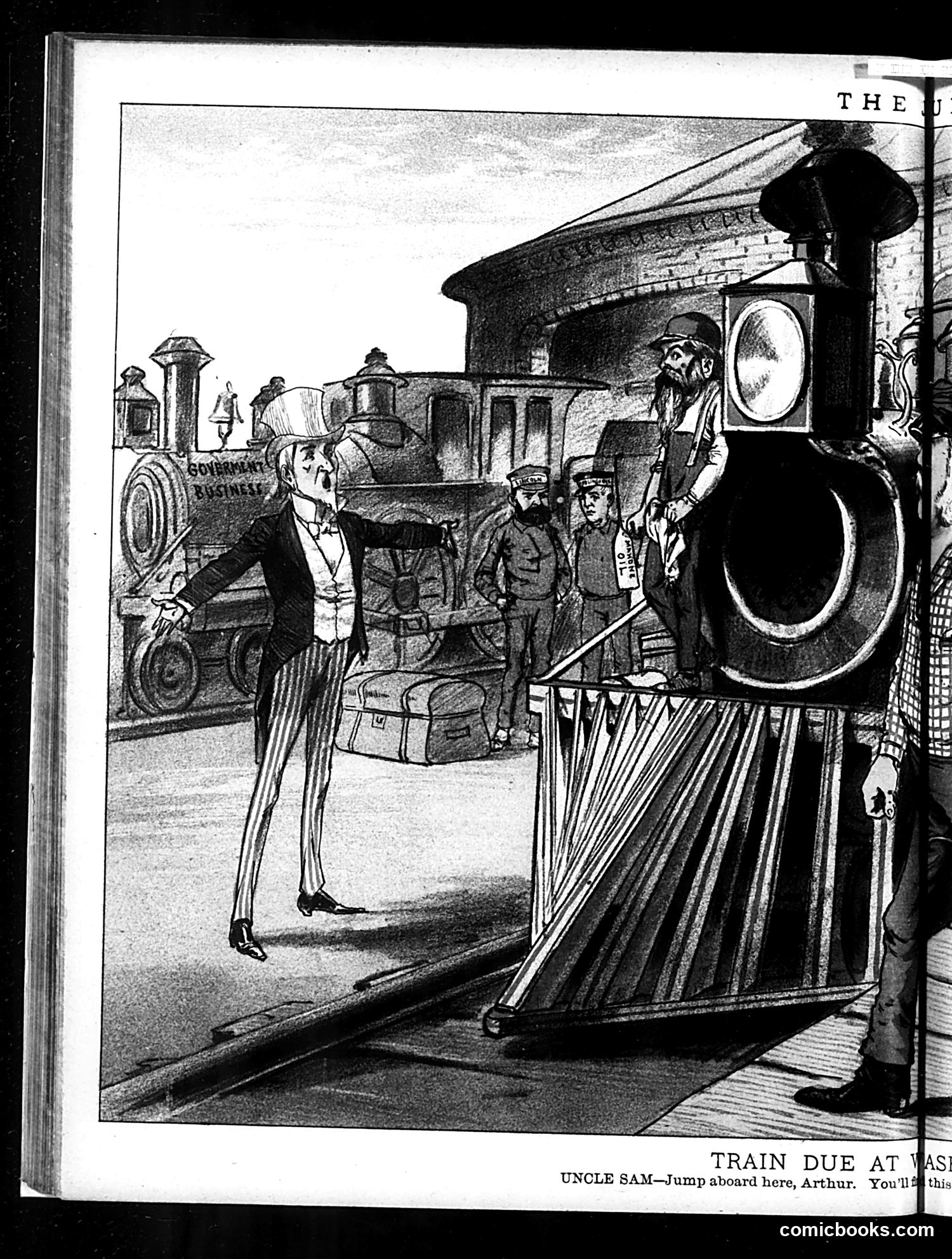
This political cartoon depicts "Uncle Sam" (representing the U.S. government) urging a well-dressed man named Arthur aboard a train. The caption reads "TRAIN DUE AT WASHINGTON—UNCLE SAM—Jump aboard here, Arthur. You'll be this..." The cartoon likely satirizes Chester Arthur's appointment or election to high office, probably referring to his presidency (1881-1885) or an earlier political position. The "train to Washington" is a common metaphor for political advancement. The cartoon mocks either Arthur's reluctance to assume power or the expectation that he should enter politics, with Uncle Sam pressuring him to board. The formal attire and casual tone suggest satirical commentary on American political ambition and obligation.
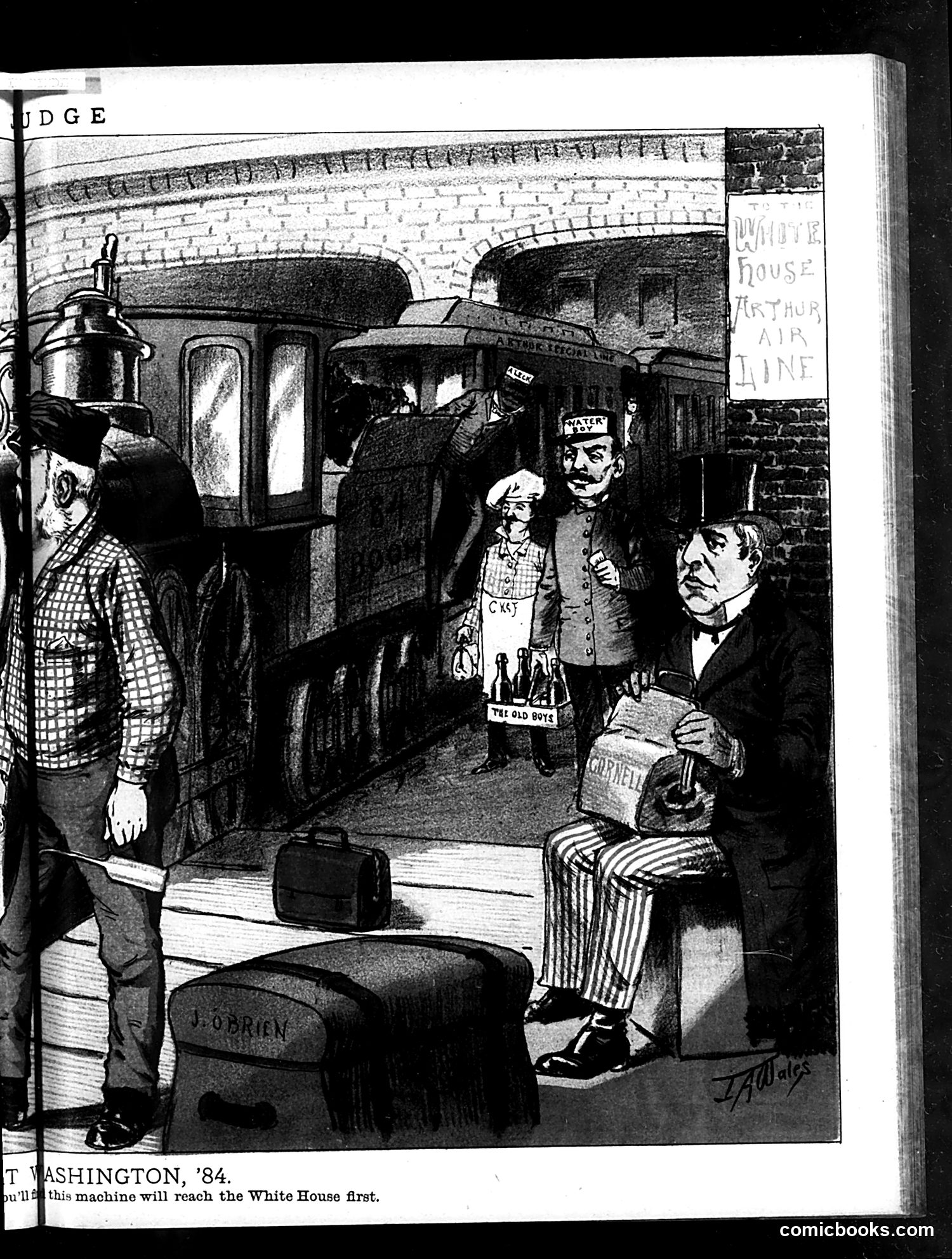
This 1884 Judge cartoon satirizes the U.S. presidential race. The setting is a train station where various political figures—identifiable by their distinctive caricatures and period dress—compete to reach the White House "first." The cartoon uses the metaphor of a departing train to represent the presidential campaign. The dignified gentleman on the right appears to be a leading candidate, while the military-uniformed figure in the center and others represent rival contenders. The suitcases labeled with names suggest different candidates' campaigns. The satire mocks the competitive scramble among politicians vying for the presidency, suggesting they're all racing toward power. The "machine" reference in the caption likely alludes to political party machinery—the organizational systems that controlled nominations and elections during this Gilded Age period.
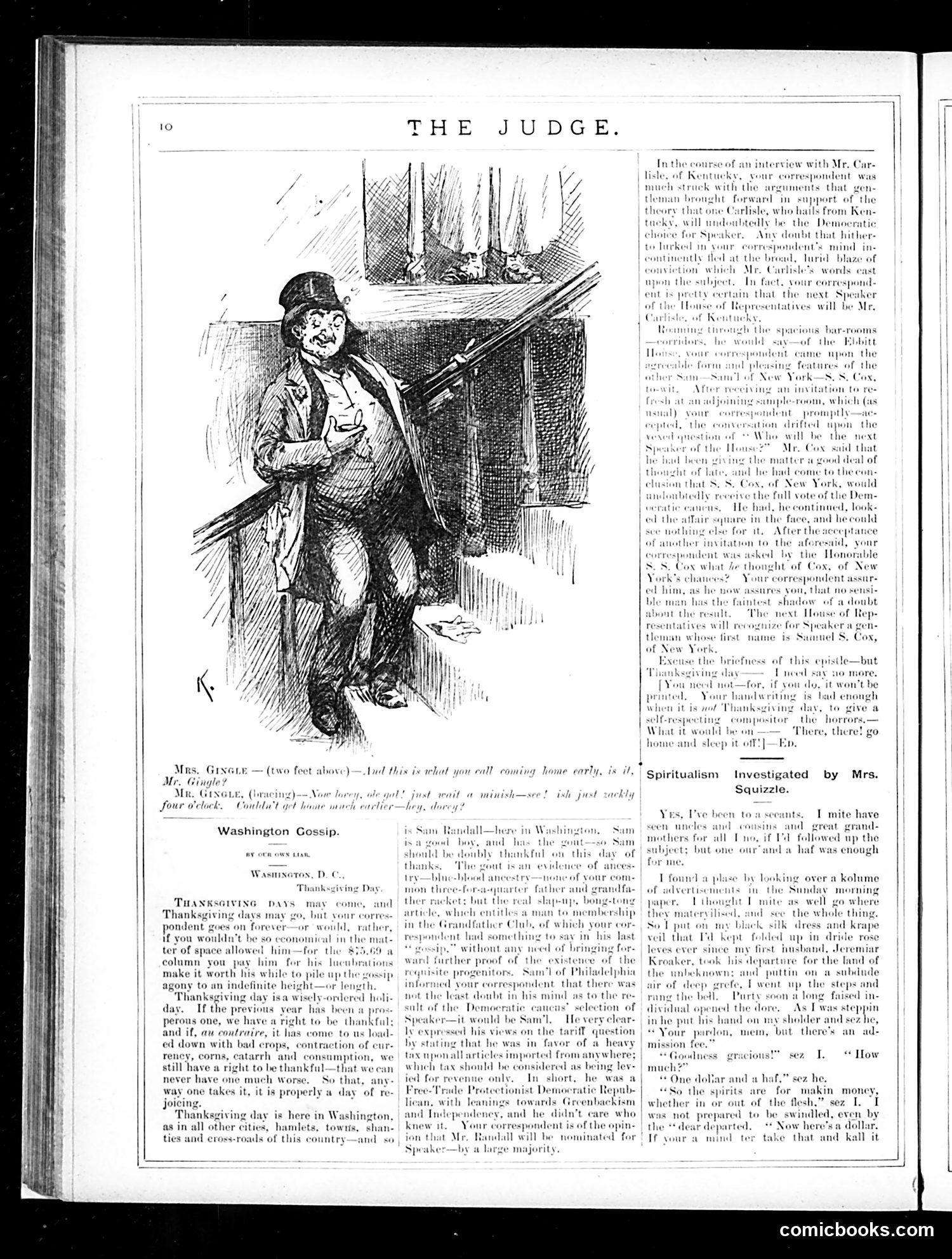
## The Main Cartoon The illustration shows a man (labeled "Mrs. Gingle") apparently levitating or floating two feet above ground while bracing against a doorframe. The caption suggests domestic comedy about someone arriving home late on Thanksgiving, with Mrs. Gingle sarcastically asking if he couldn't "get home much earlier." ## The Text Content The page contains three sections: 1. **Washington Gossip** discussing Thanksgiving and Democratic politics, notably focusing on who will become Speaker of the House—either Samuel Randall or S.S. Cox (of New York), with preference indicated for Cox. 2. **Political references** to tariff debates and the "Grandfather Club" (appears to reference genealogical/aristocratic pretensions). 3. **"Spiritualism Investigated by Mrs. Squizzle"**: A humorous account of visiting a séance, where Mrs. Squizzle pays "one dollar and a half" to contact deceased relatives—satirizing the spiritualism craze popular in the era. The satire mocks both domestic marital discord and the contemporary spiritualism phenomenon as money-wasting frauds.
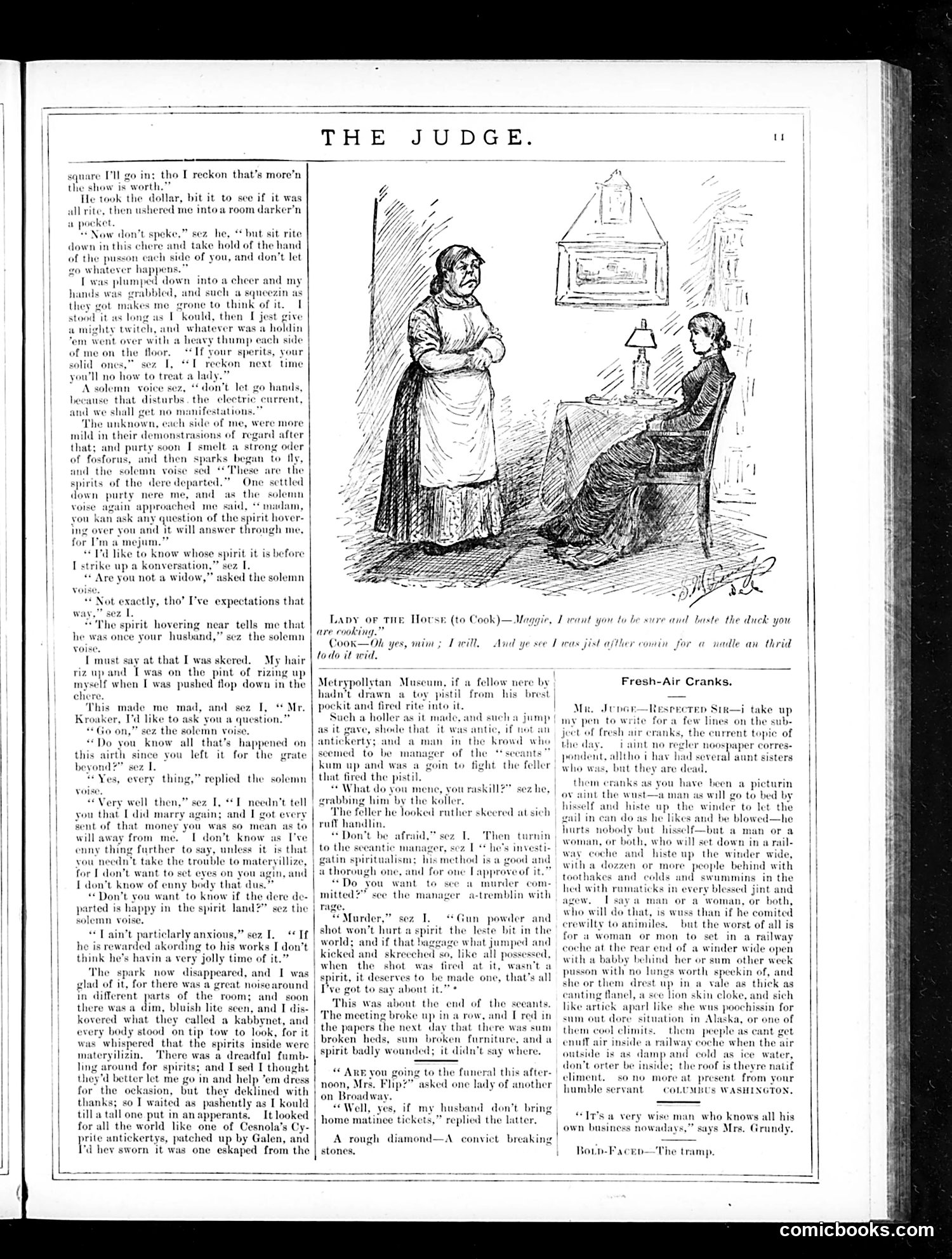
This page contains two distinct satirical pieces: ## Main Story: "Spiritualism Séance Satire" The lengthy narrative mocks spiritualist mediums and séances—a popular but fraudulent practice in the late 19th century. A woman recounts visiting a "spirit medium" who charges admission, performs theatrical tricks (phosphorus sparks, cabinet illusions), and claims to contact her dead husband. The satire exposes the con: the "medium" uses physical force, darkness, and misdirection to deceive gullible clients seeking contact with deceased relatives. The crude comparisons and colloquial dialect amplify the mockery of both the fraudster and his victims. ## Sidebar Cartoons: 1. **"Lady of the House"**: A brief domestic joke about cooking instructions 2. **"Fresh-Air Cranks"**: References to the "Fresh Air" movement sending poor urban children to the countryside—here satirizing either overzealous advocates or the program's problems The page ridicules both spiritualist charlatanism and its believers, reflecting widespread contemporary skepticism toward these practices despite their cultural popularity.
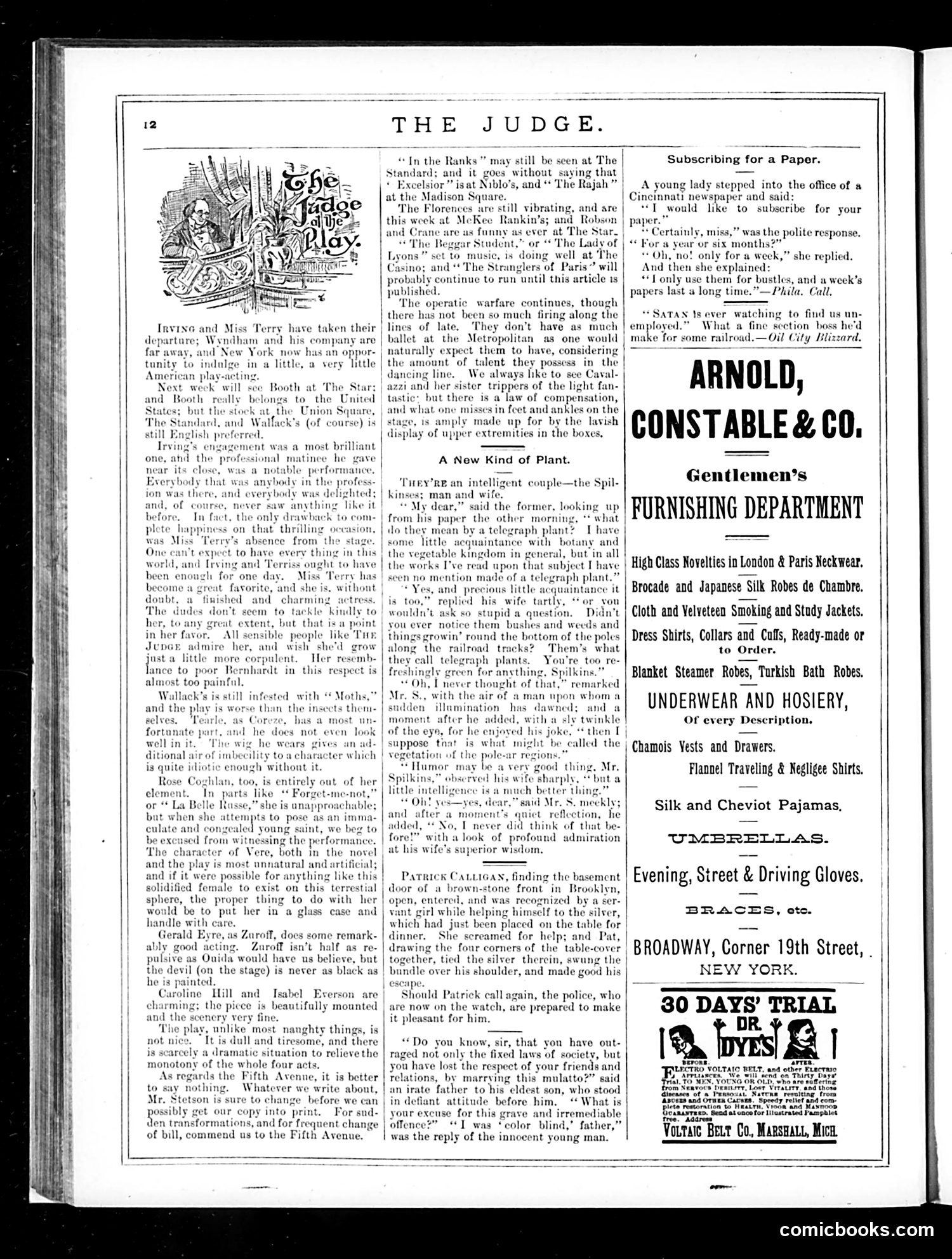
This page from Judge magazine contains theater criticism and social commentary typical of the publication's satirical approach. The main illustration (titled "The Judge at Play") appears to caricature theatrical figures and performances of the era, likely referencing popular Broadway productions mentioned in the text. The text discusses various theatrical productions—including works at notable venues like Niblo's Garden and the Metropolitan—with commentary on acting quality and audience response. The criticism is characteristically sharp, noting performers' physical attributes and stage presence with the sardonic tone Judge was known for. The "New Kind of Plant" section is a humorous anecdote about the Spilkinses, where a husband learns from his wife that the weeds around railroad tracks are called "telegraph plants"—a joke playing on the telegraph's association with railroads and the public's general confusion about botanical/technological terminology. The page also includes a brief crime notice about Patrick Calligan stealing silver from a Brooklyn brownstone, presented in Judge's typical wry reporting style.
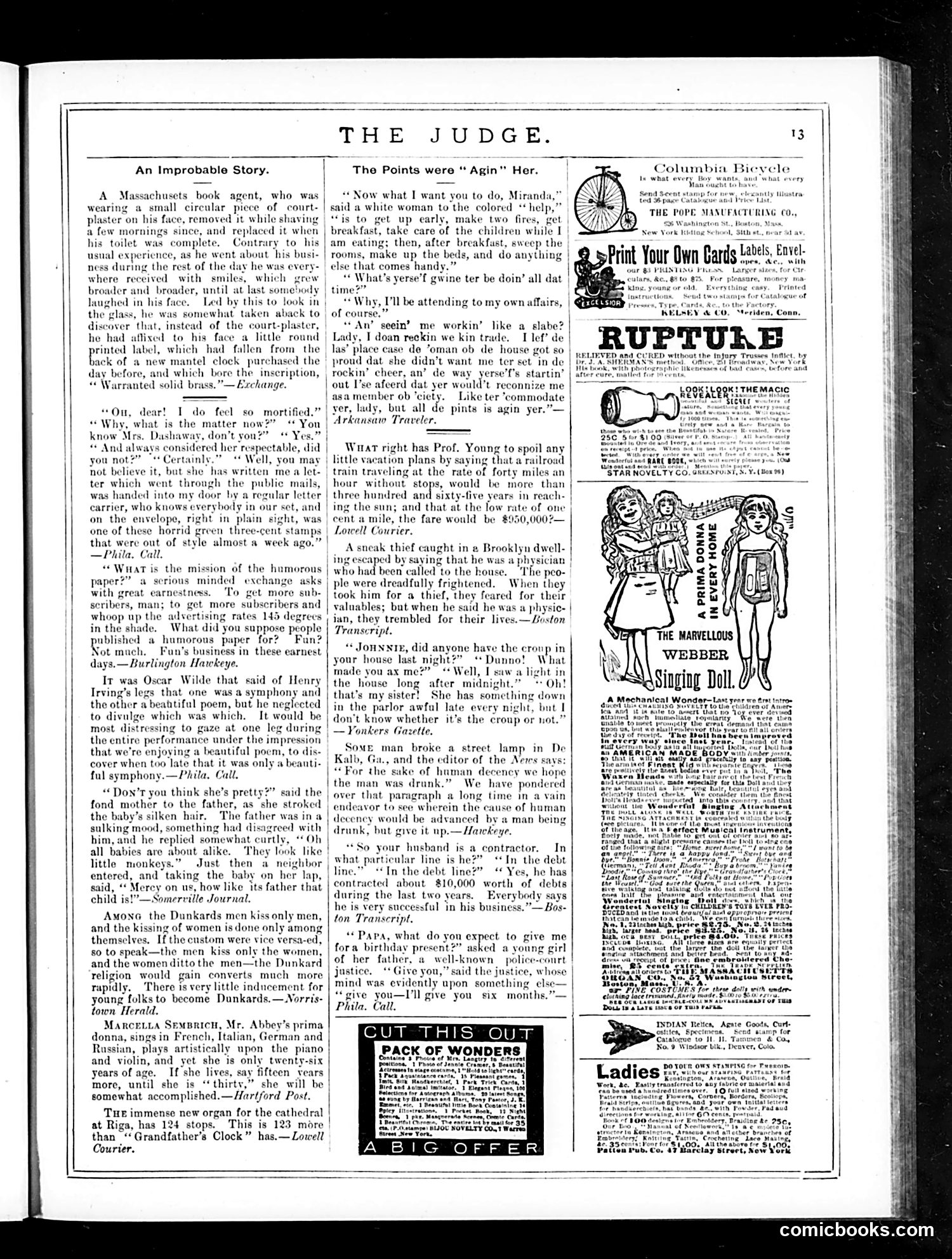
This page from **Judge** magazine contains several short humorous pieces typical of late 19th-century American satire: **"An Improbable Story"** mocks social pretension—a man unknowingly wears a product label on his face, causing embarrassment when discovered. **"The Points were 'Agin' Her"** presents a racist dialogue where a white employer lists demanding household tasks to a Black servant, who objects that she'd be doing everything herself. This reflects period attitudes toward labor and race. Other brief pieces satirize contemporary targets: Oscar Wilde's theatrical reputation, the Dunkard religious sect's kissing customs, and operatic performer Marcella Sembrich's accomplishments despite her youth. The humor relies on class commentary, ethnic stereotypes (standard for the era), and gentle mockery of public figures and social conventions. The page also contains advertisements, including for a children's doll and business cards—typical of Judge's revenue model.
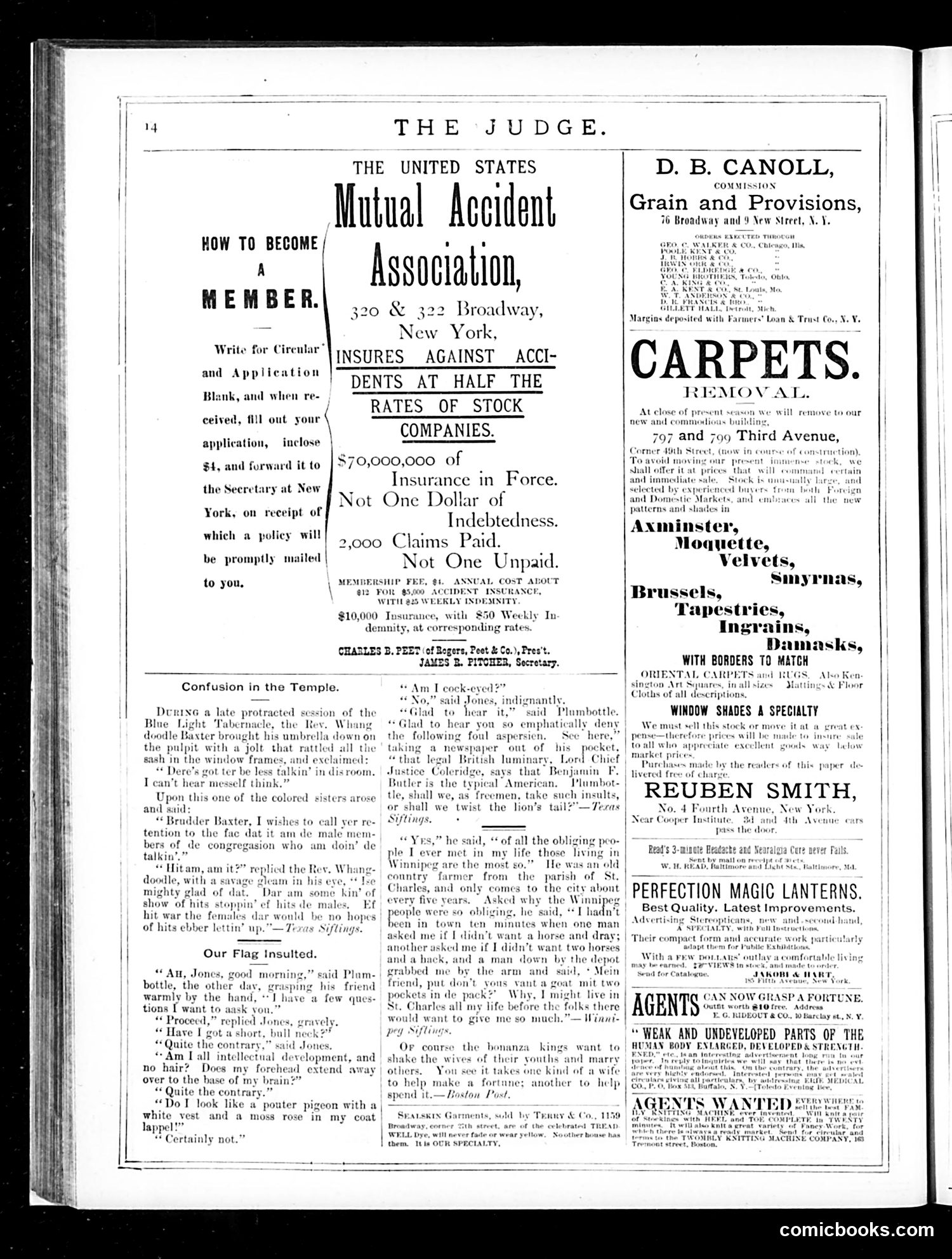
This page is primarily **advertisements** with one satirical sketch titled "Confusion in the Temple." The cartoon depicts a church service disrupted by noise. A preacher (Brudder Baxter) is interrupted by congregants making a commotion, and he scolds them: "There's got ter be less talk in dis room. I can't hear mesself think." A colored church member responds by calling attention to women in the congregation whose rustling clothing and constant movement prevent him from hearing the sermon. **The satire targets** working-class or rural African American church culture, using exaggerated dialect ("Brudder," "ter be") as comedic fodder. The humor relies on portraying Black congregants as loud, disruptive, and unable to conduct themselves properly during worship—a common racist trope of the era. The sketch reflects **late 19th-century attitudes** toward race and religion, presenting Black Americans through a lens of ridicule rather than sympathy. The magazine's intended audience would have found this "humorous," though it reflects prejudices we'd recognize today as offensive stereotyping.
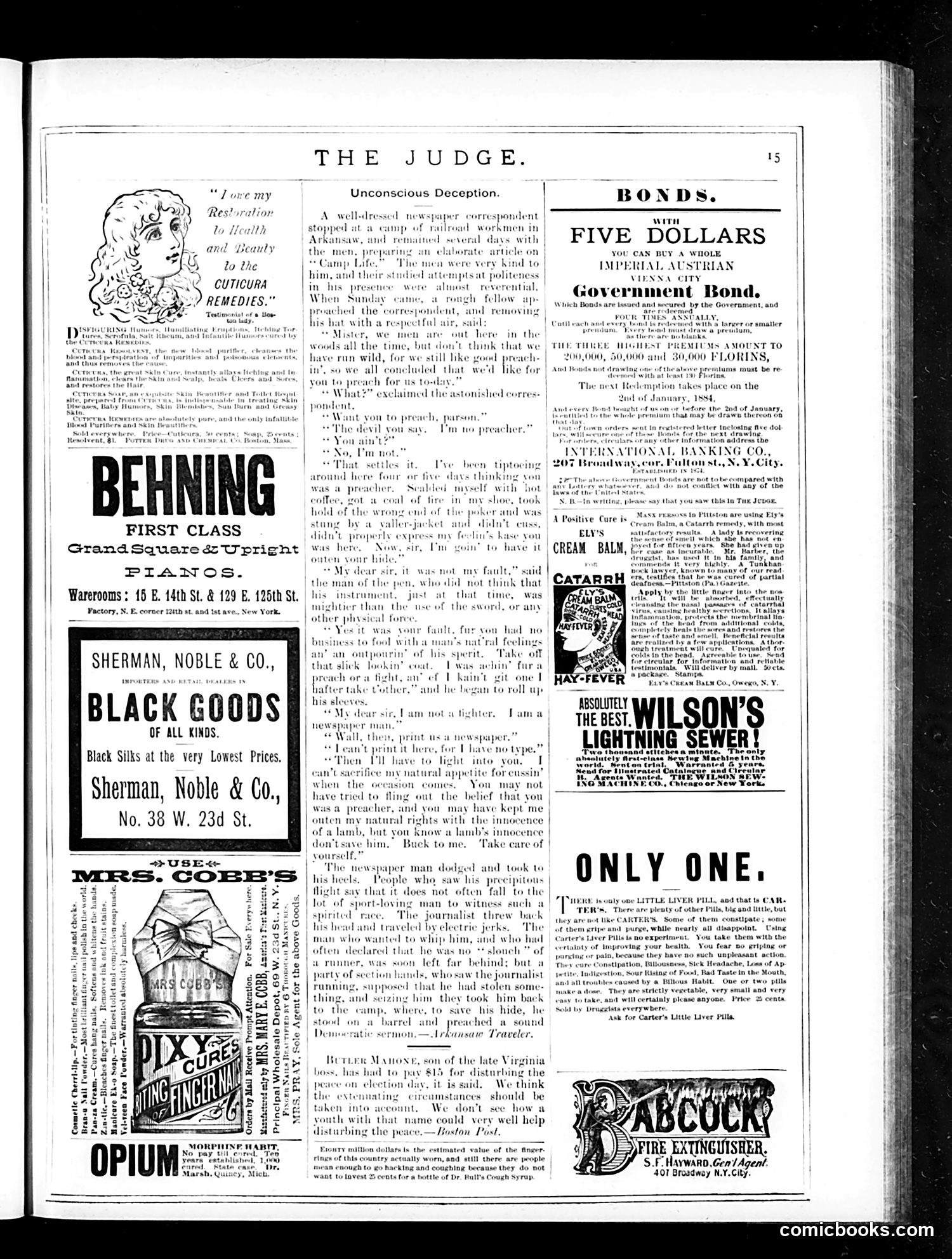
This page is primarily **advertising with one substantial cartoon story** titled "Unconscious Deception." The main cartoon depicts a conflict between a newspaper correspondent and railroad workers in Arkansas. The correspondent, dressed formally, visits a work camp and later preaches a sermon mocking the workers' roughness. A laborer confronts him, and they nearly fight. The joke's point: the "preacher" unconsciously reveals his own hypocrisy and aggression while criticizing others' brutality. The irony is that his "natural rights" lecture and physical threat undermine his moral authority. The satire targets **self-righteous urban sophistication**—the correspondent judges rural workers while behaving identically rough himself. It's a commentary on class condescension and unconscious moral blindness. The page is otherwise filled with period advertisements for pianos, black silk goods, patent medicines (Cuticura, Ely's Cream Balm), and dubious cure-alls typical of 1880s-90s magazines. These ads themselves often contained their own satirical potential in Judge's context.
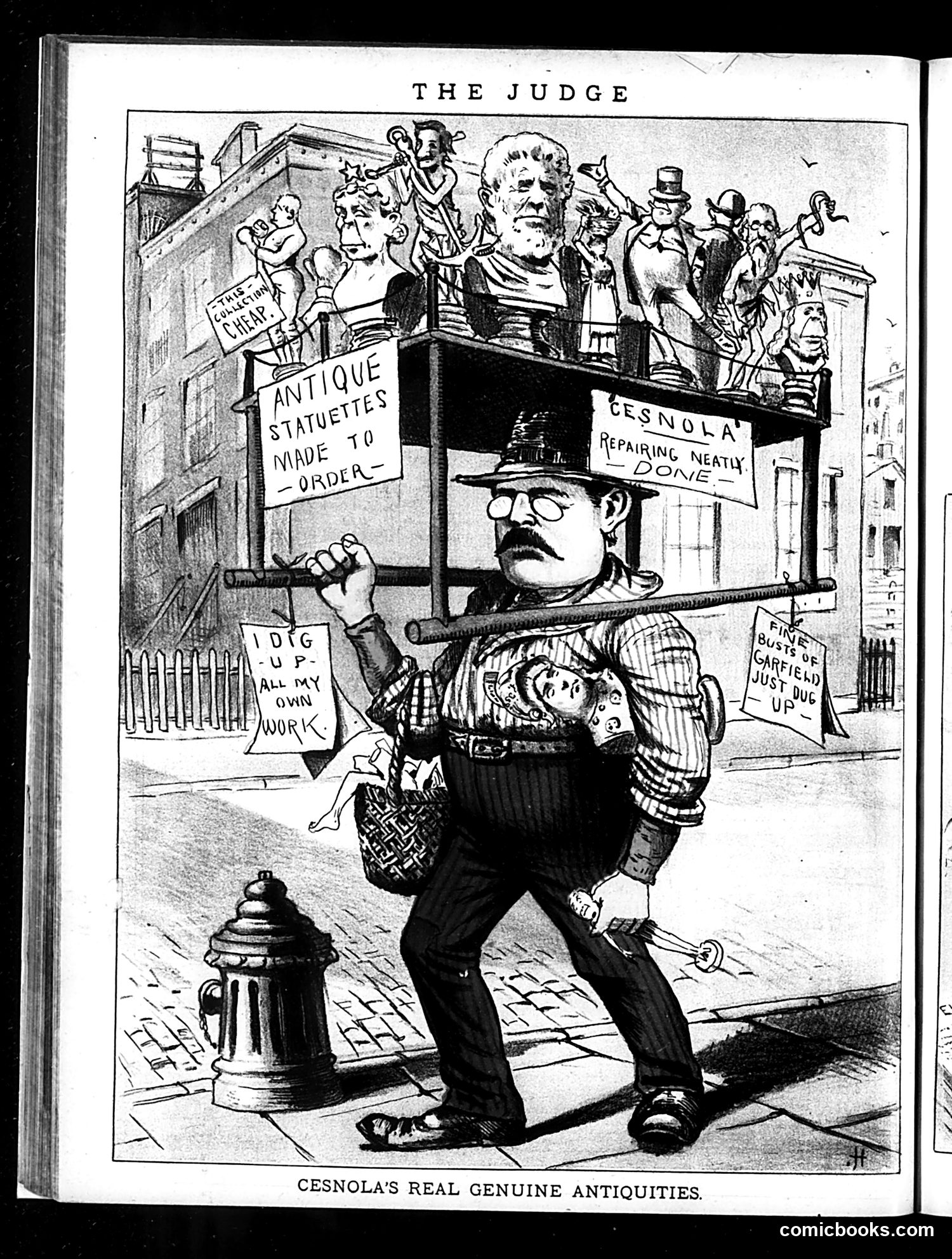
This cartoon satirizes Luigi Palma di Cesnola, an Italian archaeologist and art dealer. The central figure—a workman with a mustache—juggles various tasks: repairing statues ("Antique Statues Made to Order"), fixing a broken sculpture ("Cesnola - Repairing Neatly Done"), and managing other work ("I Do All My Own Work"). The satire attacks Cesnola's credibility by suggesting he fabricates or artificially "restores" antiquities for sale, presenting them as genuine discoveries. The ornate busts visible above represent the fraudulent merchandise. The cartoon implies Cesnola is essentially a craftsman manufacturing fake artifacts rather than a legitimate archaeologist, mocking both his commercial practices and the authenticity of items he claimed to have excavated.