
Judge, 1883-12-08 · page 2 of 16
Judge — December 8, 1883 — page 2: what you’re looking at
What you’re looking at
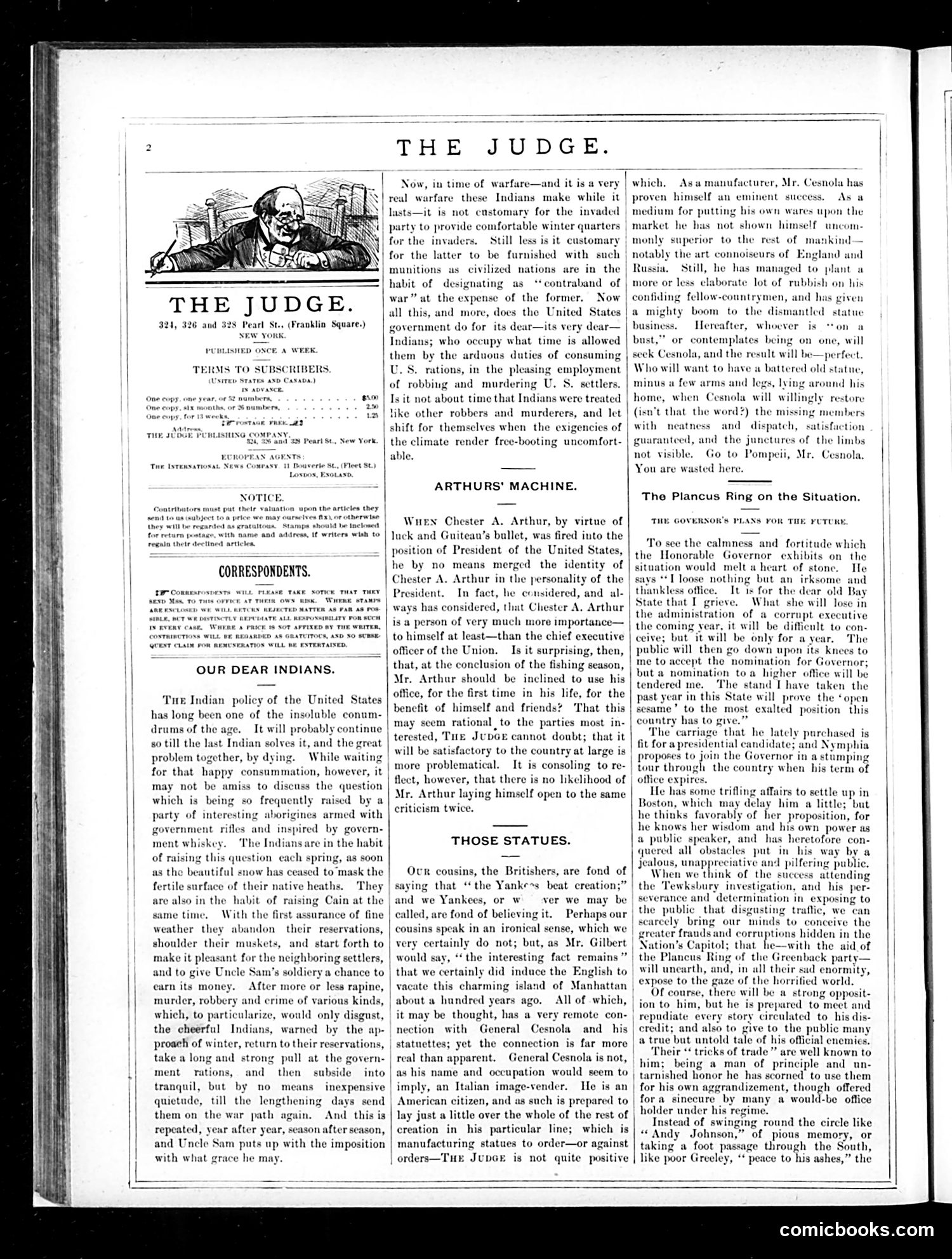
This page contains three satirical pieces from *Judge* magazine: **"Our Dear Indians"** (main article): The editorial sarcastically criticizes U.S. Indian policy, specifically the practice of providing winter quarters and weapons ("contraband of war") to Native Americans during peacetime. The author notes that Indians raid settlers each spring, then return to reservations for government rations each winter—a cycle the writer finds absurd and costly. The piece argues Indians should be treated like common criminals, not subsidized combatants. **"Arthurs' Machine"**: This attacks President Chester A. Arthur (who assumed office after Guiteau assassinated Garfield in 1881). The satire suggests Arthur views the presidency as a tool for personal enrichment and favoring friends, prioritizing his own interests over the office's dignity. **The cartoon** (top left) appears to show a figure at a desk, likely representing editorial commentary. The overall tone reflects late-19th-century attitudes: skepticism toward Native Americans and criticism of executive corruption.
📄 Transcribed text from this page (OCR, searchable)
Machine-transcribed from the original scan — historical spelling and the odd misread are preserved.
HE JUDGE. 8 Pearl Ste. (Franklin Square.) T and 3 PUBLISHED ONCE. A WEEK TERMS TO SUBSCRIBERS Usiree States asp Casapa.) Owe epy. for 13 we Tur, 3 28 Pearl St., New York. EUROPEAN AGENTS Tne IsrexsaTionat, News Compasy. 11 Rouverte St. (Fleet St) Loxbox, EXOLAs®, NOTICE, articles the} ther ald be tacked | r return pastage, with name and address, if writers wish to regain thetr dectined articles, CORRESPONDENTS. Tr Commesrosests WILL FLEAKE TAKE SOME THAT THEY aexp Mex to 1H AT THEIR OWS fink. WHERE #TAnr WHERE 4 PRick #8 SOT AFFIXED RY THE WRITER, CONTRINCTIONS WILL WH Ri As OWATUTTOCS, AxD So sCERE | QUENT CLADE FoR REMCSERATH OUR DEAR INDIANS. Tne Indian policy of the United States has long been one of the insoluble conum drums of the age. It will probably continue so till the last Indian solves it, and the great problem together, by dying. While waiting for that happy consummation, however, it may not be amiss to discuss the question which is being so frequently raised by party of interesting aborigines armed with government rifles and in: ment whiskey. ired by govern- ‘The Indians are in the habit of raising this question each spring, as soon as the beautiful snow has ¢ «d to‘mask the fertile surface of their native heaths. They are also in the habit of raising Cain at the same time. With the first assurance of fine | weather they abandon their reservations, | shoulder their muskets, and start forth to | make it pleasant for the neighboring settlers, and to give Uncle Sam’s soldie ance to | | carn its money. After more or less rapine, murder, robbery and crime of various kin¢ which, to particularize, would only disgust, the cheerful Indians, warned by the ap- proach of winter, return to their reservations, take a long and strong pull at the govern- ment rations, and then tranquil, but by no means inexpensive | quietude, till the lengthening days send them on the war path again. And this is repeated, year after year, season after season, and Uncle Sam puts up with the imposition | with what grace he may. subside into \ he by no means merged the identity of THE JUDGE. Now, in time of warfare—and it is a very real warfare Indians make while it lasts—it is not customary for the invaded party to provide comfortable winter quarters for the invaders. these Still less is it customary for the latter to be furnished with such | munitions as civilized nations are in the habit of designating as ‘contraband of | war” at the expense of the former. Now | all this, and more, does the United States | government do for its dear—its very dear— Indians; who occupy what time is allowed them by the arduous duties of consuming | U.S. rations, in the pleasing employment | of robbing and murdering U. S. settlers. | Is it not about time that Indians were treated like other robbers and murderers, and lect | shift for themselves when the exigencies of the climate render free-booting uncomfort- | able. ARTHURS' MACHINE. Wuewn Chester A. Arthur, by virtue of luck and Guitean’s bullet, was fired into the position of President of the United States, Chester A. Arthur in the personality of the President. In fact, he considered, and al- ways has considered, that Chester A. Arthur is a person of very much more importance— to himself at least—than the chief executive officer of the Union. Is it surprising, then, that, at the conclusion of the fishin Mr. Arthur should be inclined to use his office, for the first time in his life, for the benefit of himself and friends? That this y seem rational to the parties most in- | terested, Tue JubGE cannot doubt; that it will be satisfactory to the country at large is more problematical. It is consoling to re- | flect, however, that there is no likelihood of Mr. Arthur laying himself open to the same criticism twice. THOSE STATUES. Ocr cousins, the Britishers, are fond of saying that ‘the Yankees beat creation;” nd we Yankees, or wo ver we may be called, are fond of believing it. Perhaps our cousins speak in an ironical sense, which we very certainly do not; but, as Mr. Gilbert would say, “the interesting fact rem that we certainly did induce the English to vacate this charming island of Manhattan about a hundred years ago. All of which, it may be thought, has a very remote con- nection with General Cesnola and his statuettes; yet the connection is far more real than apparent. General Cesnola is not, as his name and occupation would seem to imply, an Italian image-vender. He is an American citizen, and as such is prepared to lay just a little over the whole of the rest of creation in his particular line; which is manufacturing statues to order—or against orders—Tuk JUDGE is not quite po: ins tive a public speaker, which, Asa manufacturer, Mr. Cesnola has proven himself an eminent success, As a medium for putting his own wares upon the market he has not shown himself unco monly superior to the rest of mankind— notably the art connoiseurs Russia, Still, he has man more or less elaborate f England and to plant pt of rubbish on confiding fellow-countrymen, and has given a mighty boom to the dismantled statue business. Hereafter, whoever ‘on a bust,” or contemplates being on one, will seek Cesnola, and the result will be—perfect. Who will want to have a battered old statue, minus a few arms and legs, Iying around his home, when Cesnola will willingly restore (isn’t that the word?) the missing members with and dispatch, satisfuct guaranteed, and the junctur not visible. Go to I You are wasted here. neatness n of the limbs mpeii, Mr. Cesnc The Plancus Ring on the Situation. THE GOVERNOR'S PLANS YOR THE FUTURE, ‘To see the calmness the Honorable situation would and fortitude which Governor exhibits on the melt a heart of stone. He ays **T loose nothing but an irksome and thankless office. It is for the dear old Bay State that I grieve. What she will lose in the administration of a corrupt executiv the coming year, it will be difficult to con- ceive; but it will be only for a year. The public will then go down upon its knees to me to accept the nomination for Governo: but a nomination toa higher office will be tendered me, The stand Ihave taken the past year in this State will prove the ‘open me’ to the most exalted position this untry has to give.” The carriage that he lately purchased is fit for a presidential candidate; and Nymphia proposes to join the Governor in a stumping tour through the country when his term of office expires He has some trifling affairs to settle up in Boston, which may delay him a little; but he thinks of her proposition, for he knows her wisdom and his own power as nd has heretofore con- quered all obstacles put in his way by a jealous, unappreciative and pilfering public. When we think of the success attending the Tewksbury investigation, and his per- severance and determination in exposing to the public that disgusting traffic, we can scarcely bring our minds to conceive the greater frauds and corruptions hidden in the Nation’s Capitol; that be —with the aid of the Plancus Ring of the Greenback party. will unearth, and, in all their sad enormity, expose to the gaze of the horrified world. ~ Of course, there will be a strong opposit- ion to him, but he is prepared to meet and repudiate every story circulated to his dis- credit; and also to give to the public many a true but untold tale of his official enemies. ‘Their ** tricks of trade” are well known to him; being a man of principle and un- tarnished honor he has scorned to use them for his own aggrandizement, though offered fora sinecure by many a would-be office holder under his regim Instead of swinging round the circle like “Andy Johnson,” of pious memory, or taking a foot p: through the South, like poor Greeley, “* peace to his ashes,” the comicbooks.com