
A complete issue · 16 pages · 1883
Judge — October 13, 1883
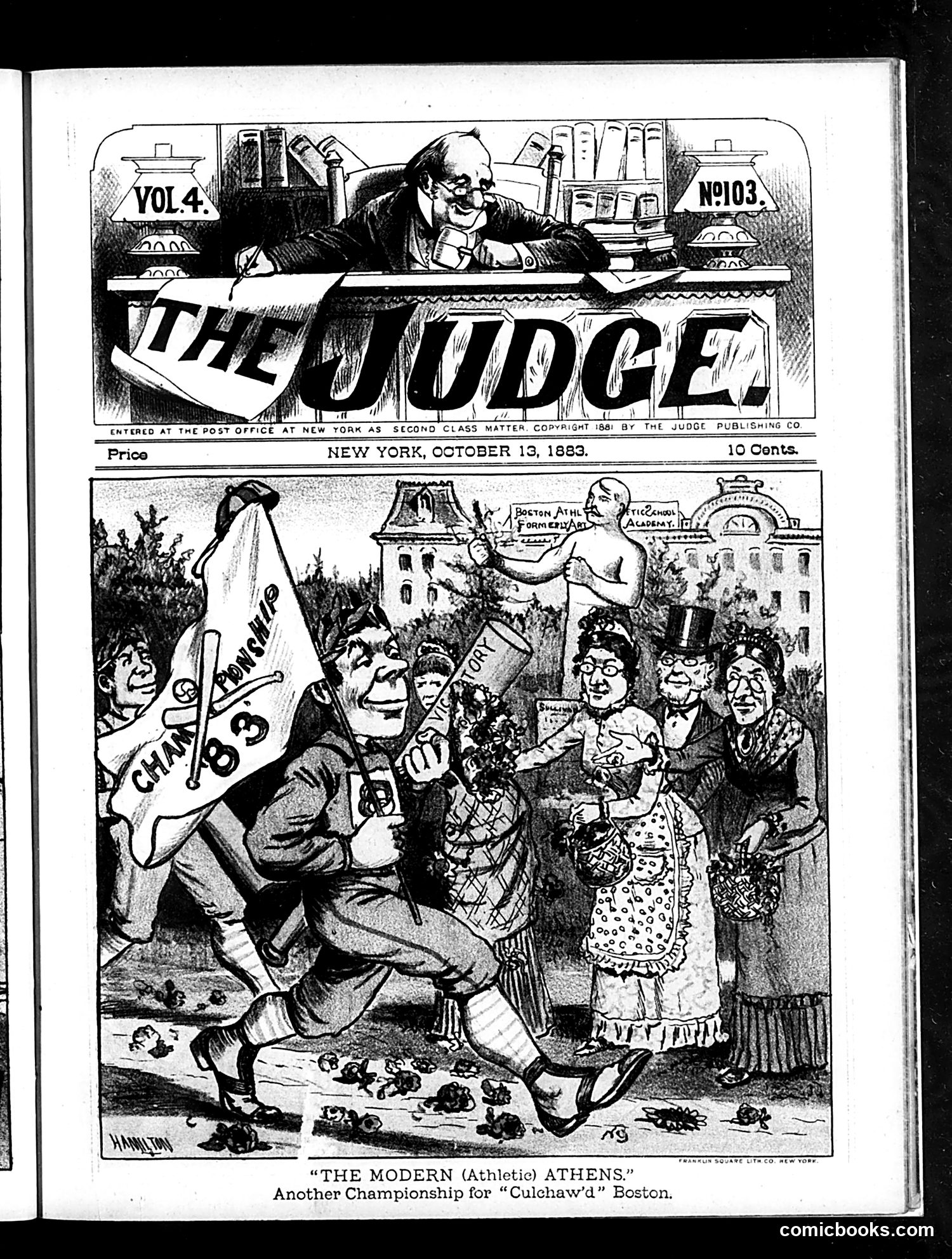
This October 13, 1883 Judge cartoon satirizes a championship athletic competition in Boston called "Culchaw'd" (likely a phonetic rendering of a Boston accent pronunciation). The main figure is a muscular, nearly-nude athlete labeled "Boston Athl[etic]" striking a triumphant pose atop a classical Greek building, referencing Boston's cultural pretensions to being America's "Athens" (an intellectual and cultural center). Below, diverse spectators—depicted with caricatured features typical of 1880s satirical cartooning—wave a flag reading "CHAMP 83" and cheer the victory. The satire appears to mock the contrast between Boston's elite cultural aspirations and the rowdy, working-class enthusiasm surrounding modern athletic spectacles, suggesting athletics had become the new religion replacing classical learning.
The main article satirizes **Anthony Comstock**, a real anti-vice crusader famous for aggressive moral policing. The cartoon depicts him as self-defeating: his loud, publicized raids—complete with "trumpets blowing and banners flying"—tip off gamblers, who flee before he arrives. The satire is that Comstock's love of newspaper notoriety undermines his actual effectiveness. His Coney Island gambling raid failed spectacularly because vice operators simply relocated, leaving him "empty-handed" while "pool-selling continued" elsewhere. The piece mocks the contradiction between Comstock's moral righteousness and his practical incompetence, comparing his strategy absurdly to the Biblical siege of Jericho—as if shouting would defeat a clever enemy. The underlying joke: Comstock performs virtue for publicity rather than achieving results. A secondary article mentions **John Kelly** and Democratic Party politics (likely Tammany Hall-related), but remains unclear without additional context.
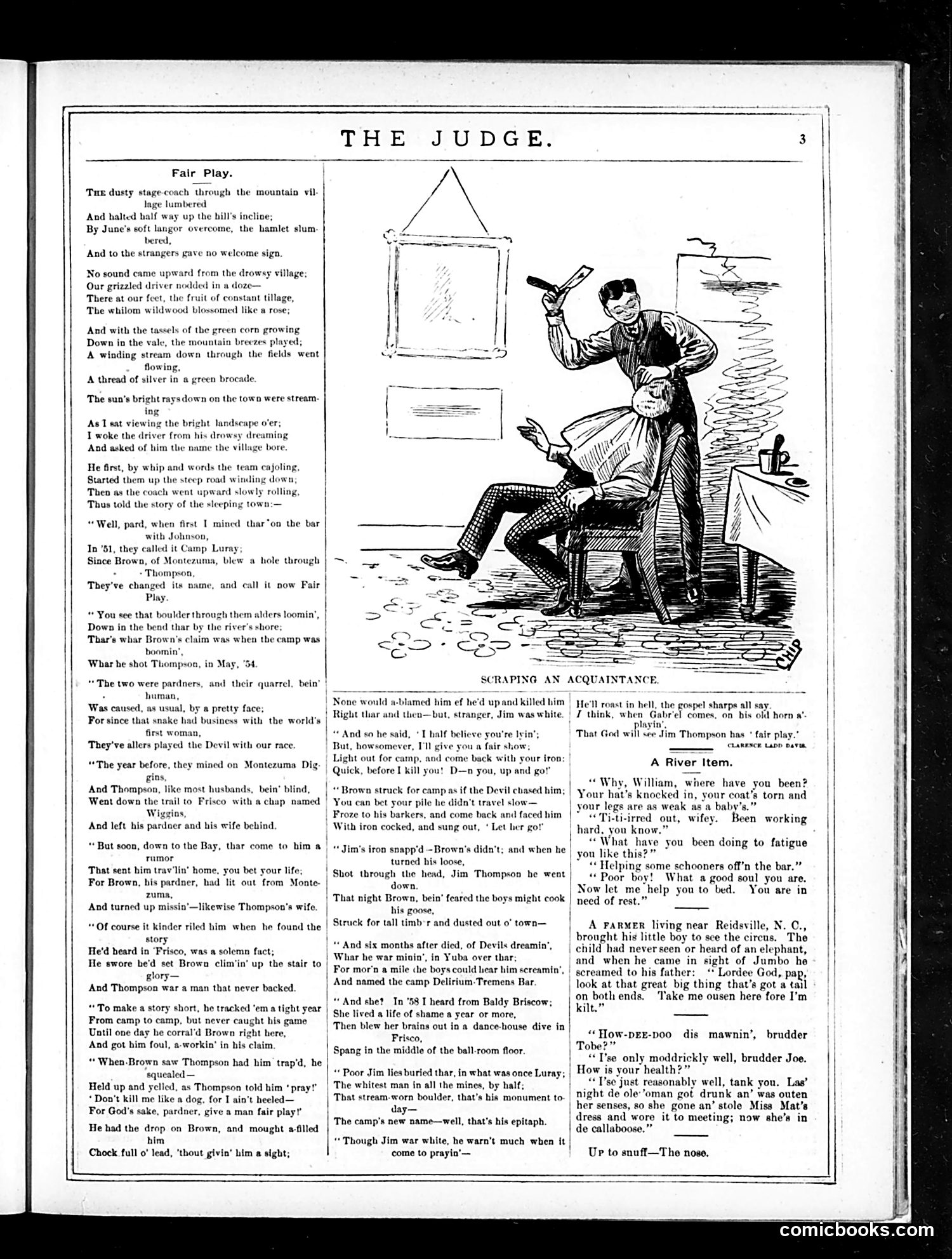
This page presents a narrative poem with accompanying illustration about frontier mining-camp justice in Gold Rush California. The story concerns two mining partners—Brown and Thompson—who quarrel over a woman. Thompson leaves camp; Brown absconds with Thompson's wife. When Thompson discovers the betrayal and tracks Brown down, he has him at gunpoint but grants Brown a "fair" chance to retrieve his gun and fight back—a code of frontier honor. The irony and satire lie in this notion of "fair play": Thompson kills Brown in the resulting gunfight, and Brown later dies of delirium tremens in the mountains. The illustration shows the two men in confrontation near a river. The piece satirizes romantic notions of frontier masculine honor—the idea that giving an opponent a "fair chance" to kill you constitutes nobility, when the outcome remains essentially murderous and the woman involved is barely mentioned.
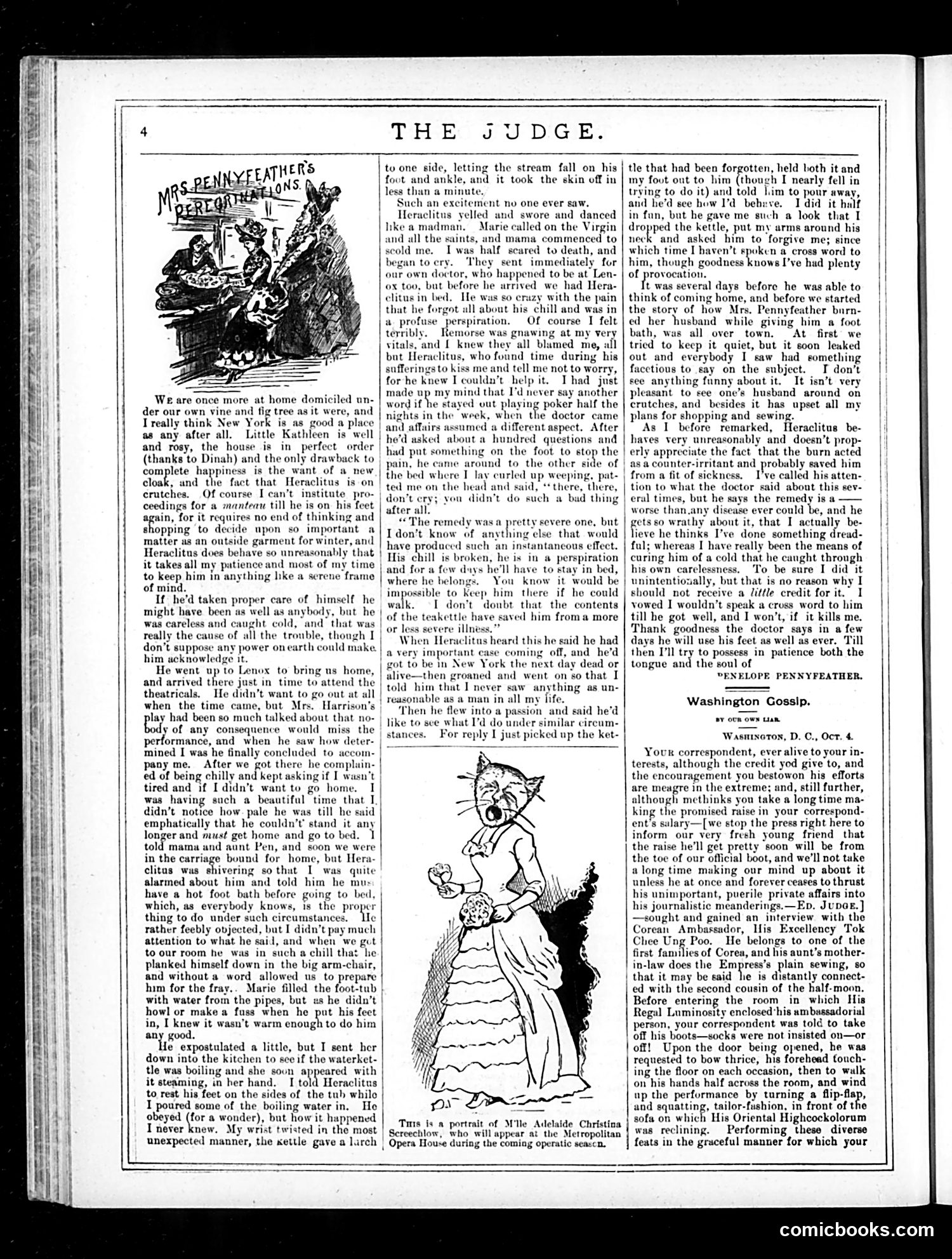
This page contains a serialized domestic humor story titled "Mrs. Pennyfeather's Experiences" (visible in the masthead illustration). The narrative is a first-person account by a society wife recounting a household mishap. **The Story's Satire:** The piece mocks upper-class domestic life and the narrator's self-centered perspective. While ostensibly about her husband Heraclitus's scalded foot—an accident she caused by carelessly pouring boiling water—the narrator spends most of her account detailing her own concerns: her desire for a new winter cloak, her frustration at missing social events, and her irritation that her husband's injury disrupts her life. **The Humor:** The satire lies in her obliviousness to her own culpability and selfishness. She initially resents Heraclitus's illness for interfering with a theater outing, and even after injuring him, her guilt quickly transforms into resentment that he might attend poker games. **Period Context:** This reflects late 19th-century *Judge* magazine's typical satirical approach to wealthy American society—gently mocking marital dynamics and female materialism through supposedly "authentic" accounts.
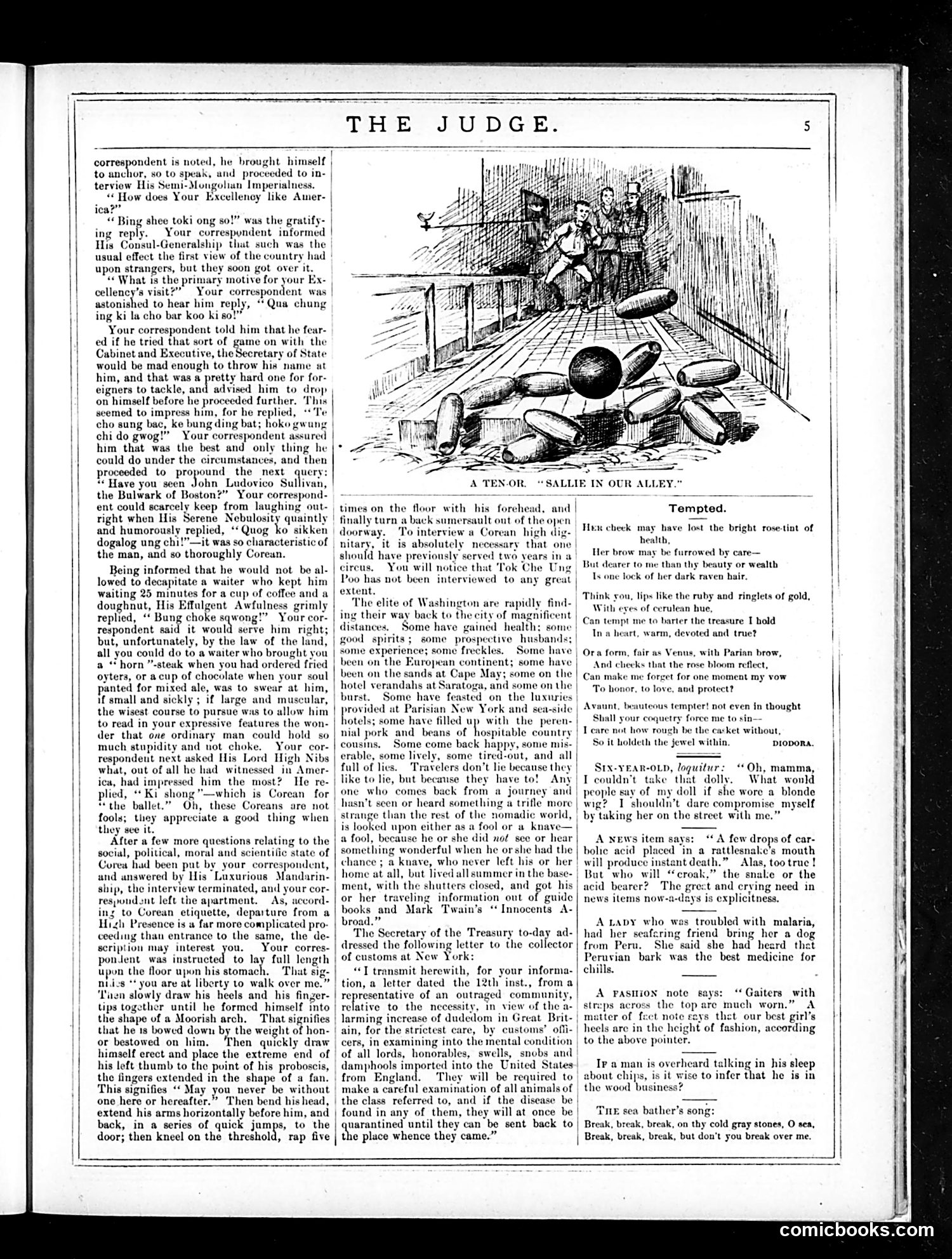
This page satirizes a visit by a high-ranking Korean (referred to in offensive period language as "His Semi-Mongolian Imperialness") to America. The cartoon depicts the visitor observing what appears to be street life or a brawl. The text is a mock-serious account of an interview with this dignitary, featuring: - **The satire**: Stereotypical "nonsense" Korean speech ("Bing shee toki ong so!") used to mock both the visitor and American interviewer's patronizing attitudes - **Social commentary**: Jabs at American service industry (complaining about waiters) and cultural pretensions - **The joke**: The Korean is most impressed by "the ballet"—suggesting superficiality or that visitors only appreciate America's entertainment, not its substance - **Elaborate court protocol**: Detailed descriptions of Korean etiquette (prostrating, arch-shaped bowing) presented as absurdly complicated, emphasizing xenophobic views of "Oriental" customs as bizarre The piece reflects late-19th-century American attitudes: condescending toward foreign visitors while satirizing both Korean customs and American pretension.
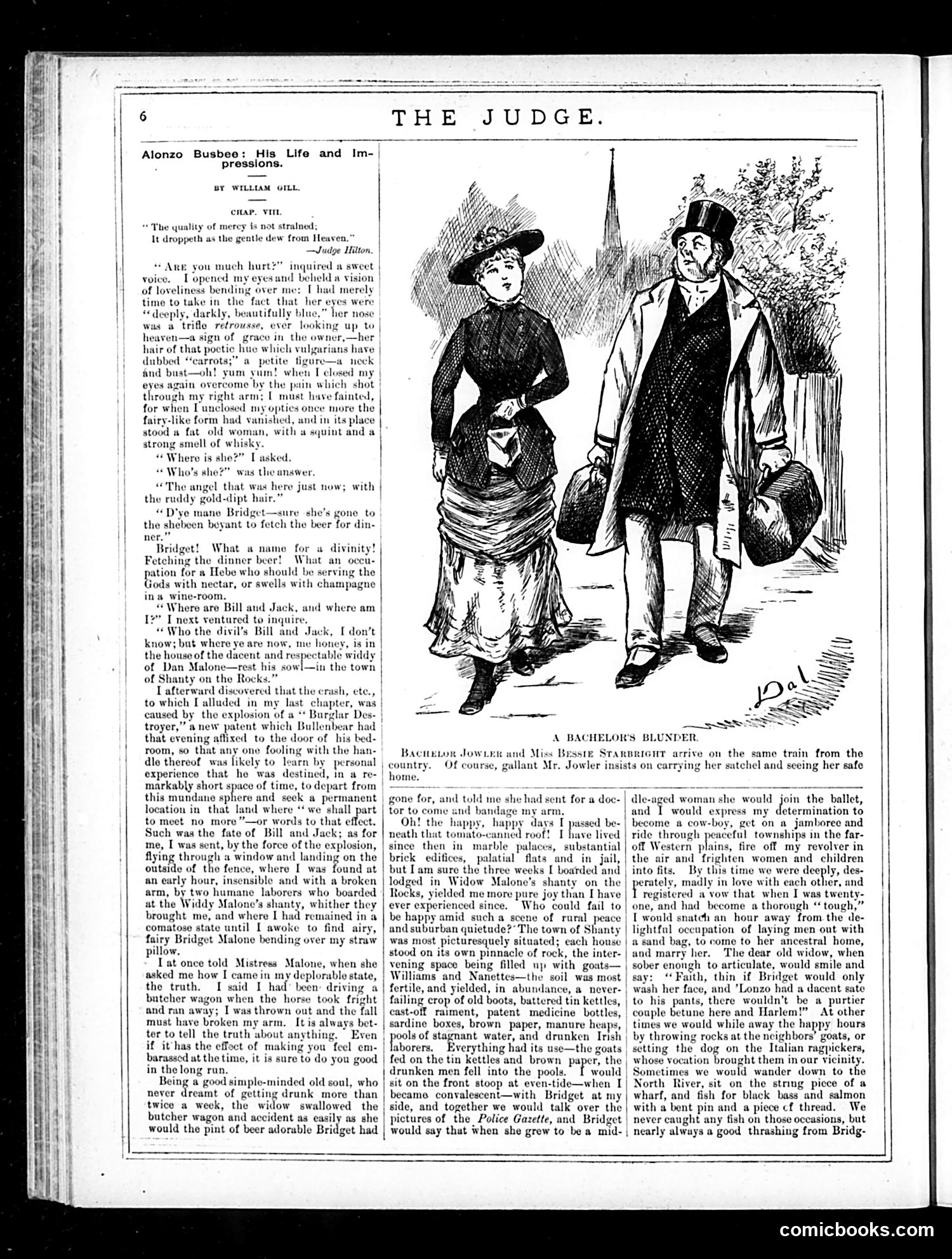
This page from *Judge* magazine presents a serialized story by William Gill titled "Alonzo Busbee: His Life and Impressions," with an illustration captioned "A Bachelor's Blunder." The narrative describes a man who, after a home explosion involving a "Burglar Destroyer" device, awakens in the house of Widow Malone in "Shanty on the Rocks"—a satirical name suggesting a poor Irish settlement. He initially mistakes an attractive young woman (Bridget) for an angel, only to discover she's actually the widow's unattractive daughter. The satire targets **Irish immigrant stereotypes**: the comic juxtaposition of romantic delusion versus harsh reality, drunkenness ("strong smell of whisky"), broken English dialect, and poverty are typical *Judge* magazine conventions mocking Irish-Americans. The "Shanty on the Rocks" setting emphasizes working-class immigrant housing conditions. The humor relies on the protagonist's disappointed expectations—a common comedic device of the era—combined with ethnic caricature typical of 19th-century American satirical publications.
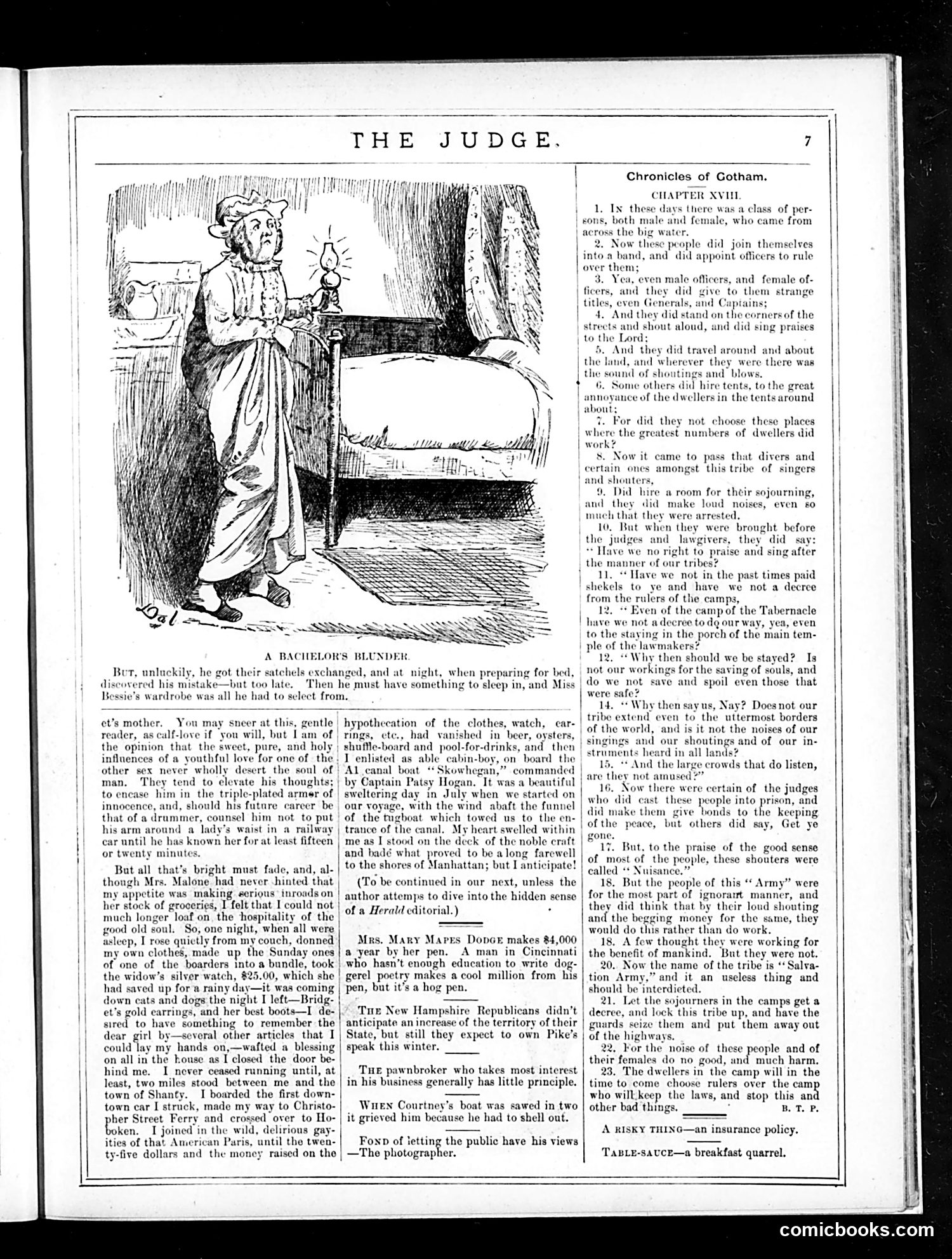
This Judge magazine page contains two distinct pieces: **"Chronicles of Gotham" (Top Right):** A mock-biblical parody mocking immigrant groups arriving in America ("across the big water"). It satirizes their religious street preaching, communal living in tent camps, and loud public demonstrations. The coded references to "officers" with strange titles suggest organized labor or socialist movements. The tone is dismissive of their activism and presence. **"A Bachelor's Blunder" (Main Article):** A comedic narrative about a young man boarding with a widow, who steals her belongings (watch, earrings, boots, money) before fleeing to Hoboken and enlisting on a canal boat. The humor relies on his shameless theft rationalized through romantic nostalgia, and the contrast between his sentimental feelings and his actual criminal behavior. The scattered brief quips at bottom are typical Judge filler—wordplay and observations with no particular topical reference. The overall page reflects late 19th-century American anxiety about immigration and labor movements alongside conventional humor about petty crime and romantic foolishness.
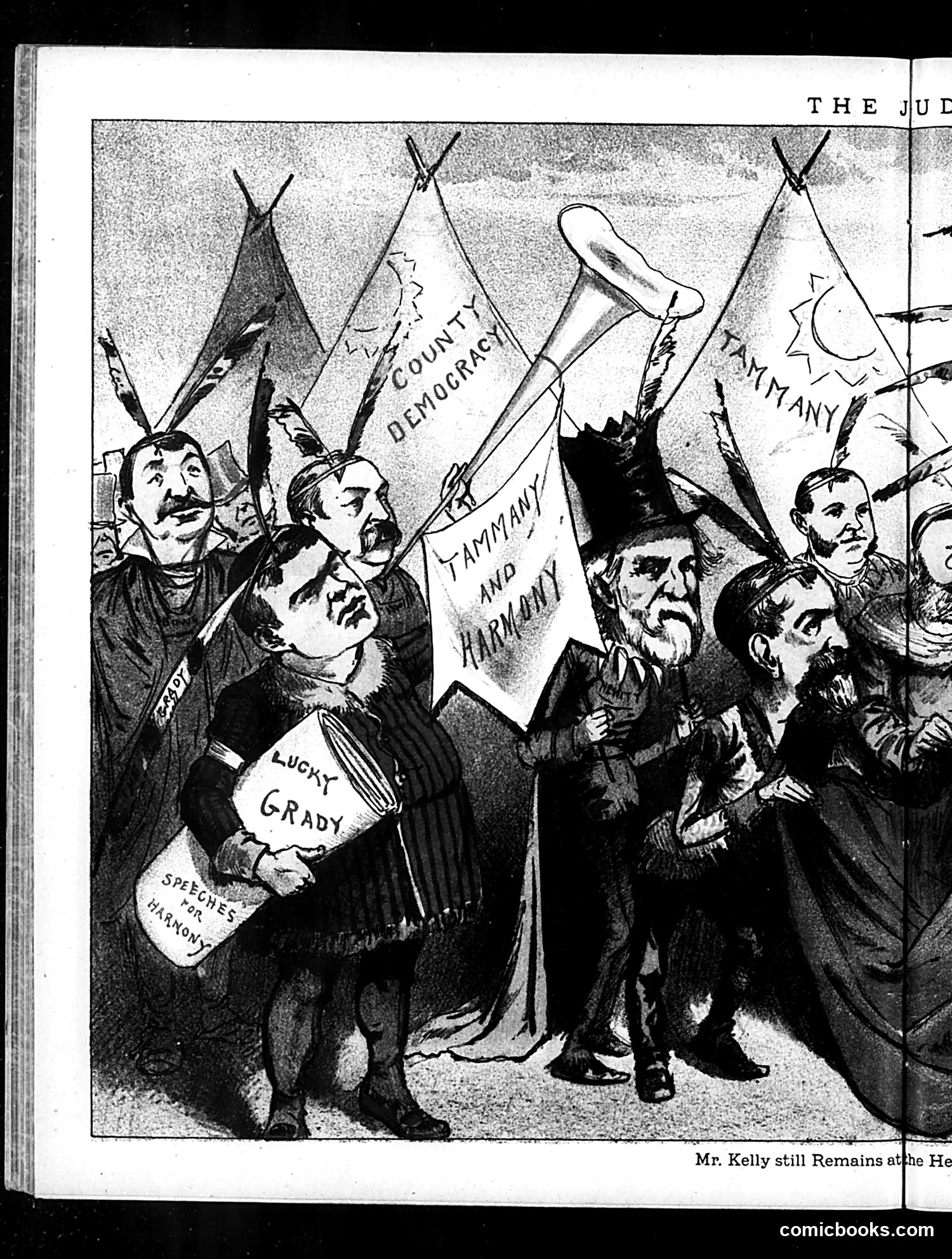
This satirical illustration depicts a group of caricatured figures carrying teepees and holding signs reading "Democracy," "Tamman and Harmony," and "Tammany." One figure clutches a bottle labeled "Lucky Grady" and another holds "Speeches for Harmony." The cartoon appears to target **Tammany Hall**, the notorious New York Democratic political machine known for corruption. The Native American imagery and teepees suggest these politicians are "playing Indian"—a contemporary satirical metaphor for deception or inauthenticity. The labels mock the gap between Tammany's public rhetoric about "democracy" and "harmony" versus their actual corrupt practices. The referenced "Mr. Kelly" likely relates to a specific Tammany politician, though the incomplete caption prevents certain identification. The satire criticizes Democratic machine politics through visual ridicule of hypocrisy.
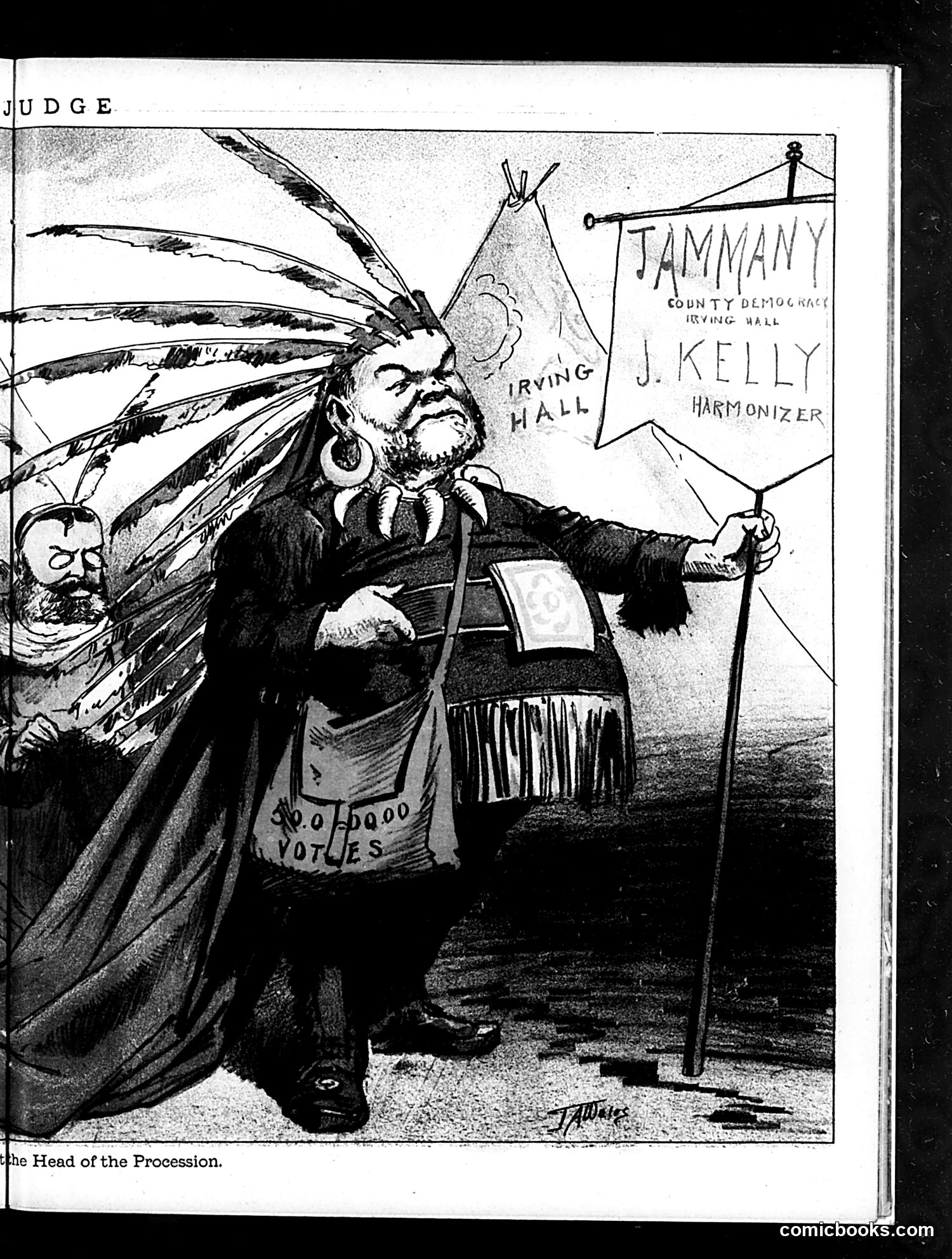
This political cartoon depicts a Native American figure leading a procession, labeled "Head of the Procession." The figure wears traditional regalia including a feathered headdress and holds a staff, carrying what appears to be a ballot box marked "10,000 VOTES." The caption identifies this as representing "County Democracy" with references to "Irving Hall" and "J. Kelly, Harmonizer"—likely political figures associated with New York Democratic machine politics of the late 19th century. The satire appears to mock Democratic Party efforts to control or "harmonize" ethnic voting blocs, depicting the Native American as a symbolic head of a political procession. The characterization uses a racial stereotype to ridicule how political machines allegedly manipulated different constituencies for electoral gain.
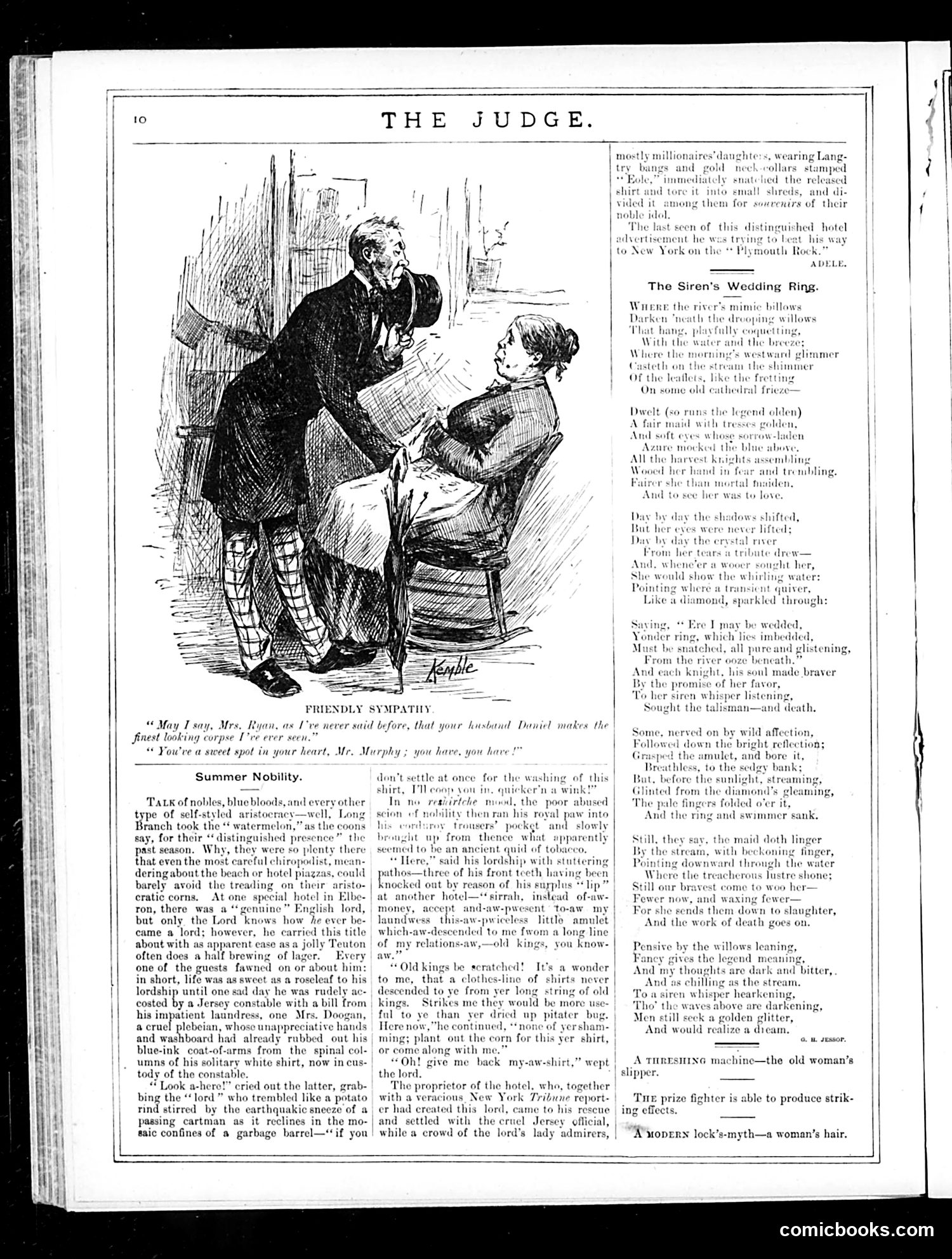
The main cartoon satirizes pretentious European aristocrats visiting Long Branch, New Jersey. A fake English "lord" so poor he cannot pay his laundry bill attempts to offer his laundress an old family heirloom instead of money. A blunt Jersey constable mocks his claim that the amulet descended from "old kings," suggesting the supposed noble lineage is fraudulent. The joke: American social climbers and fake European nobility are exposed as worthless when confronted with ordinary financial obligations. The accompanying poem "The Siren's Wedding Ring" appears to be sentimental verse about a maiden who spurns suitors by showing them a magical ring in the river—likely unrelated satirical content typical of Judge's mixed editorial approach. The satire targets both pretentious fake nobility and the American tendency to fawn over dubious foreign titles.
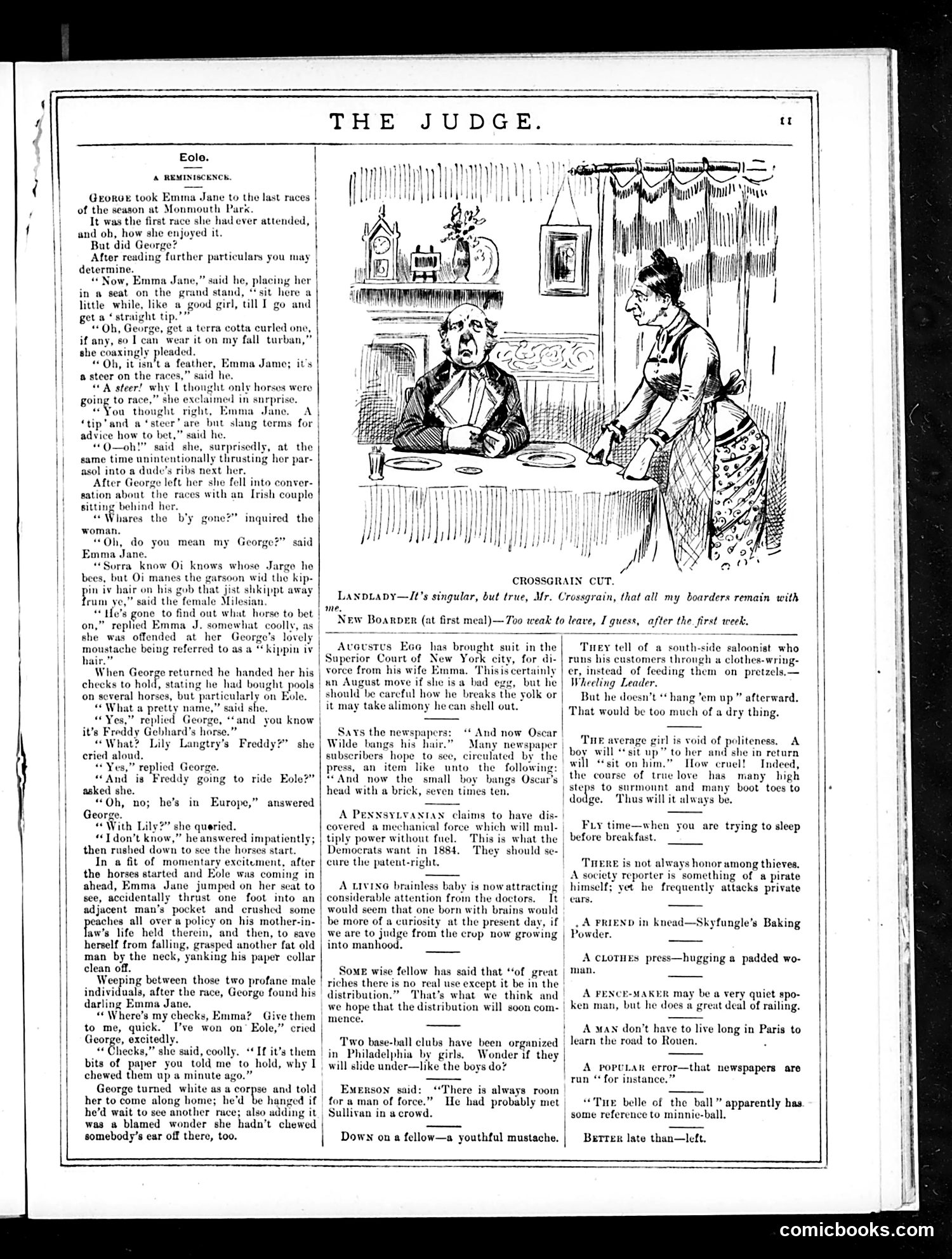
This is a humorous story about a naive young woman, Emma Jane, attending her first horse race. The satire works on multiple levels: **The Main Joke:** Emma Jane misunderstands racing slang. When George mentions getting a "straight tip" and a "steer" (betting advice), she thinks he means a decorative terra cotta curl for her hat and livestock. Later, when he gives her his betting "checks" to hold, she chews them up, costing him his winnings. **The Satire:** The piece mocks social pretension and ignorance. Emma Jane's misunderstandings expose how ridiculous specialized jargon sounds to outsiders. Her reckless behavior at the races (jabbing people with parasols, yanking a man's collar) suggests the chaos caused by uninformed spectators. **The Political Bits:** Brief quips mock contemporary figures like Oscar Wilde and Auguste Egg (likely a real divorce case), and satirize Democrats' false promises about perpetual-motion machines. The cartoon itself (labeled "Crossgrain Cut") illustrates the story's main scene.
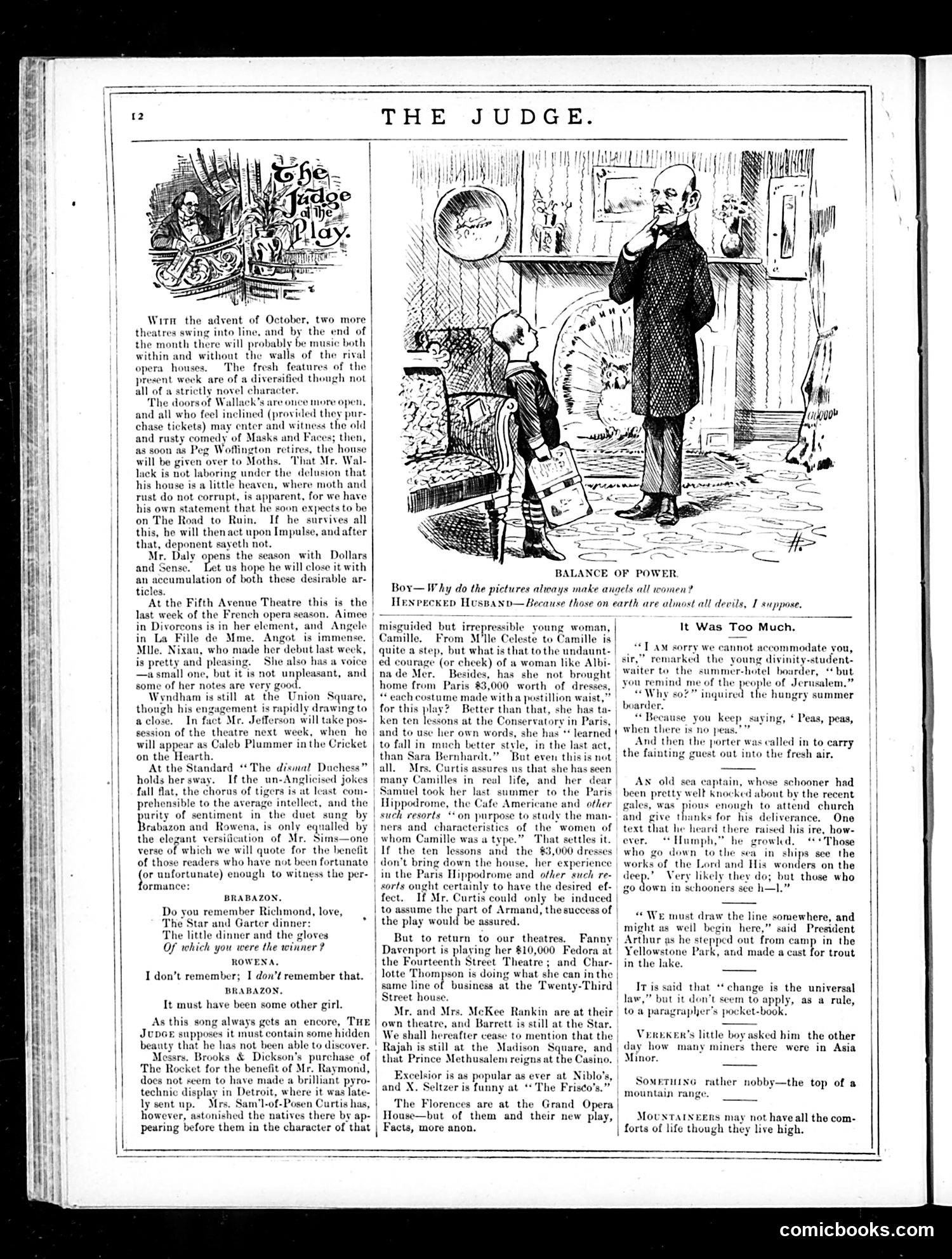
This page contains a theatrical gossip column with an accompanying political cartoon titled "Balance of Power." **The Cartoon:** The image shows a husband and wife in their home. The wife, standing on furniture, appears to be literally outweighing her husband on a scale-like composition. The caption jokes that pictures always depict angels as female because "those on earth are almost all devils, I suppose"—a common Victorian-era quip about marital power dynamics, sarcastically suggesting wives dominate their households. **The Context:** This reflects late-19th-century anxieties about women's increasing independence and domestic authority. The "balance of power" reference is humorous rather than political—it's about household gender relations, not government. **The Text:** The column reviews Broadway theaters and their current productions, gossiping about performers and upcoming shows. It mentions French opera, comedies, and dramatic productions, revealing what was popular in American theater during this period. The humor relies on insider theater knowledge and contemporary social commentary about gender roles.
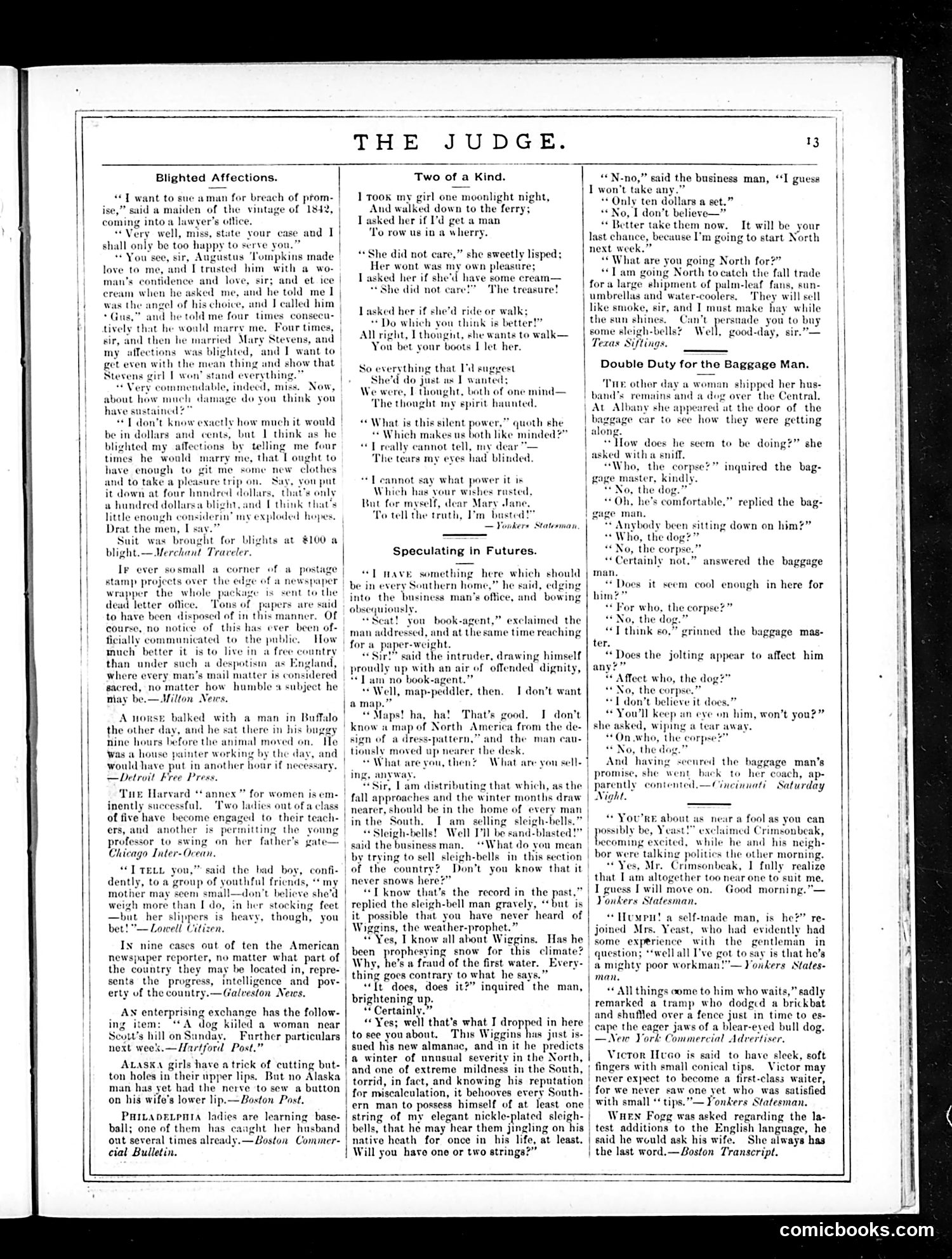
This page from **Judge** (a 19th-century American satirical weekly) contains several humorous short pieces mocking social conventions: ## Main Content: **"Blighted Affections"** satirizes breach-of-promise lawsuits—a real legal action where women could sue men who broke engagement promises. The joke: a woman sues her former suitor for $100 because he courted her four times before marrying another woman, claiming emotional damages. The satire targets both frivolous litigation and the sentimental romanticism of the era. **"Two of a Kind"** is a light romantic poem about a compliant girlfriend who agrees with everything the speaker suggests—the humor lies in his realization that their "perfect compatibility" simply means she has no opinions of her own. **"Double Duty for the Baggage Man"** depicts a deadpan exchange between a passenger and railroad baggage handler about a dog in the luggage car, played for absurdist humor. The remaining items are brief comedic observations about contemporary life (mail systems, horses, teachers, Alaska, Philadelphia women playing baseball). The tone throughout is gentle mockery of Victorian social conventions, courtship customs, and everyday absurdities.
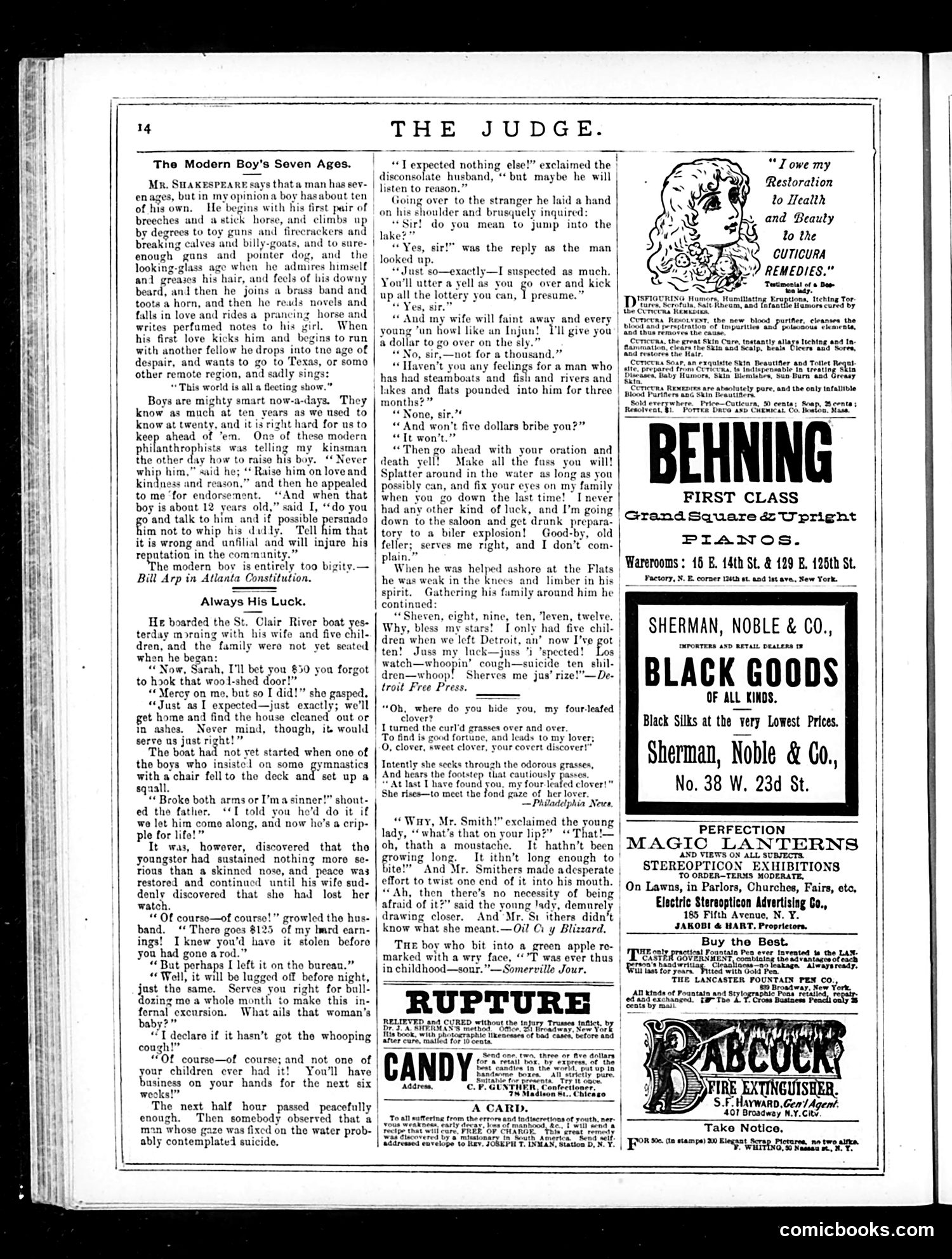
This humorous short story satirizes the pessimistic, perpetually unlucky husband—a recurring character type in period comedy. The narrative follows a man boarding a riverboat who immediately predicts disaster: his wife forgot to lock the shed, his child will be injured, his wife will lose her valuables, and his baby will get whooping cough. The satire operates on irony: his catastrophic predictions either don't materialize or prove trivial (the child has only a skinned nose), yet he responds to each supposed crisis with fatalistic doom-saying. When he encounters a stranger apparently contemplating suicide, he characteristically assumes the man will jump—revealing how his worldview reflexively expects catastrophe. The joke targets masculine self-pity and the neurotic anxiety of the period's "hard-luck" archetype. His wife and children exist mainly as sources of his imagined misfortunes, and he blames them for problems that don't occur. Judge uses this character to mock both male pessimism and the domestic tensions it creates.
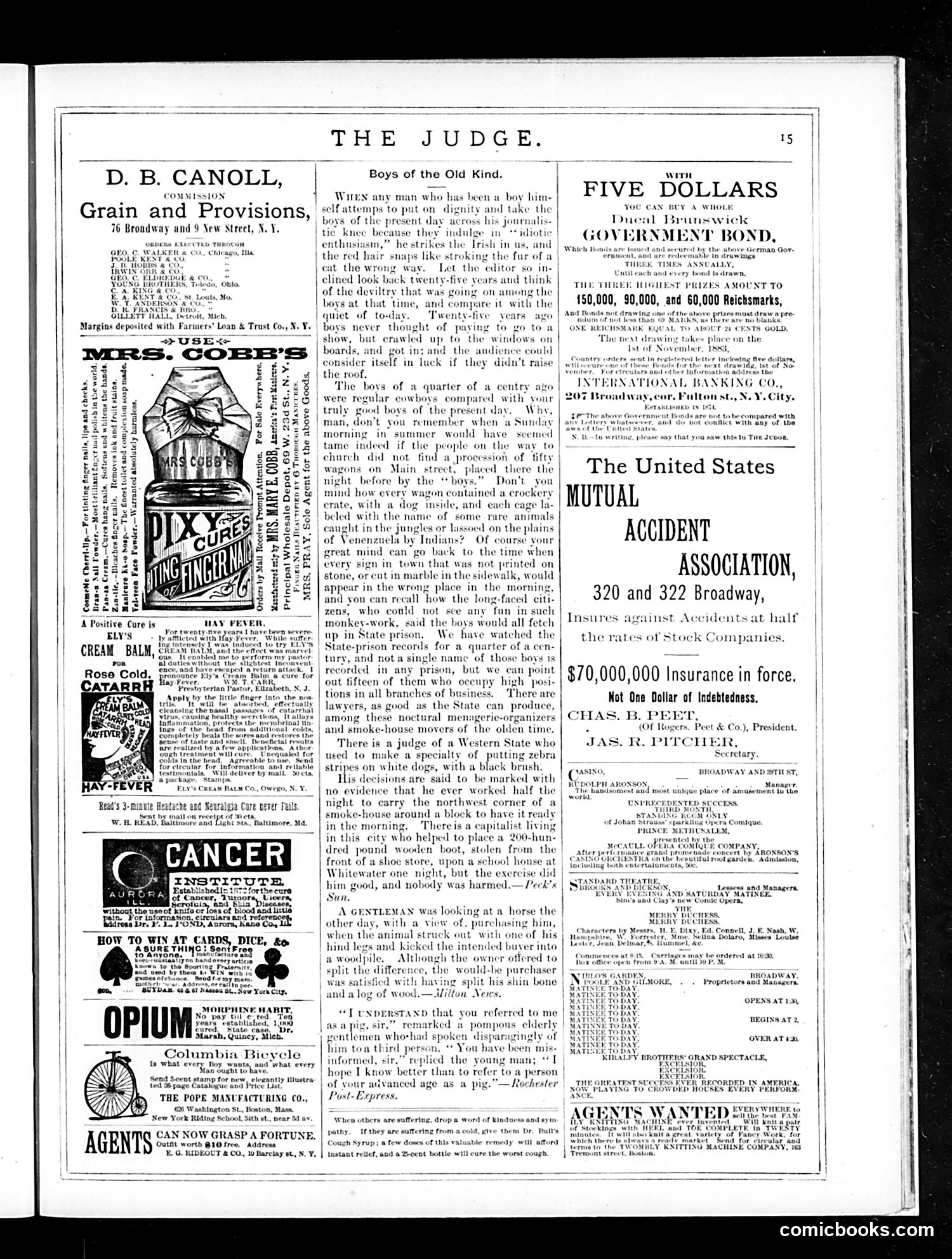
This page is primarily **advertisements and filler content** with one substantial article: "Boys of the Old Kind." ## Main Content: "Boys of the Old Kind" This nostalgic essay compares mischievous boys of 25 years prior to the "quiet" boys of the present day. The author recalls pranks—sneaking into shows, placing dogs in marked crates, moving wagons and smoke-houses, painting zebras on dogs—that he claims built character rather than led to criminality. The satire is **gently self-congratulatory**: the author notes that none of those "wild" boys ended up in prison; instead, many became judges, lawyers, and capitalists. The piece mocks contemporary anxiety about youth delinquency while celebrating the reformative power of harmless mischief. It's essentially arguing that boys need rougher play and adventure. ## Advertisements The page is cluttered with period patent medicines (Ely's Cream Balm, Duff's Cough Syrup), dubious medical institutes (Cancer Institute), and financial schemes, typical of 1880s-90s magazines. The political/social commentary is light—nostalgia for a rowdier, freer childhood rather than sharp political satire.
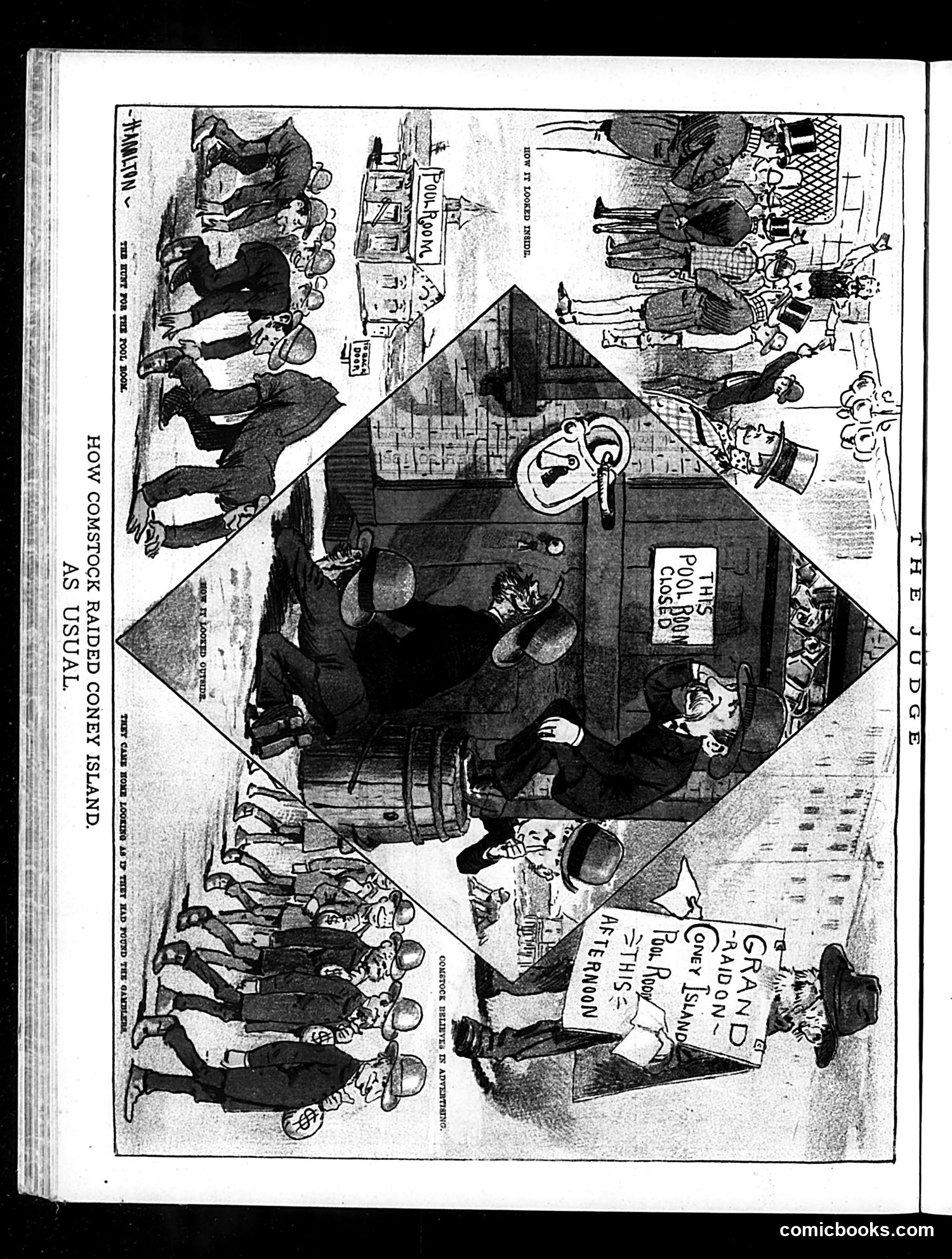
This Judge magazine cartoon satirizes Anthony Comstock, the prominent anti-vice crusader, raiding Coney Island. The diamond-shaped central image shows what appears to be a bathhouse or beach facility being inspected. Surrounding it are figures in formal dress (likely politicians or officials) arranged in a circular pattern. The satire targets Comstock's repeated, zealous raids on Coney Island—a popular seaside amusement destination—ostensibly to enforce morality laws regarding swimwear and public decency. The phrase "AS USUAL" suggests these raids were routine and predictable occurrences that Judge's readers found absurd or excessive. The cartoon mocks both Comstock's self-righteous moralizing and the cyclical nature of his crusades, implying he was more interested in making headlines than genuinely addressing vice.