
A complete issue · 16 pages · 1883
Judge — August 25, 1883
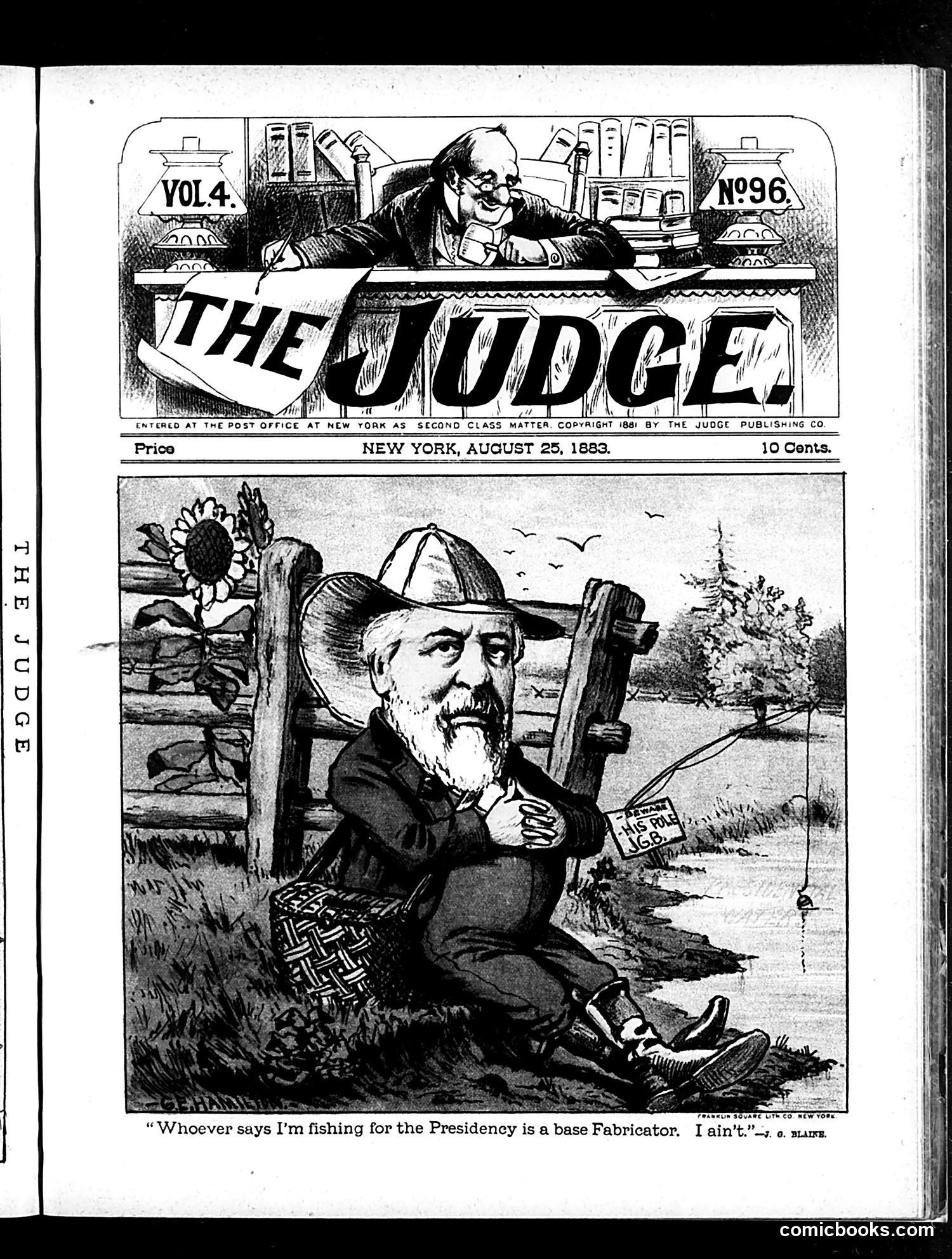
The main cartoon depicts a bearded man in a cowboy hat fishing by a riverbank, holding a rod labeled "THE PULL." A sunflower and rural landscape suggest American frontier imagery. The caption reads: "Whoever says I'm fishing for the Presidency is a base Fabricator. I ain't."—G. BLAINE. This satirizes **James G. Blaine**, a prominent Republican politician of the 1880s. The "fishing" metaphor mocks his denial of presidential ambitions while suggesting he's actively seeking the office through backchannels—hence the ironic contradiction. The cartoon implies Blaine is disingenuously denying what his actions plainly reveal. This likely references the 1884 presidential race, where Blaine was a major candidate despite public denials.
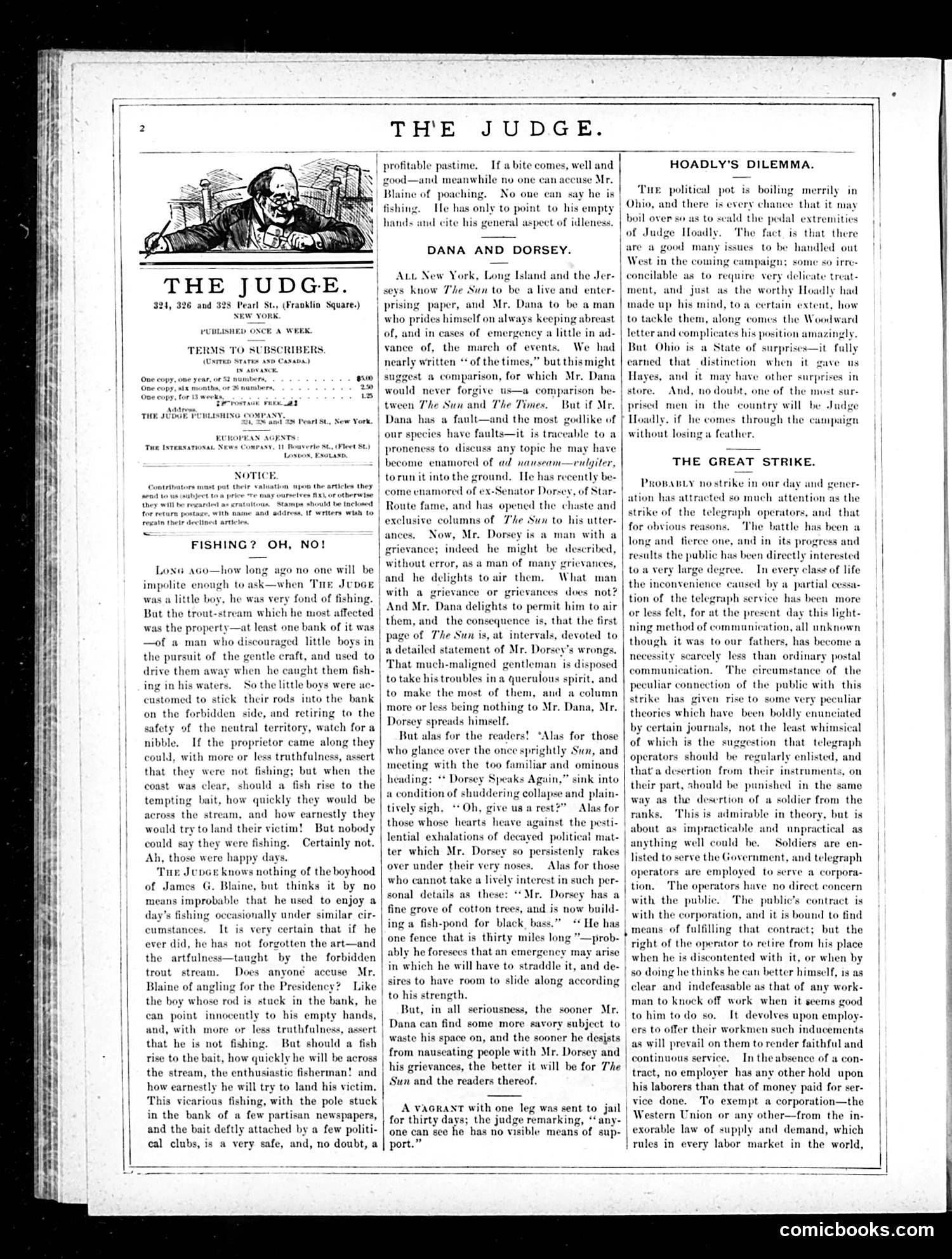
This page contains two main satirical pieces: **"Dana and Dorsey"** (top left): Critiques Charles Dana, editor of *The Sun* newspaper, for hypocritically accusing James G. Blaine of "poaching" (improper political activity) while Dana himself engages in similar behavior. The piece sarcastically notes no one can accuse Blaine of wrongdoing since he keeps his hands empty—a reference to Blaine's cautious political maneuvering. **"Fishing? Oh, No!"** (main article): An extended metaphor comparing Blaine's political strategy to a boy fishing illegally. Like the boy who hides his fishing rod on forbidden property and claims innocence when caught, Blaine uses partisan newspapers as cover ("a pole stuck in the bank") while maintaining plausible deniability. The satire suggests Blaine is strategically positioning himself for the presidency while appearing inactive. **"Hoadly's Dilemma"** (right): References Ohio political complications facing Judge Hoadly, likely related to factional disputes or the Woodward letter (appears to be a contemporary scandal). The overall theme mocks political hypocrisy and strategic deception during the Gilded Age.
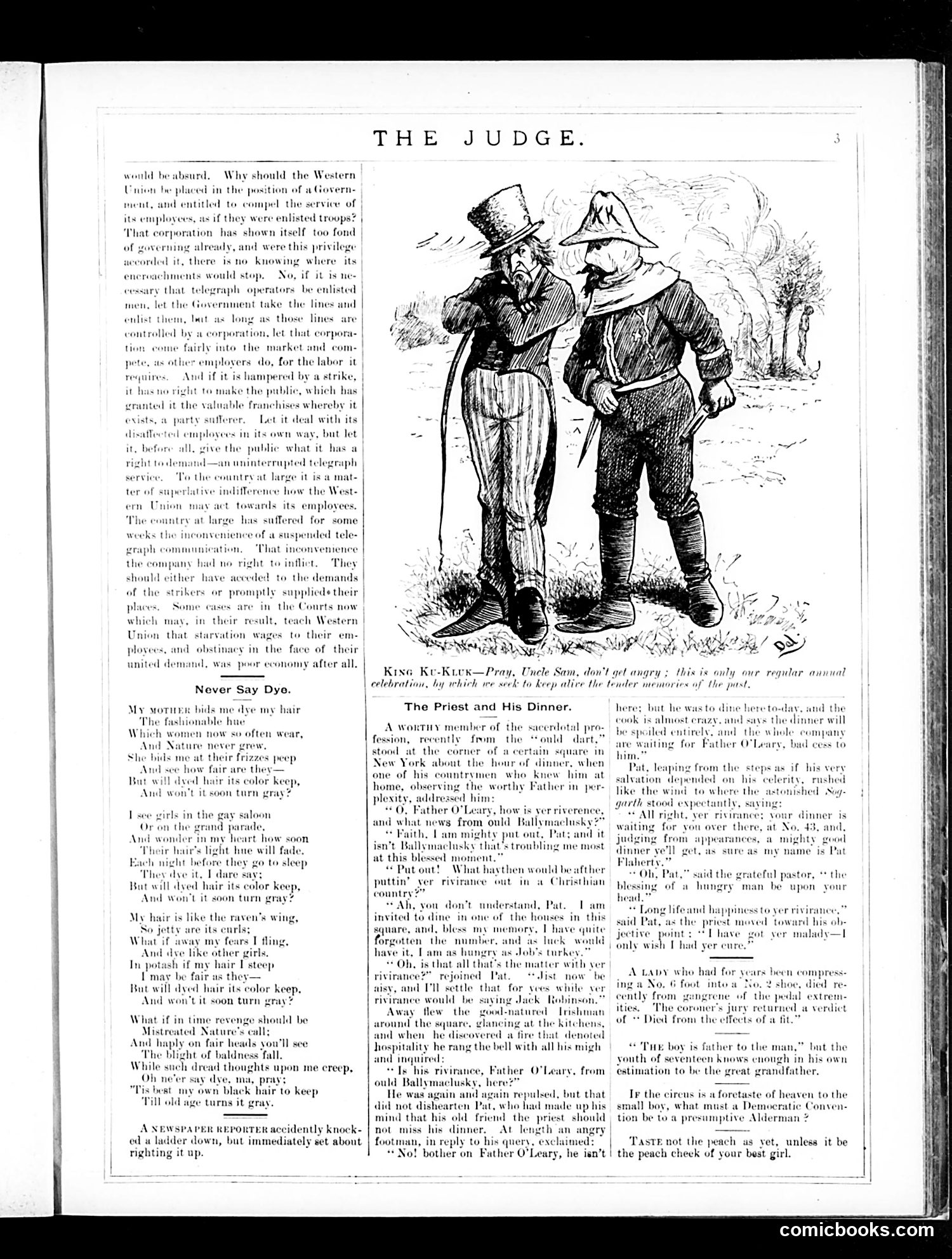
This page contains two main pieces of satire: **The Main Cartoon ("King Ku-Klux"):** Shows two figures in conversation—one appears to be Uncle Sam confronting someone in KKK regalia. The caption presents the KKK member claiming their "regular annual celebration" merely seeks to "keep alive the tender memories of the past." This is heavy irony: Judge is condemning the KKK's violence and racial terrorism by sarcastically repeating their sanitized justifications. The cartoon attacks the organization's attempts to legitimize brutal intimidation as nostalgia. **"The Priest and His Dinner":** A humorous Irish-dialect story about Father O'Leary being invited to dinner but forgetting which house. An Irishman helps him by visiting kitchens until finding roasted turkey, assuming that's the correct address. It's ethnic humor typical of the era, playing on Irish-American stereotypes. **Context:** Judge was a Republican satirical magazine often critical of the KKK and Democratic Party. The KKK reference dates this to the Reconstruction/post-Reconstruction era when the organization was resurgent and violent.
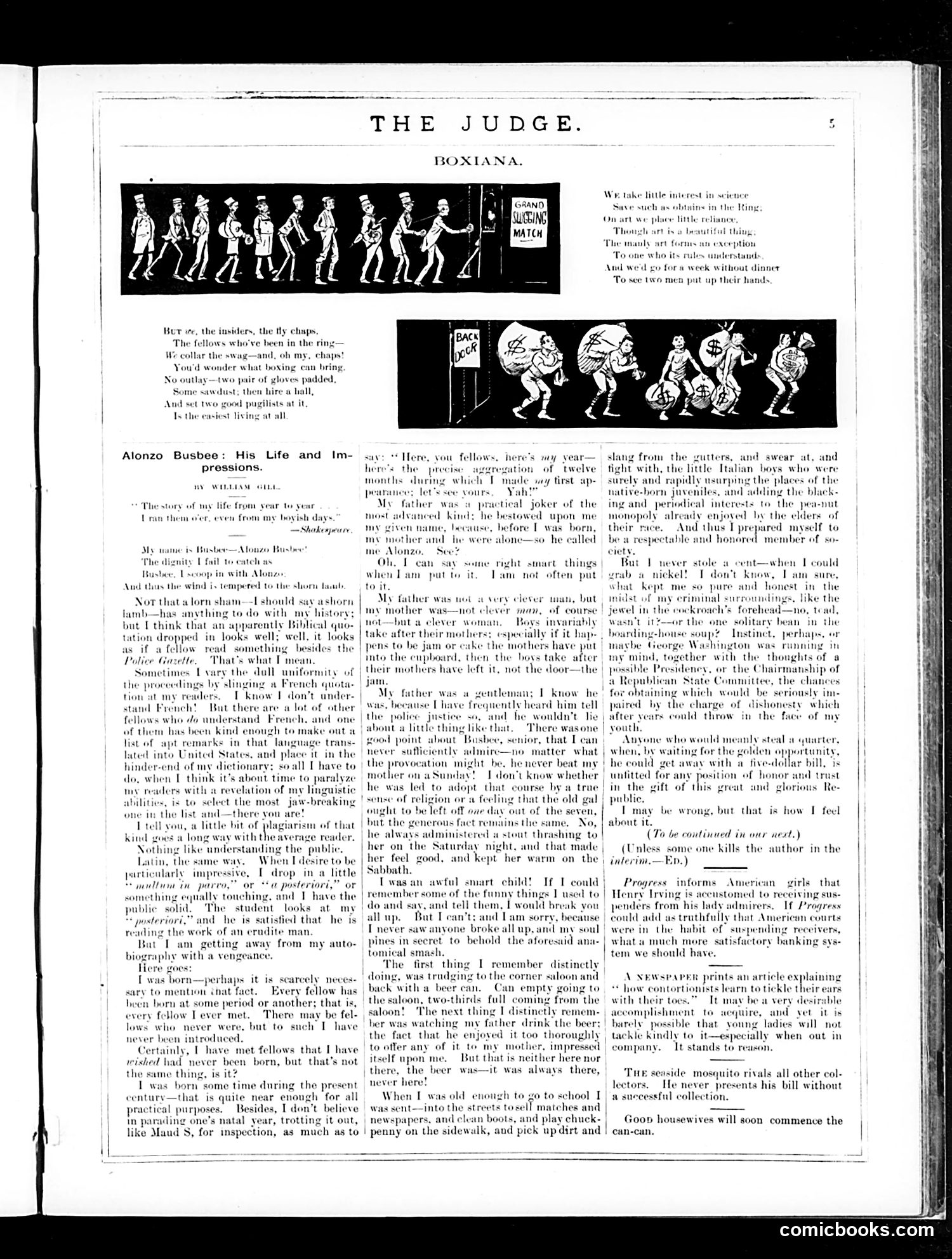
This page contains two distinct sections: **"Boxiana" cartoons** (top): Skeletal figures depicting boxers in a "Grand Nautilus Match" satirize professional boxing as a spectacle. The accompanying verse mocks how easily boxing matches can be staged—requiring merely "two pair of gloves padded" and "two good pugilists" to create entertainment, suggesting the sport is commercialized and easily manufactured. **"Alonzo Busbee: His Life and Impressions"** (main article): A humorous autobiographical narrative by William Gill, where the narrator parodies pompous memoir-writing. The piece uses self-deprecating humor—Busbee admits to plagiarizing French phrases to seem educated, inventing fake biographical details, and adopting affected language. The satire targets pretentious American writers who dress up ordinary lives with false erudition and literary affectation. The joke relies on the narrator's transparent dishonesty about his own mediocrity while attempting to seem sophisticated—a critique of vanity publishing and autobiographical self-aggrandizement common in the era.
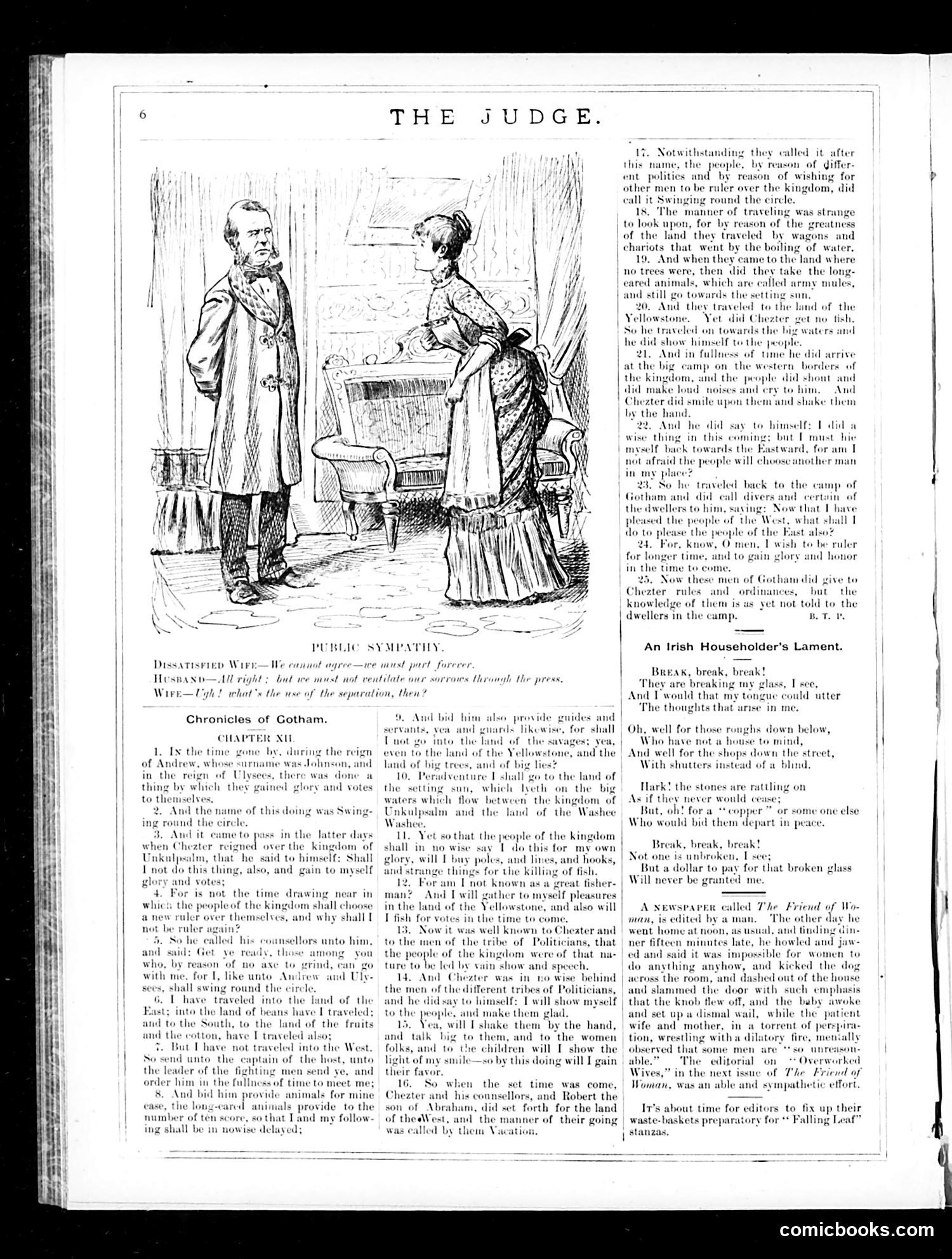
This page contains two distinct satirical pieces: **"Public Sympathy" (top cartoon):** Shows a dissatisfied married couple. The wife complains they "must part forever" but cannot air grievances publicly through the press. The husband insists on discretion. The satire mocks marital disputes that spill into newspapers—a common scandal in the era—suggesting couples want both separation *and* the publicity their disputes generate. **"Chronicles of Gotham" (text):** A mock-biblical narrative satirizing a political figure (likely a New York official, given "Gotham" as NYC's nickname). "Chester" travels west to gain glory and votes, then returns scheming how to please both western and eastern constituencies. The satire critiques self-serving politicians who chase popularity without genuine principles, and their constituents' gullibility. **"An Irish Householder's Lament" (poem):** Depicts poverty—a broken glass, no money for repairs, shuttered shops. Social commentary on working-class Irish-American hardship, likely during economic depression.
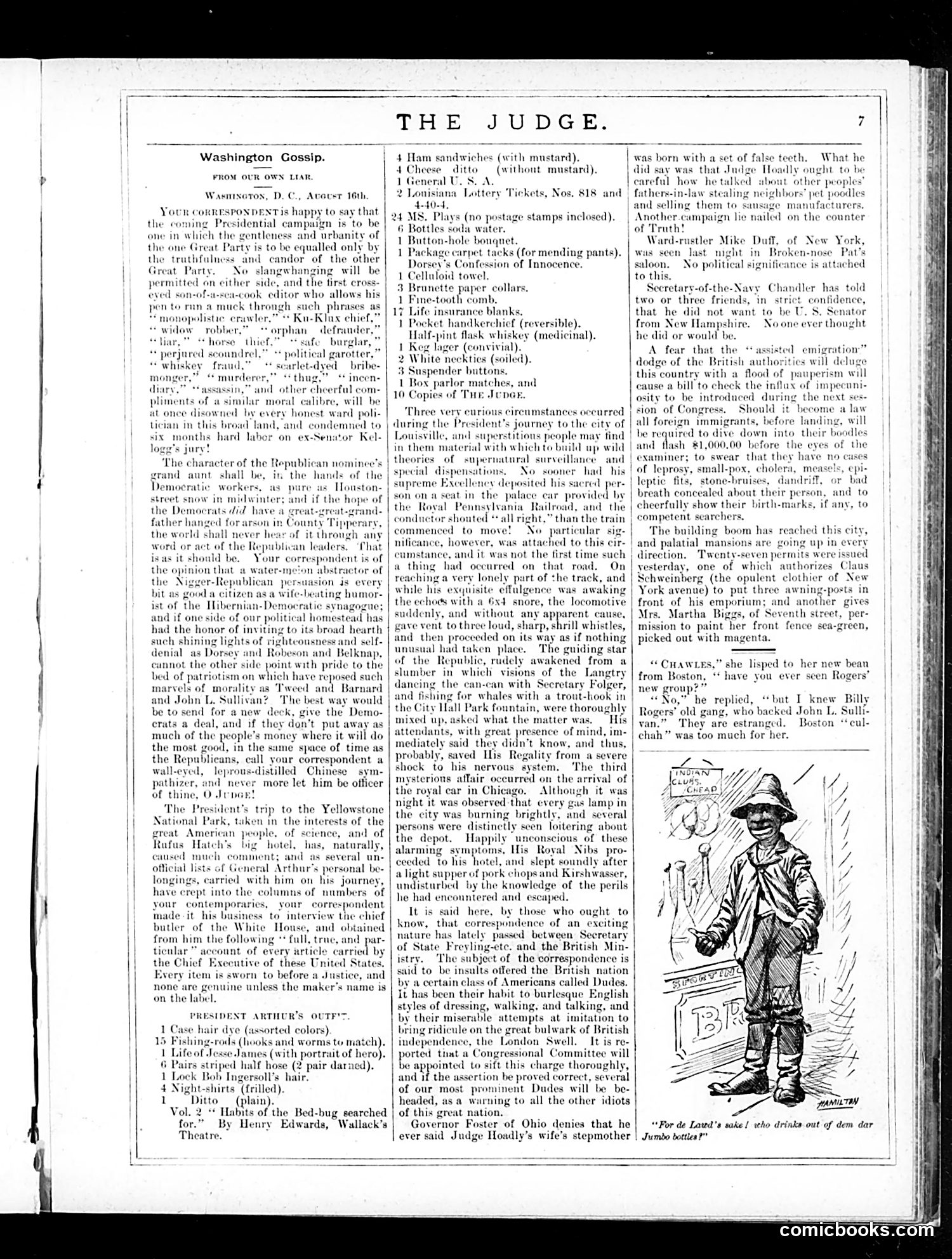
This is a satirical "Washington Gossip" column from Judge magazine mocking the 1884 presidential campaign's claims of civility and honesty. The author ironically promises "truthfulness and candor" while listing precisely the opposite—scandalous accusations against both parties' leaders. The column references real political figures and scandals: "Tweed and Barnard" (corrupt NYC politicians), "Dorsey and Robeson and Belknap" (Grant administration officials implicated in corruption). The satire's point: both major parties loudly denounce each other's moral failings while harboring equally corrupt politicians themselves. The accompanying cartoon (right) depicts a disheveled figure labeled "For de Lord's sake! who drinks out of dem dar brandy bottles?" —likely mocking President Arthur or another political figure's personal conduct. The humor relies on exposing hypocrisy: politicians would rather claim moral superiority than actually reform. This reflects deep cynicism about Gilded Age political corruption.
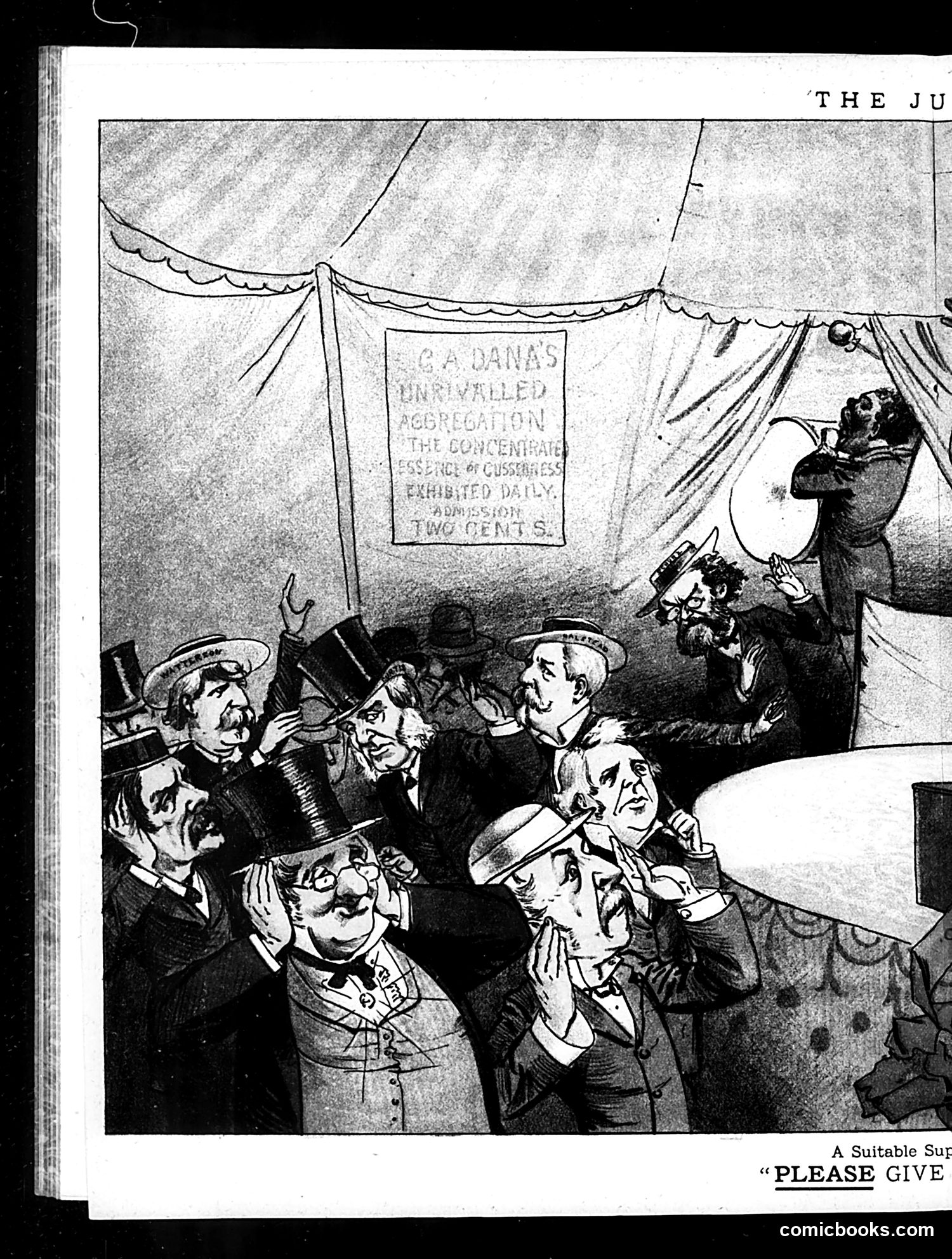
This appears to be a satirical cartoon from *Judge* magazine depicting a circus or carnival tent scene. A sign reads "C.A. DANA'S UNRIVALLED AGGREGATION" with text mentioning "THE CONCENTRATE ESSENCE OF CUSHINESS EXHIBITED DAILY" and "ADMISSION TWO CENTS." The cartoon shows multiple caricatured figures (appearing to be politicians or public figures of the era) gathered inside the tent, with exaggerated facial features typical of period political satire. The "circus" framing suggests the cartoon mocks certain individuals or institutions as fraudulent spectacles designed to fool the public. However, without knowing the specific historical date and political context, I cannot definitively identify the individuals caricatured or specify which political figures or events are being satirized. The partial text at bottom ("A Suitable Sur" / "PLEASE GIVE") is incomplete, limiting full interpretation.
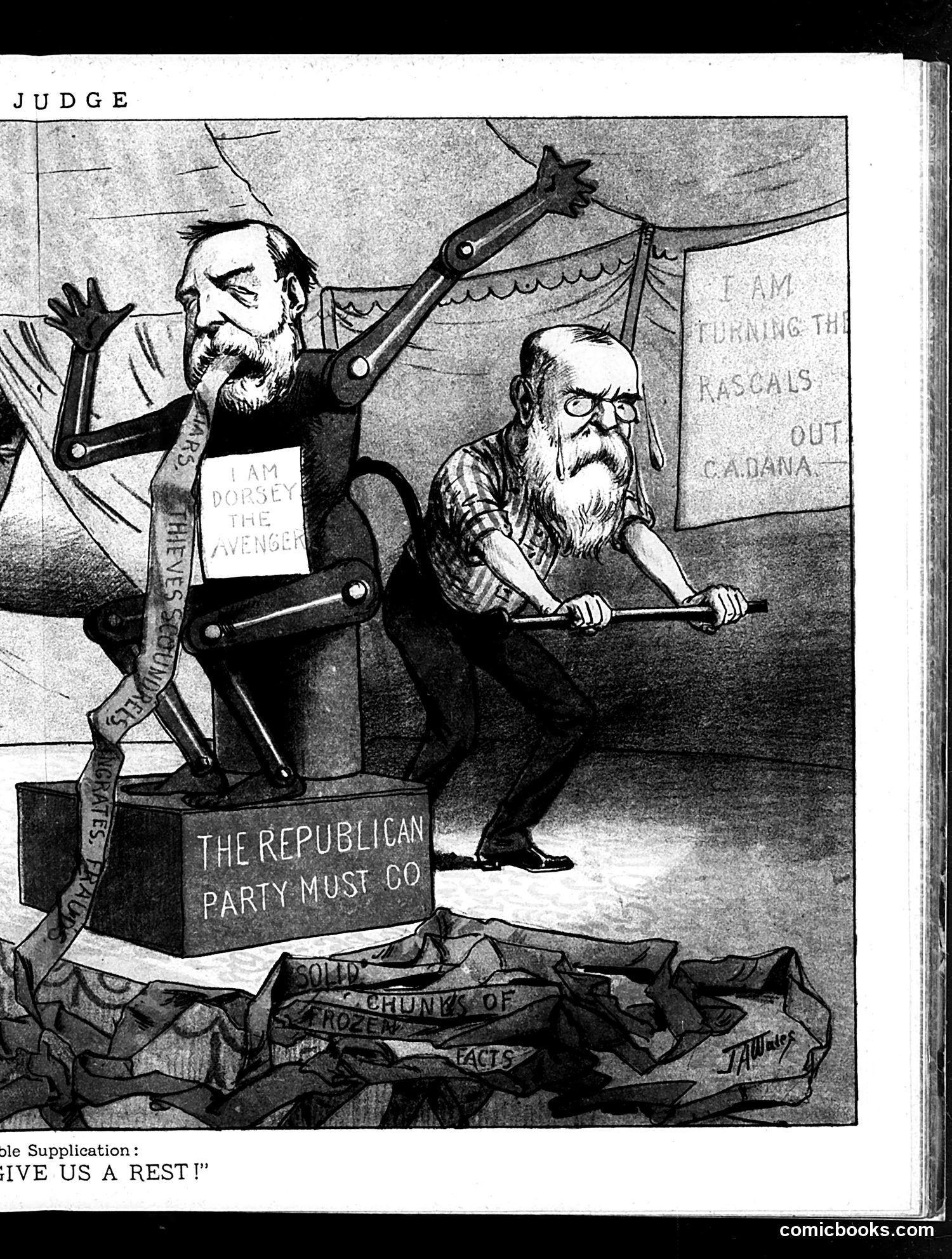
This Judge magazine cartoon depicts a mechanical figure labeled "Dorsey the Avenger" operating a lever marked "The Republican Party Must Do," with text on the lever reading "turning the rascals out." The figure being manipulated appears to be another man labeled with reference to "C. Dana" (likely newspaper editor Charles Dana). The cartoon satirizes Republican Party leadership, suggesting they are being controlled by external forces ("Dorsey") to pursue a specific political agenda—removing corrupt officials ("rascals"). The mechanical imagery implies the party lacks independent agency, merely executing predetermined actions. Scattered papers at the base reference "solid chunks of frozen facts," suggesting the cartoon critiques the party's claimed moral authority to clean up corruption. The exact historical context and identities require additional period documentation to confirm with certainty.
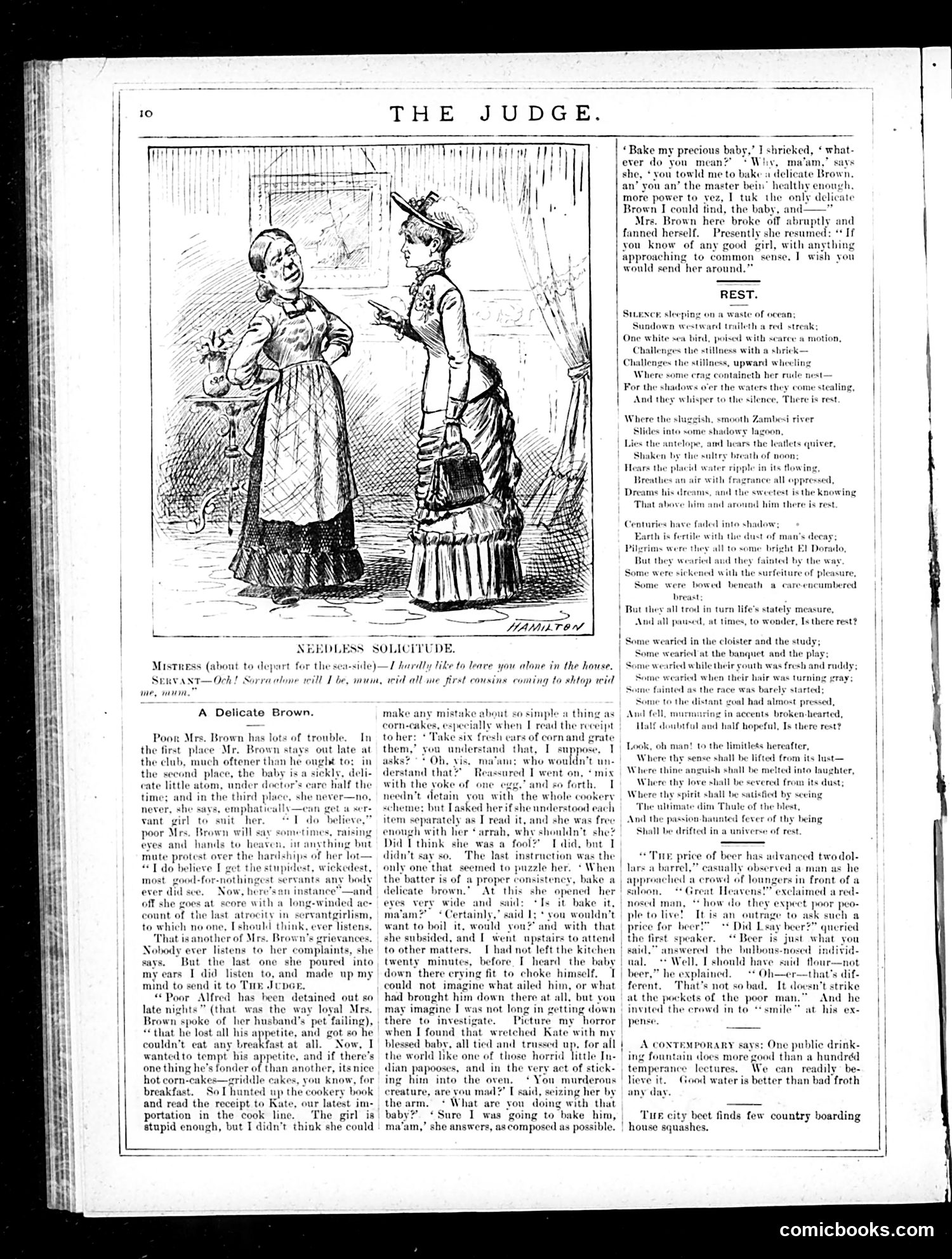
This page contains two satirical pieces about domestic life: **"Needless Solicitude"** (top cartoon by Hamilton): A mistress worries about leaving her house unattended while going to the seaside. Her Irish servant reassures her—she'll have "all me first cousins coming to shtop wid me"—a joke playing on working-class stereotypes about large Irish families and their perceived lack of concern for property maintenance. **"A Delicate Brown"** (main story): A comedic domestic tale where Mrs. Brown instructs her servant Kate to bake "a delicate Brown" (a type of dish). Kate literally interprets this as baking the Brown family's baby, nearly putting the infant in the oven. The humor derives from class-based assumptions about servants' stupidity and the dangers of poor domestic help. Both pieces satirize the anxieties of middle-class household management and the perceived incompetence of working-class domestic servants—a recurring theme in Victorian-era humor reflecting contemporary class tensions and employment concerns.
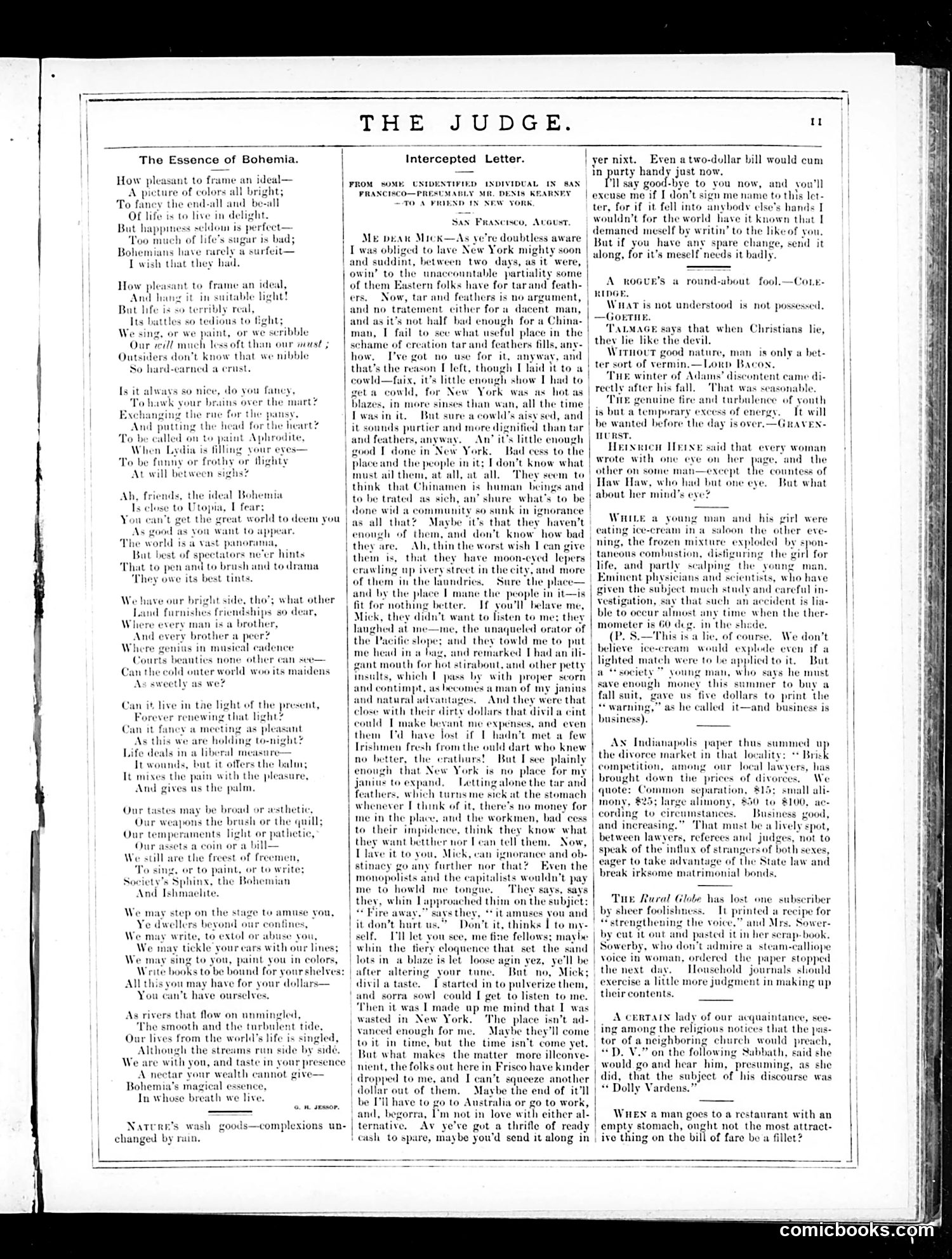
This page from *Judge* satirizes "Bohemian" artistic life in two pieces: **"The Essence of Bohemia"** (left column) is a poem mocking romantic ideals of artistic living. It contrasts the pleasant fantasy of being a struggling artist—painting, writing, composing—with harsh reality: artists barely survive on what they earn, their work is underappreciated, and they're expected to produce masterpieces while "nibbling" hard-earned crusts. The satire suggests Bohemians deceive themselves about their romantic poverty. **"Intercepted Letter"** (center/right) presents a fictional Irish immigrant's complaint to a friend about New York. He describes being driven from the city (apparently for his treatment of Chinese laborers), then lambastes Americans as ignorant, disrespectful, and stingy—unwilling to compensate him fairly. The satire targets both the Irish character's pompous self-regard and likely American attitudes toward both Irish immigrants and Chinese workers during this period of anti-Chinese sentiment. Together, the pieces mock both artistic pretension and immigrant grievance through exaggerated, unflattering characterizations.
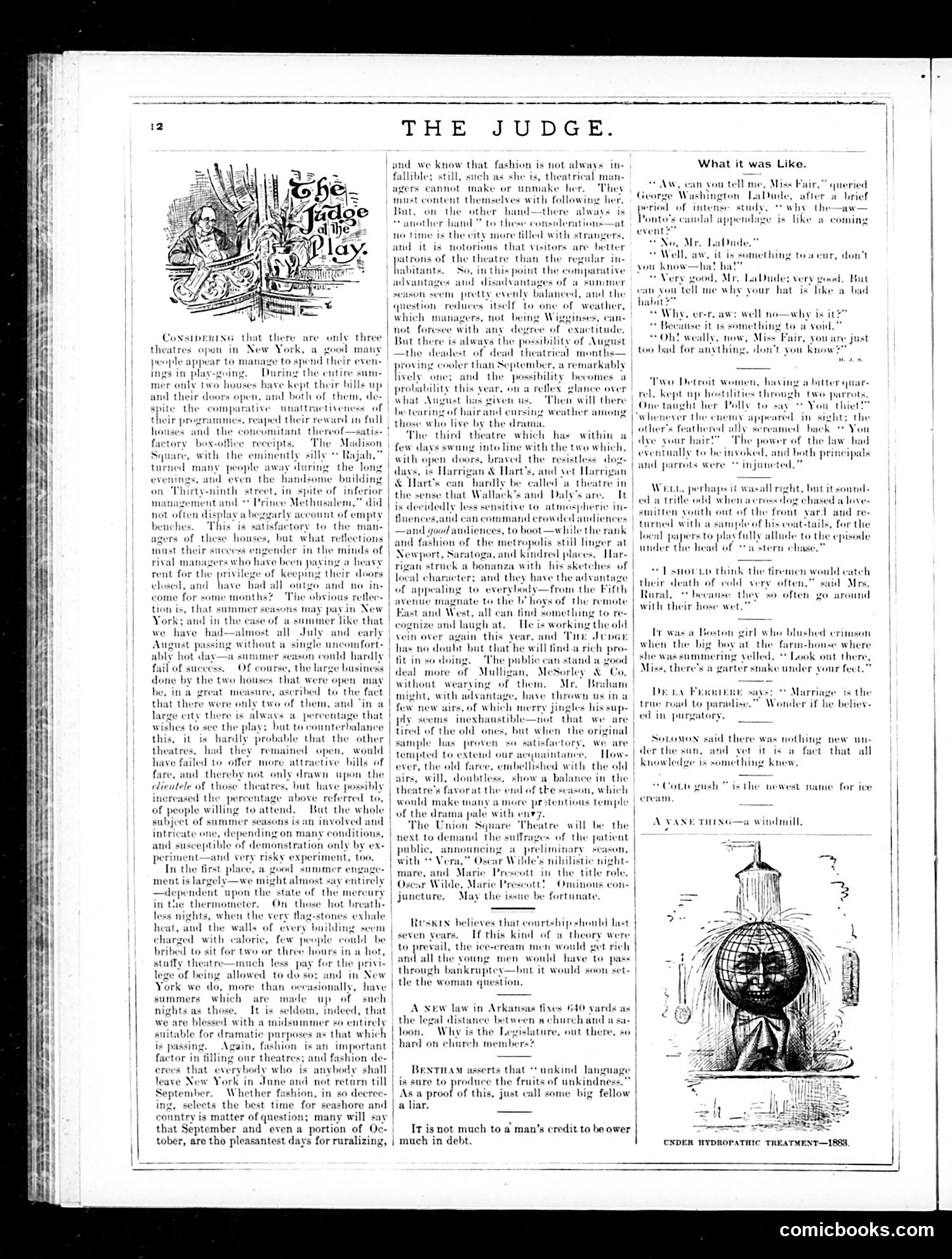
This page from *Judge* (a prominent American satirical magazine) mixes theater criticism with brief humorous anecdotes. **Main Content:** The lead article discusses New York's three open theaters during summer, noting their comparative success despite offering unattractive programs. It mentions specific venues: the Union Square Theatre (featuring "Vera" and Oscar Wilde works) and references to Harrigan & Hart's theater, which the writer dismisses as barely qualifying as a "theatre" proper. **The Humor:** The page includes short joke exchanges between characters (Mr. LaDude and Miss Fair), including riddles about hats and references to Detroit women training a parrot to insult a rival. A Boston girl blushes when warned about a garter snake—the humor playing on double entendre. **Context for Modern Readers:** This represents late 19th-century entertainment journalism blending theatrical review with light social satire. The jokes rely on period-specific references (theatrical names, social conventions around propriety) and wordplay that entertained educated, urban readers of that era.
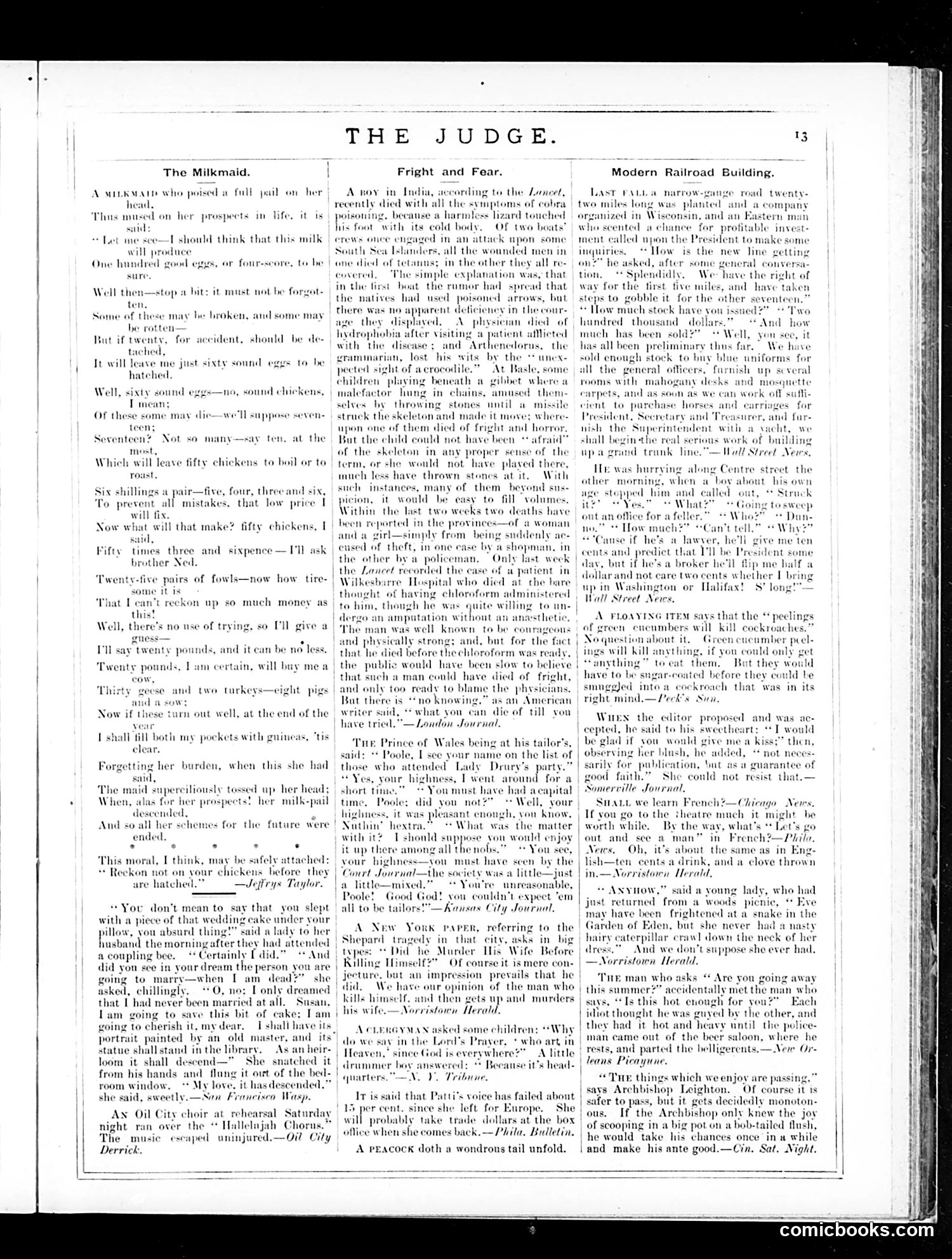
This page from Judge contains several brief satirical pieces typical of the magazine's humor: **"The Milkmaid"** presents a comedic monologue where a milkmaid calculates her future wealth by projecting egg production from her cow's milk, arriving at increasingly absurd financial estimates. The satire targets naive optimism and poor mathematical reasoning. **"Fright and Fear"** discusses medical cases involving deaths from apparent fright—a lizard's touch causing cobra-like symptoms, chloroform deaths. The satire critiques physicians' tendency to blame patients' psychological states rather than investigate actual medical causes. **"Modern Railroad Building"** satirizes railroad speculation and stock manipulation. A Wisconsin railroad organizes to seek investment; when questioned about profitability, the promoter admits the line exists primarily to sell stock and uniforms to officers—exposing the fraudulent nature of Gilded Age railroad schemes. The pieces collectively mock credulity, medical incompetence, and financial fraud—common Judge targets during this period of rapid industrialization and dubious business practices.
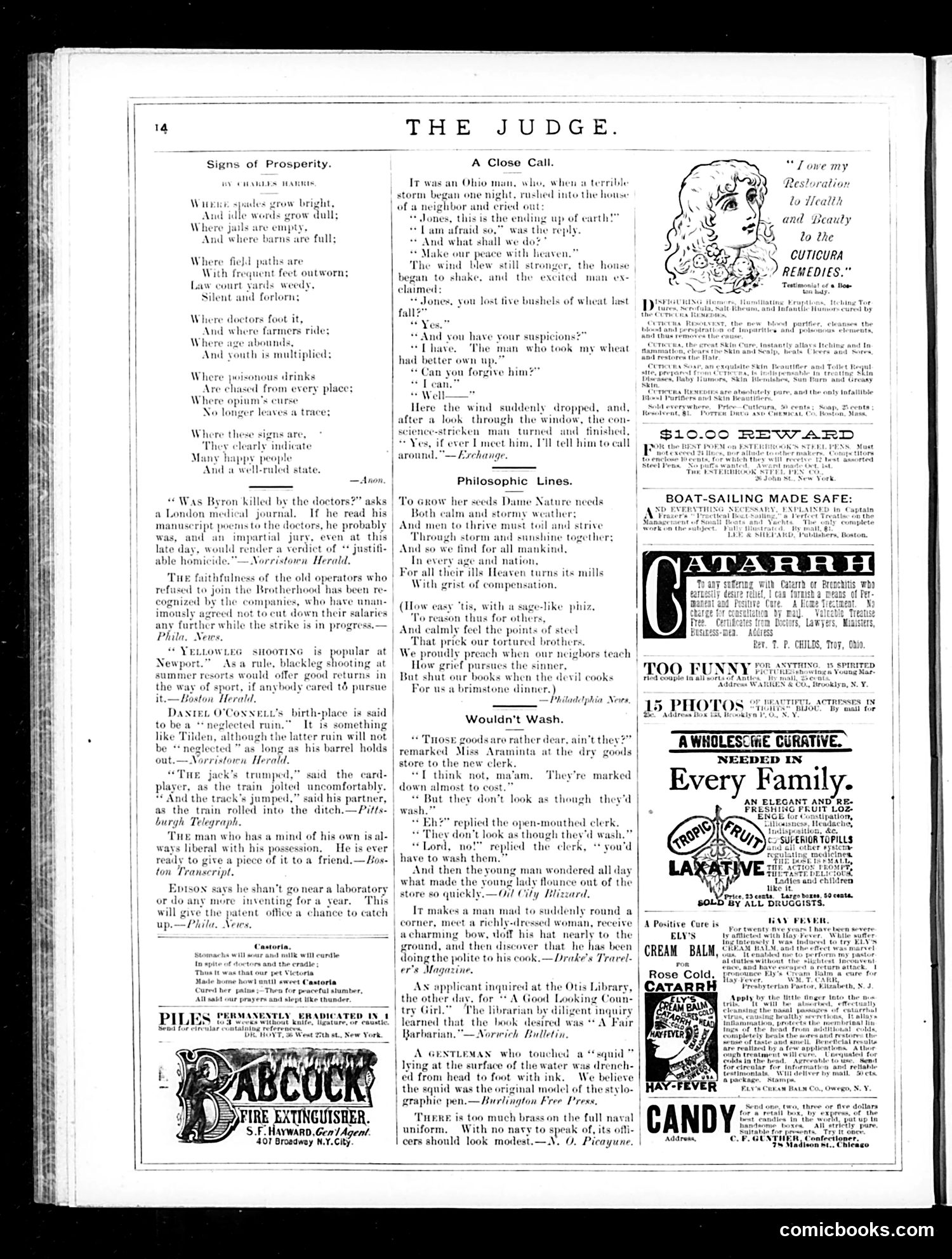
This page from *Judge* magazine contains several distinct satirical pieces: **"Signs of Prosperity"** (left column): A poem by Charles Harris listing ironic indicators of economic hardship—empty fields, weedy courtyards, doctors thriving—presented as paradoxical "signs" of a well-ruled state. The satire critiques economic inequality and social decay masked by rhetoric. **"A Close Call"** (center): A brief humorous anecdote about an Ohio man during a storm who fears the world is ending, then becomes furious at losing wheat to theft. The joke exploits the contrast between apocalyptic anxiety and mundane concerns. **"Philosophic Lines"** (lower center): Verse offering conventional wisdom about accepting life's hardships as natural balance ("Heaven turns its mills / With grist of compensation"). It satirizes platitudinous consolation offered to the suffering poor. **"Wouldn't Wash"** (lower right): A joke about cheap goods at a dry goods store—merchandise so poorly made the clerk doubts even washing would help. Social satire on consumer fraud and working-class economics. The page is primarily advertising otherwise, with promotions for patent medicines and other products typical of the era.
This page is primarily **advertisements and filler content** rather than political satire. The main text element is a three-part poem titled "Love in Three Sections," depicting a domestic quarrel between a husband and wife—he complains about dinner preparations, she refuses to tolerate his rudeness, and she storms off to her mother's house in anger. The satire is gentle and domestic rather than political. The page is dominated by period advertisements for pianos, banking services, medical treatments (nerve cures), writing instruments, bicycles, and various consumer goods typical of the 1880s. There's also a product called "Voltaic Belt" claiming to cure male ailments "before and after" treatment—a common fraudulent medical device of the era. A brief item mentions a Chinese woman marrying an Englishman in San Francisco, presented as novelty gossip rather than serious commentary. Overall, this represents **advertising-heavy popular magazine content** rather than satirical political commentary. The "satire" is confined to lighthearted domestic humor.
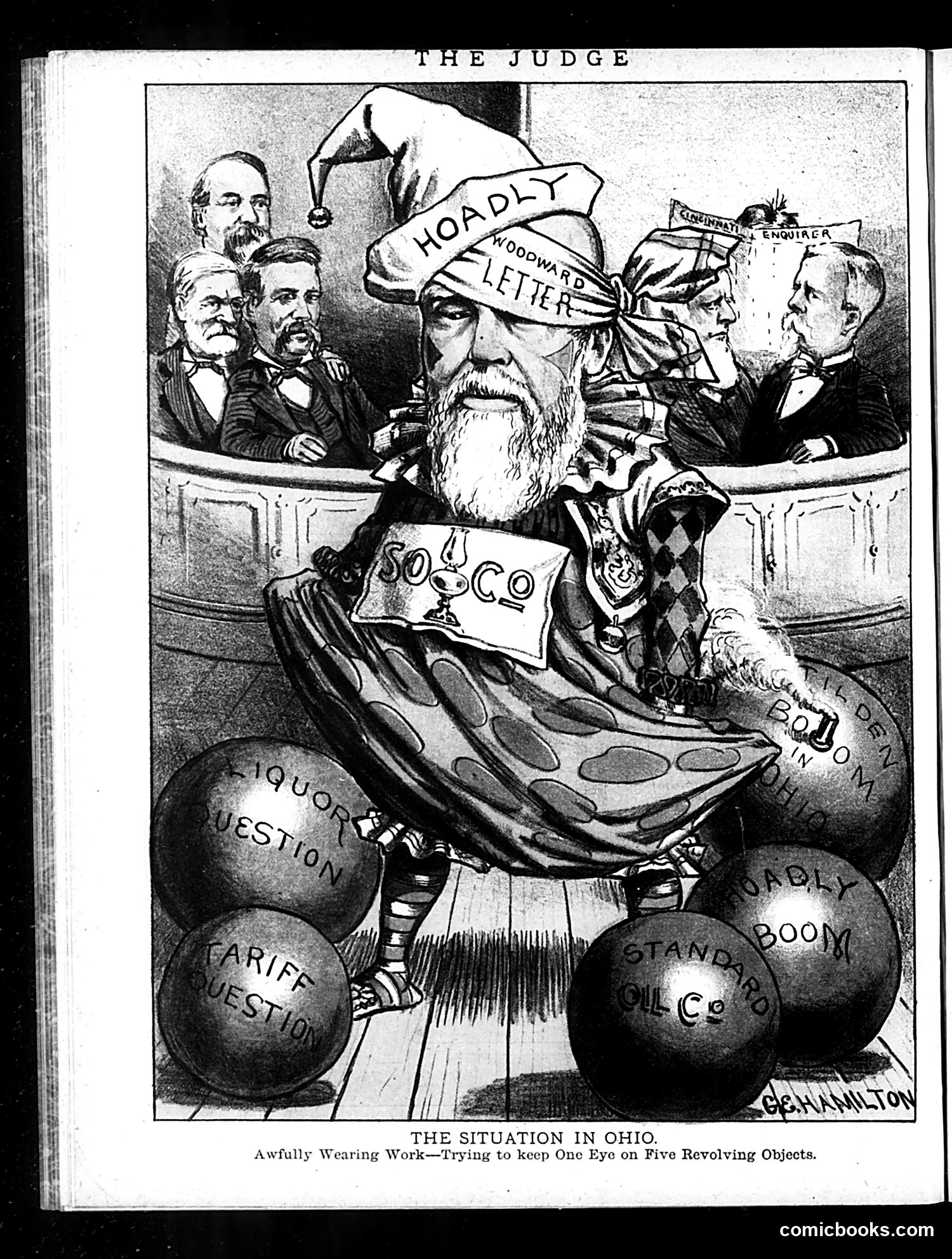
This *Judge* cartoon satirizes Ohio politics as a juggling act. A bearded figure—likely representing Ohio's government or a political leader—struggles to balance five spinning spheres labeled with contemporary issues: "Tariff Question," "Currency Question," "York Question," "Standard Oil Co.," and "Boom." The five observing men in the background appear to be political figures or stakeholders monitoring the juggler's precarious performance. The satire suggests Ohio's political leadership faces impossible competing demands: tariff and currency debates (major 1890s-1900s issues), the York Question (unclear from image alone), Standard Oil's controversial monopoly, and economic boom pressures. The juggler's strained expression conveys that maintaining balance across all five crises simultaneously is exhausting and perhaps unsustainable—commentary on the chaos of managing multiple serious political and economic problems concurrently.