
A complete issue · 16 pages · 1883
Judge — May 19, 1883
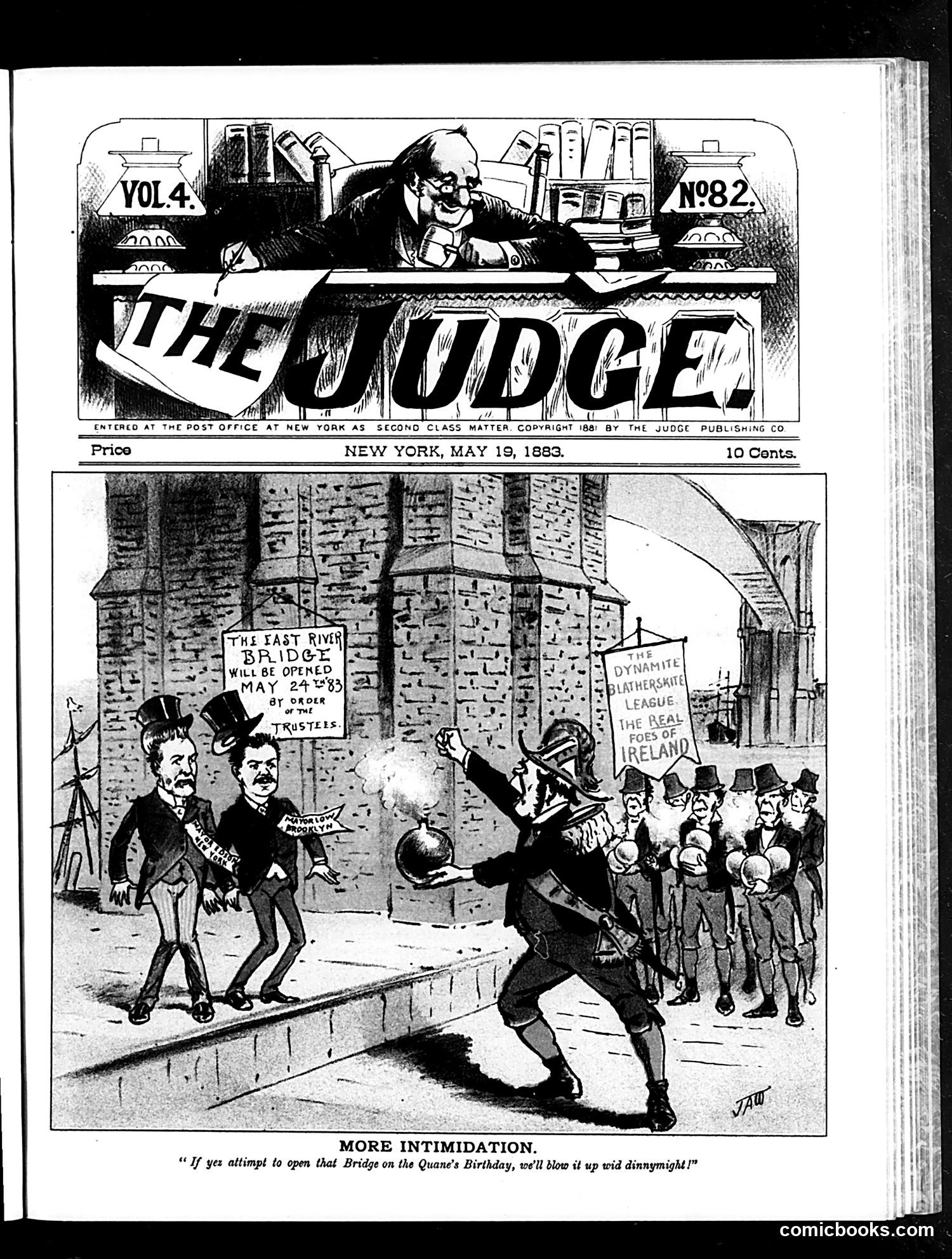
This political cartoon satirizes Irish-American threats against opening the East River Bridge on the Queen's Birthday. Two figures on the left (appearing to represent Irish or Irish-American leaders) are intimidating a central figure wielding a large bomb or explosive device. A sign references the "Dynamite Plundersite League" and "the real goes to Ireland," suggesting connections between Irish-American activism and dynamite violence—a reference to actual Fenian bombing campaigns of the 1880s. The caption "If ye attempt to open that Bridge on the Queen's Birthday, we'll blow it up wid dynamite!" frames this as extortion through terrorism. The cartoon criticizes what it portrays as violent Irish-American coercion to prevent British-aligned celebrations in New York, mocking such intimidation tactics while reflecting contemporary anxieties about anarchist and nationalist violence.
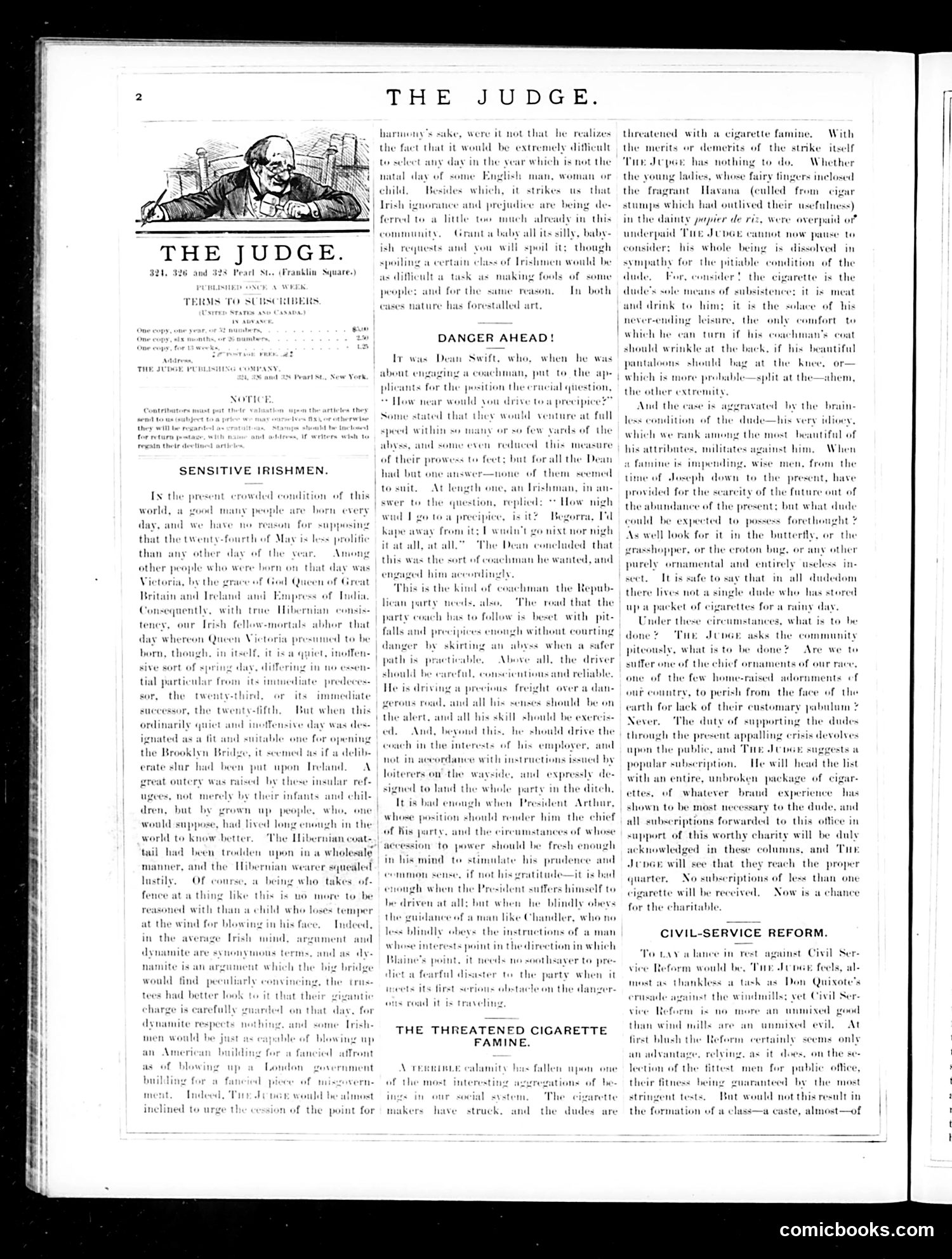
This page from Judge satirizes Irish-American sensitivities regarding May 24th—Queen Victoria's birthday, celebrated in Britain and Ireland. The cartoon ridicules what the editors see as excessive Irish outrage over the date's official recognition, particularly regarding the Brooklyn Bridge opening. The "Sensitive Irishmen" article argues that Irish immigrants are overly prone to taking offense at perceived slights, comparing them to spoiled children. It mocks their readiness to see anti-Irish conspiracies in routine administrative decisions. The "Danger Ahead" section uses Dean Swift's coaching parable to critique President Arthur's leadership, suggesting he recklessly follows advisors (like the Irish-American politician Chandler, likely) without independent judgment—driving the nation toward disaster like a blind coachman on a precipice. The overall message reflects late-19th-century WASP attitudes: Irish-Americans are simultaneously portrayed as thin-skinned troublemakers and as wielding dangerous political influence over weak leadership.
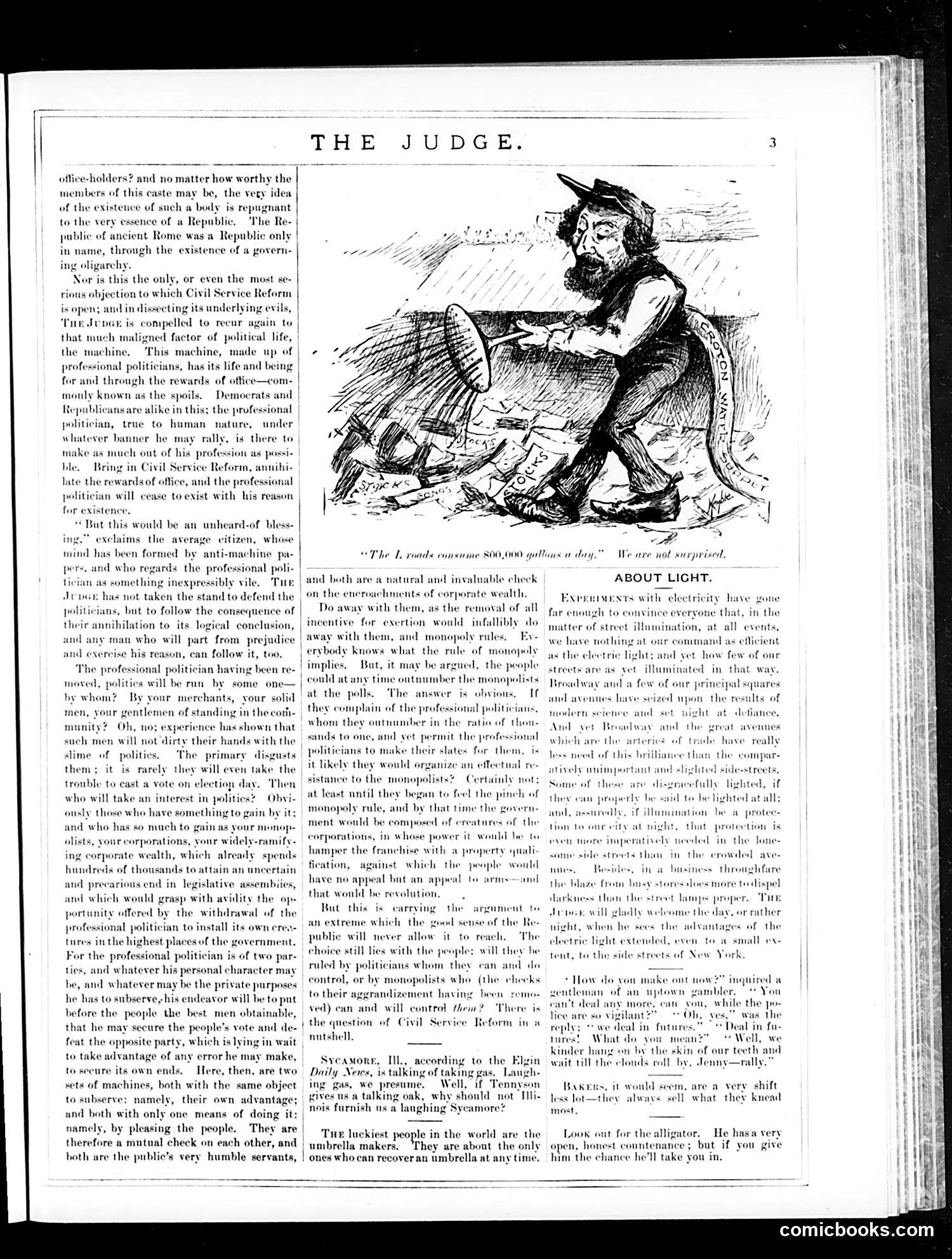
This page critiques **Civil Service Reform** through dense political argument rather than single-cartoon satire. The illustration depicts a disheveled figure (likely representing the "professional politician") surrounded by scattered papers and documents—visual shorthand for the corrupt "spoils system" of patronage politics. The text argues that eliminating Civil Service Reform would paradoxically strengthen monopolies and corporations. The author contends that professional politicians, despite their corruption, serve as a "natural and invaluable check" on corporate wealth concentration. Without them, monopolies would rule unchecked. The satire's target is reformers who naively believe removing patronage will improve government. Instead, the author warns, eliminating politicians' profit motive removes the only democratic counterbalance to concentrated corporate power—leaving ordinary citizens defenseless against monopolistic control. This reflects **Gilded Age debates** (likely 1880s-90s) between reformers and those defending the existing political machine as necessary democracy.
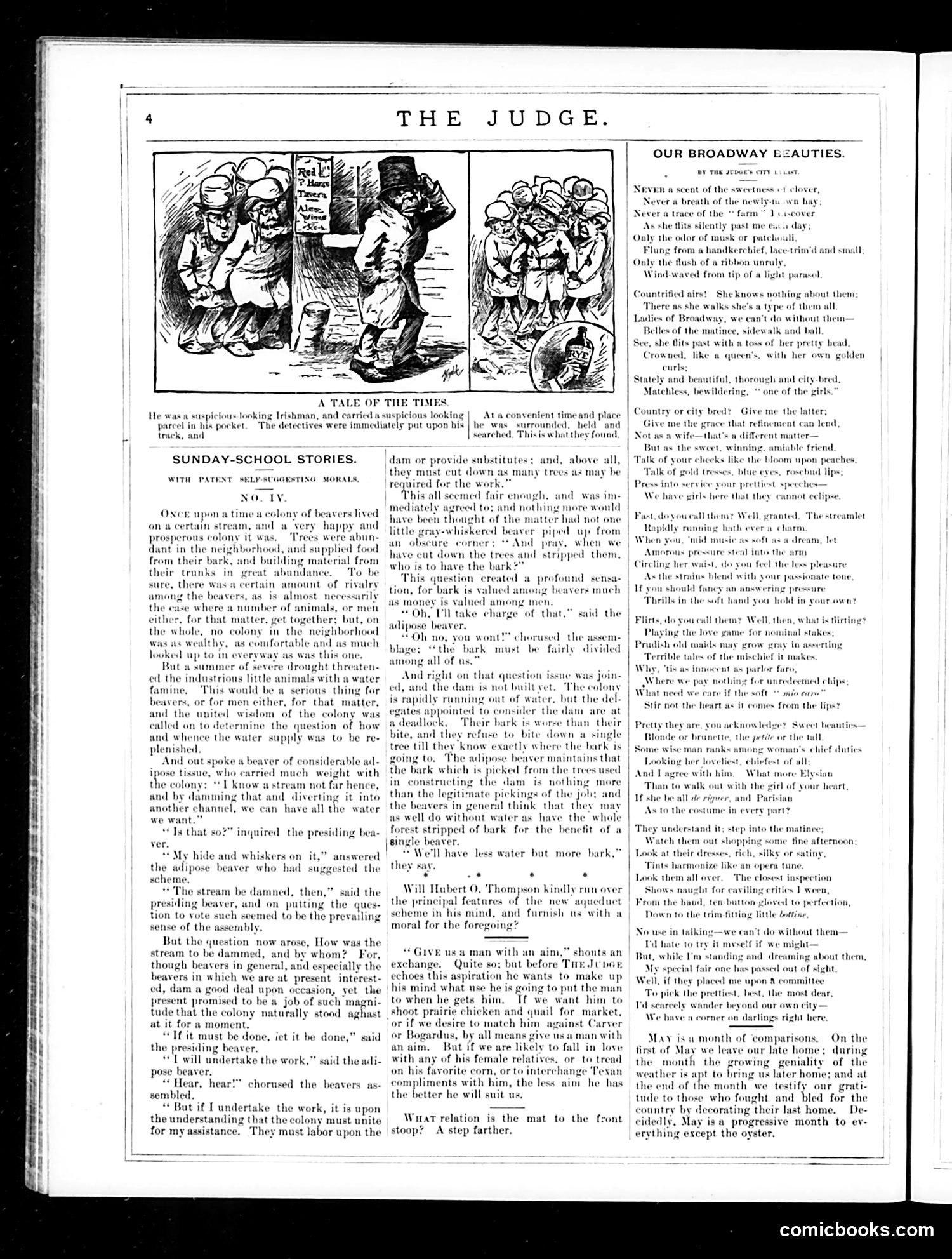
This page presents a fable about beavers building a dam, framed as a moral lesson for children. The story illustrates a labor dispute: when beavers must cut trees to build a dam, a wealthy "adipose beaver" claims ownership of the bark (representing money/profit), while refusing to share control. The working beavers refuse to continue labor until bark distribution is settled fairly. The satire targets **labor disputes and class conflict** of the Gilded Age. The "adipose" (fat, wealthy) beaver represents capitalists hoarding resources, while the colony represents workers demanding equitable treatment. The moral, attributed to "Hubert O. Thompson," ironically asks whether giving "a man with an aim" is wise—questioning capitalist ambition without social conscience. The cartoons above likely show related political commentary, though their specific subjects aren't clearly legible in this reproduction.
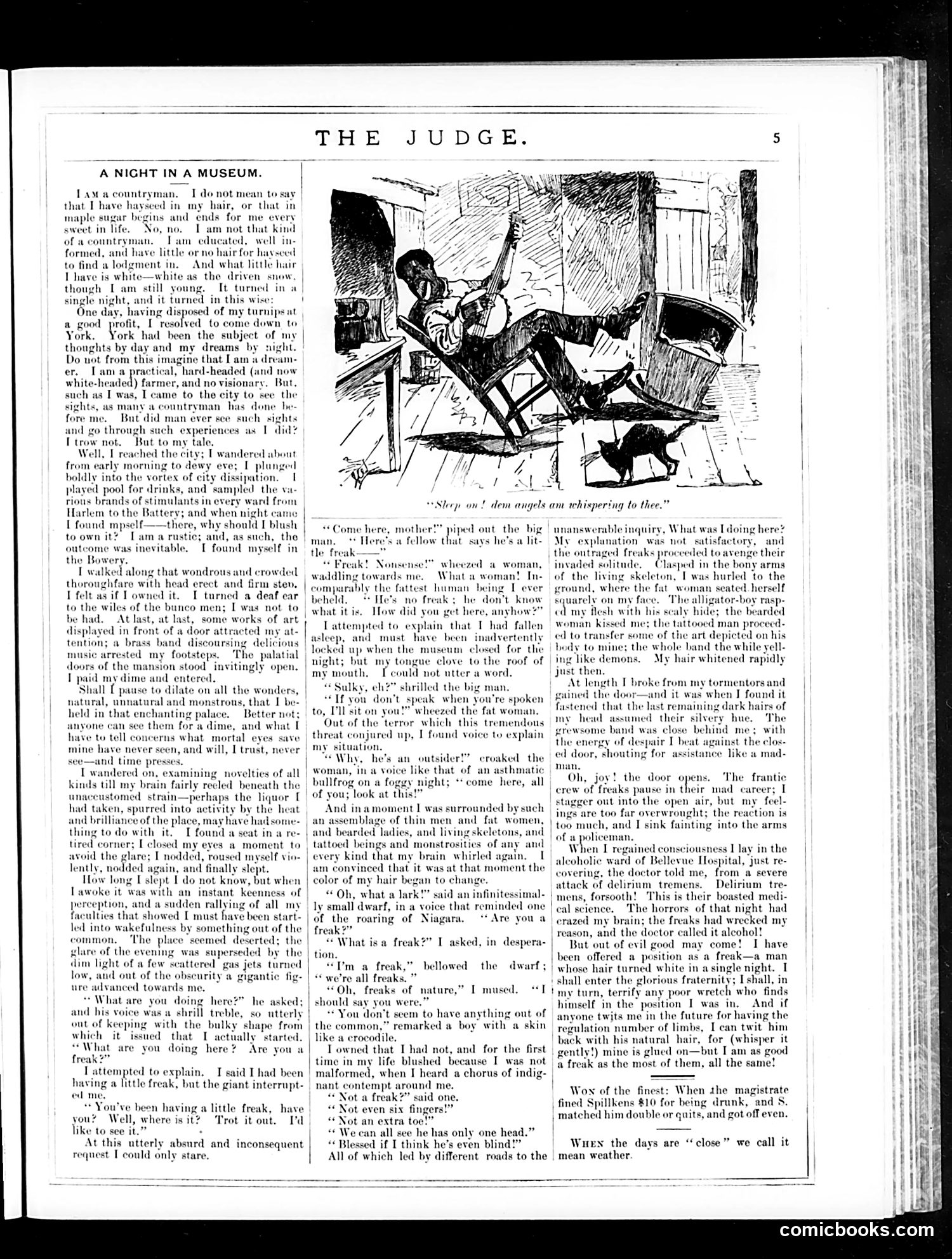
This is a humorous narrative story rather than a political cartoon. It describes a country farmer's misadventure after falling asleep in a museum and being discovered by the museum's "freak show" exhibits. The satire targets both rural naiveté and the popular 19th-century "freak show" attractions—collections of people with physical differences or unusual characteristics displayed for public entertainment. The farmer, presented as simple but well-meaning, encounters the exhibits (the fat woman, tattooed man, dwarf, bearded ladies, etc.) and they interrogate him, mistaking him for another freak who has escaped. The joke relies on the period's casual cruelty toward people with physical differences, whom museums literally displayed. The farmer's terror at being surrounded by these "monstrosities" and his utter confusion at their accusations—that he's a freak—provides the intended comedy. This reflects Judge magazine's satirical approach: mocking both rustic ignorance and society's exploitation of human difference for entertainment.
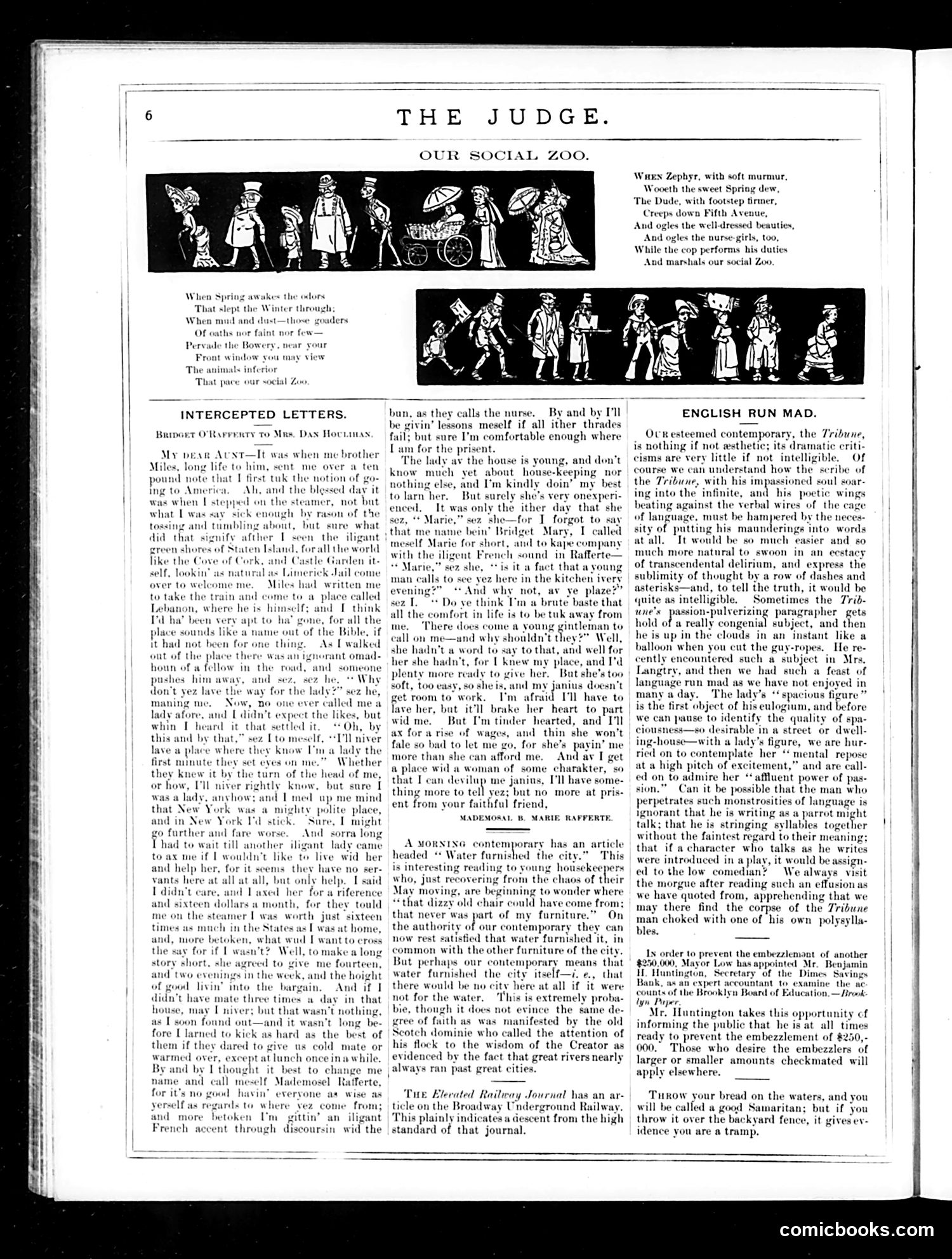
This page satirizes New York City's social hierarchy and immigrant domestic workers through two cartoons and an "intercepted letter." The illustrated strips at top depict various New York social types—the wealthy, beggars, street vendors, and fashionable pedestrians—as animals in a "zoo," suggesting the city's class divisions are as distinct and observable as different species. The main feature is a humorous letter supposedly from "Marie," an Irish immigrant servant in New York, written in heavy dialect. The satire targets: 1. **Irish immigrant workers**: depicted as comically illiterate, ambitious, and manipulative 2. **Naive American employers**: portrayed as too soft, inexperienced, and easily managed by their servants 3. **Social pretension**: Marie adopts a French name to seem more sophisticated and demands wages/raises while threatening to leave The joke relies on period stereotypes of Irish domestics as shrewd operators who exploit well-meaning but foolish American employers—a common theme in 19th-century American humor.
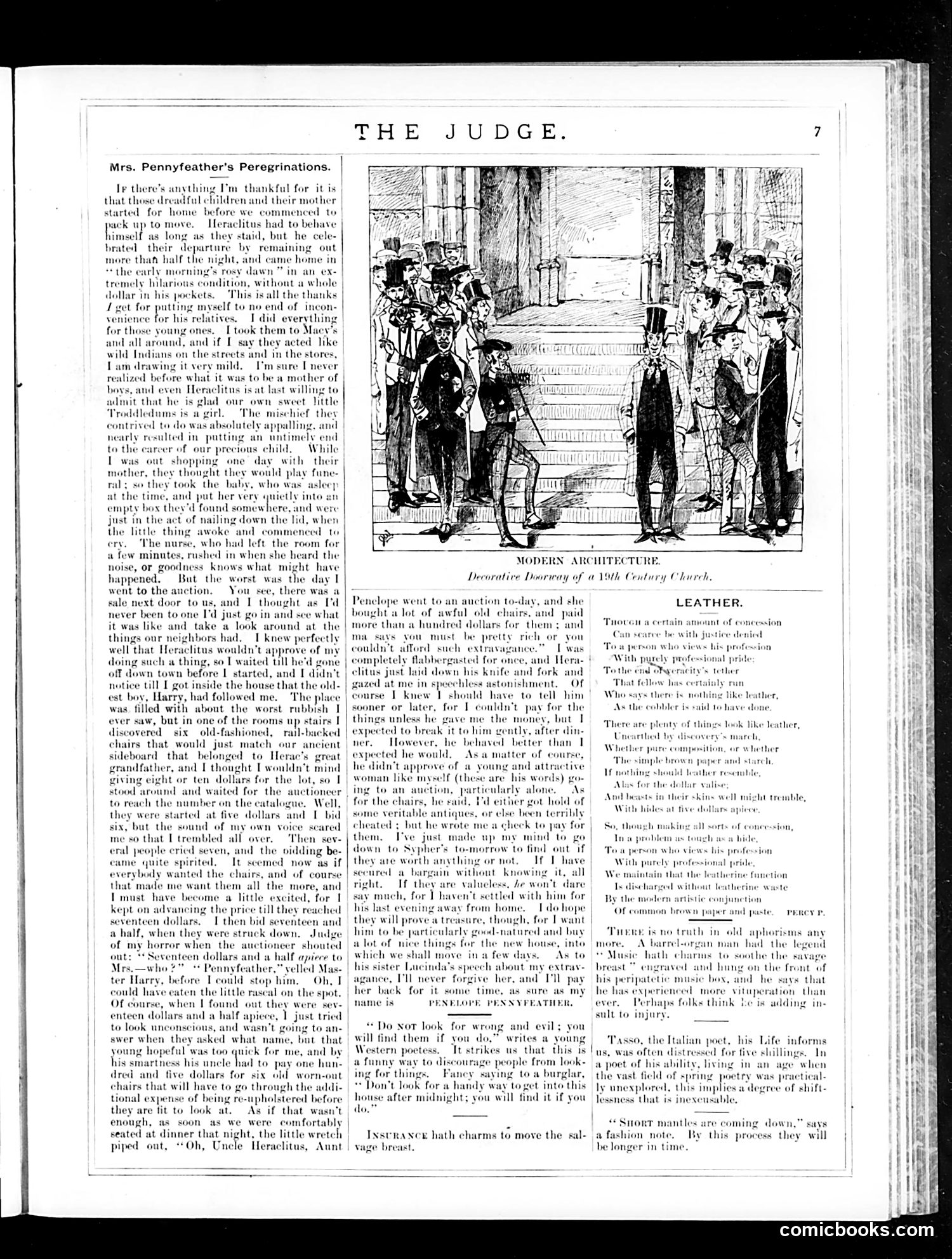
This page contains two separate pieces: a humorous domestic narrative ("Mrs. Pennyfeather's Peregrinations") and an unrelated architectural illustration titled "Modern Architecture." The main story satirizes upper-class pretension and parental embarrassment. Mrs. Pennyfeather attends an auction, becomes caught up in bidding for six old chairs, and inadvertently pays $117 for worthless furniture. Her nephew Harry publicly announces the inflated price to Uncle Heraclitus, mortifying her. The satire mocks both the frivolity of wealthy women attending auctions and the social humiliation that results from poor impulse control and trying to appear cultured. The "Modern Architecture" illustration appears to be a joke: its caption promises a "9th Century Church" but shows a simple, crude doorway—suggesting that contemporary "modern" architecture is no improvement over ancient structures, or perhaps that churches are being refurbished poorly. The humor targets class anxieties, conspicuous consumption, and architectural pretension common to Judge's satirical approach.
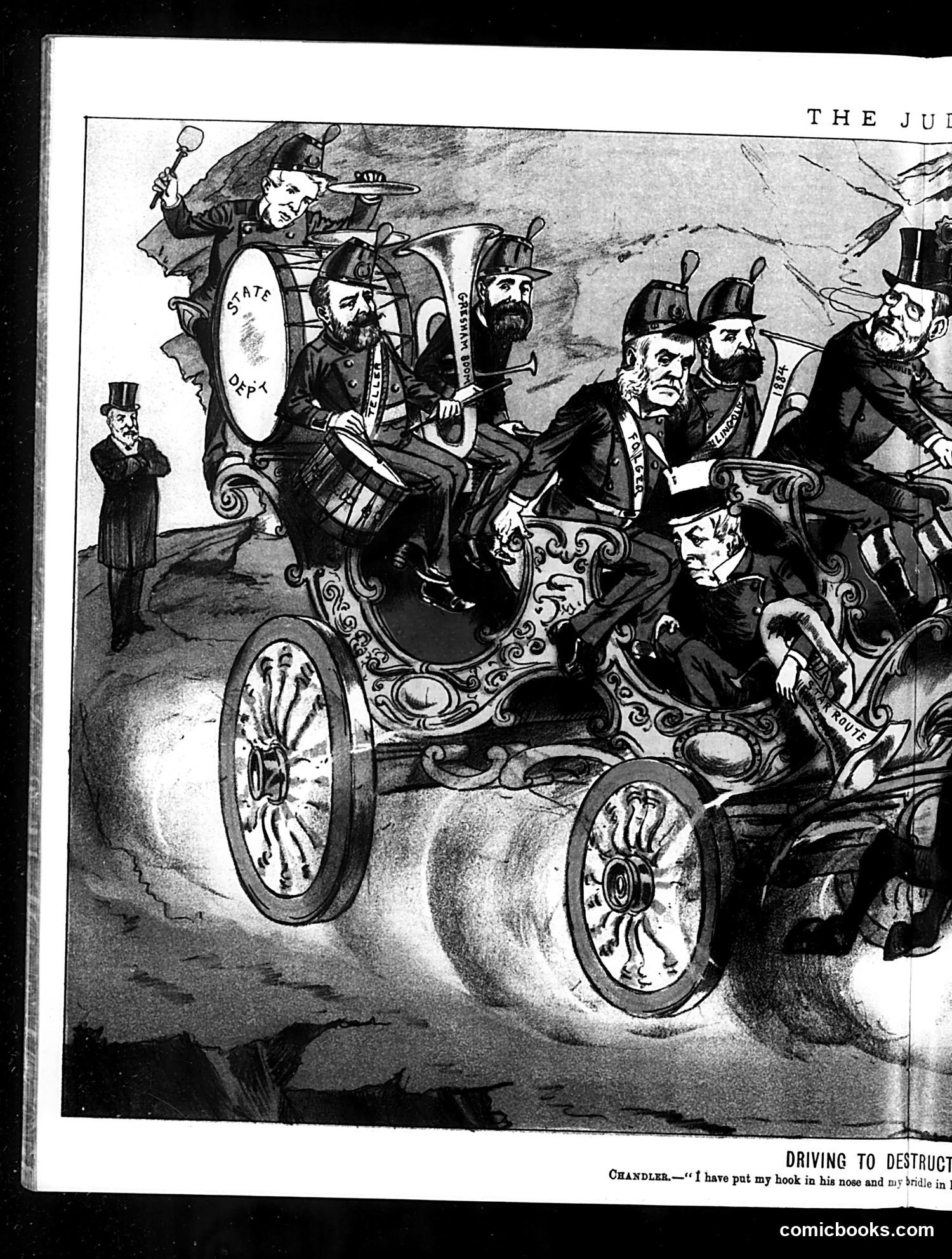
This political cartoon depicts several bearded men in formal 19th-century attire riding in an ornate carriage labeled "State Dept." The visible caption reads: "Chandler—'I have put my hook in his nose and my bridle in [his mouth].'" The satire appears to criticize Secretary of State William E. Chandler's aggressive control over foreign policy, portraying diplomatic relations as crude manipulation rather than statecraft. The figures likely represent political rivals or nations being "driven" by Chandler's forceful hand. The carriage's elaborate decoration contrasts darkly with the rocky terrain, suggesting reckless governance heading toward destructive consequences. The biblical reference ("hook in his nose") intensifies the critique, suggesting tyrannical control unbefitting diplomatic relations.
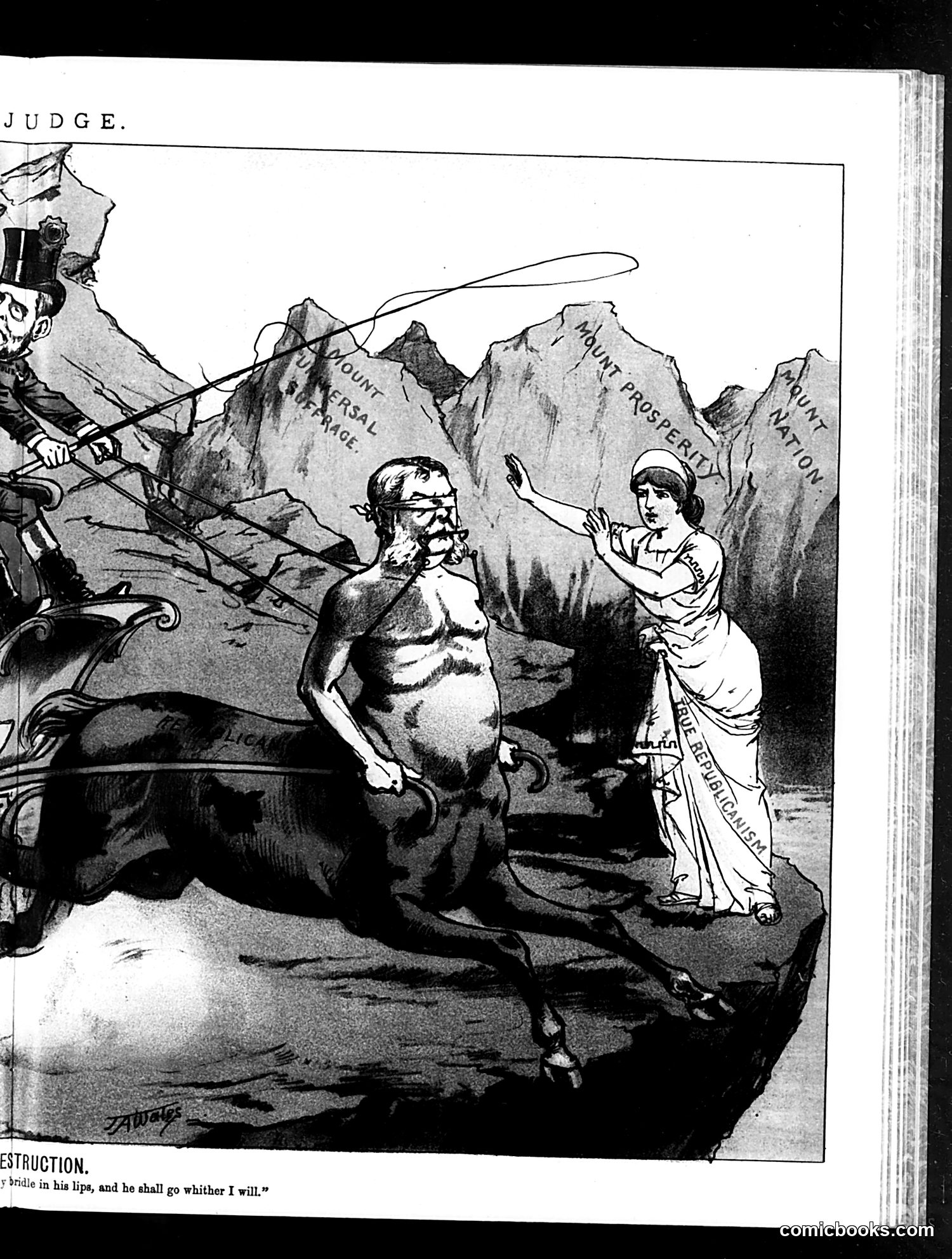
This political cartoon titled "Judge" depicts Lady Justice (the classical female figure in robes on the right) attempting to control a corpulent male figure representing what appears to be a judicial or political authority. The mountains behind them are labeled "Mount Prospect," "Mount Aspiration," and "Mount Pylon." The quote about a bridle suggests themes of control and submission to will. The cartoon satirizes the relationship between Justice (the ideal) and those wielding judicial power (the reality), suggesting that actual judicial authority has become uncontrolled or is being manipulated rather than serving justice's principles. The exact historical context remains unclear without additional publication information.
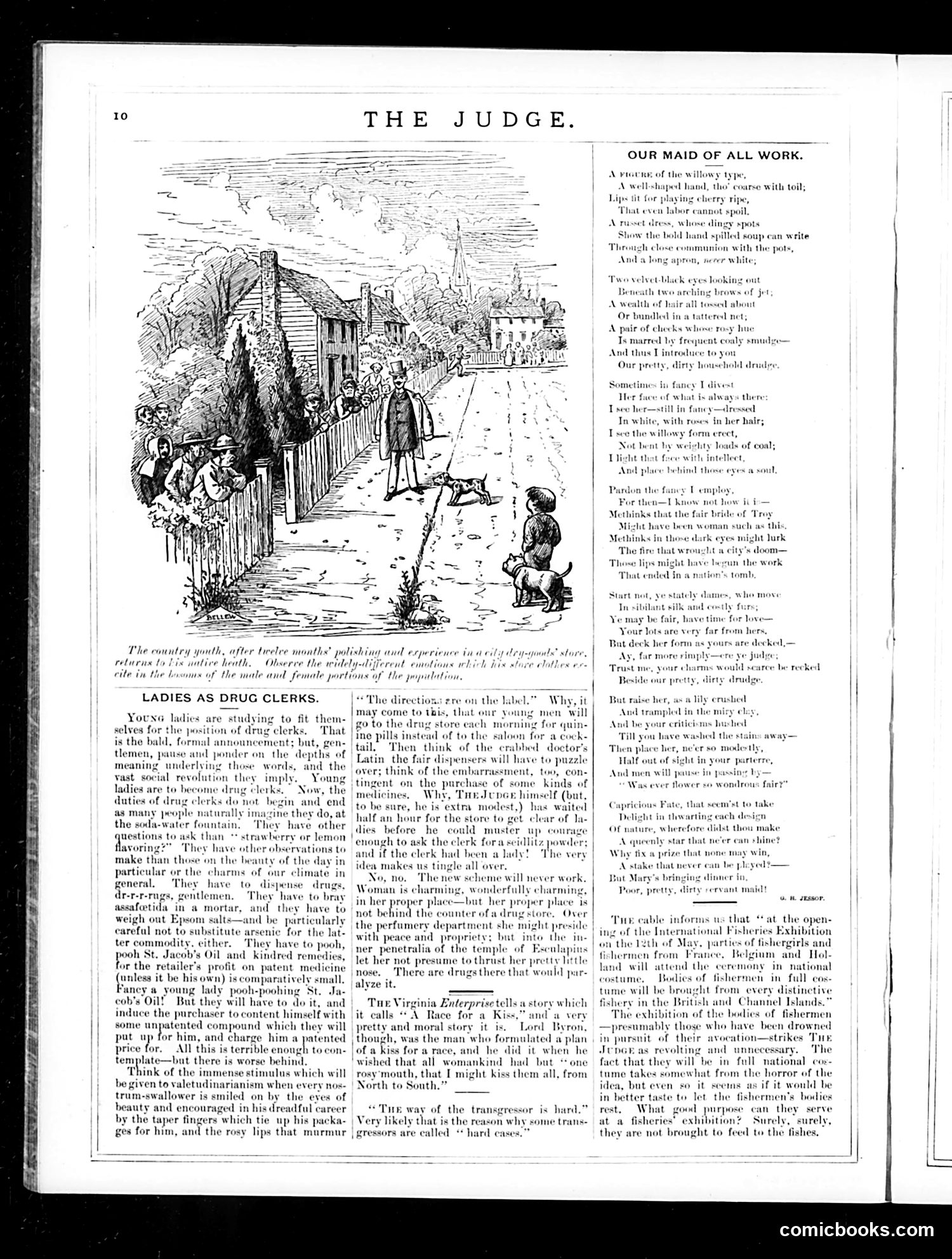
This page from *Judge* magazine contains two distinct pieces of social satire: **"Ladies as Drug Clerks"** (main article): This satirizes a proposal to employ women as pharmacy workers. The author argues against it by highlighting the unpleasant, technical duties involved—grinding powders, weighing salts, dealing with patent medicines—suggesting women are too delicate and charming for such work. The satire is actually *pro-woman*: the author mocks the paternalistic logic that confines women to decorative roles while simultaneously acknowledging their competence. It's a critique of Victorian attitudes limiting women's employment. **"Our Maid of All Work"** (poem, right): A sentimental portrait of a domestic servant—describing her physical beauty despite her exhausting labor and shabby appearance. The poem romanticizes working-class women while highlighting the gap between their actual conditions (stained aprons, coal-bent posture) and poetic idealization. Both pieces examine gender and class through Victorian-era assumptions about "proper" women's roles, though with differing tones.
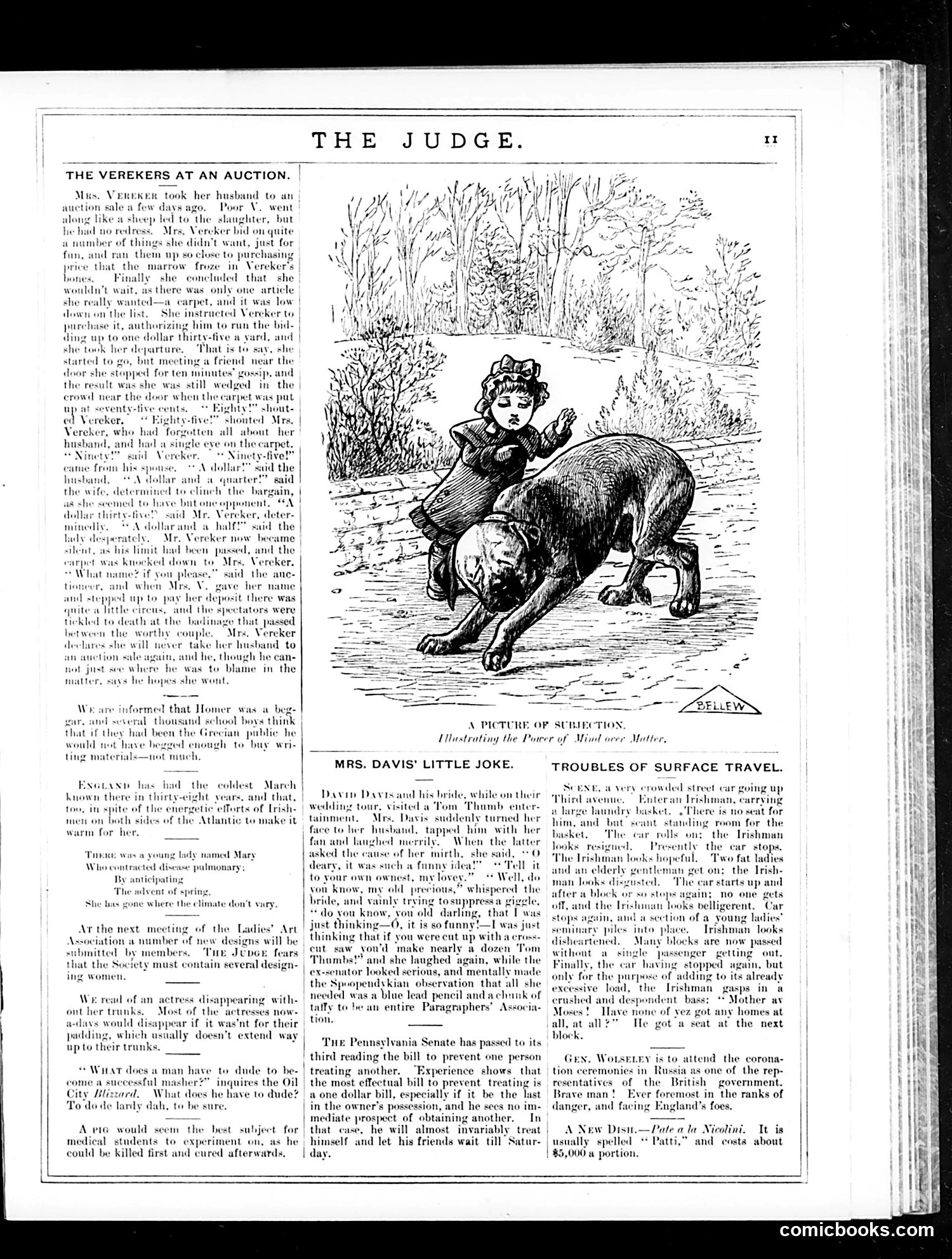
This page from *Judge* magazine contains three distinct humor pieces: **"The Verekers at an Auction"**: A domestic satire where Mrs. Vereker drags her reluctant husband to an auction. She bids aggressively on items and forces him to pay inflated prices (particularly for carpeting at "$1.35 per yard"). The joke hinges on marital power dynamics—the henpecked husband's frustration at his wife's reckless spending and domineering behavior. **"A Picture of Subjection"**: The accompanying illustration shows a child pulling a large dog by the ears, captioned to show "the Power of Mind over Matter"—suggesting willpower can overcome physical limitations, or perhaps that even the smallest can control the largest through sheer determination. **"Mrs. Davis' Little Joke"** and **"Troubles of Surface Travel"**: These brief anecdotes mock matrimonial dynamics and the chaos of crowded urban streetcars, respectively. The streetcar piece satirizes the frustration of overcrowded public transportation with an Irishman unable to find seating among competing passengers. The unifying theme: social inconveniences and domestic friction in late 19th-century America.
This page features "Public Grievances" by E.K. Ten Eyck, a first-person monologue by a police officer satirizing the public's misconceptions about police work. **The Satire's Target:** The cartoon mocks romantic notions about policing. Citizens imagine cops enjoying glamorous patrol work with "pretty nurse girls," but the officer reveals the reality: dangerous, low-paid drudgery in rough neighborhoods like "Shantytown" and "Battle Row." **Key Complaints:** - Miserable pay (officers must buy their own uniforms and sell raffle tickets to supplement income) - Dangerous conditions and long hours in bad weather - Political corruption: arrests are ignored if the accused has connections to officials' families - Lack of glory: detectives, not patrolmen, get credit for seized contraband **The Joke:** The officer's bitter monologue undercuts the heroic police mythology by contrasting idealized public perception with grinding, thankless reality. Even his attempt to help a downed horse—in his new summer gloves—emphasizes his perpetual misfortune. This reflects Progressive Era labor criticism and working-class frustrations during the early 1900s.
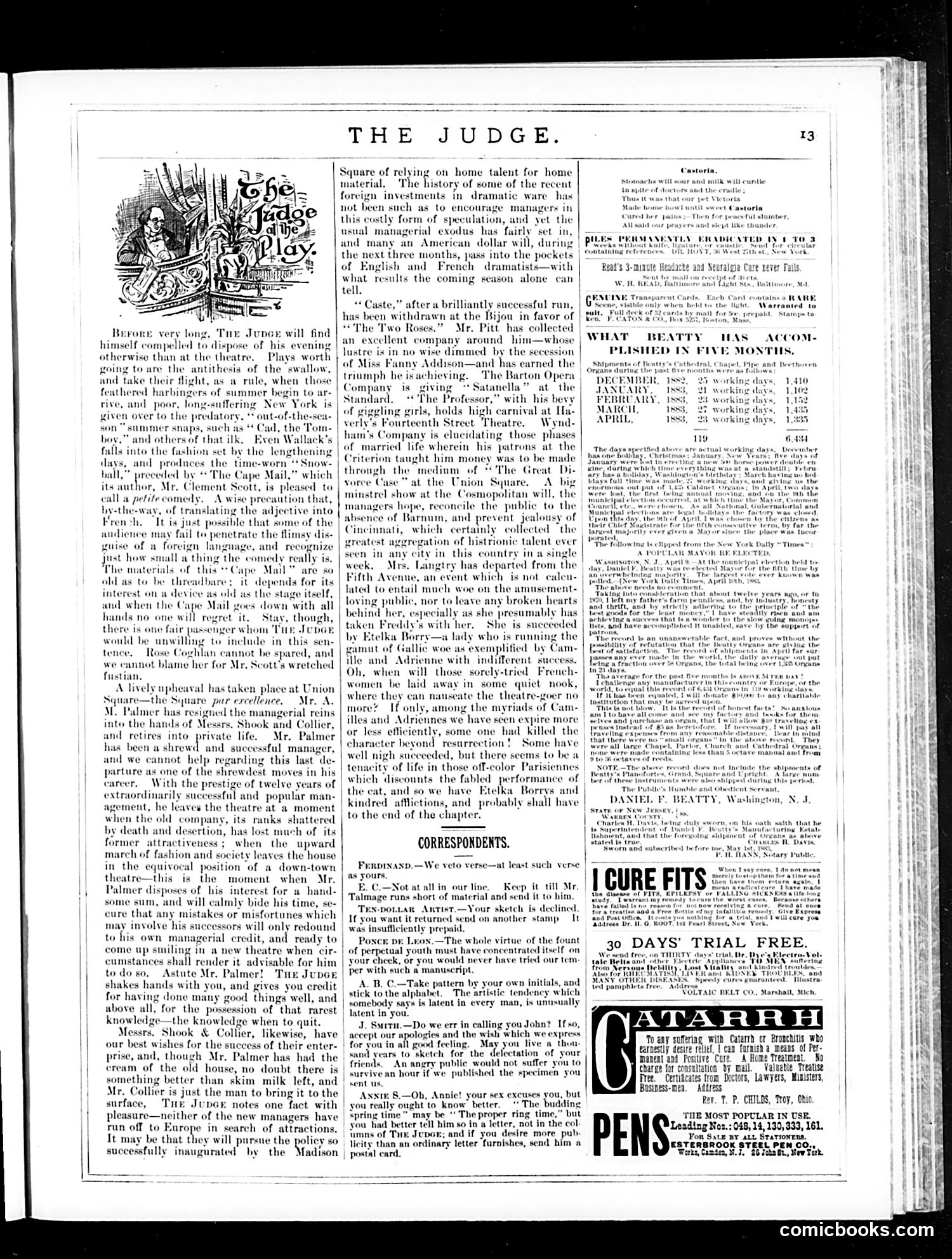
This is primarily a theatre criticism and gossip column from *Judge* magazine, not a political cartoon page. The content discusses Broadway theatrical productions and management changes circa the 1880s. **Key points:** The writer criticizes recent plays like "The Cape Mail" as derivative and poorly written, praising actress Rose Coghlan's performance despite the weak material. **Main news:** Mr. A.M. Palmer has resigned from Union Square Theatre management, retiring wealthy after a successful 12-year career. The writer praises this shrewd exit—Palmer leaves before potential business decline and avoids blame for any future theatre mishaps. The column notes a trend of American investors funding expensive foreign theatrical productions, which often fail, yet this continues. **The satire:** Palmer is portrayed as astutely recognizing when to quit while ahead—a commentary on theatrical business acumen and self-preservation among Broadway managers of the era. The page includes advertisements for pens and medical treatments, typical of 1880s magazine layouts.
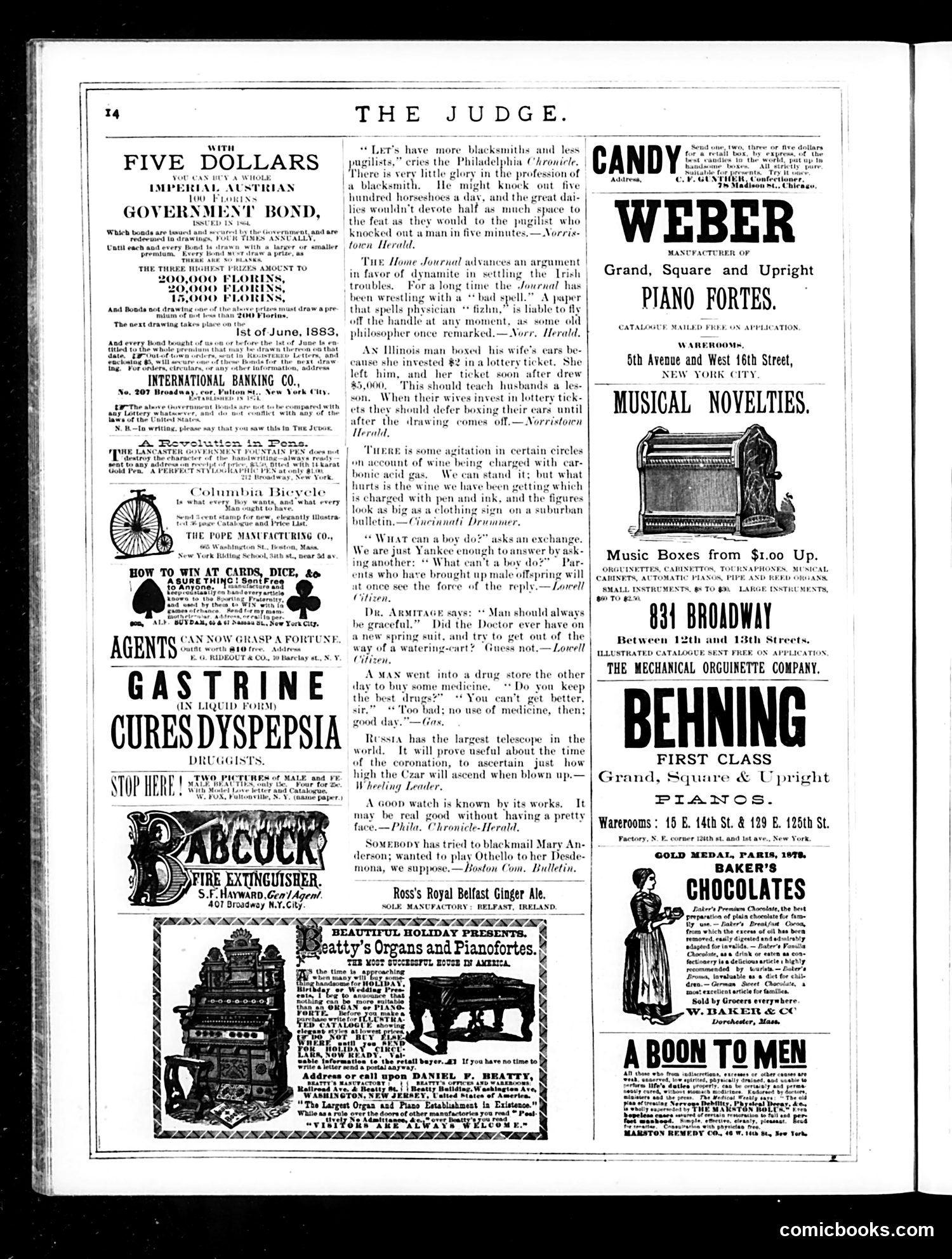
This is primarily an **advertising page** from Judge magazine, with minimal editorial cartoon content. The page showcases various commercial advertisements typical of the era (pianos, bicycles, patent medicines, chocolate). The small text snippets interspersed between ads appear to be brief satirical **social commentary** rather than political cartoons: - A jab at newspapers praising pugilists (boxers) while ignoring honest tradesmen like blacksmiths - Mockery of the *Home Journal* for poor spelling ("fizhn" for physician) while advocating dynamite to solve Irish troubles - Humor about wives losing lottery money to husbands' boxing retribution - Jokes about wine quality, doctors' advice, and Russia's telescope The satire targets **journalistic inconsistency, gender relations, and contemporary absurdities** — typical Judge fare — but these are filler material between paid advertisements rather than the page's primary content. The Babcock Fire Extinguisher and Ross's Ginger Ale ads dominate visually. This appears to be a revenue-focused page rather than editorial-focused.
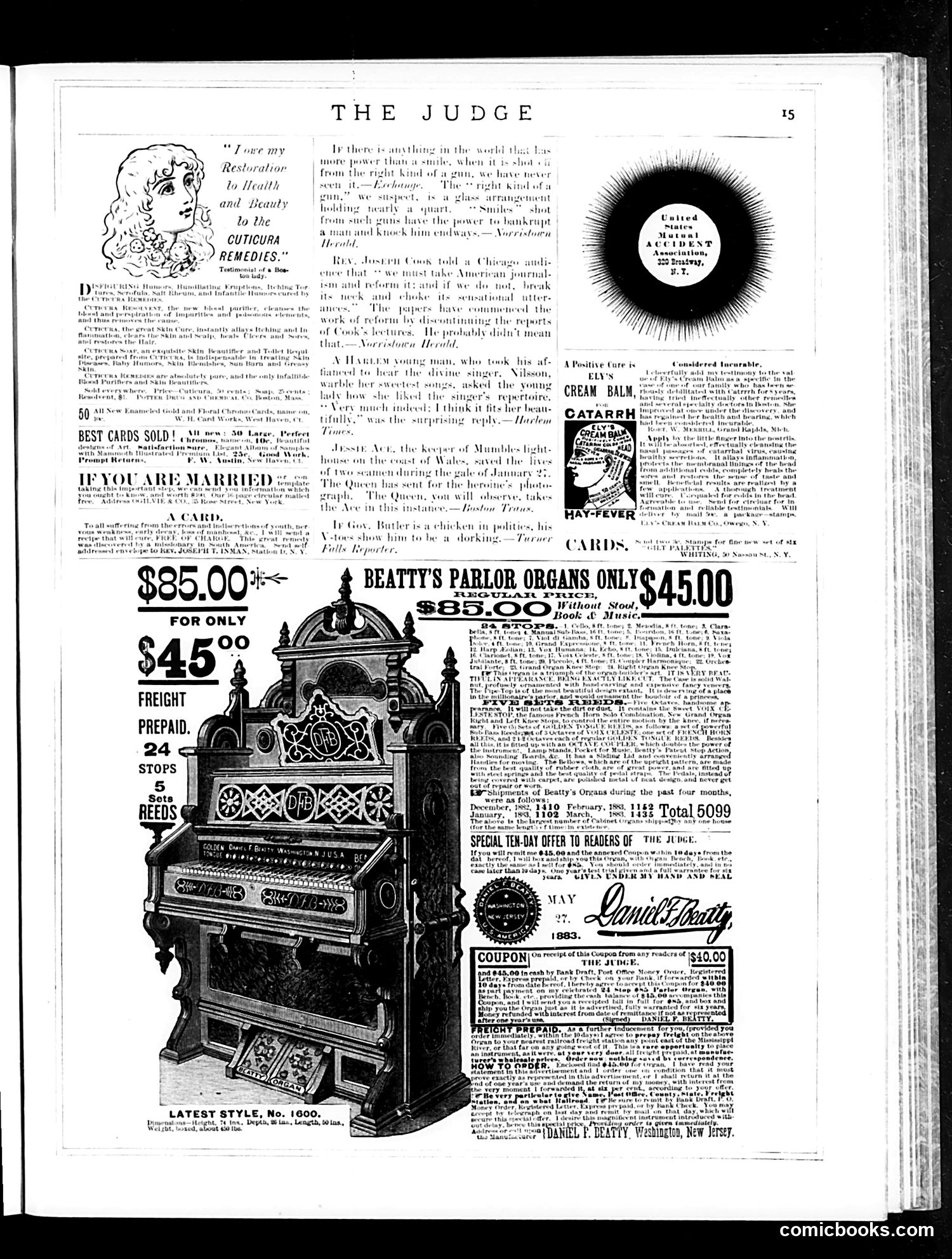
This page is primarily **advertising**, dominated by a large ornate parlor organ advertisement from Beatty's. The organ, priced at $45.00 with freight prepaid, occupies most of the layout—typical of 19th-century magazine monetization. The editorial content consists of brief **humorous anecdotes and one-liners**: - A satirical quote mocking the power of a gun - A joke about Reverend Joseph Cook's reform lectures being ineffectual - Anecdotes about a woman praising a singer's repertoire and a Queen's keeper saving sailors - A **political jab at Governor Butler**, calling him "a chicken in politics" whose "V-toes show him to be a dorking" (a chicken breed)—a crude physical insult suggesting incompetence The Butler reference appears to target a specific politician, though which Butler is unclear from context alone. The page reflects Judge's formula: **satire mixed with light gossip, coupled with substantial advertising revenue**. The content aims at quick laughs rather than sustained political commentary.
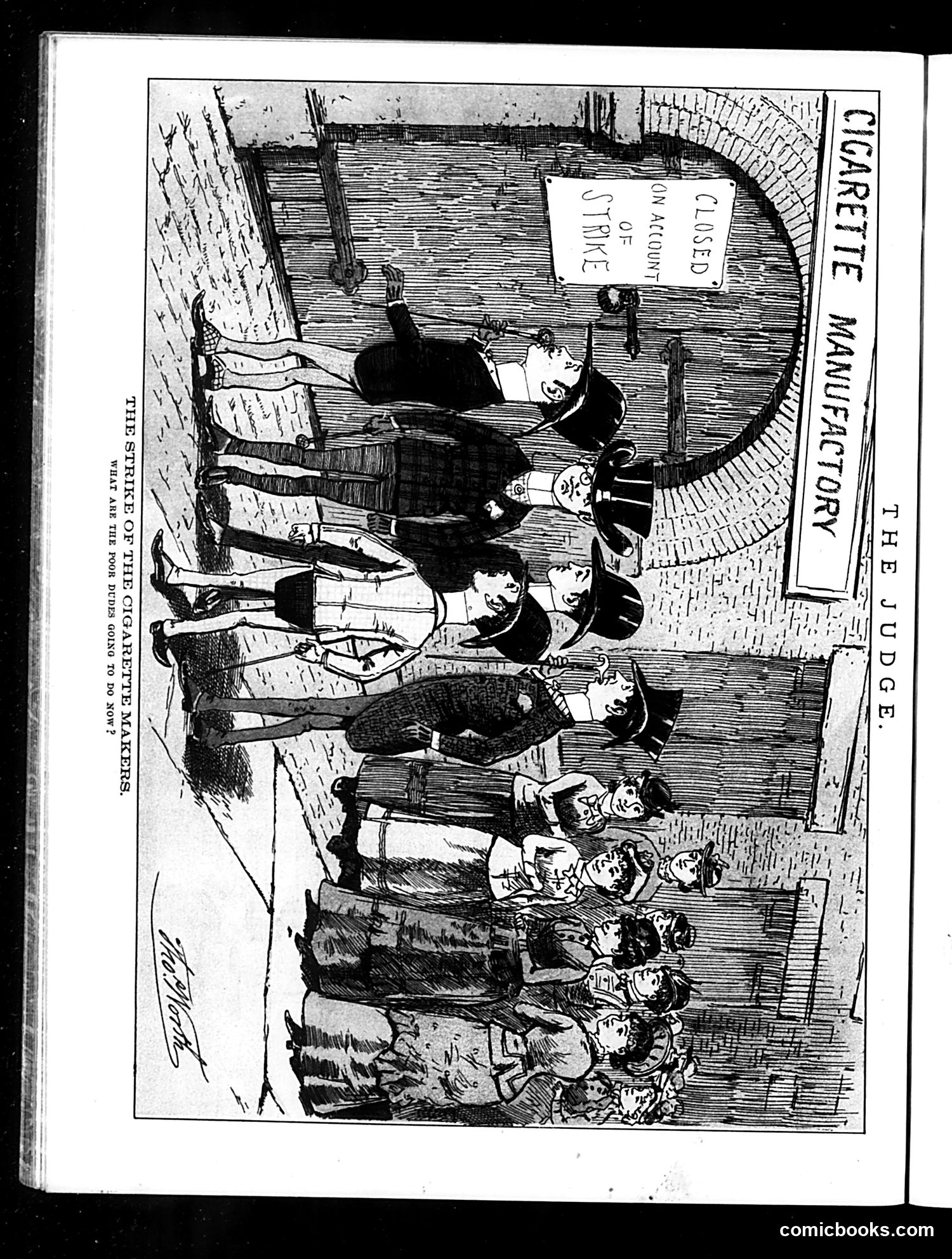
This political cartoon depicts a factory-like operation where figures in formal dress (likely politicians or judges) are processing what appears to be judicial decisions or legal rulings as if on an assembly line. The sign reads "CLAUSE MANUFACTURER" and references "OF ACCOUNT" and "STRIKE OF THE GAOARETED MAKERS." The satire mocks the mechanized, corrupt production of legal judgments—suggesting that court decisions are manufactured rather than fairly determined. The workers and operators represent the judicial system treating justice as an industrial commodity, implying that outcomes are predetermined or corrupted rather than impartial. The specific context and date remain unclear from the visible text, but this reflects Progressive Era skepticism toward institutional corruption and the "machine politics" that Judge magazine frequently criticized.