
Judge, 1883-05-19 · page 3 of 16
Judge — May 19, 1883 — page 3: what you’re looking at
What you’re looking at
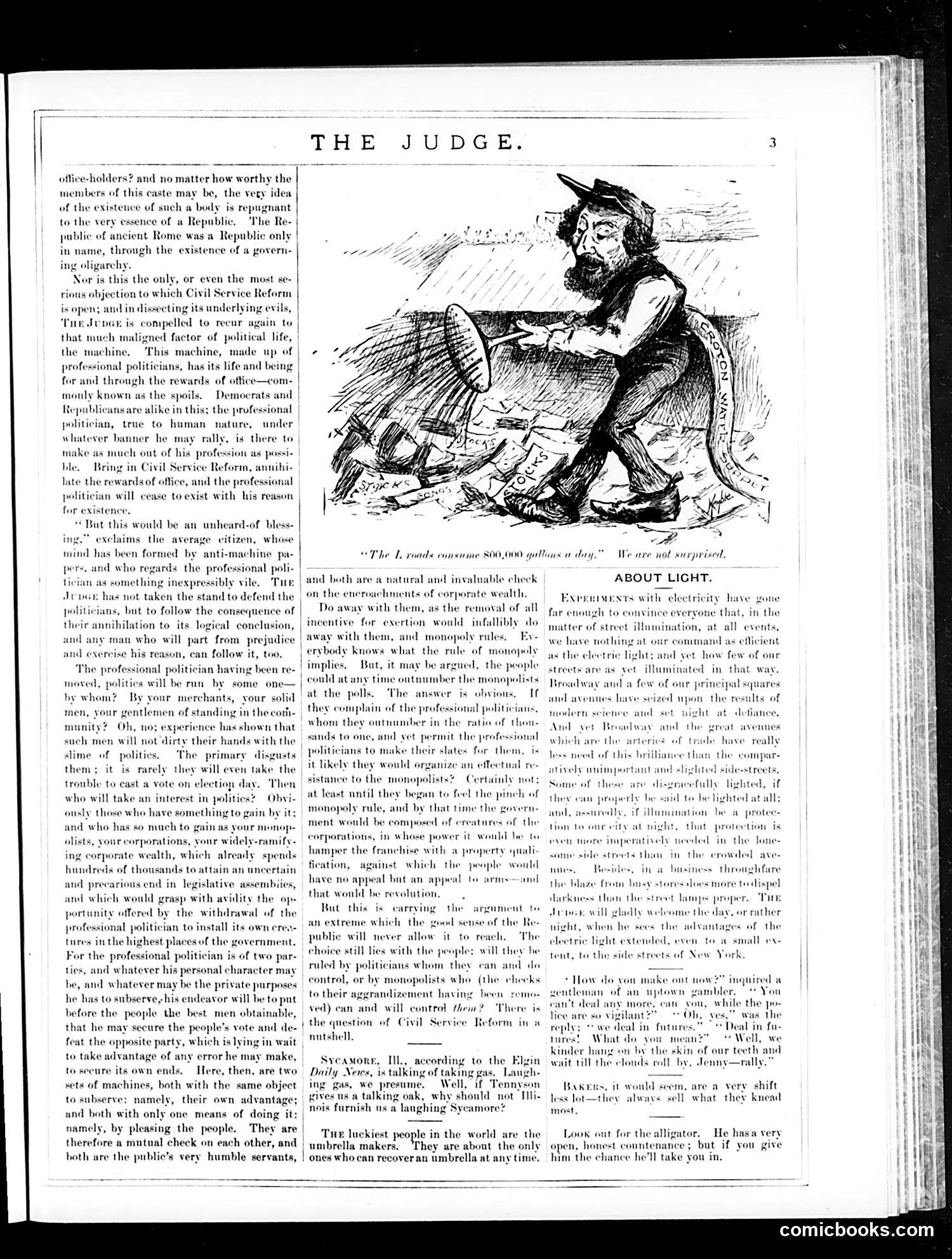
This page critiques **Civil Service Reform** through dense political argument rather than single-cartoon satire. The illustration depicts a disheveled figure (likely representing the "professional politician") surrounded by scattered papers and documents—visual shorthand for the corrupt "spoils system" of patronage politics. The text argues that eliminating Civil Service Reform would paradoxically strengthen monopolies and corporations. The author contends that professional politicians, despite their corruption, serve as a "natural and invaluable check" on corporate wealth concentration. Without them, monopolies would rule unchecked. The satire's target is reformers who naively believe removing patronage will improve government. Instead, the author warns, eliminating politicians' profit motive removes the only democratic counterbalance to concentrated corporate power—leaving ordinary citizens defenseless against monopolistic control. This reflects **Gilded Age debates** (likely 1880s-90s) between reformers and those defending the existing political machine as necessary democracy.
📄 Transcribed text from this page (OCR, searchable)
Machine-transcribed from the original scan — historical spelling and the odd misread are preserved.
office-holders? and no matter how worthy the | members of this caste may be, the very idea of the existence of such a body is re to the very essence of a Re ant | ublic, we Re- | public of ancient Rome was a Republic only a govern | | in name, through the ex ing oligarchy. wr is this the only, or even the most se- rious objection to which Civil Service Reform is open; and in dissecting its underlying evils, Tue dene that much 4 the machine. is compelled to recur ag ligned factor of political life, This machine, made up of ional politicians, has its life and being in to | profe tatanl through the rewards of office—com- | monly known as the spoils. Democ Republicansare alike in this; the pro! politician, true to human natu er banner he may rally, is there to 1s much out of his profession as possi- Bring in Civil Service Reform, annibi- late the rewardsof office, and the professional politician will cease to exist with his reason for existence, “But this would be an unheard-of bles: " ims the ave tizen, whose | en formed by ant | und who regards the pre machine ps onal sibly vile. Tie . en the stand to defend the politicians, but to follow the their annihilation to its 1 n who will part from » his n follow it, t The professional politician h moved, polities will be run hy whom? nas something inexpr bar has not and any m and eason, by some on By your merchants, your solid men, your gentlemen of standing in the coth- ? Oh, no; experience has shown that such men will not dirty their slime of polities. them ; it ands with the The primary di ely they will eve trouble to ¢ on election who will t in polit sly those who have something to gain by i and who has so much to gain as your m olists, your corporations, your widel ing th, which al hundreds of thousands t and p ‘i which would grasp with avidity the oep- by the withdrawal of the professional politic tures inthe highe unity offe nto install its own ¢ the government. n is of two. 1 character m: be the private purp: endeavor will be to put ore the people the best men obtainable, he may secure the people’s vote and ¢ feat the opposite party, which is lying in to take advantage of any error he may make, to secure its own ends, . and whatever his persor and whatever m he has to subserveyh Tere, then, are two. sets of machines, both with the same object to subserve: namely, their own advantage; h only one means of doing it: namely, by pleasing the people. They are therefore a mutual check on each other, and hoth are the public’s very humble servants, and both w: THE JUDGE. oe and both are a natural and invaluable check on the encroachments of corporate wealth, Do away with the the removal of all tive for exertion would infallibly do Ey. rule of monopoly ince away with them, and monopoly rules. erybody knows what t] implies. But, it may be argued, the people could at any time outnumber the monopolists at the polls. It they complain of the professional politicians whom they outnumber in the ratie of t The answer is obvious, sands to one, and yet permit the profe ther n effectual re- © their sh Md sistance to the monopolis at least until they monopoly rule, politi it likely they we es for ni Certainly not nto feel th and by that time ld be compe ment wi of create ations, in whi hamper the fr fication, have n hise with a pr whieh the pe ppeal but an appeal to arms aginst wonld that would be revolution, But this is an extreme whieh the g public will never allow it che carrying th iment te f the Re- to reach. “Thy ve still lies with the people: will they be ruled by politicians whem they ean and de control, or by monopolists who (the checks ood sen to their aggrandizement having been ved) can and will control them ? the question of Civil Service nutshell, emo- here is forme in a Syce Daily ing gas, work, Ill, according to the Elgin ‘ews, is talking king gas. h- Z gas, we presume. Well, if Tennyson gives us a talking oak, why should not ‘Ili- nois furnish us a laughing Sycamore? Tue luckiest people i umbrella makers. "They are about the only | ones who can recoveran umbrella at any time, We are not surpr ABOUT LIGHT. EXreniwests with electricity have gone far one veryone that, in the matter of street iumination, at all events, nd as eflicient rand yet how few of our we have nothin as the electric | illuminated in that w udway and a few of our principal squa sud avenues have seized upon the results of modern se And which are the ar Jess need of thi nee an yet Iway and the great avenues ries of tr have really ilianee than the taned s) dis Ay Ve compar: whiter woefully aid te bel atively unimpor reets. lighted, if ted at all; hey ean | and, assuredly, if iHumination be a protec: tion toonr city at wight, that tien is simperatively needed in the lone- side streets than in crowded eo blaze from busy ste darkness than the street to a small ex. tent, to the side streets of New York rie light even * How do vou make ont new?” inquired a ntleman of an uptown gambler, Y ean't de an vou, whi lice “Oh. y swe deal in future What do you meant? Well, we 1 by the skin of our teeth and louds roll by, Jenny—rally.” Deal in fu- wait till the Bakens, it would se less lot—thev always most. m, are a very shift AY what they ky He hasa very ; but if you give him the i comicbooks.com