
A complete issue · 16 pages · 1883
Judge — March 17, 1883
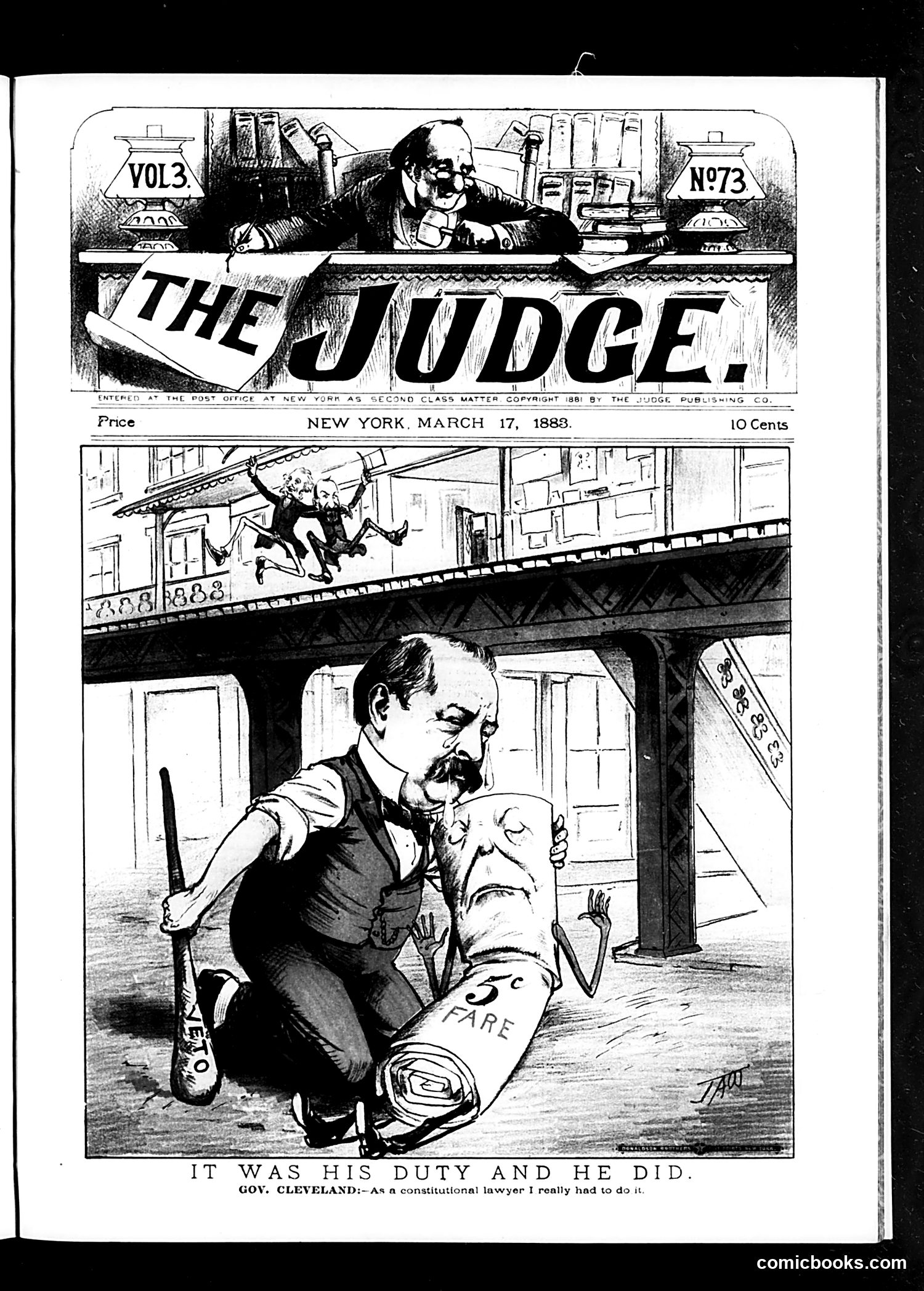
**The Main Cartoon: "It Was His Duty and He Did"** The cartoon depicts Governor Cleveland (identifiable by the caption) wielding a club against a large personified head labeled "5¢ FARE." The figure represents resistance to raising streetcar fares in New York City. **The Satire:** The caption—"As a constitutional lawyer I really had to do it"—suggests Cleveland justified an unpopular action (likely enforcing fare increases or related transit policy) on constitutional grounds, even though it was politically damaging. The cartoon criticizes Cleveland for claiming legal obligation when citizens saw only poor governance. The elevated train in the background shows people fleeing the chaos, emphasizing public displeasure. This reflects 1880s municipal transit disputes and tensions between legal justifications and popular opposition to fare hikes.
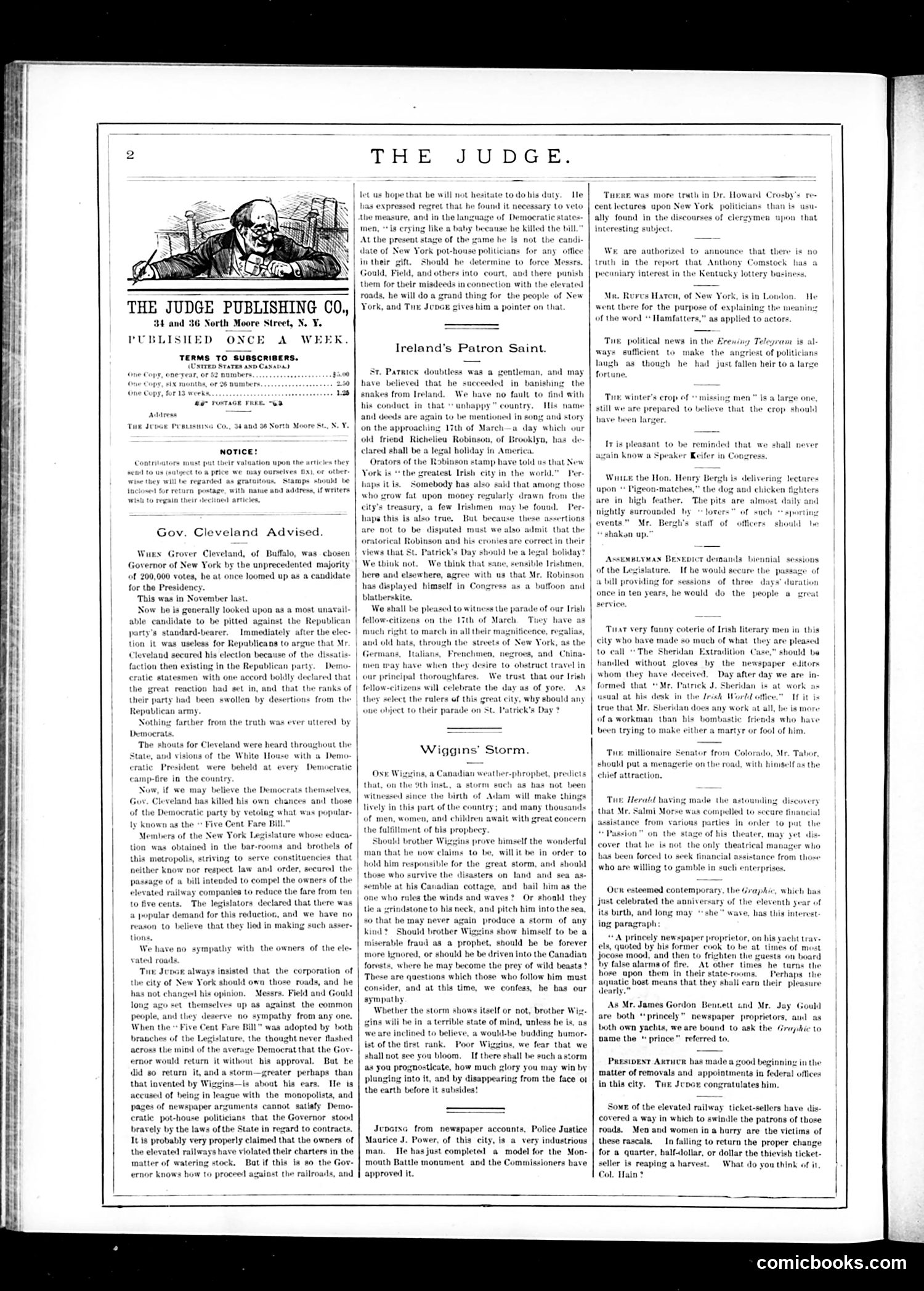
The main cartoon (top left) depicts a disheveled man labeled "THE JUDGE PUBLISHING CO.," illustrating the magazine's masthead. The editorial content addresses **Governor Grover Cleveland's veto of the "Five Cent Fare Bill"** — legislation requiring New York's elevated railway companies to reduce fares. Judge defends Cleveland's veto as legally principled, despite Democratic outrage. The piece argues Cleveland acted correctly by upholding state law regarding contracts, even though monopolistic railroad owners (Vanderbilt, Field, Gould) deserved scrutiny through proper legal channels. The secondary piece on **"Ireland's Patron Saint"** humorously advocates making St. Patrick's Day a legal holiday, noting Irish immigrants' cultural significance in New York. The page reflects 1880s-era tensions between populist demands for regulated utilities versus executive respect for contractual law—a controversy that damaged Cleveland's Democratic support despite Judge's defense of his constitutionalism.
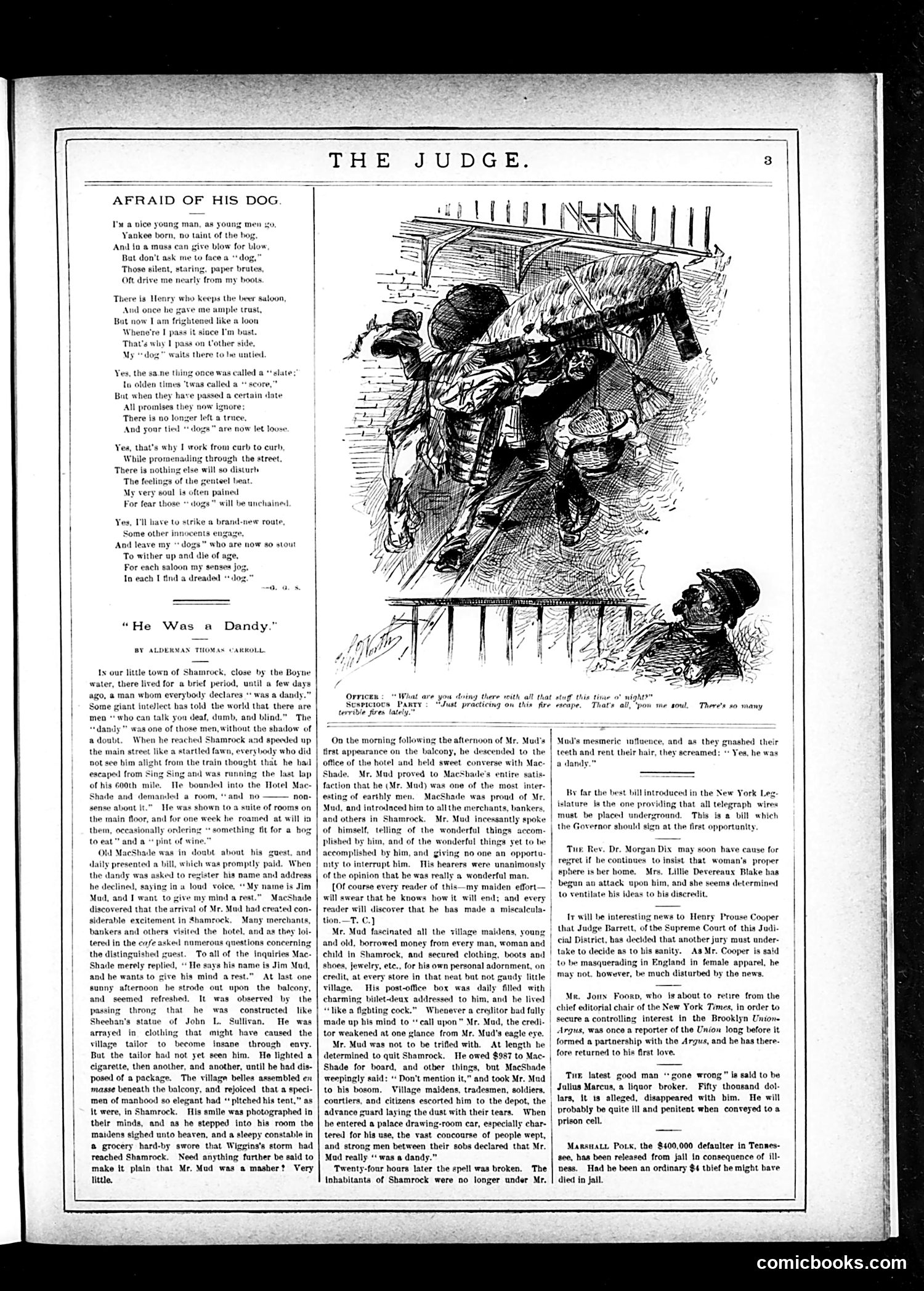
This page contains two separate pieces: **"Afraid of His Dog"** (poem, left): A satirical complaint about Irish immigrants in America. The speaker, claiming to be a "nice young Yankee," boasts of his toughness but admits being terrified of dogs tied outside Irish saloons. The satire targets both anti-Irish prejudice (mocking the "Yankee" speaker's cowardice) and Irish culture (the stereotype of dangerous dogs guarding taverns). The joke plays on "dog" as slang for a worthless person. **"He Was a Dandy"** (short story, center/bottom): A humorous tale set in an Irish village (Shamrock) about a mysterious well-dressed visitor named Mud who checks into a hotel, captivates the town with his elegant appearance and confident manner, but is eventually revealed as an escaped convict. The satire mocks small-town gullibility and superficial judgments based on appearance. Both pieces use Irish settings and characters as vehicles for social satire typical of *Judge* magazine's humor of this era.
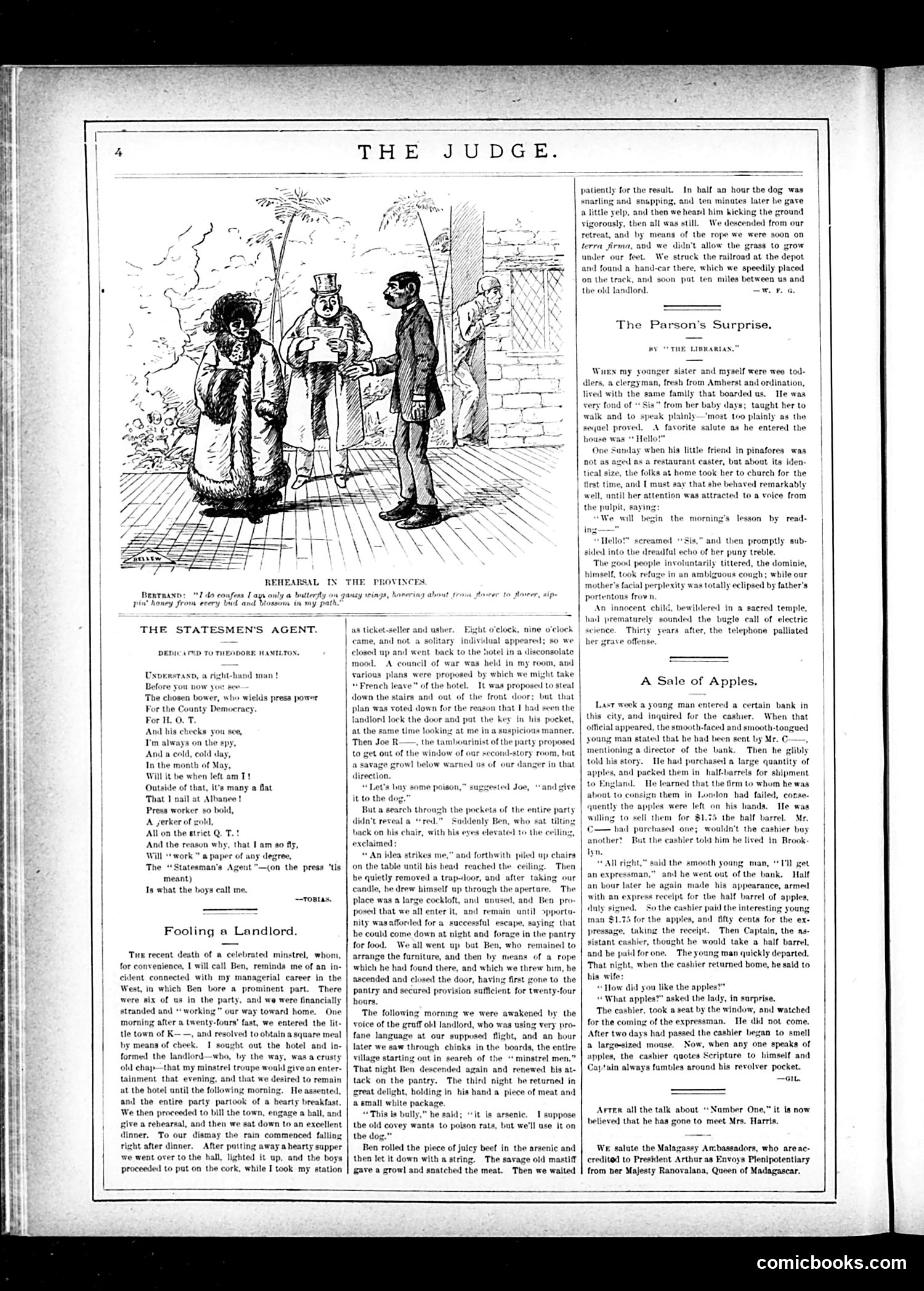
This page contains three distinct pieces of satirical content: **"Rehearsal in the Provinces"** (top cartoon): Shows a theatrical troupe in rehearsal. The caption's garbled text suggests satirizing amateur or poorly-executed theatrical productions—a common Judge target. **"The Statesman's Agent"** (poem): A cynical verse about a political operative working for the "County Democracy" (a New York Democratic faction). It mocks press agents who manipulate newspapers and public opinion through dishonest means—typical Gilded Age corruption satire. **"Fooling a Landlord"** (story): A humorous anecdote about minstrel performers (white entertainers in blackface, standard then) who trick a hotel owner into providing free lodging and meals through false promises of a show. They hide in an attic to escape, ultimately poisoning the landlord's dog. This satirizes both con-artist ethics and landlord greed, reflecting common working-class antagonism toward property owners during economically hard times. The page reflects Judge's typical focus: political corruption, theatrical pretense, and working-class/management conflicts in late 19th-century America.
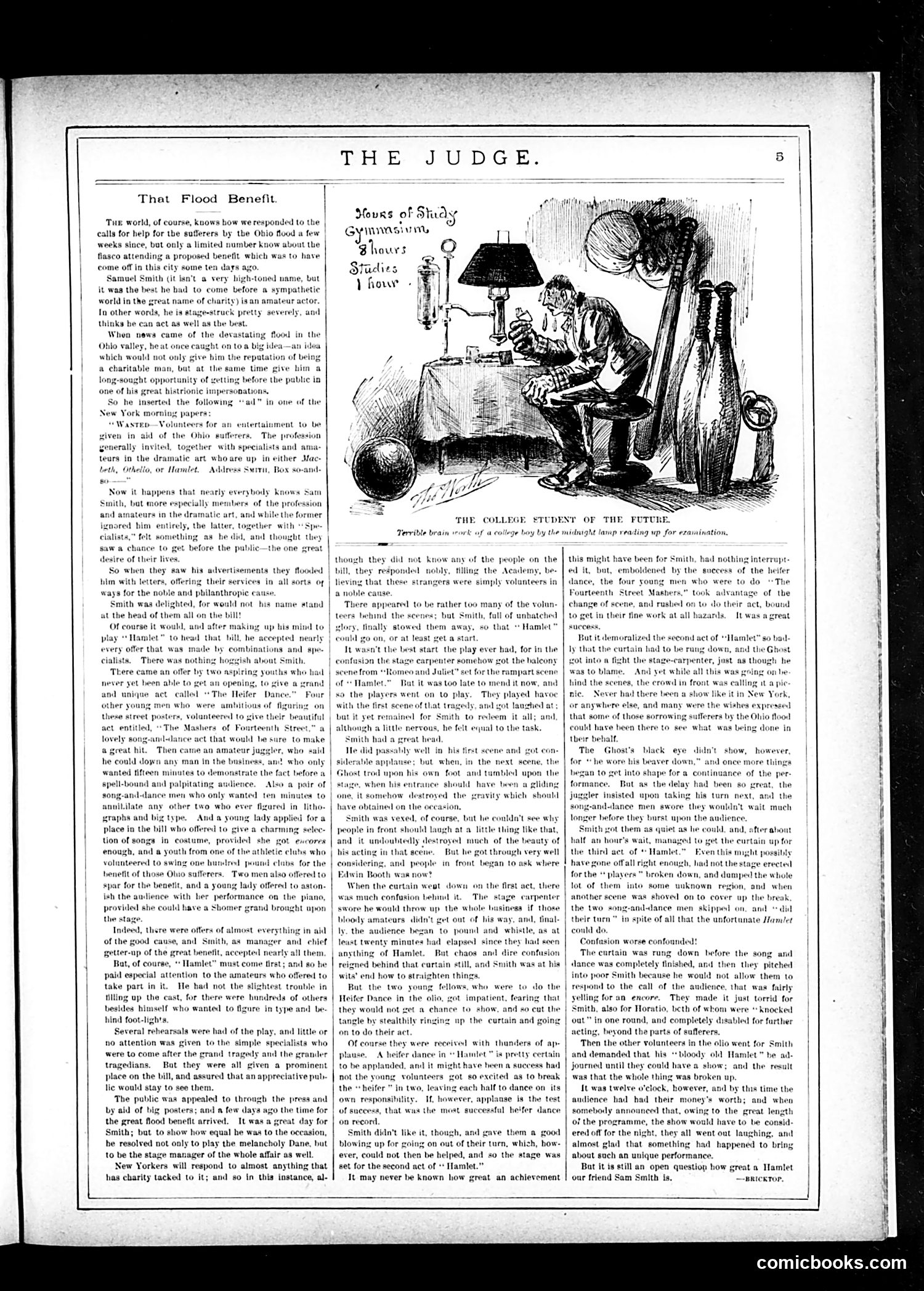
This article satirizes a self-aggrandizing actor (identified only as "Smith") who organized a theatrical charity benefit ostensibly to aid Ohio flood victims. The accompanying cartoon shows him at a desk surrounded by theatrical props and lighting equipment, receiving "Hours of Study" and "4 hours?" inquiries—mocking his pretense. The satire's target: Smith advertised for volunteer performers to support his lead role as Hamlet, attracting numerous amateurs and specialists eager for stage exposure. However, Smith's actual interest was self-promotion rather than charity. He monopolized rehearsals, minimized other performers' contributions, and structured the entire benefit around showcasing himself. The joke exposes the hypocrisy of using charitable causes as vehicles for personal vanity and career advancement. Judge criticizes both Smith's transparent opportunism and the naive volunteers who participated, hoping for recognition through association with an established actor. This reflects Progressive-era skepticism toward public figures exploiting social crises for personal gain—a timeless satirical target.
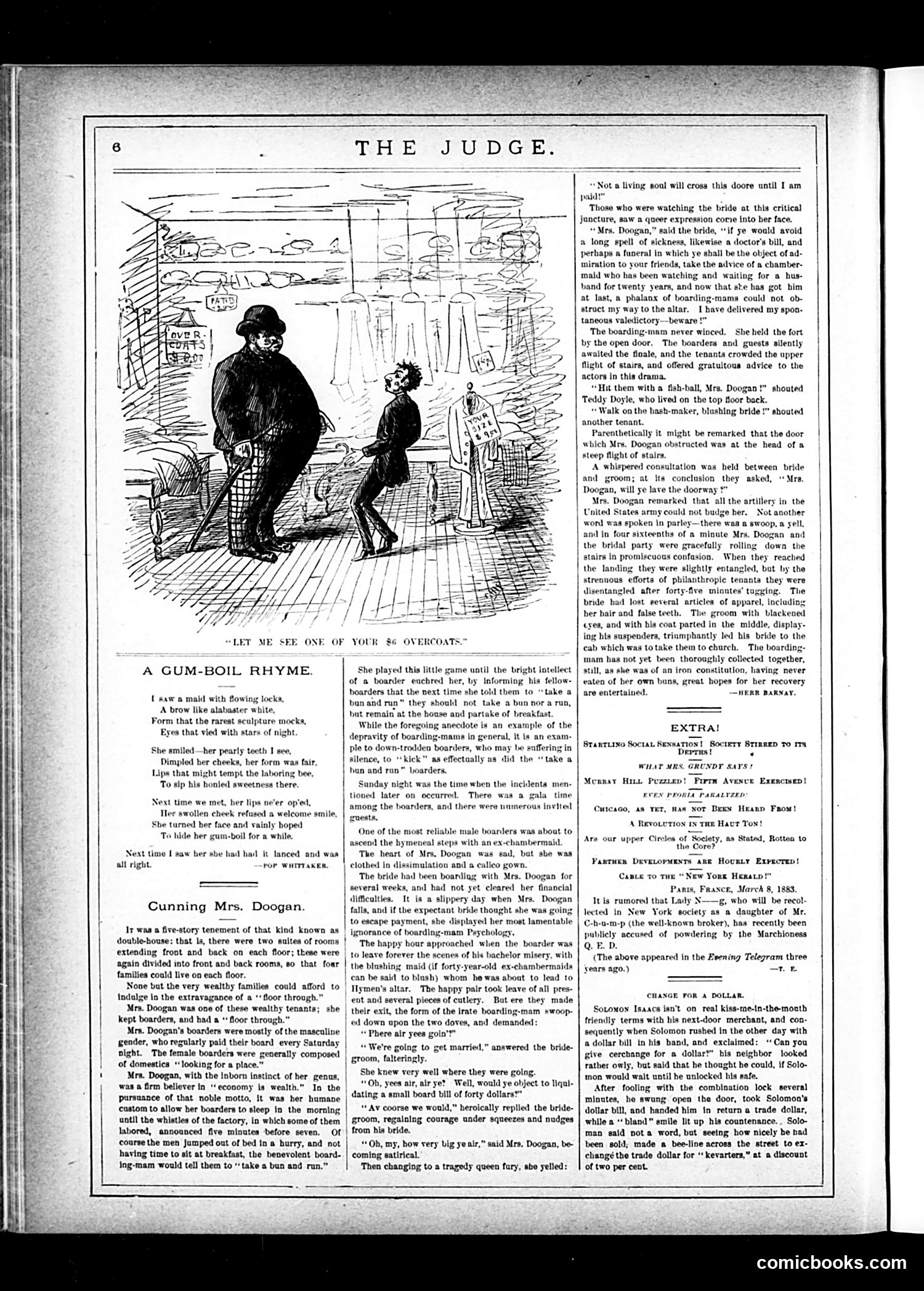
This page satirizes the exploitative practices of boarding-house operators in late 19th-century America. Mrs. Doogan is a stock character representing the shrewd, penny-pinching landlady who mistreated her working-class tenants. The main story mocks her deceptions: she serves boarders meager breakfasts ("take a bun and run"), overcharges them, and uses psychological manipulation. The satire's climax shows her pursuing a departing male boarder and his bride demanding payment of a $40 board bill—blocking their wedding departure until they settle her inflated charges. The humor targets Mrs. Doogan's cunning exploitation of vulnerable boarders (factory workers, domestic servants) who had few tenant protections. The accompanying "Gum-Boil Rhyme" is lighthearted filler about a woman's disfiguring dental abscess. This reflects genuine period grievances: boarding houses were common, often unsanitary, and operators frequently exploited residents lacking legal recourse.
This page from *Judge* contains two satirical pieces mocking wealthy pretension and hypocrisy. **"The Vanderbilt Ball"** (left) is a poem ridiculing Lady William Vanderbilt's attempt to gain social prestige through an exclusive ball. The narrator rejects her invitation, declaring that his modest "locket" is worth more than her husband's railroad fortune. The satire targets the Gilded Age obsession with aristocratic display—suggesting that old money cannot buy genuine dignity. **"What the Stage-Driver Said"** and **"Deacon Jones' Funeral"** (right) form a connected narrative. A stagecoach driver tells passengers about Hank Jones, a seemingly humble but universally respected man who rode his stage regularly. When Jones dies, the entire town—including the Sons of Temperance lodge—turns out in grand funeral procession for this unassuming figure. The satire inverts the Vanderbilt story: true worth comes from modest character, not wealth or pretense. The joke critiques how society honors the genuinely good while chasing hollow aristocratic status.
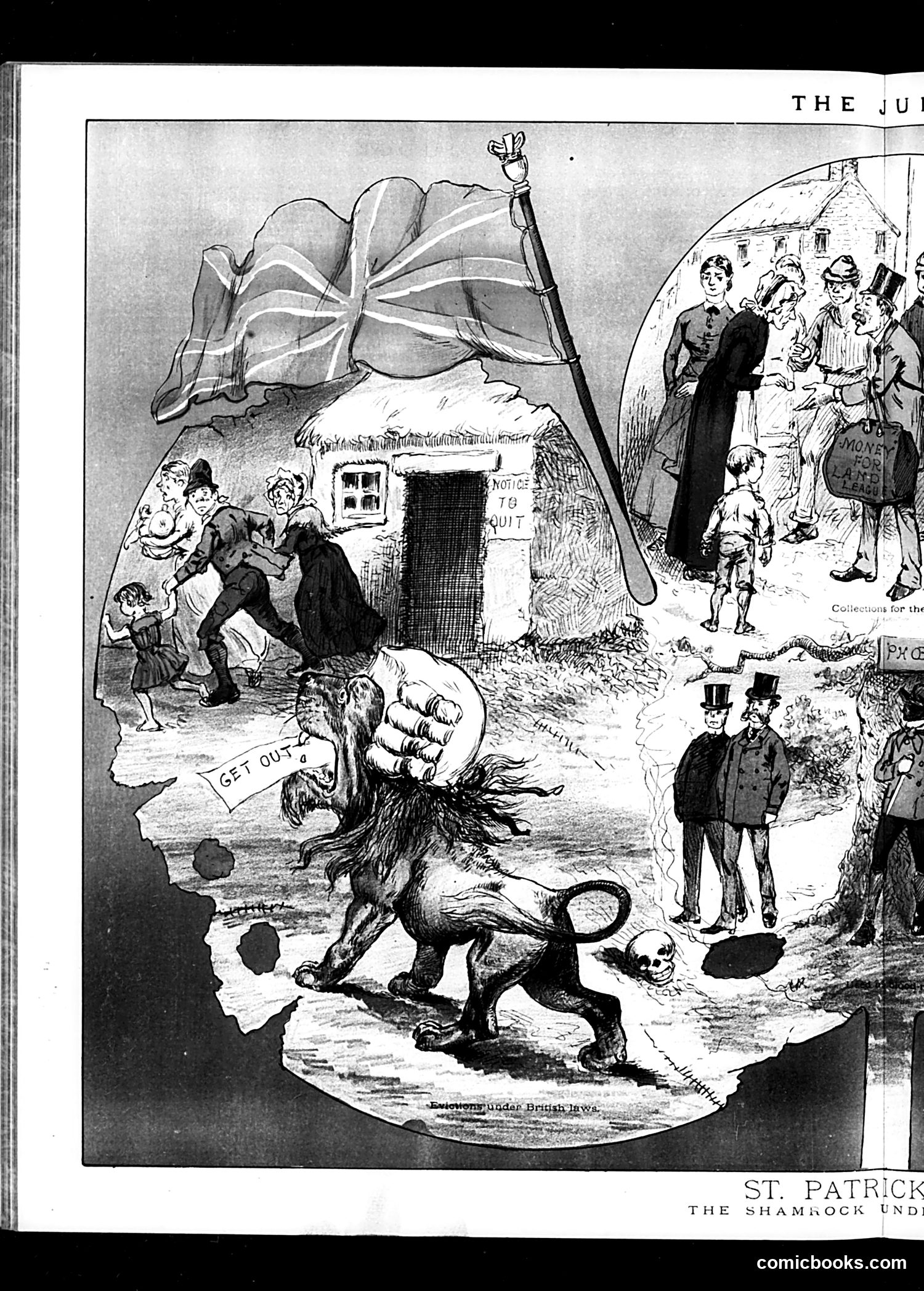
This political cartoon satirizes evictions during a period of housing crisis and poverty. The central image shows a demonic figure labeled "GET OUT" evicting a family from their modest cottage, while well-dressed gentlemen observe from the right—likely representing landlords or authorities indifferent to the suffering below. The Union Jack flag above and the caption referencing "British Laws" suggest this criticizes British housing policy or landlord practices. The skull and skeletal imagery emphasize the deadly consequences of homelessness. The cartoon appears to attack the callousness of the wealthy and powerful toward the desperate poor, using grotesque imagery to show eviction as a violent, inhumane process. The contrast between the gentlemen's composure and the family's distress underscores the moral indictment. Without a specific date visible, the exact historical moment remains unclear, but the satirical intent—condemning evictions as a systemic injustice—is unmistakable.
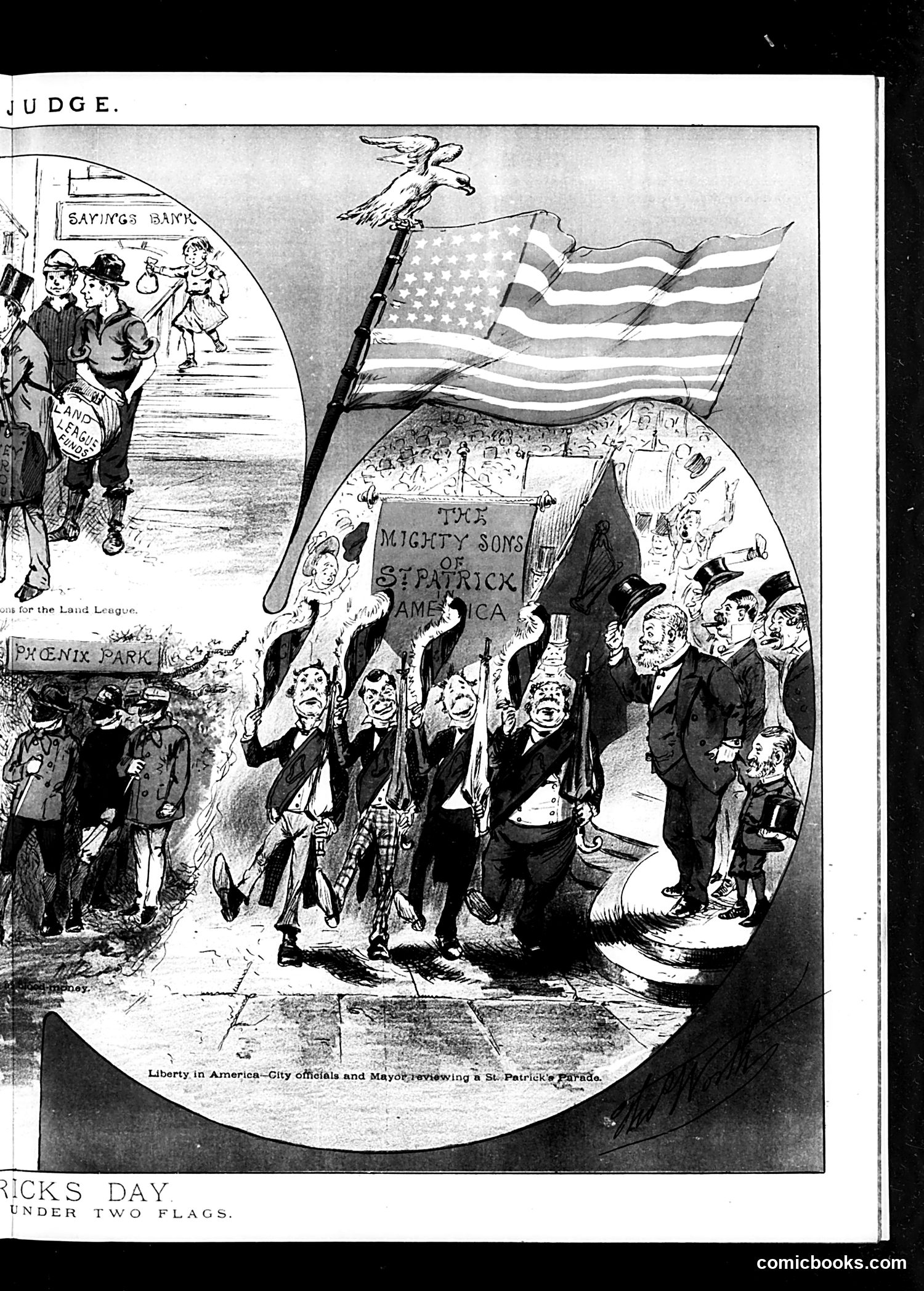
This satirical cartoon depicts St. Patrick's Day celebrations divided by competing loyalties. The main image shows "The Mighty Sons of Strabane America" marching with the American flag, while city officials and mayors observe from the side. The cartoon appears to critique Irish-American identity politics, satirizing how Irish immigrants organized themselves into ethnic societies (like the "Sons of Strabane") while supposedly pledging allegiance to America. The "two flags" reference suggests tension between Irish heritage and American citizenship—a common nativist critique of the era. The left panel shows observers at a "Savings Bank," possibly commenting on economic aspects of immigrant communities. The exaggerated facial features reflect period cartooning conventions, though by modern standards these caricatures appear offensive.
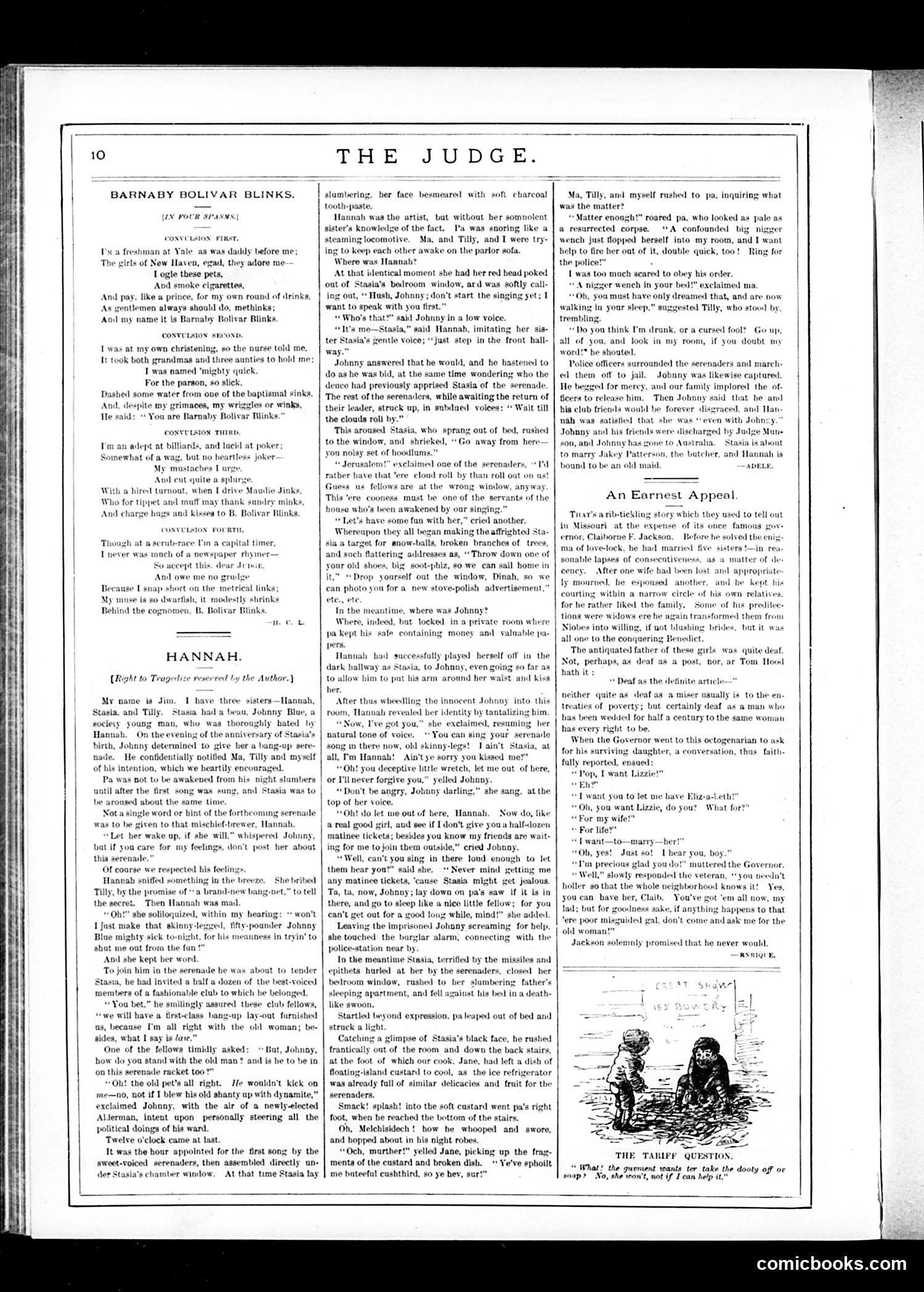
This page contains two satirical pieces from the American magazine *Judge*: ## "Barnaby Bolivar Blinks" A humorous poem mocking a pretentious Yale freshman who boasts about his wealth, social conquests, and romantic exploits. The character represents the entitled, self-important college dandy—someone who brags about throwing money around, pursuing women ("girls of New Haven"), and generally living lavishly while being fundamentally foolish. The repetitive structure emphasizes his vapid narcissism. ## "Hannah" A longer narrative story about a practical joke gone wrong. Johnny Blue plans a serenade to impress his love interest, Stasia, but her sister Hannah—depicted as mischievous—intercepts him with a deception, leading to comedic chaos involving serenaders, coal dust, and domestic disruption. The humor derives from Hannah's cunning sabotage of Johnny's romantic scheme. Both pieces are typical of *Judge's* satirical humor: mocking vanity, social pretension, and youthful foolishness through exaggerated character types and comedic storytelling.
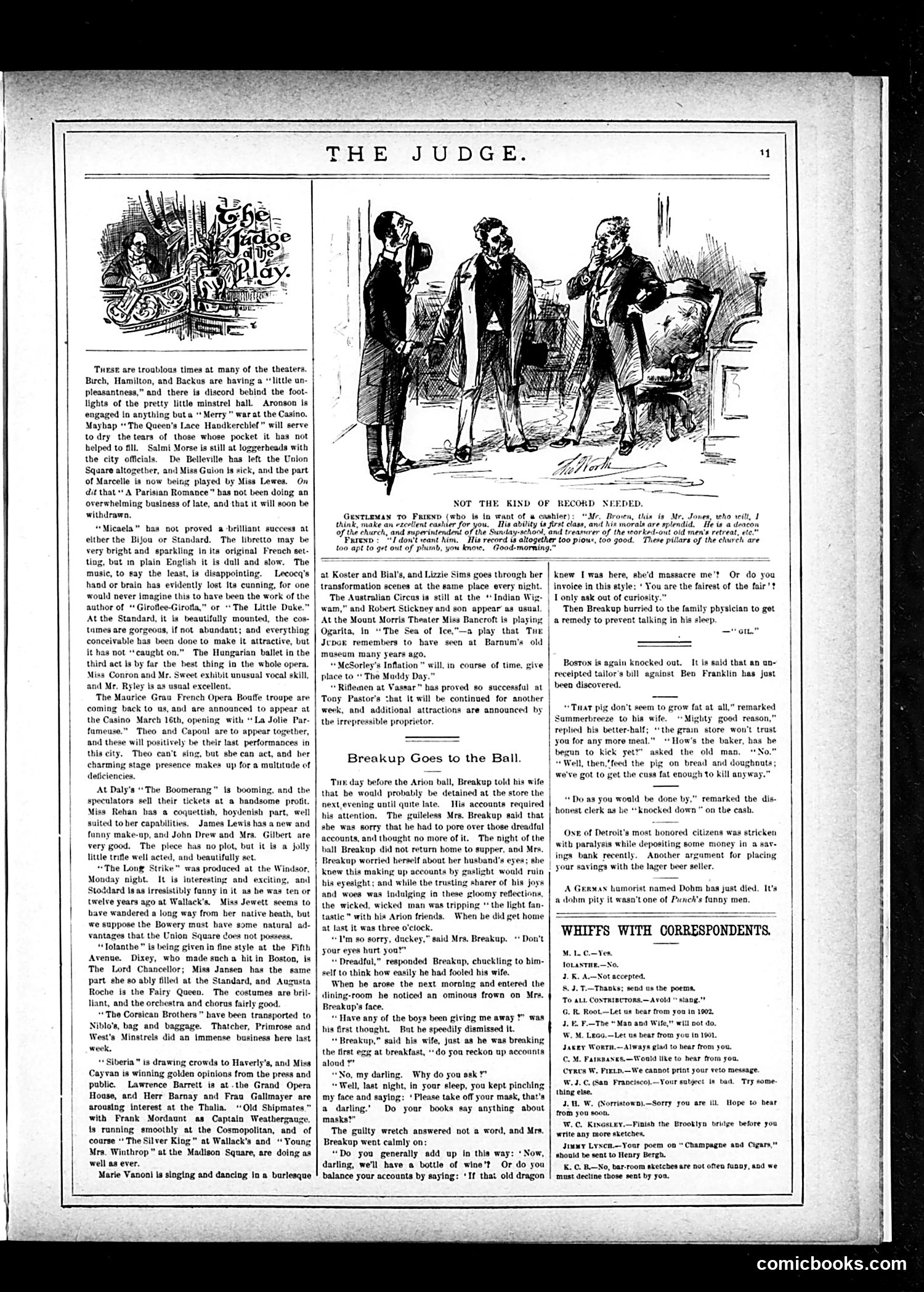
This page is primarily **theater criticism and gossip**, not political satire. It reviews multiple Broadway productions from the 1880s, commenting on cast performances, plot quality, and box office success. The main illustrated cartoon (top right) depicts a conversation between four men in formal dress, captioned "Gentleman to Friend." The dialogue concerns theatrical finances—one character warns another that a show's leading actor will likely be detained at the store because his account needs attention, implying the performer has financial troubles. The satire is **social/commercial** rather than political: it mocks the financial precariousness of stage actors and the mundane business realities behind theatrical glamour. The page reflects Judge's coverage of New York's entertainment scene, targeting readers interested in theater gossip and industry drama. The secondary section "Whiffs with Correspondents" is a letters column, unrelated to cartooning.
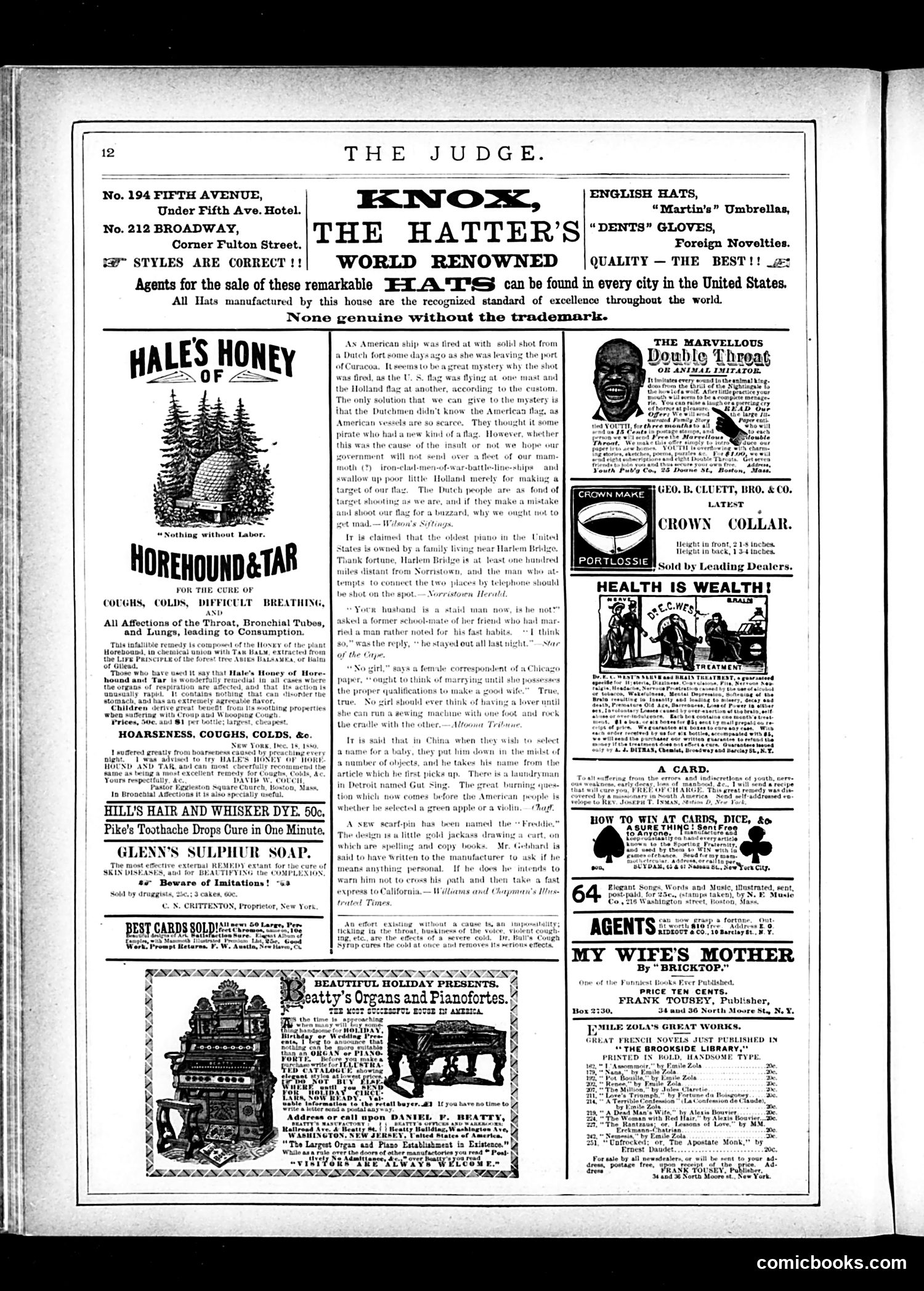
This is primarily an **advertising page** from Judge magazine, not a political cartoon. The page features commercial advertisements for various products popular in the late 19th/early 20th century: Knox hats, Hale's Honey cough remedy, Horehound & Tar medicine, Hill's Hair and Whisker Dye, Glenn's Sulphur Soap, and organs/pianofortes. The only clearly satirical content appears to be **"The Marvellous Doddin," a caricatured Black figure** (visible in the upper right), though the accompanying text is largely illegible in this reproduction. This represents the racist imagery common in period American publications. The remainder consists of patent medicine advertisements and product endorsements typical of Judge's revenue model—advertising occupied significant space in 19th-century humor magazines. There's also a book advertisement for "My Wife's Mother" and serialized French novels in "The Brookside Library." The page demonstrates how satirical magazines subsidized their content through extensive advertising rather than subscription alone.
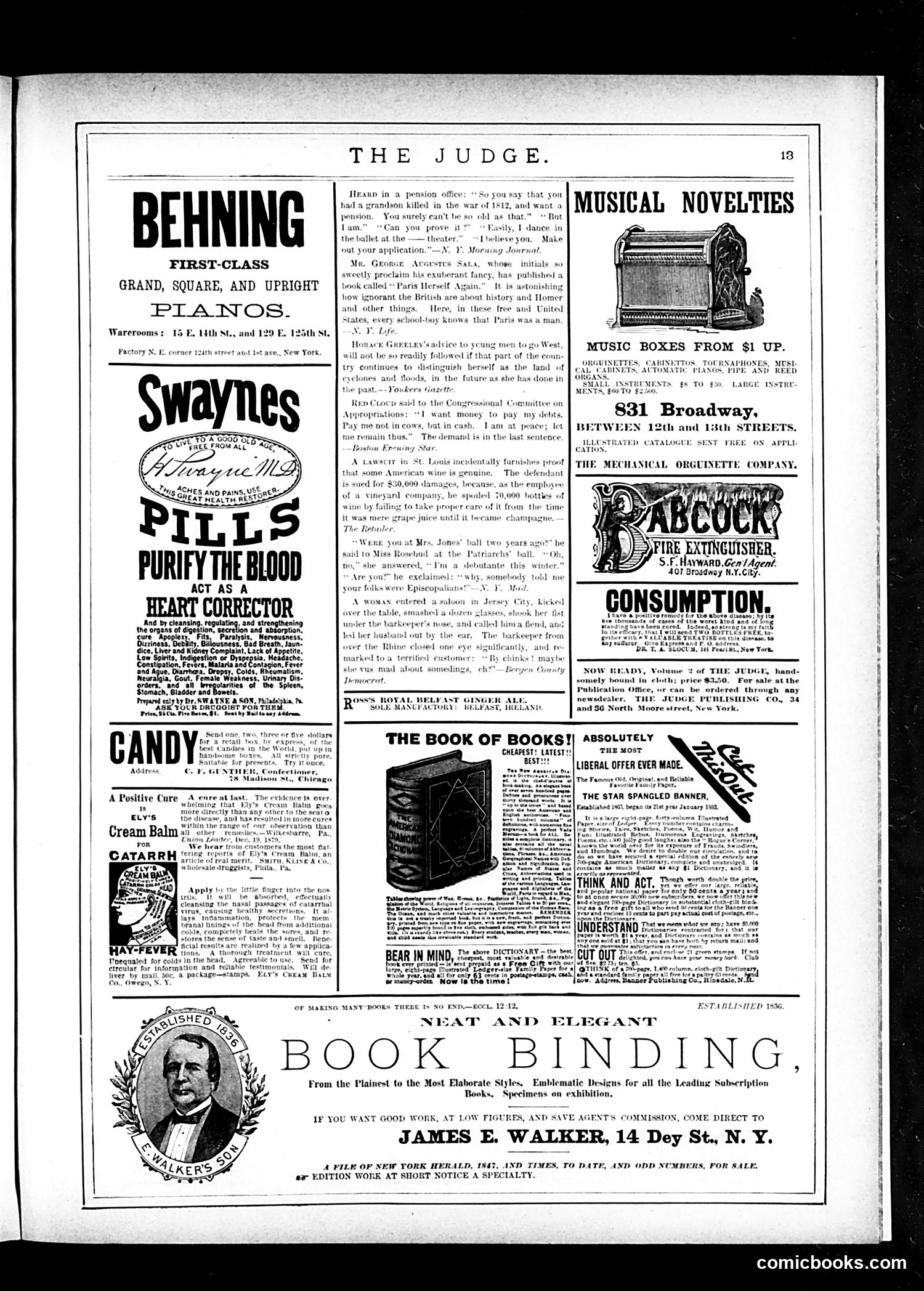
This is primarily an **advertising page** from Judge magazine, with minimal editorial content. The visible cartoons/text snippets appear to be: A brief political joke about **Red Crow** (likely a Native American reference) addressing Congress about paying debts, claiming "I want money to pay my debts. Pay me not in prose, but in cash." This satirizes government fiscal irresponsibility or broken promises—possibly referencing federal obligations to Native American tribes or general Congressional spending. Additional anecdotes mock pretension and social climbing among the wealthy (references to "Patriarchs' ball"). The page is otherwise dominated by period advertisements for **Behning pianos, Swayne's blood purifier pills, Ely's Cream Balm, musical boxes, fire extinguishers, books, and book binding services**—typical late-19th/early-20th-century American commercial messaging. The satire is light and social rather than deeply political on this particular page.
I cannot reliably read or interpret this page. The OCR text appears to be heavily corrupted or inverted, making it illegible. While the header clearly states "A STARTING DOMESTIC REVOLUTION" and there are references to sections like "FOR LADIES TO READ," "FOR MEN TO READ," and "SPECIAL FOR PHYSICIANS," the image quality and text degradation prevent me from identifying specific figures, cartoons, or satirical content with confidence. To properly analyze this Judge magazine page—identifying caricatures, political/social references, and satirical intent—I would need either a clearer image or uncorrupted source text. I cannot responsibly speculate about meaning without being able to read the actual content.
This page is primarily **advertising**, not political satire. The dominant content promotes "Frank Siddalls Way of Washing Clothes"—a commercial laundry product or method. The small cartoons at top appear to be humorous social commentary on manners: "How to Tell a Person of Honor" and "How to Tell a Person of Refinement" likely use visual gags to satirize Victorian-era pretensions about class and respectability. The bulk of the page consists of instructional text and testimonials for the Siddalls soap/washing product, emphasizing its simplicity ("any child over 12 years old" can use it) and superior cleanliness results. This represents typical late 19th/early 20th-century advertising that Judge magazines ran to fund publication. The reversed/upside-down text at the bottom appears to be standard legal disclaimers or additional product information, common in period advertising. **Bottom line**: While *Judge* was known for political satire, this particular page is largely a commercial advertisement masquerading within the magazine's format.
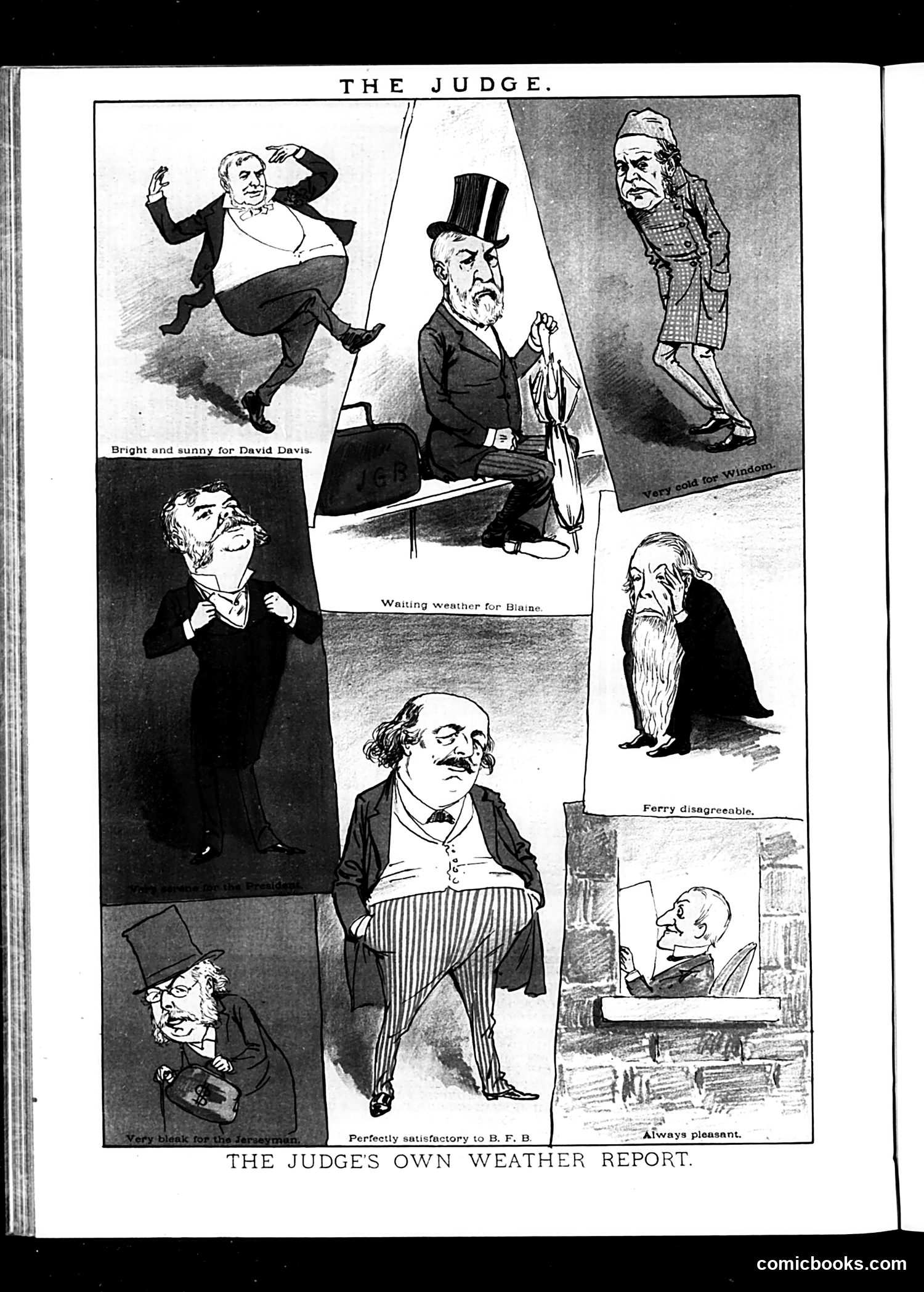
This satirical cartoon mocks political figures and their public personas by presenting them as weathermen offering biased forecasts. Each panel caricatures a different politician's characteristic attitude: - "Bright and sunny for David Davis" suggests optimism about Davis's prospects - "Waiting weather for Blaine" implies uncertainty regarding James G. Blaine - "Very cold for Windom" and "Very bleak for the Jerseyman" suggest negative outlooks - "Ferry disagreeable" likely references a political figure named Ferry - "Perfectly satisfactory to B.F.B." and "Always pleasant" suggest complacency The cartoon satirizes how politicians spin events to favor themselves. Rather than objective weather reports, these are subjective political forecasts reflecting each figure's self-interested perspective. The title's pun—"Judge's weather report" from *Judge* magazine—suggests the publication offers its own political commentary on these public figures.