
A complete issue · 16 pages · 1883
Judge — February 24, 1883
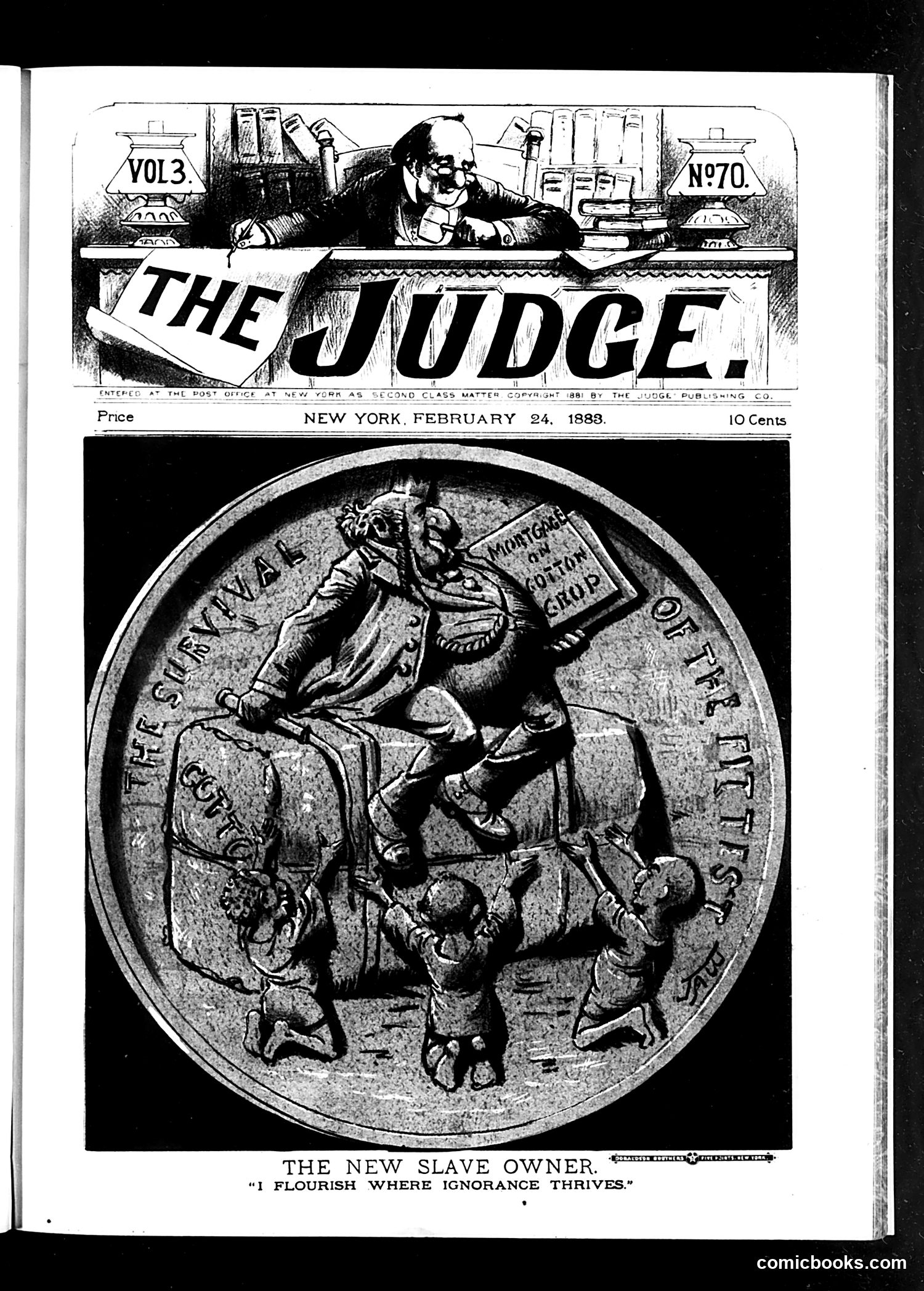
This satirical medallion depicts a figure labeled "The New Slave Owner" with the motto "I Flourish Where Ignorance Thrives." The image shows a well-dressed man on horseback riding over enslaved people and children in chains. The cartoon critiques what appears to be a post-Civil War figure—likely a politician, industrialist, or social leader—for perpetuating slavery-like conditions through exploitation of ignorant or uneducated populations. The "new" slavery referenced is probably economic exploitation or oppressive labor practices of the Gilded Age, particularly targeting vulnerable workers. The circular medallion format mimics official seals, sarcastically elevating this exploiter as a figure of authority. The satire suggests that ignorance—lack of education or awareness—enables this modern form of subjugation.
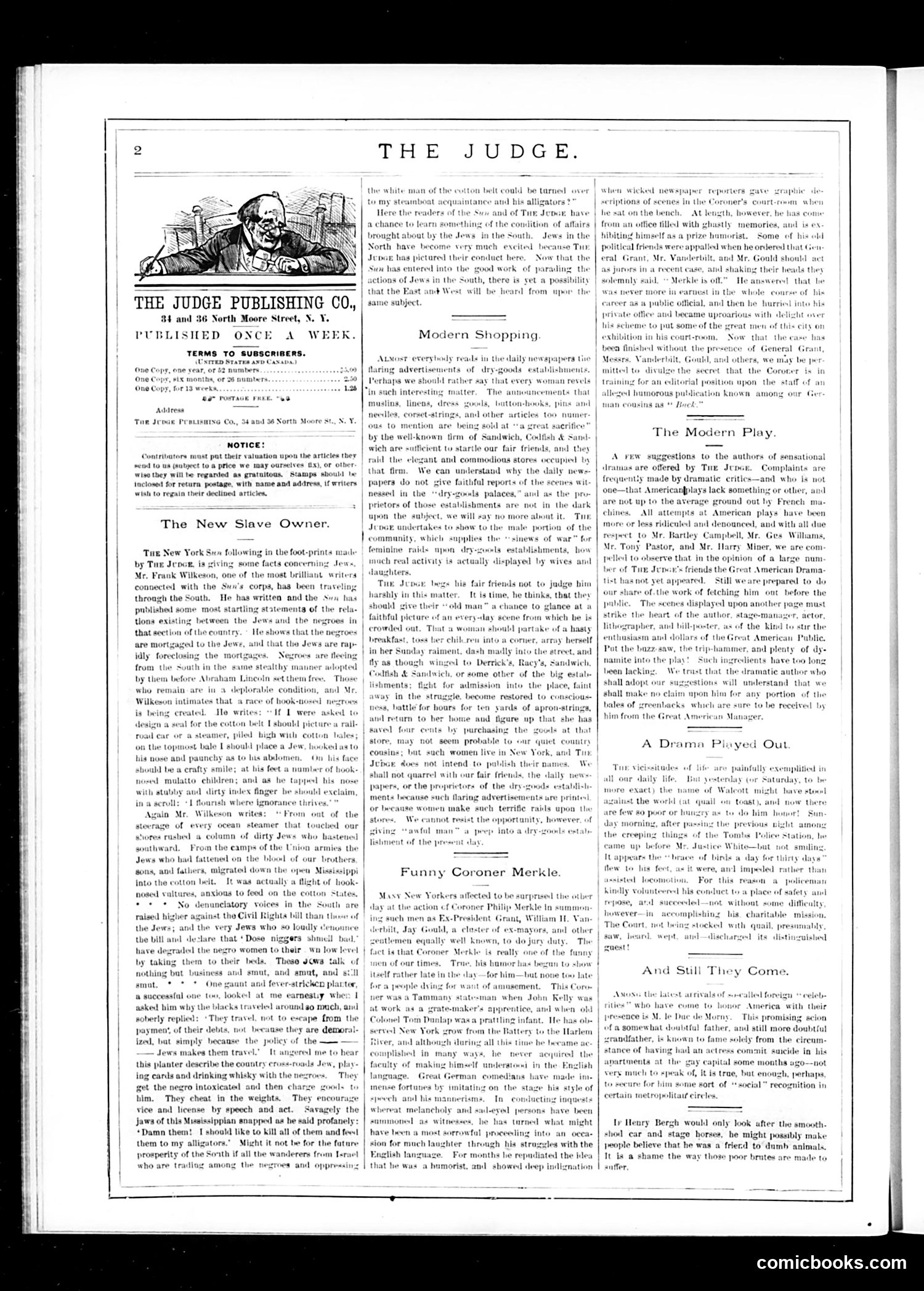
This Judge magazine page contains satirical articles addressing post-Civil War racial and social issues. **"The New Slave Owner"** criticizes Jewish merchants in the South, claiming they have economically enslaved Black people through debt and mortgages—a harmful antisemitic stereotype. The article suggests these merchants exploited freed slaves in ways analogous to slavery itself. **"Modern Shopping"** mocks wealthy women's shopping habits at department stores, suggesting wives drain family finances through frivolous purchases of dry goods, buttons, and trinkets. It argues newspapers won't report honestly on these "dry-goods palaces" because advertisers control coverage. **"The Modern Play"** complains that American theatrical productions lack energy and authenticity compared to French drama, calling for more dynamic stagecraft and realistic plots. The page reflects Judge's approach: satirizing contemporary social anxieties (economic relationships, consumer culture, artistic standards) through exaggeration and mockery, though some content reflects deeply prejudiced assumptions of the era.
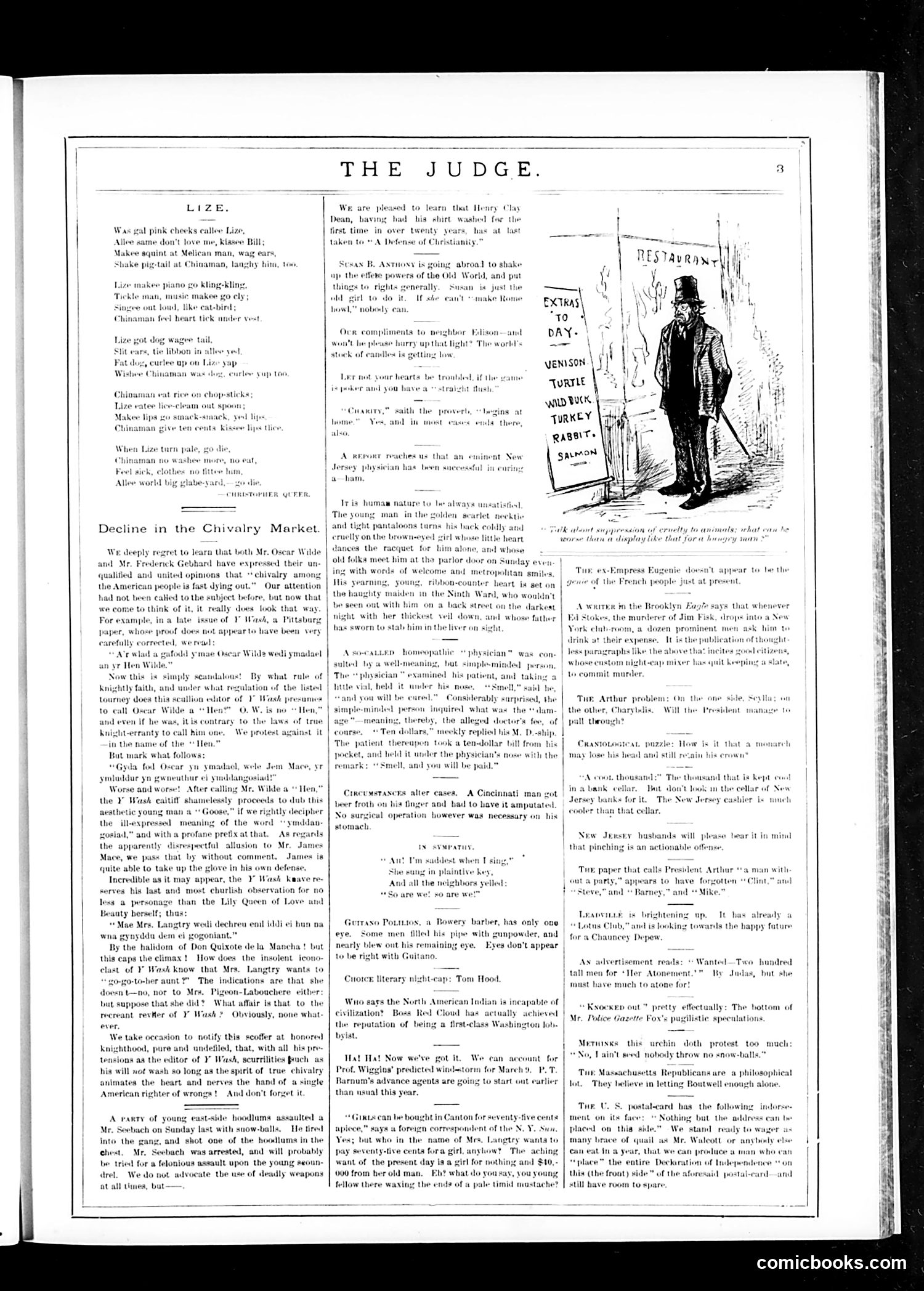
This page contains satirical commentary on the decline of chivalry, using two prominent contemporary figures as examples. **The Main Cartoon** depicts a well-dressed man standing outside a restaurant, illustrated in caricature style. The satire references Oscar Wilde and Frederick Gebhard, society figures of the era, who apparently expressed that American chivalry was dying out. **The Satire's Point**: Judge ridicules this complaint by noting these same men had themselves demonstrated unchivalrous behavior. The text mocks a competing publication (*Y Wash*) for calling Wilde a "Hen" and attacking the reputations of young society men and women—particularly "the Lily Queen of Love and Beauty" (likely actress Lillie Langtry), questioning her propriety. **The Irony**: Men complaining about declining chivalry while engaging in gossip, name-calling, and character assassination themselves exemplifies the very problem they're describing. The page also includes a poem ("Lize") using ethnic dialect humor typical of the 1880s-90s era, and various brief satirical items about contemporary social issues.
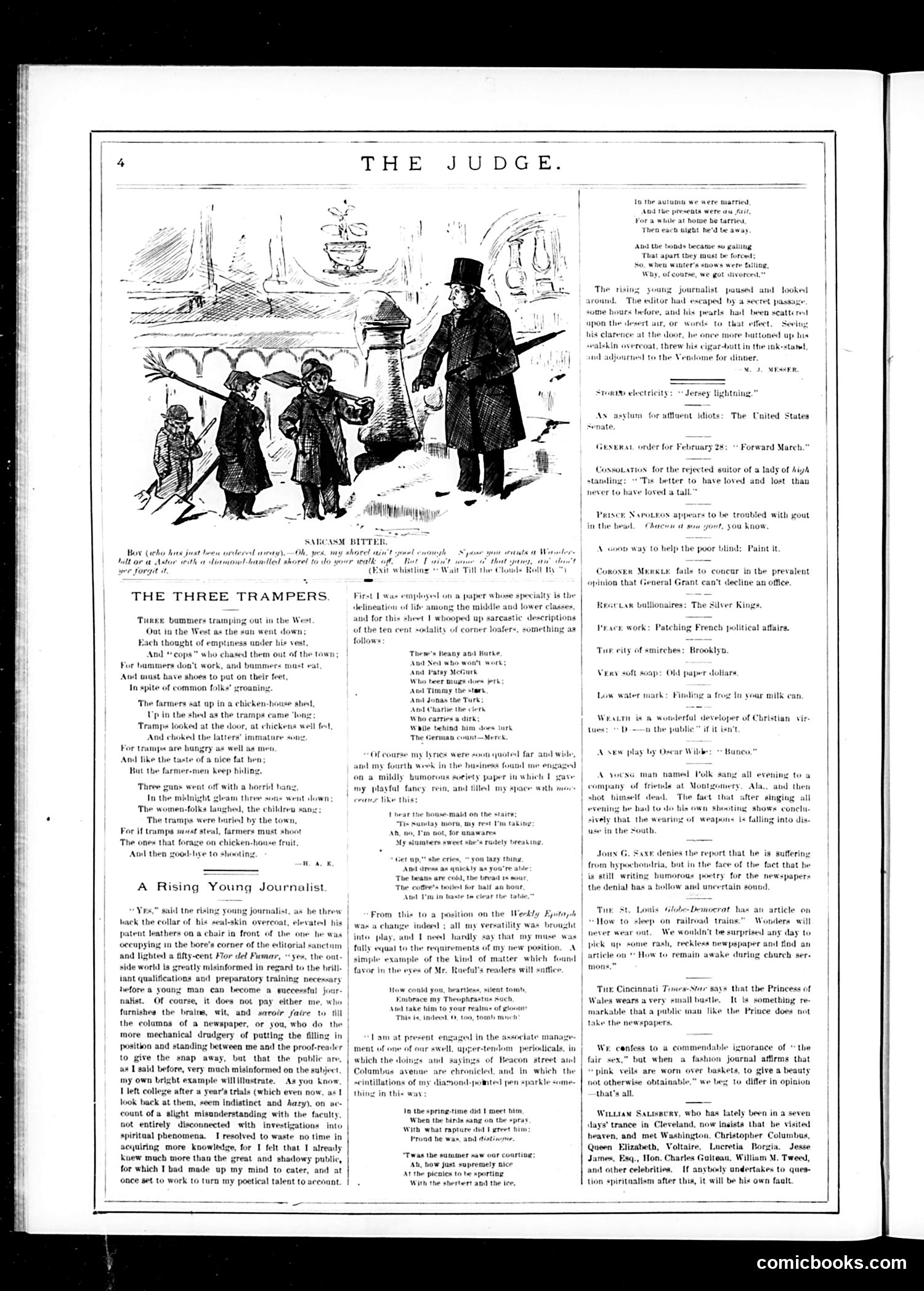
This page contains three distinct pieces of satirical content from the 1880s-90s era: **"The Three Trampers"** is a narrative poem about three vagrant men who steal chickens from a farmer. When confronted, violence erupts and the tramps are killed. The satire appears to mock both the desperation of the poor and the harsh rural response to petty crime. **"A Rising Young Journalist"** profiles an ambitious young writer who boasts of rapid career advancement from a sensationalist penny paper to a respectable weekly publication by writing increasingly sophisticated social commentary. The satire targets journalistic careerism and the pretensions of writers who inflate their own importance. **The sidebar "Sarcasm Bitter"** offers brief satirical quips mocking contemporary figures and institutions—including jokes about asylums, General Grant, billionaires, and Brooklyn. The cartoon illustration shows three shabby men (the tramps) confronting what appears to be a well-dressed gentleman, visualizing the poem's narrative. Overall, the page satirizes class conflict, journalistic ambition, and social hypocrisy typical of *Judge* magazine's approach.
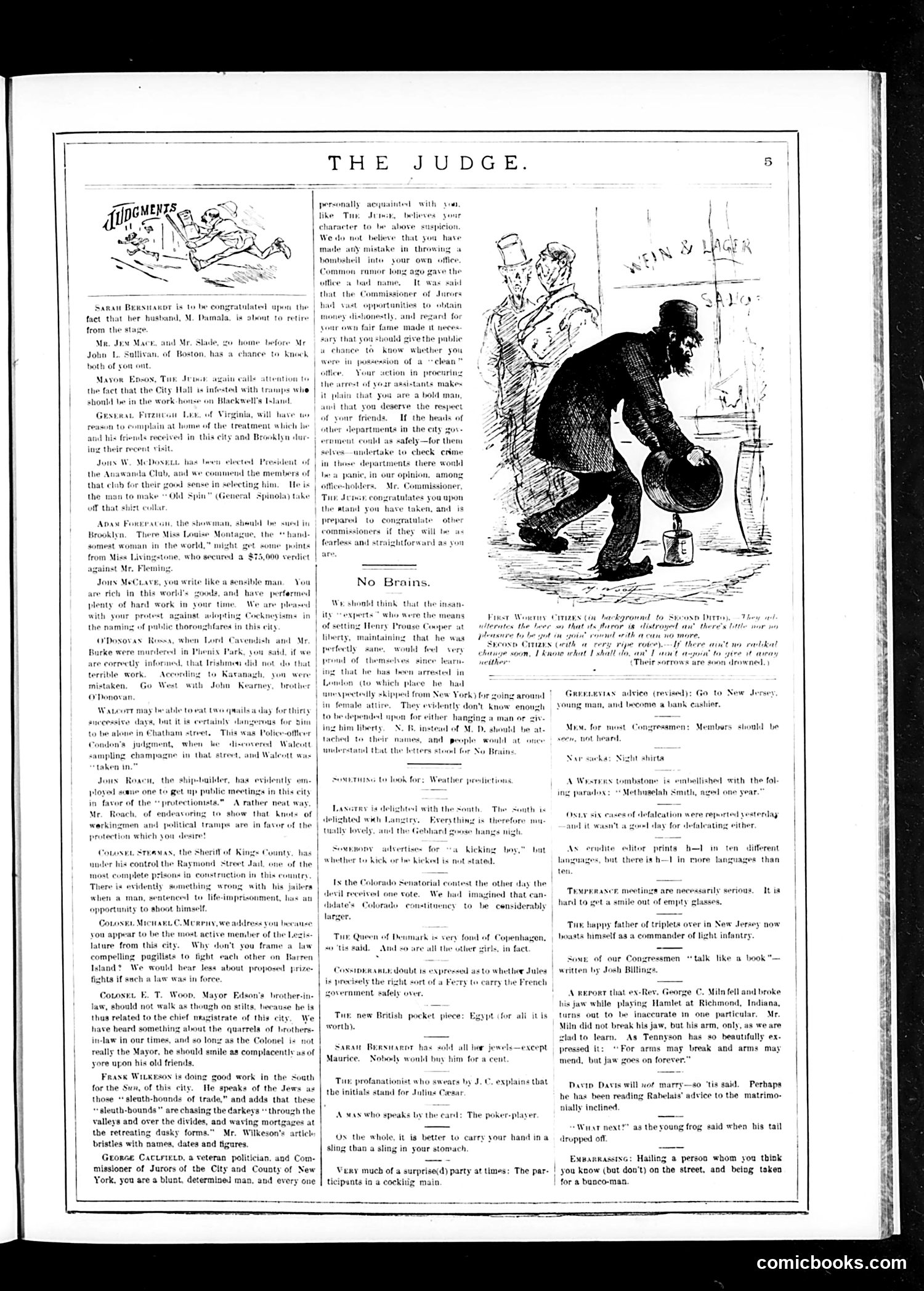
This page from the satirical magazine **Judge** contains multiple brief commentary pieces and jokes about New York City politics and society figures from the 1880s. The main cartoon (top right) depicts a well-dressed man at a desk labeled "MNAJ & LAGER" — appearing to satirize someone's business or political position through caricature. The text items mock various public figures: Mayor Edson (congratulated sarcastically for his wife's husband being away), General Fitz-Lee of Virginia (for complaining about treatment), Commissioner Gould (about his office acquiring a "bad name"), and others. The satire targets **municipal corruption, nepotism, and incompetence** in Gilded Age New York governance. References to Blackwell's Island (a prison/workhouse) and complaints about City Hall's "infested" state suggest broader critiques of institutional dysfunction. Most humor derives from personal attacks and wordplay rather than visual comedy, typical of Judge's approach to political commentary during this era.
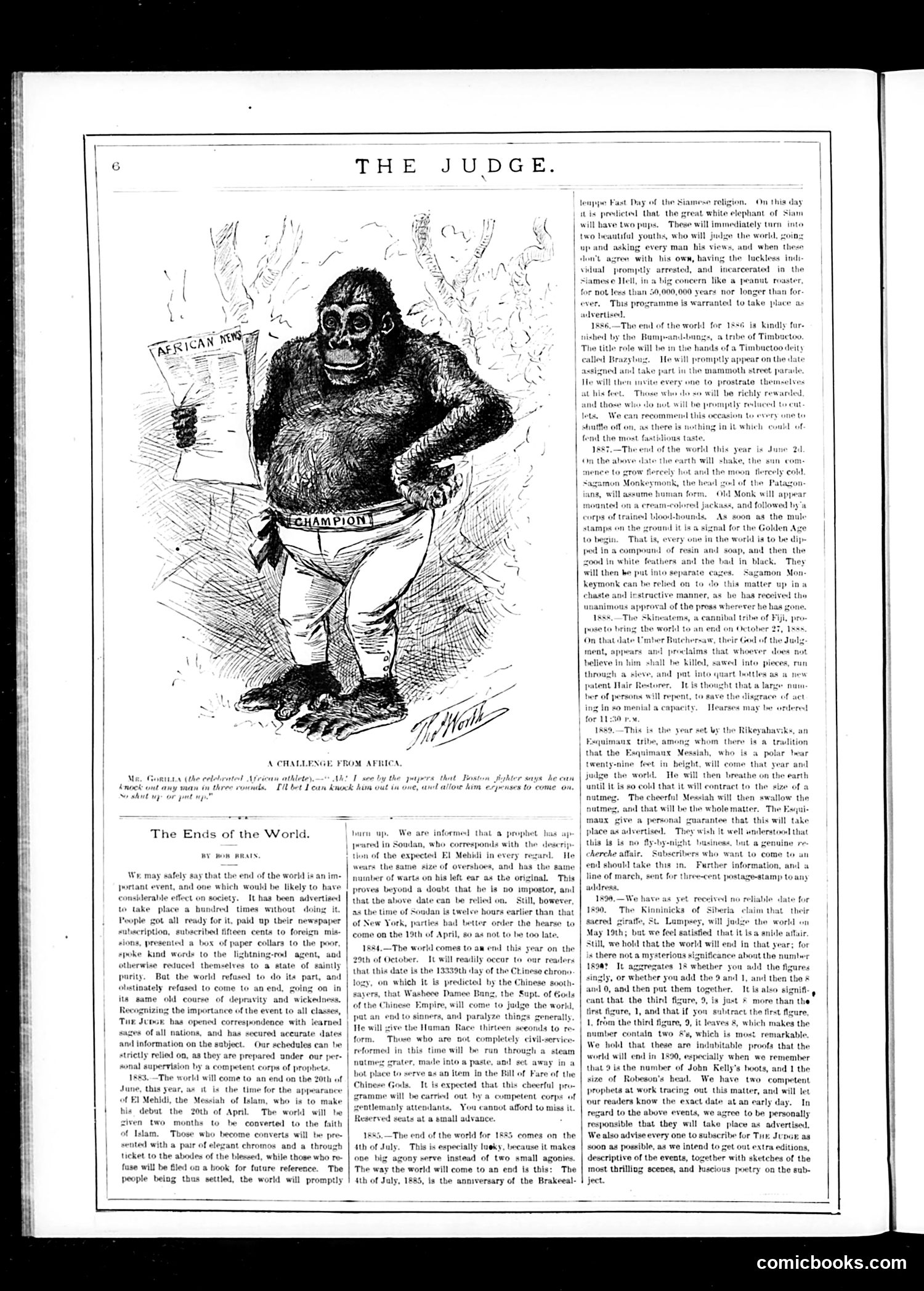
This cartoon satirizes late-19th-century predictions of the world's imminent end. The figure depicted is a caricatured African man labeled as a "champion" prophet, holding a newspaper ("African News"). The satire mocks recurring apocalyptic predictions from various religious and cultural sources. The accompanying text humorously catalogs failed "end of world" prophecies for years 1884-1885, attributed to different traditions: an Islamic Mahdi (El Mehddi), Chinese seers predicting world judgment, and Siamese religious beliefs about a white elephant. Each prediction is treated with mock-serious journalistic detail, complete with "reserved seats" and merchandise offerings. The joke targets both credulous believers in apocalyptic claims and the magazines' own readers who consumed such sensationalism. By listing multiple contradictory prophecies, Judge ridicules the absurdity of taking any doomsday prediction seriously—a common form of 19th-century skeptical humor directed at religious extremism and superstition.
This page contains two humorous stories written in exaggerated dialect, typical of Judge magazine's satirical approach. **"The Belle of the Miners Ball"** mocks frontier social pretension. A miner narrator describes a woman who attracts attention through cosmetics and flirtation at a mining camp dance, yet ultimately marries an unattractive "wall-flower" named Em. The satire targets superficial courtship practices and warns that physical appearance ("trimmin's") matters less for marriage than character. **"Jibboy's Singed Cat"** follows a poor but good-natured character attempting to impress by borrowing a fancy sleigh and horse. The story satirizes social climbing and the vanity of displaying borrowed wealth. Jibboy's comical German-dialect speech patterns were standard Judge humor of the era, though cringe by modern standards. Both stories use vernacular dialect humor and ridicule pretentiousness—central to Judge's appeal to working and middle-class readers who enjoyed seeing social climbers humbled.
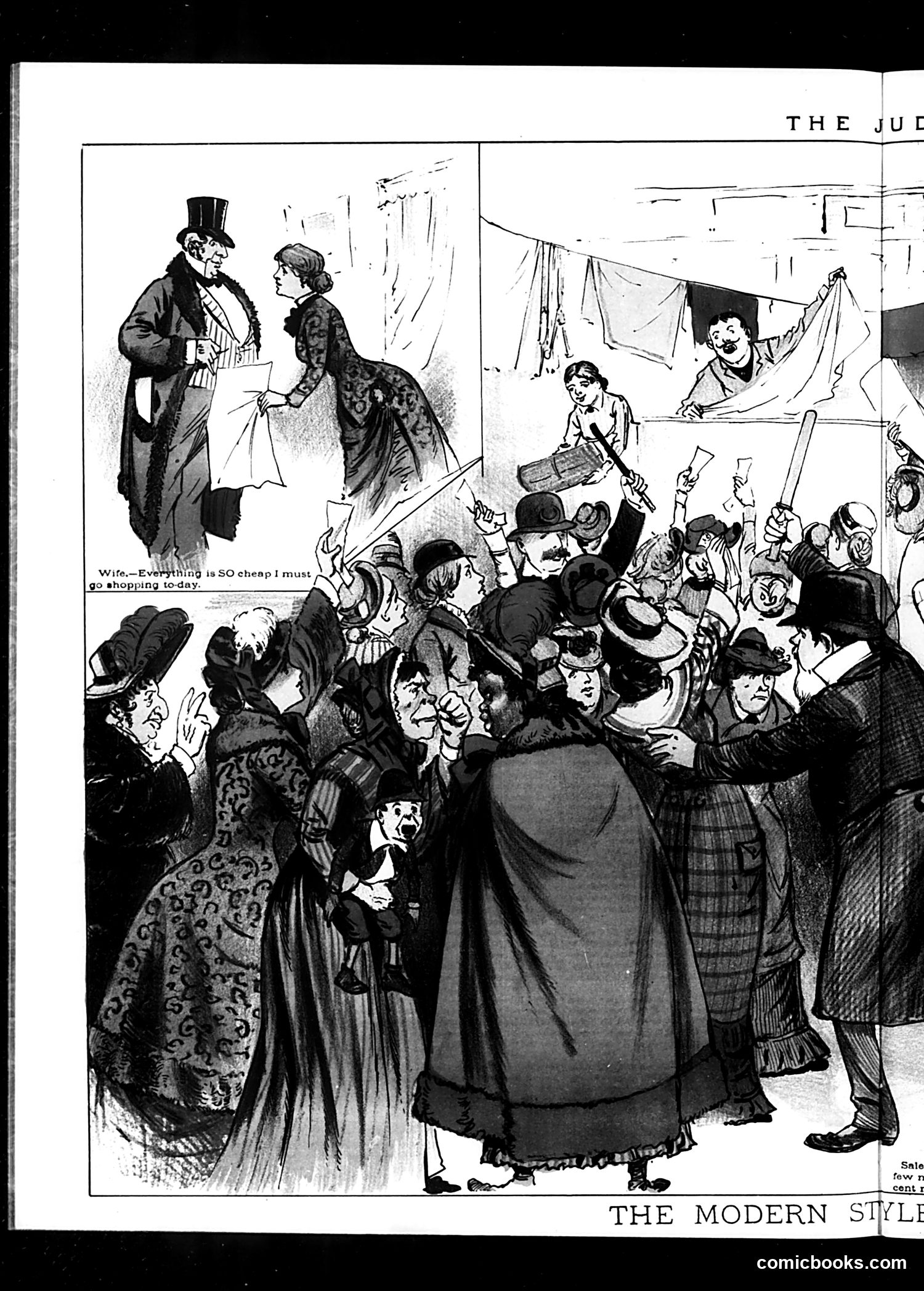
This satirical cartoon depicts the contrast between wealthy and working-class shopping experiences. The inset shows a well-dressed gentleman telling his wife that goods are "so cheap" he must go shopping—a humorous commentary on upper-class excess and frivolous consumerism among the wealthy. The main scene shows a chaotic, crowded market or sale with predominantly working-class and poor women scrambling and pushing, suggesting desperation rather than leisure shopping. The stark visual contrast satirizes class inequality: the rich shop because prices are low enough to make consumption entertaining, while the poor must frantically purchase necessities despite affordability pressures. The cartoon critiques both wealthy indulgence and the economic struggles of ordinary people, typical of Judge magazine's satirical commentary on Gilded Age American society.
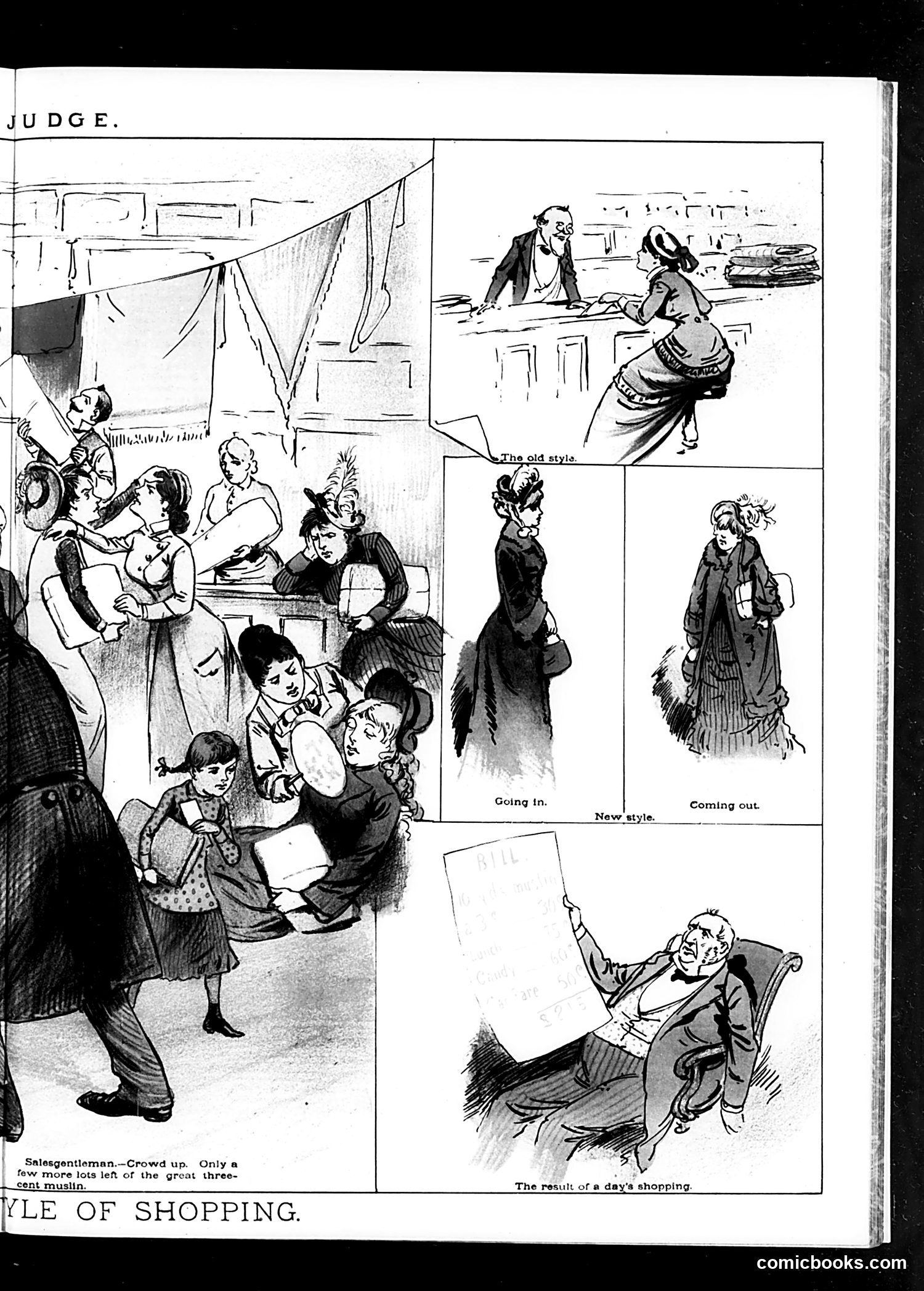
This satirical page mocks women's shopping habits and fashion obsession. The large left panel shows a chaotic department store scene where a salesclerk announces bargain "three-cent muslin," while women crowd frantically around merchandise and children. The right panels contrast fashion "styles"—"Going In" shows a woman fashionably dressed entering a store, while "Coming out" depicts her disheveled, with rumpled clothing. The final panel, "The result of a day's shopping," shows an exhausted man sprawled in a chair holding bills—presumably the husband facing the financial consequences. The satire targets both excessive female consumerism and the frenzy of bargain-hunting, while portraying shopping as physically and financially exhausting for families. The tone reflects period attitudes about women's spending habits.
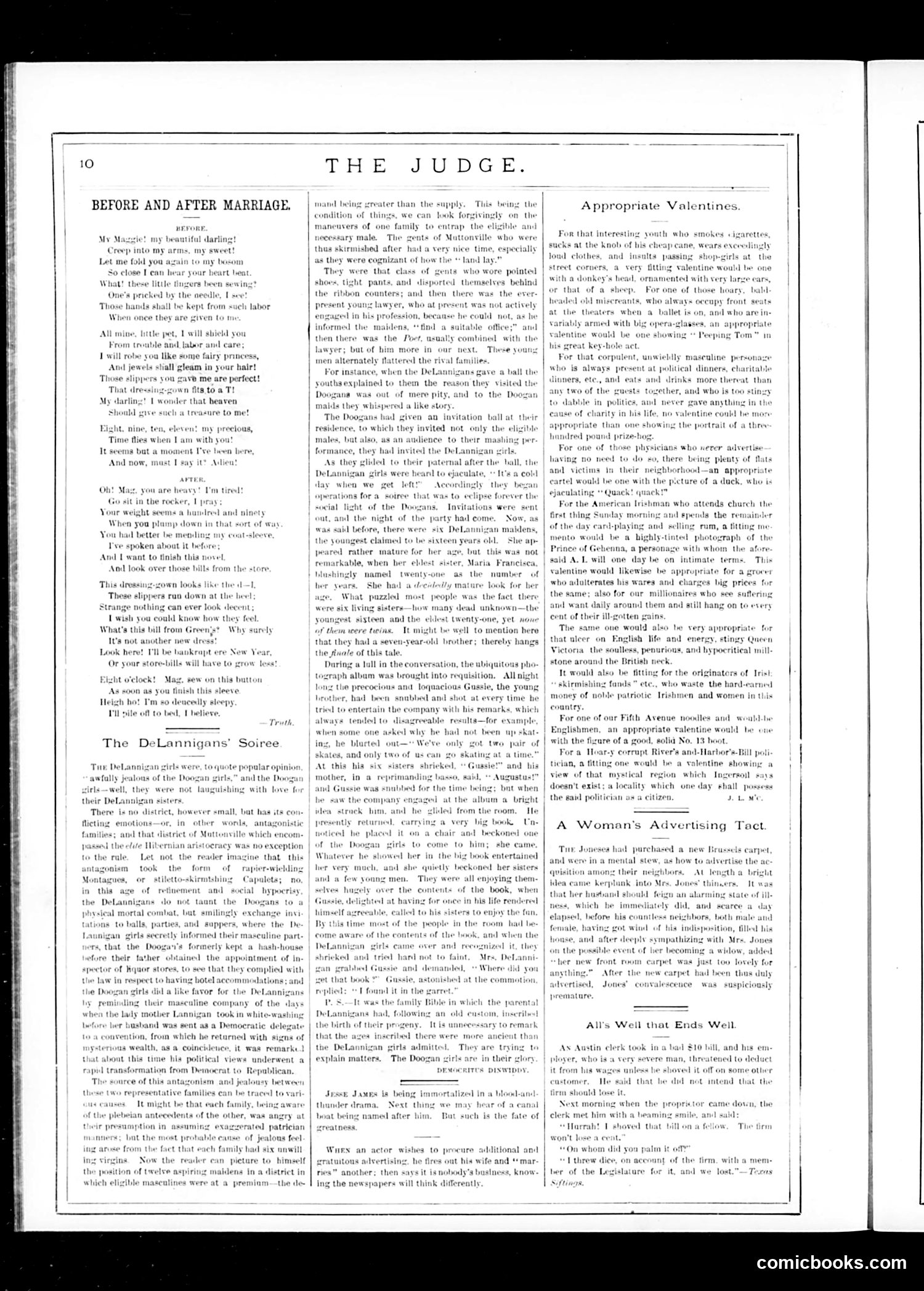
This page from Judge magazine contains two satirical pieces about courtship and marriage among the Irish-American working and middle classes. **"Before and After Marriage"** contrasts romantic pre-wedding promises with post-marital reality. The male suitor vows eternal devotion and luxury ("jewels shall gleam in your hair"), but the text humorously suggests these promises prove hollow after marriage. **"The DeLannigans' Soirée"** satirizes Irish social climbing. The DeLannigans—apparently a family that recently escaped poverty (the father "formerly kept a hash-house")—now hosts an elaborate social gathering, but their pretensions are undermined by comic mishaps: a photograph album exposes their humble origins when guests discover it contains images of their past poverty. The joke targets the gap between aspiration and reality among immigrant families attempting to enter respectable society. Both pieces mock Irish-American social ambitions through domestic humor typical of Judge's satirical approach.
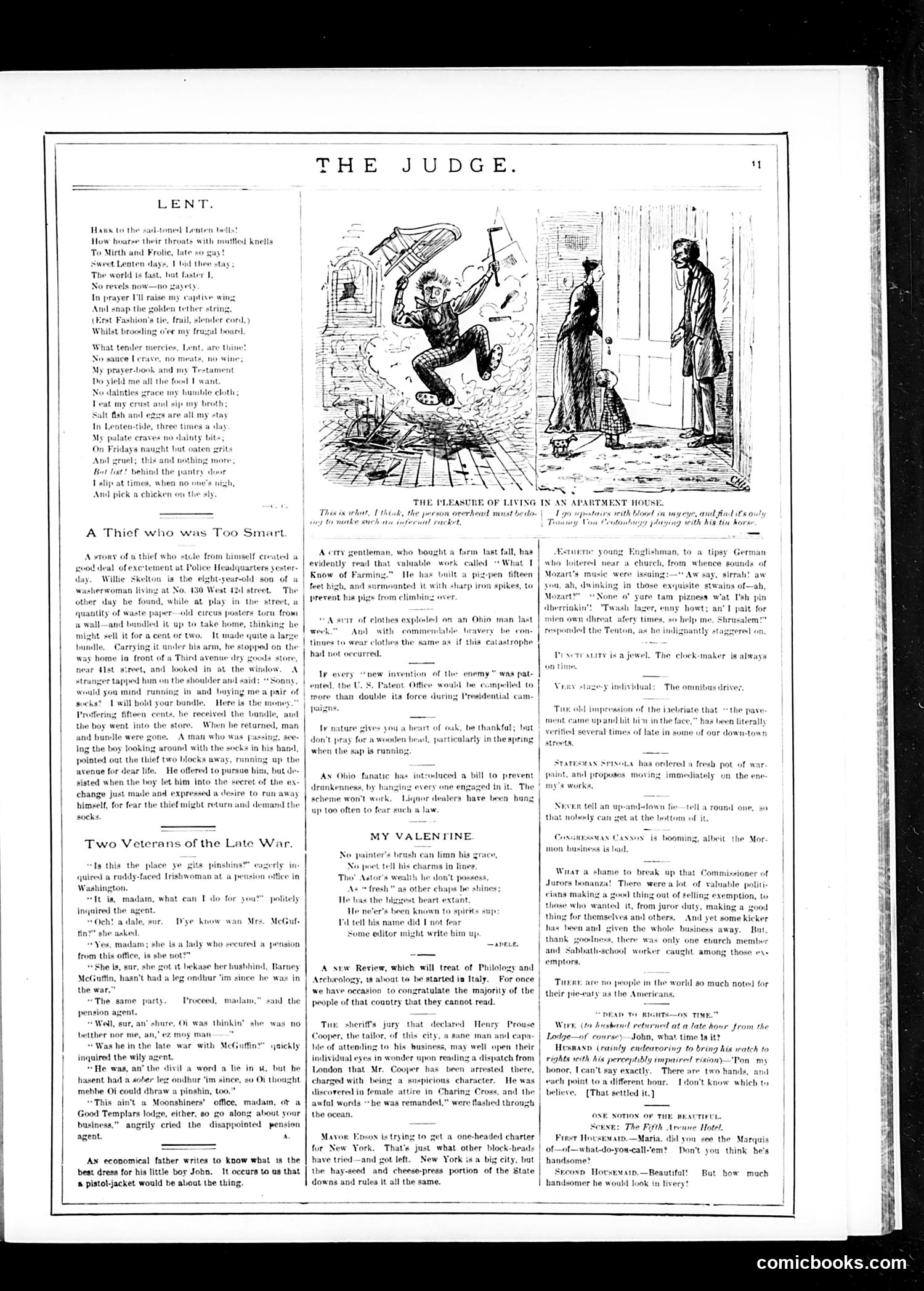
This page from *Judge* magazine contains multiple satirical pieces targeting 1880s-90s American social issues: **"A Thief Who Was Too Smart"** mocks a farm-buyer who installed anti-theft mechanisms but was outsmarted by a street child—satirizing overly elaborate security measures and urban crime. **"Two Veterans of the Late War"** features an Irish immigrant woman at a pension office seeking aid for her husband, a Civil War veteran who lost his leg. The satire targets both bureaucratic pension systems and Irish stereotypes (her dialect and supposed simplicity). **"My Valentine"** appears to be romantic verse, contrasting idealized love with realistic poverty and hardship. The **"Lent"** poem at top satirizes religious hypocrisy—claiming ascetic fasting while secretly eating well. **Minor pieces** mock Ohio prohibition legislation and a proposed Italian academic review. Overall, the page reflects *Judge's* typical targets: immigration, government inefficiency, class pretension, and social reform efforts deemed impractical.
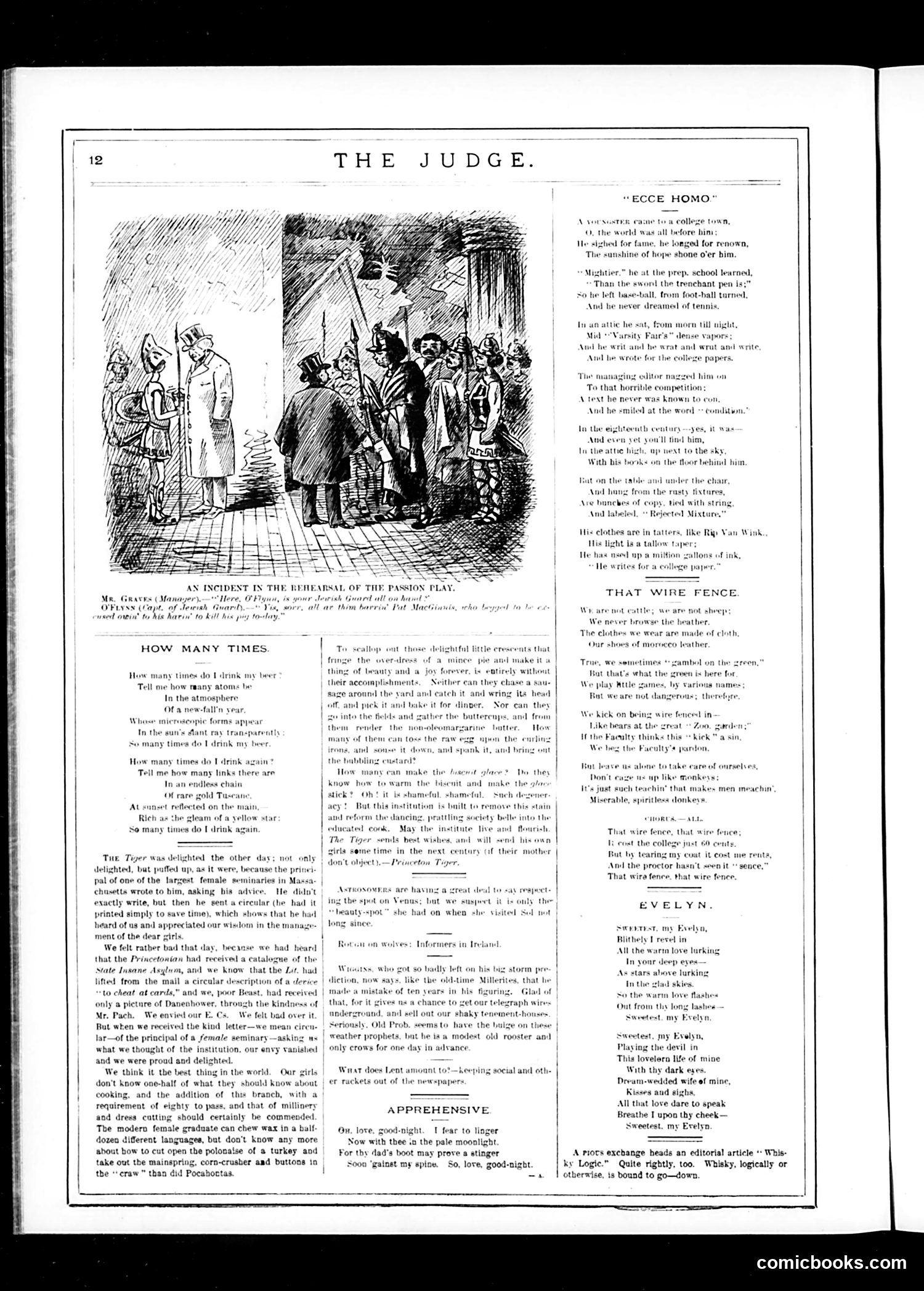
This page from *Judge* magazine contains several satirical pieces mocking American institutions and social pretensions: **Main cartoon** ("An Incident in the Rehearsal of the Passion Play"): Manager and captain argue about casting Jewish guards for a religious drama—likely satirizing both the artificiality of theatrical productions and ethnic tensions in casting decisions. **"How Many Times"**: A repetitive poem mocking college drinking culture and student excess, suggesting widespread alcohol consumption among undergraduates. **"That Wire Fence"**: Appears to mock agricultural or rural workers complaining about restrictions, possibly satirizing labor disputes or class tensions of the era. **Poetry sections** ("Ecce Homo," "Apprehensive," "Evelyn"): Sentimental love poems and literary affectations—typical targets of satirical magazines ridiculing overwrought romanticism. The overall tone satirizes American college life, theatrical pretension, and literary excess characteristic of late 19th/early 20th-century *Judge* content.
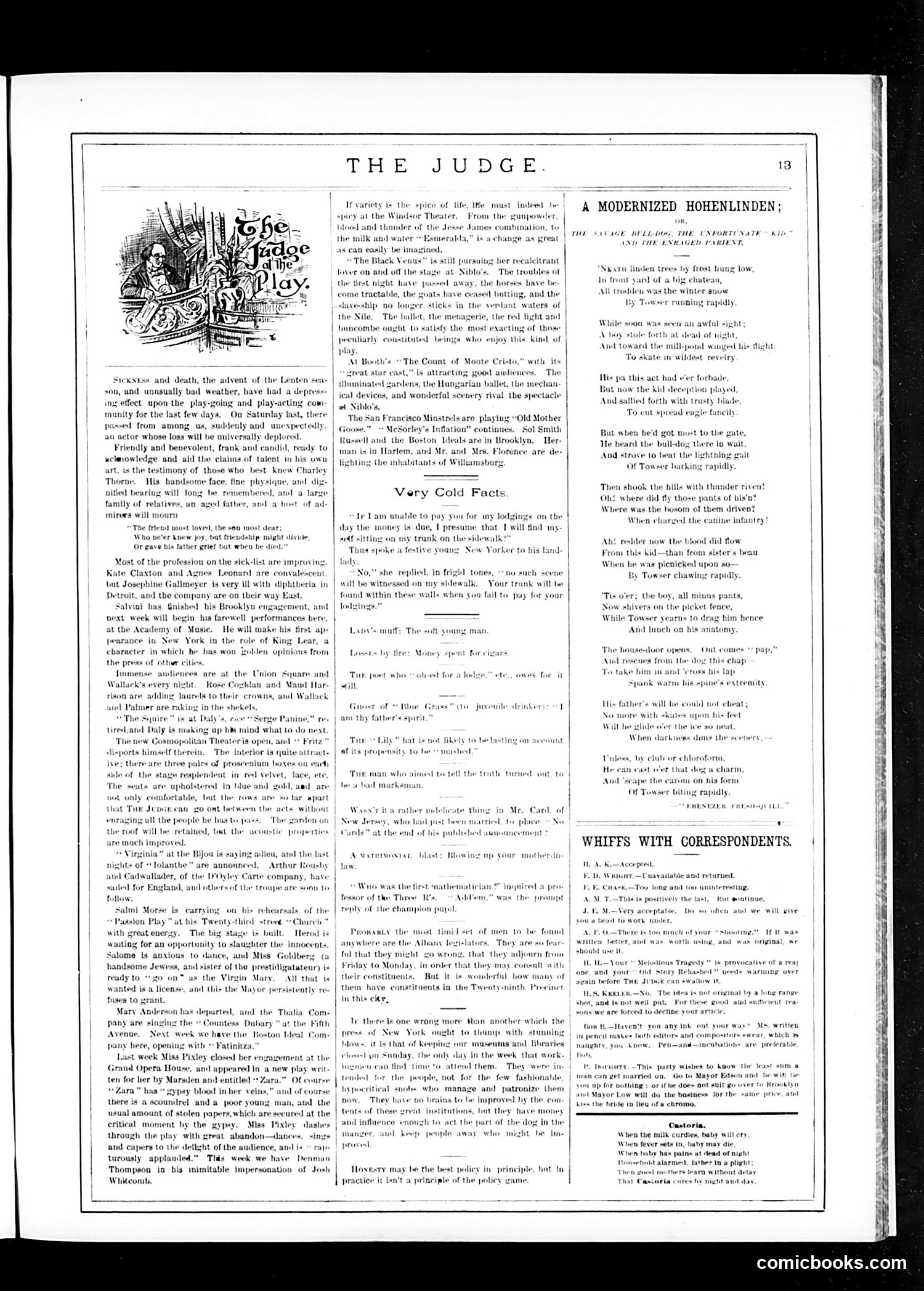
This page is primarily **theater criticism and gossip**, not political satire. It covers the New York theater scene, likely from the 1880s based on references to performers like Salvini and Mary Anderson. The main content includes: - **Reviews of current productions** at theaters like the Windsor, Niblo's Garden, and the new Cosmopolitan Theatre - **Actor health updates** (Kate Claxton, Agnes Leona ill; Josephine Gallmeyer with diphtheria) - **Casting news** and upcoming performances - **Theatrical gossip** about productions like "The Black Venus" and "The Count of Monte Cristo" The left side contains **"The Judge Play"** - an illustrated theatrical cartoon showing a judge figure, likely commenting on theater matters. The right column includes **"A Modernized Hohenlinden"** (a poem) and **"Whiffs with Correspondents"** (reader letters with cryptic abbreviations). This is essentially a **theater trade/society page** in a humor magazine, not primarily political commentary. Modern readers would need familiarity with 1880s Broadway performers and productions to fully appreciate the references.
This is primarily an **advertising page** from Judge magazine, not a political cartoon page. The layout contains numerous commercial advertisements for late 19th-century products and services. The main advertisements include: - **Knox Hats** (top): A major hatmaker promoting their "world renowned" products available nationwide - **Weber Piano Fortes**: Musical instruments manufactured in New York - **Medical/Patent remedies**: Including treatments for various ailments (typical of the era's often-dubious health claims) - **Musical novelties**: Music boxes and mechanical instruments - **Various consumer goods**: Candy, cocoa, soap, and other products The page includes **brief satirical snippets** in text form—anecdotes about Vassar College women and a Jewish lawyer's joke about profit margins—but these are filler content rather than the page's primary purpose. **For modern readers**: This reflects the advertising-heavy magazine format of the 1870s-80s, where paid advertisements subsidized editorial content. The products advertised (particularly medical "cures") reveal period attitudes toward commerce and consumer trust that would seem questionable today.
This page is primarily a collection of period advertisements rather than satirical cartoons. The content includes: **Notable Ads:** - Behning Pianos (top left) - Swayne's Pills (center left) — a patent medicine claiming to cure constipation, dyspepsia, liver problems, and other ailments - Sanford's Radical Cure for catarrh (top right) - Babcock Fire Extinguisher - Dr. T. Felix Gouraud's Oriental Cream (a skin-bleaching/beauty product) - Book binding services and publishing advertisements **Editorial Content:** A brief satirical piece titled "My Wife's Mother" by "Bricktop" appears—a common humor format of the era poking fun at in-laws. The page reflects late-19th-century Judge magazine: mixing aggressive patent medicine advertising (many containing questionable or harmful ingredients) with light social satire. This was typical for the publication, which funded itself through such advertisements while occasionally inserting editorial commentary about consumer culture and product claims.
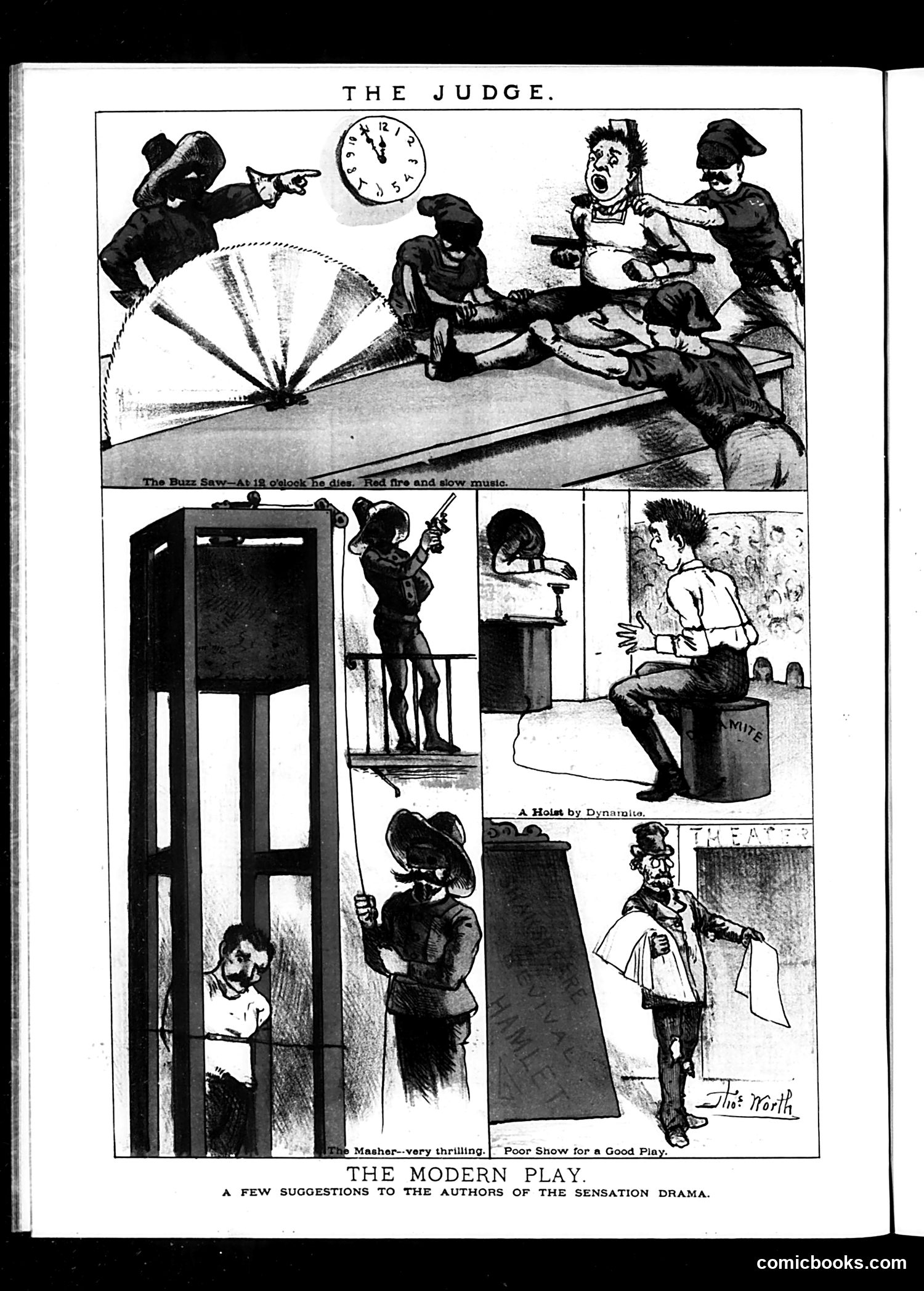
This page satirizes contemporary "sensation drama"—melodramatic theatrical productions popular in the early 20th century. The top panel mocks the overwrought staging of these plays: characters in exaggerated poses around a giant saw, with a clock showing 12 o'clock and musical notation, suggesting absurd timing and theatrical excess. The lower panels parody specific sensational plot devices: "The Masher" (depicting social predation), "A Hotel by Dynamite" (suggesting violent destruction as entertainment), and "Poor Show for a Good Play." Each cartoon ridicules how playwrights manufactured thrills through melodramatic violence, sexual danger, and implausible scenarios rather than genuine drama. The satire critiques the theater industry's reliance on shock value and overwrought sensationalism to attract audiences, suggesting such tactics produced poor quality entertainment.