
A complete issue · 16 pages · 1883
Judge — January 27, 1883
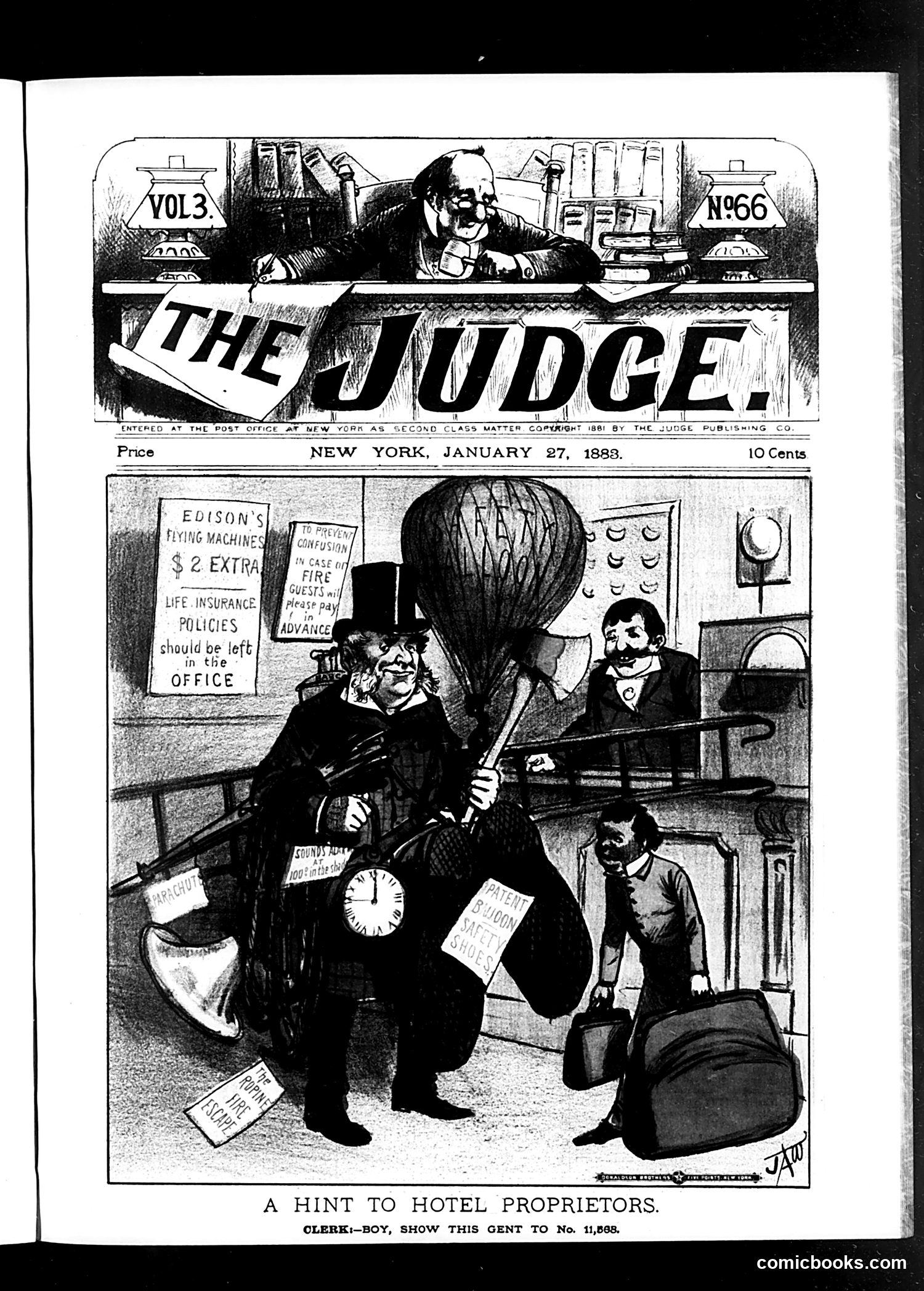
This 1888 cartoon satirizes hotel management practices. The central figure—a grotesquely caricatured man with an enormous head—represents a hotel proprietor or manager. He's surrounded by smaller figures (likely hotel staff or guests) and displays signs advertising "Edison's Flying Machines $2 Extra" and insurance policies, suggesting he's greedily charging guests for dubious add-on services and amenities. The title "A Hint to Hotel Proprietors" with the instruction "Clerk-Boy, show this gent to No. 11,886" implies satirical criticism of hotels that nickel-and-dime guests with excessive fees. The exaggerated proportions mock proprietors' greed and the absurdity of their scheme to extract money from patrons through questionable charges.
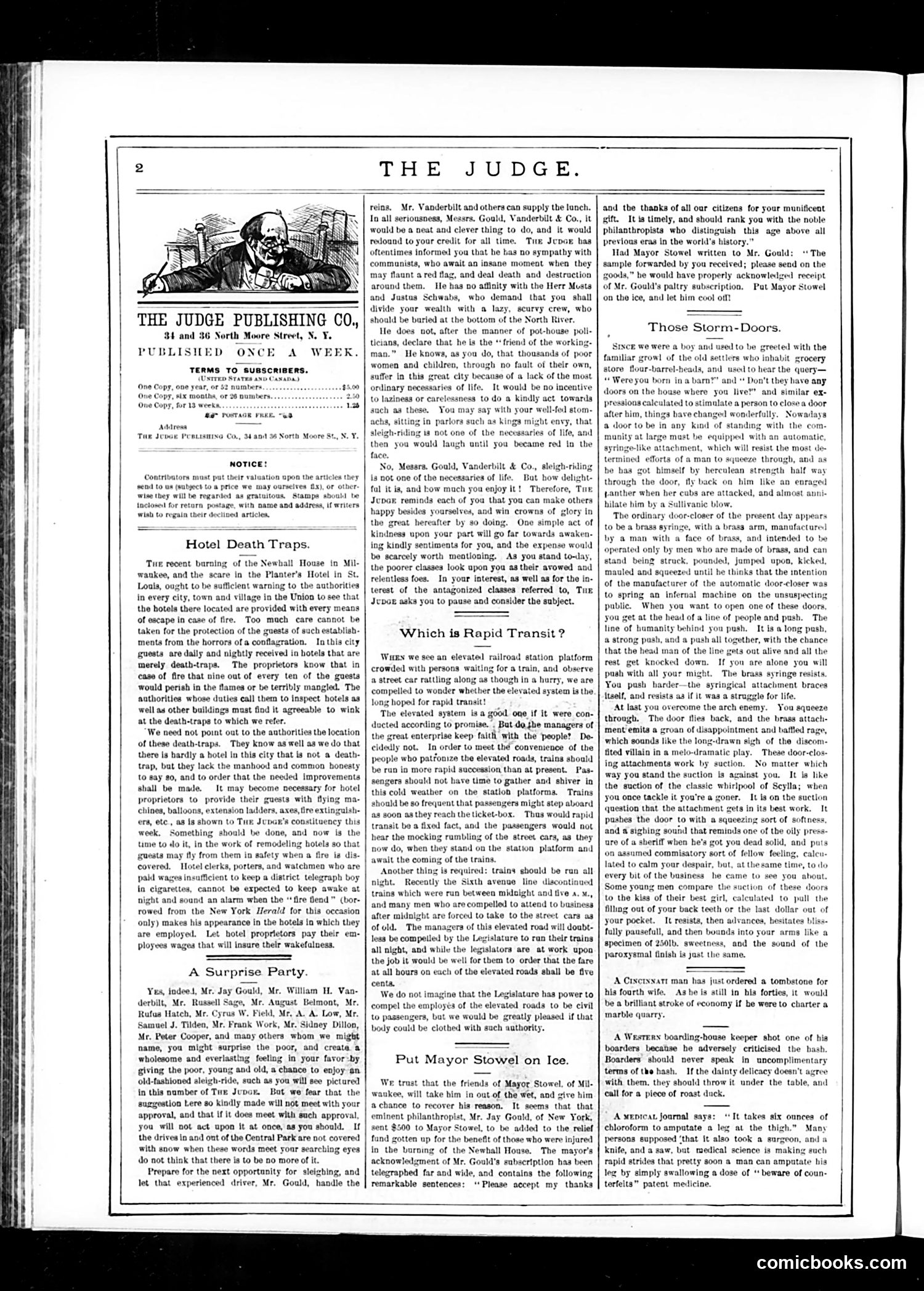
This page from **Judge** magazine contains several satirical pieces targeting wealthy industrialists and public safety issues of the era. **"Hotel Death Traps"** criticizes New York City authorities for ignoring fire hazards in hotels, referencing recent tragedies like the Newhall House fire in Milwaukee. The editorial demands hotel owners and inspectors take responsibility for guests' safety. **"A Surprise Party"** is sarcastic mockery of wealthy robber barons—Jay Gould, Vanderbilt, Russell Sage, and others—suggesting they organize charitable sleigh rides for the poor. The piece sarcastically claims this would improve their public image, while clearly doubting these notoriously ruthless industrialists would actually help the impoverished. The tone implies their wealth came at workers' expense. The cartoon likely visualizes this fantasy charity scenario. Judge regularly used such ironic proposals to highlight the wealthy's indifference to social inequality during the Gilded Age.
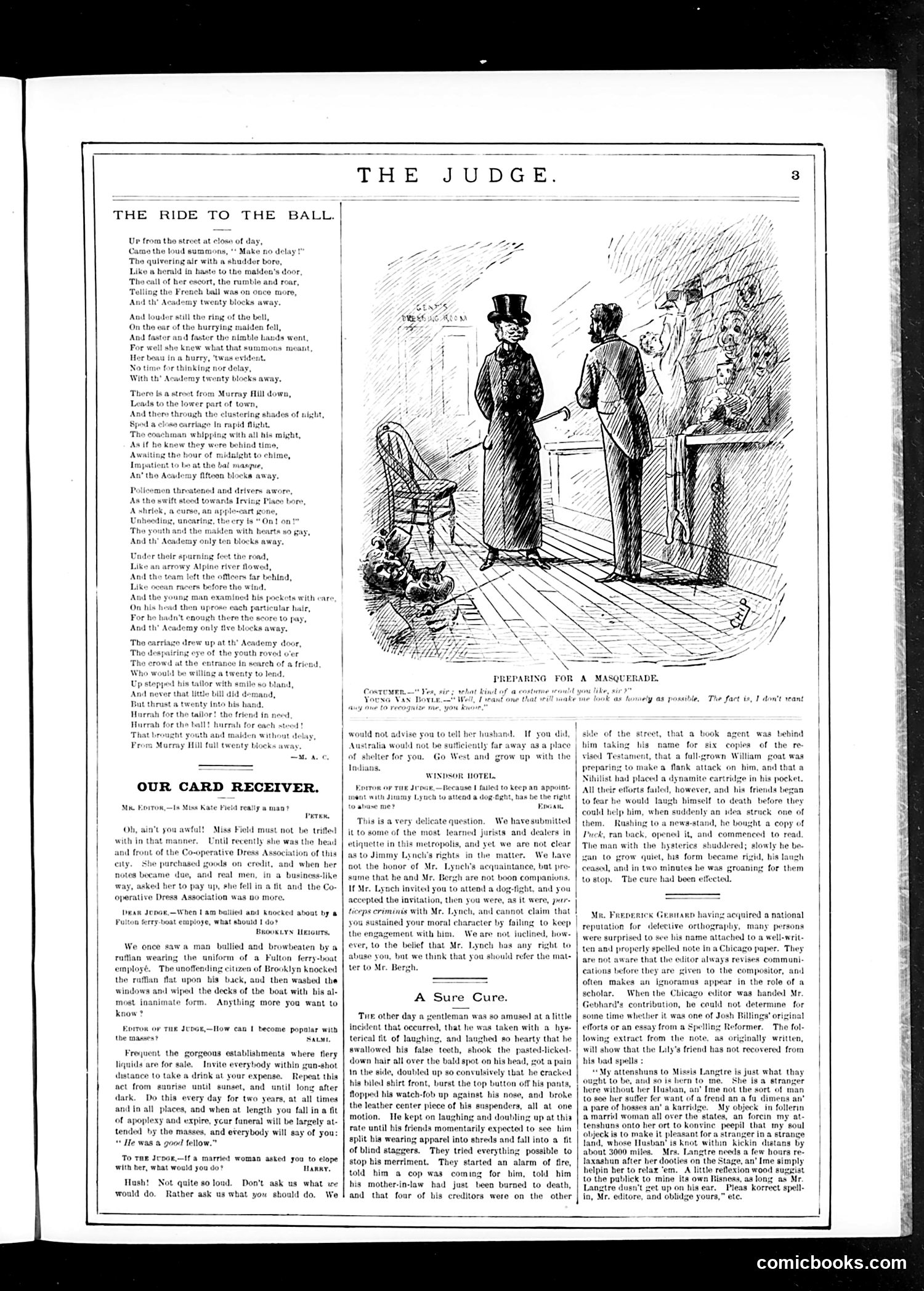
This page from Judge satirizes New York City's social pretensions and financial anxieties. **"The Ride to the Ball"** mocks the anxious rush of New Yorkers traveling to an Academy ball, with repeated mentions of "Academy only five blocks away"—suggesting breathless social climbing and fear of being late to fashionable events. **"Our Card Receiver"** contains satirical advice columns. One question about Miss Kate Field (a real journalist and women's rights activist) reveals gender controversies; another mocks Brooklyn roughnecks; a third advises becoming "popular with the masses" through buying rounds of drinks for years until your funeral draws crowds. **"Preparing for a Masquerade"** and other brief items continue the theme of social pretense and New York's obsession with appearances and status. The overall satire targets the anxiety, debt, and performative nature of Gilded Age urban society—where people spend beyond means for social acceptance and where appearances matter more than substance.
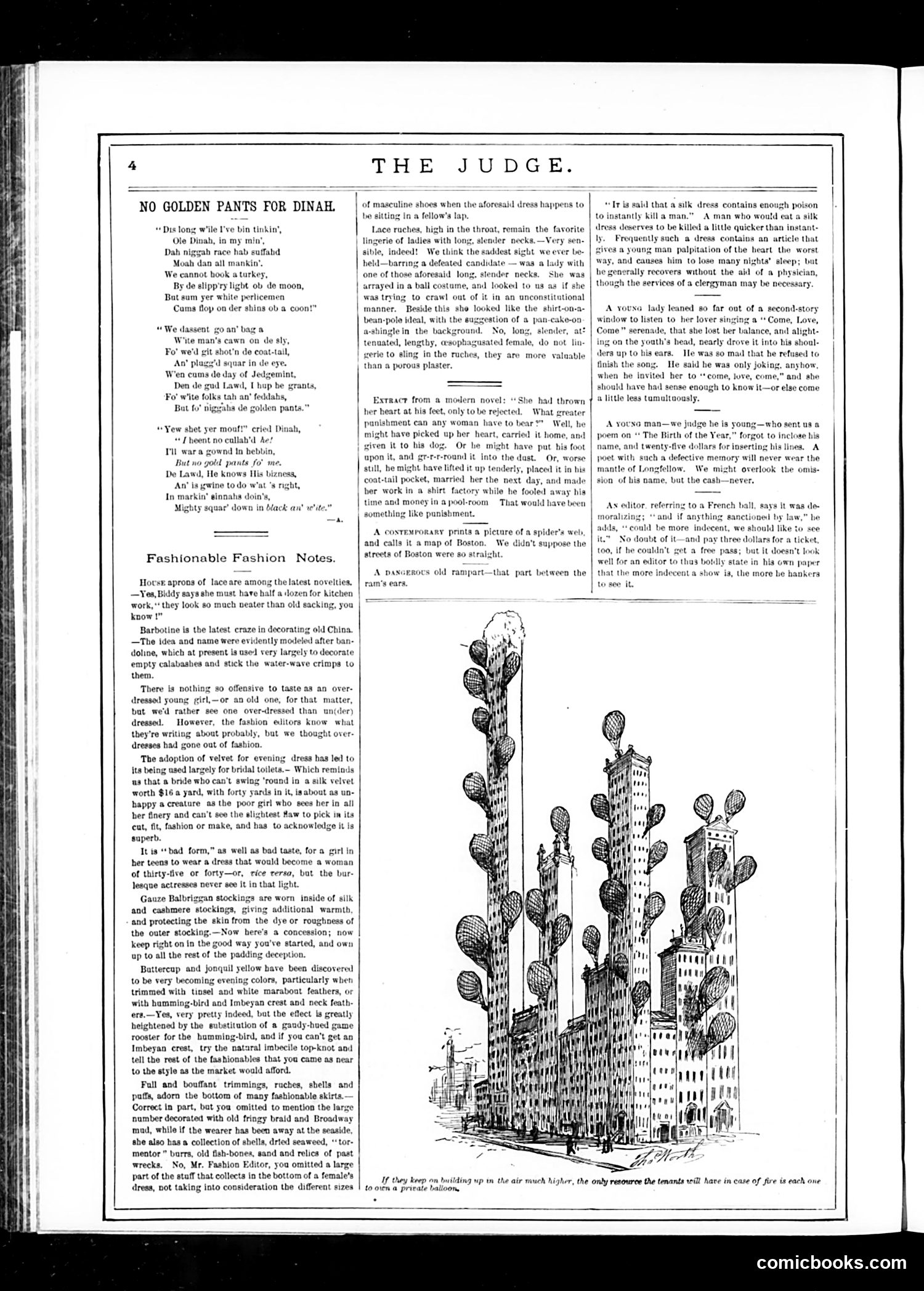
This page contains two distinct pieces of satire: **"No Golden Pants for Dinah"** is a racist dialect poem using offensive stereotypes and language. The piece mocks Black Americans through a character lamenting that enslaved people suffered greatly but won't receive "golden pants" (material wealth) in heaven—suggesting divine punishment is appropriate. It's deeply offensive by modern standards and represents the casual racism common in late 19th-century American publications. **"Fashionable Fashion Notes"** is lighthearted social satire mocking women's fashion trends of the era. It ridicules impractical clothing choices—expensive velvet dresses, gauze stockings under silk ones, and absurd decorative elements (dead birds, seaweed, fish bones). The humor targets both fashion industry excess and women who blindly follow trends. The closing jab about "masculine shoes" in a woman's lap jokes about improper behavior. Both sections reflect *Judge* magazine's satirical voice, though one relies on vicious racial stereotyping while the other offers relatively harmless social commentary.
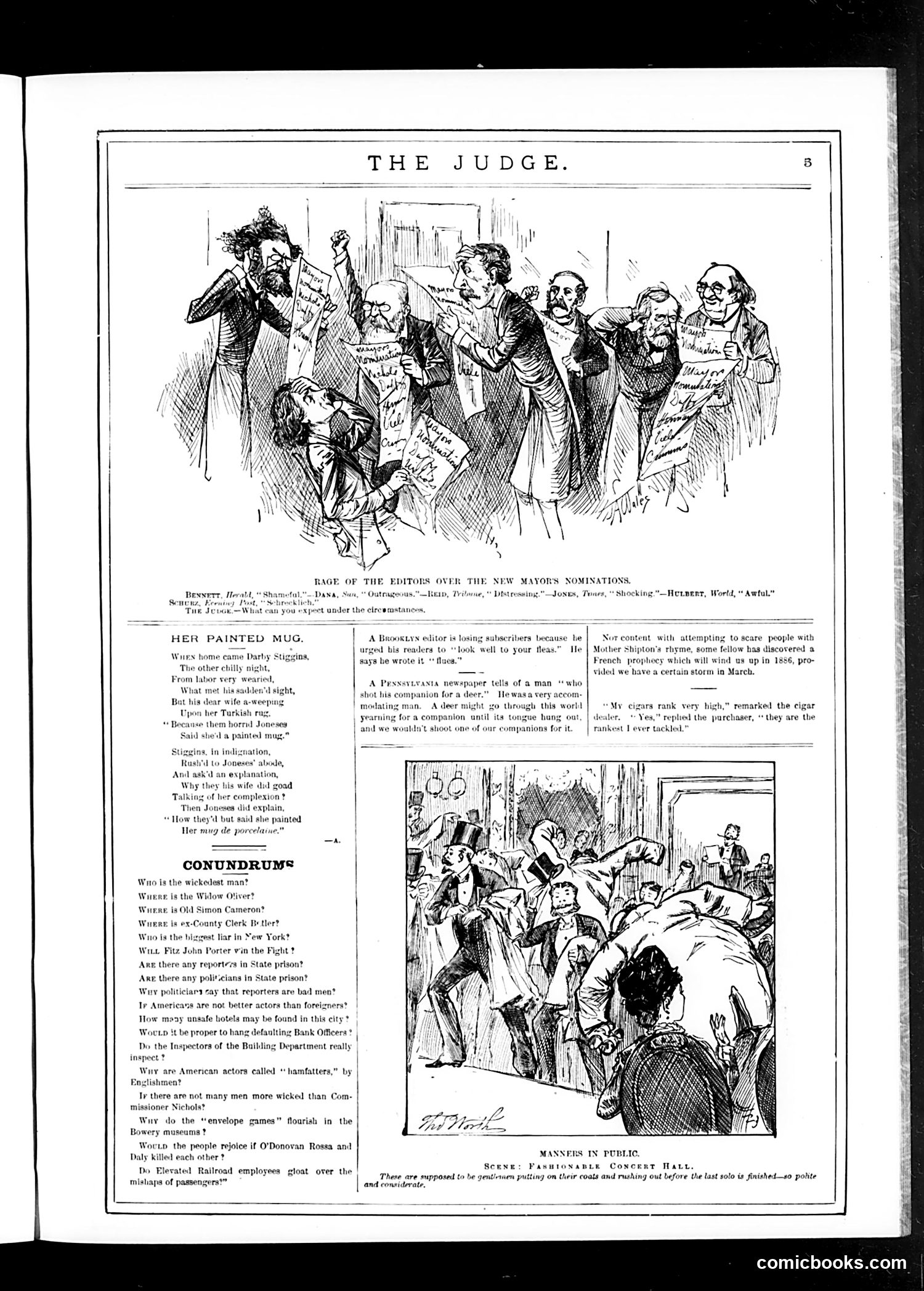
**Main Cartoon - "Rage of the Editors Over the New Mayor's Nominations":** The top illustration shows editors from competing newspapers (identified by mastheads: Herald, Tribune, World, etc.) in heated argument over the mayor's cabinet appointments. The satire mocks how rival papers would viciously attack each other's coverage of political nominations, each claiming the others' reporting was sensational or unfair. **"Conundrums" Section:** This satirical Q&A list ridiculed prominent New York figures and institutions through rhetorical questions—asking who the "wickedest man" is, referencing ex-County Clerk Butler, Commissioner Nichols, and O'Donovan Rossa (an Irish nationalist). The questions imply these individuals were corrupt or disreputable. **"Manners in Public" Cartoon:** Shows concertgoers rudely leaving mid-performance, satirizing poor etiquette among the supposedly refined classes. The page targets journalistic sensationalism, political corruption, and social hypocrisy—typical Judge magazine content criticizing New York's establishment through humor and caricature.
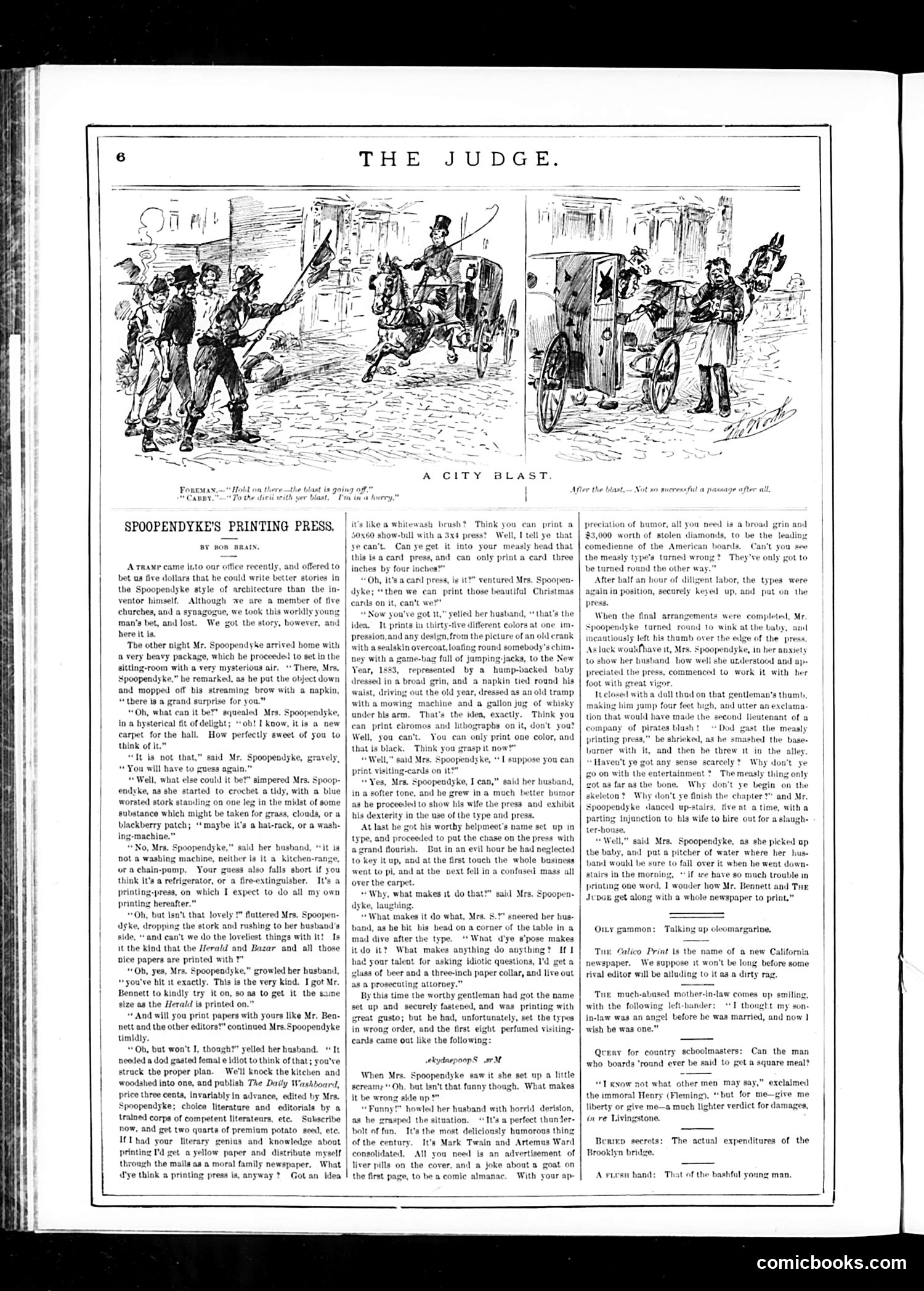
This page contains a satirical story titled "Spoopendyke's Printing Press" mocking the aspirations of an ordinary middle-class man who purchases a small printing press, believing he can rival major newspapers like the Herald. **The Satire:** Mr. Spoopendyke, an everyman character, buys a tiny 3x4 inch press and naively imagines he'll publish a newspaper ("The Daily Washboard") to compete with established papers. His wife enthusiastically but ignorantly suggests printing Christmas cards and lithographs on it—absurd uses for such equipment. **The Point:** The humor targets both Spoopendyke's delusional ambition and the widespread fantasy that anyone with minimal capital could become a newspaper publisher. The exaggerated dialogue ridicules both his pretensions and his wife's naive encouragement. **Context:** This reflects late-19th-century anxiety about small entrepreneurs overestimating their capabilities and the proliferation of amateur publications. The cartoon illustrations on the page ("A City Blast") appear separate, showing street scenes with contemporary vehicles.
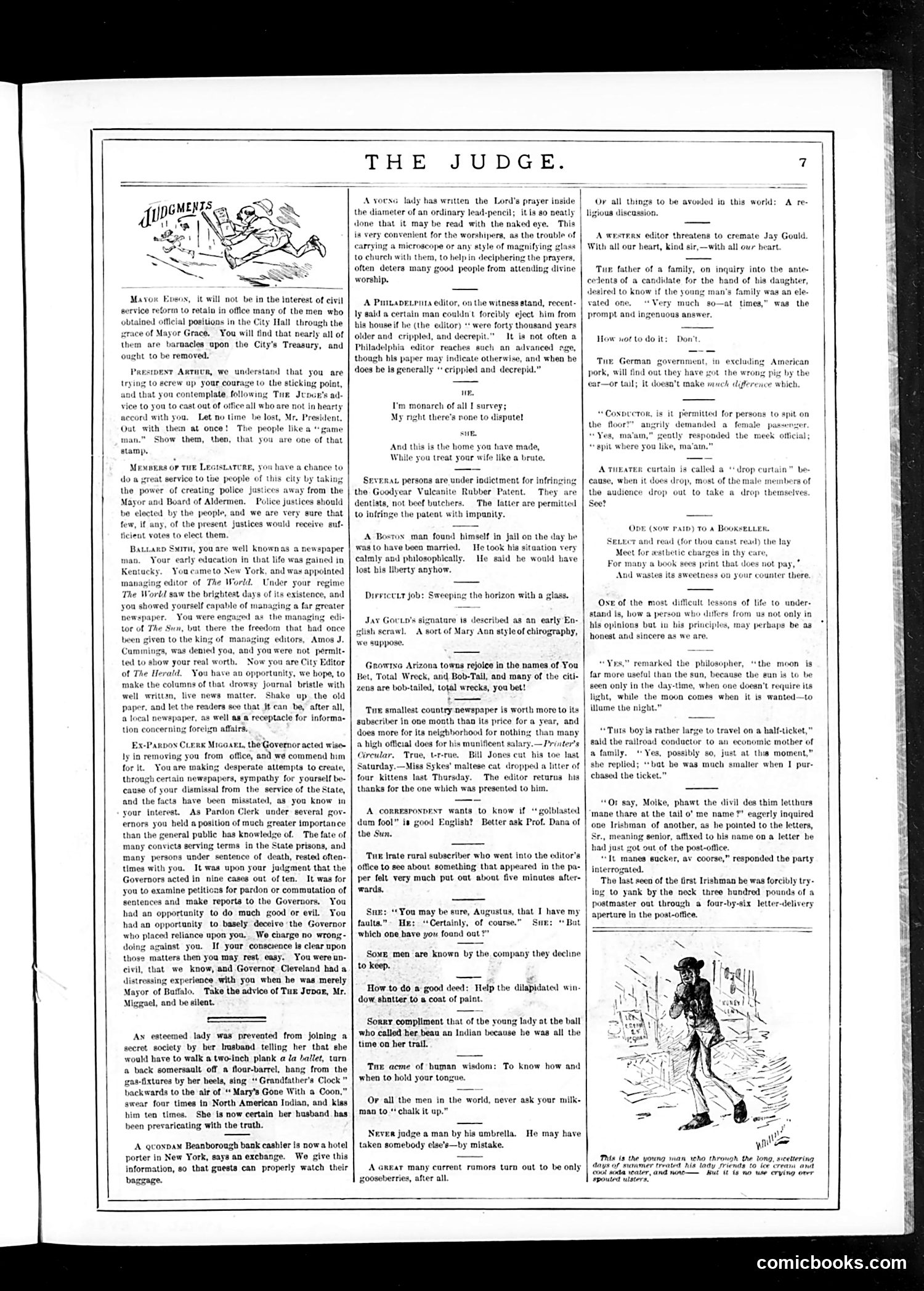
This page contains political commentary and satirical advice rather than cartoons. The primary content includes: **Political Targets:** - **President Arthur** — urged to fire City Hall officials who obtained positions through patronage - **Members of the Legislature** — encouraged to strip the Mayor of power to appoint police justices; they should be elected by people - **Ballard Smith** — praised as a newspaper editor (formerly of *The World*, now at *The Herald*), urged to "shake up" his drowsy publication - **Ex-Pardon Clerk Michael** — criticized for his dismissal by the Governor, accused of wielding improper influence over convict pardons and death sentences **The Satire's Point:** Judge advocates civil service reform and limiting patronage corruption in New York City government. The attacks on Arthur and Michael suggest this reflects 1880s-era debates over political appointments versus merit-based selection. The single cartoon (bottom right) shows unrelated domestic humor about secret society initiation requirements.
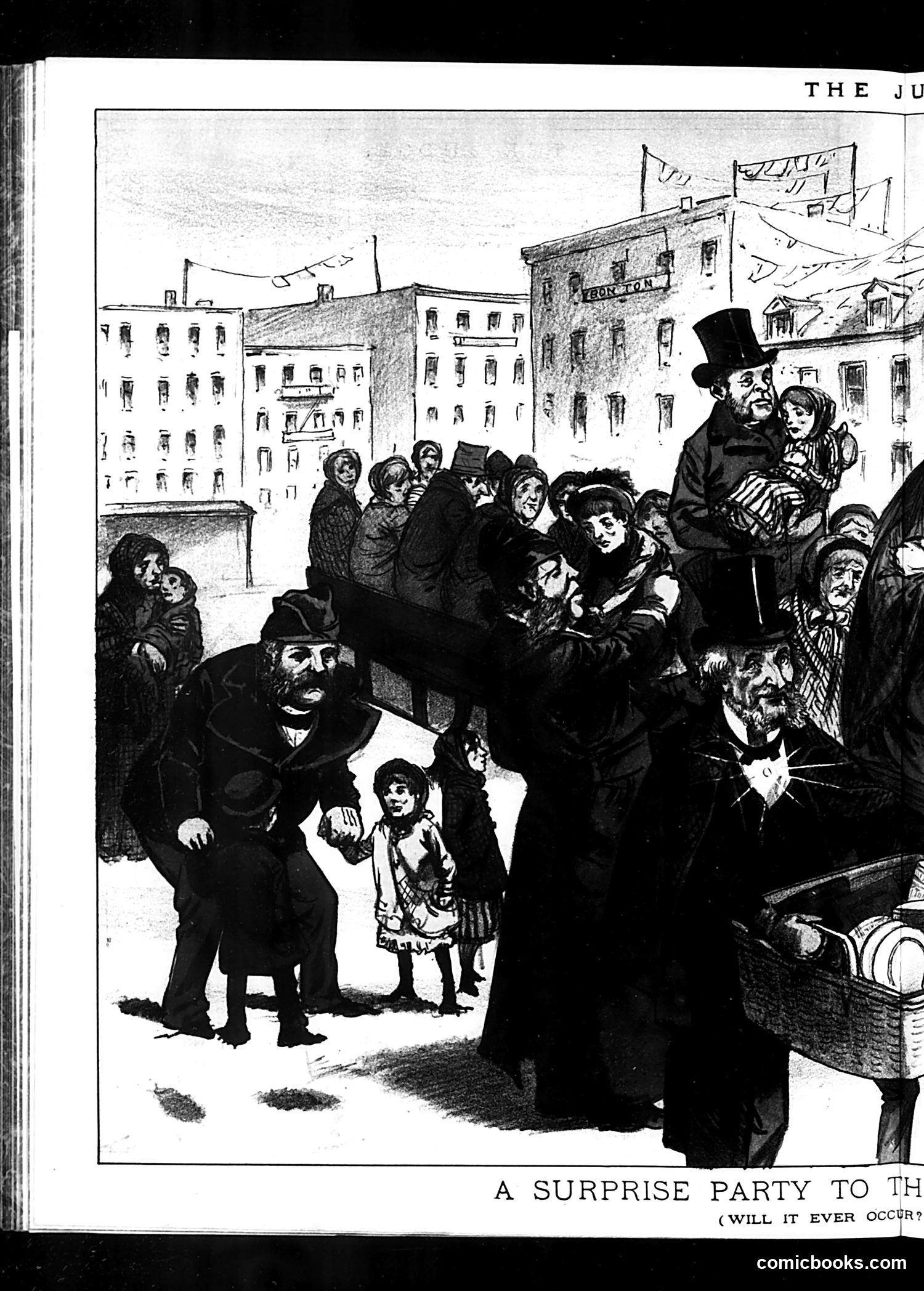
This political cartoon depicts a crowded urban street scene with working-class figures, immigrants, and children gathered around what appears to be a tenement building. The caption reads "A SURPRISE PARTY TO TH[E]" with "(WILL IT EVER OCCUR?)" suggesting an incomplete or ironic title. The satire likely critiques the gap between wealthy society's promises and poor urban realities. The gathering appears to represent common laborers and tenement dwellers—suggesting they're waiting for some promised benefit or improvement that may never materialize. Judge magazine frequently satirized class disparities, labor conditions, and unfulfilled political promises of the Gilded Age/Progressive Era. Without the complete caption, the specific target remains unclear, but the image's focus on poverty and crowded conditions indicates social commentary on urban inequality.
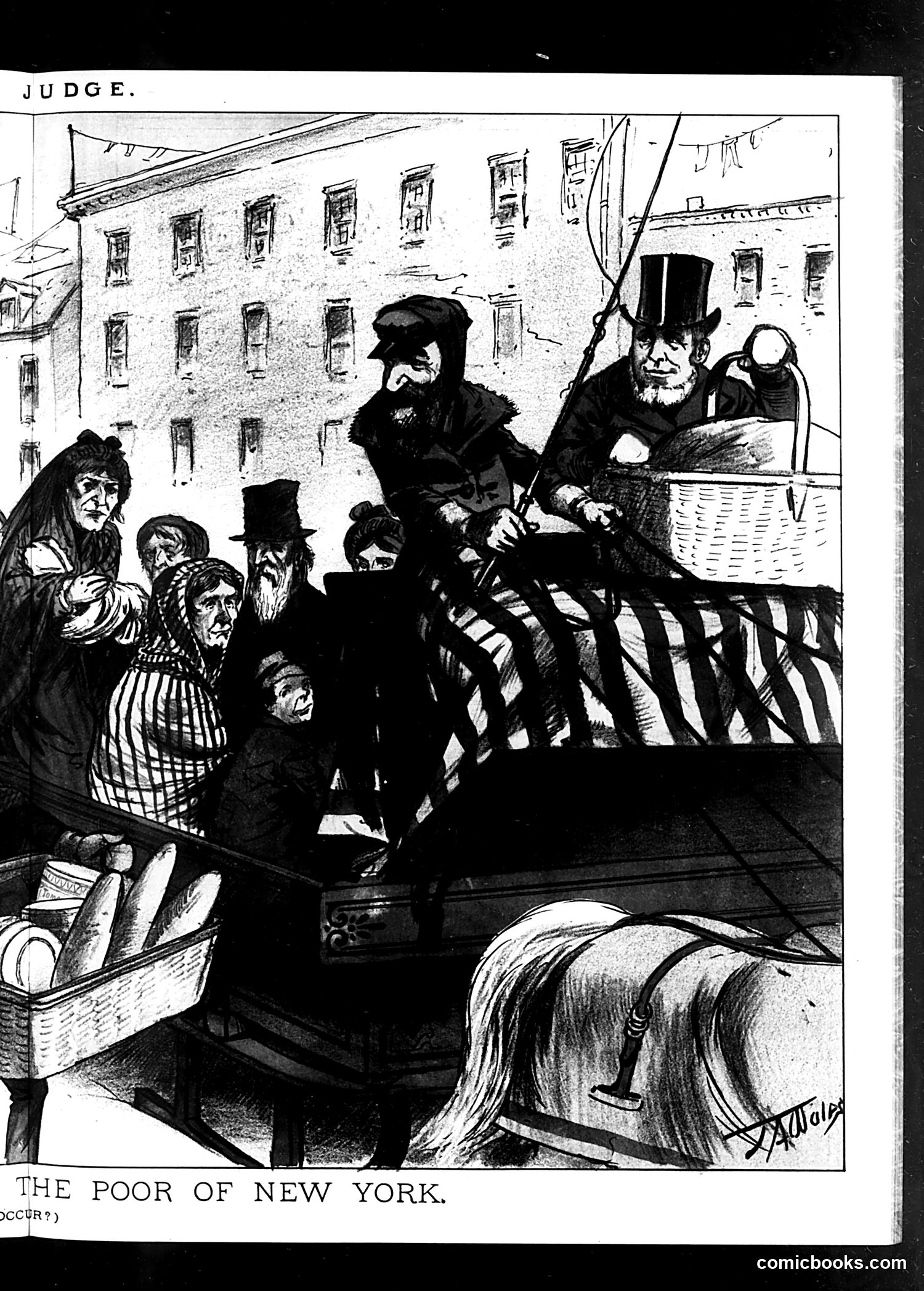
This political cartoon depicts a scene of urban poverty and inequality in New York City. A wealthy gentleman in a top hat (likely representing a judge, banker, or city official) oversees poor families—including women with children and elderly men—apparently being transported, possibly to a workhouse, asylum, or out of the city. The title "The Poor of New York" combined with the heading "JUDGE" suggests satirical commentary on how the wealthy and powerful handled poverty. The cartoon likely critiques either inadequate relief systems, forced removal of poor people from cities, or callous indifference by the privileged classes to urban poverty. The exaggerated facial features and caricature style typical of late 19th/early 20th-century satire emphasize class division and social commentary.
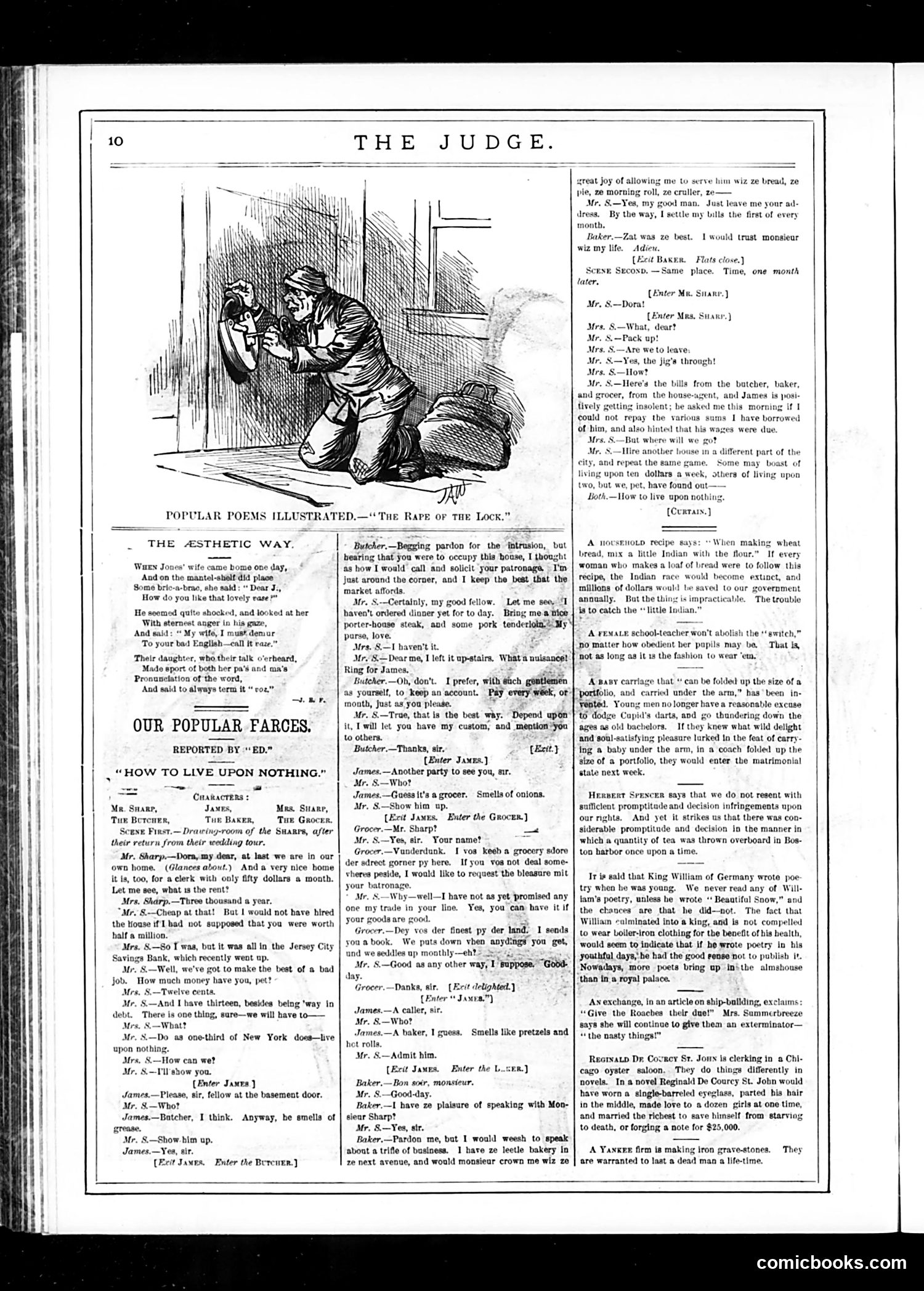
This page contains two pieces of satirical content: **"The Aesthetic Way"** (top): A brief poem mocking pretentious corrective behavior. Mr. Jones pedantically insists his wife say "vase" (pronounced "vahz") rather than "vase" (pronounced "vayze"), only to have their daughter ridicule both parents' pronunciations by calling it "coz." The joke satirizes obsessive social correctness and the absurdity of linguistic snobbery. **"How to Live Upon Nothing"** (bottom): A satirical farce about a newly married clerk earning only $50/month who rents a $3,000-year house, assuming his wife is wealthy (she's not—she only has 12 cents). The satire targets financial recklessness and the ease of obtaining credit. Tradesmen (butcher, grocer, baker) eagerly extend unlimited credit to the couple, enabling their spending despite having no income. Judge ridicules both consumers living beyond their means and merchants facilitating debt.
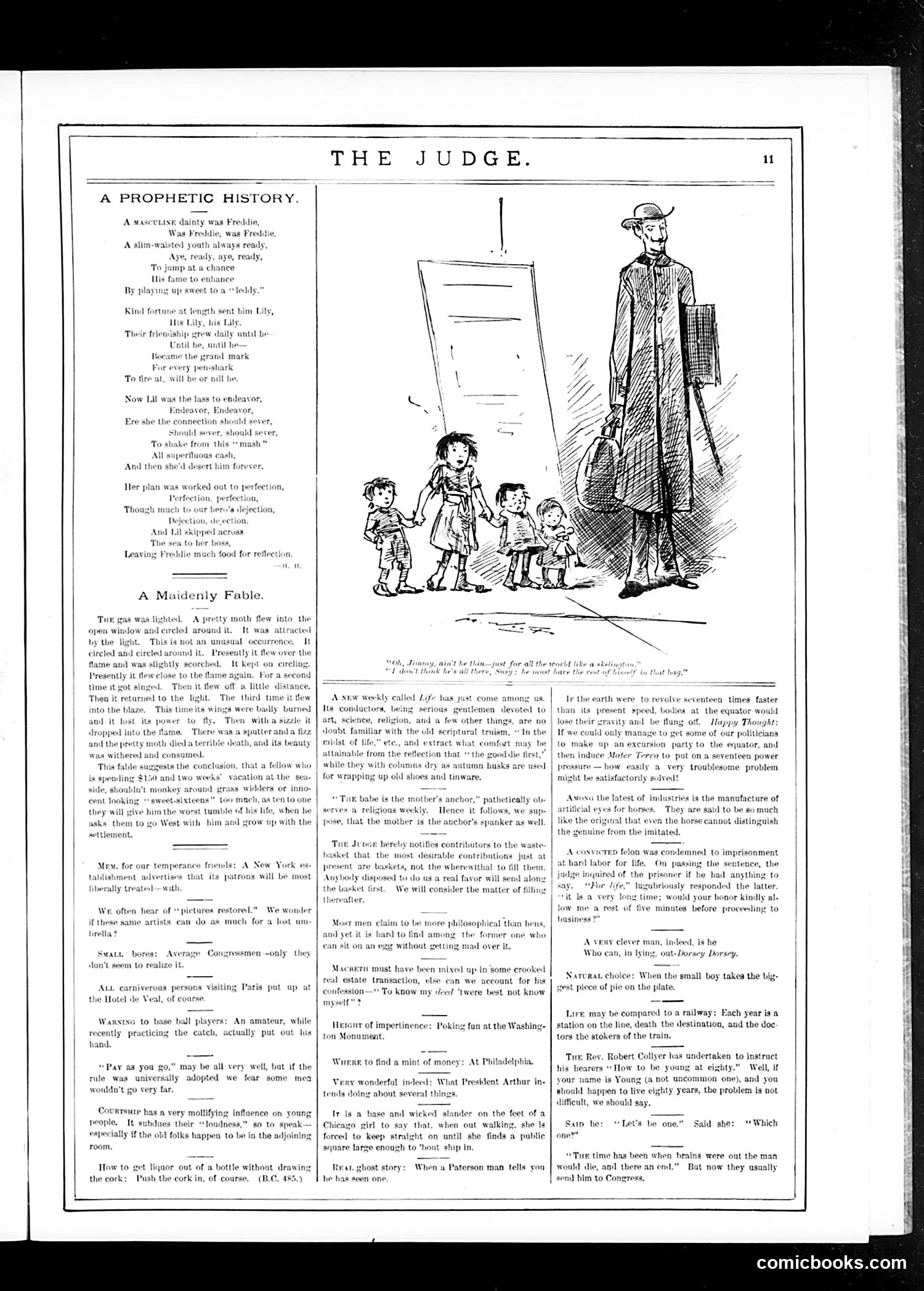
This page from the satirical magazine **Judge** contains multiple items satirizing American society and politics around the turn of the 20th century. The main illustrated cartoon depicts **a tall figure (possibly representing a judge or authority figure) leading four small children**—likely symbolizing vulnerable citizens or the public. The accompanying poem "A Prophetic History" sarcastically tells of "Freddie" who married "Lily" and became a target for "pen-sharks" (journalists/critics) to attack. The satire suggests how public figures, once romantically involved or prominent, become subjects of relentless media scrutiny and financial exploitation. Below, "A Maidenly Fable" uses a moth drawn to flame as a metaphor for human attraction to destructive behavior—comparing it to how people pursue vices despite knowing the danger. The remaining scattered anecdotes mock various American types: temperance reformers, art restorers, political figures, and social pretenders. The overall tone is cynical about American institutions and human nature, typical of Judge's satirical approach to the era's social and political issues.
This page reviews several theatrical productions playing in New York, written in the caustic style typical of Judge's drama criticism. The main target is the production "Ringing the Changes" at the Bijou Theater, which the critic savagely attacks as derivative dreck—a rehashed "Olla Podrida" (miscellaneous mixture) cobbled from earlier comic operas like "Billee Taylor" and "Tolanthe." The reviewer praises John T. Raymond's new comedy "In Paradise" at the Grand Opera House as genuinely funny, though notes the plot itself is unoriginal. The satire here operates through contrast: Judge celebrates Raymond's competent performance while demolishing the Bijou's production as artistically bankrupt. The specific jabs at actress Lucy's "appearance" and chorus girls in "very short pants" reflect period anxieties about theatrical propriety. References to other shows ("The Black Flag" at Niblo's, "Corsican Brothers" at Booth's) suggest a robust theater scene, while the critic's impatience with recycled plots reflects Judge's broader cultural gatekeeping role—elevating "quality" entertainment while mocking commercial mediocrity.
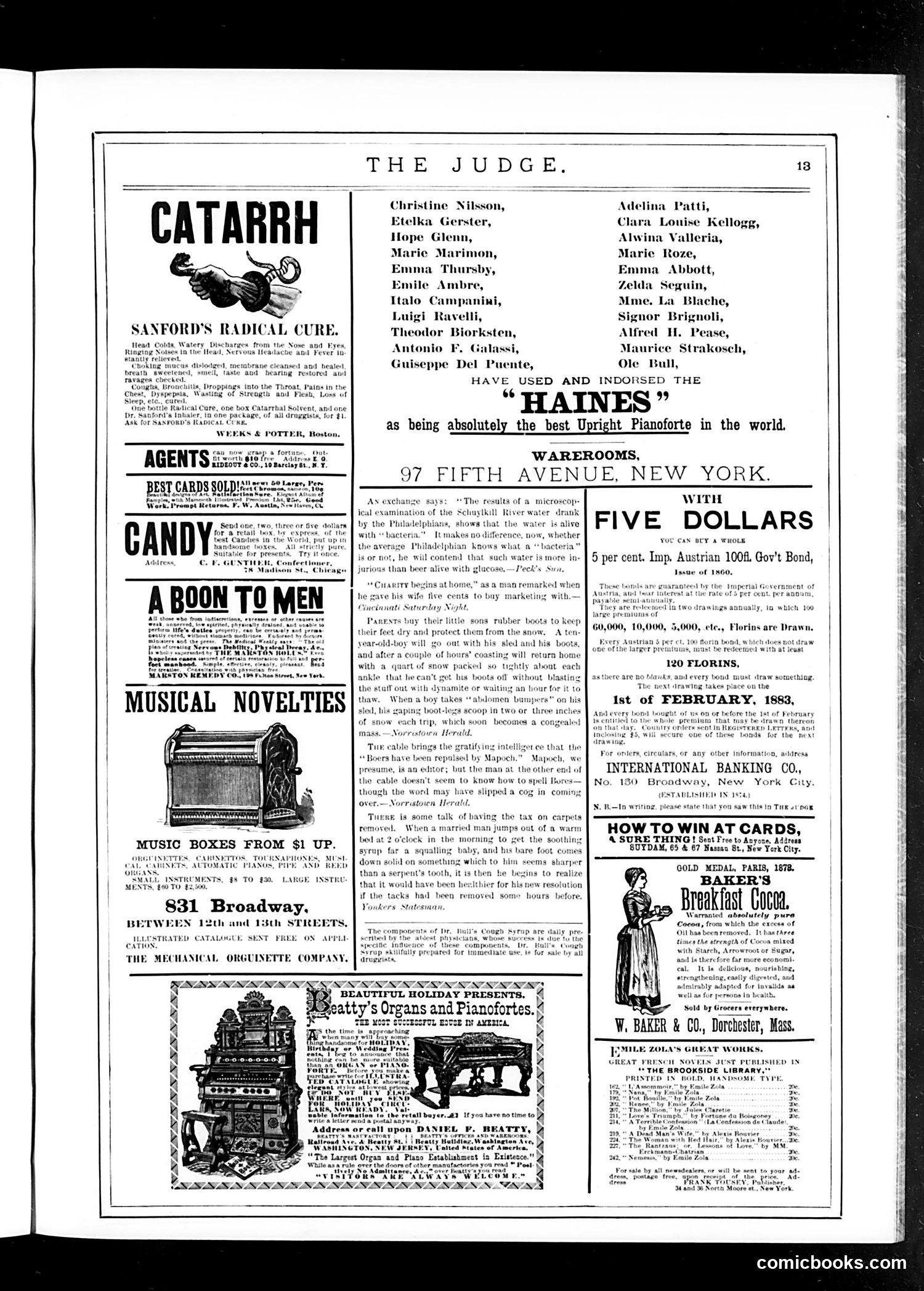
This page is **primarily advertisements** for commercial products and services typical of the 1880s era, including: - Sanford's Radical Cure for Catarrh - Musical novelties and organs - Banking and investment services - Card games guides - Piano instruction books **No significant political cartoon or satirical content is visible** on this page. The only illustrated elements are product advertisements featuring decorative engravings of organs, pianos, and a woman demonstrating a breakfast cocoa product. The page represents Judge magazine's revenue model: satirical editorial content subsidized by paid advertising. The advertisements themselves contain period-appropriate claims (catarrh cures, "radical" remedies) that modern readers might find amusing, but this reflects commercial practices rather than intentional satire.
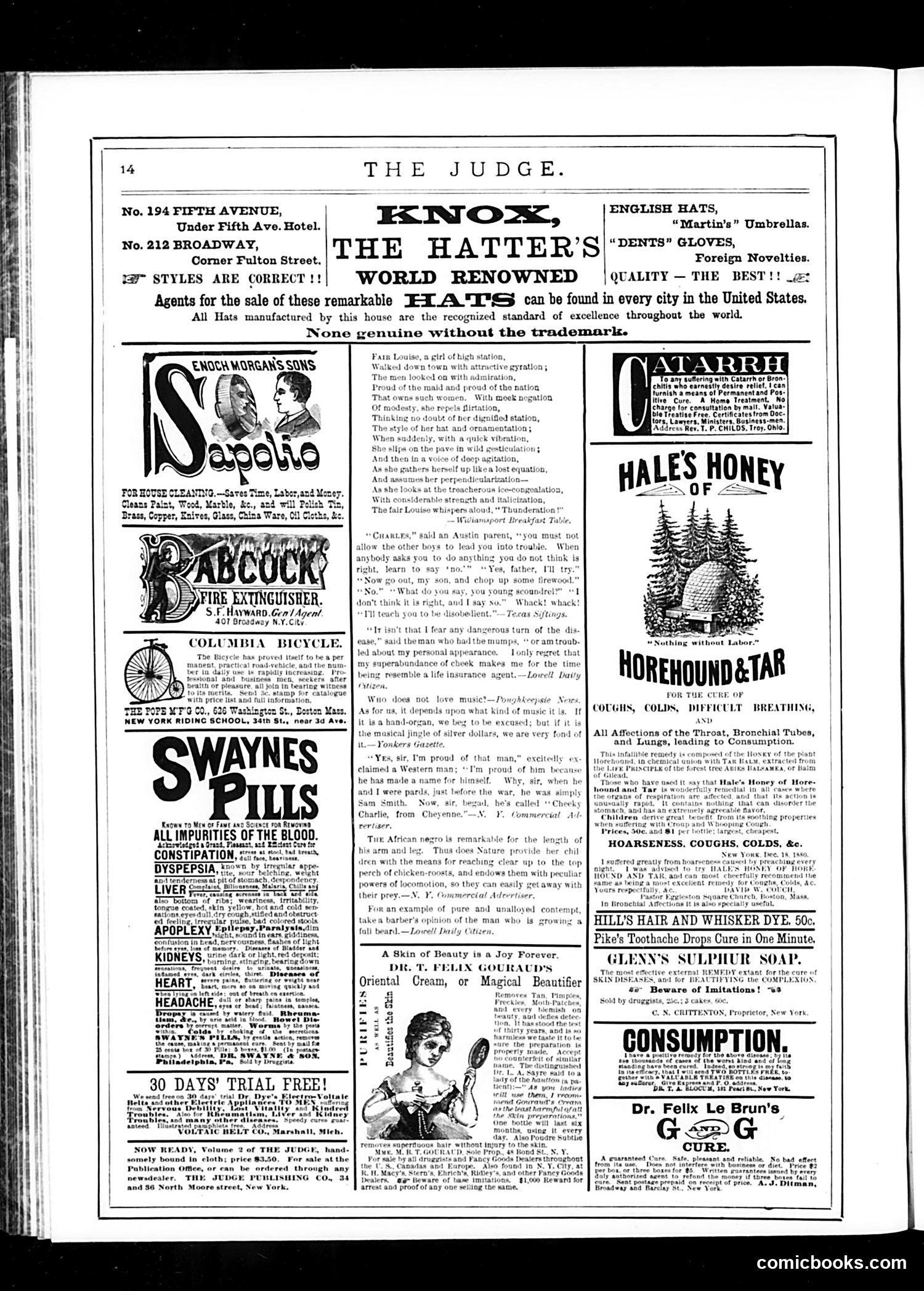
This is primarily an **advertising page** rather than editorial content. The page features numerous patent medicine and consumer product advertisements typical of late 19th-century American publications. Notable advertisements include: - **Knox Hats** (top center) — a prominent hatmaker - **Sapolio soap** — for household cleaning - **Babcock Fire Extinguisher** - **Columbia Bicycle** and riding school ads - **Swaynes Pills** — a patent medicine claiming to purify blood and cure various ailments - **Dr. Gouraud's Oriental Cream** — a skin-lightening product marketed to women - **Horehound & Tar** — a cough remedy - **Pike's Toothache Drops** and various other dubious medical remedies The page includes one visible poem fragment about a young woman's virtue and modesty, but the main content is commercial. This reflects Judge's business model: satirical editorial content subsidized by patent medicine advertising—products often containing unregulated, sometimes harmful ingredients hawked with exaggerated medical claims.
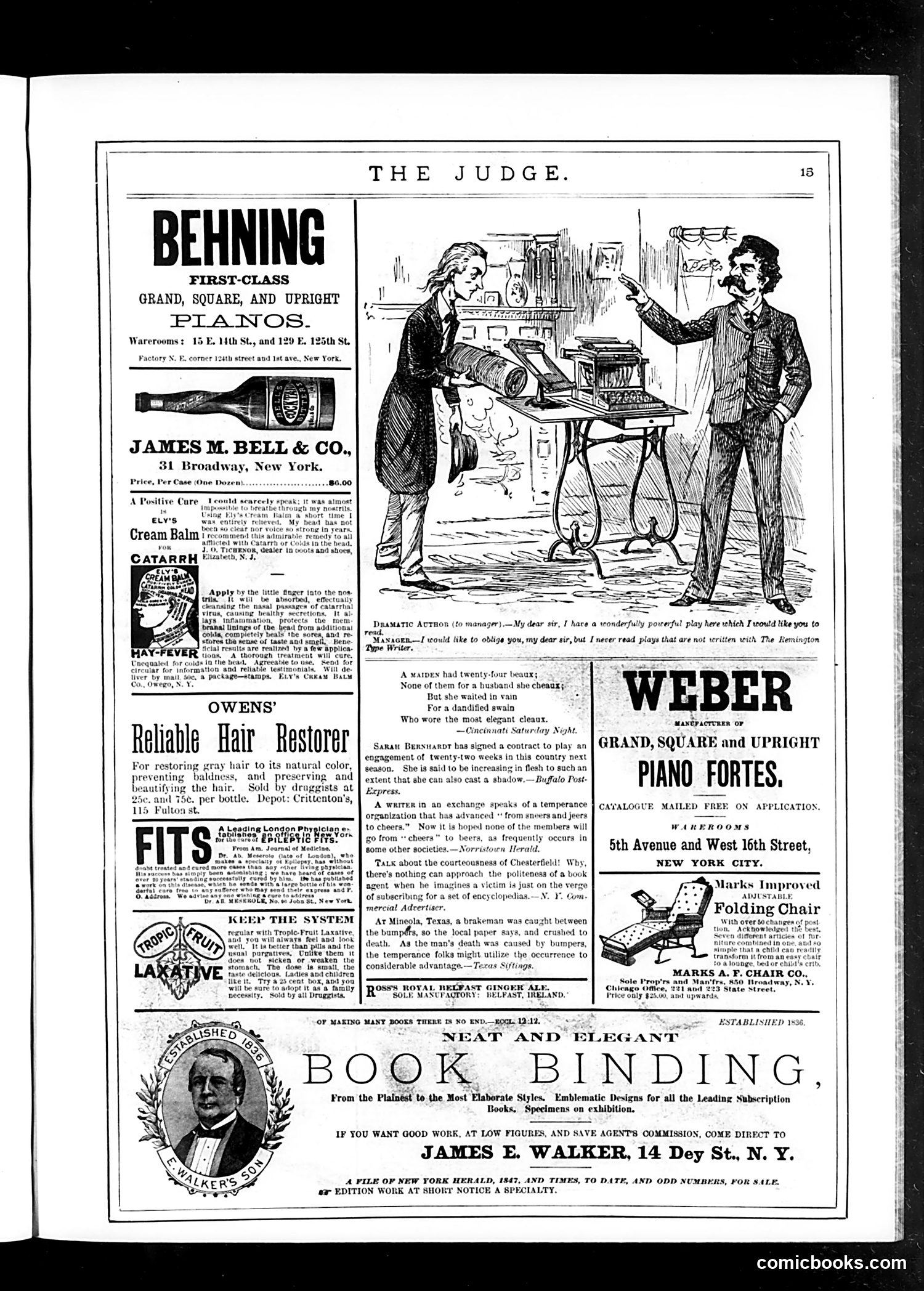
This is primarily an **advertising page** from Judge magazine with one small cartoon at the top. **The Main Cartoon:** A dramatic author pitches a play to a theater manager, who refuses to read it—*unless it was written on a Remington typewriter*. This is a straightforward **product advertisement** disguised as humor. The joke ridicules the manager's absurd requirement while promoting Remington typewriters as the standard tool for serious writers. **Supporting Content:** The page includes several brief satirical items mocking social conventions (a woman waiting for an "elegant" suitor, a temperance organization's ironic name change from "jeers" to "cheers," Chesterfield etiquette). These are generic social satire rather than political commentary. **Advertisements:** The page is dominated by period product ads—Behning pianos, James Bell champagne, Owens' Hair Restorer, a folding chair, and book binding services. **Context:** This reflects late 19th-century Judge content: light social satire mixed extensively with advertising, reflecting the magazine's commercial nature alongside its satirical mission.
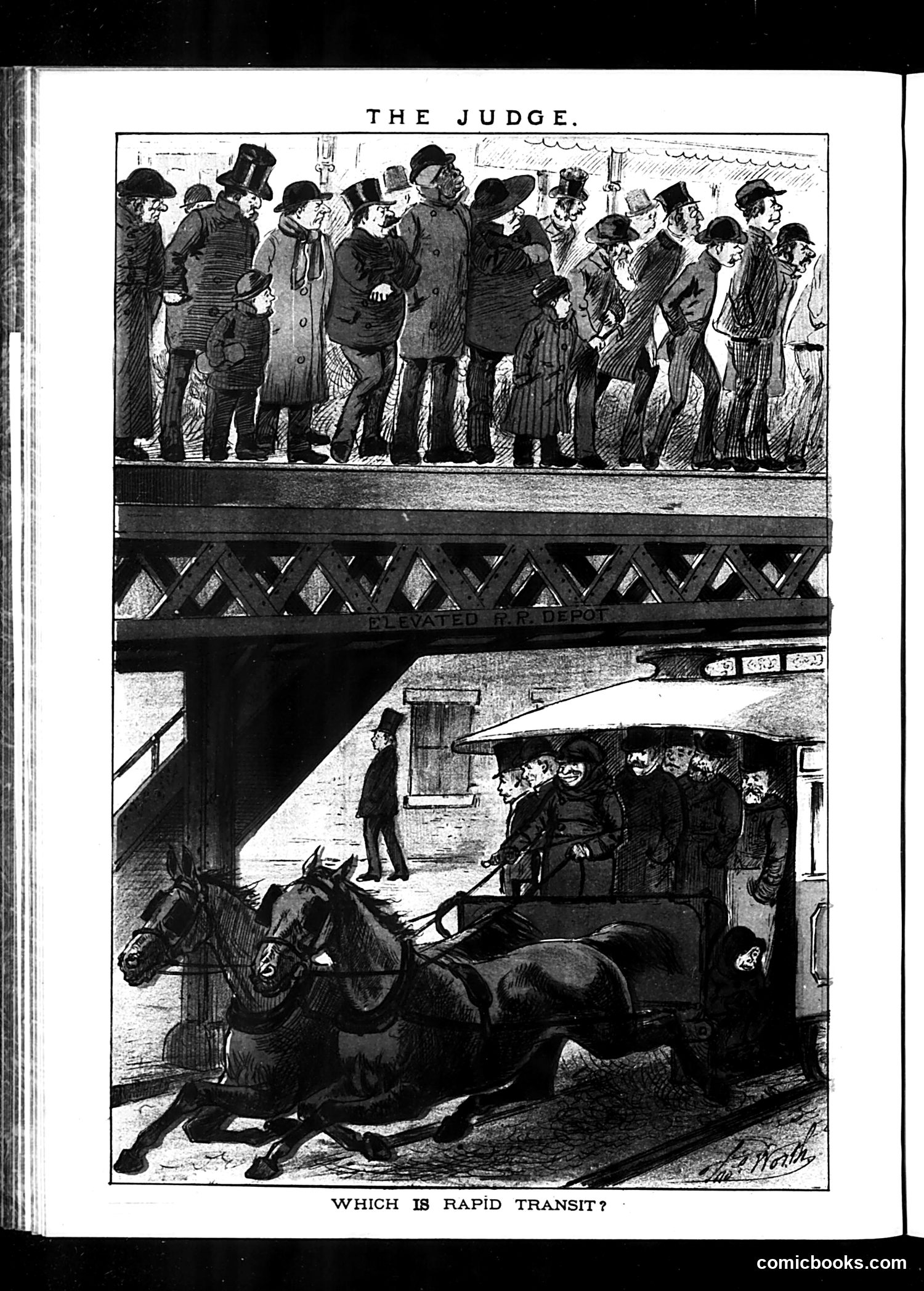
This single-panel cartoon from *Judge* satirizes the contrast between New York City's elevated railway system and horse-drawn carriages. The top half shows crowds packed onto an elevated railroad platform (labeled "ELEVATED R.R. DEPOT"), while the bottom depicts a horse-drawn cab moving swiftly beneath the structure. The joke's irony: despite being called "rapid transit," the elevated railway appears overcrowded and slow, while the supposedly outdated horse carriage moves freely and quickly below. The cartoon critiques the gap between what modern transit promised versus its actual performance—a common complaint about early elevated rail systems in American cities, which suffered from congestion and inefficiency despite their technological advancement over traditional horse transportation.