
Judge, 1883-01-27 · page 2 of 16
Judge — January 27, 1883 — page 2: what you’re looking at
What you’re looking at
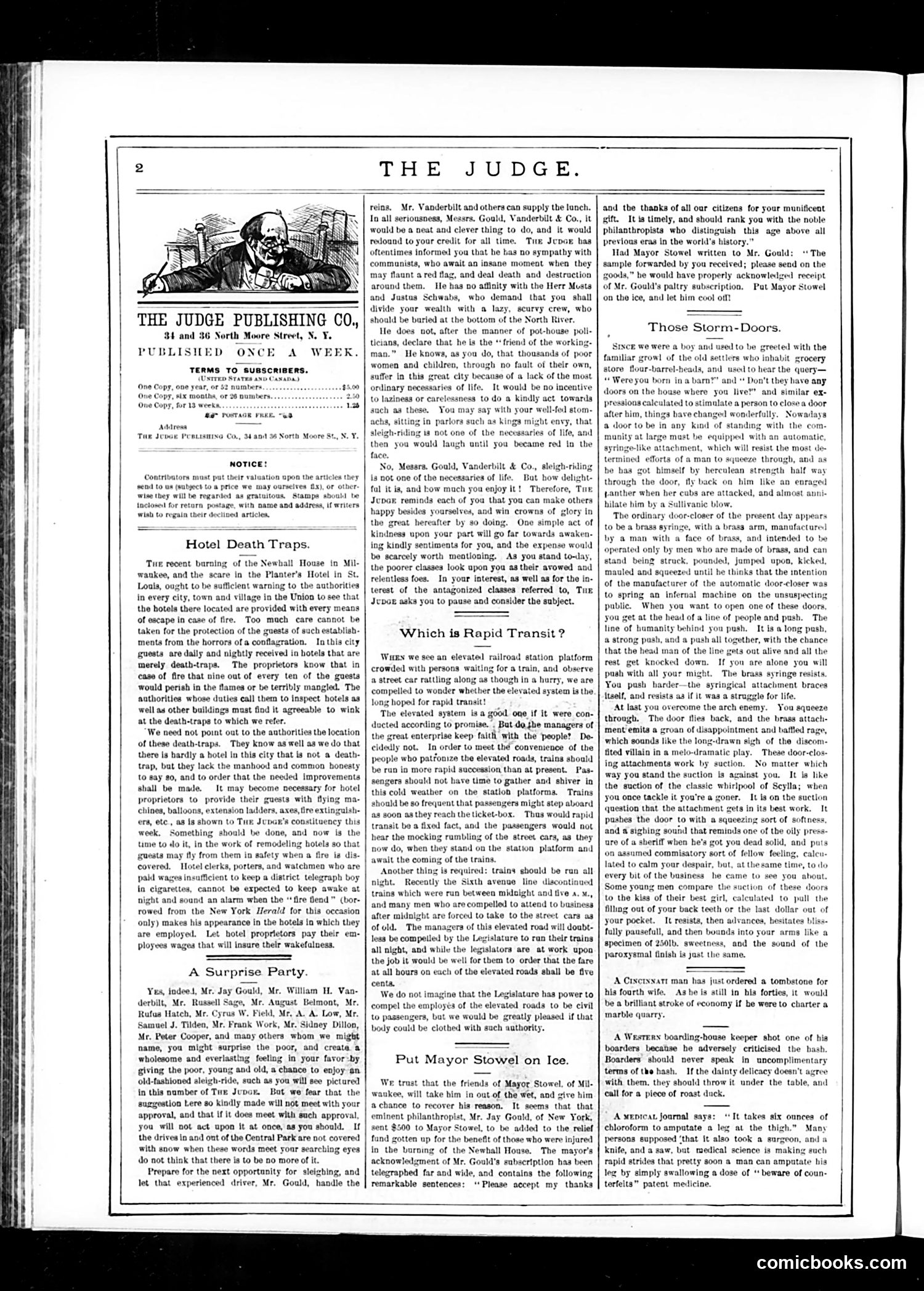
This page from **Judge** magazine contains several satirical pieces targeting wealthy industrialists and public safety issues of the era. **"Hotel Death Traps"** criticizes New York City authorities for ignoring fire hazards in hotels, referencing recent tragedies like the Newhall House fire in Milwaukee. The editorial demands hotel owners and inspectors take responsibility for guests' safety. **"A Surprise Party"** is sarcastic mockery of wealthy robber barons—Jay Gould, Vanderbilt, Russell Sage, and others—suggesting they organize charitable sleigh rides for the poor. The piece sarcastically claims this would improve their public image, while clearly doubting these notoriously ruthless industrialists would actually help the impoverished. The tone implies their wealth came at workers' expense. The cartoon likely visualizes this fantasy charity scenario. Judge regularly used such ironic proposals to highlight the wealthy's indifference to social inequality during the Gilded Age.
📄 Transcribed text from this page (OCR, searchable)
Machine-transcribed from the original scan — historical spelling and the odd misread are preserved.
THE JUDGE FUBLISHING co. 84 and 36 North Moore Street, N.Y. PUBLISHED ONCE A WEEK. TERMS TO SUBSCRIBERS. (Ustrep States ax Caxana) ‘One Cops, one year, of ¢ Copy, #1x months, oF 26 pumbers. py, for 13 weeks far rostac Tue JeDGE PoBLISMING Co., 34 and 34 North Moore St yech to a price we may ourselves fx), or other: Wise they will be regarded as gratuitous, Stamps aboull te tnclosel for retarn postage, with name and address, if writers wish to regain their declined articles Hotel Death Traps, Tue recent barning of the Newhall House in Mil- wankee, and the scare in the Planter’s Hotel in St. Loala, ought to be sufficient warning to the authorities in every city, town and village in the Union to see that the hotels there located are provided with every means of eacape in case of fire. Too mach care cannot be taken for the protection of the guests of such establish- ‘ments from the horrors of a conflagration, In this city guests are daily and nightly received in hotels that are merely death-traps. The proprietors know that in caso of fire that nine out of every ten of the guests would perish in the flames or be terribly mangled. The authorities whose duties call them to inspect hotels as well as other buildings must find it agreeable to wink at the death-traps to which we refer. We need not point out to the authorities the location of these death-traps, They know as well as we do that there is hardly a botel in this city that is not a death- trap, but they lack the manhood and common bonesty to say #0, and to order that the needed Improvements shall be made. It may become necessary for hotel proprietors to provide their guests with flying ma- chines, balloons, extension ladders, axes, {ire extingulsh- era, ete, as 1s shown to Tie Jupar’s constituency this week. Something should be done, and now is the ume to do it, In the work of remodeling hotels so that guests may fly from them in safety when a fire ia dis- covered. Hotel clerks, porters, and watchmen who are paid wages insufficient to keep a district telegraph boy {in cigarettes, cannot be expected to keep awake at night and sound an alarm when the “fire flend” (bor- rowed from the New York Herald for this occasion only) makes his appearance in the hotels in which they are employed. Let hotel proprietors pay their em- ployees wages that will insure thelr wakefulness. A Surprise Party. Yes, jodee!, Mr. Jay Gould, Mr. William H. Van- derbilt, Mr. Russell Sage, Mr. August Belmont, Mr. Rufus Hatch, Mr. Cyrus W. Field, Mr. A. A. Low, Mr. Samuel J, Tilden, Mr. Frank Work, Mr. Sidney Dillon, Mr. Peter Cooper, and many others whom we might name, you might surprise the poor, and create a wholesome and everlasting feeling in your favor-by giving the poor, young and old, a chance to enjoy an Old-fashioned sleigh-ride, such as you will see pictured in this number of Tie Jupor, Bat we fear that th suggestion Lere so kindly made will not meet with your approval, and that if it does meet with such approval, you will not act upon ft at once, as you should. If the drives in and ont of the Central Park are not covered with snow when these words meet yonr searching eyes do not think that there is to be n0 more of it. Prepare for the next opportunity for sleighing, and let that experienced driver, Mr. Gould, handle the reing, Mr, Vanderbilt and others can supply the lunch. In all seriousness, Messrs. Gould, Vanderbilt & Co., it would be a neat and clever thing to do, and it would redound to your credit for all time. Tite Jvpar has oftentimes informed you that he bas no sympathy with communists, who await an insane moment when they may flaunt ared flag, and deal death and destruction around them. He has no affinity with the Herr Musts and Justus Schwabs, who demand that you shall divide your wealth with a lazy, scurvy crew, who shoald be buried at the bottom of the North River, He does not, after the manner of pot-house poll- ticians, declare that he Is the “friend of the working. He knows, as you do, that thousands of poor women and children, through no fault of their own, suffer in this great elty because of a lack of the most ordinary necessaries of life. It would be no incentive to laziness or carelessness to do a kindly act towards such as these. You may say with your well-fed stom- cha, sitting in parlors such as kings might envy, that sleigh-riding ta not one of the necessaries of life, and hen you would laugh until you became red tn the face. No, Messra. Gould, Vanderbilt & Co., sleigh-ridi is not one of the necessaries of life. But how delight- fal it is, and how much you enjoy it! Therefore, Tue Ivpar, reminds each of you that you can make others happy besides yourselves, and win crowns of glory in the great her by so doing. One simple act of kindness upon your part will go far towards awake ing kindly sentiments for you, and the expense wou be scarcely worth meationing. As you stand toxlay, the poorer classes look upon you astheir avowed and tless foes. In your interest, as well as for tho in- terest of the antagonized classes referred to, Tur Jvpak asks you to pause and consider the subject. man. rele! Which is Rapid Transit ? Was we see an elevated railroad station platform crowded with persons waiting for a train, and observe a street car rattling along as though in a hurry, we are compelled to wonder whether the elevated system is the. long hoped for rapid transit! The elevated system is a good one if it were con- ducted according to promise. . But do. she managers of the great enterprise keep faith with the people? De- cldedly not. In order to meet thé convenience of the people who patfonize the elevated roads, trains should. be ran in more rapid succession than at present. Pas- sengers shoul not have time to gather and shiver in this cold weather on the station platforma. Trains should be so frequent that passengers might step aboard as soon as they reach theticket-box. Thus would rapid transit be a fixed fact, and the passengers would not hear the mocking rumbling of the street cars, as they now do, when they stand on the station platform and await the coming of the trains. Another thing is required: trains should be ran all night. Recently the Sixth avenue line discontinued trains which were run between midnight and five a. w., and many men who are compelled to attend to business after midnight are forced to take to the street cars as of old. The managers of this elevated road will doubt- less be compelled by the Legislature to ran their trains all night, and while the legislators are at work upoo the job it would be well for them to order that the fare at all hours on each of the elevated roads shall be five cents, We do not imagine that the Legislature has power to compel the employés of the elevated roads to be civil to passengers, but we would be greatly pleased if that body could be clothed with such authority. Put Mayor Stowel on Ice. We trust that the friends of Mayor Stowel, of Mil- waukee, will take him in out of the wet, and give him achance to recover his reason. It seems that that eminent philanthropist, Mr. Jay Gould, of New York, sent $500 to Mayor Stowel, to be added to the relief fand gotten up for the benefit of those who were injured in the burning of the Newhall House. The mayor's acknowledgment of Mr. Gould's subscription haa been telegraphed far and wide, and contains the following remarkable sentences: ‘Please accept my thanks and the thanks of all our citizens for your munificent gift. It is timely, and should rank you with the noble philanthropists who distinguish this age above all previous eras in the world’s history.” Had Mayor Stowel written to Mr. Gould: “The mple forwarded by you received; please send on the goods,” he would bave properly acknowledged receipt of Mr. Gould’s paltry eubscription, Put Mayor Stowel on the ice, and let im cool off! Those Storm-Doors. SINCE We were a boy and used to familiar growl of the old settlers who inbabit: grocery pur-barrel-beads, and used to hear the query— eyou born ina barn?” and “ Don't they have any doors on the house where you live?” and similar ex- ‘essions calculated to stimulate a person to clo: him, things have changed wonderfully. Nowadays oor to be in any kind of standing with the com- munity at large mast be equipped with an automatic syringe-like attachm termined efforts of a man to squeeze through, and as be baa got b Mf by hercolean strength half way through the door, fly back on him like an enraged panther when her cubs are attacked, and almost auni- hilate him by a Sullivanic blow, The ordinary door-closer of the present to be a brass syringe, with a brass arm, manufactures! by a man with a face of brass, and intended to be operated only by men who are made of brass, and can stand being struck. pon, kicked, auled and squeezed until he thinks that the intention of the manufacturer of the automatic door-closer was to spring an infernal machine on the unsuspecting public. When you want to open one of these doors, you get at the head of a line of people and push. The line of humanity behind you push. It is a long pus! ‘a strong pash, and a push all together, with the chance that the head man of the line gets out alive and all the reat get knocked down. If you are alone you will puah with all your might. The brass syringe resists. You push harder—the syringical attachment brace {tself, and resists as if it was a struggle for life. At last you overcome the arch enemy. You squeeze through. The door flies back, and the brass attach- ment emita a groan of disappointment and hatiled rage, which sounds like the long-drawn sigh of the discom- tited villain in a melo-dramatic play. These door-clos- 1g attachments work hy suction. No matter which way you stand the suction is against you. It ia like the suction of the classic whirlpool of Scylla; when you once tackle it you're a goner. It is on the suction question that the attachment gets in its best work. It pushes the door to with a squeezing sort of softness and a sighing sound that reminds one of the oily press are of a sheriff when he's got you dead solid, and pu ‘on assumed commisatory sort of fellow feeling, caleu lated to calm your despair, but, at thesame time, to do every bit of the business he came to see you about, Some young men compa to the kiss of their best girl, c fHllng out of your back teeth or the last dollar out of your pocket. It resists, then advances, besitates bliss- fully pausefull, and then bounds into your arms like a specimen of 2601b. sweetness, and the sound of the paroxysmal finish is jast the same. e greeted with the at, which will resist the most y appears pounded, jumped A Ciyctxxatt man has just ordered a tombstone for his fourth wife. Ashe is still in bis forties, it would be a brilliant stroke of economy if be were to charter a marble quarry, A Wesrerx boarding-house keeper shot one of his boarders Lecanse he adversely criticised the hash. Boarders’ should never speak in uncomplimentary terms of the hash. If the dainty delicacy doesn’t agree with them. they should throw it under the table, and call for a piece of roast duck. A sepicat jonrnal says: “It takes six ounces of chloroform to amputate a leg at the thigh.” Many persons supposed ‘that it also took a surgeon, and a knife, and a saw, but medical science is making euch rapid strides that pretty soon a man can amputate his leg by simply swallowing a dose of * beware of coun- terfeits” patent medicine. comicbooks.com