
Judge, 1883-01-27 · page 10 of 16
Judge — January 27, 1883 — page 10: what you’re looking at
What you’re looking at
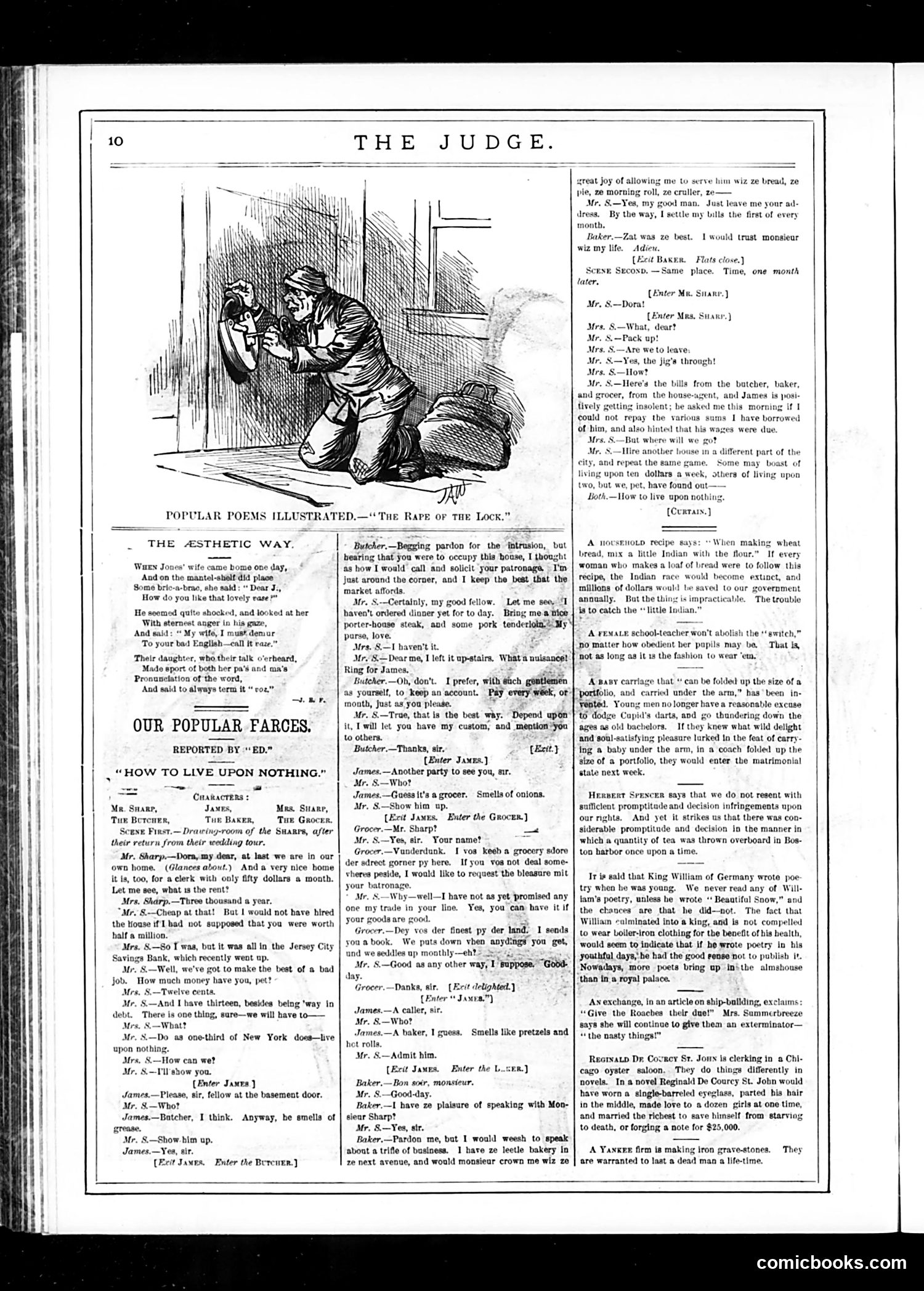
This page contains two pieces of satirical content: **"The Aesthetic Way"** (top): A brief poem mocking pretentious corrective behavior. Mr. Jones pedantically insists his wife say "vase" (pronounced "vahz") rather than "vase" (pronounced "vayze"), only to have their daughter ridicule both parents' pronunciations by calling it "coz." The joke satirizes obsessive social correctness and the absurdity of linguistic snobbery. **"How to Live Upon Nothing"** (bottom): A satirical farce about a newly married clerk earning only $50/month who rents a $3,000-year house, assuming his wife is wealthy (she's not—she only has 12 cents). The satire targets financial recklessness and the ease of obtaining credit. Tradesmen (butcher, grocer, baker) eagerly extend unlimited credit to the couple, enabling their spending despite having no income. Judge ridicules both consumers living beyond their means and merchants facilitating debt.
📄 Transcribed text from this page (OCR, searchable)
Machine-transcribed from the original scan — historical spelling and the odd misread are preserved.
POPULAR POEMS ILLU: THE 42STHETIC WAY. Wuex Jones’ wife came bome one day, And on the mantel-sbelf did place Some bric-a-brac, she sald: “ Dear J., How do you like that lovely vase He soomed quite shocked, and looked at her With sternest anger in his gaze, And said: “ My wife, I must demur To your bad English—call It raze,” Their daughter, who their talk o'erheard, Mado sport of both her pa’s and ma’s Pronunelation of the word, And said to always term it “ coz.” wm OUR POPULAR FARCES. REPORTED BY , “HOW TO LIVE UPON NOTHING.” ED.” ~ = Mr. Sarr, Janes, Mrs. Starr, Tux Bercner, Tun Baxer, — Tue Grocer. ENE Finst.—Drawing-room of the Suarrs, after their return from their wedding tour. Mr. Sharp—Dora,my dear, at last we are in our own home. (Glances about.) Anda very nice bome it Is, too, for a clerk with only fifty dollars a month. Let me see, what 18 the rent? Mrs, Sharp.—Threo thousand a year. “Mr. S.—Cheap at that! But 1 would not have hired the louse if bad not supposed that you were worth half a million. Mrs. S—So T was, but it was all in the Jersey City ings Bank, which recently went up. Mr. S.—Well, we've got to make the best of a bad 1. How mach money have you, pet? Mrs, S.—Twelve cents. Mr. S.—And [have thirteen, besides being way in There is one thing, sure—we will have to— —Do as one-third of New York does—live upon nothing. Mrs, S.—How can we? Mr, 8.—VIl show you. Enter Janes} James.—Please, sir, fellow at the basement door. Mr, 3—Whot James.—Batcher, I think. Anyway, be smells of grease. Mr. &.—Show-bim up. James.—Yes, sir. (Eeit Saves, Enter the Bere Butcher.—Begging pardon for the ‘intrusion, but bearing that you were to occupy this house, I thouzht as how I would’ call and solicit your patronage, I'm Just around the corner, and I keep the best that the market affords Mr. S—Certalnly, my good fellow. haven't ordered dinner yet for to day. Let me seo, ‘I Bring mea nice porter-honse steak, and some pork tenderlota2! My’ parse, love. Mrs. S.—I haven't it. Mr S—Dear me, I left it up-stairs, What a nuisance? Ring for James. Py Buteher.—Oh, don't. I prefer, with éach géntlemen ‘as yourself, to keep an account. Pay every wéek, or’ month, Just as you please. 7 Mr. S.—Trae, that is the best way. Depend upon it, Twill let you have my custom, and mention yoo to others. Butcher —Thanks, sir. (Enter Saves] James.—Another party to see you, sir. Mr. 8.—Whot ness it's a grocer. .—Show him up. (Exit Janes. Enter the Grocer.) Grocer.—Mr. Sharp? Mr. S.—Yes, sir. Your name? Grocer.—Vunderdunk. 1 vos keeb a grocery sdore der sdrect gorner py here. If you vos not deal some- vheres peside, I would like to request the bleasare mit your batronage. Mr, 8.—Why—well—I have not as yet jpromised any one my trade in your line. Yes, you"can have it if your goods are good. > Grocer.—Dey vos der Soest py der land, 1 sends youa book. We puts down vhen anyding# you get, und we seddles up monthly-—eh?> 2 42, Mr. S8.—Good as any other way, I’ suppose, “Godd- (Bet) Smells of onions. = Grocer.—Danks, sir. (E {Enter James.—A caller, sir. Mr. 8.—Whot James.—A baker, 1 guess, hot roll Mr. t letighted.) Jaurs.”) ‘Smells like pretzels and Admit him. (Brit James. Enter the bocer.) Baker. —Bon soir, monsieur. Mr. S.—Good-day. Baker.—I have ze plaisure of speaking with Mon- siear Sharp’ Mr. 8—Yes, str. Baker.—Pardon me, but 1 would weesh to speak about a trifle of business. I have ze leetle bakery in ze next avenue, and would monsieur crown me wiz ze reat joy of allowing me to serve him wiz ze bread, ze pie, ze morning roll, ze cruller, ze— Mr. &—Yea, my good man. Just leave me your ad- dress. By the way, I settle my bills the first of every month. Baker. wiz my life. was zo best. Adien. (Ecit Baxer. Flats close.) Scese Secosp.—Same place. Time, later. I would trust monsieur one month (Enter Mu. Sane.) Mr. 8—Dorat (Enter Mrs, Sian.) S.—What, deart Pack up! Mrs. Mr. Mrs. S. Mr. S—Yes, the jig’s throu Mrs. S—Mow? Mr, S.—Here's the bills from the bateber, baker, and grocer, from the nt, and James is posi- tively gettin, this: morning If 1 could not re ms 1 have borrowed were due. insolent ay the v in a different part of the the same gam boast of living upon ten dollars a week, others of living upon two, but we, pet, have found out—— Both.—How to live upon nothing, city, and rep Some (Cerrars.} ‘A novseHoLp recipe says: “When maki bread, mix a little Indian with the flour. woman who makes a loaf of b recipe, the Indian nr wheat It every ad were to follow this © would become extinct, and millions of dollars would te saved to our government annually. Bat the thing is impr: The trouble is to catch the ‘little Indian.” ‘A FEMALE school-teacher won't abolish the switch, o matter how obedient her papils may be. That is, not as long as it 1s the fashion to wear ‘em. ticable, A nany carriage that can be folded up the size of a portfolio, and carried under the arm,” hasbeen in- Yented. Younz men nolonger have a reasonable excuse t dodge Cupid's darts, and go thundering down the ages as old bachelors. If they knew what wild delight and soul-satisfying pleasure larked tn the feat of carry- ing a baby under the arm, in a coach folded up the size of a portfolio, they would enter the matrimonial state next week. Herbert Srexcer says that we do not resent with sufficlent promptitude and decision infringements upon our nghts, And yet it strikes us that there was con- siderable promptitude and decision in the manner in which a quantity of tea was thrown overboard in Bos- ton harbor once upon time. Ir is sald that King William of Germany wrote poe- try when he was young. We never read any of Will- tam’s poetry, unless he wrote ‘* Beautiful Snow,” and the chances are that he did—not. The fact that William ealminated into a king, and is not compelled to wear boiler-iron clothing for the benefit of his health, would seem to indicate that if he wrote poetry in his youthful days,he had the good rense not to publish it. Nowadays, more poets bring up insthe almshouse than in a royal palace. Ax exchange, in an article on ship-ballding, exclaims: “Give the Roaches their due!” Mrs. Summerbreeze says she will continue to give them an exterminator— “the nasty thin; Reorvat Dr. Covrey Sr. Jony is clerking in a Chi- cago oyster saloon. They do things differently in novels. In a novel Reginald De Courcy St. Jobn would have worn a single-barreled eyeglass, parted his hair in the middie, made love to a dozen girls at one time, and married the richest to save himself from starving to death, or forging a note for $25,000. A Yaxxee firm is making iron grave-stones. are warranted to last a dead man a life-time. They comicbooks.com