
A complete issue · 16 pages · 1883
Judge — January 13, 1883
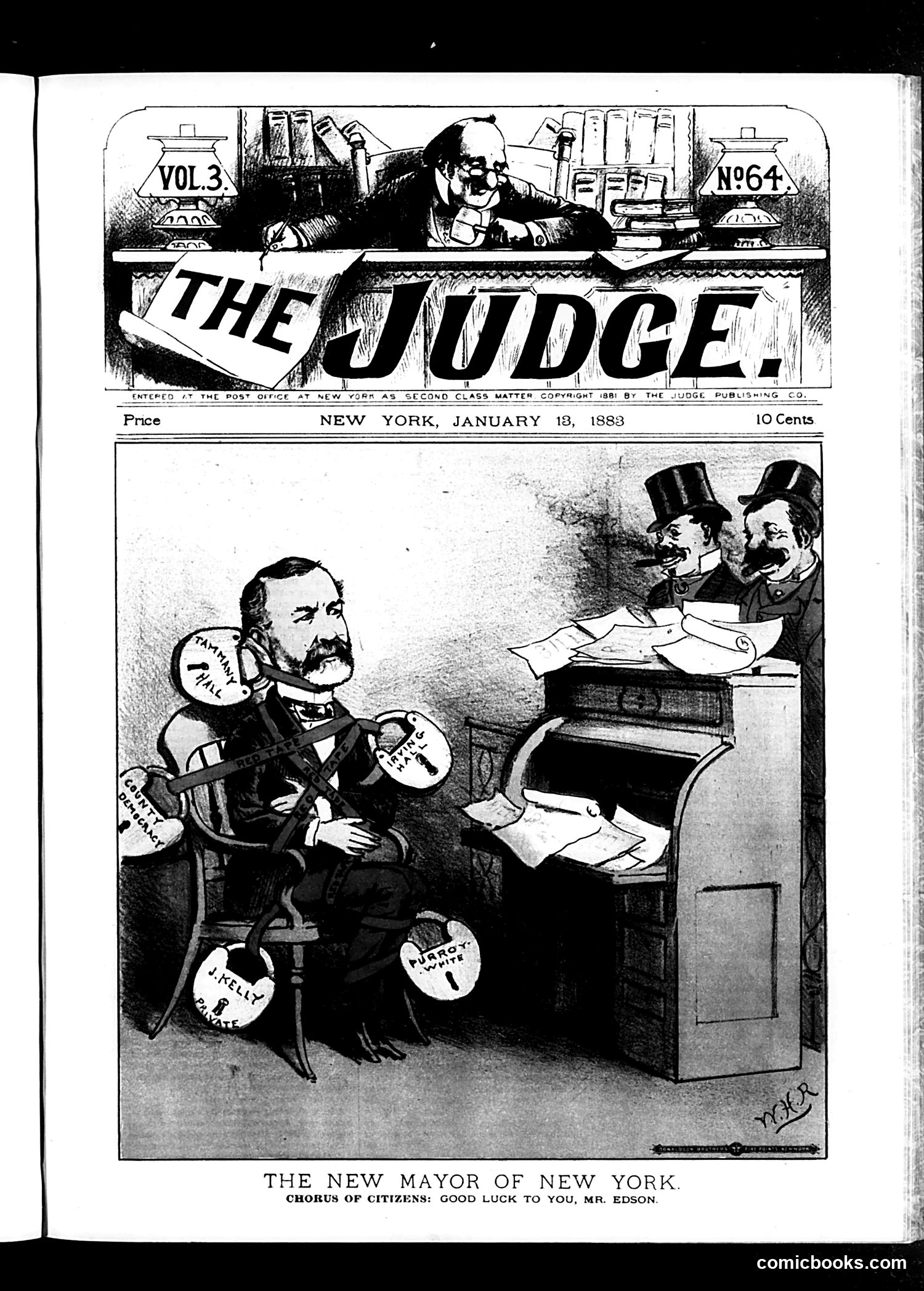
This is a satirical cartoon from *Judge* magazine dated January 18, 1883, celebrating a new New York City mayor (likely Franklin Edson, based on the caption "Good luck to you, Mr. Edson"). The cartoon depicts the incoming mayor as a figure surrounded by symbolic creatures or demons labeled with various municipal problems and vices—appearing to represent corruption, mismanagement, or political obstacles he must navigate. Two top-hatted officials on the right observe the scene, possibly representing the political establishment or outgoing administration. The satire suggests the new mayor faces daunting challenges in cleaning up city governance. The "chorus of citizens" offering good luck is ironic—the cartoon implies the role is nearly impossible given the entrenched problems awaiting him.
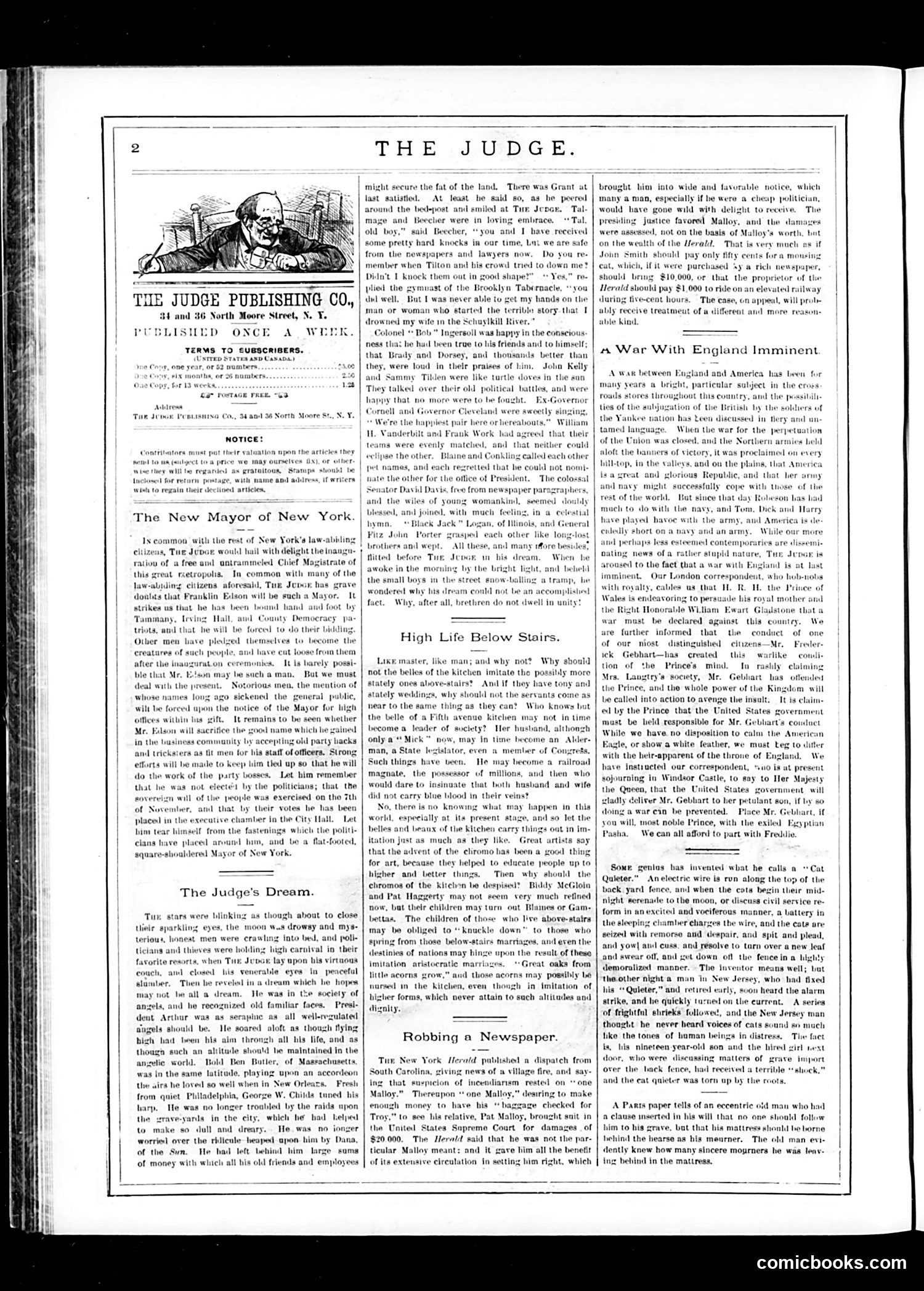
This page from *Judge* magazine contains political commentary on New York governance circa the 1880s. The main editorial, "The New Mayor of New York," celebrates Franklin Edson's election as mayor, distinguishing him from previous appointees beholden to Tammany Hall machine politics. *Judge* warns Edson against surrendering city patronage positions to "party hacks and tricksters," asserting he was elected by the people, not politicians. The satirical dream sequence, "The Judge's Dream," depicts deceased or controversial figures (President Arthur, Ben Butler, Henry Ward Beecher, Colonel Ingersoll) in an afterlife paradise, freed from earthly scandals. Beecher's inclusion references his infamous adultery trial; the passage about "the terrible story that I drowned my wife in the Schuylkill River" alludes to the Tilton-Beecher scandal that *Judge* had covered extensively. The cartoons (not clearly visible in this reproduction) likely reinforced these anti-corruption themes targeting Tammany Hall's influence.
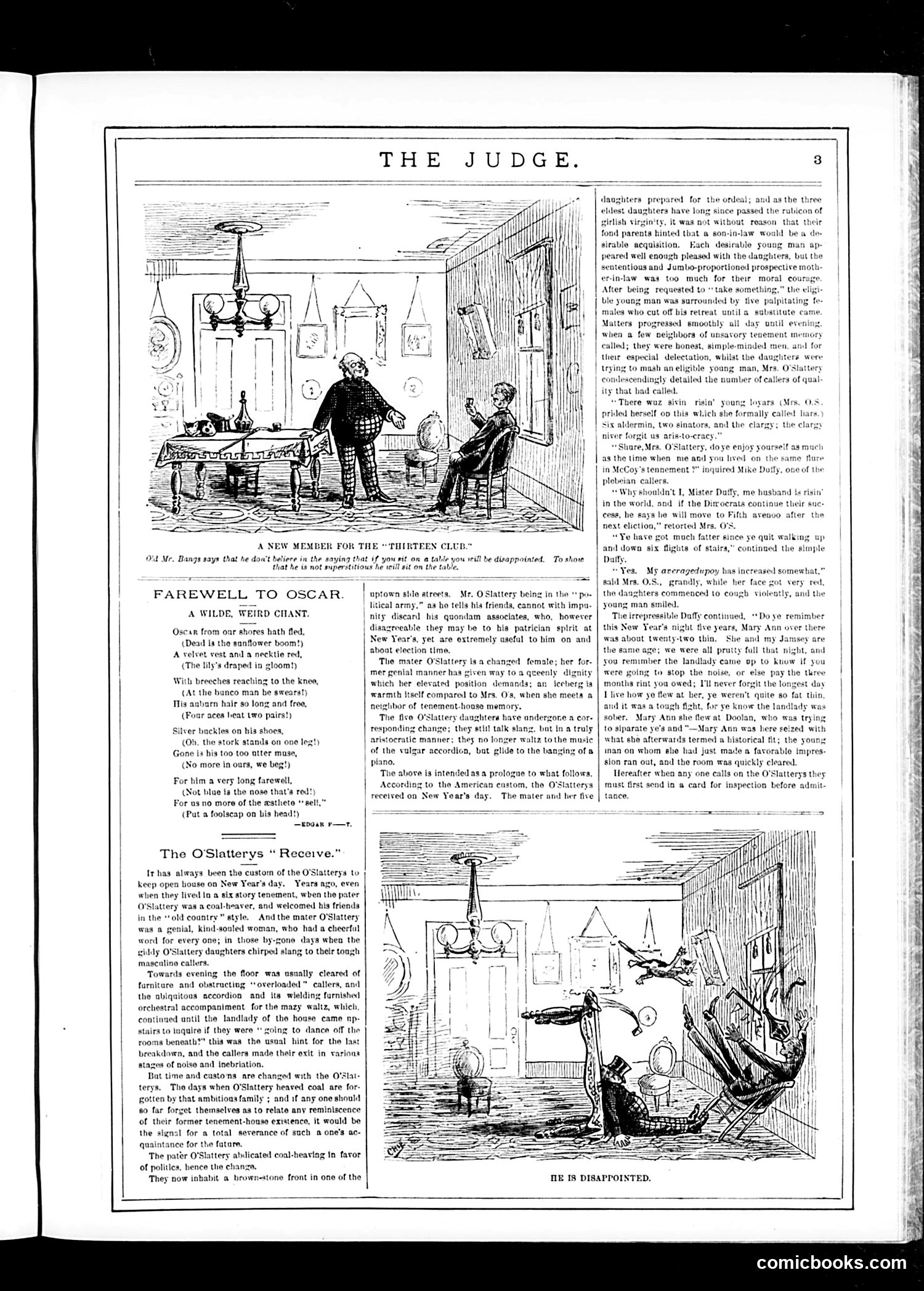
This article satirizes Irish-American social aspiration through the O'Slattery family. Once working-class tenement dwellers (the father was a coal-heaver), they've risen to brownstone respectability through the father's entry into politics. The mother and five daughters have shed their former warmth and genuine hospitality, adopting pretentious manners while still retaining working-class speech patterns—they now waltz to piano rather than accordion. The satire culminates in their New Year's reception: when old tenement neighbors visit, the family is mortified. The daughters attempt to impress an eligible suitor but are undermined by these "honest, simple-minded" former friends, whom they now regard as embarrassing reminders of their humble origins. The joke targets the hypocrisy of upwardly mobile immigrants who abandon their communities and values upon achieving modest prosperity—a common theme in Gilded Age satire.
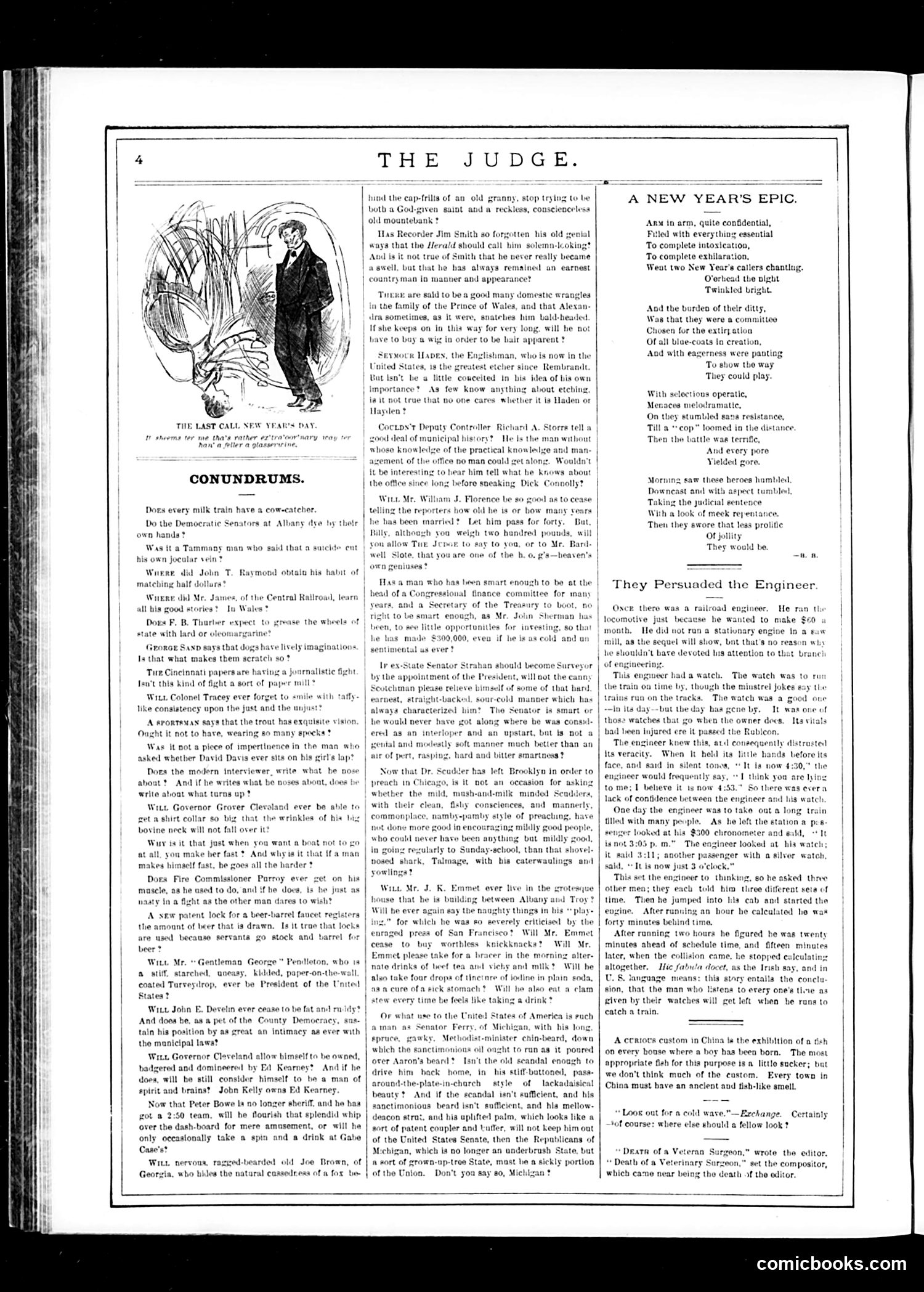
This cartoon depicts a figure in formal attire (likely representing a wealthy or politically prominent man) being confronted by a disheveled, gaunt character—possibly representing poverty, vice, or social consequence. The caption references "New Year's Day," suggesting a moral reckoning or final warning as the new year begins. The accompanying "Conundrums" column contains satirical riddles mocking contemporary political figures and public officials: Governor Grover Cleveland, various New York Democratic politicians (John Kelly, Ed Kearney), and railroad magnates. The jokes target their perceived hypocrisy, vanity, and corruption—typical of *Judge* magazine's satirical approach to Gilded Age politics and society. The overall theme appears to be accountability and the consequences of moral compromise.
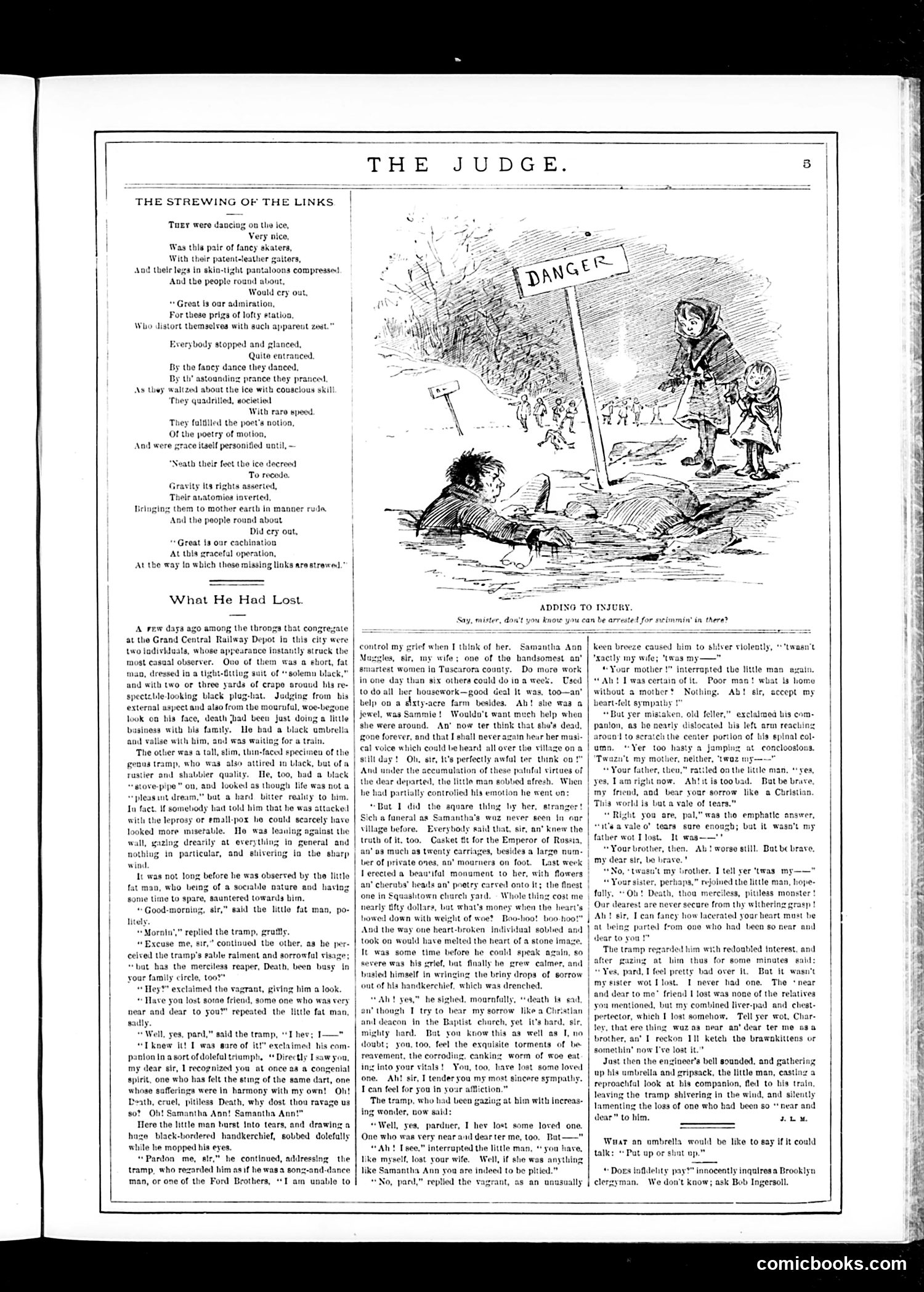
This page contains two separate pieces of Victorian-era social satire. **"The Strewing of the Links"** mocks fashionable ice skaters—likely wealthy people ("prigs of lofty station") performing elaborate skating moves for admiring crowds. The joke is physical comedy: their pretentious displays of skill end when they fall hard on the ice, reducing their "graceful operation" to undignified sprawling. The humor targets class pretension through slapstick. **"What He Had Lost"** satirizes sentimental grief performance. A well-dressed mourner, seemingly grieving a lost family member, encounters a shabby tramp and assumes they share similar losses. The mourner melodramatically laments his wife "Samantha Ann" while the tramp listens. The satire appears to target the middle-class tendency toward theatrical mourning and emotional self-indulgence—the mourner's performative sorrow contrasts with the tramp's quiet suffering. The text suggests the joke reveals the mourner's sentiment as excessive or insincere. Both pieces use exaggerated character types to mock social pretension.
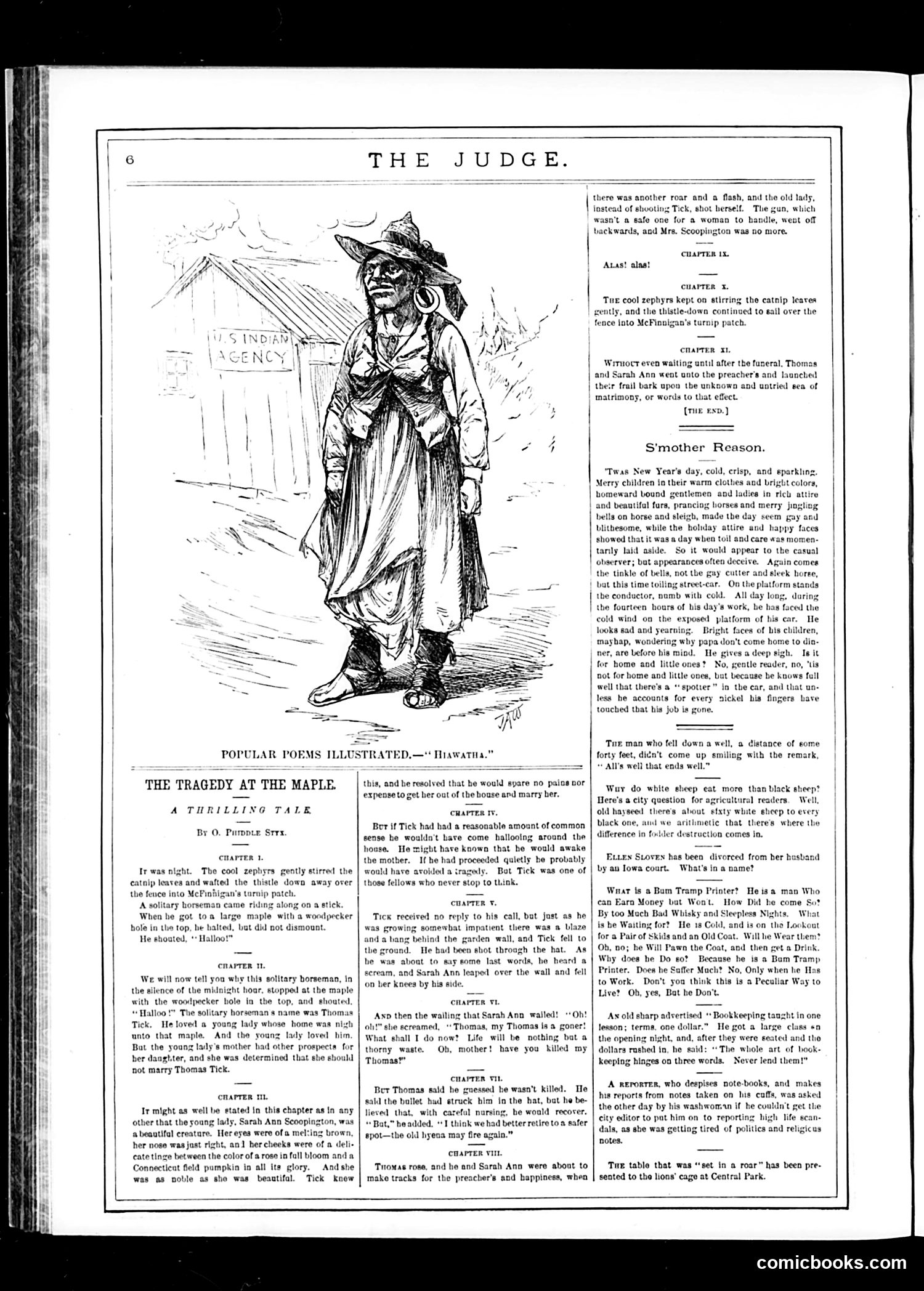
This page parodies melodramatic serialized fiction popular in the 19th century. The story follows a ridiculous love plot: Thomas Tick attempts to elope with Sarah Ann Scoopington, but her mother shoots at them from behind a garden wall. The gun backfires, killing the mother instead. The satire mocks the overwrought conventions of romantic fiction—purple prose, absurd coincidences, and contrived resolutions. Phrases like "thorny waste" and "untried sea of matrimony" exaggerate sentimental language. The absurdist details (a horseman riding "on a stick," descriptions of the heroine's complexion comparing her cheeks to "a Connecticut field pumpkin") deliberately undercut dramatic tension. The accompanying illustration of an old woman with a rifle reinforces the comedic incongruity. Judge lampooned contemporary popular literature's melodramatic excesses through this parody of serialized romance tales.
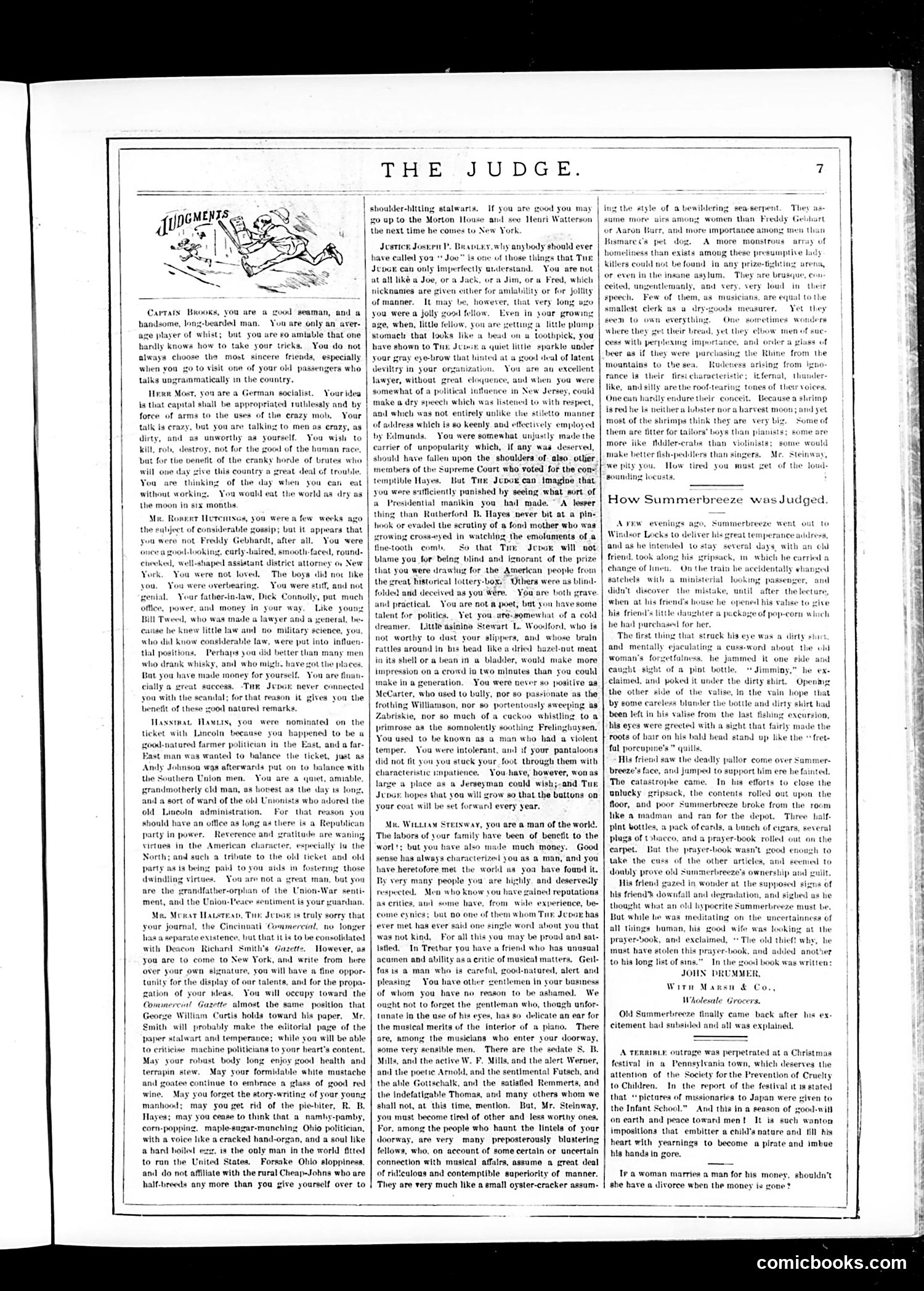
This page contains "Judgments," a satirical column delivering barbed character assessments of public figures. The text addresses several men individually: **Captain Brooks** is mocked as an mediocre whist player and insufferable socialite—handsome but morally unreliable. **Henry Moist** is attacked as a dangerous socialist who advocates violent wealth redistribution. **Rowland Hayes** receives backhanded praise as an honest, unpretentious farmer—loyal Lincoln ally now deserving continued Republican patronage out of gratitude. **Manton Marble** (editor of the *Cincinnati Commercial*) is congratulated on his newspaper consolidation and future move to New York. The satire employs personal attacks alongside political critique. The column mixes praise with insults, suggesting Judge magazine's approach was aggressive character assassination masked as witty judgment. Without the publication date visible, the specific historical context remains unclear, but the targets appear to be post-Civil War era political and media figures.
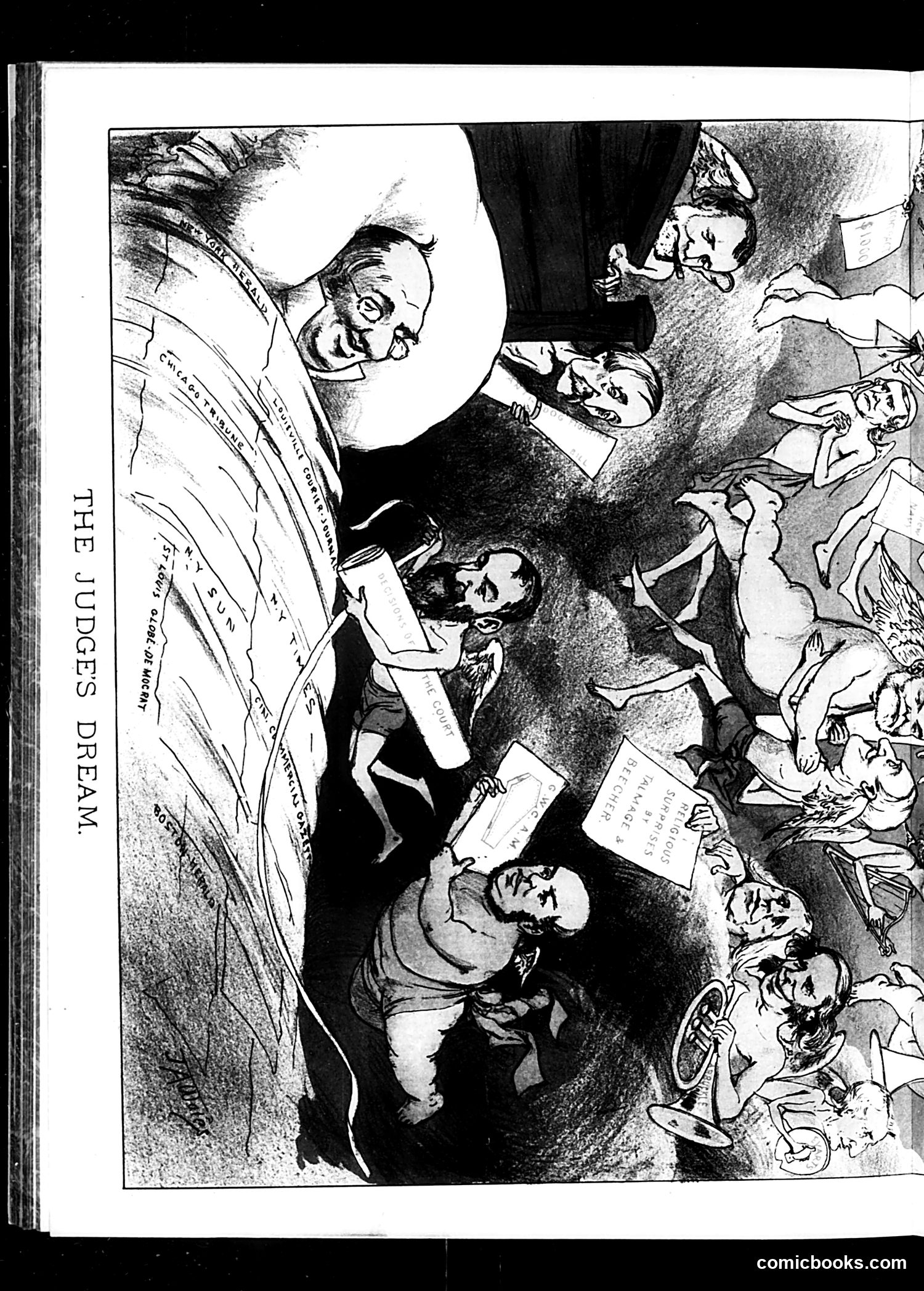
This political cartoon depicts a sleeping judge having a nightmare. The title "The Judges Dream" appears on the left margin. The image shows a figure in judicial robes lying down while surrounded by chaotic scenes—multiple figures appear to be arguing, gesturing, or in conflict around him. Documents or papers are visible scattered throughout. The satire likely critiques the judicial system's overwhelming workload or the disorder judges must navigate daily. The surreal, crowded composition of demanding figures suggests the judge is burdened by numerous cases, conflicting demands, or societal chaos requiring judicial intervention. Without clearer OCR text or visible dates, the specific historical context remains unclear, but the cartoon appears to mock either judicial inefficiency or the impossible nature of the judge's role.
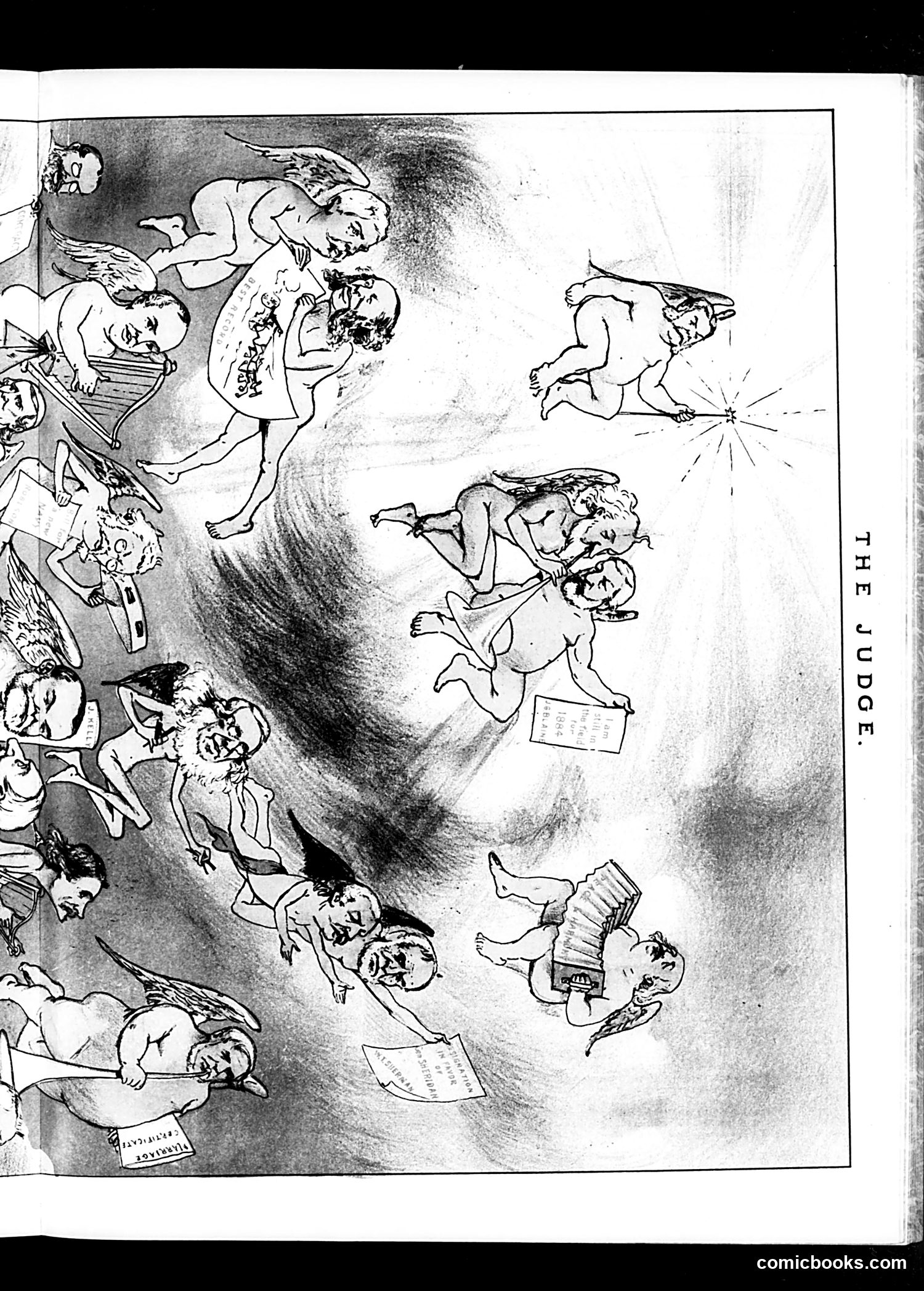
The OCR text on this page appears to be corrupted or represents only marginal elements, providing no readable information. While the image shows a satirical illustration with multiple cherub or cherub-like figures arranged around a central dark clouded area, with what appears to be scattered papers or documents, I cannot reliably identify the specific political or social references, figures, or the intended satirical message without legible text or a visible title. The artistic style and subject matter (cherubs with various poses and expressions) suggests social or political commentary typical of *Judge* magazine's approach, but without clear context or readable captions, I cannot accurately explain what modern readers would need to understand this cartoon's meaning.
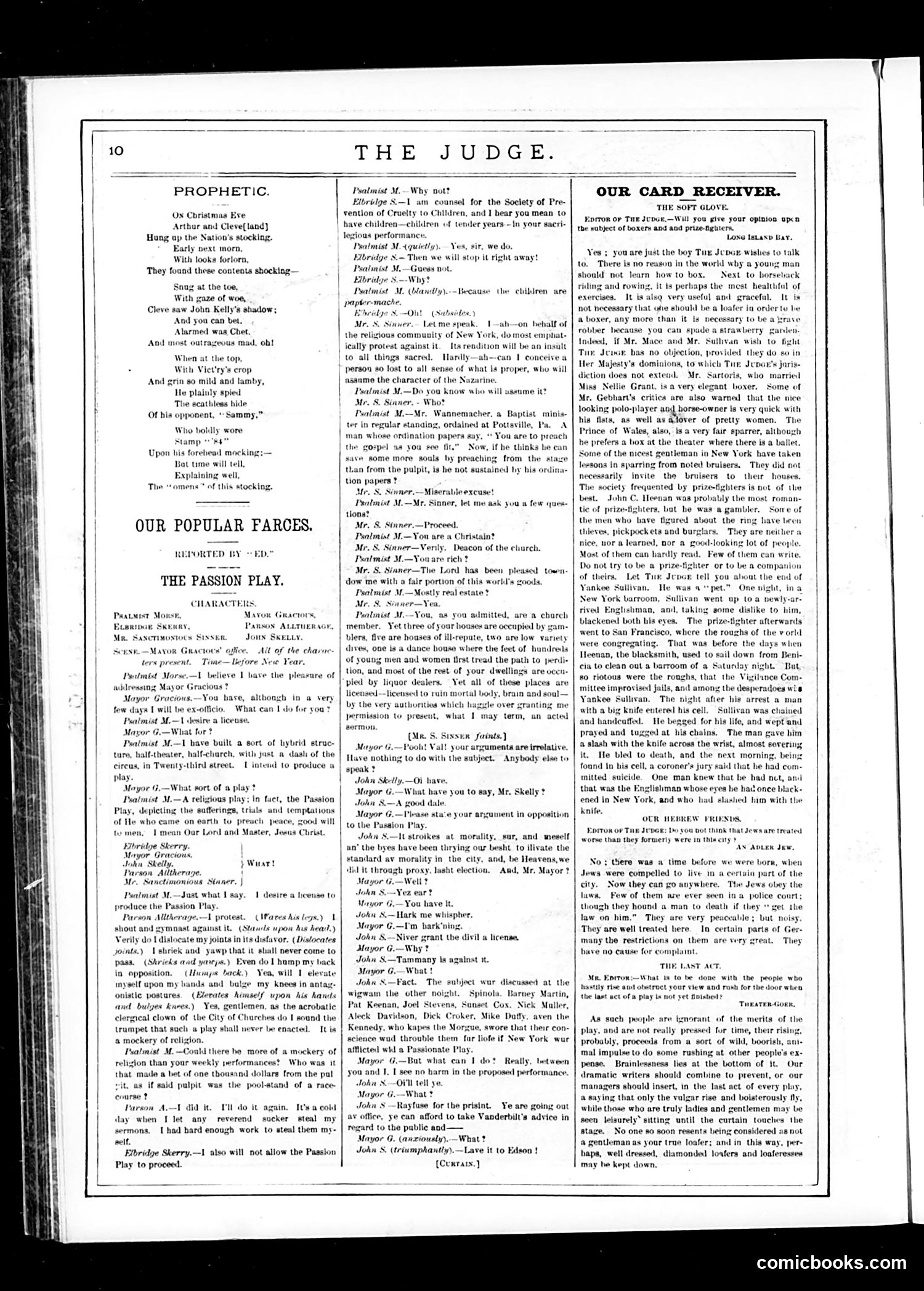
This page from *Judge* magazine presents political satire and theatrical farce from the Gilded Age. The "Prophetic" poem at top satirizes Cleveland and Arthur (likely President Chester Arthur and Grover Cleveland) by imagining their Christmas disappointment—finding "John Kelly's shadow" in their stocking. Kelly was a powerful New York Democratic politician, suggesting anxiety about political rivals and factional conflict within the party. The longer piece, "The Passion Play," mocks New York's self-righteous reformers through a license-hearing absurdity. A theater owner seeks permission to stage a Passion Play, but faces opposition from: a sanctimonious parson (performing ridiculous contortions), an SPCC representative citing "child cruelty," and a reform-minded Sinner character. The satire targets religious hypocrisy and overzealous reform movements that would censor art while the reformers themselves engage in undignified behavior. The joke: reformers are bigger mockers of religion than any theatrical production.
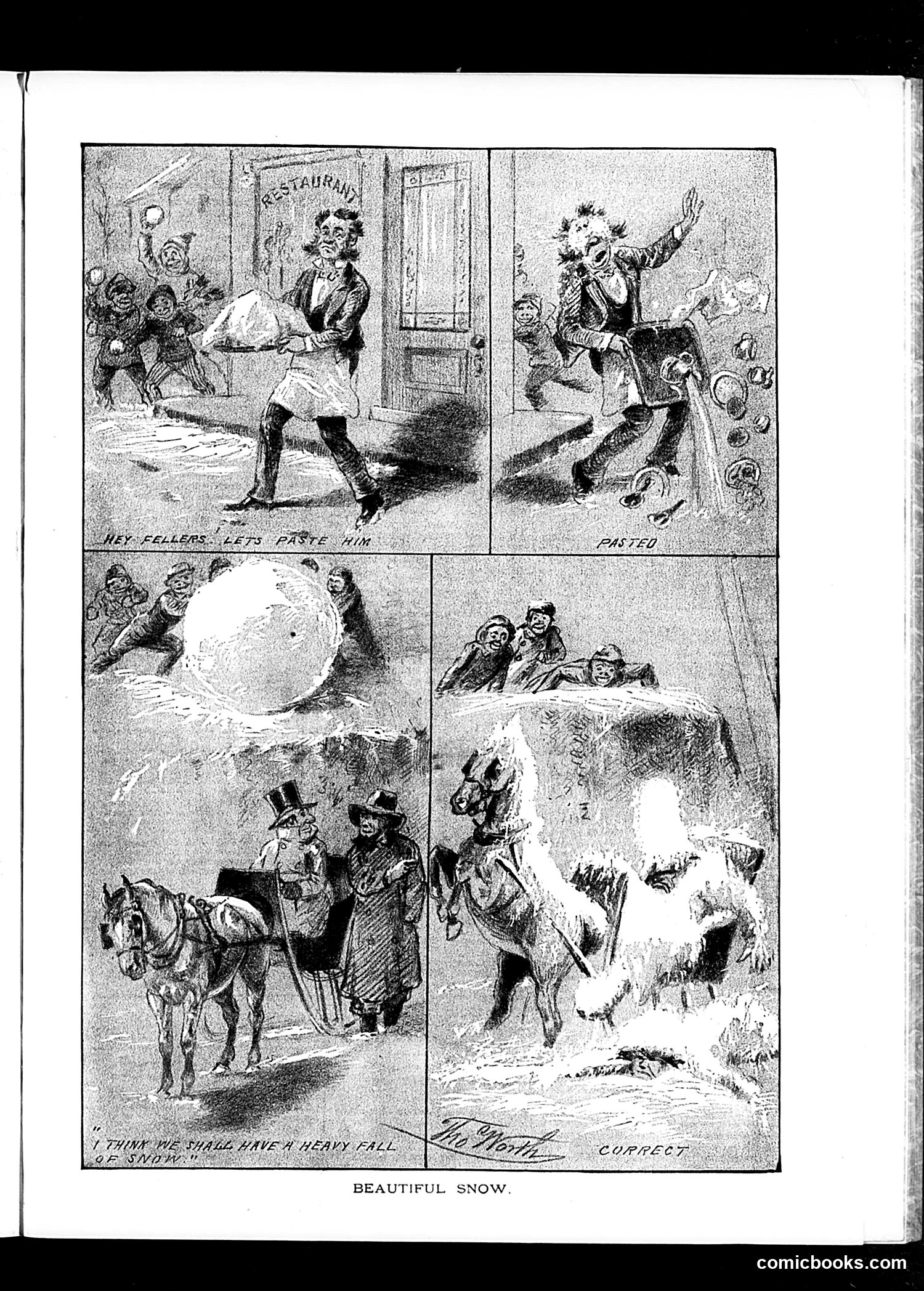
This four-panel comic depicts slapstick humor centered on snow and winter chaos. In the first two panels, a waiter exits a restaurant carrying food, which he loses when he slips on snow and falls. The caption reads "Hey, fellers, let's paste him" / "Pasted," suggesting street urchins or onlookers mock his misfortune. The lower panels show the aftermath: a massive snowball, well-dressed gentlemen in a carriage encountering deep snow, and what appears to be a snowstorm engulfing travelers. The satire critiques winter's indiscriminate destruction—affecting both working-class waiters and wealthy citizens equally. The title "Beautiful Snow" is ironic, as the comic presents snow not as picturesque but as a hazard that creates chaos, humiliation, and danger across social classes. This reflects common late-19th/early-20th-century urban complaints about winter weather.
This page from Judge magazine contains theatrical criticism rather than political cartoons. The main illustration shows a jester or court fool labeled "Judge of the Play," establishing the critic's irreverent persona. The text reviews recent Broadway productions, particularly criticizing: 1. **"The White Slave"** by Bartley Campbell—a melodrama the critic dismisses as recycled material ("hash") cobbled from earlier successful plays like "Kit" and "The Octoroon." The critic suggests only unsophisticated audiences ("hash-loving public") keep such tired plots alive. 2. **"Odette"** starring actress Modjeska—condemned as morbid, depressing psychological drama that wallows in maternal suffering without purpose or dramatic payoff. The satire targets both playwrights for lacking originality and audiences for tolerating formulaic entertainment. The critic adopts a superior, sardonic tone typical of Judge's sophisticated urban readership, mocking both theatrical mediocrity and public taste.
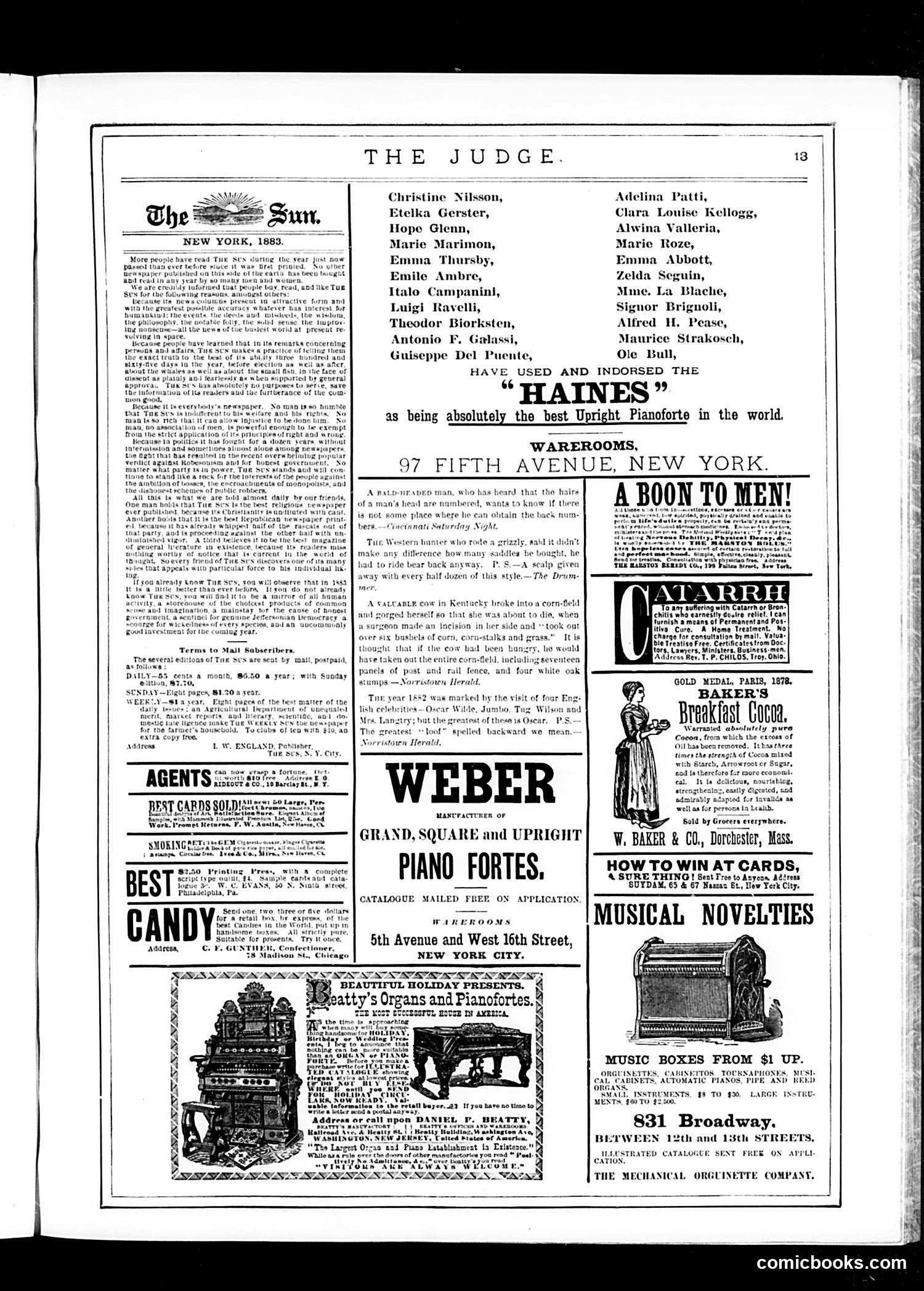
This page is primarily **advertising**, not political satire. It features a list of prominent opera singers and musicians of the era (Adelina Patti, Christine Nilsson, etc.) endorsing Haines pianos as "absolutely the best Upright Pianoforte in the world." The remainder consists of **commercial advertisements** for musical instruments (Weber and Haines pianos), Baker's Breakfast Cocoa, music boxes, and miscellaneous services. There are also brief humorous **anecdotes** in the margins (about a bald man, a Kentucky cow, a grizzly-riding hunter) typical of *Judge's* filler content. **No identifiable political cartoon or satirical commentary appears on this page.** It serves primarily as a revenue-generating advertising vehicle for music-related businesses and consumer products of the 1880s.
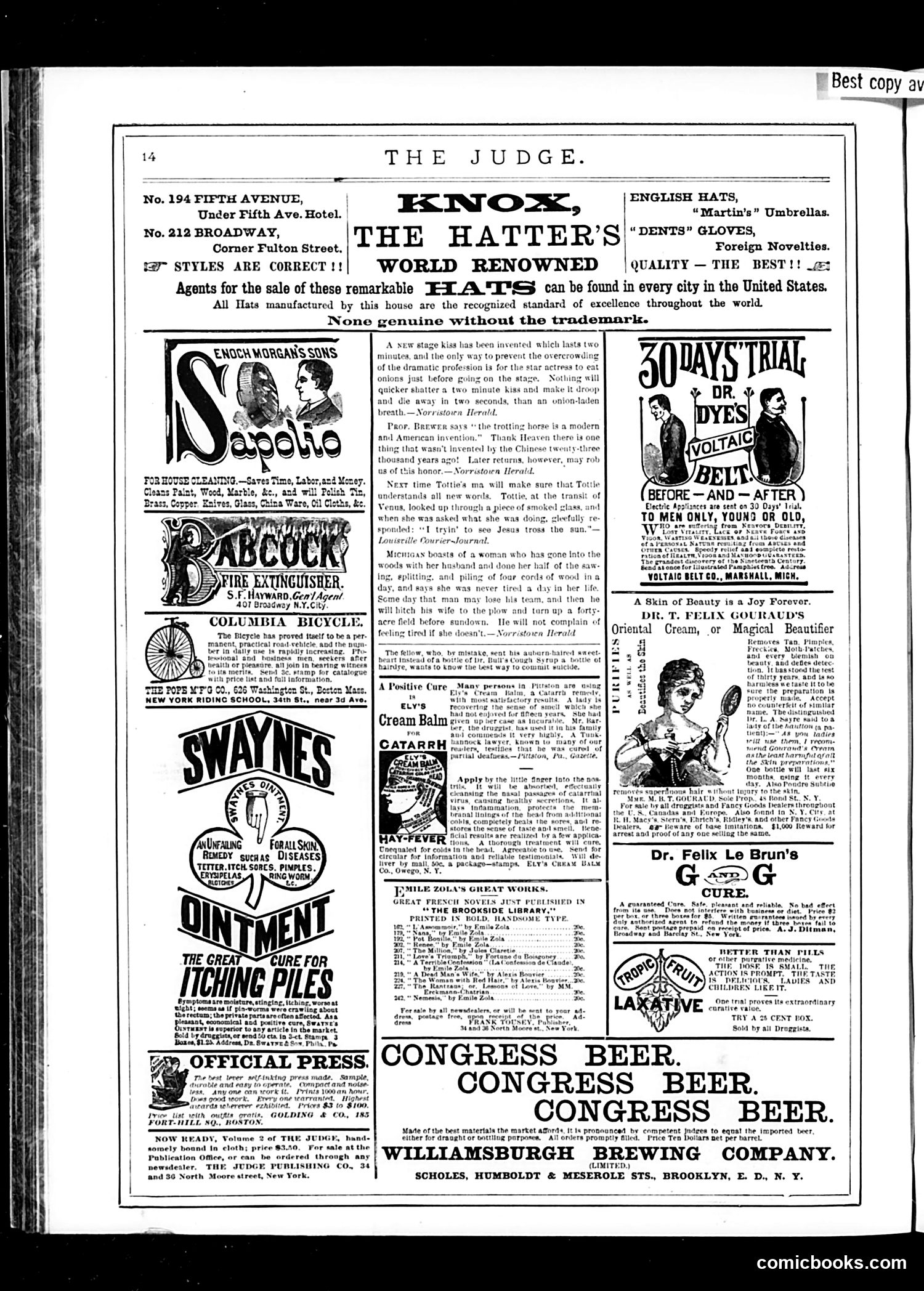
This page is primarily **advertising**, not satirical content. It showcases patent medicines, commercial products, and services typical of late 19th-century American business. **Key advertisements include:** - **Knox Hats**: Prominently featured as "The Hatter's World Renowned" product, emphasizing their trademark quality - **Swayne's Ointment**: A "cure for itching piles" (hemorrhoids)—a common patent medicine claim - **Dr. Gouraud's Cream**: A skin beautifier promising complexion improvement - **Voltaic Belt**: A quack medical device claiming to cure ailments through electrical stimulation - **Congress Beer**: Multiple advertisements for Williamsburgh Brewing Company **The Voltaic Belt advertisement** is particularly notable—these electromagnetic devices were heavily marketed as medical cure-alls despite lacking scientific validity. **Social context**: This reflects an era of unregulated patent medicines and dubious health claims, before the FDA existed to police false advertising. The page reveals what contemporary audiences considered acceptable marketing, even by today's standards of medical and consumer fraud.
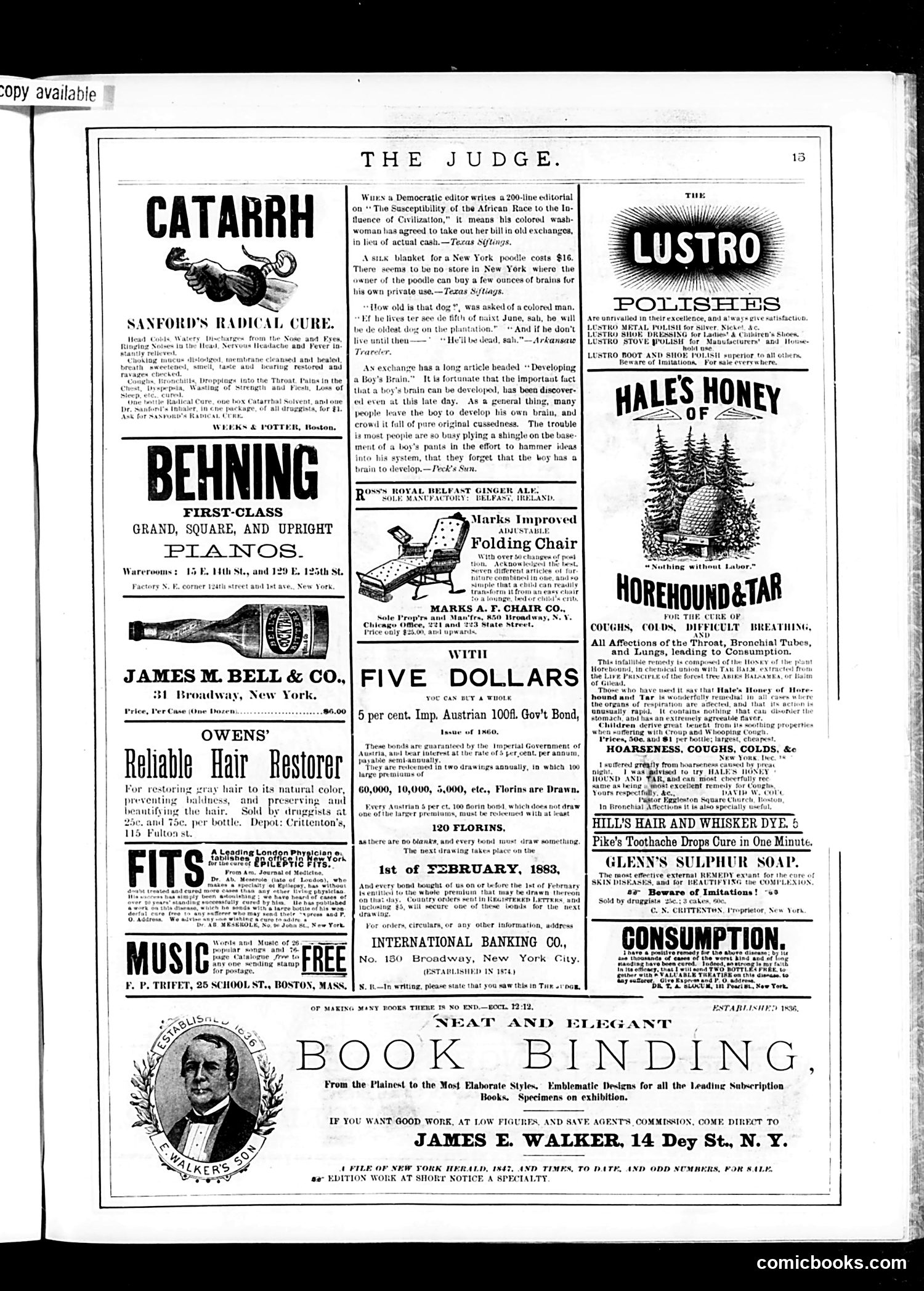
This page is primarily **advertising**, typical of 19th-century magazines. However, it opens with several satirical "items" under "THE JUDGE" masthead—short jokes about American society. The jokes target: 1. **Democratic politicians' hypocrisy**: A editor writes grandiose editorials about "African Race" civilization while his Black washerwoman accepts old newspapers instead of payment—satirizing hollow political rhetoric masking economic exploitation. 2. **Wealthy absurdity**: New Yorkers spend $16 on dog blankets but won't invest in their own education ("brains"). 3. **Race and age**: A crude joke about a "colored man" and a dog's age, reflecting period racism. 4. **Parenting**: Adults fail to develop children's intellect, yet complain about youth's ignorance. The remaining content is **patent medicines and services advertising** (hair restorer, pianos, book binding)—a window into 1880s consumer culture and the prevalence of dubious medical claims that Judge and similar publications satirized elsewhere. **No specific political cartoon is visible**—this is primarily a text and advertisement page.
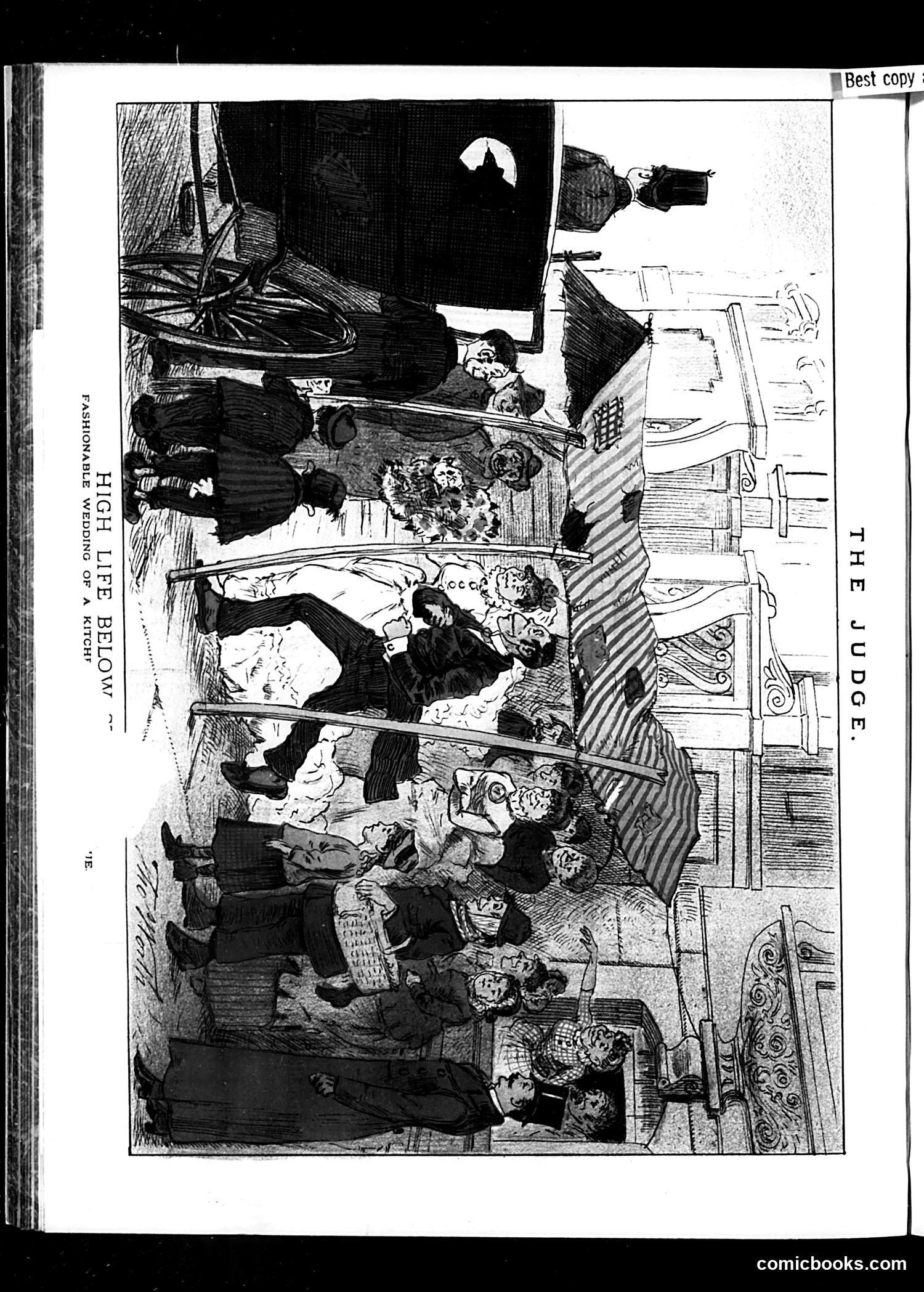
This appears to be a satirical illustration titled "HIGH LIFE BELOW" (visible on the left margin), likely from Judge magazine's late 19th or early 20th century period. The cartoon depicts a crowded, chaotic courtroom or legal proceeding scene, shown from an overhead perspective. Multiple figures in formal attire and period dress are depicted in various states of agitation or disorder around what appears to be a judge's bench or legal proceedings. The satire likely mocks the pretensions of "high society" or the judicial system by portraying dignified legal proceedings as actually disorganized and undignified "below" the surface—a common Judge magazine theme critiquing hypocrisy among the wealthy and powerful. The specific political or legal case referenced is unclear from the visible text, which appears OCR-corrupted.