
A complete issue · 16 pages · 1882
Judge — December 30, 1882
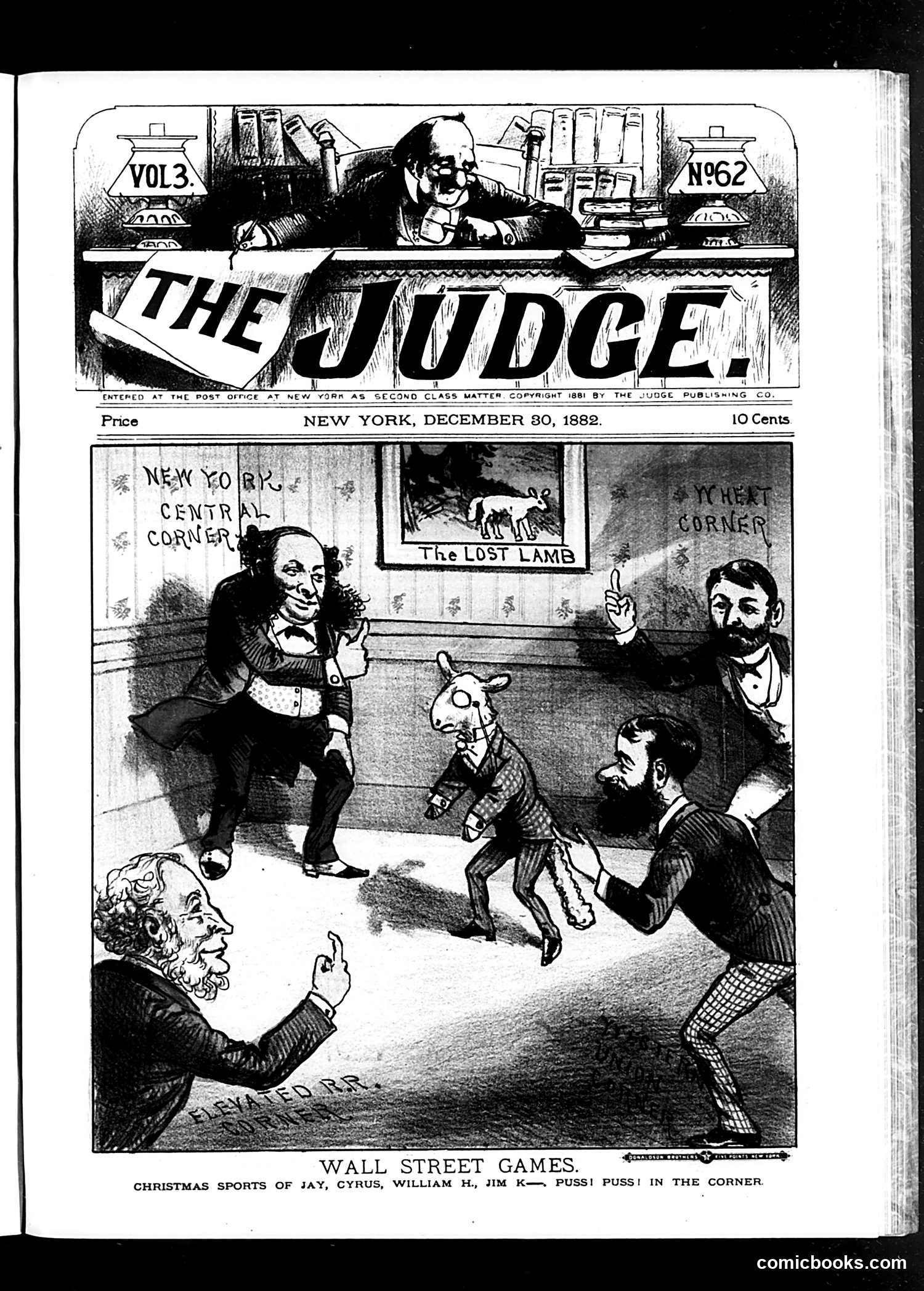
This political cartoon satirizes financial manipulation on Wall Street during the Gilded Age. The caption identifies the figures as "Jay, Cyrus, William H., Jim K.—Puss! Puss!" playing "Christmas sports." The cartoon depicts wealthy financiers depicted with exaggerated features, apparently engaged in a game involving a lamb (labeled "The Lost Lamb")—likely representing the common investor or public being victimized. The men are shown in a New York street corner setting, treating serious financial dealings as if they were casual street games. The satire criticizes how Wall Street elites treated markets like entertainment, manipulating securities and exploiting ordinary citizens for sport. The "lost lamb" metaphor emphasizes how innocent investors were separated from their money by these powerful speculators.
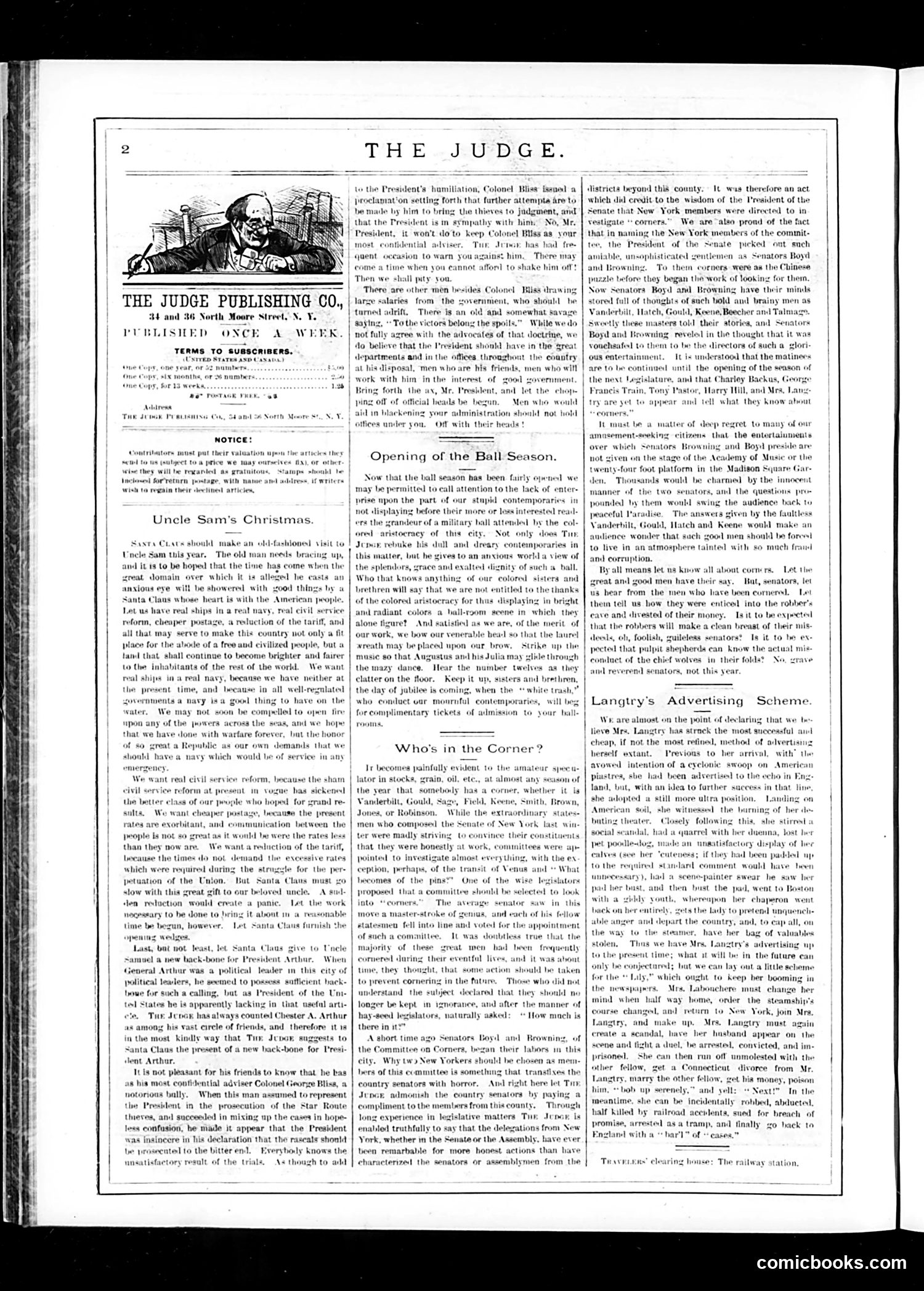
This page from *Judge* magazine contains several political commentaries on the Arthur administration (Chester A. Arthur was President 1881-1885). **"Uncle Sam's Christmas"** (main article) is a satirical wish-list for the nation, requesting that President Arthur provide: a real navy, civil service reform, postal rate reduction, and tariff reform. The tone is sarcastic—presented as gifts Santa should deliver to a struggling Uncle Sam. **The key attack concerns Colonel George Bliss**, Arthur's confidential adviser. *Judge* accuses Bliss of mismanaging the Star Route fraud prosecutions (a major scandal involving mail contractors). The article suggests Bliss deliberately bungled cases to protect the President, and demands Arthur remove him—sarcastically urging Santa to give Arthur a "new back-bone" to stand up to Bliss. The satire's point: Arthur is weak, controlled by a corrupt adviser, and failing to deliver needed reforms. The magazine uses Christmas-gift language to shame the President into action.
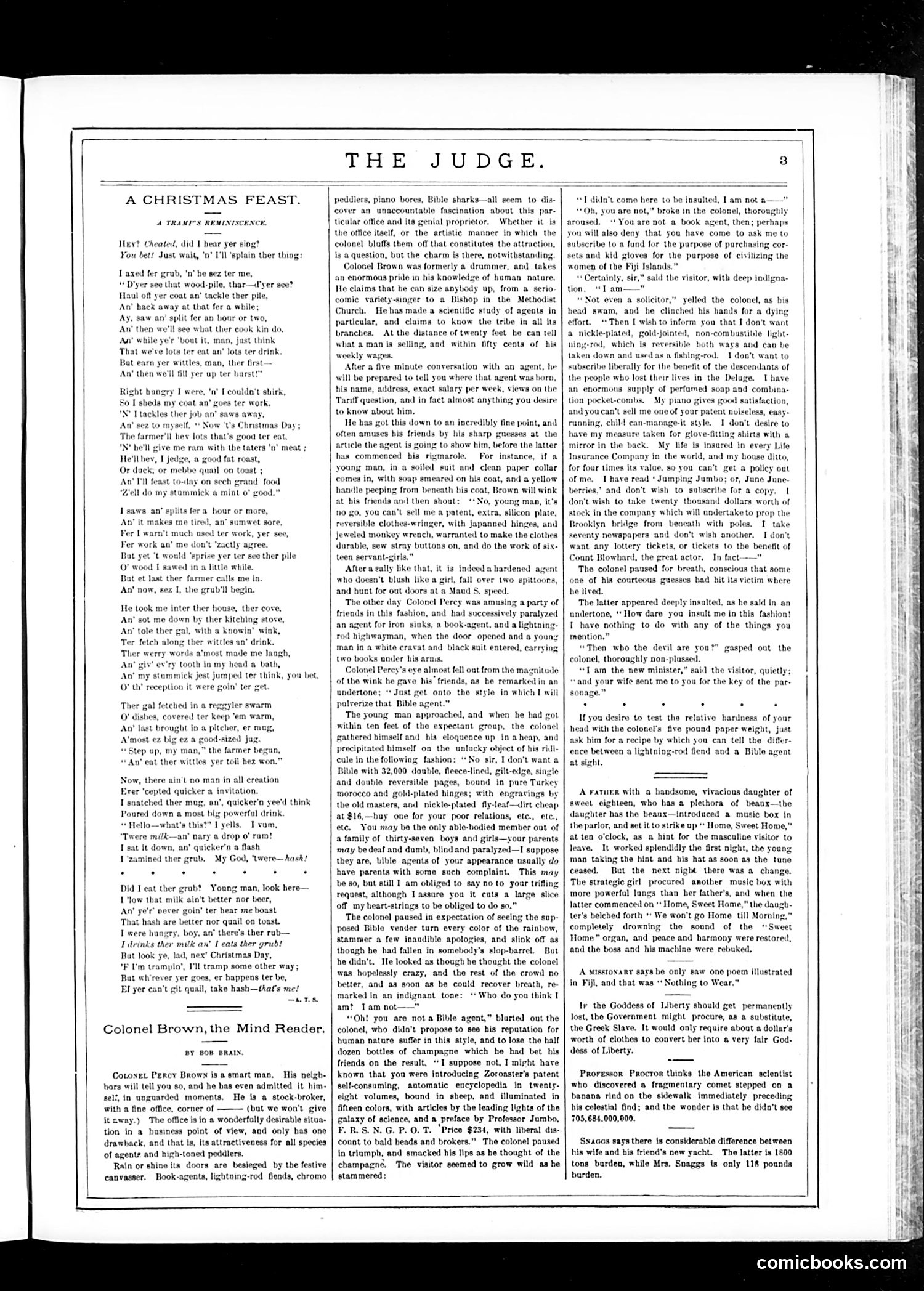
This page contains two satirical pieces from *Judge* magazine: **"A Christmas Feast"** (left column): A dialect-heavy monologue from a tramp who, after being forced to chop wood as payment for a meal, expects a lavish Christmas dinner. The joke: he receives only milk and hash—humble, disappointing food. The satire mocks both the tramp's entitled expectations and perhaps critiques the stingy treatment of laborers disguised as "charity." **"Colonel Brown, the Mind Reader"** (right): A brief introduction to a character—Colonel Percy Brown, a smart stock-broker whose office is constantly besieged by aggressive door-to-door salesmen (book agents, lightning-rod peddlers, etc.). The satire appears to target both Brown's pretentious claims about reading human nature and the era's relentless commercial hustlers who prey on businessmen. Both pieces use exaggerated dialect and social types typical of *Judge's* late-19th-century humor.
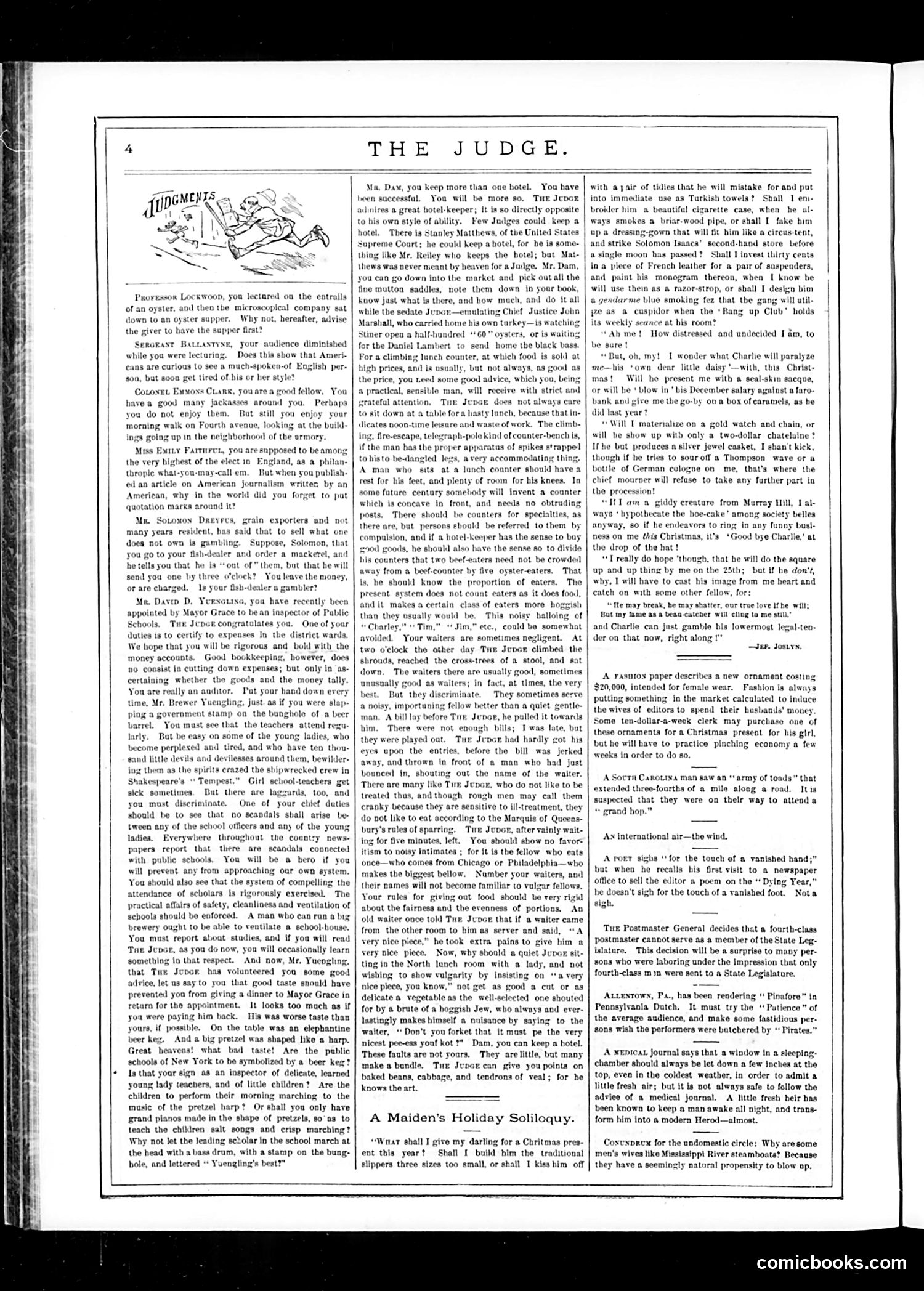
This page from Judge magazine contains editorial commentary addressing various public figures and recent appointments in New York City. The main cartoon (top left, labeled "JUDGMENTS") appears to satirize someone's lecturing style or public presentation, though the specific figure is unclear from the image. The bulk of the page consists of pointed remarks to notable individuals: Professor Lockwood (about oyster lectures), Sergeant Ballantine (on audience attention), Colonel Emmons Clark, Miss Emily Faithful (criticized for plagiarism in an article on American journalism), Mr. Sidney Dreveus (on commodity trading), and most extensively, Mr. David D. Yoe regarding his new appointment as a Public School Inspector. The Yoe section is particularly scathing, advising him on proper auditing while mocking a dinner he gave Mayor Grace—and sarcastically criticizing the event's decorations (beer kegs and pretzel harps) as inappropriate symbols for school administration. The satire targets bureaucratic incompetence, impropriety, and poor taste among the city's public servants.
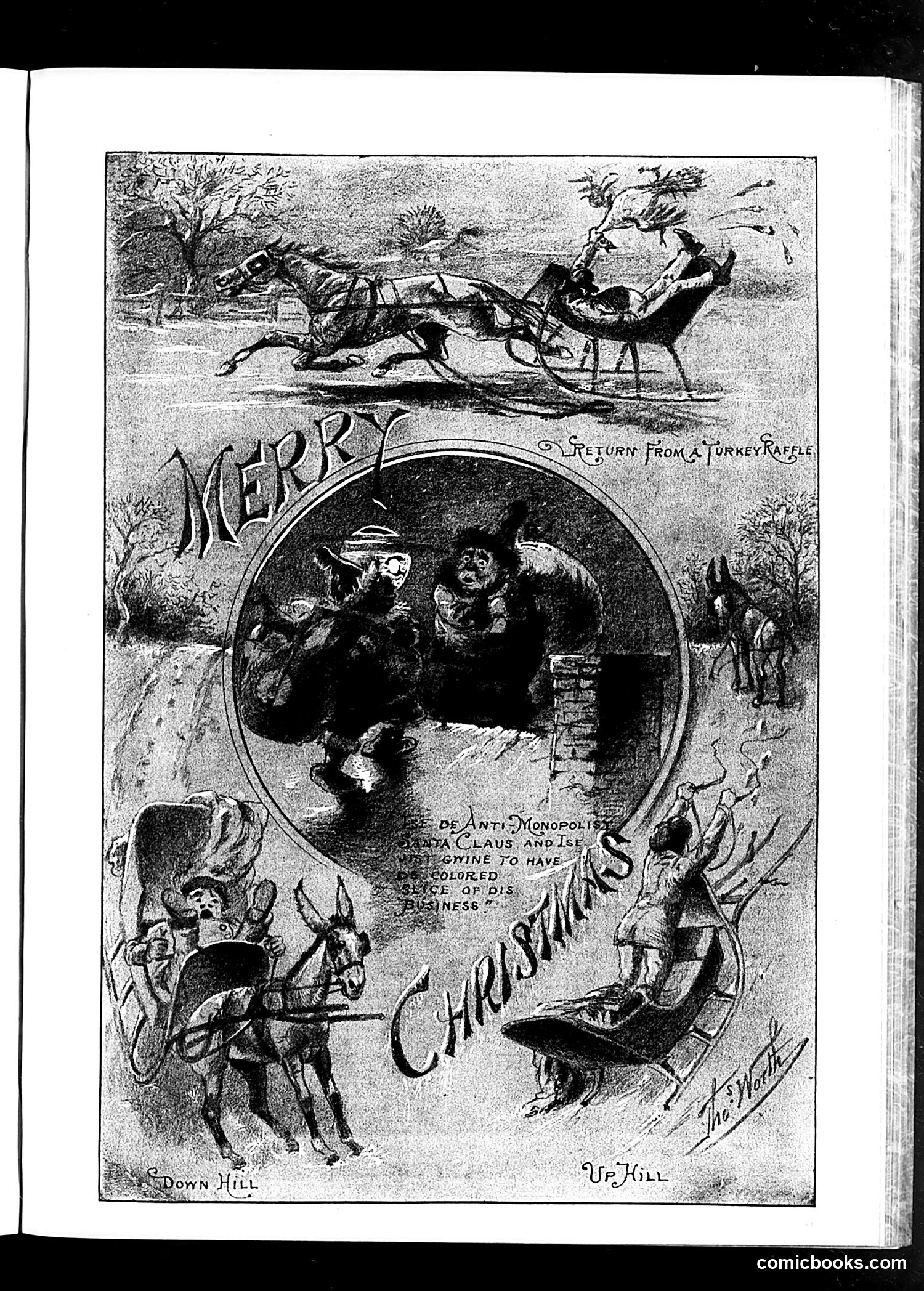
This satirical illustration depicts Santa Claus and his elf as monopolists attempting to corner the toy market. The central circular panel shows them scheming about maintaining exclusive control of Christmas business. The surrounding vignettes illustrate the consequences: children experiencing disappointment "Down Hill" and "Up Hill" as they receive inferior goods, while competitors are driven out. The satire targets **anti-competitive monopoly practices**—specifically criticizing how dominant businesses could manipulate supply and pricing to eliminate rivals and harm consumers. The "turkey raffle" reference at top suggests holiday commerce exploitation. This reflects Gilded Age concerns about monopolies like Standard Oil, using Santa as a symbol of holiday commercialization corrupting American values of fair competition and childhood joy.
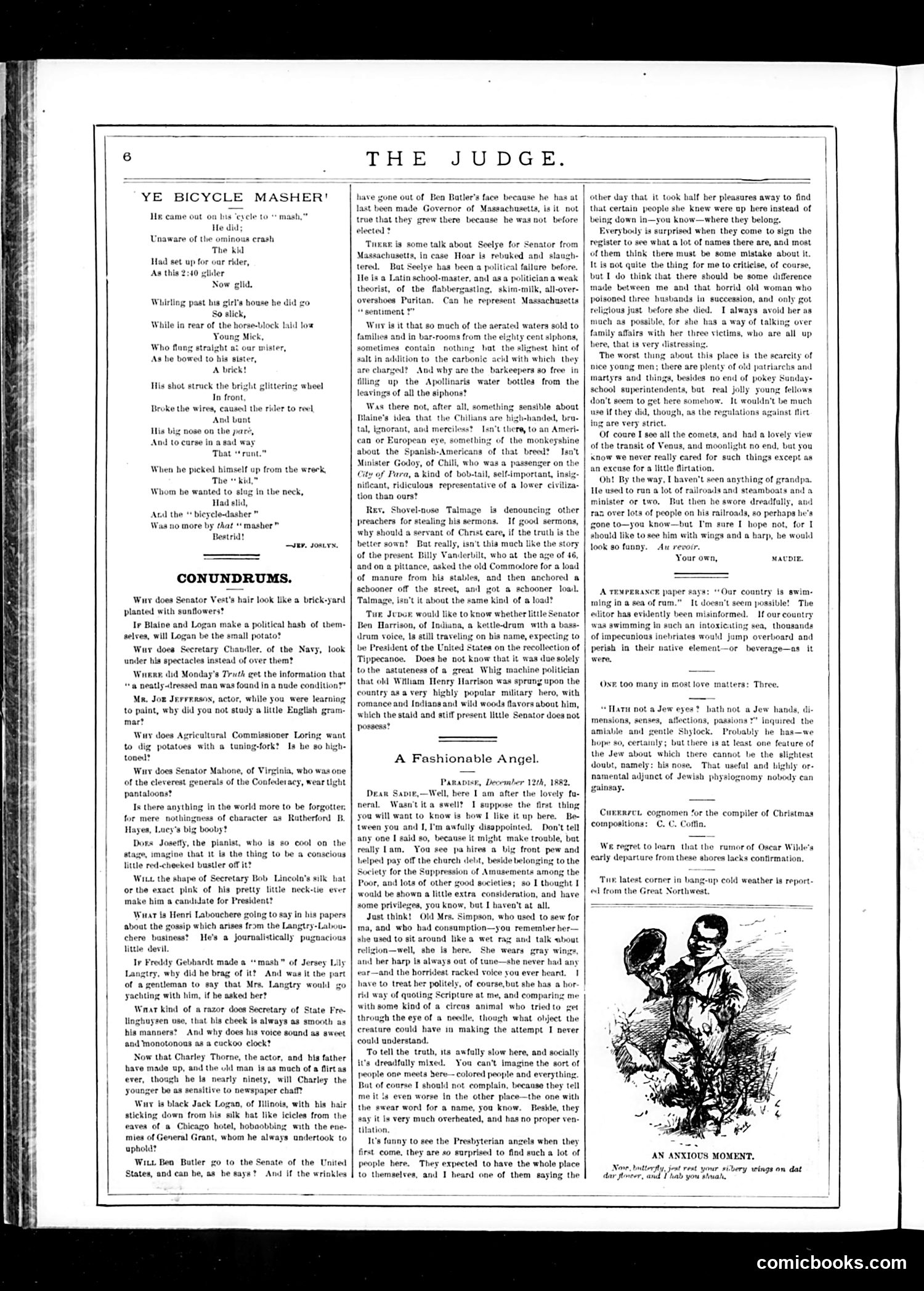
This page from the satirical magazine *Judge* contains political mockery and humor typical of the Gilded Age. ## Main Cartoon: "Ye Bicycle Masher" A poem-cartoon mocking a young man showing off on his bicycle to impress a girl. A street urchin named Mick sets a brick trap; when the "masher" (ladies' man) passes, the brick hits him, causing him to crash spectacularly—a comeuppance for his vanity. ## "Conundrums" Section Rapid-fire satirical riddles targeting prominent figures: Senator Vest, Blaine, Logan, Secretary Chandler, Secretary Loring, Senator Mahone, General Ben Butler, and others. The jokes mock their appearance, political failures, hypocrisy, or personal quirks—typical *Judge* fare attacking Republican politicians and public figures of the era. **Bottom section** references actress Lillie Langtry's scandals and the "Langtry-Labouchere business." The overall tone is crude, gossipy, and politically barbed—representative of American political satire in this period.
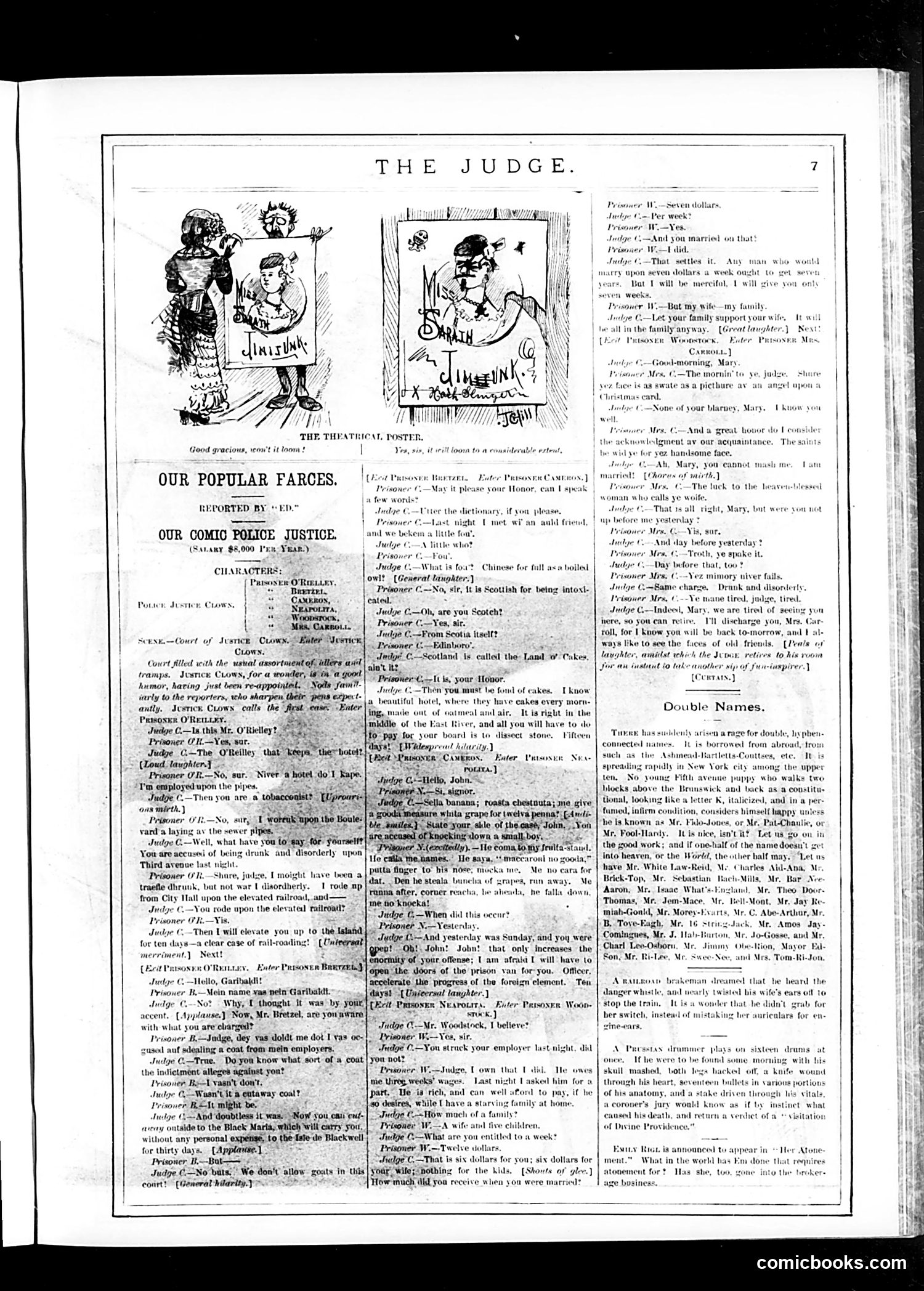
This page satirizes corrupt or incompetent American urban courts through farcical dialogues between a comical Judge Clowns and various prisoners. The humor targets: **The figures:** Working-class immigrants and laborers—an Irish pipe-worker (O'Reilley), a German immigrant (Bretzel), Scottish drunk, and Italian street vendor (Giovanni)—each portrayed with exaggerated ethnic accents and stereotypes. **The satire:** The judge dispenses absurd, punitive sentences for trivial offenses (public drunkenness, alleged theft), using wordplay that trivializes serious charges. The "elevated railroad" pun leading to sentencing exemplifies how justice becomes theater rather than fairness. **Social commentary:** The piece mocks both the judicial system's ineffectiveness and reflects period xenophobia toward immigrant populations, presenting them as criminals or buffoons. The exaggerated ethnic caricatures and broken English reinforce contemporary prejudices while using immigrants as convenient comic targets for critiquing urban corruption.
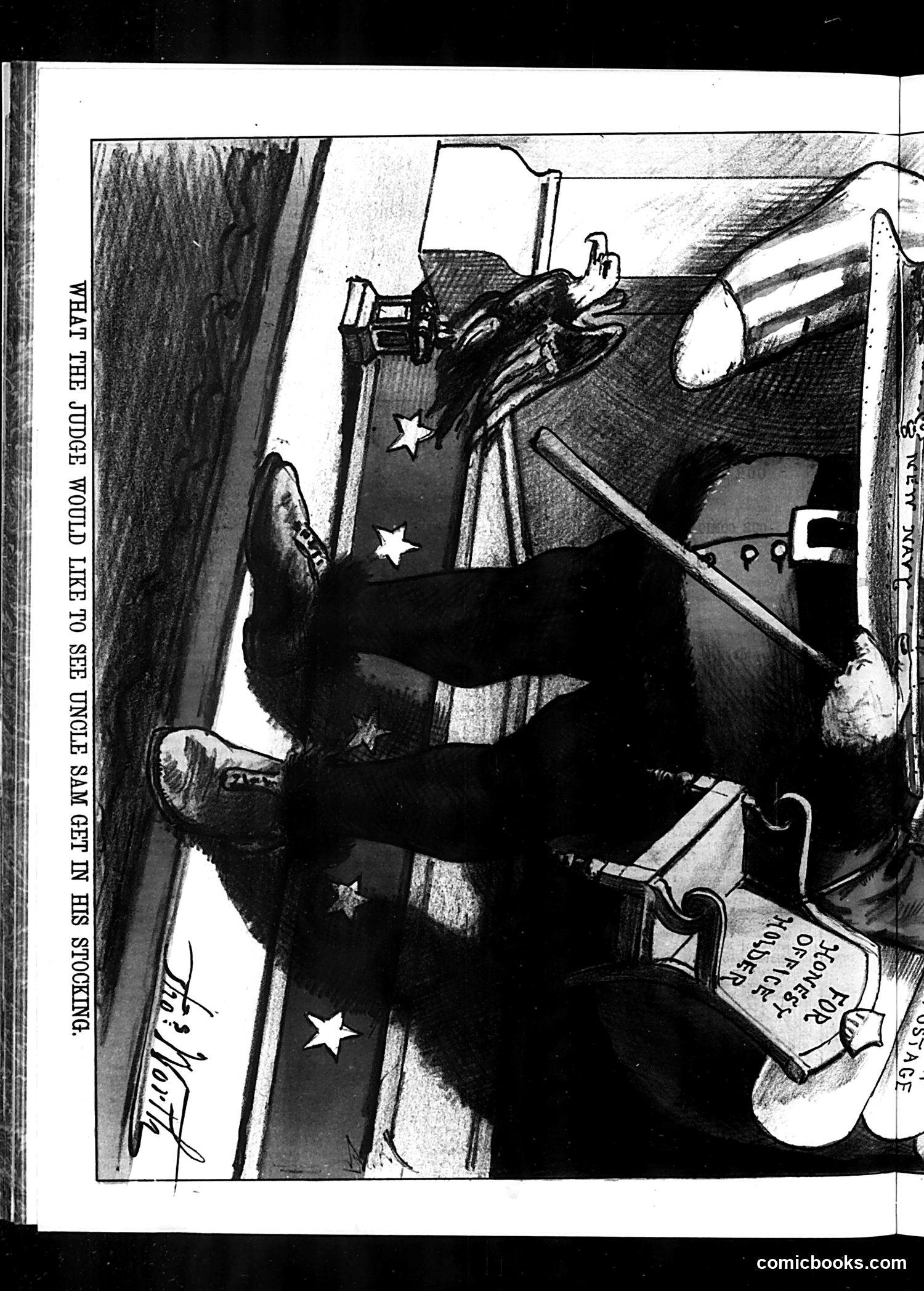
This appears to be a political cartoon from *Judge* magazine. The image shows a figure in Uncle Sam attire (identifiable by the stars-and-stripes clothing and top hat) reclining or collapsing. The vertical text alongside reads: "WILL THE DOOR 'WOULD LIKE TO SEE UNCLE SAM GET IN HIS SLUMBERS" (text is rotated and partially unclear). The cartoon likely satirizes American foreign policy or political decision-making during a period when the U.S. was expected to take action internationally. The depiction of Uncle Sam sleeping or incapacitated suggests criticism that American leadership was inactive, negligent, or avoiding responsibilities. Without the publication date visible, the specific political context remains unclear, but the satire targets perceived American passivity or isolationism during a moment when intervention was arguably needed.
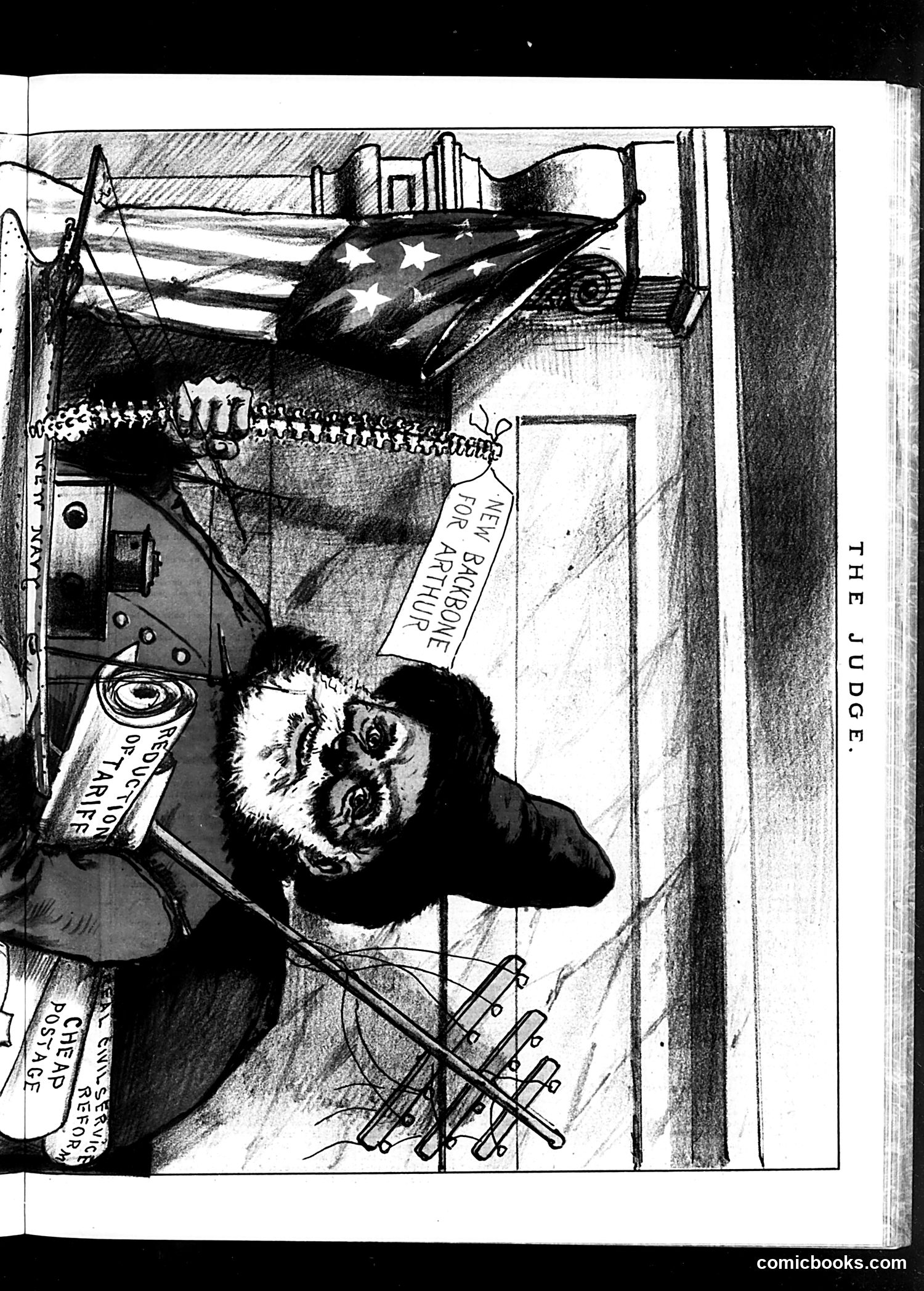
This page appears to be rotated 90 degrees in the scan. When properly oriented, it shows a political cartoon titled "THE JUDGE" featuring a caricatured figure (likely a political or public figure of the era) operating what appears to be machinery or controls. The cartoon includes visible labels referencing "BARBED WIRE" and "ARTHUR," suggesting commentary on either military/industrial policy or a specific political figure named Arthur—possibly President Chester Arthur or another contemporary politician. The American flag visible in the composition and the industrial imagery suggest this satirizes American political leadership or policy during the late 19th century. However, without clearer text legibility and confirmation of specific dates or figures, I cannot definitively identify the exact political situation being critiqued.
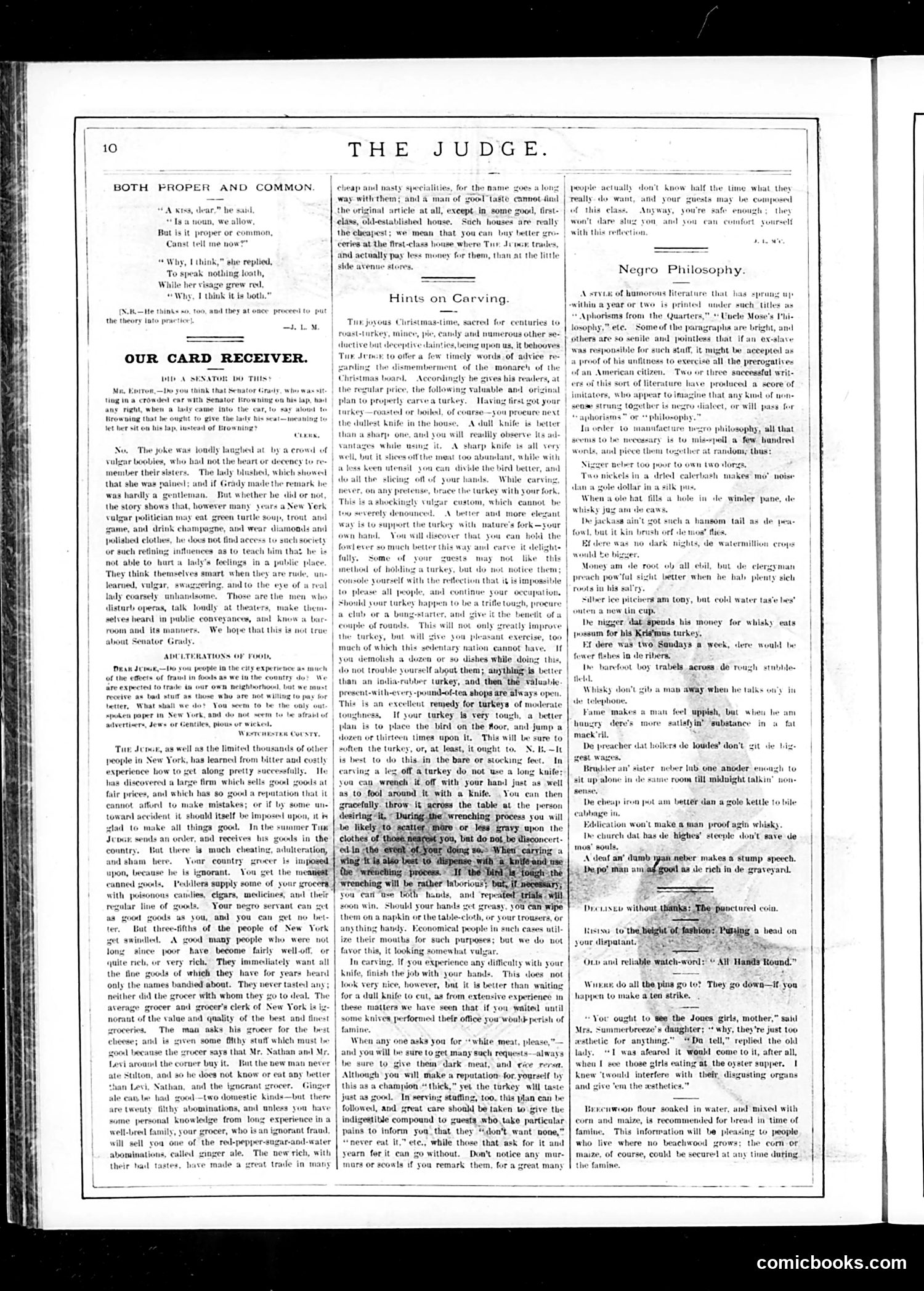
This page from Judge contains several separate satirical pieces typical of the magazine's format: **"Our Card Receiver"** mocks Senator Browning for allegedly failing to yield his seat to a lady in a crowded streetcar—a breach of Victorian gentility expected of politicians. The satire centers on the hypocrisy of a senator who presents himself as refined yet behaves rudely in public. **"Adulterations of Food"** criticizes food fraud and adulteration rampant in 1890s New York City. The piece warns that grocers deliberately sell inferior or contaminated goods (spoiled meat, diluted medicines) to unsuspecting customers, exploiting urban residents' ignorance and distance from actual food sources. It names "Levi" as a particularly fraudulent grocer. **"Hints on Carving"** offers tongue-in-cheek advice on properly carving Christmas turkey—seemingly earnest but likely mocking overly formal etiquette guides popular in the era. **"Negro Philosophy"** (the title references a recurring column) offers brief anecdotes and moral observations, though the specific content here is difficult to parse from the OCR text. The page reflects Judge's focus on urban corruption, class pretension, and consumer fraud.
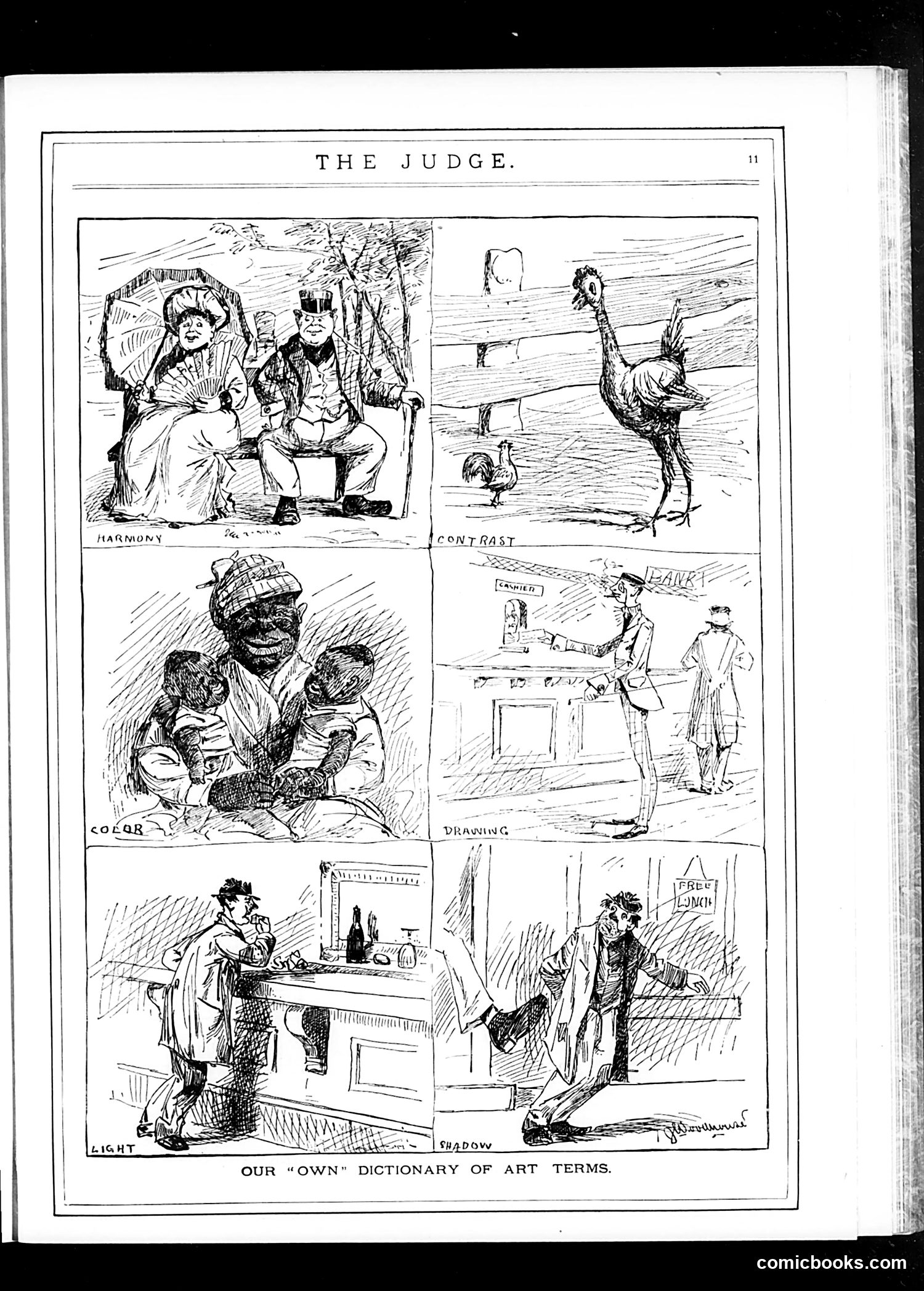
This page presents six satirical definitions of art terminology through comic sketches. Each panel illustrates an art concept with humorous, exaggerated interpretations: - **HARMONY**: A couple in elaborate dress sitting together - **CONTRAST**: Tall and short ostrich-like birds side by side - **COLOR**: A figure heavily bundled/wrapped - **DRAWING**: Two men at what appears to be a bank or counter - **LIGHT**: A figure at a bar or counter - **SHADOW**: A figure in a doorway The satire mocks pretentious art world jargon by offering absurdist, everyday interpretations rather than legitimate artistic definitions. Judge magazine's typical satirical approach ridicules both the obscurity of art criticism and the pretension of the artistic establishment, making their "own" dictionary that prioritizes humor over accuracy.
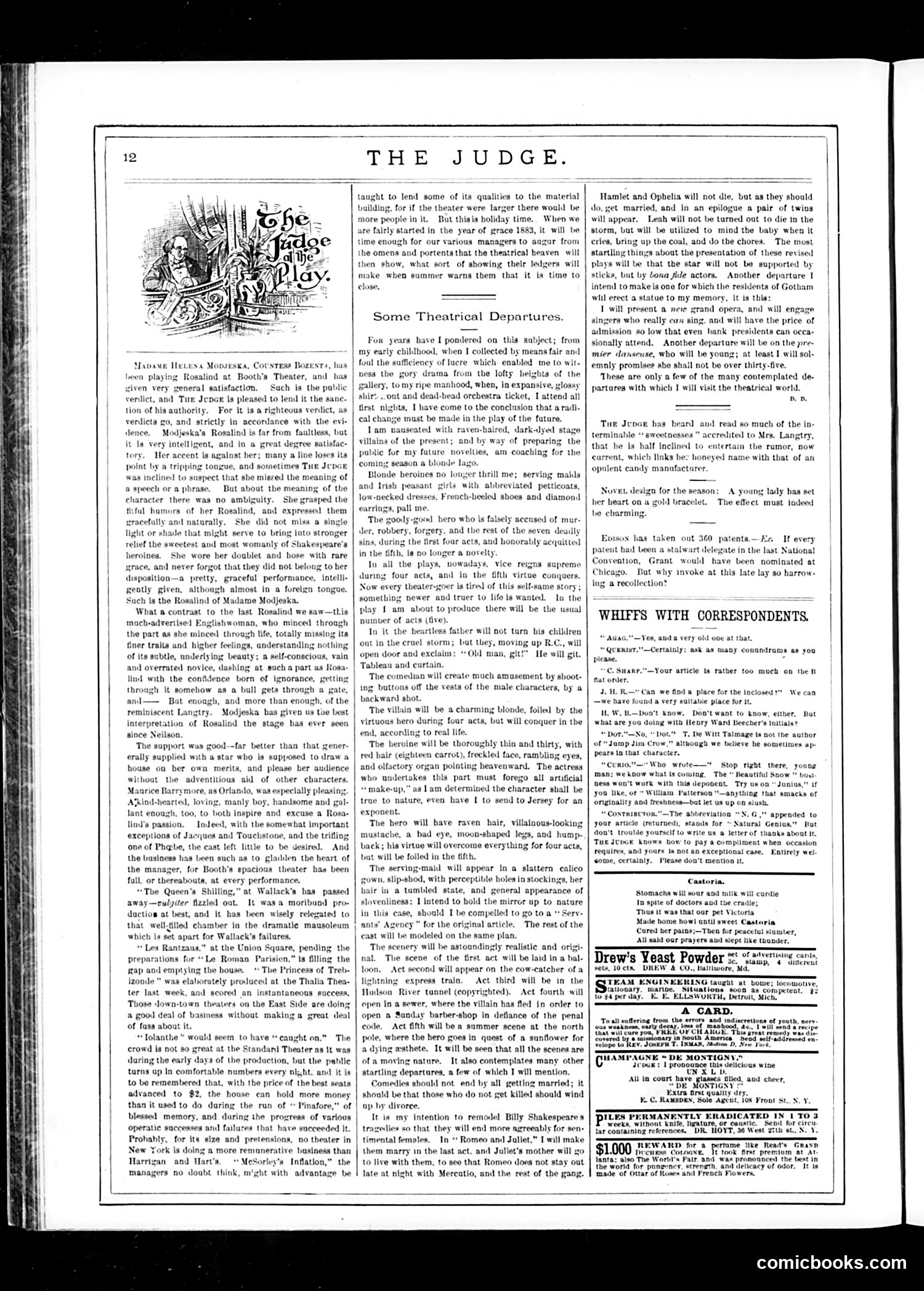
This page is primarily **theatrical criticism**, not political satire. It reviews recent Broadway productions, particularly praising actress **Modjeska's performance as Rosalind** in "As You Like It" at Booth's Theater. The main criticism targets an unnamed "much-advertised Englishwoman" (likely **Lillie Langtry**, a famous actress of the era) who previously played the same role. The critic mocks her as a vain novice who "minced through" the part with "confidence born of ignorance," contrasting her unfavorably with Modjeska's intelligent, nuanced interpretation. The piece also reviews other current productions: "The Queen's Shilling" at Wallack's (dismissed as a failure), "Les Rantzans," and downtown theater performances. **For modern readers**: This reflects Judge magazine's cultural coverage beyond politics—it functioned as a general entertainment and society publication, not exclusively political satire. The Langtry jab trades on her contemporary fame and reputation for superficiality.
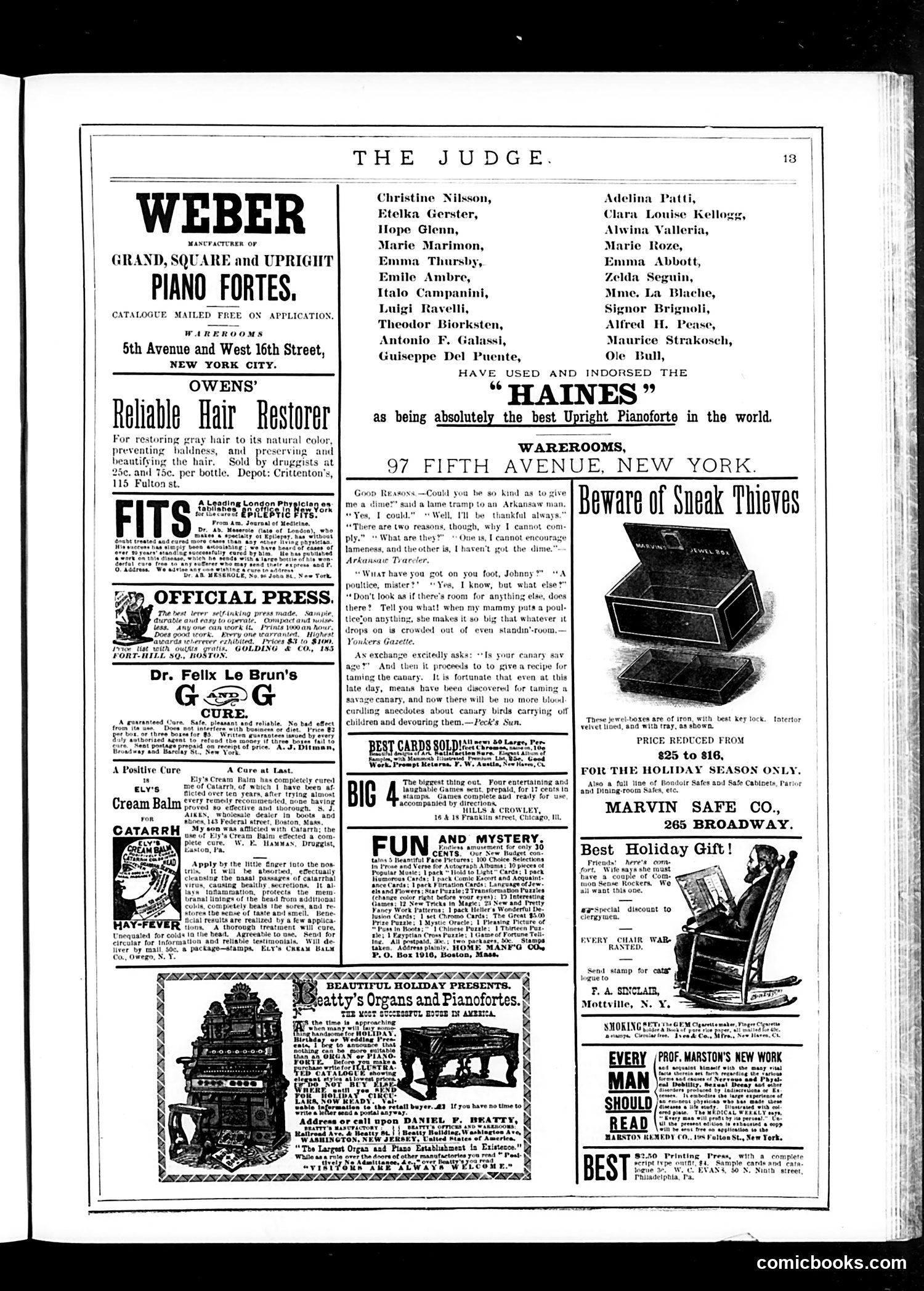
This page is primarily **advertising**, with minimal editorial content. The featured advertisements showcase high-end consumer goods marketed to wealthy Americans: pianos (Weber, Haines), a hair restorer, safes, and organs. The small editorial content visible includes brief comic exchanges: 1. **"Good Reasons"** - A dialogue between a tramp and an Arkansas farmer about giving assistance, apparently a joke about regional attitudes toward charity. 2. **"Canary Anecdote"** - A brief exchange about a canary, with a punchline involving a recipe, likely playing on period stereotypes about class or regional cooking practices (unclear without full text). These snippets represent typical Judge humor: short observational jokes about American social types and regional differences. The page reflects late-19th-century advertising practices targeting educated, affluent readers who could afford pianos and safes.
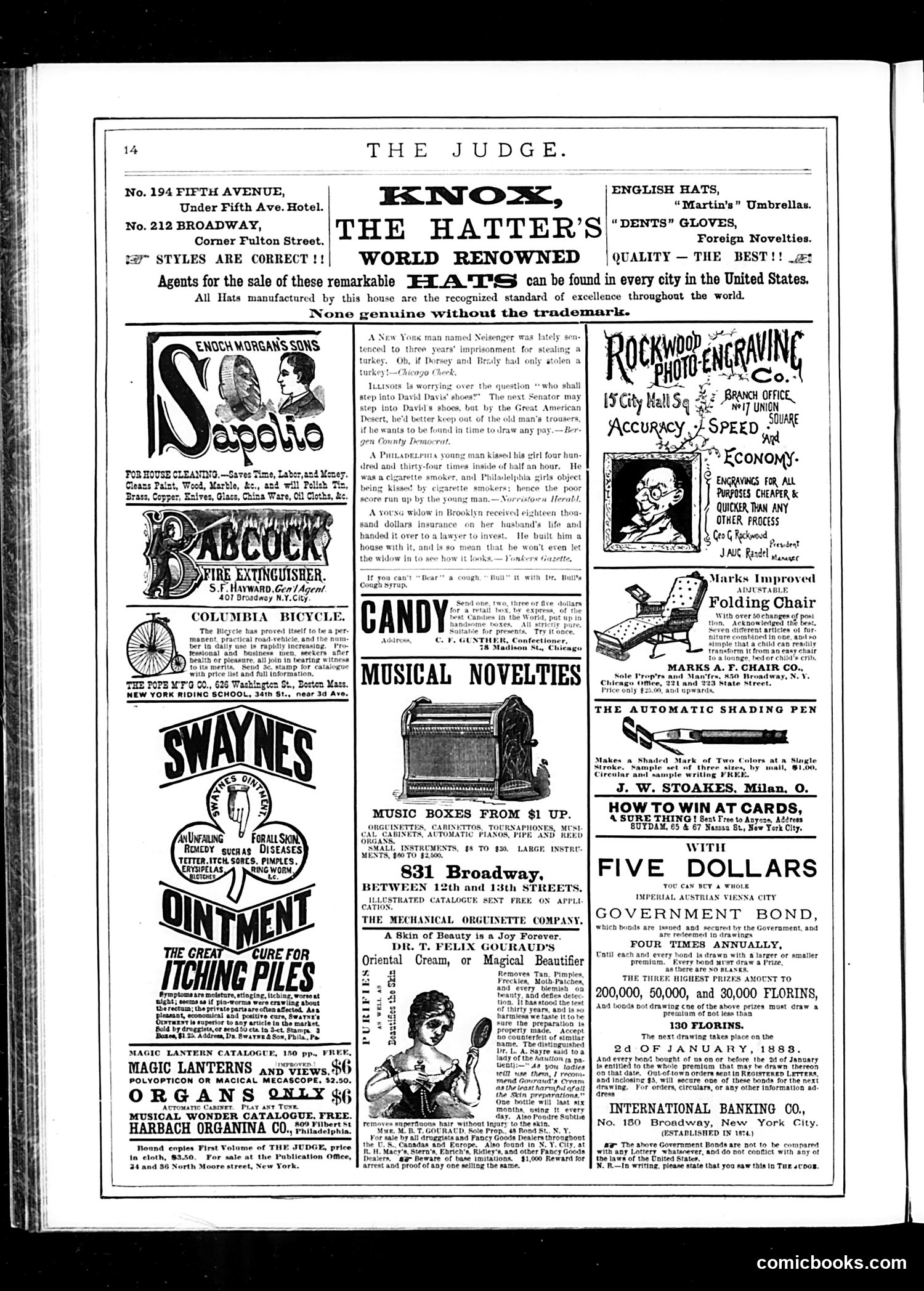
This is primarily a **advertisements page**, not a satirical cartoon page. Judge magazine's editorial content appears elsewhere; this page showcases commercial ads typical of 1880s American publications. **Key advertisements visible:** - **Knox Hats** (top): Prestigious hat manufacturer claiming "world renowned" status - **Soapine** (left): Cleaning product by Enoch Morgan's Sons - **Swaynes Ointment** (left): Patent medicine for hemorrhoids/piles—a common Victorian remedy advertised directly alongside disclaimers about effectiveness - **Dr. Gouraud's Oriental Cream** (center-right): Skin lightening/beauty cream exploiting racist beauty standards of the era - **Musical instruments and music boxes** (center): Various manufacturers - **Government bonds** (right): Advertisement for Austrian lottery bonds—a financial product targeting American investors **Notable for modern readers:** The prevalence of unregulated patent medicines, skin-whitening products, and foreign lottery schemes reflects an era with minimal consumer protection or truth-in-advertising laws. The casual juxtaposition of these products reveals period attitudes toward health claims and financial risk.
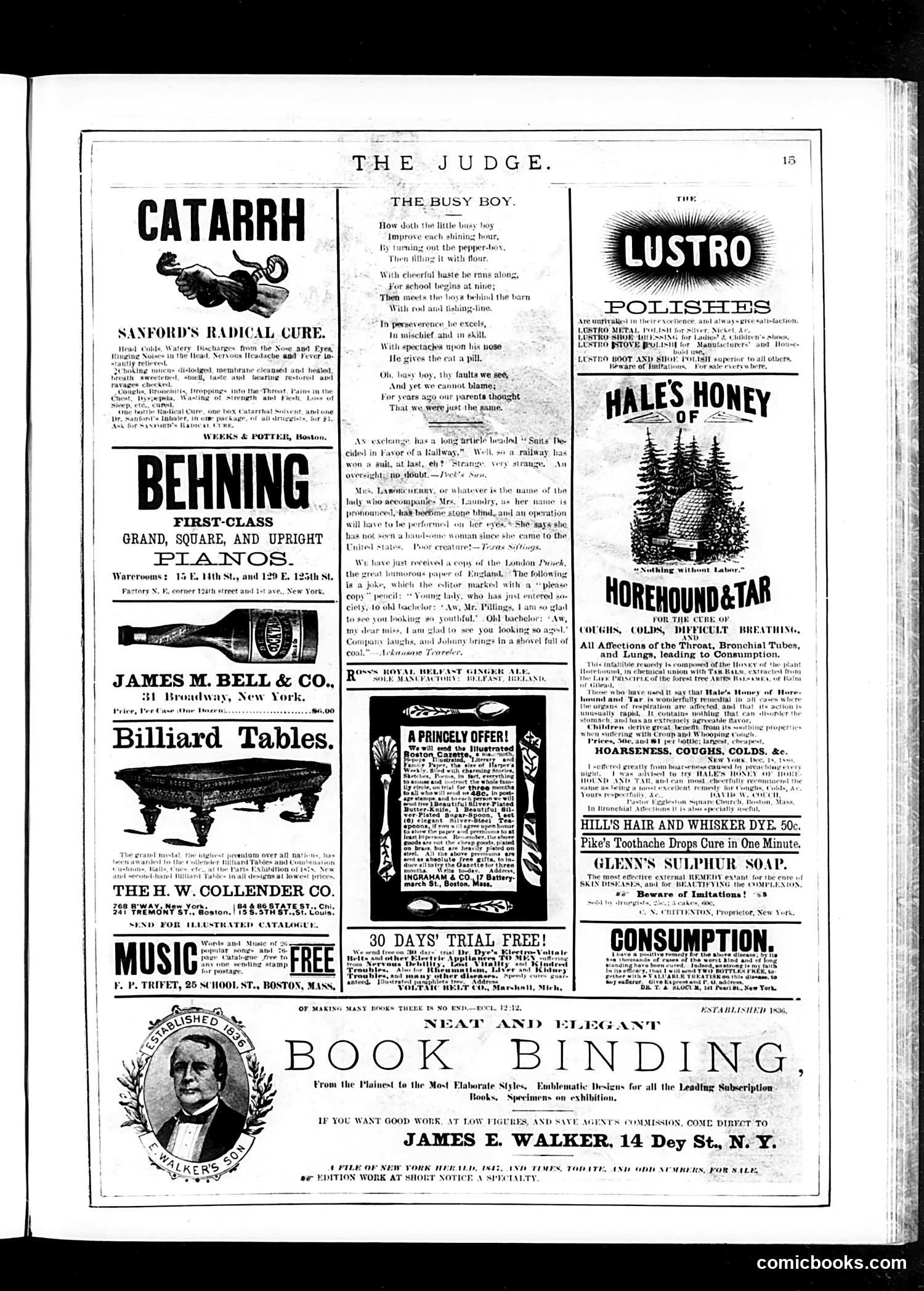
This page is primarily **advertising**, not political satire. It contains commercial advertisements typical of 1800s publications, including: - Patent medicines (Lustro Polish, Hale's Honey, Horehound & Tar, Hill's Hair Dye, Pike's Toothache Drops) promising miracle cures - Musical instruments and pianos - Billiard tables - Book binding services The only editorial content is **"The Busy Boy,"** a poem/cartoon about a schoolboy who works hard but gets into mischief ("spectacles upon his nose"). It's gentle moral humor about childhood, not political satire. The page reflects Judge's dual nature: a satirical magazine that sustained itself through extensive patent medicine advertising—which itself was often considered absurd by contemporaries for making exaggerated health claims. The juxtaposition of "respectable" editorial content with dubious medicinal ads might itself be subtly ironic.
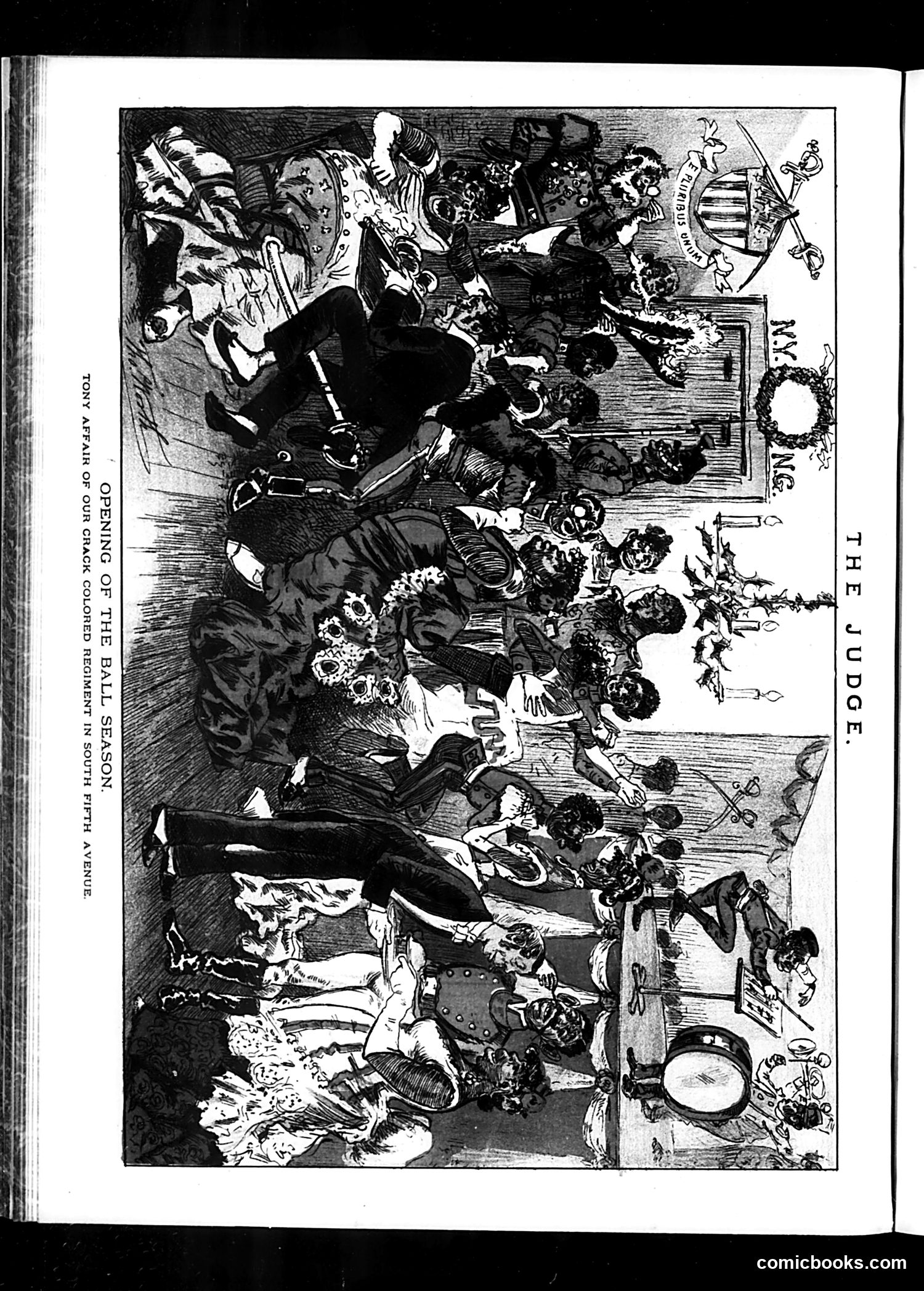
I cannot reliably read the OCR text provided—it appears corrupted or inverted. However, examining the image itself: this is "The Judge," a satirical engraving showing a crowded courtroom or legal proceeding. A central figure in judicial robes presides over numerous characters in 19th-century dress. The scene depicts social types and caricatures typical of Judge magazine's political satire. Without legible text identifying specific figures or the historical moment referenced, I cannot confidently explain which political event, scandal, or social issue this cartoon addresses. The composition suggests legal or governmental corruption being judged, but I cannot identify particular individuals or the specific context that would make the satire's point clear to a modern reader.