
A complete issue · 16 pages · 1882
Judge — December 23, 1882
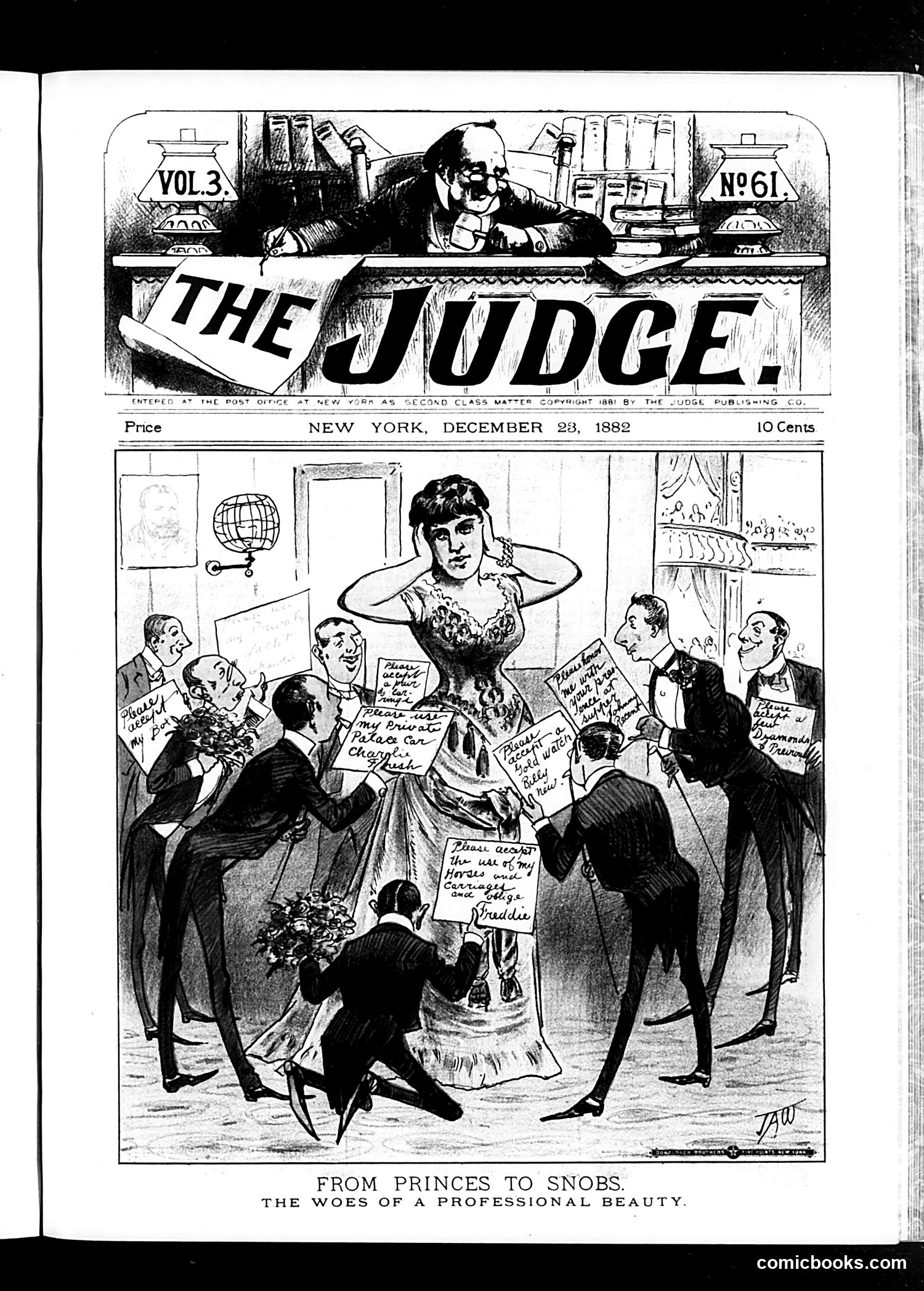
This December 1882 *Judge* cartoon satirizes the social plight of a "professional beauty"—a woman whose primary occupation is being publicly admired and sought-after. The central figure, an attractive woman, is surrounded by men holding request cards or notes, each making demands or propositions. The title's shift from "princes to snobs" suggests her desirability has declined from aristocratic admirers to lesser suitors. The cartoon mocks both the woman's precarious social position (dependent on her appearance and others' attention) and the men treating her as a commodity to be negotiated with. This reflects 1880s anxieties about changing gender roles and the commercialization of female beauty and companionship in urban society.
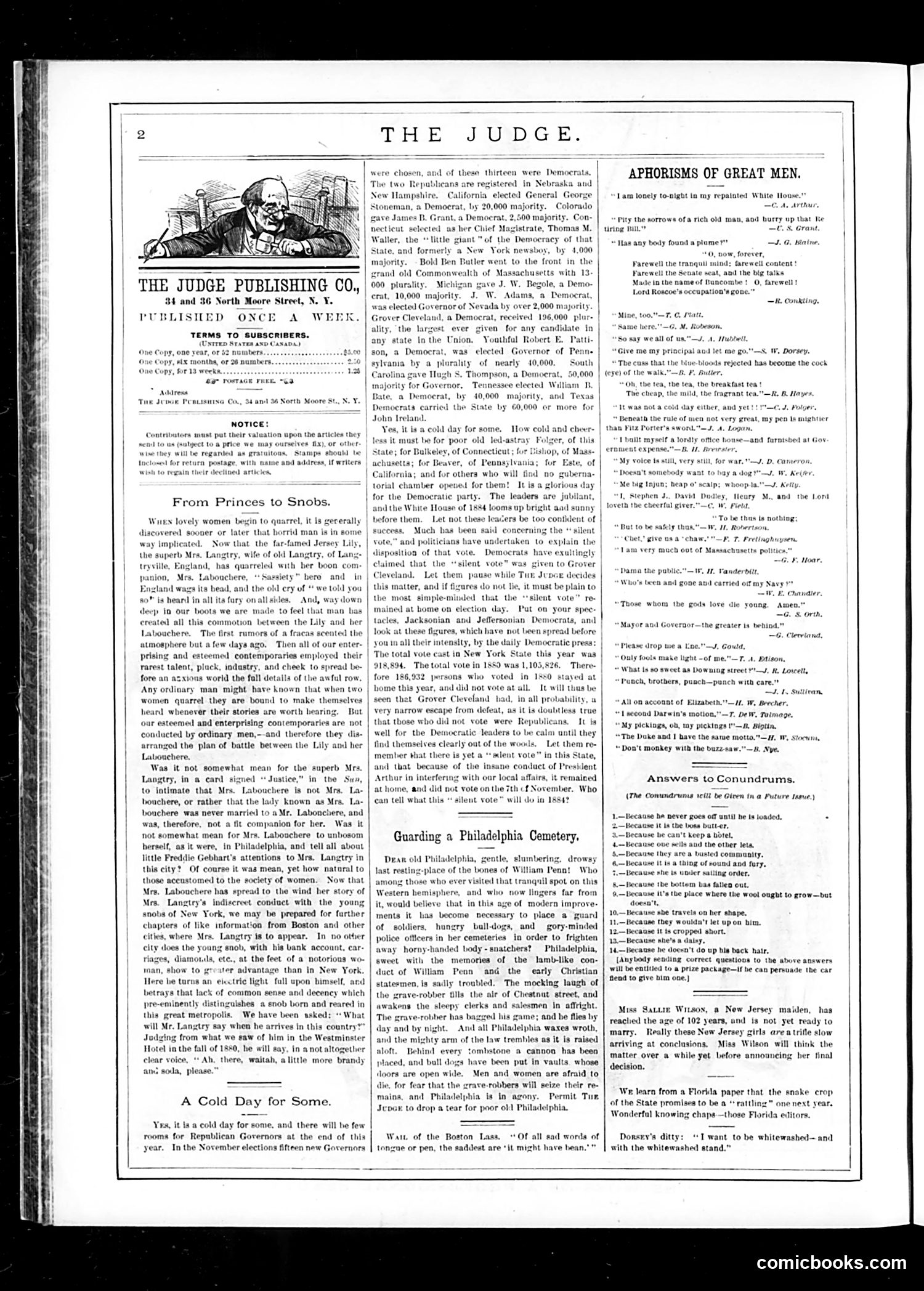
This page from *Judge* contains two main satirical articles. "From Princes to Snobs" mocks the public quarrel between society figures Lillie Langtry (the famous "Jersey Lily") and Mrs. Labouchere. The piece criticizes both women—Langtry for her indiscreet conduct with New York society men, and Labouchere for publicly airing gossip. It also ridicules New York's wealthy male "snobs" who fawn over Langtry. "A Cold Day for Some" discusses the 1882 midterm elections, where Democrats won numerous governorships. The article lists Democratic victories across multiple states, suggesting Republicans face difficult times ahead. The satire implies Republican prospects are grim—hence "cold." The illustration depicts a caricatured figure (likely representing political commentary), though specific identity is unclear from the image alone.
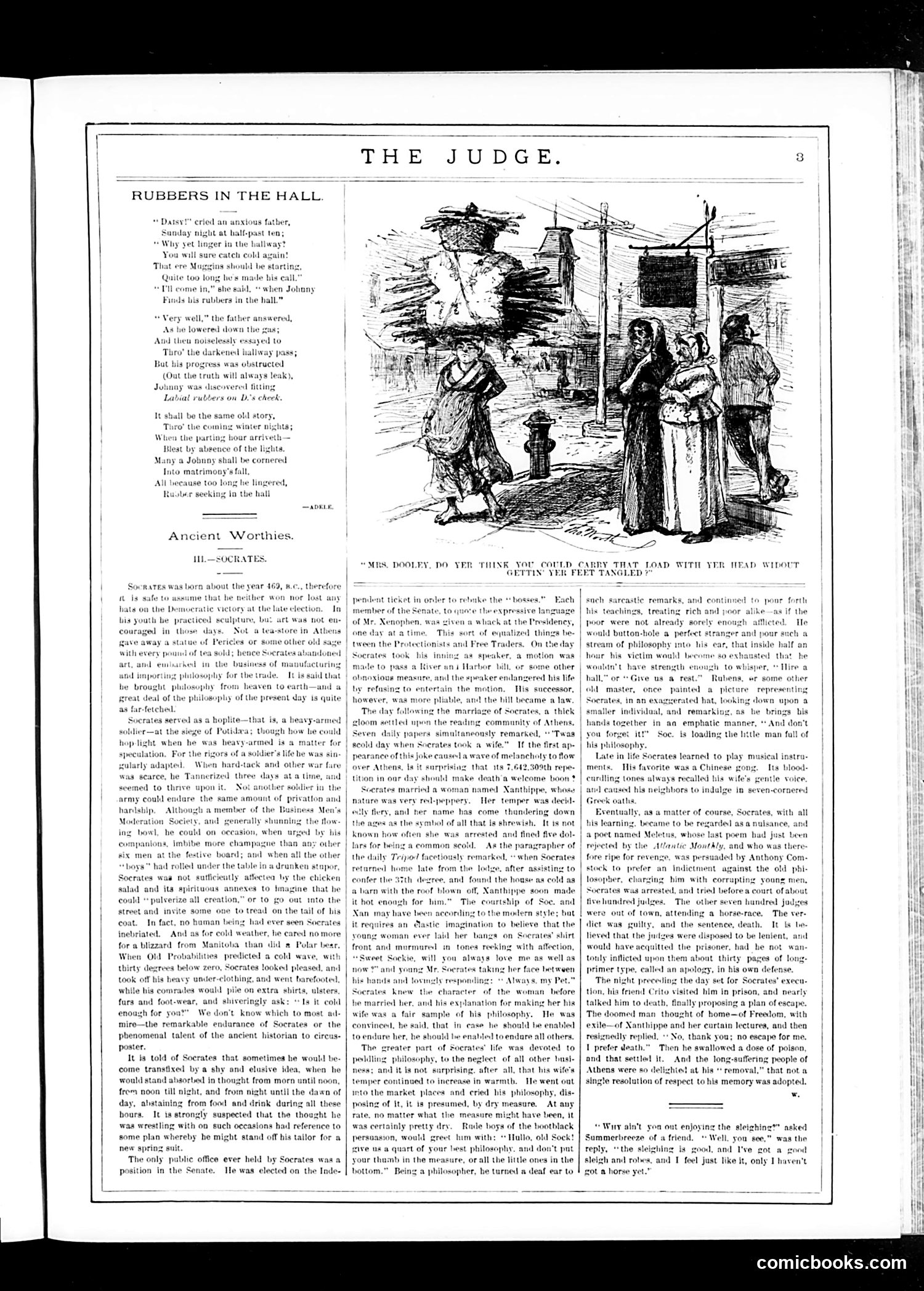
This *Judge* page contains two satirical pieces: **"Rubbers in the Hall"** (poem with illustration): A domestic comedy about a young man courting a daughter. The father declares she won't come downstairs until the suitor finds his galoshes ("rubbers") in the hallway—implying the visitor should leave. The joke's point: the father uses a practical excuse to end an overly-long courtship visit, while the son discovers the suitor kissing the daughter instead of searching for his shoes. The satire mocks both parental attempts to control courtship and young lovers' sneaky behavior. **"Ancient Worthies: Socrates"** (essay with humorous commentary): A lengthy satirical biographical piece comparing the ancient Greek philosopher to contemporary American politics and society. It draws parallels between Socrates' wife Xanthippe's difficult temperament and modern domestic life, his philosophical stubbornness and politicians' inflexibility, and his trial/execution to current political controversies. The piece uses classical history as a vehicle for mocking 1890s American society, politicians, and marital relations. Both pieces use humor to critique social conventions of their era.
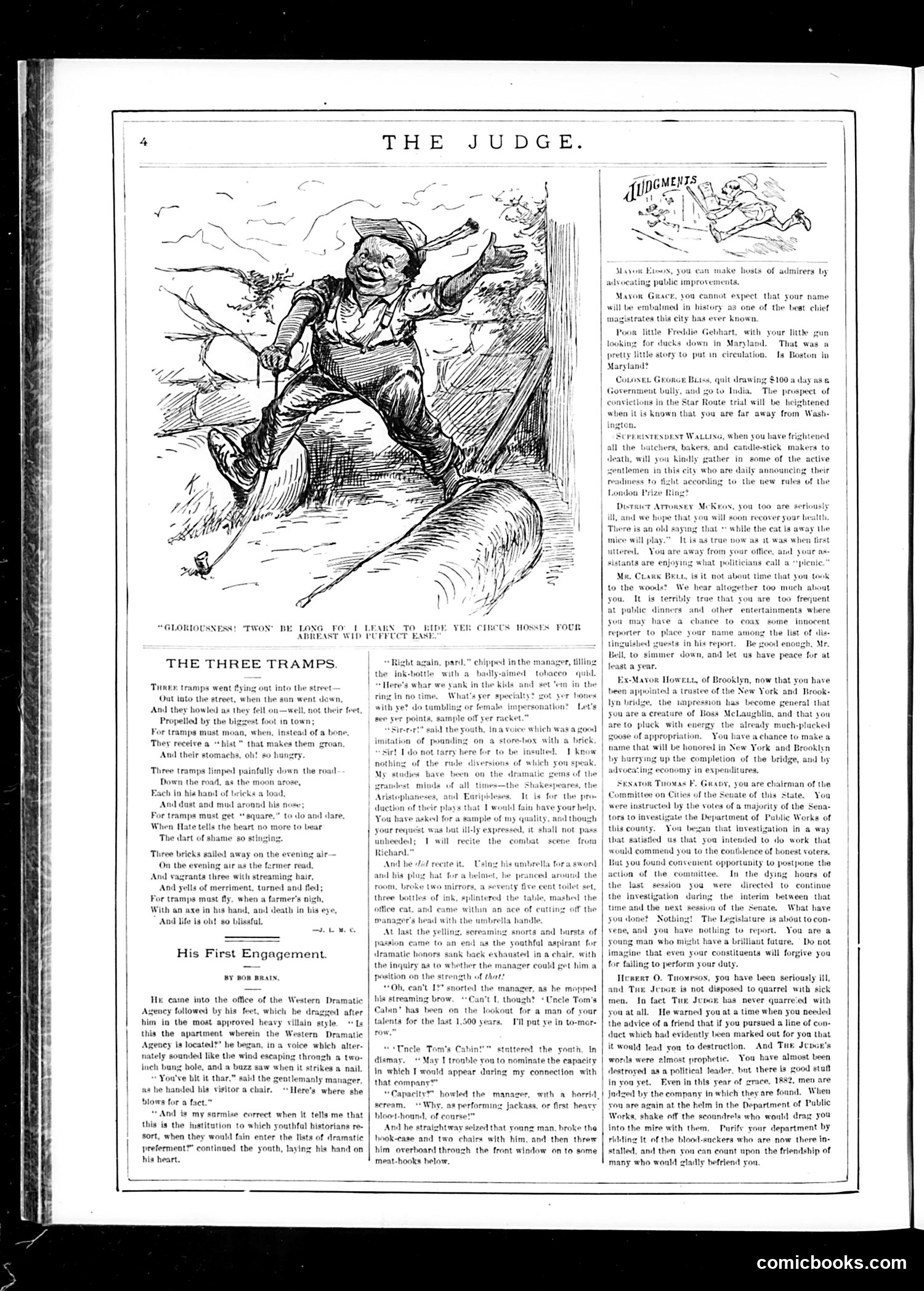
This page contains satirical commentary on New York City politics and scandals circa the 1880s. The main cartoon depicts a violent altercation, illustrating the chaos of urban life. The right-hand column consists of mock "judgments"—barbed letters addressing contemporary figures: Mayor Edson (criticized for advocating public works), Mayor Gould (mocked for spreading stories), Colonel George Bliss (involved in the Star Route trial scandal), Superintendent Walling (police corruption), and District Attorney McKeon (accused of negligence while away). The references suggest this targets corruption and incompetence in New York municipal government during a period of documented scandals. The "Three Tramps" and "His First Engagement" sections appear to be humorous verse stories unrelated to the political commentary. The satire's point: city officials are incompetent or corrupt, allowing chaos to flourish while they're distracted or absent.
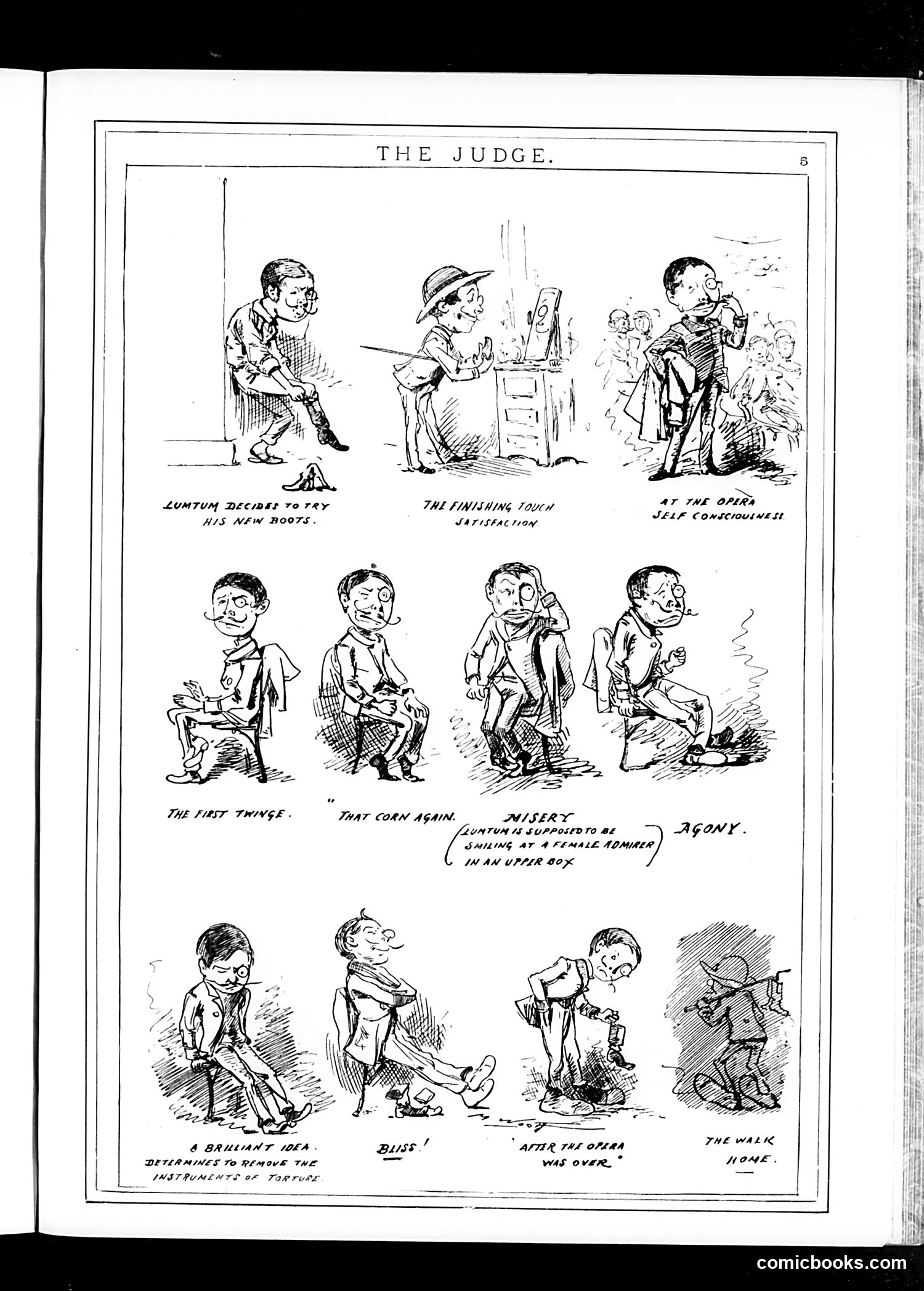
This page satirizes a character named "Luntum" (likely a political figure, though his specific identity is unclear from the text alone) attempting to maintain composure despite physical discomfort. The sequential narrative follows him trying new boots, experiencing corn pain, and struggling to appear dignified at the opera while "smiling at a female admirer in an upper box." The satire mocks the gap between public pretense and private suffering—a common Judge magazine theme ridiculing politicians and public figures who must maintain appearances despite personal difficulties. The progression from vanity (new boots) through escalating agony to forced civility suggests hypocrisy or the absurd demands of maintaining social status. Without additional context, Luntum's identity remains unclear, but the comic likely referenced a contemporary politician or public figure recognizable to Judge's 1880s-90s readers.
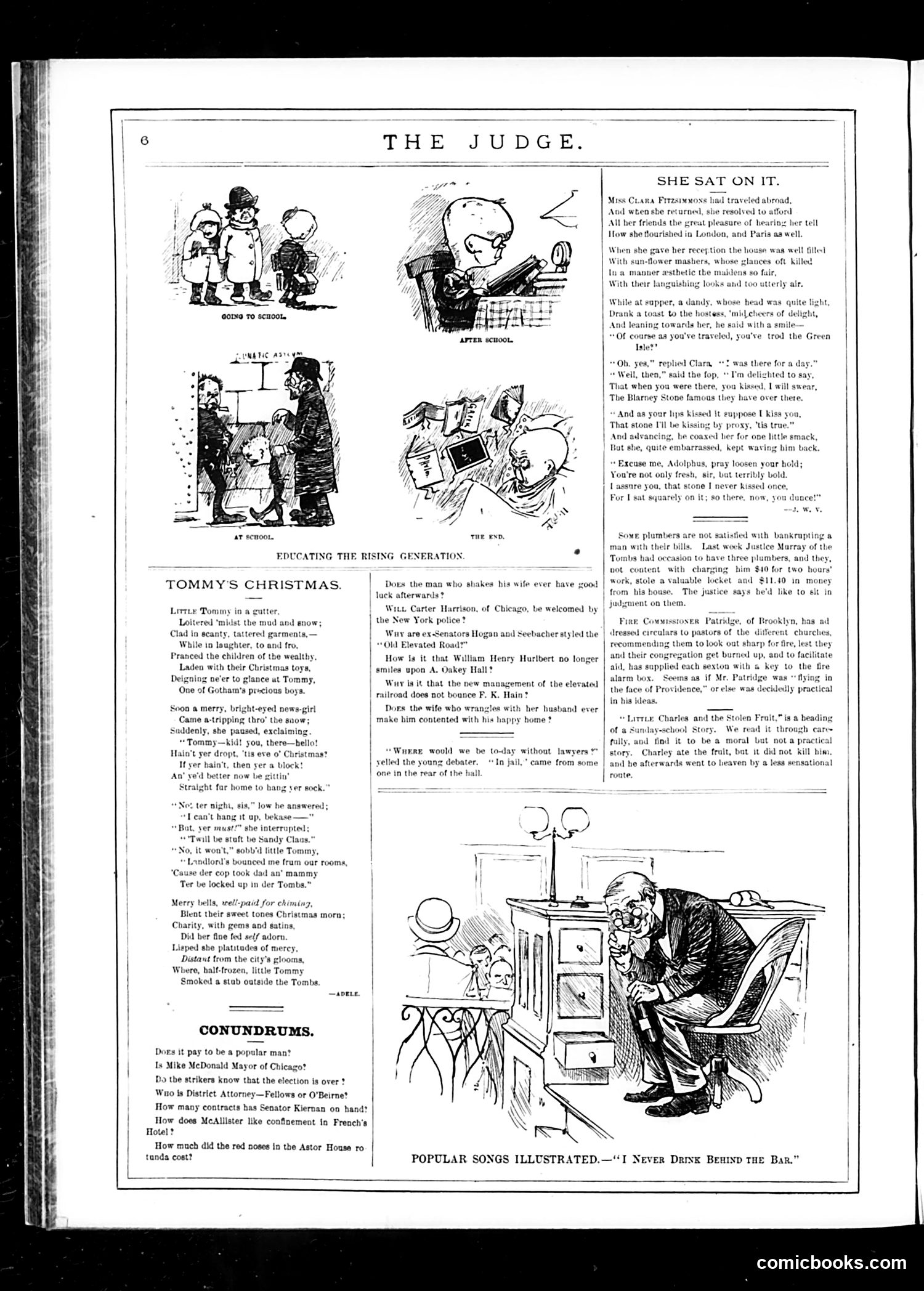
This page from *Judge* magazine contains several satirical pieces targeting late 19th-century New York politics and social hypocrisy. **"Tommy's Christmas"** contrasts wealthy children's holiday abundance with a poor street orphan, Tommy, whose father is imprisoned in "the Tombs" (NYC's notorious jail). The satire targets society's charitable hypocrisy—women like "Charity" deliver platitudes about mercy while children freeze outside prisons. **"She Sat On It"** mocks a wealthy woman, Miss Clara Fitzsimons, who pretends to have kissed the Blarney Stone in Ireland but admits she merely sat on it—exposing upper-class pretension and fabrication. **"Conundrums"** are topical riddles referencing Chicago politics (Mike McDonald, Carter Harrison), New York corruption (Senator Kiernan's contracts), and criminal justice figures—suggesting widespread bribery and political graft. The cartoons satirize Gilded Age inequality, institutional corruption, and the gap between aristocratic pretense and reality. References to specific politicians and judges appear designed for contemporary New York readers familiar with local scandals.
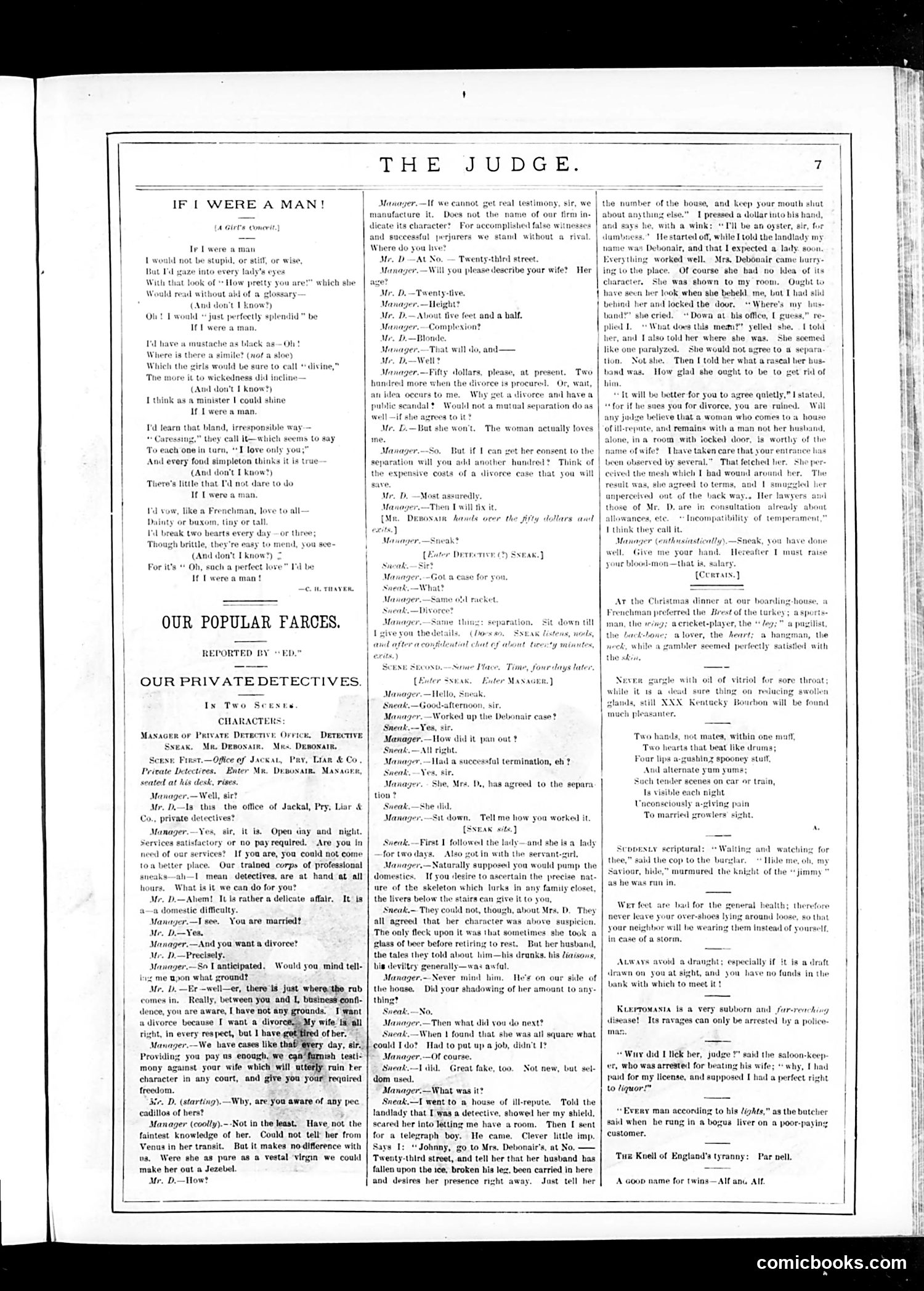
This page contains **two distinct pieces of content**: **1. "If I Were a Man!" (poem/verse)** A satirical poem about female ambition and agency. Written from a woman's perspective, it mockingly lists what she'd accomplish if given male privilege—seducing women, becoming a successful minister, breaking hearts, etc. The repeated refrain "And don't I know?" suggests the author is critiquing women who secretly harbor these desires while publicly maintaining propriety. It's satirizing both female hypocrisy and male privilege, though the target of ridicule remains ambiguous. **2. "Our Private Detectives" (farce script)** A comedic sketch about divorce-for-hire. A man seeks a detective agency to obtain a divorce from his blameless wife simply because he's "tired of her." The detective cynically offers to fabricate evidence of infidelity against even a virtuous woman for fifty dollars. This satirizes the corruption of the legal system and the ease of obtaining divorces through manufactured scandals—a contemporary social concern. Both pieces critique hypocrisy: female duplicity and male moral corruption, respectively.
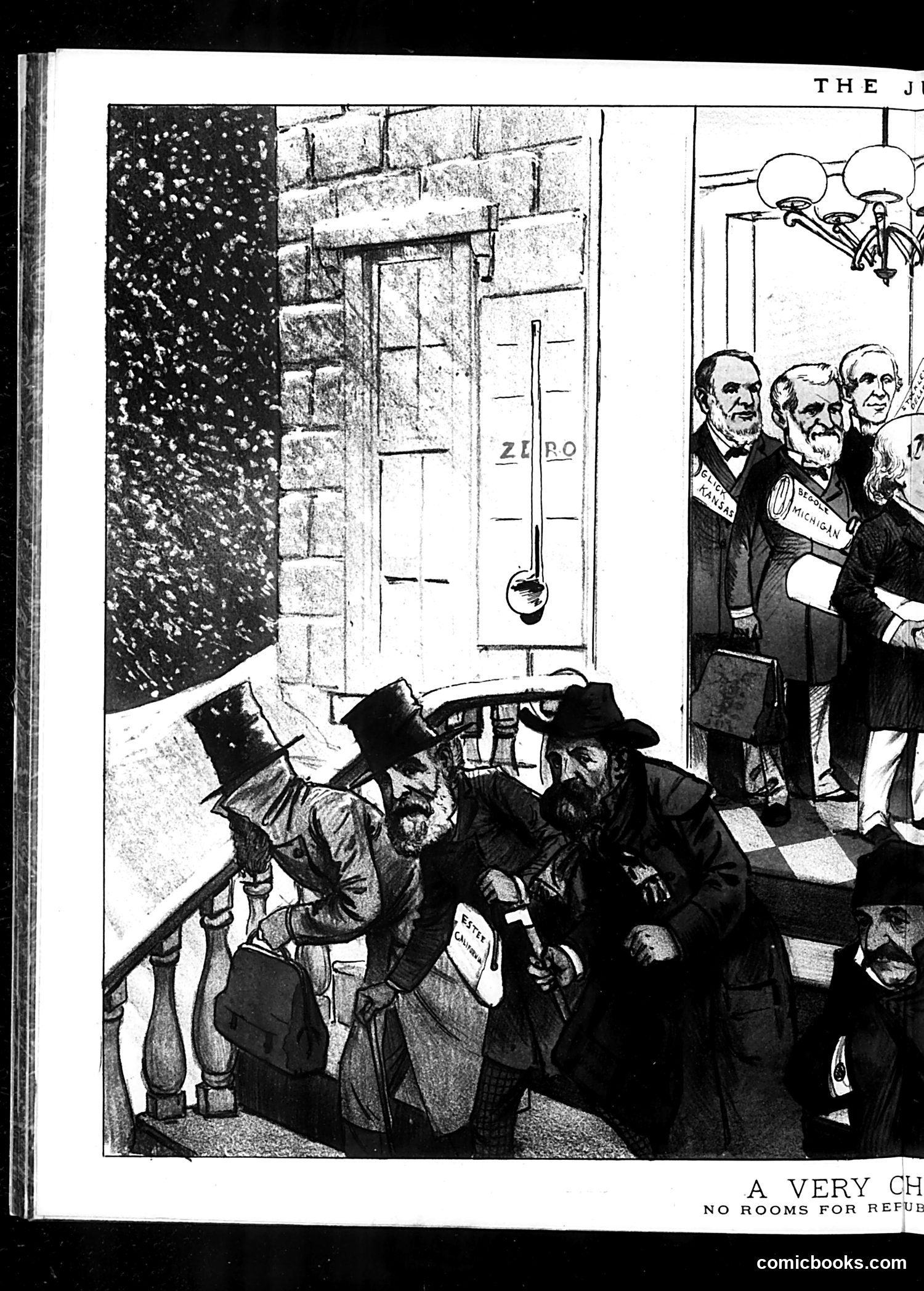
This political cartoon from *Judge* magazine satirizes immigration policy, specifically the lack of shelter for refugees or poor immigrants arriving in America. The image shows two contrasting scenes: well-dressed, respectable-looking gentlemen (likely politicians or officials) stand comfortably indoors observing the scene above. Below, impoverished immigrants wearing worn clothing and hats huddle outside in harsh conditions near a brick building. The title "A VERY CHEERFUL RECEPTION—NO ROOMS FOR REFUGEES" appears to be ironic commentary criticizing America's unwelcoming treatment of immigrants despite the nation's self-image as a beacon of opportunity. The word "ZERO" visible on the door reinforces the message: there is literally no accommodation or welcome for these desperate people. This reflects late 19th/early 20th-century debates about immigration policy and the contrast between America's ideals and its actual treatment of newcomers.
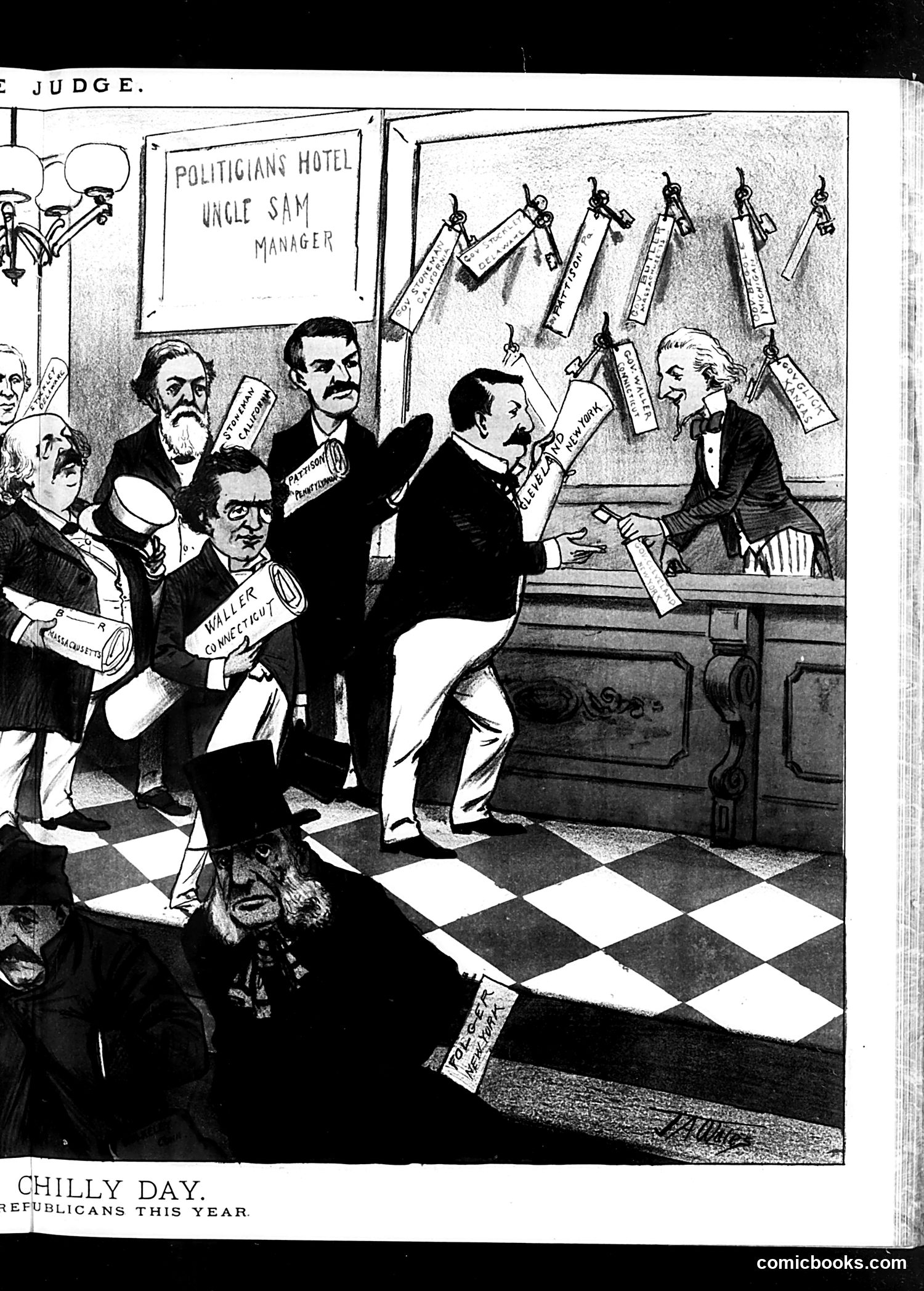
This Judge magazine cartoon satirizes Republican political prospects during an election year (date unclear from image). The scene depicts the "Politicians Hotel" run by "Uncle Sam," where various Republican figures—identifiable by labels on their clothing—gather anxiously. The cartoon's title suggests Republicans face a "chilly" electoral climate. The wall displays multiple hanging nooses or gallows, a dark visual metaphor for political defeat or elimination. The suited politicians appear distressed, cramped together in the space. The satire suggests the Republican Party is in disarray, with multiple candidates or factions facing political "execution" at the polls. Without clearer date information, the specific election year and referenced figures remain uncertain, though the visual message—Republican trouble ahead—is unmistakable.
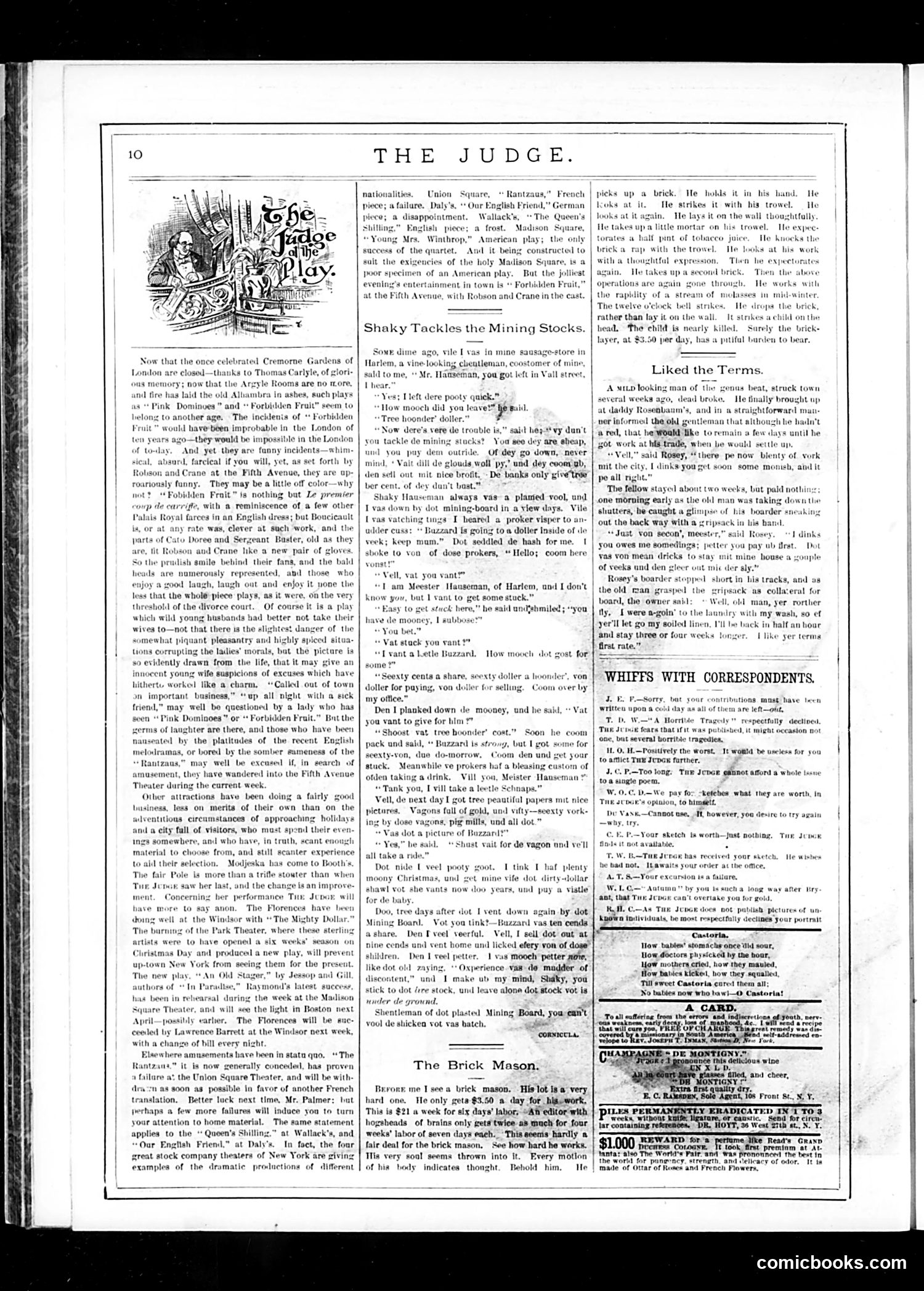
This page contains two distinct pieces. The main article reviews current New York theater productions, comparing foreign imports unfavorably to American works. It praises "Forbidden Fruit" at the Fifth Avenue Theater (starring Robson and Crane) as genuinely entertaining, while dismissing French, German, and English plays at competing theaters as failures or disappointments. The critic argues that theatrical managers should invest in home-grown American drama rather than importing European pieces. The secondary piece, "Shaky Tackles the Mining Stocks," is a humorous dialect anecdote about a German-immigrant character (rendered in heavy accent) who takes inside stock-trading tips about mining companies, only to lose money. The joke satirizes the common practice of ordinary people being lured into speculative mining stocks by false rumors and insider tips—a contemporary financial scam.
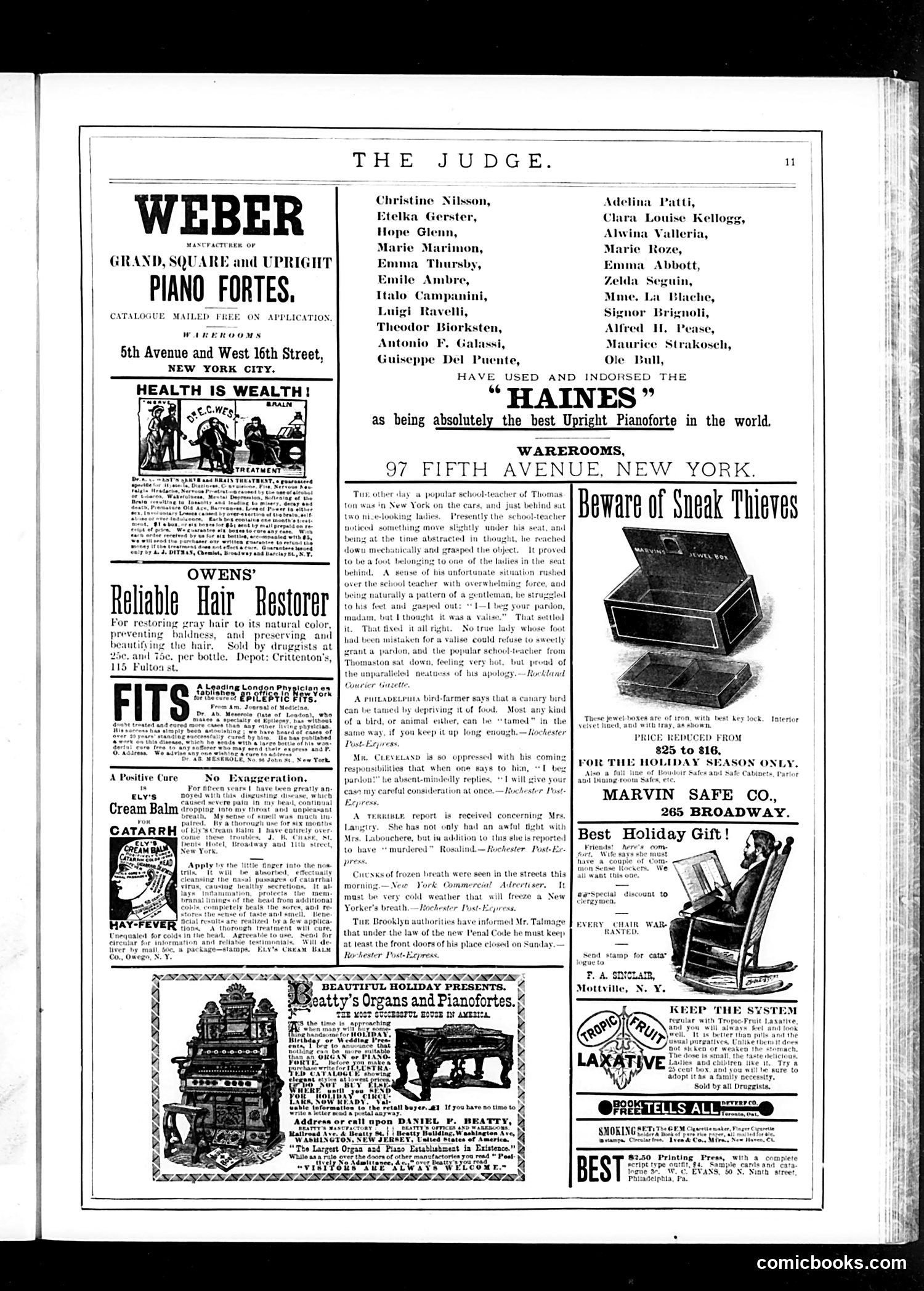
This page is primarily **advertising**, not satirical content. It showcases late 19th-century consumer goods targeted at middle and upper-class readers. The advertisements feature: - **Piano manufacturers** (Weber, Haines, Beatty's organs) — pianos were luxury status symbols and popular parlor entertainment - **Health/beauty products** (Owens' Hair Restorer, Ely's Cream Balm, Fits treatment) — typical patent medicine-style ads with exaggerated claims - **Safes and practical goods** (Marvin Safe Co., printing presses) The page header lists famous opera singers (Christine Nilsson, Adelina Patti, etc.) who **endorsed the Haines piano** — celebrity endorsements were already a marketing strategy. Several short humorous items appear (about frozen breath, a canary, a school-teacher's apology), but these are filler rather than the page's focus. This illustrates how Judge monetized its readership: affluent subscribers saw luxury goods and patent medicines targeting their wealth and aspirations.
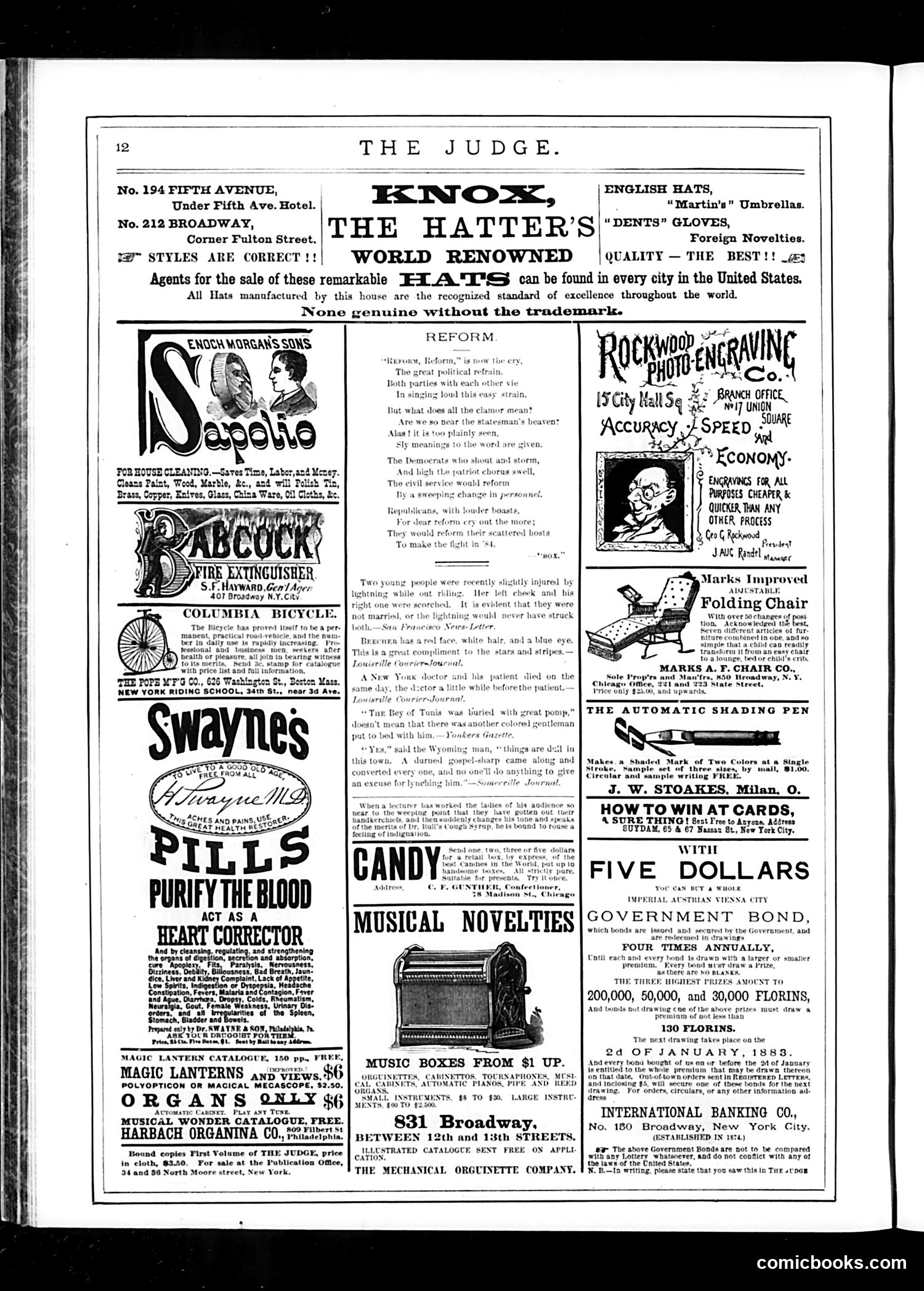
This page is primarily **advertisements** with one small political cartoon titled "Reform" positioned in the upper-center section. The cartoon presents a poem-format satire on political reform efforts. It depicts two figures—likely representing the Republican and Democratic parties—discussing reform proposals. The text mocks both parties' shallow commitment to reform, suggesting they mouth platitudes about fighting corruption and improving government while accomplishing little substantive change. Key satirical points: Republicans promise reform "with louder hoasts" (boasts); Democrats offer only "sweeping changes in personnel"—mere staff shuffling rather than systemic improvement. The cartoon suggests both parties prioritize rhetoric over genuine governance improvements. The cartoon reflects late 19th-century American skepticism toward political reform movements, implying that partisan politicians use reform language opportunistically without meaningful implementation. The rest of the page consists entirely of commercial advertising for hats, musical instruments, home products, and financial schemes typical of the era.
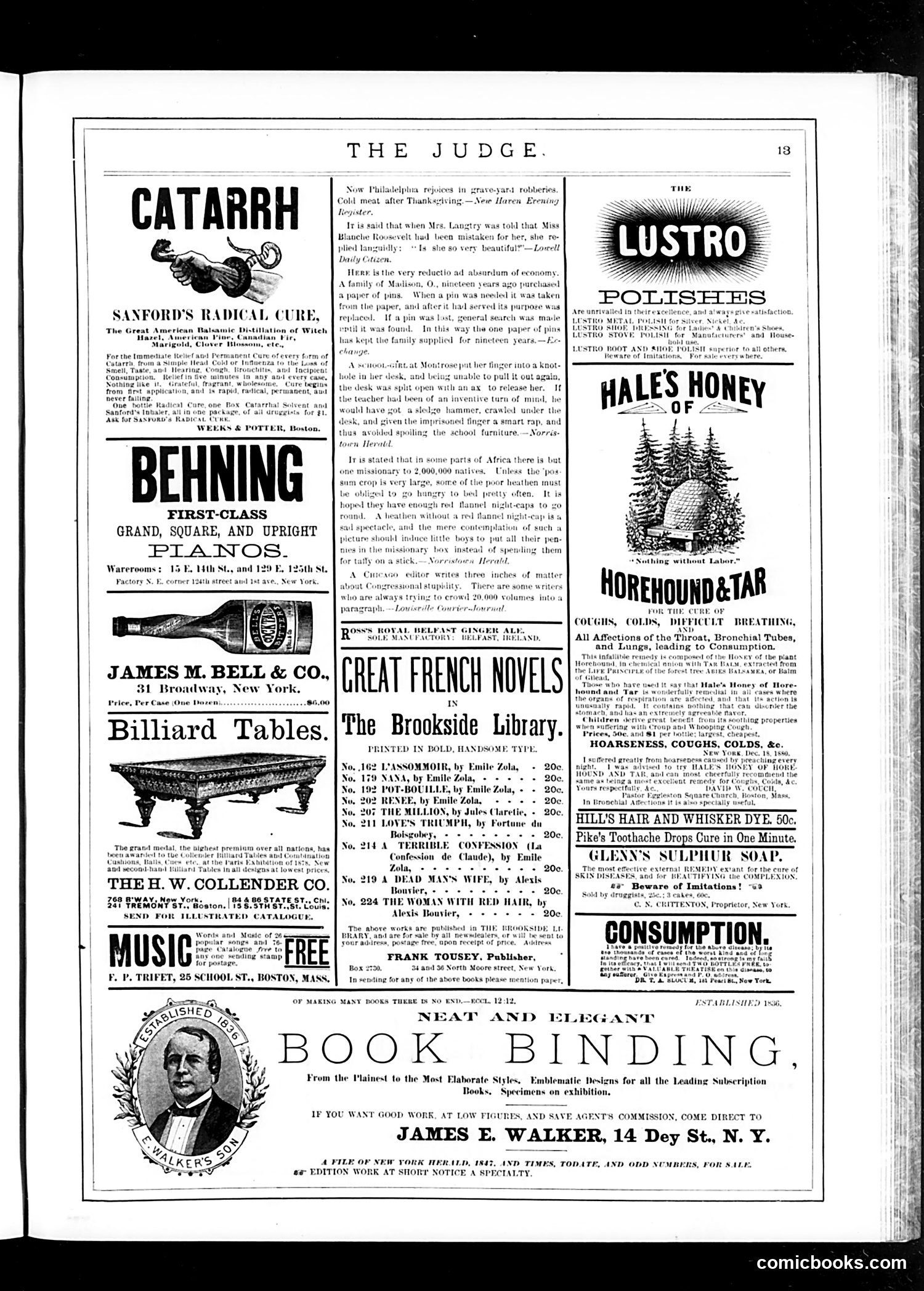
This is primarily an **advertising page** from Judge magazine, not a political cartoon or satirical content page. The layout is dominated by product advertisements typical of late 19th-century American magazines. The visible ads include patent medicines and remedies (Sanford's Radical Cure for catarrh, Hale's Honey of Horehound for consumption), furniture (Behning pianos and billiard tables), books (The Brookside Library featuring French novels by Émile Zola), and various other products (hair dye, toothache drops, soap). The only editorial content visible includes brief humorous anecdotes—one about the Roosevelt family's extreme economy (reusing a single pin for nineteen years), and another about missionary work in Africa. These appear to be filler content between advertisements rather than substantive satire. The page reflects Judge's business model: generating revenue through extensive advertising while maintaining minimal editorial content.
The OCR text on this page is severely corrupted and unreadable—it appears to be garbled or inverted, making it impossible to identify the actual content, references, or satirical intent. While the IMAGE shows what appears to be a Judge magazine page with the prominent headline **"A STARTLING DOMESTIC REVOLUTION"** and several illustrated panels with hand gestures, the illegible text prevents me from accurately explaining: - Who the figures or caricatures represent - What political/social events are being referenced - What the joke or satire actually means To provide accurate historical context as requested, I would need either clearer OCR text or the ability to read the actual printed text in the image, which is too small to decipher in this reproduction. **I cannot responsibly guess at the meaning without reliable source material.**
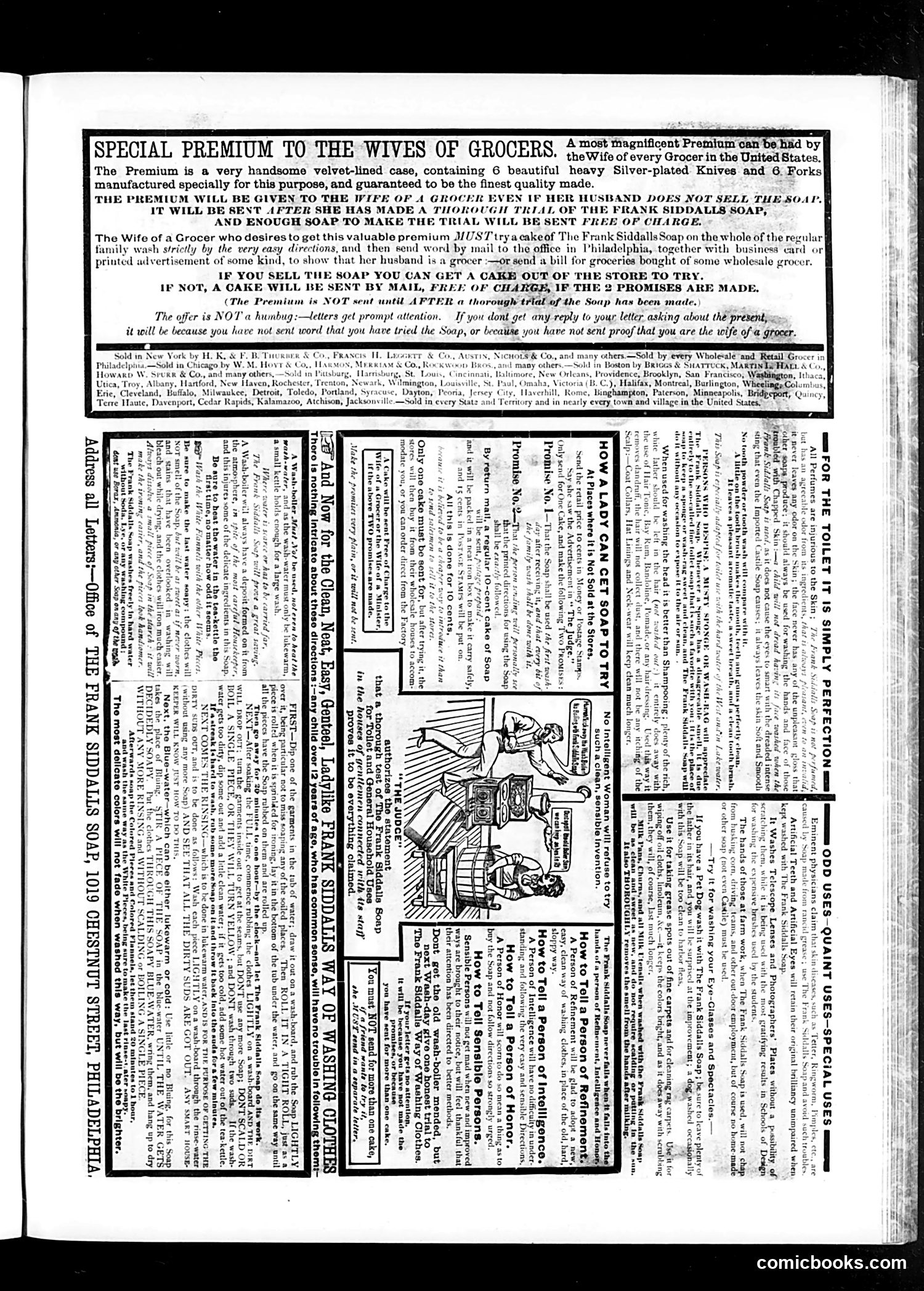
This page is **primarily advertising**, not political satire. It promotes Frank Siddalls Soap, offering a premium (silver-plated knives and forks) to grocers' wives who test the product. ## The Satire Element The satirical content appears in the middle sections titled "How to Tell a Person of Refinement," "How to Tell a Person of Intelligence," and "How to Tell a Person of Honor." These mock-serious definitions use soap-washing as a class marker—suggesting that proper use of this soap indicates one's moral and intellectual character. This is typical Judge humor: mocking the era's obsession with gentility and propriety by linking mundane domestic tasks to supposedly noble personal qualities. ## Historical Context The advertisement reflects late-19th-century marketing tactics targeting middle-class housewives. The elaborate conditions for obtaining the "free" premium (wives must prove husbands are grocers, conduct thorough trials, etc.) satirize both aggressive marketing schemes and the patronizing assumptions about women's consumer behavior. Judge's readers would recognize this as mockery of both overzealous advertisers and the consumer culture they pioneered.
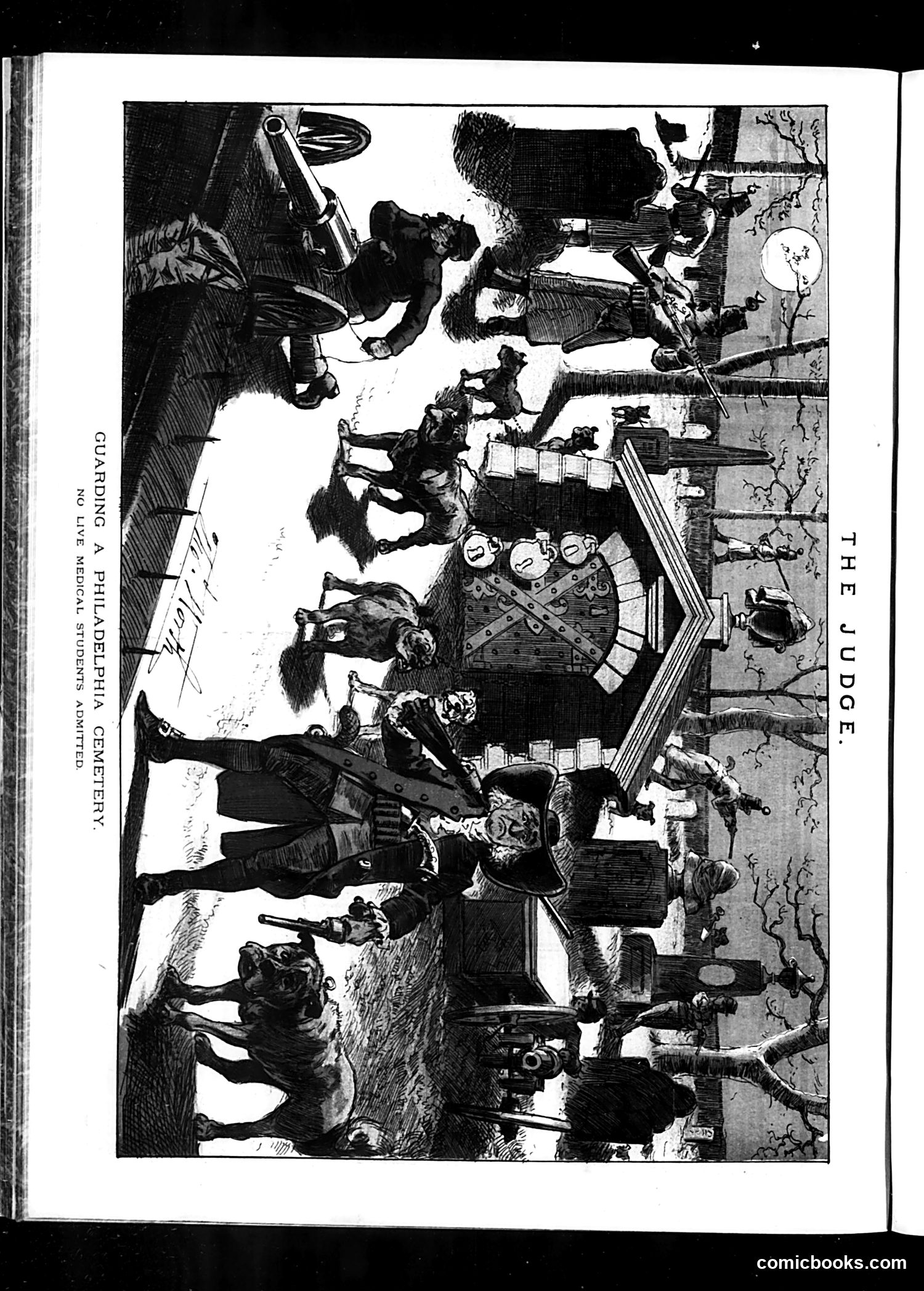
This cartoon satirizes the notorious practice of grave robbing by medical students in the 19th century. The title warns that "no live medical students" are admitted to the cemetery, darkly joking that dead ones might already be there. The image depicts armed guards protecting a Philadelphia cemetery, likely referencing the real problem of medical students stealing cadavers for anatomical study. This was a widespread issue before legal access to cadavers improved, particularly at medical schools like those in Philadelphia. The satire mocks both the students' desperation for specimens and the extreme measures cemeteries felt forced to take—armed sentries—to prevent body theft. It's a commentary on the contradiction between medical education's needs and society's respect for the dead.