
A complete issue · 20 pages · 1882
Judge — December 2, 1882
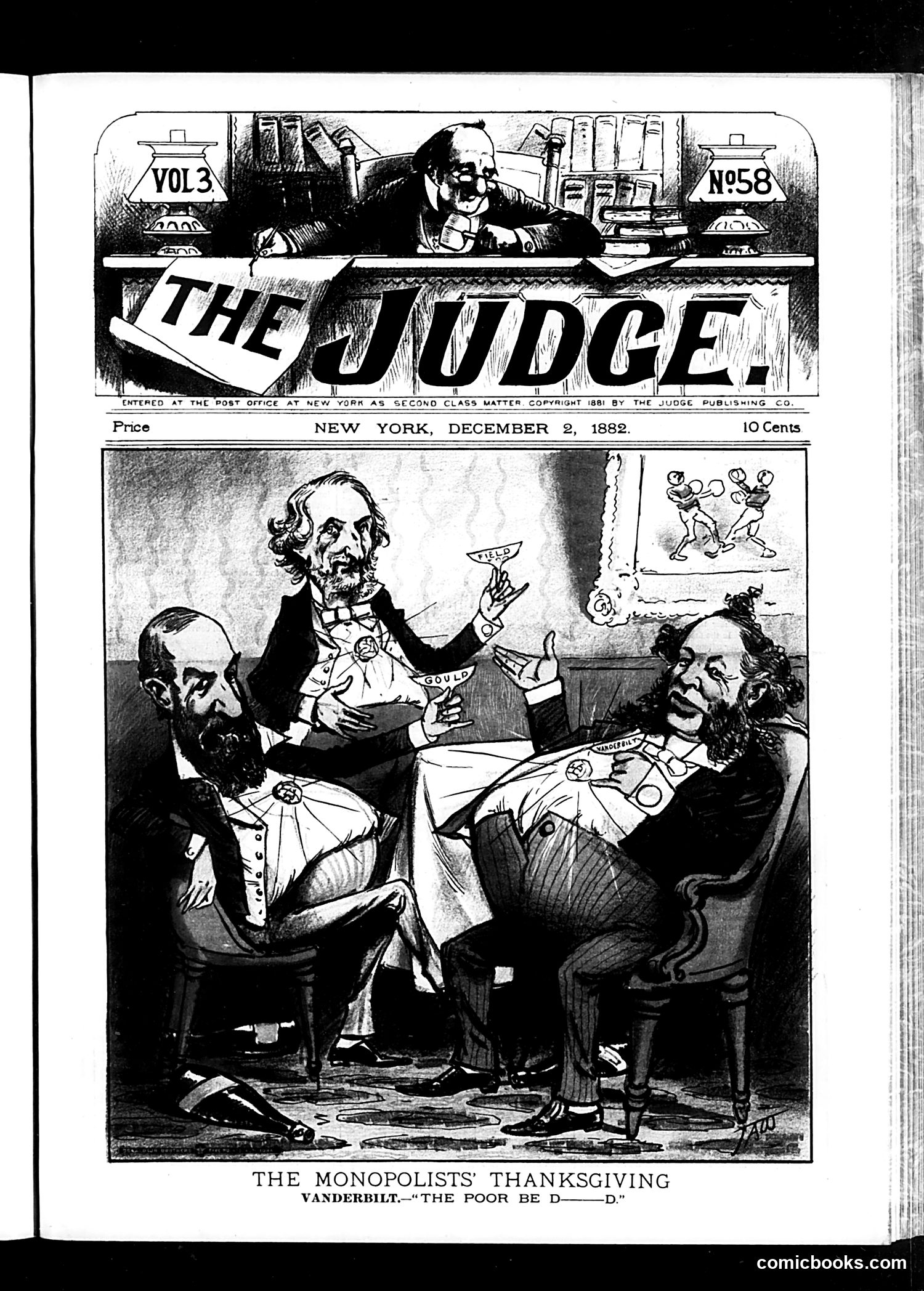
This cartoon satirizes wealthy industrialists' indifference to poverty. Three elaborately dressed men—likely representing railroad and business monopolists of the Gilded Age (the caption mentions Vanderbilt, the railroad magnate)—dine lavishly while toasting. The central figure raises his glass with the sardonic toast: "The Poor Be D——d" (damned). The satire criticizes how monopolists accumulated vast wealth through controlling industries while ignoring or actively harming working-class Americans. The fancy medals and decorations mock their self-importance. The small figures boxing in the background may represent common people struggling. This reflects 1880s-era criticism of unchecked corporate power and wealth inequality, themes that drove reform movements of that era.
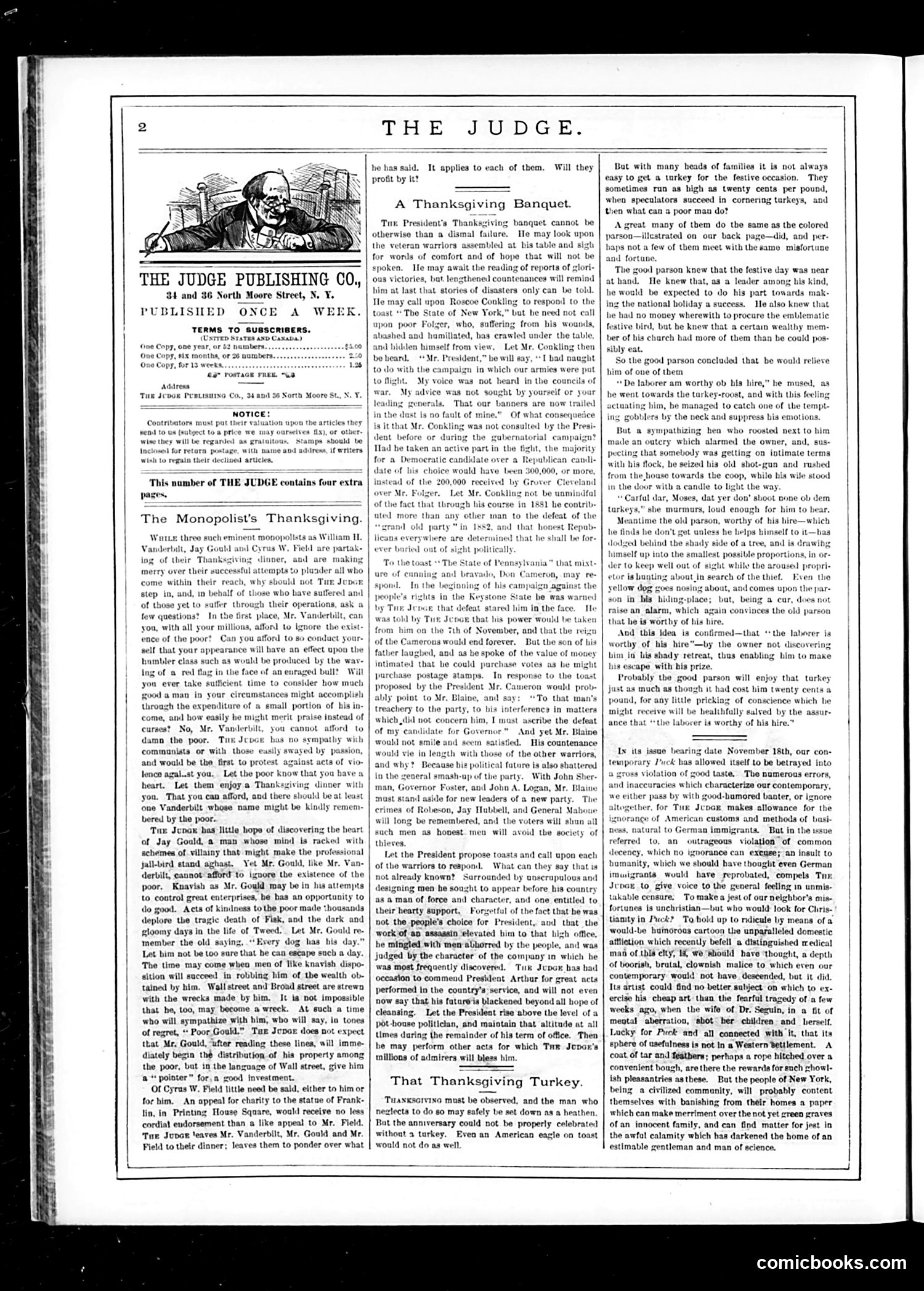
This page contains two satirical pieces attacking wealthy industrialists' lack of charitable concern during Thanksgiving. **"The Monopolist's Thanksgiving"** directly criticizes three famous robber barons—**William H. Vanderbilt, Jay Gould, and Cyrus W. Field**—for their greed and indifference to the poor. Judge magazine shames them for accumulating vast fortunes while ignoring suffering workers and the impoverished. The piece sarcastically suggests they use Thanksgiving to demonstrate humanity and generosity, implying they never would. References to **Jay Fisk's death** and **Boss Tweed** invoke recent scandals involving corrupt wealthy men. **"That Thanksgiving Turkey"** (partial) appears to address **President's** Thanksgiving, though the text is fragmented. The cartoon (upper left) likely depicts one of these wealthy figures. This reflects the **Gilded Age** context: intense public resentment toward monopolists who accumulated wealth through exploitative practices while workers faced poverty and dangerous conditions. Judge positioned itself as advocating for working-class interests against plutocratic indifference.
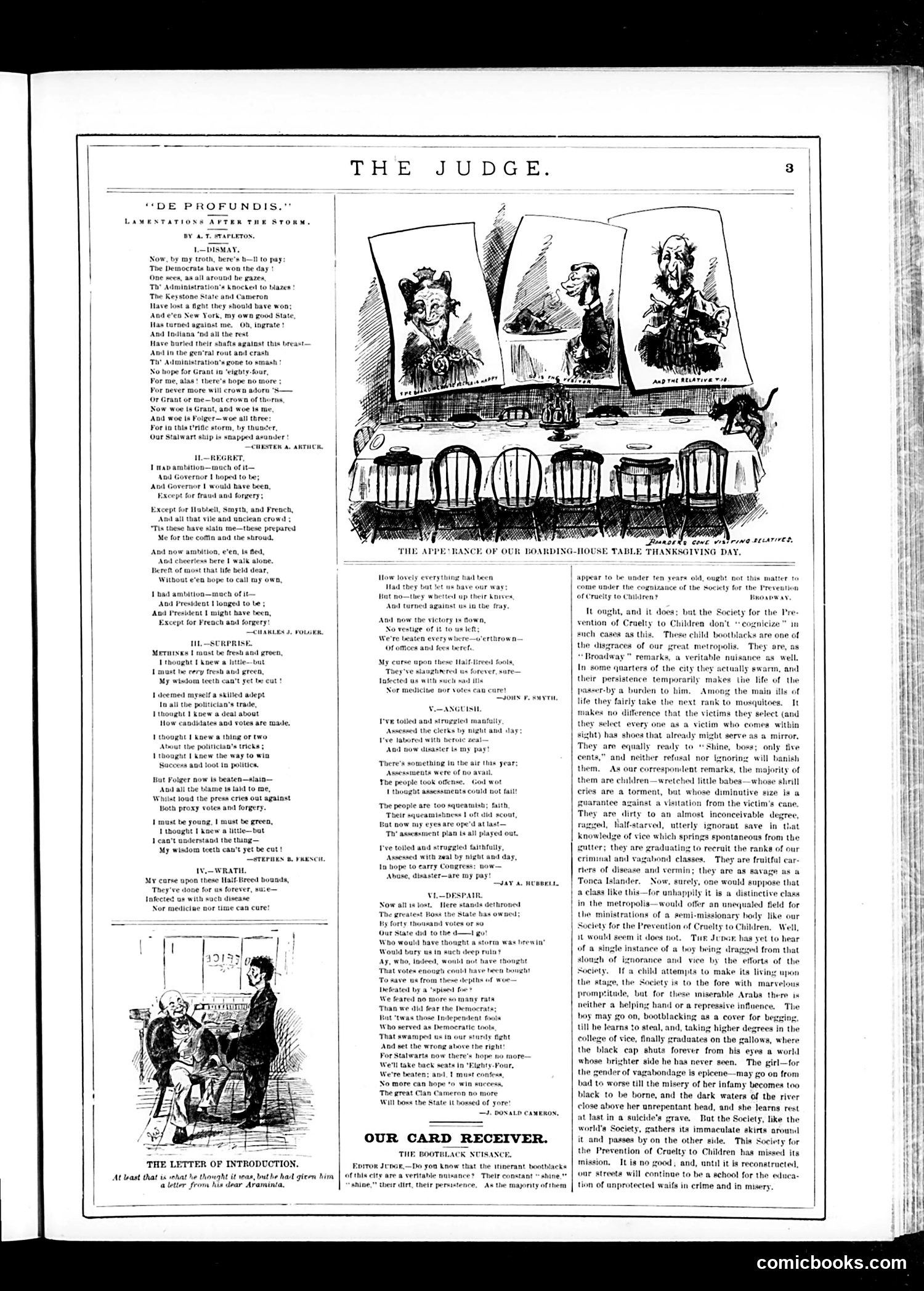
This page satirizes the Republican defeat in the 1884 election. The title "De Profundis" ("From the Depths") sets a mournful tone as Republican stalwarts lament their loss. **Main Cartoon:** The illustration shows Republican leaders at a "boarding-house table" mourning their defeat—likely depicting figures associated with Grant-era politics and the "Stalwart" Republican faction. **Satirical Poems:** Multiple verses, attributed to various authors, mock Republican ambitions thwarted by electoral defeat. References include: - Disappointment over New York and Indiana turning Democratic - Accusations of "fraud and forgery" as excuses for loss - Mentions of "Folger" (likely a New York Republican candidate) - Criticism of "assessments" (likely patronage/corruption schemes) - Dark humor about political death and burial **Point:** Judge ridicules Republicans for their grandiose expectations, their reliance on patronage systems, and their denials of genuine popular rejection. The satire suggests their defeat resulted from actual voter disapproval, not fraud—inverting their own excuses. The secondary items ("Our Card Receiver," "The Bootblack Nuisance") appear to be unrelated satirical pieces.
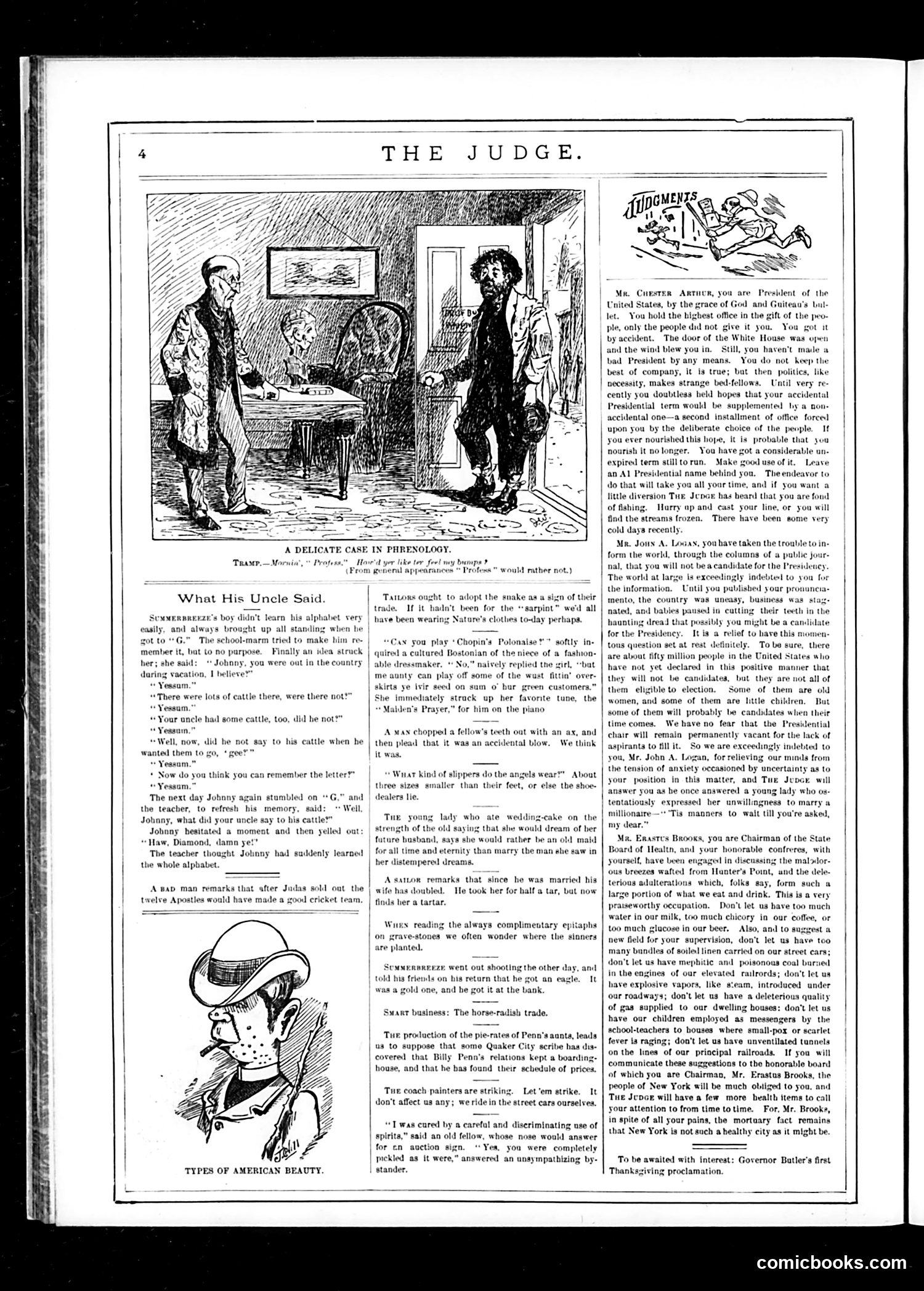
The top cartoon satirizes **Chester Arthur's accidental presidency**. The figure labeled "Tramp" represents Arthur, who became president after James Garfield's assassination by Guiteau in 1881. The accompanying text mock-addresses Arthur directly: "you got it by accident. The door of the White House was open and the wind blew you in." The "phrenology" reference—the pseudo-science of reading skull bumps to determine character—is the visual joke: examining Arthur's head for signs of presidential fitness. The satire suggests Arthur lacks the legitimate credentials for office, having arrived through tragedy rather than election. The page also contains humorous anecdotes and "Types of American Beauty" sketches typical of Judge's satirical content, including jokes about rural dialect, fashion pretension, and social absurdities.
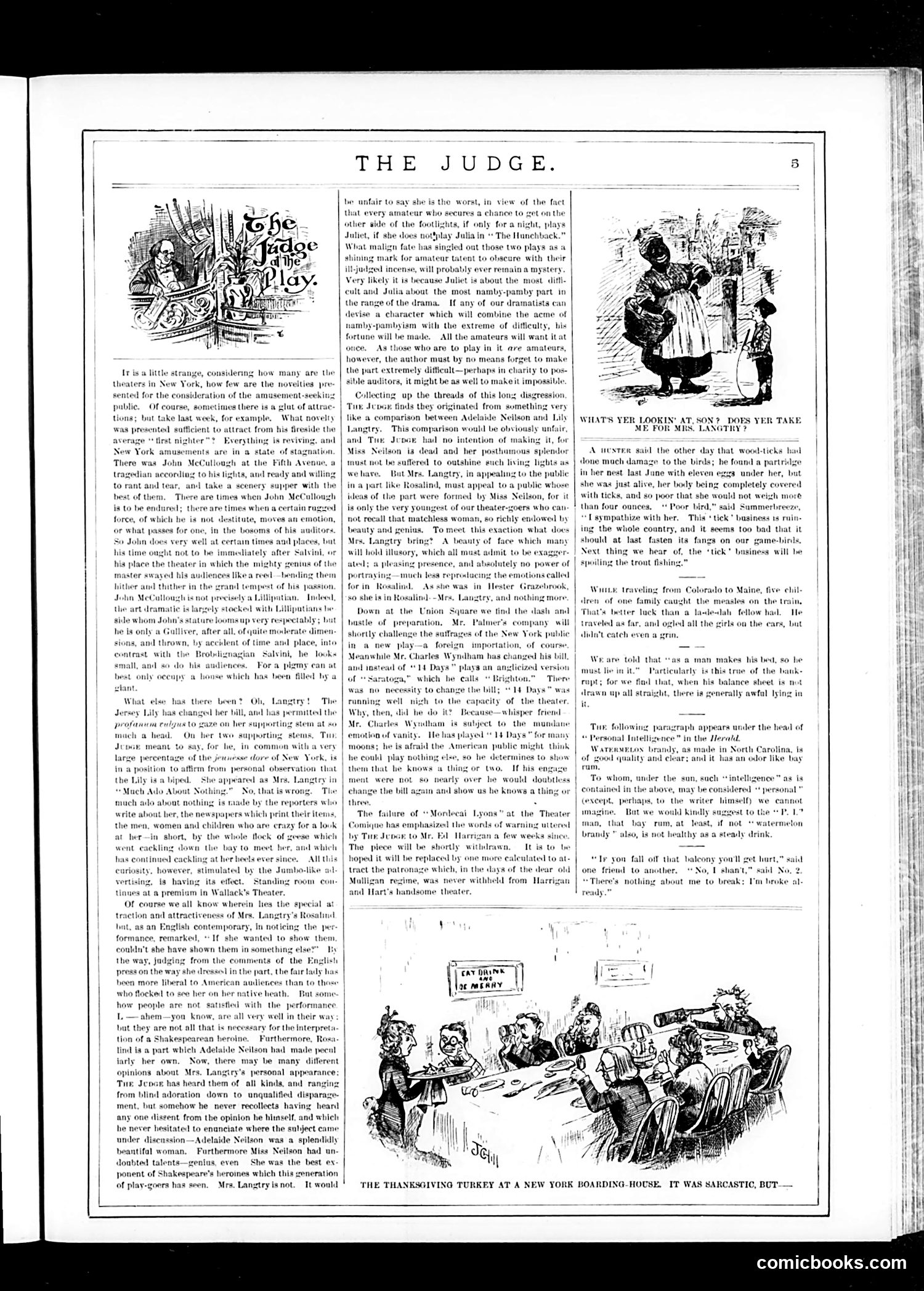
This is a theater criticism column reviewing recent New York stage productions. The writer critiques actor **John McCullough** for his overly theatrical, ranting style—calling him a "Lilliputian" compared to the tragic grandeur drama demands. The main target is **Lillie Langtry** ("the Jersey Lily"), a famous British actress whose recent New York appearances have caused public sensation. The writer argues she relies on celebrity and physical appearance rather than genuine talent. He compares her unfavorably to Adelaide Neilson, a respected Shakespearean actress, noting Langtry's "Rosalind" performance lacks substance despite her fashionable dress. The cartoon below depicts Langtry at a boarding house Thanksgiving dinner—satirizing her as a tourist attraction people flock to see, much like the famous elephant Jumbo. The satire attacks celebrity culture: audiences are starstruck rather than appreciating actual theatrical skill.
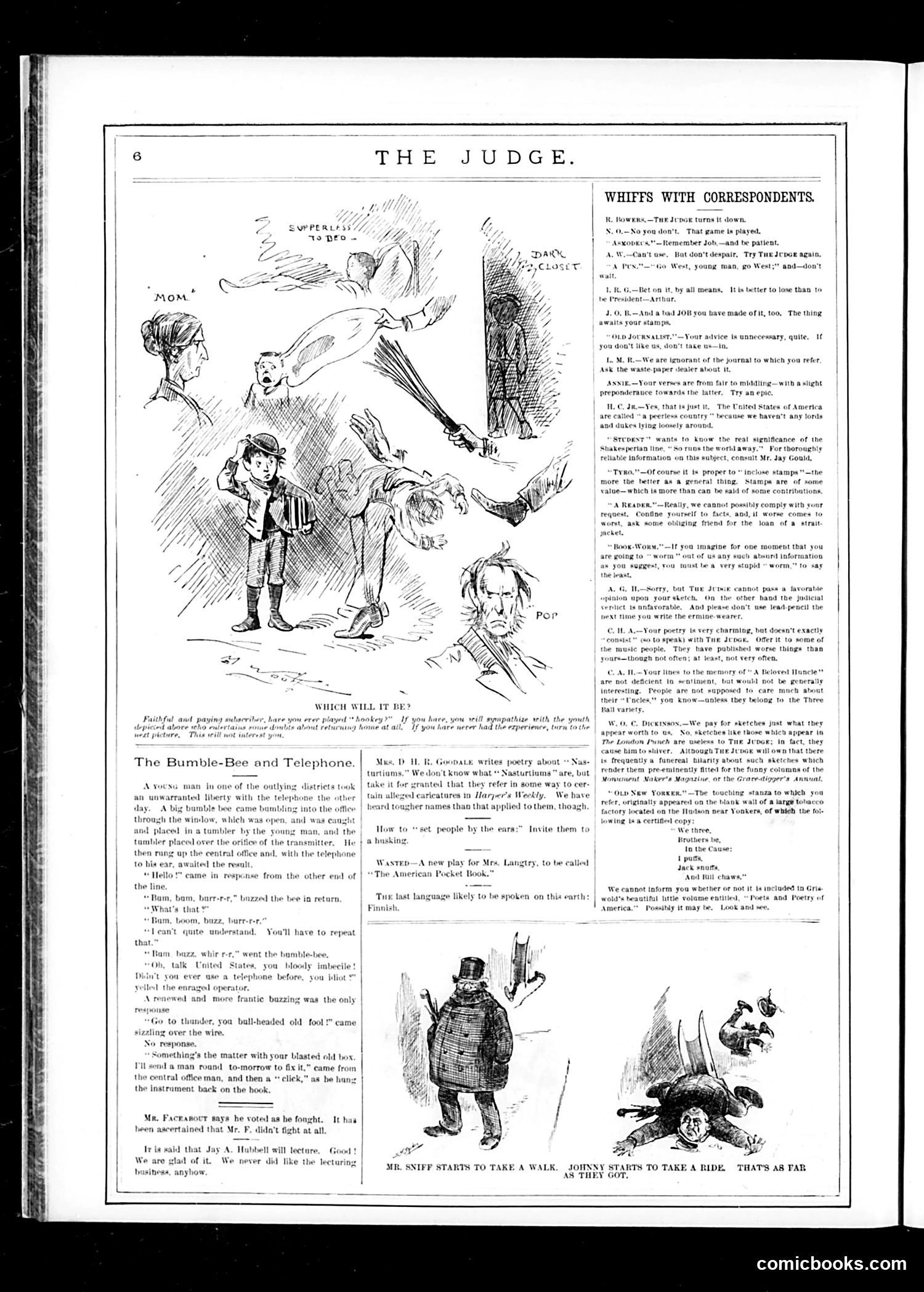
This page satirizes the **early telephone system's reliability problems**. The main story depicts a man trying to use a telephone transmitter but encountering only buzzing sounds from a bumble bee he'd accidentally placed in the apparatus. Neither party understands the other—the operator becomes exasperated, the caller grows frustrated—until the line goes dead entirely. The joke mocks **the primitive state of telephone technology and communication**, where technical failures and crossed signals were common enough that users couldn't distinguish between mechanical malfunction and actual (albeit nonsensical) transmission. The absurdist humor suggests the telephone system was so unreliable it might as well be run by insects. The bottom panel shows "Mr. Sniff" and "Johnny" attempting outdoor activities ("take a walk"/"take a ride"), likely an unrelated social vignette typical of Judge's mixed-content format. The "Whiffs with Correspondents" section contains reader responses to previous content, suggesting this was an interactive humor magazine.
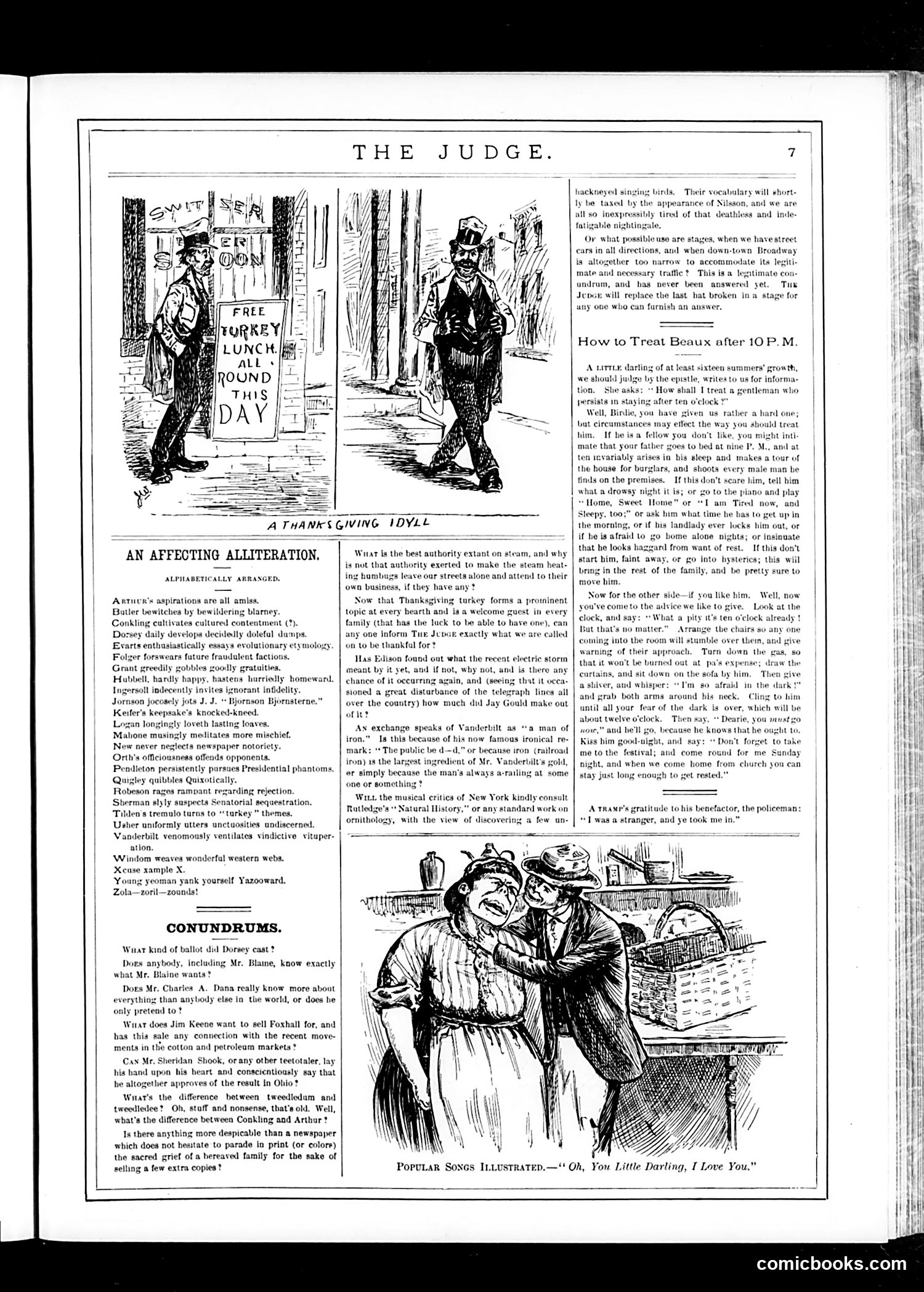
This page from *Judge* contains multiple satirical pieces typical of the magazine's political humor. **"An Affecting Alliteration"** is an alphabetically arranged list of prominent 1870s-80s political figures, each described with alliterative phrases suggesting their scandals or character flaws. Names like Grant ("greedily gobbles goodly gratuities"), Hubbell, and Robeson reference corruption charges and political controversies of the era. The piece mocks the prevalence of misconduct among public officials. **"A Thanksgiving Idyle"** satirizes wealthy industrialists' greed, particularly Vanderbilt and Jay Gould, questioning what they have to be "thankful for" beyond their ill-gotten wealth. **"How to Treat Beaux after 10 P.M."** is a humorous advice column addressing a young woman about handling suitors who overstay their welcome—suggesting various discouragement tactics for unwanted visitors versus romantic strategies for preferred ones. This reflects Victorian-era courtship etiquette concerns. The cartoons and content collectively represent *Judge*'s signature approach: combining political satire with social commentary and genteel humor for its middle-class readership.
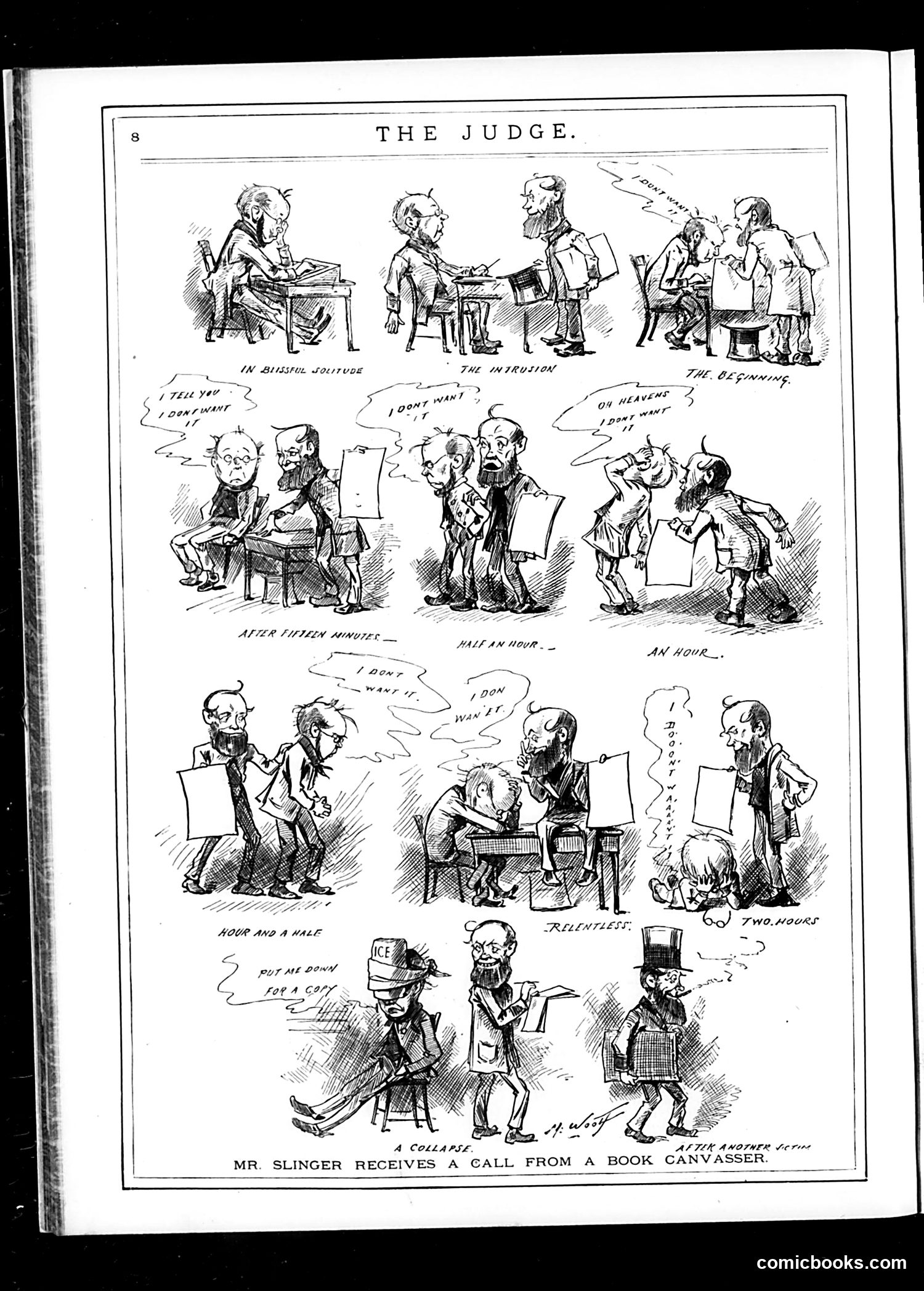
This satirical comic strip follows "Mr. Slinger" through an increasingly exasperating encounter with a door-to-door book salesman. The sequence progresses through stages labeled "In Blissful Solitude," "The Introduction," "The Beginning," and onward through "Fifteen Minutes," "An Hour," "An Hour and a Half," and finally "Two Hours." The humor targets the persistence and annoyance of Victorian-era sales canvassers who would call at homes attempting lengthy pitches. Each panel shows Slinger's mounting frustration and deteriorating composure as the salesman refuses to leave. The final panels depict physical comedy as Slinger attempts to eject the unwanted visitor, culminating in "A Collapse" and "After Another Series" where both parties appear exhausted. The satire mocks both aggressive sales tactics and the social obligation that made it difficult for homeowners to refuse visitors.
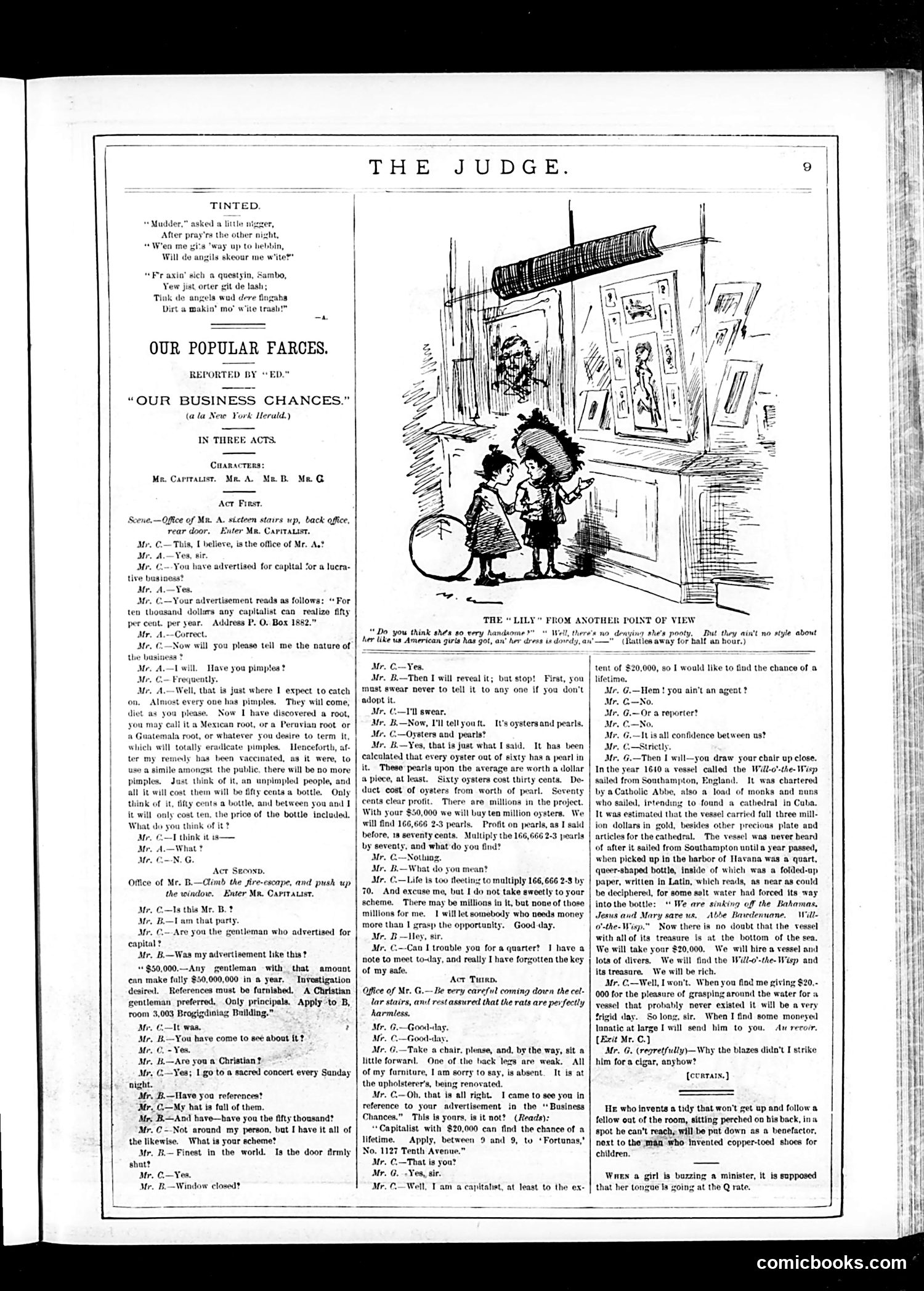
This page from *Judge* magazine contains two satirical pieces: **"Tinted"** (top left): A racist dialect poem mocking Black Americans, using offensive language and stereotypes—reflecting the magazine's deeply problematic racial attitudes of that era. **"Our Business Chances"** (main content): A three-act comedic sketch satirizing common financial scams of the Gilded Age. A capitalist (Mr. C) visits two con artists (Mr. A and Mr. B) who pitch absurd get-rich-quick schemes: one claims a "Mexican root" will eliminate pimples and make him wealthy; the other proposes buying millions of oysters to extract pearls at 70 cents profit each. The joke exposes how transparently fraudulent these schemes are, yet they preyed on gullible investors. The cartoon illustration (right) shows two figures examining what appears to be a shop window—likely depicting victims of such schemes. The satire targets both the scammers and the credulous businessmen who fall for obvious lies, reflecting contemporary anxieties about unregulated capitalism and financial fraud.
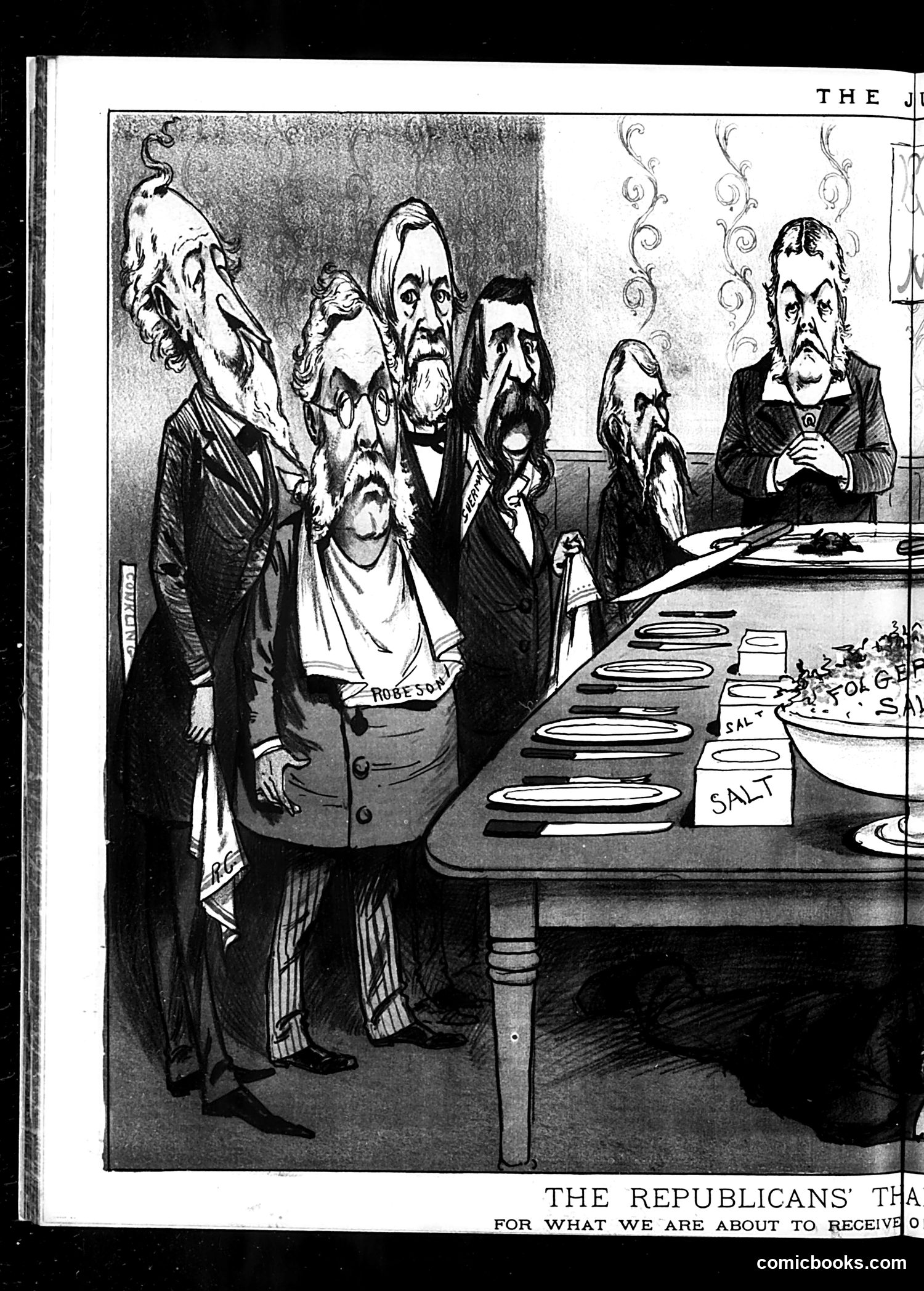
This satirical cartoon from *Judge* magazine depicts "The Republicans' Table" with the caption "For What We Are About to Receive." The cartoon shows several bearded Republican politicians gathered around a dining table laden with plates labeled "SALT" and other condiments. The men display exaggerated, somewhat grotesque facial features typical of 19th-century political caricature. One figure is labeled "ROBESON" (likely referring to a Republican politician of that era). The satire appears to mock Republican politicians as greedy or hypocritical—the dinner table imagery suggests they're about to consume or benefit from something, while their expressions convey skepticism or wariness. The "salt" references remain unclear without additional historical context, though salt was sometimes used metaphorically in political discourse. The overall tone is critical of the Republican party's anticipated actions or policies.
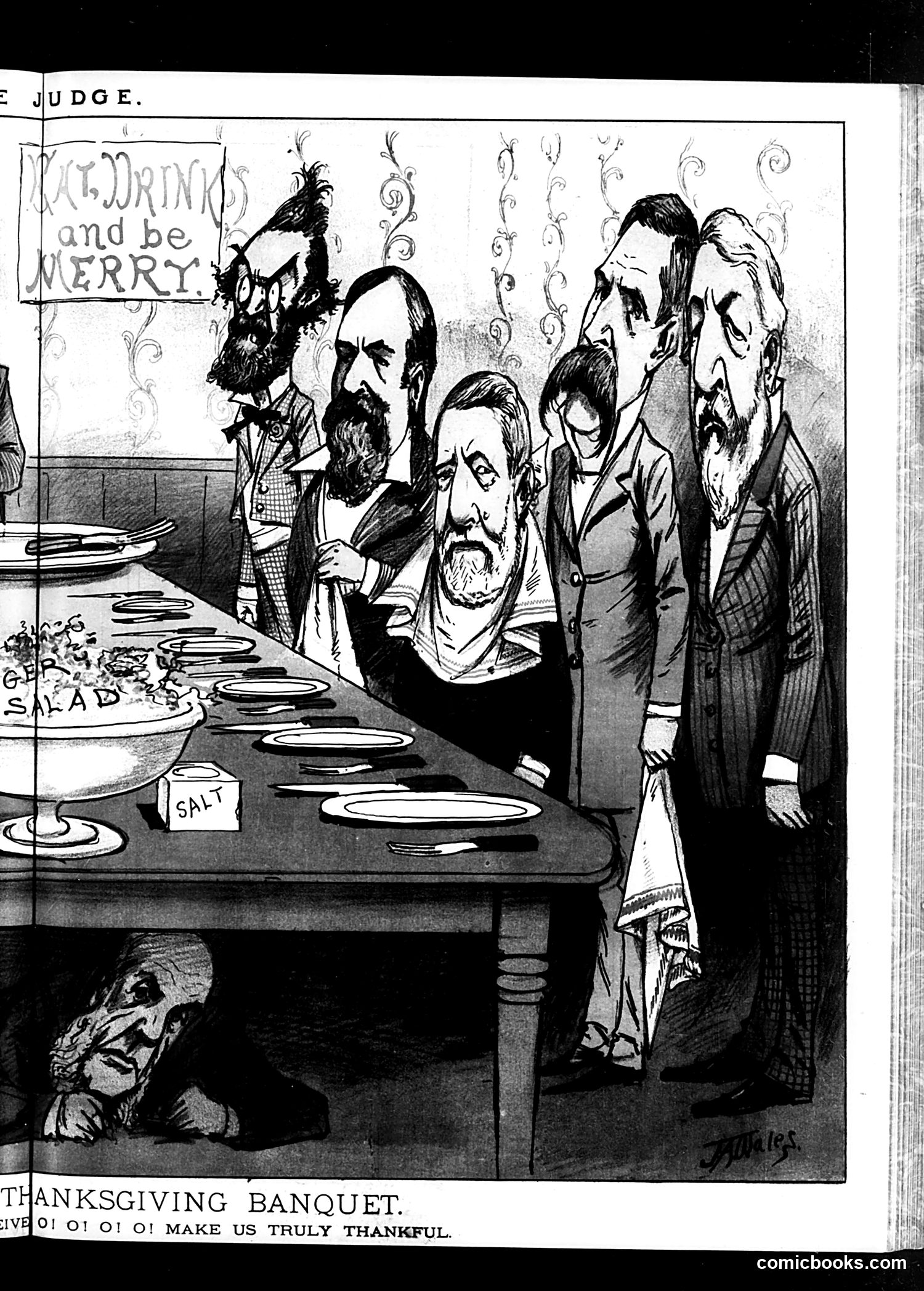
This political cartoon depicts a Thanksgiving dinner scene with satirical intent. Several bearded men in formal 19th-century dress are seated at a table with place settings and bowls labeled "SALT" and what appears to be "SALAD." A sign reading "DRINK and be MERRY" hangs above, while a figure crouches beneath the table. The caption reads "O! O! O! MAKE US TRULY THANKFUL," suggesting ironic commentary on gratitude during an era of social or political tension. The exaggerated facial features and body language convey caricature typical of period satire. However, **without knowing Judge magazine's specific publication date and the historical context of these particular figures, I cannot definitively identify the individuals or the precise political event being mocked**. The overall tone suggests criticism of hypocrisy among those claiming prosperity or blessing.
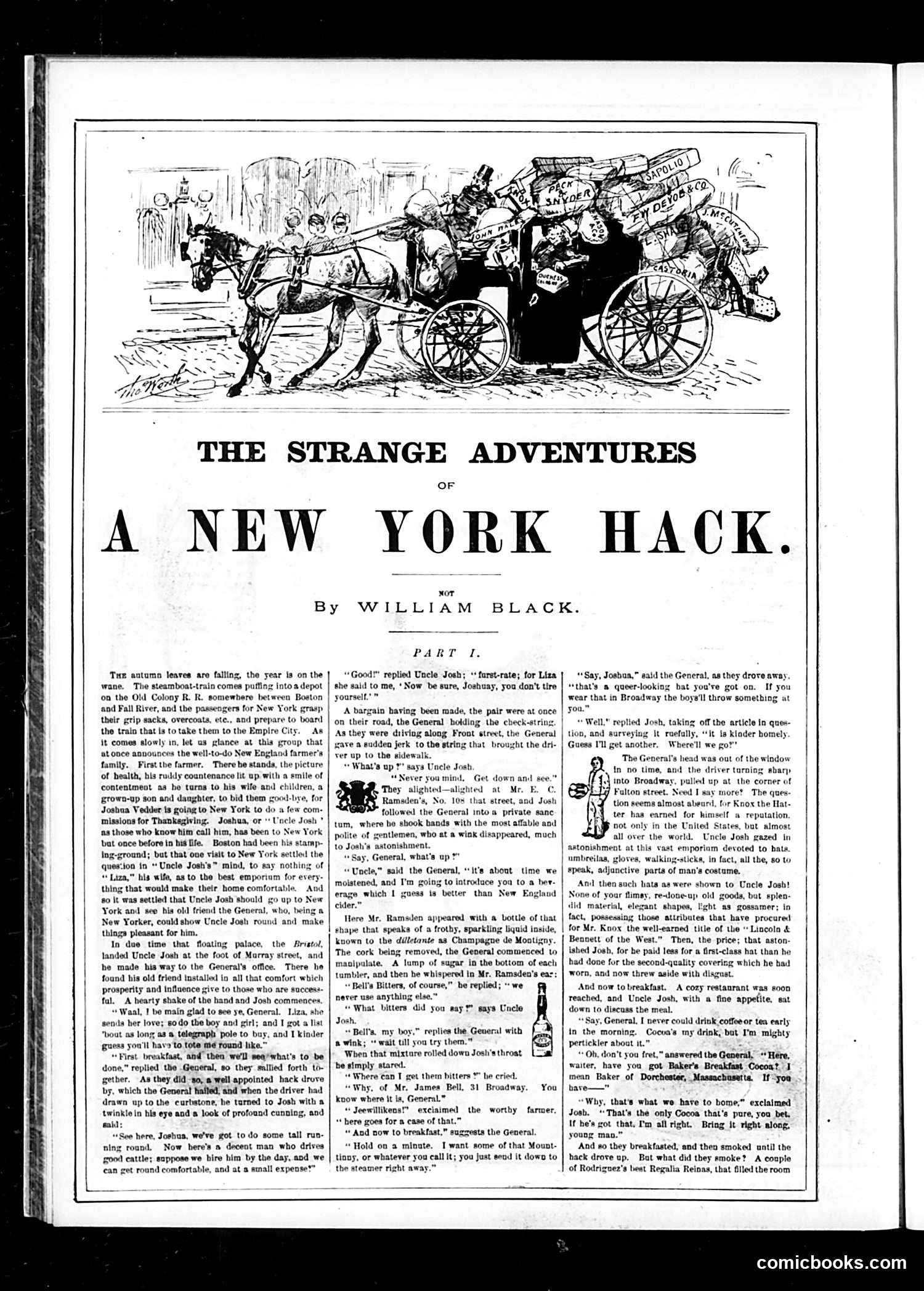
This is the opening installment of a serialized story by William Black in *Judge* magazine, featuring "Uncle Josh," a rural New England farmer visiting New York City for the first time. The narrative satirizes the contrast between provincial innocence and urban sophistication. The illustration depicts Uncle Josh and his family arriving by carriage, laden with luggage and parcels—a visual joke about rural travelers' unfamiliarity with city life. The story's humor derives from showing Uncle Josh encountering urban vices and sophistication he's unprepared for: his General friend immediately introduces him to champagne and Ramsden's establishment (apparently a saloon or drinking establishment), suggesting the "strange adventures" ahead involve moral corruption of the innocent rustic. This reflects late-19th-century *Judge* magazine's typical urban-versus-rural comedy, mocking both country folk's naïveté and implicitly critiquing city temptations. The "hack" (taxi driver) will apparently become complicit in exposing Josh to urban pleasures.
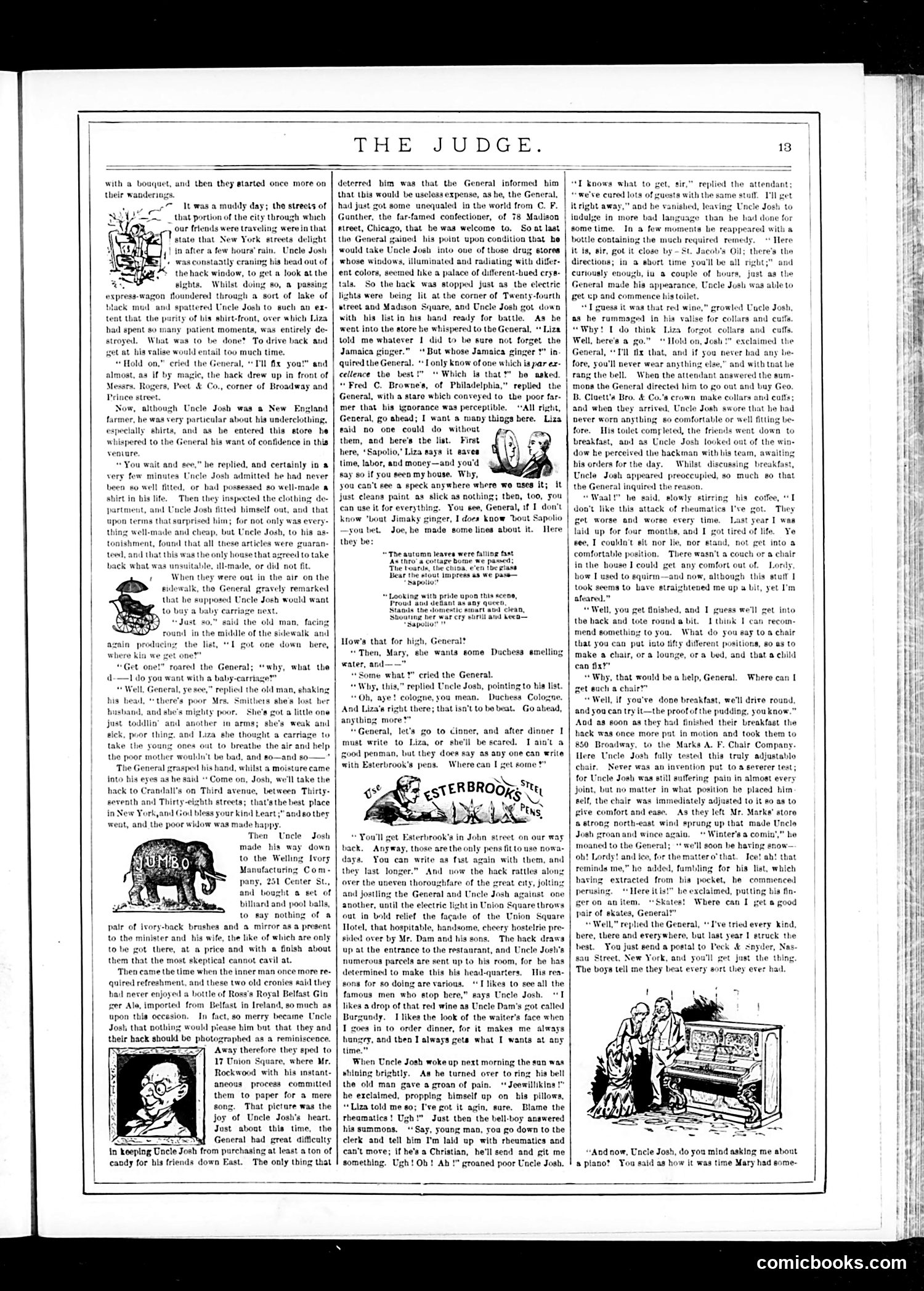
This page is part of a serialized story about Uncle Josh, a rural New England farmer visiting New York City. The narrative satirizes the contrast between rustic simplicity and urban sophistication. **Key episodes shown:** 1. **The mud incident**: Uncle Josh gets spattered by an express wagon—a joke about New York's notoriously filthy streets after rain, highlighting the city's poor infrastructure. 2. **Shopping at Rogers, Peet & Co.**: The General takes Uncle Josh to a quality clothier, with the narrative emphasizing the store's guarantees and fair prices—suggesting this was advertising. 3. **The baby carriage charity**: Uncle Josh purchases a carriage for a poor widow (Mrs. Smithers), showing the rural character's honest kindness. 4. **Consumer pleasures**: He buys billiard equipment and gets photographed—presenting urban goods and services as novelties to a country visitor. The satire gently mocks both Uncle Josh's provincial naiveté and New York's chaotic conditions, while promoting local businesses.
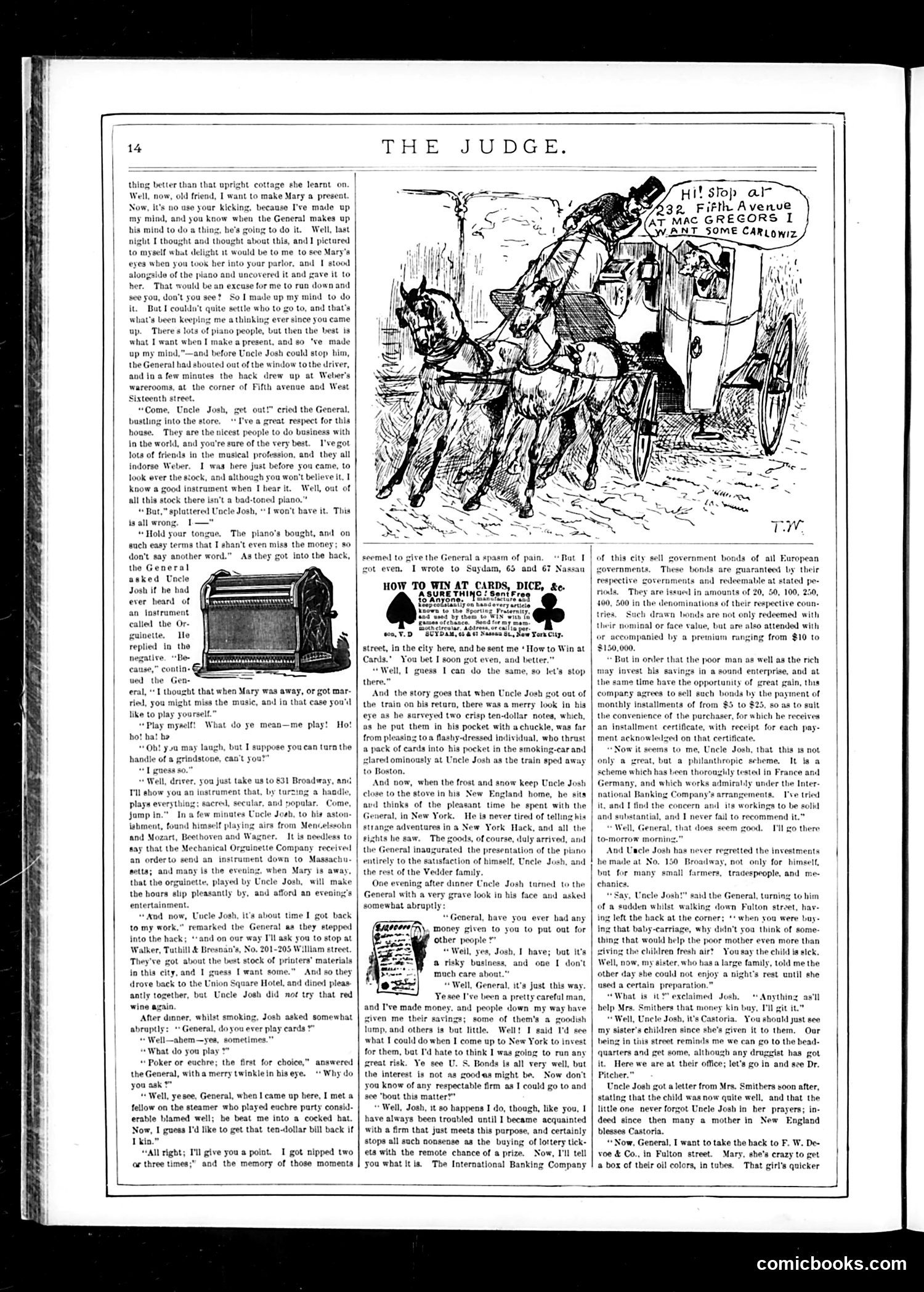
This page showcases Judge's satirical storytelling format, featuring a narrative about "the General" (likely a wealthy businessman character) surprising his friend Uncle Josh with lavish gifts. **The Main Cartoon/Illustration:** Shows a horse-drawn carriage with the General and Uncle Josh traveling through New York City. The General is enthusiastically directing them to Weber's piano showroom on Fifth Avenue. **The Satire:** The humor targets Gilded Age excess and nouveau riche generosity. The General impulsively buys an expensive piano for Uncle Josh's daughter Mary, then later purchases a mechanical musical device (an Orgainette) as a "backup" so Uncle Josh can play music himself—a comically absurd solution to a non-problem. **Social References:** - Weber's was a real, prestigious New York piano manufacturer - The "Orgainette" was an actual mechanical music device popular in the era - The casual mention of large sums suggests mockery of wealthy men's thoughtless spending **The Joke:** The General's well-intentioned but excessive generosity, combined with Uncle Josh's bewilderment and resistance, lampoons both ostentatious wealth-display and the disruption such "gifts" cause to ordinary people's lives.
This page from *Judge* magazine is a serialized humorous story titled "The Judge," featuring Uncle Josh, a rural character, touring New York City with a General. **The cartoon/illustrations** (two small portrait sketches visible) depict Uncle Josh and the General—types representing unsophisticated country visitors encountering urban sophistication. **The satire's point**: The story satirizes the contrast between rural naiveté and urban culture. Uncle Josh marvels at commercial establishments (paint shops, theatrical performances like "The Black Flag," restaurants, art galleries, magic tricks), treating ordinary New York attractions as wonders. His innocent questions and observations—asking about soap quality, remarking on food portions, being amazed by illusions—mock both rural ignorance and urban pretension. **Key references**: - Brand-name products (Devoe paint, Eberhard Faber pencils, Pears soap, Vanderbilt) - Contemporary theater and performers - NYC landmarks and businesses The humor targets both the country rube and the cosmopolitan world he encounters, a common *Judge* theme during this period.
This page features a political satire cartoon titled "Who Killed Cock Folger?" with multiple political figures each claiming responsibility for the "murder." The figures listed—Boss Arthur, Boss Robeson, Boss Hubbard, Boss French, Boss Smyth, Boss Whitelaw Reid, Boss Conkling, and Grover Cleveland—appear to reference **Republican political bosses and leaders** of the Gilded Age era. "Cock Folger" appears to be a symbolic figure (likely referencing a real political matter), with each boss claiming they "killed" him using their characteristic political methods: "little Admiration," "little River and Harbor Appropriations," "little Asinine Rulings," etc. The satire mocks how these political figures wielded corrupt influence through patronage, special interests, and underhanded tactics. The page's dominant content is actually a large **advertisement for Old Judge Cigarettes**, which defensively claims their product contains no opium or harmful drugs—suggesting contemporary public health concerns about cigarette manufacturing.
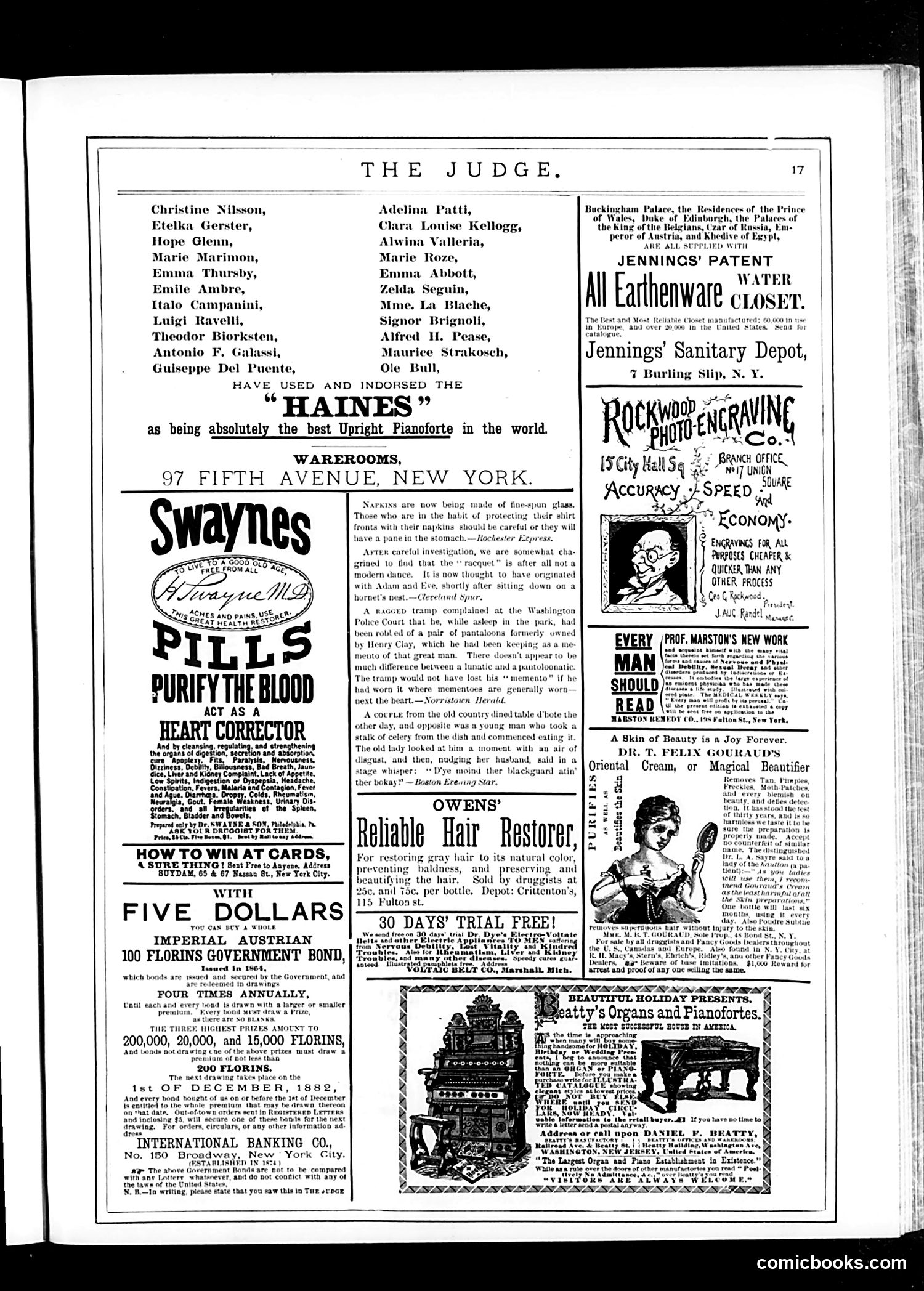
This page is predominantly **advertising**, not satirical content. It features endorsements from famous 19th-century opera singers (Adelina Patti, Clara Louise Kellogg, etc.) promoting the Haines upright pianoforte as "absolutely the best" in the world. The remaining advertisements include: - **Swayne's Pills** for blood purification and heart health - **Owens' Reliable Hair Restorer** (30-day trial) - **Dr. Gouraud's Oriental Cream** (skin beautifier) - **Seatty's Organs and Pianofortes** - Financial schemes like an Austrian Government Bond lottery and "How to Win at Cards" Small filler anecdotes appear (complaints about park tramps, a dining mishap), but these are minor editorial content amid the commercial offerings. The page reflects typical Judge magazine practice: mixing satirical journalism with paid advertisements from patent medicines, beauty products, and luxury goods targeting affluent readers.
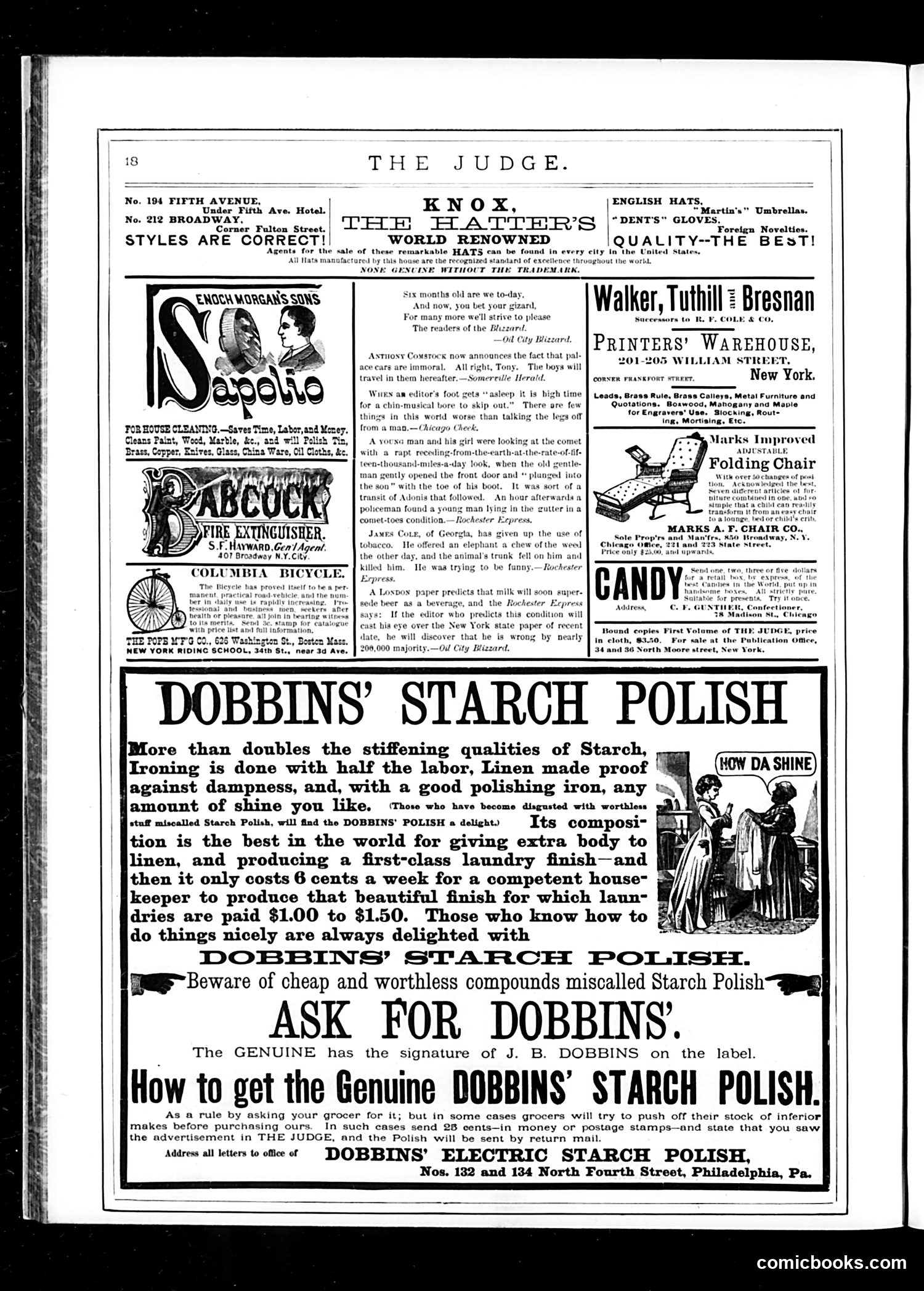
This is primarily an **advertising page** rather than editorial content or political satire. It contains multiple commercial advertisements typical of late-19th-century American magazines. The dominant advertisement is for **Dobbins' Starch Polish**, a laundry product claiming superior stiffening and shine qualities. The ad emphasizes cost-effectiveness (6 cents weekly) and warns consumers against "cheap and worthless compounds" — a common competitive tactic of the era. Other visible ads include: - **Knox Hats** ("world renowned") - **Babcock Fire Extinguisher** - **Columbia Bicycle** - **Printers' Warehouse** (New York) - **Folding Chair** (adjustable) - **Candy** advertisement Small editorial snippets appear between ads (referencing *City Blizzard* and *Rochester Express*), but no political cartoons are clearly visible on this page. This reflects Judge's dual nature as satirical magazine with substantial advertising revenue.
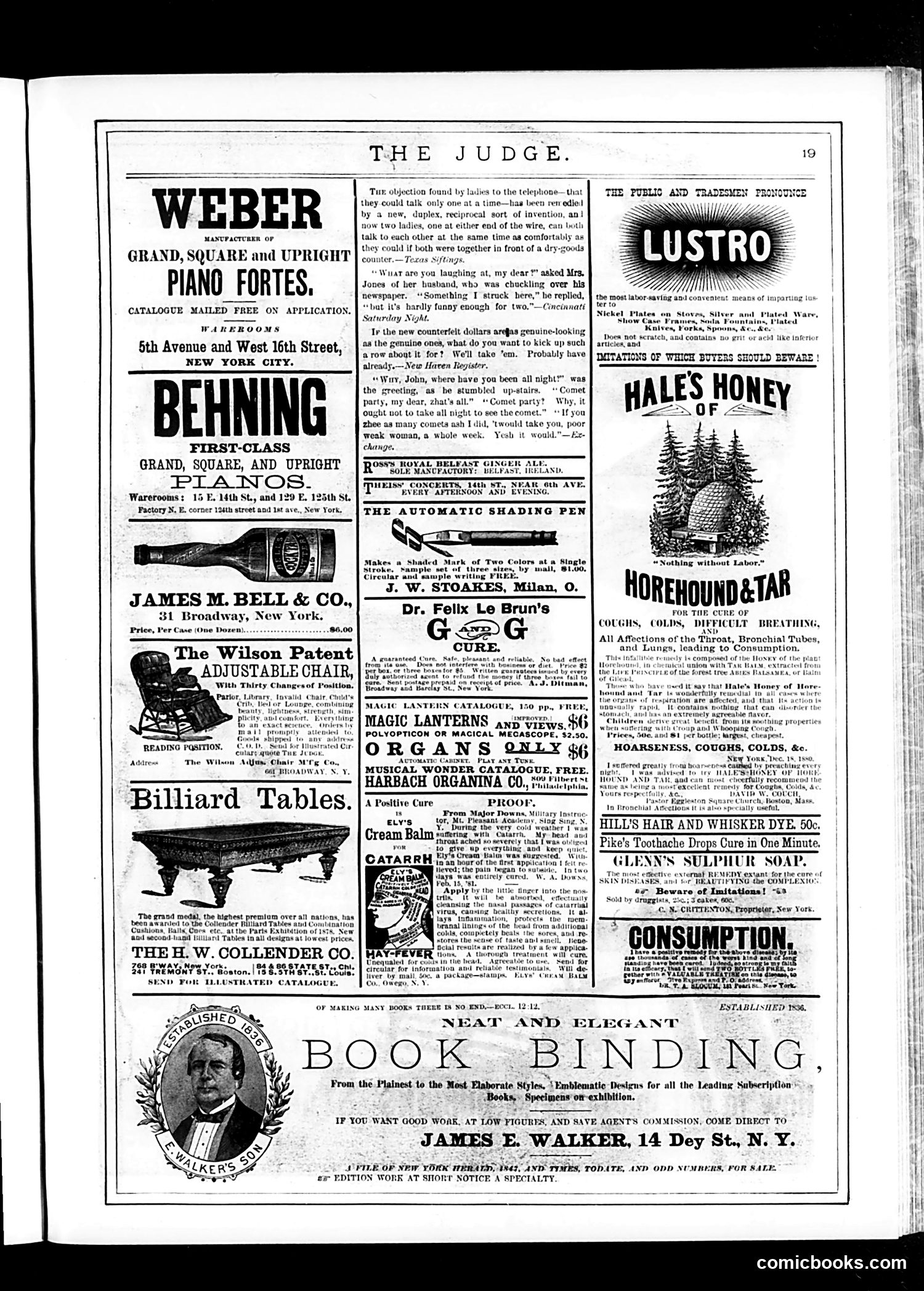
This is primarily an **advertisement page** from *The Judge*, a 19th-century satirical magazine. The page contains mostly commercial ads for pianos, furniture, medical remedies, and printing services typical of the era. Embedded within the advertisements are several **brief humorous quips** rather than developed political cartoons: - A joke about ladies using a new telephone duplex system, poking fun at women's talkativeness - A husband's excuse about seeing multiple "comets" when out all night—a transparent alibi joke - A remark about counterfeit dollars being indistinguishable from real ones These are **light social satire** targeting contemporary concerns: new technology adoption, marital dynamics, and urban crime/counterfeiting. The humor relies on wordplay and domestic situations rather than political commentary. The page demonstrates how *Judge* intermingled advertising revenue with editorial content, and how 19th-century American humor often focused on everyday absurdities and gender stereotypes rather than formal political cartooning.
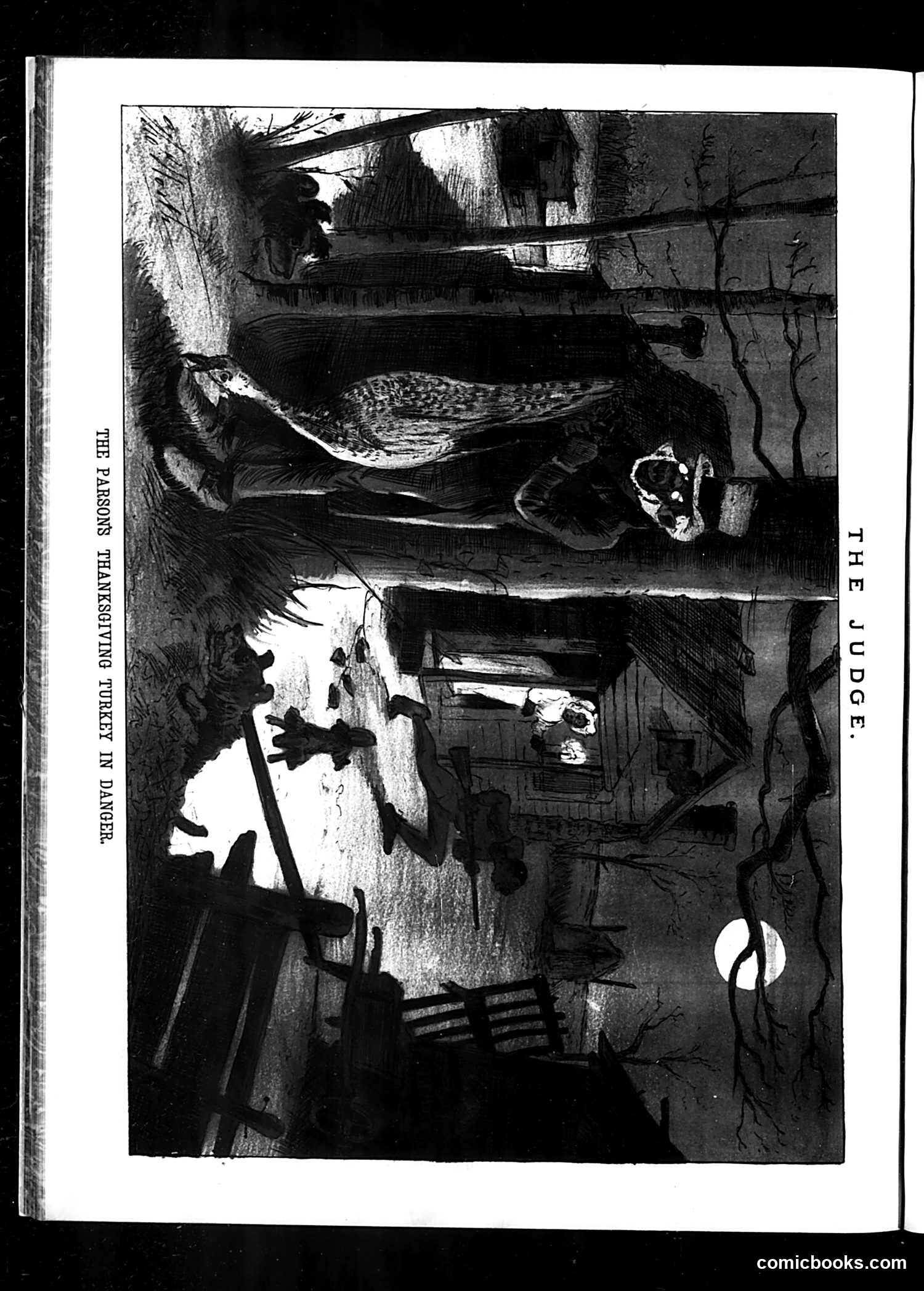
This appears to be a title page or section header from *Judge* magazine, showing "THE JUDGE" as the main text with "THE PARSON'S THANKSGIVING TURKEY IN DANGER" as a caption on the left margin. The etching depicts an interior scene with figures around what appears to be a dining table or room. A turkey is visible, and there are several people in period dress. The composition suggests a domestic or comedic scenario involving the theft or danger to a parson's (clergyman's) turkey—likely satirizing either working-class desperation, clerical hypocrisy regarding charity, or social class tensions. However, without a clear date or additional context, the specific political or social commentary remains unclear. The artistic style and printing technique suggest 19th-century origin.