
A complete issue · 16 pages · 1882
Judge — November 4, 1882
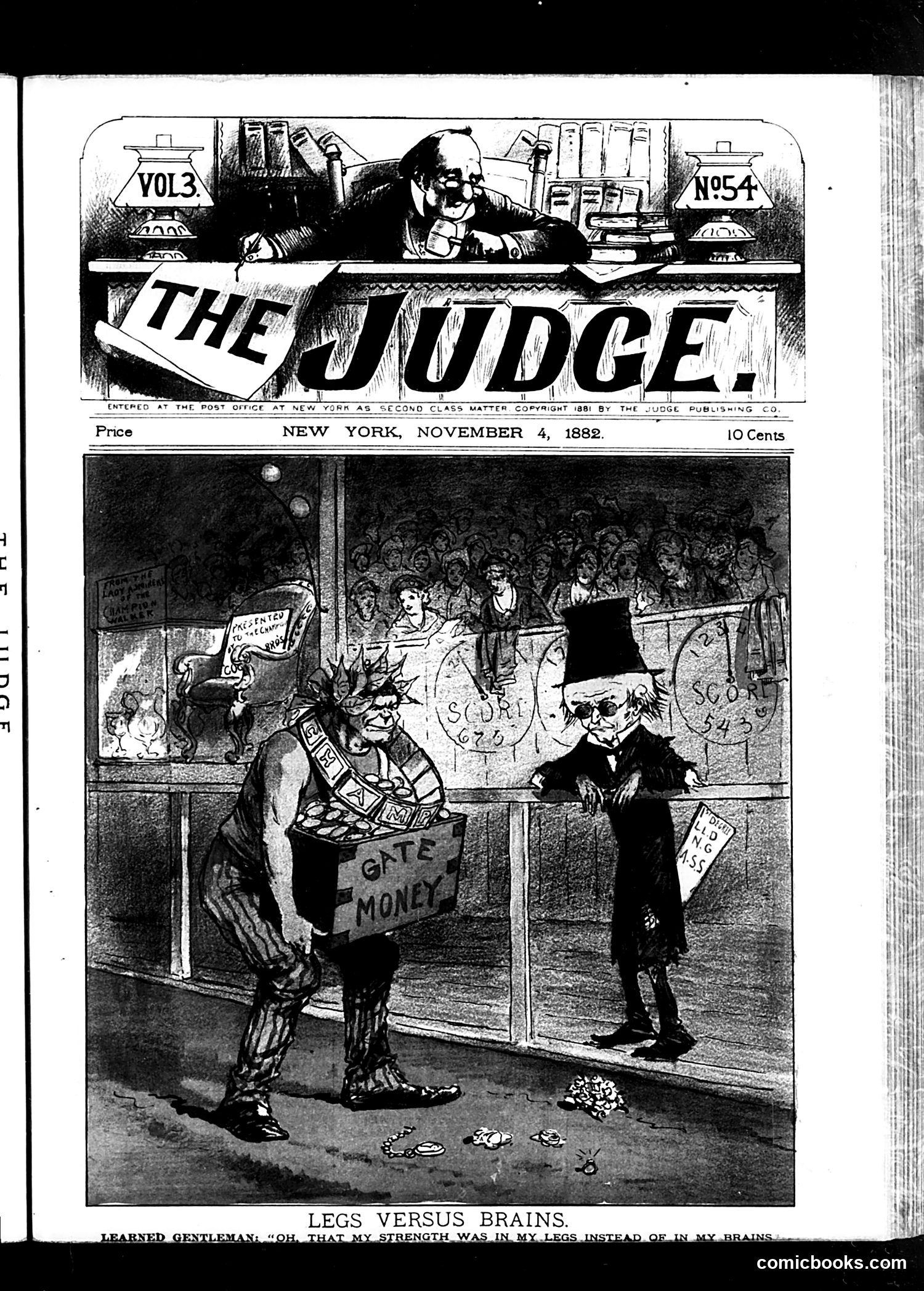
This political cartoon satirizes a boxer or athlete (depicted as a muscular, brutish figure) collecting "gate money" at what appears to be a sporting venue. A well-dressed gentleman in a top hat stands nearby, apparently representing the intellectual class or educated elite. The title "Legs Versus Brains" and the caption—"Learned Gentleman: 'Oh, that my strength was in my legs instead of in my brains'"—suggest the cartoon mocks the disparity between physical prowess and intellectual achievement in terms of financial reward. The gentleman laments that the athlete's physical abilities command higher pay and public attention than scholarly pursuits. This reflects late-19th-century anxieties about American culture prioritizing athletic spectacle and entertainment over intellectual accomplishment.
This page from *Judge* magazine contains several political satires targeting the 1880s Democratic Party during what appears to be a presidential campaign. **"This Way, Sambo"** mocks Democrats for courting the African American vote—using the derogatory term "Sambo"—suggesting this political outreach is transparently cynical, comparing it to steamboat operators competing for passengers. **"The Full and the Fasting"** is an allegory: a railroad conductor admits embezzling money from his Republican employer, but when threatened with dismissal, argues it's cheaper to keep him than hire a hungry Democrat with twenty years of "privation to get even for." The message warns voters that replacing long-corrupt Republicans with Democrats will merely swap one set of thieves for hungrier ones. **"The Coroners"** fragment (text cut off) criticizes the coroner system, which *Judge* claims to have first attacked editorially. Overall, the page reflects *Judge*'s Republican partisan stance, portraying Democratic political appeals as opportunistic and predicting Democratic governance would increase corruption and graft.
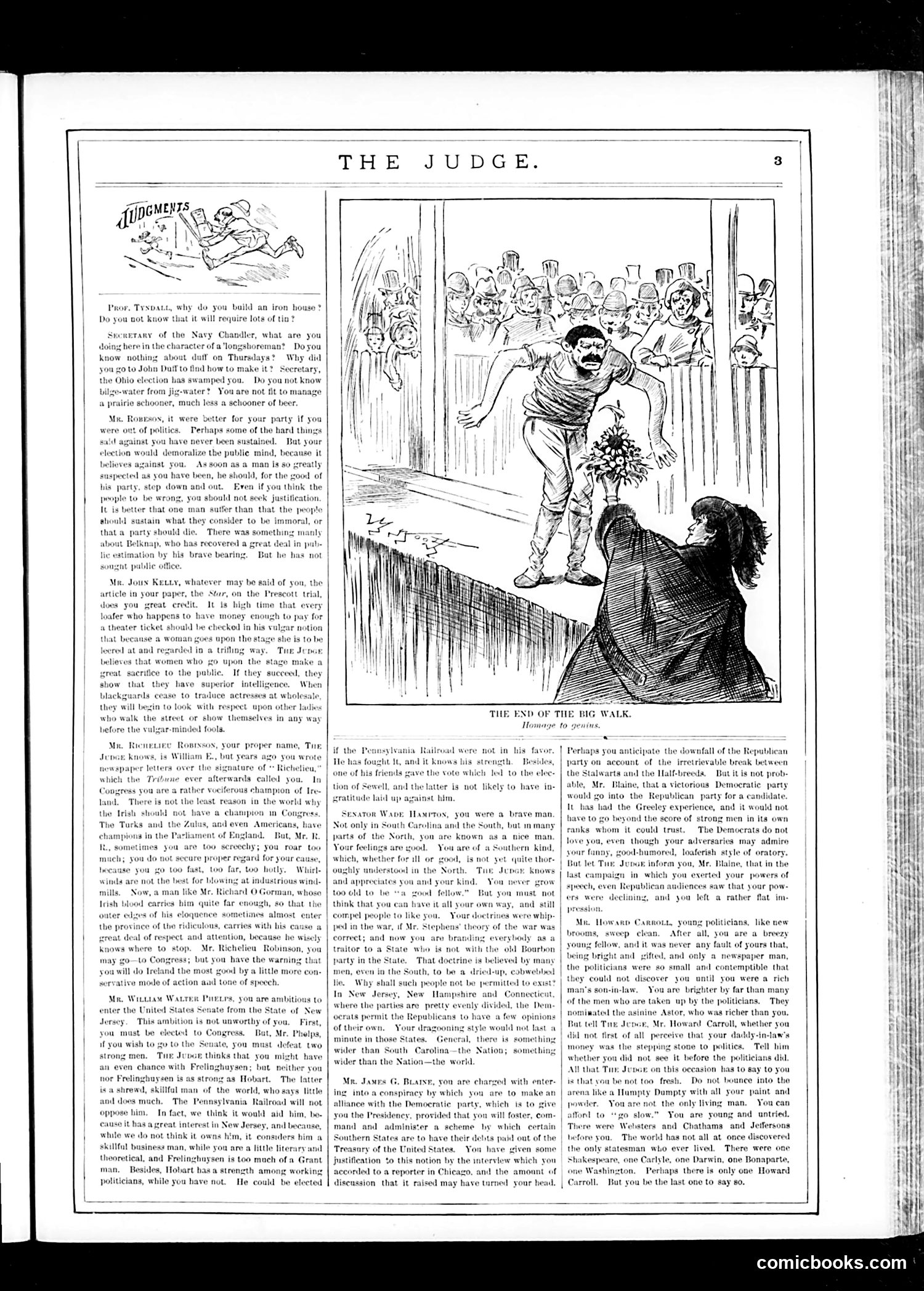
This page from Judge magazine consists primarily of **political commentary letters** rather than illustrated cartoons. The small cartoon at top left ("Judgments") and the illustration titled "The End of the Big Walk" appear secondary to the text. The letters address various 19th-century political figures—including Secretary of the Navy (likely referencing scandals), politicians involved in the Ohio election, and figures from railroad politics. The writing critiques politicians for corruption, inappropriate behavior, and poor judgment, using sarcastic humor typical of Judge's satirical approach. "The End of the Big Walk" illustration appears to depict someone being thrown out or expelled, likely referencing a specific political scandal or embarrassment, though the exact reference is unclear without additional context about contemporary events. The overall tone mocks incompetent or disgraced politicians while praising integrity, suggesting this reflects post-Reconstruction era political reform debates and party scandals that dominated 1870s-80s American politics.
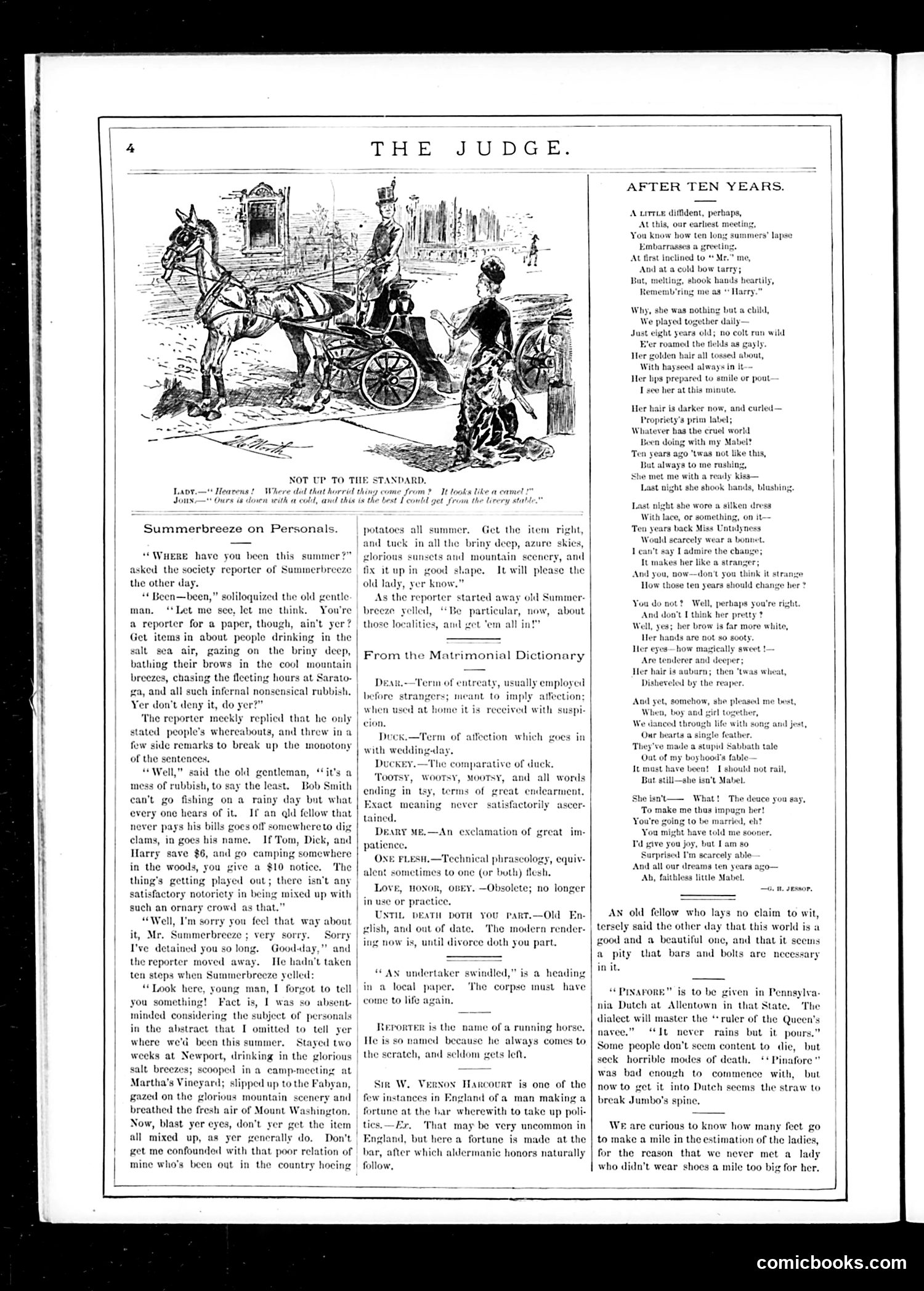
**Main Cartoon ("Not Up to the Standard"):** The illustration shows a well-dressed woman recoiling from a camel on a city street. The caption suggests shock at encountering something inappropriate or out of place in polite society. The satire likely mocks wealthy tourists returning from exotic vacations with unusual souvenirs or experiences that violate Victorian social conventions. **"Summerbreeze on Personals":** This satirizes society newspaper reporters and their coverage of the wealthy's summer activities. An old gentleman complains that society reporters trivialize vacations—mixing his Newport and Martha's Vineyard trips with mentions of his poor relations hoeing potatoes. The joke targets both the vanity of the wealthy seeking newspaper coverage and the reporters' obligatory flattery of society figures. **"Matrimonial Dictionary":** A humorous glossary mocking marital terminology, noting how terms of endearment ("deary," "duckie") lose meaning in marriage, and how promises like "love, honor, obey" are now "obsolete." The page satirizes Victorian-era social pretension and newspaper culture.
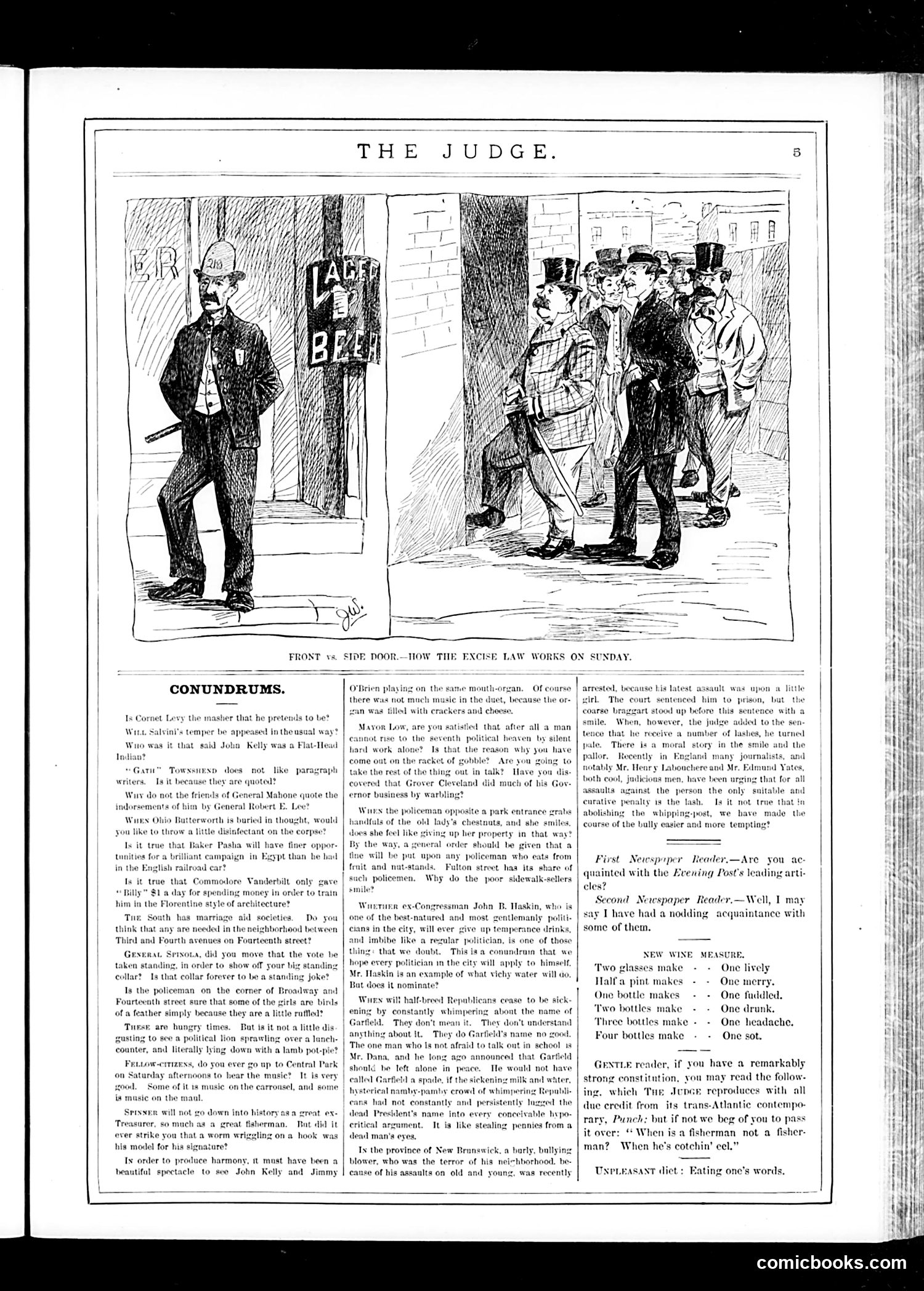
This page satirizes American political and social hypocrisies of the Gilded Age, using a cartoon and humorous Q&A format. **The Main Cartoon** ("Front vs Side Door—How the Excise Law Works on Sunday") depicts the enforcement of Sunday closing laws for saloons. The left panel shows a stern police officer at the front entrance; the right shows patrons freely entering via a side door. The satire: prohibitionist regulations are easily circumvented by the corrupt or connected, making enforcement meaningless. **The "Conundrums" section** contains rhetorical jokes mocking: - Political inconsistency (General Mahone, Republicans) - Vanity among the wealthy (Commodore Vanderbilt) - Police corruption and political favoritism - Hypocrisy around temperance and morality **Notable figures mentioned**: Congressman John R. Haskin (appears as an example of political water-carrying); references to General Mahone and General Robert E. Lee suggest Civil War-era political opportunism. The overall message: laws and moral pronouncements are meaningless when the powerful ignore them with impunity.
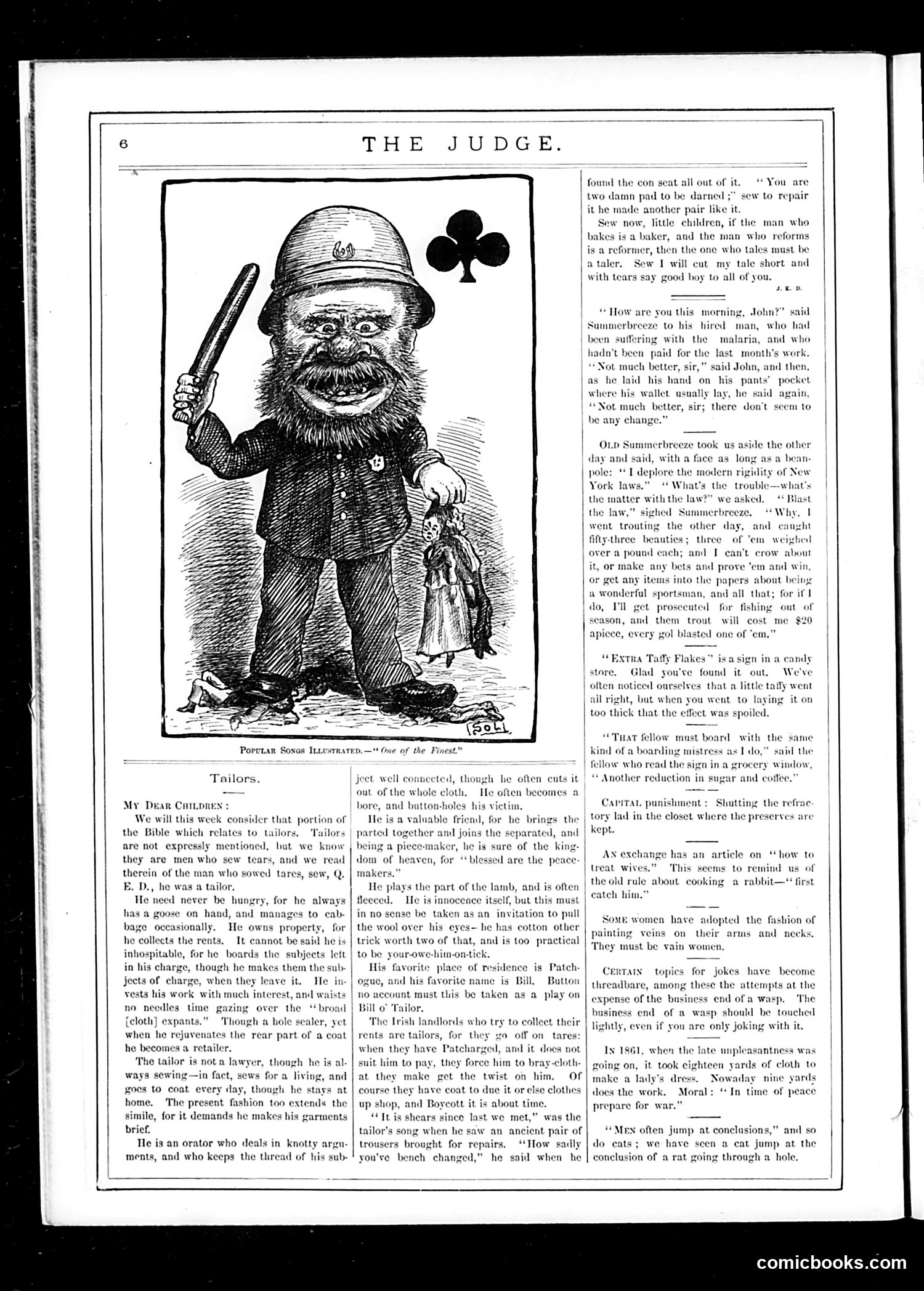
This page contains two satirical pieces: **Main Cartoon:** A caricatured figure labeled "Popular Songs Illustrated—'One of the Finest'" depicts a stout man with a large beard, German-style helmet, and club, holding a small doll-like figure. The club and helmet suggest a German immigrant or stereotype. The club labeled "justice" and the doll suggest mockery of crude or brutal law enforcement—likely satirizing either immigrant police/judges or concerns about foreign influence on American justice systems. **"Tailors" Section:** A lengthy pun-filled essay about tailors uses wordplay (sew/sow, fleece, buttonhole) to satirize tailors' dishonesty—their reputation for cutting cloth fraudulently, overcharging, and using manipulative tactics. The reference to "Irish landlords" and "Boycott" dates this to post-1880s Ireland land wars, extending the satire to ruthless debt collection. **"Old Summerbreeze" anecdote:** Satirizes new game laws restricting fishing—a wealthy man caught fish but cannot boast about it or profit from the catch without legal penalty, mocking overzealous conservation regulations.
This story satirizes the archetypal struggling artist who pesters newspaper editors. The disheveled, aggressive visitor—with long hair, slouch hat, and walking stick—embodies the stereotype of an impractical, bohemian poet. He barges into Judge's offices demanding to know why his submitted poem "An Autumn Siroces" wasn't published. The satire targets both the delusional poet (who insists his work was "too good for publication") and gently mocks the magazine itself through the editor's increasingly exasperated responses. The running joke about the office dog—supposedly trained to eat unwanted manuscripts—pokes fun at the volume of rejected submissions editors endured. The piece reflects 19th-century anxieties about artistic pretension and the gap between aspiring writers' self-assessment and editorial reality. The poet's absurd combativeness and the editor's weary dismissiveness capture the predictable clash between these figures in the publishing world.
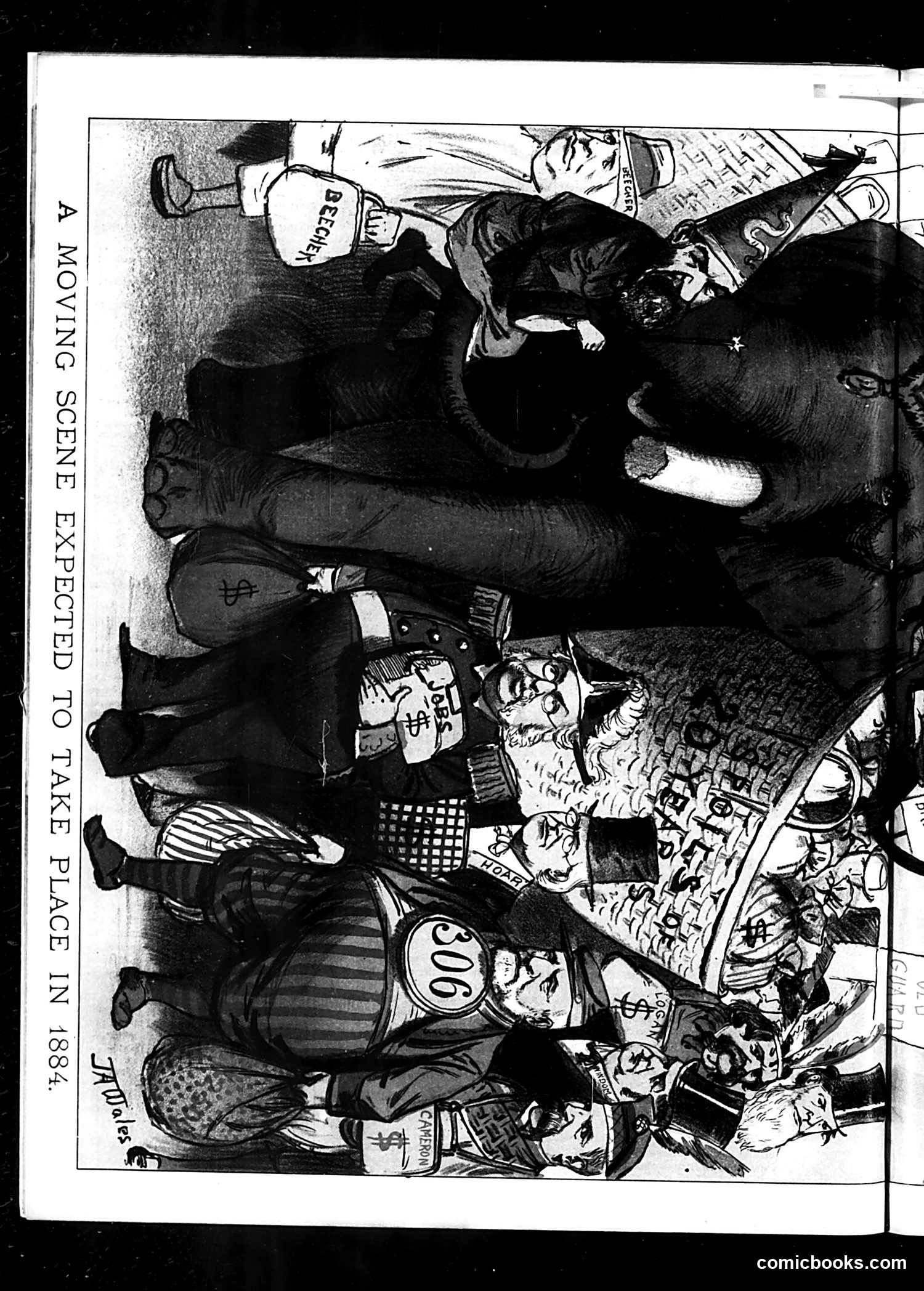
This 1884 *Judge* cartoon satirizes American political anxieties about immigration and labor. The image depicts a chaotic street scene with multiple figures, including what appears to be working-class immigrants and urban disorder—likely referencing contemporary fears about foreign workers and labor unrest. The title's reference to "1884" suggests the cartoonist was making a prediction about future social upheaval. The "moving scene" probably alludes to literal displacement or protest movements expected in that election year. The dense, crowded composition with exaggerated caricatures was typical of *Judge*'s satirical style, using grotesque depictions to mock both immigrant communities and nativist anxieties. Without clearer identifying labels, the specific individuals or events referenced remain unclear, but the overall message criticizes perceived threats to American social order.
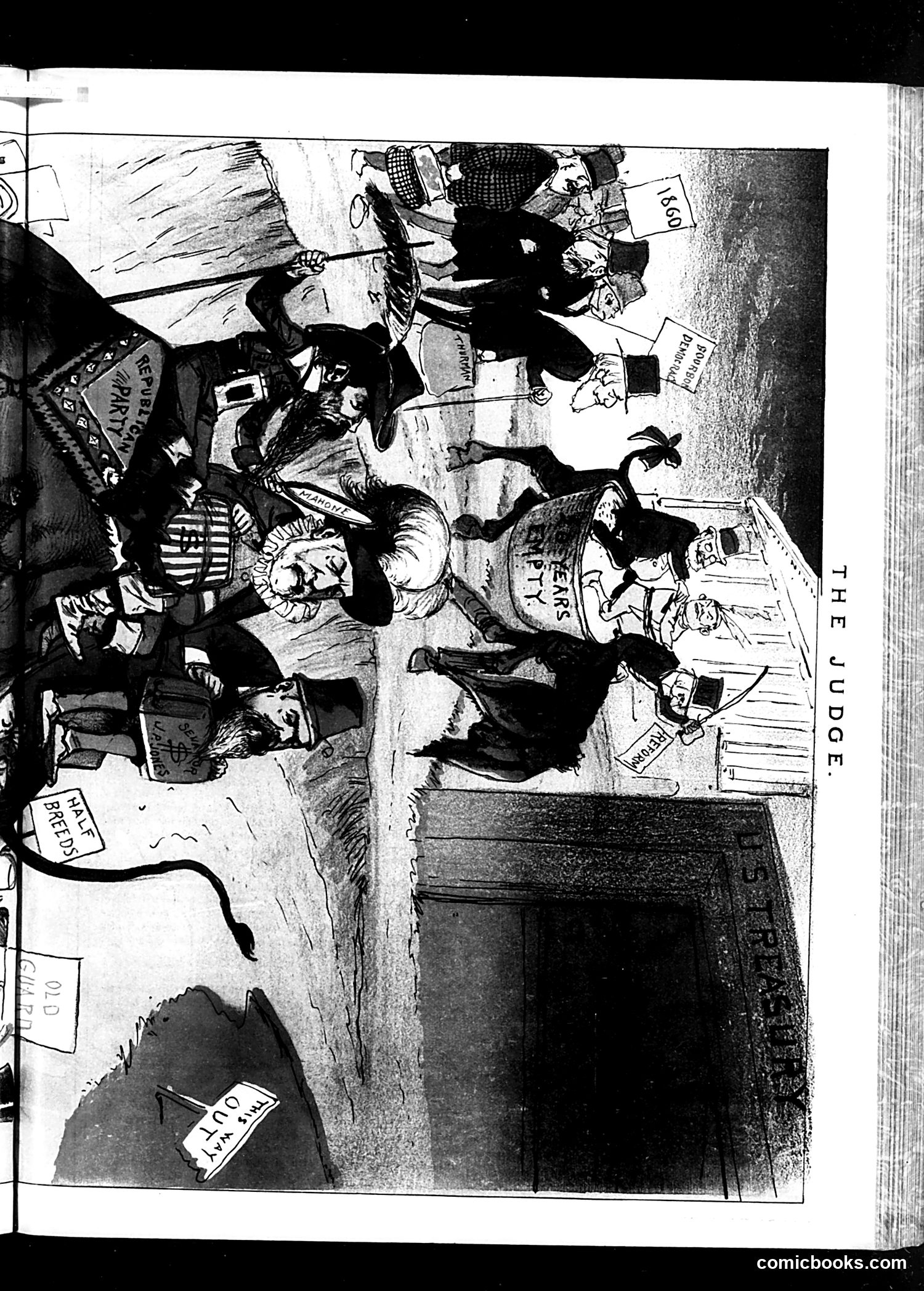
This page is rotated 90 degrees and shows "THE JUDGE" watermark on the spine. The cartoon depicts a courtroom scene with multiple figures in period dress (appearing to be late 19th or early 20th century). Various labels visible include names like "BRED" and what appear to be case or party designations. The satire appears to mock judicial proceedings, possibly targeting corruption, incompetence, or bias in the legal system. Multiple characters are positioned around what seems to be a judge's bench or courtroom furniture, suggesting commentary on how different parties or interests manipulated court outcomes. Without clearer text or specific date information, I cannot definitively identify the particular case or political figures being satirized, though the style is consistent with Judge magazine's typical social and political commentary of that era.
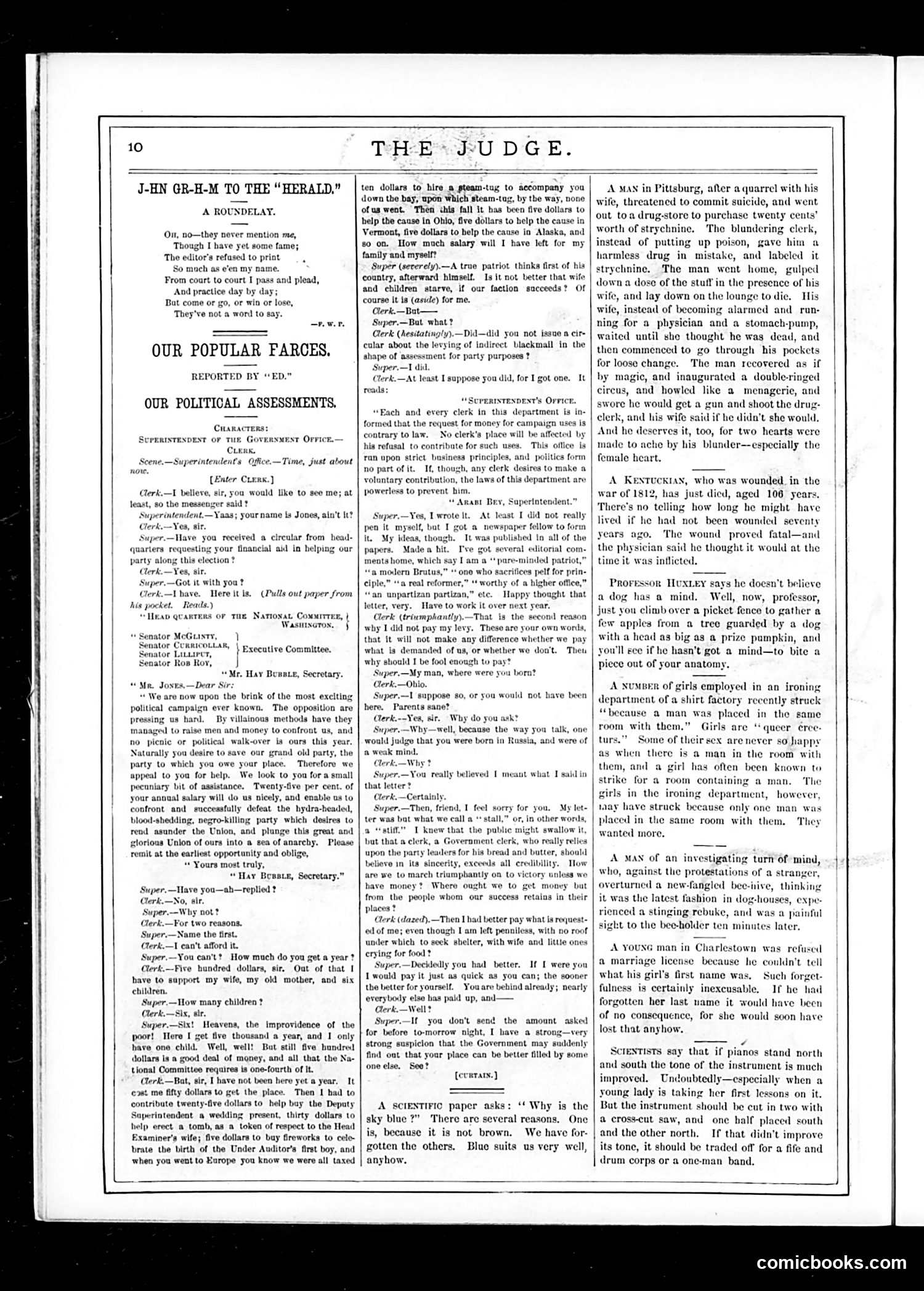
This page contains a satirical theatrical sketch about political corruption during the Gilded Age. The titled piece "J-HN GR-H-M TO THE HERALD': A ROUNDELAY" and the main dialogue present a critique of compulsory political donations from government employees. **The Satire**: A superintendent of a government office (identified as patronage-hired) demands that a junior clerk contribute 25% of his $500 annual salary to the ruling party's election campaign. The clerk protests that he's already been "taxed" for various supposed patriotic causes—funding the superintendent's European trip, wedding gifts, fireworks displays—leaving him unable to support his family. **The Point**: Judge magazine attacks the system of political assessments: forced donations from federal workers to the party in power, justified as patriotic duty. The superintendent's hypocrisy is exposed when he admits he earns five times the clerk's salary but only has one child to support, yet demands sacrifice from a struggling father of six. **Context**: This reflects real Gilded Age corruption where federal jobs were patronage rewards requiring kickbacks to party machines.
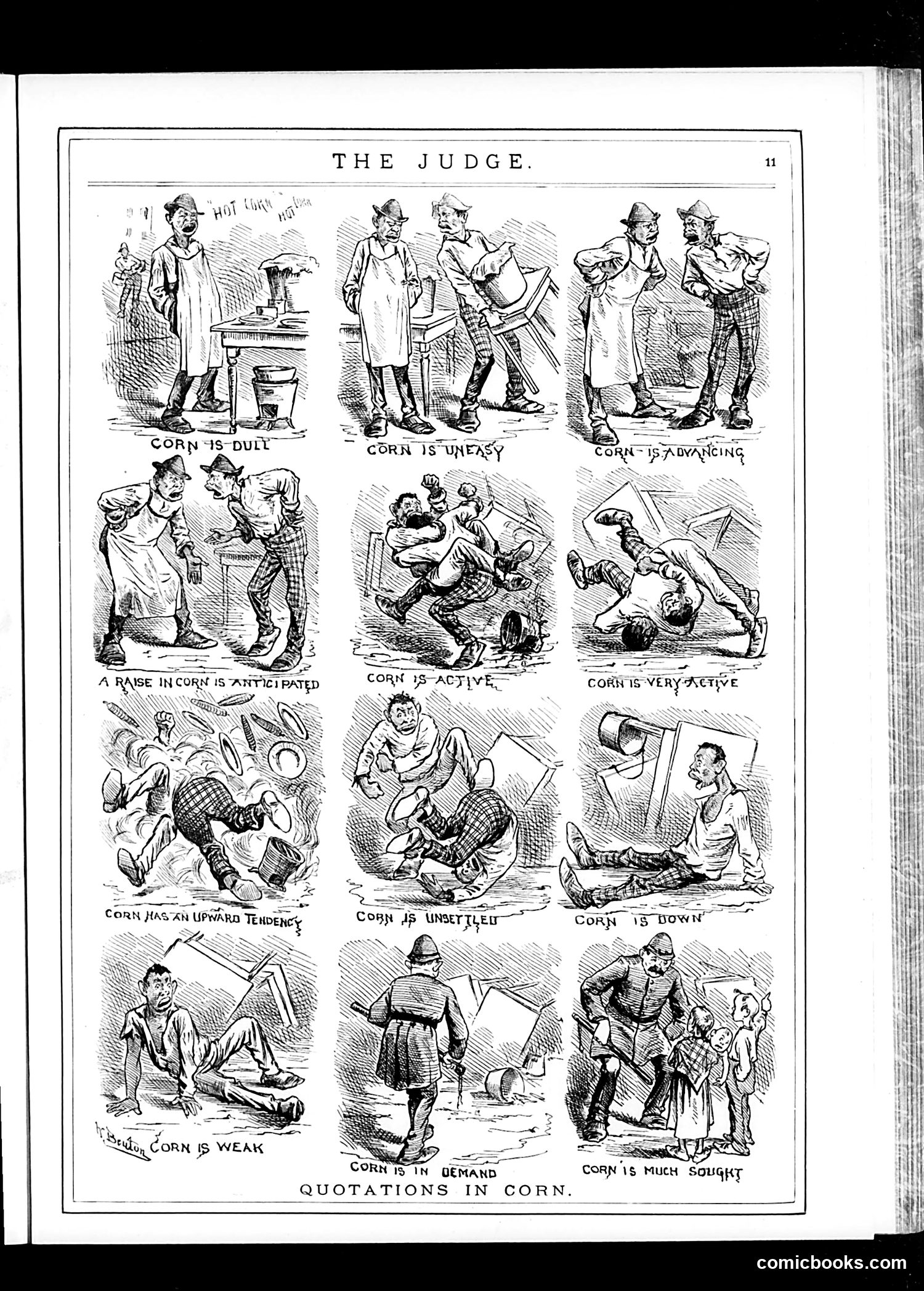
This satirical cartoon uses corn market terminology to mock political or social figures. Each panel shows a person in a different physical state or situation, labeled with stock-market language: "Corn is Dull," "Corn is Uneasy," "Corn is Active," "Corn is Down," "Corn is Weak," etc. The joke appears to be a double entendre—applying financial/commodity jargon to describe people's conditions or behaviors. Without knowing the specific historical context or who these caricatured figures represent, it's unclear whether this targets particular politicians, social types, or general human folly. The cartoonist uses physical comedy and exaggerated poses to visually reinforce each "quotation," treating human circumstances like fluctuating market commodities.
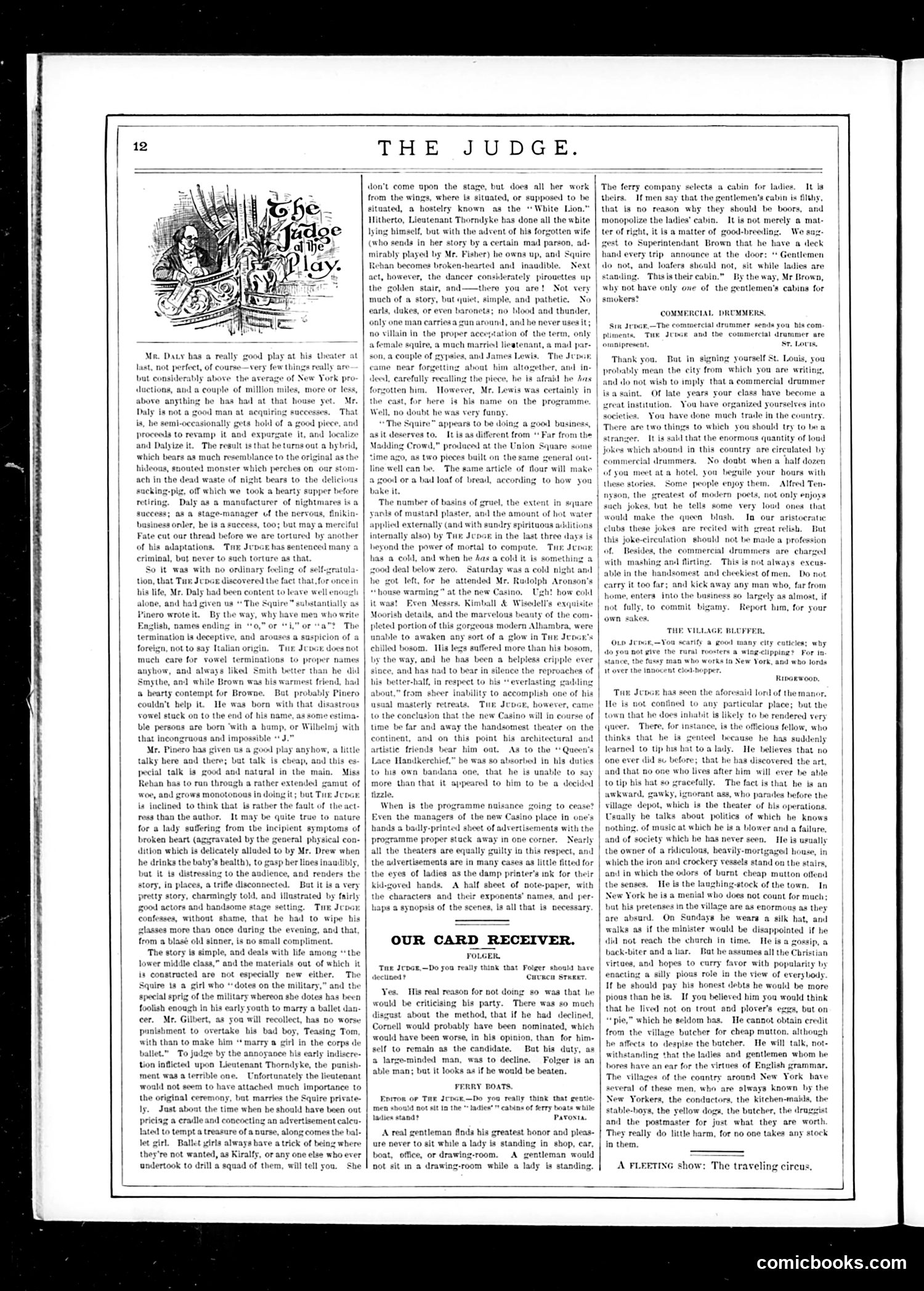
This page from the satirical magazine *Judge* contains theater criticism and social commentary rather than a political cartoon. The main illustration shows "The Judge and the Play"—a masthead or column header for theatrical reviews. The text critiques theatrical adaptations, particularly those by **Augustin Daly**, a prominent theater manager of the era. The author sarcastically praises Daly's "talent" for taking successful plays and "Dalyizing" them—adapting and localizing them so heavily they become unrecognizable hybrids. The piece reviews a play called "The Squire," critiquing its theatrical staging (particularly inaudible delivery) while praising its charming story about a military romance in the "lower middle class." The satire targets Daly's overzealous adaptation methods and theater management practices, representing a common *Judge* complaint about Broadway producers prioritizing spectacle and localization over respecting original works.
This page is primarily **advertisements and reader correspondence**, not political satire. The visible cartoon elements are minimal. The main content includes: **"Whiffs with Correspondents"** — a letters section where readers pose questions to Judge's editors, who respond with brief, often punny answers. One visible example involves a landlord and tenant discussing a toothpick box—apparently a mild joke about domestic life. **Extensive advertising** dominates the page, hawking period remedies and products: hair restoration, rheumatism cures, "electro-voltaic" medical devices, and beauty creams. These ads reflect typical late-19th-century patent medicine marketing targeting readers' health anxieties. There's also an **"Improved Magic Lantern"** advertisement (an early projection device) and various printing/publishing services. **No clear political figures or references** are identifiable in the visible content. This appears to be a standard Judge issue page mixing light humor with commercial advertising—reflecting how satirical magazines sustained themselves through paid advertisements.
This is primarily an **advertising page** from Judge magazine, not a satirical cartoon page. The page consists almost entirely of commercial advertisements for late 19th-century products and services. The few text excerpts interspersed among ads appear to be humorous quips or brief satirical comments typical of Judge's style: - A joke about a colored citizen asking when a man gets "trouble ob defeat" (unclear reference, possibly election-related) - A quip about newspapers lying about public figures seeking office - A comment contrasting infant innocence with adult newspaper deception These snippets represent Judge's typical satirical commentary on politics and society, but without fuller context or accompanying illustrations, their specific targets remain unclear. The advertisements dominate the page, promoting patent medicines (blood purifiers, toothache drops), household goods, musical instruments (pianos, organs), and French novels—reflecting common consumer products of the era. **Overall: This is an ad-heavy page with minor satirical content rather than a substantive political cartoon page.**
This page is predominantly **advertisements** with minimal satirical content. The upper portion contains brief humorous items—likely filler jokes between ads—rather than cartoons. The visible humor includes: - A jab at Ohio Democrats (referencing the October election) - A joke about a Mississippi father's whisky-fueled temperance essay contest - A quip about Circassian beauty prices The bulk of the page advertises consumer products typical of the era: Weber pianos, asthma remedies, Dobbins' Starch Polish (heavily promoted), the Monarch shipping line, a patent chair, and book-binding services. **No identifiable political figures or caricatures appear.** The Dobbins' Polish ad includes generic illustrations of women doing laundry—stock imagery, not satire. This represents Judge functioning as a commercial magazine relying on paid advertisements to sustain itself, with editorial content secondary.
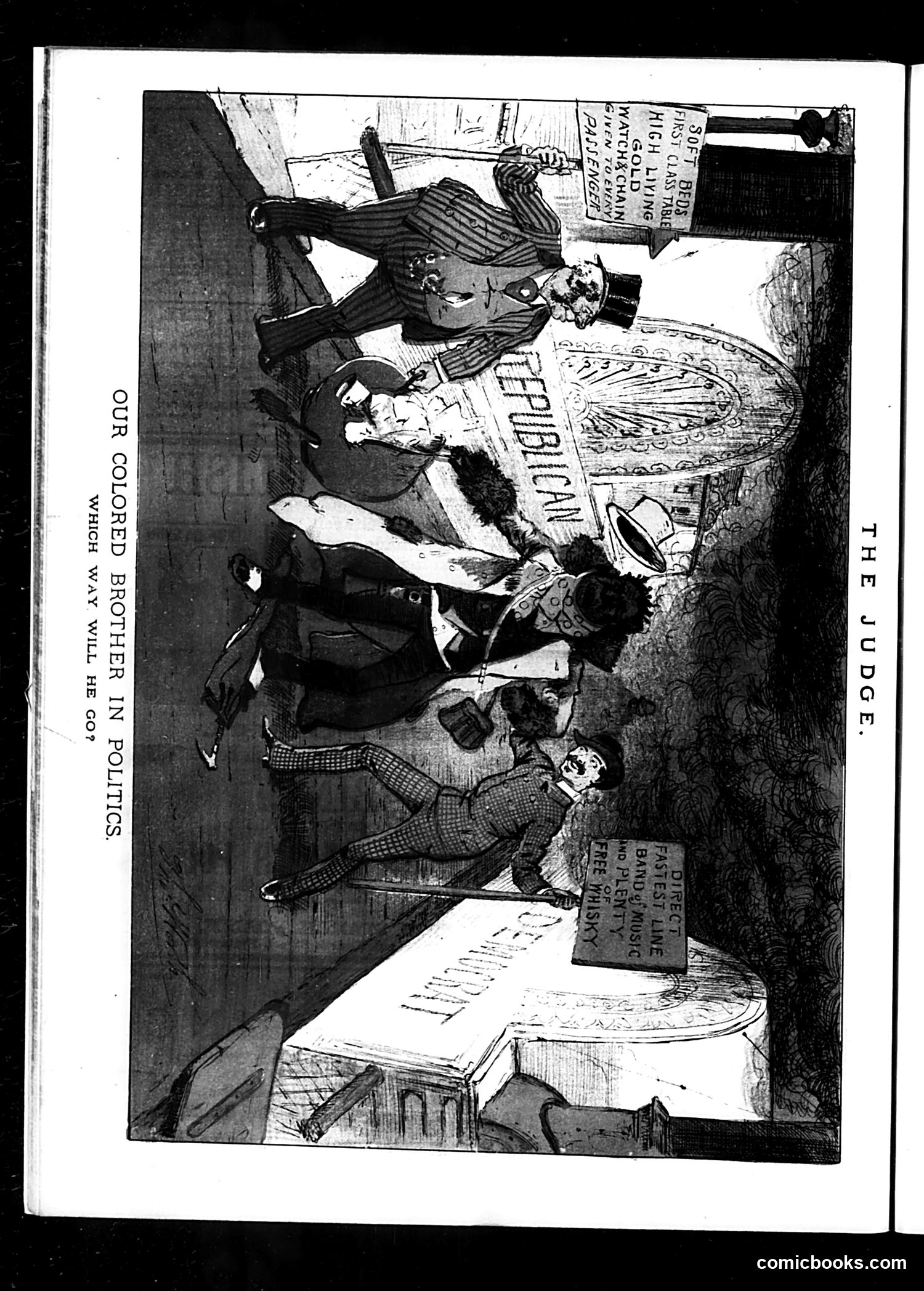
This satirical cartoon depicts an African American man ("colored brother") positioned uncertainly between competing political forces, representing the pivotal voting bloc's importance during the Reconstruction or Gilded Age era. The figure is surrounded by temptations and inducements labeled "high living," "gold," "watch chain"—suggesting political corruption and vote-buying tactics both parties allegedly employed to secure Black voters' support. The title "Which way will he go?" frames African Americans as a deciding political force whose loyalty was contested. The cartoon satirizes how both parties viewed Black voters primarily as bargaining chips to be swayed through material incentives rather than genuine political engagement. This reflects contemporary anxieties about African American political participation and voting power during a period of intense partisan competition.