
Judge, 1882-11-04 · page 10 of 16
Judge — November 4, 1882 — page 10: what you’re looking at
What you’re looking at
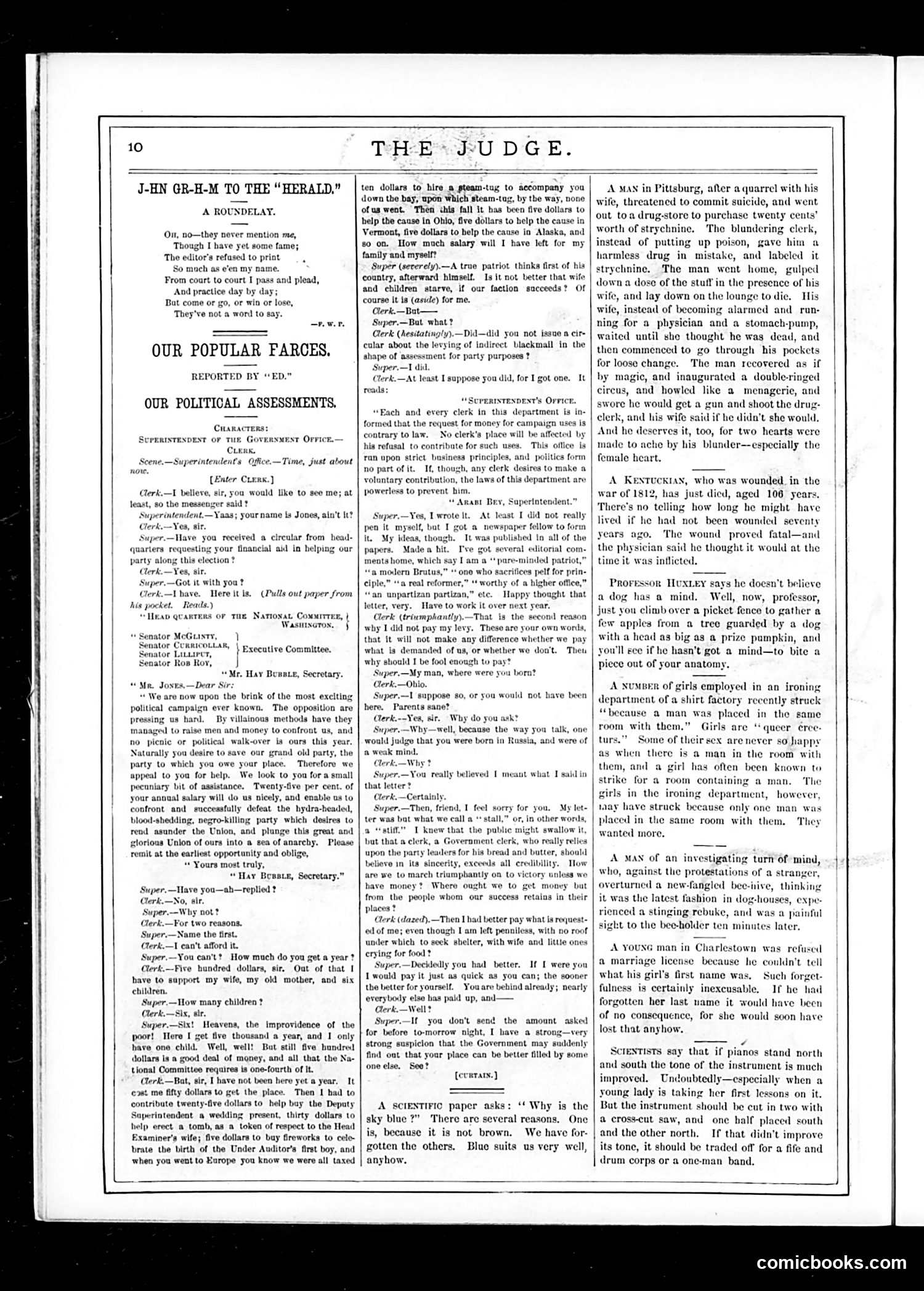
This page contains a satirical theatrical sketch about political corruption during the Gilded Age. The titled piece "J-HN GR-H-M TO THE HERALD': A ROUNDELAY" and the main dialogue present a critique of compulsory political donations from government employees. **The Satire**: A superintendent of a government office (identified as patronage-hired) demands that a junior clerk contribute 25% of his $500 annual salary to the ruling party's election campaign. The clerk protests that he's already been "taxed" for various supposed patriotic causes—funding the superintendent's European trip, wedding gifts, fireworks displays—leaving him unable to support his family. **The Point**: Judge magazine attacks the system of political assessments: forced donations from federal workers to the party in power, justified as patriotic duty. The superintendent's hypocrisy is exposed when he admits he earns five times the clerk's salary but only has one child to support, yet demands sacrifice from a struggling father of six. **Context**: This reflects real Gilded Age corruption where federal jobs were patronage rewards requiring kickbacks to party machines.
📄 Transcribed text from this page (OCR, searchable)
Machine-transcribed from the original scan — historical spelling and the odd misread are preserved.
THE JUDGE. J-HN GR-H-M TO THE “HERALD,” A ROUNDELAY. On, no—they never mention me, Though I have yet some fame; The editor's refused to print So much as e’en my name. From court to court I paas and plead, And practice day by d: Bat come or go, or win oF lose, They've not a word to say. OUR POLITICAL ASSESSMENTS. Cuanacters: SUPERINTENDENT OF TUE GovERNMEST Orrice.— CheRK. Scene.—Superintenlent’s Office.—Time, just about (Enter Curr.) Clerk. believe, sir, you would like to see me; at ast, 80 the messenger said t perintendent.—Yaas; your name is Jones, ain't it? Clerk.—Yea, ai Super.—Have you received a circular from head- quarters requesting your financial aid in helping our party along this election ? Clerk.—Yes, sit. jot it with you? Clerk.—U have. Here it is. Reads.) “Heap Qvaxrers or Tig Narioxat Was Super— (Pulls out paper from his pocket, OMMITTEE, | INGTON. | f or 3 or CURRICOLLAR, |p. 16 Coie ore ieiner wt } Executive Committee. ¢ Ros Roy, sty, Sen. “Mr. Hay Buna, Secretary. Mr. Joxes.—Dear Sir: * We are now upon the brink of the most exciting mpaign ever known, The opposition are J. By villainous methods have they men and money to confront us, and 0 picnic of political walk-over is ours this year. Naturally you desire to save our grand old party, the party to which ur place. Therefore we appeal to you for help. We look to yon for a small pecuniary bit of assistance, Twenty-five per cent. of your annual salary will do us nicely, and enable us to confront and successfully defeat the hydra-headed, blood-shedding, negro-killing party which desires to rend asunder the Union, and plunge this great and glorious Union of ours into a sea of anarchy. Please remit at the earliest opportunity and oblige, “+ Yours most truly, “Hay Bessie, Secretary.” Super.—Mave you—ah—replied ? Clerk.—I can't afford it. Super.—You can’t? How much do you get a year? Clerk.—Five hundred dollars, sir, Out of that 1 have to support my wife, my old mother, and six children. Super.—How many children ? Clerk. x, sir. Super.—Sixt Heavens, the improvidence of the poor! Here I get five thousand a year, and I only have one child. Well, well! But still five hundred dollars is a good deal of money, and all that the Na- tional Committee requires is one-fourth of It. Clerk. —Bat, sir, I have not been here yet a year. It cost me fifty dollars to get the place. Then I had to contribute twenty-five dollars to help bay the Deputy Saperintendent a wedding present, thirty dollars to help erect a tomb, as a token of respect to the Head Examiner's wife; five dollars to buy reworks to celo- brate the birth of the Under Auditor's first boy, and when you went to Europe you know we were all taxed ten dollars to hire gteam-tug to accompany you down the bay, upon Which steam-tag, by the way, none ofus went, Then this fall It has been five dollars to help the cause in Ohio, five dollars to help the cause in Vermont, five dollars to help the cause in Alaska, and so on. How much salary will I have left for my family and myself? ‘Super (sererely).—A trae patriot thinks first of his country, afterward himself. Is it not better that wife and children starve, if our faction sacceeds? Of course it is (aside) for me. Qlerk.—Bat— Super.—But what? Gerk (hesitatingly).—Did—did you not issue a cite cular about the levying of indirect blackmail in the shape of assessment for party purposes ? Super. did. Clerk.—At least I suppose you did, for I got one. It reads: “ SUrERINTENDENT’s Orricr. “Each and every clerk in this departmen formed that the request for money for camp contrary to law. No clerk's place will be affect his refasal to contribute for such uses. This offict ran upon strict business principles, and politics form no part of it. If, thou y clerk desires to make a voluntary contribution, the laws of this departr powerless to prevent him. “ Anant Bry, Superintendent.” Yes, I wrote it. At least I did not really It myself, but I got a newspaper fellow to forin though, It was published Io all of the a hit. 1 editor ments home, whi minded “a modern Brutus,” “ono who sacrifices pelf for prin- ciple,” ‘a real reformer,” “ worthy of a higher offic “an unpartizan partizan,” ete. Happy thought that letter, very. Have to work it over next year, Clerk (trinmphantly).—That is the second reason why I did not pay my levy, These aro your own words, that It will not make any difference whether we pay what is demanded of ua, or whether we don't. Then why should I be fool enough to pay? Super.—My man, where were y« Clerk.—O0 Super.—1 suppose 80, or you would not have been here. Parents sane Clerk.--Yes, sit. Why do you ask? Vhy—well, because the way you talk, would judge that you were born in Ru a weak mind. Clerk. —Why t —You really believed 1 me that letter? Clerk, Certainly. Super.—Then, friend, I feel sorry for you. My let- ter was bat what we call a ** stall,” or, in other words, a ‘stiff I knew that the pul t swallow it but that a clerk, a Government clerk, who really relies y leailers for his bread and butter, should believe in its sincerity, exceeds all credibility. Tow are we to march triumphantly on to victory unless we Where ought we to get money but from the people whom our success retains in their places ? Super. born? Super.— Super. ia, and wer Super at what I said in upon the py have money ? Clerk (dazed).—Then I had better pay what is request ed of me; even though I am left penniless, with no roof under which to seek shelter, with wife and litue crying for food ? Super.—Deciledly you had better. If I were I would pay it just as quick as you can; the sooner the better for yourself. You are behind already; nearly everybody else has paid up, and— Cerk.—Well? Super.—It you don't send for before to-morrow night, I have a strong—very strong suspicion that the Government may suddenly find out that your place can be better filled by one else. See? the amount asked [ecrraty.) ‘A ScleNTIFIC paper asks: ‘* Why is the sky blue 7” There are several reasons, One is, because it is not brown. We have for- | gotten the others. Blue suits us very well, | anyhow. A MAN in Pittsburg, after a quarrel with his wife, threatened to commit suicide, and went out toadrug-store to purchase twenty cents’ worth of strychnine. The blundering clerk, instead of putting up poison, gave him a harmless drug in mistake, and labeled it strychnine. The man went home, gulped down a dose of the stuf! in the presence of his wife, and lay down on the lounge to die. His wife, instead of becoming alarmed and run- ning for a physician and a stomach-pump, waited until she thought he was dead, and then commenced to go through his pockets for loose change. The man recovered as if by magic, and inaugurated a double-ringed cireus, and howled like a menagerie, and swore he would get a gun and shoot the drug- clerk, and his wife said if he didn’t she would. And he deserves it, too, for two hearts were made to ache by his blunder—especially the female heart. A KENTUCKIAN, who was wounded in the war of 1812, has just died, aged 106 years. ‘There's no telling how long he might’ have lived if he had not been wounded seventy ‘The wound proved fatal—and the physician said he thought it would at the time it was inflicted. years ago. Proressor HUuxLey says he doesn’t believe a dog has a mind. Well, now, professor, just you climb over a picket fence to gather a few apples from a tree guarded by a dog with a head as big as a prize pumpkin, and you'll eee if he hasn't got a mind—to bite piece out of your anatomy, A Sumber of girls employed in an ironing department of a shirt factory recently struck “because a man was placed in the same room with them.” tu Girls are “queer éree- Some of their sex are never so happy as when there is a man in the room with them, and a girl has often been known to strike for a room containing a man. The girls in the ironing department, however, taay have struck because only one man was placed in the same room with them. They wanted more, . A MAN of an investigating turn of mind, who, against the protestations of a stranger, overturned a new-fangled bee-iive, thinking it was the latest fashion in dog-houses, expe enced a stinging rebuke, and was a painful ight to the bee-holder ten minutes later, A YouNG man in Ch 8 refused a marriage license because he couldn't tell what his girl’s first name was. Such forget- fulness is certainly inexcusable. If he had forgotten her last uame it would have been of no consequence, for she would soon have lost that anyhow. stown Wi SCIENTISTS say that if pianos stand north and south the tone of the instrument is much improved. Undoubtedly—especially when a young lady is taking her first lessons on it. But the instrument should be cut in two with a cross-cut saw, and one half placed south and the other north. If that didn’t improve its tone, it should be traded off for a fife and drum corps or a one-man band. comicbooks.com