
Judge, 1882-11-04 · page 2 of 16
Judge — November 4, 1882 — page 2: what you’re looking at
What you’re looking at
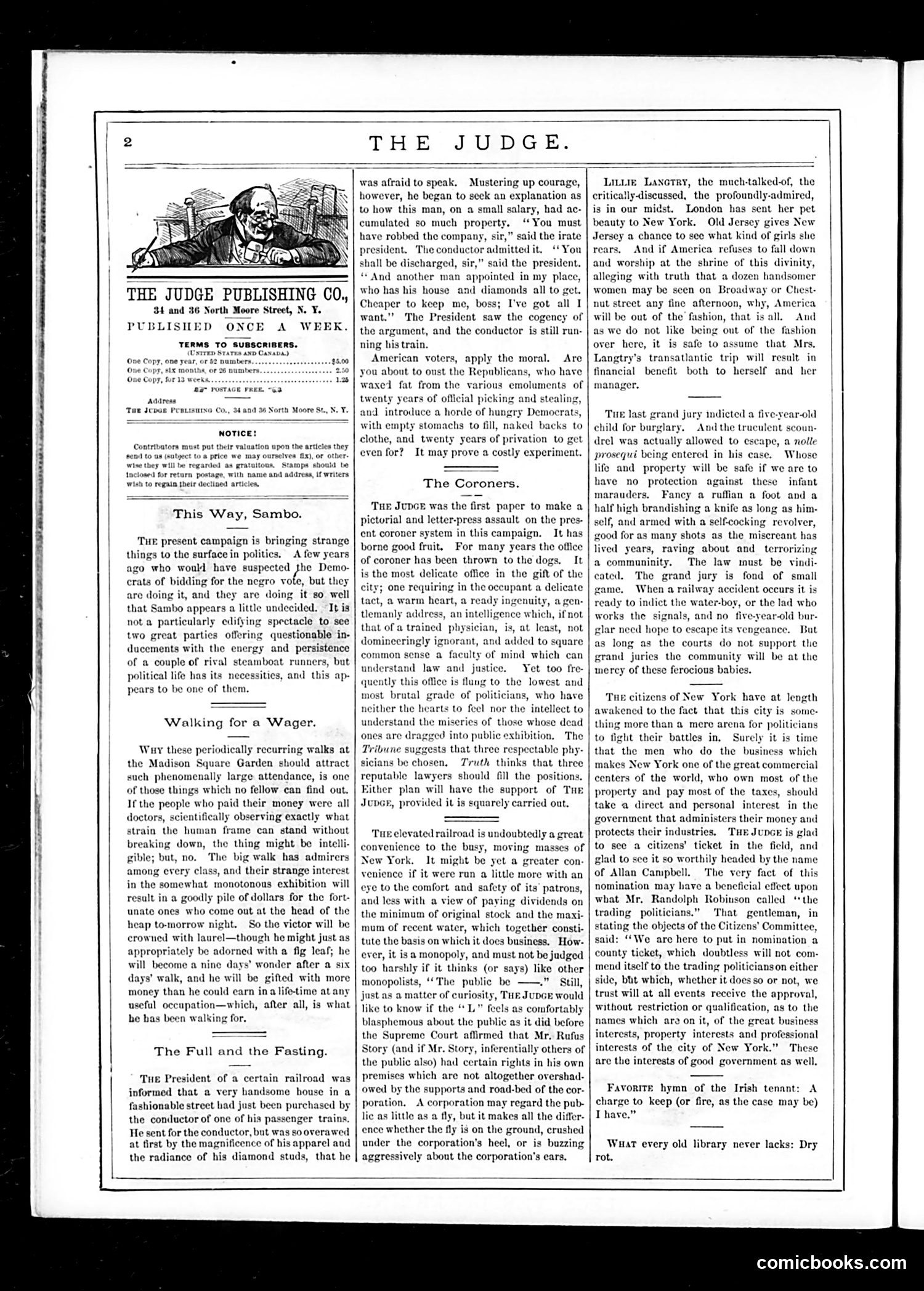
This page from *Judge* magazine contains several political satires targeting the 1880s Democratic Party during what appears to be a presidential campaign. **"This Way, Sambo"** mocks Democrats for courting the African American vote—using the derogatory term "Sambo"—suggesting this political outreach is transparently cynical, comparing it to steamboat operators competing for passengers. **"The Full and the Fasting"** is an allegory: a railroad conductor admits embezzling money from his Republican employer, but when threatened with dismissal, argues it's cheaper to keep him than hire a hungry Democrat with twenty years of "privation to get even for." The message warns voters that replacing long-corrupt Republicans with Democrats will merely swap one set of thieves for hungrier ones. **"The Coroners"** fragment (text cut off) criticizes the coroner system, which *Judge* claims to have first attacked editorially. Overall, the page reflects *Judge*'s Republican partisan stance, portraying Democratic political appeals as opportunistic and predicting Democratic governance would increase corruption and graft.
📄 Transcribed text from this page (OCR, searchable)
Machine-transcribed from the original scan — historical spelling and the odd misread are preserved.
THE JUDGE. THE JUDGE PUBLISHING CO, 34 and 36 North Moore Street, Ne ¥. PUBLISHED ONCE A WEEK. TERMS TO CRIBERS. (Ustren Starea ax Caxaba) One Copy, one year, of 82 nun py, six One Copy, for 13 weeks. " . Ba rostac “sa Agares ‘Tae Icvor PraLIsUIxe Co. 34and M North Moore St, N.Y. NOTICE! Contribators must put thelr valaation upon the articles they rent to us (satyect to a price we may ourselves fx), oF other- wise they will be regarded as gr Stamps should be tnclosed for retarn postage, with name and address, if writers wish to regain their decliped articles, This Way, Sambo. ‘Tue present campaign is bringing strange things to the surface in politics. A few years ago who would have suspected the Demo- crats of bidding for the negro vote, but they are doing it, and they are doing it so well that Sambo appears a little undecided. “It is not a particularly edifying spectacle to see two great parties offering questionable in- ducements with the energy and persistence of a couple of rival steamboat runners, but political life has its necessities, and this ap- pears to be one of them. Walking for a Wager. Wuy these periodically recurring walks at the Madison Square Garden should attract such phenomenally large attendance, is one of those things which no fellow can find out. If the people who paid their money were all doctors, scientifically observing exactly what strain the human frame can stand without breaking down, the thing might be intelli- gible; but, no. The big walk has admirers among every class, and their strange interest in the somewhat monotonous exhibition will result in a goodly pile of dollars for the fort- unate ones who come out at the head of the heap to-morrow night. So the victor will be crowned with laurel—though he might just as appropriately be adorned with a fig leaf; he will become a nine days’ wonder after a six days’ walk, and he will be gifted with more money than he could carn ina life-time at any useful occupation—which, after all, is what he bas been walking for. The Full and the Fasting. Tue President of a certain railroad was informed that a very handsome house in a fashionable street had just been purchased by the conductor of one of his passenger trains. He sent for the conductor, but was so overawed at first by the magnificence of his apparel and the radiance of his diamond studs, that he afraid to speak. Mustering up courage, however, he began to seek an explanation as to how this man, on a small salary, had ac- cumulated so much property. “You must have robbed the company, sir,” said the irate president. The conductor admitted it, ‘You shall be discharged, sir,” said the president. And another man appointed in my place, who has his house and diamonds all to get. Cheaper to keep me, boss; I've got all I want.” The President saw the cogency of the argument, and the conductor is still run- ning his train. American voters, apply the moral. Are you about to oust the Republicans, who have waxed fat from the various emoluments of twenty years of official picking and stealing, and introduce a horde of hungry Democrats, with empty stomachs to fill, naked backs to clothe, and twenty years of privation to get even for? It may prove a costly experiment. The Coroners. ‘Tue Jupce was the first paper to make a pictorial and letter-press assault on the pres: ent coroner system in this campaign. It has borne good fruit. For many years the office of coroner has been thrown to the dogs. It is the most delicate office in the gift of the city; one requiring in the occupant a delicate tact, a warm heart, a ready ingenuity, a gen- tlemanly address, an intelligence which, if not tof a trained physician, is, at least, not dominceringly ignorant, and added to square common sense a faculty of mind which can understand law and justice. Yet too fre- quently this office is flung to the lowest and most brutal grade of politicians, who have neither the hearts to feel nor the intellect to | understand the miseries of those whose dead ones are dragged into public exhibition, The Tribune suggests that three respectable phy sicians be chosen, Truth thinks that three reputable lawyers should fill the positions. Either plan will have the support of Tue JupGe, provided it is squarely carried out. ‘Tue elevated railroad is undoubtedly a great convenience to the busy, moving masses of New York. It might be yet a greater con- venience if it were run a little more with an eye to the comfort and safety of its’ patrons, and less with a view of paying dividends on the minimum of original stock and the maxi- mum of recent water, which together consti- tute the basis on which it does business. How- ever, it isa monopoly, and must not be judged too harshly if it thinks (or says) I monopolists, “The public be ——.” Still, just as a matter of curiosity, Tue JupcE would like to know if the “L” feels as comfortably blasphemous about the public as it did before the Supreme Court affirmed that Mr. Rufus Story (and if Mr. Story, inferentially others of the public also) had certain rights in his own premises which are not altogether overshad- owed by the supports and road-bed of the cor- poration, A corporation may regard the pub- lic as little as a fly, but it makes all the differ- ence whether the fly is on the ground, crushed under the corporation's heel, or is buzzing aggressively about the corporation's ears. Litiie Lanotry, the much-talked-of, the critically-diseussed, the profoundly-admired, is in our midst. London has sent her pet beauty to New York. Old Jersey gi Jersey a chance to see what kind of girls she rears. And if America refuses to fall down and worship at the shrine of this divinity, alleging with truth that a dozen handsomer women may be scen on Broadway or Chest- nut street any fine afternoon, why, America will be out of the fashion, that is all. And as we do not like being out of the fashion over here, it is safe to assume that M Langtry’s transatlantic trip will result in financial benefit both to herself and her manager. Tue last grand jury indicted a five-year-old child for burglary, And the truculent scoun- drel was actually allowed to escape, a nolle prosequi being entered in his case, Whose life and property will be safe if we are to have no protection against these infant marauders. Fancy a ruffian a foot and a half high brandishing a knife as long as him- self, and armed with a self-cocking revolver, good for as many shots as the miscreant has lived years, raving about and terrorizing a communinity. The law must be vindi- cated. The grand jury is fond of small game. When a railway accident occurs it is ready to indict the water-boy, or the lad who works the signals, and no_ five-year-old bur- glar need hope to escape its vengeance. But as long as the courts do not support the grand juries the community will be at the mercy of these ferocious babies. Tue citizens of New York have at length awakened to the fact that this city thing more than a mere arena for politicians to fight their battles in. Surely it is time that the men who do the business which makes New York one of the great commercial centers of the world, who own most of the property and pay most of the taxes, should take a direct and personal interest in the overnment that administers their money and protects their industries. Tue Jupce is glad to see a citizens’ ticket in the field, and glad to sce it so worthily headed by the name of Allan Campbell. The very fact of this nomination may have a beneficial effect upon what Mr, Randolph Robinson called ‘the trading politicians.” ‘That gentleman, in stating the objects of the Citizens’ Committee, said: ‘We are here to put in nomination a county ticket, which doubtless will not com- mend itself to the trading politicians on either side, but which, whether it does so or not, we trust will at all events receive the approval, without restriction or qualification, as to the names which are on it, of the great b interests, property interests and professional interests of the city of New York.” Th are the interests of good government as well. some- iness Favorite hymn of the Irish tenant: A charge to keep (or fire, as the case may be) Thave.” Wuat every old library never lacks: Dry rot. comicbooks.com