
A complete issue · 16 pages · 1882
Judge — September 23, 1882
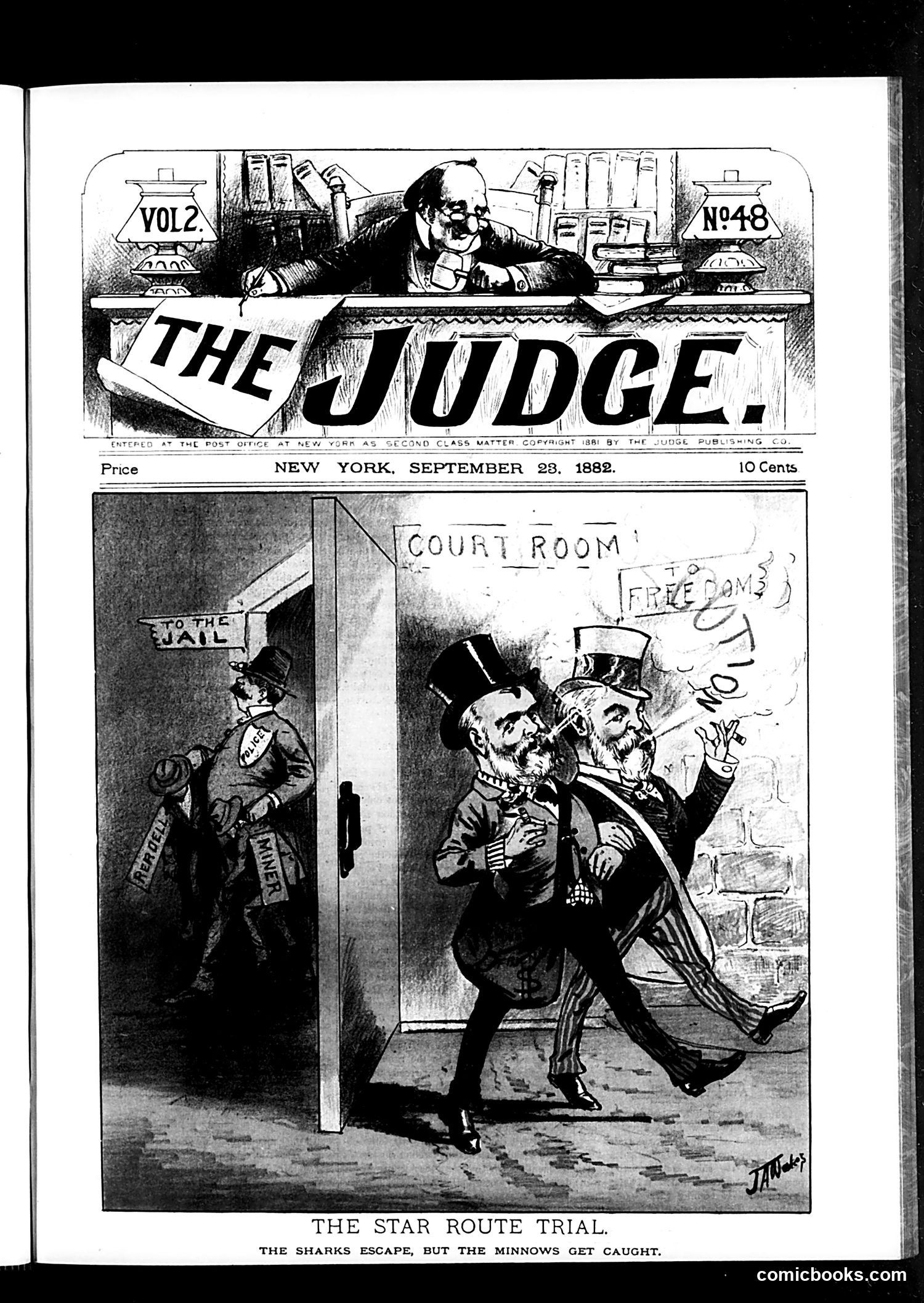
This cartoon satirizes the Star Route Trial, a major corruption scandal involving mail-route contracts. The cartoon depicts two well-dressed men labeled "the sharks" escaping from a courthouse through a window labeled "FREEDOM," while a smaller figure labeled with what appears to be "MINNOWS" is sent to jail by a guard. The satire criticizes the unequal justice system: powerful figures (the "sharks") evade prosecution for fraud and corruption, while lesser participants ("minnows") face imprisonment. The cartoon implies the wealthy and connected manipulated the legal system to escape accountability for the Star Route mail-contract scheme, which defrauded the government of significant funds during the Arthur administration.
This page contains satirical commentary on contemporary American issues, likely from the 1870s-80s based on references to Egypt and military campaigns. **The cartoons/articles address:** 1. **"American Mules"** - Satirizes England's plan to use captured Egyptian mules in their military operations. The satire mocks the impracticality: mules will buck soldiers, kick to pieces, or bolt to English lines rather than serve as cavalry horses or artillery animals. 2. **"The Last Christian Sign"** - Expresses xenophobic anxiety about Jewish merchants monopolizing New York retail businesses. The author warns that Jewish surnames are replacing Christian ones on storefronts, claiming Jewish merchants are "crowding into all sorts of mercantile lines." 3. **"Concerning Coroners"** - Attacks corrupt coroners (naming David Dudley Field and Oakey Hall), accusing them of theatrical misconduct and using dead bodies for shameless exhibitions to gain publicity. These pieces reflect period prejudices while satirizing military folly and urban corruption through exaggeration and dark humor typical of Judge's editorial approach.
This page satirizes the New York theater world, specifically the chorus line craze of the era. The poem parodies Tennyson's "Charge of the Light Brigade," mocking fashionable ballet dancers—particularly their high kicks and exposed legs—that scandalized Victorian audiences. "Bald heads" refers to older male patrons in the orchestra seats ogling the performers. The accompanying illustration shows dancers in a line, legs kicked high, entertaining seated gentlemen. The satire targets both the dancers' immodest athleticism and the older men's eager spectatorship, suggesting the dance craze was more about leg-display than legitimate artistry. The second article humorously features a Herald reporter interviewing Satan about petroleum and sulphur usage in Hell, likely alluding to contemporary industrial debates or perhaps specific public figures (references to "old Van" remain unclear without fuller context).
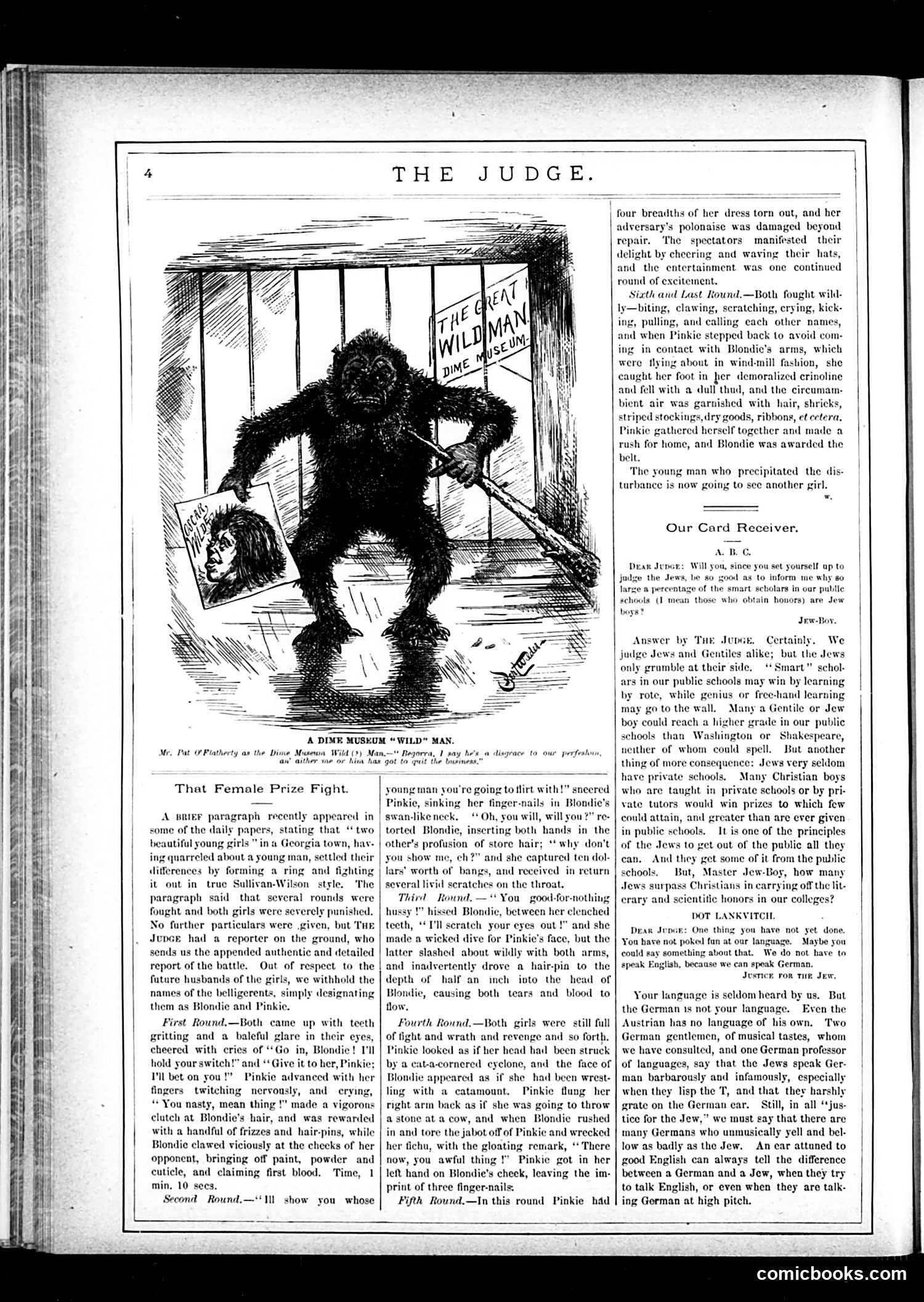
The main cartoon, "A Dime Museum 'Wild' Man," depicts a crude theatrical exhibition where a performer portrays a savage "wild man." The image satirizes both the performer and the spectators' gullible enjoyment of such obviously fake entertainment. Below are three sections addressing Jewish education: "That Female Prize Fight" describes a fight between two young women (Pinkie and Blondie), while "Our Card Receiver" presents a dialogue between "The Judge" and a Jewish correspondent debating whether Jews should attend public schools or private institutions. The piece critiques educational disparities and ethnic/religious tensions in American schooling, suggesting Jewish families faced questions about assimilation versus cultural preservation—a significant late-19th/early-20th-century debate.
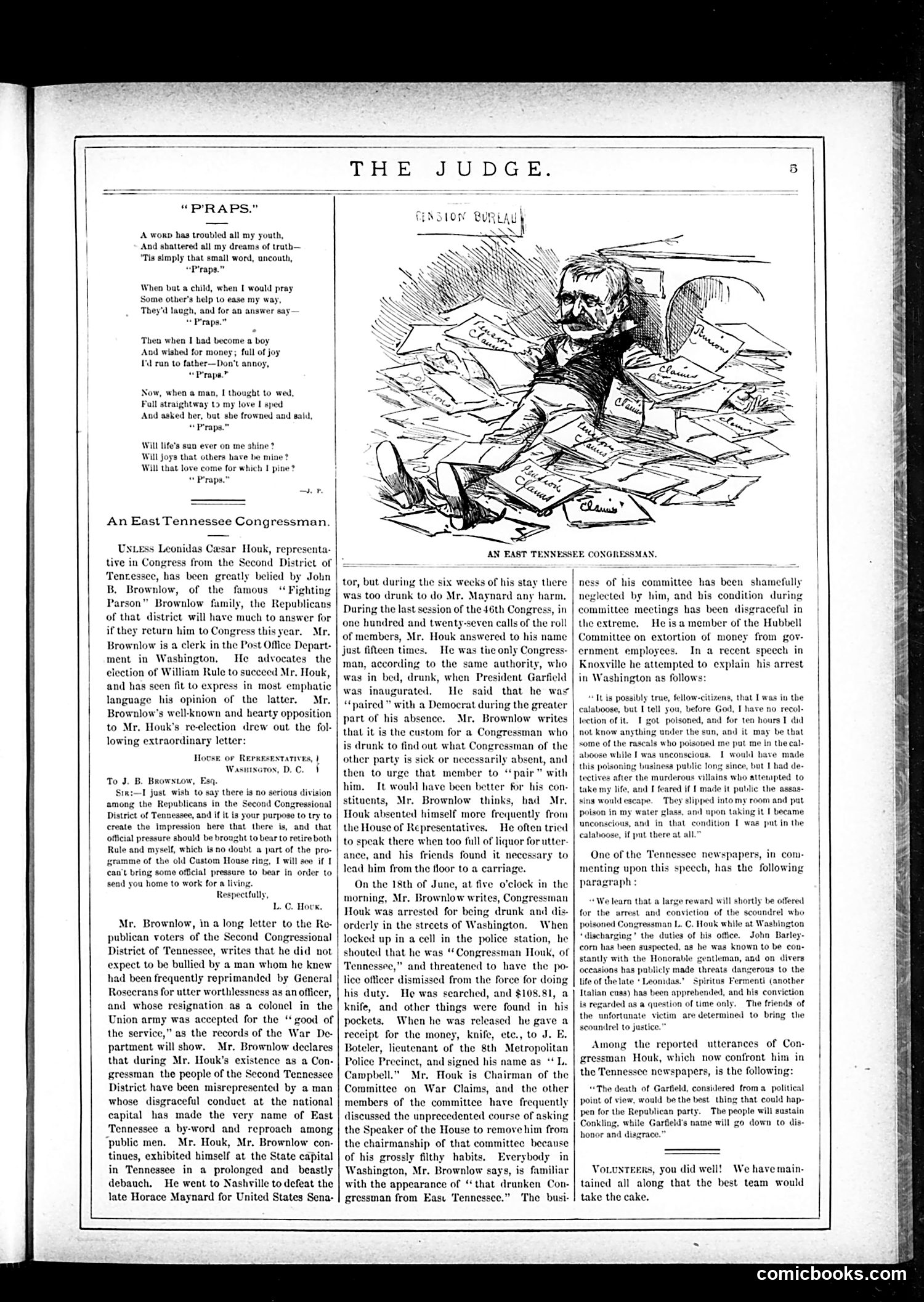
This page satirizes **Leonidas Cesar Houk**, a Republican congressman from Tennessee's Second District, through a scathing letter from **Jon B. Brownlow** (a Post Office clerk and member of the prominent "Fighting Parson" Brownlow family). The satire exposes Houk's gross dereliction of duty: he answered roll call only 15 times out of 127 during the 46th Congress, was famously drunk at President Garfield's inauguration, and spent six weeks in Nashville in a "prolonged and beastly debauch." Brownlow mocks Houk's excuse of being "paired" with an absent Democrat—suggesting Houk exploited parliamentary procedure to justify chronic absenteeism due to alcoholism. The accompanying cartoon depicts Houk literally buried under constituent complaint letters, illustrating how his negligence failed his district. The satire attacks both Houk's unfitness and Republican voters' tolerance of such disgraceful representation.
This is editorial satire mocking the formulaic conventions of popular 19th-century fiction writing. A nervous young author submits his debut novel to a Judge magazine editor, who critiques it with absurd pedantry. The satire targets both bad amateur writing and the predictable clichés publishers actually reward. The editor complains the story opens too originally—with a heroine washing dishes in daylight—when "any well-regulated heroine" should appear at twilight among vines. He demands the protagonist have "glorious orbs of heavenly blue" eyes and other purple-prose stock descriptions. The joke: the editor simultaneously ridicules hack writing while insisting the author follow every tired convention. This reflects real editorial preferences of the era, where formulaic romance and melodrama dominated popular literature. Judge uses the bumbling author and pompous editor to mock both amateur writers' pretensions and publishers' cynical reliance on predictable formulas over genuine originality.
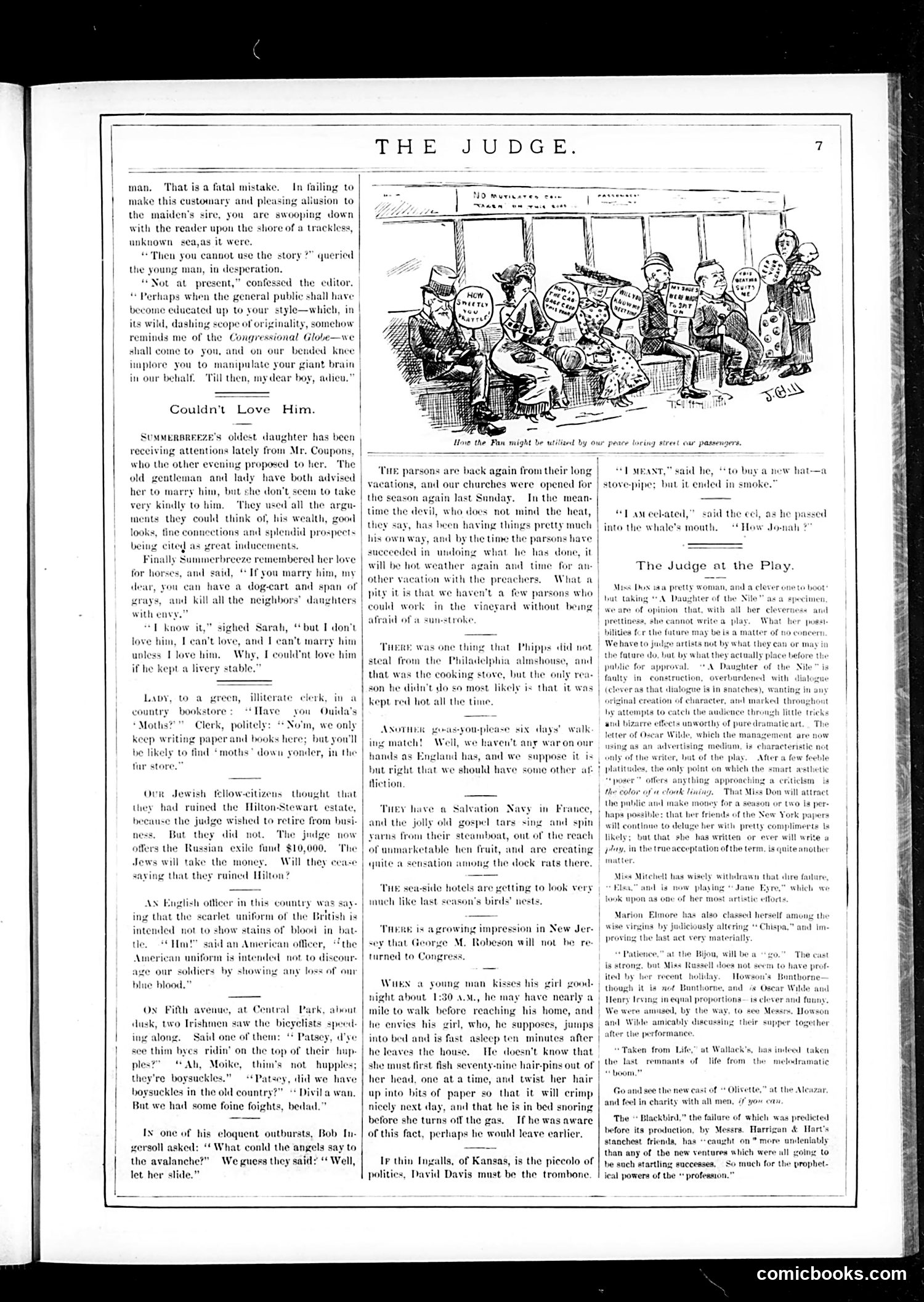
This page contains several satirical vignettes typical of the era: **"The Judge at the Play"** (main article): Critiques an actress (likely Miss Dox) playing "A Daughter of the Nile," suggesting that despite her beauty and cleverness, she cannot write plays effectively. The satire targets both the actress and theatrical pretension. **The cartoon** (top right): Depicts passengers on what appears to be a street railway or "Scenic Railway," with speech bubbles showing them being jolted and startled. The satire mocks the novelty and discomfort of this new transportation technology. **Various comic anecdotes** below include: - An editor rejecting a young writer's story as too stylistically ambitious - A woman refusing a wealthy suitor because she doesn't love him (mocking mercenary marriages) - Wordplay jokes about books, uniforms, and religious hypocrisy The overall tone is lighthearted social commentary on contemporary manners, gender relations, technology, and cultural pretensions—typical of Judge's satirical approach.
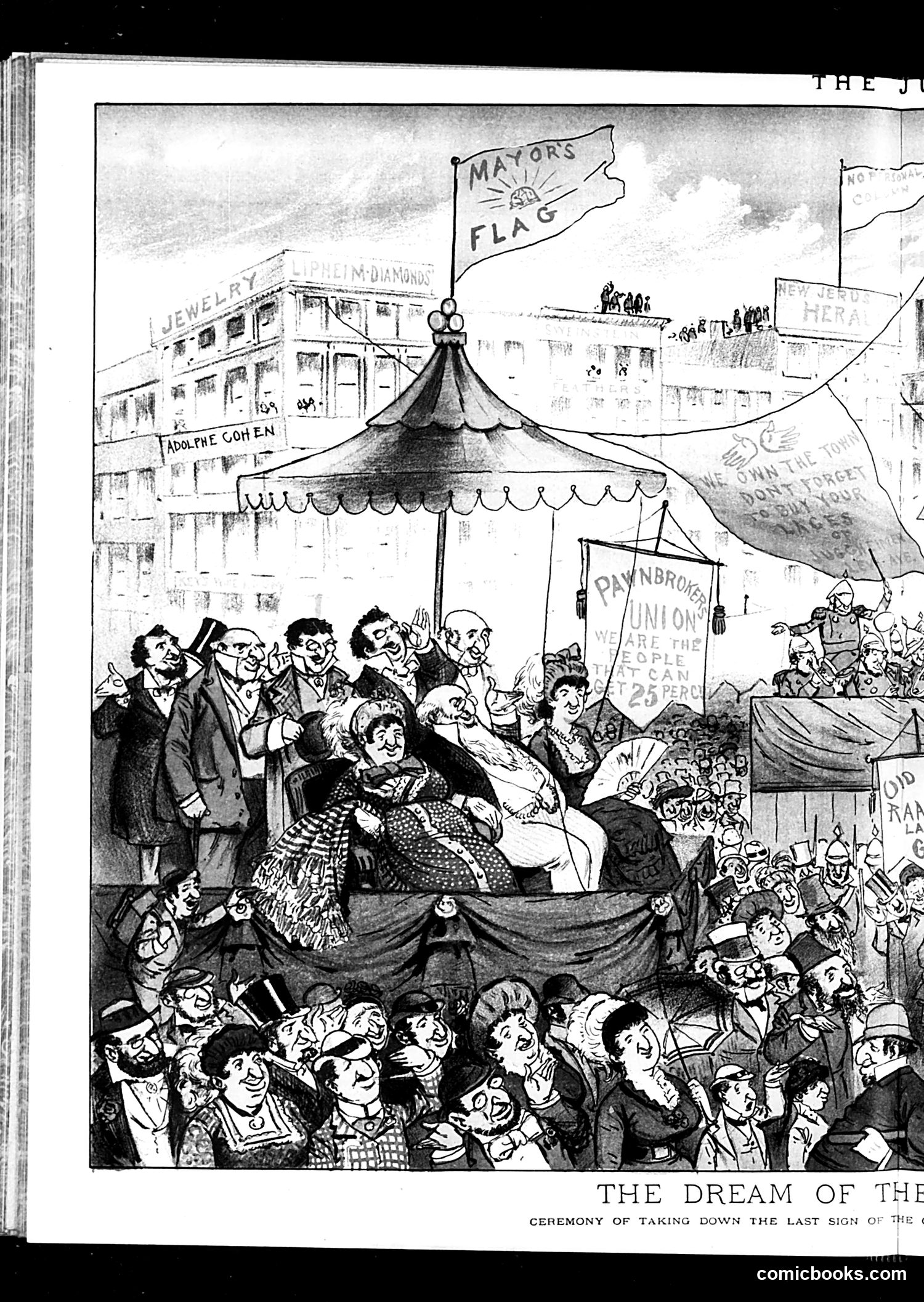
This political cartoon depicts a satirical fantasy of civic officials and dignitaries taking down the last sign of what appears to be a pawnbroker's shop or similar working-class establishment. The "Mayors Flag" waves above an ornate ceremonial tent, while crowds of ordinary citizens gather below. The satire likely mocks either: - Overly grandiose official ceremonies for trivial matters - Urban "beautification" efforts that displaced poor or working-class businesses - The gap between civic pomp and ordinary people's actual concerns The prominent "Pawnbrokers Union" sign visible suggests commentary on how rapid commercialization or gentrification affected traditional working neighborhoods. The elaborate ceremony contrasts humorously with what appears to be modest commercial signage, implying the absurdity of treating routine business closures as momentous public occasions.
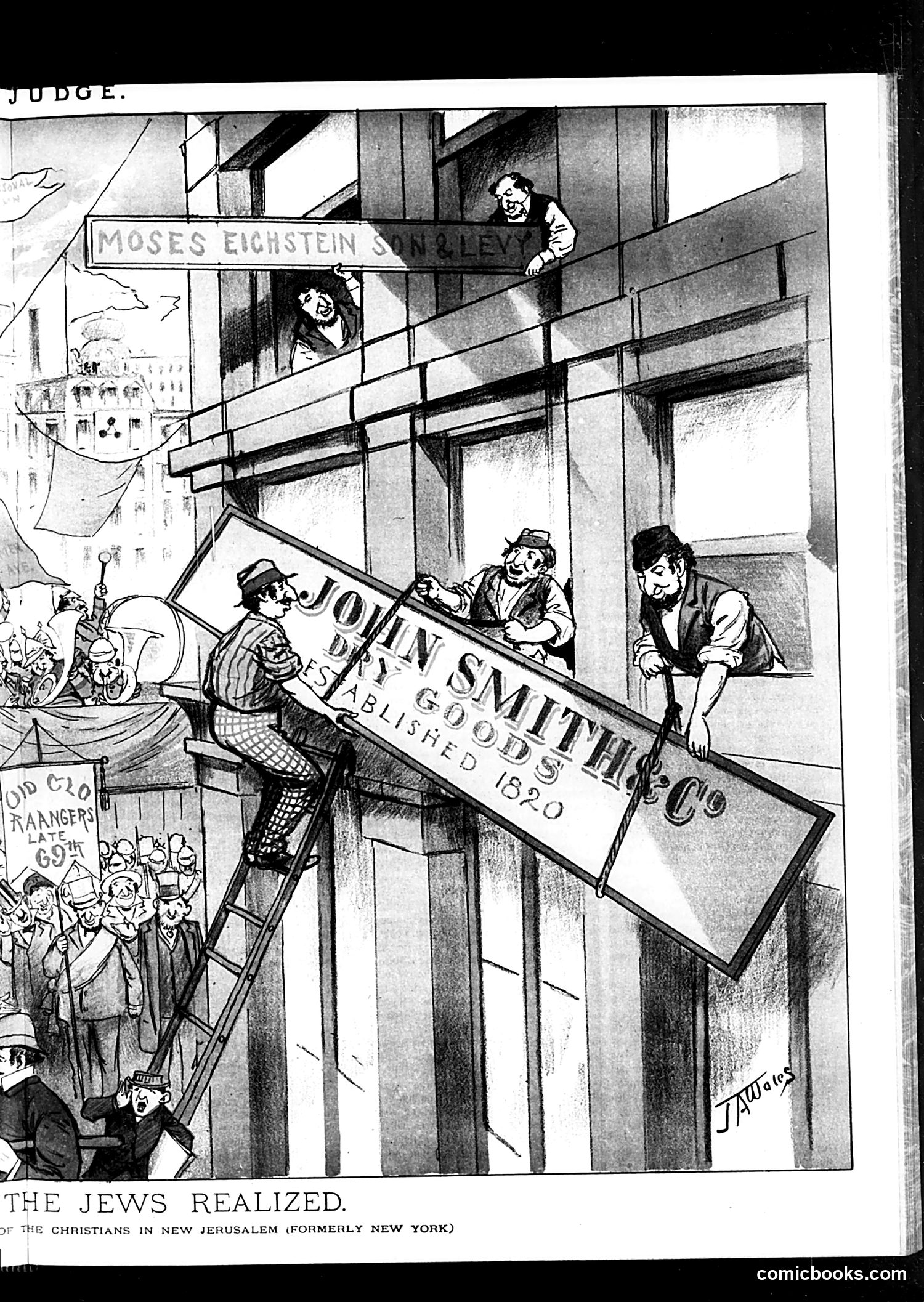
This antisemitic cartoon depicts Jewish figures taking over a New York building, with the caption suggesting Jews have "realized" (achieved) dominance over Christians in "New Jerusalem" (a derisive term for New York with its large Jewish population). The imagery shows Jewish men operating the "John Smith & Co." business from upper floors while Christians are displaced below. The sign reading "Established 1520" appears designed to suggest Jewish commercial longevity and control. This reflects early 20th-century antisemitic stereotypes common in *Judge* magazine portraying Jewish immigrants as displacing white Christian Americans economically and culturally. The cartoon exploits xenophobic anxieties about Jewish success in commerce and demographic change in American cities.
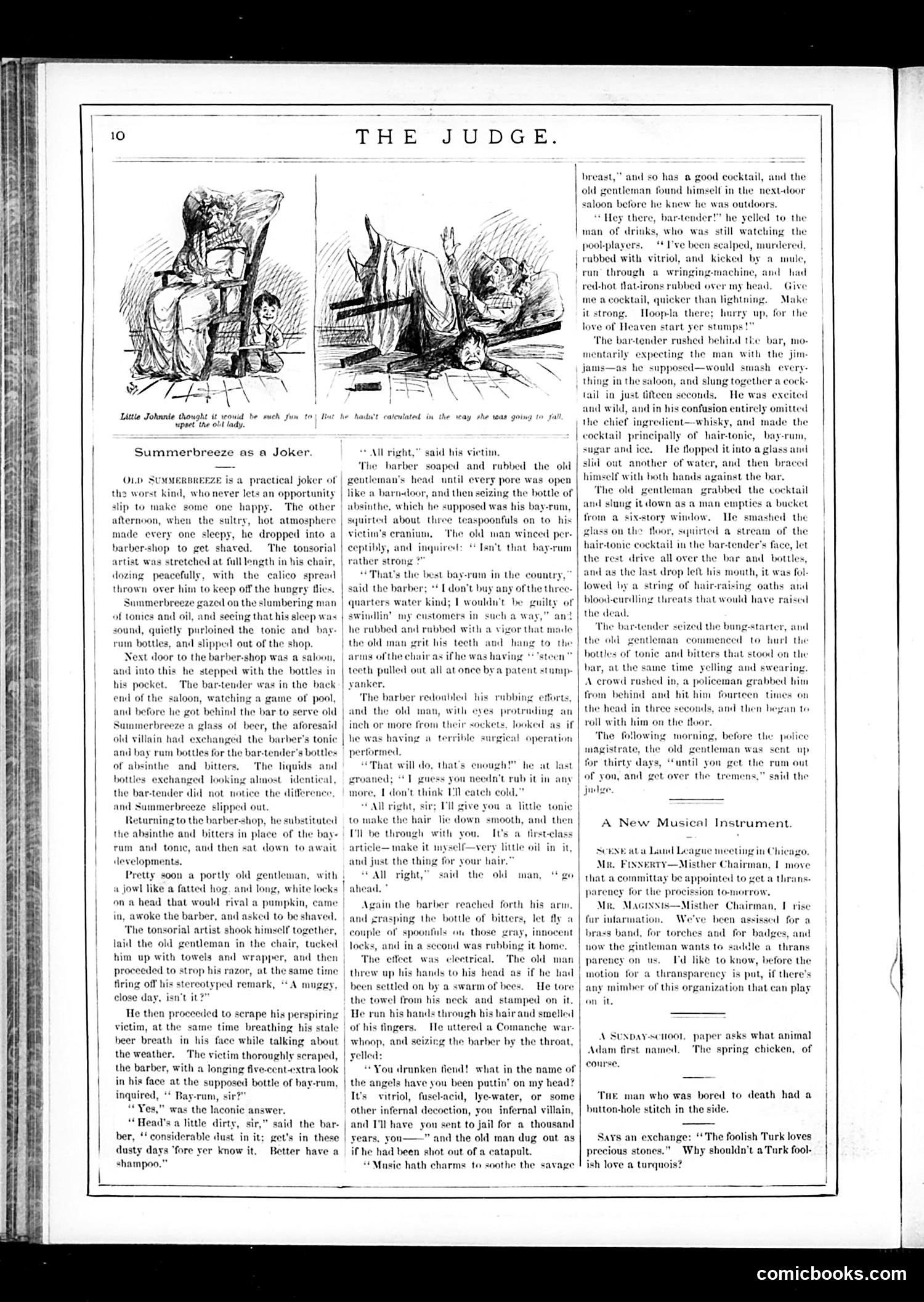
This page contains two separate humorous stories from *Judge* magazine, both satirizing practical jokers and barbershop mishaps. **"Summerbreeze as a Joker"** (main story): A practical joker named Summerbreeze switches bottles at a barbershop—replacing bay rum and tonic with absinthe and bitters from a nearby saloon. When the barber unknowingly applies the harsh liquids to a customer's head, the man's violent reaction (comparing it to dental torture) exposes the prank. The joke satirizes both the cruelty of "pranks" that cause real harm and the foolishness of someone swapping bottles without considering consequences. **"Little Johnnie" (top cartoon)**: Shows a child attempting what he thought would be a funny prank on an elderly woman, but she falls as a result—illustrating how pranks backfire dangerously. The overall theme critiques the "practical joker" as socially destructive, mocking a type of person who considers others' pain entertainment. The detailed, grotesque descriptions of the victim's suffering undercut any humor, making the satire's point: such "jokes" are actually cruel and irresponsible.
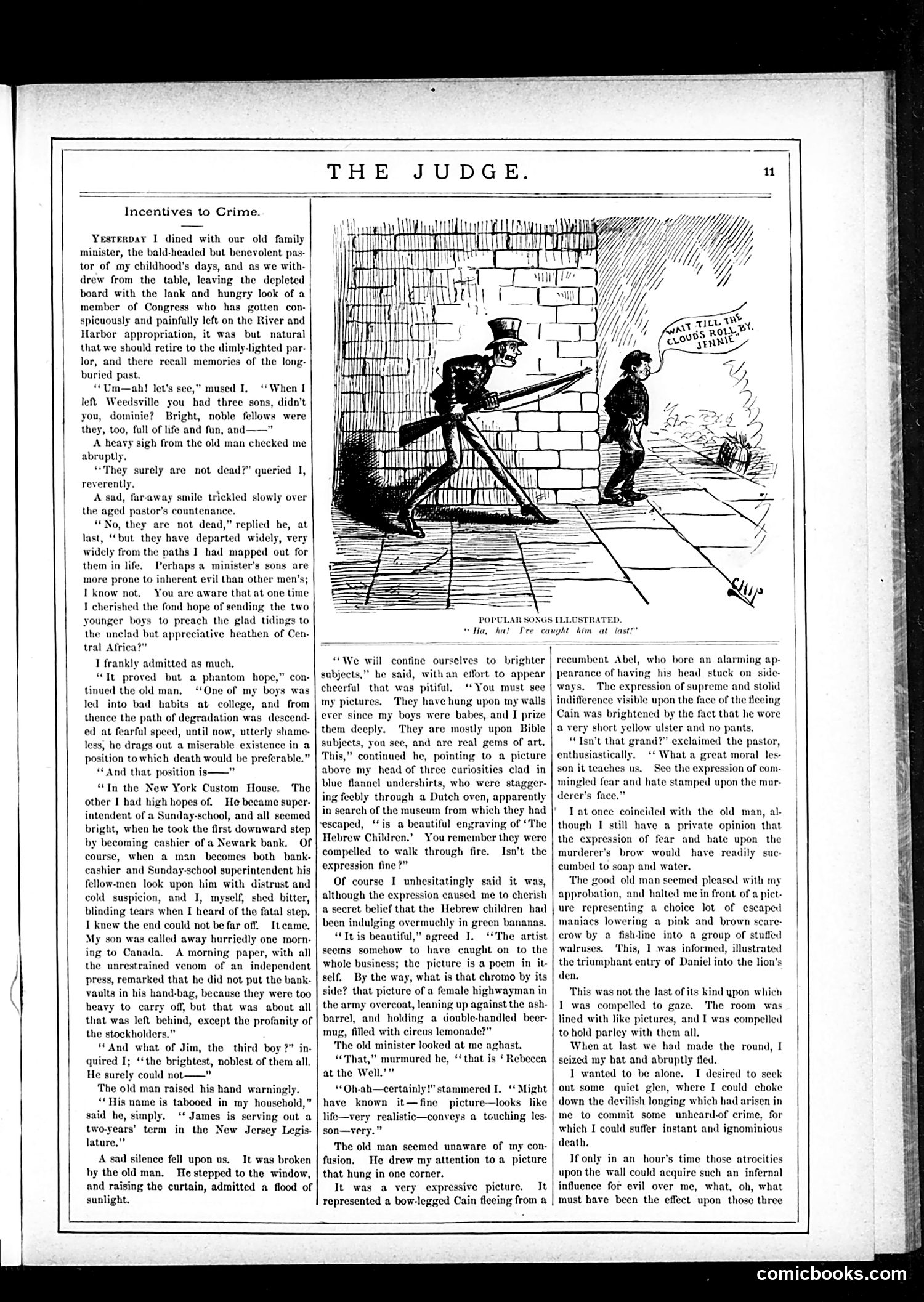
This page satirizes the corruption of ministerial sons in post-Civil War America. The cartoon illustrates a conversation between the narrator and an elderly pastor lamenting his three sons' moral failures. The satire targets: 1. **Political corruption**: One son works at the New York Custom House (notoriously corrupt), another embezzled from a Newark bank, and the third serves in the New Jersey Legislature—presented as equally disreputable. 2. **Institutional hypocrisy**: A Sunday-school superintendent becomes a bank cashier, suggesting moral institutions breed dishonesty rather than virtue. 3. **The moral crisis**: The pastor's disappointed hopes that his sons would become missionaries in Africa contrast sharply with their actual criminal/corrupt positions, implying that American institutions themselves incentivize crime more than African "heathendom" does. The accompanying illustration shows a telescope pointed at "clouds till the clouds eternal" — likely representing the pastor's naive idealism versus harsh reality. The satire blames systemic corruption, not individual moral weakness, for the sons' downfall.
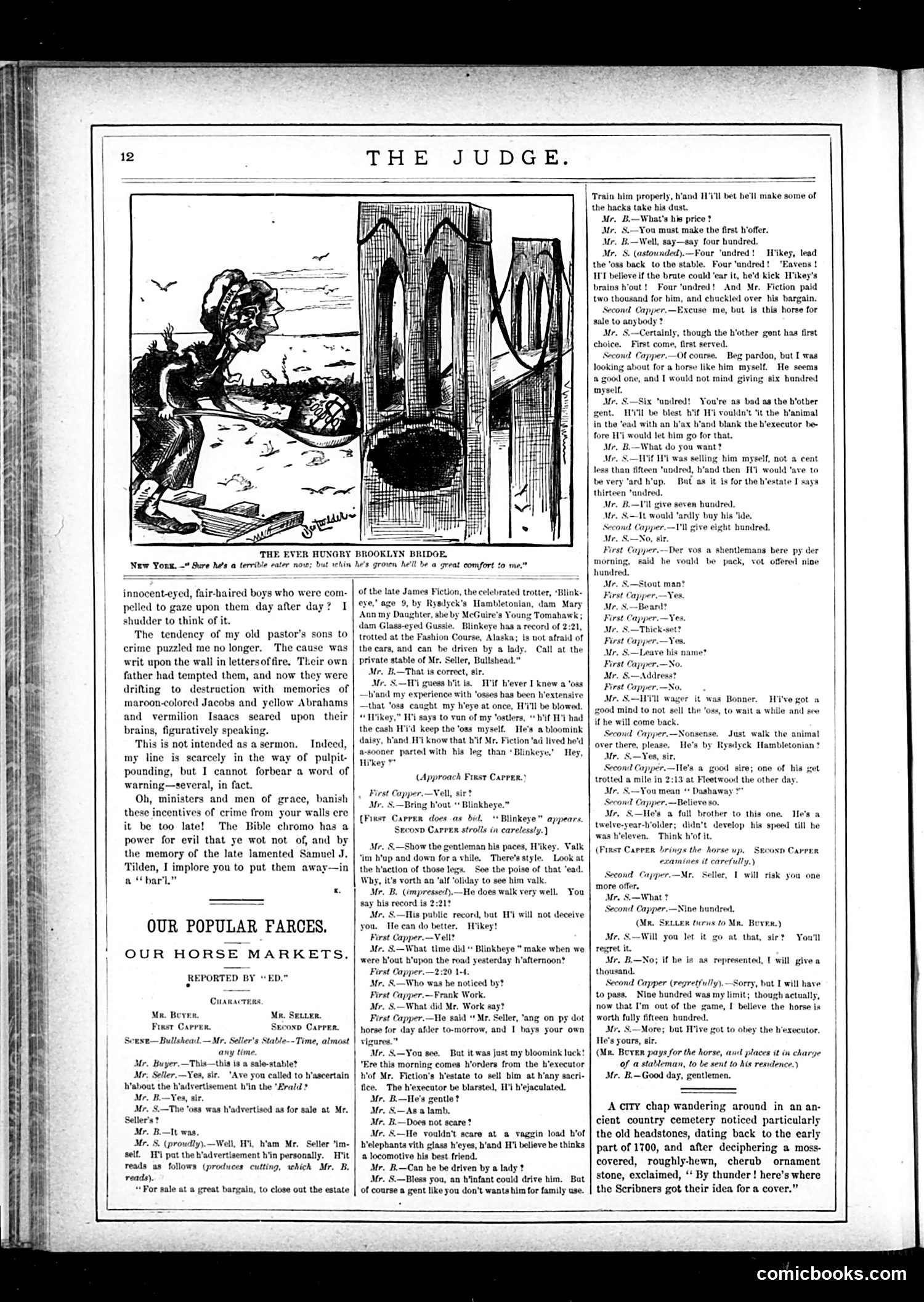
This page features a satirical farce lampooning dishonest horse traders at Bullshead Market (a real New York venue). The dialogue depicts a classic con: Mr. Seller advertises a horse ("Blinkeye") with an impressive pedigree and claims of a fast record (2:21). When Mr. Buyer arrives, Seller enlists two accomplices—"First Capper" and "Second Capper"—to pose as neutral observers and reinforce the sales pitch. The satire exposes the scam's mechanics: Seller claims Frank Work (likely a real person) recently clocked better unofficial times, pressures the buyer with fake urgency ("executor's orders"), and uses staged demonstrations of the horse's docility. The heavy dialect ("h'advertised," "vell") mockingly exaggerates the traders' speech. The cartoon above depicts a beggar at the Brooklyn Bridge—unrelated satirical commentary on urban poverty and the city's poor conditions.
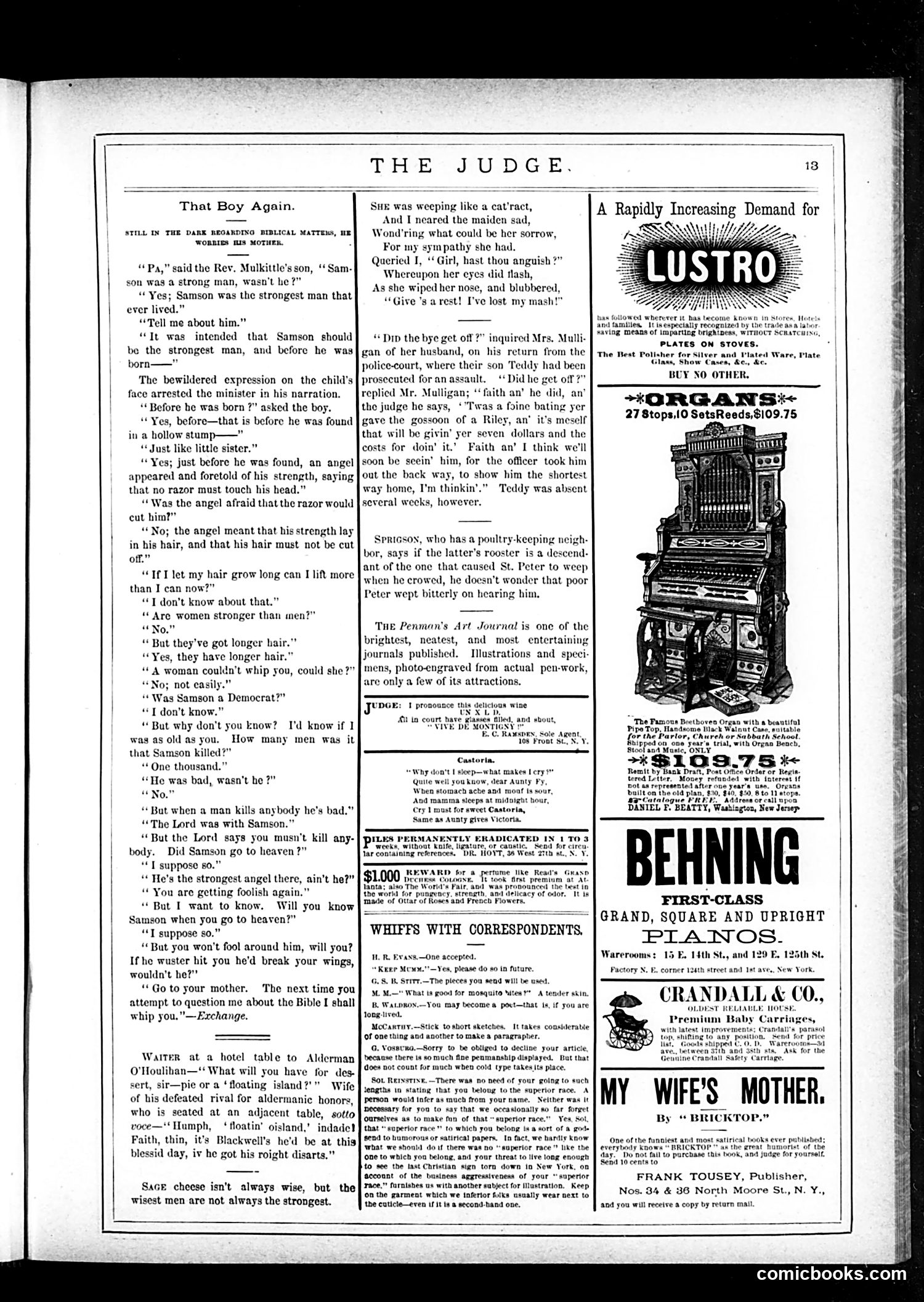
This cartoon satirizes religious instruction through a precocious child's literal-minded questioning of a minister explaining the biblical story of Samson. The boy's logic exposes contradictions in religious teaching: if Samson's strength came from his hair, why don't all long-haired people have strength? If God forbade killing yet Samson killed 1,000 people, was Samson bad? If Samson was righteous, will the minister recognize him in heaven—and won't Samson's strength be dangerous? The humor derives from the child's innocent but relentless application of rational thought to theological doctrine, ultimately frustrating the minister so thoroughly he orders the boy away and threatens to whip him. The cartoon mocks both religious inconsistency and Victorian adults' inability to answer children's straightforward questions with satisfactory logic—preferring authority and punishment to honest explanation.
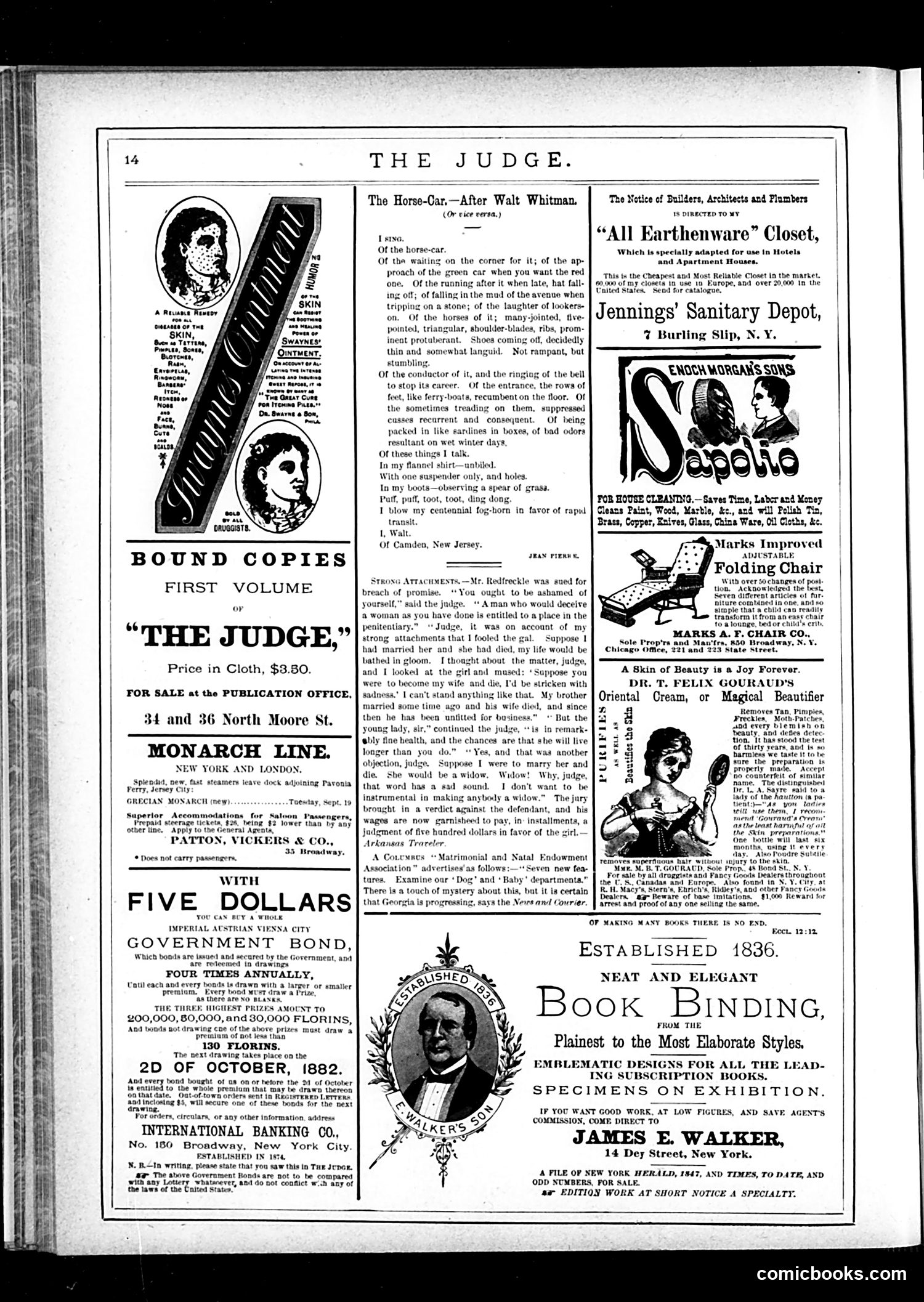
This page is primarily **advertisements and filler content** rather than political satire. However, it contains one notable literary parody: **"The Horse-Car—After Walt Whitman"** mocks the transcendentalist poet Walt Whitman's grandiose, free-verse style by applying it to the mundane experience of waiting for and riding a horse-drawn streetcar. The piece mimics Whitman's cataloguing technique and elevated language ("I sing / Of the horse-car") while describing petty frustrations: missing the right car, falling in mud, crowded conditions, and bad odors. This is humor through stylistic contrast—treating common urban annoyance with false profundity. The remaining content includes shipping advertisements (Monarch Line), a lottery bond offering, and a brief legal anecdote ("Strong Attachments") about a breach-of-promise case. These are standard magazine filler and advertising, not satirical commentary. The page reflects *Judge*'s mix of humor (literary parody), commercial content, and miscellaneous articles typical of 1880s satirical magazines.
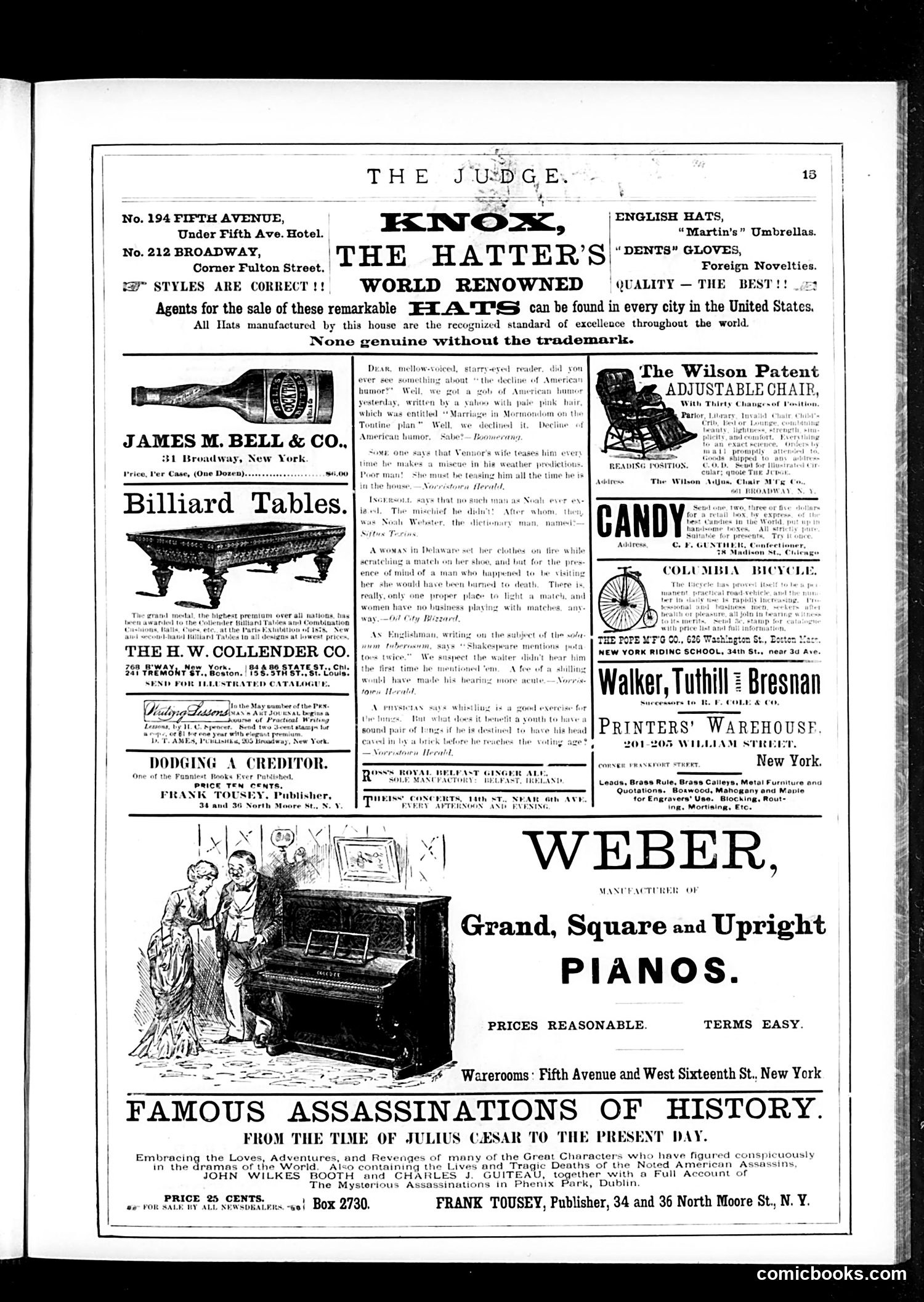
This page is primarily **advertisements** with minimal editorial content. The visible cartoon shows two elegantly dressed women examining a piano—a genteel domestic scene typical of late 19th-century advertising imagery, depicting middle-class aspirations. The page advertises consumer goods (hats, billiard tables, pianos, chairs, bicycles) and services reflecting Gilded Age commercial culture. One notable advertisement promotes a book on "Famous Assassinations of History" including John Wilkes Booth and Charles J. Guiteau—likely referencing contemporary anxieties about political violence and anarchism that concerned America in this period. The layout itself is characteristic of Judge's business model: satirical editorial content subsidized by paid advertisements targeting affluent urban readers. Without seeing the magazine's masthead date or editorial sections, the specific satirical message remains unclear, but the commercialism reflects Judge's position as a publication for prosperous audiences.
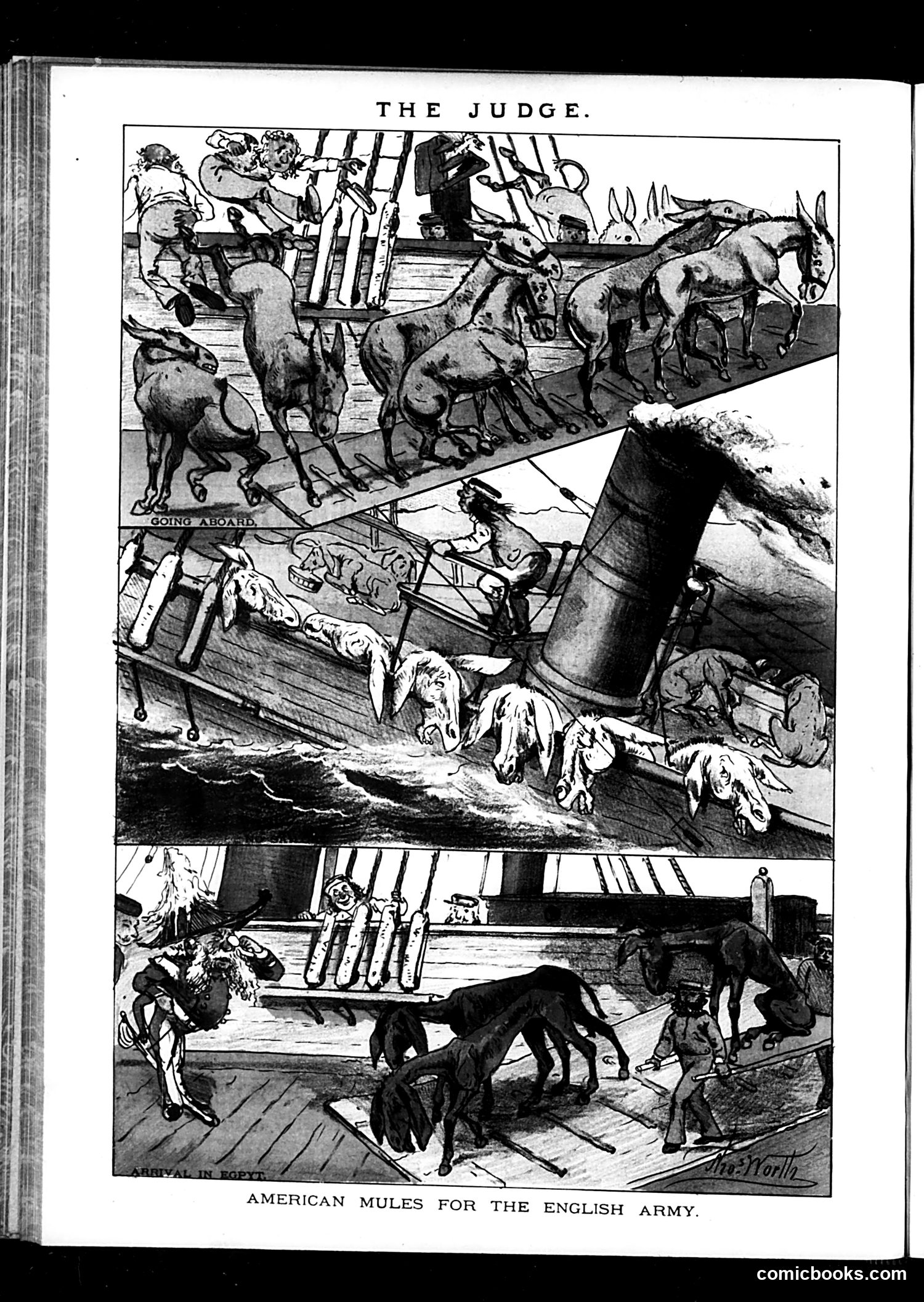
This Judge magazine cartoon satirizes the supply of American mules to the British military. The three panels depict the journey of mules from America to England by ship, showing them being loaded aboard, housed in cramped quarters below deck, and then unloaded upon arrival. The satire targets either British military procurement practices or American willingness to support British forces (likely referencing WWI-era supply arrangements). The cartoon jokes about the indignity of transporting animals across the Atlantic and the poor conditions they endure—treating their plight as ridiculous or commenting on the absurdity of this particular wartime supply chain. The cramped, chaotic scenes emphasize the chaos and discomfort of the venture.