
Judge, 1882-09-23 · page 6 of 16
Judge — September 23, 1882 — page 6: what you’re looking at
What you’re looking at
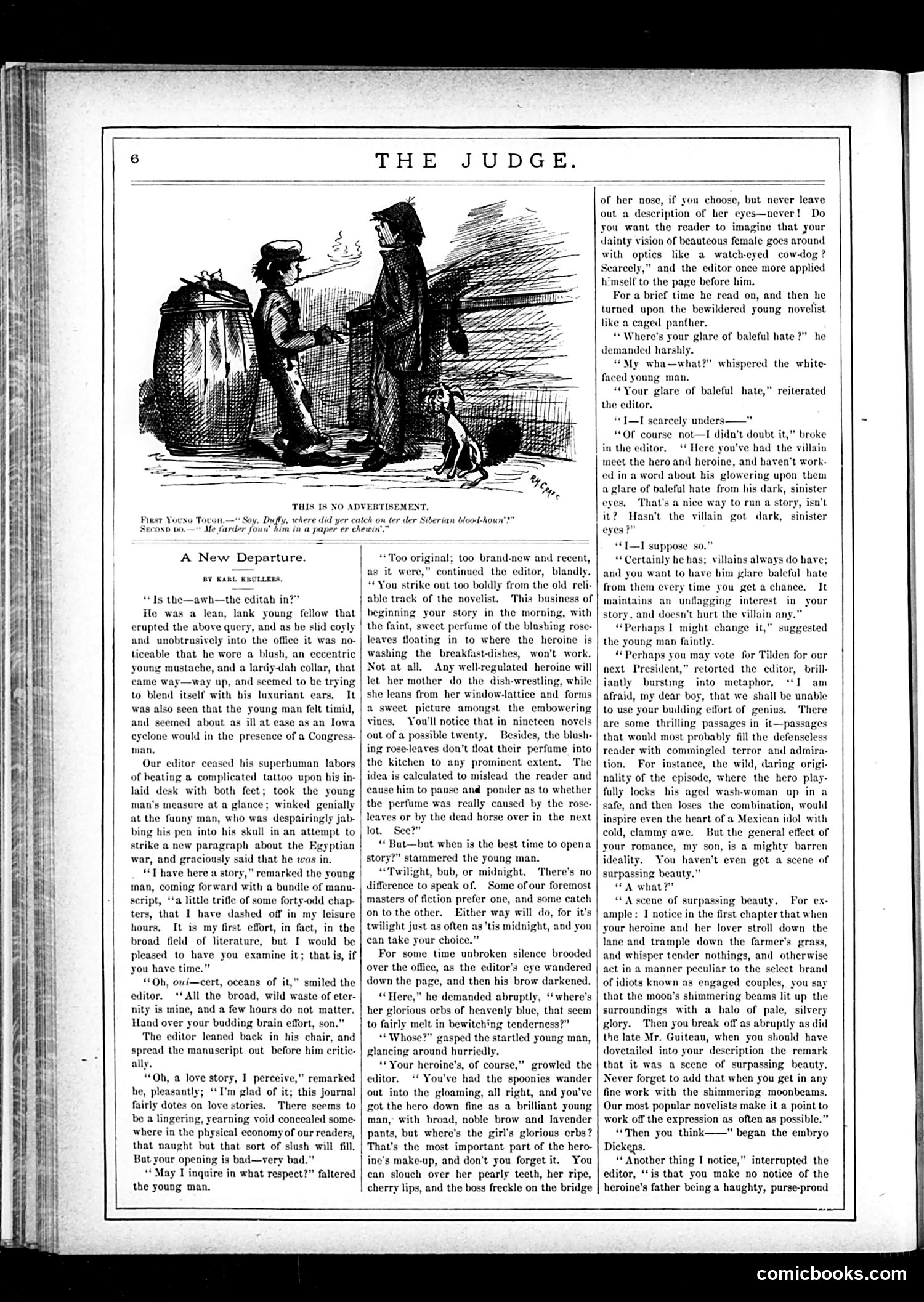
This is editorial satire mocking the formulaic conventions of popular 19th-century fiction writing. A nervous young author submits his debut novel to a Judge magazine editor, who critiques it with absurd pedantry. The satire targets both bad amateur writing and the predictable clichés publishers actually reward. The editor complains the story opens too originally—with a heroine washing dishes in daylight—when "any well-regulated heroine" should appear at twilight among vines. He demands the protagonist have "glorious orbs of heavenly blue" eyes and other purple-prose stock descriptions. The joke: the editor simultaneously ridicules hack writing while insisting the author follow every tired convention. This reflects real editorial preferences of the era, where formulaic romance and melodrama dominated popular literature. Judge uses the bumbling author and pompous editor to mock both amateur writers' pretensions and publishers' cynical reliance on predictable formulas over genuine originality.
📄 Transcribed text from this page (OCR, searchable)
Machine-transcribed from the original scan — historical spelling and the odd misread are preserved.
THE JUDGE. THIS I8 NO AD Finst Youse Tove! Steoxp po.—* Me farder foun’ him in A New Departure. awh—the editab in He was a lean, lank young fellow that erupted the above query, and as he slid coyly and unobtrusively into the office it was no- ticeable that he wore a blush, an eccentric young mustache, and a lardy-dah collar, that “Is the reel ‘ame way—way up, and seemed to be trying | to blend itself with bis luxuriant ears. It was also seen that the young man felt timid, and seemed about as ill at ease as an Iowa cyclone would in the presence of a Congress- man. Our editor ceased his superhuman labors of beating a complicated tattoo upon his in- laid desk with both feet; took the young man’s measure at a glance; winked genially at the funny man, who was despairingly jab- bing his pen into his skull in an attempt to strike a new paragraph about the Egyptian war, and graciously said that he was in. “T have here a story,” remarked the young man, coming forward with a bundle of manu- script, ‘a little trifle of some forty-odd chap- ters, that I have dashed off in my leisure hours, It is my first effort, in fact, in the broad ficld of literature, but I would be pleased to have you examine it; that is, if you have time.” “Oh, oui—cert, oceans of it,” smiled the editor. ‘All the broad, wild waste of eter- nity is mine, and a few hours do not matter. Hand over your budding brain effort, son.” The editor leaned back in his chair, and spread the manuscript out before him critic- ally. “Oh, a love story, I perceive,” remarked he, pleasantly; ‘I'm glad of it; this journal fairly dotes on love stories. There seems to be a lingering, yearning void concealed some- where in the physical economy of our readers, that naught but that sort of slush will fill. But your opening is bad—very bad.” “May I inquire in what respect?” faltered the young man. Soy. Duffy, where did yer catch 07 paper er chewin’.” | the faint, sweet perfume of the blushing rose- | out of a p r ier Siberian tloot-houn **Too original; too brand-new and recent, it were,” continued the editor, blandly. “You strike out too boldly from the old reli- able track of the novelist. This business of beginning your story in the morning, with leaves floating in to where the heroine is | washing the breakfastdishes, won't work. | Not at all. Any well-regulated heroine will let her mother do the dish-wrestling, while she leans from her window-lattice and forms a sweet picture amongst the embowering vines, You'll notice that in nineteen novels ssible twenty. Besides, the blush- ing rose-leaves don't float their perfume into the kitchen to any prominent extent. The idea is calculated to mislead the reader and cause him to pause and ponder as to whether the perfume was really caused by the ro leaves or by the dead horse over in the next lot. See?’ “ But—but when is the best time to opena story?” stammered the young man. ‘Twilight, bub, or midnight. There’s no difference to speak of. Some of our foremost masters of fiction prefer one, and some catch on to the other. Either way will do, for it’s twilight just as often as’tis midnight, and you can take your choice.” | For some time unbroken silence brooded | over the office, as the editor's eye wandered down the page, and then his brow darkened. “Here,” he demanded abruptly, ‘‘ where's her glorious orbs of heavenly blue, that seem to fairly melt in bewitching tenderness? “Whose?” gasped the startled young man, glancing around hurriedly. ‘Your heroine's, of course,” growled the editor. ‘‘ You've had the spoonies wander out into the gloaming, all right, and you've got the hero down fine as a brilliant young man, with broad, noble brow and lavend pants, but where's the girl's glorious orbs? That's the most important part of the hero- ine’s make-up, and don't you forget it. You can slouch over her pearly teeth, her ripe, cherry lips, and the boss freckle on the bridge of her nose, if you choose, but never leave out a description of her eyes—never! Do you want the reader to imagine that your dainty vision of beauteous female goes around with optics like a watch-eyed cow-dog ? Searcely,” and the editor once more applied h'mself to the page before him. For a brief time he read on, and then he turned upon the bewildered young novelist like a caged panther. “ Where's your glare of baleful hate 7” he demanded harshly, “My wha—what?" whispered the white- | faced young man. “Your glare of baleful hate,” reiterated the editor. “II scarcely unders—" “Of course not—I didn’t doubt it,” broke in the editor, ‘‘ Here you've had the villain meet the hero and heroine, and haven't work- ed in a word about his glowering upon them aglare of paleful hate from his dark, sinister eyes, That's a nice way to run a stor ' it? Hasn't the villain got dark, sinister eyes 7 “11 suppose so.” “ Certainly he has; villains always do have; and you want to have him glare baleful hate from them every time you get a chance, It maintains an unilagging interest in your story, and doesn’t burt the villain any. “Perhaps 1 might change it,” suggested the young man faintly “Perhaps you may vote for Tilden for our next President,” retorted the editor, brill- iantly bursting into metaphor. “I am afraid, my dear boy, that we shall be unable to use your budding effort of genius, ‘There are some thrilling passages in it—passages that would most probably fill the defenseless reader with commingled terror and admira tion. For instance, the wild, daring or nality of the episode, where the hero play- fully locks his aged wash-woman up in a safe, and then loses the combination, would inspire even the heart of a Mexican idol with cold, clammy awe. But the general effect of your romance, my son, is a mighty barren ideality. You haven't even got a scene of surpassing beauty.” “A what?” “A scene of surpassing beauty. For ex- ample: I notice in the first chapter that when your heroine and her lover stroll down the lane and trample down the farmer's grass, and whisper tender nothings, and otherwise act in a manner peculiar to the select brand of idiots known as engaged couples, you say that the moon's shimmering beams lit up the surroundings with a halo of pale, silvery glory. Then you break off as abruptly as did the late Mr. Guiteau, when you should have dovetailed into your description the remark that it was a scene of surpassing beaut; Never forget to add that when you get in any fine work with the shimmering moonbeams, Our most popular novelists make it a point to work off the expression as often as possible.” “Then you think——” began the embryo Dickens. “‘ Another thing I notice,” interrupted the editor, ‘‘is that you make no notice of the heroine's father being a haughty, purse-proud comicbooks.com