
A complete issue · 16 pages · 1882
Judge — September 2, 1882
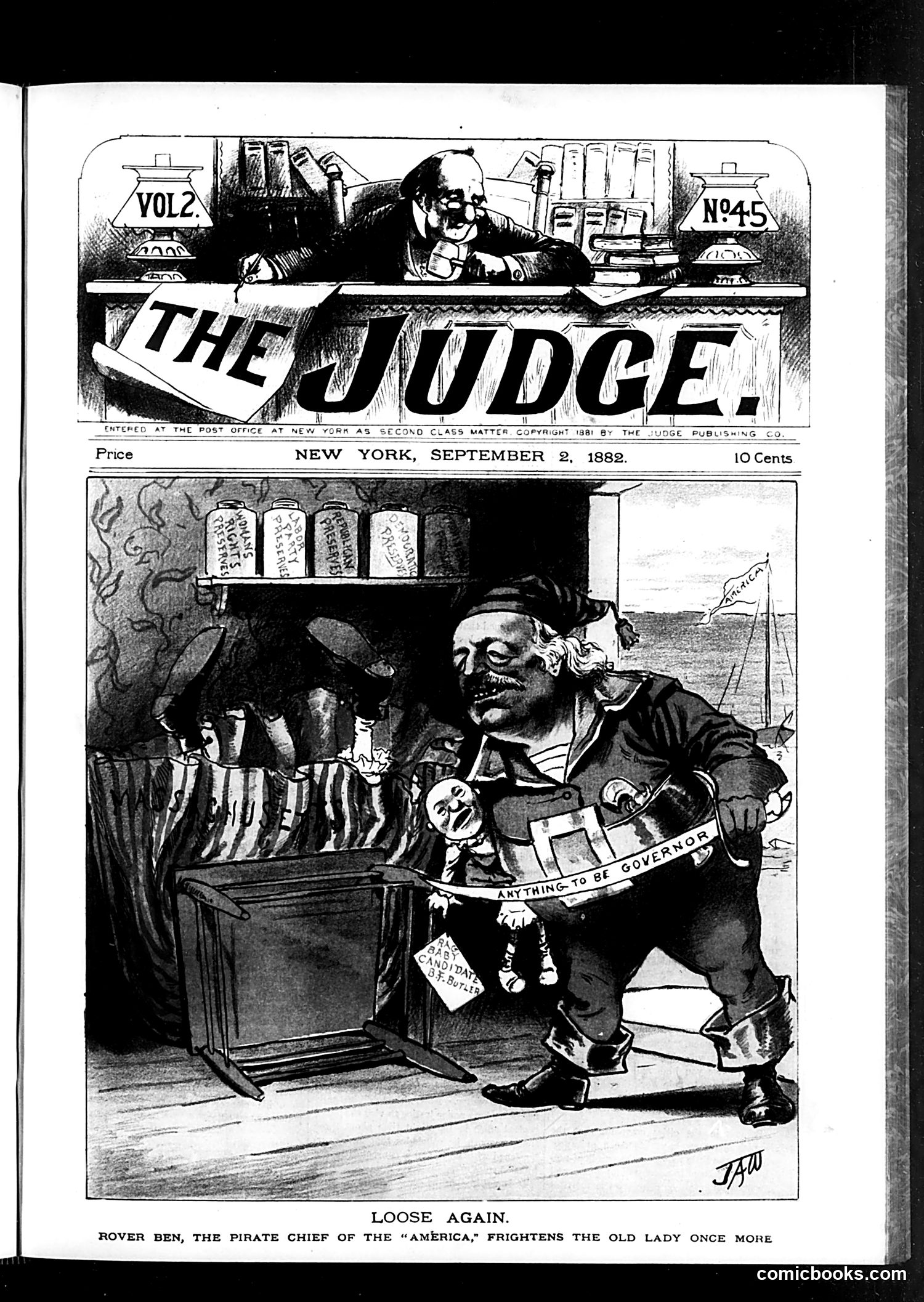
This cartoon depicts "Rover Ben," identified as a pirate chief of the ship "America," menacing an elderly woman (representing the nation or Columbia, a common allegorical figure). The pirate, depicted with exaggerated features typical of period caricature, brandishes weapons while the frightened woman cowers defensively. The satire appears to reference concerns about piracy or maritime threats to American interests in 1882. The phrase "loose again" suggests this threat recurs periodically, implying either incompetent governance allowing dangers to persist or anxieties about specific ongoing maritime conflicts or criminal activity at sea. The "Old Lady" personification was standard political imagery of the era, typically representing American sovereignty or the nation itself under threat.
This satirical piece mocks New York City police justices who, the text explains, were appointed by the Mayor to sit in police courts at night to handle bail in non-capital cases. An assemblyman named McClelland pushed legislation requiring them to actually do this job—work they had long avoided. The satire ridicules the justices by imagining their nightmares upon learning the law passed. Each justice is named (Butler Bixby, Marcus Otterbourne, James Kilbreth, Rufus Cowing, Solon Smith, Andrew White, and others), and the piece envisions them dreaming of the inconvenience and embarrassment of having to actually perform their assigned duties. The cartoon (visible header with magistrate-like figure) and accompanying article together lampoon these officials as lazy, entitled appointees who expected their positions as sinecures. The humor derives from depicting their horror at genuine accountability—suggesting New York's police justice system was staffed by do-nothing political appointees.
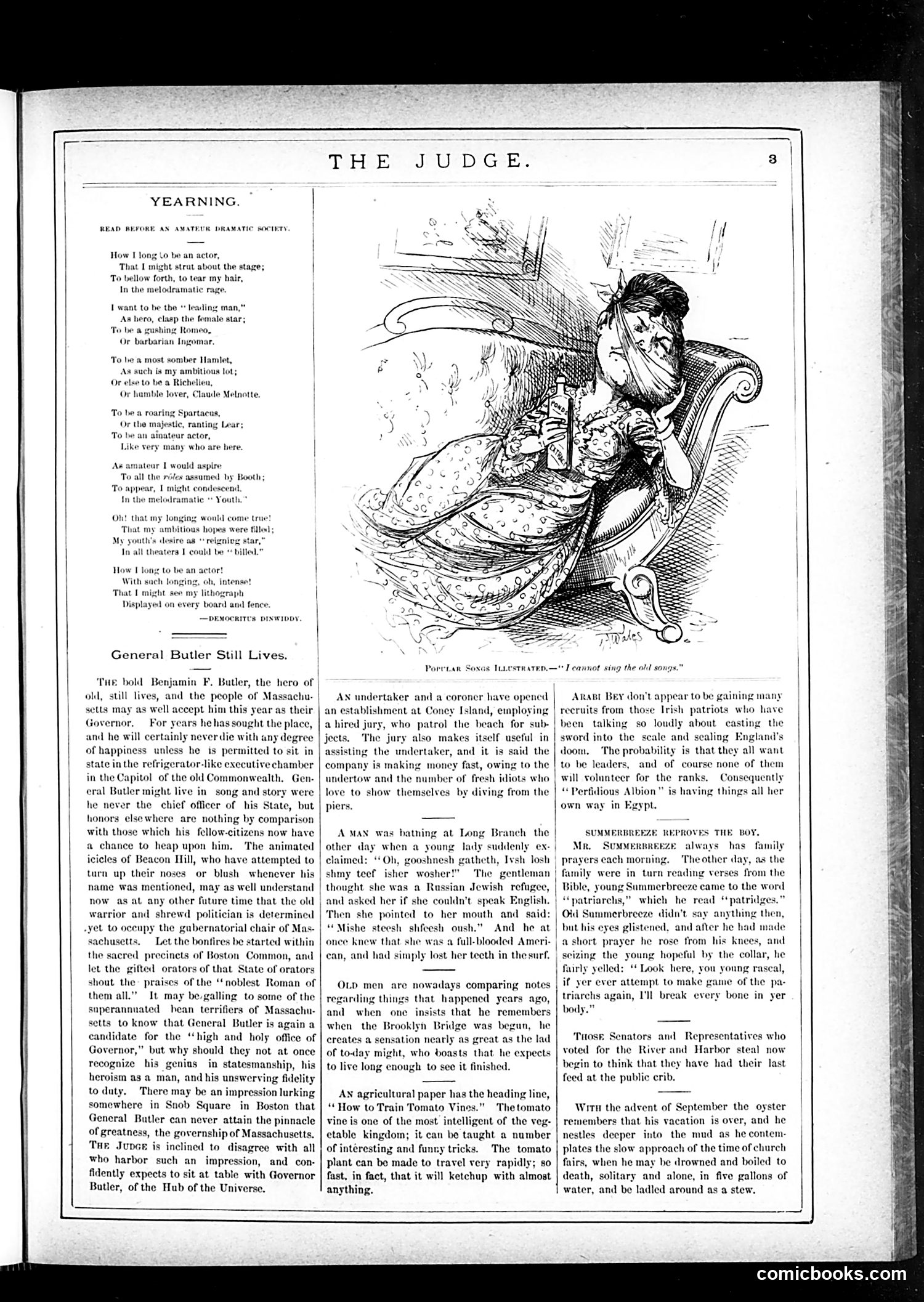
This page contains three distinct pieces of satire: **"Yearning"** (left): A poem mocking amateur theatrical aspirations, listing clichéd Romantic dramatic roles (Romeo, Spartacus, etc.) that amateurs obsessively yearn to perform. The satire targets pretentious theater enthusiasts. **"General Butler Still Lives"** (main text): A commentary on Benjamin F. Butler, a Massachusetts political figure, discussing his recurring candidacy for governor. The piece sarcastically suggests he'll eventually succeed despite Boston's social elite dismissing him. This reflects mid-19th-century Massachusetts politics where Butler was a controversial, ambitious figure. **Miscellaneous short items** (right side): Brief humorous anecdotes, including a joke about an undertaker-coroner partnership at Coney Island, a woman who lost her teeth in the surf, and observations about aging (Brooklyn Bridge references). The illustrated figure shows a reclining man in theatrical pose, likely accompanying "Yearning." The satire targets social pretension, political ambition, and human vanity across different contexts.
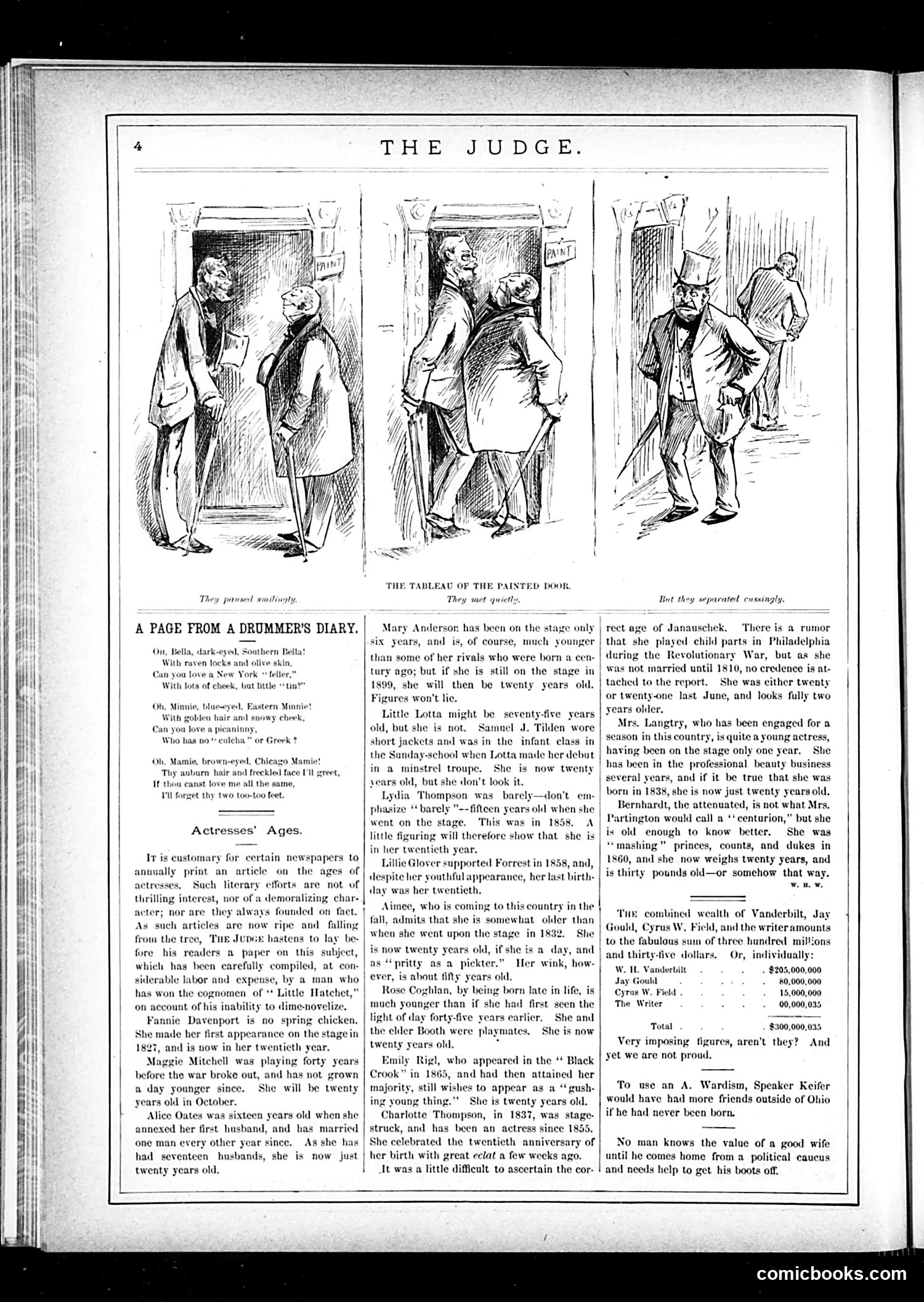
This page satirizes the theatrical world through two pieces: **The cartoon strip** (top) depicts what appears to be a domestic or romantic scene, likely mocking melodramatic theater conventions with exaggerated poses and expressions. The titles suggest commentary on theatrical artifice. **"Actresses' Ages"** is the main satirical article, mocking newspapers' habit of printing annual pieces about actresses' ages. Judge's "Little Hatchet" (their pseudonym for this writer) exposes the absurdity by listing famous actresses—Mary Anderson, Lotta Crabtree, Lydia Thompson, Rose Coghlan, and others—and sarcastically claiming all are "twenty years old" despite obvious contradictions. For example, Lillie Glover supposedly performed in 1858 yet is "twenty"; Rose Coghlan played with the elder Booth (who died in 1852) yet is also "twenty." The satire ridicules both newspapers for publishing obvious falsehoods and actresses for cooperating with age deceptions. It's humorous, cynical commentary on vanity and journalistic dishonesty in the Victorian theatrical world.
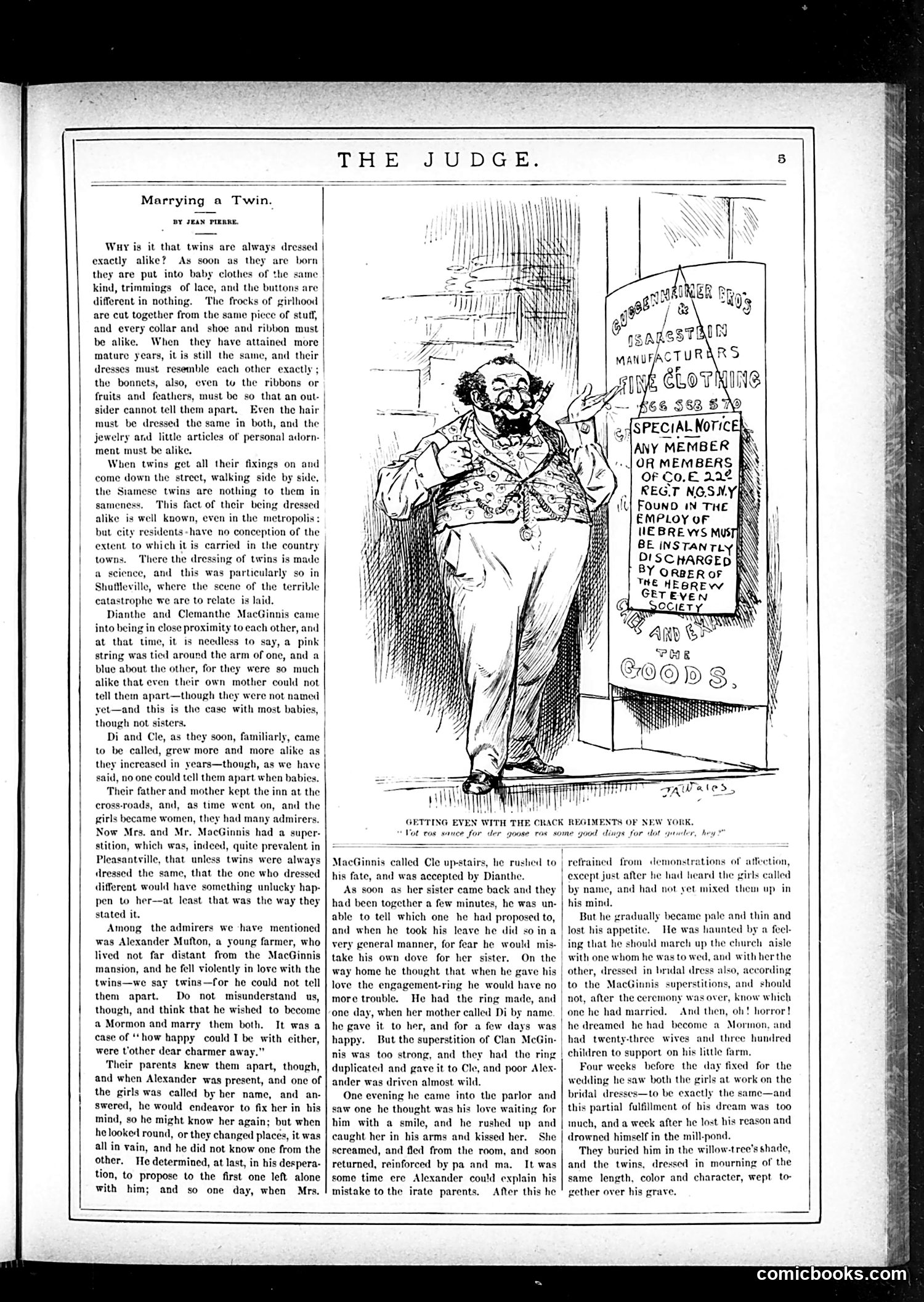
This is a humorous short story (not primarily a political cartoon) satirizing rural American customs and romantic confusion. The narrative ridicules the widespread practice in small towns of dressing identical twins in completely matching clothing—even as adults—to an absurd degree. The satire targets several things: the superstitious belief that twins dressed differently would face misfortune; the resulting inability of outsiders (including the suitor Alexander Mufton) to distinguish between them; and the chaos this creates when Mufton proposes to one twin but cannot remember which one afterward. The accompanying illustration shows a well-dressed man holding a large sign advertising "Cossacky Bros' Tearstain Manufacturers," a joke advertisement likely unrelated to the main story—typical of Judge's mixed satirical content. The humor derives from small-town conventions taken to illogical extremes, creating a predicament of mistaken identity rooted entirely in local custom rather than actual similarity.
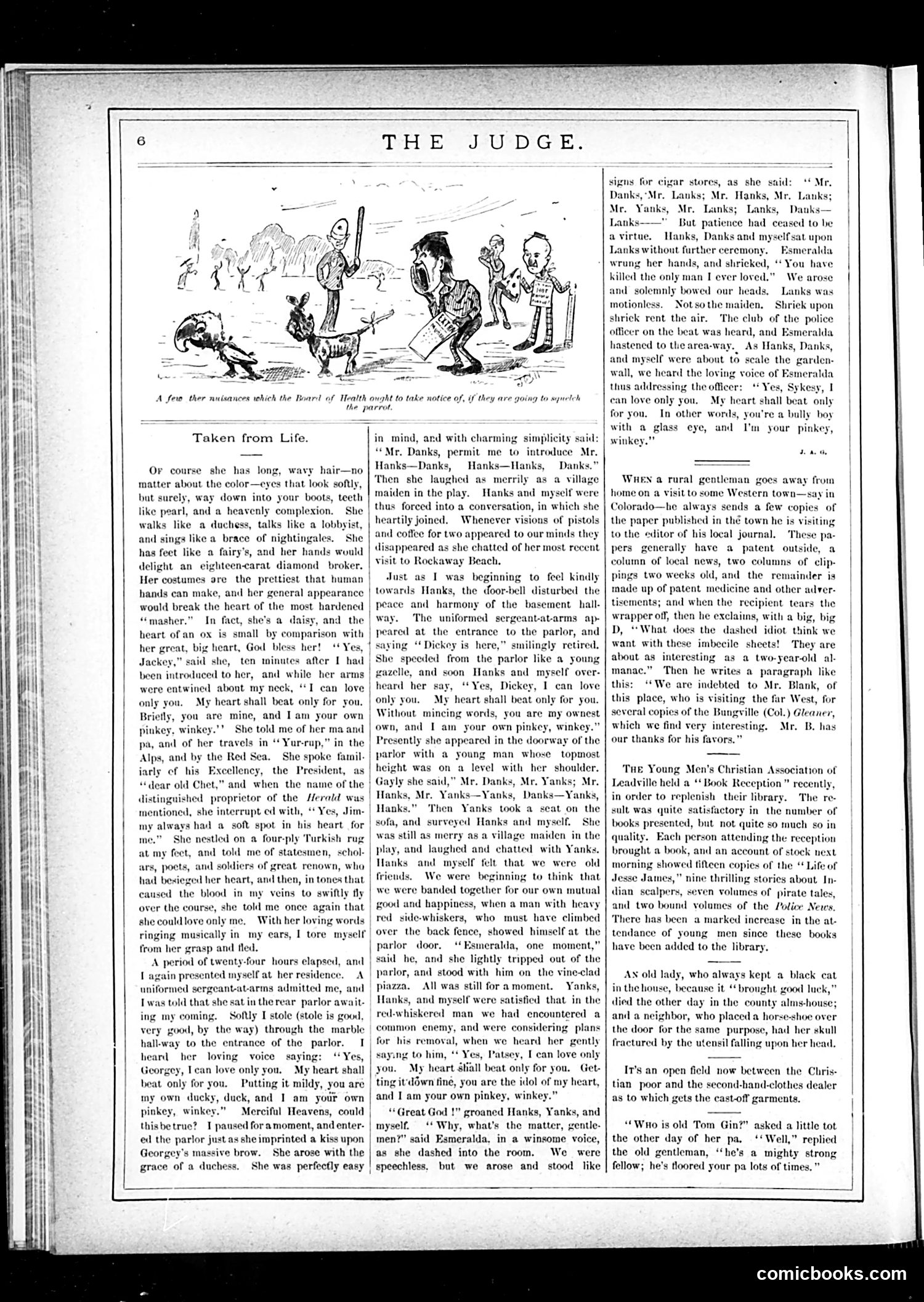
This page satirizes a common turn-of-the-century social anxiety: the deceptive romantic woman who manipulates multiple suitors simultaneously. The cartoon's title references the Board of Health's efforts against urban nuisances (like parrots mentioned in the header). The narrative, "Taken from Life," depicts a man discovering that his romantic paramour — described with exaggerated flattery (perfect hair, complexion, intelligence) — simultaneously romances several other men with identical declarations of exclusive love. Each suitor (Danks, Hanks, Yanks, Dickey) receives the same performative passion and physical affection. The satire targets female duplicity and performative femininity in courtship. The woman's theatrical charm, name-dropping of famous men, and rehearsed romantic lines suggest calculated manipulation rather than genuine feeling. For the magazine's male readership, it warns against trusting a woman's professed devotion. The cartoon mocks male gullibility while suggesting women's fundamental untrustworthiness — reflecting period attitudes about gender and romance.
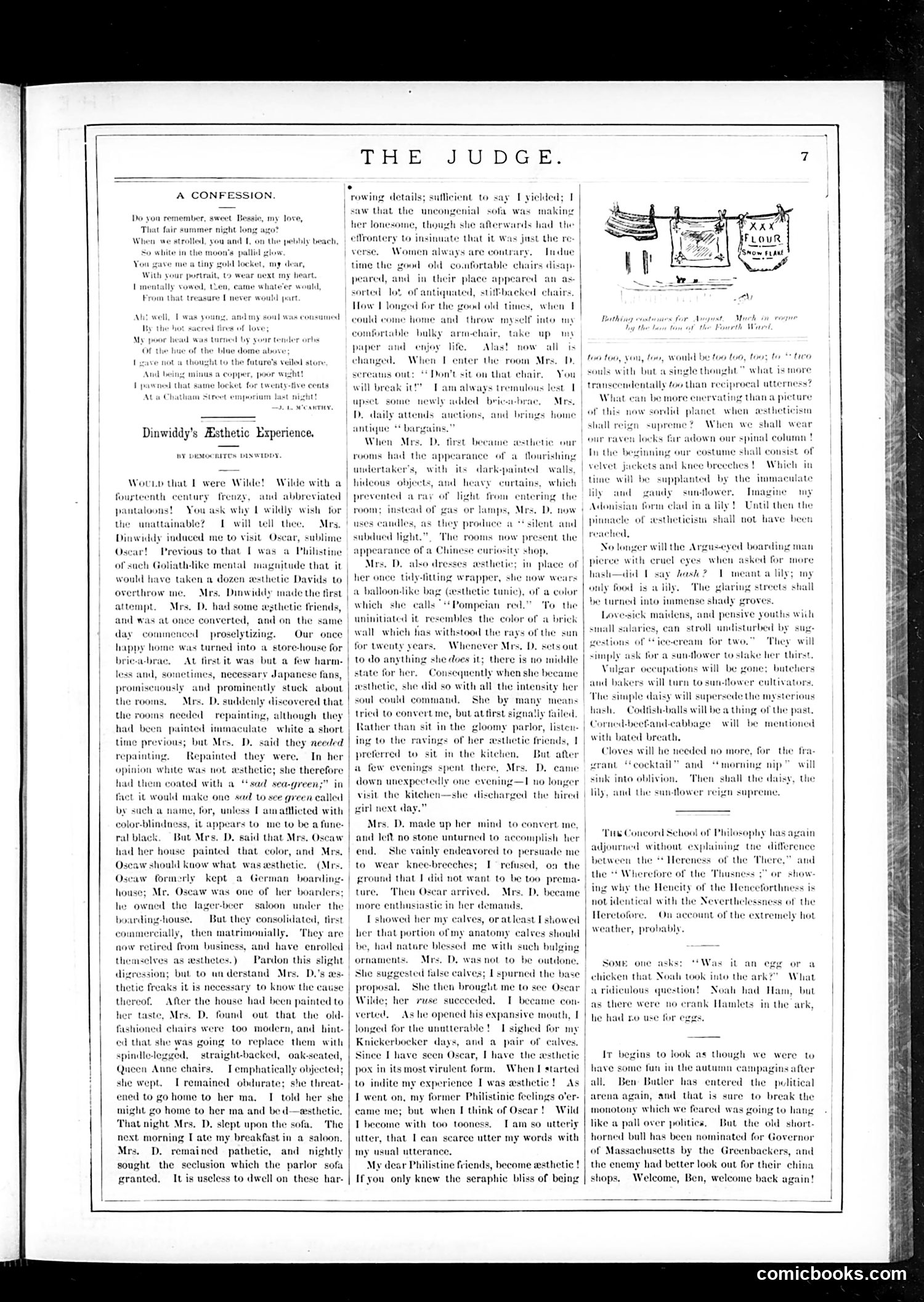
This satirical piece mocks the aesthetic movement of the 1880s-90s, which championed "art for art's sake" and decorative beauty over practicality. The narrator's friend Mrs. Dinwiddy becomes obsessed with Oscar Wilde's aesthetic philosophy after visiting him. She transforms her home into a cluttered "Chinese curiosity shop," repaints walls an ugly "Pompeian red" (described as funeral black), replaces functional furniture with uncomfortable aesthetic pieces, and obsesses over decorative bric-a-brac and Japanese fans. The satire ridicules how aesthetic converts abandon comfort and sense for pretentious fashion. Mrs. Dinwiddy's extreme makeover—even prohibiting her husband from sitting in chairs or using the kitchen—shows the movement's absurdity when taken to fanatical extremes. Judge's target: wealthy Americans blindly mimicking European artistic trends without understanding them, sacrificing livable homes to appear cultured.
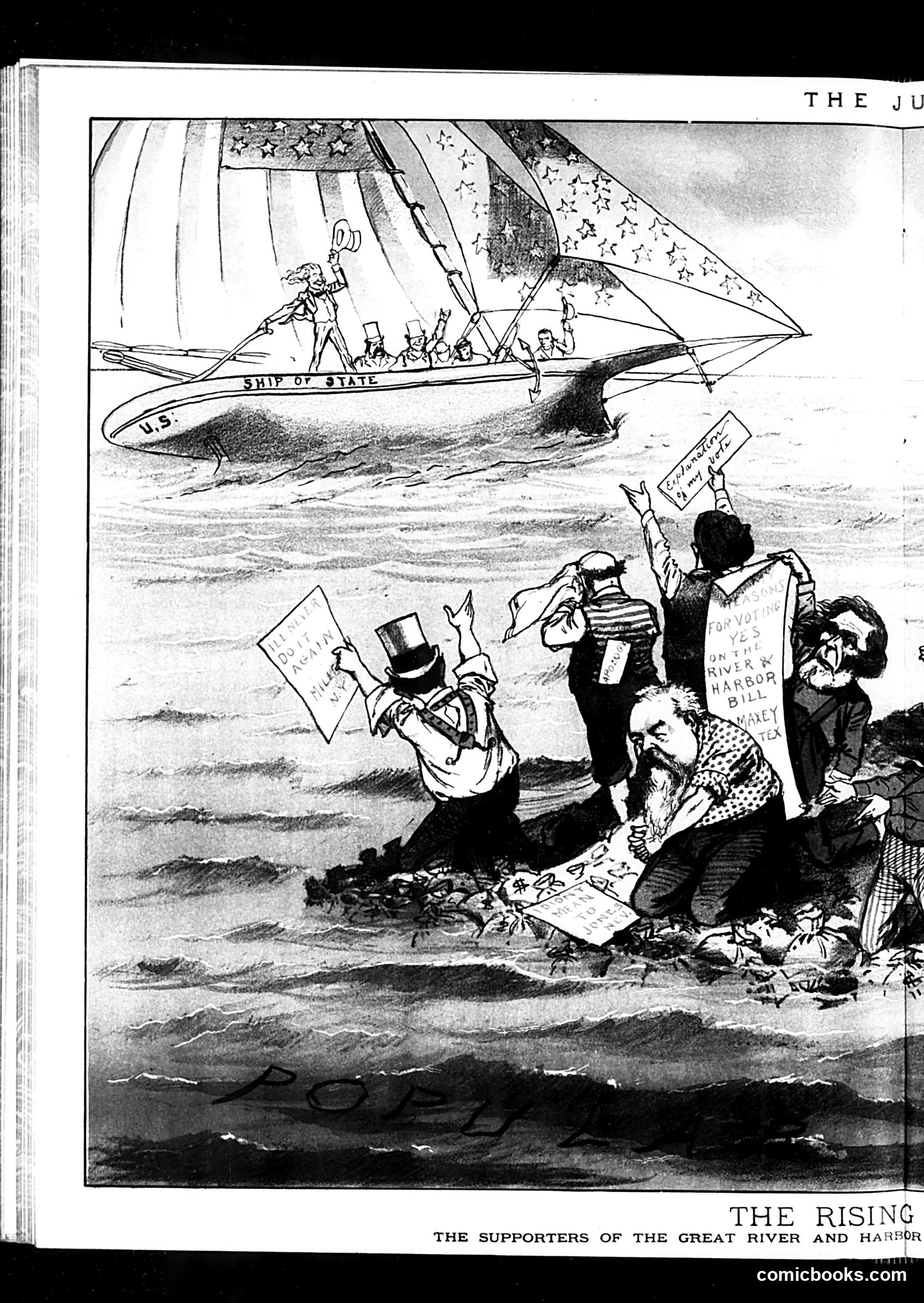
This satirical cartoon critiques supporters of federal spending on river and harbor improvements. The image depicts a group of politicians/lobbyists on shore, holding signs advocating for "River and Harbor Bill" funding, while they appear distressed or pleading toward the "U.S. Ship of State" sailing away. The cartoon suggests these supporters are trying desperately to influence national policy through advocacy, depicted as somewhat comic or desperate figures. The ship represents the federal government, seemingly indifferent or moving away from their demands. This likely relates to early 20th-century political debates over pork-barrel spending on infrastructure projects. The satire implies that river and harbor bill proponents are self-interested groups seeking government funds, viewed skeptically by Judge magazine's editorial perspective as wasteful or corrupt.
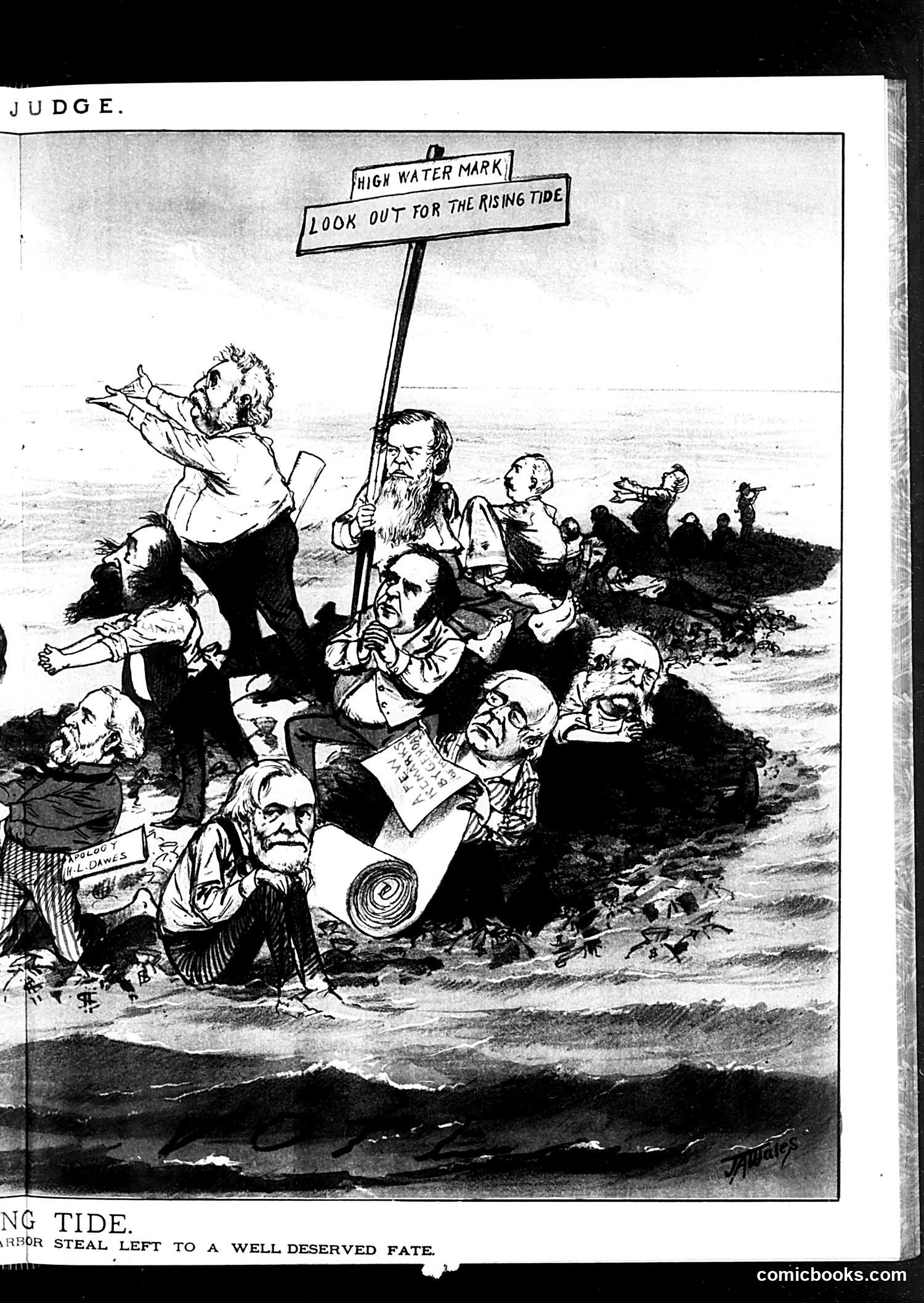
This Judge magazine cartoon depicts a group of men huddled on sinking ground with a "High Water Mark" warning sign, captioned "Look Out for the Rising Tide." The bottom text references "harbor steal left to a well deserved fate." The cartoon appears to satirize political corruption or mismanagement—likely involving harbor officials or maritime interests—using flood/drowning metaphors. The various caricatured figures suggest multiple politicians or bureaucrats implicated in some scheme. The "rising tide" symbolizes consequences or exposure catching up with them. Without seeing the publication date or additional context, I cannot definitively identify the specific figures or corruption scandal referenced, though the maritime reference suggests involvement with port authority or shipping interests. The cartoon's message is that these wrongdoers face inevitable downfall.
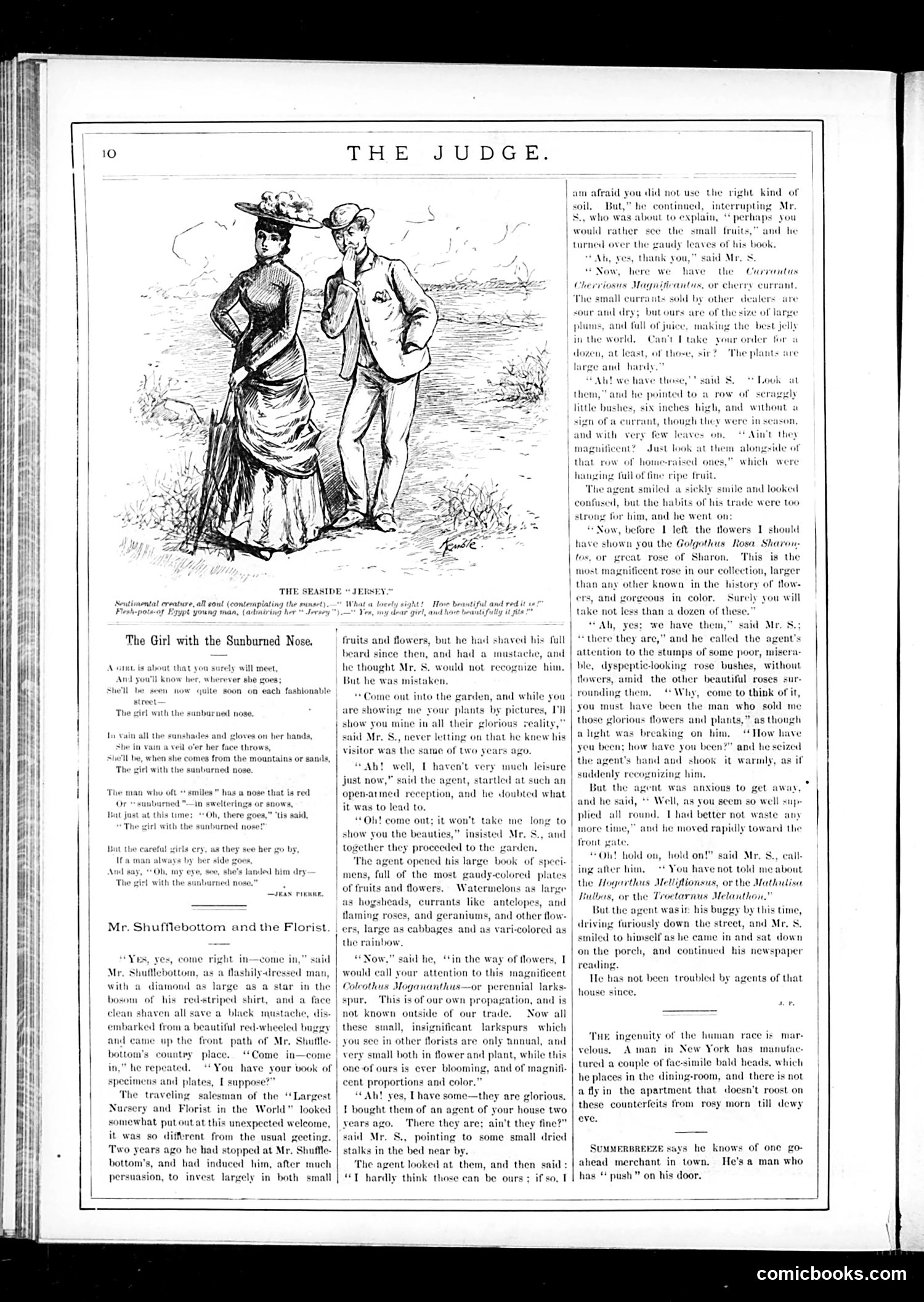
This page from Judge contains satirical stories mocking American commercial culture and salesmanship. **"The Girl with the Sunburned Nose"** is a humorous poem about fashionable society's obsession with appearance—specifically the irony that women use elaborate sunshades and veils to avoid sunburning, yet the "sunburned nose" remains inevitable. **"Mr. Shufflebottom and the Florist"** satirizes aggressive sales tactics. A traveling salesman revisits a nursery owner he'd sold expensive seeds to two years prior. The plants failed miserably (now just dried stalks), but the salesman—undeterred and unchanged—launches into a slick pitch about superior new specimens, using inflated botanical names and exaggerated claims to convince Shufflebottom to invest again. The joke targets both the dishonest "confidence man" salesman archetype and gullible customers susceptible to smooth talk and fancy nomenclature. Both pieces mock American commercial deception and vanity through satirical humor typical of late-19th-century Judge magazine.
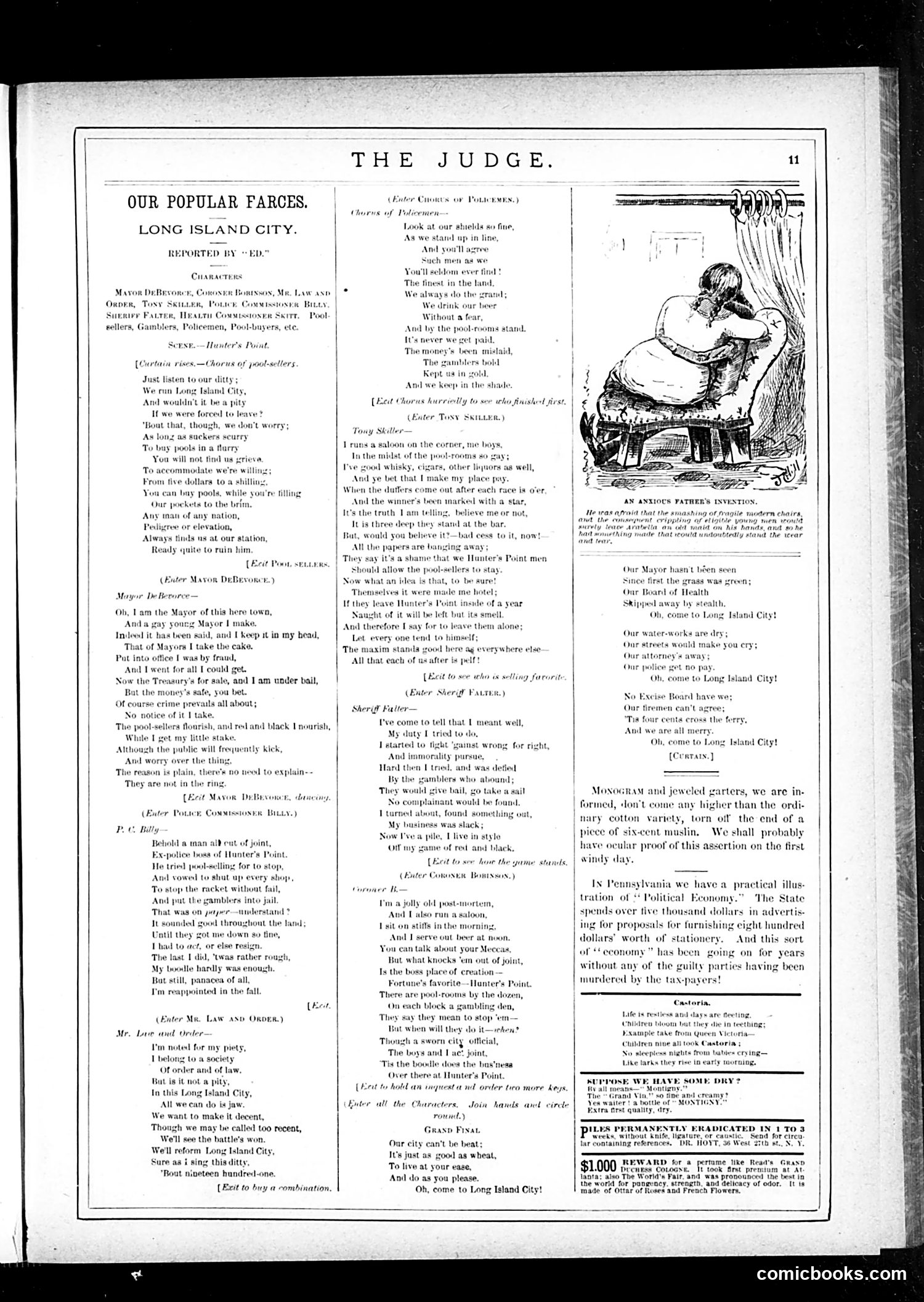
This page satirizes corruption in Long Island City government through a musical farce. The characters—Mayor DeBrevoort, Police Commissioner Bittinger, Sheriff Falten, and various officials—sing cheerfully about their illegal activities: running the city as a personal racket while extorting bribes from pool halls, saloons, and illegal gambling operations. The satire's targets are clear: public officials openly admitting they profit from vice, that money has "been mislaid," and that they maintain their positions through fraud. The chorus of police officers sing about never getting paid (suggesting graft replaces legitimate wages), while Tony Swiller boasts his saloon thrives on the corrupt system. The joke for Judge's readers: these "popular farces" aren't theatrical performances but actual city governance—officials so brazenly corrupt they might as well be performing it publicly. The satire exposes how Long Island City was essentially run as a criminal enterprise by its elected leaders with police complicity.
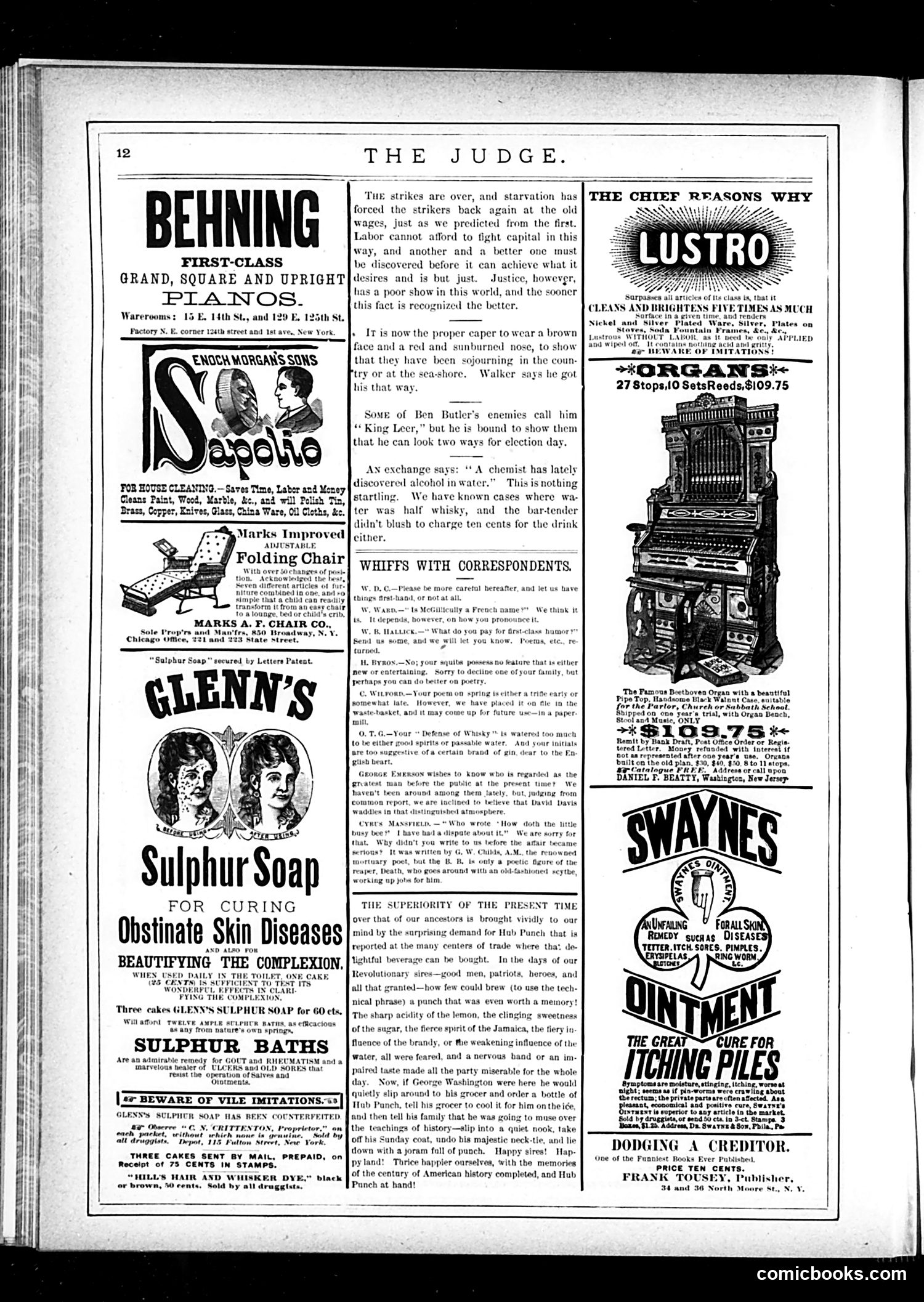
This page is primarily **advertising**, with a sidebar of editorial commentary and reader correspondence. The main editorial content critiques **labor strikes** (the text references strikers forced "back again at the old wages"). The writer argues labor cannot afford prolonged confrontation with capital, predicting strikes will fail—a position reflecting Judge's generally conservative stance during this Gilded Age period. The "**Whiffs with Correspondents**" section prints humorous rejections of reader submissions. One notable exchange involves "Ben Butler," likely referring to **General Benjamin Butler**, a controversial Reconstruction-era politician and Union general. The joke implies Butler's political enemies mock him as "King Lear," but he'll "show them" at election time—a reference to his continued political relevance. Most other content is **product advertisements**: Behning Pianos, Glenn's Sulphur Soap (for skin diseases), organs, folding chairs, and patent medicines—typical of Judge's revenue model. The ads reflect period concerns: skin conditions, household furnishings, and musical instruments as status symbols. The page lacks sophisticated political cartoons; it's a standard commercial publication mixing light satire with revenue-generating ads.
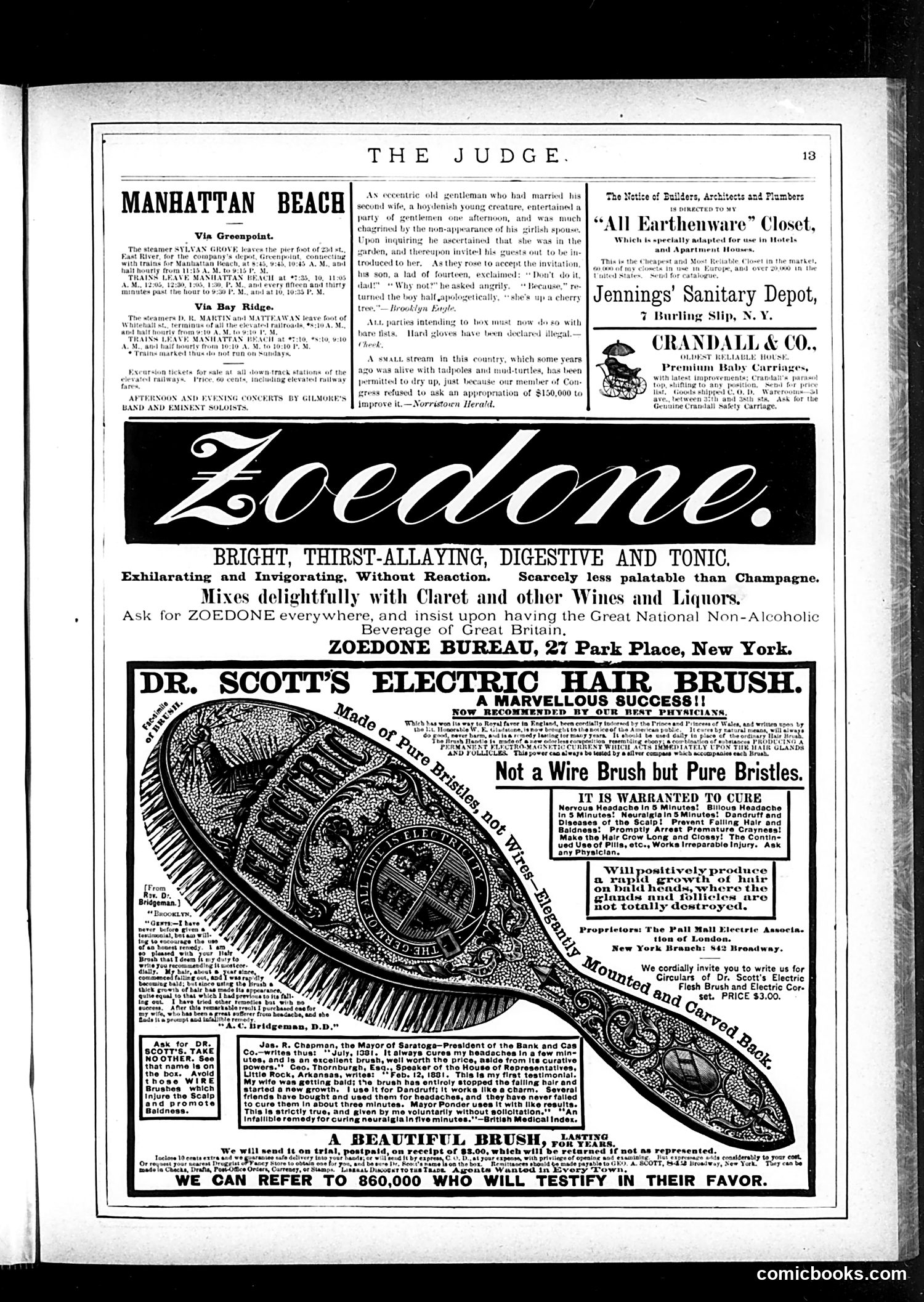
This page is primarily **advertising**, not political satire. The dominant content consists of commercial advertisements for patent medicines and consumer products typical of the late 19th century. The visible ads include: - **Zoedone**: A "non-alcoholic beverage" marketed as digestive and tonic - **Dr. Scott's Electric Hair Brush**: A pseudo-medical device claiming to cure headaches, neuralgia, and promote hair growth through "electricity"—a common Victorian-era medical fraud - **Jennings' Sanitary Depot** and **Crandall & Co.**: Household fixtures and baby carriages At the top, a brief **humorous anecdote** describes a man discovering his wife in a mental institution after marrying her. The page reflects Judge magazine's business model: satirical content subsidized by dubious patent medicine and electrical device advertisements—many of which would be considered medical fraud by modern standards. The juxtaposition is unintentional comedy: serious medical claims presented alongside obvious quackery.
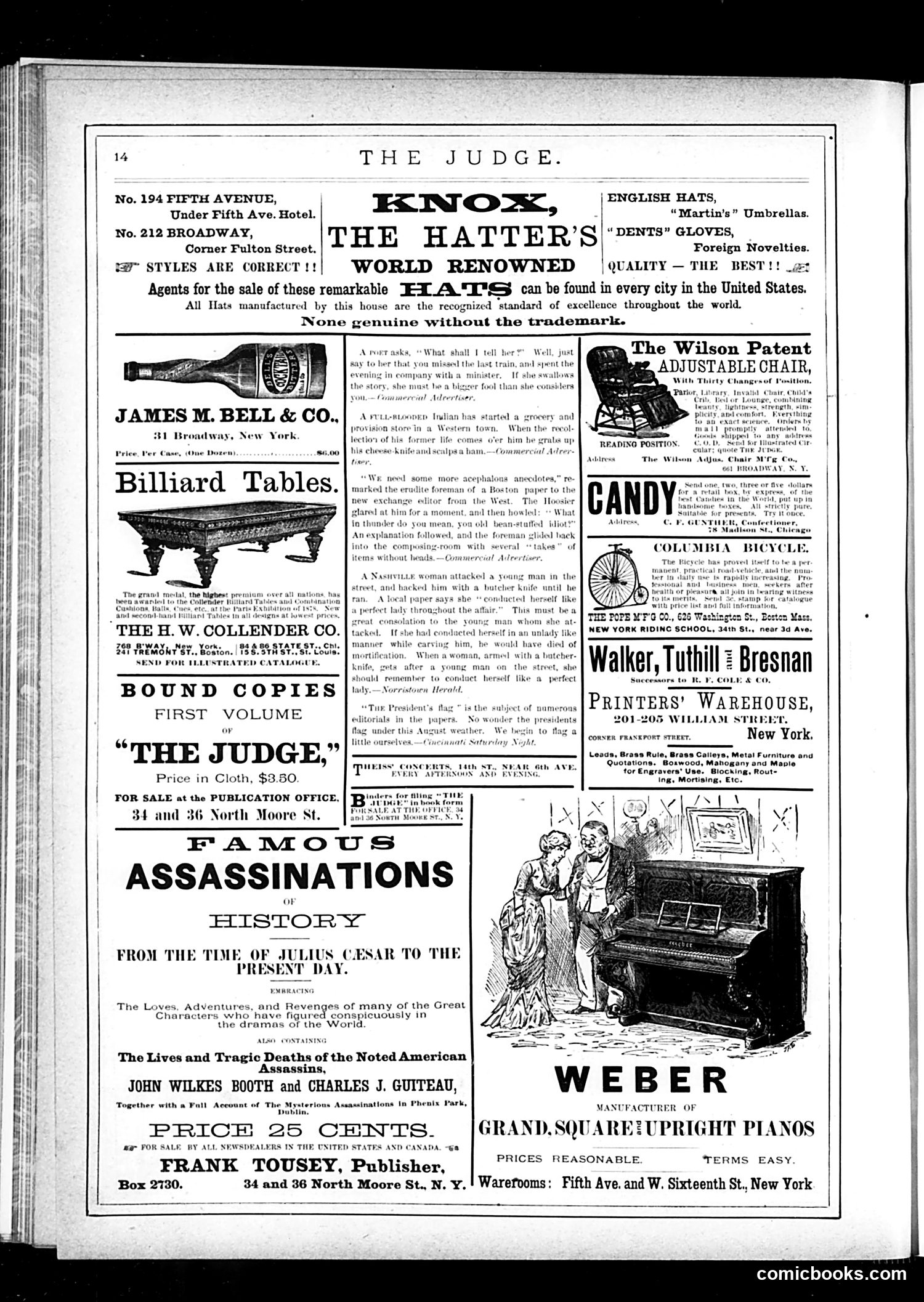
This page is primarily **advertising** rather than editorial content or political cartoons. It showcases various products and services typical of 1880s America: **Main advertisements include:** - **Knox Hats** (prominently featured) — a prestigious hatmaker with multiple New York locations - **James M. Bell & Co.** — billiard tables - **The H.W. Collender Co.** — billiard equipment manufacturer - **Bound copies of *The Judge*** — the magazine's first volume ($3.80) - **Frank Tousey, Publisher** — hawking a sensationalist book on famous assassinations, including John Wilkes Booth and Charles J. Guiteau - **Weber pianos** — with an illustration of two women admiring one - **Wilson Patent Adjustable Chair** - **Columbia Bicycle** - **Walker, Tuthill & Bresnan** — printers' warehouse There is **no significant political cartoon or satire** visible. The small dialogue snippet ("What shall I tell her?") appears to be advertising copy. This reflects *Judge*'s business model: a satirical magazine supported heavily by commercial advertising.
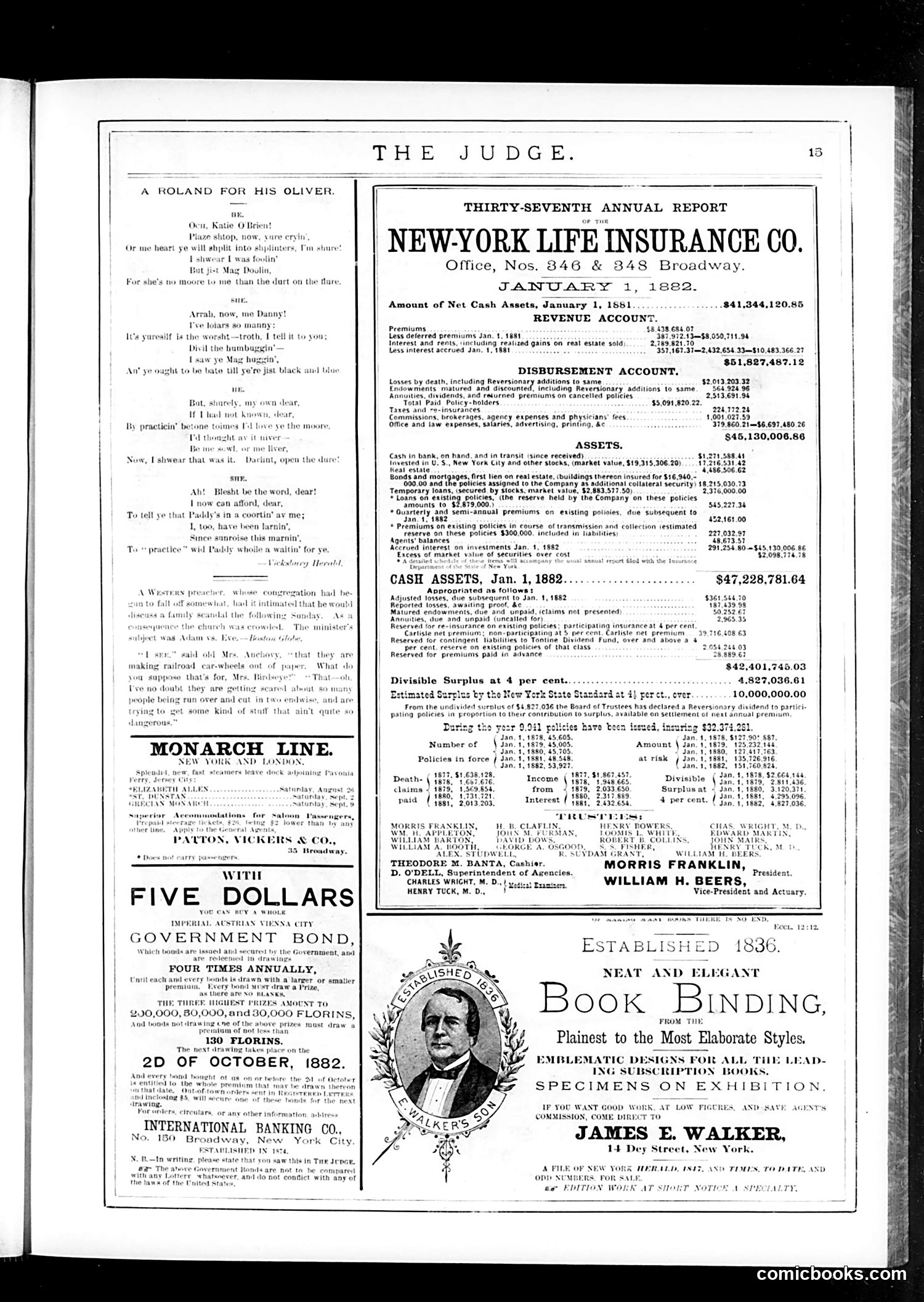
This page is primarily **advertising and financial reporting**, not political satire. The main content consists of the New York Life Insurance Company's thirty-seventh annual report (dated January 1, 1882), detailing assets, premiums, and disbursements. The small cartoon at top left, titled "A Roland for His Oliver," appears to be **Irish dialect humor** featuring two characters (likely named Paddy and Bridget based on context clues) in flirtatious banter. The phrase "a Roland for his Oliver" means tit-for-tat exchange. The joke involves courtship and romantic sparring—she mentions a suitor named Paddy; he reveals he's been "practicing" with her while waiting. It's gentle romantic comedy rather than political commentary. The rest of the page contains various **advertisements** (steamship lines, government bonds, banking services) typical of Judge magazine's revenue model. No significant political satire is present.
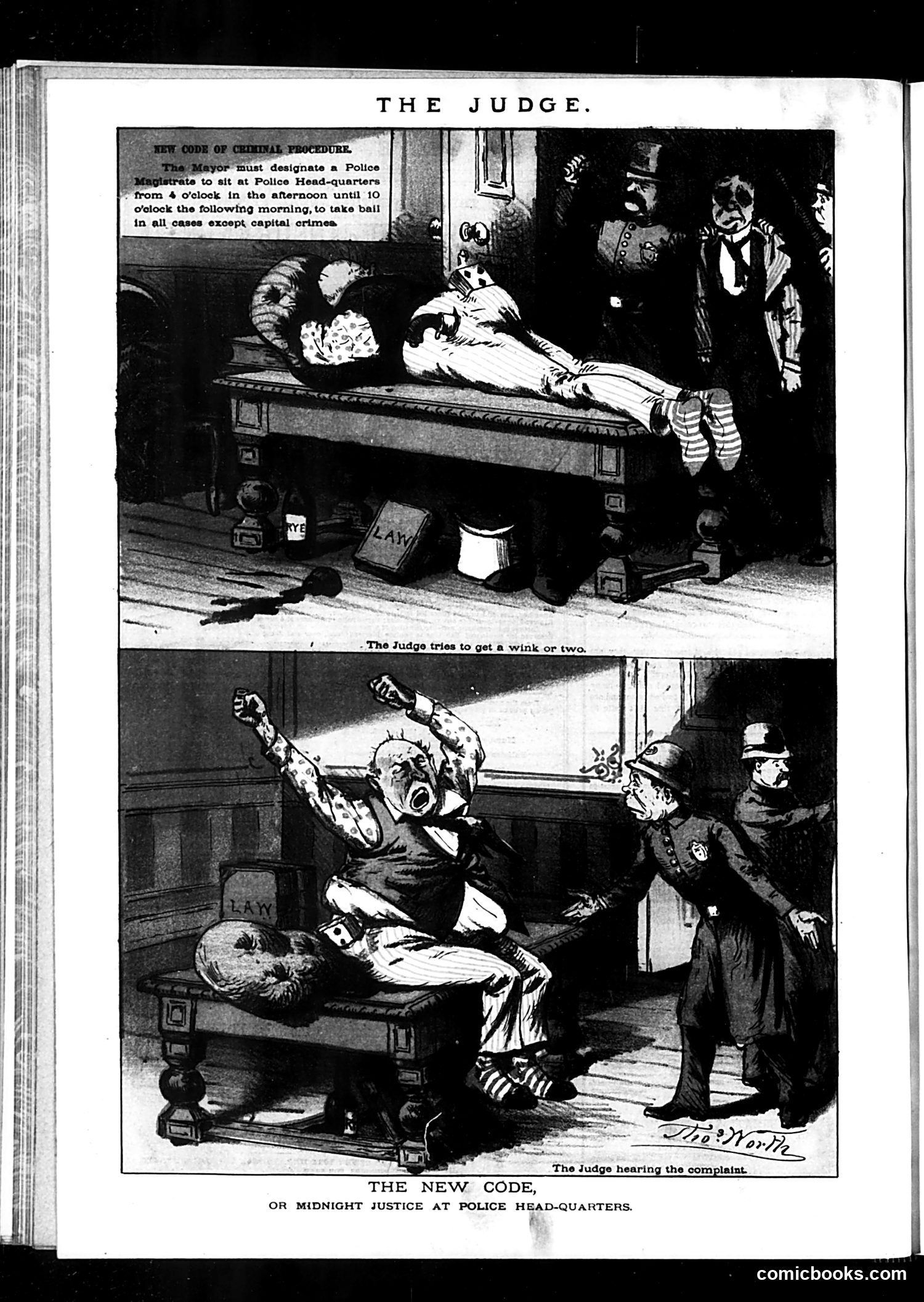
This two-panel satirical cartoon critiques a new police procedure allowing magistrates to operate from police headquarters during late-night hours (4 PM to 10 AM) to handle bail for most crimes. **Panel 1:** A judge attempts to sleep on a bench while police officers and figures surround him, suggesting the absurdity of judicial work in such conditions. **Panel 2:** The judge is now awake and animated, "hearing the complaint" from what appears to be an arrested person. The satire targets the quality and legitimacy of "midnight justice"—implying that justice administered at odd hours, in police stations rather than proper courts, is hasty, corrupt, or compromised. The exaggerated expressions and cramped setting mock the informal, late-night judicial process as inadequate and farcical, raising concerns about due process and judicial integrity.