
Judge, 1882-09-02 · page 5 of 16
Judge — September 2, 1882 — page 5: what you’re looking at
What you’re looking at
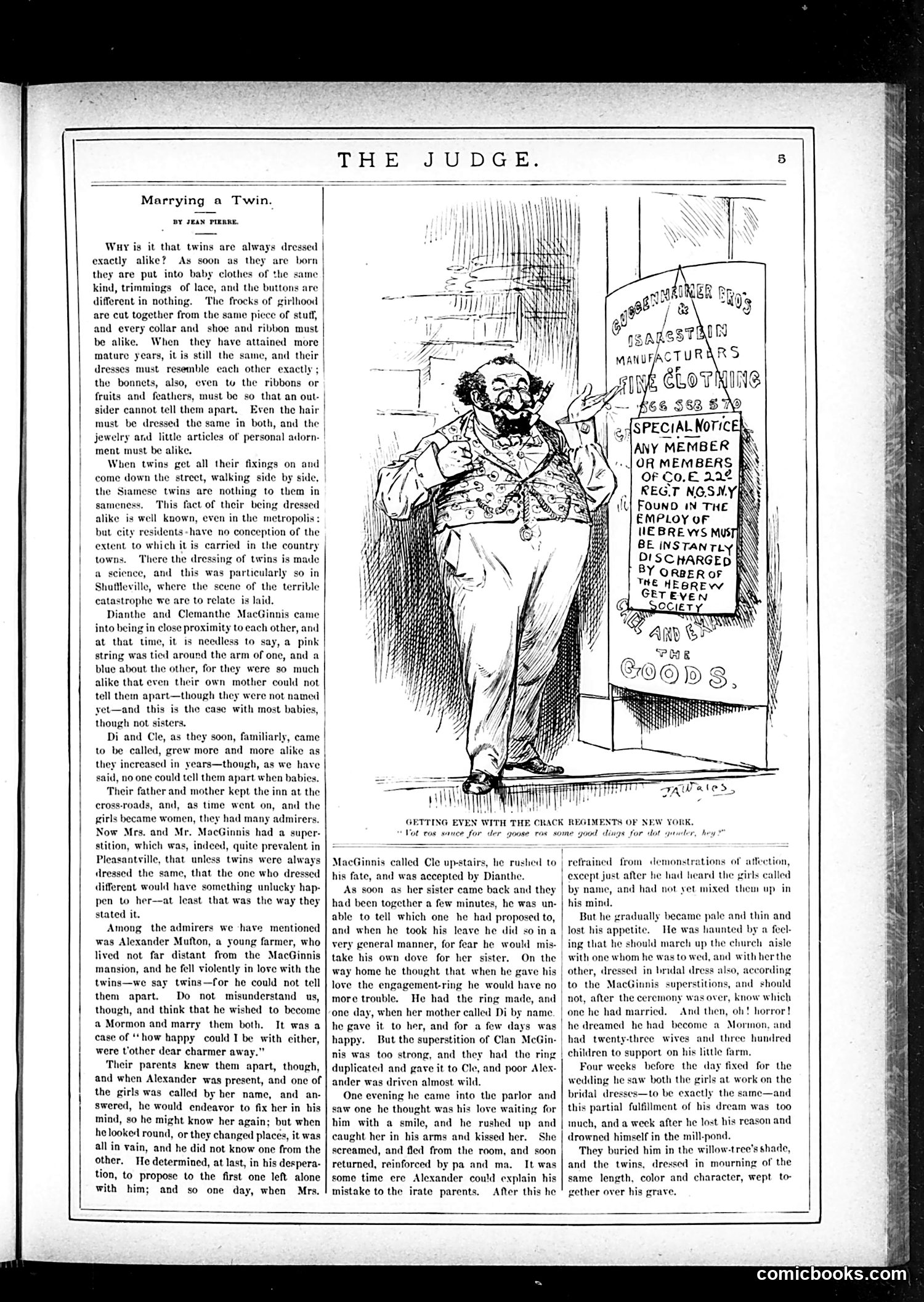
This is a humorous short story (not primarily a political cartoon) satirizing rural American customs and romantic confusion. The narrative ridicules the widespread practice in small towns of dressing identical twins in completely matching clothing—even as adults—to an absurd degree. The satire targets several things: the superstitious belief that twins dressed differently would face misfortune; the resulting inability of outsiders (including the suitor Alexander Mufton) to distinguish between them; and the chaos this creates when Mufton proposes to one twin but cannot remember which one afterward. The accompanying illustration shows a well-dressed man holding a large sign advertising "Cossacky Bros' Tearstain Manufacturers," a joke advertisement likely unrelated to the main story—typical of Judge's mixed satirical content. The humor derives from small-town conventions taken to illogical extremes, creating a predicament of mistaken identity rooted entirely in local custom rather than actual similarity.
📄 Transcribed text from this page (OCR, searchable)
Machine-transcribed from the original scan — historical spelling and the odd misread are preserved.
THE JUDGE. Marrying a Twin. BY JEAN PIERRE. Wry is it that twins are always dressed | exactly alike? As soon as they are born | they are put into baby clothes of the kind, trimmings of lace, and the buttons different in nothing. The frocks of girlhood are cut together from the same piece of stuff, and every collar and shoe and ribbon must | be alike. When they have attained more| mature years, it is still the same, and their dresses must resemble each other exactly ; the bonnets, also, even tu the ribbons or fruits and feathers, must be so that an out- | sider cannot tell them apart. Even the hair must be dressed the same in both, and the jewelry and little articles of personal adorn- ment must be alike. | When twins get all their fixings on and come down the street, walkin de by side, the Siamese twins are nothing to them in sameness, This fact of their being dressed alike is well known, even in the metropolis : but city residents-have no conception of the extent to which it is carried in the country towns. There the dr i of twins is made a science, and this was particularly so in Shutileville, where the scene of the terrible catastrophe we are to relate is laid. Dianthe and Clemanthe MacGinnis came into being in close proximity to each other, and at that time, it is needless to say, a pink string was tied around the arm of one, and a blue about the other, for they were so much alike that even their own mother could not tell them apart—though they were not named yet—and this is the case with most babies, | though not sisters. | Di and Cle, as they soon, familiarly, came | to be called, grew more and more alike as | they increased in years—though, as we have said, no one could tell them apart when babies. Their father and mother kept the inn at the cross-roads, and, as time went on, and the girls became women, they had many admirers. Now Mrs. and Mr. MacGinnis had a super- stition, which was, indeed, quite prevalent in Pleasantville, that unless twins were always «dressed the same, that the one who dressed different would have something unlucky hap- pen to her—at least that was the way they stated it, Among the admirers we have mentioned was Alexander Mufton, a young farmer, who lived not far distant from the MacGinnis mansion, and he fell violently in love with the twins—we say twins—for he could not tell them apart. Do not misunderstand us, though, and think that he wished to become a Mormon and marry them both. It was a case of “how happy could I be with cither, were tother dear charmer away.” Their parents knew them apart, though, and when Alexander was present, and one of the girls was called by ber name, and an- swered, he would endeavor to fix her in his mind, so he might know her again; but when he looked round, or they changed places, it was all in vain, and he did not know one from the other. He determined, at last, in his despera- tion, to propose to the first one left alone | with him; and so one day, when Mrs. GETTING EVEN WITH THE CRAC! “Vot cos since for er goose ros s MacGinnis called Cle up-stairs, he rushed to his fate, and was accepted by Dianthe. As soon as her sister came back and they had been together a few minutes, he was un- able to tell which one he had proposed to, and when he took his leave he did soina very general manner, for fear he would mis- take his own dove for her sister. On the way home he thought that w he gave his love the engagement-ring he would have no more trouble. He had the ring made, and one day, when her mother called Di by name. he gave it to her, and for a few days w: happy. But the superstition of Clan Met nis was too strong, and they had the ring duplicated and gave it to Cle, and poor Alex- ander was driven almost wild. One evening he came into the parlor and saw one he thought was his love waiting for him with a smile, and he rushed up and caught her in his arms and kissed her. She screamed, and fled from the room, and soon returned, reinforced by pa and ma. It was some time ere Alexander could explain his mistake to the irate parents. After this he ANY MEMBER JOR MEMBERS FOUND IN THE EMPLOY oF O1SCHARGED f Pvc ORBER oF BREW Ger Even PWR K REGIMENTS OF NEW YORK, ome good dings for dot quuter, | refrained from demonstrations of atteeti | except just after he had heard the girls called by name, and had not yet mixed them up in his mind. But he gradually became pale and thin and | lost his appetite. He was haunted by a feel- ing that he should march up the chureh aisle with one whom he towed, and with herthe other, dressed in bridal dress also, according to the MacGinnis superstitions, and should not, after the ceremony was over, know which one he had married. And then, oh! horror! | he dreamed he had become a Mormon, and had twenty-three wives and three hundred children to support on his little farm, Four weeks before the fixed for the wedding he saw both the girls at work on the bridal dresses—to be exactly the same—and this partial fulfillment of his dream was too inuch, and a week after he lost his reason and drowned himself in the mill-pond. ‘They buried him in the willow-tree's shade, and the twins, dressed in mourning of the same length, color and character, wept to- gether over his grave. comicbooks.com