
A complete issue · 16 pages · 1882
Judge — July 29, 1882
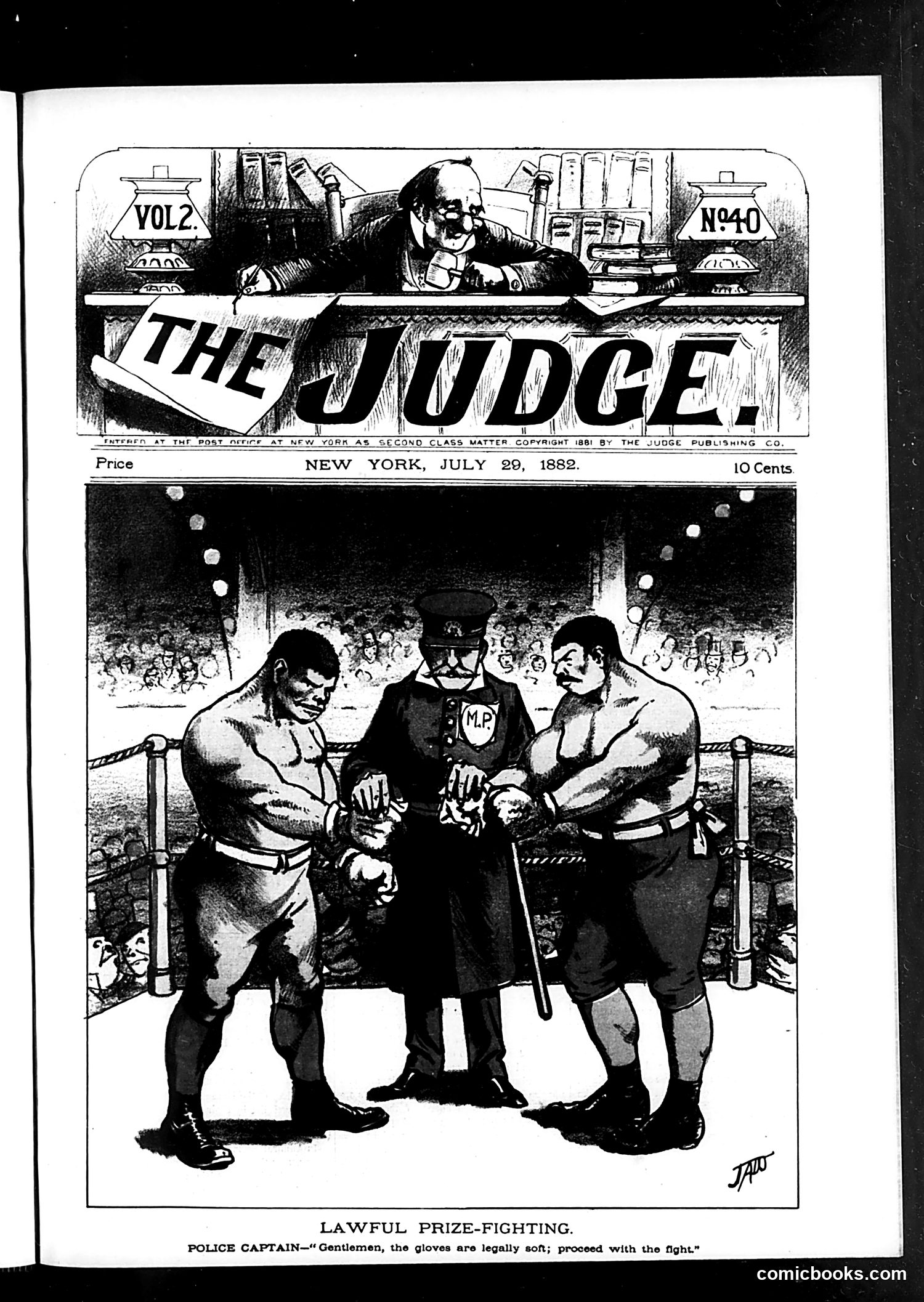
This cartoon satirizes the legal ambiguity surrounding prize-fighting in 1880s New York. The image shows two bare-knuckle boxers facing each other while a police captain oversees the match, appearing to legitimize it by declaring the gloves "legally soft." The satire targets the hypocrisy of law enforcement: prize-fighting was technically illegal, yet police captains would authorize matches under the pretense that using soft gloves made them lawful "athletic contests" rather than illegal fights. This loophole allowed underground boxing to flourish with official tolerance. The joke exposes how authorities selectively enforced boxing prohibitions, effectively licensing illegal activity through semantic technicalities. The packed stadium crowd visible in the background emphasizes the public nature of this supposedly prohibited sport.
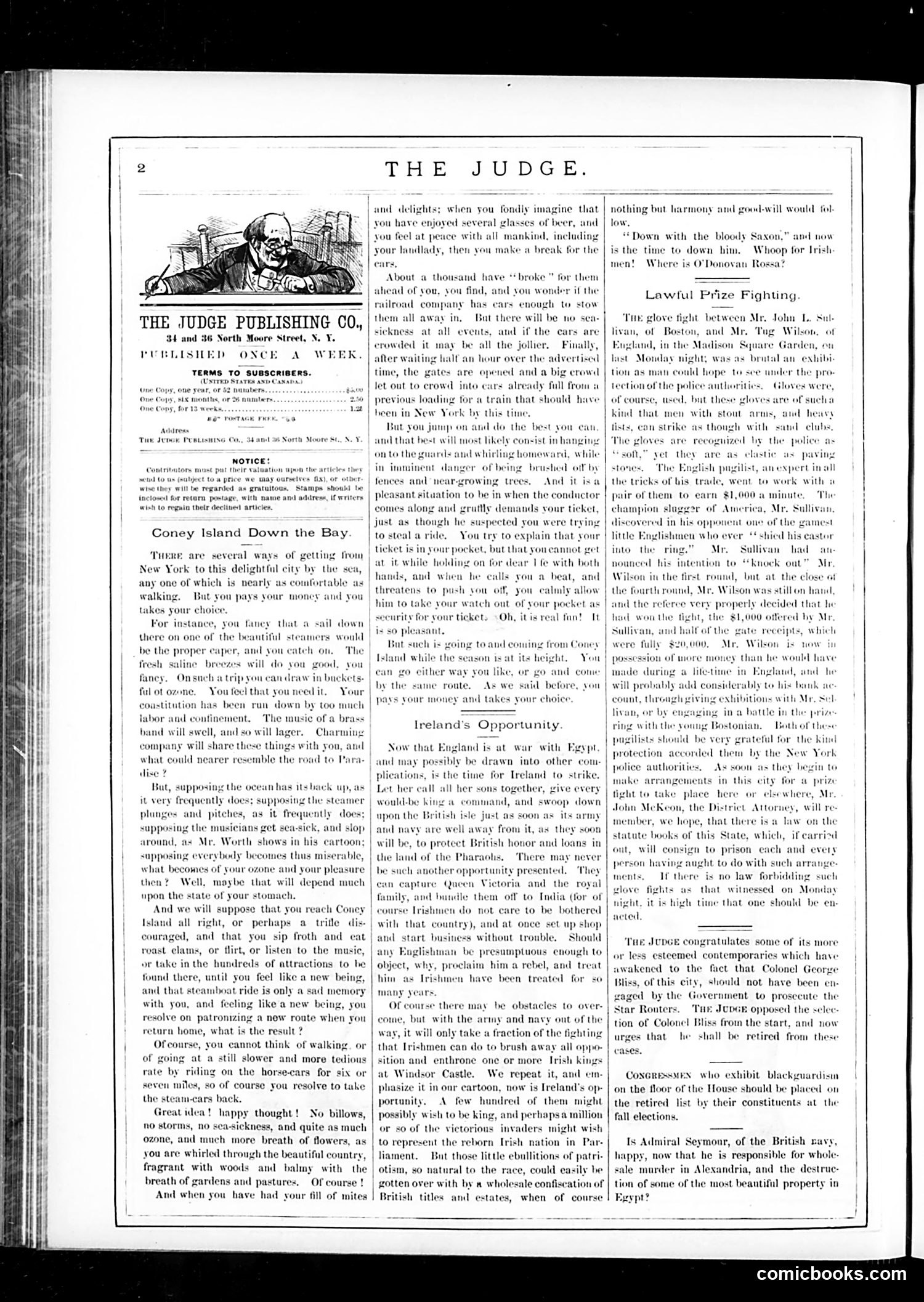
This page from *Judge* magazine contains two main pieces: **"Coney Island Down the Bay"** is a humorous essay satirizing the experience of visiting Coney Island from New York City. It mocks the contrast between the romantic *idea* of a seaside excursion (sailing, fresh air, romance) and the reality: seasickness, crowds, discomfort, and the chaotic stampede to board overcrowded return trains. The accompanying cartoon (showing a distressed figure) illustrates this gap between expectation and reality. The satire targets both the false advertising of leisure travel and the incompetence of transportation infrastructure—passengers endure hours of waiting, dangerous crowding, and rude conductors demanding tickets from people physically unable to retrieve them. The smaller items include publishing notices and an advertisement for *Judge* Publishing Company. This reflects late-19th-century anxieties about modernization: as railways made leisure travel accessible to ordinary people, the reality often proved uncomfortable and chaotic.
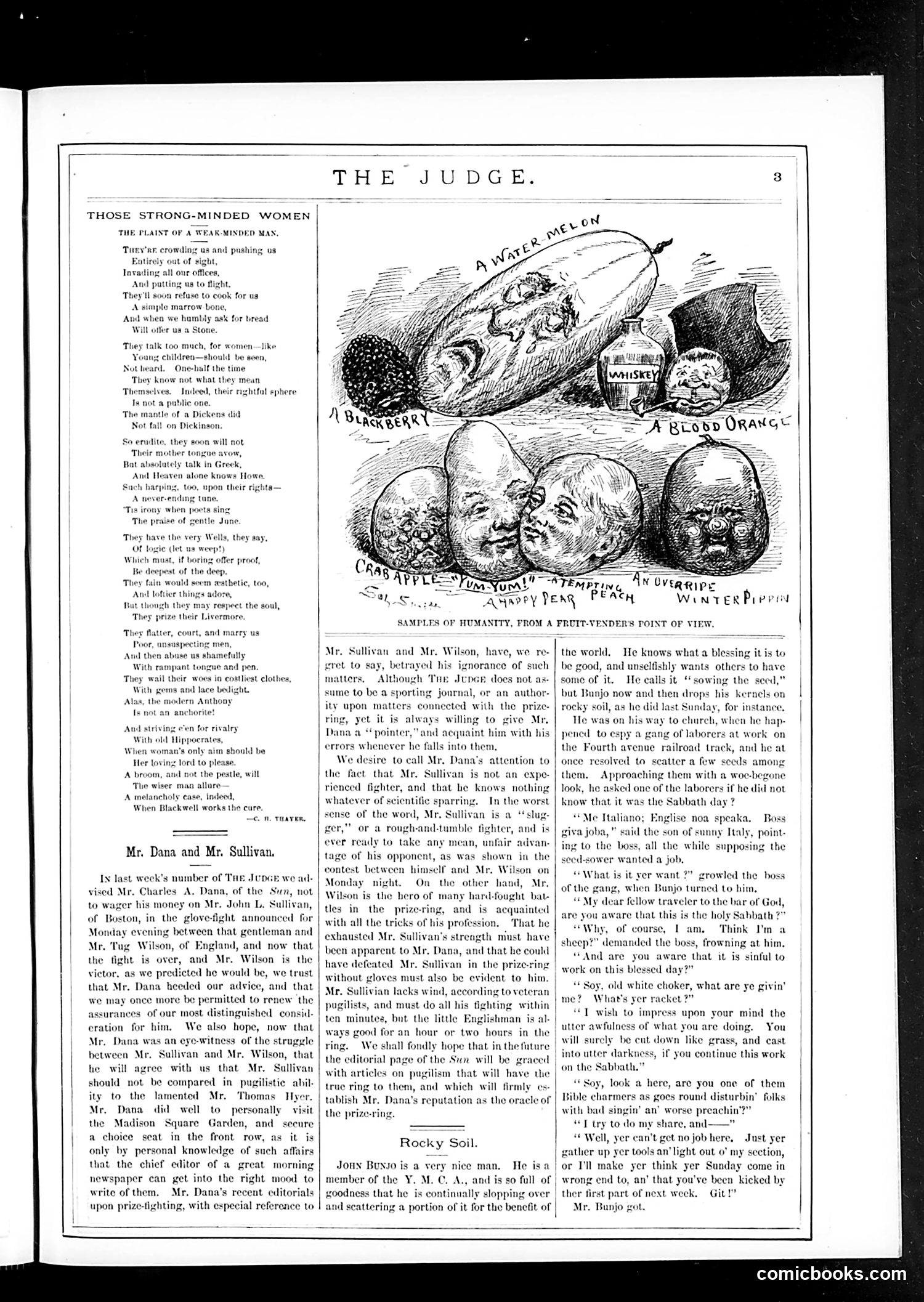
This page from *Judge* magazine contains two main satirical pieces: **"The Plaint of a Weak-Minded Man"** (left column and poem): A bitter complaint from a man opposing women's expanding social and intellectual roles. He laments that women are "crowding us" out of offices, refusing domestic servitude, talking too much, and gaining education. The satire mocks this weak man's resentment of female independence—positioning his complaints as pathetic and outdated. **"Mr. Dana and Mr. Sullivan"** (main article): Critiques Charles A. Dana (editor of the *New York Sun*) for endorsing boxer John L. Sullivan before a recent prizefight against Englishman Tug Wilson. Sullivan lost. The piece sarcastically congratulates Dana for witnessing the fight firsthand, while condescendingly "instructing" him that Sullivan is merely a crude brawler lacking scientific skill—implying Dana's sports journalism is uninformed. **"Samples of Humanity, From a Fruit-Vender's Point of View"** (center illustration): A cartoonist's joke depicting human heads as various fruits/produce with humorous labels, treating people as commodities.
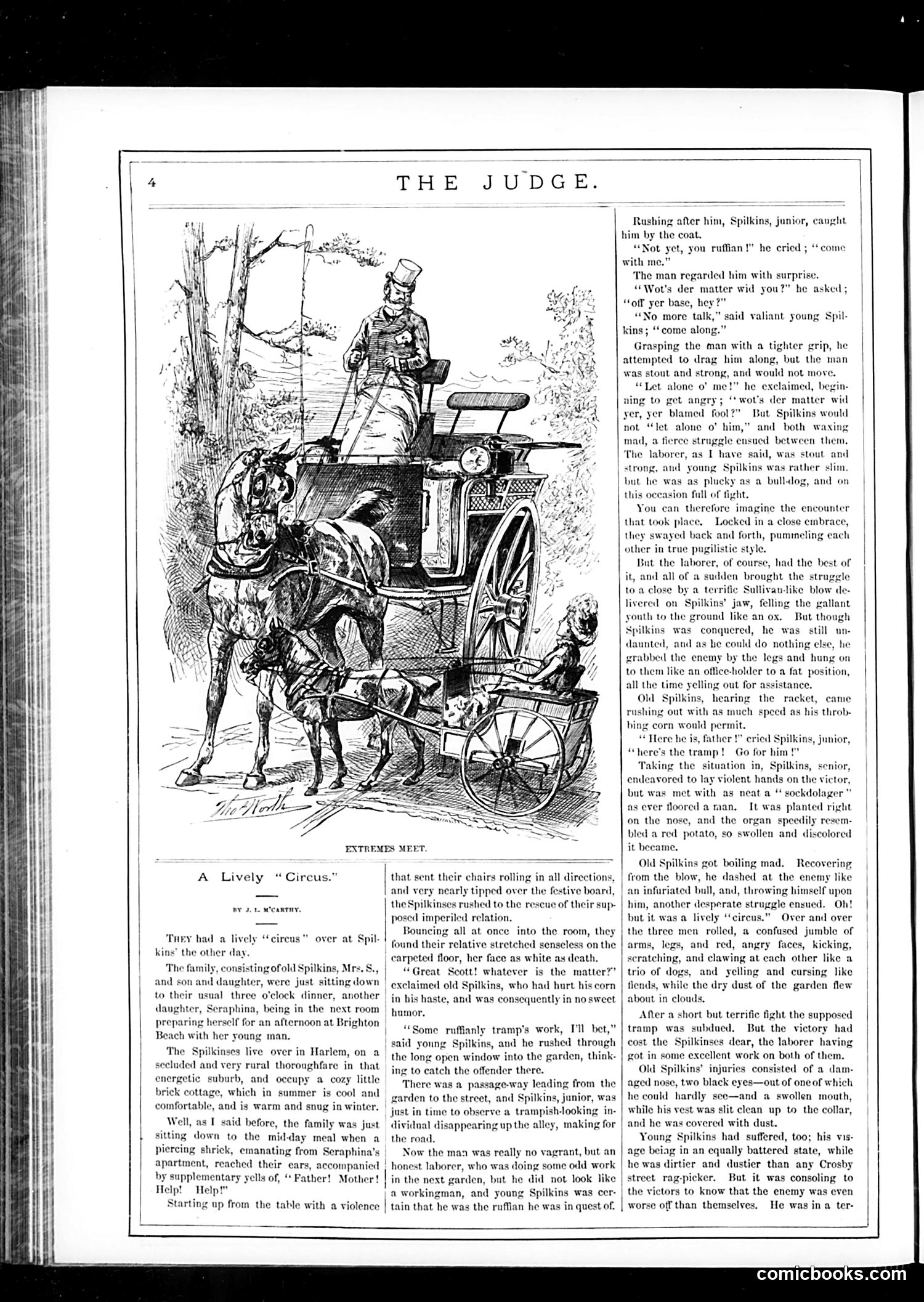
This satirical story illustrates class tensions through physical comedy. Young Spilkins, a middle-class Harlem resident, attacks an honest laborer he mistakes for a vagrant who assaulted his sister. The "extremes" are the classes: the refined Spilkins family versus the working-class laborer. The humor derives from role reversal—the supposed criminal is innocent, while the "respectable" youth commits assault. The laborer, described as "stout and strong," easily defeats the "plucky but slim" young Spilkins in their street brawl. The detailed fighting description parodies masculine Victorian heroics while exposing the vulnerability of middle-class pretension. The satire critiques both class prejudice (assuming a working man is a criminal) and the irony that genteel respectability masks violent behavior. By having the laborer win convincingly, Judge mocks upper-class assumptions of superiority.
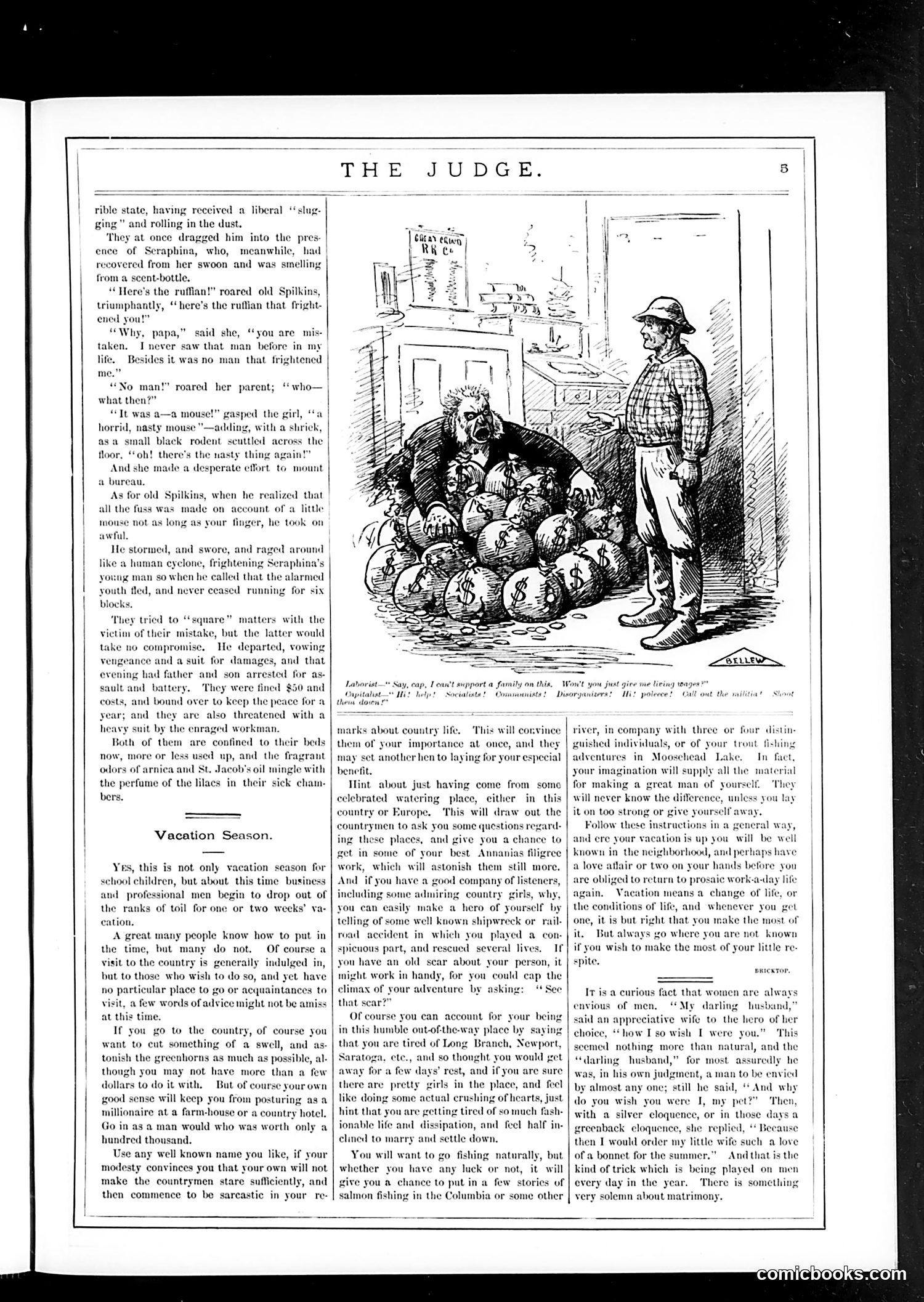
This page contains **two distinct pieces**: a serialized humorous story and advice column. **The illustrated story** (top) satirizes overwrought Victorian melodrama. A young woman named Seraphina faints in terror, causing her father Spilkins and a young man to brawl violently—only to discover she was frightened by a *mouse*. The satire mocks the absurdity of masculine overreaction to feminine hysteria and the legal consequences that follow (fines, lawsuits, confinement). The crude woodcut emphasizes the comedic disproportion between cause and effect. **"Vacation Season"** (bottom) offers tongue-in-cheek advice for middle-class men visiting the countryside. It satirizes social pretension: adopt a famous name, boast about fashionable resorts (Long Branch, Newport), invent dramatic rescue stories, and display old scars to impress rural folk. The satire targets how easily city dwellers can deceive unsophisticated country people through braggadocio and invented credentials—poking fun at both the deceivers' vanity and rural gullibility.
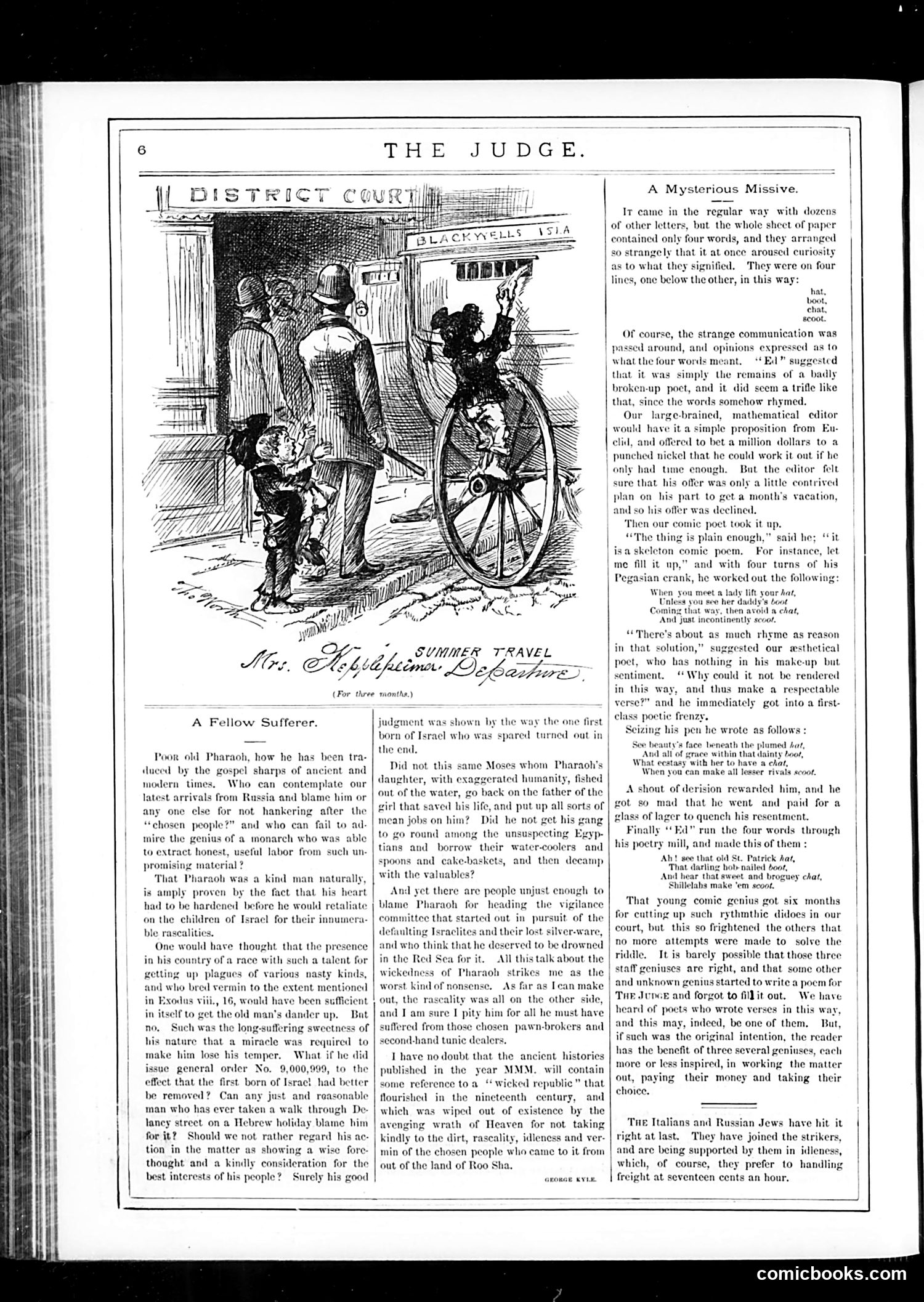
**"A Fellow Sufferer"** satirizes sympathetic defenses of Pharaoh against Biblical criticism. The author ironically argues Pharaoh was justified in oppressing the Israelites, comparing them to recent Russian Jewish immigrants to America. This reflects late-19th-century anti-immigrant sentiment: the piece mocks contemporary Jewish arrivals as lazy, thieving, and troublesome—mirroring accusations against the ancient Israelites. The satire targets not immigrants but the prejudiced American attitudes toward them, presenting Pharaoh's perspective as absurdly sympathetic to highlight how ridiculous such prejudice becomes when reversed. **"A Mysterious Missive"** describes a brief, cryptic letter containing four rhyming words (hat, loot, chat, scoot) that puzzles recipients. The staff debates its meaning—whether poetry or mathematical puzzle—offering no clear resolution. It's a light, humorous piece playing on the mystery of nonsensical correspondence. The bicycle illustration ("Summer Travel—Mrs. Shadwell's Departure") depicts summer leisure culture typical of the era.
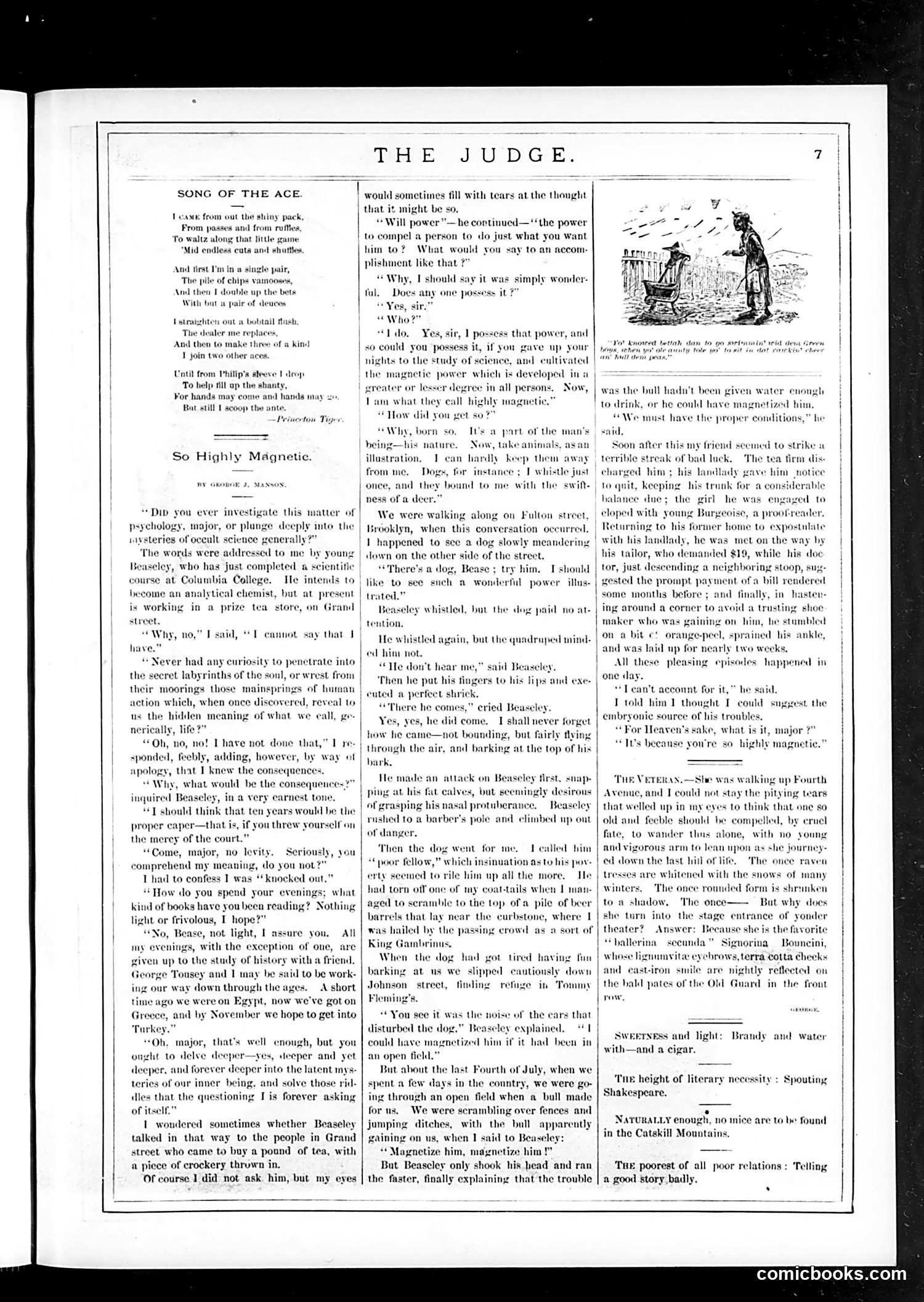
This page contains a fictional dialogue satirizing pseudoscientific claims popular in the late 19th/early 20th century. The narrator encounters "Beaseley," a Columbia College student who claims to possess supernatural "magnetic power"—the ability to compel others' actions through will alone. The satire works through deliberate deflation: Beaseley makes grandiose claims about magnetism and psychology, citing vague study of "occult science" and history. When challenged to demonstrate his power over a dog on Fulton Street in Brooklyn, his magnetism completely fails—the dog ignores his whistles. The joke targets credulous pseudo-intellectuals and the era's fascination with mesmerism, magnetism, and occultism dressed up as science. By having the charlatan's "powers" comically fail at the simplest test, Judge ridicules both the false claims and those gullible enough to believe them. The narrator's bemused perspective invites readers to share in mocking such pretension.
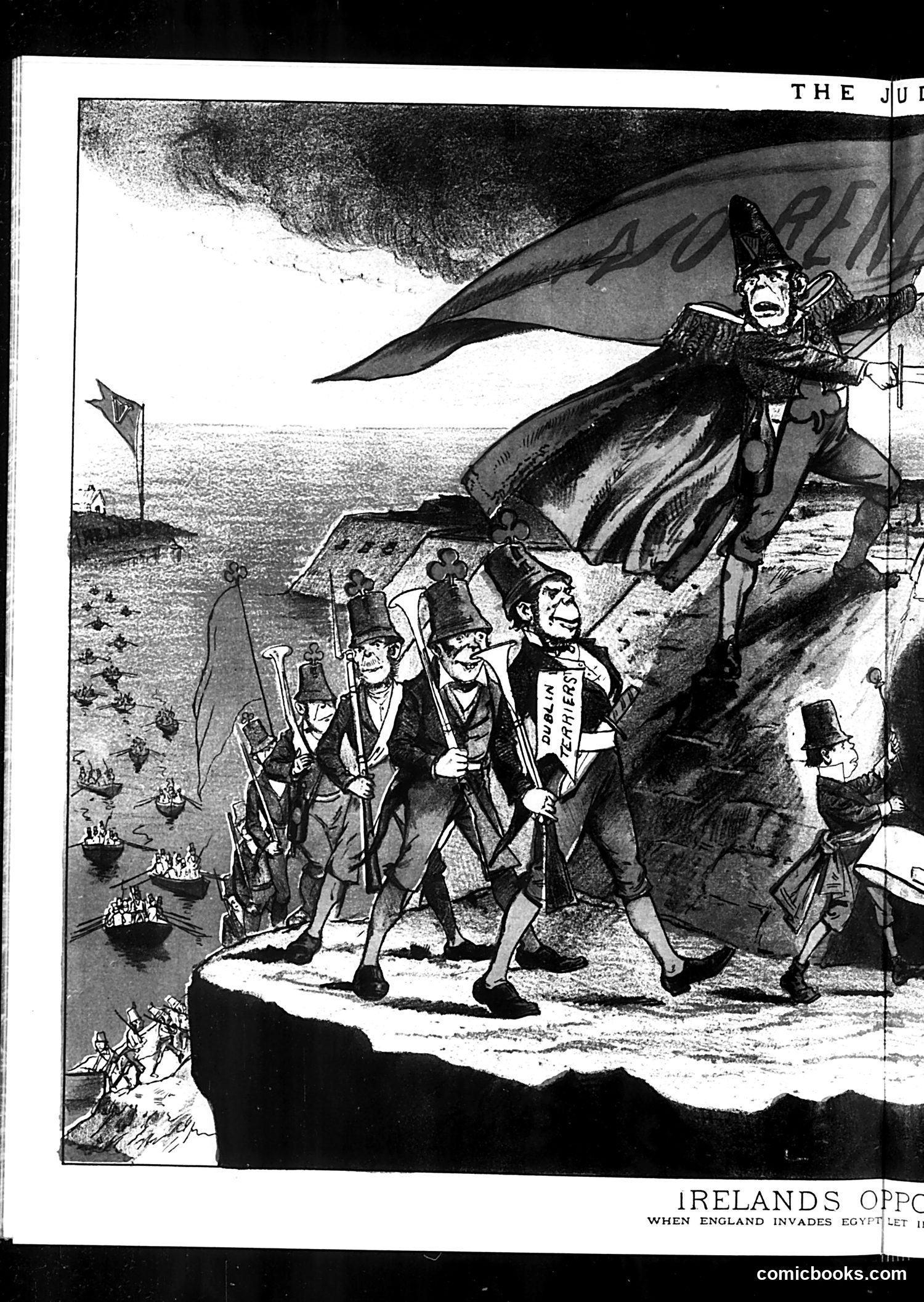
This political cartoon from *Judge* magazine satirizes Ireland's geopolitical position during World War I. The caption reads "Ireland's Opportunity When England Invades Egypt" (partially visible). The cartoon depicts Irish figures in formal dress and tall hats standing on a beach, holding flags and appearing ready to invade or take action. Above them, military vessels and airships fly what appears to be German or enemy flags. The satire suggests that if England became preoccupied defending Egypt (then a British territory), Ireland might seize the moment to rebel or break free from British control—potentially with German assistance. This reflects real historical tensions: Irish independence movements considered allying with Germany during WWI to undermine British authority. The cartoon mocks both Irish revolutionary ambitions and England's imperial vulnerabilities.
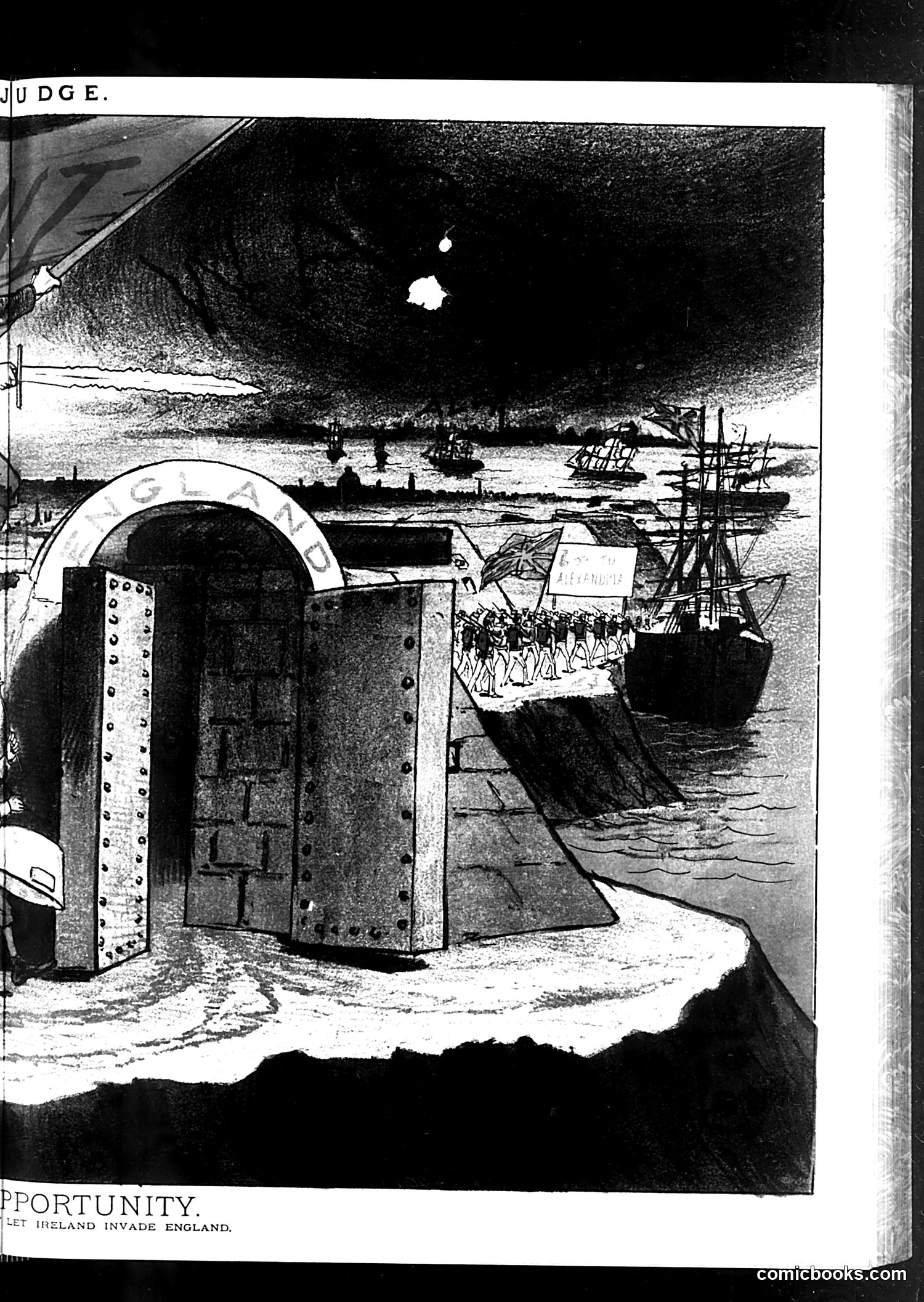
This cartoon is titled "Opportunity" with the subtitle "Let Ireland Invade England." It depicts a large cannon labeled "GLAND" (likely "ENGLAND") positioned on what appears to be the English coast, aimed at Irish vessels visible in the water. The cannon appears to be an instrument or tool of invasion. The satire criticizes British-Irish relations, likely from a period of Irish independence agitation. The cartoon sarcastically suggests that if Ireland were to "invade England," the English would use their military superiority (represented by the cannon) against them. The joke appears to be that such an invasion would be futile—presenting the "opportunity" as actually a guarantee of Irish defeat due to England's dominant naval and military power. This reflects tensions around Irish sovereignty and colonial dynamics.
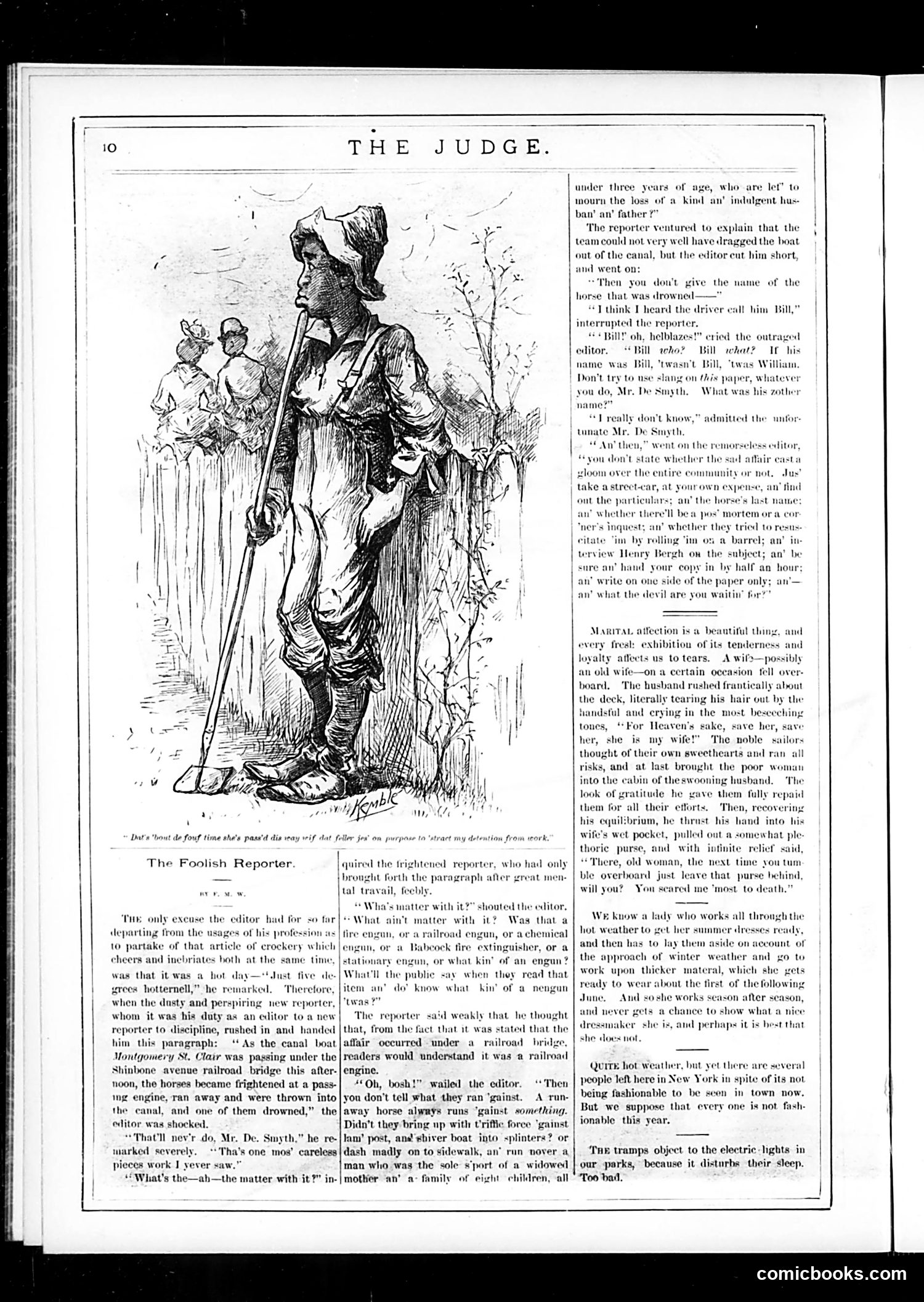
This page satirizes **editorial pedantry and overwrought journalism standards**. The main cartoon depicts an editor brutally critiquing a young reporter's simple news item about a canal-boat accident. The editor demands absurd elaborations: the horse's name, whether it hit a post or person, the widow's number of children—details irrelevant to the actual story. His nitpicking is absurd, yet presented as journalistic rigor. The accompanying anecdotes (the "Foolish Reporter" and "Marital Affection" stories) continue the theme of satirizing excessive concern with trivial details and overwrought sentimentality in newspaper writing. **The satire's target**: Editors who prioritize exhaustive (and often irrelevant) detail and melodramatic language over clear, straightforward reporting. The joke exposes how such editorial obsession produces worse journalism, not better. This reflects late 19th-century tensions between sensationalism and professional newspaper standards.
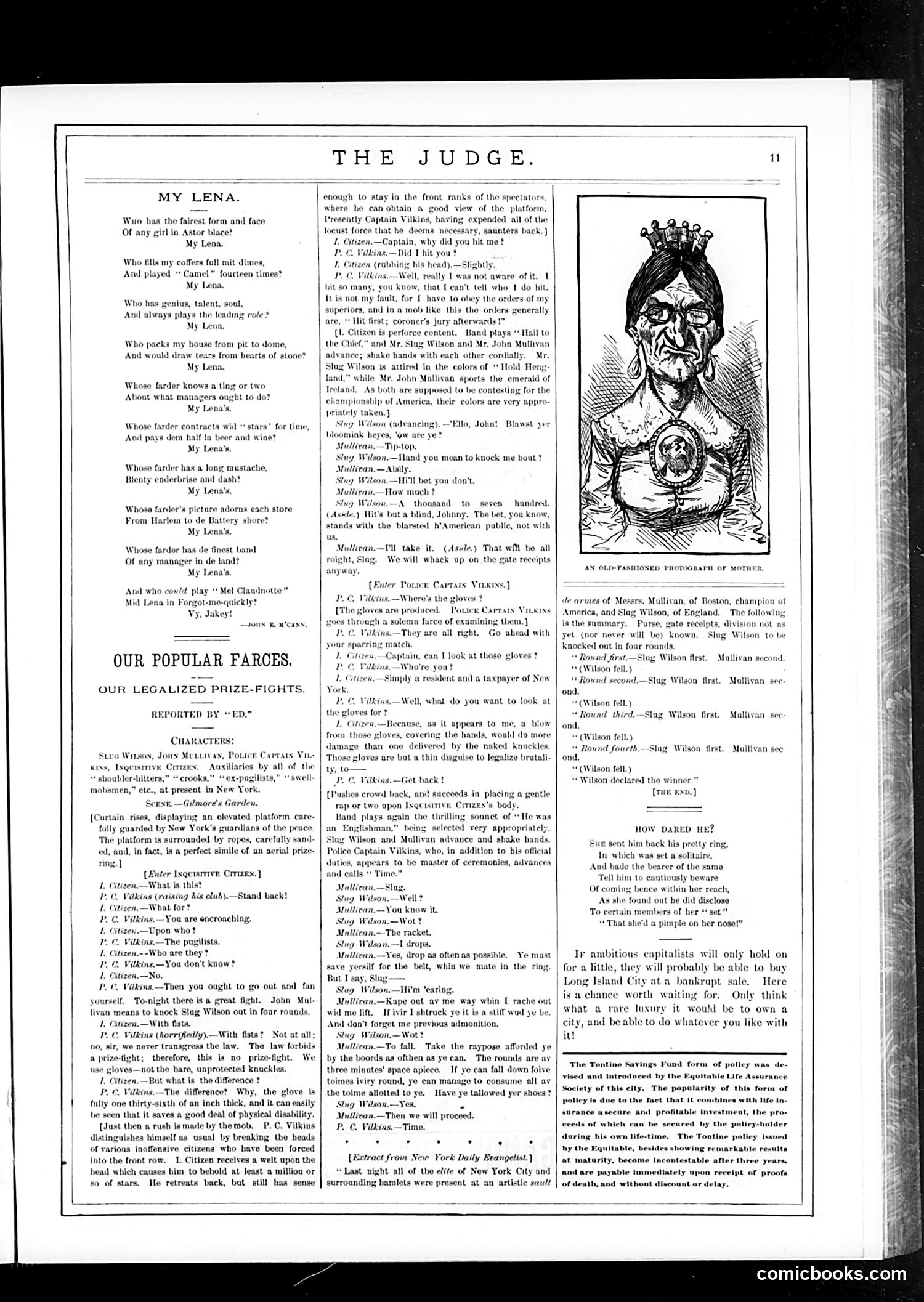
This is a satirical skit mocking New York's legal prize-fighting regulations. The joke centers on the absurd hypocrisy of allowing bare-knuckle boxing if fighters wear thin gloves—portrayed as a transparent loophole that changes nothing while appearing respectable. The characters include "P.C. Vilkins" (a Police Captain), "Slug Wilson" and "John Mullivan" (fighters representing England and Ireland), and an innocent "I. Citizen" (representing the bewildered public). The satire targets how authorities claimed gloves prevented injury, when in fact they provided minimal protection. The physical comedy—Vilkins accidentally striking the citizen while controlling the "mob"—underscores the violence inherent in these supposedly "legalized" events. The broader point: New York's regulatory framework for prize-fighting was mere theatrical window-dressing that legitimized brutality while enriching promoters (who "whack up on the gate receipts"). Judge is criticizing both the fights themselves and the government's complicit pretense of regulation.
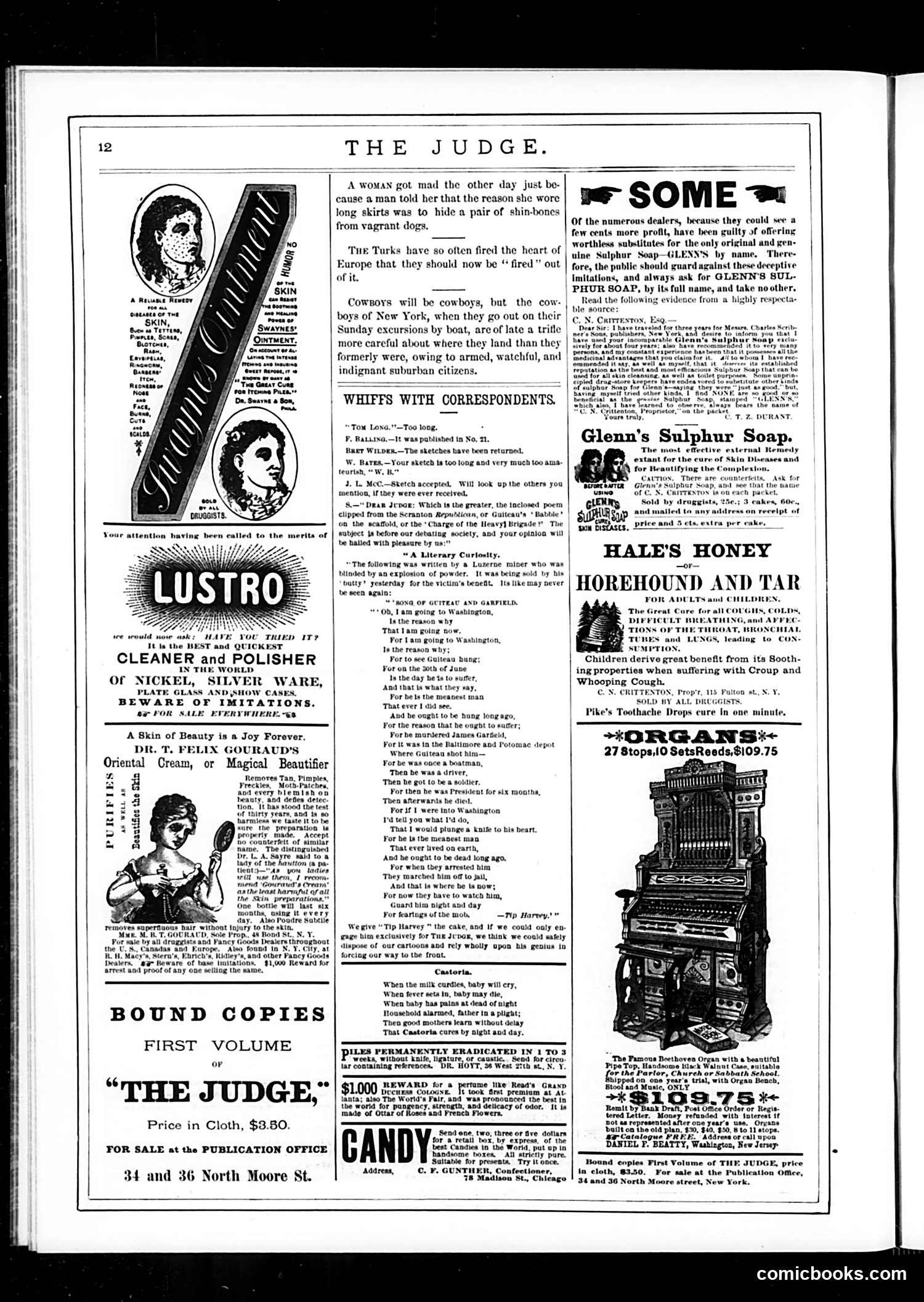
This page is primarily **advertisements and filler content** rather than political cartoons. The main elements are: **Advertisements:** - Lustro (nickel/silver polish) with product imagery - Dr. Gouraud's Oriental Cream (skin bleaching product) - Glenn's Sulphur Soap - Hale's Honey and Horehound Tar (cough remedy) - Organs for sale - Bound copies of Judge's first volume **Editorial Content:** A brief humorous section includes short quips (the "Whiffs with Correspondents" column rejecting submissions) and a remarkable piece: a poem by "Tip Harvey," a blinded Luzerne coal miner, about President Garfield's assassination by Charles Guiteau in 1881. The editors praise Harvey's rustic verse ironically, awarding him "the cake" for entertainment value. **Historical Context:** The Garfield assassination was a major 1881 event; this appears to be from that year's aftermath, when public interest in Guiteau's trial and execution remained high.
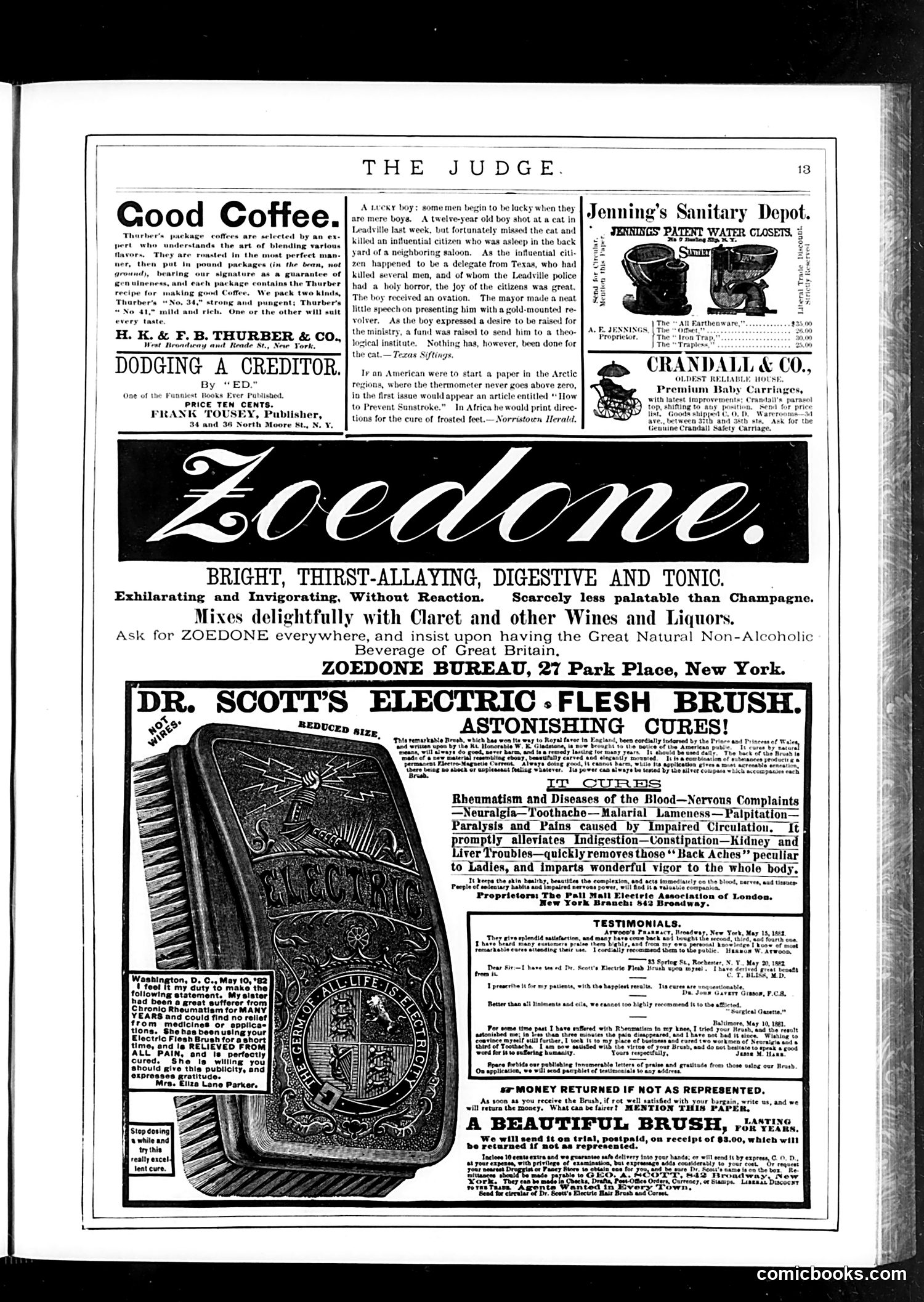
This page is primarily **advertising**, not political satire. It contains several patent medicine and product advertisements typical of late 19th-century publications. The notable content includes: **"Good Coffee"** and **"Dodging a Creditor"** appear to be brief humorous items, with the latter a short story about evading debt. **The main advertisements** promote dubious medicinal products: - **Zoedone**: A supposed digestive tonic marketed as non-alcoholic - **Dr. Scott's Electric Flesh Brush**: A quack device claiming to cure rheumatism, neuralgia, paralysis, and numerous other ailments through electrical stimulation—a common fraud of the era - **Sanitary fixtures and baby carriages** **Historical context**: These advertisements reflect the prevalence of snake-oil medicines and pseudoscientific devices in the Gilded Age, when the FDA didn't exist and unregulated medical claims flourished in magazines. Judge's readers would have seen such ads as normal commercial content, though many were fraudulent by modern standards. The page demonstrates how publications financed themselves through advertising rather than subscription alone.
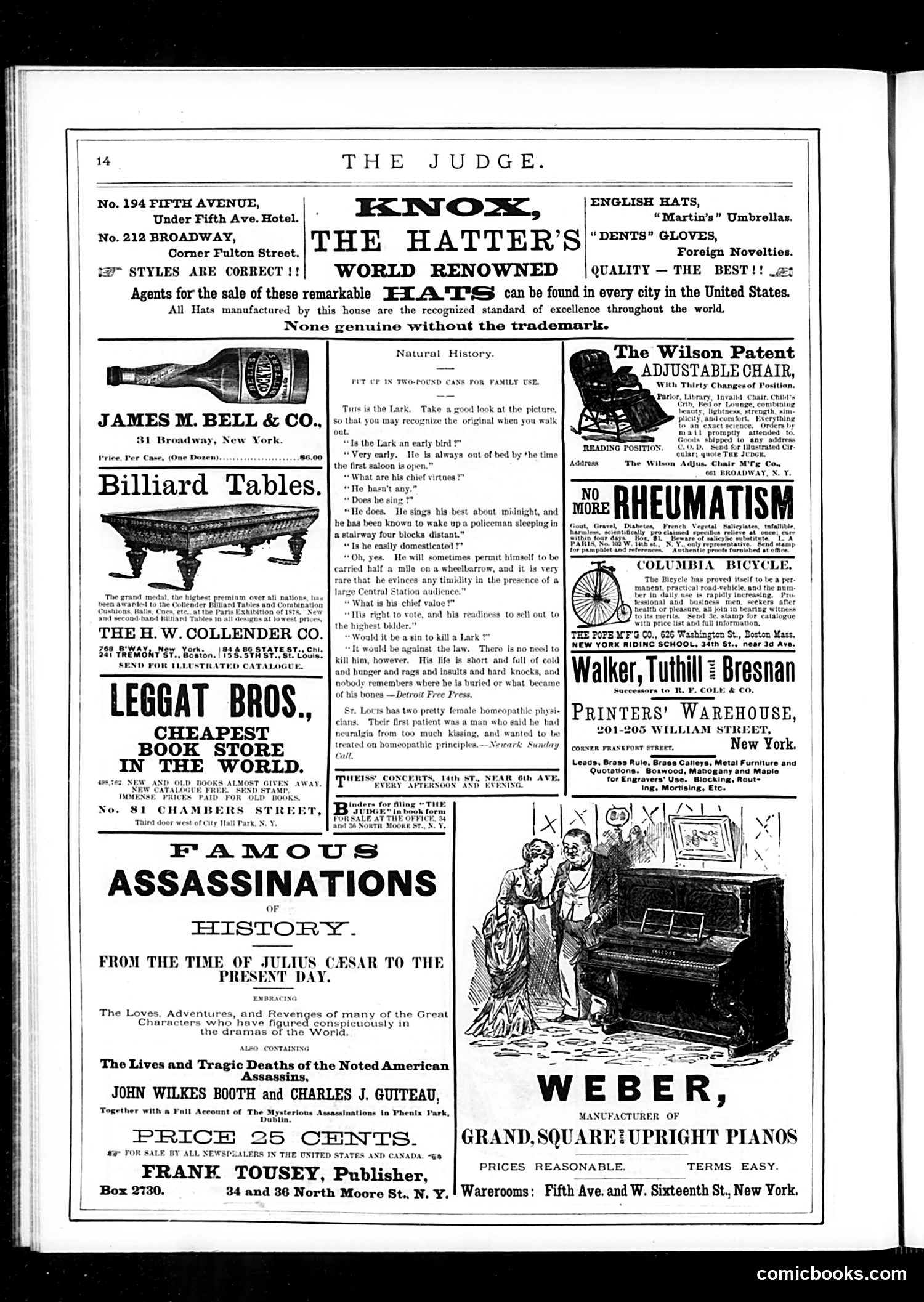
This is primarily an **advertising page** with minimal editorial content. The page showcases various commercial products typical of late 19th-century America: Knox hats, billiard tables, the Wilson Patent adjustable chair, Columbia bicycles, Weber pianos, and printing services. The only substantive content is a brief "Natural History" section featuring dialogue about a lark (bird). The exchange appears mildly humorous, playing on the bird's early-rising habits and tendency to wake sleeping policemen with its midnight singing—likely mild, gentle satire rather than sharp political commentary. Notable is the prominent advertisement for a book titled **"Famous Assassinations of History,"** which includes sections on American assassins John Wilkes Booth and Charles J. Guiteau. This reflects post-Civil War and Gilded Age American interest in violent historical events, though it's presented as straightforward commercial publishing rather than editorial commentary. The page demonstrates Judge magazine functioned substantially as a vehicle for commercial advertising alongside satirical content.
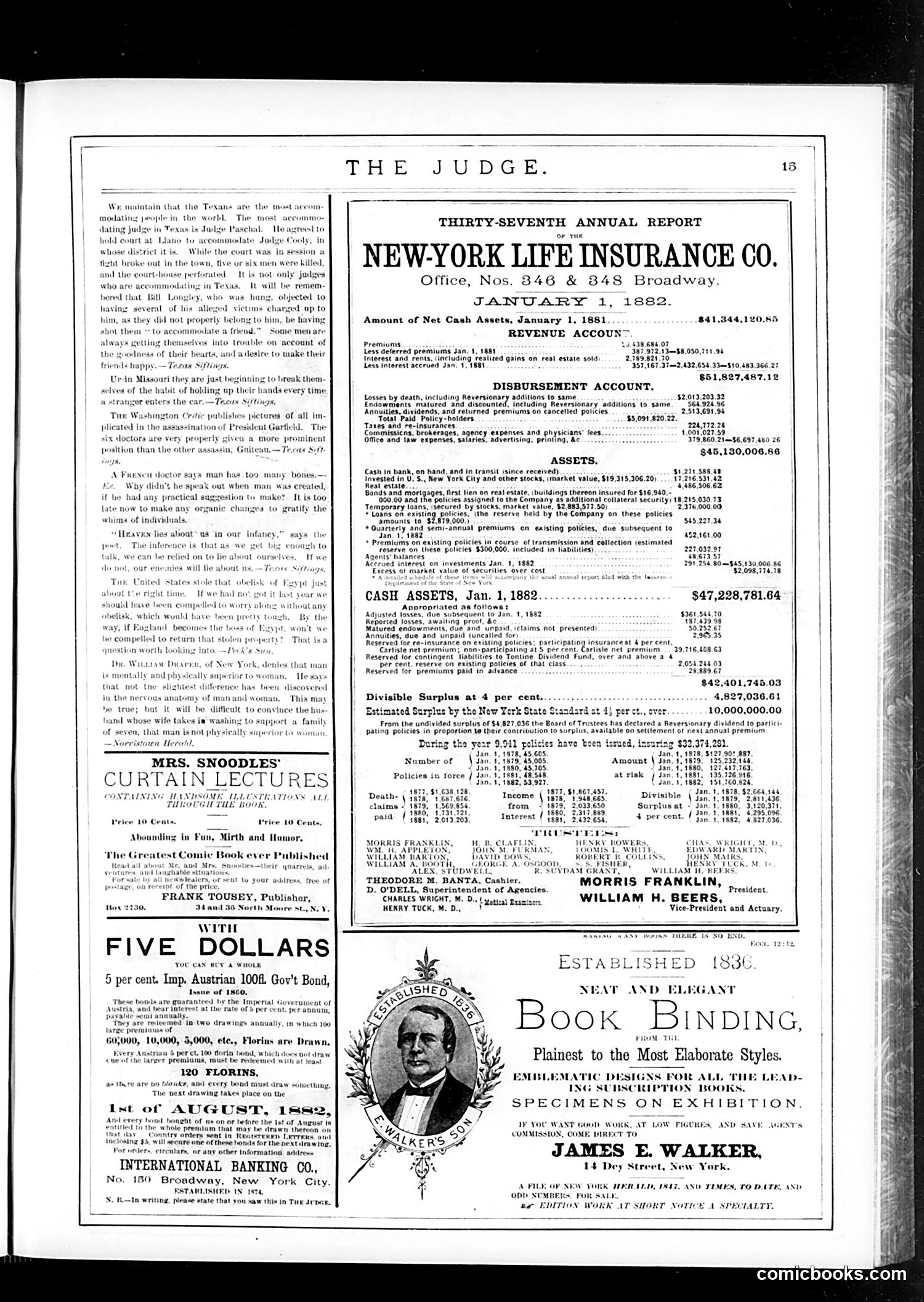
This page is primarily **advertising and financial reporting**, not satirical content. The bulk of the page consists of the New-York Life Insurance Company's thirty-seventh annual report (dated January 1, 1882), detailing assets, revenue, disbursements, and cash positions in dense financial tables. The small satirical section at the top contains brief Texas-themed jokes referencing **Bill Longley**, a notorious outlaw executed by hanging. The joke plays on the idea that Texans are "accommodating"—Longley allegedly objected to being hanged for murders he didn't commit, wanting to be hanged only for crimes he *actually* committed. The satire mocks both Texas justice and the notion of honor among criminals. The remainder consists of advertisements for books, bonds, and banking services typical of period Judge magazine pages.
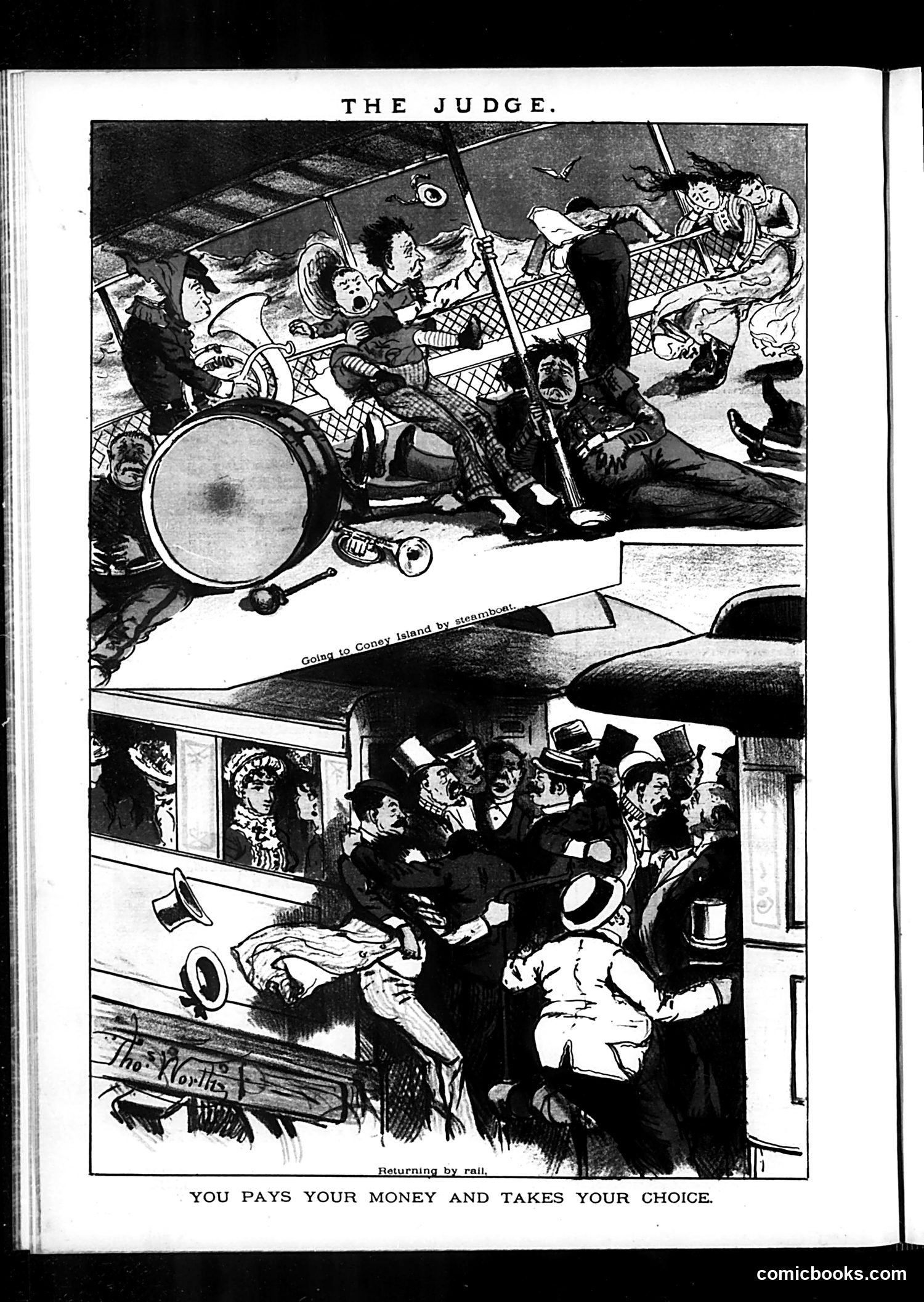
The OCR text is corrupted and unreadable, so I must work from the image alone. This two-panel satirical cartoon titled "YOU PAYS YOUR MONEY AND TAKES YOUR CHOICE" contrasts two transportation modes: the top panel shows a chaotic steamboat to Coney Island packed with rowdy working-class passengers, musicians, and general disorder. The bottom panel depicts a more orderly rail return journey with formally-dressed gentlemen in top hats. The satire appears to critique class distinctions and transportation experiences in the Gilded Age. The "choice" offered—steamboat or rail—suggests these options produce vastly different passenger experiences and social conditions, mocking either the chaos of popular entertainment venues like Coney Island or the stark class segregation in transportation. The cartoon likely satirizes American consumer culture and social stratification of the era.