
Judge, 1882-07-29 · page 4 of 16
Judge — July 29, 1882 — page 4: what you’re looking at
What you’re looking at
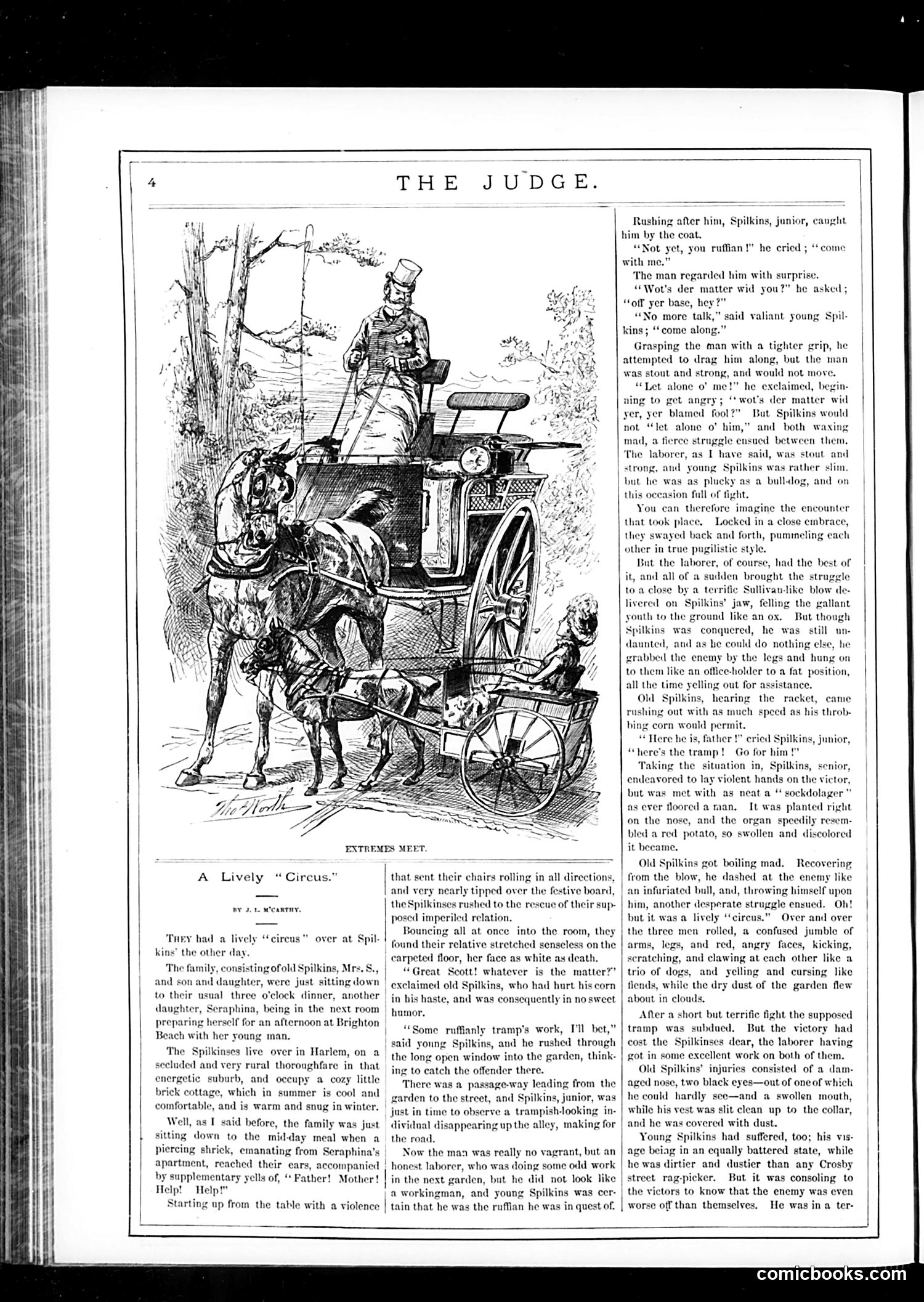
This satirical story illustrates class tensions through physical comedy. Young Spilkins, a middle-class Harlem resident, attacks an honest laborer he mistakes for a vagrant who assaulted his sister. The "extremes" are the classes: the refined Spilkins family versus the working-class laborer. The humor derives from role reversal—the supposed criminal is innocent, while the "respectable" youth commits assault. The laborer, described as "stout and strong," easily defeats the "plucky but slim" young Spilkins in their street brawl. The detailed fighting description parodies masculine Victorian heroics while exposing the vulnerability of middle-class pretension. The satire critiques both class prejudice (assuming a working man is a criminal) and the irony that genteel respectability masks violent behavior. By having the laborer win convincingly, Judge mocks upper-class assumptions of superiority.
📄 Transcribed text from this page (OCR, searchable)
Machine-transcribed from the original scan — historical spelling and the odd misread are preserved.
EXTREMES MEET. A Lively “Circus.” ny 3.1. weantay. They had a lively “circus " kins’ the other ¢ The fam onsisting ofold Spilkins, Mrs. and son and daughter, were just sitting down to their usual three o'clock dinner, another daughter, Seraphina, being in the next room preparing herself for an afternoon at Brighton Beach with her young man. The Spilkinses live over in Harlem, on a cluded and very rural thoroughfare in that ergetic suburb, and occupy a cozy little brick cottage, which in summer is cool and comfortable, and is warm and snug in winter. over at Spil- I, as I said before, the family was just sitting down to the mid-day meal when a piercing shrick, cmanating from Seraphina’s apartment, reached their ears, accompanied by supplementary yells of, “Father! Mother! Help! Help!” Starting up from the table with a violence | that sent their chairs rolling in all directions | and ve the Spilkins posed imperiled relation. Bouncing all at once into the room, they found their relative stretched senseless on the es rushed to the rescue of their sup- carpeted floor, her face as white as death. “Great Scott! whatever is the matter? exclaimed old Spilkins, who had hurt his corn | in his haste, and was consequently in no sweet humor. “Some ruffianly tramp's work, I'll bet,” said young Spilkins, and he rushed through the long open window into the garden, think- ing to catch the offender there. There was a passage-way leading from the garden to the street, and Spilkins, junior, was t in time to observe a trampish-looking in- idual disappearing up the alley, making for e road. Now the man was really no vagrant, but an | honest laborer, who was doing some odd work in the next garden, but he not look like a workingman, and young Spilkins was cer- | tain that he was the rufflan he was in quest of. nearly tipped over the festive board, | Rushing afer him, Spilkins, junior, caught him by the coat. “Not yet, you ruffian!” he cried ; ‘come with me.” ‘The man regarded him with surprise. “Wot's der matter wid you?” he asked; “off yer base, hey?” “No more talk,” said va kins ; “come along.” jiant young Spil- Grasping the man with a tighter grip, he attempted to drag him along, but the man was stout and strong, and would not move. “Let alone o' me!” he exclaimed, begin- ning to get angry; ‘*wot's der matter wid yer, yer blamed fool?” But Spilkins would not “let alone o him,” and both waxing mad, a tierce struggle ensued between them, ‘The laborer, as I have said, stout and strong, and young Spilkins was rather slim, | but he was as plucky as a bull-d | this occasion full of fight. You can therefore imagine the encounter that took pl: Locked in a close emb they swayed back and forth, pumimeling each other in true pugilistic style. But the laborer, of course, had the best of it, and all of a sudden brought the st le to a close by a terrific Sullivaulike blow de- livered on Spilkins’ jaw, felling the gallant youth to the ground like an ox. But though Spilkins was conquered, he was still un- daunted, and as he could do nothing else, he grabbed the enemy by the legs and hung on to them like an office-holder to a fat position, all the time yelling out for assistance. Old Spilkins, hearing the racket, came rushing out with as much speed as his throb- hing corn would permit. “Here he is, father !" eried Spilkins, junior, “here's the tramp! Go for him !" Taking the situation in, Spilkins, senior, endeavored to lay violent hands on the victor, but was met with as neat a “ sockdolager ” as ever floored a man, It was planted right on the nose, and the organ speedily re bled a red potato, so swollen and discolored it became, Old Spilkins got boiling mad. Recovering | from the blow, he dashed at the enemy like an infuriated bull, and, throwing himself upon him, another desperate struggle ensued. Oh! | but it was a lively ‘circus Over and over the three men rolled, a confused jumble of ‘ms, legs, and red, angry faces, kicking, scratching, and clawing at each other like a trio of dogs, and yelling and cursing like fiends, while the dry dust of the garden flew about in clouds, After a short but terrific fight the supposed tramp was subdued. But the victory had cost the Spilkinses dear, the laborer having got in some excellent work on both of them. Old Spilkins’ injuries consisted of a dam- aged nose, two black eyes—out of oneof which ould hardly see—and a swollen mouth, | while his vest was slit clean up to the collar, | and he was covered with dust. Young Spilkins had suffered, too; his vis- | age bei in an equally battered state, while | he was dirtier and dustier than any Crosby street rag-picker. But it was consoling to | the victors to know that the enemy was even | worse off than themselves. He was in a ter- sand on comicbooks.com